Things to Do in Ohio
20 Best Attractions, a 3-Day Itinerary, Where to Stay, and the Food You Cannot Miss
Quick Info
Best for: Roller coasters, rock music history, waterfalls and small-town America
Best time: May to June and September to October
How long: 3 days for the highlights; 5 days to do it properly
Budget: About $120–$180 per person per day, including a mid-range hotel
Don’t miss: Cedar Point at sunset, the Rock & Roll Hall of Fame, and sunrise at Old Man’s Cave
Ohio is the state that keeps surprising people. It holds the roller-coaster capital of the world on the Lake Erie shore, the museum that tells the whole story of rock and roll, the largest free aviation museum on the planet, and a gorge country of waterfalls and hemlock forest that looks nothing like the flat farmland on the postcards. This guide covers the 20 best things to do in Ohio, with honest 2026 prices, hours and closures checked against live sources, a 3-day itinerary, where to stay, getting around, the food you have to try, and the free things to do.
Ohio is a big state, and the honest truth is that you need a car to see it properly. Cleveland sits on Lake Erie in the north, Columbus anchors the middle, Cincinnati guards the Ohio River in the south, and the wildest scenery hides in the southeast around Hocking Hills. Base yourself in Cleveland for the lake and the museums, move south for the coasters and the islands, and finish in Columbus or the hills. What follows is the order that works: the icons first, then the quieter places that most guides skip.
Ohio at a glance
Ohio sits in the American Midwest, between Lake Erie and the Ohio River, and it packs an unusual range into one state: a Great Lakes shoreline with sandy beaches and island ferries, a national park, the world’s best collection of roller coasters, two of America’s great art museums (both free), and the largest Amish settlement in the country. The state capital is Columbus, the biggest city by population, while Cleveland and Cincinnati anchor the north and south. Drive times matter here — Cleveland to Cincinnati is about four hours — so plan your route before you book your hotels.
| Fact | Detail |
|---|---|
| Capital | Columbus |
| Largest city | Columbus |
| Population | About 11.8 million |
| Best for | Roller coasters, rock music, waterfalls, aviation history |
| Best time | May to June and September to October |
| How long | 3 days for the highlights; 5 days to do it properly |
| Budget | About $120–$180 per person per day, including a mid-range hotel |
| Getting around | Rental car is essential outside the cities |
| Don’t miss | Cedar Point, the Rock & Roll Hall of Fame, Hocking Hills |
The 20 best things to do in Ohio
These are the 20 places that earn their spot: the icons every first-timer should see, the museums and parks that beat the big-city versions, and the small towns and natural wonders that make Ohio more than a drive-through state. Prices and hours are for 2026, checked against the official sites and current visitor reports.
1. Cedar Point — Sandusky
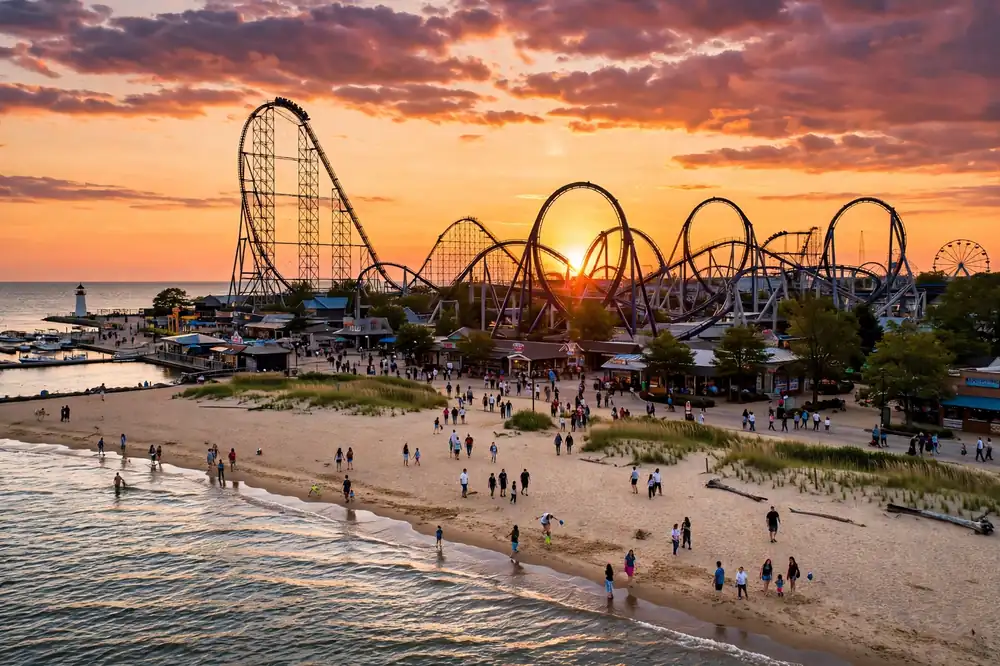
Cedar Point on Wikipedia calls itself the Roller Coaster Capital of the World, and for once the nickname is earned. The park sits on a narrow Lake Erie peninsula in Sandusky, with 18 coasters ranged along the water: Millennium Force, the 310-foot giga coaster that still defines the skyline; Steel Vengeance, the hybrid coaster that mixes wood and steel; Top Thrill 2, the 420-foot launch coaster; and Siren’s Curse, the tilt coaster that opened in 2025, lifting riders 160 feet before tipping the track to a 90-degree drop at about 58 mph. It drew the longest lines in the park through the 2026 season.
The 2026 season ran 9 May to 1 November, the park’s 157th season, and the ticket prices are the big change older guides miss. A day ticket bought online starts at about $52, but the gate price crossed $100 for the first time in the park’s history in 2026 — $105 at the window — so buy online before you go. A Gold Pass costs $99 and pays for itself in two visits. Parking is about $30. Cedar Point Shores, the water park, ran 23 May to 31 August 2026, and HalloWeekends, the autumn scare festival, ran 17 September to 1 November.
Go on a weekday if you can, arrive at the 10 am opening, and ride the big coasters before the lines build. The Fast Lane pass is worth the money on summer Saturdays. Stay for sunset: the coasters against the lake at dusk are the best free view in Ohio, and the beach beside the park is open to guests.
2. Rock & Roll Hall of Fame — Cleveland
The Rock & Roll Hall of Fame on Wikipedia is the glass pyramid on the Cleveland lakefront, and it is the single best music museum in America. Six floors of exhibits trace rock and roll from its roots to the present: handwritten lyrics, stage costumes, guitars owned by the greats, and the induction hall itself, where every inductee’s signature is displayed. The 2026 Inductees exhibit was the headline of the year, and the museum’s 50,000-square-foot expansion — new galleries and a performance venue — was debuting in fall 2026 while the museum stayed open throughout construction.
Admission in 2026 is $45 for adults, $40 for locals, students and military, and $30 for youth, with children under 5 free — older guides still print $35, so budget for the real price. The museum is open daily from 10 am to 5 pm, staying open until 9 pm on Thursdays (and until 8 pm Thursday to Saturday in July and August). It is closed on Thanksgiving and Christmas. Tickets are timed-entry, so book online, and the museum is cashless. Allow at least three hours; music fans will want four.
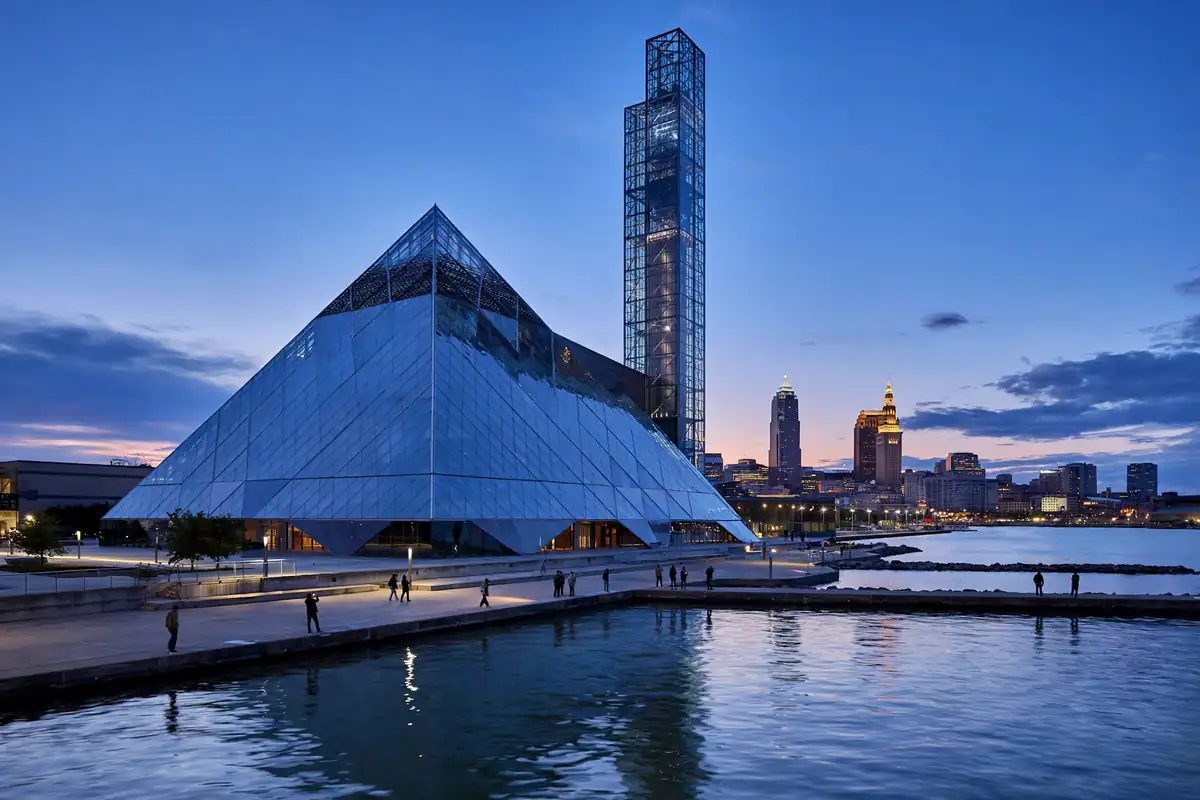
Pair it with the lakefront: the Great Lakes Science Center and the USS Cod submarine museum sit a short walk away, and the view across Lake Erie at sunset is one of the best in the Midwest. The museum’s gift shop is genuinely good — vinyl, books and posters you will not find elsewhere.
3. National Museum of the US Air Force — Dayton
The National Museum of the United States Air Force on Wikipedia is the largest military aviation museum in the world, and it is completely free — admission and parking both cost nothing. The museum sits at Wright-Patterson Air Force Base in Dayton, the city where the Wright brothers built the first airplane, and it holds more than 350 aircraft across four hangars and 19 indoor acres, from early Wright flyers to stealth jets and space capsules.
The presidential gallery is the highlight: you can walk through SAM 26000, the Air Force One that carried President Kennedy to Dallas in 1963, and see the aircraft that carried other presidents. The fourth hangar holds the experimental and space aircraft, including the XB-70 Valkyrie. The museum is open daily from 9 am to 5 pm, closed on Thanksgiving, Christmas Day and New Year’s Day. Theatre shows and flight simulators cost extra. Expect security screening at the entrance, but no military ID is needed to visit.
Plan for at least half a day — the collection is enormous, and rushing it is the most common mistake. The museum marked its 103rd anniversary in May 2026, and the exhibits are refreshed regularly, so even returning visitors find something new.
4. Hocking Hills State Park — Logan
Hocking Hills State Park on Wikipedia is the prettiest place in Ohio, a pocket of sandstone gorges, waterfalls and hemlock forest in the southeast of the state that feels a world away from the farmland around it. The star is Old Man’s Cave, a gorge trail of about a mile that winds past the Upper Falls, the Devil’s Bathtub whirlpool and towering rock walls. Ash Cave is the largest recess cave in Ohio — 700 feet across and 90 feet tall — reached by a quarter-mile paved gorge trail that is wheelchair accessible. Cedar Falls, a 0.4-mile trail from the parking area, rounds out the classic trio.
The park is free, open from half an hour before sunrise to half an hour after sunset, and no reservations are needed for day hiking. Trails are one-way in the busy sections, which keeps the gorges moving. Swimming and wading are not allowed anywhere in the park. Two warnings for 2026 visitors: some Cedar Falls Trail bridges were temporarily inaccessible in the autumn of 2026, the Old Man’s Cave to Whispering Cave loop was partially inaccessible, and the Ash Cave Fire Tower was closed because of bees — check the park’s current alerts before you go, and have a backup trail in mind.
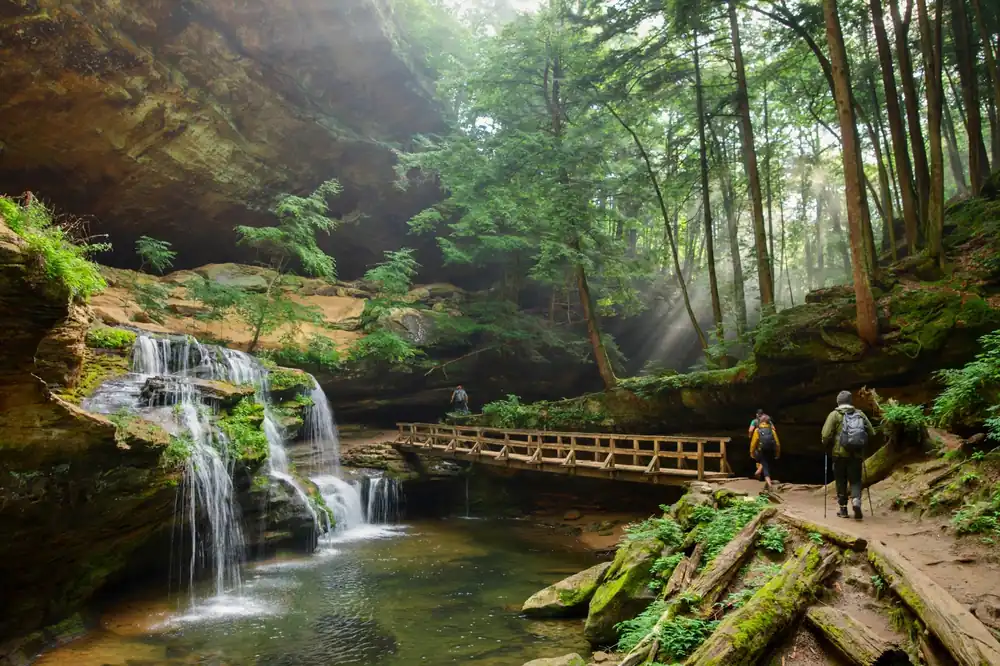
Stay in a cabin in Logan if you can — the park’s cabins and campsites book through ReserveOhio up to six months ahead, and weekends sell out early. Come at sunrise for Old Man’s Cave: the light in the gorge is at its best, and you will have the trail almost to yourself. If you have a second day in the area, add Conkle’s Hollow State Nature Preserve, a deep gorge with cliffs rising nearly 200 feet above the valley floor, and Rock House, the only true cave in the region, tunnelled into the face of a 150-foot cliff with window-like openings.
5. Cuyahoga Valley National Park — Between Cleveland and Akron
Cuyahoga Valley National Park on Wikipedia is Ohio’s only national park, and it is free to enter. The park follows the Cuyahoga River between Cleveland and Akron, and its centrepiece is Brandywine Falls, a 60-foot waterfall reached by a boardwalk that is accessible for most visitors. The Towpath Trail runs the length of the park along the old Ohio and Erie Canal, flat and easy for walking and cycling.
The Cuyahoga Valley Scenic Railroad is the park’s signature experience: the National Park Scenic round trip starts at $25, and the Explorer service lets hikers, bikers and kayakers ride one way — $10 for bikers and hikers, $15 for kayakers, $20 for tandems, with an Explorer Pass at $60. In 2026 the Scenic rides ran Friday to Sunday until Memorial Day, then Wednesday to Sunday, with the Explorer service starting at Memorial Day. Book ahead in autumn, when the fall colours fill the trains.
6. Put-in-Bay and the Lake Erie Islands — Lake Erie
Put-in-Bay on Wikipedia is the liveliest of the Lake Erie islands, a small island town on South Bass Island that feels like a coastal holiday in the middle of the Midwest. The island’s landmark is Perry’s Victory and International Peace Memorial, the 352-foot column that marks the American naval victory in the War of 1812 — but check before you go, because the monument’s observation deck and elevator are closed for a $20 million National Park Service restoration through the 2027 season, reopening in spring 2028. The grounds, the visitor centre and the island itself are still very much worth the trip.
The Miller Ferry from Catawba is the way most visitors arrive: adults pay $9 one way or $18 round trip, children aged 6 to 11 pay $1.50 one way, under-6s ride free, a bike costs $2.50 and a car $23 one way. The crossing takes 18 minutes, boats run about every 30 minutes in summer, parking at Catawba is free, and the 2026 season ran roughly 19 March to 25 November. The Jet Express from Port Clinton is faster and costs $41.99 round trip ($50 from Sandusky), ending 25 October 2026. Once on the island, rent a golf cart for about $60 to $75 a day — it is the local way to get around.
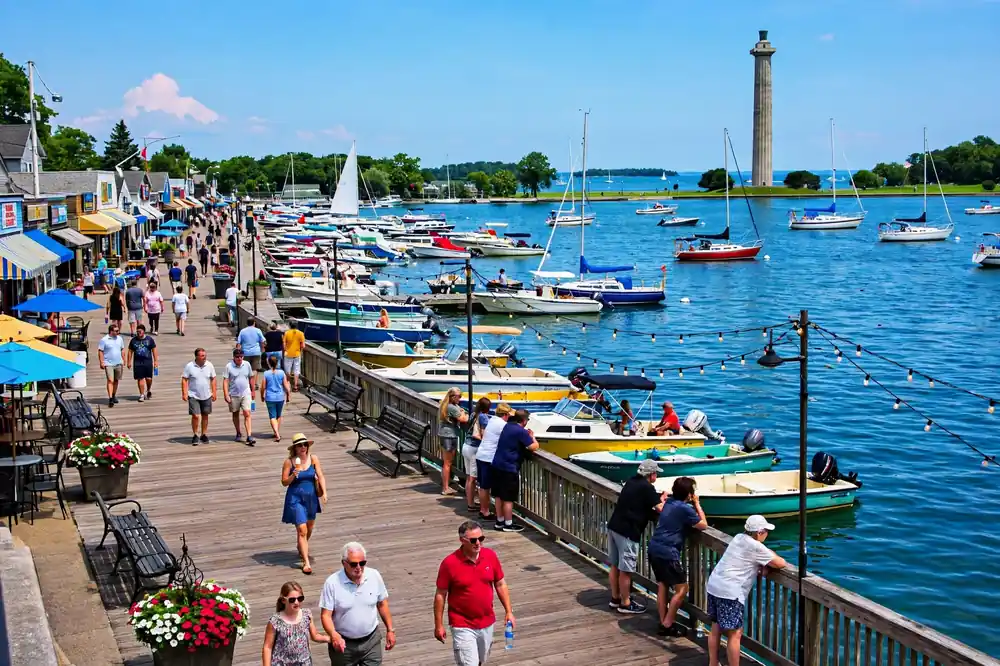
Spend the day swimming at the island’s beaches, touring the Lake Erie Islands Nature and Wildlife Center, and eating fried perch on the waterfront. Kelleys Island, the quieter neighbour, is the better choice if you want hiking and a slower pace.
7. Pro Football Hall of Fame — Canton
The Pro Football Hall of Fame on Wikipedia sits in Canton, the city where professional football was born, and it is a pilgrimage site for fans of the game. The museum tells the story of the NFL through the Hall of Fame Gallery, where every inductee’s bronze bust is displayed, the Super Bowl theatre, and hands-on exhibits that let you test your throwing arm and your knowledge of the game. Enshrinement Week in early August is the biggest event of the year, when the new class is inducted in front of a national audience.
Admission in 2026 is $46.95 for general admission, $38.95 for children aged 6 to 12, free for under-6s, and $41.95 for military and first responders. Senior Day on Tuesdays lets visitors aged 65 and over in for $23.50 at the walk-up window. Fall and winter hours (7 September to 31 December 2026) are 9 am to 5 pm daily, staying open until 8 pm on Thursdays, and the museum is closed on Thanksgiving, 26 November 2026.
8. Kings Island — Mason
Kings Island on Wikipedia is Ohio’s other great theme park, a 364-acre park in Mason, north of Cincinnati, that trades Cedar Point’s lake views for a deeper coaster collection. The Beast is the headline — the world’s longest wooden roller coaster, still thrilling after nearly fifty years — joined by Diamondback, Banshee and Orion, one of the tallest and fastest coasters in the country. Soak City, the water park, is included when it is open.
A day ticket bought online starts at about $49, against a gate reference price of $119, so the online discount is worth real money. Parking is $35. Halloween Haunt ran 25 September to 31 October 2026, and in 2026 the haunted mazes became a separate Haunted Attractions Pass from $15 a night rather than being included in admission — check before you buy. WinterFest, the Christmas event, ran 27 November to 31 December 2026 with tickets from $39, and guests aged 65 and over entered free through 31 December 2026.
9. Columbus Zoo and Aquarium — Powell
The Columbus Zoo and Aquarium on Wikipedia is one of the best zoos in America, and it is the one Jack Hanna made famous. The zoo covers 580 acres in Powell, just northwest of Columbus, with more than 10,000 animals from over 800 species, arranged in regions from the Congo to the Australian outback. The manatee coast, the polar bear habitat and the Heart of Africa savanna are the highlights, and the Zoombezi Bay water park sits next door in summer.
Pricing changed in 2026 and older guides get it wrong: the zoo now uses dynamic pricing. A ticket bought online starts at about $35 for adults aged 10 to 59, about $28 for children aged 3 to 9 and about $33 for seniors, with under-3s free; at the gate the adult price is about $41. Franklin County residents pay about $10 less. Parking is $12, and tickets are online only. Wildlights, the Christmas light display, ran 20 November 2026 to 3 January 2027 and was included with admission. The Zoo Bus runs from downtown Columbus for $2 each way in the summer months.
10. Amish Country — Holmes County
Amish Country on Wikipedia is the name for Holmes County and its neighbours in east-central Ohio, home to the largest Amish settlement in the world. This is the quietest, most old-fashioned corner of the state: horse-drawn buggies on the roads, working farms, quilt shops, cheese houses and furniture workshops. Driving the back roads between Millersburg, Berlin and Sugarcreek is the attraction — there is no ticket and no gate, just a landscape that moves at a different speed.
Stop at Lehman’s in Kidron for old-fashioned hardware and housewares, at Heini’s Cheese Chalet for samples of the region’s Swiss and Amish cheeses, and at one of the farm stands for fry pies and fresh bread. Most Amish-run businesses are closed on Sundays, so plan a weekday or Saturday visit. Drive slowly and give buggies room: the horses are working animals, and the roads are narrow.
11. Cincinnati — The Queen City
Cincinnati on Wikipedia is Ohio’s southern city, a river town with a skyline, a zoo and a food culture all its own. It gets one slot in this guide because our full Cincinnati guide covers it in depth — read our Cincinnati guide for the complete 20 attractions, including the Cincinnati Zoo, which marked its 150th anniversary in 2025 as the second-oldest zoo in the United States, and Findlay Market, the 1852 public market in Over-the-Rhine that is one of the best in the country.
If you have half a day, walk the riverfront at Smale Riverfront Park, ride the streetcar through Over-the-Rhine, and eat a three-way at Skyline Chili (more on that in the food section below). The city’s German heritage, its hilltop views and its ballpark on the Ohio River make it the most European-feeling city in the state.
12. Cleveland Museum of Art — Cleveland
The Cleveland Museum of Art on Wikipedia is one of the great art museums in America — and general admission is free, always. The collection holds more than 66,500 artworks spanning 6,000 years, from ancient Egyptian sculpture to contemporary photography, housed in a marble building in University Circle that was expanded with a glass atrium in 2013. The Armor Court, with its rows of medieval suits of armour, is the room everyone photographs.
The museum is open Tuesday, Thursday, Saturday and Sunday from 10 am to 5 pm, and Wednesday and Friday from 10 am to 9 pm; it is closed on Mondays. Special exhibitions sometimes carry a separate charge, but the permanent collection is free. ArtLens, the interactive gallery, lets you explore the collection on touchscreens and is a good starting point if you only have an hour.
13. The Wilds — Cumberland
The Wilds on Wikipedia is the most unexpected attraction in Ohio: a 10,000-acre safari park in the reclaimed strip-mine country of Muskingum County, run by the Columbus Zoo. Giraffes, rhinos, cheetahs and antelope roam open pastureland, and the Open-Air Safari takes you through it in an open vehicle with a guide who knows every animal by name. It feels closer to Africa than to Appalachia.
The Open-Air Safari costs $35 to $49 a person depending on the day and time — $35 for Tuesday to Thursday afternoon tours, $45 for weekday mornings and $49 from Friday to Monday. The season runs 1 May to 31 October, and you should book at least two hours ahead. Parking is $9 a vehicle. The Wildside Safari, a smaller-group tour, costs $139 to $164. Winter tours run from November to April for visitors who do not mind the cold.
14. Serpent Mound — Peebles
Serpent Mound on Wikipedia is one of the strangest and most beautiful ancient places in North America: a 1,348-foot effigy mound in the shape of a serpent, built about 1,000 years ago on a ridge above Ohio Brush Creek. Nobody knows exactly who built it or why — the leading theory is that it marks the seasons and the stars — and standing on the ridge at sunset, with the serpent uncoiling below you, is one of the most memorable moments in the state.
Admission is free and parking costs $8 ($4 for veterans). The site is open Tuesday to Saturday from 10 am to 5 pm and Sunday from noon to 5 pm, closed on Mondays, and the gate closes at 4 pm. The museum is seasonal. One honest warning: the observation tower that once gave the best view of the serpent is closed while it is replaced, so the full shape is best appreciated from the ground trail and the viewing platform.
15. Franklin Park Conservatory and Botanical Gardens — Columbus
Franklin Park Conservatory on Wikipedia is Columbus’s glasshouse garden, a Victorian-era palm house surrounded by themed glasshouses, outdoor gardens and a collection of Dale Chihuly glass sculptures. The Blooms and Butterflies exhibition, which ran 21 February to 5 July 2026, fills the Pacific Island Water Garden with hundreds of free-flying butterflies, and the conservatory’s plant collection is one of the best in the Midwest.
Admission is $25.20 for adults, $21 for seniors and $17.33 for children aged 3 to 12, with under-2s free; the prices include a $1.20 culture fee. The conservatory is open daily from 10 am to 5 pm, closed on Thanksgiving, Christmas Eve and Christmas Day. Community Day on the first Sunday of the month is free for Franklin County and Columbus residents. One important note for 2026 and 2027 visitors: the Palm House, the Showhouse, the terraces and the South Mallway are closed for renovation and reopen in fall 2027 — the rest of the glasshouses and gardens are open as normal.
16. Marblehead Lighthouse — Marblehead
Marblehead Lighthouse on Wikipedia has stood on the Lake Erie shore since 1821, the oldest continuously operating lighthouse on the Great Lakes. The 65-foot tower of native limestone guards the entrance to Sandusky Bay, and the state park around it is one of the most photographed spots in Ohio — the lighthouse, the rocky shore and the lake stretching to the horizon.
The grounds are free to visit, and tower tours run in the summer months. Come at sunrise or sunset, when the light on the limestone is at its best, and combine it with a drive along the Lake Erie shore to Port Clinton and the ferry towns. The lighthouse keepers’ house holds a small museum of the light’s history.
17. Ohio Statehouse — Columbus
The Ohio Statehouse on Wikipedia is the Greek Revival capitol in the heart of downtown Columbus, completed in 1861, and it is free to enter. The building’s limestone dome, its sweeping rotunda and its restored chambers are open to the public, and free guided tours explain the history of the state and the building. The grounds, with their monuments and the Civil War-era cannons, are a pleasant place to walk on a summer afternoon.
It sits at the edge of the Short North, Columbus’s arts and dining district, so pair the visit with a walk north along High Street: galleries, coffee shops and the North Market, the city’s public market hall. The Statehouse is the easiest free attraction in Columbus, and it anchors any first day in the capital.
18. West Side Market — Cleveland
West Side Market on Wikipedia is Cleveland’s great food hall, a 1912 market building with a 137-foot clock tower in the Ohio City neighbourhood. Inside, more than 100 stalls sell everything from pierogi and Polish sausages to fresh fish, Amish cheese, flowers and baked goods. It is free to wander, and grazing your way through the stalls is the cheapest good lunch in the city.
The market is open Monday, Wednesday, Friday and Saturday from 8 am to 5 pm and Sunday from 10 am to 4 pm, closed on Tuesdays and Thursdays. Parking is free for the first 90 minutes. Order a pierogi plate and a Cleveland polish boy — a kielbasa sausage with coleslaw, fries and barbecue sauce — and eat them on the steps outside, watching Ohio City go by.
19. Toledo Museum of Art — Toledo
The Toledo Museum of Art on Wikipedia is the surprise of northwest Ohio: a world-class art museum in a city most travellers pass through, with free admission. The collection is especially strong in glass — Toledo was once the glass capital of America — and the Glass Pavilion across the street holds one of the finest glass collections in the world, with live glassblowing demonstrations.
The museum’s classical building and its sculpture garden make a calm half-day after the noise of the theme parks. Special exhibitions sometimes carry a charge, but general admission is free. If you are driving between Cleveland and Chicago, Toledo is the natural stop on the way.
20. A Christmas Story House — Cleveland
A Christmas Story House on Wikipedia is the house from the 1983 film A Christmas Story, restored to look exactly as it did on screen — the leg lamp in the window, the bunny suit, the BB gun under the tree. The house sits in Cleveland’s Tremont neighbourhood, and the museum across the street holds props and costumes from the film, including the original costumes and the family car.
Admission is $20 plus tax and fees, free for under-5s. The house is open daily from 10 am to 5 pm, with tours every 30 minutes from 10:15 am, the last at 4:15 pm. It is closed on New Year’s Day, Easter, Memorial Day, 4 July, Labor Day, Thanksgiving and Christmas Day, and it closes for maintenance for the last two full weeks of February. Overnight stays in the house start at $545 a night. Book ahead in December, when the film’s fans arrive in force.
Ohio in 3 days — a ready-made itinerary
Three days is enough for the highlights if you move with purpose: one day on the lake, one day for the coasters and the islands, and one day in the hills and the capital. This route assumes you have a car and you start in Cleveland.
Day 1: Cleveland — rock music and the lake
Start at the Rock & Roll Hall of Fame when it opens at 10 am and give it three hours. Walk the lakefront afterwards, then cross to Ohio City for lunch at the West Side Market — a pierogi plate and a polish boy. Spend the afternoon at the Cleveland Museum of Art in University Circle, which is free and open until 5 pm (or 9 pm on Wednesdays and Fridays). End the day with sunset on the lakefront at Edgewater Park, then dinner in Ohio City or Tremont. If you have energy left, the A Christmas Story House is a short drive away and stays open until 5 pm.
Day 2: Sandusky and the Lake Erie islands
Drive the hour west to Cedar Point and be at the gates for the 10 am opening. Ride Millennium Force and Steel Vengeance first, before the lines build, then work through Siren’s Curse and Top Thrill 2. If you would rather have water than coasters, take the Miller Ferry from Catawba to Put-in-Bay instead: rent a golf cart, swim at the island beaches, eat fried perch on the waterfront, and walk the grounds of Perry’s Victory and International Peace Memorial. Either way, end the day in Sandusky with dinner on the waterfront, and if you are staying the night, the sunset from the Cedar Point beach is the one to remember.
Day 3: Hocking Hills and Columbus
Drive south early and be at Old Man’s Cave at sunrise, when the gorge is empty and the light is at its best. Hike the gorge loop, then drive to Ash Cave for the short paved trail before the crowds arrive. From Hocking Hills it is about an hour to Columbus: have lunch in the Short North, visit the Ohio Statehouse in the afternoon, and finish at Franklin Park Conservatory if you have time before it closes at 5 pm. Dinner in the Short North or the Arena District ends the trip. If you have a fourth day, spend it in Dayton at the National Museum of the US Air Force — it deserves a full day of its own.
Best time to visit Ohio
May to June and September to October are the best times to visit Ohio. Late spring brings warm days, green hills and the start of the theme-park season, and early autumn brings cooler air, fall colour in Hocking Hills and Cuyahoga Valley, and the HalloWeekends and harvest festivals. Summer is the busiest season: the coasters, the water parks and the Lake Erie islands are at their best, but the crowds and the hotel prices peak too. Winter is quiet and cheap, and the Christmas events at Kings Island and the Columbus Zoo are worth a trip on their own — but the ferries stop, the water parks close, and the hiking trails can be icy.
| Season | Months | Weather | What is good | What to watch |
|---|---|---|---|---|
| Spring | April to May | 50–70°F, changeable | Waterfalls at full flow, fewer crowds, zoo babies | Rain and muddy trails |
| Summer | June to August | 75–85°F, humid | Cedar Point, Lake Erie islands, festivals | Crowds, high hotel prices, storms |
| Autumn | September to October | 55–70°F, crisp | Fall colour, HalloWeekends, harvest festivals | Shorter days, some attractions close |
| Winter | November to March | 25–40°F, cold | Christmas lights, low prices, empty museums | Ferries stop, water parks closed, icy trails |
Where to stay in Ohio
Cleveland is the best base for the lake, the museums and the islands. Columbus is the best base for the centre of the state — the Statehouse, the zoo and the conservatory — and for reaching Hocking Hills. Sandusky is the practical base for Cedar Point, with hotels along the lake and near the park entrance. In Hocking Hills, book a cabin in Logan: the park’s own cabins and the private cabins around it sell out months ahead for autumn weekends. Cincinnati’s Over-the-Rhine and downtown are the best bases in the south.
| Area | Best for | Price per night |
|---|---|---|
| Downtown Cleveland | Rock Hall, museums, lakefront | $140–$220 |
| University Circle, Cleveland | Art museum, quieter stay | $120–$180 |
| Short North, Columbus | Dining, Statehouse, nightlife | $130–$200 |
| Arena District, Columbus | Family stay, walkable | $120–$180 |
| Sandusky | Cedar Point, Lake Erie shore | $110–$200 |
| Logan and Hocking Hills | Cabins, hiking, quiet | $120–$250 |
| Downtown Cincinnati | Riverfront, zoo, food | $130–$210 |
Getting around Ohio
A rental car is the only practical way to see Ohio properly. The state is built around the interstates — I-90 along the lake, I-71 from Cleveland to Columbus to Cincinnati, I-75 through Dayton and Toledo, and I-70 across the middle — and the best places are an hour or more from the nearest city. Cleveland has the RTA rail and bus system, Columbus has COTA buses, and Cincinnati has a streetcar in the downtown core, but none of them reaches the parks, the islands or Amish Country. The Miller Ferry and the Jet Express carry you to the Lake Erie islands, and rideshares work well inside the cities. Book the car early for summer weekends, and expect tolls on the Ohio Turnpike (I-80/I-90) across the north of the state.
| Transport | When to use it | Cost |
|---|---|---|
| Rental car | Everywhere outside the cities | About $45–$80 a day |
| Ohio Turnpike tolls | Crossing the north of the state | About $10–$20 end to end |
| Miller Ferry | To Put-in-Bay and the islands | $18 round trip per adult |
| Jet Express | Faster ferry to Put-in-Bay | $41.99 round trip from Port Clinton |
| Cleveland RTA | Inside Cleveland | About $2.50 a ride |
| Columbus COTA | Inside Columbus | About $2 a ride |
| Rideshare | Evenings in the cities | About $10–$25 a trip |
Ohio food you have to try
Ohio’s food is unpretentious and very good: a strange and wonderful chilli, some of the best fried fish in the Midwest, and a candy named after the state tree. Eat your way through the state and you will understand it better than any museum can teach you.
Cincinnati chili
Cincinnati chili on Wikipedia is not like any other chilli in America: a thin, spiced meat sauce — cinnamon, cocoa, allspice — served over spaghetti or on a hot dog, and always covered in a mountain of shredded cheddar. Order a three-way (spaghetti, chilli and cheese), a four-way (add onions or beans) or a coney (a hot dog with chilli, cheese, onions and mustard). Skyline Chili and Gold Star Chili are the two great chains, and every Cincinnatian has a loyalty. The argument over which is better has run for generations, and the only way to settle it is to try both.

Lake Erie perch and walleye
Lake Erie on Wikipedia gives Ohio its fish, and the fried perch basket is the dish of the lakeshore. The perch is sweet and delicate, fried crisp and served with fries and coleslaw at the waterfront shacks from Sandusky to Port Clinton to Put-in-Bay. Walleye, the lake’s prized game fish, appears on menus across the north of the state, usually fried or baked with lemon. In Cleveland, the polish boy — kielbasa, coleslaw, fries and barbecue sauce in a bun — is the street food to try, best eaten at the West Side Market.
Buckeyes and Amish country cooking
The buckeye is Ohio’s signature sweet: a ball of peanut butter fudge dipped in chocolate, leaving a small bare patch that looks like the eye of the buckeye nut, the state tree. You will find them in every bakery and candy shop in the state. In Amish Country, the food is simpler and just as good: fry pies, fresh bread, Amish cheese, bologna sandwiches and shoofly pie at the farm stands and family restaurants of Holmes County. Eat at one of the Amish-run restaurants in Berlin or Millersburg, and take a pie home for the road.
Free things to do in Ohio
Ohio is one of the most generous states in America for free attractions. The National Museum of the US Air Force is free, including parking. The Cleveland Museum of Art and the Toledo Museum of Art are both free. Hocking Hills State Park, Cuyahoga Valley National Park and the Hopewell Ceremonial Earthworks — Ohio’s first UNESCO World Heritage Site, inscribed in 2023 — are all free to visit. The Ohio Statehouse is free, the Marblehead Lighthouse grounds are free, driving through Amish Country costs nothing, and browsing the West Side Market is free. Add the lakefront parks, the Towpath Trail and the small-town main streets, and a careful traveller can fill days in Ohio without spending a dollar on admission.
Frequently asked questions
Is Ohio worth visiting?
Yes. Ohio holds the world’s best roller-coaster park, the best music museum in America, the largest free aviation museum on the planet, a national park, and some of the prettiest gorge country in the Midwest. Most visitors are surprised by how much there is to do, and the prices — especially the free museums and parks — make it one of the best-value states in the country.
How many days do you need in Ohio?
Three days covers the highlights: one day in Cleveland, one day at Cedar Point or the Lake Erie islands, and one day in Hocking Hills and Columbus. Five days lets you add Dayton’s Air Force museum, Cincinnati and Amish Country without rushing. A week is comfortable if you want to slow down, add the Lake Erie islands properly, and spend a day in the national park.
What is Ohio famous for?
Ohio is famous for Cedar Point and its roller coasters, the Rock & Roll Hall of Fame, the Pro Football Hall of Fame, the Wright brothers and the National Museum of the US Air Force, the Buckeye State nickname and Ohio State University, Cincinnati chili, and the largest Amish settlement in America. Eight US presidents were born in Ohio, more than any other state except Virginia.
What is the best time to visit Ohio?
May to June and September to October are the best times to visit Ohio. The weather is mild, the crowds are smaller than in summer, and the parks and trails are at their best. Summer is best for the Lake Erie islands and the water parks, and autumn is best for fall colour in Hocking Hills and Cuyahoga Valley National Park.
Is Ohio expensive to visit?
No — Ohio is one of the cheaper states to visit in America. Mid-range hotels run about $120 to $200 a night, a day ticket at Cedar Point starts at about $52 online, and the biggest attractions — the Air Force museum, both great art museums, the national park and Hocking Hills — are free. Budget about $120 to $180 per person per day, including a mid-range hotel, and less if you cook or picnic.
Is Ohio safe for tourists?
Yes, Ohio is generally safe for tourists. The usual city precautions apply in downtown Cleveland, Columbus and Cincinnati at night — stay in well-lit areas, keep valuables out of sight, and use rideshares late at night. The parks and small towns are very safe. The main risks are natural ones: check the weather before hiking in Hocking Hills, never swim in the park’s gorges, and watch for sudden storms on Lake Erie.
Further reading
For the history and background behind the places in this guide, start with Ohio on Wikipedia, Cleveland on Wikipedia, Columbus, Ohio on Wikipedia, Cincinnati on Wikipedia, Dayton, Ohio on Wikipedia and Sandusky, Ohio on Wikipedia. For the attractions themselves: Cedar Point on Wikipedia, the Rock and Roll Hall of Fame on Wikipedia, the National Museum of the United States Air Force on Wikipedia, Hocking Hills State Park on Wikipedia, Cuyahoga Valley National Park on Wikipedia, Put-in-Bay, Ohio on Wikipedia, Perry’s Victory and International Peace Memorial on Wikipedia, the Pro Football Hall of Fame on Wikipedia, Kings Island on Wikipedia, the Columbus Zoo and Aquarium on Wikipedia, the Cleveland Museum of Art on Wikipedia, The Wilds on Wikipedia, Serpent Mound on Wikipedia, Franklin Park Conservatory on Wikipedia, Marblehead Lighthouse on Wikipedia, the Ohio Statehouse on Wikipedia, West Side Market on Wikipedia, the Toledo Museum of Art on Wikipedia, A Christmas Story House on Wikipedia, Lake Erie on Wikipedia, the Amish on Wikipedia, Cincinnati chili on Wikipedia, Old Man’s Cave on Wikipedia, Brandywine Falls on Wikipedia, and the Hopewell Ceremonial Earthworks on Wikipedia.
We could not verify a live, useful Reddit thread about visiting Ohio, so we have not linked one — the Wikipedia links above are the best places to check.
We could not verify a live, useful Quora thread about visiting Ohio, so we have not linked one — the Wikipedia links above are the best places to check.
Your Ohio trip, in one paragraph
Ohio is the state that rewards the traveller who looks twice: a Great Lakes shoreline and island ferries in the north, roller coasters and rock and roll in the cities, and a gorge country of waterfalls and hemlock forest in the southeast — and the best of it is how much of it costs nothing at all. Start with the islands and the coasts: our Hawaii guide, our Maui guide, and our Honolulu guide. Then the American cities, in the order we wrote them: our Chicago guide, our Nashville guide, our Los Angeles guide, our Orlando guide, our Miami guide, our San Diego guide, our Denver guide, our Savannah guide, our Dallas guide, our Charleston guide, our San Francisco guide, our Myrtle Beach guide, our Las Vegas guide, and our San Antonio guide. Further afield: our London guide, our Portland guide, our Pigeon Forge guide, our Puerto Rico guide, our Atlanta guide, our Phoenix guide, our Paris guide, our Key West guide, our Colorado Springs guide, our Sedona guide, our Chattanooga guide, our Palm Springs guide, our St. Louis guide, our Tokyo guide, our Japan guide, our Kansas City guide, our Tennessee guide, our Branson guide, our Florida guide, our Amsterdam guide, our Montreal guide, our Fort Lauderdale guide, our Toronto guide, our Aruba guide, our Charlotte guide, our Indianapolis guide, our New Orleans guide, our Destin guide, our Santa Barbara guide, our Mexico City guide, our Arizona guide, our Osaka guide, our Minneapolis guide, our Pittsburgh guide, our California guide, our Asheville guide, our Costa Rica guide, our Washington DC guide, our Seattle guide, our St. Augustine guide, our Lisbon guide, our Dubai guide, our Santa Fe guide, our Galveston guide, our Maine guide, our Sacramento guide, our Kauai guide, our Boston guide, our Cancun guide, our Madrid guide, our Salt Lake City guide, our Baltimore guide, our Barcelona guide, our Reno guide, our Milwaukee guide, our North Carolina guide, our New York guide, our Tucson guide, our Raleigh guide, our Corpus Christi guide, our Milan guide, our Salem guide, our Wilmington guide, our Memphis guide, our Flagstaff guide, our Austin guide, our Oahu guide, our Iceland guide, our Cincinnati guide, our Fort Worth guide, our Panama City Beach guide, our Monterey guide, our Nassau Bahamas guide, our Lexington guide, our Lake Tahoe guide, our San Jose guide, our Tulum guide, our Louisville guide, and our Rome guide, and our Fredericksburg guide, and our Helen guide, and our Hilton Head guide.

About the Author