Things to Do in San Francisco
20 Best Attractions, a 3-Day Itinerary, Where to Stay, and the Food You Cannot Miss
Quick Info
Best for: First-timers, photographers, foodies and walkers — the bridge, Alcatraz, cable cars, Chinatown and the fog in one compact city
Best time: September–November for the warmest, clearest days; March–May for wildflowers and smaller crowds
How long: 3 full days for the highlights; 2 days covers the essentials; add a 4th day for Muir Woods or Napa
Budget: Roughly $180–$320 per person per day for a mid-range trip; the bridge walk, the parks, Chinatown and the sea lions are free
Don’t miss: Walking the Golden Gate Bridge, the Alcatraz night tour, a Powell-Hyde cable car, dim sum in Chinatown and a Mission burrito
San Francisco is the most beautiful city in America — and the one that surprises first-time visitors most. Founded in 1776 as a Spanish mission and presidio on a thumb of land between the Pacific Ocean and the bay, it grew rich on the Gold Rush, burned and rebuilt after the 1906 earthquake, and became the city of the Beat poets, the hippies, the tech boom and the fog. San Francisco is the city of the Golden Gate Bridge and Alcatraz, of cable cars climbing hills so steep they look impossible, of Chinatown and the Mission and a waterfront that glows after dark. And in 2026 the city is celebrating its 250th birthday — with the Presidio turning 250, the Castro Theatre reopened, and new art, food halls and hotels across downtown.
This guide gives you the 20 best things to do in San Francisco in a sensible order, a ready-made 3-day itinerary, honest advice on when to go, where to stay and how to get around, and the three foods you have to try before you leave. Prices and hours change, so every price in this guide is marked as approximate — always check the official website before you visit.
San Francisco at a glance
| Question | Short answer |
|---|---|
| How long do you need? | 3 full days for the highlights; 2 days covers the essentials; 4 days if you add Muir Woods or Napa Valley. |
| Best area for a first trip | Union Square and the Embarcadero — the cable cars, Chinatown, the Ferry Building and the waterfront are all a walk or one ride away. |
| One thing to book early | Alcatraz ferry tickets (they sell out weeks ahead in summer), and popular restaurants on weekends. |
| One thing that is free | Walking the Golden Gate Bridge, the Presidio, Golden Gate Park, the sea lions at Pier 39 and Chinatown — the best of San Francisco costs nothing. |
| Do you need a car? | Not in the city — Muni, the cable cars and rideshares cover the core, and parking is expensive. A car helps for Muir Woods, Napa and the coast. |
For background before you go, the Wikipedia entry on San Francisco covers the city’s history, from its founding in 1776 to the Gold Rush, the 1906 earthquake and the city’s rebirth — it is linked in Further reading at the end of this guide.
The 20 best things to do in San Francisco
The list starts with the experiences that define San Francisco and that first-time visitors should protect time for, then moves into the parks, the neighbourhoods and the day trips beyond the city. If you only have two days, do numbers 1 to 10.
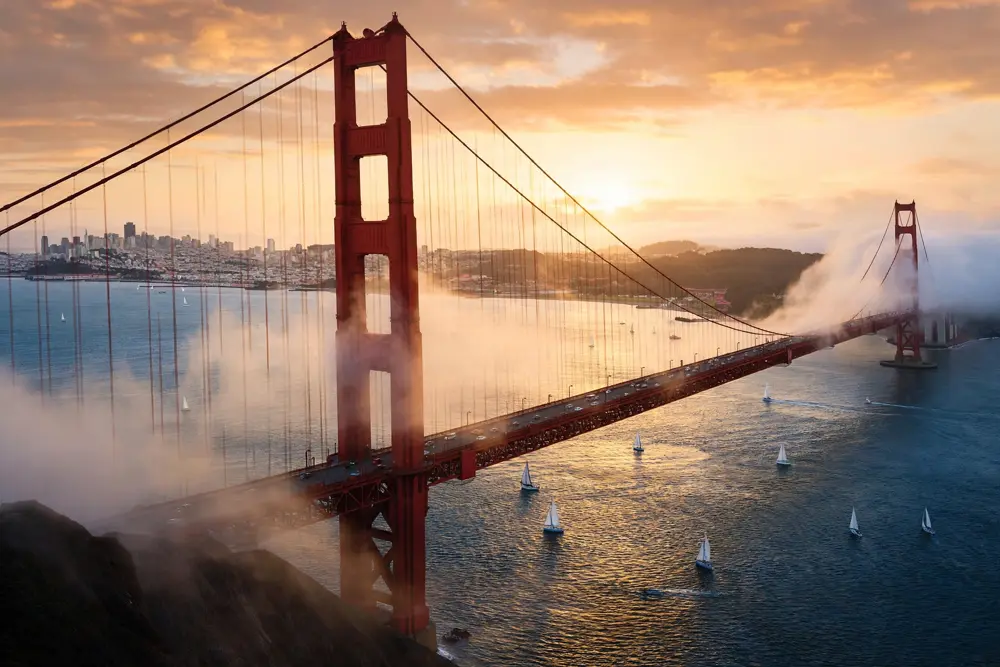
1. Walk or bike the Golden Gate Bridge
The Golden Gate Bridge is the reason most people come to San Francisco, and walking it is the one experience no first trip should skip. The International Orange suspension bridge, opened in 1937, stretches 1.7 miles across the mouth of the bay, and the walk takes about 30 to 45 minutes each way, with the city on one side, the Pacific on the other, and the wind in your face the whole way. Come in the morning, before the afternoon fog rolls in — the locals call the fog Karl, and he arrives most summer afternoons — and stop at the viewpoints at both ends: Fort Point below the south tower, and Battery Spencer across the bay in the Marin Headlands, which is the best photograph in the Bay Area.
Practical tip: Walking the bridge is free and open daily. The east sidewalk is for pedestrians, the west for cyclists — keep to your side. There is no charge to cross on foot, but drivers pay a southbound electronic toll of roughly $9.75, so take the bus or a rideshare to the bridge and walk back.
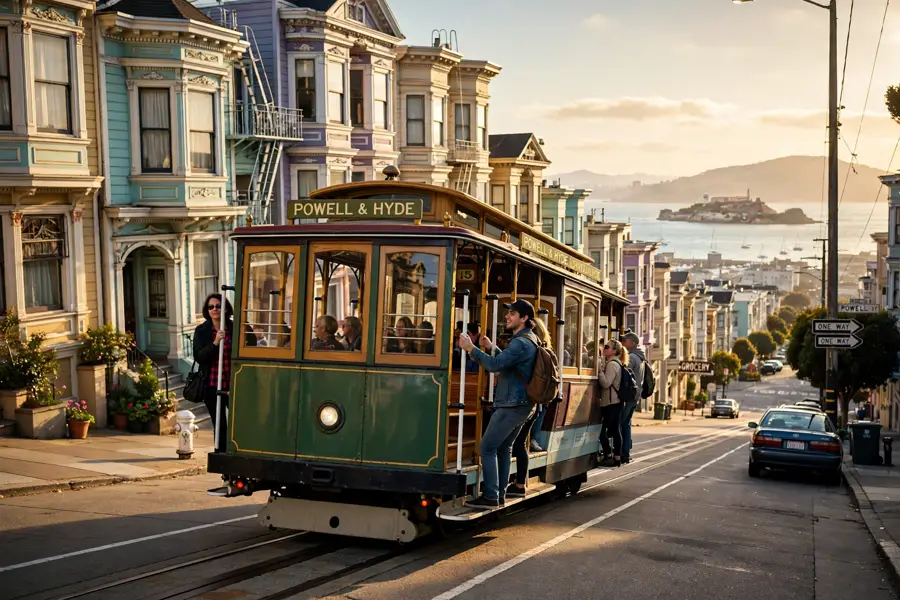
2. Ride a cable car
The cable cars are the last manually operated cable car system in the world — and the most fun way to climb a San Francisco hill. Three lines still run: Powell-Hyde, Powell-Mason and California Street. Take the Powell-Hyde line, the most scenic of the three: it crests Nob Hill, passes the top of Lombard Street, then drops steeply toward Fisherman’s Wharf, with the bay opening up in front of you. Stand on the outside running board if you can — it is the best seat in the city, and the gripman will ring the bell as you roll downhill. The first car ran up Clay Street in 1873, and the whole system is a National Historic Landmark.
Practical tip: A single cable car ride costs roughly $9 in 2026 — prices are approximate, so check before visiting — and a rise to $12 is planned for January 2027. Buy a ticket before boarding at the Powell & Market turnaround, or pay the conductor on the California line. The Powell Street queues can be an hour long in summer: catch the California line near the Ferry Building instead, or ride early in the morning.
3. Tour Alcatraz Island
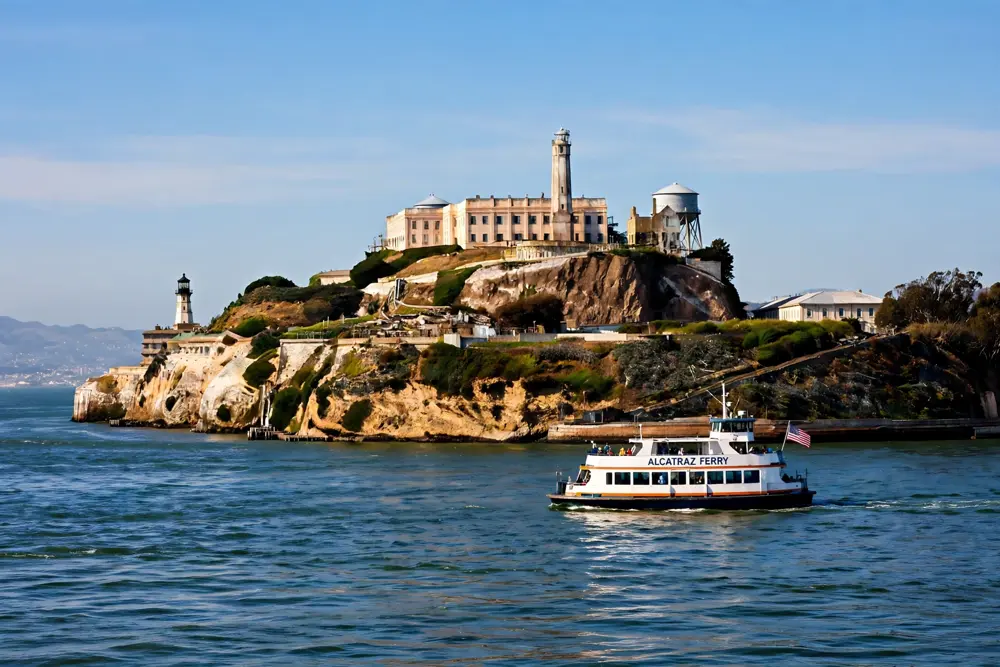
Alcatraz Island is the one San Francisco attraction that regularly sells out, and the one that lives up to the hype. The island held the federal penitentiary from 1934 to 1963 — Al Capone and Robert Stroud, the Birdman of Alcatraz, among its inmates — and the self-guided cellhouse audio tour, narrated by former guards and prisoners, is one of the best audio tours in America. The ferry from Pier 33 takes about 15 minutes, and the island also holds the oldest operating lighthouse on the West Coast and 19th-century military fortifications. Take the night tour if you can: it costs more, but the prison after dark, with the bay black around you, is a completely different experience.
Practical tip: Day tour tickets cost roughly $47.95 for adults and the night tour roughly $59.65 — prices are approximate, so check before visiting. Book at least two to three weeks ahead in summer, through Alcatraz City Cruises, the only authorised operator — and check that a “bay cruise” actually lands on the island, because many do not. One note for 2026: headlines since May 2025 have floated turning the island back into a working federal prison, and $152 million was requested for it in April 2026 — but the National Park Service still runs the island and tours run as normal.
4. Fisherman’s Wharf and Pier 39
Fisherman’s Wharf is the most touristy district in San Francisco — and it is still worth an hour, for one reason: the sea lions. Since 1989, hundreds of California sea lions have hauled out on the floating docks at Pier 39’s K-Dock, barking, jostling and napping in the sun, and they are free to watch from the pier. The Wharf itself holds the Aquarium of the Bay, the two-storey carousel, street performers and the sourdough bakeries, and the old ships of the Maritime National Historical Park sit at Hyde Street Pier at the far end. Go for the sea lions and the bay views, eat one thing well, and move on — the Wharf is at its best in the morning, before the crowds arrive.
Practical tip: The sea lions are free to watch from Pier 39 and are most active in the morning and late afternoon — though they mostly leave in June, when they gather to mate off Southern California. The Aquarium of the Bay costs roughly $30 for adults — prices are approximate, so check before visiting. One Wharf fixture is ending: Ripley’s Believe It or Not, here for nearly 60 years, closes for good on December 1, 2026.
5. Explore Chinatown
Chinatown is the oldest Chinatown in North America and the largest outside Asia — and the neighbourhood most first-timers rush past. Enter through the Dragon Gate on Grant Avenue, then walk Stockton Street, where the herbal shops, bakeries and produce stalls are the real Chinatown, not the souvenir shops of Grant Avenue. Stop at the Golden Gate Fortune Cookie Factory on Ross Alley, where fortune cookies have been folded by hand since 1962, and eat dim sum: the city’s best is in Chinatown’s crowded, noisy dining rooms, where the trolleys come to you. The neighbourhood was founded during the Gold Rush, between 1848 and 1855, and it still feels like a city inside the city.
Practical tip: Chinatown is free to walk and best in the morning, when the markets are busiest. The fortune cookie factory charges a small fee for photos. For dim sum, arrive before 11am or expect a queue — and bring cash for the smallest bakeries. The hills here are steep: enter from Grant Avenue and walk downhill.
6. See the Painted Ladies at Alamo Square
The Painted Ladies are the postcard: a row of pastel Victorian houses on Steiner Street, facing the downtown skyline across Alamo Square park. Built in the 1890s and painted in the 1960s, they are the most photographed houses in America — the Full House opening credits made them famous, and the view from the top of the park, houses in front and skyscrapers behind, is the classic San Francisco photograph. Come at golden hour, when the light turns the houses pink and gold, and bring a picnic: the park lawn is the best free seat in the city, and the whole square feels like a neighbourhood park rather than a tourist stop.
Practical tip: Alamo Square is free and open all day. Come at golden hour for the best photographs, and walk the hill from the park’s top corner for the classic shot. The houses are private homes, so admire them from the street. Pair it with a walk down Hayes Street, the neighbourhood’s café and boutique strip.
7. Walk down Lombard Street
Lombard Street is the crookedest street in the world — one block of eight hairpin turns, paved in red brick, between Hyde and Leavenworth streets on Russian Hill. The turns were built in 1922 so cars could manage the 27-degree slope, and the street is now one of the most photographed in the city: hydrangeas in the flower beds, the bay at the bottom, and a line of cars inching down the bends. Walk down rather than driving it — the view from the top, looking down the curves to the bay, is the photograph, and the sidewalk gives you time to enjoy it.
Practical tip: Lombard Street is free to walk and best early in the morning, before the tour buses arrive. The Powell-Hyde cable car stops at the top of the hill, so ride up and walk down. Be respectful: the houses on the street are private homes, and the residents live with the crowds every day.
8. Climb Coit Tower on Telegraph Hill
Coit Tower stands on top of Telegraph Hill, and the climb is half the point. The tower was built in 1933 with money left by Lillie Hitchcock Coit, a San Francisco philanthropist, to beautify the city, and its base holds Depression-era murals painted by artists of the Public Works of Art Project — free to see, and some of the best public art in the city. The elevator to the observation deck gives you a 360-degree view: the bay, the bridge, the downtown towers and Alcatraz all at once. Walk up through the Filbert Street steps, past the wild parrots of Telegraph Hill, and you have earned the view.
Practical tip: The tower base and murals are free; the elevator to the observation deck costs roughly $10 for non-resident adults and $7 for San Francisco residents — prices are approximate, so check before visiting. The Filbert Street steps are steep — take the 39 bus up if your knees object — and the parrots are loudest in the morning.
9. The Palace of Fine Arts
The Palace of Fine Arts is the most photogenic spot in San Francisco that most visitors rush past. Built for the 1915 Panama-Pacific International Exposition, the Roman-style rotunda and its lagoon were meant to be temporary — they were so loved that the city rebuilt them in concrete, and they have stood ever since. The lagoon holds swans and turtles, the colonnade frames the dome, and the whole place feels like a Roman temple dropped into the Marina District. Come at sunrise, when the water is still and the light is soft, and you will have it almost to yourself.
Practical tip: The Palace of Fine Arts is free to walk around and open all day. Come at sunrise for the quietest photographs, and pair it with a walk through the Marina District to Crissy Field — the bayfront path runs straight from the lagoon to the bridge.
10. The Ferry Building and the farmers market
The Ferry Building is the best food destination in San Francisco — and the best place to understand why the city eats so well. The 1898 transit hub at the foot of Market Street holds a marketplace of artisan producers, and on Tuesdays and Saturdays the plaza fills with the Ferry Plaza Farmers Market, one of the best in America: oysters, bread, cheese, fruit and food stalls, with the bay behind them. Come hungry on a Saturday morning, when the market is at its fullest, and eat your way along the stalls. Outside, the 45-foot R-Evolution statue — part of the city’s Big Art Loop, which plans up to 100 large sculptures across the city over three years — now watches over the plaza.
Practical tip: The Ferry Building marketplace is free to browse and open daily; the farmers market runs Tuesday and Saturday mornings. Arrive before 10am on Saturday for the best stalls and the shortest lines, and bring a bag — the bread, the cheese and the jam are the souvenirs worth taking home.
11. Spend a day in Golden Gate Park
Golden Gate Park is larger than Central Park in New York — 1,017 acres of gardens, lakes, windmills and museums — and it holds more in one visit than most visitors realise. The Music Concourse holds two great museums side by side: the de Young, whose free observation tower gives you a view across the whole park to the ocean, and the California Academy of Sciences, a natural history museum, aquarium, planetarium and four-storey rainforest under one living roof. Across the park, the Japanese Tea Garden is the oldest public Japanese garden in the United States, established in 1894, and the San Francisco Botanical Garden holds 55 acres of rare plants from around the world. Rent a bike and ride the whole park, from the Conservatory of Flowers to Ocean Beach.
Practical tip: The park itself is free; the museums are ticketed. The California Academy of Sciences costs roughly $46 for adults, the de Young roughly $20, and the Japanese Tea Garden roughly $15 — prices are approximate, so check before visiting. The Tea Garden offers free entry during the first hour on Mondays, Wednesdays and Fridays, and San Francisco residents enter free at all times.
12. The Mission District — murals, Dolores Park and burritos
The Mission District is the most colourful neighbourhood in San Francisco — and the one where the city’s Latin heart beats loudest. The streets hold the city’s best murals: Balmy Alley and Clarion Alley, two laneways covered in political and community art, are the open-air galleries most guides bury. Dolores Park, on the hill above the Mission, is the city’s front lawn on a sunny day: picnics, views of downtown, and the whole of the neighbourhood out. And the Mission invented the Mission-style burrito — foil-wrapped, rice and beans inside, the size of a small log — which is the meal this neighbourhood is known for.
Practical tip: The Mission is free to walk and best in the late afternoon, when the light is good for the murals and Dolores Park fills up. A Mission burrito costs roughly $12–$18 — prices are approximate, so check before visiting. The murals change regularly, so walk both Balmy Alley and Clarion Alley, and bring layers: the Mission is the warmest neighbourhood in the city, but the fog still finds it.
13. North Beach and City Lights
North Beach is San Francisco’s Little Italy — and the neighbourhood where American literature changed. The streets around Columbus Avenue hold Italian cafes, bakeries and restaurants in the buildings where Italian immigrants settled in the mid-19th century, and Caffe Trieste, the city’s oldest espresso house, still pulls shots the old way. On the corner of Columbus and Broadway sits City Lights Bookstore, the Beat Generation bookshop founded in 1953, where Allen Ginsberg’s Howl was first published — and the alley beside it, Jack Kerouac Alley, is the most literary 60 feet in the city. Come for a coffee in the morning, when the cafes are quiet, and stay for dinner in the evening, when the whole neighbourhood eats out.
Practical tip: North Beach is free to walk and best in the morning for the cafes and the evening for dinner. City Lights is free to browse and open daily. Walk the Filbert steps from here to Coit Tower — the climb is steep, but the parrots and the views are worth it.
14. The Presidio and Tunnel Tops
The Presidio of San Francisco is the park most visitors underrate — and the one locals love most. The former military post, founded by Spain in 1776, is now a national park site of 1,500 acres, and in 2026 it turns 250, with a year of anniversary events. Tunnel Tops, the 14-acre park built over the Presidio Parkway tunnels, holds lawns, a children’s play area and the best bridge views in the park, and the free Presidio GO shuttle runs from downtown. New for 2026: Mess Hall at the Presidio, the all-day food hall and market beside Tunnel Tops, opened in the summer. Don’t miss the Walt Disney Family Museum, the Yoda statue at the Lucasfilm campus, and the walk down to Baker Beach.
Practical tip: The Presidio is free and open all day, and the Presidio GO shuttle is free from downtown. In spring 2026 four new electric buses joined the fleet, so the shuttle is easier than ever. The Walt Disney Family Museum costs roughly $25 for adults — prices are approximate, so check before visiting — and the Disneyland Story exhibition runs through May 2026.
15. Lands End Trail and the Legion of Honor
The Lands End Trail is the most beautiful walk in San Francisco — and the one most visitors never take. The coastal path runs from the old Sutro Baths ruins, past cypress trees and shipwreck views, to the Legion of Honor museum in Lincoln Park, with the Golden Gate Bridge in front of you the whole way. The Legion of Honor, a copy of the Palais de la Légion d’Honneur in Paris, holds one of the finest art collections in the city, and its courtyard looks straight out over the Pacific. Walk the trail at sunset, when the light turns the cliffs gold, and you will understand why locals call it the best free walk in the city.
Practical tip: The Lands End Trail is free and open all day. The Legion of Honor costs roughly $15 for adults — prices are approximate, so check before visiting. The trail has steps and uneven ground, so wear walking shoes, and bring a jacket: the wind off the Pacific is cold even in summer.
16. SFMOMA and Yerba Buena
The San Francisco Museum of Modern Art is the largest modern art museum in the United States — and the best rainy-day stop in the city. The museum, expanded in 2016 with a rippling white tower by Snøhetta, holds seven floors of modern and contemporary art, from Rothko and Warhol to the city’s own photographers, and the rooftop sculpture garden looks out over the downtown towers. Around it, Yerba Buena Gardens holds lawns, a waterfall and the Martin Luther King Jr. Memorial, and the whole district is the city’s cultural centre. New for the holidays: Banksy Limitless, an exhibition of around 250 works, opens on December 4, 2026 at 150 Powell Street in Union Square, in the former H&M flagship store.
Practical tip: SFMOMA costs roughly $30 for adults — prices are approximate, so check before visiting — and is free for visitors 18 and under. Go on a weekday morning to avoid the school groups, and allow three hours. Yerba Buena Gardens is free and open daily.
17. The Castro and the Castro Theatre
The Castro is the historic heart of San Francisco’s LGBTQ+ community — and the neighbourhood with the most visible history in the city. The streets around Castro and Market hold the Rainbow Honor Walk, the bronze plaques in the sidewalk honouring LGBTQ+ heroes, the Harvey Milk Photo Center, and the GLBT Historical Society Museum, the first museum of its kind in the United States. And the Castro Theatre, the century-old movie palace, is back: after a two-year, $41 million renovation it reopened in February 2026, marked by a 20-show residency from Sam Smith. Catch a film there if you can — the organ still rises from the floor before the show, and the audience still cheers.
Practical tip: The Castro is free to walk and best in the late afternoon, when the shops are open and the neighbourhood fills. The GLBT Historical Society Museum costs roughly $10 — prices are approximate, so check before visiting. Check the Castro Theatre programme before you go: the reopened palace hosts films, concerts and live events most nights.
18. Japantown and the Peace Plaza
Japantown is one of only three remaining Japantowns in the United States — and the one that has just been reborn. The neighbourhood’s Peace Plaza, the heart of the community since the 1960s, has completed a $33 million renovation that finished in mid-2026, with a renewed plaza, new landscaping and the five-tiered Peace Pagoda at its centre. Around it, the Japan Center mall holds sushi bars, ramen shops, bookshops and the best Japanese grocery in the city, and the neighbourhood’s festivals — the Cherry Blossom Festival in April, the Nihonmachi Street Fair in August — are the most joyful in San Francisco. Come hungry: the ramen and the sushi here are the best in the city.
Practical tip: Japantown is free to walk and best at lunchtime, when the restaurants are fullest. A bowl of ramen costs roughly $16–$22 — prices are approximate, so check before visiting. The Cherry Blossom Festival runs in April and draws the biggest crowds of the year — book tables ahead if you come for it.
19. Twin Peaks — the best view in the city
Twin Peaks is the highest viewpoint in San Francisco — and the view that makes the whole city make sense. The two hills, 922 feet above the bay, look out over the entire 7-by-7-mile city: downtown, the bay, the bridge and, on a clear day, the whole Bay Area. Come at sunset, when the fog is low and the city lights come on, or at sunrise, when the hills are empty and the light is soft. It is the view most visitors skip because it needs a car or a bus — and the one locals recommend first. If the fog is in, wait an hour: San Francisco fog moves fast, and the view changes by the minute.
Practical tip: Twin Peaks is free and open all day. Take the 37 bus to the top, or a rideshare — there is no direct cable car or Muni Metro stop. Bring a jacket: the wind at the top is cold even in summer, and the fog can roll in within minutes.
20. Day trip: Muir Woods
Muir Woods National Monument is the closest place to San Francisco where you can stand under giant redwoods — and the day trip most first-timers remember longest. The old-growth forest, 12 miles north of the bridge, holds coast redwoods up to 250 feet tall and more than 800 years old, with boardwalk trails through fern-covered canyons and the sound of Redwood Creek below. The main loop takes about an hour; the longer trails climb to the ridges and the views. It is the quietest, most unexpected half-day in the Bay Area, and it pairs perfectly with a drive up Mount Tamalpais and a lunch stop in Sausalito, the waterfront town at the foot of the bridge.
Practical tip: Muir Woods needs a reservation: parking costs roughly $9.50 per vehicle and the shuttle from Sausalito roughly $3.75 per adult round trip — prices are approximate, so check before visiting. There is no entrance fee for the monument itself beyond the parking or shuttle. Book the parking or shuttle at least a week ahead in summer, and arrive at opening for the forest to yourself.
San Francisco in 3 days — a ready-made itinerary
This plan groups sights that sit near each other, so you are sightseeing instead of crossing the city. San Francisco is a walking city, so each day stays in one area, and the plan is built around the fog: the outdoors in the morning, when the fog is lightest, and the museums in the afternoon, when it rolls in. Timings are a guide, not a schedule to stress about — swap Day 2 and Day 3 if the weather demands it, and always do the Golden Gate Bridge first thing, when the fog is thinnest.
| Day | Morning | Afternoon | Evening |
|---|---|---|---|
| Day 1 — The bridge and the bay | Golden Gate Bridge walk and Crissy Field | Palace of Fine Arts and the Presidio | Fisherman’s Wharf, Pier 39 sea lions and dinner on the waterfront |
| Day 2 — Downtown and the hills | Cable car Powell-Hyde line and Lombard Street | Chinatown, North Beach and Coit Tower | Alcatraz night tour, then drinks in North Beach |
| Day 3 — Parks and neighbourhoods | Golden Gate Park and the Japanese Tea Garden | The Mission District murals and Dolores Park | Painted Ladies at golden hour, dinner in the Mission |
Day 1: The bridge and the bay
Start at the Golden Gate Bridge in the morning, when the fog is lightest, and walk or cycle across to the Marin Headlands. In the afternoon, walk Crissy Field to the Palace of Fine Arts and through the Presidio to Tunnel Tops. Finish the day at Fisherman’s Wharf, with the sea lions at Pier 39 and dinner on the waterfront — the right way to end a first day in San Francisco.
Day 2: Downtown and the hills
Start with the Powell-Hyde cable car in the morning, when the queues are shortest, and ride to the top of Lombard Street. Walk down the crooked street, then explore Chinatown and North Beach in the afternoon, with dim sum for lunch and City Lights for a browse. End the day with the Alcatraz night tour — book it weeks ahead — and a drink in North Beach afterwards.
Day 3: Parks and neighbourhoods
Start in Golden Gate Park in the morning, with the Japanese Tea Garden and the de Young’s free observation tower. In the afternoon, walk the Mission District murals and Dolores Park, with a Mission burrito for lunch. End the trip at the Painted Ladies at golden hour, then dinner in the Mission — the right way to finish a San Francisco trip.
Only have 2 days? Do Day 1 and Day 2, and add Golden Gate Park on the morning of Day 2 if your flight is late. Only have 1 day? Do the Golden Gate Bridge, a cable car, Chinatown and the Ferry Building — that is San Francisco in miniature. With 4 days, add Muir Woods and a day in Napa Valley, or a second day in Golden Gate Park and the Presidio. Families with younger children should also look at the Exploratorium and the California Academy of Sciences, both an easy walk from the Ferry Building and the park. And if you have a spare half-day, Sausalito — the waterfront town across the bridge, with galleries, cafes and the bay views — is the stop most guides underrate.
Best time to visit San Francisco
San Francisco has a Mediterranean climate with a twist: the fog. There is no bad month — but the city feels very different by season. The honest summary is this: September to November gives you the best balance of warm weather, clear skies and smaller crowds, while summer is foggy and cold, and winter is the cheapest and quietest time downtown.
| Season | What it is like | Best for |
|---|---|---|
| Winter (December–February) | Cool and rainy, highs around 55–60°F, the cheapest hotels — with the clearest days between storms | First trips, walking, budget trips |
| Spring (March–May) | Mild days in the 60s, wildflowers in the parks, the fog still light | First trips, gardens, festivals |
| Summer (June–August) | Foggy and cool, highs of 55–65°F — the famous “Karl the Fog” summer, so pack a jacket | Museums, the fog, early mornings |
| Autumn (September–November) | Warm and golden, the fog lifts, highs in the 70s — the best weather of the year | First trips, the bridge, the best weather of the year |
Remember that the fog — the locals call it Karl — rolls in most summer afternoons and can drop the temperature by 20 degrees in an hour, so pack a jacket even in July and August. The warmest, sunniest months are actually September and October, when the fog lifts and the city glows. Winter brings rain and the cheapest hotels of the year, and the clearest days come between storms. Whatever month you choose, dress in layers: San Francisco weather changes by the neighbourhood, and the fog finds you when you least expect it.
Where to stay in San Francisco
For a first trip, stay in Union Square or near the Embarcadero. You will be close to the sights in this guide, you will be able to walk in the evenings, and you will not lose time commuting. These are the areas to look at first:
| Area | Who it suits | Why stay there |
|---|---|---|
| Union Square | First-timers, shoppers | The cable cars, Chinatown and the shops on your doorstep |
| Fisherman’s Wharf | Families, first-timers | Pier 39, the sea lions and the bay cruises on your doorstep |
| Nob Hill | A classic feel, views | The cable car lines, Grace Cathedral and the city views on your doorstep |
| The Mission District | Food lovers, a younger crowd | Burritos, murals and Dolores Park on your doorstep |
| Japantown | A local feel, food | Sushi, ramen and the Peace Plaza on your doorstep |
Wherever you choose, check how far the nearest cable car stop or Muni station is before you book — San Francisco is a walking city, but a hotel that looks central can still be a 20-minute uphill walk from the sights you visit most. Hotel prices swing sharply with the autumn conventions, the big conferences and spring weekends, so comparing dates can save real money. And note the 2026 changes: the historic Huntington Hotel on Nob Hill is reopening in 2026 after a top-to-bottom renovation, and Francis Ford Coppola’s Hideaways boutique hotel in the Columbus Tower is slated to debut in late 2026 — so the city’s hotel map is changing fast.
Getting around San Francisco
San Francisco is a walking city, and the honest advice is to use your feet and the cable cars downtown and a rideshare for everything else. The core is well served, but the sights in this guide are spread across the hills, the parks and the bay — and the fog makes walking long distances cold work in summer.
- Walking: The city is only 7 by 7 miles, and the core — Union Square, Chinatown, North Beach and the waterfront — is walkable. The hills are the real limit: the streets climb at up to 30 degrees, so walk downhill where you can and save your legs for the views.
- Cable cars: Three lines still run — Powell-Hyde, Powell-Mason and California Street — and a single ride costs roughly $9 in 2026, with a rise to $12 planned for January 2027. The Powell-Hyde line is the most scenic. Buy a ticket before boarding at the Powell & Market turnaround, or pay the conductor on the California line.
- Muni buses and Metro: Muni buses and light rail cover the whole city. A single ride costs roughly $2.85 with Clipper or a contactless card, or $3 with cash — prices are approximate, so check before visiting. Children and young people under 19 ride buses and streetcars free. Note that MuniMobile single-ride tickets were discontinued on September 1, 2026, so pay with Clipper or a contactless card instead.
- F-line historic streetcars: The F-line runs vintage streetcars from around the world along Market Street and the Embarcadero, from the Castro to Fisherman’s Wharf — the most charming ride in the city, and the easiest way to get between downtown and the waterfront.
- BART: BART runs from San Francisco International Airport (SFO) directly into downtown in about 30 minutes, and out to the East Bay. It is the fastest way to and from the airport, and the fares are distance-based, so tap in and out.
- Rideshare: Rideshare cars are easy to find downtown and in the neighbourhoods, and are the simplest way to reach Twin Peaks, the Presidio and the beaches without a car of your own. There is no direct public transit to Muir Woods, so plan a shuttle or a rideshare for that day.
- Driving: A car is the most flexible way to reach Muir Woods, Napa and the coast, and the sights in this guide are spread across them. Parking downtown is expensive and the hills are steep, so park in a garage and walk once you are there — and never leave anything visible in a parked car.
- Cycling: The Embarcadero and the Presidio are the best rides in the city — flat, scenic and separated from traffic — and bike rentals are available at Fisherman’s Wharf. Keep the bike to the waterfront and the parks: the hills and the traffic make downtown cycling hard work.
San Francisco food you have to try
You can eat very well in San Francisco at every budget, from taquerias in the Mission to white-tablecloth dining in Union Square. But three foods are San Francisco signatures, and a first trip is not complete until you have tried all three.
Mission-style burrito
The Mission burrito was invented in San Francisco in the 1960s, and it is the meal the city is known for. The formula has not changed: a flour tortilla wrapped in foil, filled with rice, beans, meat, salsa, cheese and sour cream, and big enough to need two hands. The best versions are in the Mission District, where the taquerias have been serving the same plates for decades — order it “super” for the full version, and do not ask for a fork: the burrito is eaten in your hands, and the foil is part of it.
Practical tip: A Mission burrito costs roughly $12–$18 — prices are approximate, so check before visiting. Order it at lunch, when the taquerias are at their best, and try it twice: every Mission taqueria has its own version, and locals argue about which is best.
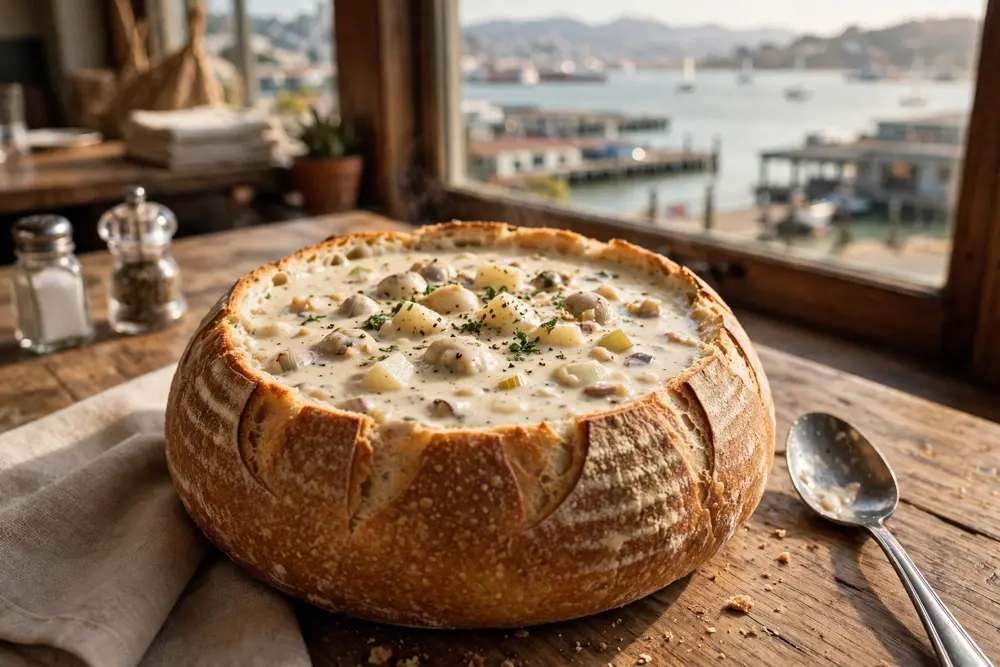
Clam chowder in a sourdough bread bowl
Clam chowder in a sourdough bread bowl is the San Francisco plate every first trip should include — creamy New England-style chowder, served in a hollowed-out round of the city’s famous sourdough, which has been baked here since the Gold Rush. The best versions are on the waterfront, where the chowder is made fresh daily and the bread is baked in the city’s old sourdough bakeries. Eat the chowder first, then the bowl: the sourdough soaks up the soup, and the last bites are the best.
Practical tip: A bread bowl of clam chowder costs roughly $14–$20 — prices are approximate, so check before visiting. Order it at Fisherman’s Wharf, where the bakeries are, and eat it outside if the sun is out: the bayfront benches are the best seats in the city.
Cioppino
Cioppino is the dish San Francisco invented — a tomato and wine stew of crab, clams, mussels, shrimp and fish, created by the Italian fishermen of North Beach in the late 1800s from the day’s catch. It is served with sourdough for dipping, and the best versions are in the North Beach restaurants that have been cooking it for generations. Order it family-style, share it with the table, and do not ask for a spoon: the bread is the spoon, and the mess is part of it.
Practical tip: Cioppino costs roughly $28–$40 per person — prices are approximate, so check before visiting. Order it in North Beach, where the recipe was born, and come hungry: the stew is served family-style and the portions are generous. The Dungeness crab season, which opens in November, is the other San Francisco ritual worth planning a trip around.
Beyond the big three, leave room for a plate of dim sum in Chinatown, a bowl of ramen in Japantown, a family-style dinner in North Beach — and at least one neighbourhood meal in the Mission or on Hayes Street.
Free things to do in San Francisco
San Francisco is unusually generous to budget travellers. Several of its very best experiences cost nothing at all:
- Walking the Golden Gate Bridge: The 1.7-mile walk across the bridge, with the city on one side and the Pacific on the other — the best free walk in America.
- The Presidio and Tunnel Tops: 1,500 acres of national park, the bridge views from Tunnel Tops and the free shuttle from downtown.
- Golden Gate Park: The park itself is free — the gardens, the lakes, the windmills and the bison paddock, all free to walk.
- The sea lions at Pier 39: Hundreds of sea lions barking and napping on the docks at K-Dock — free to watch, and the best free wildlife in the city.
- Chinatown: The Dragon Gate, Stockton Street’s markets and the fortune cookie factory — the oldest Chinatown in North America, free to walk.
- The de Young observation tower: The free tower at the de Young Museum, with a view across the whole park to the ocean.
- Dolores Park: The city’s front lawn, with downtown views and the whole neighbourhood out on a sunny day.
- Lands End Trail: The coastal path from the Sutro Baths ruins to the Legion of Honor, with the bridge in front of you the whole way.
Build each day around one paid highlight and fill the rest with free sights. That is how a San Francisco weekend stays affordable without feeling cheap — the free things here are genuinely the best things in the city.
Frequently asked questions
How many days do you need in San Francisco?
Three full days is the standard first trip: one day for the bridge and the bay, one day for downtown and the hills, and one day for the parks and the neighbourhoods. Two days covers the essentials — the bridge, Alcatraz, the cable cars and Chinatown — and a fourth day is best spent in Muir Woods or Napa Valley.
What is the best time to visit San Francisco?
September to November is the sweet spot: the fog lifts, the days are warm with highs in the 70s, and the crowds thin. March to May is the other good window, with mild days and wildflowers in the parks. Summer is foggy and cool, with highs of 55–65°F, so pack a jacket — the warmest months are actually September and October. Winter is mild, with highs around 55–60°F, and the cheapest hotels of the year.
Do you need a car in San Francisco?
Not for the main sights — the city is only 7 by 7 miles, and Muni, the cable cars, the F-line streetcars and rideshares cover the core. A car helps for Muir Woods, Napa and the coast, where there is no direct public transit. If you do rent one, park in a garage and walk once you are there: parking is expensive, the hills are steep, and break-ins are a real risk — never leave anything visible in a parked car.
Is San Francisco expensive?
San Francisco is one of the most expensive cities in the United States: a mid-range trip runs roughly $180–$320 per person per day, and downtown hotel rooms can run well over $300 a night in autumn. The way to keep costs down is to stay in the Mission or Japantown, eat burritos and dim sum instead of fine dining, and build your days around the free sights — the bridge walk, the parks, Chinatown and the sea lions cost nothing.
Is San Francisco safe for tourists?
The tourist areas are safe with normal city sense: stay aware late at night around the Tenderloin and parts of Market Street, do not leave valuables visible in parked cars, and keep to the busy, well-lit streets after dark. Union Square, the Wharf, the Mission and the parks are well patrolled and busy into the evening.
What is the one thing you should not miss in San Francisco?
Walking the Golden Gate Bridge. It is the bridge the city is known for, it is the most moving hour in San Francisco, and it costs nothing. Go in the morning, before the fog rolls in, and pair it with Fort Point below the south tower and Battery Spencer across the bay — the three together are the best views in the city.
Further reading — Wikipedia, Reddit and Quora
Want to dig deeper or hear directly from locals and other travellers? These pages are the best next stops:
- Wikipedia — San Francisco — the city’s history, from its founding in 1776 to the Gold Rush, the 1906 earthquake and the city’s rebirth as one of America’s most visited cities.
- Wikipedia — Golden Gate Bridge — the story of the bridge, from its construction in the 1930s to the International Orange paint and the fog that hides it.
- Wikipedia — Alcatraz Island — the history of the island, from its military fort to the federal penitentiary of 1934–1963 and the National Park Service today.
- Reddit — r/sanfrancisco — the San Francisco community on Reddit, where locals answer first-time visitors’ questions and share current tips on the fog, the hills and the best neighbourhoods.
- Quora — what to do in San Francisco in summer — travellers’ and locals’ answers on what to do in San Francisco during summer, when the fog is thickest and the city is at its coldest.
Your San Francisco trip, in one paragraph
Walk the Golden Gate Bridge in the morning, ride a cable car in the afternoon, watch the sunset from Twin Peaks, eat a Mission burrito, spend a day in Golden Gate Park and the Presidio, and finish with Alcatraz at night. Do that, and you will leave San Francisco understanding exactly why people who visit once tend to come back. And if you liked this guide, read our guide to things to do in Chicago, our guide to things to do in Nashville, our guide to things to do in Los Angeles, our guide to things to do in Orlando, our guide to things to do in Miami, our guide to things to do in San Diego, our guide to things to do in Denver, our guide to things to do in Savannah, our guide to things to do in Dallas and our guide to things to do in Charleston — the same format, the same honest prices, and ten more great American cities.
Prices, hours and seasonal schedules in this guide are approximate and were given as a guide only. Please check the official website of each attraction before you visit.

About the Author