Things to Do in Arizona
20 Best Attractions, a 3-Day Itinerary, Where to Stay, and the Food You Cannot Miss
Quick Info
Best for: The Grand Canyon, slot canyons, red rock deserts, Route 66 towns and dark-sky stargazing
Best time: March to May and September to November, when the desert is warm but not dangerous
How long: 3 days for the classic north loop; 5 to 7 days to add Tucson and the south
Budget: Roughly $150–$250 per person per day mid-range, before flights (about $80–$130 for a hotel room, $40–$60 for food)
Don’t miss: Sunrise at the Grand Canyon South Rim, a light-beam tour of Upper Antelope Canyon, Horseshoe Bend at sunset and a Sonoran hot dog in Tucson
Arizona is the American Southwest at full volume — a mile-deep canyon, slot canyons that glow like furnaces, a desert full of giant cacti, ghost towns on Route 66 and cities where the summer sun is a genuine safety warning. This guide covers the 20 best things to do in Arizona, a 3-day itinerary that strings the northern highlights together, where to stay from canyon lodges to desert resorts, how to get around a state bigger than the United Kingdom, three foods you have to try, and the best free sights in the state. Every price below was checked against live sources in November 2026, and where older guides get it wrong — above all on Grand Canyon fees, Antelope Canyon prices and the North Rim — we say so.
Arizona at a glance
| Topic | What to know |
|---|---|
| Best for | The Grand Canyon, Antelope Canyon, Monument Valley, Saguaro National Park, Route 66, dark skies |
| Best time | March–May and September–November; desert highs of 75–90°F, cool nights up north |
| How long | 3 days for the Phoenix–Sedona–Grand Canyon–Page loop; 5–7 days to add Tucson and the south |
| Budget | About $150–$250 per person per day mid-range; national park entry $25–$35 per vehicle |
| Don’t miss | Grand Canyon sunrise, Upper Antelope Canyon light beams, Horseshoe Bend, a Sonoran hot dog |
| Getting around | A rental car is essential — sights are hours apart and public transport barely exists outside Phoenix |
| Entry fees | Grand Canyon $35 per vehicle plus a new $100 nonresident fee from January 1, 2026; Saguaro and Petrified Forest $25 per vehicle |
| Watch out for | Summer heat over 110°F in Phoenix and Tucson, monsoon storms in July and August, and no daylight saving time in most of the state |
The 20 best things to do in Arizona
1. Grand Canyon National Park — South Rim
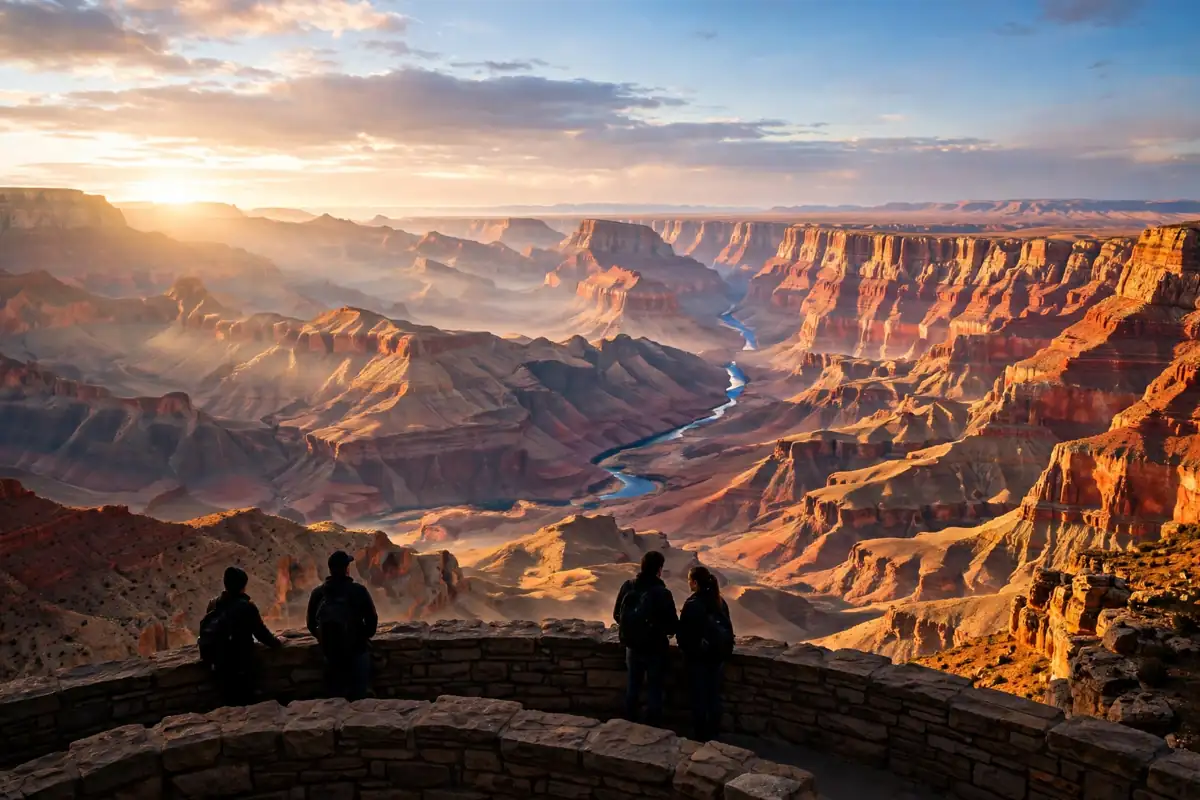
Everything in Arizona is measured against the Grand Canyon, and the South Rim is the way to see it. The canyon is 277 miles long, up to 18 miles wide and a mile deep, and the South Rim stays open all year with the full set of viewpoints, lodges and free shuttle buses. Start at Mather Point at sunrise, when the layered walls turn from purple to orange in about twenty minutes, then walk part of the flat Rim Trail west toward Hopi Point, catching Yavapai Point and Mohave Point on the way. The Bright Angel Trail drops into the canyon itself — even an hour down and back gives you a completely different sense of scale — but the National Park Service warns summer hikers to stay out of the inner canyon between 10 a.m. and 4 p.m., and it advises against hiking from the rim to the river and back in one day. Read more about the Grand Canyon on Wikipedia.
Two 2026 changes catch people out. First, entry is $35 per vehicle for a seven-day pass, and since January 1, 2026, non-US residents aged 16 and over pay an additional $100 per person unless they hold an America the Beautiful pass, which costs $250 for non-residents and $80 for US residents. Many guides still quote the old $35-only price, so budget for the extra fee if it applies to you. Second, there is no entry reservation for the South Rim in 2026 — a few websites claim a $2 timed-entry permit for May to October, but the National Park Service does not require one. What is restricted is Hermit Road, which is closed to private cars from March 1 to November 30, 2026, and served by the free Red Route shuttle instead, and the purple shuttle from the gateway town of Tusayan is out of service until summer 2027.
The North Rim is a different story in 2026. It reopened on May 15, 2026, as a day-use-only area after the July 2025 Dragon Bravo Fire, which burned more than 145,000 acres and destroyed the historic Grand Canyon Lodge. There is no lodging inside the park and no drinking water for the 2026 season, the campground runs from June 1 to October 15 with no water or hookups, and the nearest beds are at Kaibab Lodge and Jacob Lake Inn outside the park. If a guide tells you the North Rim is “closed for the season”, that is out of date — but if it tells you to book a room at the lodge, that is out of date too.
2. Antelope Canyon — Upper and Lower
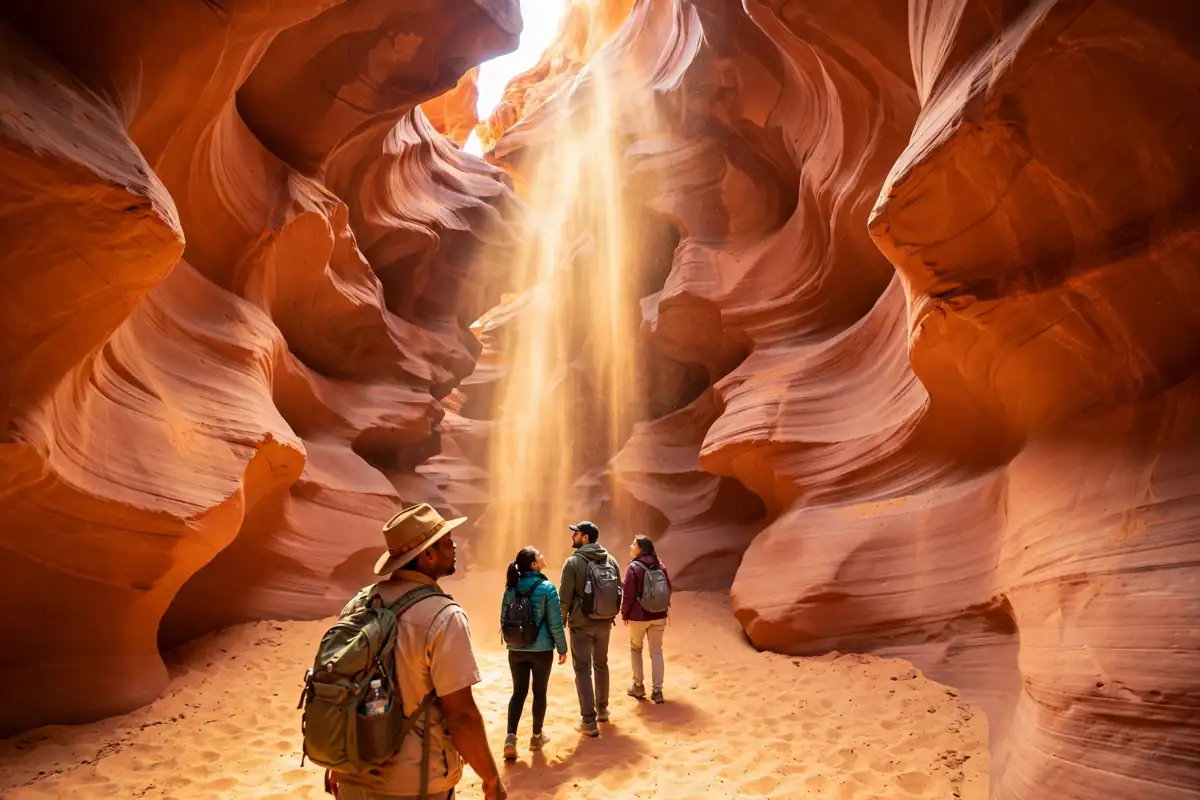
Antelope Canyon, near Page, is the most photographed slot canyon in the Southwest, and it earns the hype. Floodwater has carved the Navajo sandstone into smooth, flowing walls of orange, pink and purple, and between April and September, shafts of sunlight drop through the narrow opening above Upper Canyon around midday and light the whole passage like a cathedral. Lower Canyon is longer, deeper and more adventurous, with ladders and narrow squeezes, and many photographers prefer it. The two canyons are separate tours run by different operators, so pick one rather than trying to squeeze both into a morning. Read more about Antelope Canyon on Wikipedia.
You cannot visit on your own. Antelope Canyon sits on Navajo Nation land, and entry is only on a guided tour with one of the nine Navajo-authorized operators — six for Upper Canyon, two for Lower Canyon and one for the quieter Canyon X. Expect to pay around $92 for an Upper Canyon tour plus a $15 Navajo entry fee, about $80.50 all-in for Lower Canyon, and about $68.99 for Canyon X, with prices varying by operator and time slot. The America the Beautiful pass buys you nothing here, and the popular midday light-beam slots sell out weeks ahead in spring and autumn. Book directly with an authorized operator and ignore any website offering a self-guided visit — it does not exist. Tours are cancelled when monsoon storms threaten flash flooding, usually between July and September, so keep your schedule flexible in summer.
3. Horseshoe Bend
Ten minutes from Page, the Colorado River makes a near-perfect 270-degree bend around a sandstone cliff, 1,000 feet below the overlook. It is one of the most photographed views in America, and it takes about ninety minutes door to door, which is why it pairs so naturally with Antelope Canyon. The walk from the car park is 0.7 miles each way across open, unshaded slickrock, so go at sunrise or sunset, carry water and wear a hat — there is almost no shade. The overlook itself is free and needs no reservation, and sunset is the busiest time, so arrive an hour early for a spot at the rail.
Here is the trap older guides set: parking costs $10 per standard vehicle, paid to the City of Page, with $5 for motorcycles and $35 for RVs and oversized vehicles. Several popular guides still write “$10 per person”, which is wrong and can double or triple a family’s expected cost. The America the Beautiful pass is not accepted here either. The viewpoint has a railing now, but the rim beyond it does not — keep children close and do not step past the rail for a photo.
4. Monument Valley Navajo Tribal Park
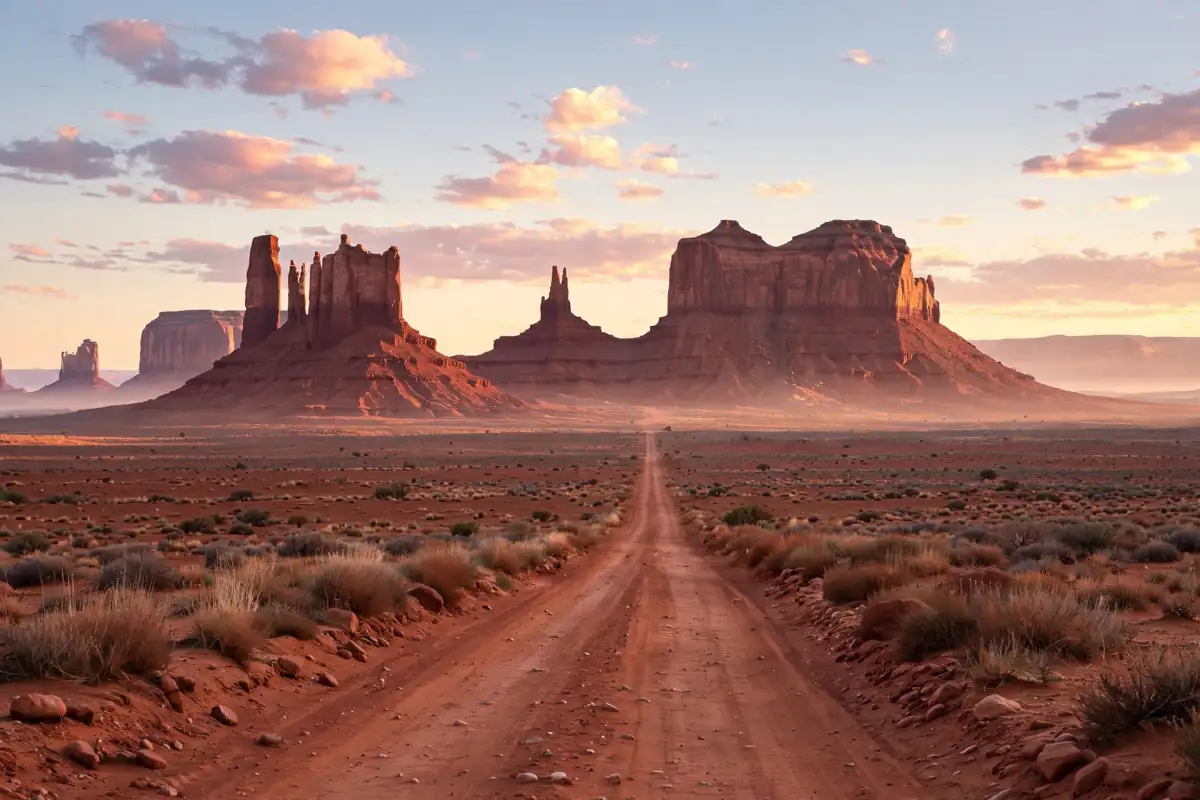
Monument Valley is the landscape of a hundred Western films: towering red buttes rising 400 to 1,000 feet out of an empty desert plain on the Arizona–Utah border. The 17-mile Valley Drive loop takes you past the Mittens, the Three Sisters and John Ford’s Point, and the view from the visitor centre terrace at sunrise is the single most cinematic sunrise in the state. The park is on Navajo Nation land, so it runs by tribal rules, not National Park Service rules — and that matters for prices. Read more about Monument Valley on Wikipedia.
Since January 1, 2026, entry costs $10 per person per day plus $15 per vehicle for the Valley Drive loop. Before that it was $8 per person with no vehicle fee, so most guides still quote the old price, and the America the Beautiful pass is not accepted here at all. In winter, from October 17, the Valley Drive runs from 8 a.m. to 5 p.m. with last entry at 2:30 p.m. The only trail you can hike without a guide is the 4-mile Wildcat Trail loop around West Mitten Butte; everything beyond the drive — the backcountry, the restricted valleys, the sunset tours — needs a licensed Navajo guide, and those guided tours are worth it, because the guides tell the stories the rocks cannot. Stay overnight at The View Hotel if you can: waking up to the Mittens from your window is the point.
5. Sedona — red rocks, vortexes and the free shuttle
Sedona is Arizona’s prettiest town, a cluster of galleries, cafés and trailheads wrapped around red sandstone cliffs, and it is the easiest red-rock country in the state to enjoy without a 4×4. Cathedral Rock is the signature hike and the most photographed formation in town; Bell Rock and Courthouse Butte are gentler; and the Chapel of the Holy Cross, a tiny church built into the rock in 1956, is free to enter and one of the best viewpoints in Arizona. Sedona is also famous for its “vortex” sites — Cathedral Rock, Bell Rock, Airport Mesa and Boynton Canyon — where believers say the energy is strongest; whether or not you feel it, the views at those four spots are genuinely the best in town. Our full Sedona guide covers all 20 of the town’s best sights.
The practical change that trips visitors up is the free Sedona Shuttle, which runs Thursday to Sunday from 7 a.m. to 5:30 p.m. (with extra days over spring break and holidays) from three park-and-ride lots to Cathedral Rock, Little Horse, Soldier Pass, Dry Creek Vista and Mescal. On shuttle days the Cathedral Rock and Soldier Pass car parks are closed to private cars, so you cannot drive to those trailheads — and the shuttle does not run before sunrise, so a sunrise hike at Cathedral Rock is only possible Monday to Wednesday, when you can drive in yourself. The Soldier Pass gate is closed from 6 p.m. to 8 a.m. daily. A Red Rock Pass costs $5 a day, $15 for seven days or $20 for twelve months and covers most trailhead parking. One more 2026 note: the West Fork Trail in Oak Creek Canyon is closed through February 28, 2027, after the Pocket Fire, although State Route 89A through the canyon reopened on July 13, 2026, and most other trails reopened on September 17, 2026.
6. Saguaro National Park
The saguaro cactus — the tall, branching giant on every Arizona postcard — grows naturally nowhere on earth except the Sonoran Desert, and Saguaro National Park, outside Tucson, protects the densest forest of them. The park is split in two: the Tucson Mountain District to the west, with the Bajada Loop Drive and the best sunset views, and the Rincon Mountain District to the east, with the Cactus Forest Loop Drive and longer desert trails. Visit in the early morning or late afternoon, when the light is gold and the desert is alive with cactus wrens, Gila woodpeckers and, in spring, the white blooms that crown the saguaros. Entry is $25 per vehicle for seven days. Read more about Saguaro National Park on Wikipedia.
The trap here is the heat and the size. A saguaro can weigh eight tons and store 200 gallons of water, and the desert around it is not a theme park — carry a litre of water per person per hour of hiking, wear a hat, and do not hike in the middle of a summer day. The Desert Museum next door is the better first stop in summer, because much of it is indoors. And if you only have an hour, drive the Bajada Loop at sunset rather than attempting a trail: the cacti turn black against a pink sky, and it costs you nothing but the entry fee.
7. Petrified Forest National Park
In the high desert of eastern Arizona, Petrified Forest National Park protects a landscape that looks like another planet: badlands striped in purple, blue and rust, and logs of 200-million-year-old wood turned to rainbow stone. The park is really two parks joined by a 28-mile scenic drive — the Painted Desert at the north end, best at sunrise and sunset, and the petrified wood forests at the south end, where the Giant Logs Trail puts you among the biggest specimens. Entry is $25 per vehicle for seven days, and the drive, with its overlooks and short trails, is one of the easiest national park visits in Arizona: you can see the highlights in three hours without a single long hike. Read more about the Petrified Forest on Wikipedia.
The rule every visitor needs to hear is simple: do not take petrified wood. Collecting even a small piece is a federal offence with real fines, and the park loses an estimated twelve tons of it a year to souvenir hunters. Buy a legal piece in the gift shop instead — it is polished, labelled and cheap. The park also sits at about 5,400 feet, so it is noticeably cooler than Phoenix, and winter mornings can be below freezing. Pair it with Meteor Crater, an hour west on Interstate 40, for a full day of strange geology.
8. Havasu Falls — the turquoise waterfalls
Havasu Falls is the hardest prize in Arizona and the most beautiful: a 98-foot waterfall pouring into a turquoise pool in a side canyon of the Grand Canyon, on Havasupai tribal land. The water gets its colour from dissolved travertine, and on a hot day the pools at Havasu Falls, Mooney Falls and Beaver Falls are the best swimming in the state. Getting there is a 10-mile hike each way from Hualapai Hilltop, with a 2,000-foot descent, and there is no day hiking at all. Read more about Havasu Falls on Wikipedia.
The booking system changed completely for 2026, and older guides describe a system that no longer exists. The old lottery is gone. For 2026, early access ran from January 21 to 31 with a $40 per person surcharge, then the general sale opened on February 1 and sold out in about thirty to sixty minutes. The price is $455 per person for the mandatory three-night campground stay, and the lodge costs $2,277 per room for up to four people. Cancellations made 90 or more days ahead get a 50 percent refund, and permits cannot be transferred or resold — anyone caught buying a resold permit is turned away at the trailhead. The season runs from February 1 to November 30, check-in is at the Grand Canyon Caverns Inn, and pack mules cost around $400 round trip if you would rather not carry your gear. If you miss the sale, do not plan around Havasu Falls — plan around the Grand Canyon instead, and try again next year.
9. Canyon de Chelly National Monument
Canyon de Chelly, near Chinle on the Navajo Nation, is Arizona’s great overlooked canyon: sheer red walls up to 1,000 feet high, Ancestral Puebloan cliff dwellings tucked into alcoves, and Navajo families still farming the canyon floor, as they have for centuries. Two rim drives — the 16-mile South Rim Drive with seven overlooks including the 800-foot Spider Rock spire, and the 15-mile North Rim Drive past Antelope House and Massacre Cave — are free and open year-round, and the visitor centre is open daily from 8:30 a.m. to 4:30 p.m. Read more about Canyon de Chelly on Wikipedia.
The freshness news here is good. The White House Trail, the only self-guided trail to the canyon floor — a 2.5-mile round trip descending 600 feet to the White House Ruin — reopened in 2026 after more than five years closed, and many guides still call it closed. Check the National Park Service conditions page before you drive out, because this trail has changed status before. Everything else below the rim requires an authorized Navajo guide: expect about $90 per person for a four-wheel-drive tour and about $75 per person for a guided hike, plus a $15 per person Navajo backcountry pass. Book ahead in the March-to-October season. The canyon floor is private Navajo land, not public parkland — stay with your guide, do not photograph people without asking, and do not enter ruins.
10. Phoenix — Desert Botanical Garden and the Heard Museum
Phoenix already has its own full guide on this site, so here it gets one slot — and the Desert Botanical Garden is the one to pick. Set against the red rocks of Papago Park, the garden holds more than 50,000 desert plants on 140 acres, including a towering cactus collection and a wildflower trail that explodes in spring. Come at opening time in summer, when the light is soft and the temperature is still bearable, or visit after dark in spring and autumn, when the garden runs evening events and the paths are lit. Our Phoenix guide covers the garden, the Heard Museum, Camelback Mountain and the rest of the Valley in full.
Two Phoenix warnings belong in any Arizona guide. First, the heat is not a joke: when the National Weather Service issues an Extreme Heat Warning, the city closes the Echo and Cholla trails on Camelback Mountain, the Piestewa Peak trails and selected South Mountain routes from 8 a.m. to 5 p.m., and every summer people are rescued — and some die — on trails they underestimated. Hike before 8 a.m., carry more water than you think you need, and take the heat closures seriously. Second, Phoenix is the gateway, not the destination: fly into Phoenix Sky Harbor, pick up a car, and be in Sedona in two hours or at the Grand Canyon in four.
11. Tucson — Arizona-Sonora Desert Museum
The Arizona-Sonora Desert Museum is not really a museum — it is a zoo, a botanical garden, an aquarium, an art gallery and a natural history museum fused into one 98-acre site in the Tucson Mountains, and it is consistently rated one of the best attractions in the United States. About 85 percent of it is outdoors, so you walk desert trails past mountain lions, javelinas, Gila monsters and a walk-in hummingbird aviary, then cool off in the reptile house and the stingray touch pool. Entry is $29.95 for adults aged 13 to 64, $24.95 for children aged 3 to 12, free for under-threes, and Arizona and Sonora residents get $5 off. It is open 365 days a year, from 8:30 a.m. to 5 p.m. in the cooler months of October to May and from 7:30 a.m. to 4 p.m. in summer, when the Cool Summer Nights programme keeps it open until 10 p.m. on Saturdays from June to August. Read more about the Arizona-Sonora Desert Museum on Wikipedia.
Tucson itself is worth a day beyond the museum. It was the first UNESCO City of Gastronomy in the United States, the historic Barrio Viejo is one of the prettiest old neighbourhoods in the Southwest, and the drive up Mount Lemmon — from saguaro desert at 2,500 feet to pine forest at 9,000 feet in about an hour — is the best scenic drive in southern Arizona. If you are choosing between Tucson and Scottsdale for a second city base, pick Tucson for food and desert, and Scottsdale for resorts and art.
12. Flagstaff — Lowell Observatory
Flagstaff sits at 7,000 feet in the world’s largest ponderosa pine forest, and it is the cool, walkable, mountain-town counterweight to the desert cities — as well as the first city in the world to be named an International Dark Sky City. Its star attraction is Lowell Observatory, on Mars Hill above downtown, where Clyde Tombaugh discovered Pluto in 1930 using the same telescope you can still see today. The observatory’s Astronomy Discovery Center, opened in 2024, adds more than 150 exhibits, the historic Clark Telescope dome and the Giovale Open Deck Observatory, with six public telescopes for evening stargazing under some of the darkest skies in the country.
General admission is $35 for adults aged 18 and over, $30 for seniors aged 55 and over and $20 for children aged 6 to 17, with under-fives free; adding the Dark Sky Planetarium show costs $43, $38 and $28 respectively. The campus is open from noon to 10 p.m. on Monday and Wednesday to Sunday, and it is closed on Tuesdays — a detail that ruins more visits than any other, because Tuesday is the one day many road-trippers pass through. It is also closed on Thanksgiving, Christmas Eve, Christmas Day and New Year’s Day, and ticket sales end at 9 p.m. Book the evening stargazing session if you can: Flagstaff’s sky is the reason the observatory is here, and on a clear night the Milky Way is bright enough to cast a shadow. Read more about Lowell Observatory on Wikipedia.
13. Meteor Crater
About 35 miles east of Flagstaff on Interstate 40, a hole nearly a mile wide and 550 feet deep sits in the middle of the desert — the best-preserved meteorite impact site on earth, made about 50,000 years ago when an iron meteorite roughly 150 feet across hit at about 26,000 miles per hour. You cannot walk down into it, and you cannot climb around the rim on your own, but the guided rim tour, the observation decks and the interactive museum explain the science better than any crater on the planet. Admission is $29 for adults aged 13 to 59, $25 for juniors aged 6 to 12, $27 for visitors aged 60 and over and free for under-fives, and the site is open daily from 8 a.m. to 5 p.m., closing at noon on Thanksgiving and all day on Christmas Day. The ticket includes the museum, the viewpoints and a guided tour along part of the rim.
Meteor Crater was recently named one of America’s top roadside attractions, and it works best as a one-hour stop between Flagstaff and the Petrified Forest, which is an hour further east. The common mistake is to expect a national park: this is privately owned, the America the Beautiful pass is not accepted, and the $29 ticket surprises people who assumed a roadside crater would be free. It is worth it for the scale alone — stand on the rim and the crater swallows the horizon. Read more about Meteor Crater on Wikipedia.
14. Kartchner Caverns State Park
Kartchner Caverns, an hour southeast of Tucson near Benson, is one of the most beautiful show caves in America — and it stayed a secret for fourteen years after its discovery in 1974, because the finders kept it quiet to protect it. The Rotunda and Throne Rooms run year-round, the Big Room runs only from October 15 to April 15, when the bats are away, and the cave stays at a constant 72 degrees with 99 percent humidity, which makes it a perfect escape from a summer afternoon. Cave tours cost $30 for adults aged 14 and over and $15 for children aged 7 to 13, and children under seven are not allowed on the Big Room tour. The park entry fee is $10 for a single occupant or $20 for two to four people, and it is waived if you hold a tour or campsite reservation. Reservations are effectively required in spring and autumn — walk-ins are regularly turned away.
Two rules catch first-timers out. Cameras and phones are not allowed on standard tours, so do not plan your photos inside the cave; there is a special Photo Tour on the third Saturday of the month for $175, for adults only. And the cave is a living one, still growing — touching formations is banned, and the rangers mean it. Book the Throne Room tour if you only take one: it ends at a 58-foot column called Kubla Khan, one of the tallest in the United States. Read more about Kartchner Caverns State Park on Wikipedia.
15. Route 66 — Williams, Seligman and Winslow
Arizona holds the longest surviving stretch of Route 66 in America — 158 miles of it — and the Mother Road towns along it are the most fun low-effort stops in the state. Williams, an hour south of the Grand Canyon, is the classic base: a neon-lit main street of diners, motels and souvenir shops, the departure point for the Grand Canyon Railway, and the last town on Route 66 to be bypassed by the interstate, in 1984. Seligman, further west, is the town that saved Route 66 — barber Angel Delgadillo led the campaign that got the road listed as a historic route in 1987 — and its Snow Cap Drive-In and rusty roadside Americana are pure time travel. Winslow, to the east, is the town from the Eagles song “Take It Easy”: stand on the corner in Winslow, Arizona, at Standin’ on the Corner Park, where a bronze statue of a man with a guitar waits under a mural of a girl in a flatbed Ford. It is free, it takes ten minutes, and everyone does it. Read more about Route 66 on Wikipedia.
Drive the old road between Seligman and Kingman rather than the interstate: it is slower, emptier and far prettier, with long straight stretches through high desert and the occasional wild burro at Oatman, a former mining town where the donkeys roam the main street. Fill up before you leave the interstate — petrol stations are sparse on the old alignment, and the same is true across much of northern Arizona.
16. Tombstone — the town too tough to die
Tombstone is the most famous Old West town in America, and it knows it. The gunfight at the O.K. Corral on October 26, 1881 — Wyatt Earp, Doc Holliday and the Clantons, thirty shots in thirty seconds — is re-enacted daily at the O.K. Corral, the Bird Cage Theatre still stands as the rowdiest theatre of the mining era, and Boot Hill Graveyard holds the men who lost arguments in the street. The whole main street is a stage set of boardwalks, saloons and gun shops, and the Allen Street gunfight re-enactments are gloriously, deliberately cheesy. Read more about Tombstone on Wikipedia.
Go in the morning, before the tour buses and the heat, and treat it as a half-day stop from Tucson, about 70 miles away, rather than a full day on its own. Pair it with Bisbee, an hour further south — a former copper-mining town turned arts colony, built into a steep canyon with a beautifully preserved main street and the Queen Mine tour, where retired miners take you 1,500 feet underground. Together, Tombstone and Bisbee are the best Old West day trip in southern Arizona.
17. Lake Powell and Glen Canyon
Lake Powell is the second-largest reservoir in the United States, a maze of red rock canyons filled with blue water on the Arizona–Utah border, and the launch point for the sights around Page. From Wahweap Marina you can rent a boat, join a half-day cruise to Antelope Canyon’s water-level entrance or to Rainbow Bridge National Monument, or simply swim and paddleboard off the shore. Glen Canyon National Recreation Area charges $30 per vehicle for entry, and the lake is at its best in late spring and early autumn, when the water is warm and the crowds are thin. The dam itself — Glen Canyon Dam, 710 feet high — is worth the viewpoint stop, and the short walk to the Glen Canyon Dam Overlook at sunset is one of the quietest views in the Page area.
The practical note is water levels. Lake Powell has run low in recent years, and some boat ramps and marinas close or move with the waterline, so check the current lake level and ramp status before you book a rental. The same applies to the popular Antelope Canyon boat tour: it only runs when the water is high enough to reach the canyon mouth, and in low-water years it is cancelled. If the lake is not cooperating, the slot canyons and Horseshoe Bend, both minutes away, are the backup plan. Read more about Lake Powell on Wikipedia.
18. Jerome — the ghost town on the hill
Jerome is a former copper-mining boom town clinging to the side of Cleopatra Hill at 5,200 feet, twenty-five minutes from Sedona — and it was once called the wickedest town in the West, with a population of 15,000, dozens of saloons and a sliding jail that literally moved downhill as the ground subsided. Today it is a hillside of art galleries, wine tasting rooms and haunted hotels, with the Jerome State Historic Park and its Douglas Mansion telling the mining story, and the Gold King Mine and Ghost Town, a sprawling yard of old trucks, mining gear and rusted Americana, delivering the weirdest hour in Arizona. The views alone are worth the drive: from Jerome’s main street you can see the whole Verde Valley, and on a clear day, the San Francisco Peaks near Flagstaff.
Jerome works as an afternoon detour from Sedona or as a stop on the drive between Sedona and Prescott. Park at the bottom of town and walk up — the streets are steep, narrow and one-way, and parking at the top is scarce. The Haunted Hamburger is the classic lunch stop, and if you believe in ghosts, the Jerome Grand Hotel, a former hospital, is the place to book a room and test your nerve.
19. Montezuma Castle and the Verde Valley cliff dwellings
Montezuma Castle, between Phoenix and Flagstaff on Interstate 17, is one of the best-preserved cliff dwellings in North America — a five-storey, 20-room apartment built into a limestone alcove by the Sinagua people around 1100, about 90 feet above the valley floor. It was never Aztec, despite the name: early American settlers wrongly assumed it was, and the name stuck. Entry is $10 per person, and the visit is short — a paved loop trail, a museum and the castle itself across the creek — which makes it a perfect ninety-minute stop on the drive north. A few miles away, Montezuma Well is a strange natural sinkhole, 55 feet deep, that pumps out 1.5 million gallons of water a day and is free to visit.
Pair the castle with Tuzigoot National Monument, near Clarkdale, a hilltop pueblo with 110 rooms and sweeping views over the Verde Valley, and with the cliff dwellings of Walnut Canyon, outside Flagstaff, where the Island Trail drops 185 feet down stone steps into a canyon lined with 25 cliff dwellings you can walk past. Together the three sites tell the story of the people who farmed this desert a thousand years ago — and they are all easy, short visits that fit between the bigger names.
20. Scottsdale — Old Town and Taliesin West
Scottsdale is Phoenix’s polished neighbour, and its Old Town is the best place in the state to spend an evening: walkable streets of galleries, boutiques and restaurants, the Scottsdale Museum of Contemporary Art, and a food scene that punches far above a desert suburb’s weight. By day, the headline is Taliesin West, Frank Lloyd Wright’s winter home and desert laboratory, built into the foothills of the McDowell Mountains in 1937 and now a UNESCO World Heritage Site. The guided tours — the only way to see it — walk you through Wright’s drafting studio, his private living quarters and the desert masonry he invented for the site, and they book out days ahead in spring, so reserve before you arrive.
Scottsdale is also the base for the McDowell Sonoran Preserve, 30,000 acres of desert trails on the edge of town, where the Gateway Trailhead gives you a proper desert hike without leaving the city. Come for the art walk on Thursday evenings, when the galleries stay open late, and stay for dinner — Scottsdale has the best restaurant density in Arizona, and it is the most comfortable place in the Valley to spend a summer evening, when the misters are on and the temperature finally drops below 100.
Arizona in 3 days — a ready-made itinerary
| Day | Where | What you do |
|---|---|---|
| Day 1 | Phoenix to Sedona | Drive north, stop at Montezuma Castle, arrive in Sedona for sunset at Airport Mesa |
| Day 2 | Sedona to the Grand Canyon | Morning hike in Sedona, drive to the South Rim, sunset at Hopi Point |
| Day 3 | Grand Canyon to Page | Sunrise at Mather Point, drive to Page, Antelope Canyon and Horseshoe Bend |
Day 1 — Phoenix to Sedona
Land at Phoenix Sky Harbor, pick up your car and drive north on Interstate 17. Stop at Montezuma Castle for ninety minutes, then continue to Sedona, about two hours from Phoenix in total. Check in, take the free shuttle to the Cathedral Rock viewpoint if it is a shuttle day, and finish at Airport Mesa for sunset — the whole town glows red, and the vortex crowd thins out as the light fades. Dinner in Uptown Sedona, and an early night: tomorrow starts before dawn.
Day 2 — Sedona to the Grand Canyon
Start early with a hike — Cathedral Rock if it is a Monday, Tuesday or Wednesday, when you can drive to the trailhead, or Bell Rock if it is a shuttle day — then drive north on State Route 89A through Oak Creek Canyon to Flagstaff and on to the Grand Canyon South Rim, about two and a half hours from Sedona. Spend the afternoon walking the Rim Trail from the visitor centre to Hopi Point, ride the free Red Route shuttle along Hermit Road, and stay for sunset at Hopi Point, the widest view on the rim. Sleep in the park if you booked months ahead, or in Tusayan just outside the south entrance.
Day 3 — Grand Canyon to Page
Wake before dawn for sunrise at Mather Point, then drive north and east to Page, about two and a half hours. Book the midday Upper Antelope Canyon tour for the light beams, then walk to Horseshoe Bend for sunset. If you have a fourth day, add Monument Valley — two hours from Page — or drive south to Flagstaff and Lowell Observatory for an evening under the stars. If you only have three days, this loop is the best of Arizona, and everything else in this guide is the reason to come back.
Best time to visit Arizona
The short answer is spring and autumn: March to May and September to November, when desert highs sit between 75 and 90 degrees, the nights are cool, and the trails are at their best. Wildflowers bloom in the desert in March and April, the Grand Canyon is warm enough to hike comfortably, and the crowds are thinner than in the summer school holidays.
Summer is the season to plan around, not through. Phoenix and Tucson regularly pass 110 degrees from June to September, and the monsoon season runs from June 15 to September 30, bringing sudden thunderstorms, flash floods and dust storms. That does not mean you cannot visit — it means you hike at dawn, sightsee in the morning, rest in the middle of the day and come back out at sunset. The high country is the exception: Flagstaff, the Grand Canyon and the White Mountains stay ten to twenty degrees cooler, which is why summer is the best time for the North Rim.
Winter is the desert’s secret season. December to February brings highs of 65 to 75 degrees in Phoenix, Tucson and the southern deserts, which is perfect hiking weather, and the snowbirds arrive in force — book hotels early. Up north it is a different state: the Grand Canyon South Rim gets snow, the North Rim closes for winter from mid-October to mid-May, and Flagstaff is a proper ski town. If you want both desert sun and snowy pines in one trip, February is the month: ski at Arizona Snowbowl in the morning and eat dinner on a patio in Phoenix the same evening.
Where to stay in Arizona
Arizona is a road trip state, so think in bases rather than one hotel. Phoenix and Scottsdale are the arrival base: the biggest choice of hotels, the best flight connections and the easiest start, with resorts in Scottsdale for a splurge and downtown Phoenix for a budget stay. Sedona is the red rock base: book early, because the town is small and the good rooms go months ahead in spring and autumn, and stay near Uptown or West Sedona for walkable restaurants. The Grand Canyon is the hardest booking in the state: rooms inside the park, like El Tovar and Maswik Lodge, sell out months ahead, so reserve the moment your dates are firm, and fall back to Tusayan, just outside the south entrance, if the park is full. Flagstaff is the high-country base: a walkable Route 66 downtown, good value motels and the best launch point for the Grand Canyon, Meteor Crater and Lowell Observatory. Tucson is the southern base: cheaper than Scottsdale, with a great food scene and easy access to Saguaro National Park and the Desert Museum. Page is the slot canyon base: functional motels rather than charm, but you are there for Antelope Canyon and Horseshoe Bend, and you only need one night.
Two booking rules save real money. First, the Grand Canyon and Antelope Canyon both reward booking months ahead — the canyon lodges sell out, and the midday light-beam tours sell out, so do not leave either to the week before. Second, summer is the cheapest season in Phoenix and Tucson, when the resorts slash prices to fill rooms in the heat: a five-star Scottsdale resort that costs $400 a night in March can cost $150 in July, and the pools are the whole point anyway.
Getting around Arizona
You need a car. That is the single most important practical fact about Arizona. The state is bigger than the United Kingdom, the sights are hours apart, and outside central Phoenix there is almost no public transport worth using. Fly into Phoenix Sky Harbor International Airport, the main gateway, or into Tucson International Airport for the south, and pick up a rental car at the airport. Flagstaff Pulliam Airport has limited flights from Phoenix and Dallas, and it is useful if you are only doing the north.
The main roads are easy. Interstate 17 runs Phoenix to Flagstaff, Interstate 40 runs Flagstaff to the Petrified Forest and beyond, and US Highway 89 runs Flagstaff to Page and the Utah border. The drives are part of the trip: Phoenix to Sedona is about 120 miles and two hours, Phoenix to the Grand Canyon South Rim is about 230 miles and four hours, Phoenix to Tucson is about 115 miles and an hour and three quarters, and Page to Monument Valley is about two hours. Fuel up whenever you pass a town — petrol stations are sparse on tribal lands and on the old Route 66 alignment, and phone signal disappears for long stretches, so download offline maps before you leave the city.
Inside the cities, Phoenix has the Valley Metro light rail, which is useful for downtown and Tempe, and Sedona has the free shuttle covered above. At the Grand Canyon, the free shuttle buses are the only way to see Hermit Road in the car-free months, and they are frequent and easy. One time-zone trap to know: most of Arizona stays on Mountain Standard Time all year and does not observe daylight saving time, but the Navajo Nation does. If your Antelope Canyon or Monument Valley reservation shows a different time from your phone, the reservation is probably right — check before you set off.
Arizona food you have to try
Arizona may not be the first food state that comes to mind, but the dishes below are worth the trip on their own — and the Sonoran hot dog alone is reason enough to detour to Tucson.

1. The Sonoran hot dog
The Sonoran hot dog is Arizona’s signature dish, and it comes from Tucson, where it crossed the border from Sonora, Mexico. A bacon-wrapped hot dog goes into a soft bolillo bun, then gets piled with pinto beans, diced tomato, chopped onion, mustard, mayonnaise and jalapeño salsa, and it is eaten standing up at a cart or a counter, usually with a cold Mexican soda. El Güero Canelo, in Tucson, is the classic — it has won national awards and the queue moves fast — and BK Carne Asada, also in Tucson, is the locals’ pick. Phoenix has good versions too, but the dish belongs to Tucson, and a food crawl of the city’s Sonoran hot dog stands is a legitimate reason to spend a day there. Read more about the Sonoran hot dog on Wikipedia.
2. Navajo tacos and fry bread
Fry bread is the food of the Navajo Nation and of the whole Southwest: dough fried until it puffs golden, then served either sweet, with honey and powdered sugar, or savoury, as a Navajo taco, topped with ground beef or mutton, beans, lettuce, tomato and cheese. You will find it at roadside stands near Monument Valley, at the Cameron Trading Post on the way to the Grand Canyon, at the Canyon de Chelly visitor area and at fairs and markets across the north of the state. It is cheap, filling and best eaten hot from the fryer, and the stands are often run by the same families for generations. Ask for honey on the side with a savoury taco — the sweet-savoury combination is the point. Read more about frybread on Wikipedia.
3. The chimichanga and prickly pear everything
The chimichanga — a deep-fried burrito — was invented in Arizona, and Tucson and Phoenix have been arguing about which restaurant did it first for decades. El Charro Café in Tucson, founded in 1922, claims the invention, and its version, filled with shredded beef or chicken and served with rice and beans, is the one to order. After that, look for prickly pear, the fruit of the cactus that colours half the menus in the state: prickly pear margaritas, prickly pear lemonade, prickly pear candy and prickly pear ice cream, all a shocking magenta colour and all tasting of watermelon and bubblegum. The margarita is the essential one, and the best place to drink it is on a patio in Scottsdale or Sedona at sunset. Read more about the chimichanga on Wikipedia.
Free things to do in Arizona
Arizona is not a cheap state to sightsee — the big names all charge — but the free list is better than most visitors expect. The Chapel of the Holy Cross in Sedona is free to enter and has one of the best views in the state. Both rim drives at Canyon de Chelly are free, with seven overlooks on the South Rim alone. Standin’ on the Corner Park in Winslow is free, the Route 66 main streets in Williams and Seligman cost nothing to wander, and the Red Rock Scenic Byway, State Route 179 into Sedona, is a free drive past some of the most photographed cliffs in America. Papago Park in Phoenix, home of the Hole-in-the-Rock formation, is free, and so is the Desert Botanical Garden’s neighbouring trail network at the right hour — check the garden’s free days. The Horseshoe Bend overlook itself is free, although the car park costs $10, and stargazing is free everywhere in the state if you can get away from the city lights — Flagstaff’s dark skies, the Grand Canyon’s rim at night and the desert outside Tucson are among the best free shows in the country. On the first Friday of the month, downtown Phoenix runs the First Friday Art Walk, with galleries open late and street stalls, and it costs nothing to wander.
Frequently asked questions
How many days do you need in Arizona?
Three days covers the classic northern loop — Phoenix, Sedona, the Grand Canyon and Page — but it is rushed, and you will spend a lot of it driving. Five to seven days is the right amount for a first trip: it adds Tucson and Saguaro National Park, Monument Valley and a proper day at the Grand Canyon, with time to hike rather than just photograph. If you only have a long weekend, base yourself in Sedona and do the Grand Canyon as a day trip; if you have ten days, add the southern loop through Tucson, Tombstone and Kartchner Caverns.
What is the number one thing to do in Arizona?
The Grand Canyon South Rim, and it is not close. It is the most visited natural wonder in the United States for a reason, and a sunrise at Mather Point is the single experience that justifies the trip. If you have already seen the canyon, the second-best thing is a light-beam tour of Upper Antelope Canyon, which is the most beautiful hour in the state. Book both as far ahead as you can — the canyon lodges and the midday Antelope tours sell out months in advance.
Is Arizona expensive to visit?
Arizona is a mid-range American destination. A mid-range trip costs roughly $150 to $250 per person per day: about $80 to $130 for a hotel room, $40 to $60 for food, and $25 to $35 per vehicle for national park entry, with the big-ticket items being the guided tours — Antelope Canyon at around $80 to $107 per person, Monument Valley at $10 per person plus $15 per vehicle, and Havasu Falls at $455 per person for three nights. The traps are the 2026 price changes: the Grand Canyon’s new $100 nonresident fee, Monument Valley’s new vehicle fee and the higher Antelope Canyon prices all catch people who planned from older guides. Summer is the cheapest season in Phoenix and Tucson, when resort prices fall sharply.
Do you need a car in Arizona?
Yes, essentially. The sights are hours apart, there is no useful public transport between them, and even the Grand Canyon’s free shuttles only run inside the park. Rent a car at Phoenix Sky Harbor, download offline maps, and fuel up whenever you pass a town — petrol stations are sparse on tribal lands and phone signal disappears for long stretches. The only places you do not need your own car are central Phoenix, where the light rail works, and Sedona’s shuttle-served trailheads on shuttle days.
When is the best time to visit Arizona?
March to May and September to November, when the desert is warm but not dangerous and the high country is clear. Summer brings 110-degree heat in Phoenix and Tucson and monsoon storms that can cancel Antelope Canyon tours, while winter is perfect in the desert and snowy up north — the Grand Canyon North Rim closes for winter from mid-October to mid-May, and the South Rim gets snow. For a single answer, pick April: wildflowers in the desert, light beams in Antelope Canyon, and comfortable hiking everywhere.
Do you need a tour for Antelope Canyon?
Yes, and there is no exception. Antelope Canyon sits on Navajo Nation land, and entry is only on a guided tour with one of the nine Navajo-authorized operators. Self-guided visits do not exist, the America the Beautiful pass is not accepted, and tours are cancelled when monsoon storms threaten flash flooding. Book directly with an authorized operator, aim for a midday slot between April and September for the light beams, and budget around $92 plus a $15 Navajo entry fee for Upper Canyon or about $80.50 all-in for Lower Canyon.
Further reading — Wikipedia
Read more about Arizona on Wikipedia, the Grand Canyon on Wikipedia, Monument Valley on Wikipedia and Route 66 on Wikipedia. We checked for a live Reddit community and a live Quora thread about visiting Arizona before writing this guide, and we could not verify either one through search, so we link only to Wikipedia here rather than to a page we cannot confirm exists.
Your Arizona trip, in one paragraph
Arizona is a state that rewards the driver who keeps going: the Grand Canyon at sunrise, a light beam in Antelope Canyon, the Mittens of Monument Valley at dawn and a Sonoran hot dog in Tucson are four experiences that belong on any American bucket list, and they sit within a single road trip of a state that also holds slot canyons, ghost towns, cliff dwellings, dark skies and the longest surviving stretch of Route 66. If Arizona leaves you hungry for more American road trips, our guides to Chicago, Nashville, Los Angeles, Orlando, Miami, San Diego, Denver, Savannah, Dallas, Charleston, San Francisco, Myrtle Beach, Las Vegas, San Antonio, London, Portland, Pigeon Forge, Puerto Rico, Atlanta, Phoenix, Paris, Maui, Key West, Colorado Springs, Sedona, Chattanooga, Palm Springs, St Louis, Tokyo, Japan, Kansas City, Tennessee, Branson, Florida, Amsterdam, Montreal, Honolulu, Fort Lauderdale, Toronto, Aruba, Charlotte, Indianapolis, New Orleans, Destin, Santa Barbara and Mexico City cover the rest of the Americas and beyond — pick your next city and start planning.

About the Author