Things to Do in Milwaukee
20 Best Attractions, a 3-Day Itinerary, Where to Stay, and the Food You Cannot Miss
Quick Info
Best for: First-timers, families, beer and bike lovers — a lakefront city with world-class museums, the world’s largest music festival and the best frozen custard on earth
Best time: June–September for the lakefront and festivals; May and October for mild days and thin crowds; November–March for museums and the Domes
How long: 3 days for downtown, the museums and the lakefront; 4 to 5 days adds the zoo, the Domes and a custard crawl
Budget: About $130–$220 per person per day mid-range — the museums are $24–$27, the Hop streetcar is free, and the lakefront is free
Don’t miss: The Art Museum wings at noon, the Harley-Davidson Museum, a Lakefront Brewery tour, a Friday fish fry, and custard at Gilles, Leon’s or Kopp’s
Milwaukee on Wikipedia is Wisconsin’s largest city and the one most visitors get wrong — a lakefront city of about 577,000 people on the western shore of Lake Michigan, where the cream-coloured brick, the breweries and the festivals sit an hour and a half north of Chicago and a world away from it. This guide covers the 20 best things to do in Milwaukee, a 3-day itinerary that actually works, where to stay without paying festival prices by accident, how to get around on the free streetcar and the bus, the three foods you should not skip, and the free sights that cost nothing. Everything below was checked against live sources in November 2026 — including the Brewers winning the World Series, the Public Museum’s closing date, the Art Museum’s new admission price and the bus fare rise older guides underplay.
Milwaukee at a glance
| Topic | What to know |
|---|---|
| Full name | Milwaukee — “Cream City”, “Brew City”, “City of Festivals”, the county seat of Milwaukee County, Wisconsin |
| Founded | 1846, incorporated as a city; settled in the 1830s where the Milwaukee, Menomonee and Kinnickinnic rivers meet Lake Michigan |
| Population | About 577,000 people in the city, about 1.57 million in the metro area |
| Elevation | 617 feet (188 metres) on the western shore of Lake Michigan |
| Airport | Milwaukee Mitchell International Airport (MKE), about 8 miles south of downtown |
| Best base | Downtown or the Historic Third Ward for a first visit — the museums, the RiverWalk and the lakefront are walkable; the East Side for nightlife |
| Getting around | Walking downtown, the free Hop streetcar, and MCTS buses; a car for the zoo, the Domes and the custard stands |
| Famous for | The Art Museum wings, Harley-Davidson, beer, Summerfest, the Brewers, frozen custard and cheese curds |
Milwaukee divides into two ideas that most visitors only partly see. The postcard city is the one the breweries built: the cream-coloured brick, the RiverWalk, the beer halls and the festivals that fill the lakefront all summer. The other Milwaukee is the one that makes people come back: a serious art museum with wings that open like a bird, a motorcycle museum that is really a museum of American design, a Polish basilica that looks like St. Peter’s, and a food culture — custard, cheese curds, the Friday fish fry — that no other American city does the same way. The trap is the season and the small print: the city is at its best from June to September, packed and expensive during Summerfest and the big games, and quiet in November, while the lakefront beaches close for winter, the museums close on Mondays and Tuesdays, and the bus fare on the booking site is not the bus fare you pay. Book the museums for the morning, the lakefront for the evening, and a car for the zoo and the custard stands, and the city rewards you in every month of the year.
The 20 best things to do in Milwaukee
1. The Milwaukee Art Museum
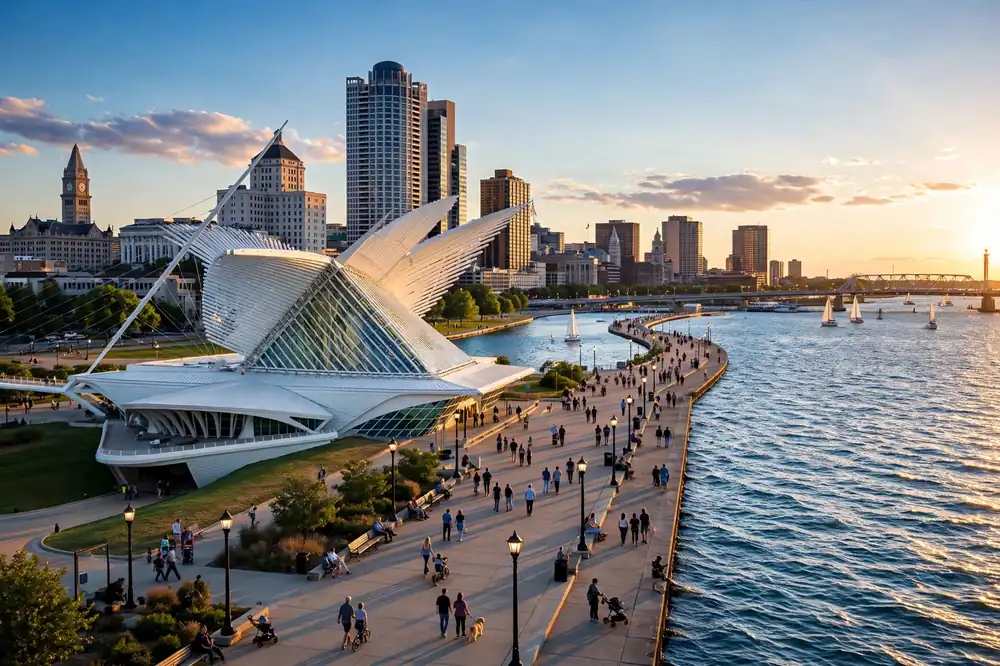
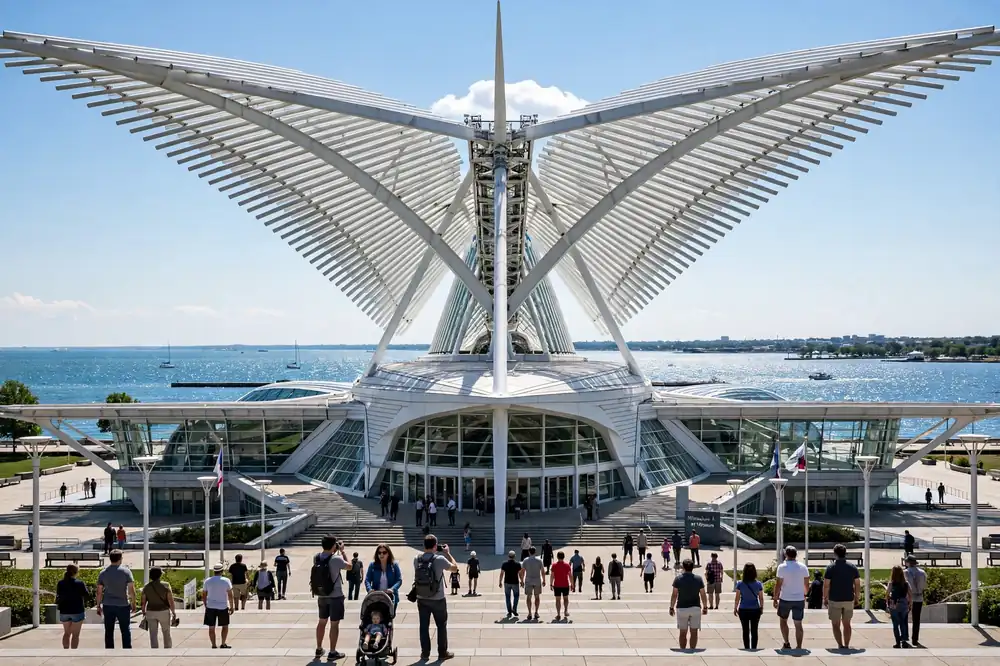
The Milwaukee Art Museum on Wikipedia is the building that put Milwaukee on the architecture map — and the single best reason to come to the city. The Quadracci Pavilion, by the Spanish architect Santiago Calatrava on Wikipedia, opened in 2001, and its Burke Brise Soleil is a movable sunscreen of white steel wings that spans 217 feet — about the wingspan of a Boeing 747 — and opens and closes above the museum like a giant bird. The wings open with the museum in the morning, close and reopen at noon, and close at 10 p.m., so time your visit for noon if you want to watch them move. Inside, the collection holds more than 30,000 works, from ancient art to contemporary, with strong holdings in American and European painting, folk art and design. The prices and the hours are the part older guides get wrong: as of November 2026, admission is $27 for adults, $20 for students, seniors 65 and over and military, free for kids 12 and under and for Wisconsin K-12 teachers with ID — older guides still quote $19, and that price is years out of date. Hours are Wednesday and Friday to Sunday 10 a.m. to 5 p.m., Thursday 10 a.m. to 8 p.m., and the museum is closed on Mondays and Tuesdays — do not plan a Monday visit. The free window is Thursday evenings, when admission is pay-what-you-wish from 4 to 8 p.m. Two exhibitions are on through the winter: The Shakers: A World in the Making, on view 25 September 2026 to 31 January 2027, and Beneath the Surface: Mining and American Photography, on view 23 October 2026 to 18 January 2027. Allow two to three hours, and go at noon for the wings, then stay for the lake views from the pavilion — the museum sits on the shore of Lake Michigan, and the view from the glass is the best free sight in the building.
2. The Harley-Davidson Museum
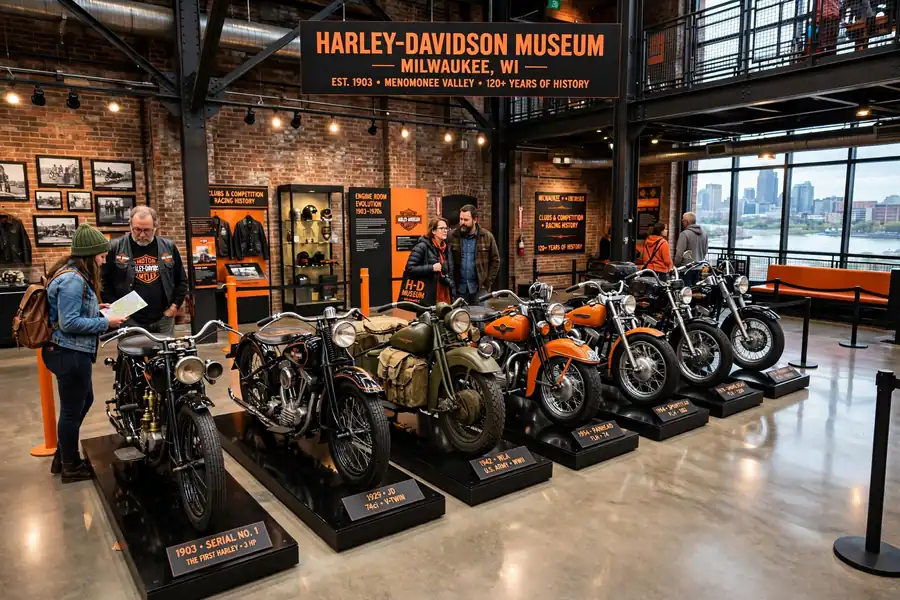
The Harley-Davidson Museum on Wikipedia is the temple of American motorcycle culture — and it works even if you have never ridden a bike. Harley-Davidson on Wikipedia was founded in Milwaukee in 1903, and the museum, on a 20-acre former industrial site on the Menomonee River at 400 W Canal Street, opened in July 2008: 130,000 square feet of motorcycles, memorabilia, engines, art and fashion, from Serial Number One, the oldest known Harley, built in 1903, through the bikes of the wars, the choppers and the 2026 models. The centrepiece is the gallery of more than 450 motorcycles, displayed in street scenes and period settings, with the story of the company told through the machines and the people who rode them. The prices are straightforward: as of November 2026, admission is $25 for adults 18 to 64, $21 for seniors 65 and over, U.S. military with ID and college students with ID, $11 for children 5 to 17, and free for children under 5 and for H.O.G. members. The museum is open daily from 10 a.m. to 5 p.m., except in January and February, when it is closed on Tuesdays and Wednesdays. The Motor Bar & Restaurant is inside the complex, parking is free, and the grounds along the river are a park in themselves. Allow two to three hours, and do not rush the early bikes — the 1903 machine and the first V-twins are the reason the museum exists, and the chopper gallery is the reason it stays fun for people who do not care about motorcycles.
3. The Historic Third Ward
The Historic Third Ward on Wikipedia is Milwaukee’s most charming neighbourhood — a National Register Historic District of restored 19th-century warehouses on the Milwaukee River, rebuilt after the fire of 1892, and now the city’s gallery, boutique and restaurant quarter. Start at the corner of Broadway and St. Paul Avenue and walk the cobbled streets: the art galleries and the design shops, the boutiques in the old warehouse buildings, the restaurants that spill onto the pavements in summer, and the Milwaukee Public Market at the heart of it. The Third Ward is also where Milwaukee’s theatre lives — the Broadway Theatre Center and the Milwaukee Rep are here — and where the neighbourhood’s festivals happen, including the Third Ward Art Festival each summer. Two practical notes: the Third Ward is a ten-minute walk from downtown across the river, or one stop on the free Hop streetcar, and the parking is in the lots and garages, so the streetcar or a walk is the better choice. Allow half a day, and come hungry — the Third Ward is the district that rewards a slow wander, and the shopkeepers are the people who will tell you what else to do in town.
4. The Milwaukee Public Market
The Milwaukee Public Market on Wikipedia is the food hall that anchors the Third Ward — a two-storey indoor market at 400 N Water Street, opened in 2005, where Milwaukee eats, shops and meets. The vendors are the draw: St. Paul Fish Company for oysters and the Friday fish fry, West Allis Cheese & Sausage Shoppe for the cheese curds and the Wisconsin cheeses, C. Adam’s Bakery for the bread and the pastries, Thief Wine for the tastings, and the produce, flower and speciality stalls in between. Upstairs is the Palm Garden, a seating area with a view over the market floor, and the market runs cooking classes through the year. The hours are straightforward: Monday to Saturday 10 a.m. to 8 p.m., Sunday 10 a.m. to 6 p.m., with early opening at 7 a.m. on weekdays for the coffee and bakery stalls. Parking in the market lot is free for the first 30 minutes, with validation from the vendors. Allow an hour or two, and come at lunchtime — the market is at its best when the stalls are full and the tables are taken, and it is the fastest way to taste Milwaukee in one room.
5. The Milwaukee RiverWalk
The Milwaukee Riverwalk on Wikipedia is the walk that ties downtown together — about three miles of paved promenade along both banks of the Milwaukee River, from the Third Ward north through downtown to the Beerline Trail, lined with restaurants, bars, public art and the city’s best people-watching. The walk is free, open 24 hours a day, all year, and it is the way to see the city: the bridges lifting for the boats, the kayakers and the paddleboarders in summer, the restaurant patios along the water, and the Bronze Fonz — the bronze statue of Arthur Fonzarelli from Happy Days, the sitcom set in 1950s Milwaukee — standing on the riverfront by the Third Ward, the most photographed statue in the city. The RiverWalk is also the route to the lakefront: follow it east past the Third Ward and the river meets Lake Michigan at the Art Museum. Two practical notes: the RiverWalk is at its best in the early morning, before the crowds, or at dusk, when the lights come on along the river, and the patios fill fast on a summer Friday, so book a table if you want to eat on the water. Allow an hour or two, and walk the whole thing — it is the walk that tells you whether Milwaukee is your kind of city.
6. The Lake Michigan lakefront — Bradford Beach and Veterans Park
Lake Michigan on Wikipedia is the reason Milwaukee looks the way it does — the city’s eastern edge is more than eight miles of public lakefront, with parks, beaches, marinas and trails, and it is the best free thing in the city. Bradford Beach is the sandy beach at the foot of the bluffs, with volleyball courts, a beach house, The Dock waterfront bar and MooSa’s custard stand, and on a hot July weekend it is full of Milwaukeeans swimming in water that is cold even in August — Lake Michigan rarely warms above the low 70s, so the beach is a sunbathing beach first and a swimming beach second. Veterans Park is the green lawn just south of the Art Museum, where the kites fly, the sailboats launch and the paddleboards rent in summer, and where the lakefront trail runs north to the marina and south to the Summerfest grounds. Lakeshore State Park, the 22-acre urban state park on the harbour, is the quietest corner of the lakefront, with a fishing pier and a view of the skyline. Two practical notes: the lakefront is a summer place — the beaches and the rentals run from June to August, and in November the wind off the lake is the coldest wind in the city, so dress for it — and the Oak Leaf Trail, more than 125 miles of paved trail around the county, runs the length of the lakefront, so rent a bike and ride it. Allow half a day, and come in the evening, when the sun sets over the city and the lake goes silver.
7. The Milwaukee Public Museum — closing soon
The Milwaukee Public Museum on Wikipedia is Wisconsin’s natural history museum — and the museum with the shortest deadline in America. The current building at 800 W Wells Street, chartered in 1882 and opened to the public in 1884, with its present building completed in 1962, will close for good on 3 January 2027. Its successor, the Nature & Culture Museum of Wisconsin, opens in the second quarter of 2027 in the Haymarket neighbourhood at 1310 N Sixth Street, a five-storey, 200,000-square-foot building that cost $255 million — but the new museum is not the old museum moved. The Streets of Old Milwaukee, the 1965 exhibit of a recreated 19th-century Milwaukee street, and the European Village will not move: their facades are built into the Wells Street building, and they cannot be taken apart. The museum is marking their final months with special programming through 17 December 2026, and the beloved snake button — the button visitors have pressed for decades to make the snake strike — is one of the few pieces that will survive into the new building. This is the trap older guides miss: they list the Streets of Old Milwaukee as a permanent attraction, and after January 2027 it will be gone. Go now, while the old building is still open, and check the museum’s own site for current hours and admission before you go. Allow two to three hours, and do not skip the dinosaurs, the rainforest and the butterfly exhibit — the pieces the new museum is keeping, and the reason the old one is loved.
8. Discovery World
Discovery World on Wikipedia is Milwaukee’s hands-on science museum and the best rainy-day stop in the city with children — 120,000 square feet of interactive exhibits on science, technology and the Great Lakes, on the lakefront at 500 N Harbor Drive, between the Art Museum and the Summerfest grounds. The Reiman Aquarium is the draw: the largest aquarium in Wisconsin, with Caribbean sharks, native Lake Michigan fish and a tunnel tank, and the 85,000-gallon Lake Michigan tank, where divers feed the fish every Wednesday at 10 a.m. while visitors watch. Upstairs are the labs, the virtual worlds, the building challenges and the rocket launches, and outside is the tall ship S/V Denis Sullivan, docked at the museum’s pier. The prices are straightforward, with one warning: the museum uses dynamic pricing, so the price moves with demand. As of November 2026, admission is $24 for adults, $20 for children 3 to 17 and seniors over 60, $18 for college students and military, and free for children under 2 — book online and save. Hours are Wednesday to Sunday 9 a.m. to 4 p.m., and the museum is closed on Mondays and Tuesdays. Allow two to three hours with children, or an hour and a half without, and go on a Wednesday morning if you want the diver feeding without the school groups.
9. The Mitchell Park Domes
The Mitchell Park Horticultural Conservatory on Wikipedia is Milwaukee’s most photographed building after the Art Museum — three giant geodesic glass domes at 524 S Layton Boulevard, each a different world: the Tropical Dome, a rainforest; the Desert Dome, a desert; and the Show Dome, a floral show that changes five times a year with seasonal themes, from Christmas to Halloween to fantasy. The domes opened in 1965 and they are the best bad-weather stop in the city: warm, humid and green in the middle of a Milwaukee winter. The prices are the cheapest museum ticket in the city: as of November 2026, admission is $10 for adults, $9 for Milwaukee County residents with ID, free for children 2 and under, and $5 for everyone on the last Thursday of every month. Hours are Monday to Friday 9 a.m. to 5 p.m., with last admission at 4 p.m., and Saturday, Sunday and holidays 9 a.m. to 4 p.m., with last admission at 3 p.m. — and the domes are closed on Thanksgiving and Christmas. One warning: during show transitions the Show Dome closes and only the Desert and Tropical domes are open, at full admission, so check the schedule before you go. Allow an hour or two, and go in January, when the tropical dome is the warmest room in Wisconsin.
10. The Pabst Mansion
The Pabst Mansion on Wikipedia is the Gilded Age house that explains Milwaukee’s brewing fortune — the home Captain Frederick Pabst, founder of the Pabst Brewing Company, built on Grand Avenue, now Wisconsin Avenue, between 1890 and 1892, in the Flemish Renaissance style, with 37 rooms, 12 baths and 14 fireplaces, at 2000 W Wisconsin Avenue. The guided tour takes about an hour and a half through three floors: the parlours and the dining room, the bedrooms and the art, and the story of the family that built the beer empire. The prices are straightforward: as of November 2026, admission is $19 for adults and $17 for children and teenagers, with discounts for seniors, students and military. Hours are Sunday to Thursday 10 a.m. to 4 p.m. and Friday to Saturday 10 a.m. to 5 p.m., with a self-guided hour every day from noon to 1 p.m. and a family-friendly tour every Saturday at 9:30 a.m. — kids go free on the family tour. The Christmas season is the busiest time: Christmas at the Pabst Mansion dresses the whole house in holiday finery, and the tours sell out, so book online. Allow an hour and a half to two hours, and do not skip the third floor — the bedrooms and the art are the part of the house that most visitors rush past.
11. The Basilica of St. Josaphat
The Basilica of St. Josaphat on Wikipedia is the most beautiful building in Milwaukee that most visitors never see — a Polish basilica in Lincoln Village, at 2333 S 6th Street, built by Polish immigrants between 1896 and 1901 and modelled on St. Peter’s Basilica in Rome, one of the largest churches in the United States. The interior is the reason to go: the murals by the Conrad Schmitt Studios, the marble, the gold and the light, with the Milwaukee Symphony Orchestra performing here through the year. The visit is free — donations are accepted at the door — and the Visitor Center in the Pope John Paul II Pavilion is open Monday to Saturday from 10 a.m. to 3 p.m., with a free docent-led tour after the Sunday 10 a.m. Mass. The basilica is a working church, so dress conservatively, act reverently, and remember that daily Mass is held in the basement. Two practical notes: the basilica is a fifteen-minute drive south of downtown, not a walk, and the tours last about an hour. Allow an hour, and go on a Sunday morning if you want the free tour — it is the best free hour in the city.
12. The Lakefront Brewery tour
The Lakefront Brewery on Wikipedia is the brewery tour by which all other brewery tours are measured — a 50-minute tour of the brewery at 1872 N Commerce Street, founded in 1987 by the brothers Jim and Russ Klisch, with the guides who are funny on purpose, four 8-ounce pours of anything on tap, and a souvenir pint glass included in the price. The prices are straightforward: as of November 2026, the tour is $13 Monday to Thursday and $16 Friday to Sunday, with kids under 13 free — and the tour is 21 and over unless supervised by a parent, because the content is adult-oriented. The beer hall is open Monday to Wednesday 3 to 9 p.m., Thursday 3 to 9 p.m., Friday to Saturday 11 a.m. to 9 p.m. and Sunday 11 a.m. to 5 p.m., and the Friday fish fry — the brewery’s famous one — runs on Friday evenings, with the kitchen closing at 3 p.m. and reopening at 4 p.m. for the fry. The cheese curds are the food to order, and Bernie’s Chalet — the chalet from County Stadium, the old Brewers ballpark — sits in the beer hall, a shrine to the team’s history. Two practical notes: book online, especially for Saturdays, because the tours sell out, and get there early on a Friday, because the fish fry seats fill by 4 p.m. Allow two hours, and stay for a pint after the tour — the beer hall is the best room in Milwaukee to drink in.
13. American Family Field — home of the World Series champions
The American Family Field on Wikipedia is the ballpark that Milwaukee built for its team — and in 2026 it became the home of the World Series champions. The Milwaukee Brewers on Wikipedia won the first World Series title in franchise history on 28 October 2026, beating the Tampa Bay Rays 4-1 in Game 5 at Tropicana Field to win the series four games to one — the 2026 World Series on Wikipedia — 44 years after their only other trip to the Fall Classic, when they lost to St. Louis in seven games in 1982. The 2026 team won 103 games, beat San Diego in the division series, swept the two-time defending champion Los Angeles Dodgers in the championship series, and then beat the Rays, with catcher William Contreras named World Series Most Valuable Player and rookie Jacob Misiorowski throwing five and two-thirds shutout innings in the clincher. The city celebrated with a parade downtown on Friday 30 October 2026, and the ballpark is now the place to see the trophy. The field itself opened in 2001 as Miller Park and was renamed in 2021: a retractable-roof stadium with tailgating in the lots, the five sausage mascots — Bratwurst, Polish, Italian, Hot Dog and Chorizo — racing between innings, and the best ballpark food in the league. Two practical notes: the ballpark is a fifteen-minute drive west of downtown, near the zoo, and the roof means the game goes on in any weather — but the tailgate is the reason to arrive early. Allow an evening, and buy tickets ahead for the big series — the 2027 season will sell fast after a championship.
14. Fiserv Forum and the Deer District — the Bucks
The Fiserv Forum on Wikipedia is the arena that changed downtown Milwaukee — the home of the Milwaukee Bucks on Wikipedia, opened in September 2018 on the north edge of downtown, with the Deer District plaza outside it, full of restaurants, bars and the big screen that shows the games. The Bucks won the NBA championship in 2021, their first since 1971, behind Giannis Antetokounmpo, and the arena is the loudest room in the city on a game night. The season runs from October to April, with the playoffs in spring, and the arena also hosts the biggest touring concerts that play Milwaukee. Two practical notes: the Deer District is free to walk and the screen shows the games outside, so come even without a ticket, and the Hop streetcar stops at Fiserv Forum, so the bus or the streetcar is the better choice on a game night — the parking fills and the prices rise. Allow an evening, and pair it with dinner in the Deer District before tip-off.
15. The Summerfest grounds — Henry Maier Festival Park
Summerfest on Wikipedia is the festival that gives Milwaukee its nickname, the City of Festivals — the world’s largest music festival, on 75 acres of lakefront at Henry Maier Festival Park, 200 N Harbor Drive, with a dozen stages, hundreds of acts and the American Family Insurance Amphitheater for the headliners. Summerfest 2026 ran across three long weekends — 18 to 20 June, 25 to 27 June and 2 to 4 July — and drew 613,475 fans, kicking off with two sold-out Garth Brooks shows on 16 and 17 June and three more sold-out amphitheater shows from Ed Sheeran, Post Malone and Megan Moroney, plus the festival’s first regional Mexican headliner, Carín León. Summerfest 2027 is already dated, and a week later than usual: 24 to 26 June, 1 to 3 July and 8 to 10 July, moved to keep the festival off Juneteenth. The first headliners are already announced: Zac Brown Band on 25 June, Lake Street Dive on 26 June, My Morning Jacket on 1 July and Foreigner on 2 July. Two practical notes: the festival grounds are closed outside festival season, so do not plan a visit in November — walk the lakefront instead — and on festival days, take the MCTS Summerfest shuttle from the park-and-ride lots, because the parking at the grounds fills and the traffic is slow. Allow a full day, and buy the amphitheater tickets when they go on sale — the headliners sell out.
16. The Milwaukee County Zoo
The Milwaukee County Zoo on Wikipedia is the family day out that Milwaukee does best — more than 2,500 animals on 200 acres at 10001 W Bluemound Road, about fifteen minutes west of downtown, with the elephants, the big cats, the primates, the penguins and the aviary, and the zoo train that loops the grounds. The prices use flex pricing, so the ticket moves with the date: as of November 2026, adults pay $14.75 to $19.75 at the gate and children 3 to 12 pay $9.75 to $16.75, with children 2 and under free — and tickets bought online are about $3 cheaper, Milwaukee County residents get $1.75 off, and Wednesdays are reduced. The free days are the Family Free Days, one Saturday a month in January, February, March, October, November and December — in 2026 they were 3 January, 7 February, 7 March, 3 October, 7 November and 5 December — though parking still applies, at $15 plus tax a vehicle. The hours change with the season: in winter, weekdays 9:30 a.m. to 2:30 p.m. and weekends to 4:30 p.m.; in summer, 9:30 a.m. to 5 p.m. — and admission ends 45 minutes before closing. The zoo’s front entry was reconfigured in April 2026, with a new free-flow entrance, so the ticket line is shorter than it was. Allow half a day, and go in the morning, when the animals are active and the crowds are thinnest.
17. The North Point Lighthouse
The North Point Lighthouse on Wikipedia is the lighthouse that watches over Milwaukee’s lakefront — a 74-foot tower at 2650 N Wahl Avenue, built in 1888, with a keeper’s house that is now a museum of the lake and the light. The climb is the reason to go: the tower stairs lead to a view over Lake Michigan, the lakefront and the city that no other spot in Milwaukee gives you, and the museum downstairs tells the story of the keepers who lived here and the ships they guided. The prices are small: as of November 2026, admission is $8 for adults, $5 for seniors 65 and over with ID and children 5 to 11, and free for children 4 and under. The museum is open from 1 to 4 p.m. — check the days before you go, because the hours are limited. Two practical notes: the lighthouse sits in Lake Park, Frederick Law Olmsted’s park on the bluffs, so pair it with a walk through the park, and the climb is steep, so wear good shoes. Allow an hour, and go on a clear day — the view is the point, and the clouds take it away.
18. The Lynden Sculpture Garden
The Lynden Sculpture Garden on Wikipedia is the outdoor museum that most Milwaukee guides skip and the one that rewards the drive — 40 acres of park, lake and woodland at 2145 W Brown Deer Road, with more than 50 monumental sculptures set into the landscape, from Henry Moore to Barbara Hepworth. The garden is a walk, not a museum: the sculptures appear on the lawns, in the trees and by the pond, and the best way to see them is slowly, on foot, with the map in your hand. The garden is at its best in summer, when the trees are full and the lawns are green, and in autumn, when the leaves turn. Two practical notes: the garden is a fifteen-minute drive north of downtown, not a walk, and the hours and admission change with the season, so check the site before you go. Allow two hours, and come in the morning, when the light is best and the garden is quietest.
19. Brady Street and the East Side
Brady Street is the East Side’s old Little Italy and still its weirdest street — a stretch of Italian grocers, cafes, bars and bookshops on Milwaukee’s East Side, where the city’s creative life happens. Start at the corner of Brady and Farwell and walk east: the coffee roasters and the bakeries, the vintage shops and the record stores, and Black Cat Alley, the free outdoor street-art gallery in the alley off Brady Street, with murals by artists from Milwaukee, Los Angeles and Berlin. The East Side is also where Milwaukee goes out at night, with the bars and the music venues, and where the Oriental Theatre stands — the 1927 movie palace on Farwell Avenue, one of the most beautiful cinemas in America, and the home of the Milwaukee Film Festival. Two practical notes: Brady Street is a fifteen-minute bus ride from downtown, or a walk from the lakefront, and the parking is street parking, so the bus is the better choice. Allow half a day, and come hungry — Brady Street is the district that rewards a slow wander, and the shopkeepers are the people who will tell you what else to do in town.
20. America’s Black Holocaust Museum
America’s Black Holocaust Museum on Wikipedia is the museum that tells the story Milwaukee owes — the history of the Black Holocaust in America, from slavery to the present, at 401 W North Avenue in the Bronzeville neighbourhood. The museum was founded by Dr. James Cameron, a survivor of a lynching in Marion, Indiana, in 1930, who opened the original museum in 1988; it closed in 2008 and reopened in February 2022 in a new building, with exhibits on the Middle Passage, slavery, segregation and the civil rights movement, and the story of Milwaukee’s own Black community. The museum is small and the visit is heavy — this is not a light afternoon, and it is not meant to be. Two practical notes: the museum is a ten-minute drive north of downtown, and the hours change with the season, so check the site before you go. Allow two hours, and go in the morning, when the museum is quietest and the exhibits can be taken slowly.
Milwaukee in 3 days — a ready-made itinerary
This three-day plan covers downtown, the museums and the lakefront, and it uses walking and the free streetcar in the city, with a car only for the zoo and the custard stands. Book the Lakefront Brewery tour before you fly, put the museums on a weekday, and keep the evenings for the Third Ward and Brady Street — Milwaukee eats early by big-city standards, with dinner from 6 p.m. and the fish fry on Fridays.
Day 1 — Downtown and the lakefront: the Art Museum, the RiverWalk and the Third Ward
Start at the Milwaukee Art Museum at 10 a.m., and stay for the wings at noon — the museum, the lake and the skyline in one morning. Walk the RiverWalk to the Third Ward for lunch at the Public Market, then spend the afternoon in the galleries and the shops, with the Bronze Fonz photograph on the way. Finish with dinner on Water Street and a drink in the Third Ward.
Day 2 — Beer, bikes and the Domes: the Harley-Davidson Museum, the brewery and the Pabst Mansion
Start at the Harley-Davidson Museum at 10 a.m. and give it two to three hours, then take the Lakefront Brewery tour and stay for the cheese curds and a pint. In the afternoon, walk to the Pabst Mansion for the guided tour, then drive to the Mitchell Park Domes for the tropical dome. Finish on Brady Street, with custard at Leon’s on the way back.
Day 3 — Out of town: the zoo, the sculpture garden and the custard crawl
Start at the Milwaukee County Zoo at 9:30 a.m. and give it half a day, then drive north to the Lynden Sculpture Garden for the afternoon walk. On the way back, do the custard crawl: Gilles on Bluemound Road, Leon’s on 27th Street and Kopp’s in Glendale, one scoop at each. Finish at Bradford Beach for the sunset, with a walk along the lakefront.
Best time to visit Milwaukee
| Season | Weather | Crowds | Notes |
|---|---|---|---|
| Spring (March–May) | Highs about 43–65°F (6–18°C), lows about 30–48°F (−1–9°C) | Moderate | Best all-round season; the lakefront wakes up, the Domes in bloom |
| Summer (June–August) | Highs about 75–80°F (24–27°C), lows about 59–65°F (15–18°C) | High | Festival season — Summerfest, the lakefront, the beach; the highest hotel prices |
| Autumn (September–November) | Highs about 46–71°F (8–22°C), lows about 34–56°F (1–13°C) | Moderate | Second-best season; fall colour on the Oak Leaf Trail, thin crowds by November |
| Winter (December–February) | Highs about 30–34°F (−1–1°C), lows about 18–23°F (−8–−5°C) | Low | Coldest and quietest; the museums and the Domes, the lowest hotel prices, about 45 inches of snow a year |
The best time to visit Milwaukee is June to September, and if you want one answer, pick late June or early September: the days are warm without being punishing, the lakefront is at its best, Summerfest is on or just over, and the hotel prices have not yet spiked for the festivals. July is the festival month, with Summerfest at the start of it, and the city is at its most crowded — come then for the events, and book the hotel a month ahead. November is the quiet month: the average high is about 46°F (8°C) and the low about 34°F (1°C), the crowds are gone, the hotel prices are at their lowest, and the museums are at their quietest. January is the coldest month, with an average high of 30°F (−1°C) and a low of 18°F (−8°C), and the city gets about 45 inches of snow a year — the snow stays on the ground, which is where you want it if you like winter. The seasonal traps are specific: the Art Museum is closed on Mondays and Tuesdays; Discovery World is closed on Mondays and Tuesdays too; the Milwaukee Public Museum closes for good on 3 January 2027; the Summerfest grounds are closed outside festival season; and the lakefront beaches are a June-to-August place, so a November trip to Bradford Beach is a walk, not a swim. Milwaukee gets more than 2,500 hours of sun a year, and the lake makes the weather change fast — pack a jacket even in July.
Where to stay in Milwaukee
| Area | Best for | Price range |
|---|---|---|
| Downtown | First-timers, the museums and the RiverWalk | $130–$260 a night |
| Historic Third Ward | Food, markets, galleries, the river | $140–$280 a night |
| Deer District | Bucks games, Fiserv Forum, nightlife | $150–$300 a night |
| East Side and Brady Street | Nightlife, cafes, the lake | $110–$200 a night |
| Bay View | Local life, cafes, the lakefront | $90–$170 a night |
| Wauwatosa | Value, the zoo, Gilles custard | $100–$180 a night |
Stay downtown if this is your first visit — the Art Museum, the RiverWalk and the Third Ward are walkable, the Hop streetcar is free, and the room rates are the most reasonable in the city — and the Pfister Hotel, the grand Victorian hotel on Wisconsin Avenue, is the stay that is an attraction in itself, with its art collection and its lobby. Stay in the Historic Third Ward if you want food and galleries — the Public Market, the restaurants and the shops, with downtown a ten-minute walk away. Stay in the Deer District if you are here for a Bucks game or a concert — the arena is outside the door, and the plaza is the party. Stay on the East Side if you want nightlife — Brady Street, the cafes and the bars, with the lake a walk away. Stay in Bay View if you want local life — the cafes, the lakefront and the village feel, with downtown a fifteen-minute bus ride away. Stay in Wauwatosa if you want value and quiet — the zoo, Gilles custard and the chain hotels, with the bus into downtown. Two warnings: do not book a room during Summerfest, a Bucks playoff game or a Brewers home series without checking the price first — the rates double, and the rooms sell out — and do not book a room on the lakefront side of a downtown hotel if you want quiet, because the wind off the lake is loud on a stormy night.
Getting around Milwaukee
| Way to travel | Cost | Best for |
|---|---|---|
| Walking | Free | Downtown, the Third Ward, the RiverWalk, the lakefront |
| The Hop streetcar | Free | Downtown, the Third Ward, the lakefront, the Intermodal Station |
| MCTS bus (single ride) | $2.75 | Everywhere the streetcar does not reach |
| MCTS day cap | $8.25 | A full day of buses |
| Rideshare / taxi | About $12–$25 in the city | Late nights, the airport with luggage |
| Rental car | About $50–$90 a day | The zoo, the Domes, the custard stands, day trips |
| Amtrak Hiawatha | Varies | Arriving from Chicago — the station is downtown |
| Bublr Bikes | Varies | The lakefront and the Oak Leaf Trail |
Downtown Milwaukee is a walking city: the Art Museum, the RiverWalk, the Third Ward and the lakefront are all within twenty minutes of each other, and the East Side is a twenty-minute walk north. The streetcar is the way to go further: The Hop is free, sponsored by Potawatomi Casino | Hotel, with the M-Line running from the Intermodal Station to Burns Commons and the L-Line looping through the lakefront and the Third Ward — and in festival season the two lines combine into the F-Line, with a stop at the Summerfest grounds. The bus is the way to go further still: MCTS runs the city, with a single ride at $2.75, a daily cap at $8.25, a weekly cap at $33 and a monthly cap at $99 — and the fare is the trap older guides miss, because it rose from $2 to $2.75 in early 2026, so the $2 fare in the old guides is stale. The airport bus is the bargain: the MCTS routes from Milwaukee Mitchell International Airport to downtown cost $2.75, and the airport is only about eight miles from downtown, a fifteen-minute drive. A car is only needed for the day trips — the zoo, the Domes, the custard stands and Lynden Sculpture Garden — and the drive to Chicago is an hour and a half on I-94. Two warnings: the downtown street parking is metered, and the parking fills up on game nights and festival weekends, so the streetcar is the better choice then — and the lake wind is real, so the walk along the lakefront is colder than the walk downtown, and you will feel it more than you expect.
Milwaukee food you have to try
Milwaukee’s food is the food of a brewing city that grew up on German boardinghouses, Polish delis, Italian grocers and Wisconsin dairy — and the tourist-trap problem here is the opposite of most cities: the chain restaurants downtown are fine, but the best food is in the Third Ward, on Brady Street and at the custard stands, where the locals queue, and the most Milwaukee meal of all is the one eaten on a Friday night with a fish fry and a beer.
Cheese curds, custard and the Friday fish fry
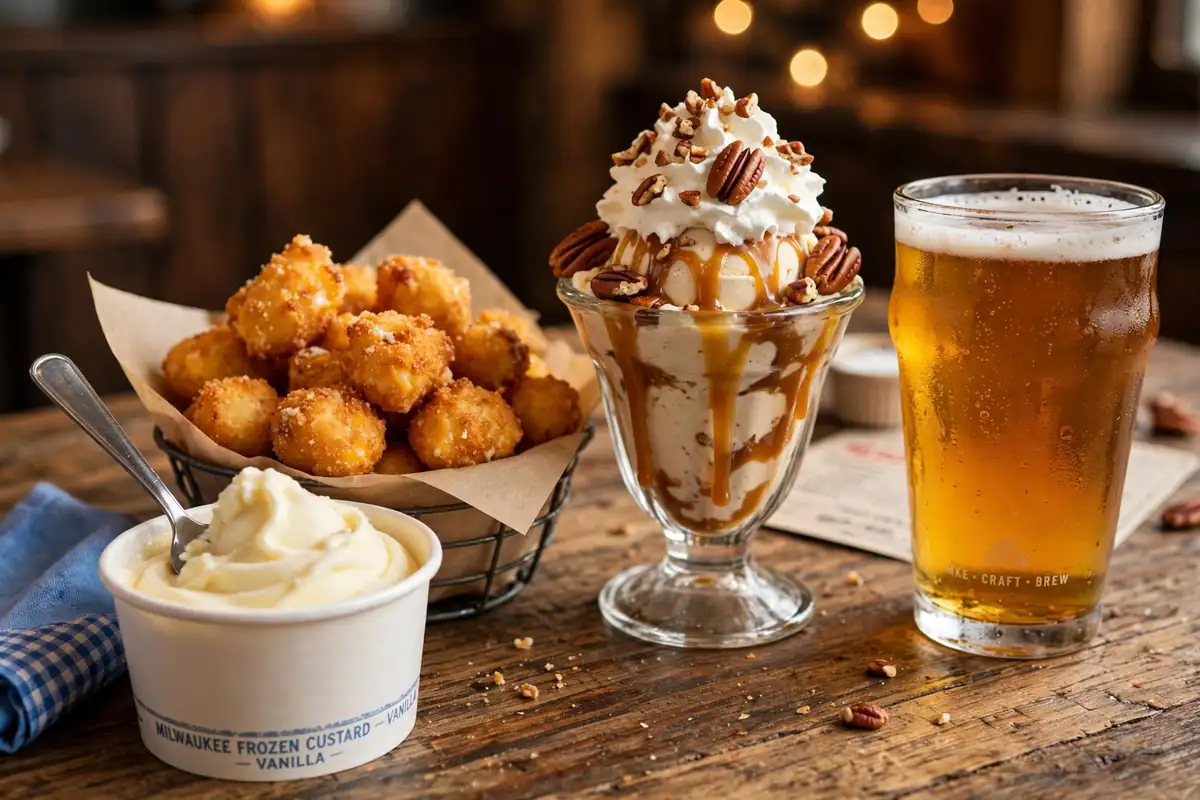
Cheese curds on Wikipedia are the dish Milwaukee is known for in the food world, and the reason is Wisconsin itself — the state’s dairy, the fresh curds that squeak when you bite them, and the battered and fried curds that every beer hall in the city serves with ranch dressing. The best curds in the city are at Lakefront Brewery, where they are fried to order and served with the beer they were made to go with. Frozen custard on Wikipedia is the dessert Milwaukee is known for in the rest of the world: the egg-yolk ice cream invented on Coney Island in 1919 that came to Milwaukee in the 1930s and never left, and Milwaukee is now the frozen custard capital of the world, with the highest concentration of custard stands anywhere. The holy trinity is Gilles, Leon’s and Kopp’s. Gilles Frozen Custard, at 7515 W Bluemound Road, opened in 1938 and is the oldest custard stand in the city — the Turtle Sundae, with buttery pecans, hot fudge, caramel and real whipped cream, is a local rite of passage. Leon’s Frozen Custard, at 3131 S 27th Street, opened in 1942 and still has its original neon sign and drive-in structure — three flavours only, vanilla, chocolate and butter pecan, plus a rotating special. Kopp’s Frozen Custard, founded by Elsa Kopp in 1950, invented the Flavor of the Day, and now has three locations in Glendale, Greenfield and Brookfield, with scoops the size of grapefruits. Fish fry on Wikipedia is the Friday tradition: the Catholic fish fry, cod or perch, potato pancakes, rye bread and coleslaw, served in every tavern and church hall in the city on Friday nights — and the Lakefront Brewery fish fry is the one to book. Eat the curds once, eat the custard three times, and eat the fish fry on a Friday — that is the Milwaukee food plan.
German food and Old World Third Street
Milwaukee’s German food is the oldest food in the city, and Old World Third Street is where it lives — the street of German restaurants, delis and shops that the city’s German immigrants built, a block from the river. Mader’s, at 1041 N Old World Third Street, has served German food since 1902: the sauerbraten, the schnitzel, the spaetzle and the strudel, in a dining room full of the family’s collection of armour and art. Usinger’s, at 1030 N Old World Third Street, has made sausage since 1880 — the bratwurst, the knockwurst and the summer sausage, sold from the shop that has stood on the street for almost 150 years. The Spice House, on the same street, is the spice shop that looks like it is from 1900, and Kegel’s Inn, in West Allis, has served German food since 1924. The German fest, German Fest Milwaukee, runs each summer at the lakefront, with the beer, the polka and the food. Eat lunch at 11:30 a.m. or 12 p.m., dinner from 6 p.m., and do not expect the German restaurants to stay open as late as the bars — the kitchens close earlier than the taverns, and the best tables fill by 7 p.m. on a Friday.
The Third Ward and the market halls
The Third Ward is where Milwaukee eats now — the Public Market and the market halls, where the food is for locals and the prices are lower than the downtown hotel restaurants. The Milwaukee Public Market on Wikipedia is the anchor: St. Paul Fish Company for the oysters, West Allis Cheese & Sausage Shoppe for the curds and the cheeses, C. Adam’s Bakery for the bread, and Thief Wine for the tastings. The 3rd St Market Hall, at 275 W Wisconsin Avenue, is the food hall — a marketplace of locally owned stalls and restaurants under one roof, with indoor games, giant Jenga and shuffleboard, and the kitchens that stay open late. Sherman Phoenix, at 3536 W Fond du Lac Avenue, is the food hall in Sherman Park, with the local vendors and the community kitchen. Eat lunch at 11:30 a.m. or 12 p.m., dinner from 6 p.m., and do not expect the market halls to stay open as late as the casinos — the local kitchens close earlier, and the best tables fill by 7 p.m. on a Friday.
Free things to do in Milwaukee
Milwaukee is cheaper than its reputation suggests, because the best sights cost nothing. The RiverWalk is free, and so is the walk along the Milwaukee River from the Third Ward to the lakefront. The Bronze Fonz is free, and so is the photograph with him. Black Cat Alley is free, and so is the street art. Bradford Beach is free, and so is the sand and the volleyball. Veterans Park is free, and so is the kite flying and the lakefront trail. Lakeshore State Park is free, and so is the fishing pier and the skyline view. The Basilica of St. Josaphat is free, and so is the tour after Sunday Mass. The Milwaukee Art Museum is pay-what-you-wish on Thursday evenings from 4 to 8 p.m., and the Milwaukee County Zoo is free on the Family Free Days. The Oak Leaf Trail is free, and so is the Hank Aaron State Trail on Wikipedia — the 14-mile trail named for the Milwaukee baseball legend, running from the lakefront west through the city. Jazz in the Park is free, on Thursday evenings in summer in Cathedral Square Park, and Sculpture Milwaukee is free, the outdoor sculpture exhibition that runs from June to October. Do the free list on your first day, and you will have seen the river, the lake, the art and the beach before you have spent a dollar on a ticket.
Frequently asked questions
How many days do you need in Milwaukee?
Three days is the minimum for the highlights: one day for downtown, the Art Museum, the RiverWalk and the Third Ward, one day for the Harley-Davidson Museum, the brewery and the Domes, and one day for the zoo, the sculpture garden and the custard crawl. Four to five days is the right amount for a real trip, with both sports venues, the Basilica and a day trip — Madison, or the Lake Michigan shore towns — and a week if you want to use the city as a base for Wisconsin, with the Door County peninsula and the Kettle Moraine trails. Two days works if you plan well — the Art Museum, the Harley-Davidson Museum, the Third Ward and a custard stand — but you will leave having seen a third of the city, and you will have missed the lakefront, which is the reason to come in summer.
Is Milwaukee safe?
Milwaukee is safe in the way a mid-sized American city is safe, and unsafe in one specific way that every visitor needs to know. Violent crime is rare in the downtown, Third Ward, East Side and lakefront areas, which are busy with visitors at all hours. The problem is the petty crime in some neighbourhoods away from the centre and late at night: keep your bag zipped and in front of you, your phone in a front pocket and never on a bar or a table, and do not leave valuables visible in a parked car — the break-ins are the crime the police report most. The areas north and west of downtown are the ones to avoid after dark unless you know them, and the alleys behind the bars are not a shortcut. Use the same sense you would in any American city, and the only thing you will lose is money at the custard stands.
When is the best time to visit Milwaukee?
June to September, when the days are warm, the lakefront is open and the city is full without being crowded. Late June and early September are the single best picks. July is the festival month, with Summerfest at the start of it, and the highest hotel prices — come then for the events, and book a month ahead. November is the quietest good month, with an average high of 46°F, thin crowds and the lowest hotel prices, and the museums at their quietest. January is the coldest, with an average high of 30°F, and the best month for the Domes, with the tropical dome at its warmest and the city at its emptiest.
Is Milwaukee expensive?
Cheaper than Chicago for the same weekend, and cheaper than most American cities for a museum trip. A downtown hotel costs $130 to $260 a night, a Third Ward hotel $140 to $280, a museum ticket $24 to $27, a brewery tour $13 to $16, a bus ride $2.75, and a custard cone about $5 to $8. The costs most visitors underestimate are the museum tickets, which add up — the Art Museum, the Harley-Davidson Museum and Discovery World together are more than $75 a person — and the Summerfest hotel prices, which double. A careful three days can be done for about $130 to $220 a person a day, and the RiverWalk, the lakefront, the parks and the street art are free.
Do you need a car in Milwaukee?
No, for the city itself. Downtown, the Third Ward and the lakefront are walkable, and the free Hop streetcar covers downtown, the Third Ward and the lakefront, with the MCTS buses covering the rest for $2.75 a ride. Yes, for everything outside the centre: the zoo, the Domes, the custard stands and the Lynden Sculpture Garden all need a car or a bus, and the rental is $50 to $90 a day. Rent a car only for the days you leave the centre, and take the streetcar for the days you do not — the downtown parking costs more than the rental on a game night. The only reason to rent for the whole trip is a road trip through Wisconsin, where the car is the trip.
What should I skip in Milwaukee?
Six things, and all six are traps older guides still get wrong. First, do not go to the Milwaukee Art Museum on a Monday or Tuesday: it is closed, and the wings do not open. Second, do not plan a trip around the Streets of Old Milwaukee after 3 January 2027: the Public Museum closes that day, and the Streets will not move to the new museum. Third, do not budget $19 for the Art Museum: admission is $27 now, and the $19 price is years out of date. Fourth, do not budget $2 for the bus: the MCTS fare rose to $2.75 in early 2026. Fifth, do not go to Bradford Beach in winter expecting a beach day: the lake is cold, the rentals are gone, and the beach season is June to August. And sixth, do not go to Discovery World on a Monday or Tuesday: it is closed, and the aquarium is the part of the lakefront you will have missed.
Further reading
Start with Milwaukee on Wikipedia, which covers the history and the geography, and Wisconsin on Wikipedia for the state and its dairy and brewing history. For what locals and regular visitors actually recommend, the r/Milwaukee subreddit is where travellers ask what there is to do besides the breweries — the RiverWalk, the lakefront, the Third Ward, the custard stands and the Brewers are the answers that come up again and again. No Quora link is included here: no live on-topic Quora thread on visiting Milwaukee turned up, so none is listed rather than linking to an off-topic one.
Your Milwaukee trip, in one paragraph
Milwaukee is the lakefront city that rewards getting up early: the Art Museum wings at noon with the lake behind them, the RiverWalk in the morning before the crowds, the Harley-Davidson Museum and the Public Market in the afternoon, a Lakefront Brewery tour and a Friday fish fry for dinner, and custard at Gilles, Leon’s or Kopp’s before you leave. For more guides in the same style, start with our Hawaii guide for the whole-state trip — this guide is only about Milwaukee — then see how Milwaukee compares with Maui, Honolulu, Chicago, Nashville, Los Angeles, Orlando, Miami, San Diego, Denver, Savannah, Dallas, Charleston, San Francisco, Myrtle Beach, Las Vegas, San Antonio, London, Portland, Pigeon Forge, Puerto Rico, Atlanta, Phoenix, Paris, Key West, Colorado Springs, Sedona, Chattanooga, Palm Springs, St Louis, Tokyo, Japan, Kansas City, Tennessee, Branson, Florida, Amsterdam, Montreal, Fort Lauderdale, Toronto, Aruba, Charlotte, Indianapolis, New Orleans, Destin, Santa Barbara, Mexico City, Arizona, Osaka, Minneapolis, Pittsburgh, California, Asheville, Costa Rica, Washington DC, Seattle, St Augustine, Lisbon, Dubai, Santa Fe, Galveston, Maine, Sacramento, Kauai, Boston, Cancun, Madrid, Salt Lake City, Baltimore, Barcelona and Reno.

About the Author