Things to Do in Dallas
20 Best Attractions, a 3-Day Itinerary, Where to Stay, and the Food You Cannot Miss
Quick Info
Best for: First-timers, history lovers, art fans, foodies and families — JFK history, a huge arts district, Texas barbecue and the Cowboys in one trip
Best time: March–May and September–November for highs in the 70s; summer runs 95–105°F, so plan museums for midday
How long: 3 full days for the highlights; 2 days covers the essentials; add a 4th day for Fort Worth or Arlington
Budget: Roughly $150–$280 per person per day for a mid-range trip; the Arts District museums, Klyde Warren Park and White Rock Lake are free
Don’t miss: The Sixth Floor Museum, Reunion Tower at sunset, the Dallas Arboretum, brisket in Deep Ellum and the State Fair in autumn
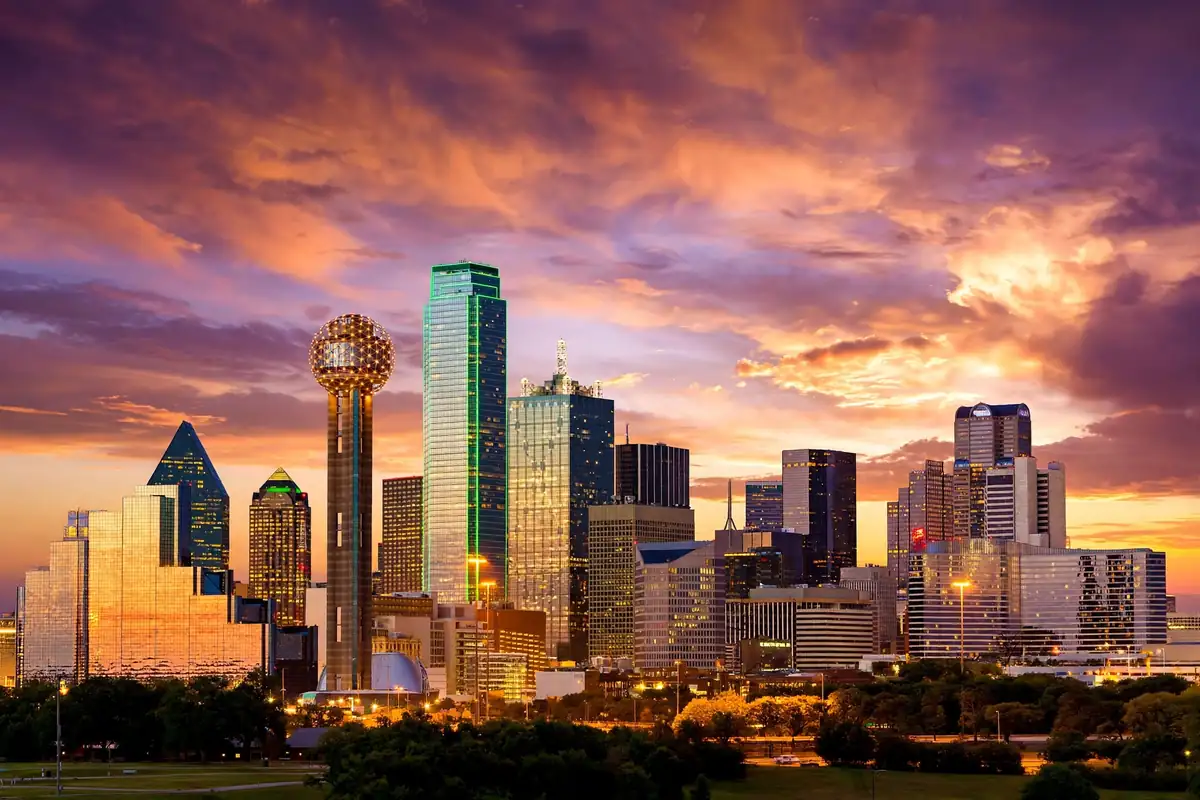
Dallas is the ninth-largest city in the United States — and the most underrated big city in America. Founded in 1841 as a trading post on the Trinity River by John Neely Bryan and incorporated on February 2, 1856, it grew into a city of 1.3 million people and the centre of the Dallas–Fort Worth metroplex, the fourth-largest metropolitan area in the country with more than 8.4 million people. Dallas is the city of the JFK assassination and the Cowboys, of the largest arts district in America and the biggest state fair in the country, of Texas barbecue and Tex-Mex and a skyline that glows after dark. And in the summer of 2026 it hosted the FIFA World Cup — a tournament-record nine matches at AT&T Stadium, including the semi-final — so the city you visit now is a city that has just shown itself to the world.
This guide gives you the 20 best things to do in Dallas in a sensible order, a ready-made 3-day itinerary, honest advice on when to go, where to stay and how to get around, and the three foods you have to try before you leave. Prices and hours change, so every price in this guide is marked as approximate — always check the official website before you visit.
Dallas at a glance
| Question | Short answer |
|---|---|
| How long do you need? | 3 full days for the highlights; 2 days covers the essentials; 4 days if you add Fort Worth or Arlington. |
| Best area for a first trip | Downtown and the Arts District — the Sixth Floor Museum, Klyde Warren Park and the museums are all within walking distance. |
| One thing to book early | Sixth Floor Museum timed tickets (they sell out 5–7 days ahead on weekends), State Fair tickets in autumn and Cowboys games. |
| One thing that is free | The Dallas Museum of Art, the Crow Museum of Asian Art, Klyde Warren Park, the McKinney Avenue Trolley and White Rock Lake. |
| Do you need a car? | Not downtown — DART light rail, the free trolley and rideshares cover the core. A car helps for the Arboretum, the Zoo and Arlington. |
For background before you go, the Wikipedia entry on Dallas covers the city’s history, from John Neely Bryan’s 1841 trading post to the JFK assassination and the World Cup summer of 2026 — it is linked in Further reading at the end of this guide.
The 20 best things to do in Dallas
The list starts with the experiences that define Dallas and that first-time visitors should protect time for, then moves into museums, neighbourhoods and the day trips beyond the city. If you only have two days, do numbers 1 to 10.
1. The Sixth Floor Museum at Dealey Plaza
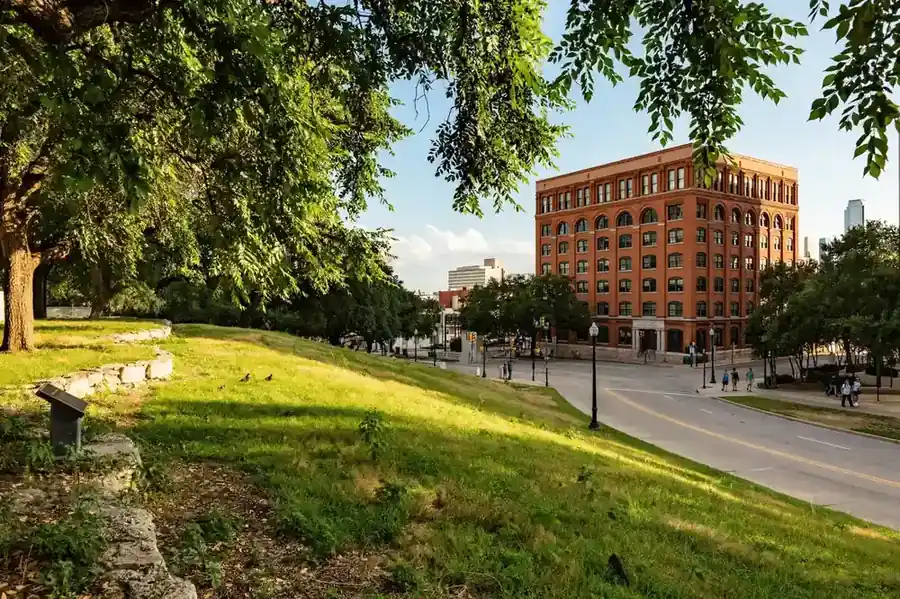
The Sixth Floor Museum is the one place in Dallas you should not miss — and the museum most first-time visitors come for. It sits on the sixth floor of the former Texas School Book Depository, the building from which Lee Harvey Oswald fired the shots that killed President John F. Kennedy on November 22, 1963, and its main exhibit, John F. Kennedy and the Memory of a Nation, walks you through Kennedy’s life, the motorcade, the assassination and the decades of investigation and argument that followed, with historic film, photographs, artefacts and more than 2,500 oral-history recordings. The museum opened on Presidents’ Day, February 20, 1989, and now draws about 400,000 visitors a year. The corner window — the “sniper’s nest” — is preserved behind glass, with the route of the motorcade marked on Elm Street below.
Practical tip: Tickets cost roughly $24–$25 for adults and entry is timed — prices are approximate, so check before visiting. The museum is closed on Mondays and weekend tickets regularly sell out 5–7 days ahead, so book online before you travel. Allow 90 minutes, and bring the audio guide — it is included and it is excellent.
2. Dealey Plaza, the Grassy Knoll and the JFK Memorial
Step outside the museum and you are standing in Dealey Plaza itself — the triple underpass, the grassy knoll, the white X painted on Elm Street where the fatal shot struck, and the reflecting pool. The plaza is a National Historic Landmark District and it is free to walk, which means you will share it with conspiracy theorists, tour groups and quiet visitors paying their respects. Two blocks east, the John F. Kennedy Memorial Plaza — a stark, roofless 30-foot square of white concrete by architect Philip Johnson, opened in 1970 — holds a simple black granite slab with Kennedy’s name in gold. It is open 24 hours a day and it is free.
Practical tip: The plaza is free and open all day. Come early in the morning, before the tour buses arrive, and read the historical markers first — they give you the facts before the street vendors give you the theories. The memorial is a two-minute walk east along Main Street.
3. Reunion Tower GeO-Deck
Reunion Tower is the glowing ball on the Dallas skyline — and the best view in the city. The 561-foot tower, completed in 1978, holds the GeO-Deck observation deck at 470 feet, with 360-degree views over downtown, the Trinity River and, on a clear day, the whole metroplex. Inside, interactive screens let you zoom into the landmarks you are looking at, and the deck runs a light show most evenings that turns the sphere into a slowly changing lantern. Come at sunset: the city goes gold, the lights come on, and the view from the deck is the photograph every Dallas visitor wants.
Practical tip: Tickets cost roughly $19–$25 for adults — prices are approximate, so check before visiting. Sunset slots are the most popular and sell out on weekends, so book ahead. The tower sits next to the Hyatt Regency downtown, a short walk from Dealey Plaza, and the restaurant upstairs, Crown Block, is worth a splurge if you want dinner with the view.
4. Klyde Warren Park
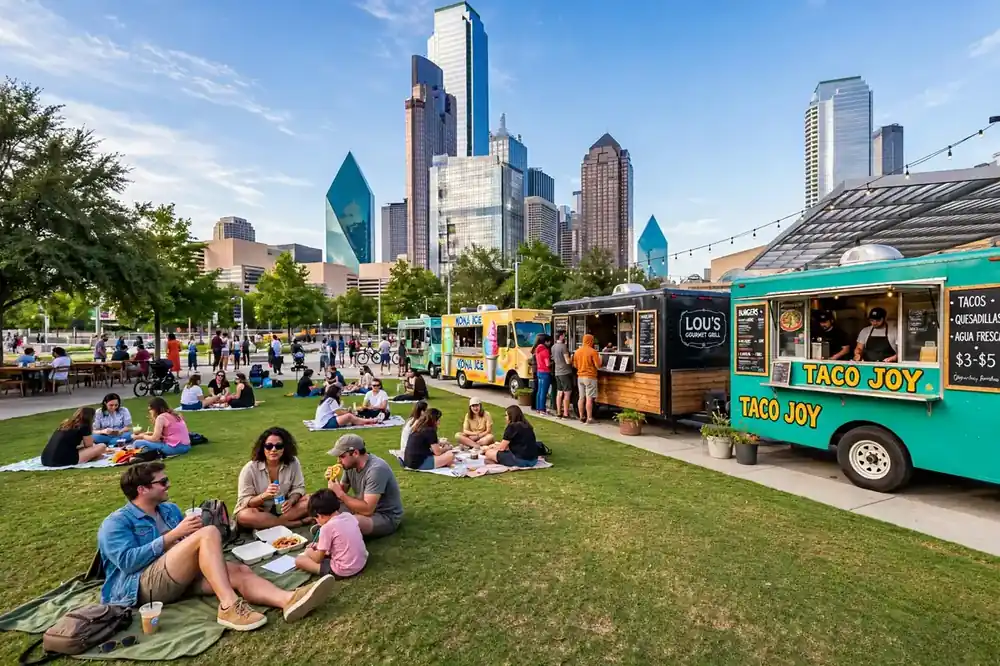
Klyde Warren Park is the park that changed downtown Dallas. Built over the Woodall Rodgers Freeway and opened in 2012, the 5.2-acre green sits between the Arts District and Uptown, with a great lawn, food trucks, a dog park, a children’s playground, free Wi-Fi and a calendar of free yoga, concerts and fitness classes. It is the city’s front lawn: office workers eat lunch here, families spread out on the grass, and on a good evening the whole of downtown seems to be out. The park is free, it is open daily, and it is the easiest free hour in the city.
Practical tip: The park is free and open daily from 6am to 11pm. Come at lunchtime for the food trucks — the lines are shortest before noon — and check the park’s calendar before you go: the free concerts and movie nights are the best evenings in downtown Dallas.
5. The Dallas Arts District — DMA, Nasher and the Crow Museum
The Dallas Arts District is the largest contiguous urban arts district in the United States — 118 acres of museums, concert halls and sculpture gardens in the middle of downtown — and its best secret is how much of it is free. The Dallas Museum of Art has offered free general admission for years, and its collection of more than 24,000 works spans 5,000 years, from ancient Mediterranean art to contemporary Texas painting. Next door, the Nasher Sculpture Center holds one of the finest collections of modern sculpture in the world in a garden designed by Renzo Piano, and the Crow Museum of Asian Art — free, always — is one of the best Asian art collections in America. Around them sit the Winspear Opera House and the Meyerson Symphony Center, two of the finest performance halls in the country.
Practical tip: The Dallas Museum of Art and the Crow Museum are free every day; the Nasher charges a small admission but is free on the first Saturday of each month — prices are approximate, so check before visiting. Start at the DMA in the morning, walk the Nasher garden at lunch, and finish at the Crow Museum in the afternoon.
6. Perot Museum of Nature and Science
The Perot Museum is the best family museum in Dallas — and the most fun building in the city to look at. The cube-shaped museum by Thom Mayne, opened in 2012, holds five floors of hands-on science: a full-size T. rex skeleton, a walk-through earthquake simulator, a children’s discovery museum for under-fives, and a 3D theatre. The travelling exhibitions rotate roughly every 90 days, so there is usually something new even if you have been before. It sits at the edge of the Arts District, a ten-minute walk from Klyde Warren Park, and it is the perfect midday stop in a Dallas summer — air-conditioned, absorbing and big enough to fill a whole afternoon.
Practical tip: Tickets cost roughly $27 for adults and $17 for children aged 2–12 — prices are approximate, so check before visiting. Go on a weekday morning to avoid the school groups, and buy tickets online: the museum can sell out on rainy summer days. Allow three hours.
7. Dallas Arboretum and Botanical Garden
The Dallas Arboretum is the prettiest place in the city — 66 acres of named gardens on the southeastern shore of White Rock Lake, built around the 1939 DeGolyer estate, a Spanish Colonial Revival mansion on the National Register of Historic Places. There are 19 named gardens, from the Jonsson Color Garden to A Woman’s Garden and the Rory Meyers Children’s Adventure Garden, and the seasonal shows are the reason locals keep coming back: Dallas Blooms, with hundreds of thousands of tulips, runs from late February to mid-April, and Autumn at the Arboretum fills the Pecan Grove with more than 50,000 pumpkins, gourds and squash in the autumn. Come in the morning, when the light is soft and the lake is still.
Practical tip: Tickets cost roughly $21.95 on weekdays and $25.95 on weekends for adults — prices are approximate, so check before visiting. Parking is extra, so consider a rideshare from White Rock Lake. The gardens open at 9am; arrive at opening in spring and autumn, when the seasonal shows draw the biggest crowds.
8. White Rock Lake
White Rock Lake is where Dallas goes to breathe. The 1,015-acre lake, built as a reservoir in 1911, is ringed by a 9.33-mile shoreline trail that is the city’s best running, cycling and walking loop, with skyline views across the water and herons, pelicans and turtles along the shore. The park around it holds picnic areas, the Bath House Cultural Center, kayak and paddleboard rentals, and the Dallas Arboretum on its southeastern shore. On a spring Saturday the trail fills with runners, cyclists and families; on a weekday morning it is just you, the water and the skyline.
Practical tip: The lake and the trail are free and open daily. Rent a bike at the trailhead if you want the full loop — the 9.33 miles take about an hour by bike and three hours on foot — and bring water in summer: there is almost no shade on the eastern side of the trail.
9. Deep Ellum
Deep Ellum is the creative heart of Dallas — and the neighbourhood most visitors end up loving most. The former warehouse district east of downtown, founded in 1873, was once the centre of Dallas blues and jazz; today its brick streets hold more than 100 bars, restaurants and music venues, walls covered in murals, and some of the best barbecue in Texas. Come for a walk in the afternoon, when the murals are best in the light, and stay for the evening, when the clubs fill and the smell of brisket drifts down the street. The Pecan Lodge, on Main Street, is the barbecue stop most locals name first — arrive before noon or expect a queue.
Practical tip: Deep Ellum is free to walk and liveliest after 6pm. Park once and walk — the neighbourhood is compact — and keep an eye on the murals: they change regularly, and the best ones are on the side streets off Main. The area is busiest on Friday and Saturday nights.
10. Bishop Arts District
The Bishop Arts District is the Dallas the locals keep for themselves — a 60-block walkable neighbourhood in Oak Cliff, south of the Trinity River, built around the old Bishop Arts streetcar stop. The streets hold independent boutiques, galleries, coffee roasters and restaurants in restored early-20th-century storefronts, and the pace is deliberately slow: this is the place for a long lunch, a browse through the shops and a slice of pie at Emporium Pies, the neighbourhood institution that put Bishop Arts on the map. It is the best half-day in Dallas for anyone who likes neighbourhoods more than landmarks.
Practical tip: The district is free to walk and best in the late afternoon, when the shops are open and the restaurants fill. Take the Dallas Streetcar from downtown — it crosses the river and drops you at the edge of the district — and come hungry: the pie shops and the Mexican restaurants are the reason most people come.
11. Dallas Zoo
The Dallas Zoo is the oldest and largest zoo in Texas — founded in 1888, spread over 106 acres, and home to more than 2,000 animals. The Giants of the Savanna habitat, opened in 2010, is the highlight: elephants, giraffes, zebras and lions sharing one of the largest savanna habitats in the United States, with a giraffe feeding deck that is the most popular photo in the zoo. The Wilds of Africa monorail, the children’s zoo and the daily animal encounters fill the rest of the day, and the zoo’s conservation work — including its breeding programmes for endangered species — is some of the best in the country.
Practical tip: Tickets cost roughly $18–$24 for adults — prices are approximate, so check before visiting. Go at opening, when the animals are most active and the Texas heat has not yet built, and buy tickets online on weekends: the zoo can sell out on spring Saturdays. Allow three to four hours.
12. Dallas World Aquarium
The Dallas World Aquarium is the most surprising building in downtown Dallas — a former warehouse in the West End that holds a full rainforest inside it. You walk down through a three-storey Orinoco rainforest, past toucans, sloths and free-flying birds, to a 20,000-gallon tunnel tank of sharks and rays, then through the Mundo Maya exhibit to penguins, manatees and a 40-foot waterfall. It is the best rainy-day stop in the city and the best indoor hour in Dallas in a summer heatwave — and it is the attraction most families name as the unexpected highlight of their trip.
Practical tip: Tickets cost roughly $34.95 for adults and $24.95 for children — prices are approximate, so check before visiting. Go at opening to beat the school groups, and allow two to three hours: the rainforest walk is slower than it looks, and the shark tunnel deserves a second pass.
13. Dallas Farmers Market
The Dallas Farmers Market has been feeding the city since 1941, and it is the best place in Dallas to eat like a local. The indoor market hall is open every day, with butchers, bakers, cheese stalls and prepared-food vendors; the outdoor Shed pavilion, open on weekends, holds more than 100 stalls of Texas farmers selling produce, pecans, honey, jams and flowers. Come hungry on a Saturday morning, when the stalls are fullest and the food trucks line up outside — and come with cash for the smallest vendors. The market sits at the edge of downtown, a short walk from Deep Ellum, and it pairs perfectly with a morning in the neighbourhood.
Practical tip: The market is free to browse and open daily; the outdoor Shed is busiest on Saturday mornings. Arrive before 10am for the best produce and the shortest food-truck lines, and bring a bag — the pecans, the honey and the jams are the souvenirs worth taking home.
14. State Fair of Texas and Fair Park
The State Fair of Texas is the biggest event in Dallas — and the most Texan thing you can do in the city. Held almost every year since 1886 at Fair Park, the 277-acre 1936 Texas Centennial Exposition site and National Historic Landmark, the fair runs for 24 days from late September to mid-October and draws more than two million visitors. Big Tex, the 55-foot cowboy who has greeted visitors since 1952, presides over fried food of every description, livestock shows, the Midway, the auto show and the nightly fireworks. The 2026 fair ran September 25 to October 18, with adult tickets around $15 on weekdays and $25 on weekends. Fair Park itself is worth a visit all year: the Art Deco halls, the lagoon and the museums are the finest collection of 1930s architecture in the United States.
Practical tip: If you visit in late September or October, plan a full day at the fair and buy tickets online — prices are approximate, so check before visiting. Come on a weekday for smaller crowds, wear comfortable shoes, and save the fried food for the afternoon: the morning is for the livestock barns and the Art Deco halls.
15. See the Cowboys at AT&T Stadium
Even if you are not a football fan, a Dallas Cowboys game at AT&T Stadium in Arlington is one of the great American sporting experiences. The stadium — the largest in the NFL, with a capacity of around 94,000 — holds the world’s largest high-definition video board, a retractable roof and a party deck, and the pre-game tailgating in the parking lots is a Texas ritual in itself. The stadium’s newest claim to fame is the FIFA World Cup 2026: Dallas hosted a tournament-record nine matches here, renamed Dallas Stadium for the tournament, from June 14 to July 14, 2026 — five group games, two Round of 32 ties, one Round of 16 tie and the semi-final, in which Spain beat France 2–0 on July 14 before going on to win the World Cup, beating Argentina 1–0 after extra time at MetLife Stadium on July 19. The crowds have gone and the prices have settled, but the stadium tours still tell the story.
Practical tip: Game tickets vary widely by opponent — check the Cowboys’ schedule and book early for divisional games. There is no direct public transit to the stadium, so plan a rideshare or a stadium shuttle from downtown Dallas. Stadium tours run on non-game days and are the best way to see the building without a ticket.
16. George W. Bush Presidential Library and Museum
The George W. Bush Presidential Center, on the campus of Southern Methodist University, is the most thoughtful presidential library in Texas — and one of the best museums in Dallas. The museum covers the Bush presidency with unusual honesty, including a full-scale replica of the Oval Office, the steel beams from the World Trade Center, the decision points theatre where you can replay the choices of 9/11 and the Iraq War, and a 15-acre native Texas prairie outside. It is a serious, absorbing museum, and it is the best place in Dallas to understand the city’s recent history — and the presidency that defined the 2000s.
Practical tip: Tickets cost roughly $22 for adults — prices are approximate, so check before visiting. Allow two to three hours, and do not miss the Oval Office replica — it is the most photographed room in the museum — or the prairie walk outside, which is free and open daily.
17. Frontiers of Flight Museum
The Frontiers of Flight Museum, at Dallas Love Field, is the museum most Dallas guides underrate — and the one aviation fans love most. The 100,000-square-foot museum holds more than 30 aircraft and spacecraft, from a full-size Apollo 7 command module to a Southwest Airlines Boeing 737 you can walk through, plus flight simulators, a children’s discovery area and one of the best collections of Southwest Airlines memorabilia in the world. It sits on the airport where Southwest was born, and the whole museum smells faintly of jet fuel and history. It is the perfect stop on your way to or from Love Field — and the best hour in Dallas for anyone who loves aeroplanes.
Practical tip: Tickets cost roughly $12 for adults — prices are approximate, so check before visiting. Allow two hours, and time your visit for a weekday morning, when the simulators are quiet and the museum is at its calmest. The museum is a five-minute drive from Love Field, so it pairs well with an arrival or departure day.
18. Margaret Hunt Hill Bridge and the Trinity River
The Margaret Hunt Hill Bridge is the most photographed bridge in Texas — a single white arch by Santiago Calatrava, opened in 2012, spanning the Trinity River and tying downtown Dallas to West Dallas. Walk it at dusk, when the arch is lit and the skyline glows behind you, then cross the Ronald Kirk Pedestrian Bridge next door, which holds a lawn, a dog park and the best skyline picnic spot in the city. Below, the Trinity River floodplain holds the Trinity Skyline Trail and the Trinity River Audubon Center, where the city’s newest parkland is taking shape — and where Dallas is building its next decade of green space. The bridges are free, and they are the best free sunset in the city.
Practical tip: The bridges are free and open 24 hours. Come at sunset for the best photographs, and walk the Ronald Kirk Pedestrian Bridge rather than driving across the Hunt Hill Bridge — the pedestrian bridge is where the views are. The Trinity River Audubon Center, ten minutes east, is free on the third Thursday of each month.
19. The Eye and downtown’s public art
The Eye is the strangest sight in downtown Dallas — a 30-foot-tall fibreglass eyeball, complete with veins and a blue iris, sitting on the lawn of The Joule hotel on Main Street. The sculpture, by Tony Tasset, was installed in 2013 and has become the city’s most photographed oddity: everyone who walks past it stops, stares and takes a photo. It is the start of a free public-art walk through downtown: from The Eye, walk to the giant red Pegasus on the Magnolia Building, the murals of Deep Ellum, the sculptures of the Nasher garden and the neon of the AT&T Discovery District, the plaza that lights up after dark with digital art and free events. Dallas takes its public art seriously — and the walk is free.
Practical tip: The Eye is free to see and photograph, on the lawn of The Joule at Main and Akard. Do the walk in the late afternoon, when the light is good for photographs, and finish at the AT&T Discovery District after dark, when the plaza’s digital art comes alive.
20. Day trip: the Fort Worth Stockyards
The Fort Worth Stockyards are the best day trip from Dallas — and the most Texan hour within 40 minutes of downtown. The historic Stockyards, the centre of the Texas cattle trade, still run the world’s only twice-daily longhorn cattle drive, at 11:30am and 4pm, when a herd of Texas longhorns walks down East Exchange Avenue past the saloons and the shops. Around it sit the Livestock Exchange Building, the Cowtown Coliseum — home of the world’s first indoor rodeo — and the Stockyards Museum, plus barbecue joints, boot shops and the best Western wear in Texas. Pair it with the Kimbell Art Museum in the Fort Worth Cultural District, whose permanent collection is free, and you have the best day trip in North Texas.
Practical tip: The Stockyards are about 40 minutes west of downtown Dallas by car, and the cattle drive is free to watch — arrive 15 minutes early for a good spot. The drive runs at 11:30am and 4pm daily. If you want a second stop, the Kimbell Art Museum’s permanent collection is free, and its building by Louis Kahn is one of the finest museum buildings in America. And if you have a second day trip in you, Palo Pinto Mountains State Park — the first new Texas state park in North Texas in more than 25 years — opened on March 1, 2026, about 75 miles west of Dallas, with 4,871 acres of hiking, camping and hill-country views.
Dallas in 3 days — a ready-made itinerary
This plan groups sights that sit near each other, so you are sightseeing instead of crossing the city. Dallas is a driving city, so each day stays in one area, and the plan is built around the heat: the outdoors in the morning and the evening, the museums in the middle of the day. Timings are a guide, not a schedule to stress about — swap Day 2 and Day 3 if the weather demands it, and always do the Sixth Floor Museum first thing, when it is quietest.
| Day | Morning | Afternoon | Evening |
|---|---|---|---|
| Day 1 — Downtown and the Arts District | Sixth Floor Museum and Dealey Plaza | Dallas Museum of Art, Nasher and Klyde Warren Park | Reunion Tower at sunset, dinner in Deep Ellum |
| Day 2 — Fair Park, the Perot and the neighbourhoods | Perot Museum of Nature and Science | Fair Park and the State Fair grounds, then the Farmers Market | Bishop Arts District for dinner and a stroll |
| Day 3 — White Rock Lake, the Arboretum and the river | Dallas Arboretum and Botanical Garden | White Rock Lake trail and the Katy Trail | Margaret Hunt Hill Bridge at dusk, barbecue dinner |
Day 1: Downtown and the Arts District
Start at the Sixth Floor Museum in the morning — book the first timed slot, when the museum is quietest — then walk Dealey Plaza, the grassy knoll and the JFK Memorial. In the afternoon, cross to the Arts District for the Dallas Museum of Art, the Nasher Sculpture Center garden and Klyde Warren Park, with the food trucks for lunch. Finish the day at Reunion Tower for sunset, then dinner and live music in Deep Ellum.
Day 2: Fair Park, the Perot and the neighbourhoods
Start at the Perot Museum in the morning, when the hands-on exhibits are quietest. In the afternoon, head to Fair Park — the Art Deco halls, the lagoon and the museums — then walk the Dallas Farmers Market and the edge of Deep Ellum. End the day in the Bishop Arts District, with a long dinner, a browse through the shops and a slice of pie. If it is late September or October, swap the afternoon for the State Fair of Texas instead.
Day 3: White Rock Lake, the Arboretum and the river
Start at the Dallas Arboretum at 9am opening, when the gardens are at their best, then walk or cycle the White Rock Lake trail in the late morning. In the afternoon, take the Katy Trail through Uptown and the McKinney Avenue Trolley back downtown. End the trip at the Margaret Hunt Hill Bridge at dusk, with the skyline lit behind you, and a barbecue dinner in Deep Ellum — the right way to finish a Dallas trip.
Only have 2 days? Do Day 1 and Day 2, and add the Arboretum on the morning of Day 2 if your flight is late. Only have 1 day? Do the Sixth Floor Museum, Dealey Plaza, the Arts District, Klyde Warren Park and Reunion Tower at sunset — that is Dallas in miniature. With 4 days, add the Fort Worth Stockyards and the Kimbell Art Museum, or a Cowboys game and Six Flags Over Texas in Arlington. Families with younger children should also look at Universal Kids Resort in Frisco, the new family theme park that joined the metro’s line-up in 2026.
Best time to visit Dallas
Dallas has a humid subtropical climate, so there is no bad month — but the city feels very different by season. The honest summary is this: March to May and September to November give you the best balance of mild weather, bluebonnets and smaller crowds, while summer is hot and fierce, and winter is the cheapest and quietest time downtown.
| Season | What it is like | Best for |
|---|---|---|
| Winter (December–February) | Mild and sunny, highs around 45–60°F, the cheapest hotels — with the occasional ice storm | First trips, walking, budget trips |
| Spring (March–May) | Warm days in the 70s, bluebonnets in bloom, Dallas Blooms tulips at the Arboretum from late February to mid-April | First trips, the Arboretum, festivals |
| Summer (June–August) | Hot and fierce, highs of 95–105°F, afternoons past 100°F — plan museums for midday and the outdoors for morning | Indoor museums, the Zoo early, the State Fair build-up |
| Autumn (September–November) | Warm and golden, the State Fair of Texas in late September to mid-October, the Pumpkin Village at the Arboretum | First trips, the State Fair, the best weather of the year |
Remember that the State Fair of Texas runs from late September to mid-October and brings the biggest crowds of the year — book hotels months ahead if you come for it — and that Dallas Blooms fills the Arboretum with tulips from late February to mid-April. Summer brings near-daily highs past 100°F, so plan the outdoors for the morning and the museums for the afternoon, and drink more water than you think you need. Whatever month you choose, pack for the heat in summer and layers in winter: Dallas weather changes fast, and the winter ice storms arrive without warning.
Where to stay in Dallas
For a first trip, stay downtown or in Uptown, around the Arts District and McKinney Avenue. You will be close to the sights in this guide, you will be able to walk in the evenings, and you will not lose time commuting. These are the areas to look at first:
| Area | Who it suits | Why stay there |
|---|---|---|
| Downtown — Arts District | First-timers, walkers | The museums, Klyde Warren Park and Dealey Plaza on your doorstep |
| Uptown | Nightlife, restaurants | The McKinney Avenue Trolley, the Katy Trail and the restaurants on your doorstep |
| Deep Ellum | Music lovers, a younger crowd | Live music, murals and barbecue on your doorstep |
| Bishop Arts District | A local feel, indie shops | Quiet streets, galleries and pie shops on your doorstep |
| Arlington | Sports and theme parks | AT&T Stadium and Six Flags Over Texas on your doorstep |
Wherever you choose, check how far the nearest DART station or trolley stop is before you book — Dallas is a driving city, but a hotel that looks central can still be a 20-minute walk from the sights you visit most. Hotel prices swing sharply with the State Fair, big Cowboys games and convention weekends, so comparing dates can save real money.
Getting around Dallas
Dallas is a driving city, and the honest advice is to use DART and the free trolley downtown and a car or a rideshare for everything else. The core is well served, but the sights in this guide are spread across the city — and the heat makes walking long distances hard work in summer.
- Walking: Downtown and the Arts District are flat and compact — you can cross them on foot in about 20 minutes — and every sight on Day 1 of this guide is a walk from Dealey Plaza. The summer heat is the real limit: walk in the morning and the evening, and use the air-conditioning in between.
- DART light rail: The DART light rail runs four lines through downtown, Uptown, the Fair Park area and out to the airports’ edges. A day pass costs roughly $6 — prices are approximate, so check before visiting. Note that the D2 Subway construction has shifted some downtown rail routing in 2026, so check the DART site for current service before you travel.
- Free McKinney Avenue Trolley: The vintage streetcars of the M-Line run free, 365 days a year, through Uptown and the Arts District — the most charming ride in the city, and the easiest way to get between downtown and Uptown.
- Dallas Streetcar: The modern streetcar crosses the Trinity River from downtown to the Bishop Arts District, making the Oak Cliff neighbourhoods easy without a car.
- Rideshare: Rideshare cars are easy to find downtown and in Uptown, and are the simplest way to reach the Arboretum, the Zoo and the Bishop Arts District without a car of your own. There is no direct public transit to AT&T Stadium, so plan a rideshare or a stadium shuttle for game days.
- Driving: A car is the most flexible way to reach the Arboretum, the Zoo, Fort Worth and Arlington, and the sights in this guide are spread across them. Traffic is heavy by Texas standards at rush hour, so park in a garage downtown and walk once you are there.
- From the airport: Dallas/Fort Worth International Airport (DFW) is about 25 minutes northwest of downtown by car and is one of the largest and busiest airports in the world; the DART Orange Line runs to the airport. Dallas Love Field (DAL) is ten minutes northwest of downtown and is served by bus and rideshare.
- Cycling: The Katy Trail runs 3.5 miles through Uptown and the White Rock Lake trail loops 9.33 miles around the lake — the two best rides in the city. Bike rentals are available at the trailheads. Keep the bike to the trails and the parks in summer: the heat and the traffic make downtown cycling hard work.
Dallas food you have to try
You can eat very well in Dallas at every budget, from food trucks in Klyde Warren Park to white-tablecloth dining in Uptown. But three foods are Dallas signatures, and a first trip is not complete until you have tried all three.
Texas barbecue brisket
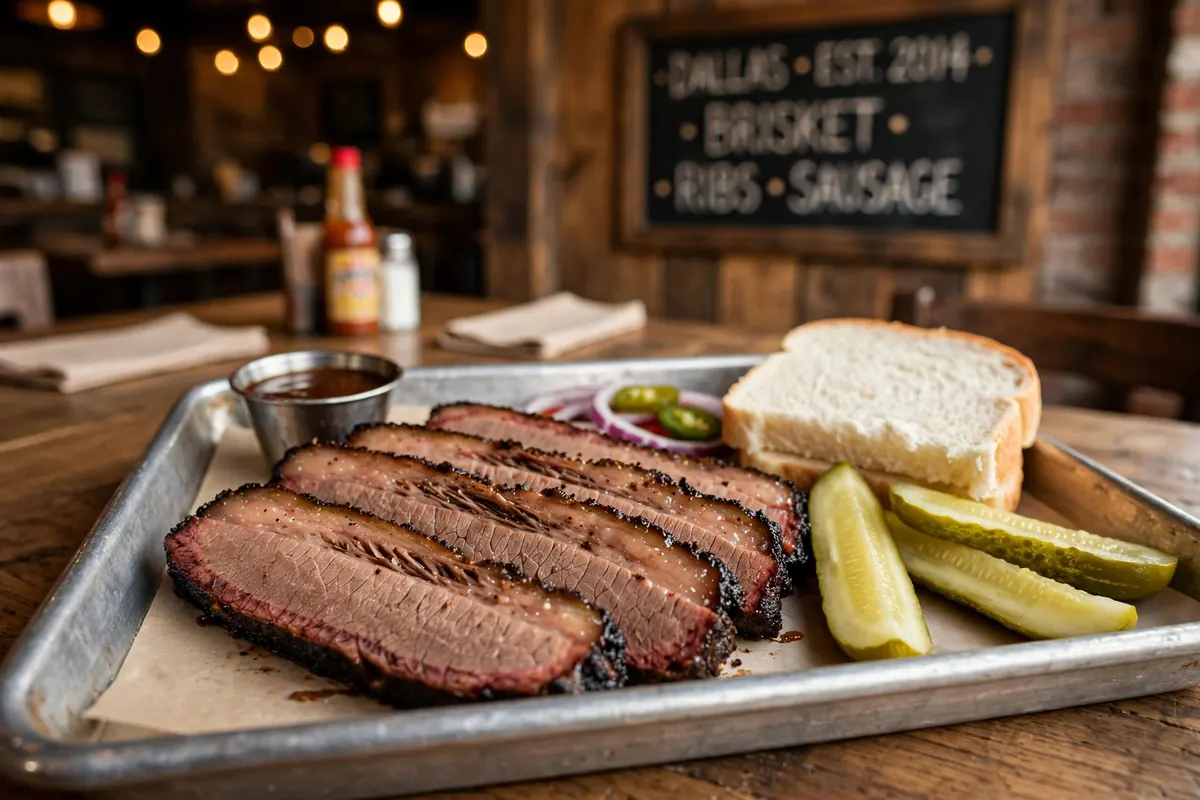
Texas barbecue is brisket — and Dallas does it as well as anywhere in the state. The brisket is smoked low and slow over post oak for 12 to 16 hours until the bark is black and the meat pulls apart, then sliced thick and served on butcher paper with pickles, onions and white bread. No sauce, or sauce on the side: in Texas, the meat is the argument. The Pecan Lodge in Deep Ellum is the name most locals give first, but the city holds a dozen serious smokehouses, from Lockhart Smokehouse in Bishop Arts to Terry Black’s in Deep Ellum. Order the brisket, the beef ribs and the jalapeño sausage, and come hungry.
Practical tip: A barbecue plate costs roughly $18–$28 — prices are approximate, so check before visiting. The best smokehouses sell out of brisket by early afternoon, so arrive before noon on weekends, and expect a queue: it is part of the experience.
Tex-Mex
Tex-Mex was invented in Texas, and Dallas is one of its capitals. The formula is simple and it has not changed in a century: queso and chips on arrival, cheese enchiladas with chili gravy, crispy tacos, fajitas sizzling on a cast-iron skillet, and a frozen margarita to wash it down. Mi Cocina — the original on Greenville Avenue, with its famous Mambo Taxi margarita — is the Dallas institution, and the city holds a hundred neighbourhood Tex-Mex joints that have been serving the same plates for decades. Order the enchiladas, the queso and the margarita, and do not ask for a fork with the fajitas.
Practical tip: A Tex-Mex dinner costs roughly $15–$25 per person — prices are approximate, so check before visiting. Go at lunch for the cheapest plates, and try the queso — Dallas takes its queso seriously, and the best versions are the ones with chorizo.
Chicken-fried steak
Chicken-fried steak is the dish Texas claims as its own — a tenderised steak, breaded like fried chicken, fried crisp and drowned in cream gravy, served with mashed potatoes and green beans. It is the plate that built the Texas diner, and Dallas does it properly: the steak is thin, the crust is crisp, the gravy is peppery and the portion is generous. The best versions are in the old-school diners and the neighbourhood cafes, not the chains — and the honest advice is to order it once, share it if you can, and save room for the pie.
Practical tip: A chicken-fried steak costs roughly $14–$22 — prices are approximate, so check before visiting. Order it at lunch, when the diners are at their best, and ask for the cream gravy on the side if you want to taste the crust first.
Beyond the big three, leave room for a plate of breakfast tacos, a bowl of tortilla soup, a family-style dinner in the Bishop Arts District — and at least one neighbourhood meal in Deep Ellum or on Greenville Avenue.
Free things to do in Dallas
Dallas is unusually generous to budget travellers. Several of its very best experiences cost nothing at all:
- The Dallas Museum of Art: Free general admission every day, with a collection of more than 24,000 works spanning 5,000 years.
- The Crow Museum of Asian Art: Free always, with one of the best Asian art collections in America, in the heart of the Arts District.
- Klyde Warren Park: The freeway park with food trucks, free yoga, free concerts and the best lawn in downtown Dallas.
- The McKinney Avenue Trolley: A free ride in a vintage streetcar through Uptown, running 365 days a year.
- White Rock Lake: The 9.33-mile shoreline trail, the picnic areas and the skyline views — all free, all day.
- Dealey Plaza and the JFK Memorial: The plaza, the grassy knoll and the memorial are free to walk, 24 hours a day.
- The Margaret Hunt Hill Bridge: The Calatrava arch and the pedestrian bridge next door, with the best free sunset in the city.
- The Eye at The Joule: The 30-foot eyeball on Main Street — the strangest free photo in Dallas.
Build each day around one paid highlight and fill the rest with free sights. That is how a Dallas weekend stays affordable without feeling cheap — the free things here are genuinely the best things in the city.
Frequently asked questions
How many days do you need in Dallas?
Three full days is the standard first trip: one day for downtown and the Arts District, one day for Fair Park, the Perot and the neighbourhoods, and one day for White Rock Lake, the Arboretum and the river. Two days covers the essentials — the Sixth Floor Museum, Reunion Tower, the Arts District and Deep Ellum — and a fourth day is best spent in Fort Worth or Arlington.
What is the best time to visit Dallas?
March to May and September to November are the sweet spot: mild days with highs in the 70s, the Arboretum in bloom in spring and the State Fair in autumn. Summer is hot, with highs of 95–105°F and afternoons past 100°F, so plan museums for midday and the outdoors for the morning. Winter is mild, with highs around 45–60°F, and the cheapest hotels of the year — with the occasional ice storm.
Do you need a car in Dallas?
Not for the main sights — downtown, the Arts District, Deep Ellum and Uptown are covered by DART light rail, the free McKinney Avenue Trolley and rideshares. A car helps for the Arboretum, the Zoo and Arlington, where there is no direct public transit to AT&T Stadium. If you do rent one, park in a garage downtown and walk once you are there.
Is Dallas expensive?
Dallas is one of the more affordable big cities in the United States: a mid-range trip runs roughly $150–$280 per person per day. The way to keep costs down is to use the free museums, the free trolley and the free parks, eat barbecue and Tex-Mex instead of fine dining, and stay in Uptown or Bishop Arts rather than downtown.
Is Dallas safe for tourists?
The tourist areas are safe with normal city sense: stay aware late at night in Deep Ellum, do not leave valuables visible in parked cars, and keep to the busy, well-lit streets after dark. Downtown, the Arts District and Uptown are well patrolled and busy into the evening.
What is the one thing you should not miss in Dallas?
The Sixth Floor Museum. It is the museum Dallas is known for, it is the most moving hour in the city, and it is the reason most first-time visitors come. Book the timed ticket before you travel — weekend slots sell out 5–7 days ahead — and pair it with a walk around Dealey Plaza and the JFK Memorial afterwards.
Further reading — Wikipedia, Reddit and Quora
Want to dig deeper or hear directly from locals and other travellers? These pages are the best next stops:
- Wikipedia — Dallas — the city’s history, from John Neely Bryan’s 1841 trading post to the 9th-largest city in the United States, the JFK assassination and the World Cup summer of 2026.
- Wikipedia — Sixth Floor Museum — the history of the museum in the former Texas School Book Depository, from its opening on February 20, 1989 to its oral-history archive of more than 2,500 recordings.
- Wikipedia — Dallas Arboretum and Botanical Garden — the story of the 66-acre garden on White Rock Lake, from the DeGolyer estate to Dallas Blooms and the 50,000-pumpkin Autumn at the Arboretum.
- Reddit — r/Dallas — the Dallas community on Reddit, where locals answer first-time visitors’ questions and share current tips on barbecue, the State Fair and the best neighbourhoods.
- Quora — indoor things to do in Dallas — travellers’ and locals’ answers on the best indoor things to do in Dallas, Texas — useful when the summer heat or a winter ice storm keeps you inside.
Your Dallas trip, in one paragraph
Start at the Sixth Floor Museum in the morning, walk the Arts District in the afternoon, watch the sunset from Reunion Tower, eat brisket in Deep Ellum, spend a day at the Arboretum and White Rock Lake, and finish with the State Fair in autumn or the Stockyards in Fort Worth. Do that, and you will leave Dallas understanding exactly why people who visit once tend to come back. And if you liked this guide, read our guide to things to do in Chicago, our guide to things to do in Nashville, our guide to things to do in Los Angeles, our guide to things to do in Orlando, our guide to things to do in Miami, our guide to things to do in San Diego, our guide to things to do in Denver and our guide to things to do in Savannah — the same format, the same honest prices, and eight more great American cities.
Prices, hours and seasonal schedules in this guide are approximate and were given as a guide only. Please check the official website of each attraction before you visit.

About the Author