Things to Do in New Orleans
20 Best Attractions, a 3-Day Itinerary, Where to Stay, and the Food You Cannot Miss
Quick Info
Best for: First-time visitors, music lovers, food lovers, history buffs and anyone who wants an American city that feels like nowhere else in the country
Best time: February to April and October to November for warm days, festivals and the lowest humidity; late November to December for the holiday lights
How long: 3 days covers the essentials; add a fourth day for a swamp tour, a plantation visit or a slow day in the Garden District
Budget: Roughly $150 to $250 per person per day, mid-range, before your hotel
Don’t miss: Jackson Square in the morning, a set at Preservation Hall, jazz on Frenchmen Street, the St. Charles streetcar, and a bowl of gumbo
New Orleans is the most unlike-anywhere-else city in the United States: a French-founded, Spanish-built, Creole-cooked port where jazz was born, the cemeteries sit above ground, the streetcars are older than most countries’ railways, and dinner is an event, not a meal. This guide covers the 20 best things to do in New Orleans, with honest 2026 prices and the traps outdated guides still fall into. Use the 3-day itinerary to plan your days, the where to stay section to pick a base, and the how to get around notes to ride the streetcars like a local — then finish with the three foods every visitor should taste and the free sights that cost nothing at all.
New Orleans was founded by the French in 1718, ruled by Spain for forty years, sold to the United States in the Louisiana Purchase of 1803, and shaped ever since by French, Spanish, African, Caribbean and Vietnamese hands. The result is a city with its own music, its own food, its own architecture and its own calendar — Mardi Gras in February, Jazz Fest in spring, second lines on Sundays all year. Come for the French Quarter, but stay for the neighbourhoods: the Garden District’s oak-lined avenues, the Marigny’s music clubs, Tremé’s brass bands and City Park’s live oaks. One honest warning before you go: a lot of what you read about New Orleans online is years out of date. Prices have risen, a cemetery has reopened, Café du Monde no longer stays open all night, and the museum that used to cost $15 now costs $23. This guide was checked against 2026 sources, and where an old figure still circulates, it is called out.
New Orleans at a glance
| Attraction | What it is | Adult price in 2026 | Where |
|---|---|---|---|
| Jackson Square and St. Louis Cathedral | The heart of the French Quarter | Free | French Quarter |
| Café du Monde | Beignets and café au lait since 1862 | About $4 for three beignets | French Quarter, Decatur Street |
| Preservation Hall | Traditional jazz in a tiny room | From $25 per set | French Quarter, St. Peter Street |
| National WWII Museum | America’s best WWII museum | $37 | Warehouse District |
| St. Charles streetcar | World’s oldest street railway | $1.25 a ride | Canal Street to Uptown |
| St. Louis Cemetery No. 1 | Above-ground tombs, guided tours only | From $25 | Edge of the French Quarter |
| City Park and NOMA | Live oaks, sculpture garden, art museum | Park free; museum $23 | Mid-City, Esplanade Avenue |
| Audubon Zoo | Louisiana swamp, white alligators | $30–$40 | Uptown, Audubon Park |
| Steamboat Natchez | Mississippi riverboat cruise | $25.75 | French Quarter riverfront |
| Whitney Plantation | Museum of enslaved people’s history | $89 with coach | River Road, about an hour away |
The 20 best things to do in New Orleans
1. The French Quarter and Jackson Square
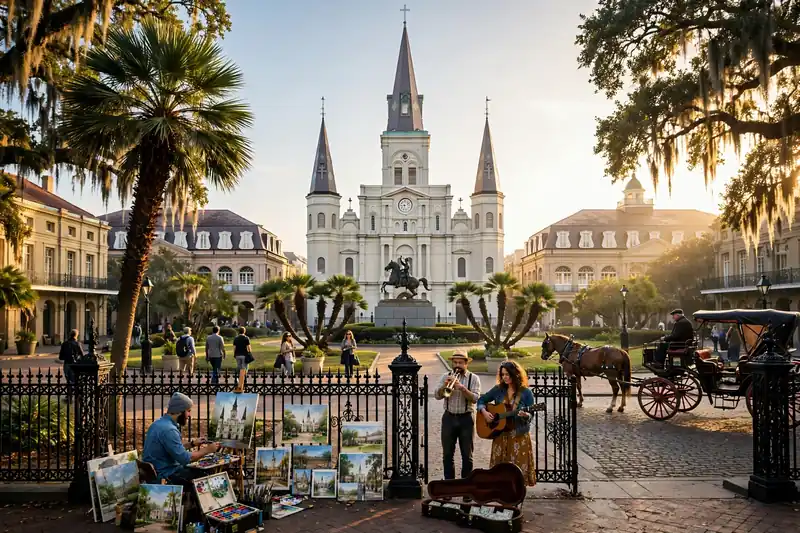
The French Quarter — the Vieux Carré — is the oldest neighbourhood in New Orleans, founded in 1718, and it is the only place to start. Go in the morning, before the crowds and the heat, and walk it slowly: the wrought-iron balconies on Royal Street, the shuttered Creole townhouses on Dauphine, the gas lamps that still burn on the quieter blocks. Jackson Square is the heart of it all, a green square of artists, musicians and fortune tellers in front of St. Louis Cathedral, whose three white spires are the most photographed sight in the city. Read about the French Quarter on Wikipedia and Jackson Square on Wikipedia before you go, then stand in the square at 8 a.m., when the light is gold and the Quarter belongs to the locals.
The practical facts for 2026: the square and the cathedral are free to enter, and the cathedral — completed in its current form in 1850 — is the oldest continuously active Roman Catholic cathedral in the United States. The Cabildo and the Presbytère, the two Spanish colonial buildings flanking the cathedral, hold the Louisiana State Museum’s exhibitions on the city’s history and on Mardi Gras. One honest note: the Quarter is at its best in the morning and at dusk, and at its worst on Bourbon Street after midnight, when it is loud, crowded and expensive. Sleep in the Quarter if you want the noise; stay a few blocks away if you want to sleep.
2. Beignets and café au lait at Café du Monde
Café du Monde is the single most famous bite in New Orleans: square French doughnuts, fried to order and buried under a mountain of powdered sugar, with a cup of café au lait — coffee cut with hot milk and chicory — at the open-air stand on Decatur Street, facing Jackson Square. It has been serving exactly that, and almost nothing else, since 1862. The menu has not changed in a century and a half, and that is the point. Read about Café du Monde on Wikipedia before you go, then order three beignets and one coffee, sit under the green-and-white awning, and accept that the sugar will end up on your clothes.
The practical facts for 2026: this is the trap most guides fall into — Café du Monde is NOT open 24 hours any more. The stand now opens at 7:15 a.m. and closes at 11 p.m. Sunday to Thursday, midnight on Friday and Saturday, and it closes on Christmas Day. It is cash only, so bring dollars, and an order of three beignets costs about $4, with a café au lait about the same. The queue looks long but moves fast, because nobody lingers over a beignet. If the line is around the block, the City Park location serves the same beignets with almost no wait — and the Morning Call stand in City Park is the locals’ quieter alternative.
3. Bourbon Street after dark
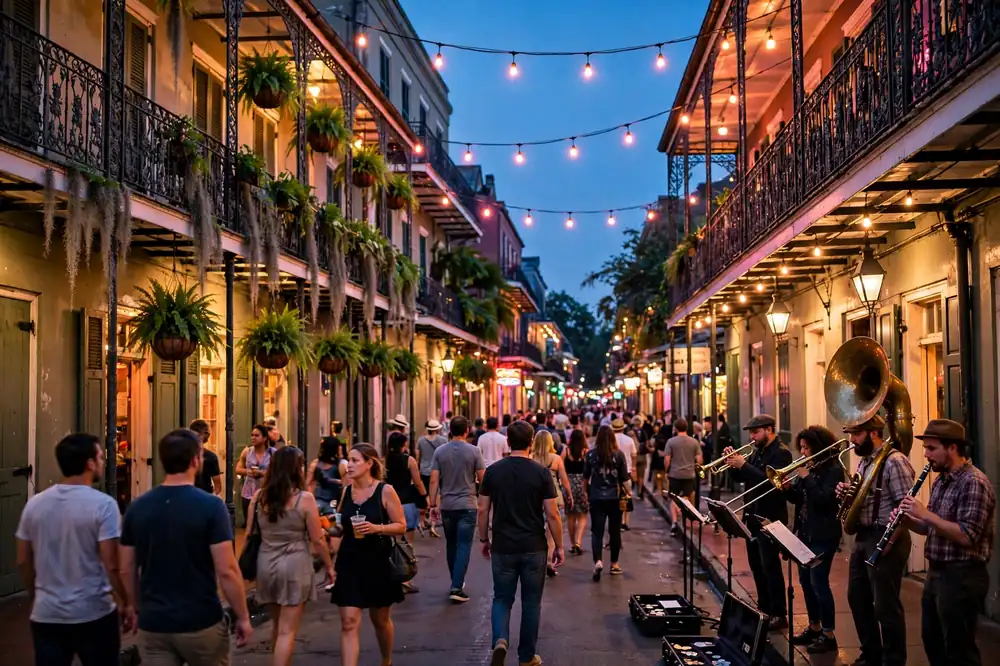
Bourbon Street is the most famous street in New Orleans, and the most misunderstood. Thirteen blocks of neon, daiquiri shops, strip clubs and bars with live music spilling onto the pavement, it is loud, commercial and deliberately over the top — and for one night, it is genuinely fun. Go after dark, walk the whole strip once, listen to the bands, have one drink in a plastic go-cup (open containers are legal in the Quarter, which is part of the point), and then leave. Read about Bourbon Street on Wikipedia before you go, and treat it as a checkbox, not a base camp.
The practical facts for 2026: Bourbon Street itself is free, and the drinks are the expensive part — expect $12 to $18 for a cocktail in the big bars, and much less in the dives a block off the strip. The live music on Bourbon is often a DJ or a cover band; the real jazz is on Frenchmen Street, two neighbourhoods over, which is where the next two sections of this guide take you. One honest note: Bourbon Street after midnight is where most of the city’s tourist crime happens, so stay in the lit, crowded blocks, keep your bag in front of you, and take a rideshare back to your hotel rather than walking home alone through the quiet streets.
4. Preservation Hall
Preservation Hall is the most important room in American music: a tiny, un-air-conditioned hall at 726 St. Peter Street, founded in 1961 to protect traditional New Orleans jazz, where the Preservation Hall Jazz Band and guest musicians play 45-minute sets a few feet from the audience, with no amplification, no bar and no drinks. There is no stage, no microphone and no bad seat, because the room holds about a hundred people. It is the single best live-music experience in the city, and the one that sells out first. Read about Preservation Hall on Wikipedia before you go, and book the moment you know your dates.
The practical facts for 2026: tickets run about $25 to $50 per 45-minute set, depending on the seat, with sets at 5, 6, 8, 9 and 10 p.m. most nights. Buy online in advance at preservationhall.com, because the popular sets sell out days ahead, and the standing-room line outside forms an hour before each show. Door tickets, when they exist, are cash only. One honest note: the hall is small, hot and crowded by design, and the bench seats are hard — arrive early for a good spot, bring water, and expect to stand in line. The discomfort is part of the legend, and nobody who has been inside complains about it afterwards.
5. Frenchmen Street
Frenchmen Street, in the Faubourg Marigny just past Esplanade Avenue, is where New Orleans actually sounds like New Orleans. Three short blocks hold a dozen music clubs — The Spotted Cat, d.b.a., Blue Nile, Snug Harbor — playing traditional jazz, brass bands, funk, blues and swing, most with no cover charge or a small one, and the music spills onto the pavement every night. It is the locals’ answer to Bourbon Street, and it is better in every way that matters. Read about Frenchmen Street on Wikipedia before you go, then walk it slowly from 8 p.m., duck into whichever club sounds best, and stay for a set.
The practical facts for 2026: most clubs have no cover or charge $5 to $10 at the door, and drinks run $8 to $12. The street is at its best on Thursday to Saturday nights, and the brass bands on the corner outside the clubs are free to watch — tip them, because that is how they eat. One honest note: Frenchmen Street is a fifteen-minute walk from Jackson Square, or one stop on the Rampart–St. Claude streetcar, and the walk back late at night is best done with a rideshare rather than on foot through the quiet blocks between the Marigny and the Quarter.
6. St. Louis Cemetery No. 1
St. Louis Cemetery No. 1, opened in 1789, is the oldest surviving cemetery in New Orleans and the most famous of the city’s “cities of the dead” — above-ground tombs and vaults, because the water table is so high that the dead cannot be buried below ground. Inside are the tombs of the voodoo queen Marie Laveau, the civil-rights pioneer Homer Plessy, and the future tomb of the actor Nicolas Cage, a white pyramid that draws more photographs than almost anything else in the cemetery. Read about St. Louis Cemetery No. 1 on Wikipedia before you go, and go in the morning light, when the white tombs glow and the shadows are long.
The practical facts for 2026: this is the trap most visitors fall into — the cemetery is closed to the general public and can only be entered on an authorised guided tour. The Archdiocese closed it after years of vandalism, and no amount of asking at the gate will get you in. The official walking tour runs about 45 minutes and costs from $25 per person, with small groups of twenty or fewer, and it regularly sells out, so book ahead. One honest note: the “X” marks on Marie Laveau’s tomb are vandalism, not tradition, and the guides will tell you so — do not add to them. If you cannot get a tour, Lafayette Cemetery No. 1, covered in section 9, has just reopened and is the other way to see the above-ground tombs.
7. The National WWII Museum
The National WWII Museum, on Magazine Street in the Warehouse District, is consistently ranked among the best museums in the United States, and the ranking is deserved. It is the only museum in the country that tells the whole American story of the Second World War, from the Pacific to D-Day, and it belongs in New Orleans because the Higgins boats — the landing craft that made D-Day possible — were designed and built here. The Road to Berlin and Road to Tokyo pavilions, the 4D film Beyond All Boundaries, and the restored aircraft hanging overhead make it a half-day at least. Read about the National WWII Museum on Wikipedia before you go, and arrive at opening time, because the crowds build fast.
The practical facts for 2026: general admission is $37 for adults, $34 for seniors, $27 for students and military with ID, free for children under 5 and for WWII veterans. Beyond All Boundaries costs $9 extra, and a second-day ticket is $15. The museum is open daily from 9 a.m. to 5 p.m., closed only on Mardi Gras Day, Thanksgiving, Christmas Eve and Christmas Day. One honest note: older guides quote $28 to $32, and those prices are gone — budget $37, and budget four to five hours, because three is not enough. Book online in advance on a weekend, when the entry queue can stretch to the street.
8. The St. Charles streetcar and the Garden District
The St. Charles streetcar is the oldest continuously operating street railway in the world, running since 1835, and it is the best $1.25 you will spend in New Orleans. The green wooden cars rattle thirteen miles from Canal Street up St. Charles Avenue, past the mansions of the Garden District, under the live oaks of Audubon Park, to the Riverbend — a slow, swaying tour of the city’s grandest avenue. Read about the Garden District on Wikipedia before you go, then ride the whole line to the end and walk back through the Garden District itself, where the streets are named after the Greek Muses and the houses are the finest in the city.
The practical facts for 2026: a single ride costs $1.25, paid in exact cash or through the Le Pass app — drivers carry no change. A 1-day Jazzy Pass is $3, a 3-day pass about $8, and a 5-day pass $15, and the pass covers every streetcar, bus and ferry in the city. The St. Charles line runs 24 hours a day, and the Canal Street line runs from about 5 a.m. to 1 a.m. One honest note: the last short leg of the St. Charles line, from Carrollton at St. Charles up to Carrollton at Claiborne, is covered by a replacement bus while the Carrollton Double Crossover accessibility project runs — work that began on 27 July 2026 and is scheduled for about six months. It does not touch the Garden District or anything else in this guide, but do not be surprised by the bus at the far end.
9. Lafayette Cemetery No. 1
Lafayette Cemetery No. 1, in the Garden District on Washington Avenue, is the headline freshness fact of this guide: closed for repairs since 2019, it reopened for small guided tours on 1 October 2026. It is the most beautiful of the city’s cemeteries — crumbling white tombs under magnolia trees, the resting place of the city’s 19th-century German and Irish immigrants, and a filming location for Interview with the Vampire and Double Jeopardy. Most 2026 guides still say it is closed, and they are now wrong. Read about Lafayette Cemetery No. 1 on Wikipedia before you go, and pair it with a walk through the Garden District, because the two belong together.
The practical facts for 2026: like St. Louis No. 1, Lafayette No. 1 is entered on a guided tour only, with small groups and limited numbers each day, so book ahead. The cemetery sits at the foot of the Garden District, a short walk from the St. Charles streetcar stop at Washington Avenue, and the streets around it — Prytania, Coliseum, Camp — are the prettiest residential streets in the city. One honest note: the tombs are fragile and the ground is uneven, so wear closed shoes, bring water in summer, and do not climb on anything. Commander’s Palace, the city’s most famous restaurant, is two blocks away on Washington Avenue, and its 25-cent lunch martinis — three per person, with an entrée — are the best deal in fine dining in America.
10. City Park, the Sculpture Garden and NOMA
City Park is one of the largest urban parks in the United States — 1,300 acres at the head of Esplanade Avenue, with live oaks older than the city itself, lagoons, a botanical garden and the New Orleans Museum of Art. The Sydney and Walda Besthoff Sculpture Garden, inside the park, is free and open every day, with ninety sculptures on eleven acres of paths and water, including a copy of Robert Indiana’s LOVE. The museum itself is the oldest fine-arts institution in the city, with strong Louisiana, French and West African holdings. Read about City Park on Wikipedia before you go, and come on a Wednesday to Sunday, because Monday is the day the park’s attractions close.
The practical facts for 2026: the park is free, the Sculpture Garden is free, and the museum is the trap — admission rose on 1 January 2026 to $23 for out-of-state adults and $18 for Louisiana residents, and older guides still quote $15. Everyone under 20 gets in free, Louisiana residents get in free on Wednesdays, and the museum is closed on Mondays, open 10 a.m. to 5 p.m. Tuesday to Sunday and until 7 p.m. on Wednesdays. The Canal Street streetcar’s City Park branch drops you at the Esplanade gates. One honest note: Carousel Gardens, the park’s amusement area, is a $27 wristband, and the Louisiana Children’s Museum is about $18 to $20 a head — budget them separately if you are travelling with children.
11. Audubon Zoo
Audubon Zoo, in Uptown’s Audubon Park at the end of the St. Charles streetcar line, is one of the best zoos in the United States, and the best family attraction in the city. The Louisiana Swamp exhibit — white alligators, black bears, a working Cajun house — is the star, along with the elephants, the sea lions and the cool, shaded paths under the live oaks. It is a manageable three to four hours, and the park around it is worth a walk on its own. Read about the Audubon Zoo on Wikipedia before you go, and go in the morning, when the animals are active and the heat has not yet arrived.
The practical facts for 2026: zoo admission is dynamic, with adults $30 to $40 depending on the day — buy online for the lower price and a guaranteed entry time. The zoo is open daily from 10 a.m. to 5 p.m. One honest note: the zoo, the aquarium and the insectarium are three separate tickets, but the Audubon Combo covers all three for $60 for adults and $55 for children and seniors, which is the right buy if you plan to do more than one. The St. Charles streetcar drops you at Audubon Park, and the zoo is a ten-minute walk through the park from the stop.
12. Audubon Aquarium and Insectarium
The Audubon Aquarium of the Americas, on the riverfront at 1 Canal Street, is the downtown answer to the zoo: more than 10,000 animals across 530 species, a Gulf of Mexico tunnel walkway, penguins, sea otters and a giant Caribbean reef tank, all in a building that sits right on the Mississippi. Since 2023 it shares its ticket with the Audubon Insectarium and Butterfly Garden upstairs, with thousands of butterflies in a free-flight garden. Read about the Audubon Aquarium on Wikipedia before you go, and pair it with a walk along the riverfront afterwards.
The practical facts for 2026: a combined Aquarium and Insectarium ticket runs $45 to $55 for adults and $40 to $50 for children and seniors, depending on the day, and the $60 Audubon Combo adds the zoo. The aquarium is open daily from 10 a.m. to 5 p.m. One honest note: the aquarium is smaller than the zoo and better suited to younger children — if you only have time for one Audubon attraction and your children are over ten, the zoo wins. The Riverfront streetcar stops right outside, and the French Market is a five-minute walk along the river.
13. An airboat swamp tour
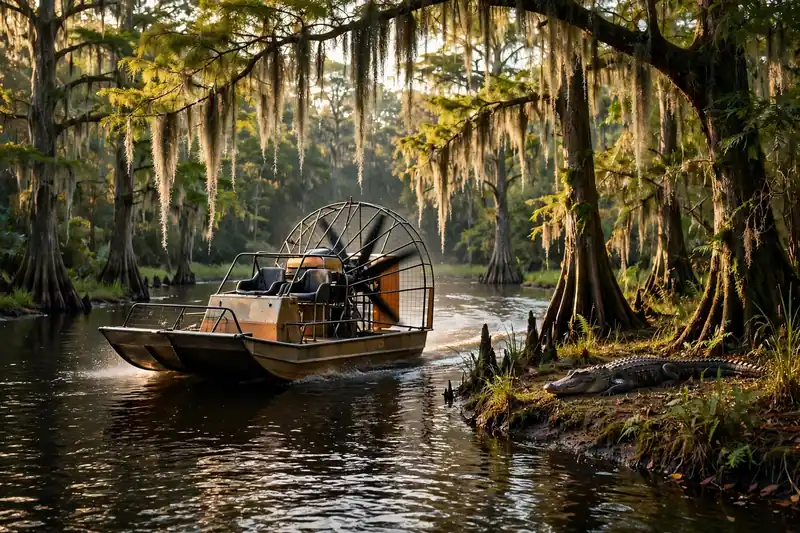
The swamp is the Louisiana that the city hides: cypress trees draped in Spanish moss, black water, herons, turtles and alligators, thirty to forty-five minutes from the French Quarter. An airboat tour — a flat-bottomed boat pushed by a giant fan — is the fastest, loudest way into it, and the guides know every gator by name. A covered pontoon boat is the slower, quieter alternative, and better for small children. Read about the Louisiana swamps on Wikipedia before you go, and book the morning departure, when the alligators are sunning themselves and the light is best.
The practical facts for 2026: a covered pontoon tour costs from about $30 to $35 per person, an airboat with hotel transport runs $65 to $90, and a small-group airboat is from $119. Most tours last two to four hours door to door, including the drive, and they run rain or shine — only lightning stops them. One honest note: the alligators are wild and the guides feed them, which is how the tours guarantee sightings; if that bothers you, the Jean Lafitte National Historical Park’s Barataria Preserve, south of the city, has free boardwalk trails through the same swamp with wild gators and no feeding. Go in winter for the clearest water and the fewest mosquitoes.
14. A Mississippi cruise on the Steamboat Natchez
The Steamboat Natchez is the only authentic steam-powered sternwheeler still working the Mississippi at New Orleans, built in 1975 and sailing from the Toulouse Street Wharf in the French Quarter. The 75-minute daytime jazz cruise is the one to take: live jazz on deck, the calliope playing as you board, the engine room open to watch, and the skyline of the city sliding past as the river bends. The evening dinner cruise and the Sunday jazz brunch are the longer, pricier versions. Read about the Steamboat Natchez on Wikipedia before you go, and sit on the top deck on the way out, when the view of the Quarter is at its best.
The practical facts for 2026: the daytime sightseeing cruise costs $25.75 for adults and $12.75 for children aged 6 to 12, with children under 5 free. The evening jazz cruise with dinner is $107.50 for adults, and the Sunday brunch cruise is $80. Reservations are recommended for dinner, brunch and holiday cruises, but the daytime cruise can usually be booked on the day. One honest note: the Natchez is a working steamboat, not a luxury liner — the seats are simple, the food on the dinner cruise is a buffet, and the best part of the trip is the river itself, which is the widest, muddiest and most powerful river in North America.
15. Congo Square and Louis Armstrong Park
Congo Square, inside Louis Armstrong Park in Tremé, is the birthplace of jazz — and one of the most important music sites in the world. In the 18th and 19th centuries, enslaved people gathered here on Sundays, their one free day, to drum, dance and trade, and the rhythms they brought from West Africa became jazz, blues, rock and roll and funk. Today the square is a quiet green space with a plaque and a statue of Louis Armstrong, and on Sunday afternoons the brass bands still play. Read about Congo Square on Wikipedia before you go, and come on a Sunday, when the square comes alive.
The practical facts for 2026: the square and the park are free, and the park is at its best before 10 a.m., when it is quiet, and on Sunday afternoons, when the second lines and brass bands gather. The park sits on the edge of the French Quarter, a ten-minute walk from Jackson Square across North Rampart Street. One honest note: Tremé is the oldest African-American neighbourhood in the United States, and it is also one of the poorest — visit with respect, stay on the main streets, and do not treat people’s homes as a backdrop. The Backstreet Cultural Museum, a few blocks away in Tremé, tells the story of the Mardi Gras Indians and the second lines for a small admission, and it is worth the detour.
16. Mardi Gras World
Mardi Gras World, across the river in Algiers, is where the floats are built — a working warehouse the size of several football fields, full of giant papier-mâché figures, half-finished kings and queens, and the artists who build them. The guided tour walks you through the workshop floor, lets you try on a costume and a mask, and ends with a slice of king cake. It is the best rainy-day attraction in the city, and the best way to understand what Mardi Gras actually is: a year-round industry, not a single weekend. Read about Mardi Gras in New Orleans on Wikipedia before you go, and take the ferry across, because the ride is half the fun.
The practical facts for 2026: admission is $22 for adults and $14 for children under 12, and the tour takes about an hour. The Algiers ferry from Canal Street costs $2 each way for pedestrians, and Mardi Gras World runs a free shuttle from the Algiers ferry landing. One honest note: Mardi Gras World is closed on some holidays and during the week after Mardi Gras, when the warehouse is at its busiest turning the floats around — check the opening days before you go. If you are here in February, the real thing is free and on the streets, and this is the place to see how it is made.
17. The French Market
The French Market, on Decatur Street along the riverfront, is the oldest public market in the United States, trading since 1791. Today it is two markets in one: the farmers’ market at the uptown end, with Creole tomatoes, satsumas and hot sauce, and the flea market at the downtown end, with masks, jewellery, art and souvenirs. It is free to browse, and it is the best place in the Quarter to buy something made in Louisiana rather than imported for tourists. Read about the French Market on Wikipedia before you go, and come in the morning, when the farmers are there and the light is on the river.
The practical facts for 2026: the market is open daily, and the farmers’ market is at its best on Saturday mornings. The muffaletta — the giant round sandwich of cured meats, cheese and olive salad — was invented at Central Grocery on Decatur Street in 1906, and the shop is the classic place to buy one, to eat on a bench in Jackson Square. One honest note: the flea-market stalls vary wildly in quality, and the same souvenir is often cheaper two stalls down — bargain politely, and buy the art and the hot sauce from the makers, not the importers. The market is a five-minute walk from Jackson Square, and the Riverfront streetcar runs along its edge.
18. Royal Street and the Historic New Orleans Collection
Royal Street, one block from Bourbon, is the Quarter’s civilised side: antique shops, art galleries, courtyards and the best window-shopping in the city. The street musicians here play classical and jazz rather than covers, and the shops sell real antiques rather than plastic beads. Halfway down, at 520 Royal Street, the Historic New Orleans Collection is a free museum of the city’s history — maps, photographs, furniture and the story of New Orleans from 1718 to today — in a beautiful 19th-century courtyard house. Read about the Historic New Orleans Collection on Wikipedia before you go, and give it an hour, because it is the best free museum in the city and most visitors walk straight past it.
The practical facts for 2026: the museum is free, open Tuesday to Sunday, and its courtyard is one of the prettiest in the Quarter. Royal Street is closed to cars during the day, which makes it the pleasantest street to walk in the Quarter. One honest note: the antique shops are real and the prices are serious — if you are not buying, the galleries are still free to browse, and the street itself is the attraction. The Sazerac House, on Canal Street at the edge of the Quarter, is the other free museum worth an hour: a working distillery museum about the Sazerac cocktail, with free tours and tastings, bookable online.
19. A plantation day trip — Whitney Plantation
Whitney Plantation, an hour up River Road from New Orleans, is the most important day trip in Louisiana, and the hardest to forget. It is the only plantation museum in the country dedicated entirely to the history of the enslaved people who built Louisiana — not to the owners, but to the men, women and children who lived, worked and died there. The self-guided audio tour, narrated in the voices of the enslaved, walks you through the slave cabins, the church, the memorials and the Wall of Honour, with the names of 107,000 enslaved people carved in stone. Read about Whitney Plantation on Wikipedia before you go, and give it a full half-day, because it is not a quick stop.
The practical facts for 2026: a tour with round-trip coach transport from the French Quarter costs $89 for adults and $42 for children aged 6 to 12, and the trip takes about five to five and a half hours door to door. The Whitney opened to the public in 2014, and its self-paced audio tour takes about two to two and a half hours on site. One honest note: Oak Alley Plantation, the famous one with the 300-year-old oak alley, is the prettier photograph and the lighter visit, at $75 to $89 with transport — but it tells the owners’ story, and most guides that recommend it without mentioning Whitney are missing the point. The swamp-and-plantation combo, at $131 with transport, pairs either plantation with an airboat ride and is the best full-day trip from the city.
20. The Algiers ferry and the skyline
The Algiers ferry is the best $2 in New Orleans: a fifteen-minute ride across the Mississippi from Canal Street to Algiers Point, the quiet neighbourhood on the far bank, with the skyline of the French Quarter spread out behind you. Algiers Point itself is a village of 19th-century houses, a jazz walk of fame, and the best view of the city at sunset — and almost no tourists. Read about Algiers on Wikipedia before you go, and take the ferry at dusk, when the light turns the river gold and the Quarter’s spires stand out against the sky.
The practical facts for 2026: the ferry costs $2 each way for pedestrians, paid through the Le Pass app or at the terminal, and it runs every day, roughly every half hour. Algiers Point is small and walkable, and the walk along the levee to the old courthouse is the quietest hour you will spend in New Orleans. One honest note: the ferry is a commuter service, not a cruise, and it is at its busiest at rush hour — ride it mid-morning or at dusk, and do not expect commentary or a bar. The view from the top deck, looking back at the Quarter, is the photograph that belongs on your wall.
New Orleans in 3 days — a ready-made itinerary
| Day | Morning | Afternoon | Evening |
|---|---|---|---|
| Day 1 — The French Quarter | Jackson Square, St. Louis Cathedral and Café du Monde | Royal Street, the Historic New Orleans Collection and the French Market | Bourbon Street, then a set at Preservation Hall |
| Day 2 — Music and history | St. Louis Cemetery No. 1 tour, Congo Square and Tremé | The National WWII Museum | Frenchmen Street clubs, dinner in the Marigny |
| Day 3 — Beyond the Quarter | St. Charles streetcar to the Garden District and Lafayette Cemetery No. 1 | City Park, the Sculpture Garden and NOMA | Steamboat Natchez sunset cruise, gumbo for dinner |
Day 1 — The French Quarter
Start at 8 a.m. in Jackson Square, before the heat and the crowds, and walk the Quarter while it is still quiet: the cathedral, the Cabildo, the Pontalba Buildings and the artists setting up along the iron fence. Cross to Café du Monde for beignets and café au lait, then walk Royal Street to the Historic New Orleans Collection and down to the French Market. In the afternoon, ride the Riverfront streetcar to the Aquarium, or walk the Moon Walk along the river. In the evening, walk Bourbon Street once, then book a 9 p.m. set at Preservation Hall — the day’s best hour, in the city’s best room.
Day 2 — Music and history
Take the morning tour of St. Louis Cemetery No. 1, then walk to Congo Square and Louis Armstrong Park, and through Tremé to the Backstreet Cultural Museum. In the afternoon, give the National WWII Museum the four hours it deserves, and finish with a late lunch in the Warehouse District. In the evening, take the Rampart–St. Claude streetcar to Frenchmen Street and hop between the clubs — The Spotted Cat for traditional jazz, d.b.a. for brass, Snug Harbor for modern jazz — and eat a late po’boy in the Marigny before a rideshare home.
Day 3 — Beyond the Quarter
Board the St. Charles streetcar at Canal and Carondelet and ride it uptown, getting off at Washington Avenue for the Garden District and the newly reopened Lafayette Cemetery No. 1. Walk the oak-lined streets, have lunch on Magazine Street, then take the Canal streetcar to City Park for the Sculpture Garden and NOMA. In the evening, board the Steamboat Natchez at the Toulouse Street Wharf for the sunset cruise, and finish the trip with a bowl of gumbo and a Sazerac in the Quarter. If you have a fourth day, spend it on the swamp tour in the morning and Whitney Plantation in the afternoon — the two trips that show you the Louisiana beyond the city.
Best time to visit New Orleans
The best months to visit New Orleans are February to April and October to November. February brings Mardi Gras — Fat Tuesday falls on 9 February 2027 — and the parade season that builds for two weeks before it. March and April bring the French Quarter Festival, 8 to 11 April 2027, the largest free music festival in the United States, and the start of crawfish season. October and November bring warm days, cool evenings and the lowest humidity of the year. Jazz Fest, the city’s biggest festival, runs 22 April to 2 May 2027 at the Fair Grounds Race Course, and hotel prices double on festival weekends, so book months ahead.
Summer, from June to September, is the cheapest season and the hottest: temperatures in the 90s, humidity above 80 percent, and afternoon thunderstorms most days. It is also hurricane season, which runs June to November — the city has not had a direct hit since Hurricane Katrina in August 2005, but the season is real, and travel insurance is worth buying. December brings the holiday lights in the Quarter and the lowest hotel prices of the year outside the festivals. One honest note: there is no month when New Orleans is quiet, because the city throws a festival almost every week — check the calendar before you book, and either plan around the big ones or plan for them.
Where to stay in New Orleans
The French Quarter is the obvious base, and the loudest: stay here if you want to walk everywhere and do not mind the noise, and ask for a room off Bourbon Street, on a courtyard, if you want to sleep. The Warehouse District, just across Canal Street, is the best compromise — quieter, with the city’s best hotels and restaurants, and a ten-minute walk to the Quarter and the WWII Museum. The Garden District is the prettiest base, with bed-and-breakfasts in 19th-century mansions and the streetcar at the door, but it is a twenty-minute ride from the Quarter. The Marigny and Bywater, across Esplanade Avenue, are the local choice: guesthouses, music clubs and cafés, with Frenchmen Street on your doorstep. The Central Business District is the budget choice, with the big chain hotels and the streetcar on Canal Street.
Budget roughly $150 to $250 a night for a mid-range hotel in the Quarter or the Warehouse District outside festival weekends, and double that during Mardi Gras and Jazz Fest. One honest note: the Quarter’s cheapest rooms are often the noisiest, and the noise does not stop at midnight — if you are a light sleeper, pay for the courtyard room or stay in the Warehouse District. Book Mardi Gras and Jazz Fest six months ahead, and check whether your hotel charges a resort fee, because several in the Quarter now do.
Getting around New Orleans
New Orleans is a walking city, and the French Quarter, the Marigny and the Warehouse District are all best explored on foot — flat, dense and full of things to look at. For everything else, the streetcar is the answer: a single ride costs $1.25 on any streetcar, bus or ferry, paid in exact cash or through the Le Pass app, and a 1-day Jazzy Pass is $3, a 3-day pass about $8 and a 5-day pass $15, covering every streetcar, bus and ferry in the city. The four lines are the St. Charles line to Uptown and the Garden District, the Canal line to the cemeteries and City Park, the Riverfront line along the Mississippi, and the Rampart–St. Claude line to the Marigny and Bywater. The St. Charles line runs 24 hours a day, and the Canal line runs from about 5 a.m. to 1 a.m.
You do not need a car in New Orleans, and you should not rent one — parking in the Quarter is expensive and scarce, and the streets are narrow and one-way. The airport, Louis Armstrong New Orleans International Airport, is about fifteen miles west of the city, and the RTA 202 Airport Express bus costs $1.25 and takes 45 to 60 minutes to downtown; a taxi is about $36 flat rate to the French Quarter, and a rideshare is usually $25 to $35. One honest note: the streetcars are slow, and the buses are slower — if you are in a hurry, take a rideshare, and if you are not, take the streetcar, because the ride is half the pleasure. At night, take a rideshare rather than walking through the quiet blocks between neighbourhoods.
New Orleans food you have to try
New Orleans is the best food city in the United States, and the food is the reason many people come. Creole and Cajun cooking — French technique, Spanish spice, African okra and rice, Caribbean heat — produced dishes that exist nowhere else, and the city takes them seriously: a bad gumbo is a scandal, and a good one is a religion. Eat in the neighbourhoods, not just the Quarter, and eat where the locals queue.
1. Gumbo — Dooky Chase’s Restaurant
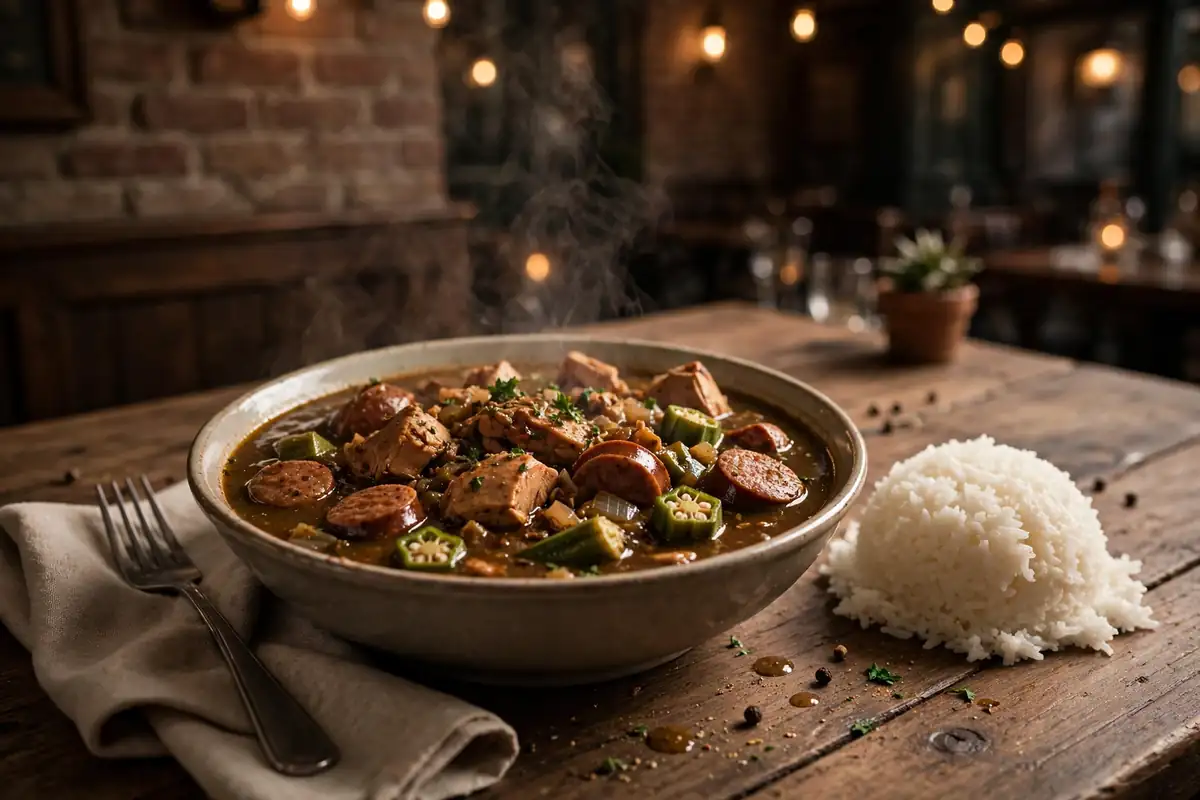
Gumbo is the dish of New Orleans: a dark roux, the holy trinity of onion, celery and bell pepper, okra or filé, and chicken, sausage, seafood or all three, served over rice. It is the city’s signature, and the place to eat it is Dooky Chase’s Restaurant in Tremé, the Creole institution run by the Chase family since 1941, where the gumbo is dark, rich and perfect, and the fried chicken is the other thing to order. Read about gumbo on Wikipedia before you go, and go for lunch, when the line is shorter and the prices are lower.
The practical facts for 2026: lunch at Dooky Chase’s runs about $20 to $30 a person, and the restaurant is closed on Mondays. The other great gumbos are at Commander’s Palace in the Garden District, where the turtle soup is the other classic, and at the Gumbo Shop in the Quarter, which is the easiest version for a first-timer. One honest note: gumbo is not a soup and it is not a stew, and nobody in New Orleans agrees on the recipe — the argument is part of the meal, and every version is right.
2. Po’boy — Parkway Bakery and Tavern
The po’boy is the sandwich of New Orleans: French bread, crisp outside and soft inside, stuffed with fried shrimp, roast beef, fried oyster or hot sausage, dressed with lettuce, tomato, pickles and mayonnaise. It was invented in 1929, during a streetcar strike, when a bakery fed the striking workers for free — “poor boys” — and it has been the city’s lunch ever since. The place to eat it is Parkway Bakery and Tavern in Mid-City, the 1911 bakery that has been serving po’boys longer than almost anyone, with the fried shrimp and the roast beef debris as the two orders to have. Read about the po’boy on Wikipedia before you go, and order it “dressed”, which is how the locals take it.
The practical facts for 2026: a po’boy at Parkway runs about $12 to $18, and the bakery is a ten-minute walk from the Canal streetcar’s City Park branch. The other great versions are at Domilise’s in Uptown, a tiny counter that has been frying shrimp since 1918, and at Killer Poboys in the Quarter, which does the modern versions. One honest note: the bread is the whole sandwich, and it goes stale fast — eat it at the counter, not as takeaway, and never order a po’boy with the bread toasted, because that is not how it is done.
3. Crawfish boil — in season, February to June
A crawfish boil is the party of New Orleans: pounds of crawfish boiled with corn, potatoes, sausage and spice, dumped on a table covered in newspaper, and eaten with your hands, with a cold beer. Crawfish season runs roughly February to June, peaking in March and April, and the boils happen in backyards, bars and restaurants all over the city. Read about crawfish on Wikipedia before you go, and go to a boil, not a restaurant that serves crawfish year-round — the point is the table, the newspaper and the people.
The practical facts for 2026: a boil costs about $25 to $40 a person, depending on the weight, and the best ones are at Clesi’s in Mid-City, at Bevi Seafood Co. in the Marigny, and at the pop-up boils that appear in bars across the city in spring. Outside the season, the crawfish are farmed or frozen, and the price doubles — if you are here in October, order the shrimp and grits instead, which is the other dish to have. One honest note: a crawfish boil is messy, and that is the point — roll up your sleeves, peel with your hands, suck the heads if you dare, and do not wear white.
Free things to do in New Orleans
New Orleans is one of the best free cities in America, and you can build a whole free day out of it. Jackson Square is free, St. Louis Cathedral is free, the French Market is free to browse, and the Historic New Orleans Collection is free. The Besthoff Sculpture Garden is free, City Park is free, Congo Square is free, and the Algiers ferry costs $2, which is nearly free. The French Quarter Festival is free, the brass bands on Frenchmen Street are free to watch, and the second lines on Sundays are free. The Sazerac House tours are free, the Ogden Museum of Southern Art is free on Thursdays for Louisiana residents, and the Mississippi riverfront — the Moon Walk — is free at sunset. The best free evening in the city is a walk along the riverfront at dusk, when the steamboats pass and the Quarter lights up behind you.
Frequently asked questions
How many days do you need in New Orleans?
Three days is the right amount of time for a first visit: one day for the French Quarter, one day for music and history, and one day for the Garden District and City Park. Two days works if you skip the swamp and the plantation and pick one neighbourhood instead of two, and four to five days is better if you want the swamp tour, Whitney Plantation and a slow day in the Marigny. One day is enough for the Quarter and a set at Preservation Hall, but not for New Orleans.
Is New Orleans safe for tourists?
New Orleans is safe for tourists who stay aware, and honest to say so. The French Quarter, the Warehouse District, the Garden District and the Marigny are busy and well policed during the day and the early evening, and most visitors have no trouble at all. The risks are the same as in any big American city: pickpocketing and bag-snatching in crowds, especially on Bourbon Street after midnight, and car break-ins. Stay on the busy, well-lit streets, keep your bag in front of you, do not walk alone late at night through quiet neighbourhoods, and take a rideshare after dark rather than walking home. Do not flash cash or jewellery, and do not accept drinks from strangers.
What is the best time to visit New Orleans?
February to April and October to November are the best months, for warm days, festivals and the lowest humidity. Mardi Gras falls on 9 February 2027, the French Quarter Festival runs 8 to 11 April 2027, and Jazz Fest runs 22 April to 2 May 2027 — book months ahead for all three, because hotel prices double. Summer is the cheapest season and the hottest, with temperatures in the 90s and afternoon thunderstorms, and hurricane season runs June to November. December brings the holiday lights and the lowest hotel prices outside the festivals.
Do I need a car in New Orleans?
No, and you should not rent one. The French Quarter, the Marigny and the Warehouse District are best on foot, the streetcar covers the Garden District, Uptown and City Park for $1.25 a ride, and rideshares are cheap and everywhere. Parking in the Quarter is expensive and scarce, the streets are narrow and one-way, and a car is a burden, not a help. Rent a car only for a day trip to the plantations or the swamp, and only if you are not taking an organised tour — the coach tours from the French Quarter are easier and cheaper than driving yourself.
Is Bourbon Street worth it?
Yes, for one night, and no more. Bourbon Street is loud, commercial and expensive, and it is the most famous street in the city for a reason — but it is not where the real New Orleans lives. Walk it once after dark, have one drink, listen to one band, and then go to Frenchmen Street, where the music is better, the drinks are cheaper and the locals actually go. If you only have one evening, spend it on Frenchmen Street instead, and see Bourbon Street in the daytime, when the architecture is visible and the crowds are gone.
What should I eat in New Orleans?
Gumbo, a po’boy and a crawfish boil in season are the three dishes to have, and this guide covers all three in the food section above. Beyond them, order the beignets at Café du Monde, the muffaletta at Central Grocery, the chargrilled oysters at Drago’s, the shrimp and grits at a neighbourhood café, and a Sazerac — the city’s official cocktail — at the Sazerac Bar in the Roosevelt Hotel. Eat in the neighbourhoods, not just the Quarter, and eat where the locals queue: the line is the review.
Further reading — Wikipedia, Reddit and Quora
For more on New Orleans, read New Orleans on Wikipedia, join the New Orleans community on Reddit, and read the Quora thread on cheap things to do in New Orleans.
Your New Orleans trip, in one paragraph
New Orleans is the city that breaks every rule in America, and three days here give you the best of it: Jackson Square in the morning, beignets at Café du Monde, a set at Preservation Hall, jazz on Frenchmen Street, the St. Charles streetcar to the Garden District, the newly reopened Lafayette Cemetery, the WWII Museum, City Park’s live oaks, a swamp tour and a steamboat on the Mississippi, with the gumbo, the po’boy and the crawfish boil in between. Come in February to April for Mardi Gras and Jazz Fest, or in October to November for the best weather, stay in the Warehouse District or the Garden District, take the streetcar everywhere and a rideshare after dark, and eat the gumbo, the po’boy and the beignets. New Orleans is the 43rd place in our series, and it sits alongside the other great trips we have written about — Chicago, Nashville, Los Angeles, Orlando, Miami, San Diego, Denver, Savannah, Dallas, Charleston, San Francisco, Myrtle Beach, Las Vegas, San Antonio, London, Portland, Pigeon Forge, Puerto Rico, Atlanta, Phoenix, Paris, Maui, Key West, Colorado Springs, Sedona, Chattanooga, Palm Springs, St Louis, Tokyo, Japan, Kansas City, Tennessee, Branson, Florida, Amsterdam, Montreal, Honolulu, Fort Lauderdale, Toronto, Aruba, Charlotte and Indianapolis — and if you want another American city with a music scene and a food scene to match, the honky-tonks of Nashville and the jazz clubs of Chicago are the natural next trips.

About the Author