Things to Do in Osaka
20 Best Attractions, a 3-Day Itinerary, Where to Stay, and the Food You Cannot Miss
Quick Info
Best for: Neon food streets, a castle, Super Nintendo World, Japan’s best street food and big-city energy at small-city prices
Best time: March to May and October to November, when the weather is mild and the cherry blossom or autumn leaves are out
How long: 3 days for the city itself; 4 to 5 days to add Universal Studios Japan and a Kyoto or Nara day trip
Budget: Roughly ¥15,000–¥25,000 per person per day mid-range, before hotel (about ¥8,000–¥15,000 for food, transport and admissions)
Don’t miss: Dotonbori after dark, Osaka Castle in cherry blossom season, a morning graze at Kuromon Market, Super Nintendo World and a plate of takoyaki eaten standing up
Osaka is Japan’s kitchen and its loudest, friendliest big city — a place where the food comes first, the neon never really switches off, and strangers will happily tell you where to eat. This guide covers the 20 best things to do in Osaka, a 3-day itinerary that strings the highlights together, where to stay from Namba to Umeda, how to get around on the Metro and JR lines, three foods you have to try, and the best free sights in the city. Every price below was checked against live sources in November 2026, and where older guides get it wrong — above all on Osaka Castle, Universal Studios Japan and the Expo site — we say so.
Osaka at a glance
| Topic | What to know |
|---|---|
| Best for | Dotonbori, Osaka Castle, Universal Studios Japan, Kuromon Market, Shinsekai, the food |
| Best time | March–May and October–November; mild days, cherry blossom in late March, autumn colour in November |
| How long | 3 days for the city; 4–5 days with Universal Studios Japan and a Kyoto or Nara day trip |
| Budget | About ¥15,000–¥25,000 per person per day mid-range; Metro rides ¥190–¥390 |
| Don’t miss | Dotonbori after dark, Osaka Castle, Super Nintendo World, Kuromon Market, takoyaki |
| Getting around | Osaka Metro and JR Loop Line; ICOCA card or contactless bank card; airport by Nankai or JR Haruka |
| Entry fees | Osaka Castle ¥1,200; Kaiyukan ¥2,700–¥3,200; USJ from ¥8,400; Umeda Sky Building ¥2,000 |
| Watch out for | Expo 2025 is OVER — Yumeshima is a demolition site; the Amazing Pass is digital-only; summer is hot and humid |
The 20 best things to do in Osaka
1. Osaka Castle
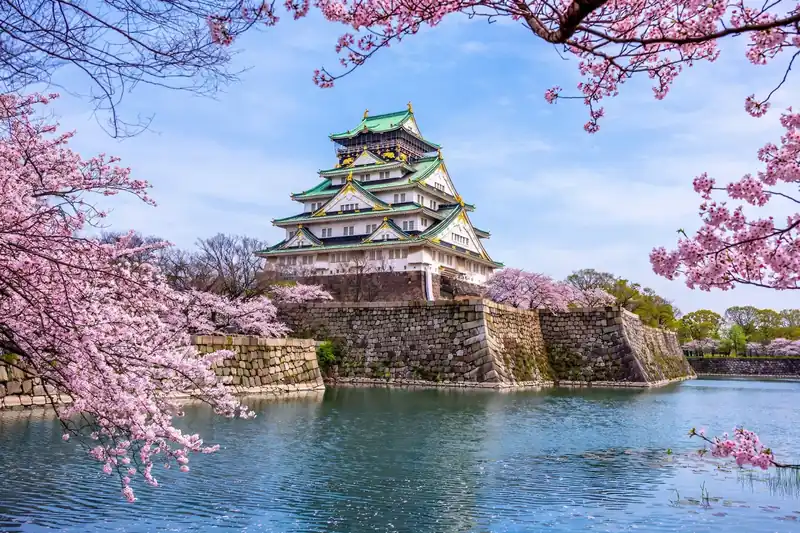
Osaka Castle is the city’s symbol: a white-and-green keep rising above massive stone walls and a wide moat, in the middle of a 106-hectare park with some 3,000 cherry trees. The tower you photograph is a 1931 concrete reconstruction of Toyotomi Hideyoshi’s sixteenth-century castle, and inside it is a modern eight-floor museum about Hideyoshi and the sieges that ended his line, with an observation deck at the top. The park, the moats, the gates and the giant stones are free and open around the clock — only the keep itself charges. Read more about Osaka Castle on Wikipedia.
The price is the trap most guides still get wrong. Adult admission to the main tower doubled from ¥600 to ¥1,200 on April 1, 2025, and any guide still quoting ¥600 is out of date — ¥600 is now the student rate. Students with ID pay ¥600 and junior-high age and under go free. The same ¥1,200 ticket also covers the Toyotomi Stone Wall Museum, which opened in July 2025 beside the keep, where you descend to see the buried 1580s stone wall found in a 1984 dig. The keep is open 9:00 a.m. to 6:00 p.m., last entry 5:30 p.m., and closes only from December 28 to January 1. Nishinomaru Garden, the lawn inside the park, is a separate ticket — ¥300 since April 1, 2026, up from ¥200 — and it closes on Mondays. Come at 9:00 a.m. to beat the queues, and in cherry blossom season stay for the evening illuminations.
2. Dotonbori and the Glico Running Man
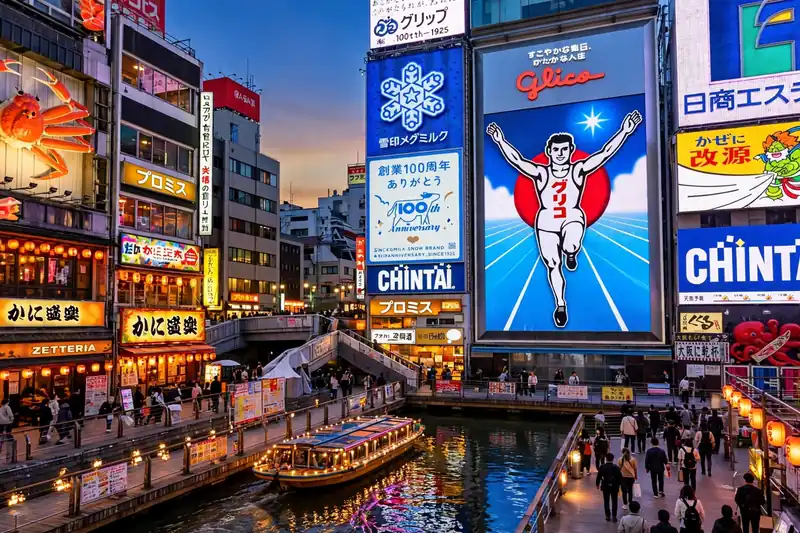
Dotonbori is the canal and the four-hundred-odd metres of street beside it in Minami, the southern half of central Osaka — and it is the single most photographed street in Japan. Giant mechanical signs jut over the water: a crab, an octopus, a pufferfish, a dragon, and above them all the Glico Running Man, the neon athlete who has glowed over Ebisubashi Bridge since 1935. The bridge is public and free, the sign is lit from dusk until around midnight, and the best time to photograph it without a wall of heads in frame is 7:00 to 9:00 in the morning. After dark it is chaos in the best sense: neon, steam, music and crowds. Read more about Dotonbori on Wikipedia.
Do it in two halves. In the evening, walk the canal, take the Tombori River Cruise — twenty minutes, nine bridges, ¥2,000 for an adult, ¥1,000 for a student and ¥500 for a child, boarding at the Tazaemonbashi kiosk beside Don Quijote — and ride the Dotonbori Ferris Wheel on the third floor of the Don Quijote building for ¥600, the cheapest aerial view of the canal. In the morning, slip into Hozenji Yokocho, the stone-paved alley a minute off the main strip, where the moss-covered Fudo statue at Hozenji Temple is splashed with water by visitors for luck. The Tombori Riverwalk, the promenade along both banks, is open around the clock and is the release valve when the main street gets too crowded.
3. Universal Studios Japan — Super Nintendo World
Universal Studios Japan, in the bay area, is one of the three most-visited theme parks in the world, and its Super Nintendo World is the reason most visitors come to Osaka at all. The land combines Super Mario Land with Donkey Kong Country, which opened on December 11, 2024, and its Mine-Cart Madness coaster is currently one of the most in-demand rides in Japan. The Wizarding World of Harry Potter, Minion Park and Jurassic Park fill out the rest of the park, and in 2026 the park is celebrating its 25th anniversary, which means record crowds and top-tier pricing all year. Read more about Universal Studios Japan on Wikipedia.
The ticket system is the trap. A 1-Day Studio Pass uses dynamic, dated pricing: since September 1, 2026, the adult floor is ¥8,400 (about US$54), and the price of a date can rise after it goes on sale, so buying early is usually cheaper — expect roughly ¥8,400 to ¥12,000 depending on the date, with children from about ¥5,500. The pass gets you into the park and every standby line, but it does not guarantee entry to Super Nintendo World. Since January 5, 2026, the only way into the land without an Express Pass is a free Area Timed Entry Ticket booked in the official app after you are inside the park — and on busy days they run out early. An Express Pass is an add-on on top of the Studio Pass, roughly ¥14,800 to ¥21,800 for variants with area entry, and only variants whose name explicitly says Super Nintendo World guarantee it. Book tickets about 60 days ahead, arrive at opening, and do not plan anything else that day: USJ is a full day.
4. Kuromon Ichiba Market
Kuromon Ichiba Market is Osaka’s kitchen: a covered 580-metre arcade of about 150 fishmongers, butchers, fruit vendors and street grills, ten minutes east of Dotonbori, where the chefs of the city’s restaurants have bought their morning fish for generations. Entry is free — you pay only for what you eat — and a tasting lap runs about ¥2,000 to ¥3,500: a plate of sushi or sashimi for ¥500 to ¥2,000, grilled king-crab legs or scallops for ¥800 to ¥3,000, a skewer of blowtorched A5 wagyu for ¥1,000 to ¥2,500, and a takoyaki snack for ¥500 to ¥800.
Go between 10:00 a.m. and 1:00 p.m., when the morning catch is fully laid out and the best cuts have not sold through; most stalls trade roughly 9:00 a.m. to 6:00 p.m., and by 3:00 or 4:00 p.m. many counters are packing down. Two rules before you go in: eating while walking is frowned on in Osaka, so eat at the stall’s own counter and drop your skewers and cups in that stall’s bin, and bring cash in yen — many stalls are cash-only, with the reliable ATMs in the convenience stores at either end of the arcade. Prices here are higher than they were before the tourist boom, and the restaurants on the side streets serve comparable seafood for less, so graze here and eat a full meal elsewhere.
5. Shinsekai and Tsutenkaku Tower
Shinsekai, the “new world” built in 1912 south of Namba, is retro Osaka preserved in amber: narrow lanes of kushikatsu counters, vintage signs, cheap bars and the Janjan Yokocho alley, all watched over by Tsutenkaku Tower, the 103-metre landmark modelled loosely on the Eiffel Tower. The tower’s observation decks look out over the whole of southern Osaka, and the current tower is itself a 1956 rebuild of the 1912 original. The district is at its best after dark, when the signs come on and the kushikatsu shops fill up. Read more about Tsutenkaku on Wikipedia.
Tsutenkaku costs ¥1,500 for an adult aged 15 and over (¥1,800 from December 30 to January 3), and it is open 9:00 a.m. to 9:45 p.m., last entry 9:15 p.m. It is free on the Osaka Amazing Pass, but you must book a time slot at the facility. The Tower Slider and the Dive and Walk rooftop experience cost extra. The real reason to come, though, is the food: kushikatsu — skewers of meat, seafood and vegetables, battered and deep-fried — served at counters where the rule is strict and famous: no double-dipping in the shared sauce. Eat in Janjan Yokocho, where the oldest shops are, and pair it with a walk to nearby Tennoji Park.
6. Osaka Aquarium Kaiyukan
Osaka Aquarium Kaiyukan, in Tempozan Harbor Village on the bay, is one of the largest aquariums in the world — 30,000 creatures across 620 species in more than five million litres of water — and its star is the whale shark in the nine-metre-deep Pacific Ocean tank. The visit is a one-way spiral down through the habitats of the Pacific Rim, from the Aleutian Islands to Antarctica, past penguins, sea lions, dolphins and jellyfish, and it takes two to three hours. It is the best wet-day answer in Osaka and the anchor of a Bay Area day. Read more about Osaka Aquarium Kaiyukan on Wikipedia.
Three 2026 rules catch people out. First, Kaiyukan uses dynamic pricing: an adult pays ¥2,700 to ¥3,200 depending on the date, up to ¥3,500 on the busiest days, with children ¥1,400 to ¥1,650 — check the price calendar for your day, and book the date-and-time e-ticket about 30 days ahead to lock in your entry time. Second, re-entry ended on June 15, 2026: once you leave, the visit is over, so plan any meal around that. Third, Kaiyukan is NOT covered by the Osaka Amazing Pass, despite appearing in older lists of pass attractions. Hours float by date — on weekdays in October and November it opens at 10:30 a.m., at weekends 9:30 a.m., closing at 8:00 p.m. with last entry an hour before — and it closes for a two-day maintenance break each January. Go late in the day, when the crowds thin and the evening lighting comes on.
7. Umeda Sky Building — Kuchu Teien Observatory
The Umeda Sky Building, in Kita north of Osaka Station, is two forty-storey towers joined at the top by a suspended ring — the Kuchu Teien, the Floating Garden Observatory — and it is Osaka’s best sunset. The observatory runs across the 39th and 40th floors and out onto a 360-degree open-air rooftop at 173 metres, and the ride up is part of it: a glass-enclosed escalator floating between the towers. Admission is ¥2,000 for an adult and ¥500 for a child aged 4 to 12, under-4s free, and it is open 9:30 a.m. to 10:30 p.m., last entry 10:00 p.m. Read more about the Umeda Sky Building on Wikipedia.
The pass trap is worth knowing before you plan your day around it. The Osaka Amazing Pass covers the observatory free only until 3:00 p.m.; from 3:00 p.m. it drops to roughly a 10 percent discount. So the pass and the sunset view almost never overlap — if you want the golden hour from the rooftop, budget the full ¥2,000. The rooftop closes during thunderstorms, so check the weather before you go. The 35th floor is free to access and gives you the escalator ride part-way, and the whole building is a seven-minute walk from JR Osaka Station through Grand Green Osaka.
8. Shitennoji Temple
Shitennoji, founded in 593 by Prince Shotoku, is Japan’s oldest officially administered Buddhist temple — older than Kyoto’s famous temples by more than a century — and it sits in Tennoji, a short walk from the zoo and Abeno Harukas. The five-storey pagoda, the main hall and the lecture hall are arranged in the straight line of the original sixth-century layout, and the temple runs a flea market on the 21st of each month that draws crowds from across the city. The grounds are free to wander; the inner Garan precinct, with the pagoda and the main hall, charges a small fee. It is quiet, unhurried and almost entirely free of the tour groups that fill the castle and Dotonbori. Read more about Shitennoji on Wikipedia.
Come on the 21st if you can, when the flea market fills the grounds with antiques, kimono and street food, and pair it with Isshin-ji Temple nearby, whose gate statues are made from the ashes of tens of thousands of followers. The temple is also the starting point for the Aizen Festival, which kicks off Osaka’s summer from June 30 to July 2 each year with women in summer kimono carried on palanquins. Allow an hour, and go in the morning, when the light is best on the pagoda and the grounds are at their calmest.
9. teamLab Botanical Garden Osaka
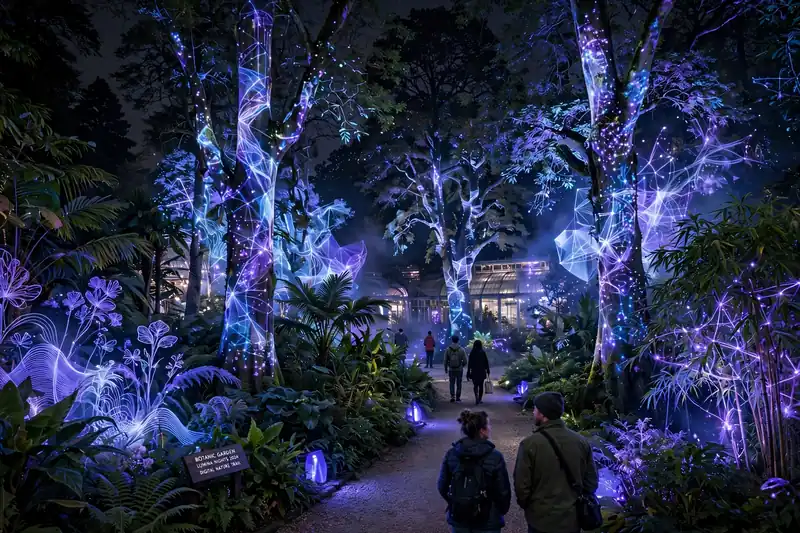
teamLab Botanical Garden Osaka is a permanent, night-only, entirely outdoor digital art exhibition inside Nagai Botanical Garden in Nagai Park — and it is the Osaka teamLab most visitors actually mean. After dark, the garden’s trees, lake and flower beds light up with interactive projections: flowers that glow brighter and sound a tone when you stand near them, trees that change colour as you pass, and a whole landscape that responds to the people walking through it. It is open in rain, though a storm, heavy-rain or thunder warning can delay or close it. Read more about teamLab on Wikipedia.
The ticket rule is online-only, timed and date-based: adult tickets are ¥1,800 in advance (¥2,000 at the gate if capacity allows) and children aged 6 to 15 pay ¥500, with under-6s free — but teamLab runs dynamic pricing, so the adult price you actually pay is often ¥2,000 to ¥2,200 on the dates that matter. From November 9, 2026 to January 31, 2027 the hours are 6:00 p.m. to 9:30 p.m., last entry 8:30 p.m., with opening times shifting by season. There is also an annual maintenance closure — in 2026 it ran roughly February 9 to 28. Book ahead: weekend and holiday evenings sell out days in advance. The garden is about ten minutes on foot from Nagai Station on the Midosuji Line, and from November 7 to 28, 2026 around 20,000 cosmos flowers glow in a limited-time artwork.
10. Sumiyoshi Taisha
Sumiyoshi Taisha, in the south of the city, is one of Japan’s oldest Shinto shrines — founded in the third century, before Buddhism reached Japan — and it is built in the pure Sumiyoshi-zukuri style, with straight roofs and no Chinese influence at all. The approach is part of the experience: the steep red Sorihashi Bridge arches over the pond, and crossing it is said to purify you before you reach the main hall. The shrine is free, the grounds are calm, and it is one of the few places in Osaka where you can feel the city as it was a thousand years ago. Read more about Sumiyoshi Taisha on Wikipedia.
Come for hatsumode, the first shrine visit of the New Year, when more than two million people pass through in three days, or come on any ordinary morning, when the shrine is almost empty and the only sound is the crows. It is a short walk from Sumiyoshi Taisha Station on the Nankai Line — the same line that runs to Kansai Airport — so it pairs naturally with an arrival or departure day. Allow an hour, and do not skip the smaller shrines tucked behind the main hall.
11. Abeno Harukas 300
Abeno Harukas, built over Kintetsu Osaka-Abenobashi Station in Tennoji, is Japan’s tallest building, and its Harukas 300 observatory sits on the 58th to 60th floors at 300 metres — the highest viewpoint in the country. The 60th floor is a full 360-degree glass deck, and the 58th floor has a roofless open-air deck. On a clear day you can see across the whole of Osaka Bay to Awaji Island, and at night the city lights stretch to the horizon. It is the better choice of the two big viewpoints on a wet or freezing night, since it is fully enclosed.
The price changed in 2026, and older guides are wrong about it. A counter ticket is now ¥2,200 for an adult and ¥900 for a child, up from ¥1,500 on July 23, 2026; booking online by the previous day brings it down to ¥1,980 and ¥810. Harukas 300 is open 9:00 a.m. to 10:00 p.m., last entry 9:30 p.m., and it is NOT on the Osaka Amazing Pass facility list, so its price is payable on any pass day. The 16th floor has a free observation deck if you want the view without the ticket — bring snacks from the FamilyMart on the 17th floor and enjoy it like the locals do. Read more about Abeno Harukas on Wikipedia.
12. Grand Green Osaka and Umekita Park
Grand Green Osaka is the city’s newest district: a 4.5-hectare urban park and shopping complex built on the site of the old Umeda Freight Station, directly north of JR Osaka Station. South Park, the open lawn with its fountain, has been open since September 6, 2024, the South Building opened on March 21, 2025, and the district now holds hotels, shops, restaurants and Time Out Market Osaka — the first Time Out Market in Asia. It is free to enter, it is the most relaxing green space in central Osaka, and it has already drawn some 28 million visitors since its advance opening.
The newest piece opens while you are reading this: Umekita no Mori, the urban forest in North Park, opens on November 20, 2026, with about 9,000 square metres of forest, a pond, a 10-metre-wide waterfall and a 350-metre walkway, the Hirameki no Michi, linking the two halves of the park. The full park opens around spring 2027. Most 2026 guides still describe Grand Green Osaka as a construction site — it is not. Come for a picnic, for the winter lights, or just for an hour between trains: it is the calmest hour in the city, five minutes from the busiest station in Japan.
13. Nakanoshima — museums and the river
Nakanoshima is the slender island between the Dojima and Tosabori rivers in the middle of the city, and it is Osaka’s cultural quarter: the National Museum of Art, the Nakanoshima Museum of Art, the Osaka City Central Public Hall with its red-brick neo-baroque facade, the Science Museum and the rose garden, all within a ten-minute walk of each other. The island is at its best in spring, when the cherry blossom lines the river, and in autumn, when the ginkgo turns gold. The riverside promenade is free, the museums charge separately, and the whole island is a quieter, greener counterweight to Dotonbori. Read more about Nakanoshima on Wikipedia.
The National Museum of Art is the one to pick if you only visit one: an underground museum of modern and contemporary art beneath a striking glass-and-steel entrance, with a strong collection of Japanese post-war art. Pair it with the rose garden in May, when the roses are at their peak, and with a walk along the river to the Osaka City Central Public Hall, which is free to enter and worth it for the interior alone. Nakanoshima is also where the city’s big winter illumination, the Festival of the Lights, runs along Midosuji Boulevard from November to January.
14. Minoh Falls — Minoo Park
Minoh Falls is the best half-day escape from the city: a 33-metre waterfall at the end of a 2.8-kilometre forest walk through Minoo Park, about thirty minutes north of Umeda by train. The walk follows a river through maple forest, past temples and a monkey-inhabited hillside — do not feed the monkeys, and keep your snacks out of sight — and the waterfall itself is at its best in November, when the maples turn red, and in summer, when the spray cools the whole valley. The park is free, the walk is paved and mostly flat, and it feels a million miles from Dotonbori. Read more about Minoh Park on Wikipedia.
The local speciality is momiji tempura — maple leaves deep-fried in sweet batter — sold at the stalls along the path for a few hundred yen a bag. It is a Minoh-only snack, and it is the thing to buy at the top. Take the Hankyu Takarazuka Line from Umeda to Ishibashi handai-mae, change to the Minoh Line, and walk from Minoh Station. Allow three hours door to door, and go on a weekday if you can: the path is one of Osaka’s most popular autumn walks, and November weekends are crowded.
15. Cup Noodles Museum Osaka Ikeda
The Cup Noodles Museum Osaka Ikeda, in the suburb where instant ramen was invented, is the original Cup Noodles museum — and it is free to enter. Momofuku Ando invented Chicken Ramen in a backyard shed in Ikeda in 1958, and the museum tells the story through the Instant Ramen Tunnel, a wall of every flavour ever made, and a reproduction of Ando’s shed. The highlight is the My Cupnoodles Factory, where you design your own cup, choose your soup and four toppings, and watch it get sealed — ¥500 per cup, up to three cups per person, on a same-day numbered ticket. Read more about the Cup Noodles Museum on Wikipedia.
The Chicken Ramen Factory, where you make ramen from scratch, costs ¥1,000 for an adult (¥1,200 after January 31) and requires an advance reservation — book up to three months ahead, and note that it only takes bookings for even numbers, so solo travellers cannot join it. The museum is open 9:30 a.m. to 4:30 p.m., last entry 3:30 p.m., and closes on Tuesdays and over the New Year holidays. It is five minutes on foot from Ikeda Station on the Hankyu Takarazuka Line, about twenty minutes from Umeda. Allow two hours, bring cash for the cup vending machine, and do not expect to eat your cup inside — there is no eating area, so take it home as a souvenir.
16. Tennoji Zoo and Tennoji Park
Tennoji Zoo, inside Tennoji Park beside Tennoji Station, is Japan’s third-oldest public zoo — opened in 1915 — and it is wedged between park trees and tower blocks, with giraffes standing in an open African savanna paddock against the skyline and hippos viewed underwater through glass. The rebuilt elephant exhibit reopened in April 2026 as Elephant Village, a rainforest enclosure, and the newest area, Polar Bear Coast, opened in August 2026 with an underwater viewing area joined to the penguins and sea lions. The park itself is free and open 7:00 a.m. to 10:00 p.m., with the zoo, the Keitakuen strolling garden and the Osaka City Museum of Fine Arts inside it, each charging separately.
The price is another 2026 change most English pages still get wrong: adult admission rose from ¥500 to ¥800 on July 1, 2026, with out-of-city school pupils at ¥200 and pre-schoolers free. The zoo is open 9:30 a.m. to 5:00 p.m., last entry 4:00 p.m., and closes on Mondays — as do Keitakuen and the art museum, so do not plan a Monday for Tennoji. Show your Tsutenkaku ticket receipt and the zoo drops to ¥720 until the end of the following month. Autumn Night ZOO evenings run to 8:00 p.m. in the autumn season.
17. Amerikamura and Den Den Town
Amerikamura — America Village — is Osaka’s youth-culture district, a few minutes west of Shinsaibashi: vintage shops, streetwear boutiques, record stores, cafes and street art, centred on the triangle around Sankaku Park. It is where Osaka’s fashion starts, and it is at its best in the afternoon, when the shops are open and the streets fill with students. Den Den Town, a ten-minute walk south in Nipponbashi, is Osaka’s answer to Akihabara: electronics, anime, manga, figures and retro games, with the Otaku Road running through its middle. Together they are the two halves of Osaka’s subculture — fashion in Amerikamura, fandom in Den Den Town — and both are free to wander.
Amerikamura is also home to the city’s best vintage shopping and to some of its most creative cafes, and Den Den Town is where to look for the figure or game you cannot find anywhere else. Neither district needs a plan: walk, browse, and let the shops pull you in. Both are on the Midosuji Line, and both pair naturally with a Shinsaibashi shopping walk, which runs from Amerikamura’s edge all the way to Namba.
18. Expo ’70 Commemorative Park and the Tower of the Sun
Expo ’70 Commemorative Park, in Suita north of the city, is the site of the first World Expo held in Asia — and its icon, the Tower of the Sun, is one of the strangest and most loved structures in Japan. The 70-metre tower, designed by Taro Okamoto, has three faces: the golden face on the front, the face of the sun on the back, and the black face of the sun underneath. Inside, the Tree of Life rises through the tower’s belly, and the park around it holds the Japanese Garden, one of the finest in the country, and the National Museum of Ethnology. The park is a full half-day, and it is where Osaka goes for cherry blossom and autumn colour without the castle crowds.
Do not confuse this with Expo 2025. The 2025 Expo ran from April 13 to October 13, 2025 on Yumeshima, an artificial island in Osaka Bay, drew about 25.6 million visits — and it is over. The Yumeshima site is now a demolition zone, with pavilions being taken down and only a 200-metre section of the Grand Ring, the two-kilometre timber structure that encircled the site, being preserved as an observation deck. A casino-integrated resort, MGM Osaka, is under construction to the north of the site and is scheduled to open around autumn 2030. Any guide that still lists Expo 2025 as a thing to do in Osaka is out of date — go to the 1970 park instead. Read more about Expo ’70 on Wikipedia.
19. Solaniwa Onsen
Solaniwa Onsen, in Bentencho on the bay, is Osaka’s big-city onsen: a Japanese garden hot-spring complex where you bathe in yukata, soak in open-air rock baths, and wander a rooftop garden with a foot bath. It is the easiest onsen in the city for a first-timer — everything is explained in English, the yukata is provided, and the whole complex is designed for visitors rather than regulars. It is also the best way to end a long day of walking: an hour in the baths, then dinner in the food hall upstairs.
The rules are the standard Japanese onsen rules, and they matter here: you bathe naked, separated by gender, no swimwear, and tattoos are generally not accepted — check the current policy before you go if you have one. Prices vary by time of day and day of the week, so check the current rate when you book. It is a short walk from Bentencho Station on the Osaka Loop Line, and it pairs well with a Bay Area day: Kaiyukan in the morning, Tempozan Ferris Wheel at sunset, Solaniwa Onsen to finish.
20. Namba Yasaka Shrine
Namba Yasaka Shrine, a five-minute walk from Namba Station, is Osaka’s most photographed shrine after Sumiyoshi Taisha — and it is famous for one thing: a twelve-metre-high lion head that serves as the shrine’s stage, its mouth wide open, swallowing evil and spitting out good fortune. The shrine is small, free and almost always quiet, and the lion head is one of the most unusual sights in the city. It is also the home of the shrine’s lion dance, performed at the summer festival, when the lion’s mouth becomes a stage for traditional dance.
Come early in the morning, when the light hits the lion’s face and there is nobody else there, and pair it with a walk through the Namba backstreets. It takes ten minutes, it costs nothing, and it is the kind of odd, memorable stop that makes an Osaka trip feel personal rather than checklist-driven. If you only have time for one shrine in the city centre, make it this one — Sumiyoshi Taisha is the grand one, but the lion is the fun one.
Osaka in 3 days — a ready-made itinerary
| Day | Where | What you do |
|---|---|---|
| Day 1 | Castle and Minami | Osaka Castle in the morning, Kuromon Market for lunch, Dotonbori and Shinsekai after dark |
| Day 2 | Bay Area and Umeda | Kaiyukan in the morning, Tempozan Ferris Wheel, Grand Green Osaka, Umeda Sky Building at sunset |
| Day 3 | Culture and day trip | Shitennoji and Sumiyoshi Taisha, teamLab at night — or a full day at Universal Studios Japan |
Day 1 — Castle and Minami
Start at Osaka Castle for the 9:00 a.m. opening — the keep, the Stone Wall Museum and the park before the crowds — then take the Metro to Nipponbashi for lunch at Kuromon Ichiba Market, grazing your way down the arcade. Walk the Shinsaibashi covered arcade south to Dotonbori, take the Tombori River Cruise in the late afternoon, and stay for the neon after dark: the Glico sign, Hozenji Yokocho, and dinner in Shinsekai — kushikatsu in Janjan Yokocho, with Tsutenkaku Tower lit above you. This is the day the Osaka Amazing Pass pays for itself: the castle, the cruise and Tsutenkaku are all on it.
Day 2 — Bay Area and Umeda
Take the Chuo Line to Osakako for the Osaka Aquarium Kaiyukan — go for the late opening on a weekday, or arrive at 9:30 a.m. at the weekend — then ride the Tempozan Giant Ferris Wheel beside it (¥1,000 per person aged 3 and over, free on the Amazing Pass) and have lunch in Tempozan Harbor Village. In the afternoon, take the Loop Line to Osaka Station for Grand Green Osaka and Umekita Park, and finish at the Umeda Sky Building for sunset — remembering that the Amazing Pass only covers it free before 3:00 p.m., so budget the ¥2,000. If you still have energy, Solaniwa Onsen in Bentencho is the way to end the day.
Day 3 — Culture and day trip
Spend the morning at Shitennoji Temple and Sumiyoshi Taisha, the two oldest shrines in the city, then wander Nakanoshima’s museums and river walk in the afternoon. In the evening, take the Midosuji Line to Nagai for teamLab Botanical Garden Osaka after dark. Or swap the whole day for Universal Studios Japan: it is a full day on its own, and it deserves one — buy your Studio Pass early, book your Super Nintendo World timed entry in the app the moment you are inside, and do not plan anything else that evening. If you have a fourth day, take the train to Kyoto or Nara — both are under an hour away, and both are covered in our guides to Japan and Tokyo.
Best time to visit Osaka
The short answer is spring and autumn: March to May and October to November, when the days are mild, the nights are cool, and the city is at its most beautiful. Cherry blossom in Osaka starts around March 23 to 25, with peak bloom from March 31 to April 6, and Osaka Castle Park — with its 3,000 cherry trees — is one of the best places in Japan to see it. Autumn colour peaks in November, when the maples at Minoh Falls and in Osaka Castle Park turn red and gold.
| Season | Weather | Crowds | Notes |
|---|---|---|---|
| Spring (March–May) | Mild, 15–25°C, cherry blossom late March | High at cherry blossom | Best overall; book hotels early for late March |
| Summer (June–August) | Hot and humid, 30–35°C, rainy season in June | High at USJ | Tenjin Matsuri July 24–25; fireworks; hydrate |
| Autumn (October–November) | Mild, 15–25°C, autumn colour in November | Moderate | Best light for photography; Midosuji Illumination |
| Winter (December–February) | Cool and dry, 5–12°C | Lower | Cheapest hotels; illuminations; castle quiet |
Summer is the season to plan around: June brings the rainy season, July and August bring 30 to 35 degrees with punishing humidity, and the crowds at Universal Studios Japan peak. If you do come in summer, do what the locals do — sightsee in the morning, rest in the middle of the day, and come back out after dark, when Dotonbori and Shinsekai are at their best. Winter is the cheapest season, with clear dry days and the city’s illuminations along Midosuji Boulevard, and the castle park is almost empty. Two dates to plan around: the Tenjin Matsuri on July 24 and 25, one of Japan’s three great festivals, with a river procession and fireworks, and the Aizen Festival from June 30 to July 2, which opens the summer.
Where to stay in Osaka
Osaka is a compact city, so the choice of neighbourhood matters more than the choice of hotel. Namba and Dotonbori are the best base for a first visit: the food, the nightlife and the Metro are all on your doorstep, and the area never sleeps — which is also the reason to ask for a room away from the street. Umeda, around Osaka Station, is the best base for transport: the JR lines, the shinkansen at Shin-Osaka and the airport trains all run from here, and Grand Green Osaka is on the doorstep. Tennoji is the budget base: cheaper hotels, the zoo and Abeno Harukas nearby, and the Haruka airport train stops here. The Bay Area, around Universal City, is only worth it if USJ is the reason for your trip — stay there the night before, and nowhere else.
| Area | Best for | Price per night in 2026 | Getting around |
|---|---|---|---|
| Namba / Dotonbori | First-timers, food, nightlife | ¥12,000–¥25,000 | Midosuji Line; walk to Dotonbori |
| Umeda | Transport, shopping, business | ¥15,000–¥30,000 | JR Osaka Station; all lines |
| Tennoji | Budget, families, airport | ¥8,000–¥18,000 | Haruka airport train; Midosuji Line |
| Bay Area / Universal City | USJ only | ¥15,000–¥30,000 | JR Yumesaki Line to Universal City |
| Shinsaibashi | Shopping, couples | ¥12,000–¥22,000 | Midosuji Line; covered arcade |
Book early for cherry blossom season in late March and for Golden Week in late April to early May, when prices rise sharply and the good rooms go first. Summer is the cheapest season in the big hotels, and the business hotels around Umeda and Tennoji — small rooms, big beds, excellent showers — are the best value in the city for a solo traveller or a couple.
Getting around Osaka
Osaka is one of the easiest big cities in Japan to get around, and the Midosuji Line is the spine of it all: it runs north to south from Shin-Osaka through Umeda, Shinsaibashi, Namba and Tennoji, and a single hop from Umeda to Namba costs ¥230 and takes about seven minutes. Osaka Metro fares run ¥190 to ¥390 an adult ride by distance, across eight subway lines and the New Tram. The JR Osaka Loop Line circles the city and is the line for Universal Studios Japan, the Bay Area and Tennoji, and private railways — Hankyu, Hanshin, Keihan, Kintetsu and Nankai — cover the day trips to Kyoto, Kobe and Nara.
The payment rule is simple: get an ICOCA card at the airport or any station. A new ICOCA costs ¥2,000, of which ¥500 is a refundable deposit, and it works on the Metro, JR, private railways, buses and convenience stores across Japan — Suica and PASMO work too. Contactless Visa and Mastercard taps also work on Osaka Metro, the New Tram and Osaka City Bus, but they always charge the adult fare, and they are not confirmed for JR or private railways. The Enjoy Eco Card, the Metro day pass, costs ¥820 on a weekday and ¥620 at the weekend, and from October 1, 2026 the Metro also sells a 30-hour pass for ¥1,200.
From Kansai Airport, the fastest way to Namba is the Nankai Rapi:t limited express: 34 minutes, ¥1,670 at the counter or ¥1,520 through the Nankai app — the limited-express charge rose from ¥520 to ¥700 on April 1, 2026, so the Rapi:t now costs ¥700 more than the ordinary train for about ten minutes saved. The ordinary Nankai Airport Express takes 45 to 50 minutes and costs ¥970, and it is the cheapest way into town. The JR Haruka limited express runs to Tennoji in about 35 minutes and to Osaka Station in about 50: foreign visitors can buy the discounted HARUKA One-way Ticket — ¥1,300 to Tennoji, ¥1,800 to Osaka and Shin-Osaka, ¥2,200 to Kyoto — but it rises on November 1, 2026 to ¥1,600, ¥1,900 and ¥2,700, so check the current price before you travel. The old ICOCA and Haruka bundle that older guides mention ended in September 2023, and JR West’s Kansai Area Pass stopped selling on September 30, 2026.
Two passes to know about. The Osaka Amazing Pass is the city’s sightseeing pass: ¥3,500 for one day and ¥5,000 for two days, covering unlimited Metro and city bus rides plus free entry to around 40 attractions. It is now digital-only — a QR code through the Surutto QRtto system — since the physical card ended in June 2024, and the two-day digital pass covers Metro and bus only, not private railways. Since October 1, 2026 there is also a KIX 28-hour version for ¥5,300 that includes the Nankai ride from the airport to Namba. The separate Osaka e-Pass, at roughly half the price, covers attractions only and includes no transport — do not confuse the two. For travel beyond Osaka, the Japan Rail Pass costs ¥50,000 for seven days, and it does not pay for Osaka alone: our guides to Japan and Tokyo explain when it is worth it. One more 2026 change: the departure tax rose to ¥3,000 on July 1, 2026, and tax-free shopping changed on November 1, 2026 — you now pay the tax-inclusive price in the shop and get the consumption tax refunded at the airport after customs confirms your goods.
Osaka food you have to try
Osaka is known across Japan as the nation’s kitchen — kuidaore, the city says, eat until you drop — and the three dishes below are the reason. They are cheap, they are everywhere, and they are best eaten standing up, straight off the grill.
1. Takoyaki
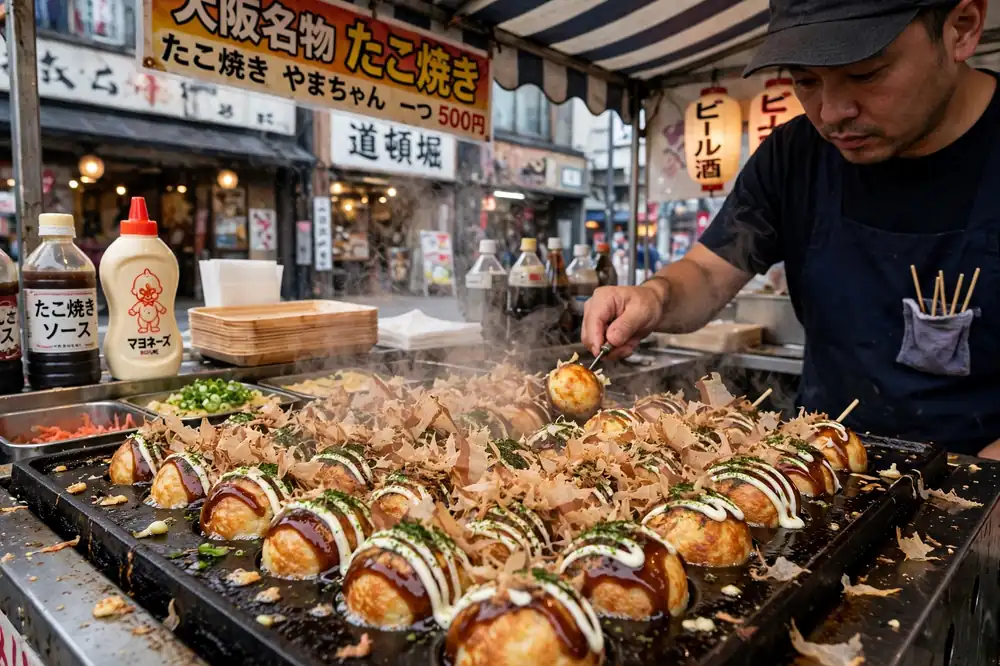
Takoyaki is Osaka’s signature street food: balls of wheat batter filled with diced octopus, tempura scraps, spring onion and pickled ginger, cooked in a special griddled pan until crisp outside and molten inside, then topped with takoyaki sauce, mayonnaise, seaweed and dancing bonito flakes. A box of eight costs about ¥500 to ¥900, and the benchmark is Takoyaki Doraku Wanaka in Sennichimae, a takeaway window with a standing area where the line moves in a few minutes. The rule is to eat them immediately, while they are too hot to hold comfortably — that is the point. Read more about takoyaki on Wikipedia.
2. Okonomiyaki
Okonomiyaki is Japan’s savoury pancake, and Osaka’s version is the original: a thick batter of flour, egg, shredded cabbage and your choice of pork, seafood or cheese, griddled in front of you and finished with sauce, mayonnaise, seaweed and bonito flakes. The classic place to eat it is a counter restaurant in Dotonbori or Namba, where the chef cooks it on the hotplate in front of you and you eat it straight off the grill with a small spatula. A full okonomiyaki costs about ¥1,000 to ¥1,800, and the best ones are at the counters where the locals queue, not the ones with the biggest signs. Read more about okonomiyaki on Wikipedia.
3. Kushikatsu
Kushikatsu is Shinsekai’s gift to the world: skewers of meat, seafood and vegetables, battered in panko and deep-fried, eaten with a shared pot of sauce — and the rule is absolute. No double-dipping: you dip once, eat, and never put a bitten skewer back in the pot. The oldest shops are in Janjan Yokocho, where a set of five skewers costs about ¥500 to ¥800, and the best order is a mix: beef, shrimp, lotus root, onion and quail egg. It is the cheapest proper meal in Osaka, and the one most visitors remember. Read more about kushikatsu on Wikipedia.
Free things to do in Osaka
Osaka is generous with free things to do, and you can fill a whole day without spending a yen. Osaka Castle Park, the moats and the great stone walls are free and open around the clock. Dotonbori, the Glico sign, Hozenji Yokocho and the Tombori Riverwalk cost nothing to walk. Shitennoji Temple’s grounds, Sumiyoshi Taisha, Namba Yasaka Shrine and the lion head are all free. The Cup Noodles Museum is free to enter, and so is the 16th-floor observation deck at Abeno Harukas. Grand Green Osaka and Umekita Park are free, Nakanoshima’s riverside promenade and rose garden are free, and the Midosuji Illumination turns the city’s main boulevard into a free light show from November to January. The best free view in the city is from the top of the Umeda Sky Building’s 35th floor — free to access, with the glass escalator ride thrown in — and the best free show is the sunset over Osaka Bay from Tempozan, with the Ferris wheel turning above the harbour.
Frequently asked questions
How many days do you need in Osaka?
Three days covers the city itself: one day for the castle and Minami, one for the Bay Area and Umeda, and one for the temples and the night garden. Add a fourth day for Universal Studios Japan, which is a full day on its own, and a fifth if you want a Kyoto or Nara day trip. Two days is possible but rushed — you will spend most of it in Dotonbori and at the castle, and you will miss the Bay Area entirely. If you only have a long weekend, base yourself in Namba and do the castle, Dotonbori and one big ticket sight a day.
Is Osaka worth visiting?
Yes — and for many travellers it is the best city in Japan. It is cheaper than Tokyo, friendlier than Kyoto, and it has the best food in the country at street level. The castle, Dotonbori, Super Nintendo World and the aquarium are all world-class, and the city is compact enough that you can walk between most of them. If you are choosing between Osaka and Tokyo for a first trip to Japan, pick Osaka for food and fun, and Tokyo for scale and variety. Most first-timers do both, with Osaka as the base for Kansai.
Is Osaka expensive to visit?
Osaka is a mid-range Japanese destination, and it is noticeably cheaper than Tokyo. A mid-range trip costs roughly ¥15,000 to ¥25,000 per person per day: about ¥8,000 to ¥15,000 for food, transport and admissions, plus the hotel. The big-ticket items are Universal Studios Japan at ¥8,400 to ¥12,000 and the aquarium at ¥2,700 to ¥3,200; everything else is ¥2,000 or less, and much of the best of the city — Dotonbori, the castle park, the shrines, the markets — is free. Budget travellers manage on ¥8,000 to ¥12,000 a day by eating standing up and staying in a business hotel; comfortable travel runs ¥25,000 to ¥40,000.
Do you need a car in Osaka?
No, and you do not want one. The Metro, the JR Loop Line and the private railways reach every sight in this guide, parking is scarce and expensive, and the city centre is a maze of one-way streets. The only place a car helps is a day trip into the mountains, and even then the train is usually faster. Buy an ICOCA card, download an offline map, and walk the last ten minutes — that is how Osaka is meant to be seen.
When is the best time to visit Osaka?
March to May and October to November, when the weather is mild and the city is at its most beautiful. Cherry blossom starts around March 23 to 25, with peak bloom from March 31 to April 6, and autumn colour peaks in November. Summer brings 30 to 35 degrees with punishing humidity and the biggest crowds at Universal Studios Japan, while winter is cool, dry and cheap, with the city’s illuminations along Midosuji Boulevard. Avoid planning your temple days for a Monday if you want Tennoji Zoo — it closes on Mondays — and avoid the castle on a public holiday, when the queues are at their worst.
Is the Osaka Amazing Pass worth it?
Yes, on a day of paid sights — and no on a Universal Studios Japan day. The one-day pass costs ¥3,500 and covers unlimited Metro and city bus rides plus free entry to around 40 attractions. A day that takes in Osaka Castle’s keep (¥1,200), the Umeda Sky Building observatory before 3:00 p.m. (¥2,000) and Tsutenkaku Tower (¥1,500) already comes to ¥4,700 in admissions alone, ¥1,200 more than the pass, before you count a single train ride. Skip it if you are spending the day at USJ or Kaiyukan — neither is covered — or if you reach Umeda Sky after 3:00 p.m., when the free entry becomes a 10 percent discount. Buy it online as a QR code; the physical card is gone.
Further reading — Wikipedia and Reddit
For more background on the city, read about Osaka on Wikipedia, the Osaka Castle on Wikipedia and Dotonbori on Wikipedia. For local tips and current conditions, the Osaka subreddit is the city’s active community forum. No Quora link is included here — we could not verify a live Osaka-specific thread on Quora, so we have not invented one.
Your Osaka trip, in one paragraph
Osaka is the city that eats first and asks questions later: a castle that doubled its price and is still worth every yen, a canal of neon and octopus balls, a theme park where Mario Kart is real, a market where the chefs shop, and a shrine with a twelve-metre lion head — all of it crossed by a ¥230 subway ride, in three days, without ever feeling rushed. If Osaka leaves you hungry for more, our guides to Chicago, Nashville, Los Angeles, Orlando, Miami, San Diego, Denver, Savannah, Dallas, Charleston, San Francisco, Myrtle Beach, Las Vegas, San Antonio, London, Portland, Pigeon Forge, Puerto Rico, Atlanta, Phoenix, Paris, Maui, Key West, Colorado Springs, Sedona, Chattanooga, Palm Springs, St Louis, Tokyo, Japan, Kansas City, Tennessee, Branson, Florida, Amsterdam, Montreal, Honolulu, Fort Lauderdale, Toronto, Aruba, Charlotte, Indianapolis, New Orleans, Destin, Santa Barbara, Mexico City and Arizona cover the rest of the Americas and beyond — pick your next city and start planning.

About the Author