Things to Do in Salt Lake City
20 Best Attractions, a 3-Day Itinerary, Where to Stay, and the Food You Cannot Miss
Quick Info
Best for: First-timers, skiers, history lovers and families — a walkable mountain city with the Wasatch at its doorstep
Best time: May–June and September–October for mild days; December–March for the deepest snow in North America
How long: 3 days for the city, the lake and one canyon; 4 to 5 days adds a ski day and the Bonneville Salt Flats
Budget: About $120–$180 per person per day mid-range — many of the best sights are free, the ski days are not
Don’t miss: Temple Square after its 2026 reopening, floating in the Great Salt Lake, sunset from Ensign Peak, a pastrami burger with fry sauce and a ski day in the Cottonwoods
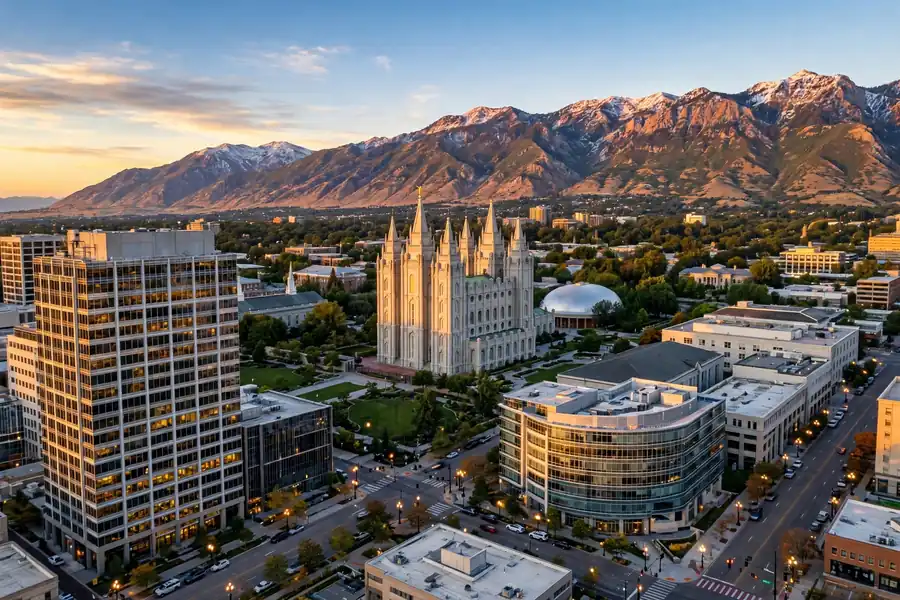
Salt Lake City on Wikipedia is the capital of Utah and the highest major city in the American West that most visitors underestimate — a city of about 200,000 people at 4,226 feet above sea level, laid out on a wide grid that counts every address from Temple Square, with the snow-covered Wasatch Mountains rising straight out of its eastern edge and the Great Salt Lake shimmering to the west. This guide covers the 20 best things to do in Salt Lake City, a 3-day itinerary that actually works, where to stay without overpaying, how to get around on the TRAX light rail and by car, the three foods you should not skip, and the free sights that cost nothing. Everything below was checked against live sources in November 2026 — including the reopened Temple Square, the lake’s record-low water level, and the 2026–27 ski prices.
Salt Lake City at a glance
| Topic | What to know |
|---|---|
| Full name | Salt Lake City — the capital and largest city of Utah |
| Founded | July 24, 1847, when Brigham Young and the Mormon pioneers arrived in the Salt Lake Valley |
| Population | About 200,000 people in the city, about 1.2 million in the metro area |
| Language | English; Spanish is widely spoken |
| Airport | Salt Lake City International Airport (SLC), about 7 miles west of downtown |
| Best base | Downtown or Capitol Hill for a first visit — walkable, with TRAX at your door |
| Getting around | TRAX light rail downtown, buses, and a car for the canyons, the lake and the ski resorts |
| Famous for | Temple Square, the Great Salt Lake, the 2002 Winter Olympics, and the greatest snow on earth |
Salt Lake City divides into two ideas that most visitors only partly see. The pioneer city is the one on the postcards: Temple Square, the granite Capitol on its hill, and the wide streets Brigham Young laid out wide enough, so the story goes, for an ox team to turn around. The other Salt Lake City is the one that makes people come back: a young, outdoors-obsessed mountain town where the ski bus leaves downtown at 7 a.m., the craft breweries fill at 5 p.m., and the trailheads start where the suburbs end. The trap is the calendar: the city is at its best in late spring and early autumn, brutally hot in July, and grey with winter inversion in January — while the ski resorts 30 minutes away get 500 inches of the driest snow in North America. Plan around the season, not against it, and the city rewards you in every month of the year.
The 20 best things to do in Salt Lake City
1. Temple Square
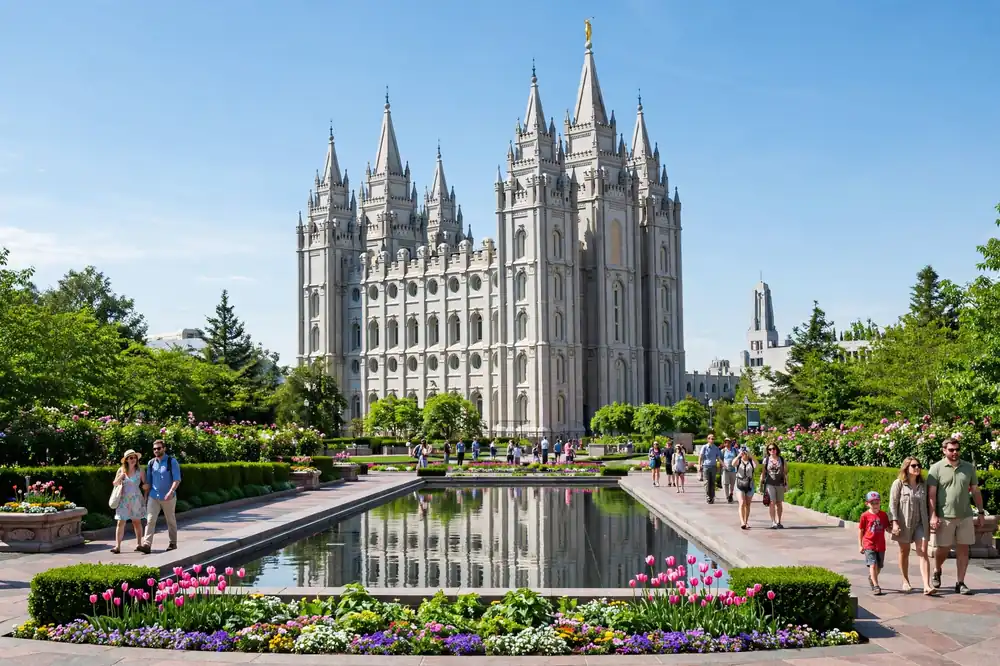
Temple Square on Wikipedia is the spiritual and historic heart of the city, a 10-acre walled complex owned by The Church of Jesus Christ of Latter-day Saints and designated a National Historic Landmark District — and it is the single most important thing to know before you visit in 2026. After nearly seven years of construction and renovation, the grounds reopened to the public in September 2026, just before the October general conference, with the construction barriers gone, the gardens restored, 12 new statues, a rebuilt Main Street Plaza reflection pool, and a new Flag Plaza near the Church Office Building. The gates are open daily from 7 a.m. to 10 p.m., and walking the grounds is free. The Salt Lake Temple itself — the granite landmark built from 1853 to 1893, with six spires rising 210 feet — is still closed to the public while the final work is finished: it opens for a six-month public open house, the Salt Lake Temple Celebration, from April 5 to October 1, 2027, with free tours by reservation through TempleSquare.org, before it is rededicated and returns to regular temple use. The new Temple Square Visitors’ Center, which opened on May 18, 2026, is open daily from 9 a.m. to 9 p.m. with immersive exhibits and a large-scale model of the temple; its “Inside a Temple” guided tour needs a reservation, with new tickets released every other Monday. Two warnings for 2026: the Conference Center is closed for renovation until March 2027, and the Beehive House, the Lion House and the Assembly Hall are closed until spring 2027. Older guides still describe the square as a construction site — it is not anymore, but the temple interior is still a 2027 event, not a 2026 one.
2. Utah State Capitol
Utah State Capitol on Wikipedia sits on Capitol Hill above downtown, a Neoclassical landmark designed by Richard Kletting and built between 1912 and 1916 from Utah granite and Georgia marble, with a copper dome that catches the evening light across the whole valley. Entry is free, and volunteer docents lead free guided tours on weekdays, hourly from 10 a.m. to 3 p.m. — the best way to see the rotunda, the House and Senate chambers, and the murals of Utah history. The grounds are the other half of the visit: the lawns and the war memorials face south over the city, and the sunset view from the Capitol steps is the free photograph of Salt Lake City. One new fact for 2026: Utah’s first state history museum, the Utah State History Museum, opened on June 27, 2026 inside the new North Capitol Building on Capitol Hill, a short walk from the Capitol itself. Allow an hour for the building and the grounds, and pair it with Ensign Peak, which is a five-minute drive north.
3. Natural History Museum of Utah
Natural History Museum of Utah on Wikipedia is the state’s official natural history museum, inside the copper-clad Rio Tinto Center that steps up the foothills above the University of Utah — and it is the best single museum in the city. The dinosaur hall is the showstopper, with walls of skeletons in dramatic poses, including Allosaurus and Utahraptor, but the upper floors are just as good: the geology of the Wasatch, the story of Lake Bonneville, the ancient lake that once covered the valley and left the Great Salt Lake behind, and the Native voices of the Shoshone, Ute, Paiute, Goshute and Navajo peoples. Admission is $24.95 for adults, $22.95 for seniors 65 and over and young adults 13 to 24, $20.95 for children 3 to 12, and free for children 2 and under, museum members, and University of Utah students, faculty and staff with ID. The museum is open daily from 10 a.m. to 5 p.m., and until 9 p.m. on Wednesdays; it is closed on Thanksgiving Day and Christmas Day. Tickets stop 30 minutes before closing, and the museum encourages booking online. Allow two to three hours, and do not skip the terraces — the view over the valley is part of the ticket.
4. Antelope Island State Park
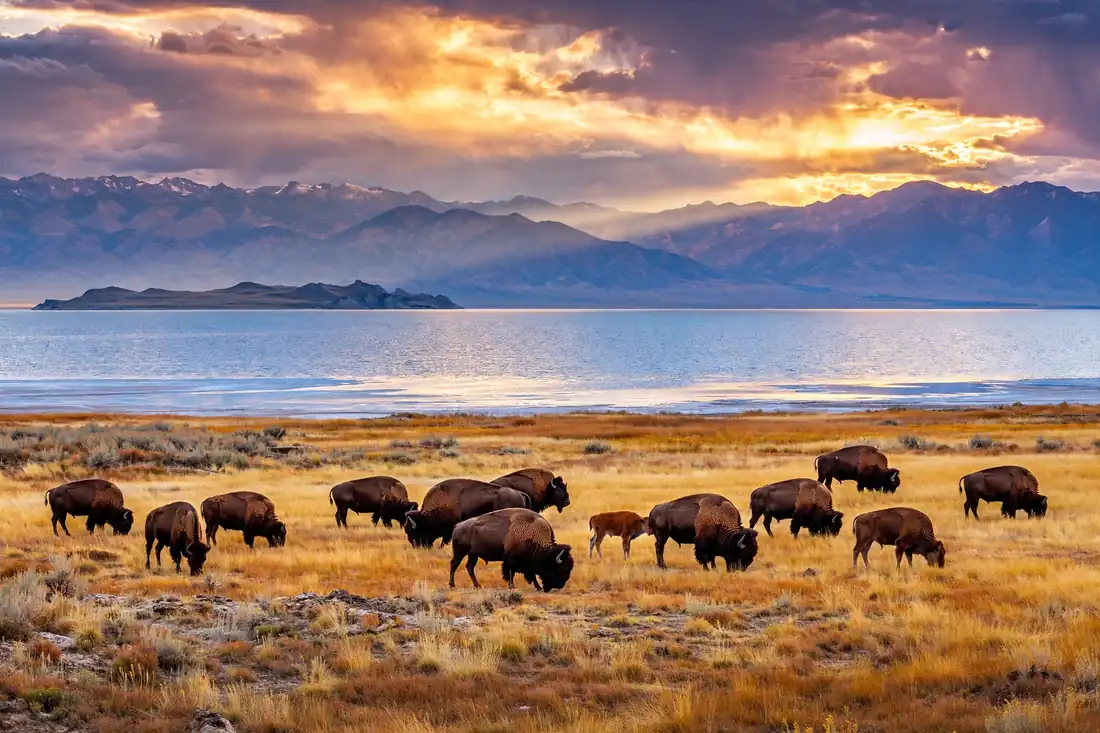
Antelope Island State Park on Wikipedia is the wildest place in the Salt Lake Valley — a 28,000-acre island in the Great Salt Lake, reached by a seven-mile causeway from Syracuse, about an hour north of downtown. The island is home to one of the largest free-roaming bison herds in the country, around 500 to 700 animals, plus pronghorn, bighorn sheep, mule deer and coyotes, and the bison are the reason to come: they wander the roads and the grasslands, and the park asks you to stay at least 25 yards away. Entry is $15 per vehicle for up to eight people, or $10 for a senior-driven vehicle, and the park is open daily from 6 a.m. to 10 p.m.; facilities are closed on Thanksgiving and Christmas. The causeway itself is part of the experience — the lake on both sides, the mountains ahead — and the best stops are the Fielding Garr Ranch, a working ranch from the 1840s, the hike up Frary Peak for the island’s highest view, and the sunset from the west shore. One warning: the Antelope Island Visitor Center was closed for construction and renovation in September 2026, so check its status before you go, and bring water — there is almost no shade and no food on the island. The lake level matters here too: at 4,190 feet in November 2026, the shoreline has pulled far back from the old beaches, and the causeway now crosses more exposed lakebed than water.
5. The Great Salt Lake — floating at Saltair
The Great Salt Lake on Wikipedia is the largest saltwater lake in the Western Hemisphere, a remnant of ancient Lake Bonneville, and the one sight in Utah that does not behave like a lake at all: it has no outlet, so the minerals the rivers bring in stay behind as the water evaporates, and the south arm is about 12 percent salt — roughly three times saltier than the ocean — which is why you float in it without trying. The easiest place to do it is Great Salt Lake State Park at Saltair, about 16 miles west of downtown: entry is $10 per vehicle, or $5 for a senior vehicle, and the beach is a short walk from the parking lot. Bring water shoes — the salt crust is sharp underfoot — and rinse off afterwards, because the salt dries on your skin and your swimsuit. The honest warning is the lake itself: in November 2026 the south arm stood at 4,190 feet above sea level, only 1.5 feet above the all-time record low of 4,188.5 feet set in November 2022, and the lake is about 29.7 percent full, with more than 57 percent of its lakebed exposed. The exposed bed blows dust into the valley during windstorms, and the lake’s decline is the biggest environmental story in Utah — the article in the “skip” FAQ explains what not to expect. Go in late spring or early autumn, when the water is warmest and the brine flies are fewest, and do not expect a beach resort: Saltair is a stark, beautiful, slightly eerie place, and that is the point.
6. Alta Ski Area
Alta Ski Area on Wikipedia is the temple of Utah powder — a skiers-only mountain at the top of Little Cottonwood Canyon, about 30 minutes from downtown, with 2,614 acres and about 540 inches of snow a year, among the most reliable powder anywhere on earth. There is no snowboarding here, by design, and there is almost no scene either: no village, no nightlife, just lifts, traverses, tree runs and bowls, and a lodge culture that has barely changed in decades. Day tickets for 2026–27 were on sale from November, at about $209 a day when bought four or more days ahead, with walk-up prices higher on peak days; the combined Alta–Bird season pass with Snowbird is $3,188 for an adult. Alta is on the Ikon Pass, and the interconnect ticket links it with Snowbird next door for a combined 4,700-plus acres. The season generally runs from late November into April, and on big snow days the canyon road can close for avalanche control — check the road status before you leave, and take the ski bus if you can. If you only ski one day in Utah, ski Alta on a weekday, when the powder lasts past noon.
7. Snowbird
Snowbird on Wikipedia is Alta’s bigger, louder neighbour in Little Cottonwood Canyon — 2,500 acres, a 3,240-foot vertical drop, and about 500 inches of snow a year, with the 125-passenger Aerial Tram climbing 2,900 feet to Hidden Peak at 11,000 feet in about ten minutes. The tram ride alone is worth the trip even if you never click into skis: the view from the top covers the whole Salt Lake Valley on one side and the Wasatch wilderness on the other, and in summer the tram runs for hikers and sightseers. For 2026–27, the peak walk-up adult day ticket is $238, with online advance tickets from about $194, and dynamic pricing means the cheapest days are the weekdays you book early. Snowbird is on the Ikon Pass for seven days combined with Alta, and on the Mountain Collective for two days, and the Flex-5 pass gives five no-blackout days at about $112 a day. The season runs late November into May, sometimes longer, and the base stays open deep into spring. One practical note: Snowbird and Alta share the same canyon road, so on powder days leave downtown by 7 a.m. or take the $5 ski bus and skip the parking fight entirely.
8. Park City and Main Street
Park City, Utah on Wikipedia is the resort town 35 minutes east of Salt Lake City over Parleys Canyon — and it is the other half of the ski story. Park City Mountain is the largest ski resort in the United States by acreage at 7,300 acres, joined to the Canyons side by the Quicksilver Gondola, and it is the flagship Utah resort on the Epic Pass. For 2026–27 the peak-day adult ticket is about $369, with four or more weeks of lead time saving 30 percent or more, so a walk-up holiday ticket is the most expensive lift ticket in Utah and an advance weekday ticket is a different price entirely. The town itself is the reason to come even without skis: Historic Main Street, a former silver-mining street of Victorian storefronts, with galleries, boutiques and restaurants, and the Sundance Film Festival, which takes over the town every January. Deer Valley, the ski-only resort on the other side of town, is the most luxurious in the state, with walk-up tickets around $229 to $295 and a daily cap on ticket sales, and it is expanding through the new Deer Valley East Village. Stay a night if you can — Park City after the lifts close, with the lights on Main Street and the snow falling, is a different town from the day-trip version.
9. Bonneville Salt Flats
The Bonneville Salt Flats on Wikipedia are the strangest landscape in Utah — 30,000 acres of blinding white salt crust in the Great Salt Lake Desert, about two hours west of Salt Lake City on I-80 toward the Nevada border, flat to within a foot over miles. There is no entrance fee, no permit and no hours: it is public land managed by the Bureau of Land Management, open 24 hours a day, and you drive in from the rest area at exit 4 near Wendover. The best window for the mirror effect is February through April, when shallow winter flooding turns the flats into a giant reflection of the sky — go at sunrise, when the wind is calm, for the glass. The dry season, June through August, is best for walking and driving on the salt, and it is also racing season: Speed Week runs July 27 to August 8, 2026, with the World of Speed from August 30 to September 8 and the World Finals from September 23 to 29, when the flats are restricted and spectators pay an event fee. Three rules: never drive on the salt when it is wet or flooded — cars sink into the mud under the crust and need expensive extraction; rinse your car afterwards, because the salt is corrosive; and bring water, because there is nothing out there. The Tree of Utah, the 87-foot sculpture 25 miles east of Wendover on I-80, is the landmark to watch for on the way.
10. This Is The Place Heritage Park
This Is The Place Heritage Park on Wikipedia marks the spot at the mouth of Emigration Canyon where, on July 24, 1847, Brigham Young first looked out over the Salt Lake Valley and, according to tradition, said “This is the place.” The 450-acre living history site recreates 19th-century Utah from the Mormon arrival in 1847 to statehood in 1896, with more than 50 historic buildings, costumed interpreters, a petting corral, pony rides and three trains — the Jupiter, the Blackhawk and the 119 — that tour the village. The park grounds and the monument are free to enter from dawn to dusk; the paid experiences run Monday to Saturday from 10 a.m. to 5 p.m., closed on Sundays, and the Fall 2026 season runs September 9 through October 31, with an experience pass of $25 for ages 2 and over. Summer admission is $22.95 for adults 12 to 64, $19.95 for seniors 65 and over, and $16.95 for children 3 to 11. It is the best family stop in the city, and the monument at the top of the hill is the view Brigham Young saw — the whole valley laid out below, which makes the history land in a way no museum panel can.
11. Red Butte Garden
Red Butte Garden on Wikipedia spreads over more than 100 acres of the Wasatch foothills above the University of Utah, mixing themed display gardens — roses, herbs, water-wise plants, a children’s garden — with miles of trails through native scrub oak and canyon slopes. Admission is $16 for adults, $14 for seniors and military, $8 for children 3 to 17, and free for children under 2, and the garden is open daily from around 9 a.m. to 5 p.m., with hours varying by day and season, so check the website before you go. The garden is at its best in May and June, when the roses and the wildflowers are out and the foothills are green, and in October, when the scrub oak turns gold. It is also Salt Lake City’s summer concert venue, with the outdoor amphitheatre hosting big-name shows on warm evenings — book those separately, because concert tickets are not garden admission. Pair it with the Natural History Museum of Utah next door, which shares the same foothill road, and allow two hours for the garden alone.
12. Utah Museum of Fine Arts
The Utah Museum of Fine Arts on Wikipedia is Utah’s premiere art museum, on the University of Utah campus, with a collection of nearly 20,000 works spanning European, American, modern and contemporary art, plus artifacts from India, Polynesia, Mesoamerica and Africa — and admission is free, which makes it the best free museum in the city. The galleries are quiet, well lit and easy to walk in an hour and a half, and the rotating exhibitions are the reason to check what is on before you go: the museum runs two major fall exhibitions most years, and the collection galleries change more often than most visitors expect. It sits a short walk from the Natural History Museum of Utah and Red Butte Garden, so the three make a natural east-bench half day: art, dinosaurs and gardens, all within a mile of each other. The museum is closed on Mondays, so do not plan it for the start of the week.
13. Ensign Peak
Ensign Peak on Wikipedia is the dome-shaped hill just north of the Capitol, and the short but steep trail to its summit is the easiest big view in Salt Lake City. The trail is about half a mile each way, climbing to 5,379 feet, and at the top stands the monument marking the spot where Brigham Young climbed on July 26, 1847, two days after arriving in the valley, and named the peak. The view covers the whole city, the Great Salt Lake to the west, and the Wasatch to the east, and it is at its best at sunset, when the valley lights come on below. Go in the morning in summer, when the slope is in shade, and bring water — there is none on the trail, and the climb is steeper than it looks from the car park. It is free, it takes under an hour, and it is the hike locals recommend first, because it explains the city in a single view: the grid below, the lake beyond, and the mountains that box it all in.
14. Gilgal Sculpture Garden
Gilgal Sculpture Garden on Wikipedia is the strangest small park in Utah — a half-acre garden in a residential neighbourhood, filled with stone sculptures carved between 1945 and 1963 by Thomas Battersby Child Jr., a Mormon bishop with a mason’s hands and a visionary’s imagination. The centrepiece is a sphinx with the face of Joseph Smith, the founder of the Latter-day Saint movement, flanked by stone figures, arches and scriptural scenes, all of it earnest, odd and completely sincere. The garden is free, open daily during daylight hours, and takes about 20 minutes to walk — it is the kind of place most guides skip and most visitors remember. It sits a short drive east of downtown, near the 9th and 9th neighbourhood, so pair it with a coffee and a walk around the indie shops there. Do not expect a museum: there is no ticket desk, no gift shop, and no explanation beyond the stones themselves.
15. Clark Planetarium
Clark Planetarium on Wikipedia is the downtown science museum at The Gateway, and its exhibit floors are free — which makes it the best rainy-day or inversion-day stop in the city. The hands-on exhibits cover space, weather and the physics of the everyday, the IMAX theatre and the star dome run ticketed shows, and the Foucault pendulum in the lobby is the quiet showpiece. It is open daily, and the planetarium is at its best with children in tow, though the space exhibits hold adults too. The Gateway itself, the open-air shopping and dining district around it, is worth a walk after dark, when the fountains and the lights come on. One practical note: the planetarium’s show schedule changes by season, so check the day’s times before you go, and book the dome shows online on weekends, when they sell out.
16. Tracy Aviary and Liberty Park
Tracy Aviary on Wikipedia occupies eight acres inside Liberty Park, Salt Lake City’s second-largest park, and it has been open to the public since 1938, when banker Russell Lord Tracy donated his private bird collection to the city. The aviary holds around 400 birds across 135 species, from Andean condors to showy flamingos, with free-flight shows in the warmer months and a conservation program that works on birds of the Intermountain West. Liberty Park itself is 80 acres of lawns and tall trees, established in 1881 on land bought from Brigham Young’s estate, with a 1.4-mile walking loop, paddle boats on the pond, tennis courts and the Isaac Chase Mill, built in 1852 and the oldest commercial building still standing in Utah. The aviary is the paid part; the park is free, and it is the city’s best picnic ground. Come on a Saturday morning, when the farmers’ market runs in the summer, and the park fills with families, dogs and runners.
17. Utah’s Hogle Zoo
Utah’s Hogle Zoo on Wikipedia spreads over 42 acres at the mouth of Emigration Canyon, across the road from This Is The Place Heritage Park, and it is one of the best small zoos in the Mountain West. The highlights are the African Savanna, with elephants, giraffes, zebras and rhinos on a single sweeping habitat, Rocky Shores for polar bears and sea lions, and the Asian Highlands for snow leopards and Amur tigers — animals that belong in a mountain climate. The zoo is open daily, with hours varying by season, and the animals are most active in the morning, before the heat builds. It is a half-day stop, and it pairs naturally with This Is The Place across the road: history in the morning, animals in the afternoon, with Emigration Canyon behind both. Book online on summer weekends, when the car park fills by late morning.
18. Utah Olympic Park
Utah Olympic Park on Wikipedia is the 2002 Winter Olympics venue in Park City, at 3419 Olympic Parkway, about 35 minutes from downtown — and it is where the Olympic story becomes something you can touch. The venue and its museums are open daily from 9 a.m. to 6 p.m., and the museums are free, with exhibits on the 2002 Games, the athletes and the sliding sports. The paid activities are the reason to go: the bobsled ride down the Olympic track, the ziplines, the alpine slide in summer, and the freestyle aerials training pool, where you can watch athletes practise jumps into the water. Most activity tickets are date and time specific, with no refunds, including for bad weather, so book the morning you want and check the weather first. The park is also part of the 2034 story: Salt Lake City hosts the Winter Games again in 2034, and Utah Olympic Park, Deer Valley, Park City Mountain and Soldier Hollow in Midway will stage events including snowboarding, freestyle skiing, ski jumping, Nordic combined and sliding sports. Go now, before the 2034 construction changes it.
19. Salt Lake Tabernacle and the Tabernacle Choir
The Salt Lake Tabernacle on Wikipedia is the domed hall on Temple Square, built between 1863 and 1867 with a roof held up by 44 sandstone piers and no interior pillars, so that all 21,000 people inside could see and hear — and it is still the home of the Tabernacle Choir at Temple Square, the choir that has sung here since 1847. The Sunday morning broadcast, Music & the Spoken Word, is free and open to the public, with doors opening early and the hall filling fast; arrive at least 30 minutes before the 9:30 a.m. start, and check the schedule, because the choir tours and the broadcast moves. The Tabernacle organ, with 11,623 pipes, is one of the largest in the world, and the free organ recitals on weekdays are the quiet way to hear it. The Tabernacle sits on the west side of Temple Square, so it is easy to reach now that the grounds have reopened, but it is a working performance hall, not a museum — come for a performance, not a tour.
20. City Creek Center and downtown
City Creek Center on Wikipedia is the open-air shopping and dining centre across South Temple Street from Temple Square, with 110 stores and restaurants under a retractable glass roof, a creek running through the middle of it, and a central plaza with a fountain. It is Utah’s premiere shopping destination, with Nordstrom, Tiffany and the Cheesecake Factory among the names, but the reason to come is the setting: the creek, the trout in it, the bridge over it, and the way the centre opens onto Temple Square on one side and the downtown grid on the other. It is free to wander, and it is at its best in December, when the Christmas lights go up and the plaza fills. Around it, downtown is changing fast: the Smith Entertainment Group’s four-block, 35-acre redevelopment tied to the Delta Center renovation, with a 6,000-seat Live Nation music venue, a near-total rebuild of the Salt Palace convention center, a renovation of Abravanel Hall and a new art museum, begins demolition and construction in February 2027, with everything complete before the end of 2033 for the 2034 Winter Olympics. Downtown Salt Lake City in 2026 is a city mid-rebuild — go now, and go again in 2034.
Salt Lake City in 3 days — a ready-made itinerary
This three-day plan covers the pioneer city, the lake and one canyon, and it uses TRAX downtown and a car for everything beyond it. Book the ski day and the bobsled before you fly, put the museums on a weekday, and keep the evenings for the food — Salt Lake City eats early by mountain-town standards, and the best tables fill by 7 p.m.
Day 1 — Downtown: Temple Square, the Capitol and Ensign Peak at sunset
Start at Temple Square at the 7 a.m. gate opening, before the crowds, and walk the reopened grounds, the gardens and the new Visitors’ Center — remember the temple itself is closed until the 2027 open house, so the grounds and the centre are the visit. Cross to the City Creek Center for lunch, then take TRAX or walk to the Utah State Capitol for the free afternoon tour and the view from the steps. Walk down to the Salt Lake City Public Library for the rooftop view, and finish at Ensign Peak for sunset, with the whole valley below. Dinner is a pastrami burger with fry sauce at Crown Burgers, or the mole sampler at Red Iguana on North Temple.
Day 2 — The east bench and the lake: museums, gardens and Antelope Island
Start at the Natural History Museum of Utah at the 10 a.m. opening, before the school groups, and give it two to three hours — dinosaurs first, then the Lake Bonneville galleries. Walk next door to Red Butte Garden for the late morning, and stop at the Utah Museum of Fine Arts on the way back down the hill. In the afternoon, drive the causeway to Antelope Island for the bison, the ranch and the sunset over the lake, and stop at the Great Salt Lake State Park at Saltair on the way back if you want to float. Dinner is in the 9th and 9th neighbourhood, where the indie restaurants and the coffee shops are.
Day 3 — The mountains: a ski day, or the Salt Flats and Park City
If it is winter, take the ski bus to Alta or Snowbird at 7 a.m., ski until the lifts close, and be back downtown for dinner — the Cottonwood canyons are 30 minutes away, and a powder day here is the best skiing in North America. If it is any other season, drive two hours west to the Bonneville Salt Flats for the morning mirror or the dry-season walk, then back through Park City for Main Street, the Olympic Park museums and dinner. Spend the last evening at the Eccles Theater if a show is on, or at the Gateway, with the fountains and the planetarium, and finish with a dirty soda — the Utah drink you will not find anywhere else.
Best time to visit Salt Lake City
| Season | Weather | Crowds | Notes |
|---|---|---|---|
| Spring (March–May) | Highs about 54–73°F (12–23°C), lows about 36–50°F (2–10°C) | Moderate | Best all-round season; wildflowers, ski season ends in April |
| Summer (June–August) | Highs about 84–94°F (29–34°C), lows about 59–68°F (15–20°C) | High | Hottest and driest; festivals, hiking, lake swimming |
| Autumn (September–November) | Highs about 51–81°F (11–27°C), lows about 33–56°F (1–13°C) | Moderate | Second-best season; fall colour in the canyons, thin crowds |
| Winter (December–February) | Highs about 38–45°F (3–7°C), lows about 24–29°F (-4–-2°C) | High | Deepest snow; inversion days in the valley, bluebird days in the canyons |
The best time to visit Salt Lake City is May to June and September to October, and if you want one answer, pick late May or late September: the days are warm without being punishing, the evenings are long, the canyons are green or gold, and the city is full without being crowded. July is the hottest month, with an average high of 94°F (34°C) and a low of 68°F (20°C), and heatwaves regularly push past 100°F — the city sits in a high desert bowl, and the sun is strong at 4,226 feet. January is the coldest month, with an average high of 39°F (4°C) and a low of 24°F (-4°C), and the city averages about 52 inches of snow a year, against about 500 inches in the Cottonwood Canyons. The winter trap is the inversion: cold air pools in the valley under a layer of warm air, and a typical Utah winter brings five to six multi-day inversion episodes and an average of 18 days with PM2.5 above the federal air quality standard. On inversion days the valley looks grey and the air tastes of exhaust — drive 30 minutes up a canyon and you are above it, in blue sky and clean air, which is exactly what the skiers do. The other winter fact is the lake: as it shrinks, the exposed lakebed blows dust into the valley during windstorms, and researchers link that dust to the air quality problem the 2034 Olympics are meant to help fix. There is no wet season — April is the wettest month at about 2.2 inches of rain, July the driest at about 0.5 inches — and the city gets more than 3,000 hours of sun a year.
Where to stay in Salt Lake City
| Area | Best for | Price range |
|---|---|---|
| Downtown | First-timers, walking everywhere, TRAX | $120–$250 a night |
| Capitol Hill and the Avenues | Quiet, historic streets, valley views | $110–$220 a night |
| Sugar House | Cafés, parks, local shops | $100–$200 a night |
| 9th and 9th | Indie restaurants, coffee, walkable streets | $100–$200 a night |
| University and East Bench | Museums, gardens, quieter nights | $110–$220 a night |
| Park City | Ski base, Main Street, resort nights | $200–$500 a night in ski season |
Stay downtown if this is your first visit — everything is walkable, TRAX is under your feet, Temple Square and the City Creek Center are the meeting point, and the airport train drops you here. Stay on Capitol Hill or in the Avenues if you want quiet and historic: the grid of elegant streets northeast of downtown, with the best sunset views in the city and the calmest nights. Stay in Sugar House if you want the local Salt Lake City — the cafés, the parks and the shops, with the mountains at the end of every street. Stay in 9th and 9th if food is the reason you came — the indie restaurants, the coffee shops and the walkable streets, with the Liberty Park farmers’ market on Saturdays. Stay near the University or the East Bench if you want the museums and the gardens on your doorstep and a quieter sleep. Stay in Park City if skiing is the trip — the resorts, Main Street and the resort nights — but book early for Christmas and New Year, the Sundance Film Festival in January, and the Presidents’ Day weekend, when the city fills first and the prices rise fastest. Two warnings: do not book a room right on State Street or Main Street if you want quiet — the bars below go on until 1 a.m., when alcohol service stops — and do not assume a downtown hotel includes parking, because most charge $20 to $40 a night for it.
Getting around Salt Lake City
| Way to travel | Cost | Best for |
|---|---|---|
| TRAX single (2-hour window) | $2.50 | Downtown, the airport, the University |
| TRAX day pass | $5.00 | Heavy daily use; FAREPAY caps at $5 a day |
| Ski bus | $5.00 | Alta, Snowbird, Brighton, Solitude |
| FrontRunner (commuter rail) | $2.50 base + $0.60 per station | Day trips to Ogden and Provo |
| Rental car | $40–$80 a day plus fuel | Canyons, the lake, the Salt Flats |
| Taxi or rideshare (airport to downtown) | $25–$40 | Groups, luggage, late nights |
Salt Lake City’s TRAX light rail is the way to move downtown: three lines — Blue, Red and Green — converging on the city centre, with trains every 15 minutes on weekdays and every 30 minutes on Sundays. The Green Line runs from the airport station, on the ground level just outside the terminal at door 1A, straight through downtown past Temple Square and City Creek Center, in about 20 minutes, for $2.50. A single fare of $2.50 covers two hours of rides on TRAX, local buses, the S-Line streetcar and UTA On Demand, and a FAREPAY card caps local fares at $5 a day or $20 a week. Part of downtown is a Free Fare Zone: rides that start and end inside it on TRAX or a fixed-route bus are free, as long as you tap on and off. Two warnings: UTA does not accept tap-to-pay bank cards or phones, so buy a FAREPAY card or use the Transit app; and the reduced fare of $1.00 needs an approved Reduced Fare FAREPAY card, which has not been sold on the spot at ticket machines since April 12, 2026. Beyond downtown you need a car: the canyons, Antelope Island, the Salt Flats and the ski resorts are all beyond the rails. In the Cottonwood Canyons, the traction law applies on snow days — all-wheel drive or chains, or the ski bus, which is $5 and skips the parking fight. The airport is 7 miles west of downtown, and TRAX does not run all night: the first train reaches the airport at 5:46 a.m. and the last leaves it at 10:37 p.m., so early flights and late arrivals need a taxi or a rideshare.
Salt Lake City food you have to try
Salt Lake City’s food is the food of a mountain town that grew up fast: the Mexican kitchens of North Temple, the pastrami burgers of the old drive-ins, the fry sauce on every table, and the dirty sodas that Utah invented and the rest of the country is only now discovering. The tourist-trap problem here is the opposite of most cities: the restaurants on Temple Square’s doorstep are fine, but the best food is a ten-minute drive away, in the neighbourhoods — eat where the locals queue, and eat early, because the best tables fill by 7 p.m.
Fry sauce, pastrami burgers and the diner trail
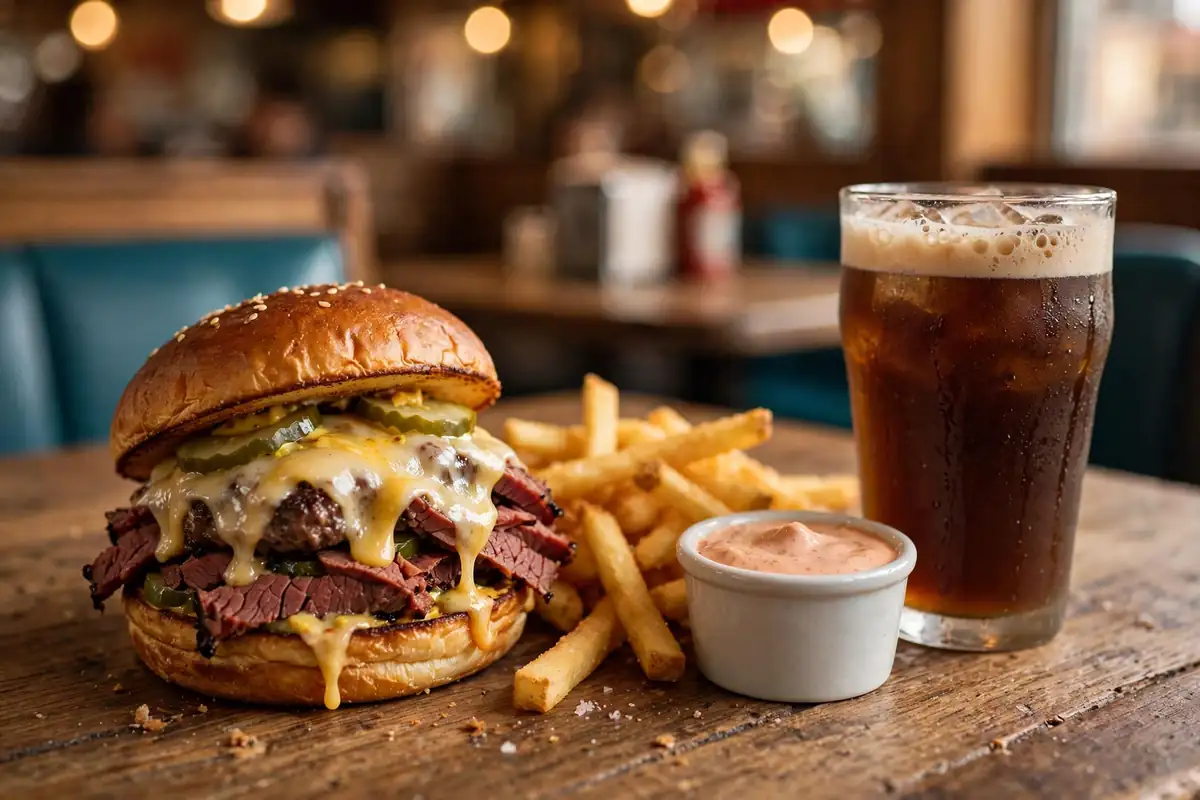
Fry sauce is the dish Utah argues about most: a pink blend of ketchup and mayonnaise, with garlic and spices, served with every order of fries in the state. The story most Utahns tell is that Don Carlos Edwards, founder of the Arctic Circle chain, created it as “pink sauce” in the late 1940s at his Salt Lake City restaurants; folklorists have since traced the name to two teenage employees mixing ketchup and mayonnaise at a Provo Arctic Circle in the mid-1950s — either way, it started in Utah, and the 2002 Olympics even issued a fry-sauce-shaped commemorative pin. The place to eat it is Crown Burgers, the local chain where the pastrami burger — a deep-fried patty piled with thin-sliced pastrami — defines Utah’s burger scene, with fry sauce standard and not optional. The other diner stop is J Dawgs, the Provo-born hot dog stand that Salt Lake City adopted, where the beef dogs come with sauerkraut, grilled onions and the house sauce. Order the pastrami burger, ask for extra fry sauce, and eat it in the car park like everyone else.
Red Iguana and the seven moles
Red Iguana is the single most consistently recommended restaurant in Salt Lake City, and it is the one to book first: a family-owned Mexican restaurant at 736 West North Temple, run by the Cardenas family since 1965 at the current location since 1985, built around seven house-made moles, each from a different regional tradition. Mole Negro, the king of moles, is built on dried chile mulato, negro pasilla, Mexican chocolate, raisins, peanuts, walnuts and bananas; Mole Amarillo runs fiery on habanero and yellow tomatoes; Mole Verde is fresh and bright with pepitas and avocado; and Mole Coloradito, the most approachable entry point, is served with carnitas. The mole sampler is the order if you are new — it lets you taste several moles before committing to a full dish — and the tamales, made in-house with multiple mole preparations, are the other signature. In 2025, Yelp placed Red Iguana first on its Salt Lake City Top Local Eats list, Guy Fieri featured it on Diners, Drive-Ins and Dives in 2008 and returned in 2020, and it has been voted the city’s best Mexican restaurant for more than 25 consecutive years. It is open Sunday to Thursday from 11 a.m. to 9 p.m. and Friday and Saturday from 11 a.m. to 10 p.m., at two locations on North Temple and South Temple — go to the original on North Temple, and go early, because the queue starts before the doors open.
Dirty sodas, Jell-O and the sweet tooth
The dirty soda is Utah’s other invention: a fountain soda — usually Dr Pepper or Coke — mixed with coconut cream, flavoured syrups and a squeeze of lime, served over pebble ice in a 44-ounce cup. Swig, founded in St. George in 2010, started the craze, and Sodalicious and the rest followed; there are now dirty soda shops on nearly every busy corner in Salt Lake City, and the lines at lunchtime are the review. Order the classic — Dr Pepper, coconut cream and lime — and drink it on the drive to the canyons. The other Utah sweet is Jell-O: Utah eats more Jell-O per capita than any other state, and in 2001 the state legislature named it the official state snack — a nod to the Mormon potluck culture of funeral potatoes, the cheesy hash-brown casserole that shows up at every church supper and family gathering. For dessert, the local move is the Pie Pizzeria, the underground pizza joint under the University of Utah that has served thick, cheesy slices since 1980, and the place to finish a ski day. Save room after dinner: Salt Lake City’s sweet tooth is not a side note, it is the city’s personality.
Free things to do in Salt Lake City
Salt Lake City is cheaper than its reputation suggests, because the best sights cost nothing. The grounds of Temple Square are free, and so is the walk around the gardens, the reflection pool and the new Flag Plaza. The Utah State Capitol is free, with free guided tours on weekdays, and so is the sunset view from its steps. Ensign Peak is free, and so is the view from the top. Gilgal Sculpture Garden is free, and so is the Utah Museum of Fine Arts. The exhibit floors of Clark Planetarium are free, and so is the Salt Lake City Public Library and its rooftop terrace. Liberty Park is free, and so is the walk around its pond and the Isaac Chase Mill. The Utah Olympic Park museums are free, and so is the walk around the ski jumps. And the paid museums have free windows: the Natural History Museum of Utah is free for University of Utah students, faculty and staff, and for children under 2. Do the free list on your first day, and you will have seen the temple, the Capitol, the view, the art and the park before you have spent a dollar on a ticket.
Frequently asked questions
How many days do you need in Salt Lake City?
Three days is the minimum for the highlights: one day for downtown and Capitol Hill, one day for the east-bench museums and Antelope Island, and one day for the mountains — a ski day in winter, the Salt Flats and Park City in any other season. Four to five days is the right amount for a real trip, with a second ski day and a canyon hike, and a week if you want to use the city as a base for Utah’s national parks, which are three and a half to four and a half hours south. Two days works if you plan well — Temple Square, the Capitol, one museum and Antelope Island — but you will leave having seen a third of the city.
Is Salt Lake City safe?
Salt Lake City is one of the safest mid-sized cities in the American West, and the risk is ordinary city risk, not something specific to Utah. Downtown, Capitol Hill, the Avenues, Sugar House and the University are safe to walk day and night, including the TRAX ride home after dinner. The usual rules apply: keep your bag in front of you in crowds, do not leave valuables visible in a parked car at a trailhead, and do not leave a car running unattended in winter. The neighbourhoods around the city are quiet, and the streets stay busy until late at weekends. Use the same sense you would in any American city, and the only thing you will lose is sleep.
When is the best time to visit Salt Lake City?
May to June and September to October, when the days are warm, the evenings are long and the city is full without being crowded. Late May and late September are the single best picks. December to March is the ski season, with the deepest snow in the Cottonwood Canyons and the highest hotel prices. July and August are the hottest months, with average highs of 94°F and 92°F, and the inversion season runs through the winter, when the valley air can turn grey for days at a time — drive up a canyon and you are above it. January is the coldest month, with an average high of 39°F, but the winter sun is strong and the Christmas lights at Temple Square and City Creek Center make December the prettiest month of the year.
Is Salt Lake City expensive?
Mid-range, and cheaper than Denver or Park City for the same mountains. A mid-range hotel costs $120 to $250 a night downtown, a pastrami burger about $12 to $15, a mole dinner at Red Iguana about $15 to $25 a person, and a dirty soda about $5. TRAX is $2.50 a ride, the Natural History Museum of Utah $24.95, and Antelope Island $15 a vehicle — and the Capitol, the art museum, the Temple Square grounds and Ensign Peak are free. The ski days are the expensive days: a peak walk-up ticket at Park City is about $369, at Snowbird $238, and at Alta about $209 booked ahead, so buy online and early. A careful three days without skiing can be done for about $120 to $180 a person a day, and the parks, the squares and the sunset are free.
Do you need a car in Salt Lake City?
For downtown, no. TRAX runs from the airport to the centre in about 20 minutes, the downtown Free Fare Zone covers Temple Square and City Creek Center, and the city centre is flat and walkable. For everything else, yes: the canyons, Antelope Island, the Salt Flats and the ski resorts are all beyond the rails, and the ski bus only covers the resorts. Rent a car for the days you leave downtown, and take TRAX for the days you do not — the rental is $40 to $80 a day, and downtown parking is $20 to $40 a night, so the maths favours renting only when you need it. The only reason to rent for the whole trip is the national parks to the south, where the car is the trip.
What should I skip in Salt Lake City?
Six things, and all six are traps older guides still get wrong. First, do not plan on going inside the Salt Lake Temple: it is closed until the public open house from April 5 to October 1, 2027, and the grounds and the Visitors’ Center are the visit in 2026. Second, do not expect the Great Salt Lake to look like the photographs: at 4,190 feet in November 2026, only 1.5 feet above its record low, the shoreline has pulled far back, and the old beaches are now exposed lakebed. Third, do not buy a walk-up lift ticket on a holiday weekend: Park City’s peak-day price is about $369, and booking four weeks ahead saves 30 percent or more. Fourth, do not drive on the Bonneville Salt Flats when they are wet or flooded: cars sink into the mud under the crust and need expensive extraction. Fifth, do not drink and drive in Utah: the legal limit is 0.05, the strictest in the country, and the state liquor stores are closed on Sundays. And sixth, do not plan a canyon drive on a powder morning without checking the road: the Cottonwood Canyons close for avalanche control, and the traction law means all-wheel drive, chains, or the ski bus.
Further reading
Start with Salt Lake City on Wikipedia, which covers the history and the geography, and Utah on Wikipedia for the state and its regions. For what locals and regular visitors actually recommend, the r/SaltLakeCity subreddit is where travellers answer questions about the ski buses, the inversion, the lake level and the best tables. No Quora link is included here: no live Quora thread on visiting Salt Lake City could be verified, so none is listed rather than linking to an unverified one.
Your Salt Lake City trip, in one paragraph
Salt Lake City is the mountain city that rewards getting up early: Temple Square at the 7 a.m. gate opening with the gardens to yourself, the Capitol tour and the view from its steps, an afternoon at the Natural History Museum of Utah with the dinosaurs and the Lake Bonneville galleries, sunset from Ensign Peak, and a pastrami burger with fry sauce for dinner. For more guides in the same style, start with our Hawaii guide for the whole-state trip — this guide is only about Salt Lake City — then see how Salt Lake City compares with Maui, Honolulu, Chicago, Nashville, Los Angeles, Orlando, Miami, San Diego, Denver, Savannah, Dallas, Charleston, San Francisco, Myrtle Beach, Las Vegas, San Antonio, London, Portland, Pigeon Forge, Puerto Rico, Atlanta, Phoenix, Paris, Key West, Colorado Springs, Sedona, Chattanooga, Palm Springs, St Louis, Tokyo, Japan, Kansas City, Tennessee, Branson, Florida, Amsterdam, Montreal, Fort Lauderdale, Toronto, Aruba, Charlotte, Indianapolis, New Orleans, Destin, Santa Barbara, Mexico City, Arizona, Osaka, Minneapolis, Pittsburgh, California, Asheville, Costa Rica, Washington DC, Seattle, St Augustine, Lisbon, Dubai, Santa Fe, Galveston, Maine, Sacramento, Kauai, Boston, Cancun and Madrid.

About the Author