Things to Do in Colorado Springs
20 Best Attractions, a 3-Day Itinerary, Where to Stay, and the Food You Cannot Miss
Quick Info
Best for: First-time Colorado visitors, hikers, families, Olympic fans and mountain-town explorers — a high-altitude city where red-rock parks, a 14,115-foot peak and a Victorian spa town sit within minutes of each other
Best time: May–October for hiking and the Cog Railway; September–October for golden aspens and thinner crowds; winter for snow-dusted peaks and lower hotel prices
How long: 3 full days for the highlights; 2 days covers Garden of the Gods, Pikes Peak and the museums; add a 4th day for the Royal Gorge or Cripple Creek
Budget: Roughly $150–$300 per person per day for a mid-range trip with a hotel and one big ticketed activity; a day of parks and free attractions runs much cheaper
Don’t miss: Garden of the Gods at sunrise, the Pikes Peak summit, the Manitou Incline, the Olympic Museum and green-chile-smothered breakfast
Colorado Springs sits at the foot of Pikes Peak, 6,035 feet above sea level and about 70 miles south of Denver, and it is the rare American city where the scenery does the heavy lifting. Red sandstone fins rise straight out of the neighbourhoods, a 14,115-foot mountain fills the western horizon, and a Victorian spa town with free mineral springs is a ten-minute drive away. This guide gives you the 20 best things to do in Colorado Springs in a sensible order, a ready-made 3-day itinerary, honest advice on when to go, where to stay and how to get around, and the three foods you have to try before you leave — plus the free sights that cost nothing at all. Prices and hours change, so every price in this guide is marked as approximate — always check the official website before you visit.
One thing to know before you go: Colorado Springs in 2026 is not the city of the old guidebooks. The Air Force Academy’s Cadet Chapel is still closed for a major repair that runs until 2028, Seven Falls is not free despite what some guides claim, and the Manitou Incline officially requires a free reservation even though nobody checks it at the base. This guide tells you which of those traps to watch for, and which prices changed in 2026, so you can plan with facts instead of outdated blog posts.
Colorado Springs at a glance
| Question | Short answer |
|---|---|
| Where is Colorado Springs? | At the foot of Pikes Peak in central Colorado, about 70 miles south of Denver and 6,035 feet above sea level |
| What is it best for? | Red-rock parks, a 14,115-foot summit, Olympic history, family zoos and waterfalls, and a Victorian spa town next door |
| How long should I stay? | 3 full days for the highlights; 2 days for the essentials; add a day for the Royal Gorge or Cripple Creek |
| How much does it cost? | Roughly $150–$300 per person per day mid-range; many of the best parks and museums are free |
| Do I need a car? | Yes — a car is the easiest way to get around; buses exist but run limited routes |
| What is the one thing not to miss? | Garden of the Gods at sunrise, with Pikes Peak behind the red rocks |
| When is the best time to go? | May–October for hiking; September–October for golden aspens; winter for quiet trails and low prices |
| Is it good for families? | Yes — the zoo, the Olympic Museum, the Cog Railway and the waterfalls are all built for kids |
The 20 best things to do in Colorado Springs
These are the 20 best things to do in Colorado Springs, ranked the way a first-time visitor should actually do them: the big free park first, the mountain second, then the museums, waterfalls and day trips. Every price below is the 2026 price as published by the attraction itself, and every trap — the closed chapel, the “free” waterfall that is not free, the reservation nobody checks — is called out where it matters.
1. Garden of the Gods
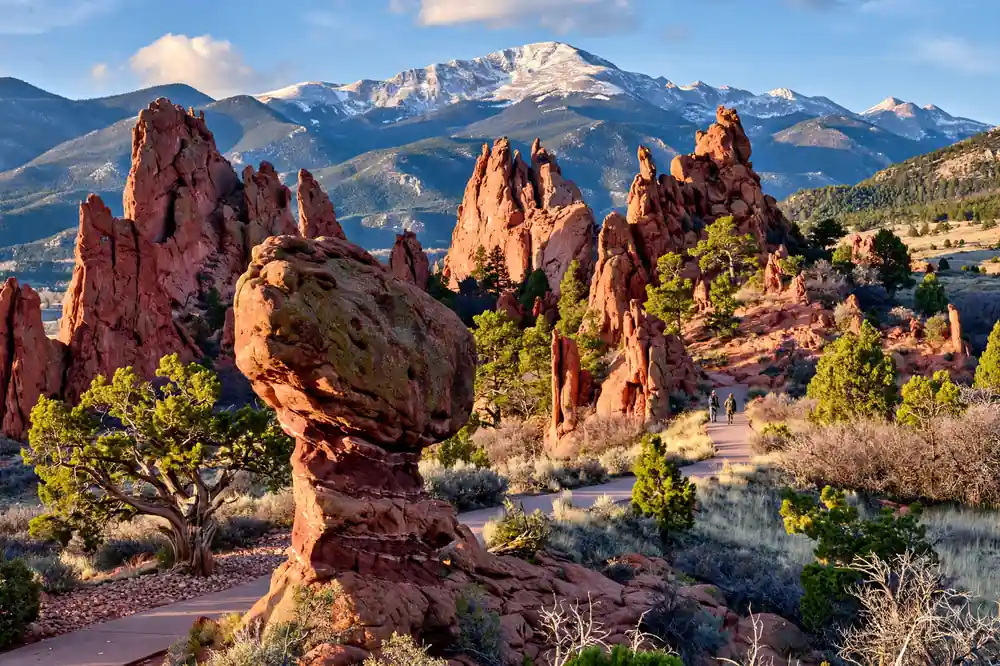
Garden of the Gods is the reason most people come to Colorado Springs, and it is free. Towering red sandstone fins — some 300 feet tall — rise out of a 1,341-acre city park, with snow-capped Pikes Peak behind them, and the whole place costs nothing to enter. The land was deeded to the city in 1909 on one condition: it must stay free forever. That promise still holds, which makes this one of the best free attractions in the United States. Learn more about Garden of the Gods on Wikipedia https://en.wikipedia.org/wiki/Garden_of_the_Gods.
Start at the free Garden of the Gods Visitor and Nature Center for the view from its terrace, then drive the loop road past the Kissing Camels, Balanced Rock and the Cathedral Spires. The best walk is the Perkins Central Garden Trail, a paved 1.5-mile loop through the tallest formations that anyone can manage, including wheelchairs and strollers. Go at sunrise if you can: the rocks turn orange, the parking lots are empty, and Pikes Peak glows pink. Rock climbing is allowed with a permit, and the park runs free guided nature walks from the visitor centre. The one mistake to avoid is treating it as a quick photo stop — give it at least two hours, and three if you hike the Siamese Twins trail for the framed view of Pikes Peak through the rocks.
2. Pikes Peak — by Cog Railway or highway
Pikes Peak is 14,115 feet high, the most famous mountain in Colorado, and the one Katharine Lee Bates climbed in 1893 before writing “America the Beautiful”. There are two ways to the summit, and both are worth it for different reasons. Read the full story of Pikes Peak on Wikipedia https://en.wikipedia.org/wiki/Pikes_Peak.
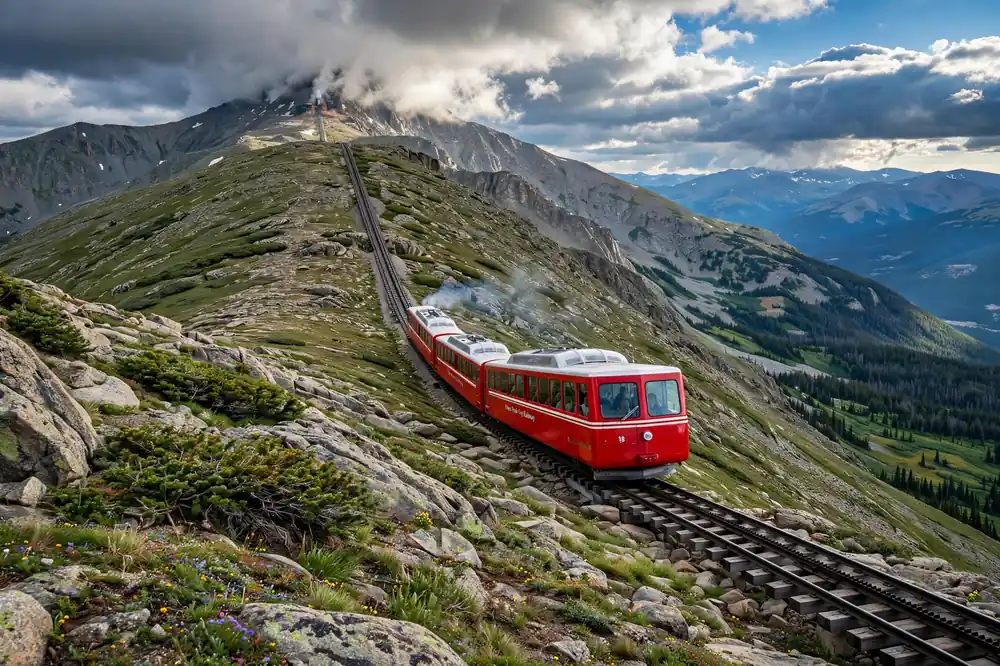
The Broadmoor Manitou and Pikes Peak Cog Railway is the world’s highest cog railway, and it is the easy way up. Trains leave from the depot at 515 Ruxton Avenue in Manitou Springs, climb for about an hour and ten minutes, and give you roughly 40 minutes at the summit before the three-hour round trip ends. In 2026, reserved seats booked online start at about $67 for adults and $57 for children, with an Engineer’s View seat — the front row beside the engineer — from about $96. Walk-up and phone bookings cost more, from about $86, and summer trains sell out, so book at cograilway.com as soon as your dates are set. Depot parking is about $20 per vehicle.
The other way up is the Pikes Peak Highway, a 19-mile paved road to the summit. In summer 2026 (May 1 to November 30), entry costs about $18 per adult aged 16 and over, $8 per child aged 6 to 15, or $65 per carload of up to five people, plus a $2 timed-entry permit per vehicle from May 22 to September 30. In winter (December 1 to April 30), prices drop to about $10, $5 and $35. The gate opens at 7:30 a.m. in summer, with last entry at 6 p.m. (5 p.m. in September); from October to May the gate opens at 9 a.m., last entry is 3 p.m. and the summit closes at 4 p.m. A summer shuttle also runs from the lower lots for about $40 per adult and $12 per child, admission included. Whichever way you go up, bring a jacket: the summit can be 30 degrees colder than the city, with wind and snow possible in any month. And eat a Pikes Peak donut at the Summit House — the famous high-altitude doughnuts are made at 14,115 feet, and the recipe only works up there.
3. The Manitou Incline
The Manitou Incline is the hardest workout in Colorado Springs and the most bragged-about. It is 2,744 steps up an old cog railway bed, climbing about 2,000 feet in under a mile, with grades as steep as 68 percent. The average hiker takes 45 minutes to two hours to reach the top, and the reward is a view across the whole city — then a gentler 2.5-mile descent down the Barr Trail, making a 3.5-mile loop back to the base. Find the history of the Manitou Incline on Wikipedia https://en.wikipedia.org/wiki/Manitou_Incline.
Here is the honest 2026 rule, and the trap. The city officially requires a free reservation for every hiker: book online, sign the waiver, groups of up to eight, 45 reservations per 30-minute arrival window, with next month’s slots opening on the 1st. The hours are 6 a.m. to 6 p.m. from May 1 to October 31, and 6 a.m. to 3 p.m. from November 1 to April 30. But several 2026 local guides report that the reservation is not actually checked at the base, and most regulars skip booking entirely. Book the free reservation anyway — it costs nothing and takes two minutes, and the official rule is the official rule. Bring more water than you think you need, start early in summer, and do not attempt it if you have a heart condition or have just arrived from sea level: this is a serious climb at altitude, not a staircase in a park.
4. U.S. Olympic & Paralympic Museum
The U.S. Olympic & Paralympic Museum is the most modern museum in Colorado Springs, and the one that surprises people most. The 60,000-square-foot building, designed by Diller Scofidio + Renfro, twists like an athlete in motion, and inside the exhibits are almost entirely interactive: test your balance against an Olympic gymnast, race a virtual sprinter, try a ski simulator, and hold a real Olympic torch. It is the final project of the city’s City for Champions initiative, and it sits downtown in the Olympic City USA district. Read about the U.S. Olympic & Paralympic Museum on Wikipedia https://en.wikipedia.org/wiki/United_States_Olympic_%26_Paralympic_Museum.
In 2026 the museum uses seasonal pricing. On peak days (Friday to Sunday), admission is about $23.95 for adults aged 13 and over and $13.95 for children aged 5 to 12; on value days (Monday and Thursday), it is about $21.95 and $12.95, and in the summer peak it can reach about $29.95 for adults. Children under four go free, and seniors aged 65 and over, military members, first responders, educators and healthcare workers get 20 percent off. Colorado residents pay just $10 every Saturday from 3 p.m., from September 12, 2026 to May 22, 2027, with valid ID. The museum is open 10 a.m. to 5 p.m., with the last ticket at 4 p.m., and it is closed on Tuesdays and Wednesdays from Labor Day to Memorial Day, then open seven days a week from Memorial Day to Labor Day. Allow two to three hours — the interactive galleries are the point, and rushing them misses the museum.
5. Cheyenne Mountain Zoo
Cheyenne Mountain Zoo is America’s only mountainside zoo, built into the side of Cheyenne Mountain since 1926, and it was named the number two Best Zoo in North America by USA TODAY 10Best Readers’ Choice in 2025. The setting is the attraction: giraffes, elephants and lions live on terraced hillsides with views across the city, and the Mountaineer Sky Ride — an open-air chairlift — carries you over the animal yards for a view you cannot get anywhere else. Read about Cheyenne Mountain Zoo on Wikipedia https://en.wikipedia.org/wiki/Cheyenne_Mountain_Zoo.
In 2026, admission is about $34 for adults aged 12 to 64, $29 for children aged 3 to 11, and $32 for seniors aged 65 and over; children under two go free, and military families pay about $31 and $26. There is a 75-cent Quarters for Conservation fee added to every admission. Advance timed e-tickets are required, the zoo is open 365 days a year, and tickets are non-refundable, so check the weather before you book. The giraffe herd is the star — feeding them is the zoo’s most popular experience — and the African Rift Valley, Rocky Mountain Wild and the Australia walkabout are the three areas to prioritise. The Sky Ride costs extra and closes in bad weather. Give it three hours, wear comfortable shoes, and remember the zoo is built on a slope: every path goes up or down.
6. Seven Falls
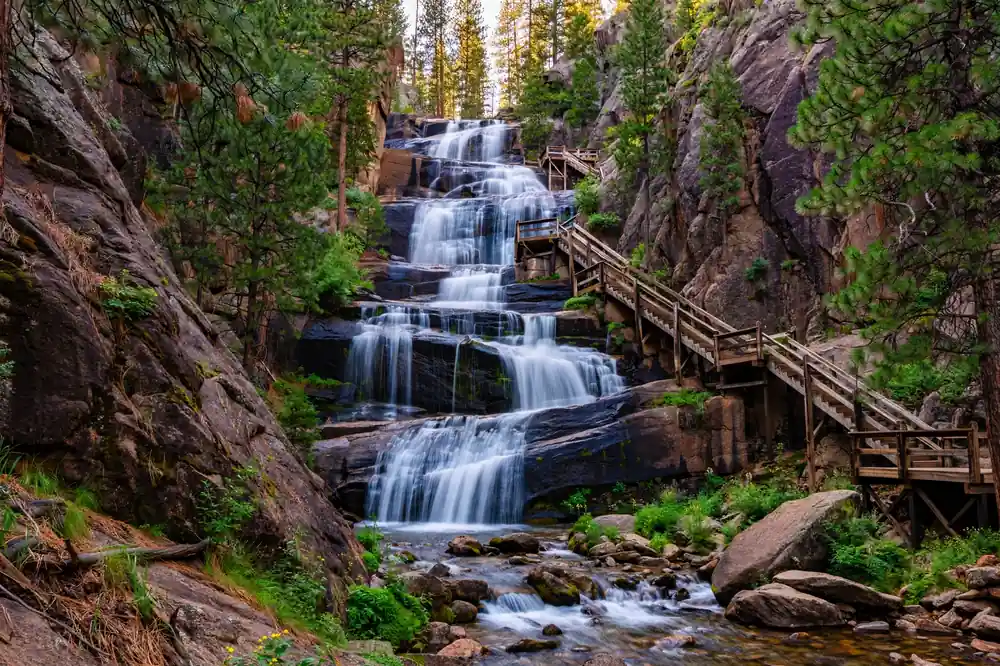
Seven Falls is a 181-foot waterfall in a narrow granite canyon, lit up at night in summer, and it is the single most misunderstood attraction in Colorado Springs — because some guides still say it is free. It is not. Seven Falls is owned by The Broadmoor, it sits in South Cheyenne Canyon, and it charges admission. Anyone telling you it is free as part of a public park is wrong, and that mistake appears in several 2026 guides. Learn about Seven Falls on Wikipedia https://en.wikipedia.org/wiki/Seven_Falls.
In 2026, tickets bought online cost about $25 for adults aged 13 and over from 9 a.m. to 1 p.m., and about $21 from 2 p.m. to 7 p.m.; children aged 2 to 12 pay about $19, seniors aged 65 and over about $22, and children under two go free. Walk-up tickets cost about $27 and $23. Add $1 on Memorial Day, Independence Day and Labor Day weekends. The season runs from March 13 to November 29, 2026, tickets are timed, and a shuttle runs from the Norris Penrose Event Center to the canyon entrance. Once inside, it is 224 steps to the top of the falls — or 185 steps to the Eagles Nest viewpoint, which has an elevator — and the “Grandest Mile of Scenery” walk through the canyon is half the experience. Go in the evening in summer if you can, when the falls are lit.
7. Cave of the Winds Mountain Park
Cave of the Winds is a cave system that has been open to visitors since 1881, and it is the best rainy-day attraction in Colorado Springs — because it is underground, and 54 to 56 degrees all year. The Discovery Tour is the standard visit: 45 to 60 minutes, about half a mile of passages, 196 stairs, and formations with names like the Silent Splendor and the Bridal Chamber. Read about Cave of the Winds on Wikipedia https://en.wikipedia.org/wiki/Cave_of_the_Winds_(Colorado).
In 2026, the Discovery Tour costs about $30 for adults and $20 for children aged 4 to 12, with children under three free (though they still need a ticket); military families get 10 percent off. Some older listings still show $29 and $19, but the park’s own site lists $30 and $20, so use those. The Lantern Tour, an evening walk by lantern light, costs about $35, and the Expedition Tour — a crawling, squeezing, three-hour wild-cave trip for ages 13 and over — costs about $99. The park is open year-round, 9 a.m. to 9 p.m. in summer from Memorial Day to Labor Day, and 10 a.m. to 5 p.m. from September to May. Above ground, the Terror-Dactyl — a 200-foot free-fall swing ride — costs about $50, and there is a zip line and a challenge course. Bring a light jacket even in August: the cave is cold, the stairs are steep, and the passages are narrow.
8. Manitou Springs and its mineral springs
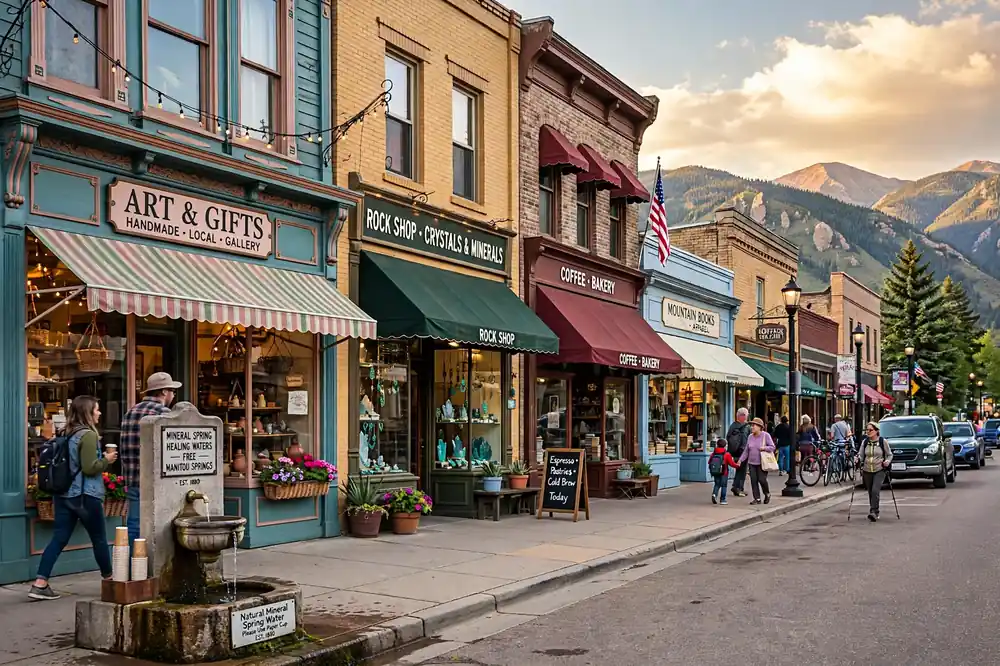
Manitou Springs is a Victorian spa town six miles west of downtown Colorado Springs on U.S. Highway 24, and it feels like a different century. It was founded in 1872 around natural carbonated mineral springs that were sacred to the Ute people long before the town existed, and eight of those springs are still free to taste today — bring a bottle and fill up at the Seven Minute Spring, the Shoshone Spring and the Cheyenne Spring, each with its own mineral taste. Learn about Manitou Springs on Wikipedia https://en.wikipedia.org/wiki/Manitou_Springs,_Colorado.
The town itself is the attraction: a walkable main street of Victorian storefronts, art galleries, ice-cream parlours and the old Manitou Springs Penny Arcade, with the foothills rising behind every shopfront. The Manitou Springs Heritage Center tells the town’s story, and the mineral springs foundation publishes a free walking map of all eight springs. Manitou is also the gateway to everything on this list’s western side — the Cog Railway depot, the Manitou Incline base and Cave of the Winds are all here, not in Colorado Springs itself. Come in the evening, when the day-trippers leave and the town’s string lights come on. Every October 31, the town hosts the Emma Crawford Coffin Races, a parade of coffins on wheels that is exactly as strange as it sounds.
9. Old Colorado City
Old Colorado City is where Colorado Springs began. Founded in 1859 as Colorado City, it was the first capital of Colorado Territory in 1861, and its main street — Colorado Avenue — still looks like a frontier town that grew up gracefully: red-brick storefronts, art galleries, antique shops, bookstores and restaurants, with Pikes Peak at the end of the street. Read about Old Colorado City on Wikipedia https://en.wikipedia.org/wiki/Old_Colorado_City.
Today it is the city’s best neighbourhood for an unhurried afternoon. Browse the galleries, eat lunch on a patio, and look for the historic markers that explain which buildings are originals from the 1860s and which are careful reconstructions. Each May, the Territory Days street festival takes over Colorado Avenue with food stalls, live music and a parade — one of the biggest free festivals in the city. Old Colorado City is also the most practical base for a first visit: it is cheaper than downtown, quieter than Manitou Springs, and five minutes from Garden of the Gods.
10. U.S. Air Force Academy and the Hosmer Visitor Center
The U.S. Air Force Academy is one of the most visited military sites in America, and in 2026 it comes with a trap that most guides still get wrong. The Cadet Chapel — the famous 17-spired aluminium landmark — has been closed since 2019 for repairs after leaks and water damage, and the repair bill ballooned from $158 million to $335 million. The giant white enclosure around the chapel comes down between August 2027 and January 2028, chaplains return around April 2028, and the full public reopening is not expected until August 2028. If a guide tells you to visit the chapel in 2026, it is out of date. Read about the U.S. Air Force Academy on Wikipedia https://en.wikipedia.org/wiki/United_States_Air_Force_Academy.
What you can visit in 2026 is the new Hosmer Visitor Center, which opened on May 16, 2026 with a grand opening attended by more than 1,600 people. The 34,000-square-foot, roughly $65 million building is the final project of the City for Champions initiative, and it sits outside the North Gate off Interstate 25 at Exit 156, so you do not need to enter the base to reach it. Admission is free, and it is open daily from 9 a.m. to 5 p.m., except Thanksgiving, Christmas Eve, Christmas Day, New Year’s Eve and New Year’s Day. Inside are exhibits on cadet life, the academy’s history and the B-52 display outside. If you do enter the base itself, bring a photo ID, enter through the North Gate, and check the academy’s visitor rules first — access rules change with security conditions.
11. North Cheyenne Cañon Park and Helen Hunt Falls
North Cheyenne Cañon Park is the locals’ canyon: 1,277 acres of pine forest, granite walls and creek trails, five minutes from the Broadmoor, and almost entirely free. The main draw is Helen Hunt Falls, a 35-foot waterfall at the end of a short paved trail from the parking lot — easy enough for small children and grandparents, and beautiful after rain or snowmelt. Read about North Cheyenne Cañon Park on Wikipedia https://en.wikipedia.org/wiki/North_Cheyenne_Ca%C3%B1on_Park.
Do not confuse this canyon with South Cheyenne Canyon, where Seven Falls sits — they are different canyons, different entrances, and one charges admission while the other does not. In North Cheyenne Cañon, the Starsmore Discovery Center at the entrance has trail maps and nature exhibits, Gold Camp Road is a popular hike and bike route through old railroad tunnels (closed to cars), and the trails climb to viewpoints over the whole city. It is also one of the best places in town to see autumn colour. Come early on weekends: the Helen Hunt Falls parking lot fills up by mid-morning in summer.
12. Red Rock Canyon Open Space
Red Rock Canyon Open Space is Garden of the Gods without the crowds. This free 789-acre city park sits between Colorado Springs and Manitou Springs, with the same red sandstone as its famous neighbour, about 11 miles of multi-use trails, old sandstone quarries, two off-leash dog loops and a free-ride bike park — and a fraction of the visitors. The city bought the land in 2003, and the quarries supplied stone for many of the city’s historic buildings. Learn about Red Rock Canyon Open Space on Wikipedia https://en.wikipedia.org/wiki/Red_Rock_Canyon_Open_Space.
The Sand Canyon, Contemplative and Roundup trails are the best introductions, and the Quarry Trail shows where the stone was cut. Climbers use the canyon walls, mountain bikers use the singletrack, and dog owners use the off-leash loops — it is the most local-feeling park on this list. Go here on a Saturday morning if Garden of the Gods is packed, or come at sunset, when the red rocks glow and the parking lot is half empty.
13. The Broadmoor
The Broadmoor is not just a hotel; it is a Colorado institution. Opened in 1918 by Spencer Penrose, this Five-Star resort sits on 5,000 acres at the foot of Cheyenne Mountain, with a lake, two golf courses, a spa, and the Penrose Room — one of the most celebrated dining rooms in the American West. You do not need to stay here to enjoy it: anyone can walk the grounds, stroll around Cheyenne Lake, book afternoon tea, or eat at one of the restaurants. Read about The Broadmoor on Wikipedia https://en.wikipedia.org/wiki/The_Broadmoor.
The Broadmoor is also the reason several attractions on this list exist in their current form — it owns Seven Falls, and its wilderness properties, Cloud Camp and The Ranch at Emerald Valley, are the high-country end of the resort. A visit here is a good way to spend a slow afternoon: arrive for lunch, walk the lake loop, and watch the sun set behind the mountain. Rooms start at several hundred dollars a night, so most visitors treat the Broadmoor as a place to visit rather than a place to sleep — and that is exactly how the locals use it too.
14. Colorado Springs Pioneers Museum
The Colorado Springs Pioneers Museum is free, downtown, and far better than its modest name suggests. It sits in the 1903 El Paso County Courthouse at 215 South Tejon Street, and inside are more than 60,000 objects telling the story of the Pikes Peak region — from the Ute people and the gold rush to the founding of the city by General William Jackson Palmer and the growth of the military bases. Read about the Colorado Springs Pioneers Museum on Wikipedia https://en.wikipedia.org/wiki/Colorado_Springs_Pioneers_Museum.
The building itself is worth the visit: a restored courthouse with marble staircases and a clock tower, right on the downtown walking route. The museum is open Tuesday to Saturday, 10 a.m. to 5 p.m., and an hour here gives you the context that makes everything else on this list — the red rocks, the springs, the Broadmoor, the Academy — make sense. Pair it with a downtown lunch and the public art walk around Acacia Park.
15. Manitou Cliff Dwellings
The Manitou Cliff Dwellings are the most misunderstood attraction in Manitou Springs, and the museum itself is honest about it: this is not an original Ancestral Puebloan village. It is a reconstruction, built in 1907 from rubble taken from collapsed sites in southwestern Colorado, and opened as a museum and open-air preserve. That does not make it worthless — you can walk through 40 rooms of stone architecture, climb ladders, and see how Ancestral Puebloan families lived — but it does mean you should not visit expecting an untouched archaeological site. The real cliff dwellings are in Mesa Verde, four hours away. Read about the Manitou Cliff Dwellings on Wikipedia https://en.wikipedia.org/wiki/Manitou_Cliff_Dwellings.
In 2026, admission is about $12.75 for adults aged 12 and over, $8 for children aged 4 to 11, and $10 for seniors aged 60 and over; children under three go free, and no advance tickets are needed. Hours are 9 a.m. to 5 p.m. from April to October, shorter in winter, and the site is closed on Thanksgiving and Christmas Day. Allow about an hour, more if you read the exhibit panels. The dwellings are not wheelchair-accessible — there are steps and narrow passages — though the entrance and museum are. The gift shop is one of the better ones in town for Native American crafts.
16. Royal Gorge Bridge & Park (day trip)
The Royal Gorge is the best day trip from Colorado Springs: about 45 minutes south to Cañon City, where the Arkansas River cuts a 1,000-foot-deep canyon and a suspension bridge — built in 1929 — spans it 956 feet above the water. Walking across is the point: the bridge is 1,260 feet long, the wind moves it slightly, and the view straight down is unforgettable. Read about the Royal Gorge on Wikipedia https://en.wikipedia.org/wiki/Royal_Gorge.
Here is the 2026 price trap. Older guides say admission starts at about $25, but the price has risen: in 2026, general admission is about $40 per person, and that covers the bridge, unlimited aerial gondola rides, the Plaza Theater show and the children’s playland. The zip line, the Skycoaster and the Via Ferrata cost extra. The park is open daily on 360 acres, most visitors spend about two hours on site, and the gondola closes in high wind, so check conditions before you drive down. Combine it with whitewater rafting on the Arkansas River below — the Royal Gorge stretch is one of the most popular rafting runs in Colorado — or with a stop in Cañon City’s historic downtown on the way home.
17. Paint Mines Interpretive Park (day trip)
The Paint Mines Interpretive Park is the strangest landscape near Colorado Springs: 750 acres of pink, orange, purple and white clay formations east of the city near Calhan, about 40 minutes away, carved by wind and water into spires, hoodoos and striped badlands. It is free, it is open daily, and most visitors have never heard of it. Learn about the Calhan Paint Mines Archeological District on Wikipedia https://en.wikipedia.org/wiki/Calhan_Paint_Mines_Archeological_District.
The park has about four miles of trails through the formations, and the colours are best at sunrise and sunset, when the low light turns the clay bands gold and rose. The formations are fragile: climbing on them is forbidden, and the rule is enforced. Bring water and sun protection — there is no shade and no shop — and allow two hours. Pair it with a morning at Garden of the Gods for a full day of Colorado geology, or with a drive through the eastern plains for a completely different side of the state.
18. Palmer Park
Palmer Park is the free park the locals use and the tourists miss. This 730-acre mesa-top park was donated to the city in 1902 by General William Jackson Palmer, the founder of Colorado Springs, and it sits in the middle of the city with panoramic views of Pikes Peak in one direction and downtown in the other. The red rock mesas, the dog park, the mountain-bike trails and the picnic areas are all free, and the park is open daily. Read more about Colorado Springs on Wikipedia https://en.wikipedia.org/wiki/Colorado_Springs,_Colorado.
The best short walk is the loop around the central mesas, and the best time is sunset, when the city lights come on below and Pikes Peak turns pink. Mountain bikers rate the singletrack here as some of the best in-town riding in Colorado. It is also the easiest place in the city to see why Palmer chose this spot: stand on the mesa edge at dusk and the whole city, the foothills and the mountain are laid out in front of you.
19. Colorado Springs Fine Arts Center
The Colorado Springs Fine Arts Center at Colorado College is the city’s art museum, and it is one of the finest small museums in the American West. The art deco building, designed by John Gaw Meem and opened in 1936, holds a collection that is especially strong in Native American, Latin American and Hispanic art, alongside works by Georgia O’Keeffe and Ansel Adams. The Bemis School of Art and the theatre in the same building make it a working arts centre, not just a gallery. Read about the Colorado Springs Fine Arts Center on Wikipedia https://en.wikipedia.org/wiki/Colorado_Springs_Fine_Arts_Center.
Allow ninety minutes for the galleries, and check what is on before you go — the rotating exhibitions are usually the highlight. The museum sits on the Colorado College campus, a short walk from downtown, and it pairs well with the Pioneers Museum for a culture half-day. Admission is modest and members and Colorado College students go free; check the museum’s site for current prices and free days.
20. National Museum of WWII Aviation
The National Museum of WWII Aviation is the surprise hit of Colorado Springs: a working aviation museum at the airport with about 30 restored aircraft, a new 40,000-square-foot hangar, and docents who are often veterans or pilots themselves. The collection covers the aircraft that won the war in the air — fighters, bombers and trainers — and many of them still fly. Read about the National Museum of WWII Aviation on Wikipedia https://en.wikipedia.org/wiki/National_Museum_of_World_War_II_Aviation.
The museum is open daily from 10 a.m. to 5 p.m. at 775 Aviation Way, and the docent-led tours are the reason to go: the guides know the aircraft, the missions and the people who flew them. Allow two hours. It is also the best bad-weather backup in the city if the mountain is closed, and it is one of the highest-rated attractions in Colorado Springs on TripAdvisor — ahead of several better-known names on this list.
Colorado Springs in 3 days — a ready-made itinerary
| Day | Focus | Highlights |
|---|---|---|
| Day 1 | The icons | Garden of the Gods at sunrise, Pikes Peak by Cog Railway, Old Colorado City for dinner |
| Day 2 | Waterfalls, caves and Manitou | Seven Falls, Cave of the Winds, Manitou Springs mineral springs, the Incline if you are fit |
| Day 3 | Museums and the local side | Olympic Museum, Cheyenne Mountain Zoo, Pioneers Museum, Red Rock Canyon at sunset |
Day 1 — Garden of the Gods and Pikes Peak
Start at Garden of the Gods at sunrise, when the rocks glow orange and the parking lots are empty. Walk the Perkins Central Garden Trail, then drive the loop road past Balanced Rock. By late morning, drive to Manitou Springs for the Cog Railway — book the earliest train you can, because the summit is clearest before the afternoon clouds build. Spend 40 minutes at the summit, eat a donut, and take the train back down. Spend the late afternoon in Old Colorado City: browse the galleries, have dinner on Colorado Avenue, and watch Pikes Peak turn pink at dusk.
Day 2 — Waterfalls, caves and Manitou Springs
Start early at Seven Falls, which is quietest in the first timed slot, then drive ten minutes to Cave of the Winds for the Discovery Tour. Have lunch in Manitou Springs, taste the free mineral springs, and walk the main street. If you are fit and the weather is good, climb the Manitou Incline in the late afternoon — or save it for another trip and spend the afternoon at the Manitou Cliff Dwellings instead. Finish the day with dinner in Manitou Springs, where the restaurants are cheaper and more local than downtown.
Day 3 — Museums, the zoo and the local side
Spend the morning at the U.S. Olympic & Paralympic Museum, then drive to Cheyenne Mountain Zoo for the afternoon — the animals are most active before the heat of the day, so go as early as you can. If you have time, stop at the Pioneers Museum downtown on the way back, then finish at Red Rock Canyon Open Space for a sunset walk. If you have a fourth day, spend it at the Royal Gorge, or drive to Cripple Creek, the old gold-mining town an hour west, for a completely different slice of Colorado history.
Best time to visit Colorado Springs
Colorado Springs gets more than 300 days of sunshine a year, and there is no bad month — only different trade-offs. Summers are warm and dry, with afternoon thunderstorms that clear quickly; winters are mild by Colorado standards, with snow that melts fast in the sun; and the shoulder seasons are the sweet spot for most visitors.
| Season | Weather | Crowds and prices | Best for |
|---|---|---|---|
| Spring (Mar–May) | 50s–70s°F, changeable, some snow into April | Quiet, low prices, some attractions on winter hours | Wildflowers, waterfalls running high, budget trips |
| Summer (Jun–Aug) | 80s°F, afternoon thunderstorms, cool nights | Busiest, highest prices, book the Cog Railway early | Hiking, the Incline, festivals, long days |
| Autumn (Sep–Oct) | 60s–70s°F, crisp and clear | Thinner crowds after Labor Day, good prices | Golden aspens, photography, comfortable hiking |
| Winter (Nov–Feb) | 30s–40s°F, sunny with snow that melts fast | Quietest, lowest hotel prices, some seasonal closures | Snow-dusted Garden of the Gods, the zoo, museums |
May to October is the best window for most visitors: the Cog Railway runs its full schedule, the Incline hours are longest, and the waterfalls are at their best. September and October are the sweet spot — golden aspens in the foothills, clear skies, and thinner crowds after Labor Day. Summer is the busiest season, and the Cog Railway sells out, so book weeks ahead. Winter is underrated: Garden of the Gods under snow is beautiful, the zoo is open 365 days, and hotel prices are at their lowest. Two dates to plan around are the Pikes Peak International Hill Climb in June — the “Race to the Clouds”, run since 1916 — and the Labor Day Lift Off hot-air balloon festival in early September. Both fill hotels, so book early if your trip overlaps with them.
Where to stay in Colorado Springs
| Area | Best for | Price range (approx) |
|---|---|---|
| Downtown | First-timers, walkers, the Olympic Museum and Pioneers Museum | $130–$220 per night |
| Old Colorado City | Charm, galleries, restaurants, five minutes from Garden of the Gods | $120–$200 per night |
| Manitou Springs | The Cog Railway, the Incline, the mineral springs, small-town feel | $110–$200 per night |
| The Broadmoor area | Luxury, the lake, the Penrose Room, Seven Falls and the zoo | $400+ per night |
| Northgate / Air Force Academy | The Academy, the Hosmer Visitor Center, chain hotels, easy I-25 access | $100–$180 per night |
First-time visitors should stay downtown or in Old Colorado City. Downtown puts you within walking distance of the Olympic Museum, the Pioneers Museum and the restaurant district, and it is the easiest base without a car. Old Colorado City is the prettier choice: cheaper, quieter, and five minutes from Garden of the Gods, with Colorado Avenue’s restaurants and galleries outside your door. Manitou Springs suits travellers who are here for the mountain — the Cog Railway depot and the Incline base are in town — but the streets are steep and parking is tight. The Broadmoor is the splurge: stay there for the lake, the service and the history, or just visit for lunch and a walk. The north side, around the Air Force Academy, has the chain hotels and the easiest highway access, and it is the best value if you are driving everywhere anyway. Book early for summer weekends and for the Hill Climb and balloon festival dates.
Getting around Colorado Springs
A car is the easiest way to get around Colorado Springs. The attractions are spread out — Garden of the Gods, the zoo, the Academy and Manitou Springs are all in different directions — and the bus network, Mountain Metro Transit, runs limited routes that do not reach every attraction. Rent a car at Colorado Springs Airport, about 15 minutes from downtown, or drive up from Denver, about 70 miles north on Interstate 25. Denver International Airport is about an hour and a half away, and many visitors fly into Denver and drive down.
Downtown itself is walkable, and Old Colorado City and Manitou Springs are both best explored on foot once you arrive. Ride-hailing apps work across the city, and taxis are available at the airport and the Broadmoor. If you are driving, two rules matter. First, the altitude: you are at 6,035 feet in the city and 14,115 feet on Pikes Peak, so drink more water than usual, take it easy on your first day, and remember that alcohol hits harder up here. Second, the weather: mountain roads can close in snow, and the Pikes Peak Highway closes the summit in bad weather, so check conditions before you set out. Parking is free at Garden of the Gods, Red Rock Canyon and the free parks; the Cog Railway depot charges about $20 per vehicle, and downtown parking is metered.
Colorado Springs food you have to try
Colorado Springs is not a famous food city, and that is part of its charm: the food here is hearty, high-altitude and unpretentious. Three things define eating in the Springs — green chile, summit doughnuts and craft beer — and a fourth, Beau Jo’s mountain pizza, served with honey for the crust, is the local pizza style worth one meal. Eat breakfast early, eat lunch after the morning hike, and save the Broadmoor’s dining rooms for the one special night.
Green chile — the sauce that defines Colorado cooking
Green chile is Colorado’s signature dish, and in Colorado Springs it comes smothered over everything. Roasted green chiles, pork, onion and garlic are cooked into a thick sauce and poured over burritos, breakfast burritos, enchiladas and eggs — the “smothered” style that defines a Colorado breakfast. Pueblo green chile, from the city of Pueblo an hour south, is the local benchmark: roasted, slightly sweet, and milder than New Mexico’s Hatch chile. Read about green chile on Wikipedia https://en.wikipedia.org/wiki/Green_chile. Order a breakfast burrito smothered in green chile on your first morning, and ask for it “Christmas style” — half green, half red — if you want to try both sauces at once. The best versions are in the small Mexican restaurants on the city’s south and west sides, not in the hotel dining rooms.
Pikes Peak donuts — made at 14,115 feet
The most famous food in Colorado Springs is a doughnut you can only eat in one place. Pikes Peak donuts are made at the Summit House on top of Pikes Peak, 14,115 feet above sea level, using a high-altitude recipe that only works up there — the low air pressure changes how dough rises, so the same recipe fails at sea level. They are cake doughnuts, fried fresh at the summit, dusted with sugar, and eaten while looking out over four states. The line moves fast, the doughnuts are cheap, and they are the one food souvenir that actually tastes of the place. Buy two: one for the summit, one for the train ride down. If the summit is closed, the Cog Railway depot shop sometimes stocks them — but the summit batch is the real thing.
Colorado craft beer — and the Broadmoor’s table
Colorado is one of the great craft beer states in America, and Colorado Springs has dozens of breweries of its own, concentrated in the downtown brewery district and along Tejon Street. Bristol Brewing, Phantom Canyon and Red Leg Brewing are the established names, and the taprooms are the city’s evening social life — relaxed, family-friendly, and usually serving food trucks outside. Learn about craft beer on Wikipedia https://en.wikipedia.org/wiki/Craft_beer. Beer here is stronger than it tastes at altitude, so pace yourself: the same pint hits harder at 6,035 feet. For the opposite end of the scale, book one dinner at the Broadmoor — the Penrose Room is one of the most celebrated dining rooms in the American West, and the resort’s restaurants are open to non-guests.
Free things to do in Colorado Springs
Colorado Springs is one of the best-value cities in America, because its best attractions are free. Garden of the Gods costs nothing, including parking and the visitor centre. Red Rock Canyon Open Space, Palmer Park, North Cheyenne Cañon Park and Helen Hunt Falls are all free. The Colorado Springs Pioneers Museum is free. Tasting the eight mineral springs in Manitou Springs is free. The Hosmer Visitor Center at the Air Force Academy is free. The Paint Mines Interpretive Park is free. A full day of parks, museums and springs can cost nothing at all — which is why the city’s budget in this guide starts low. The paid attractions that are worth it are the Cog Railway, the Olympic Museum, the zoo and Seven Falls; everything else on a first visit can be free.
Frequently asked questions
Is Colorado Springs worth visiting?
Yes — and it is the best-value mountain city in Colorado. Garden of the Gods alone justifies the trip, and it is free; Pikes Peak, the Olympic Museum, the zoo and Manitou Springs give you three full days without repeating yourself. It is quieter and cheaper than Denver, and the scenery is better. Come for the red rocks and the mountain, and stay for the waterfalls, the caves and the small-town feel.
How many days do you need in Colorado Springs?
Three full days is the right amount for the highlights: one day for Garden of the Gods and Pikes Peak, one day for Seven Falls, Cave of the Winds and Manitou Springs, and one day for the Olympic Museum, the zoo and the local parks. Two days covers the essentials if you skip the museums. Add a fourth day for the Royal Gorge or Cripple Creek, or for a slow day hiking in the foothills.
Is Garden of the Gods really free?
Yes — free forever, by law. The land was deeded to the city in 1909 on the condition that it must remain free to the public, and that promise still holds: entry, parking and the visitor centre all cost nothing. The only things you pay for are optional extras, like guided tours and climbing permits. If a website tries to sell you a Garden of the Gods ticket, you do not need it.
Do you need a reservation for the Manitou Incline?
Officially, yes: the city requires a free reservation for every hiker, booked online with a signed waiver, and next month’s slots open on the 1st. In practice, several 2026 local guides report that reservations are not checked at the base and most regulars skip booking. Book the free reservation anyway — it costs nothing, takes two minutes, and the official rule is the official rule. The Incline is open 6 a.m. to 6 p.m. from May 1 to October 31, and 6 a.m. to 3 p.m. from November 1 to April 30.
What is the altitude in Colorado Springs, and will I get altitude sickness?
The city sits at 6,035 feet above sea level, and Pikes Peak summit is 14,115 feet. Most visitors feel the altitude a little on the first day: shortness of breath on stairs, a mild headache, worse sleep. Drink far more water than usual, take it easy on your first day, eat lightly, go easy on alcohol, and use strong sunscreen — the sun is much stronger at altitude. Symptoms usually pass within a day. If you plan to climb the Incline or drive to the Pikes Peak summit on your first day, reconsider: do the easy parks first and save the mountain for day two.
Can you drive to the top of Pikes Peak?
Yes — two ways. The Pikes Peak Highway is a 19-mile paved road to the summit, about $18 per adult in summer 2026, with a $2 timed-entry permit per vehicle from May 22 to September 30. Or take the Cog Railway from Manitou Springs, about $67 per adult booked online, which is the easier option if you do not want to drive a mountain road or worry about altitude. Both take you to the same Summit House, the same donuts and the same view. If you drive, check the weather first: the summit closes in bad conditions, and it can snow up there in any month.
Further reading — Wikipedia, Reddit and Quora
Wikipedia: Colorado Springs on Wikipedia — the city’s history, geography and neighbourhoods.
Reddit: for local tips, trip reports and current conditions, see the Colorado Springs community on Reddit — the live community where locals answer visitor questions. We link to the community home rather than a single thread, because threads move and close.
Quora: read the Quora thread about visiting Colorado Springs without hiking — it covers Pikes Peak, Garden of the Gods, Cave of the Winds, Seven Falls, the zoo and the museums, and it is honest about what works when you cannot hike.
Your Colorado Springs trip, in one paragraph
Colorado Springs is the mountain city that gives you the most for the least: a free red-rock park at sunrise, a 14,115-foot summit by train or by road, waterfalls and caves and a Victorian spa town, Olympic history and a mountainside zoo — all in three days, much of it free. Start with Garden of the Gods, take the Cog Railway to Pikes Peak, climb the Incline if your legs are willing, taste the mineral springs in Manitou, and finish with green chile and a local beer. And when you are ready for the next city, the same 20-attraction format covers Chicago, Nashville, Los Angeles, Orlando, Miami, San Diego, Denver, Savannah, Dallas, Charleston, San Francisco, Myrtle Beach, Las Vegas, San Antonio, London, Portland, Pigeon Forge, Puerto Rico, Atlanta, Phoenix, Paris, Maui and Key West — twenty-three guides, one for every kind of trip.

About the Author