Things to Do in Lisbon
20 Best Attractions, a 3-Day Itinerary, Where to Stay, and the Food You Cannot Miss
Quick Info
Best for: First-timers, walkers, food lovers and viewpoint chasers — and anyone who wants a European capital that still feels affordable
Best time: April–June and September–October for warm days and thinner crowds; November–February for the cheapest hotels and empty museums
How long: 3 days for the centre and Belém; 4–5 days if you add Sintra, Cascais and a slow food crawl
Budget: About €120–€220 per person per day with a mid-range hotel — many of the best sights are free
Don’t miss: Tram 28 before 9 a.m., the castle at sunset, Jerónimos Monastery at opening, a pastel de nata still warm from the oven and a miradouro at golden hour
Lisbon on Wikipedia is the oldest capital city in Western Europe, older than Rome, and it is the rare European capital where the history is still lived in: laundry hangs over cobbled lanes, fado drifts out of tiny taverns, and a 1930s wooden tram climbs hills too steep for buses. Seven hills rise above the Tagus River, and every one of them ends in a viewpoint over terracotta roofs and the wide estuary. This guide covers the 20 best things to do in Lisbon, a 3-day itinerary that actually works, where to stay without overpaying, how to get around on foot, by tram and by metro, the three foods you should not skip, and the free sights that make Lisbon one of the best-value city breaks in Europe. Everything below was checked against live sources in November 2026 — including the closures most guides still get wrong.
Lisbon at a glance
| Topic | What to know |
|---|---|
| Full name | Lisbon, Portugal — the capital, on the north bank of the Tagus River near the Atlantic |
| Founded | Settled by the Phoenicians, then Roman; one of the oldest cities in Western Europe |
| Population | About 550,000 in the city; about 2.9 million in the metropolitan area |
| Currency | Euro (€) |
| Language | Portuguese (English widely spoken in the centre, hotels and restaurants) |
| Airport | Humberto Delgado Airport (LIS), about 7 km north, roughly 20 minutes by metro |
| Best base | Baixa or Chiado for walking everywhere; Alfama for atmosphere |
| Getting around | Walk the centre, tram 28 for the hills, metro for longer hops, train for Sintra and Cascais |
| Famous for | Tram 28, Alfama, São Jorge Castle, Belém Tower, the miradouros, fado and pastéis de nata |
Lisbon sits on Portugal’s Atlantic coast, where the Tagus River meets the ocean, and it packs an unusual amount into a small, steep, walkable footprint. The centre divides into three parts: the flat Baixa grid rebuilt after the 1755 earthquake, the old hills of Alfama and the castle to the east, and Chiado and Bairro Alto to the west — with Belém six kilometres down the river and the modern Parque das Nações to the northeast. Most visitors stay in or near Baixa and walk everywhere, using the tram and the metro only for the hills and Belém, and that is the right call — a car is a liability here, and the hills punish anyone who tries to see everything on foot in one day. Come for the viewpoints, stay for the food — and plan your mornings early, when the trams are empty and the light on the river is at its best.
The 20 best things to do in Lisbon
1. Alfama
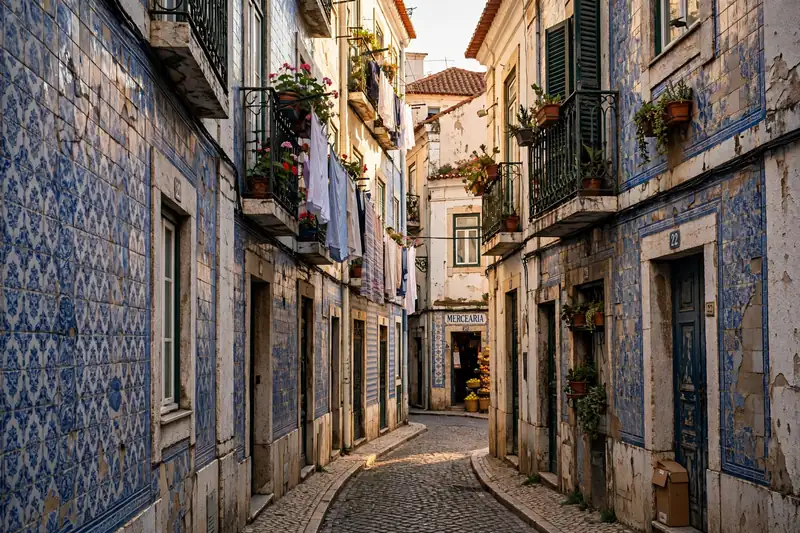
Alfama on Wikipedia is Lisbon’s oldest quarter, a maze of narrow lanes and stepped alleyways that survived the 1755 earthquake, and it is the place to start if you want to understand the city rather than just tick off landmarks. The quarter climbs the hill below São Jorge Castle in a tangle of whitewashed houses, tiled facades, laundry lines and tiny squares, and it belongs to its residents until about 10 a.m. — after that the tour groups arrive. Walk it without a plan: start at the Sé, climb past the Santa Luzia and Portas do Sol viewpoints, and let the lanes take you to the castle. Two practical notes: the streets are steep and the cobbles are slippery when wet, so wear flat shoes with grip, and the best fado in the city is sung in the small taverns here after dark — listen for it, and keep your voice down when the singing starts. Allow half a day, and come back at sunset, when the lanes turn gold and the viewpoints fill with locals carrying bottles of wine.
2. São Jorge Castle
São Jorge Castle on Wikipedia is the Moorish castle above Alfama, and its ramparts hold the best panorama in central Lisbon — the whole sweep of terracotta roofs, the Baixa grid and the Tagus. The castle was built by the Moors in the 11th century, taken by Portugal’s first king in 1147, and later used as a royal palace before it fell into ruin and was rebuilt in the 20th century. Inside the walls you will find the towers, the archaeological site, peacocks in the gardens and the Camera Obscura, a periscope that projects a live 360-degree view of the city onto a table. Admission is €17 for adults, €8.50 for ages 13 to 25, €14 for over-65s and free for children under 12, and the Lisboa Card gets you in free. The castle is open daily from 9 a.m. to 9 p.m. from March to October and 9 a.m. to 6 p.m. from November to February, closed on 1 January, 1 May and 24, 25 and 31 December. Two things to know: the museum inside is closed in 2026 while the toilets are upgraded, and the gate queue can pass 45 minutes from May to September — book online through the castle’s own site, castelodesaojorge.pt, and come at opening or in the last two hours, when the light is best and the crowds thin out.
3. Tram 28
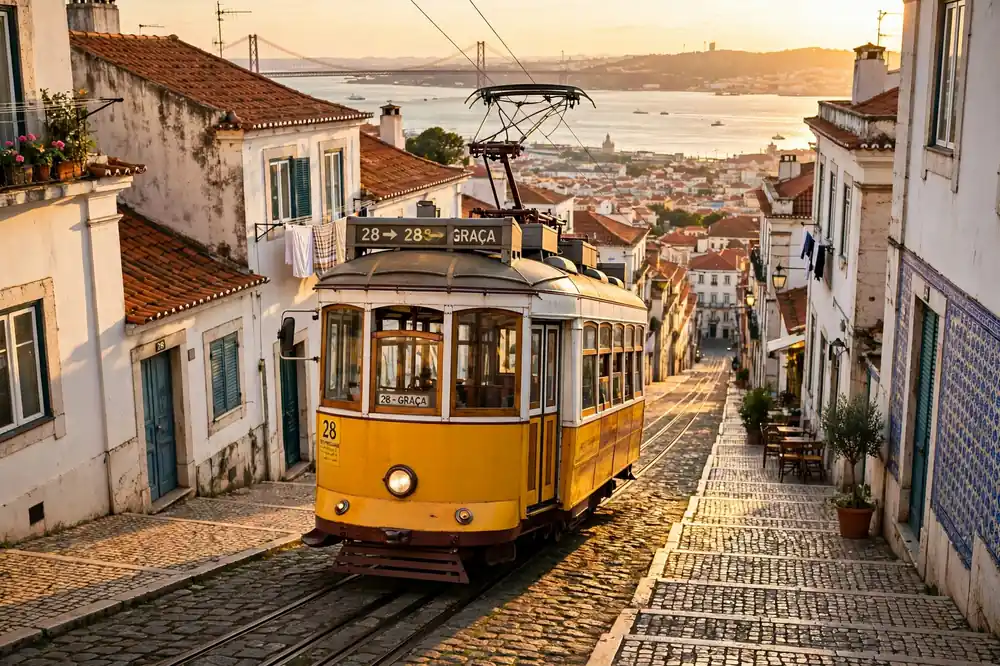
Trams in Lisbon on Wikipedia is the story of the city’s famous yellow cars, and Tram 28 is the one every visitor wants to ride — a rattling 1930s wooden Remodelado car that climbs and plunges through Graça, Alfama, Baixa, Chiado and Estrela on its way from Martim Moniz to Prazeres in Campo de Ourique. The route passes the Sé, the castle hill, the viewpoints and the basilica of Estrela, and it is a tour of the old city for the price of a tram ticket. A ticket bought on board costs €3.30 in 2026, but that ticket is valid for one tram only — if you hop off and board again, you pay again. The smart way is a Navegante card: €1.90 for a single ride or about €1.72 with zapping credit, and a 24-hour Carris and Metro ticket is €7.25. The trams run from about 5:40 a.m. to 11:30 p.m. on weekdays, every 8 to 9 minutes by day, and they are full by 10 a.m. — board at the Martim Moniz terminus before 9 a.m., or after 7 p.m., and keep your bag in front of you: the 28 is Lisbon’s best-known pickpocket spot. One warning from recent years: roadworks split the route for long spells in 2025 and 2026, but the trams were running the whole way again in October 2026 — still, check Carris service notices before you go, and remember bus 737 covers much of the same route without the crush.
4. Jerónimos Monastery
Jerónimos Monastery on Wikipedia is Lisbon’s greatest monument, a masterpiece of Manueline stonework built with the riches of the Age of Discovery, and it is the one sight in Belém you should not skip. The monastery was built from 1501 on the site where Vasco da Gama prayed before sailing to India, and its two-storey cloister — all lace-like arches and carved rope, coral and sea monsters — is the finest room in Portugal. The church next door is free and holds the tombs of Vasco da Gama and the poet Luís de Camões. The cloister costs €18 for adults in 2026, €9 for ages 13 to 24 and over-65s, and free for children under 12, and it is covered by the Lisboa Card. It is open Tuesday to Sunday from 9:30 a.m. to 5:30 p.m., with last entry at 5 p.m., and closed on Mondays, 1 January, Easter Sunday, 1 May, 13 June and 25 December. Two things most guides get wrong: first, there is no combined ticket with Belém Tower — the two need separate timed tickets, booked on the official Museus e Monumentos shop. Second, the cloister queue in summer can swallow two hours, and tickets often sell out on the day — book the 9:30 a.m. slot as soon as your dates are fixed, and do not stand in the church queue by mistake: the free church entrance is separate from the cloister entrance. Allow 90 minutes.
5. Belém Tower
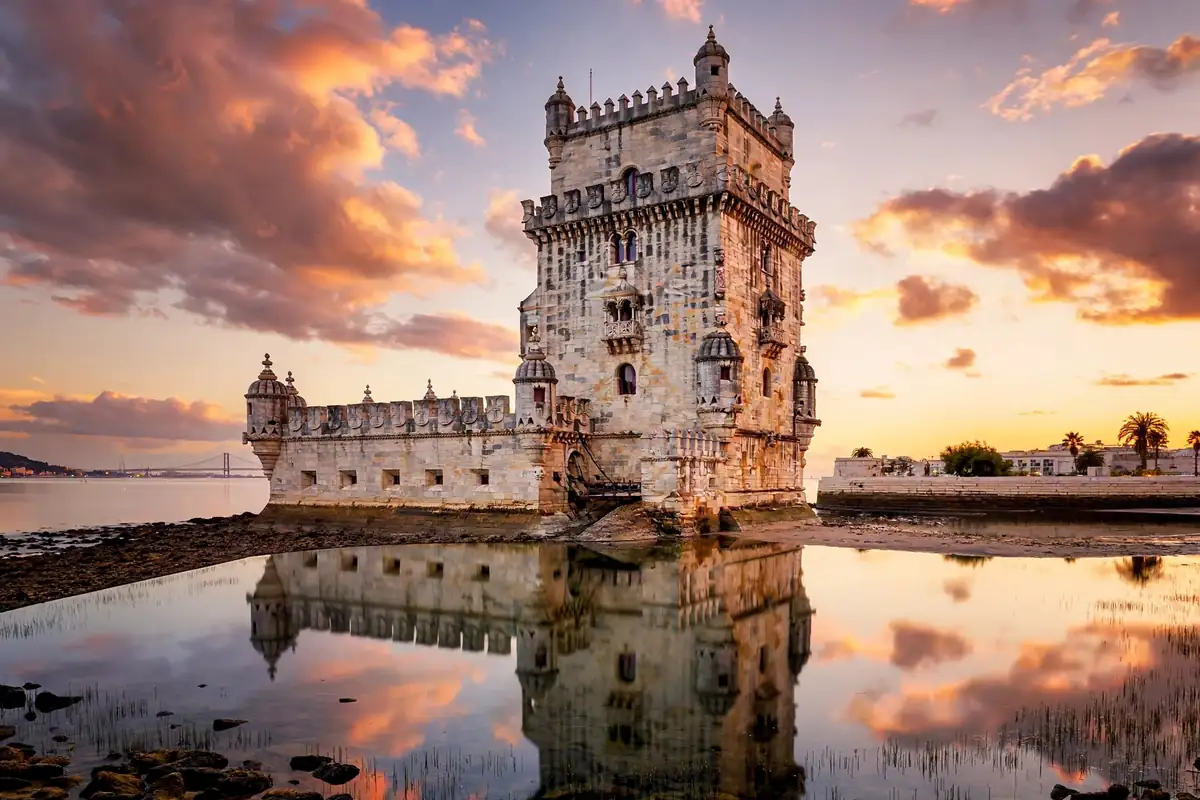
Belém Tower on Wikipedia is the 16th-century fortress that guarded the mouth of the Tagus, and it is Lisbon’s defining monument — a filigreed limestone tower rising straight out of the river, built between 1514 and 1519 and listed by UNESCO in 1983 alongside the monastery. Here is the news most guides still miss: the tower reopened on 27 May 2026 after thirteen months of restoration, its first major one since 1998, and entry now runs in 30-minute timed slots, about 60 people at a time and some 900 a day. Tickets cost €15 for adults, €7.50 for ages 13 to 24 and over-65s, and free for children under 12, and the Lisboa Card covers it. It is open Tuesday to Sunday from 9:30 a.m. to 5:30 p.m., with last entry at 5 p.m., and closed on Mondays, 1 January, Easter Sunday, 1 May, 13 June and 25 December. The interior is a single spiral stair with one-way traffic, so the visit is short — about 45 minutes — and the outside is free and just as photogenic. Book a slot before you go: in summer the afternoons sell out days ahead. While you are on the riverfront, walk to the Monument to the Discoveries on Wikipedia, the 52-metre stone caravel raised in 1960 for the 500th anniversary of Henry the Navigator’s death, whose viewing deck costs about €10 and looks straight down the river the explorers sailed.
6. Praça do Comércio and the Baixa
Praça do Comércio on Wikipedia is Lisbon’s grandest square, a vast riverside plaza framed by yellow Pombaline arcades, with the Rua Augusta Arch at its north end and the Cais das Colunas steps dropping into the Tagus at its south. The square was rebuilt after the 1755 Lisbon earthquake on Wikipedia destroyed the old royal palace that stood here, and it is the best place to feel the scale of the rebuilt city: the Baixa grid runs north from the arch in dead-straight streets, the first earthquake-proof city plan in Europe. Walk under the arch — you can pay to go up it for the view over the square and the river — then wander Rua Augusta, the pedestrian shopping street, and Rossio Square, with its wave-patterned pavement and the twin fountains. The Baixa is flat, which matters in Lisbon: it is the easiest base for first-timers and the place to come when your legs need a rest from the hills. Come at sunset, when the light turns the arcades gold and the square fills with street musicians and locals sitting on the steps.
7. The miradouros
Lisbon’s viewpoints are a sport in themselves, and the best of them cost nothing. The miradouros are the reason to climb the hills, and each one has a different character: Santa Luzia, above Alfama, has the postcard view over the rooftops to the river, framed by azulejo tile panels and bougainvillea; Portas do Sol, a minute further up, is the sunrise spot; Senhora do Monte, in Graça, has the widest panorama in the city, with the castle in the foreground and the 25 de Abril Bridge in the distance; São Pedro de Alcântara, at the top of Bairro Alto, is where locals go for a sunset drink at the kiosk, with the castle across the valley; and the Miradouro da Graça, beside the old Graça church, is the quiet one, with a church terrace and a cafe. They are all free, all open all hours, and all best at golden hour — come an hour before sunset, bring a bottle of wine from a corner shop, and expect company: the popular ones fill up on summer evenings. The one to skip at midday is Santa Luzia, which is packed with tour groups by 11 a.m. — go at 8 a.m. instead, when it is yours alone.
8. Lisbon Cathedral (Sé)
Lisbon Cathedral on Wikipedia is the city’s oldest church, a fortress-like Romanesque cathedral built in the 12th century on the site of a mosque, and it is the one church in Lisbon worth paying to enter. The Sé survived the 1755 earthquake when almost everything around it fell, and its heavy stone towers and cloister tell the story of a city that has been Roman, Moorish and Christian in turn. Inside, the cloister holds an archaeological dig that goes down through Roman, Moorish and medieval layers, and the treasury holds the relics of St Vincent, Lisbon’s patron saint. Entry costs €7 in 2026, and the cathedral sits on the Tram 28 route, so the tram passes right in front of it — get off here, visit the cathedral, then climb through Alfama to the castle. The cloister dig is the part most visitors miss: it is a literal cross-section of Lisbon’s history, and it is worth the extra minutes. Allow 45 minutes to an hour.
9. Chiado and Bairro Alto
Chiado on Wikipedia is Lisbon’s elegant quarter, all bookshops, theatres and cafes, and Bairro Alto on Wikipedia is its noisy twin, the nightlife district that sleeps all day and wakes at midnight. Chiado is where to come for the classic Lisbon afternoon: coffee at A Brasileira, where Fernando Pessoa’s statue sits outside, the world’s oldest bookshop, Bertrand, founded in 1732, and the ruined Carmo Convent around the corner. Bairro Alto is a grid of narrow streets that fills after dark with bars, fado houses and crowds spilling onto the pavements — it is loud, late and not for light sleepers, so do not book a hotel here unless you plan to stay out. The two quarters are joined by the Santa Justa Lift on Wikipedia, the iron elevator that has carried people from Baixa up to Carmo since 1902 — except that it has not, since the Glória funicular derailment on Wikipedia on 3 September 2025, when 16 people died and Carris closed the Glória, Bica and Lavra funiculars and the Santa Justa Lift as a precaution. None has a reopening date, and a new Glória is not planned before the first half of 2029 — so walk up Rua do Carmo instead, or take tram 28E or 24E to Camões. It is a ten-minute climb, and the view from Largo do Carmo is the reward.
10. Carmo Convent ruins
Carmo Convent on Wikipedia is the most atmospheric ruin in Lisbon: the roofless shell of a Gothic church, its arches open to the sky, left exactly as the 1755 earthquake left it. The convent was founded in 1389 and was one of the grandest churches in the city until the earthquake struck on All Saints’ Day, 1 November 1755, and brought the roof down on the congregation. The ruins were never rebuilt — they stand as the city’s memorial to the quake — and the Archaeological Museum now fills the surviving chapels with tombs, tiles and a Peruvian mummy. The convent sits on Largo do Carmo, one of Lisbon’s prettiest squares, with cafes under the trees and the old headquarters of the National Republican Guard across the way, where the Carnation Revolution ended in 1974. It is a short, steep walk up from the Baixa, and it pairs naturally with Chiado: do the convent first, then coffee at A Brasileira. Allow 45 minutes, and come in the late afternoon, when the sun slants through the arches.
11. National Pantheon and Feira da Ladra
The National Pantheon is the great white dome of the Igreja de Santa Engrácia in Graça, and its terrace holds one of the best views in Lisbon — the river, the castle and the whole eastern half of the city. The church took almost 300 years to finish, from 1682 to 1966, and it now holds the tombs of Portugal’s greats: the fado singer Amália Rodrigues, the footballer Eusébio, the writer Sophia de Mello Breyner Andresen and the poet Luís de Camões. Entry costs €10 in 2026, and the climb to the terrace is by lift and stairs. Come on a Tuesday or a Saturday, when the Feira da Ladra — the “thieves’ market”, running since the 13th century — spreads out in the square beside the church: stalls of vintage clothes, books, vinyl, antiques and bric-a-brac, with bargaining expected and fakes mixed in with the finds. The market is at its best before 11 a.m., when the dealers are still setting out and the serious buyers are already there. The Pantheon has no Wikipedia page of its own, so there is no link here — the church and the market are the reason to come, not the reading.
12. Oceanário de Lisboa
The Oceanário de Lisboa is the largest indoor aquarium in Europe, and it is the best rainy-day sight in Lisbon — a single great ocean tank seen from two levels, with sharks, rays, a sunfish and sea otters swimming past, surrounded by four smaller habitats for the Atlantic, the Pacific, the Indian and the Antarctic oceans. It sits in the Parque das Nações, the modern district built for the 1998 World Expo, on the Red metro line at Oriente, three stops from the airport. Tickets are tiered by entry window in 2026: €29 for the 10:00–11:30 window, €27 for 12:00–15:30 and €25 for 16:00–18:30, with children aged 3 to 12 at €17, €16 and €15, under-2s free and seniors at €19, €18 and €17. The late tier is the cheapest and the emptiest, and last entry is 7 p.m. with the building closing at 8 p.m., so it still leaves three hours. Book online for 5% off with the code ONLINE5, and note the Lisboa Card gives 15% off rather than free entry. The Oceanário de Lisboa site lists current hours and the tier prices. Allow two to three hours, then walk the Expo riverfront, which is flat, modern and a world away from Alfama.
13. LX Factory
The LX Factory is Lisbon’s creative quarter, a 23,000-square-metre block of 19th-century textile mills in Alcântara, directly under the approach ramp of the 25 de Abril Bridge on Wikipedia, that reopened in 2008 as a lane of about fifty shops, studios, cafes and restaurants. Entry is free, and you can easily spend two hours here: the Ler Devagar bookshop, built inside a former printing works with a flying bicycle hanging from the ceiling, is the reason most people come, and the street art, the rooftop bars and the Sunday market are the reason they stay. The complex is open every day, roughly 9 a.m. to 11 p.m., with shops usually 11 a.m. to 8 p.m., and the LX Market runs on Sundays, 11 a.m. to 8 p.m. from May to September and 10 a.m. to 6 p.m. from October to April. Get there on tram 15E to the Calvário stop, about 20 minutes from Praça do Comércio, or on the Cascais-line train to Alcântara-Mar — and do it on the way back from Belém rather than as a trip of its own, since it sits on the same line. The LX Factory site lists the shops and the market dates. Sunday is the day; a weekday before noon is half shut.
14. Time Out Market
Time Out Market is Lisbon’s famous food hall, a curated market inside the 1882 Mercado da Ribeira at Cais do Sodré, and it is the easiest good meal in the city for a first-timer. Under one roof sit 26 restaurants from the city’s best chefs and eight bars, with long shared tables and no need to book: order a prego steak sandwich, a plate of grilled octopus, a bowl of seafood rice or a pastel de nata from the Manteigaria counter, and eat it standing or sitting with strangers. The market is open daily from 10 a.m. to midnight, until 1 a.m. on Fridays and Saturdays, and most mains cost €10 to €18, with small plates at €4 to €10 and a full meal with drinks at about €20 to €40 a person. Two things to know: the market takes cards and MBWay only — no cash anywhere — and the eastern half of the building is still a working morning produce market, with fishmongers and vegetable sellers from 6 a.m. to 2 p.m. Come at 11:30 a.m. or after 2:30 p.m.: the midday hour is genuinely chaotic and dominated by tour groups, and the market is at its best in the early evening, when the light comes through the roof and the bars fill up. Time Out Market lists the stalls and the hours.
15. MAAT and the Belém riverfront
Museum of Art, Architecture and Technology on Wikipedia — the MAAT — is the white wave on the Belém riverfront, and it is Lisbon’s most photogenic building. The museum, designed by Amanda Levete and opened in 2016, curves low over the Tagus like a breaking wave, and its roof is a public viewpoint in itself: walk up the slope for the view back over Belém and the 25 de Abril Bridge. Inside are rotating exhibitions of contemporary art, architecture and technology, and the old power station next door holds the permanent collection. The MAAT is open Wednesday to Monday from 10 a.m. to 7 p.m. and closed on Tuesdays. The riverfront walk from the MAAT to the tower is the best flat walk in Lisbon: the Discoveries monument, the marina, the gardens and the wide river, all with the bridge in the distance. Do it on your Belém day, after the monastery and the tower, when the afternoon light is on the water. The National Coach Museum on Wikipedia is a five-minute walk from the monastery, and it is worth a look if you like the ornate: the world’s finest collection of royal carriages, including the 18th-century coaches of the Portuguese court, for €15.
16. National Azulejo Museum
National Azulejo Museum on Wikipedia is the museum of the tile — the art form that covers Lisbon’s walls, churches and metro stations — and it is the most underrated museum in the city. The museum sits in the Madre de Deus convent, east of the centre, and it tells the whole story of the Portuguese tile, from 15th-century Moorish patterns to the blue-and-white panels of the 18th century and the modern work of today. The highlight is the 23-metre panorama of Lisbon before the 1755 earthquake, a tiled view of the city as it was, with the castle, the churches and the riverfront all laid out in blue and white. The convent church itself is a riot of gilded wood and tiles, and the cloister is the quietest room in Lisbon. Come here if you want to understand what you have been looking at all over the city — after this museum, every tiled facade in Alfama reads differently. Allow 90 minutes, and take the bus or a taxi: it is a 20-minute walk east of Santa Apolónia station, and the route is not obvious on foot.
17. Gulbenkian Museum and gardens
The Calouste Gulbenkian Museum is Lisbon’s great private collection, and its gardens are the city’s best picnic spot. The museum holds the collection of the Armenian oil magnate Calouste Gulbenkian — Egyptian and Greek antiquities, Islamic art, Chinese porcelain, Japanese lacquer and European painting from Rembrandt to Renoir — in a low modernist building set in seven and a half hectares of gardens, ponds and sculpture. It is the museum for a rainy day, or for the morning after a late night in Bairro Alto: quiet, uncrowded and calm in a way the centre never is. The gardens are free and open to everyone, and on a sunny day they fill with locals reading, picnicking and walking dogs — bring a pastel de nata and a coffee and join them. The Gulbenkian site lists the exhibitions and the garden hours. The museum sits north of the centre, on the Blue metro line at São Sebastião, and it pairs well with the Parque Eduardo VII viewpoint above it, which looks straight down the Avenida da Liberdade to the river.
18. Fado after dark
Fado on Wikipedia is Portugal’s song of longing, and Lisbon is the only place to hear it properly — in a tiny tavern in Alfama or Mouraria, with a guitar, a Portuguese guitar and a singer standing in the half-dark. Fado was born in these quarters in the 19th century, and UNESCO listed it as Intangible Cultural Heritage in 2011. The best nights are the small ones: a casa de fado with a dozen tables, a singer who works in a shop by day, and an audience that falls silent the moment the music starts. The big dinner shows in the centre are easier to book but more touristy, and many carry a minimum spend — if you want the real thing, try A Baiuca in Alfama, which is more authentic than most, or Tasca do Chico in Bairro Alto, and book ahead. Two rules: keep your voice down when the singing starts — talking over fado is the fastest way to offend a room — and expect dinner to run late, with the music starting around 9 p.m. and the last song after midnight.
19. Sintra day trip — Pena Palace
Pena Palace on Wikipedia is the fairy-tale palace in the hills above Sintra, and it is the essential day trip from Lisbon — but it is also the trip most likely to go wrong, so read this section twice. Take the train from Rossio station, about 40 minutes, €5.10 return, then the 434 or 435 bus up the hill — a 24-hour ticket for both buses is €13.50, and you cannot drive up to the palace. Pena runs on a mandatory timed-entry slot: the Essential visit is €20, the Complete visit €45 and park-only €12, and the time on your ticket is when you must already be standing at the palace door, which is roughly 30 minutes’ walk uphill from the park gate. There is no tolerance for lateness — arrive after your slot and you are refused, with no refund — so buy an afternoon slot, which is quieter, and treat the slot as a deadline with a climb attached. Online tickets can be moved until 6 p.m. the day before. If you want a second palace, Quinta da Regaleira is €20 with 30-minute slots and a one-hour grace period, the Moorish Castle is €12 and the National Palace of Sintra is €13. The Lisboa Card covers the train but not entry to Pena or Regaleira. Since 8 July 2026, tour coaches have been banned from the centre of Sintra, so the town is calmer than it was — but the palaces still sell out, so book Pena before you go. Sintra on Wikipedia covers the town’s history and its palaces.
20. Cascais and the coast
Cascais on Wikipedia is the beach town at the end of the train line from Cais do Sodré, about 40 minutes away, and it is the easiest escape from the city when the hills have beaten you. The old fishing town turned resort has a small citadel, a marina, a promenade that runs for kilometres along the coast, and beaches that are swimmable from June to September, when the Atlantic warms to about 20°C. The train is the way to get there: it runs along the coast the whole way, past Belém, the Estoril casino and the cliffs, and a return ticket costs a few euros on your Navegante card. Walk the promenade to the Boca do Inferno, the “mouth of hell” cliff where the waves crash into a chasm, then have lunch in the old town — grilled sardines and a cold beer — and take the slow train back as the sun goes down. If you have a car, or a full day, carry on to Cabo da Roca, the westernmost point of mainland Europe, where the cliffs drop 140 metres into the Atlantic and the wind never stops. It is the wild end of the same coast, and it is worth the detour.
Lisbon in 3 days — a ready-made itinerary
This three-day plan covers the historic centre on foot, Belém by tram and train, and Sintra by rail. It assumes you are staying in Baixa or Chiado and have a Navegante card — if you do not, buy one at the airport metro station on arrival.
Day 1 — Alfama, the castle and the viewpoints
Start in Alfama before 9 a.m., when the lanes belong to the residents: walk from the Sé up through Santa Luzia and Portas do Sol to São Jorge Castle, and spend the morning on the ramparts. Walk down through the castle quarter to the National Pantheon and the Feira da Ladra if it is a Tuesday or a Saturday, then down to the Baixa for lunch — a tasca prato do dia, not a tourist menu. In the afternoon, cross the Baixa to Chiado, see the Carmo Convent ruins, and climb to São Pedro de Alcântara for the sunset. End the day with fado in Alfama or Mouraria — book A Baiuca or Tasca do Chico in advance. Dinner: grilled sardines if it is summer, bacalhau à brás if it is not.
Day 2 — Belém, LX Factory and Bairro Alto
Take the train from Cais do Sodré to Belém for your timed Jerónimos Monastery slot at 9:30 a.m., then the Belém Tower slot, the Monument to the Discoveries and a pastel de nata at Pastéis de Belém — walk inside for seated service rather than joining the takeaway queue. In the afternoon, walk the riverfront to the MAAT, then take tram 15E to LX Factory for the shops and the bookshop, and the Sunday market if it is Sunday. In the evening, come back to Cais do Sodré for dinner at Time Out Market, then up to Bairro Alto for a drink — but not a hotel there, unless you plan to stay out until 2 a.m.
Day 3 — Sintra, or the museums and the coast
Take the early train from Rossio to Sintra for your Pena Palace slot — an afternoon slot is quieter, so spend the morning in the park and the old town, then the palace, then Quinta da Regaleira if you have the energy. Back in Lisbon by evening, walk the Baixa one last time and have dinner in Chiado. If palaces are not your thing, swap Sintra for a museum day: the Gulbenkian in the morning, the National Azulejo Museum in the afternoon, and the Oceanário in the Parque das Nações in the late afternoon, when the cheapest entry tier starts. Or take the train to Cascais for a beach afternoon and a slow seafood lunch on the promenade.
Best time to visit Lisbon
| Season | Weather | Crowds | Notes |
|---|---|---|---|
| Spring (March–May) | Highs 18–25°C, lows 10–15°C | Moderate | Best all-round season — warm, dry and green; book Easter week early |
| Summer (June–August) | Highs 27–30°C, lows 18–20°C | High | Hottest and driest; sardine season; Festas de Santo António on 12–13 June |
| Autumn (September–November) | Highs 18–27°C, lows 11–17°C | Moderate, low in November | September is the best-value month; November is the wettest, and Web Summit fills hotels 9–12 November |
| Winter (December–February) | Highs 15–16°C, lows 8–11°C | Low | Cheapest hotels outside the holidays; mild but rainy; museums empty |
The best time to visit Lisbon is April to June and September to October: warm days, cool evenings, low rainfall and thinner crowds than summer. September is the sweet spot for value — highs around 27°C, the sea still warm, hotel rates about 15% below August and the queues shorter. October brings golden light and the best photographs, though the rain starts to return. Summer is hot and dry, with highs around 30°C and almost no rain in July and August, but it is also the busiest season and the hardest time to ride Tram 28 or get a Pena Palace slot. Winter is the cheapest season, with highs of 15 to 16°C, and it is the only time you can walk straight into the museums — but November is the wettest month, with around 10 wet days and 115 to 135 mm of rain, and the evenings shorten sharply after the clocks go back on 25 October, with sunset at about 5:15 p.m. by late November. The annual average high is about 21°C, and Lisbon has the mildest winters of any European capital — a grey day here still beats a cold one anywhere else.
Where to stay in Lisbon
| Area | Best for | Price range |
|---|---|---|
| Baixa | Flat, central, first-timers | €140–€280 a night |
| Chiado | Elegant streets, shopping, cafes | €160–€320 a night |
| Alfama | Atmosphere, fado, castle views | €120–€250 a night |
| Bairro Alto / Príncipe Real | Nightlife, bars, late nights | €130–€260 a night |
| Belém | Quiet streets, museums, the river | €110–€220 a night |
| Parque das Nações | Modern hotels, the airport, Web Summit | €100–€200 a night |
Stay in Baixa if this is your first visit — it is flat, central and well connected by tram, metro and bus, and you will walk to Rossio, the river, Chiado and the metro without climbing a hill. The district’s hotels are mostly mid-range chains and boutique conversions in Pombaline buildings, and the grandest is the Avenida Palace, the 1892 hotel beside Rossio station. Chiado is the elegant pick, with boutique hotels above the bookshops and cafes, and the best shopping on your doorstep. Alfama is the atmospheric pick — small guesthouses and apartments in the old lanes, with castle views from the terraces — but expect stairs, church bells and fado drifting up from the taverns, and do not bring a wheeled suitcase. Bairro Alto and Príncipe Real are the nightlife pick, with the city’s best bars and restaurants, and the worst sleep: the streets stay loud until 2 a.m., so bring earplugs or stay elsewhere. Belém is the quiet pick, a 20-minute tram ride from the centre, and Parque das Nações is the practical pick, with modern hotels near the airport and the Oceanário. Wherever you stay, check the hill before you book: a hotel in Alfama or Graça means a climb home every night, and a hotel in Baixa means you will not need a taxi at all.
Getting around Lisbon
| Way to travel | Cost | Best for |
|---|---|---|
| Walking | Free | The whole centre — but the hills are steep, so plan your climbs |
| Metro | €1.72–€1.90 a ride | Fastest across town; the Red line reaches the airport in about 20 minutes |
| Tram 28 | €3.30 on board, €1.72 zapping | The hills and the old town, before 9 a.m. |
| Tram 15E | €3.30 on board, €1.72 zapping | Baixa to Belém and LX Factory along the river |
| Train | €5.10 return to Sintra | Sintra and Cascais day trips from Rossio and Cais do Sodré |
| Ferry | A few euros | Cais do Sodré to Cacilhas, about 10 minutes on the water |
| Uber or Bolt | €5–€12 a ride in town | Late nights and the airport run |
Getting to Lisbon is easy: Humberto Delgado Airport is about 7 km north of the centre, and the metro Red line reaches Baixa in about 20 minutes — buy a Navegante card at the airport station for €0.50 and load it with zapping credit at €1.72 a ride, or a 24-hour Carris and Metro ticket at €7.25. The old Aerobus shuttle no longer runs, so do not follow guides that still recommend it. Once you are in town, the centre is best on foot, with the metro for longer hops: four lines cover the city, and a single ticket loaded on a Navegante card costs €1.90, or €1.72 with zapping, and is valid for an hour. A ticket bought on board a tram costs €3.30 and is valid for that tram only, so the Navegante card pays for itself by the second ride. The one thing to plan around is the funiculars: the Glória, Bica and Lavra funiculars and the Santa Justa Lift have been out of service since the Glória funicular derailment on 3 September 2025, and a new Glória is not planned before the first half of 2029, with no reopening date for the others. Replacement buses 51E, 22B and 19B run the three funicular routes on ordinary card fares. The one funicular that does run is the modern Graça funicular, which reopened on 30 April 2026 and runs daily from about 7 a.m. to 9 p.m. — €4.30 on board for two trips, or free with your card. For the hills, walk, take tram 28 or 24, or take a taxi: the climbs are the price of the views, and the views are worth it.
Lisbon food you have to try
Lisbon’s food is Atlantic, Mediterranean and African all at once, and it is the most underrated food scene in Western Europe. The city eats late, eats cheaply and eats well: a tasca lunch costs less than a sandwich in London, and the seafood is the freshest on the continent.
Pastel de nata
Pastel de nata on Wikipedia is the dish that defines Lisbon, and it is a custard tart in shatteringly flaky puff pastry, dusted with cinnamon and powdered sugar and eaten warm. The recipe comes from the monks of the Jerónimos Monastery: when the monasteries were dissolved in 1834, the recipe passed to a sugar refinery, and the Fábrica de Pastéis de Belém has been baking the tarts since 1837 — about 20,000 a day, and only this bakery may call its tarts pastéis de Belém. A tart costs about €1.50 to €1.60 at the source, €1.30 to €1.70 across the city, and the best ones come out of the oven in the morning, between 8 a.m. and 10 a.m. The queue at Pastéis de Belém, on Rua de Belém 84–92, looks long but moves fast — and locals know to walk straight inside for seated service rather than joining the takeaway line outside. If you do not want the trip to Belém, Manteigaria on Rua do Loreto 2 in Chiado bakes a tart just as good for about €1.30 to €1.50, with branches in the Time Out Market and across the city. Eat it warm, dust it with cinnamon, and do not buy a box to take home: a cold pastel de nata is a different, lesser thing.

Bacalhau and grilled sardines
Bacalhau is Portugal’s salt cod, and the saying goes that there are 365 ways to cook it — one for every day of the year. The one to order first is bacalhau à brás: shredded salt cod folded through egg, onion and matchstick potatoes, served with black olives and parsley. It is the tasca classic, and a prato do dia lunch of bacalhau with soup and a glass of wine costs about €8 to €14. From June to September, the fish to eat is the grilled sardine: the Festas de Santo António on 12 and 13 June is sardine season at its peak, with the whole city smelling of charcoal and sardines grilled on street corners. Order them with boiled potatoes, a salad and a cold beer, and eat them with your hands — the bones are part of the experience. For a serious seafood dinner, Cervejaria Ramiro is the institution, with garlic prawns, percebes and crab, at about €40 to €60 a person. And remember the couvert rule: the bread, olives and cheese placed on your table are not free — they are charged if you eat them, so send them back untouched if you do not want them.
Bifana, ginjinha and petiscos
The bifana is Lisbon’s sandwich: thin slices of pork marinated in garlic and white wine, pressed into a crusty roll, for about €2.50 to €3.50 from a tasca counter. It is the working lunch of the city, eaten standing up with a beer, and the best ones come from the no-name counters in Baixa rather than the tourist menus. Ginjinha is the city’s cherry liqueur, served in a tiny glass for about €1.50 to €1.80, with or without a sour cherry in the bottom — the original Ginjinha Rubi near Rossio has been pouring it since the 19th century. Petiscos are the Portuguese answer to tapas: small plates of octopus salad, salt cod fritters, grilled chouriço and clams in garlic, shared over wine in the early evening. The rule is to eat like a local: lunch from 12:30 to 3 p.m., dinner rarely before 7:30 p.m. and usually at 8:30 p.m., a pastel de nata and a bica — a short black coffee — for breakfast at about €3 to €4, and a tasca rather than a restaurant with a laminated menu in five languages. Lisbon’s food is cheap, honest and everywhere: the worst meal you will have here is the one you eat on the busiest street.
Free things to do in Lisbon
Lisbon is one of the best-value city breaks in Europe, because many of the best sights cost nothing. The miradouros are all free, and they are the best thing in the city: Santa Luzia at 8 a.m., Senhora do Monte at sunset, São Pedro de Alcântara with a bottle of wine. Alfama costs nothing to walk, and the Sé, the castle walls from the outside, the Baixa grid and the Praça do Comércio are all free. The LX Factory is free to wander, the Feira da Ladra is free to browse, the Gulbenkian gardens are free, and the riverfront walk from Cais do Sodré to Belém is free. The church of the Jerónimos Monastery is free to enter — only the cloister charges — and the MAAT’s roof terrace is free to climb for the view over the river. The beaches are free: Cascais is a train ride away, and the ferry to Cacilhas costs a few euros for the crossing and the view back over the city. One trap to avoid: the state museums’ free Sundays are for residents only — tourists pay every day of the week, so do not plan a free Sunday that does not exist.
Frequently asked questions
Is Lisbon worth visiting?
Yes — Lisbon is worth visiting, and it is the most rewarding city break in Western Europe for the money. It has a real castle, a real monastery, real fado and a real beach town forty minutes away, all in a city that is still affordable, walkable and lived-in. It is also one of the few European capitals that is not a theme park: the history is genuine, the old town is a working neighbourhood, and the food is distinctive.
How many days do you need in Lisbon?
Three days is the right amount for most visitors. Two days covers Alfama, the castle, Baixa, Chiado and Belém. Three days adds Sintra or Cascais, the Oceanário or the Gulbenkian, and an evening for fado. One day is possible — the tram covers the highlights — but you will leave feeling rushed, and you will miss the beach and the palaces.
Is Lisbon walkable?
Yes, the centre is very walkable — Baixa is flat, and most of the sights are within a few blocks of each other. But the hills are steep, and Alfama, Graça and Bairro Alto are all climbs: the castle is a twenty-minute walk uphill from the Baixa, and the cobbles are slippery when wet. Use the tram and the metro for the hills, and save your legs for the viewpoints.
Are the funiculars and the Santa Justa Lift open?
No. The Glória, Bica and Lavra funiculars and the Santa Justa Lift have been out of service since the Glória funicular accident on 3 September 2025, in which 16 people died. A new Glória is planned for the first half of 2029, and there is no reopening date for the others. The modern Graça funicular is the only one running — it reopened on 30 April 2026. Walk up Rua do Carmo, take tram 28 or 24, or use the replacement buses 51E, 22B and 19B.
Do I need to book Belém Tower and Pena Palace in advance?
Yes — both run on timed slots, and both sell out. Belém Tower reopened on 27 May 2026 with 30-minute slots and a daily cap of about 900 visitors, and the afternoons go days ahead in summer. Pena Palace is stricter: the time on your ticket is when you must already be standing at the palace door, and there is no tolerance for lateness — arrive after your slot and you are refused, with no refund. Book both as soon as your dates are fixed.
Is the Lisboa Card worth it?
It depends on your pace. The 24-hour card costs €31, the 48-hour €51 and the 72-hour €62, and it covers public transport — including the trains to Sintra and Cascais — and entry to the Jerónimos cloister, Belém Tower and São Jorge Castle. Those three alone cost €50 at full price, so the card wins on a full Belém day. On a slow day of walking and free viewpoints, it loses. It does not cover Pena Palace, Quinta da Regaleira or the Oceanário — the Oceanário is 15% off with the card. Buy it for a busy sightseeing day, not for a slow one.
Further reading
Start with Lisbon on Wikipedia, which covers the founding, the earthquake, the Age of Discovery and the modern city, and Belém Tower on Wikipedia for the tower’s full story. For what locals actually recommend, the r/Lisbon subreddit is the community where residents answer visitor questions about transport, restaurants and the best viewpoint — it is the best place to check a plan against local knowledge before you go. Visit Lisboa is the official tourism site, with current event listings, the Lisboa Card details and the transport fares. No Quora link is included in this guide, because no Lisbon-specific Quora thread could be verified as a live, useful discussion — the Wikipedia and Reddit links above cover the history and the local advice.
Your Lisbon trip, in one paragraph
Lisbon is the oldest capital in Western Europe, and it earns the title. For more city guides in the same style, start with our Florida guide for the rest of the state, then see how Lisbon compares with Chicago, Nashville, Los Angeles, Orlando, Miami, San Diego, Denver, Savannah, Dallas, Charleston, San Francisco, Myrtle Beach, Las Vegas, San Antonio, London, Portland, Pigeon Forge, Puerto Rico, Atlanta, Phoenix, Paris, Maui, Key West, Colorado Springs, Sedona, Chattanooga, Palm Springs, St Louis, Tokyo, Japan, Kansas City, Tennessee, Branson, Amsterdam, Montreal, Honolulu, Fort Lauderdale, Toronto, Aruba, Charlotte, Indianapolis, New Orleans, Destin, Santa Barbara, Mexico City, Arizona, Osaka, Minneapolis, Pittsburgh, California, Asheville, Costa Rica, Hawaii, Washington DC, Seattle and St Augustine.

About the Author