Things to Do in St Louis
20 Best Attractions, a 3-Day Itinerary, Where to Stay, and the Food You Cannot Miss
Quick Info
Best for: First-time Midwest visitors, families, history lovers, architecture fans and budget travellers — a river city where the biggest attractions are free
Best time: April–May and September–October for mild weather and fall colour; summer for festivals and ballgames; winter for the lowest hotel prices and the holiday lights
How long: 3 full days for the highlights; 2 days covers the Arch, Forest Park and the City Museum; add a 4th day for Cahokia Mounds and the gardens
Budget: Roughly $120–$250 per person per day for a mid-range trip with a hotel and one big ticketed activity; a day of free sights and Forest Park runs much cheaper
Don’t miss: The Gateway Arch tram ride, the City Museum rooftop, the free Saint Louis Zoo, the Cathedral Basilica mosaics and a plate of toasted ravioli
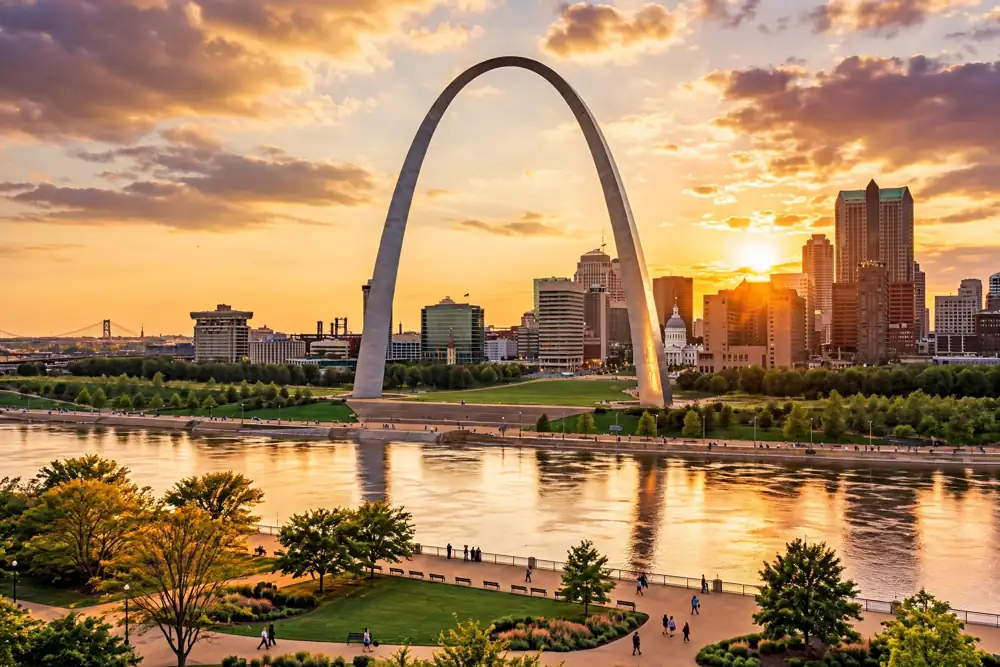
St Louis sits on the west bank of the Mississippi River in eastern Missouri, about 300 miles southwest of Chicago and 250 miles east of Kansas City — and it is the rare American city where the scenery, the history and the food are all within a short train ride of each other. A 630-foot steel arch rises over the riverfront, a park bigger than Central Park holds a free zoo, a free art museum and a free science centre, and a neighbourhood called The Hill invented a dish the whole country now copies. This guide gives you the 20 best things to do in St Louis in a sensible order, a ready-made 3-day itinerary, honest advice on when to go, where to stay and how to get around, and the three foods you have to try before you leave — plus the free sights that cost nothing at all. Prices and hours change, so every price in this guide is marked as approximate — always check the official website before you visit.
One thing to know before you go: St Louis in 2026 is not the city of the old guidebooks. Forest Park turned 150 on June 24, 2026, and the Missouri History Museum has a whole exhibition about it. The Old Courthouse — closed for years for renovation — reopened on May 3, 2025 with four new galleries, so any guide that still calls it closed is out of date. The City Museum added a new Labyrinth and an antique children’s carousel in 2026, and Union Station is adding three new rides to its Wheel Park. And the free part is real, not a trick: the zoo, the art museum, the science centre and the history museum are free every day, funded by a regional tax, which is why St Louis is one of the best-value city breaks in America. This guide tells you which of those traps to watch for, and which prices changed in 2026, so you can plan with facts instead of outdated blog posts.
St Louis at a glance
| Question | Short answer |
|---|---|
| Where is St Louis? | On the west bank of the Mississippi River in eastern Missouri, about 300 miles southwest of Chicago, at the meeting point of the Mississippi and Missouri rivers |
| What is it best for? | The Gateway Arch, a park full of free world-class museums, the City Museum, Cardinals baseball and food you cannot get anywhere else |
| How long should I stay? | 3 full days for the highlights; 2 days for the essentials; add a day for Cahokia Mounds and the botanical garden |
| How much does it cost? | Roughly $120–$250 per person per day mid-range; many of the best sights — the zoo, the art museum, the science centre, Forest Park — are free |
| Do I need a car? | Not downtown or in Forest Park — MetroLink light rail is $2.50 a ride and the day pass is $5 — but a car is the easiest way to reach Grant’s Farm and Cahokia Mounds |
| What is the one thing not to miss? | The tram ride to the top of the Gateway Arch in the morning, then the City Museum in the afternoon |
| When is the best time to go? | April–May and September–October for mild weather; summer for festivals and baseball; winter for the cheapest hotels |
| Is it good for families? | Yes — the free zoo, the Science Center, the City Museum and the riverboat are all built for kids |
The 20 best things to do in St Louis
These are the 20 best things to do in St Louis, ranked the way a first-time visitor should actually do them: the riverfront first, then Forest Park, then the museums and neighbourhoods, then the day trips. Every price below is the 2026 price as published by the attraction itself, and every trap — the courthouse that reopened, the tram prices that change by date, the parking that costs more than the ticket — is called out where it matters.
1. Gateway Arch
The Gateway Arch is the single best reason to come to St Louis, and the most photographed monument in the American Midwest. Designed by Eero Saarinen and completed in 1965, the 630-foot curve of stainless steel — as wide as it is tall — is the tallest man-made monument in the United States, built to mark St Louis as the gateway to the American West. The ride to the top is the point: small eight-person tram cars climb inside the legs of the Arch in about four minutes, and at the top you look out through narrow windows over the Mississippi River, downtown and, on a clear day, 30 miles in every direction. The free Museum at the Gateway Arch underneath tells the story of westward expansion, Native American cultures and the building of the Arch itself. Read about the Gateway Arch on Wikipedia.
The practical facts for 2026: the grounds and the museum are free. The tram ride costs $15 to $19 for adults 16 and over and $11 to $15 for children 3 to 15, with the price varying by date — peak summer days cost more — and $3 of every adult ticket is the National Park Service entrance fee, so pass holders pay $12 to $16. On Value Days, Monday to Thursday in the quieter months, tickets are $15 for adults and $11 for children. Tickets are timed entry and sell out early and often, especially in summer and on weekends, so book online at gatewayarch.com as soon as you know your dates; same-day tickets go on sale at 9 a.m. and are not guaranteed. Allow 45 to 60 minutes for the whole tram experience, with no more than 10 minutes at the top. Two honest warnings: the tram cars are small and enclosed, so the ride is not for anyone with claustrophobia, and wheelchairs and strollers cannot make the trip to the top. The grounds are open daily from 5 a.m. to 11 p.m., and the Arch is closed on Thanksgiving, Christmas Day and New Year’s Day.
2. Forest Park
Forest Park is the green heart of St Louis, and the park every other American city wishes it had. At about 1,300 acres it is bigger than New York’s Central Park, and it was the site of the 1904 World’s Fair — the Louisiana Purchase Exposition — which is why the park still holds grand buildings, lakes, bridges and gardens more than a century later. Today it holds the Saint Louis Zoo, the Saint Louis Art Museum, the Missouri History Museum and the Saint Louis Science Center, plus the Muny outdoor theatre, the Jewel Box greenhouse, the Boathouse on Post-Dispatch Lake, golf courses, tennis courts and miles of paved trails. It is free, open daily from 6 a.m. to 10 p.m., and it is where St Louisans actually spend their weekends. Read about Forest Park on Wikipedia.
The 2026 freshness that most guides miss: Forest Park turned 150 on June 24, 2026. The park opened on that date in 1876, and the 150th year brings the Forest Park Passport — a free activity book with 150 things to do in the park, seasonal challenges and prizes, available at park locations through August 2027 — and a Missouri History Museum exhibition, “Yours Forever: Forest Park at 150”, about how the park has changed over a century and a half. The best way to see the park is on foot or by bike: rent one at the Boathouse, ride the lakeside paths, climb Art Hill for the view back to the Art Museum, and end the day at the World’s Fair Pavilion. Parking is mostly free — only four lots in the park charge, at the Zoo, under the Art Museum and behind the Science Center — and the MetroLink Forest Park-DeBaliviere station drops you at the park’s north edge.
3. City Museum
The City Museum is the most fun you will have in St Louis, and the strangest museum in America. It is not a museum at all in the usual sense: it is a 600,000-square-foot former shoe warehouse at 750 North 16th Street, rebuilt by artist Bob Cassilly into a climbable, crawlable, slideable work of art — caves and tunnels, a ten-storey slide, a rooftop Ferris wheel, a school bus tipped over the edge of the building, a giant praying mantis, a whale you can climb inside, and MonstroCity, the outdoor climbing structure of salvaged aircraft and construction equipment. Children love it, adults love it more, and everyone leaves with scraped knees and a story. Read about the City Museum on Wikipedia.
The practical facts for 2026: general admission starts at about $20 a person when you buy online, roughly 10% cheaper than the ticket window, and children 2 and under are free. The rooftop is a separate $8 add-on, weather permitting, and it closes after sunset with limited hours in winter. The museum usually opens at 10 a.m., but the closing time changes by day and season, with later hours on weekends and in summer, and it sometimes closes early for private events — check the hours calendar on citymuseum.org on the morning of your visit. Plan four hours minimum; many families stay five or six. Two 2026 additions to look for: a new Labyrinth and an antique children’s carousel, both added in 2026. The honest warnings: wear closed shoes and clothes you can climb in, leave the nice bag at the hotel, and do not skip the rooftop — it is the best view in downtown. Parking in the museum’s Serpent Lot is about $15, card only. On Friday and Saturday nights the museum runs City Nights, its 21-and-over evenings with DJs in the caves.

4. Saint Louis Zoo
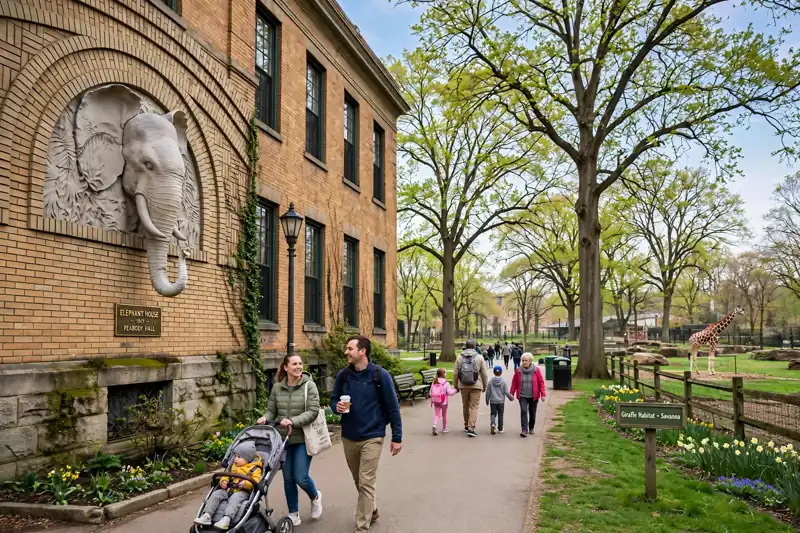
The Saint Louis Zoo is one of the best zoos in the United States, and it is free. In Forest Park since 1910, it holds more than 16,000 animals from nearly 600 species across 90 acres — big cats, primates, penguins, sea lions, elephants and a river’s-edge habitat that is one of the best in the country — and in June 2026 it was voted “Best Free Attraction” in the United States by the USA TODAY 10Best Readers’ Choice Awards, for the second time. The historic 1913 Elephant House, the bird house and the primate house are worth a look on their own, and the zoo’s conservation work is the reason the animals’ enclosures keep getting better. Read about the Saint Louis Zoo on Wikipedia.
The practical facts for 2026: general admission is free every day, for everyone, with no ticket and no residency requirement — the zoo is funded partly by the regional Zoo Museum District property tax. Paid extras — the Zooline Railroad, the Conservation Carousel, the sea lion show, the stingrays at Caribbean Cove and the 4D theatre — are sold together as an Adventure Pass, about $17.50 a person, cheaper online. From October 8 to December 31, 2026, the zoo is open 9 a.m. to 4 p.m. daily, with summer hours running later (8 a.m. to 5 p.m.). Parking in the zoo lots is $15 to $20 a car, or free on the street a 15-minute walk away — the parking, not the ticket, is the cost to plan for. Allow three to four hours, go in the morning when the animals are active, and pair it with the Art Museum across the park for a full free day.
5. Missouri Botanical Garden
The Missouri Botanical Garden is the oldest botanical garden in the United States, and the most peaceful place in St Louis. Founded in 1859 by Henry Shaw, it covers 79 acres in the Shaw neighbourhood with the Climatron — a geodesic dome holding a tropical rainforest — a traditional Japanese garden with a lake and koi, a Bavarian garden, the historic Tower Grove House, and more than 27,000 plants. It is the garden the locals call Shaw’s Garden, and it is the best slow morning in the city. Read about the Missouri Botanical Garden on Wikipedia.
The practical facts for 2026: general admission is $16 for visitors 13 and over, children 12 and under are free, seniors 65 and over pay $4, and St Louis city and county residents pay $6 with proof of residency — and residents get in free on Wednesday and Saturday mornings before noon. The garden is open daily from 9 a.m. to 5 p.m., with last entry at 4:30 p.m., and it is entirely cashless, so bring a card. The event to plan around is Garden Glow, the walk-through holiday light show, which runs November 14, 2026 to January 2, 2027, with timed-entry tickets from $6 to $25 depending on the date — book ahead, because peak nights sell out, and note it is closed on Thanksgiving, Christmas Eve and Christmas Day. The Holiday Flower and Train Show runs the same dates in the daytime and is included in regular admission. Allow two to three hours, and go in the morning, when the light in the Climatron is at its best.
6. Cathedral Basilica of St Louis
The Cathedral Basilica of St Louis is the most beautiful room in the city, and most visitors walk past it without realising it is there. On Lindell Boulevard in the Central West End, this Romanesque and Byzantine Revival cathedral — completed in 1914 and made a basilica by Pope John Paul II in 1997 — holds the largest collection of mosaic art in the world: 41.5 million glass tesserae in 7,000 colours, covering 83,000 square feet, installed by hand between 1912 and 1988. The mosaics tell the story of the Church and of Missouri, the main chapel was designed by Tiffany Studios, and the building is both a working parish church and a National Historic Landmark. Admission is free, with donations welcome, and a 60-minute guided tour runs most days at 1 p.m. for about $7 a person. Read about the Cathedral Basilica of St Louis on Wikipedia.
Go for the light: the mosaics are at their best in the late morning, when the sun is high enough to light the dome, and the rose window throws colour across the floor. Be quiet and respectful — Mass is celebrated several times a day and the cathedral is an active church, not a museum. The cathedral is an easy pair with the Central West End’s restaurants and shops on Euclid Avenue, and with the Missouri History Museum in Forest Park a short drive away.
7. The Old Courthouse
The Old Courthouse is the most historically important building in St Louis, and the one most 2026 guides still get wrong. This Greek Revival courthouse, with its 126-foot dome, was built in stages between 1839 and 1862, and it is where Dred and Harriet Scott sued for their freedom in 1846 — a case that reached the U.S. Supreme Court in 1857 and became one of the most consequential decisions in American history — and where Virginia Minor fought for women’s suffrage in the 1870s. The courthouse was closed for a $27.5 million renovation, and any guide that still tells you it is closed is out of date: it reopened on May 3, 2025, as the final stage of the $380 million CityArchRiver project that reconnected the riverfront, with four new galleries on the Dred and Harriet Scott case, the courthouse’s own history, the stories of the people who used the building, and its restoration. Read about the Old Courthouse on Wikipedia.
Admission is free, and the courthouse is at 11 North 4th Street, right across from the Gateway Arch grounds — visit it before or after the Arch, since the two are a two-minute walk apart and tell the same story from opposite ends. Allow 45 minutes to an hour, and read the panels about the Scott case slowly: the courthouse is the reason the building matters, and the new galleries explain the case better than any plaque in the city.
8. Saint Louis Art Museum
The Saint Louis Art Museum is one of the best free art museums in America, and it sits on top of Art Hill in Forest Park. Built as the Palace of Fine Arts for the 1904 World’s Fair, the Beaux-Arts building holds more than 36,000 works covering 5,000 years of art — a world-class Oceanic collection, an Egyptian mummy, a huge Max Beckmann collection, 20th-century masters, and one of the finest collections of German Expressionist art anywhere — and the 2013 East Building added a whole wing of contemporary art. Admission is free every day, with no ticket and no residency requirement, and special exhibitions are free on Fridays. Read about the Saint Louis Art Museum on Wikipedia.
The practical facts for 2026: the museum is open Tuesday to Sunday from 10 a.m. to 5 p.m., with hours until 9 p.m. on Friday, and it is closed on Mondays. The garage costs $15 a car during peak season (March through October) and $10 off-peak, but the parking lots across Fine Arts Drive are free. Come for the Beckmann gallery and the Oceanic collection, stay for the free docent tours, and end on the museum steps: the view down Art Hill across the park lake to the city is the best free photo in St Louis. Pair it with the zoo and the Missouri History Museum for a full free day in Forest Park.
9. Anheuser-Busch Brewery
The Anheuser-Busch Brewery is the working heart of the oldest and largest brewery complex in St Louis, and the birthplace of Budweiser. The brewery has been brewing on the same site since the 1850s, and the red-brick campus — now a National Historic Landmark — still produces the beer that made the company famous, with the famous Clydesdales stabled on site, the historic Brew House, and the Bevo packaging plant. The Day Fresh tour walks you through the brewing process from grain to glass, ends with a tasting, and includes a visit to the Clydesdale stables. Read about the Anheuser-Busch Brewery on Wikipedia.
The practical facts for 2026: the Day Fresh tour costs about $16 to $17 a person — recent visitors report $33 for two adults — and the Brewmaster tour, which takes you deeper into the process with more samples, costs more. Book ahead, because tours sell out on weekends. After the tour, the Biergarten on the brewery grounds serves draft beer, food and live music in the warmer months. The winter event is Brewery Lights, a drive-through and walk-through holiday light show, running November 21 to December 26, 2026, with tickets $12 for adults, $7 for ages 6 to 20, and free for children under 5. The brewery is at 1200 Lynch Street in Soulard, about a ten-minute drive south of downtown — easy to combine with the Soulard Market in the morning.
10. Grant’s Farm
Grant’s Farm is the most surprising day out near St Louis: a 281-acre estate in south St Louis County that was once the home of Ulysses S. Grant, and is now a free-admission animal park run by Anheuser-Busch. More than 900 animals from six continents live here — Clydesdale horses, camels, bison, zebras, kangaroos and the famous elephant herd — and the main attraction is the open-air tram ride through Deer Park, where the animals wander freely up to the tram. The farm also preserves Grant’s own log cabin, “Hardscrabble”, built by Grant himself in the 1850s, and the Bauernhof, the German-style farmhouse where the Busch family entertained guests. The farm has been open to the public since 1954. Read about Grant’s Farm on Wikipedia.
The practical facts for 2026: general admission is free, and the tram ride through Deer Park is included. The real cost is parking, which is about $25 a car, cheaper when you book online. The farm is open seasonally, so check the hours calendar on grantsfarm.com before you go — it closes for the winter, and it is closed on some weekdays. Allow three hours, go in the morning when the animals are active, and take a car or a rideshare: there is no MetroLink stop at the farm, and the bus service is poor. It is a 20-minute drive southwest of downtown, and it pairs well with the Anheuser-Busch Brewery on the way back.
11. Delmar Loop
The Delmar Loop is the most famous street in St Louis, and the most fun one to walk. Named one of the “10 Great Streets in America” by the American Planning Association, the six-block stretch of Delmar Boulevard at the eastern end of University City is a mix of record shops, vintage stores, restaurants, bars, street murals and the brass stars of the St Louis Walk of Fame set into the sidewalk — more than 150 St Louisans honoured, from Chuck Berry and Maya Angelou to Tina Turner and Yogi Berra. The anchor is Blueberry Hill, the restaurant and music club at 6504 Delmar Boulevard that has been open since 1972, where Chuck Berry played monthly shows in the Duck Room for decades, and where the dart room, the pinball machines and the Elvis Room are a museum in themselves. Read about the Delmar Loop on Wikipedia.
The practical facts: the Loop is best in the afternoon and evening, when the shops are open and the bars fill up. Walk the full six blocks from the MetroLink Delmar Loop station to Skinker Boulevard, stop for root beer at Fitz’s (made on site since 1993), see a film at the Tivoli Theatre, and eat at Salt + Smoke for barbecue or at one of the Loop’s many international restaurants. The Loop is also the eastern edge of Washington University in St Louis, so it stays lively year-round. If you are short on time, the one stop is Blueberry Hill — order the food, look at the walls, and remember that you are standing in the room where Chuck Berry played.
12. Saint Louis Science Center
The Saint Louis Science Center is one of the largest free science museums in the country, and the best rainy-day option in the city. On the southern edge of Forest Park, the centre holds more than 700 hands-on exhibits across two buildings joined by a glass Sky Bridge over Interstate 64, plus the McDonnell Planetarium, the OMNIMAX theatre with its four-storey screen, and the GROW agriculture exhibit — a working farm exhibit with a greenhouse, a chicken coop and a simulated farm market. It is free, it is aimed squarely at families, and it is the one museum in the city where you are encouraged to touch everything. Read about the Saint Louis Science Center on Wikipedia.
The practical facts for 2026: general admission is free every day, with no ticket and no residency requirement. The centre is open Monday and Wednesday to Saturday from 9:30 a.m. to 4:30 p.m., Sunday from 11 a.m. to 4:30 p.m., and it is closed on Tuesdays. The OMNIMAX and planetarium shows cost extra, and parking in the centre’s garage is $15 a car for non-members. The special exhibition to know about in 2026 is Blue Whale, a full-size model of a blue whale’s heart that visitors can walk through, on view until January 10, 2027, with adult tickets about $16. Allow three hours, and go on a weekday if you can — weekends are the busiest time in the building.
13. Missouri History Museum
The Missouri History Museum is the best place in St Louis to understand the city itself, and it is free. Founded in 1866 and housed in a Jefferson Memorial building in Forest Park since 1913, the museum tells the story of St Louis and Missouri through exhibits on the 1904 World’s Fair, the Lewis and Clark expedition, Charles Lindbergh and the Spirit of St Louis, the city’s blues and jazz heritage, and the civil rights movement. The museum also runs one of the best rotating exhibitions programmes in the city, and it is the place to go when you want to understand why St Louis looks the way it does. Read about the Missouri History Museum on Wikipedia.
The practical facts for 2026: admission is free every day, with no ticket and no residency requirement. The museum is open Tuesday to Sunday from 10 a.m. to 5 p.m., with Thursday evenings until 8 p.m. The exhibition to plan around in 2026 is “Yours Forever: Forest Park at 150”, about the park’s century and a half, and the History Clubhouse is a dedicated children’s area on the lower level. Allow two hours, and pair it with the Art Museum — the two buildings are a five-minute walk apart, across the park.
14. St Louis Union Station
St Louis Union Station is the grandest train station in America that no longer runs trains, and it is now one of the best places in the city to spend an evening. Opened in 1894 and once the largest and busiest passenger rail terminal in the world, the station closed to trains in 1978 and was rebuilt as a hotel and entertainment complex in 1985, preserving the Romanesque headhouse, the Grand Hall with its 65-foot barrel-vaulted ceiling and stained glass, and the 230-foot clock tower. Today the station holds the St Louis Union Station Hotel, the St Louis Aquarium, the St Louis Wheel and the Wheel Park rides, a mini-golf course and a ropes course, and the Grand Hall light show that plays on the ceiling every evening. Read about St Louis Union Station on Wikipedia.
The practical facts for 2026: the St Louis Wheel is 200 feet tall, with 42 climate-controlled gondolas, a 15-minute ride with three to four rotations, and tickets from about $15 to $19 for adults and $10 to $12 for children, card only. The St Louis Aquarium costs from $29.75 for adults and $24.95 for children, and the mini golf and ropes course are $12 and $15 a person. The freshness to know about: on August 28, 2025, the station opened three new rides in Wheel Park as part of a $15 million expansion — Loco Motion, a train-themed spinning coaster; Flying Louie, a 42-seat pirate ship; and Wave Swinger, a swing ride themed to the 1904 World’s Fair — so the Wheel Park is bigger than most 2025 guides say. Come in the evening, when the Grand Hall light show and the Wheel are lit, and the station is at its best.
15. Busch Stadium and the Cardinals
Busch Stadium is the home of the St Louis Cardinals, and a Cardinals game is the most St Louis thing you can do after the Arch. The Cardinals are one of the most storied franchises in baseball, with 11 World Series titles, and the stadium — opened in 2006, the third Busch Stadium on the site — sits right downtown, with the Arch visible from the upper deck. The atmosphere is the draw: the Cardinals draw more than 3 million fans a year, the stadium fills with red on game days, and the Ballpark Village entertainment district next door, with its restaurants, bars and the Cardinals Hall of Fame and Museum, keeps the party going before and after the game. Read about Busch Stadium on Wikipedia.
The practical facts: the baseball season runs from late March or early April to late September or early October, and the cheapest seats are in the upper deck and standing room — book early for the big rivalries, especially against the Chicago Cubs, when tickets sell out weeks ahead. The Cardinals Hall of Fame and Museum in Ballpark Village is open year-round, even when the team is on the road, and the stadium tour runs on non-game days. Even if you do not go to a game, walk through Ballpark Village in the evening: it is the liveliest spot in downtown after dark, and it is where the city celebrates on game nights.
16. Soulard Market
Soulard Market is the oldest farmers market west of the Mississippi River, and the most St Louis morning you can have. The market was established in 1779 on land donated by Julia Soulard, and it has been selling produce, meat, flowers and baked goods in the Soulard neighbourhood ever since — today it is a covered market hall and open-air stalls at 730 Carroll Street, a ten-minute walk south of downtown, filled with local farmers, butchers, bakers and florists. On Saturday mornings the market is packed, the stalls spill into the street, and the smell of fresh bread and coffee fills the air. Read about St Louis on Wikipedia.
The practical facts: the market is open Wednesday to Saturday, and Saturday is by far the best day — arrive before 10 a.m. for the full range of stalls, and bring cash, because some vendors are cash only. The market is closed Sunday to Tuesday. After the market, walk the Soulard neighbourhood itself: it is one of the oldest neighbourhoods in the city, with French colonial-era houses, brick row homes and the bars and restaurants that make Soulard the centre of St Louis Mardi Gras every February — the second-largest Mardi Gras celebration in the United States, after New Orleans. Combine it with the Anheuser-Busch Brewery, which is a five-minute drive away.
17. The Hill
The Hill is the Italian-American neighbourhood of St Louis, and the home of the city’s most famous food. Settled by Italian immigrants in the late 1800s, the Hill is a tight grid of brick homes, Italian markets, bakeries and restaurants around St Ambrose Catholic Church, and it is where toasted ravioli was invented — at Angelo’s, where a chef is said to have dropped a ravioli into hot oil by accident in the 1940s, and at Charlie Gitto’s, which claims the invention for itself. The Hill is also where baseball legends Yogi Berra and Joe Garagiola grew up, on the same street, and where the neighbourhood’s Italian identity is still visible in the flags, the murals and the shop signs. Read about The Hill, St Louis on Wikipedia.
The practical facts: the Hill is a residential neighbourhood, not a tourist attraction, so the way to see it is to eat there. Book a table at Charlie Gitto’s (5226 Shaw Avenue) for toasted ravioli and pasta, stop at the Italian markets on Marconi Avenue for bread and salami, and pick up a cannoli from a bakery on the way back. The neighbourhood is about a 15-minute drive west of downtown, and it is best visited at lunch or dinner — the restaurants are the point, and the streets are quiet in between.
18. Mississippi Riverfront Cruise
The best way to see the Gateway Arch is from the water, on a Mississippi riverboat cruise. The riverboats leave from the dock at the foot of the Arch — 50 South Leonor K Sullivan Boulevard — and the one-hour narrated sightseeing cruise takes you up and down the river past the Arch, the working riverfront, the barges and the bridges, with a guide telling the story of the river that built the city. The riverfront itself is worth a walk: the cobblestones of the old levee, the Eads Bridge, and the view back to the Arch from the water’s edge. Read about the Mississippi River on Wikipedia.
The practical facts for 2026: the riverboat season runs from March to November, and the 2026 season opened on March 5. A one-hour sightseeing cruise costs $26 for adults, $24 for seniors 60 and over, and $16 for children 3 to 15, with children under 3 free. The Skyline Dinner Cruise, which runs on selected evenings, starts from $64 a person. Book online, because the popular afternoon cruises sell out on weekends, and go in the late afternoon if you can: the light on the Arch from the river is at its best in the golden hour, and the sunset cruise is the most romantic hour in the city.
19. Cahokia Mounds
Cahokia Mounds is the most important archaeological site in North America that most visitors have never heard of, and it is a 20-minute drive from downtown St Louis. A thousand years ago, Cahokia was the largest city in North America north of Mexico, home to tens of thousands of people, with a great plaza, a wooden stockade, and more than 120 earthen mounds — the largest of which, Monks Mound, is 100 feet tall and the largest earthen mound in North America. The city flourished from about 800 to 1400 AD, and it is now a UNESCO World Heritage Site, one of only a handful in the United States. The interpretive centre explains the city with models, artefacts and a film, and the climb to the top of Monks Mound — 154 steps — gives you the view the city’s rulers had: the whole floodplain, and the St Louis skyline on the horizon. Read about Cahokia on Wikipedia.
The practical facts: Cahokia Mounds State Historic Site is in Collinsville, Illinois, across the river from St Louis, and admission to the grounds and the interpretive centre is free, with donations welcome. The site covers 2,200 acres, so wear walking shoes and allow two to three hours. There is no public transport to the site, so you will need a car or a rideshare — it is about a 20-minute drive east of downtown. Go in the morning, when the light is good and the site is quiet, and pair it with a stop in the town of Collinsville itself.
20. Laumeier Sculpture Park
Laumeier Sculpture Park is the most unexpected free attraction in St Louis: a 105-acre outdoor sculpture park in the suburb of Sunset Hills, with more than 60 large-scale sculptures spread across meadows, woods and a creek. The works range from the playful — a giant eye called “The Way”, a huge red abstract form, a 40-foot-tall sculpture you can walk under — to the monumental, and the park is free, open daily from dawn to dusk, and one of the best places in the city for a long walk. The indoor galleries in the estate house hold rotating exhibitions, and the park runs concerts, art fairs and family events through the year. Read about Laumeier Sculpture Park on Wikipedia.
The practical facts: the park is free every day, with donations welcome, and parking is free. It is about a 25-minute drive southwest of downtown, in Sunset Hills, and there is no MetroLink stop nearby, so take a car or a rideshare. Allow two hours, wear walking shoes, and go in the morning or late afternoon, when the light on the sculptures is at its best. It is the best half-day trip from the city if you want art and nature without a ticket price, and it pairs well with Grant’s Farm, which is a 15-minute drive away.
St Louis in 3 days — a ready-made itinerary
Three days is the right amount of time for St Louis: one day for the riverfront and downtown, one day for Forest Park, and one day for the neighbourhoods and the food. This itinerary assumes you are staying downtown or in the Central West End, and that you have booked your Arch tram tickets in advance.
| Day | Morning | Afternoon | Evening |
|---|---|---|---|
| Day 1 — The riverfront and downtown | Gateway Arch tram and museum, then the Old Courthouse | City Museum | Ballpark Village and a Cardinals game, or dinner downtown |
| Day 2 — Forest Park | Saint Louis Zoo, then the Saint Louis Art Museum | Missouri History Museum, then the Saint Louis Science Center | Dinner in the Central West End |
| Day 3 — Neighbourhoods and food | Soulard Market, then the Anheuser-Busch Brewery | Delmar Loop and Blueberry Hill, or Cahokia Mounds | Toasted ravioli and St Louis-style pizza on The Hill |
Day 1 — The riverfront and downtown
Start early at the Gateway Arch: book the first tram of the day, ride to the top, and spend an hour in the free museum underneath. Walk across to the Old Courthouse — free, and reopened in May 2025 — and spend 45 minutes in the new galleries about the Dred Scott case. Walk the riverfront to the riverboat dock for a late-morning cruise if the weather is good. After lunch, head to the City Museum and stay until it closes — four hours is the minimum, and the rooftop at sunset is the best view in the city. In the evening, walk to Ballpark Village for dinner, and if the Cardinals are in town, go to the game.
Day 2 — Forest Park
Spend the whole day in Forest Park, and spend nothing on tickets. Start at the Saint Louis Zoo when it opens at 9 a.m., when the animals are active, and allow three hours. Walk across the park to the Saint Louis Art Museum for lunch and the Beckmann gallery, then the Missouri History Museum for the Forest Park 150 exhibition. If you have children, or energy left, finish at the Saint Louis Science Center. End the day with dinner in the Central West End, on Euclid Avenue, and a walk past the Cathedral Basilica to see the mosaics in the evening light.
Day 3 — Neighbourhoods and food
Start at Soulard Market on Saturday morning if you can, and eat breakfast at the market. Tour the Anheuser-Busch Brewery and the Clydesdale stables, then drive to the Delmar Loop for the afternoon: walk the six blocks, see the Walk of Fame stars, have root beer at Fitz’s and a drink at Blueberry Hill. If you would rather see something older, swap the Loop for Cahokia Mounds, a 20-minute drive east. In the evening, drive to The Hill for dinner at Charlie Gitto’s: toasted ravioli to start, pasta to follow, and a cannoli to finish — the most St Louis meal in the city.
Best time to visit St Louis
| Season | Weather | Crowds | Prices | Best for |
|---|---|---|---|---|
| Spring (March–May) | Mild, 60s–70s°F, some rain | Moderate | Moderate | The best all-round time — gardens, Forest Park and the Arch |
| Summer (June–August) | Hot and humid, highs around 89°F, thunderstorms | High | High | Cardinals baseball, festivals, the Muny and long evenings |
| Autumn (September–November) | Mild, 60s–70s°F, fall colour in October | Moderate | Moderate | The other best time — fall colour, harvest festivals, Garden Glow from mid-November |
| Winter (December–February) | Cold, highs around 41°F, some snow | Low | Lowest | The cheapest hotels, Brewery Lights, Garden Glow and the holiday season |
The best time to visit St Louis is April and May, and September and October, when the weather is mild, the gardens are at their best, and the crowds are manageable. Summer is hot and humid — average highs around 89°F, with thunderstorms — but it is also the season for Cardinals baseball, the Muny outdoor theatre in Forest Park, and the city’s festivals. Winter is cold, with average highs around 41°F in January, but it is the cheapest time to visit, and the holiday lights — Garden Glow at the botanical garden and Brewery Lights at the Anheuser-Busch Brewery — are worth the trip on their own. April is the wettest month of the year, so pack a rain jacket in spring. The freshest travel news for 2026: British Airways started nonstop flights from London Heathrow to St Louis on April 19, 2026, four times a week, the first nonstop service between St Louis and Europe in years — which makes the city an easier trip from the UK than it has been in a long time.
Where to stay in St Louis
| Area | Best for | Price range | Vibe |
|---|---|---|---|
| Downtown | First-time visitors, the Arch, Cardinals games | $130–$250 | Lively on game nights, quieter otherwise, best MetroLink access |
| Central West End | Food, the Cathedral Basilica, Forest Park | $150–$300 | The city’s most walkable neighbourhood, cafes and restaurants on Euclid Avenue |
| Clayton | Business travellers, upscale stays, easy MetroLink | $150–$280 | Quiet, polished, tree-lined streets and good restaurants |
| The Loop / Delmar | Nightlife, music, Washington University | $120–$200 | Young, energetic, bars and record shops |
| Soulard | Markets, bars, Mardi Gras | $110–$180 | Historic, friendly, best for a longer stay |
Downtown is the best base for a first visit: you are within walking distance of the Arch, the Old Courthouse, the City Museum and Busch Stadium, and the MetroLink runs from the airport straight to the downtown stations. The Hyatt Regency St Louis at The Arch and the Drury Plaza Hotel are the best-value downtown picks, and the St Louis Union Station Hotel is the most atmospheric — a hotel inside the old station, with the Grand Hall light show downstairs. The Central West End is the best base if you want restaurants and a neighbourhood feel: the Royal Sonesta Chase Park Plaza, a historic hotel on Lindell Boulevard, and the Angad Arts Hotel, the city’s most design-led hotel, are both here, and Forest Park is a ten-minute walk away. Clayton, one stop west on the MetroLink, is the quietest and most upscale option, with the Ritz-Carlton and a string of good restaurants. The Loop is the best base for nightlife and music, and Soulard is the best base for a longer stay, with vacation rentals and a local feel. Avoid staying in the far suburbs unless you have a car — the city is easy to get around, but the suburbs are not.
Getting around St Louis
Getting around St Louis is easier than most American cities, because the MetroLink light rail connects the airport, downtown, Forest Park, the Delmar Loop and Clayton on two lines. A single ride costs $2.50, a bus ride costs $1, a day pass costs $5, a 7-day pass costs $27 and a 30-day pass costs $78, with fare capping at $5 a day — once you have spent $5 in a day, the rest of your rides are free. The MetroLink has two lines, 38 stations and 46 miles of track, and it runs from about 5 a.m. to 1 a.m. One warning that catches visitors: tap-to-pay bank cards do NOT work at the MetroLink validators, so buy your ticket in the Transit app or at a station ticket machine before you board, and keep it with you — the system now has security gates at the busiest stations. The Red Line runs from St Louis Lambert International Airport to downtown in about 30 minutes, which makes the train the best way to arrive.
Downtown, Forest Park and the Central West End are all walkable, and the MetroLink and the buses cover the main sights. You will need a car or a rideshare for Grant’s Farm, Cahokia Mounds and Laumeier Sculpture Park, which are all outside the MetroLink network. Amtrak serves St Louis at the Gateway Station, 430 South 15th Street downtown, with trains to Chicago, Kansas City and beyond. If you are driving, parking downtown costs about $10 to $20 a day in a garage, and street parking is metered — the Arch garage and the City Museum lot are the most expensive spots in the city, so walk or take the train when you can.
St Louis food you have to try
St Louis has one of the most distinctive food cultures in America, and it is not a copy of anywhere else. The city invented its own pizza, its own cake and its own ravioli, and it has a barbecue tradition, a frozen custard tradition and a late-night diner tradition of its own. These are the three foods to try first.
Toasted ravioli — the snack St Louis invented
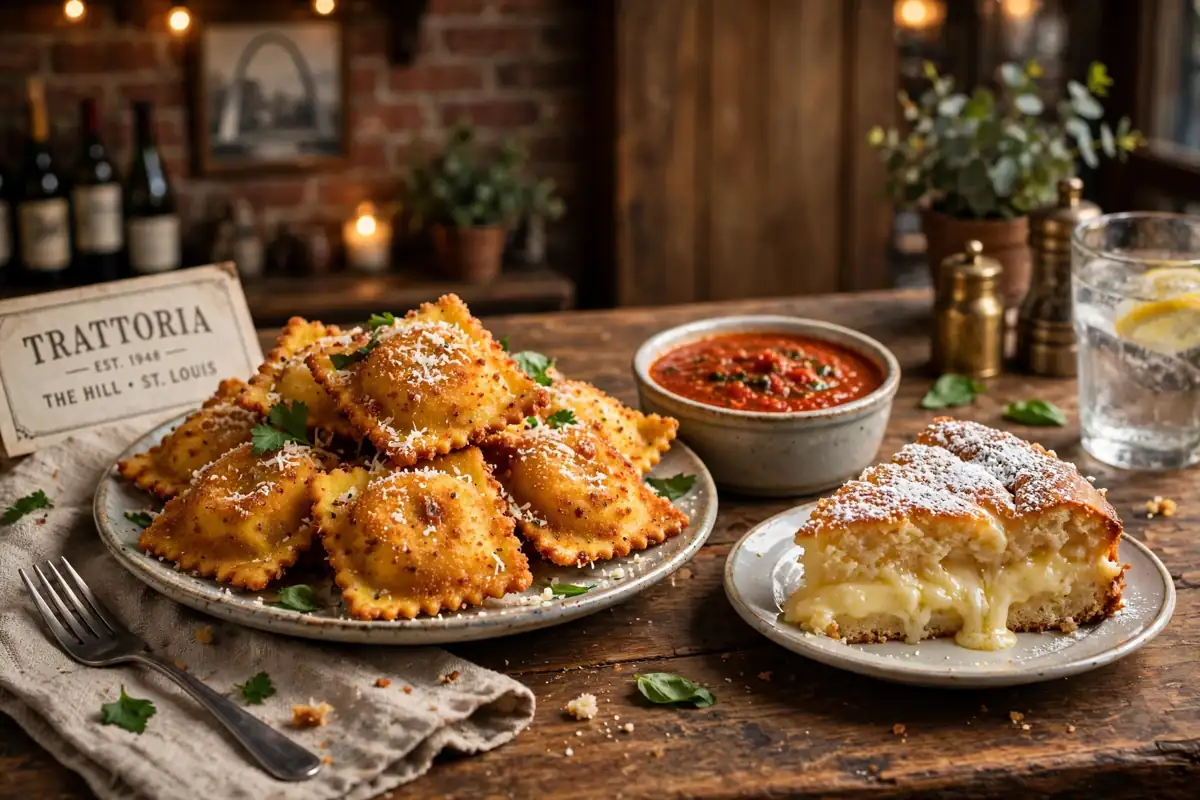
Toasted ravioli — “T-ravs” to the locals — is the most famous food in St Louis, and it was invented here by accident. In the 1940s, a chef at Angelo’s on The Hill is said to have dropped a ravioli into hot oil instead of water, and the result — a breaded, deep-fried ravioli, crisp on the outside and soft on the inside, served with marinara sauce for dipping and a dusting of parmesan — became the city’s signature appetiser. Charlie Gitto’s, at 5226 Shaw Avenue on The Hill, claims the invention for itself, and the argument over who invented it is part of the fun. The best place to try it is on The Hill, where Charlie Gitto’s and the other Italian restaurants serve it as a starter, but you will also find it at Imo’s pizza parlours and at bars across the city, where a plate of toasted ravioli costs about $10 to $11. Read about toasted ravioli on Wikipedia.
St Louis-style pizza and gooey butter cake
St Louis-style pizza is unlike any other pizza in America: a cracker-thin crust, a sweet tomato sauce, and Provel cheese — a processed blend of cheddar, Swiss and provolone that melts into a gooey, slightly smoky layer — cut into squares, not slices, because the pizza is meant to be shared. It was created by Imo’s Pizza, founded in 1964 by Ed and Margie Imo, and it is the pizza St Louisans argue about the way New Yorkers argue about theirs: the locals love it, visitors are divided, and everyone has an opinion. The slogan is “the square beyond compare”, and the best place to try it is an Imo’s — there are dozens across the city. Read about St Louis-style pizza on Wikipedia.
Gooey butter cake is the city’s other invention: a flat, dense, buttery cake with a gooey centre, created by accident in the 1930s when a German baker mixed up the proportions of a coffee cake. The best place to try it is Park Avenue Coffee in Lafayette Square, at 1919 Park Avenue, which makes more than 70 flavours — from the classic to pumpkin, chocolate and red velvet — and sells it by the slice or by the whole cake. Read about gooey butter cake on Wikipedia.
Barbecue, frozen custard and the slinger
St Louis barbecue is its own style, and it is not Texas or Kansas City. The city’s signature cut is the pork steak — a thick slice of pork shoulder, grilled and sauced — and the best places to try it are Pappy’s Smokehouse in Midtown, where the ribs are the draw and the line starts before the doors open, Bogart’s Smokehouse in Soulard, and Salt + Smoke on the Delmar Loop. For dessert, Ted Drewes Frozen Custard has been serving thick frozen custard “concretes” — custard blended with toppings, served upside down to prove how thick it is — since 1929, from its Route 66 stand on Chippewa Street, and it is still the best dessert in the city. And for the late-night dish, there is the slinger: a diner plate of eggs, hash browns, a hamburger patty, chilli, cheese and onions, served at diners across the city after midnight — the most St Louis meal you can have at 2 a.m.
Free things to do in St Louis
St Louis is one of the best-value cities in America, because so many of its best attractions are free. The Saint Louis Zoo, the Saint Louis Art Museum, the Saint Louis Science Center and the Missouri History Museum are all free every day, with no ticket and no residency requirement. The Museum at the Gateway Arch and the Old Courthouse are free, and the Arch grounds are free to walk. The Cathedral Basilica is free, Laumeier Sculpture Park is free, Cahokia Mounds is free, and Forest Park itself is free. The Delmar Loop’s Walk of Fame is free to walk, Soulard Market is free to browse, and Citygarden — the downtown sculpture park on Market Street, with its fountains and modern sculptures — is free. A full day in Forest Park, from the zoo in the morning to the Art Museum in the afternoon, costs nothing but lunch and parking, and a full day in the city — the Arch grounds, the Old Courthouse, the Cathedral Basilica, Citygarden and the riverfront — costs nothing at all. That is the secret of St Louis: the city gives away its best things, and charges you only for the tram, the City Museum and the parking.
Frequently asked questions
How many days do you need in St Louis?
Three full days is the right amount of time for a first visit: one day for the Gateway Arch, the Old Courthouse and the City Museum, one day for Forest Park, and one day for the neighbourhoods and the food. Two days covers the essentials — the Arch, Forest Park and the City Museum — and four days lets you add Cahokia Mounds, the Missouri Botanical Garden and Laumeier Sculpture Park without rushing. The city is compact, so you will not waste time travelling between sights.
Is St Louis safe for tourists?
St Louis has a reputation for high crime, and it is honest to say that the city has real problems with violent crime — but the tourist areas are a different story. Downtown, the Arch grounds, Forest Park, the Central West End, the Delmar Loop, Clayton and Soulard are safe in the daytime and busy in the evening, and most visitors have no trouble at all. Use the same sense you would use in any American city: stay in the busy areas after dark, do not wander alone late at night in neighbourhoods you do not know, do not leave valuables visible in a parked car, and take a rideshare rather than walking through an unfamiliar area at night. The MetroLink is safe during the day, and the stations in the tourist areas are well used.
Do you need a car in St Louis?
Not for the main sights. The MetroLink light rail connects the airport, downtown, Forest Park, the Delmar Loop and Clayton, and downtown, Forest Park and the Central West End are all walkable. A car is useful — and for some sights, necessary — for Grant’s Farm, Cahokia Mounds and Laumeier Sculpture Park, which are all outside the MetroLink network, and for exploring the suburbs. If you are staying downtown and only visiting the main sights, skip the car and use the train, the bus and rideshares.
Is the Gateway Arch worth it?
Yes, and it is the one ticket you should book first. The tram ride to the top is a unique experience — the small cars, the climb inside the legs of the Arch, the view from 630 feet — and the free museum underneath is one of the best small museums in the country. Book your timed ticket online as soon as you know your dates, because the tram sells out, and go in the morning, when the light is best and the crowds are smallest. If you are claustrophobic, skip the tram and enjoy the free museum and the grounds instead — the Arch is impressive from the ground too.
What is St Louis known for?
St Louis is known for the Gateway Arch, the tallest man-made monument in the United States, and for being the gateway to the American West. It is known for its free museums — the zoo, the art museum, the science centre and the history museum — and for Forest Park, one of the largest urban parks in the country. It is known for its food: toasted ravioli, St Louis-style pizza, gooey butter cake, pork steak barbecue and frozen custard. And it is known for its history: the Lewis and Clark expedition set out from here in 1804, the Dred Scott case was heard in the Old Courthouse, the 1904 World’s Fair was held in Forest Park, and the Cardinals are one of the most storied teams in baseball.
When is the best time to visit St Louis?
April and May, and September and October, are the best months to visit St Louis, with mild weather, gardens in bloom or in fall colour, and manageable crowds. Summer is the season for Cardinals baseball and the Muny outdoor theatre, but it is hot and humid, with average highs around 89°F. Winter is the cheapest time to visit, with the lowest hotel prices, and the holiday lights — Garden Glow and Brewery Lights — run from mid-November to early January. If you want the best weather and the best prices, come in late April or early October.
Further reading — Wikipedia and Reddit
For more background on the city, read about St Louis on Wikipedia, which covers the history, the neighbourhoods and the 1904 World’s Fair in detail. For up-to-date local advice, restaurant tips and trip reports from people who live there, the St Louis community on Reddit is active and helpful — search it for the neighbourhood you are visiting, and for the latest on the Arch, the City Museum and the Cardinals. There is no Quora link here: we could not verify a real, live Quora thread about things to do in St Louis, and we would rather leave a link out than invent one.
Your St Louis trip, in one paragraph
St Louis is the city that gives you its best things for free — a park bigger than Central Park, a zoo, an art museum, a science centre and a history museum that cost nothing, a 630-foot arch over the Mississippi, and a neighbourhood that invented its own pizza, cake and ravioli — and it is the city that rewards a slow three days more than a rushed one. Come for the Arch and the City Museum, stay for Forest Park and The Hill, and leave with a plate of toasted ravioli and a plan to come back. And if you want more city guides in the same style, we have them: Chicago, Nashville, Los Angeles, Orlando, Miami, San Diego, Denver, Savannah, Dallas, Charleston, San Francisco, Myrtle Beach, Las Vegas, San Antonio, London, Portland, Pigeon Forge, Puerto Rico, Atlanta, Phoenix, Paris, Maui, Key West, Colorado Springs, Sedona, Chattanooga and Palm Springs.

About the Author