Things to Do in Pigeon Forge
20 Best Attractions, a 3-Day Itinerary, Where to Stay, and the Food You Cannot Miss
Quick Info
Best for: Families, theme-park fans, dinner-show lovers and mountain hikers — Dollywood, the Smokies, the Parkway and the Great Smoky Mountain Wheel in one town
Best time: April–June and September–October for mild days and smaller crowds; mid-October to early November for peak fall colour
How long: 3 full days for the highlights; 2 days covers the essentials; add a 4th day for Gatlinburg and the national park
Budget: Roughly $150–$250 per person per day for a mid-range trip with a Dollywood day; a no-park day runs much cheaper, and the national park has no entrance fee
Don’t miss: Dollywood at opening, the new NightFlight Expedition, a dinner show, Cades Cove at sunrise and the Wheel at dusk
Pigeon Forge is the loudest, happiest gateway town in America — five miles of Parkway neon, pancake houses and dinner shows pressed up against the quietest wilderness in the East. Founded as a mill town on the Little Pigeon River, it grew into the front porch of Great Smoky Mountains National Park, the most visited national park in the United States, and in 2026 the town is changing fast: Dollywood has its biggest new ride ever, two brand-new attractions have opened on the Parkway, and the Winterfest lights are bigger than ever. This guide gives you the 20 best things to do in Pigeon Forge in a sensible order, a ready-made 3-day itinerary, honest advice on when to go, where to stay and how to get around, and the three foods you have to try before you leave — plus the free sights that cost nothing at all. Prices and hours change, so every price in this guide is marked as approximate — always check the official website before you visit.
One thing to know before you go: Pigeon Forge is not Gatlinburg. The two towns sit about nine miles apart on the same road into the national park, and they feel nothing alike — Pigeon Forge is the wide, flat Parkway of theme parks and dinner shows, Gatlinburg is the narrow, walkable mountain street. This guide is about Pigeon Forge, with Gatlinburg as a day trip at the end.
For background before you go, the Wikipedia entry on Pigeon Forge covers the town’s history, from the 1830 Old Mill to the Dollywood era — it is linked in Further reading at the end of this guide.
Pigeon Forge at a glance
| Question | Short answer |
| How long do you need? | 3 full days for the highlights; 2 days covers the essentials; 4 days if you add Gatlinburg and a full park day. |
| Best area for a first trip | The Parkway between the Old Mill and The Island — Dollywood, the dinner shows, the Wheel and the trolley are all a short ride from there. |
| One thing to book early | Dollywood dated tickets, dinner show seats on weekend nights, and a cabin or hotel for October weekends. |
| One thing that is free | The national park has no entrance fee, the Winterfest lights are free, and The Island and the Old Mill Square cost nothing to wander. |
| Do you need a car? | Yes, mostly — the Parkway is five miles long and the trolley is cheap, but a car is the easy way to the park, the coasters and Wears Valley. |
The 20 best things to do in Pigeon Forge
The list starts with the experiences that define Pigeon Forge and that first-time visitors should protect time for, then moves into the museums, the mountain coasters and the national park beyond the town. If you only have two days, do numbers 1 to 10.
1. Spend a day at Dollywood
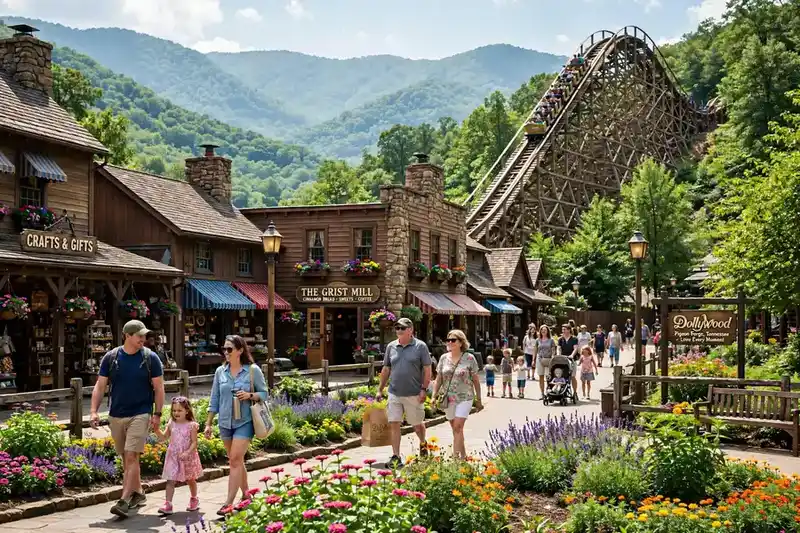
Dollywood is the reason most people come to Pigeon Forge, and it is the anchor of the whole town. The theme park, co-owned by Dolly Parton since 1986, sits in a bowl of the Smokies two and a half miles off the Parkway, with more than 50 rides, live bluegrass and country shows, Appalachian craftspeople at work in Craftsman’s Valley, and food — the Grist Mill cinnamon bread alone is worth the trip. Dollywood is marking its 40th anniversary season in 2026, and the headline is NightFlight Expedition, the park’s biggest new attraction ever: a more than $50 million indoor family hybrid coaster and whitewater raft ride in Wildwood Grove, the world’s first of its kind, with a 39-inch height requirement and a ride of about five and a half minutes. Note the date that catches out-of-date guides: NightFlight was announced for spring 2026 but actually opened to the public on August 19, 2026, so any guide that still says “opening spring 2026” is behind. The park’s other coasters — Big Bear Mountain, the longest coaster in the park, Lightning Rod, Mystery Mine and FireChaser Express — fill the rest of the day, and the festivals run all season: the I Will Always Love You Festival in spring, Flower & Food in April to June, the Smoky Mountain Summer Celebration with a drone show, the Harvest Festival from September 14 to October 31 with Great Pumpkin LumiNights, and Smoky Mountain Christmas from November 6, 2026 to January 3, 2027 with more than six million lights.
Practical tip: A one-day Pick-A-Day ticket costs from roughly $94.99 for adults in 2026, with children aged 4 to 9 and seniors 62 and over at roughly $84.99, and children 3 and under free — prices are approximate, so check before visiting. A two-day ticket starts from roughly $124.99 and must be used within five days. General parking is roughly $25 a car. Go at opening, ride NightFlight and Big Bear Mountain first, and check the calendar before you book: Dollywood is closed November 1 to 5, Thanksgiving Day, Christmas Eve and Christmas Day, and the season ends January 3, 2027.
2. Ride the Great Smoky Mountain Wheel at The Island
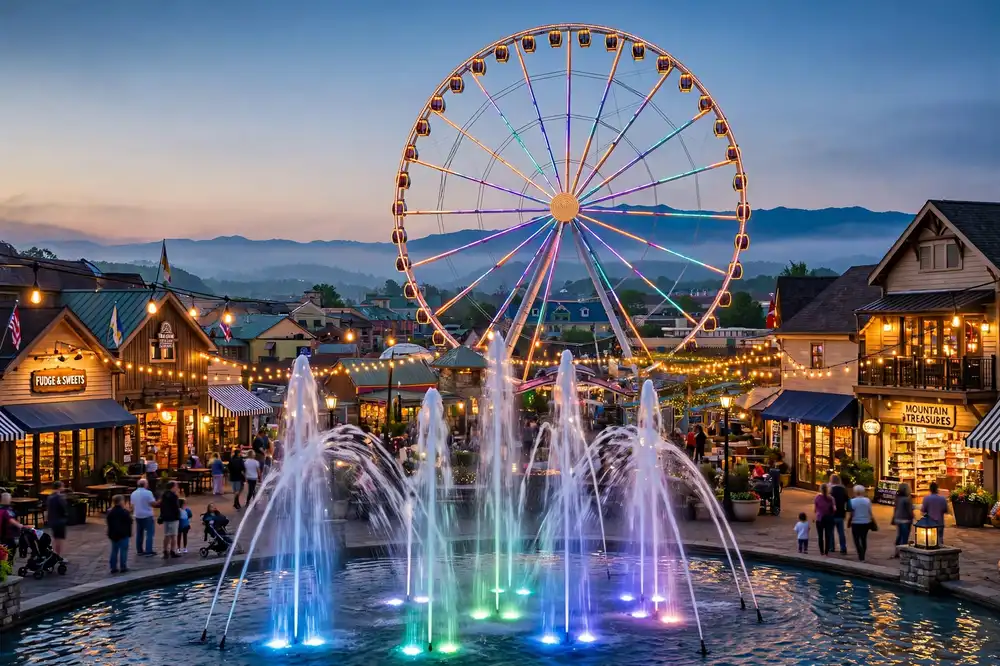
The Island is Pigeon Forge’s town square — a 23-acre entertainment district off the Parkway with free admission, free parking, shops, restaurants, rides and a dancing fountain — and its centrepiece is the Great Smoky Mountain Wheel. The 200-foot wheel, with 42 climate-controlled glass gondolas, lifts you above the Parkway for the best view in town, out over the rooftops to the Smokies. The Island in Pigeon Forge is free to wander at any hour, and the fountain show, choreographed to music and lights, runs through the evening. The Island also holds the Alcatraz East Crime Museum, the SkyFly: Soar America simulator, and the free Jurassic Adventure, with 22 life-size interactive dinosaurs around the fountain, running from March 2 to September 13, 2026.
Practical tip: Admission and parking at The Island are free; you pay per ride. The Wheel costs roughly $16.99 for adults and $11.99 for children in 2026, and the 48-hour Unlimited Rides Wristband starts from roughly $39 and covers the outdoor rides — prices are approximate, so check before visiting. Ride the Wheel at dusk, when the town lights come on and the mountains turn blue, and come back in winter, when the Wheel is the centrepiece of Winterfest at The Island from November 21, 2026.
3. Drive Cades Cove in Great Smoky Mountains National Park
Cades Cove is the single best morning in the Smokies, and the reason the national park is America’s most visited. An 11-mile one-way loop road circles a broad valley of 19th-century log cabins, churches and a working gristmill, with deer, turkeys and often black bears in the fields. Great Smoky Mountains National Park charges no entrance fee — it is the most visited national park in the United States, with more than 12 million visitors a year and over 800 miles of trails across 522,000 acres — but since 2023 it has required a parking tag for any vehicle parked for more than 15 minutes: roughly $5 a day, $15 a week or $40 a year. Cades Cove is the loop to do first, and the trap for out-of-date guides is the Wednesday closure: from May 6 to September 30, 2026 the loop is closed to cars all day every Wednesday, reserved for cyclists and walkers only.
Practical tip: The loop is open sunrise to sunset; allow two to four hours. Buy the $5 parking tag before you go — most trailheads have no machine — and go at sunrise, when the valley is empty and the wildlife is out. Traffic crawls on summer and autumn weekends, so a weekday morning beats a Saturday every time.
4. Step aboard the Titanic Museum Attraction
You cannot miss it: half of the RMS Titanic, rising out of the Parkway at 2134 Parkway, its bow pointed at the traffic. Inside, the museum holds one of the largest permanent collections of Titanic artifacts in the world, with recreated cabins, the Grand Staircase, the Captain’s Bridge and the sloping decks that show what the sinking felt like. RMS Titanic sank on her maiden voyage in 1912, and every visitor is handed a boarding pass with the name of a real passenger or crew member — at the end of the tour you learn whether your person survived. New in 2026, the museum added a ticketed dinner experience inside the attraction, so check the museum’s own site for the current evening offering.
Practical tip: Admission costs roughly $38 for adults and $17 for children aged 5 to 11 in 2026, with children 4 and under free and a family pass for two adults and up to four children at roughly $125 — prices are approximate, so check before visiting. Reservations are required, the tour is self-guided and takes about two hours, and it is entirely indoors, so it is the best rainy-day pick in town.
5. Dolly Parton’s Stampede dinner show
The Stampede is the original Pigeon Forge dinner show and still the one to book first. In a 35,000-square-foot arena at 3849 Parkway, two teams of trick riders, horses and acrobats compete while you eat a four-course Southern feast — creamy vegetable soup, a biscuit, rotisserie chicken and hickory-smoked pulled pork — with no cutlery, the way the show intends it. It runs about 90 minutes, and it is the world’s most visited dinner show. Book the Christmas version in November and December, when the arena turns into a holiday show with the same feast.
Practical tip: Tickets run roughly $59.99 to $89.99 per adult in 2026, depending on date and seating, with children cheaper — prices are approximate, so check before visiting. Book weekend nights well ahead, arrive early for the pre-show, and note that the show sells by date on its official site, so the price you see is the price for your night.
6. Hatfield & McCoy Dinner Feud
The feud is the funniest dinner show in town, and the best one for a crowd that likes its entertainment loud. Two feuding mountain families settle it with comedy, stunts, feats of strength, singing and dancing, while the audience eats an all-you-can-eat Southern feast of fried chicken, pulled pork barbecue and dessert, with unlimited soft drinks, tea and coffee. The Hatfield-McCoy feud was a real family war in West Virginia and Kentucky in the 1880s, and the show plays it for laughs from start to finish. It sits at 119 Music Road, right next door to the Titanic Museum, and its Christmas Dinner Feud runs daily from November 6, 2026 through January 3, 2027.
Practical tip: Tickets start from roughly $69.99 per adult in 2026, with children 2 and under free on a parent’s lap — prices are approximate, so check before visiting. Show times are 5 pm and 8 pm daily, with a 2 pm show in peak season, and the all-you-can-eat feast means you should arrive hungry and skip lunch.
7. Pirates Voyage Dinner & Show
Pirates Voyage is the dinner show for children, and the most spectacular room in town. Two rival pirate crews fight it out in a 30,000-square-foot arena built around a 300,000-gallon indoor lagoon, with two 25-foot pirate ships, acrobatics, sword fights, high diving, mermaids and live animals — parrots and sea lions among them. The four-course feast runs from creamy vegetable soup and a Buccaneer biscuit through pan-fried chicken and sugar-cured ham to apple pie, with unlimited soft drinks, tea and coffee. It sits at 2713 Parkway, next to The Island.
Practical tip: Tickets cost roughly $69.99 per adult in 2026, with children aged 3 to 9 cheaper and children 2 and under free on a lap — prices are approximate, so check before visiting. The show lasts about 90 minutes, and you can add a pirate or mermaid makeover before the show for roughly $24.99.
8. The Old Mill and Old Mill Square
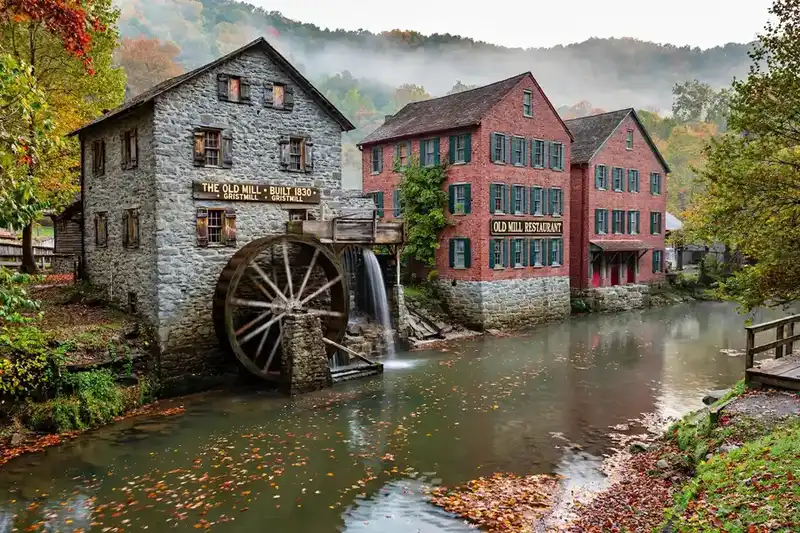
The Old Mill is the oldest thing in Pigeon Forge and the quietest hour on the Parkway. Built in 1830 on the Little Pigeon River, it is one of the oldest continually operating gristmills in the country, and it still grinds flour and cornmeal the way it always has. Around it, Old Mill Square holds the Old Mill Restaurant, the General Store, a pottery studio, a creamery, a candy kitchen and the Old Forge Distillery, all in the same brick-and-timber district. It is the stop that explains the town before Dollywood existed, and it is free to wander.
Practical tip: The square is free and open daily. Come for breakfast at the Old Mill Restaurant, watch the waterwheel turn, and buy a bag of the mill’s own stone-ground flour or grits from the General Store — the one souvenir that is actually made here.
9. Cool off at Dollywood’s Splash Country
Dollywood’s Splash Country is the separate water park next door to the theme park, and the best hot-day plan in Pigeon Forge. Thirty-five acres of slides, a lazy river, a wave pool and a mountain-tower slide complex sit in the foothills, with cabanas for rent and a family raft ride that drops through the trees. It has its own gate and its own ticket — there is no park-hopper between the two parks — and its own seasonal calendar. The 2026 season opened May 16 to 17 for the first weekend, ran daily from May 23 through August 8, and finishes with weekend operation through September 20, the final day of the season.
Practical tip: A one-day water park ticket was listed from roughly $29.99 in the late-summer promotion in 2026 — prices are approximate, so check before visiting. Go on a weekday, arrive at opening for the big slides, and do not plan a water park day after September 20: the park is closed for the season, and older guides that list it as open into October are out of date.
10. Ride a mountain coaster
Pigeon Forge has more mountain coasters than anywhere else in the Smokies, and they are the best thrill in town after Dollywood. The Smoky Mountain Alpine Coaster, on Wears Valley Road, is a downhill alpine coaster that winds through the trees for more than a mile — you control the speed with hand brakes, so it is as gentle or as fast as you want it. The Rocky Top Mountain Coaster, on the Parkway, runs a similar course with four-person cars and a night ride lit up after dark. Both are open year-round, weather permitting, and both are the ride to do when Dollywood’s queues are long.
Practical tip: Mountain coaster rides cost roughly $15 to $20 per person in 2026 — prices are approximate, so check before visiting. Ride in the evening, when the tracks are lit and the queues are shorter, and wear shoes with grip — the walk back up from the finish is part of the experience.
11. WonderWorks
WonderWorks is the upside-down house on the Parkway, and the best rainy-day attraction in Pigeon Forge. The building sits on its roof, with a palm tree growing out of it, and inside are more than 100 hands-on science exhibits: a hurricane simulator, a bed of nails, a ropes course, laser tag, a 4D motion ride and a bubble lab. WonderWorks is built for children, but the ropes course and the simulators keep teenagers and adults busy too, and it is entirely indoors, so it is the first place to go when a Smoky Mountain thunderstorm rolls in.
Practical tip: Admission costs roughly $35 to $40 per person in 2026, with children cheaper — prices are approximate, so check before visiting. Allow two to three hours, book online to skip the ticket line, and do the ropes course early, before the queues build.
12. Alcatraz East Crime Museum
Alcatraz East is the most talked-about museum in Pigeon Forge, and the one adults enjoy most. Five themed galleries across 25,000 square feet trace American crime history, from pirates and outlaws to forensic science and the death penalty, with interactive exhibits and real artifacts: Ted Bundy’s VW Beetle, the white Ford Bronco from the O.J. Simpson chase, and items from famous cases. It sits at The Island, so it pairs naturally with the Wheel and the fountain show, and it is the attraction to do when the children are at the rides.
Practical tip: Admission costs roughly $25 to $30 per person in 2026 — prices are approximate, so check before visiting. Allow two hours, and note that some exhibits are graphic, so it suits teenagers and adults better than small children.
13. Feed the goats at Goats on the Roof
Goats on the Roof is the quirkiest stop in the Smokies, and the one children remember longest. On Wears Valley Road, a mountain coaster winds through the trees — and above the gift shop, live goats graze on the roof, fed by a bicycle-powered lift that carries food up to them. The Coaster at Goats on the Roof is a single-rider alpine coaster with a long downhill run, and the goats are the free show: buy a cup of feed, pedal the bike, and watch a goat ride the lift up to the roof to eat it.
Practical tip: The coaster costs roughly $15 to $18 per ride in 2026, and goat feed is a few dollars — prices are approximate, so check before visiting. Go in the morning, when the goats are hungry and the coaster queue is short, and pair it with a drive down Wears Valley Road, the quiet scenic alternative to the Parkway.
14. Paula Deen’s Lumberjack Feud Supper Show
The Lumberjack Feud is the dinner show for people who have already seen the big three, and it is the best value of the four. Two teams of real lumberjacks compete in axe throwing, log rolling, speed climbing and chainsaw carving, while the audience eats a Southern supper — and Paula Deen’s name on the door means the food is taken seriously. Paula Deen built the show around her Savannah cooking, and the 2026 season is themed around America’s 250th birthday, with new patriotic staging. The show sits in Lumberjack Square, which the city is turning into the new Main Street Entertainment District, with more shops and dining on the way.
Practical tip: Tickets cost roughly $45 to $55 per adult in 2026, making it the cheapest of the Pigeon Forge dinner shows — prices are approximate, so check before visiting. Book the supper show, not the daytime adventure park alone, and arrive early for the pre-show axe-throwing contest.
15. Slick City Action Park, the brand-new indoor slide park
Slick City is the newest attraction in Pigeon Forge, and the one most 2026 guides have not caught up with yet. It opened on June 27, 2026 at 3735 Parkway, in the old TopJump building, as the world’s first indoor slide and air court park: giant dry slides, air courts, soft play areas and party rooms, all under one roof. It is the best bad-weather plan in town for children and teenagers, and the attraction that turns a rainy Parkway afternoon into the best part of the day.
Practical tip: Admission is by the hour or the day, from roughly $20 to $35 per person in 2026 — prices are approximate, so check before visiting. Wear socks — the slides require them — and book online on weekends, when the park fills up by midday.
16. Scooby Doo Mystery Putt
Scooby Doo Mystery Putt is the world’s first Scooby-Doo mini-golf course, and the newest mini-golf in the Smokies. At The Mountain Mile on Teaster Lane, two 18-hole courses — Coolsville Mine and Coolsville Cemetery — wind through immersive Scooby-Doo scenes, with surprises, sound effects and the Mystery Machine itself. It is the best mini-golf in town for families with elementary-aged children, and the attraction that proves Pigeon Forge still invents new ways to play mini-golf, a town tradition since the 1970s.
Practical tip: A round costs roughly $12 to $15 per person in 2026 — prices are approximate, so check before visiting. Play the Mine course first, go in the evening when the lighting is best, and pair it with the shops and restaurants at The Mountain Mile, which keeps adding new stores.
17. Stand on top of Tennessee at Kuwohi
Kuwohi is the highest point in Tennessee, and the best view in the Smokies. At 6,643 feet, the summit — long known as Clingmans Dome, and renamed Kuwohi, its Cherokee name, in 2024 — looks out over ridge after ridge of blue mountains, and on a clear day you can see for a hundred miles. Clingmans Dome is reached by a seven-mile spur road off Newfound Gap Road, then a steep half-mile paved trail to the observation tower. Go at sunrise, when the valleys fill with fog and the peaks float above it, and dress warmly: the summit runs at least 10 degrees cooler than Pigeon Forge, and the road closes in winter weather.
Practical tip: The summit is free, apart from the national park parking tag if you park for more than 15 minutes. The trail is steep and paved, with benches along the way, and the tower is the reward — allow 90 minutes from the Parkway, and check the road status before you go in winter.
18. The Apple Barn and Applewood Farmhouse
The Apple Barn is Pigeon Forge’s sweetest stop, and the one that tastes most like the Smokies. An apple orchard and farm complex on the east side of town, it holds the Applewood Farmhouse Restaurant, where the apple fritters and apple butter come to the table before you order, a cider mill, a candy kitchen, a Christmas shop and the Apple Barn Winery. The restaurant serves Southern cooking all day, the fritters are the reason to come, and the orchard is the place to slow down after the Parkway.
Practical tip: The farm is free to wander; you pay for food and shopping. Come for breakfast, order the apple fritters and the apple butter, and buy a jar to take home — it is the souvenir that actually gets eaten.
19. Pigeon Forge Winterfest and the Wonders of Light
Winterfest is the reason to come to Pigeon Forge in winter, and the biggest free show in town. From November 6, 2026 through January 31, 2027, the town puts up more than 10 million lights: a free driving tour along the Parkway, with Smoky Mountain wildlife scenes, giant ornaments and 12 Days of Christmas displays, and the free Wonders of Light Walking Trail along the Riverwalk Greenway, with more than 45 nature-themed displays. The official Winterfest kickoff is Friday, November 13, 2026, from 4 to 8 pm at Patriot Park, and Winterfest at The Island runs November 21, 2026 through January 31, 2027, with a tree lighting and a nightly light show at 6, 7, 8 and 9 pm.
Practical tip: The lights are free and best seen after dark — sunset is around 5:40 pm in November. Drive the Parkway loop slowly, walk the Riverwalk trail, and pair the lights with Dollywood’s Smoky Mountain Christmas, which runs November 6, 2026 to January 3, 2027 with more than six million lights of its own.
20. Day trip: Gatlinburg and Anakeesta
Gatlinburg is the day trip from Pigeon Forge, nine miles up the Parkway into the mountains, and it is a different town entirely: a narrow, walkable mountain street of shops, moonshine tastings and restaurants, pressed against the national park. The headline is Anakeesta, the mountaintop adventure park reached by chondola from downtown, with a treetop skywalk, duelling ziplines and a mountain coaster. Anakeesta is in the middle of a $100 million expansion for 2026, with larger chondolas, an extended skywalk and a new Nighttime Firefly Experience. Gatlinburg also holds the SkyBridge — the longest pedestrian cable bridge in North America — with Lights Over Gatlinburg running November 6, 2026 through January 31, 2027, and the Roaring Fork Motor Nature Trail, a six-mile one-way loop past old cabins and waterfalls.
Practical tip: Anakeesta admission costs roughly $35 to $40 per adult in 2026 — prices are approximate, so check before visiting. Take the trolley from the Gatlinburg Welcome Center and walk downtown — parking in Gatlinburg is scarce and expensive — and go on a weekday, when the chondola queue is short.
Pigeon Forge in 3 days — a ready-made itinerary
| Day | Morning | Afternoon | Evening |
| Day 1 — Dollywood | Dollywood at opening, NightFlight first | Craftsman’s Valley and the coasters | The Island and the Great Smoky Mountain Wheel at dusk |
| Day 2 — The park and the Parkway | Cades Cove at sunrise | Titanic Museum and the Old Mill | A dinner show — the Stampede or the Feud |
| Day 3 — Mountains and the new town | Kuwohi and Newfound Gap | Mountain coaster and Slick City | Apple Barn dinner and the Winterfest lights |
Day 1 — Dollywood
Start at Dollywood at opening, when the queues are short, and go straight to NightFlight Expedition in Wildwood Grove, then Big Bear Mountain. Spend the afternoon in Craftsman’s Valley — the blacksmiths, the glassblowers, the cinnamon bread at the Grist Mill — and ride the coasters you missed in the morning. Finish at The Island: the fountain show, the shops, and the Great Smoky Mountain Wheel at dusk, when the town lights come on. Day one is the classic Pigeon Forge, and it is the one to get right.
Day 2 — The park and the Parkway
Leave before sunrise for Cades Cove, drive the 11-mile loop while the valley is empty, and stop at the Cable Mill and the old churches. Spend the afternoon on the Parkway — the Titanic Museum, then the Old Mill Square for a late lunch — and finish with a dinner show: the Stampede for horses, the Feud for comedy, Pirates Voyage for children. Book the show before you leave home; weekend nights sell out.
Day 3 — Mountains and the new town
Drive up to Kuwohi for the sunrise view, then back down through Newfound Gap and the Sugarlands Visitor Center. Spend the afternoon on the new Pigeon Forge: a mountain coaster, Slick City if it is raining, Scooby Doo Mystery Putt at The Mountain Mile. Finish at the Apple Barn for dinner, then drive the Winterfest lights if it is the season. If you have a fourth day, add Gatlinburg and Anakeesta, or a full day in the national park.
Best time to visit Pigeon Forge
| Season | What it is like | Best for |
| Winter (December–February) | Cold days in the 40s and 50s, the cheapest hotels — with Winterfest lights and Dollywood Christmas | Budget trips, the lights, Dollywood Christmas |
| Spring (March–May) | Mild days in the 60s and 70s, wildflowers in the park, Dollywood’s spring festivals | First trips, the park, the flowers |
| Summer (June–August) | Warm and humid, highs in the 80s, the busiest crowds and the highest prices | Dollywood, Splash Country, the water parks |
| Autumn (September–November) | Warm and golden, smaller crowds until October, peak fall colour late October to early November | First trips, the foliage, the Harvest Festival |
The best time to visit Pigeon Forge is April to June or September to October, when the days are mild, the park is at its best and the crowds are manageable. October is the big one for fall colour: high elevations turn first, from mid-September, and the lower elevations around Pigeon Forge peak from mid-October into early November — but October weekends are the busiest of the year, so go midweek if you can. Summer is the classic season — hot, busy and full — with Dollywood and Splash Country at their best, and winter is the cheapest, with the Winterfest lights and Dollywood Christmas. Avoid the car-show weekends in April and September if you hate traffic: the Parkway fills up, and a five-mile drive can take an hour.
Where to stay in Pigeon Forge
| Area | Who it suits | Why stay there |
| The Parkway, Old Mill end | First-timers, walkers | The Old Mill, the trolley hub, Patriot Park and the river on your doorstep |
| The Parkway, The Island end | Families, evening wanderers | The Island, the Wheel, the dinner shows and the shops on your doorstep |
| Teaster Lane | A quiet base, families | The Mountain Mile, the new attractions and the Parkway a short drive away |
| Wears Valley Road | Cabins, a quiet base | Mountain views, the coasters, Goats on the Roof and the scenic drive |
| Dollywood’s resorts | Park days, a treat | DreamMore Resort and HeartSong Lodge, with park shuttles and resort perks |
First-timers should stay on the Parkway, where the trolley, the dinner shows and The Island are all a short ride away. Families who want an evening out should look at The Island end, where the Wheel and the fountain show set the tone. Teaster Lane suits a quiet base with a car, Wears Valley Road suits cabin stays with mountain views, and Dollywood’s own resorts — DreamMore Resort & Spa and HeartSong Lodge & Resort — suit a park day, with shuttles and early perks. Whatever you book, book October weekends months ahead: they fill faster than any other month in the Smokies.
Getting around Pigeon Forge
The Parkway is five miles long, and the traffic is the trip’s biggest enemy: between 4 pm and 7 pm in peak season, a five-mile drive can take an hour. The cheap fix is the Fun Time Trolley, which has run since 1986 and stops at more than 200 places across Pigeon Forge, Gatlinburg and Sevierville, all from the hub at Patriot Park. Most routes cost roughly $1 a ride in 2026, the Dollywood and Splash Country routes cost roughly $2.50, and the all-day pass costs roughly $3 — children 3 and under ride free. Note the outdated-guide trap: older guides still say the all-day pass is $2.50, but the 2026 price is $3. The trolleys run 8 am to midnight from March through October and 10 am to 10 pm in November and December, and they do not run on Thanksgiving, Christmas Eve or Christmas Day. Drivers take exact cash only. A car is still the easy way to the national park, the coasters and Wears Valley, and the nearest airport is McGhee Tyson Airport in Knoxville, about 35 miles away, roughly 45 minutes by car.
Pigeon Forge food you have to try
Pancakes at a Parkway pancake house
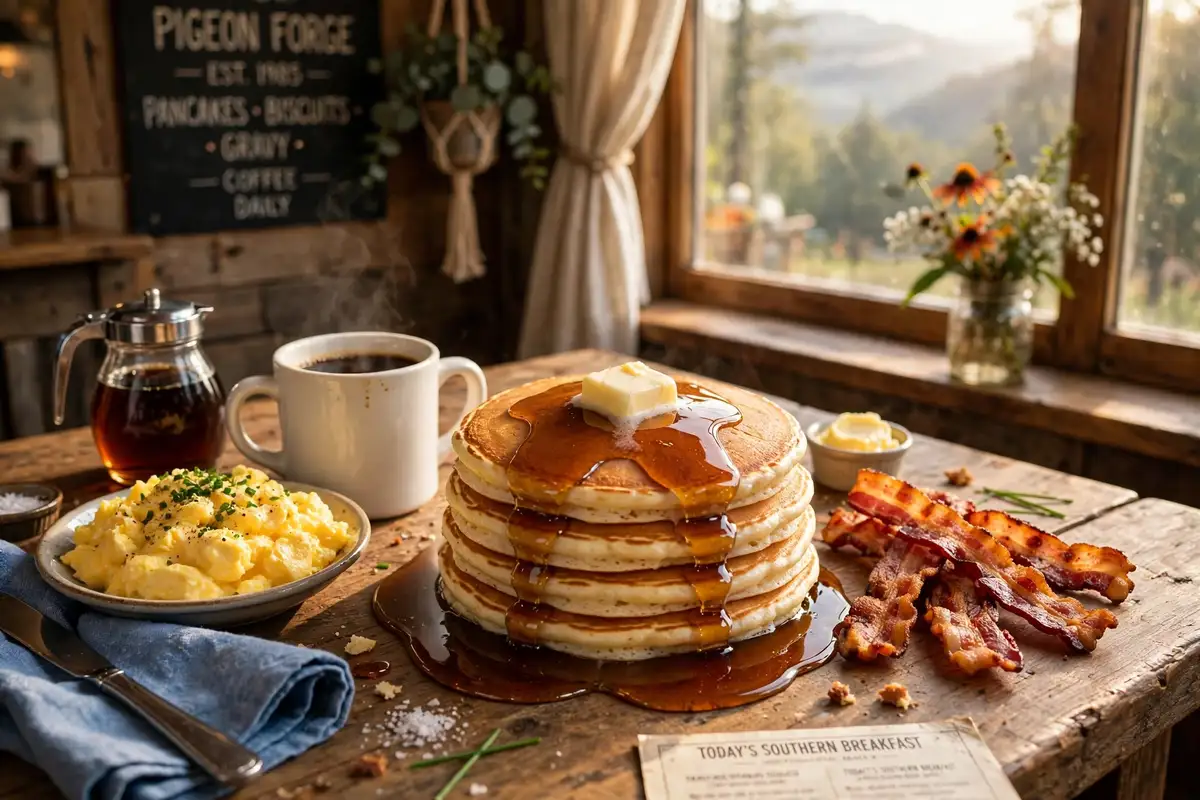
Pancakes are Pigeon Forge’s signature breakfast, and the Parkway is lined with pancake houses that have served them for decades. The Log Cabin Pancake House, Sawyer’s Farmhouse and the Old Mill Restaurant all pour them thick, with butter, syrup and a side of bacon or sausage, and the lines out the door on weekend mornings are the proof. Order the house special — buckwheat cakes at the Old Mill, the farmhouse stack at Sawyer’s — and go early, before the Dollywood crowd wakes up.
Southern barbecue
Barbecue is the Smokies’ second religion, and Pigeon Forge does it properly. Bennett’s Pit Bar-B-Que, on the Parkway since 1992, smokes its pork and ribs over hickory and serves them with the fixings, and Calhoun’s, the Knoxville-born smokehouse, holds the Parkway’s biggest barbecue room. Order the pulled pork plate with hushpuppies and slaw, and save room for the banana pudding. The barbecue is the cheapest great dinner in town, and the one that explains the Smokies’ food better than any dinner show.
Moonshine, cider and the tasting rooms
Moonshine is the Smokies’ oldest drink, and Pigeon Forge is where it went legal. Ole Smoky Moonshine, the distillery that led Tennessee’s legal moonshine push, pours free tastings at The Island, with flavours from apple pie to blackberry, and the Apple Barn’s cider mill and winery pour the softer side of the same tradition. The tastings are free, the jars are the souvenir, and the rule is simple: taste, do not drive, and take the trolley home.
Beyond the three dishes above, save room for the city’s other classics: the apple fritters and apple butter at the Apple Barn, the cinnamon bread at Dollywood’s Grist Mill, and the four-course feasts at the dinner shows, where the fried chicken is the point. And one warning: the restaurants on the busiest stretch of the Parkway charge tourist prices for average food — eat where the locals eat, at the pancake houses, the barbecue joints and the Old Mill, not on the busiest corner of the strip.
Free things to do in Pigeon Forge
The free list in Pigeon Forge runs longer than the Parkway’s neon suggests. Great Smoky Mountains National Park has no entrance fee, and the Cades Cove drive, the Newfound Gap road and the Kuwohi viewpoint are free apart from the $5 parking tag. The Winterfest lights are free, the Wonders of Light Walking Trail is free, Patriot Park is free, the Old Mill Square is free to wander, The Island is free to enter, and the fountain show is free to watch. The Riverwalk Greenway runs four miles along the Little Pigeon River, the Great Smoky Arts & Crafts Community is an eight-mile loop of more than 100 artisan studios, and the best free thing of all is a sunset drive down Wears Valley Road, with the mountains turning pink behind the barns.
Frequently asked questions
How many days do you need in Pigeon Forge?
Three full days covers the highlights: Dollywood, the national park and the Parkway, with a dinner show and The Island. Two days covers the essentials if you skip the day trip and pick one park day or one museum day. Add a fourth day for Gatlinburg and Anakeesta, or for a full day in the national park — Pigeon Forge rewards a slow day more than a rushed one.
Is Pigeon Forge expensive?
Yes, but less than it looks. The national park is free, the Winterfest lights are free, The Island is free to enter, and the trolley costs $3 a day. The expensive parts are Dollywood at roughly $94.99 a day and the dinner shows at roughly $60 to $90 — so pick one park day and one show, and let the free mountains do the rest. A mid-range trip runs roughly $150–$250 per person per day with a park day, and a no-park day is possible on half that if you eat at the pancake houses and barbecue joints.
What is the best time to visit Pigeon Forge?
April to June and September to October are the sweet spot: mild days, comfortable walking, smaller crowds and lower hotel prices. October is the best month for fall colour, with the lower elevations peaking from mid-October into early November — but October weekends are the busiest of the year. June to August is the classic season, hot and busy, with the water parks open. December to February is mild and cheap, with the Winterfest lights and Dollywood Christmas.
Do you need a car in Pigeon Forge?
Mostly, yes. The Parkway is five miles long, and while the Fun Time Trolley covers it for $3 a day, a car is the easy way to the national park, the mountain coasters and Wears Valley Road. The trolley is the smart move for a Parkway evening, when the traffic is worst — park at Patriot Park, ride the trolley, and skip the 4 pm to 7 pm gridlock.
Is Pigeon Forge good for adults without children?
Yes. Dollywood’s coasters, the dinner shows, the crime museum, the moonshine tastings, the barbecue and the national park are all adult-friendly, and the town has grown up a lot in the last few years — the new attractions at The Mountain Mile, the craft scene and the resorts are aimed at adults as much as families. Come in spring or fall, skip the water parks, and treat it as a mountain town with a theme park, not a theme park with a town.
What is the one thing you should not miss in Pigeon Forge?
Dollywood at opening, before the crowds arrive. It is the smallest, quietest moment in the town — the coasters warming up, the craftsmen opening their shops, the Smokies behind the park — and it is the experience every other stop in Pigeon Forge builds on. After that, Cades Cove at sunrise and a dinner show at night.
Further reading — Wikipedia
Wikipedia — Pigeon Forge: the town’s history, the Old Mill and the Dollywood era. Pigeon Forge on Wikipedia
Wikipedia — Dollywood: the theme park, its rides and its festivals. Dollywood on Wikipedia
Wikipedia — Great Smoky Mountains National Park: the park, its trails and Cades Cove. Great Smoky Mountains National Park on Wikipedia
Your Pigeon Forge trip, in one paragraph
Pigeon Forge is the town that does loud fun and quiet mountains better than anywhere else in the South: Dollywood and the dinner shows, the Wheel and the Parkway, the pancakes and the barbecue, and the Smokies ten minutes away. Three days is enough to see it properly, and the 2026 changes — the new NightFlight Expedition, Slick City and Scooby Doo Mystery Putt on the Parkway, the Winterfest lights and the Opry building’s next chapter — mean the guides from last year are already out of date. Book Dollywood, ride the Wheel at dusk, and leave a morning free for Cades Cove. If you want more city guides from this series, start with Chicago, Nashville, Los Angeles, Orlando, Miami, San Diego, Denver, Savannah, Dallas, Charleston, San Francisco, Myrtle Beach, Las Vegas, San Antonio, London and Portland — and if the mountains call you back, the Smokies will still be here, waiting.

About the Author