Things to Do in Aruba
20 Best Attractions, a 3-Day Itinerary, Where to Stay, and the Food You Cannot Miss
Quick Info
Best for: First-time visitors, beach lovers, snorkellers, families and anyone who wants a sunny Caribbean island without hurricane worries
Best time: December to April for the driest weather; May to June and November for the best value
How long: 3 days covers the essentials; 4 to 5 days if you add De Palm Island, a UTV tour and a slow beach day
Budget: Roughly $200 to $300 per person per day, mid-range, before your hotel
Don’t miss: Eagle Beach at sunset, the Natural Pool in Arikok, flamingos on Renaissance Island, Baby Beach, and a plate of keshi yena
Aruba is the Caribbean island that breaks the rules: a desert island with white-sand beaches, a Dutch capital painted in pastel colours, a national park full of cacti and caves, and weather so reliable that the island sits outside the hurricane belt. This guide covers the 20 best things to do in Aruba, with honest 2026 prices and the traps outdated guides still fall into. Use the 3-day itinerary to plan your days, the where to stay section to pick a base, and the how to get around notes to ride the bus like a local — then finish with the three foods every visitor should taste and the free sights that cost nothing at all.
Aruba is a small island, about 32 kilometres long, sitting 15 miles off the coast of Venezuela in the southern Caribbean. It is a constituent country of the Kingdom of the Netherlands, and the mix shows everywhere: Dutch gables in Oranjestad, Papiamento on the street signs, and US dollars accepted almost everywhere alongside the Aruban florin, which is pegged at 1.79 to the dollar. Before you fly, complete the online ED Card at edcardaruba.aw within 7 days of arrival — it is mandatory, and it collects the $20 Sustainability Fee for most air arrivals aged 8 and over. One honest warning: only use the official site, because third-party sites charge far more for the same form.
Aruba at a glance
| Attraction | What it is | Adult price in 2026 | Where |
|---|---|---|---|
| Eagle Beach | Wide white-sand beach with divi-divi trees | Free | West coast, low-rise strip |
| Arikok National Park | Desert park with caves and the Natural Pool | $22 Conservation Pass | East and north coast |
| Natural Pool (Conchi) | Rock pool on the wild north coast | Park pass only | Inside Arikok |
| Palm Beach | Two-mile high-rise beach strip | Free | Noord, high-rise strip |
| Baby Beach | Shallow lagoon, best for families | Free | Southeast tip, near San Nicolas |
| Flamingo Beach | Flamingos on a private island | $125 day pass | Renaissance Island, Oranjestad |
| De Palm Island | All-inclusive private island | $119 walk-in | Off the southwest coast |
| California Lighthouse | 1916 lighthouse with 360-degree views | $5 | Northwest tip, Hudishibana |
| Butterfly Farm | Tropical garden full of butterflies | $19 | Palm Beach, J.E. Irausquin Blvd |
| San Nicolas murals | 50-plus street-art murals | Free | Southeast, second city |
The 20 best things to do in Aruba
1. Eagle Beach
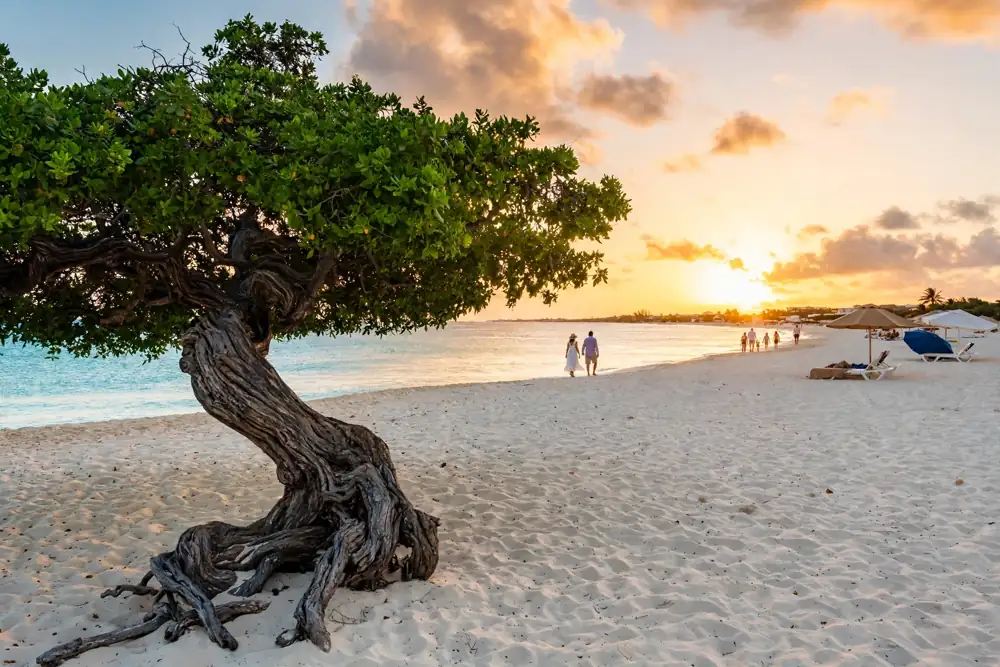
Eagle Beach is the beach Aruba is famous for, and it lives up to the postcards: a long, wide sweep of powder-white sand on the west coast, lined with the bent divi-divi trees that have become the island’s symbol, with calm turquoise water and room to spread out even in high season. It is the quieter of the two big beaches — no high-rise wall behind it, just low-rise resorts and open sky — and it is regularly ranked among the best beaches in the Caribbean. Read about Eagle Beach on Wikipedia before you go, then come for the late afternoon, when the light turns gold and the water is at its calmest.
The practical facts for 2026: the beach is free and public, like every beach in Aruba, and it is best in the morning for swimming or at sunset for the light. Palapas and loungers are rented by the resorts and beach bars, and the Arubus L10A bus stops right on the strip. Sea turtles nest here in season, so keep beach lights off at night and never disturb a marked nest. One honest note: Eagle Beach has almost no shade of its own, so bring sunscreen — reef-safe only, because sunscreens with oxybenzone are banned on the island — and a hat, because the trade wind hides how fast the sun burns.
2. Arikok National Park
Arikok National Park is the other Aruba, and it is the reason to rent a car: nearly 20 percent of the island set aside as desert park, with cactus forests, limestone caves painted by the Arawak people, lava formations, hidden bays and the island’s highest point, Jamanota Hill at 188 metres. The landscape feels nothing like the hotel strip — dry, rugged and silent, with goats on the trails and the wind coming off the north coast. Read about Arikok National Park on Wikipedia before you go, and start at the San Fuego visitor centre, where the rangers explain the trails and the day’s conditions.
The practical facts for 2026: this is the trap most visitors fall into — the Conservation Pass now costs $22 per adult, and children under 17 enter free. Older guides still quote $11, a stale figure from 2025 or earlier, so budget the new price. The main San Fuego entrance is open daily from 8 a.m. to 3:30 p.m., and the pass is your only park fee. Bring water, a hat and closed shoes, because there is almost no shade and the trails are rough. A regular rental car can handle the main park roads, but the roughest tracks — including the road to the Natural Pool — are for 4x4s only, so book a jeep tour for those.
3. The Natural Pool (Conchi)
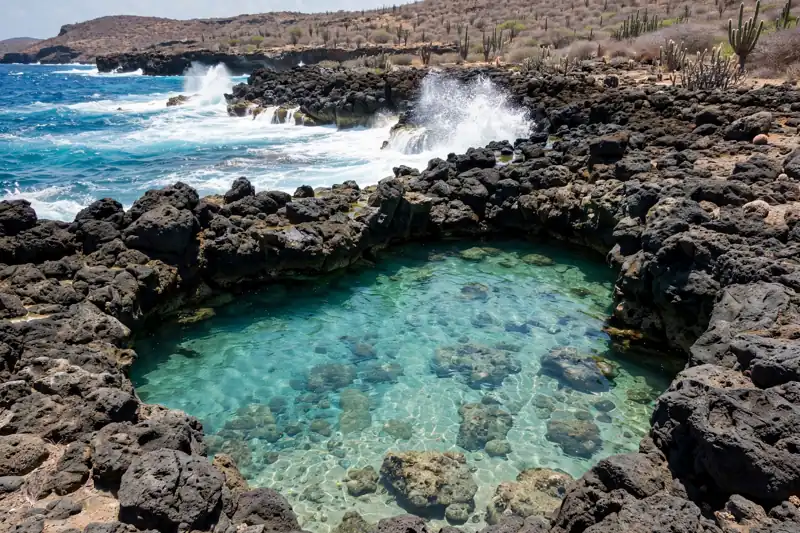
The Natural Pool, called Conchi locally, is Aruba’s most thrilling sight: a pool of clear seawater enclosed by volcanic rock on the wild north coast, inside Arikok National Park, where the waves crash over the rocks outside and the water inside stays calm enough to swim in. Getting there is half the adventure — a rough 4×4 track across desert and lava rock — and arriving feels like finding a secret the island kept for itself. The pool is at its best in the morning, when the light is on the water and the tour groups have not yet arrived.
The practical facts for 2026: the pool sits inside Arikok, so the $22 Conservation Pass covers your entry, and the only way in is by guided 4×4 jeep tour, horseback or a long hike — regular rental cars are not allowed on the track, and the rental companies will fine you for trying. ABC Tours runs the classic Natural Pool and Indian Cave jeep safari from about $99 per person for four and a half hours, covering Conchi, the Fontein cave garden, the Ayo rock formation and Dos Playa. One honest note: the pool can be closed when the sea is rough, so check conditions on the day and wear water shoes, because the rocks are sharp.
4. Palm Beach
Palm Beach is Aruba’s lively beach: a two-mile strip of white sand in front of the high-rise hotels, with calm, shallow water, piers, beach bars, water sports and the island’s busiest sunset scene. It is the beach for people who want everything within walking distance — a swim in the morning, a pierside lunch, a sunset sail from the sand — and it is where most first-timers end up staying. Read about Palm Beach on Wikipedia before you go, and walk the full strip at least once, because each pier has its own bar and its own crowd.
The practical facts for 2026: the beach is free and public, and the water is calm enough for children and nervous swimmers. The Arubus L10A bus runs the strip from Oranjestad, and MooMba Beach, at the southern end, is where the Jolly Pirates schooner departs. Palapas and loungers belong to the hotels and bars, so expect to pay or to order drinks for a spot. One honest note: Palm Beach is the busiest beach on the island, and the sand is narrowest in front of the big hotels — walk north past the last pier for space, or head to Eagle Beach for quiet.
5. Baby Beach
Baby Beach is the island’s gentlest swim: a shallow, almost lagoon-like crescent of pale sand and warm, clear water at the southeastern tip, protected by a reef, where you can wade far out and still touch the bottom. It is the best beach in Aruba for families and for anyone who wants to snorkel without a boat — the reef at the edge of the lagoon holds colourful fish in water barely over your head. Read about Baby Beach on Wikipedia before you go, and come in the morning, when the water is at its clearest and the beach is at its quietest.
The practical facts for 2026: entry is free, and there are complimentary shade huts, a refreshment stand and lounger rentals on the sand. Rum Reef, the bar and restaurant on the beach, is the lunch spot, and Rodgers Beach, a short walk west, is the quieter alternative with palm shade and fewer people. The beach sits about 30 minutes by car from the hotel strip, near San Nicolas, and the bus does not run there reliably, so drive or take a taxi. One honest note: Baby Beach is increasingly well known since the adults-only Secrets resort opened beside it in June 2025, so weekends fill up — go on a weekday if you can.
6. Oranjestad — the pastel capital
Oranjestad is Aruba’s capital, and it is worth a proper half-day rather than a cruise-ship dash: pastel Dutch colonial buildings along the waterfront, the main shopping street Caya G.F. Betico Croes, the Renaissance Mall, and Fort Zoutman, built in 1798 and the oldest building on the island, with the Willem III Tower beside it. The free streetcar loops along the main boulevard, and the harbourfront is where the cruise ships dock and the fishing boats unload. Read about Oranjestad on Wikipedia before you go, then walk the waterfront from the cruise terminal to the marina, because the best of the city is on foot.
The practical facts for 2026: the city is compact and walkable, and the free streetcar runs the length of the main street, so you never need a taxi downtown. Tuesday evenings bring the Bon Bini Festival at Fort Zoutman, with local music, dance and food stalls — the island’s weekly street party. The National Archaeological Museum, in a restored 19th-century house, tells the story of the island’s first people. One honest note: Oranjestad is at its liveliest when a cruise ship is in and its quietest on Sunday, when many shops close — plan your shopping for a weekday.
7. California Lighthouse
The California Lighthouse stands on a hill at the island’s northwestern tip, in the area called Hudishibana, and it is the best viewpoint in Aruba: a white stone tower built between 1914 and 1916, named after the steamship California that wrecked on the reef below in 1891, with 360-degree views over the desert, the golf course, the hotel strip and the sea. Come at sunset, when the whole northwest coast turns gold and the wind drops just enough to stand on the terrace. Read about the California Lighthouse on Wikipedia before you go, and pair it with the wild north coast, because the lighthouse is the start of the island’s rugged side.
The practical facts for 2026: entry to the lighthouse costs $5 per person, and it is open from 9 a.m. to 7 p.m. daily, with no reservations needed. There is a restaurant at the base of the hill, and the Arubus L10A bus runs to Arashi Beach nearby, from where it is a short walk. One honest note: the lighthouse is exposed and windy, and the stairs to the top are steep and narrow — hold the rail, and skip the climb if heights bother you, because the view from the terrace is nearly as good.
8. Flamingo Beach (Renaissance Island)
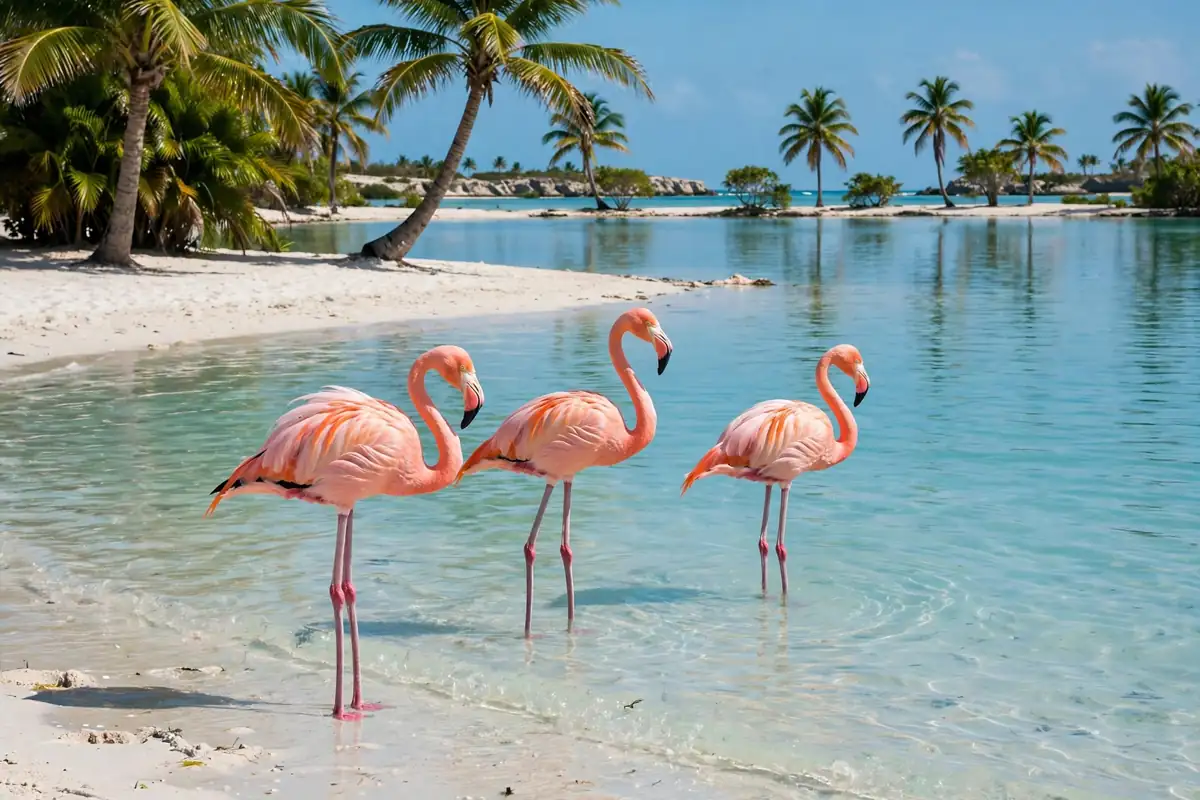
Flamingo Beach is the photo every Aruba visitor wants: pink flamingos strolling along the sand and eating from your hand, on a 40-acre private island owned by the Renaissance Wind Creek Aruba Resort, a ten-minute water taxi ride from Oranjestad. The island has two beaches — Flamingo Beach, for adults, and Iguana Beach, for families — and the flamingos are the reason the day pass sells out. Read about Aruba on Wikipedia for the island’s background, then book the pass the moment it opens, because this is the hardest ticket in Aruba to get.
The practical facts for 2026: this is the trap most visitors fall into — the Island Pass costs $125 per adult, $60 for children aged 6 to 12, and free for children under 5, and passes are released online only, every Saturday at 9 a.m. Aruba time, for the coming Sunday to Saturday, through the resort’s portal at renaissancearuba.idaypass.com. There is no walk-up sale, no reseller and no food and beverage credit — that credit ended in 2025, so budget lunch and drinks separately. Flamingo Beach is adults-only from 10 a.m., with children allowed only from 9 to 10 a.m., and a cabana starts at $525 a day. Staying a night at the Renaissance includes island access, which is often the easier route in high season.
9. De Palm Island
De Palm Island is Aruba’s all-inclusive day out: a private coral island a short ferry ride from the southwest coast, where one ticket covers the water park with its drop slides, guided snorkelling over the reef, unlimited banana boat rides, a lunch buffet and an open bar, from 10 a.m. to 5 p.m. It is the easiest full day on the island for families — everything is included, the kids have a water park, and the snorkelling over the reef is genuinely good, with blue parrotfish among the coral. The island has flamingos of its own, in a reserved section, so the birds are here too.
The practical facts for 2026: admission is $119 per adult without transport or $129 with round-trip hotel transport, $104 and $109 for children aged 3 to 9, and free for children under 3, based on the resort’s own booking pages checked in September 2026. Book direct rather than through a reseller, because third-party listings show prices up to $159 for the same day. One honest note: the standard ticket only lets you watch the flamingos from a distance — getting among them needs a paid premium seating or cabana upgrade — and the banana boat queue can be long, so ride it early.
10. Snorkel the Antilla shipwreck — Jolly Pirates
The SS Antilla is the Caribbean’s largest shipwreck, and the best way to see it is from the deck of the Jolly Pirates: a 400-foot German freighter scuttled by its own crew in 1940, lying in about 60 feet of water off the northwest coast, now covered in coral and full of fish. The Jolly Pirates sail is an 85-foot teak schooner that feels like a film set, with a rope swing off the stern, and it stops at three snorkel sites — the Malmok reefs, the calm cove of Boca Catalina and the Antilla herself. Read about the SS Antilla on Wikipedia before you go, then book the morning sail, because the water is calmest and the light is best before noon.
The practical facts for 2026: the morning sail runs from about $108 per person for four hours, with three snorkel stops, a barbecue lunch and an open bar included, and the afternoon sail from about $89 for three hours. Both depart from MooMba Beach on Palm Beach, and snorkelling gear is included. Book at least a week ahead in high season, from December to April, because the boat sells out. One honest note: the afternoon boat sometimes makes only two snorkel stops rather than three, and the sea can be choppy — if you are prone to seasickness, take the morning sail and sit mid-ship.
11. San Nicolas — the street-art city
San Nicolas is the Aruba most visitors never see, and it is the island’s most surprising town: the old refinery city on the southeastern tip, nicknamed Sunrise City, reinvented as the street-art capital of the Caribbean, with more than 50 large-scale murals across its downtown buildings. The murals began with the Aruba Art Fair, launched in 2016 by a local, Tito Bolivar, after a trip to Bogotá, and they now cover whole facades — portraits, wildlife, surreal scenes — with new pieces added every year. Read about San Nicolas on Wikipedia before you go, then just walk Main Street slowly, because the art finds you.
The practical facts for 2026: the murals are free to walk and photograph, and one to two hours on foot covers the best of them — start at the ARTISA Gallery on Main Street, then weave a block off in each direction. Charlie’s Bar, serving drinks since 1941 and covered in decades of memorabilia, is the town’s institution, and the Museum of Industry, inside the old water tower, tells the story of gold, aloe, phosphate, oil and tourism. San Nicolas is about 30 minutes by car from the hotel strip, and it pairs naturally with Baby Beach, a few minutes east. One honest note: San Nicolas is a working town, not a resort, so come for the art and the history rather than the polish — and go in the morning, when the light is soft and the sidewalks are empty.
12. The Butterfly Farm
The Butterfly Farm is a small tropical garden on the Palm Beach strip, and it is the most peaceful hour in Aruba: hundreds of butterflies from around the world flying free among flowers, trees and small waterfalls, including the iridescent Blue Morpho, whose wings span five to eight inches, and the giant Atlas moth, one of the largest moths in the world by wing area. The guided tour walks you through the whole life cycle, from microscopic eggs to caterpillars, jewel-like pupae and flying adults, and the farm’s advice is to wear bright clothes and citrus cologne if you want the butterflies to land on you.
The practical facts for 2026: admission is $19 for adults, $16 for seniors and students with ID, $10 for children aged 4 to 17, and free for children under 4. The farm is open daily from 8:30 a.m. to 4:30 p.m., with the last guided tour at 4 p.m., and the tour lasts 20 to 25 minutes — after that you can stay as long as you like. The ticket includes a free return pass for the whole of your vacation, valid for up to a month, so go early in your trip and come back when the light changes. The farm sits on J.E. Irausquin Boulevard, directly opposite the Divi resorts, an easy walk from the Palm Beach hotels. One honest note: it is a small garden, not a zoo — an hour is enough, and it is best paired with a beach morning rather than as a full day on its own.
13. Aruba Aloe Factory and Museum
Aruba Aloe is the oldest aloe company in the world, founded in 1890, and its factory and museum, just outside Oranjestad, tell the story of the island’s first industry: aloe, grown in the desert, cut by hand and turned into the gels and creams that Aruba still exports. The free tour walks you through the cutting room, the museum of old tools and photographs, and the fields themselves, and it is the best 45 minutes in Aruba for understanding how the island lived before tourism. The shop at the end is genuinely good, and the prices are lower than in the resort gift shops.
The practical facts for 2026: admission to the factory, museum and store is free, and tours run through the day. The factory sits on the road between Oranjestad and the hotel strip, an easy stop on the way to or from the airport. One honest note: the tour is short and the factory is a working plant, not a theme park — come for the history and the aloe, buy the gel if you need it, and do not expect a full morning here. Read about aloe vera on Wikipedia for the plant behind the industry.
14. Alto Vista Chapel
Alto Vista Chapel is a small yellow chapel on a hill on the north coast, and it is the spiritual heart of Aruba: first built in 1750, rebuilt in 1952, it stands alone in the desert with the sea behind it, and the Way of the Cross, fourteen stations along the road, leads up to it. It is a pilgrimage site for Arubans, who walk the road on Good Friday, and a quiet stop for everyone else — the kind of place that makes you slow down. Read about the Alto Vista Chapel on Wikipedia before you go, and come at sunset, when the yellow walls glow and the coast below turns gold.
The practical facts for 2026: the chapel is free to visit and open during the day, and it sits on the north coast road between the California Lighthouse and the Natural Bridge, so it pairs naturally with both. There is no café and no shade, so bring water and a hat. One honest note: the chapel is a place of worship, not a photo backdrop — keep your voice down inside, dress respectfully, and do not climb on the walls for a picture.
15. Casibari Rock Formations
Casibari is a cluster of giant boulders in the middle of the island, piled up like a giant’s building blocks, and it is the best free climb in Aruba: stone steps wind between the rocks to a viewpoint over the whole island, with the hotel strip on one side and the desert on the other. The rocks are toned with lichen and carved with shapes that locals have named over generations, and the garden at the base, with cacti and lizards, is worth a slow walk on its own. The nearby Ayo Rock Formations hold Arawak rock drawings, the oldest art on the island, carved into the stone centuries before the Dutch arrived.
The practical facts for 2026: entry is free, and the site is open during the day. Casibari sits in the centre of the island, about 15 minutes by car from Oranjestad, and it pairs well with Hooiberg, a few minutes away. Wear closed shoes with grip, because the stone steps are smooth and steep, and go in the morning before the heat builds. One honest note: the climb is short but exposed, and there is no shade at the top — bring water, and skip it in the midday sun.
16. Hooiberg
Hooiberg, the Haystack, is the island’s most satisfying climb: a lone volcanic hill rising 165 metres above the flat centre of the island, with 561 concrete steps to the top and a view that, on a clear day, stretches all the way to Venezuela. The climb takes about 20 minutes at a steady pace, and the reward is the whole island laid out below — the hotel strip, Oranjestad, the desert and the sea on both sides. It is the best sunrise walk in Aruba, and the best way to understand how small the island really is.
The practical facts for 2026: the climb is free, and the steps start from the car park at the base, a short drive from Oranjestad. Go at sunrise or late afternoon, because there is no shade on the steps and the midday heat is fierce. Bring water and wear proper shoes, because the steps are steep and uneven in places. One honest note: 561 steps is a real climb, not a stroll — take your time, stop at the landings, and skip it if your knees or your heart object.
17. The Natural Bridge ruins and the wild north coast
The north coast is Aruba at its wildest, and the Natural Bridge is its most famous ruin: a coral limestone arch carved by the sea, which stood for centuries until it collapsed in September 2005, leaving the smaller Baby Bridge beside it and a viewing platform where the big arch once stood. The coast around it is all crashing waves, lava rock and blowholes, with Boca Prins, a wild beach in Arikok, and Black Stone Beach, a pebble beach of dark volcanic stone, a short drive away. It is the coast the hotel brochures do not show, and it is the one that stays with you.
The practical facts for 2026: this is the trap most visitors fall into — the original Natural Bridge is gone, and guides that still show it standing are out of date. What remains is worth seeing, but come for the coast, not the arch. The north coast roads are rough, so drive a 4×4 or take a tour, and never swim on this coast: the waves and currents are dangerous, and there are no lifeguards. Read about the Natural Bridge on Wikipedia for the arch’s history.
18. Boca Catalina and Malmok — shore snorkelling
Boca Catalina is the best shore snorkelling in Aruba: a small, calm cove just north of Palm Beach, sheltered by the reef, where the water is clear and shallow and the fish come right up to the sand — yellow-striped grunts, angelfish, green parrotfish and grouper among elkhorn coral, brain coral and barrel sponges. Malmok, the reef just offshore, is the deeper version of the same water, and Tres Trapi, a few minutes north, is where the sea turtles feed. Bring your own mask and fins, because there is no rental shack on the sand, and go in the morning, when the water is at its calmest.
The practical facts for 2026: both beaches are free and public, with parking on the road above the coves and no facilities on the sand — bring water, shade and your own gear. The water is calmest from September to early December, when the trade winds relax and visibility peaks around the reefs. One honest note: the shore is rocky in places, so wear water shoes, and never touch the coral or chase the turtles — look, float, and let them come to you.
19. Bushiribana gold mill ruins and the UTV north coast
Bushiribana is the ruin of Aruba’s gold rush: a stone mill built in 1872, when gold was found in the island’s hills, abandoned in 1916 when the ore ran out, standing now as a roofless shell on the north coast with the sea behind it. It is the most atmospheric ruin on the island, and the best way to reach it is the way the island demands — in an open UTV or a 4×4, bouncing along the rough north coast track past cactus, lava rock and hidden coves, with a swim stop at Tres Trapi on the way back. The UTV tour is the most fun half-day in Aruba, and Bushiribana is its best photo stop.
The practical facts for 2026: a UTV off-road adventure runs about $165 per person for four hours, driving your own side-by-side through the rugged north coast and Arikok terrain. If you would rather ride than drive, ABC Tours runs the Natural Pool jeep safari from about $99, and the Arikok Conservation Pass of $22 is charged on top of the tour price at check-in. Book ahead in high season. One honest note: the north coast is dusty and rough, so wear clothes you do not mind ruining, bring a bandana for the dust, and leave the good camera at the hotel unless it is in a sealed bag.
20. Aruba Donkey Sanctuary
The Aruba Donkey Sanctuary is the island’s kindest stop: a refuge near Santa Cruz for around 130 rescued donkeys, the descendants of the animals that once carried water and goods across the island, now living out their days in a shaded yard where visitors can feed them, brush them and walk among them. It is a small place, run by volunteers, and it is the best hour in Aruba for children — and for adults who need a break from beaches and bars. The donkeys are gentle, the volunteers are full of stories, and the whole visit feels like being let in on a secret.
The practical facts for 2026: entry is free, and the sanctuary runs on donations, so bring a few dollars and buy a bag of feed at the gate. It is open during the day, and it sits inland near Santa Cruz, about 20 minutes by car from Oranjestad, so pair it with Casibari and Hooiberg for a central-island morning. One honest note: the sanctuary is a working refuge, not a petting zoo — follow the volunteers’ instructions, do not feed the donkeys anything but the feed sold at the gate, and wash your hands after.
Aruba in 3 days — a ready-made itinerary
Three days is the right amount of time for Aruba: one day for the beaches and Oranjestad, one day for the wild north and east, and one day for the water and the south. The itinerary below assumes you are staying on Palm Beach or Eagle Beach, and it uses the bus, a rental car and one boat trip. If you only have two days, do Day 1 and Day 2 and save the south for next time. If you have a fourth day, spend it on De Palm Island, or do nothing at all on Eagle Beach — Aruba rewards the slow day.
| Day | Theme | Highlights | Where you sleep |
|---|---|---|---|
| Day 1 | Beaches and the capital | Eagle Beach, Palm Beach, Oranjestad, California Lighthouse at sunset | Palm Beach or Eagle Beach |
| Day 2 | The wild north and east | Arikok National Park, Natural Pool, Casibari, Hooiberg, Alto Vista Chapel | Palm Beach or Eagle Beach |
| Day 3 | The water and the south | Jolly Pirates snorkel sail, San Nicolas murals, Baby Beach | Palm Beach or Eagle Beach |
Day 1 — Beaches and the capital
Start on Eagle Beach in the morning, swim and walk the sand north to the divi-divi trees, then take the bus to Oranjestad for the late morning: the pastel streets, Fort Zoutman, the free streetcar and lunch at the Pastechi House. Spend the afternoon on Palm Beach, swim and walk the piers, and finish at the California Lighthouse for sunset, when the whole northwest coast turns gold. If it is a Tuesday, swap the evening for the Bon Bini Festival at Fort Zoutman.
Day 2 — The wild north and east
Spend the morning in Arikok National Park: take a guided jeep tour to the Natural Pool, stop at the Fontein cave and the Ayo rock formation, and climb Jamanota Hill if the tour allows it. In the afternoon, drive to Casibari for the boulders, climb Hooiberg for the view, and finish at Alto Vista Chapel for sunset. End the day with keshi yena at Gasparito in Noord, and book ahead, because the restaurant fills up.
Day 3 — The water and the south
Spend the morning on the Jolly Pirates sail: three snorkel stops including the Antilla, lunch and the rope swing, back on Palm Beach by early afternoon. Then drive south to San Nicolas for the murals and Charlie’s Bar, and finish at Baby Beach for a late swim in the lagoon, with dinner at Rum Reef on the sand. If you have a fourth day, spend it on De Palm Island, or book the Renaissance Island day pass — but book that pass on Saturday at 9 a.m., a week ahead.
Best time to visit Aruba
The best time to visit Aruba is December to April, when the days are dry and sunny, the trade winds are at their strongest and the island is at its liveliest — but it is also the most expensive and the busiest, so book hotels and the Flamingo Beach day pass well ahead. May to June and November are the best value: the weather is nearly as good, the crowds thin out and hotel prices drop 20 to 35 percent. September to November is the cheapest season, with the calmest seas for snorkelling and diving, and the fewest visitors. Aruba sits outside the hurricane belt, so even in the Atlantic hurricane season, from June to November, direct hits are extremely rare — the island has been hit directly only twice in recorded history.
| Season | Months | Weather | What’s on |
|---|---|---|---|
| Peak | December to April | Highs 82 to 86 degrees, dry and sunny | Carnival, the driest weather, the busiest beaches |
| Shoulder | May to June | Highs 84 to 88 degrees, breezy | Soul Beach Music Festival in late May, the best value |
| Summer | July to August | Highs 86 to 88 degrees, strong winds | Windsurfing season at Fisherman’s Huts, thin crowds |
| Low | September to November | Highs 86 to 90 degrees, brief showers | Calmest seas, lowest hotel prices, quiet beaches |
Carnival is the island’s biggest event, and it is worth planning around: the season opens on November 11 at 11:11 a.m., and the parades build through January and February to the Grand Parade in San Nicolas on February 6, 2027 and the Grand Parade in Oranjestad on February 7, 2027, with Carnival Monday on February 8 and the burning of King Momo closing the season. The Soul Beach Music Festival in late May is the other big date. If you can only pick one month, pick April: the weather is dry, the light is gold, the crowds have thinned and the island is yours.
Where to stay in Aruba
Palm Beach is the best base for a first visit: you are on the sand, within walking distance of the restaurants, the bars and the boat departures, and the hotels range from the big high-rise resorts to the smaller boutique stays, though the prices are the highest on the island. Eagle Beach is the best base for quiet and space, with the low-rise resorts and the widest sand, and the beach a short walk away. Oranjestad is the best base for value and culture, with the cheapest rooms in the centre, the cruise port and the free streetcar at your door. Noord, around the low-rise hotels, is the best base for families who want a kitchen and a pool without the high-rise crowds. San Nicolas is the best base for a local stay, with guesthouses and apartments at half the hotel-strip price, and the murals and Baby Beach nearby. The rule for Aruba is simple: check the total price before you book, because taxes and resort fees are added at checkout, and a $250 room becomes $300 before you have slept in it.
| Area | Best for | Price range |
|---|---|---|
| Palm Beach | First-timers, the beach, walking everywhere | $250 to $500 a night |
| Eagle Beach | Quiet, the beach, couples | $200 to $450 a night |
| Oranjestad | Value, culture, the cruise port | $100 to $250 a night |
| Noord | Families, villas, quiet | $150 to $350 a night |
| San Nicolas | Local stays, budget, art | $80 to $200 a night |
| Savaneta and Baby Beach | Quiet, the south, families | $120 to $300 a night |
Getting around Aruba
Aruba is a small island, and getting around is easy — but the right tool depends on the day. The Arubus public bus runs the hotel strip on the L10A route, from Oranjestad through Eagle Beach and Palm Beach to Arashi Beach, and a single ride costs $2.60, paid in cash to the driver, with a retour card for two rides at $5 and a day pass at $15. The free streetcar loops through downtown Oranjestad. Taxis use fixed fares set by the government, with no meters and no Uber or Lyft, so agree the fare before you get in. A rental car is the best tool for Arikok, San Nicolas and the north coast, where the bus does not go, and driving is easy — the island drives on the right, the roads are good, and the whole island is about 45 minutes end to end.
The practical facts for 2026: the taxi fares changed on May 20, 2026, in the first revision since 2018, so the old guides are wrong. The minimum fare is now $10, up from $7, and an airport transfer costs about $26 to downtown Oranjestad, $38 to Eagle Beach and $41 to the Palm Beach high-rise resorts — the Palm Beach fare was $31 before the change. The airport, Queen Beatrix International, sits about ten minutes from Oranjestad, and the bus stop is on the main road just outside the terminal. One trap to know: Aruba has US preclearance at the airport, so you clear US customs in Aruba before flying home — arrive at least three hours early for a US flight, because the lines are long. Once you are on the island, take the bus along the strip, rent a car for the wild side, and never drive a regular rental car to the Natural Pool — the rental companies fine you for it.
Aruba food you have to try
Aruba’s food is a mix of Dutch, Caribbean and Latin American cooking, and it is better than the resort buffets suggest. The island’s best meals are a plate of keshi yena in a cunucu house, a bag of hot pastechi from a bakery at dawn, and fresh fish at a beach shack with your feet in the sand — and the three together cost less than one resort dinner. Eat those three, and you have eaten Aruba. For everything else, the food trucks, the snack windows and the beach bars will keep you fed — and the service charge, 10 to 15 percent added to most restaurant bills, is the island’s unofficial tax, so check the bill before you tip.
1. Keshi yena — Gasparito Restaurant
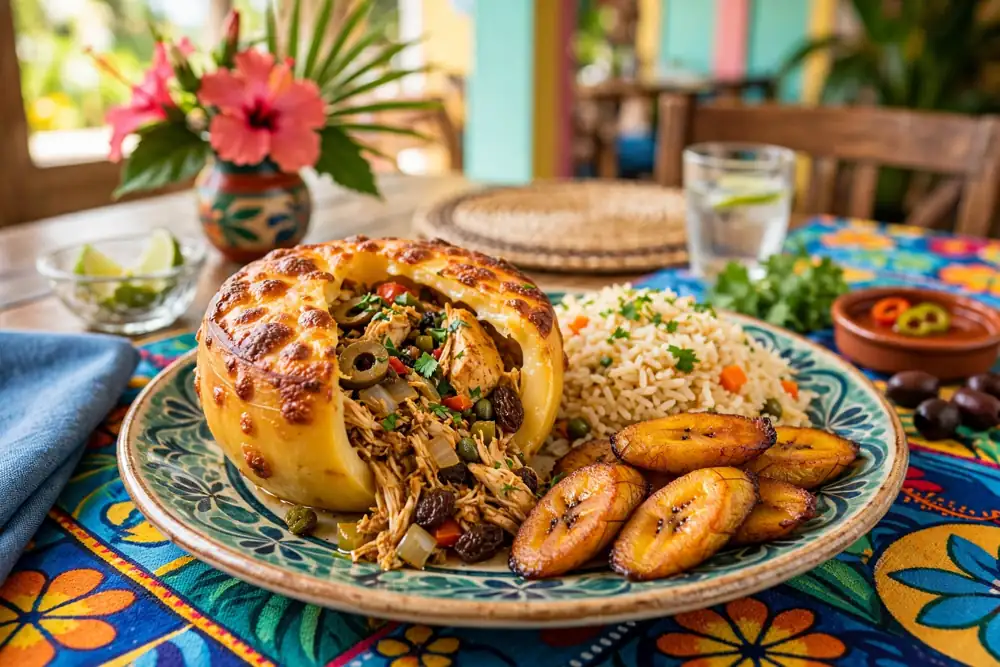
Keshi yena is Aruba’s national dish, and it is unlike anything else: a ball of Gouda cheese, hollowed out and stuffed with spiced meat — usually chicken or beef — with vegetables, raisins, olives and cashews, then baked until the cheese melts into a golden shell around the filling. It is rich, savoury and slightly sweet, and it was born from the island’s Dutch history, when settlers brought Edam cheese and locals turned leftovers into something unforgettable. The place to eat it is Gasparito Restaurant in Noord, set in a traditional cunucu house and widely considered the best version on the island. Read about keshi yena on Wikipedia.
The practical facts for 2026: a main course at Gasparito runs about $22 to $28, and reservations are recommended, especially in high season. Yemanja Woodfired Grill in Oranjestad does an upscale version as an appetiser for about $18 to $22, and the Pastechi House sells a smaller version for about $10 to $12. Local bakeries sell individual portions for $5 to $8. One honest note: keshi yena is rich, and one portion is enough — share a starter if you are eating light, and save room for the pan bati, the sweet cornbread that comes with it.
2. Pastechi — Pastechi House
Pastechi are Aruba’s favourite fast food: deep-fried pastry pockets stuffed with cheese, ham, beef, chicken, tuna or even chop suey, eaten at every time of day and sold for a couple of dollars each. They are the Aruban equivalent of empanadas, and breakfast pastechi from a local bakery is an institution — follow the line of locals at 7 a.m. and you will find the best ones. The place to eat them is the Pastechi House in Oranjestad, the dedicated pastechi spot with dozens of fillings, in the backstreets behind the Renaissance marina.
The practical facts for 2026: a pastechi costs about $2 to $5 each, and two or three make a lunch. The Pastechi House opens early and closes by the afternoon, and cash is preferred. Bright Bakery in Noord, open from 5 a.m., is the other local favourite, with excellent cheese and meat varieties. Wash one down with a batido, a fresh fruit shake, from Happy Spot nearby, which keeps 16 flavours on the board. One honest note: pastechi are fried and filling, so they are a snack, not a feast — eat two, walk the waterfront, and save your appetite for dinner.
3. Fresh fish — Zeerovers
Zeerovers, in the fishing village of Savoneta, is the best seafood in Aruba and the least like a restaurant: a harbour shack where the fishing boats unload, the catch of the day is written on a board, and you order at the counter, eat at a picnic table on the water and watch the pelicans. The fish is whatever came in that morning — red snapper, mahi-mahi, wahoo, shrimp — fried or grilled and served with pan bati, funchi and plantains. It is the meal the locals drive across the island for, and it is the one the resort restaurants cannot copy.
The practical facts for 2026: lunch at Zeerovers runs about $15 to $25 a person, and the catch sells out, so arrive early and do not expect a menu — the board is the menu. The other great version is Flying Fishbone at Malmok, where the tables stand in the sand and the water laps at your feet at dinner, and you should book ahead. One honest note: Zeerovers is a shack, not a dining room — there is no table service and no view except the harbour, and that is exactly the point.
Free things to do in Aruba
Aruba is not a cheap island, but it has a good list of free things, and you can build a whole free day out of them. Eagle Beach is free, with the sand, the divi-divi trees and the sunset. Palm Beach is free to walk, the Oranjestad streetcar is free, and the San Nicolas murals are free to photograph. The Casibari rocks are free to climb, Hooiberg is free to climb, Alto Vista Chapel is free to visit, and the Aruba Aloe factory tour is free. Baby Beach is free, Boca Catalina is free, and the Donkey Sanctuary is free, running on donations. The Bon Bini Festival on Tuesday evenings at Fort Zoutman is free to watch, and the best free evening on the island is a walk along Eagle Beach at dusk, when the light turns gold and the divi-divi trees bend against the wind.
Frequently asked questions
How many days do you need in Aruba?
Three days is the right amount of time for a first visit: one day for the beaches and Oranjestad, one day for the wild north and east, and one day for the water and the south. Two days works if you skip the south and pick one beach instead of two, and four to five days is better if you want De Palm Island, a UTV tour and a slow beach day. One day is enough for the highlights — Eagle Beach, Oranjestad and a sunset sail — but not for Aruba.
Is Aruba expensive?
Aruba is one of the pricier islands in the Caribbean, and it is honest to say so. A mid-range trip runs roughly $200 to $300 per person per day, including a hotel, one paid attraction and meals — before taxes and resort fees. The best savings are the free sights — the beaches, the murals, the climbs, the free streetcar — the pastechi and food trucks instead of the resort restaurants, and staying in Oranjestad or San Nicolas, where the rooms are half the price of the hotel strip. The $20 Sustainability Fee, paid with the ED Card, is the one charge every visitor pays.
Do I need a car in Aruba?
Not for the hotel strip, but yes for the rest of the island. The bus covers Oranjestad, Eagle Beach, Palm Beach and Arashi Beach for $2.60 a ride, and the free streetcar covers downtown. But Arikok, the Natural Pool, San Nicolas, Baby Beach and the north coast need a car or a tour, because the bus does not go there reliably. Rent a car for two or three days and use the bus for the rest — and never take a regular rental car to the Natural Pool, because the track is 4×4 only and the rental companies fine you for it.
Is Aruba safe?
Yes — Aruba is one of the safest islands in the Caribbean. The US State Department rates it Level 1, “exercise normal precautions”, and the main concern is petty crime in busy tourist areas, so watch your bag on the beach and do not leave valuables in a parked car. The north coast is the real risk on the island: the waves and currents are strong, there are no lifeguards, and people are injured every year swimming where they should not. Swim on the west and south coasts, where the water is calm, and stay out of the water on the north coast.
What is the best time to visit Aruba?
December to April is the best time to visit, for the dry, sunny weather and the festivals, with Carnival in January and February as the highlight. May to June is the best value — nearly the same weather, thinner crowds and hotel prices 20 to 35 percent lower. September to November is the cheapest season, with the calmest seas for snorkelling. Aruba sits outside the hurricane belt, so even in hurricane season the island stays sunny — the trade-off is that September to November brings brief showers and the weakest wind of the year.
Do I need a visa or the ED Card for Aruba?
Most visitors do not need a visa, but every air traveller needs the ED Card. Complete the online Embarkation/Disembarkation Card at edcardaruba.aw within 7 days of your flight — it is mandatory, and it collects the $20 Sustainability Fee for most visitors aged 8 and over, paid by credit card. Children under 8 are exempt from the fee but still need the card, and visitors who return within a year of their last visit are exempt from paying again. Only use the official site, because third-party sites charge far more for the same form, and complete the card before you fly — airlines can deny boarding without it.
Further reading — Wikipedia, Reddit and Quora
For more on Aruba, read Aruba on Wikipedia, join the Aruba community on Reddit, and read the Quora thread on the best vacation spots in Aruba.
Your Aruba trip, in one paragraph
Aruba is the Caribbean island that breaks the rules, and three days here give you the best of it: Eagle Beach in the morning, Oranjestad at dusk, a jeep ride to the Natural Pool, flamingos on Renaissance Island, the murals of San Nicolas and a swim at Baby Beach, with the keshi yena, the pastechi and the fresh fish in between. Come in December to April for the dry, sunny weather, or in May to June for the best value, stay on Palm Beach or Eagle Beach, take the bus along the strip and a car for the wild side, and eat the keshi yena, the pastechi and the fish at Zeerovers. Aruba is the 40th place in our series, and it sits alongside the other great trips we have written about — Chicago, Nashville, Los Angeles, Orlando, Miami, San Diego, Denver, Savannah, Dallas, Charleston, San Francisco, Myrtle Beach, Las Vegas, San Antonio, London, Portland, Pigeon Forge, Puerto Rico, Atlanta, Phoenix, Paris, Maui, Key West, Colorado Springs, Sedona, Chattanooga, Palm Springs, St Louis, Tokyo, Japan, Kansas City, Tennessee, Branson, Florida, Amsterdam, Montreal, Honolulu, Fort Lauderdale and Toronto — and if you want a Caribbean trip with a different flavour, the beaches of Puerto Rico and the islands of Key West are the natural next trips.

About the Author