Things to Do in Portland
20 Best Attractions, a 3-Day Itinerary, Where to Stay, and the Food You Cannot Miss
Quick Info
Best for: First-timers, book lovers, garden fans and foodies — Powell’s Books, two world-class gardens, food carts and the Columbia River Gorge in one rainy-green city
Best time: June–September for dry days and roses in bloom; September for warm days and thinner crowds
How long: 3 full days for the highlights; 2 days covers the essentials; add a 4th day for the Gorge and wine country
Budget: Roughly $120–$200 per person per day for a mid-range trip; the Rose Test Garden, Forest Park, the Saturday Market and the waterfront are free
Don’t miss: Powell’s City of Books, the Japanese Garden at opening, the roses in June, a food cart pod at lunch and the view from Pittock Mansion
Portland is the city every traveller thinks they know from the jokes about rain and weirdness, and no one ever finishes. Founded in 1845 on the Willamette River, it grew into the largest city in Oregon — a place where the world’s biggest independent bookstore fills a whole city block, where a Japanese garden is called the most authentic outside Japan, where more than 10,000 roses bloom for free in a public park, and where dinner comes from a food cart. And in 2026 the city is changing fast: the Portland Art Museum has a brand-new glass pavilion, Powell’s is back at the airport, the Rose Festival has a brand-new parade, and the Oregon Zoo has just taken over new ground in Washington Park. This guide gives you the 20 best things to do in Portland, Oregon, in a sensible order, a ready-made 3-day itinerary, honest advice on when to go, where to stay and how to get around, and the three foods you have to try before you leave — plus the free sights that cost nothing at all. Prices and hours change, so every price in this guide is marked as approximate — always check the official website before you visit.
One thing to know before you fly: Oregon has no sales tax, so the price on the tag is the price you pay — a small thing that adds up over a long weekend of books, doughnuts and beer. And one warning about the rain: Portland averages more than 5 inches of rain a month from November through January, so pack a waterproof jacket and plan a museum or a bookstore for the wettest afternoon.
For background before you go, the Wikipedia entry on Portland covers the city’s history, from its founding in 1845 to the modern Rose City — it is linked in Further reading at the end of this guide.
Portland at a glance
| Question | Short answer |
| How long do you need? | 3 full days for the highlights; 2 days covers the essentials; 4 days if you add the Gorge and wine country. |
| Best area for a first trip | Downtown and the Pearl — Powell’s, the Art Museum, the Saturday Market and the river are all a walk from there. |
| One thing to book early | Japanese Garden tickets on summer weekends, zoo tickets online, and Multnomah Falls timed permits in summer. |
| One thing that is free | The Rose Test Garden, Forest Park, the Saturday Market, the waterfront and the parks — the best of Portland costs nothing. |
| Do you need a car? | Not in the city — MAX, buses and the streetcar cover it. A car helps for the Gorge, Mount Hood and wine country. |
The 20 best things to do in Portland
The list starts with the experiences that define Portland and that first-time visitors should protect time for, then moves into the neighbourhoods, the parks and the Gorge beyond the city. If you only have two days, do numbers 1 to 10.
1. Get lost in Powell’s City of Books
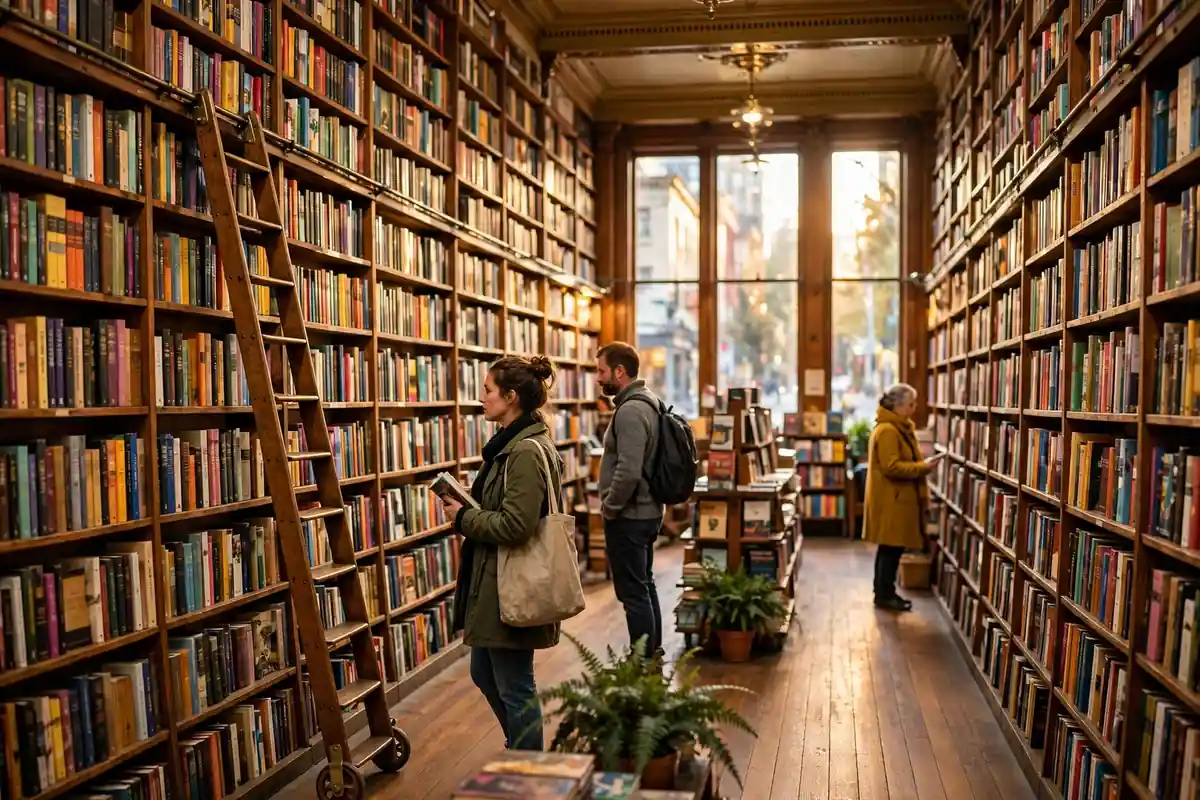
Powell’s City of Books is the one Portland experience no first-timer should skip, and the most Portland thing in the city. The flagship store fills a whole city block at 1005 W Burnside Street, with more than one million new and used books in 68,000 square feet, arranged through nine colour-coded rooms and some 3,500 sections — so big that it hands you a map at the door. Powell’s City of Books claims to be the largest independent new and used bookstore in the world, and it earns the title: the rare book room upstairs, the staff picks shelves, the author events most nights of the week. The 2026 news is that Powell’s is back at Portland International Airport, opening a new store in March 2026 after a six-year gap, so you can start — or finish — your trip with a book.
Practical tip: Browsing is free, and the store is open daily. Grab a map at the entrance, give it at least an hour — most people stay two — and start in the Blue Room for new fiction and the rare book room upstairs. The Pearl District and the Saturday Market are a short walk away.
2. The Portland Japanese Garden
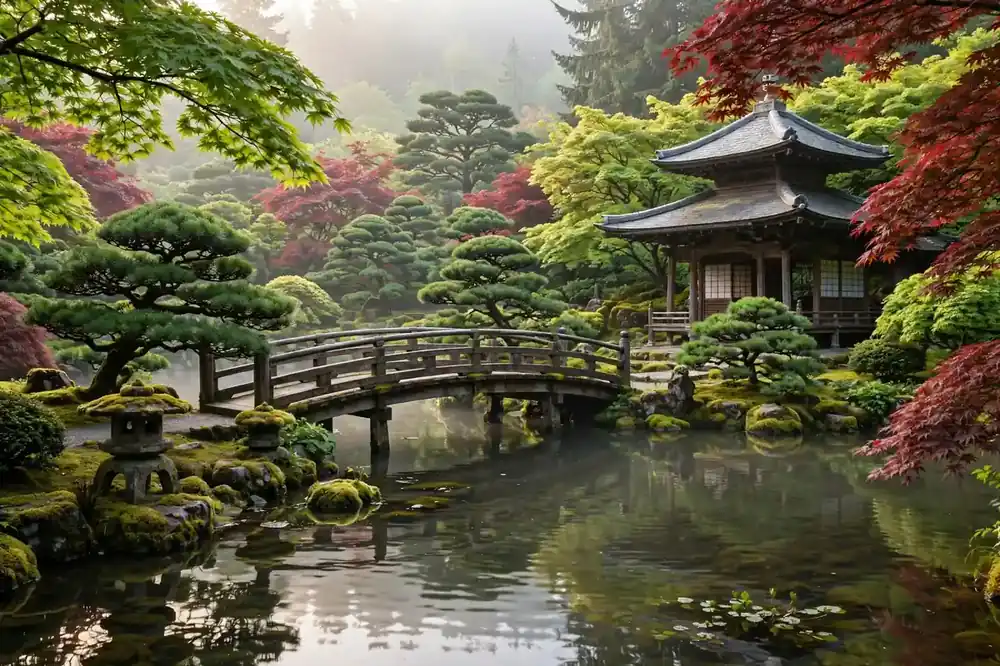
The Portland Japanese Garden is the paid attraction in Washington Park most worth the money, and the quietest hour in the city. Twelve acres of hillside above downtown hold five garden styles — a strolling pond garden, a tea garden, a natural garden, a sand and stone garden and a flat garden — with a waterfall, raked gravel, deep moss and views of Mount Hood through the trees. The Portland Japanese Garden is widely called the most authentic Japanese garden outside Japan, and the Cultural Village designed by architect Kengo Kuma, completed in 2017, added classrooms, a bonsai terrace and a cultural centre. The garden’s final exhibition of 2026, “Weaving Time: NUNO — Textiles of Tradition and Transformation”, runs from October 3, 2026 through February 14, 2027, and the garden celebrates its 65th anniversary in 2027.
Practical tip: Adult tickets cost roughly $22.50 in 2026, with youth aged 6 to 17 at roughly $16.50 and children 5 and under free — prices are approximate, so check before visiting. The garden is closed on Tuesdays, and open from 10 am to 5:30 pm on other days. Go at opening, when the light is soft and the crowds have not arrived, and allow 90 minutes to two hours. In spring, check the garden’s Sakura tracker for the cherry blossom.
3. Smell the roses at the International Rose Test Garden
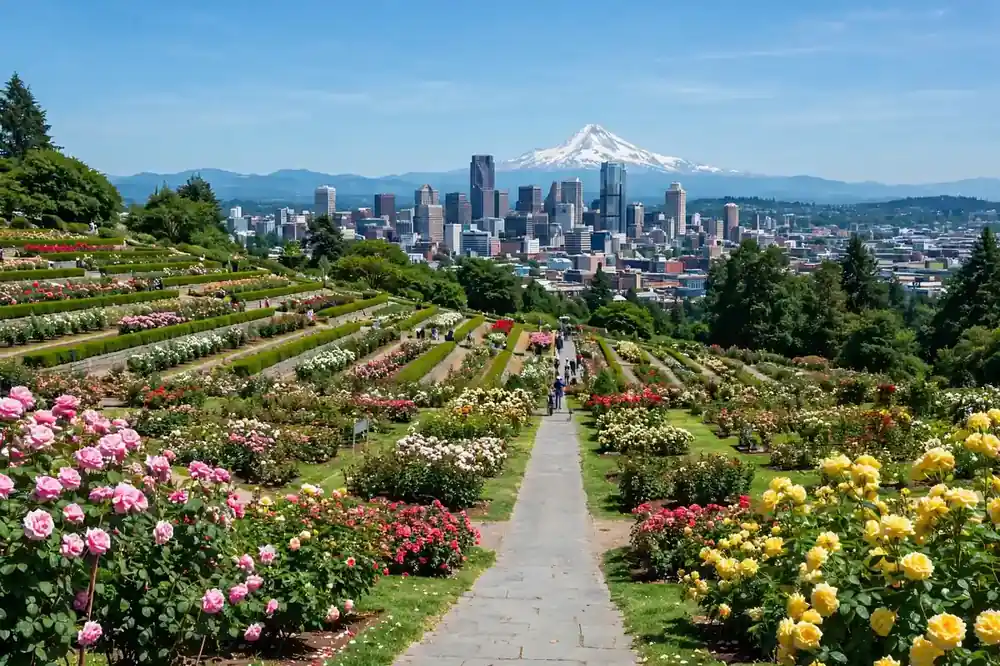
Portland is the City of Roses, and this is where the nickname earns its keep. The International Rose Test Garden in Washington Park holds more than 10,000 rose bushes of over 610 varieties, laid out in terraces with the downtown skyline and Mount Hood behind them — and it is free. The International Rose Test Garden was established in 1917 and is the oldest official, continuously operated public rose test garden in the United States. The roses peak in June, when the Rose Festival fills the city, and the bloom season stretches from late May through October.
Practical tip: The garden is free and open daily from 5 am to 10 pm. Come in June for the peak bloom, go in the morning for the best light and the fewest people, and pair it with the Japanese Garden next door. Parking in Washington Park costs roughly $2.40 an hour, up to $9.60 a day — prices are approximate, so check before visiting.
4. Pittock Mansion and the best view in Portland
Pittock Mansion is the house on the hill with the best view in Portland, and the view is free even if the house is not. The 1914 French Renaissance mansion, 16,000 square feet of it, was built by Henry Pittock, the publisher of The Oregonian, and saved from demolition in 1964 after the city bought it. Pittock Mansion holds period rooms, a gate lodge and a special exhibit — in late 2026 the house is dressed for the holidays, with the display running from November 16, 2026 through January 10, 2027 — and the lawn in front of it looks out over the whole downtown, the Willamette River and Mount Hood.
Practical tip: Admission costs roughly $17 for adults, $15 for seniors and students, and $14 for youth aged 6 to 18, with children under 6 free — prices are approximate, so check before visiting. The mansion is open from 9 am to 4 pm, opening at noon on Tuesdays, with last admission 30 minutes before closing. The grounds and the viewpoint are free, and the hike up from Lower Macleay Park through Forest Park takes about an hour each way.
5. Hike Forest Park and find the Witch’s Castle
Forest Park is the giant green lung of Portland — more than 5,200 acres of Douglas fir forest inside the city limits, one of the largest urban forests in the United States, with some 80 miles of trails that start at the edge of the Northwest district. Forest Park is where Portlanders run, walk dogs and escape the streets without leaving town, and its spine is the Wildwood Trail, which runs for 30 miles end to end. The classic short hike is the Lower Macleay Trail to the Stone House, the moss-covered ruin everyone calls the Witch’s Castle, about a mile from the trailhead — free, atmospheric, and the most photographed spot in the park.
Practical tip: The park is free and open daily. Start at Lower Macleay Park on NW 23rd, wear shoes with grip — the trails are muddy after rain, which is most of the year — and carry water. The full Wildwood Trail is a serious day hike; most visitors do two to four hours.
6. Lan Su Chinese Garden
Lan Su Chinese Garden is the walled oasis in Old Town Chinatown, and the most peaceful hour in downtown Portland. Built by artisans from Suzhou, China, and opened in 2000, it is a Ming-dynasty scholar’s garden in miniature: covered walkways, bridges, open colonnades, pavilions and a koi-filled lake, all inside a single city block. Lan Su Chinese Garden is called one of the most authentic Chinese gardens outside China, and the Yun Shui Teahouse inside serves traditional tea daily, with free rotating art exhibits and more than 500 cultural programs a year.
Practical tip: Admission costs roughly $18 for adults in 2026, with seniors and students at roughly $17, youth aged 6 to 18 at roughly $15, and children 5 and under free — prices are approximate, so check before visiting. The garden is open daily from 10 am, with closing times varying by season, and the last entry is 30 minutes before closing. Go on a weekday morning, when it is quietest, and allow an hour.
7. The Portland Art Museum and the new Rothko Pavilion
The Portland Art Museum is the cultural anchor of downtown, and in 2026 it is a brand-new museum in all but name. Founded in 1892, it is the oldest art museum on the West Coast, with a strong collection of Native American art, contemporary Northwest work and European paintings. The Portland Art Museum reopened its transformed campus on November 20, 2025, with the new Mark Rothko Pavilion — a four-story glass pavilion, 24,000 square feet, built for roughly $111 million — connecting the museum’s two historic buildings and giving it a new front door onto a public plaza. The pavilion is named for Mark Rothko, who grew up in Portland after his family emigrated from Latvia, and the museum opened with “The Art of Mark Rothko”, an exhibition of his paintings on view for several years.
Practical tip: Admission costs roughly $27.50 for adults, $24.50 for seniors, and $22.50 for students, with children 17 and under free — prices are approximate, so check before visiting. The museum is open from 10 am to 5 pm, Tuesday to Sunday, and closed on Mondays. Admission is free from 10 am to 7 pm on the first Thursday of each month. Allow two to three hours.
8. The Oregon Zoo
The Oregon Zoo sits in Washington Park, a short MAX ride from downtown, and it is the city’s best family day. The zoo holds more than 2,000 animals across 64 acres, and it is the oldest zoo west of the Mississippi, at its Washington Park home since 1959. The Oregon Zoo is best known for its elephants — a herd of six, including the youngster Samson — along with Polar Passage, the penguins and the primates, and the narrow-gauge Washington Park and Zoo Railway that loops the grounds. The 2026 news is that the zoo has just acquired the 3.4-acre property next door that housed the Portland Children’s Museum, which closed permanently in 2021 — the building is not open and no plans have been announced yet, so do not plan a visit around it, but the zoo’s campus is set to grow.
Practical tip: Adult tickets cost roughly $26 in 2026, and tickets must be bought online in advance — prices are approximate, so check before visiting. The zoo is open daily from 9 am to 6 pm, with the last entry at 4:30 pm. Take the MAX Blue or Red line to the Washington Park station, the deepest transit station in North America at 260 feet below ground, and allow three to four hours.
9. OMSI and the USS Blueback submarine
The Oregon Museum of Science and Industry is the hands-on museum on the east bank of the Willamette, and the one to do with children. OMSI holds a planetarium, a giant-screen theatre, a turbine hall full of experiments and the USS Blueback, a real Navy submarine moored on the river that you can tour — the last diesel-electric submarine in the US Navy, and the one that starred in the film The Hunt for Red October. It is also the right replacement for the Portland Children’s Museum, which closed permanently in 2021: older Portland guides that still list the Children’s Museum are out of date, and OMSI is the current hands-on option.
Practical tip: Admission costs roughly $20 for adults, $17 for seniors, and $15 for youth aged 3 to 13, with children under 3 free — prices are approximate, so check before visiting. The museum is open Tuesday to Friday from 9:30 am to 5:30 pm, Saturday until 7 pm, and Sunday from 9:30 am to 5:30 pm. Admission is $5 on the first Sunday of every month. The submarine tour costs extra and is not suitable for small children or anyone who dislikes tight spaces.
10. Portland Saturday Market
The Portland Saturday Market is the biggest outdoor market in the city and the best Saturday morning in Portland. Running on the waterfront under the Burnside Bridge on Saturdays and Sundays from March through December, it has been a Rose City tradition since 1974 — the largest continuously operating arts-and-crafts fair in the United States, with more than 250 local artisans and up to one million visitors a season, and a designated Oregon Heritage Tradition. The Portland Saturday Market holds jewellery, pottery, prints, food stalls and street performers, and the 2026 season runs from March 7 through December 31.
Practical tip: Browsing is free and the market is open on weekends, March through December. Go early to beat the crowds, bring cash for the small stalls, and pair it with a walk along the waterfront esplanade. The market is at its liveliest in June, during the Rose Festival.
11. Ride the Portland Aerial Tram
The Portland Aerial Tram is the best view in Portland for the least effort: a glass cabin that sweeps from the South Waterfront up 500 feet to Marquam Hill in three minutes, over 3,300 feet of river, freeway and rooftops, with Mount Hood, Mount St. Helens and the whole downtown laid out below. The Portland Aerial Tram is one of only two commuter aerial tramways in the United States — the other is New York’s Roosevelt Island Tram — and it was built to carry hospital staff to Oregon Health & Science University, which is why it runs like a commuter service rather than a tourist ride.
Practical tip: A round trip costs roughly $9 in 2026, with children 6 and under free alongside a paying adult — prices are approximate, so check before visiting. Buy the fare online or at either terminal. The tram does not run on Sundays or holidays, so do not plan a Sunday ride, and go on a clear day — in low cloud you pay to sit inside a grey sky.
12. Walk Tom McCall Waterfront Park and the bridges
Tom McCall Waterfront Park is the mile and a half of riverside green that replaced a six-lane highway, and the best free walk in downtown Portland. Named for Governor Tom McCall, who pushed the highway out and the park in, it runs along the Willamette from the Steel Bridge to the Hawthorne Bridge, with the Saturday Market, the Rose Festival CityFair and the city’s fireworks all landing here. Tom McCall Waterfront Park is also the place to see Portland’s bridges: the Steel Bridge, which lifts for river traffic, the Hawthorne Bridge, the oldest vertical-lift bridge in the United States, and Tilikum Crossing, the white cable-stayed bridge that carries only MAX trains, buses, bikes and pedestrians — no cars at all.
Practical tip: The park is free and open around the clock. Walk the esplanade loop across one bridge and back over another — the Vera Katz Eastbank Esplanade on the far side is the prettier half — and come at sunset, when the bridges light up and Mount Hood shows on a clear evening. The Rose Festival CityFair fills the park from May 22 to June 7, 2026.
13. Picnic on a volcano at Mount Tabor Park
Mount Tabor Park is a park on top of an extinct volcano — one of the few extinct volcanoes inside a US city — and the best sunset spot on the east side. The cinder cone rises over the neighbourhoods of Southeast Portland, with reservoirs, Douglas firs and a view across downtown to the West Hills, and on a clear day Mount Hood fills the eastern sky. Mount Tabor is where Portlanders picnic, run and watch the Fourth of July fireworks, and it is the quiet half of the day after the downtown crowds.
Practical tip: The park is free and open daily. Drive or take the bus to the summit lot, or walk up from the base in about 20 minutes, and bring a picnic — there are no cafés in the park. The reservoirs are fenced and off limits, but the paths around them are the walk.
14. Alberta Arts District and Last Thursday
Alberta Street is Portland’s most vibrant arts street, and the place to see the city being itself rather than performing for visitors. The Alberta Arts District runs along NE Alberta Street, with galleries, vintage shops, cafés and the Alberta Rose Theatre, and it is home to Salt & Straw’s original scoop shop. On the last Thursday of every month from May through September, the street fills for the Last Thursday art walk, with galleries open late, street performers and food carts. Alberta is also where to find Breakside Brewery’s Dekum pub, pouring some of the best IPAs in a city with more than 75 breweries.
Practical tip: The street is free to wander and the art walk runs on the last Thursday of the month, May through September. Go in the late afternoon, eat on Alberta or nearby Mississippi Avenue, and take the bus — parking on Alberta is tight on art walk nights.
15. The Pearl District and First Thursday
The Pearl District is the former warehouse quarter turned gallery district, and the polished half of downtown Portland. Old brick warehouses now hold art galleries, boutiques, restaurants and Powell’s City of Books, with Jamison Square and Tanner Springs Park — a constructed urban wetland — as its green heart. On the first Thursday of every month, the galleries open late for the First Thursday art walk, and the Portland Art Museum is free from 10 am to 7 pm the same day. The Pearl is also where to eat well: the district holds some of the city’s best restaurants, from the Peruvian dining room Andina to the farm-to-table rooms on NW 13th Avenue.
Practical tip: The district is free to wander and the First Thursday art walk runs on the first Thursday of every month. Go in the late afternoon, start at Jamison Square, and pair it with Powell’s — the bookstore is on the Pearl’s southern edge.
16. St. Johns Bridge and Cathedral Park
The St. Johns Bridge is the bridge Portlanders photograph most, and the one most visitors never see. Built in 1931, the neo-Gothic steel suspension bridge rises over the Willamette in North Portland on two 408-foot towers, the tallest bridge in the city, with its green paint and pointed arches making it look like something from a storybook. St. Johns Bridge is best seen from below, in Cathedral Park, the small riverside park beneath its eastern tower, where the arches frame the river and the park’s lawn is the city’s favourite picnic spot.
Practical tip: The park and the view are free. Take the bus to St. Johns, walk down to Cathedral Park for the view, and go in the late afternoon, when the light falls through the arches. The St. Johns neighbourhood itself, with its pubs and shops, is worth an hour.
17. Cruise the Willamette River
Portland is a river city, and the best way to understand it is from the water. The Portland Spirit runs lunch, brunch and dinner cruises from the downtown waterfront, gliding under the city’s lift bridges with the skyline on one side and the industrial east bank on the other, and Willamette Jetboat Excursions turns the same river into a fast, wet, two-hour ride. Either way, the river shows you the Portland the streets hide: the bridges from below, the houseboats, the herons on the banks and the working port downstream.
Practical tip: Cruises run from spring through autumn, and the dinner cruises sell out on summer weekends — prices are approximate, so check before visiting. Book ahead, dress warmly — the river breeze is cold even in July — and take the evening cruise for the bridges at dusk.
18. Pioneer Courthouse Square
Pioneer Courthouse Square is Portland’s living room — 40,000 square feet of brick paving in the middle of downtown, opened in 1984 on the site of a demolished hotel and a parking lot, and now the place where the city gathers. The square holds concerts, markets, protests and festivals, with food carts around its edges and the MAX running past its doors, and it is the meeting point every Portlander knows. The square is also the gateway to the downtown shopping streets and the South Park Blocks, the elm-lined corridor that runs south to Portland State University.
Practical tip: The square is free and open around the clock. Come at lunchtime, when the food carts are open and the chess players are out, and use it as the meeting point for a downtown day — Powell’s, the Art Museum and the Saturday Market are all a short walk away.
19. Hawthorne and Division — vintage shops and food streets
Hawthorne Boulevard and Division Street are the two streets that explain Portland’s east side, and the best half day of wandering in the city. Hawthorne, between 30th and 40th avenues, holds vintage shops, record stores, bookshops and cafés in the city’s old counterculture heart, with the Bagdad Theater — a 1927 movie palace that still shows films and serves pizza — as its anchor. Division Street, a few blocks south, has become Portland’s most ambitious food corridor, with farm-to-table restaurants, bakeries and wine bars in a single walkable stretch. Between them sit the food cart pods: Cartopia, at 1207 SE Hawthorne since 2008, and Hawthorne Asylum, at 1080 SE Madison with 21 carts around a fire pit.
Practical tip: Both streets are free to wander. Start on Hawthorne for the shops, walk south to Division for dinner, and eat at a cart pod for lunch — Potato Champion’s poutine at Cartopia is the local legend. Most shops open late morning and the restaurants book out on weekend evenings.
20. Day trip: Columbia River Gorge and Multnomah Falls
The Columbia River Gorge is the best day trip from Portland — 30 minutes east, and a different world. The 80-mile gorge, where the Columbia River cuts through the Cascade Range, holds sheer basalt cliffs and more than 90 waterfalls, and its icon is Multnomah Falls, 620 feet of it, the second-tallest year-round waterfall in the United States. Multnomah Falls is free to visit, but from late spring through autumn you need a timed permit to drive into the falls area — the permit costs roughly $2 — and the Columbia Gorge Express shuttle runs from the Gateway Transit Center in Portland for visitors without a car. Above the falls, the Historic Columbia River Highway climbs to the Vista House at Crown Point, with the best view in the Gorge.
Practical tip: The falls are free, with the summer timed permit costing roughly $2 — prices are approximate, so check before visiting. Go early on a weekday, take the shuttle if you do not have a car, and wear shoes with grip — the trail to the top of the falls is steep and wet. If you have the whole day, keep driving: Hood River’s fruit stands and breweries are an hour east, and the wineries of the Willamette Valley are 30 minutes south-west of Portland.
Portland in 3 days — a ready-made itinerary
| Day | Morning | Afternoon | Evening |
| Day 1 — Downtown icons | Powell’s City of Books and the Pearl | Art Museum and Lan Su Chinese Garden | Saturday Market and the waterfront |
| Day 2 — Washington Park | Japanese Garden and Rose Test Garden | Oregon Zoo and Pittock Mansion | Food cart pod dinner on Hawthorne |
| Day 3 — Neighbourhoods and the river | Alberta Arts District | Aerial Tram and South Waterfront | Division Street dinner |
Day 1 — Downtown icons
Start at Powell’s City of Books at opening, when the aisles are empty and the rare book room is quiet, then walk the Pearl District — Jamison Square, the galleries, a coffee on NW 13th. Spend the afternoon at the Portland Art Museum, with the new Rothko Pavilion, then Lan Su Chinese Garden for the quiet hour, and finish on the waterfront: the Saturday Market if it is a weekend, the esplanade at sunset, and dinner downtown. Day one is the classic Portland, and it is the one to get right.
Day 2 — Washington Park
Take the MAX to Washington Park in the morning and go straight to the Japanese Garden at opening, before the crowds, then the Rose Test Garden next door while the light is good. Spend the afternoon at the Oregon Zoo — the elephants, Polar Passage and the railway — then walk or ride up to Pittock Mansion for the view at golden hour. Finish on Hawthorne: a food cart pod dinner at Cartopia or Hawthorne Asylum, and a film at the Bagdad Theater if you have the energy.
Day 3 — Neighbourhoods and the river
Start on Alberta Street for the galleries, vintage shops and a Salt & Straw ice cream, then spend the afternoon on the river: the Aerial Tram from the South Waterfront for the view, and a walk along the esplanade back downtown. Finish on Division Street for dinner, the city’s best food corridor. If you have a fourth day, add the Columbia River Gorge and Multnomah Falls, or the wineries of the Willamette Valley.
Best time to visit Portland
| Season | What it is like | Best for |
| Winter (December–February) | Cold and wet, highs around 8–10°C, the cheapest hotels — with more than 5 inches of rain a month | Budget trips, museums, Powell’s |
| Spring (March–May) | Mild days, blossom in the parks, the gardens waking up, the Rose Festival at the end of May | First trips, the gardens, the Saturday Market |
| Summer (June–August) | Warm and dry, highs in the 70s and 80s°F, the busiest crowds and the highest prices | First trips, the Gorge, the roses in June |
| Autumn (September–November) | Warm and golden in September, rain returns in October, smaller crowds, fall colour in the gardens | First trips, the best weather of the year, the Japanese Garden |
The best time to visit Portland is June to September, when the days are warm and dry, the roses are in bloom and the festivals are on. September is the sweet spot: the summer heat has broken, the rains have not started, average highs hover in the mid-70s, and the crowds thin after Labor Day. Winter is the cheapest time to visit, with the museums and Powell’s at their best, but the days are short and wet — it rains on roughly one day in two from November through January. The Rose Festival runs from May 22 to June 7, 2026, with the new combined CareOregon Grand Floral Starlight Parade on June 6, 2026, and the Saturday Market season runs from March 7 through December 31, 2026.
Where to stay in Portland
| Area | Who it suits | Why stay there |
| Downtown and the Pearl | First-timers, walkers | Powell’s, the Art Museum, the Saturday Market and the river on your doorstep |
| Northwest and Nob Hill | Shoppers, a local feel | NW 23rd boutiques, Forest Park trailheads and the Alphabet District |
| Southeast (Hawthorne/Division) | Foodies, a local feel | Food carts, vintage shops and Division’s restaurants on your doorstep |
| The Lloyd District | Budget trips, event-goers | The Moda Center, the Convention Center and the MAX lines on your doorstep |
| The South Waterfront | A quiet base, families | The Aerial Tram, the riverfront esplanade and the streetcar on your doorstep |
First-timers should stay downtown or in the Pearl, where Powell’s, the Art Museum and the Saturday Market are all a walk away. Foodies who want the best restaurants should look at Southeast, around Hawthorne and Division, where the food carts and the farm-to-table rooms set the tone. Northwest suits shoppers, with NW 23rd’s boutiques and the Forest Park trailheads on the doorstep, the Lloyd District suits budget trips and event-goers, and the South Waterfront suits a quiet base with the tram and the river nearby. Whatever you book, stay inside the central city if you want to walk: the sights, the stations and the restaurants are all within a couple of miles of each other, and the MAX fare cap keeps the rest cheap.
Getting around Portland
Downtown Portland is walkable: Powell’s, the Art Museum, Lan Su, the Saturday Market and the waterfront are all within about a mile of each other, and the riverfront esplanade is the flattest walk in town. For anything further, the MAX light rail is the backbone — the Blue and Red lines run to Washington Park, where the station sits 260 feet below ground, the deepest transit station in North America — and the buses, the Portland Streetcar and the Aerial Tram fill in the gaps. The simplest way to pay is the Hop Fastpass: tap your phone or a contactless card on the reader, and the system caps what you pay automatically. An adult fare costs roughly $2.80 for 2½ hours in 2026, and you never pay more than $5.60 in a day or $100 in a calendar month — prices are approximate, so check before visiting. Youth and honoured citizens pay roughly $1.40 a ride, and the Portland Streetcar costs roughly $2 a ride. Portland is also one of the most bike-friendly cities in the United States, with bike lanes everywhere and Biketown bike-share stations across the central city. A car is worth having only for the Gorge, Mount Hood and wine country, and the airport is about 20 minutes from downtown on the MAX Red Line — through the airport’s rebuilt main terminal, with its mass-timber roof, which opened in August 2024.
Portland food you have to try
The food cart pods
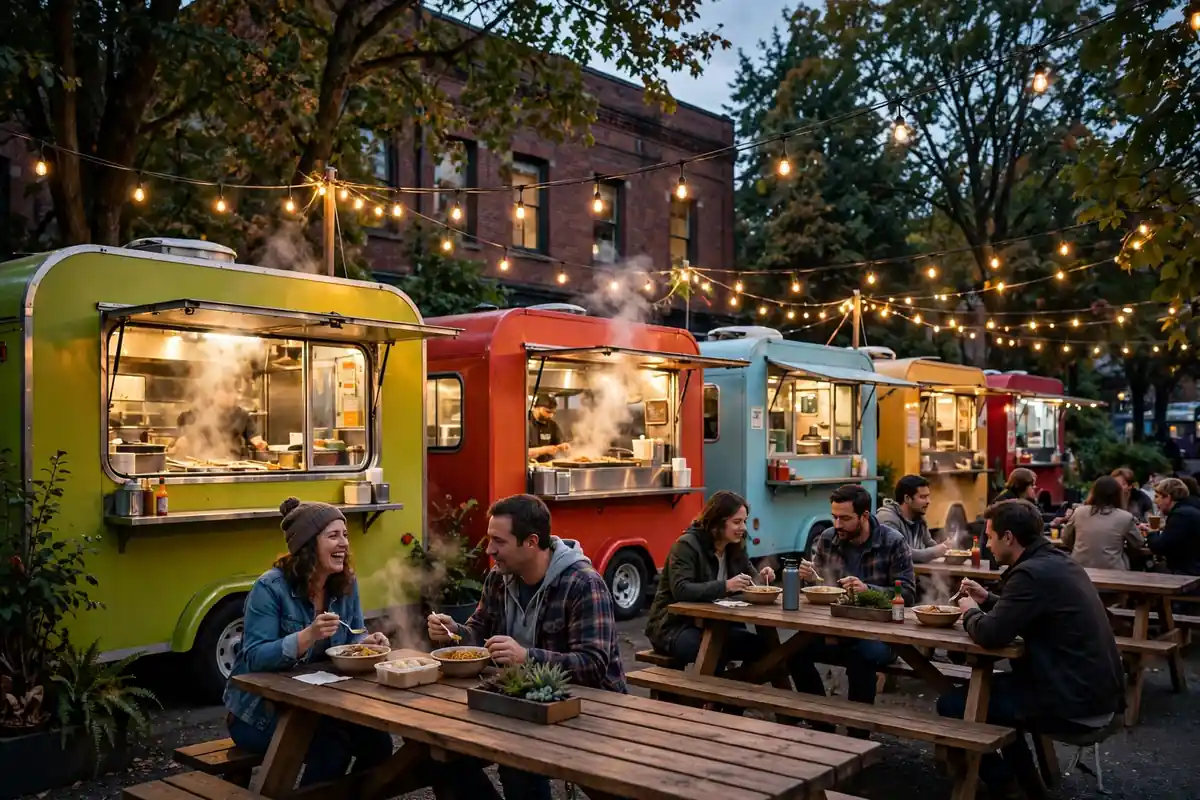
Portland’s food carts are the city’s signature meal, and the pods are where to eat them. The carts are grouped into pods — licensed lots with shared seating — and the two to know are Cartopia, at 1207 SE Hawthorne since 2008, and Hawthorne Asylum, at 1080 SE Madison with 21 carts around a fire pit. At Cartopia, Potato Champion’s poutine — twice-fried Belgian-style fries under gravy — is the local legend, and the pod stays open late. At Hawthorne Asylum, the range runs from Burmese curries to Korean tacos and Russian dumplings. The scene keeps changing: Portland Mercado, the Latin American food hub on SE Foster, is rebuilding after a 2024 fire, with a reopening targeted for summer 2026, and a new pod, Modhaus, opened in Southeast Portland in 2026. The rule is simple: eat standing up, try the samples, and save room for a second cart.
Voodoo Doughnut and the doughnut wars
Voodoo Doughnut is Portland’s most photographed food, and the pink box is the souvenir. The original shop in Old Town serves doughnuts with names like the maple bacon bar and the Voodoo Doll, in a shop that looks like a carnival and tastes like one too. Voodoo is the tourist favourite, but the local argument is that Blue Star Donuts, with its brioche doughnuts and flavours like passionfruit cocoa nib, is the better doughnut — try both and settle it yourself. Either way, the doughnut is the cheapest great meal in Portland, at roughly $2 to $4 a doughnut — prices are approximate, so check before visiting.
Salt & Straw ice cream
Salt & Straw is Portland’s ice cream, and the line outside the Alberta Street shop is the proof. The flavours run from the familiar — sea salt with caramel ribbons — to the strange, with seasonal menus that have included everything from bone marrow to olive oil, and the shop on NE Alberta is the original. The ice cream is made in small batches, the waffle cones are baked in the shop, and the tasting flight — five small scoops — is the way to try it properly. Go on a weekday, when the line is short, and eat it walking Alberta Street, the way Portlanders do.
Beyond the three dishes above, save room for the city’s other classics: Stumptown Coffee, the roaster founded in Portland in 1999 that started the city’s coffee obsession, and the craft beer — more than 75 breweries in the city, with the best IPAs poured at the brewpubs on Mississippi Avenue and in the Pearl. Division Street holds the farm-to-table restaurants, and the Saturday Market holds the street food. And one warning: the restaurants on the busiest stretch of downtown charge tourist prices for average food — eat where the locals eat, in the pods, on Alberta and on Division, not on the busiest corner of the walk.
Free things to do in Portland
The free list in Portland runs longer than in most American cities. The International Rose Test Garden is free, Forest Park is free, the Saturday Market is free to browse, Tom McCall Waterfront Park is free, Pioneer Courthouse Square is free, and the views from Pittock Mansion’s lawn, Mount Tabor and Cathedral Park are free. Hoyt Arboretum, the tree museum in Washington Park, is free, the First Thursday art walk is free, the Last Thursday art walk on Alberta is free, and browsing Powell’s City of Books is free. The Portland Art Museum is free on the first Thursday of every month, OMSI is $5 on the first Sunday, and the best free thing of all is a sunset walk along the Willamette esplanade, from the Steel Bridge to Tilikum Crossing, with the bridges lighting up around you.
Frequently asked questions
How many days do you need in Portland?
Three full days covers the highlights: downtown and the Pearl, Washington Park, and the neighbourhoods and the river. Two days covers the essentials if you skip the day trip and pick one museum day. Add a fourth day for the Columbia River Gorge and Multnomah Falls, or for the Willamette Valley wineries — Portland rewards a slow day more than a rushed one.
Is Portland expensive?
Yes, but less than it looks. The Rose Test Garden, the parks, the Saturday Market and the waterfront are free, the museums are free on their discount days, and Oregon has no sales tax. The expensive parts are the paid sights — the Japanese Garden at roughly $22.50, the zoo at roughly $26, the Art Museum at roughly $27.50 — so pick one or two and let the free gardens do the rest. A mid-range trip runs roughly $120–$200 per person per day, and a budget trip is possible on half that if you eat at the food carts and stay outside downtown.
What is the best time to visit Portland?
June to September is the sweet spot: warm, dry days, the roses in bloom, the festivals on and the Gorge at its best. September is the best month of all, with warm days and thin crowds. June to August is the classic season, warm and busy, with the highest prices. December to February is mild and cheap, with the museums and Powell’s at their best, but the days are short and wet. It rains on roughly one day in two from November through January, so pack a waterproof whatever the season.
Do you need a car in Portland?
Not in the city. Downtown, the Pearl, the Saturday Market and the waterfront are walkable, and the MAX, buses and streetcar cover everything else — a day of transit never costs more than $5.60. A car is worth it if you want the Columbia River Gorge, Mount Hood or the Willamette Valley wineries — and the airport is only about 20 minutes from downtown on the MAX Red Line, so a rental is easy.
Is Portland safe for tourists?
The tourist areas are safe with normal city sense: stay on the main streets and the riverfront at night, keep valuables out of sight in parked cars, and watch the rain-slick streets — the brick sidewalks are slippery when wet. Downtown has had a hard few years and is actively recovering, with foot traffic rebuilding in the Pearl and new hotels and restaurants opening, so some blocks are quieter than they were — stick to the busy streets after dark. The parks, the museums and the neighbourhoods are safe in daylight.
What is the one thing you should not miss in Portland?
Powell’s City of Books, first thing in the morning. It is the smallest, quietest moment in the city — the aisles empty, the rare book room to yourself, a million books waiting — and it is the experience every other stop in Portland builds on. After that, the Japanese Garden at opening and a food cart lunch on Hawthorne.
Further reading — Wikipedia and Reddit
Wikipedia — Portland, Oregon: the city’s history, geography and government. Portland on Wikipedia
Wikipedia — Powell’s Books: the bookstore, its history and the City of Books. Powell’s Books on Wikipedia
Wikipedia — Multnomah Falls: the waterfall, the Gorge and the Historic Highway. Multnomah Falls on Wikipedia
Reddit — r/Portland: the local community, with trip reports, restaurant recommendations and what is new in 2026. r/Portland on Reddit
Your Portland trip, in one paragraph
Portland is the city that does books, gardens and food better than anywhere else in the Pacific Northwest: Powell’s City of Books, the Japanese Garden and the roses, the food cart pods and the doughnuts, and the Gorge half an hour away. Three days is enough to see it properly, and the 2026 changes — the new Rothko Pavilion at the Art Museum, Powell’s back at the airport, the Rose Festival’s brand-new parade and the zoo’s new ground in Washington Park — mean the guides from last year are already out of date. Book the Japanese Garden, eat at a cart pod, and leave a morning free for Forest Park. If you want more city guides from this series, start with Chicago, Nashville, Los Angeles, Orlando, Miami, San Diego, Denver, Savannah, Dallas, Charleston, San Francisco, Myrtle Beach, Las Vegas, San Antonio and London — and if the rain calls you back, the Rose City will still be here, 180 years of it, waiting.

About the Author