Things to Do in Tennessee
20 Best Attractions, a 3-Day Itinerary, Where to Stay, and the Food You Cannot Miss
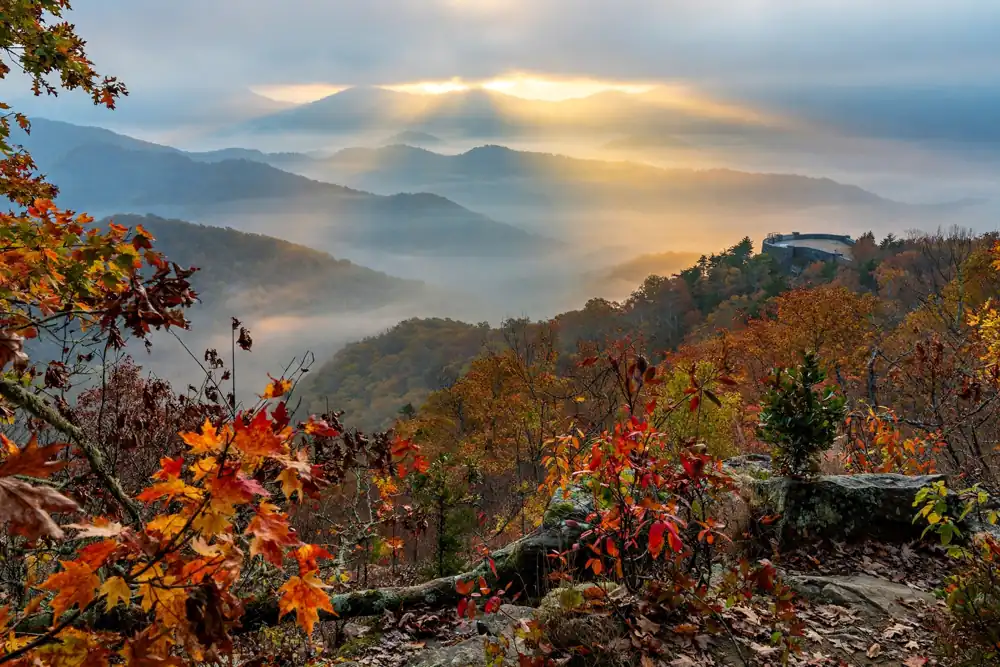
Quick Info
Best for: Music lovers, history buffs, hikers, families, barbecue and hot chicken fans, and anyone who wants America’s most-visited national park and three great music cities in one trip
Best time: Mid-April to mid-May and mid-September to mid-October for the best weather; mid-October to early November for Smokies fall colour; late March to early April for spring wildflowers
How long: 3 days covers one corner of the state; 5 to 7 days is the right amount for Nashville, the Smokies and Memphis together; a full week with Chattanooga and the state parks
Budget: Roughly $150 to $250 per person per day for a mid-range trip, including a hotel, a rental car, one paid attraction and meals; a day of free parks, free museums and free music costs almost nothing
Don’t miss: The Smokies at sunrise, Graceland, Beale Street at night, the Ryman Auditorium, a hot chicken plate in Nashville, and one night in a cabin above Gatlinburg
Tennessee is the American state that gives you three different worlds in one road trip: the misty mountains of the east, the honky-tonks of Nashville in the middle, and the blues and soul of Memphis in the west. It is the home of the most-visited national park in America, the birthplace of rock ‘n’ roll, the capital of country music, and the only state where you can eat Nashville hot chicken for lunch and Memphis barbecue for dinner. This guide gives you the 20 best things to do in Tennessee in a sensible order, a ready-made 3-day itinerary, honest advice on when to go, where to stay and how to get around, and the three foods you have to try before you leave — plus the free sights that cost nothing at all. Prices and hours change, so every price in this guide is the 2026 price as published by the attraction itself — always check the official website before you visit.
One thing to know before you go: Tennessee in 2026 is not the state of the old guidebooks, and the old guides are wrong in expensive ways. The Great Smoky Mountains are still free to enter, but you now need a parking tag — $5 a day — if you stop anywhere for more than 15 minutes, and most guides never mention it. The National Civil Rights Museum in Memphis now costs $25, not the $16 or $18 the old lists quote, and it has a brand-new $38 million wing that opened in May 2026. Graceland is $85 for the standard tour, and the Cades Cove loop’s car-free Wednesdays ended on September 30, 2026, so do not plan a bike day around them until the 2027 dates are announced. This guide tells you which traps to watch for, so you can plan with facts instead of outdated blog posts. Read about Tennessee on Wikipedia.
Tennessee at a glance
| Question | Short answer |
|---|---|
| Where is Tennessee? | A state in the American South, split into three Grand Divisions — East, Middle and West — from the Smoky Mountains to the Mississippi River |
| What is it best for? | Music, mountains, barbecue, Civil War history and free state parks — and the most-visited national park in America |
| How long should I stay? | 3 days for one corner; 5 to 7 days for Nashville, the Smokies and Memphis together |
| How much does it cost? | Roughly $150 to $250 per person per day mid-range; a day of free parks and free museums costs almost nothing |
| What is the one thing not to miss? | The Smokies at sunrise, then Graceland and Beale Street in Memphis |
| When is the best time to go? | Mid-April to mid-May and mid-September to mid-October; mid-October to early November for fall colour |
| Is it good for families? | Yes — Dollywood, the Smokies, the aquariums, the zoos and the free state parks, and most music is all ages by day |
| Do I need a car? | Yes — Tennessee is a driving state, about 440 miles end to end on I-40; only Memphis has an Amtrak station |
The 20 best things to do in Tennessee
These are the 20 best things to do in Tennessee, ranked the way a first-time visitor should actually do them: the Smokies and the music cities first, then the whiskey, the theme parks and the waterfalls, then the Civil War sites and the quiet corners most guides skip. Every price below is the 2026 price as published by the attraction itself, and every trap — the parking tag the Smokies now require, the museum that doubled its price, the Wednesday bike day that has ended for the year — is called out where it matters.
1. Great Smoky Mountains National Park
Great Smoky Mountains National Park is the most-visited national park in the United States, and it is the single best reason to come to Tennessee. More than half a million acres of misty ridges and old-growth forest straddle the Tennessee–North Carolina line, with about 900 miles of trails, 2,000 miles of streams, and the highest peaks in the eastern United States — Kuwohi, at 6,643 feet, is the tallest mountain in Tennessee. The park is free to enter, which is why so many people come, and it is beautiful in every season: spring wildflowers, summer waterfalls, autumn colour that draws millions, and winter snow on the high ridges. Read about Great Smoky Mountains National Park on Wikipedia.
The practical facts for 2026: there is no entrance fee, but you need a parking tag if you park anywhere in the park for more than 15 minutes — $5 a day, $15 a week or $40 a year, bought at visitor centres, from machines at busy spots or online, and you must display the physical tag. Cades Cove, the 11-mile one-way loop past log cabins, churches and a working gristmill, is the most popular drive in the park; allow two to four hours, and go at sunrise or on a weekday, because Saturday mornings can back up for two hours. The vehicle-free Wednesdays, when the loop belonged to cyclists and walkers, ran from May 6 to September 30, 2026, and have now ended for the year — the 2027 dates have not been announced, so do not plan a bike day around them yet. Kuwohi Road, formerly Clingmans Dome Road — the peak was renamed Kuwohi in 2024 — ran from April 1 to November 29 in 2026, and the half-mile paved trail to the observation tower is steep but worth it. Newfound Gap Road (US 441) is the only road through the park, and it closes in snow and ice, so check conditions before you go. The park has posted bear warnings on some trails in 2026, so carry bear spray, make noise on the trail and never leave food in your car.
2. Graceland, Memphis
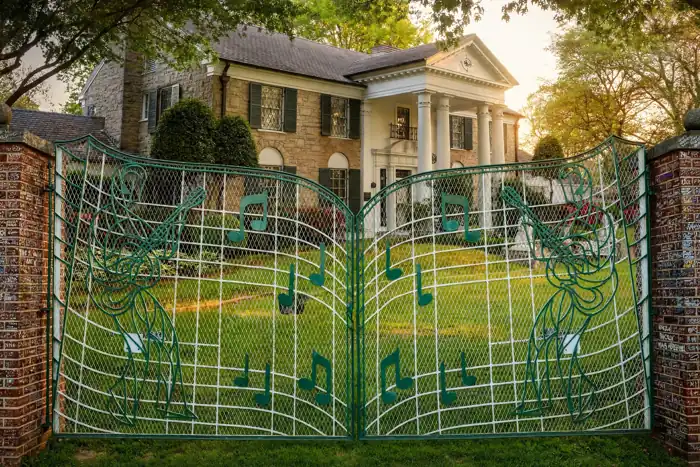
Graceland is the most famous house in American music, and it is the one splurge most visitors to Tennessee budget for. Elvis Presley’s mansion in Memphis — 13.8 acres at 3717 Elvis Presley Boulevard, about nine miles south of downtown — is where the King of Rock ‘n’ Roll lived from 1957 until his death in 1977, and it has been a museum since 1982. The self-guided tour walks you through the living room, the Jungle Room, the Trophy Building and the Meditation Garden where Elvis and his family are buried, and then across the street to Elvis Presley’s Memphis, the entertainment complex with his cars, his costumes, his gold records and his two private jets. Read about Graceland on Wikipedia.
The practical facts for 2026: the standard Elvis Experience tour — mansion plus the entertainment complex and the jets — costs $85 for adults and $49 for youth aged 5 to 10, with under-4s free, and the complex-only ticket is $53 for adults and $30 for youth. The VIP tiers climb to $148 for the Entourage VIP and $215 to $260 for the Ultimate VIP, and there is a facility fee on top of every ticket. Tours are timed-entry, so book ahead, especially around Elvis Week in August and the Christmas season — from November 19 to December 23, 2026, Graceland runs special Christmas tours with live guides, from $100 for the afternoon tour to $300 or $350 for the evening experiences. One free thing most visitors miss: the Meditation Garden is open free every morning before the tours start, except on Thanksgiving and Christmas Day. Allow three to four hours for the full visit, and take a car or a rideshare — Graceland is not on the downtown trolley line.
3. Beale Street, Memphis
Beale Street is the most famous street in American music, and it is free to walk. Three blocks of blues clubs, barbecue joints and neon in downtown Memphis, Beale Street is where W.C. Handy wrote the blues, where B.B. King played as a young man, and where the music still spills out of every doorway from noon until 2 a.m. By day it is a pleasant walk past historic buildings and street musicians; by night it is loud, crowded and alive, with live bands in every club and no cover charge at most of them. The street is officially the Home of the Blues, and it was declared a National Historic Landmark in 1977. Read about Beale Street on Wikipedia.
The practical facts for 2026: walking Beale Street costs nothing, and most clubs have no cover before 8 p.m., though some charge $5 to $10 later at night. The best plan is to come in the late afternoon, eat barbecue at one of the Beale Street institutions — the Rendezvous, famous for its dry-rub ribs since 1948, or B.B. King’s Blues Club — and then bar-hop from club to club, listening to a song or two in each. Beale Street is at its best on a Friday or Saturday night, and during the Beale Street Music Festival in May, which is part of Memphis in May. One honest warning: Beale Street is a party street, and it is loud and crowded after dark, so it is not the place for small children late at night. Stay on the main three blocks, keep your valuables close, and take a rideshare back to your hotel — downtown Memphis is walkable by day, but the streets around Beale are quiet after the clubs close.
4. National Civil Rights Museum, Memphis
The National Civil Rights Museum is the most important museum in Tennessee, and one of the most powerful museums in America. It is built around the Lorraine Motel at 450 Mulberry Street, where Dr. Martin Luther King Jr. was assassinated on April 4, 1968, and it tells the story of the civil rights movement from slavery through 1968 — and now, with its new wing, right up to the present day. Room 306, Dr. King’s room, is preserved exactly as it was, and the balcony where he stood is the most sobering spot in the state. The museum is a place to go slowly: allow two to three hours, and expect to be moved. Read about the National Civil Rights Museum on Wikipedia.
The practical facts for 2026: admission is $25 for adults, $23 for seniors 65 and over and college students, and $22 for children aged 5 to 17, with under-5s free. That is a real rise — many guides still quote $16 or $18, and they are out of date. The museum is open 9 a.m. to 5 p.m. every day except Tuesday, when it is closed, and tickets are timed and sold online only, so book ahead. The big news for 2026 is the Legacy Experience, a $38 million expansion across the street from the Lorraine Motel that opened on May 16, 2026, carrying the story from 1968 to today across three floors of interactive galleries on poverty, education, housing, gender equity and nonviolence — it is included with the $25 admission. Tennessee residents get in free on Mondays from 3 p.m. until closing, with a state ID, except on major holidays. The museum is a short walk from Beale Street, so pair the two on the same day.
5. Sun Studio, Memphis
Sun Studio is the birthplace of rock ‘n’ roll, and it is still a working recording studio. At 706 Union Avenue in Memphis, a small storefront studio with a hand-painted sign, Sam Phillips recorded Elvis Presley’s first record in 1954, and then Johnny Cash, Carl Perkins, Jerry Lee Lewis, Roy Orbison and B.B. King — the Million Dollar Quartet session of December 1956, when Elvis, Cash, Lewis and Perkins jammed together in this one room, is the most famous recording session in history. The guided tour, about 40 to 50 minutes, walks you through the studio itself, where you can stand at the microphone Elvis used and hear the outtakes, and it ends with a free shuttle to Graceland and the Rock ‘n’ Soul Museum. Read about Sun Studio on Wikipedia.
The practical facts for 2026: the guided tour costs about $15 for adults and $10 for ages 5 to 11, with tours running daily from 10 a.m. to about 5:15 p.m. — one guide lists $20, but the studio’s own site and the Memphis guides that checked it in 2026 list $15, so treat $15 as the price and check before you go. Tours are first-come, first-served, with no reservations, and they start on the hour, so arrive early on a weekend. The studio is still in use at night, so the daytime tour is the only way in, and photography is allowed in most of the building. Pair it with Stax, below, for a full Memphis music day — the two studios tell the two halves of the city’s story, rock ‘n’ roll and soul, and they are about ten minutes apart by car.
6. Stax Museum of American Soul Music, Memphis
The Stax Museum of American Soul Music is the other half of the Memphis music story, and it is the only soul-music museum in the world. It stands on the original Stax Records site at 926 East McLemore Avenue in Soulsville, rebuilt as an exact replica of the old studio after the original was demolished in 1989, and it tells the story of Otis Redding, Isaac Hayes, Booker T. and the M.G.’s, the Staple Singers and Sam and Dave — the sound that came out of a converted movie theatre in a Black neighbourhood and changed American music. The star of the show is Isaac Hayes’ gold-trimmed Superfly Cadillac, all 20 feet of it, sitting in the middle of the museum. Read about the Stax Museum of American Soul Music on Wikipedia.
The practical facts for 2026: admission is $20 for adults and about $16 for concessions, and the museum is open Tuesday to Sunday from 10 a.m. to 5 p.m., closed on Mondays. Allow about 90 minutes, and listen to the listening stations — the museum is built for ears as much as eyes. The Soulsville neighbourhood around it is worth a walk too, and the free shuttle that links Sun Studio, Graceland and the Rock ‘n’ Soul Museum stops nearby. One honest note: Stax is in a residential neighbourhood south of downtown, so take a car or a rideshare rather than walking, and pair it with Sun Studio in the morning and Beale Street in the evening for the full Memphis music day.
7. Broadway honky-tonks and the Ryman Auditorium, Nashville
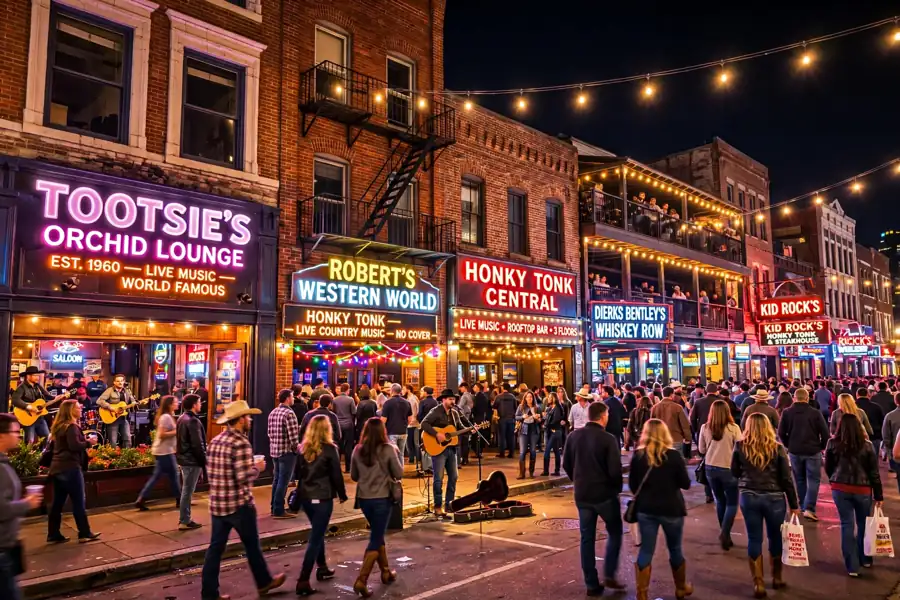
Broadway in Nashville is the loudest street in Tennessee, and the Ryman Auditorium is its soul. Lower Broadway — the Honky Tonk Highway — is four blocks of honky-tonks with live bands playing from 10 a.m. until 3 a.m., no cover charge at most of them, and a new band every hour. Tootsie’s Orchid Lounge, Robert’s Western World, the Stage and Kid Rock’s Big Ass Honky Tonk Rock ‘n’ Roll Steakhouse are the famous names, and the rule is simple: walk in, order a beer, tip the band, and walk out when you feel like it. Two blocks north, at 116 Rep. John Lewis Way, stands the Ryman Auditorium, the Mother Church of Country Music — a red-brick former tabernacle where the Grand Ole Opry lived from 1943 to 1974, and still one of the best-sounding rooms in America. Read about the Ryman Auditorium on Wikipedia.
The practical facts for 2026: walking Broadway costs nothing, and the honky-tonks are free to enter by day, though some charge a cover after 8 p.m. on weekends. The Ryman’s self-guided daytime tour costs about $30 for adults, and the guided backstage tour is about $45 — tour times shrink on performance days, because the Ryman is still a working venue, so check the calendar before you go. The Grand Ole Opry returns to the Ryman for part of the winter — the January 2027 shows are at the Ryman, not the Opry House — which is the best way to see both in one night. For the full Nashville music experience, read our Nashville guide, which covers Broadway, the Ryman and the rest of the city in detail. One honest warning: Broadway is a bachelor-party street at night, and it is loud, crowded and expensive after dark — come in the daytime for the music without the chaos, and save your money for the Ryman.
8. Country Music Hall of Fame and Museum, Nashville
The Country Music Hall of Fame and Museum is the biggest music museum in Tennessee, and it is the place that explains why Nashville is Music City. At 222 Rep. John Lewis Way South in the SoBro district, two blocks from the Ryman, it holds more than two million artefacts — Elvis’ gold Cadillac, Johnny Cash’s black suit, Taylor Swift’s handwritten lyrics, the wall of gold and platinum records — and the Hall of Fame rotunda itself, where the bronze plaques of the inductees hang. The museum is a full half-day, and the combo ticket with RCA Studio B, the studio where Elvis recorded more than 200 songs, is the one to buy. Read about the Country Music Hall of Fame and Museum on Wikipedia.
The practical facts for 2026: admission starts at about $33 for adults, and tickets are timed and date-stamped, so book online in advance. The RCA Studio B combo adds a shuttle ride from the museum to the studio on Music Row, and it runs on a fixed schedule, so build your day around it. The museum is open daily, and it is busiest on weekends and during CMA Fest in June — come on a weekday morning if you can. Allow two to three hours for the museum alone, and three to four with Studio B. The Hatch Show Print shop inside the museum, one of the oldest letterpress shops in America, is worth a visit on its own, and the prints make the best souvenir in Nashville.
9. Grand Ole Opry, Nashville
The Grand Ole Opry is the longest-running radio broadcast in American history, and it is the show every country music fan should see once. Since 1925 — first on WSM radio, then at the Ryman, and since 1974 at the Grand Ole Opry House at 600 Opry Mills Drive, about 20 minutes northeast of downtown — the Opry has put eight or more artists on one stage in a single night, from legends to newcomers, and the rule is that nobody knows the full line-up until the show starts. It is part concert, part history lesson, and part church service, and it is the most Tennessee thing you can do after dark. Read about the Grand Ole Opry on Wikipedia.
The practical facts for 2026: show tickets start from about $61 for the cheapest seats, with most nights running $68 to $130 depending on the line-up, and the Christmas shows — November 29 and 30, and December 2, 3, 6, 9, 10, 13, 14, 20, 21 and 22 in 2026 — cost more and sell out first. Book through the Opry’s own site, not a reseller, because resale prices run far higher. The show runs about two to two and a half hours, with two sets and an intermission, and the backstage tour is a separate ticket. The Opry House is not downtown, so take a rideshare or drive — parking is on site — and arrive early, because the Opry Mills mall next door and the Gaylord Opryland Resort, a hotel the size of a small city with indoor waterways and gardens, are worth an hour before the show. From January 2027 the Opry moves back to the Ryman for its winter run, so check which venue your date is at before you book a hotel.
10. Jack Daniel’s Distillery, Lynchburg
Jack Daniel’s Distillery is the most famous distillery in the world, and it sits in the smallest, driest town in Tennessee. Every drop of Jack Daniel’s Tennessee whiskey is made in Lynchburg, a town of about 6,000 people in Moore County, about 90 minutes southeast of Nashville — and Moore County is dry, so the only place you can taste or buy the whiskey is at the distillery itself, under a special state exception. The standard tour walks you through the working distillery, the charcoal mellowing vats, the barrel houses and Cave Spring Hollow, where the iron-free spring water Jack Daniel chose in 1866 still feeds the whiskey, and it ends with a six-sample tasting for guests 21 and over. Read about Jack Daniel’s on Wikipedia.
The practical facts for 2026: the standard Jack Daniel Distillery Tour costs $35, tax and fees included, lasts about one hour and 50 minutes, and runs daily — under-21s can join the walk but cannot sample. The smaller Bonded Tour is $55, and the full-day A Day at Jack is $160 for a maximum of eight guests. Book online at least three hours ahead, because the small tours sell out on Saturdays. The visitor centre is open 9 a.m. to 5 p.m. every day. Two things to know: backpacks, camera bags and strollers are not allowed on the tours, and the White Rabbit Bottle Shop at the distillery is the only place in the county where you can buy a bottle — you cannot buy one anywhere else in Lynchburg. Pair the tour with lunch at Miss Mary Bobo’s Boarding House, about $29.95 for the family-style lunch, and with the town square, which is worth an hour on its own. Full-day bus tours from Nashville run from about $125 to $165 and include the transport, which is the easy option if you do not want to drive.
11. Dollywood, Pigeon Forge
Dollywood is the best theme park in Tennessee, and it is the reason most families come to the Smokies. Dolly Parton’s theme park in Pigeon Forge — co-owned by Dolly herself, who grew up in the mountains a few miles away — mixes world-class roller coasters with Smoky Mountain crafts, gospel and bluegrass music, and food that is better than any theme park has a right to serve. The 2026 season is the park’s 40th anniversary year, and the headline is NightFlight Expedition, the new $50 million-plus indoor family hybrid coaster and whitewater ride in Wildwood Grove, which opened on August 19, 2026 — the world’s first ride of its kind, and the reason to go this year even if you have been before. Read about Dollywood on Wikipedia.
The practical facts for 2026: one-day tickets start from around $95 to $100 for adults, with children’s tickets a little less, and parking is about $25 for a standard space. The park is closed on November 1 to 5, November 26 and December 24 to 25, and the season ends on January 3, 2027. The Smoky Mountain Christmas festival runs from November 6, 2026, to January 3, 2027, with more than six million lights. Dollywood is a full day, and the Pigeon Forge area around it — the Island, the dinner shows, the Titanic Museum — is a full weekend. For the complete guide, read our Pigeon Forge guide, which covers Dollywood, the Smokies towns and the dinner shows in detail. One honest warning: Dollywood is not a cheap day, and the ticket price is the trap most guides get wrong — older lists quote $85 or less, and the 2026 price is higher, so check the official site before you go.
12. Anakeesta, Gatlinburg
Anakeesta is Gatlinburg’s mountaintop adventure park, and it is the best view in the Smokies that you do not have to hike for. A chondola — part chairlift, part gondola — carries you from the Parkway up to a 70-acre mountaintop park with a treetop skywalk, the AnaVista observation tower, Vista Gardens, a treehouse village and two mountain coasters, and at night the Astra Lumina light walk turns the forest into a show. The park opened in 2017, and in 2026 it finished a $100 million expansion called Making More Magic, with the new Crystal Express gondola — 56 all-glass cabins — carrying visitors to the summit. Read about Gatlinburg on Wikipedia.
The practical facts for 2026: general admission starts at $39.99 for adults and $27.99 for children aged 4 to 11, with under-3s free, and the coasters, zipline and Astra Lumina cost extra — the coaster pass add-on is about $16.99. Tickets are date-specific, so buy online in advance, and check the online calendar before you go, because Anakeesta closes for part of the winter — in 2026 it closed from early January to early March. Parking is about $20 a day in the lot next door, and the park is at 576 Parkway, right on the main strip. The Bear-Varian Fall Festival runs from August 28 to November 1, 2026, and is included with admission. Allow three to four hours, and go in the late afternoon if you want the sunset from the tower and the lights of Astra Lumina after dark.
13. Tennessee Aquarium and Lookout Mountain, Chattanooga
Chattanooga is Tennessee’s most underrated city, and its two best stops sit on opposite sides of the river. The Tennessee Aquarium, on the downtown riverfront, is one of the best aquariums in America, with two buildings — River Journey and Ocean Journey — holding more than 10,000 animals, from river otters and alligators to sharks and penguins, and a butterfly garden on the roof. Across the river, Lookout Mountain holds Rock City, the 4,100-foot Enchanted Trail with its seven-state view from Lover’s Leap, and Ruby Falls, the 145-foot waterfall inside a cave, 260 feet underground. The two together are a full day, and they are the reason Chattanooga deserves a night on your trip. Read about the Tennessee Aquarium on Wikipedia.
The practical facts for 2026: the aquarium costs $39.95 for adults and $29.95 for youth aged 4 to 17, with under-3s free, and it is open daily from 10 a.m. to 7 p.m., with last entry at 5 p.m. — book a timed ticket online. Rock City uses dynamic timed pricing, roughly $43 for adults and $33 for children on weekdays and a little more at weekends, and booking a day ahead online can save up to $22. Ruby Falls costs $29.95 for adults and $19.95 for children aged 3 to 12, and it is online-only timed entry — there are no walk-up tickets. The Walnut Street Bridge, the 2,376-foot pedestrian bridge across the Tennessee River, reopened on October 3, 2026, after an 18-month closure and a $47 million restoration, and most 2026 guides still say it is closed — it is not. For the complete guide, read our Chattanooga guide, which covers the aquarium, Rock City, Ruby Falls, the Incline Railway and the rest of the city in detail.
14. Fall Creek Falls State Park
Fall Creek Falls State Park is the best waterfall in Tennessee, and it costs nothing to see. The park, at nearly 30,000 acres on the Cumberland Plateau, is the largest and most-visited state park in Tennessee, and its centrepiece is Fall Creek Falls itself — a 256-foot free-fall plunge into a shaded gorge, one of the tallest waterfalls in the eastern United States. The park holds six major waterfalls in all, more than 56 miles of trails, a lake, a lodge, cabins and a golf course, and it is the place to go when the Smokies feel too crowded. Read about Fall Creek Falls State Park on Wikipedia.
The practical facts for 2026: admission is free, like every Tennessee state park — there is no entry fee for day use, and you only pay for camping, lodge rooms, cabins and golf. The main overlook is a short walk from the car park, and the trail to the base of the falls is about a mile round trip, steep and rocky, so wear proper shoes. The waterfall is at its fullest from February to April, and the park is about two hours from Nashville, reached from I-40 via Highway 111 South. The other waterfalls — Cane Creek Falls, Rockhouse Falls and Cane Creek Cascades — are on a 3.5-mile loop, and the Cane Creek Cascades are the swimming hole in summer. The park is open year-round, and the day-use areas close at sunset. One honest warning: the base trail is genuinely steep, with loose rock and no handrails in places, so it is not the walk for small children or bad knees — the overlook gives you the same view for free.
15. Shiloh National Military Park
Shiloh National Military Park is the most important Civil War battlefield in Tennessee, and it is free. On April 6 and 7, 1862, more than 100,000 men fought around Shiloh Church and Pittsburg Landing on the Tennessee River, and nearly 24,000 of them were killed, wounded or captured — the bloodiest battle in American history up to that point, and the battle that taught both sides the war would be long. Today the park is a quiet, beautiful place: a 12.7-mile auto tour with 20 stops, past Bloody Pond, the Hornet’s Nest, and the spot where Confederate General Albert Sidney Johnston was killed, plus a visitor centre and the Corinth Civil War Interpretive Center, 22 miles away in Mississippi. Read about Shiloh National Military Park on Wikipedia.
The practical facts for 2026: there is no entrance fee at Shiloh or at Corinth — the park does not charge, and no pass is needed. The grounds are open daily from sunrise to sunset, and the visitor centre and the Corinth centre are open 8 a.m. to 5 p.m. daily, closed on Thanksgiving, Christmas and New Year’s Day. Download the free Shiloh Battle App before you go — it runs four guided tours through both battlefields, and it is the best way to understand what happened here. Allow two to three hours for the auto tour, and half a day if you add Corinth. Shiloh is about two hours from Memphis and three hours from Nashville, in the far west of the state, and it is best combined with a drive along the Tennessee River and a night in nearby Savannah or Pickwick Lake.
16. Andrew Jackson’s Hermitage
Andrew Jackson’s Hermitage is the best presidential home in Tennessee, and it is the place that explains the state’s complicated history. The 1,120-acre estate, ten miles east of downtown Nashville, was the home of Andrew Jackson, the seventh President of the United States, and it is one of the largest and most-visited presidential homes in the country — more than 17 million people have visited since it opened as a museum in 1889. The mansion itself is one of the most accurately preserved early presidential homes in America, and the grounds hold the gardens, the slave cabins, the cemetery where Jackson and his wife are buried, and a museum that does not shy away from the enslaved people who built and worked the estate. Read about The Hermitage on Wikipedia.
The practical facts for 2026: the mansion-and-grounds ticket costs about $28 for adults, $25 for seniors 62 and over and veterans, and $18 for youth aged 5 to 12, with under-4s free, and the grounds-only pass is about $21 for adults. The site is open daily from 9 a.m. to 5 p.m., with the last ticket sold at 4 p.m., and the mansion tours run continuously through the day. New for 2026 is the Enslaved Community guided tour, a $15 add-on, and a horse-drawn carriage experience through the grounds for $20, plus the Roots and Rhythms outdoor concert series on summer evenings. Allow two to three hours, and take a car — the Hermitage is not on a bus line. The grounds pass allows dogs on leashes, which is rare for a historic house, and the on-site Natchez Hills Winery offers discounted tastings for visitors.
17. Franklin: Carnton and the Carter House
Franklin is the prettiest small town in Tennessee, and it holds the bloodiest afternoon in the state’s history. On November 30, 1864, the Battle of Franklin killed more than 6,000 men in five hours, and two houses on the edge of town still carry the scars: the Carter House, which served as the Federal headquarters and still has more than a thousand bullet holes in its walls, and Carnton, the 48-acre plantation that became a Confederate field hospital, with the largest private Confederate cemetery in the United States on its grounds. The town itself is worth an afternoon on its own — a Main Street of antique shops, coffee houses and restaurants that has been named one of the best in America. Read about the Battle of Franklin on Wikipedia.
The practical facts for 2026: the Carter House and Carnton are run by the Battle of Franklin Trust, and the combination ticket — a 60-minute Classic House Tour at each site — is about $27 as an online special, with Carnton’s single-site tour at $22 for adults and $14 for children aged 6 to 15, and the three-site Tennessee Campaign ticket at $40. Both houses are open 9 a.m. to 5 p.m. Monday to Saturday and 10 a.m. to 5 p.m. on Sunday, closed on New Year’s Day, Easter, Thanksgiving, Christmas Eve and Christmas. A new Carter House Visitor Center was slated to open by Labor Day 2026 — check whether it has opened before you go. Franklin is about 20 miles south of Nashville, a 30-minute drive down I-65, and it pairs naturally with Leiper’s Fork and the Natchez Trace Parkway, below. The Lotz House, across the street from the Carter House, was a field hospital after the battle and is worth an hour too.
18. Knoxville: Market Square, the Sunsphere and Ijams
Knoxville is the Tennessee city most visitors skip, and that is a mistake. The state’s third city, home to the University of Tennessee, is a friendly, walkable place with a free downtown, a riverfront and the best small-city food scene in the state. Market Square, the historic heart of downtown, is a brick plaza of restaurants, coffee shops and a farmers market on Wednesdays and Saturdays, and the Sunsphere — the 26-storey golden globe built for the 1982 World’s Fair — still stands over it, with a free observation deck on the fourth floor that gives you the best view in the city. A mile south, Ijams Nature Center holds 300 acres of trails, a quarry lake you can swim in, and the Tennessee River. Read about the Sunsphere on Wikipedia.
The practical facts for 2026: Market Square and the Sunsphere observation deck are free, and Ijams is free to enter, with parking and some activities charged. The Sunsphere’s observation deck is open daily, and the view runs from downtown to the Smokies on a clear day. Fort Dickerson Quarry, inside the Ijams area, is the swimming hole the locals use — clear, blue-green water in an old quarry, with a view of the mountains from the overlook above. Knoxville is about three hours east of Nashville on I-40 and an hour west of Gatlinburg, so it works as a stop on the way to the Smokies or as a base for the quiet side of the park. The city is also the gateway to Oak Ridge, the secret city built in total secrecy during the Second World War to enrich the uranium for the atomic bomb — the American Museum of Science and Energy there is worth an hour if you are passing.
19. The Lost Sea Adventure, Sweetwater
The Lost Sea Adventure is the strangest thing in Tennessee, and it is the one most visitors have never heard of. Under a hill in Sweetwater, about an hour southwest of Knoxville, lies the largest underground lake in the United States — four and a half acres of water inside Craighead Caverns, discovered in 1905 and explored by boat ever since. The guided tour walks you down through the cave, past the Civil War saltpetre workings and the oldest known date in the cave, 1863, carbon-tested and genuine, and then puts you on a glass-bottom electric boat to glide across the lake in the dark. The cave stays at 58 degrees all year, so bring a jacket even in July.
The practical facts for 2026: the tour lasts about one hour and 20 minutes, runs every 15 minutes, and costs $21.95 for adults and $12.95 for children aged 4 to 12, with under-3s free. The Lost Sea is open daily except Thanksgiving and Christmas Day, and reservations are not required, though the walk-in queue can run an hour or two on a summer weekend. The Wild Cave Adventure, for groups of 12 or more, goes deeper into the cave and can even include an overnight stay. The Lost Sea is at 140 Lost Sea Road in Sweetwater, about halfway between Knoxville and Chattanooga on I-75, so it works as a stop on the drive between the two cities. One honest note: the cave is damp, the paths are uneven, and the boat is low — it is not the stop for anyone who dislikes enclosed spaces.
20. Natchez Trace Parkway
The Natchez Trace Parkway is the most beautiful drive in Tennessee, and it is free. The 444-mile parkway runs from Nashville to Natchez, Mississippi, following the old Natchez Trace — the trail the Chickasaw, the Choctaw and then the traders, soldiers and settlers walked for centuries — and the Tennessee section, from Nashville to the Alabama line, is the prettiest part: rolling hills, hardwood forest, waterfalls, and not a single billboard, petrol station or traffic light for the whole length. The speed limit is 50 miles an hour, and the point is to go slowly: stop at the waterfalls, the old tobacco barns, the Jackson Falls and the Meriwether Lewis Monument, where the explorer died in 1809. Read about the Natchez Trace Parkway on Wikipedia.
The practical facts for 2026: the parkway is free, open 24 hours, and maintained by the National Park Service — there is no entrance fee, and the only rule is the 50-mile-an-hour limit and no commercial traffic. The Tennessee section starts at the northern terminus just southwest of Nashville, and the first 30 miles are the busiest, so start early. Leiper’s Fork, the artists’ village five minutes off the parkway, is worth a stop for Puckett’s Grocery, the general store turned restaurant that hosts songwriter nights, and the village is at its best on a Saturday. The parkway is also the gateway to Franklin, above, and to the small towns of Middle Tennessee. Allow half a day for the Tennessee section, and a full day if you drive it to the Alabama line and back. Cyclists use the parkway too, so watch for them on the hills.
Tennessee in 3 days — a ready-made itinerary
Three days is the right amount of time for one corner of Tennessee, not the whole state — the state is 440 miles end to end, and Nashville to Memphis alone is a three-and-a-half-hour drive. The itinerary below gives you the classic first trip: one day in Nashville, one day in the Smokies, and one day in Memphis, with a rental car and an early start. If you have five to seven days, add Chattanooga and Fall Creek Falls between Nashville and the Smokies, and a day in Franklin and Lynchburg. If you only have two days, do Nashville and the Smokies and save Memphis for next time.
| Day | Theme | Highlights | Where you sleep |
|---|---|---|---|
| Day 1 | Nashville — music city | Broadway honky-tonks, Ryman Auditorium, Country Music Hall of Fame, hot chicken dinner | Downtown Nashville or Broadway |
| Day 2 | The Smokies and Pigeon Forge | Great Smoky Mountains National Park, Cades Cove, Anakeesta, Dollywood or Gatlinburg in the evening | Gatlinburg or Pigeon Forge |
| Day 3 | Memphis — blues and soul | Graceland, National Civil Rights Museum, Sun Studio, Beale Street at night | Downtown Memphis or Beale Street |
Day 1 — Nashville, music city
Start on Broadway. Walk Lower Broadway in the late morning, when the honky-tonks are open and the bands are playing but the crowds are still thin, and pop into Tootsie’s and Robert’s Western World for a song or two in each. Take the Ryman Auditorium tour in the early afternoon, then walk two blocks to the Country Music Hall of Fame and Museum and spend two to three hours there, with the RCA Studio B combo if you booked it. Come back to Broadway for the evening, when the neon comes on and the bands get louder, and end the day with hot chicken — Hattie B’s on 19th Avenue South, or Prince’s in East Nashville, where the dish was invented. If you are here on a Saturday, the Nashville Farmers’ Market is the breakfast stop before Broadway.
Day 2 — The Smokies and Pigeon Forge
Leave Nashville early — the drive to Gatlinburg is about three and a half hours — and go straight into Great Smoky Mountains National Park. Drive Newfound Gap Road, stop at the overlooks, and spend the morning in Cades Cove, the 11-mile loop past the log cabins and the gristmill, remembering that you need a parking tag if you stop for more than 15 minutes. In the afternoon, ride the Anakeesta chondola up to the mountaintop park for the treetop skywalk and the AnaVista tower, or spend the day at Dollywood in Pigeon Forge instead — the two are 20 minutes apart, and you cannot do both properly in one day. End the evening on the Gatlinburg Parkway, with dinner and the mountain air, and sleep in a cabin above the town if you can.
Day 3 — Memphis, blues and soul
Drive to Memphis — about eight hours from Gatlinburg, or fly into Memphis International Airport if you are short on time — and start at Graceland in the morning, when the tours are quietest. Allow three to four hours for the mansion and the entertainment complex, then drive downtown for the afternoon: the National Civil Rights Museum at the Lorraine Motel, with its new Legacy Experience wing, and Sun Studio, where rock ‘n’ roll began. End the day on Beale Street, with barbecue at the Rendezvous and live blues in the clubs until late. If you have a fourth day, add Stax, the Memphis Zoo and Shelby Farms Park, the 4,500-acre urban park that is five times the size of Central Park.
Best time to visit Tennessee
The best time to visit Tennessee is mid-April to mid-May and mid-September to mid-October, when the days are warm, the humidity is low and the state is at its best for walking and hiking. The Smokies’ fall colour peaks from mid-October to early November, and it is the busiest time in the mountains — book cabins and hotels months ahead. Spring brings wildflowers to the Smokies and thunderstorms to the whole state, and May is the wettest month. Summer is hot and humid everywhere, with Nashville and Memphis averaging about 89 degrees in July, and the Smokies are cooler at elevation but crowded. Winter is the budget season, with the lowest hotel prices, and it has its own reward: the Smokies in snow, the Opry at the Ryman, and Graceland’s Christmas decorations from late November to early January.
| Season | Months | Weather | What’s on |
|---|---|---|---|
| Spring | March to May | Highs 58 to 76 degrees, May is the wettest month, thunderstorms possible | Smokies wildflowers, Memphis in May, CMA Fest in June, Dollywood opens |
| Summer | June to August | Highs 85 to 90 degrees, hot and humid | Dollywood, the Smokies, Beale Street at night, outdoor concerts everywhere |
| Autumn | September to November | Highs 55 to 80 degrees, the driest season | Smokies fall colour mid-October to early November, harvest festivals, the Opry |
| Winter | December to February | Highs 41 to 47 degrees, lows in the 20s and 30s, snow in the Smokies | Graceland Christmas, the Opry at the Ryman, lowest hotel prices, quiet trails |
Where to stay in Tennessee
Nashville’s Downtown and Broadway district is the best base for a first visit: you are steps from the honky-tonks, the Ryman and the Hall of Fame, and the nightlife is outside your door — but it is also the most expensive base in the state, and the noisiest. Memphis’s Downtown and Beale Street area is the best base for the music and history, with the riverfront and the trolley nearby. Gatlinburg is the best base for the Smokies, with cabins in the mountains above the town, and Pigeon Forge is the family base, with hotels and cabins near Dollywood. Chattanooga’s Downtown is the best base for the aquarium and Lookout Mountain, and Knoxville’s Market Square is the quiet, cheap base for the Smokies’ quiet side. The rule for Tennessee is simple: stay where you will spend your days, because the drives between the cities are long.
| Area | Best for | Price range |
|---|---|---|
| Downtown Nashville and Broadway | First-timers, honky-tonks, music | $180 to $350 a night |
| Downtown Memphis and Beale Street | Graceland, blues, civil rights history | $120 to $250 a night |
| Gatlinburg | The Smokies, cabins, mountain views | $120 to $250 a night |
| Pigeon Forge | Families, Dollywood, dinner shows | $100 to $200 a night |
| Downtown Chattanooga | Aquarium, Lookout Mountain, riverfront | $130 to $220 a night |
| Knoxville and Market Square | Budget travellers, the quiet Smokies | $110 to $200 a night |
Getting around Tennessee
Tennessee is a driving state, and a rental car is not optional — it is the trip. The state runs about 440 miles end to end on I-40, from Memphis in the west to Bristol in the east, and the drives are the point: Nashville to Memphis is about 210 miles and three to three and a half hours on I-40; Nashville to Gatlinburg is about 215 miles and three and a half hours; Nashville to Chattanooga is about 135 miles and two hours; and Memphis to Gatlinburg, via Nashville, is about 500 miles and eight hours. Fly into Nashville International Airport (BNA) for the middle of the state, Memphis International Airport (MEM) for the west, and McGhee Tyson Airport (TYS) in Knoxville or Chattanooga Metropolitan Airport (CHA) for the east. Read about Nashville International Airport on Wikipedia.
One trap to know: Tennessee has only one Amtrak station. Memphis Central Station is the only full-service Amtrak station in the state, served by the City of New Orleans train between Chicago and New Orleans — and there is no Amtrak service to Nashville, Chattanooga or Knoxville at all, so do not plan a rail trip between the cities. Inside the cities, Nashville has the WeGo bus system and a free downtown circulator, Memphis has the MATA trolley on Main Street and the riverfront, and Chattanooga has a free electric shuttle downtown — but none of them replaces a car for a state-wide trip. Petrol is cheap by American standards, parking is easy outside downtown Nashville, and the interstates are well maintained. Book the rental car with the flight, because prices rise sharply in the Smokies’ fall colour season.
Tennessee food you have to try
Tennessee is a food state, and it has two barbecue traditions, one hot chicken tradition and one whiskey tradition — and they argue with each other. Nashville does hot chicken and pulled pork, Memphis does dry-rub ribs and whole-hog barbecue, and both cities claim to have invented the best plate in the South. Eat barbecue at least twice, once in each city, and save room for the biscuits, the whiskey and the Goo Goo Cluster.
Nashville hot chicken — the dish that bites back
Nashville hot chicken is fried chicken basted in a cayenne paste, served on white bread with pickles, and it was invented in the 1930s at Prince’s Hot Chicken Shack in East Nashville, so the story goes, as revenge on a cheating husband — it backfired, because he loved it. The dish is now the city’s signature, and the heat scale is the thing to understand: Southern means no heat at all, then Mild, Medium, Hot, Damn Hot, and Shut the Cluck Up at the top, and the gaps between the levels are much bigger than the names suggest. Order below your instinct, especially if you are used to chain hot chicken elsewhere, because Nashville’s version is hotter. Read about Nashville hot chicken on Wikipedia.
The practical facts for 2026: Hattie B’s, the best-known name, charges about $13.80 for the fried chicken sandwich and $15.55 for the three-tenders plate, with half-bird plates from about $19 to $21.30, and the original location on 19th Avenue South has the longest queues — go at 11 a.m. or after 2 p.m. to skip them. Prince’s, the original, is in East Nashville and is the purist’s choice, and 400 Degrees, in the Gulch, is the locals’ favourite that the guidebooks miss. The sides matter too: pimento mac and cheese, collard greens and banana pudding are the order. One honest warning: hot chicken is not a challenge, and the top heat levels are genuinely painful — start at Medium, and save Damn Hot for your second visit.

Memphis barbecue — dry rub, wet sauce and the great argument
Memphis barbecue is the other half of the state’s great food argument, and it is the opposite of Nashville’s. Memphis does pork — dry-rub ribs, pulled pork shoulder and whole-hog barbecue — cooked low and slow over hickory, with the sauce on the side or not at all, because the rub is the flavour. The city’s great divide is dry versus wet: the Rendezvous, on Beale Street since 1948, serves its ribs dry, with a rub of paprika, garlic and oregano, while Central BBQ, the locals’ favourite, does both, and the Commissary in Germantown is the connoisseur’s choice. Read about Memphis-style barbecue on Wikipedia.
The practical facts for 2026: a barbecue plate in Memphis costs about $15 to $22, with a half-rack of ribs from about $18 to $25, and the portions are generous — one plate feeds most people. The Rendezvous is the tourist stop and it is worth it for the history, but Central BBQ on Central Avenue is where Memphians eat, and the lines are shorter. The other Memphis rule: barbecue is lunch food here, and the best places close early or sell out by 8 p.m., so do not plan a late barbecue dinner. And the argument itself is the point — ask a Memphian and a Nashvillian which city has the better barbecue, and you will get an hour of free entertainment.
Biscuits, whiskey and the Goo Goo Cluster
Beyond the two great barbecue traditions, Tennessee has three more foods worth a meal. The biscuit is the state’s breakfast: Loveless Cafe, on Highway 100 southwest of Nashville, has served its biscuits since 1951, and the line on a Saturday morning is part of the experience — go early, and order the country ham. Tennessee whiskey is the state’s drink, and it is not bourbon: by law it is filtered through sugar-maple charcoal, the Lincoln County Process, which gives it the smooth, slightly sweet taste that Jack Daniel’s made famous — try it at the distillery in Lynchburg, or at any bar in Nashville, where the old fashioned is the order. And the Goo Goo Cluster, invented in Nashville in 1912, is the state’s candy: a round of milk chocolate, caramel, marshmallow nougat and peanuts, made at the Goo Goo Chocolate Company downtown, where you can make your own for a few dollars. Read about the Goo Goo Cluster on Wikipedia.
Free things to do in Tennessee
Tennessee is one of the cheapest states in America to visit, because so much of the best of it is free. Great Smoky Mountains National Park has no entrance fee — you only pay for the parking tag if you stop. Every Tennessee state park is free to enter, including Fall Creek Falls, and Shiloh National Military Park is free. Beale Street is free to walk, and the honky-tonks on Broadway are free to enter by day. The Tennessee State Museum in Nashville is free, and the grounds of the Parthenon in Centennial Park — the full-scale replica of the Athens original — are free to walk. The Natchez Trace Parkway is free, the grounds of the National Civil Rights Museum are free to walk, and the Meditation Garden at Graceland is free every morning. In Memphis, Tom Lee Park on the riverfront is free, the Big River Crossing — the pedestrian bridge over the Mississippi to Arkansas — is free, and the sunset from the riverfront is the best free view in the city. In Nashville, the Frist Art Museum is free for under-18s, and the Hatch Show Print shop is free to browse. A full day of free sights in Tennessee is not a budget compromise; it is the best day in the state.
Frequently asked questions
How many days do you need in Tennessee?
Three days is right for one corner: Nashville and the Smokies, or Memphis and the Smokies, or Nashville and Memphis. Five to seven days is the right amount for the whole state — two days in Nashville, two days in the Smokies and Pigeon Forge, and two days in Memphis, with Chattanooga and Franklin in between. Ten days lets you add the state parks, the Natchez Trace and the Civil War sites properly. Do not try to do the whole state in three days — the drives alone are eight hours end to end, and you will spend the trip in the car.
Is Tennessee worth visiting?
Yes, and it is one of the best-value trips in America. The Smokies are free to enter, the state parks are free, the music on Broadway and Beale Street is free by day, the barbecue is cheap, and the hotels cost far less than in New York or California. It has America’s most-visited national park, the birthplace of rock ‘n’ roll, the capital of country music, the best barbecue argument in the country and some of the friendliest people in the South. Come for three days and you will leave planning the next trip.
What is Tennessee known for?
Music, mountains, barbecue and history. Tennessee gave the world country music in Nashville, the blues in Memphis, and rock ‘n’ roll at Sun Studio. It holds the Great Smoky Mountains, the most-visited national park in America, and the tallest waterfall in the eastern United States. It invented Nashville hot chicken and Memphis dry-rub ribs, and it makes the best-selling whiskey in the world. And it is the Volunteer State — the nickname comes from the thousands of Tennesseans who volunteered for the War of 1812 and the Mexican-American War.
Do I need a car in Tennessee?
Yes. Tennessee is a driving state, and a rental car is the only practical way to see it. The cities are 200 miles apart, the Smokies and the state parks are not on any bus line, and only Memphis has an Amtrak station. Inside the cities you can walk downtown Nashville, downtown Memphis and downtown Chattanooga, and Nashville has a free downtown circulator — but for the state as a whole, the car is the trip. Book it with your flight, and fill the tank before you head into the mountains, because petrol stations are scarce on the back roads.
What is the best time to visit Tennessee?
Mid-April to mid-May and mid-September to mid-October, when the days are warm and the humidity is low. Mid-October to early November is the Smokies’ fall colour season, and it is the most beautiful time in the state — but also the busiest, so book months ahead. Late March to early April brings the spring wildflowers to the Smokies. Summer is hot and humid, and winter is the budget season, with the lowest hotel prices and the Opry at the Ryman.
Is the Great Smoky Mountains National Park free?
Yes, there is no entrance fee — the park is free to enter, and you can drive through it without paying anything. But you need a parking tag if you park anywhere in the park for more than 15 minutes: $5 a day, $15 a week or $40 a year, and you must display the physical tag. The tag is not an entrance fee, and an America the Beautiful pass does not cover it. Most guides just say the park is free and stop there — the tag is the detail that catches people out.
Further reading — Wikipedia, Reddit and Quora
For more background on the state, read about Tennessee on Wikipedia, which covers the history, the three Grand Divisions and the music in detail. For up-to-date local advice, trip reports and the barbecue argument of the week, the Tennessee community on Reddit is active and helpful — search it for the small towns, the Smokies hikes and the hot chicken debate. For the Smokies specifically, the Quora thread on visiting Great Smoky Mountains National Park has real answers from people who have hiked it, on Cades Cove, the trails and the crowds.
Your Tennessee trip, in one paragraph
Tennessee is the state that gives you a misty mountain sunrise and a honky-tonk at midnight in the same day, a plate of hot chicken for lunch and dry-rub ribs for dinner, the room where Elvis recorded his first song and the balcony where Dr. King stood, a free national park and a free state park and a free bridge over the Mississippi — and it is the state that rewards a slow week more than a rushed three days. Come for the Smokies at dawn and Beale Street at night, stay for the Ryman, the barbecue and the waterfalls, and leave with a plan to come back in a different season, because Tennessee in fall colour and Tennessee in spring wildflowers are two different states. And if you want more city guides in the same style, we have them: Chicago, Nashville, Los Angeles, Orlando, Miami, San Diego, Denver, Savannah, Dallas, Charleston, San Francisco, Myrtle Beach, Las Vegas, San Antonio, London, Portland, Pigeon Forge, Puerto Rico, Atlanta, Phoenix, Paris, Maui, Key West, Colorado Springs, Sedona, Chattanooga, Palm Springs, St Louis, Tokyo, Japan and Kansas City.

About the Author