Things to Do in Minneapolis
20 Best Attractions, a 3-Day Itinerary, Where to Stay, and the Food You Cannot Miss
Quick Info
Best for: Art lovers, Prince fans, lake lovers and first-time visitors to the Twin Cities
Best time: Late May to early October; September is the sweet spot, with warm days and thin crowds
How long: 3 days for the city itself; add a day for Paisley Park and the Mall of America
Budget: Roughly $150–$250 per person per day mid-range, before hotel
Don’t miss: The Stone Arch Bridge at sunset, the free Minneapolis Institute of Art, Spoonbridge and Cherry, Minnehaha Falls and a Jucy Lucy
Minneapolis is the city most visitors underestimate. It sits on the Mississippi River in the middle of the Upper Midwest, it calls itself the City of Lakes, and it has more parkland per resident than any other major American city — yet it also has one of the best art scenes in the country, the club where Prince became Prince, and a cheese-stuffed burger that food critics have called one of the best in America. This guide covers the 20 best things to do in Minneapolis, a 3-day itinerary that strings the highlights together, where to stay from the North Loop to Uptown, how to get around on the light rail and the skyways, three foods you have to try, and the best free sights in the city. Every price below was checked against live sources in November 2026, and where older guides get it wrong — above all on the Stone Arch Bridge, the Mill City Museum and the light rail — we say so.
Minneapolis at a glance
| Topic | What to know |
|---|---|
| Best for | The Mississippi riverfront, world-class free art, Prince history, lakes and parks, the State Fair |
| Best time | Late May–early October; September is best overall, with highs near 75°F and the fewest rainy days |
| How long | 3 days for the city; 4 days with Paisley Park and the Mall of America |
| Budget | About $150–$250 per person per day mid-range; light rail rides are a flat $2 |
| Don’t miss | Stone Arch Bridge at sunset, Mia, Spoonbridge and Cherry, Minnehaha Falls, a Jucy Lucy |
| Getting around | METRO Blue and Green light rail lines, buses, the 9.5-mile Skyway System downtown, Nice Ride bikes |
| Entry fees | Mia free; Walker Art Center $18; Mill City Museum $15; Foshay Tower about $20; Mall of America free to enter |
| Watch out for | Winter is genuinely cold — January averages a high of 24°F; the Stone Arch Bridge is OPEN again; the Blue Line is running again after its 2026 rebuild |
The 20 best things to do in Minneapolis
1. Minneapolis Institute of Art (Mia)
Start with the best free museum in the Midwest. The Minneapolis Institute of Art — Mia to everyone in town — holds more than 90,000 works spanning 5,000 years, from ancient Egyptian coffins to one of the largest Japanese and Asian art collections in the United States, and general admission is free, every day, all year. The building sits at 2400 3rd Avenue South, a ten-minute bus ride from downtown, and it is open Tuesday to Sunday from 10:00 a.m. to 5:00 p.m., with late hours until 9:00 p.m. on Thursdays; it is closed on Mondays. Special exhibitions are the only ticketed part, usually around $20, and the permanent galleries alone are worth two or three hours. Read more about the Minneapolis Institute of Art on Wikipedia.
Do not rush it. The African art galleries, the Period Rooms that recreate historic interiors from around the world, and the photography collection are the parts most visitors skip and most regret skipping. The museum cafe is a calm lunch stop, and on the first Thursday evening of the month the building stays lively late. If you only visit one museum in Minneapolis, make it this one — it is free, it is enormous, and it is the single most underrated attraction in the city.
2. Walker Art Center and the Minneapolis Sculpture Garden
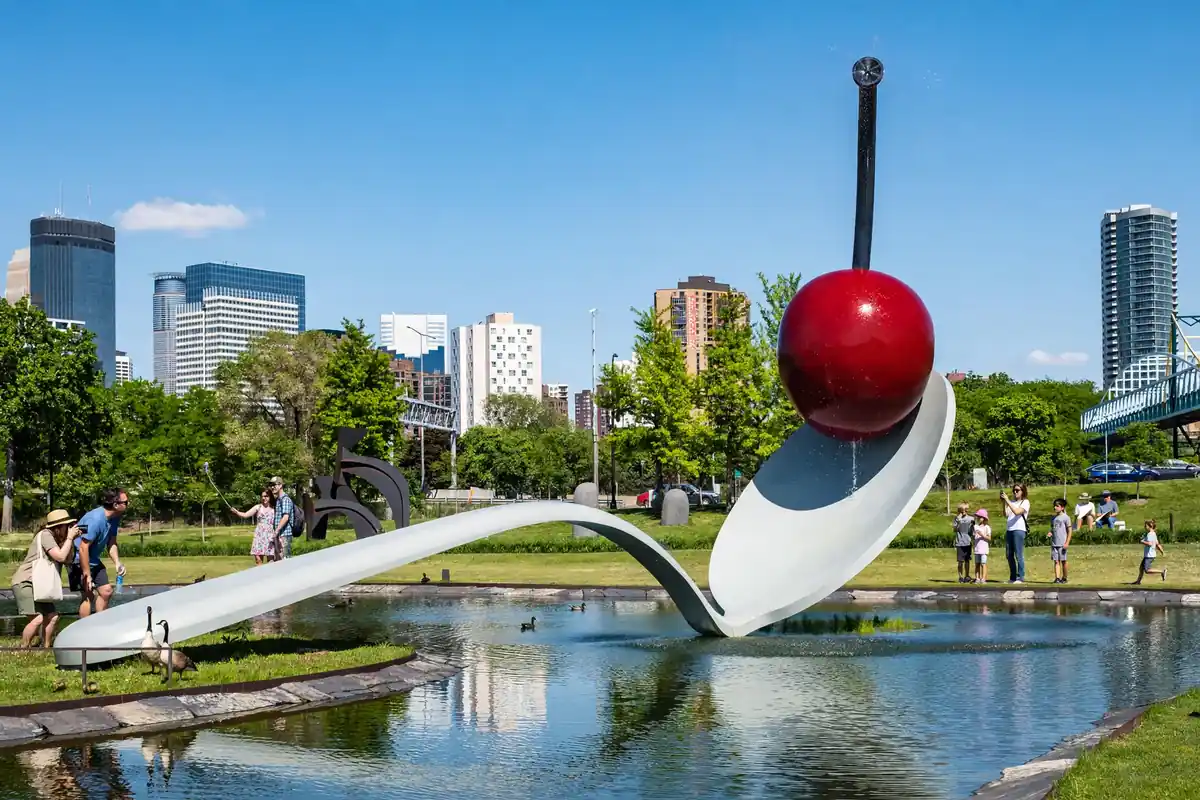
The Walker is Minneapolis’s temple of contemporary art, and the Sculpture Garden next door is its front lawn — eleven acres of open-air sculpture that is free, open daily from 6:00 a.m. to midnight, and home to the city’s most photographed object: Spoonbridge and Cherry, Claes Oldenburg and Coosje van Bruggen’s giant silver spoon holding a bright red cherry over a small pond. The sculpture was installed on May 9, 1988, and it still draws a line of phone cameras every sunny afternoon. Read more about the Walker Art Center on Wikipedia.
The museum itself charges $18 for adults, $16 for seniors 65 and over, $12 for students with ID, $9 for active military and families, and it is free for everyone 18 and under, for members, and for EBT cardholders. Hours are Wednesday to Sunday, 10:00 a.m. to 5:00 p.m., with Thursday evenings until 9:00 p.m.; it is closed on Mondays and Tuesdays. The garden, by contrast, costs nothing and never closes its gate until midnight. A useful trap to avoid: several older guides quote the Walker at $15 or say the garden charges admission. Neither is true in 2026 — the garden is free, and the museum is $18.
3. Stone Arch Bridge
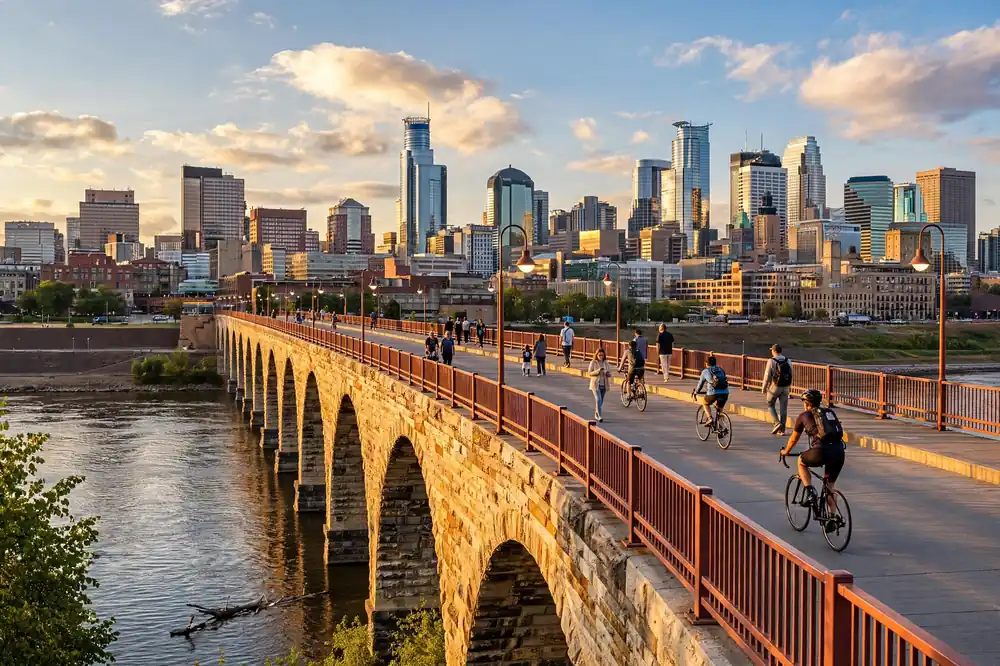
Here is the headline freshness fact of this guide, and the one most other guides still get wrong: the Stone Arch Bridge is OPEN. The 2,100-foot former railway bridge — 23 stone arches completed in 1883, a National Historic Civil Engineering Landmark — closed in April 2024 for a $38.5 million mortar and stone repair, and it reopened on July 21, 2025, months ahead of schedule, with a ribbon-cutting celebration on August 9, 2025. Guides written in 2024 and 2025 still say it is closed. It is not. Read more about the Stone Arch Bridge on Wikipedia.
Walk it at sunset. The bridge is pedestrian and bicycle only, and from the middle you get the classic Minneapolis view: St. Anthony Falls and the mill ruins on one side, the downtown skyline on the other, and the Guthrie Theater’s blue cantilever jutting over the river. Come at dawn if you want it to yourself, or cross it as part of the St. Anthony Falls Heritage Trail, the 1.8-mile riverfront loop that links the bridge, the mill ruins and the Guthrie. It is free, it is open around the clock, and it is the single best first walk in the city.
4. Mill City Museum
The Mill City Museum is built into the ruins of the Washburn A Mill — once the largest flour mill in the world — and it tells the story of how Minneapolis became the flour-milling capital of the planet. The star is the Flour Tower, a freight-elevator ride through the ruined mill that ends on an observation deck over the Mississippi. The museum sits at 704 South 2nd Street, right beside the Stone Arch Bridge, so pair the two. Read more about the Mill City Museum on Wikipedia.
Now the trap. Older guides quote admission at $12 or $14 and say the museum is open Tuesday to Sunday. Both are out of date. The official Minnesota Historical Society price in 2026 is $15 for adults, $12 for seniors 65 and over, veterans, active military and college students, $8 for children aged 5 to 17, and free for children under 4 and for MNHS members. Hours have also been scaled back: the museum is open Thursday and Friday from 10:00 a.m. to 4:00 p.m. and Saturday and Sunday from 10:00 a.m. to 5:00 p.m., and it is closed Monday to Wednesday. Tickets are sold on site only — there is no advance online sale — so arrive early on a Saturday, when the Flour Tower queue is longest.
5. Guthrie Theater and the Endless Bridge
The Guthrie is one of America’s great regional theaters, but you do not need a ticket to enjoy its best feature. The Endless Bridge is a 175-foot cantilevered walkway, designed by French architect Jean Nouvel, that juts out from the fourth and fifth floors of the theater at 818 South 2nd Street and hangs over the Mississippi with tiered seating at the end. It is free, it is open to the public seven days a week, and on most nights it stays open until 11:00 p.m. Read more about the Guthrie Theater on Wikipedia.
Go for the view, then stay for the building. The blue steel exterior is one of the most photographed structures in the city, the ninth-floor Yellow Room has the best panorama of downtown and the river, and the theater’s three stages stage everything from Shakespeare to new American plays — tickets typically run $30 to $100. Backstage tours run on Friday and Saturday mornings. The Endless Bridge is also the best place in the city to photograph the Stone Arch Bridge at golden hour, with no crowds and no ticket.
6. Minnehaha Falls and Minnehaha Regional Park
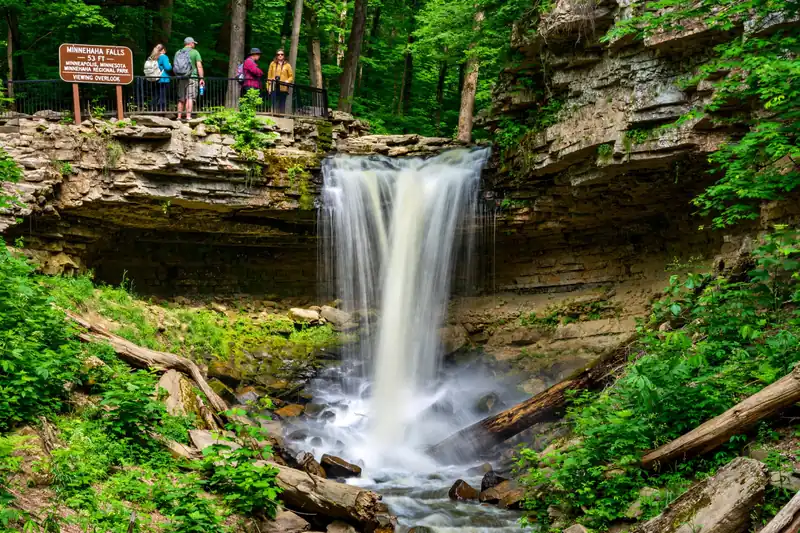
A 53-foot waterfall inside the city limits sounds like a trick, but Minnehaha Falls is real, free, and ten minutes from downtown. Minnehaha Creek drops over a limestone ledge into a wooded gorge in Minnehaha Regional Park, and the park around it — 67 acres of trails, gardens, a bandstand and picnic areas — is open daily from 6:00 a.m. to 10:00 p.m. The falls are at their best in spring, when snowmelt turns the creek into a thundering curtain, and in deep winter, when the whole drop freezes into a blue-white ice column that photographers travel for. Read more about Minnehaha Falls on Wikipedia.
Two honest warnings. First, the flow is not constant: in a dry late summer the falls can shrink to a trickle, so spring and early summer are the reliable months for a big flow. Second, the much-loved Sea Salt Eatery — the seasonal seafood counter in the park pavilion, famous for its scallop po’boy and crab claw bucket — is open roughly April through October only, and the line on a summer weekend can run 45 minutes. Arrive before noon or after 2:00 p.m. The park is on the METRO Blue Line at the 50th Street/Minnehaha Park station, and paid street parking near the pavilion runs about $2.50 an hour.
7. Chain of Lakes
Minneapolis calls itself the City of Lakes, and the Chain of Lakes is where the nickname earns its keep. Four lakes — Bde Maka Ska, Lake Harriet, Lake of the Isles and Cedar Lake — are linked by a 13-mile loop of paved trails, and on a summer evening the whole circuit fills with cyclists, runners, paddleboarders and families walking dogs. Bde Maka Ska is the biggest and the liveliest, with beaches, kayak rentals and a sailing school; Lake Harriet has the bandshell and the rose garden; Lake of the Isles is the quiet, pretty one; Cedar Lake is the wild card, with a dog beach and a more wooded feel.
Rent a bike and ride the loop. Nice Ride bikes and rental shops cluster around Bde Maka Ska and Lake Harriet, and the full circuit takes two to four hours at a relaxed pace. In winter the same lakes freeze and the scene flips: ice skating, cross-country skiing and even ice fishing, with warming houses at the beaches. It is all free except rentals, and it is the single best answer to the question of what locals actually do on a nice day.
One name deserves a note. Bde Maka Ska was called Lake Calhoun until 2018, when the Dakota name — meaning Lake White Earth — was officially restored after a long campaign. You will still see the old name on some maps and in some older guides, but every sign, bus stop and rental shop in the city now uses Bde Maka Ska, and using the new name is the respectful choice.
8. First Avenue and 7th St Entry
First Avenue is the most famous small music venue in America that is not in New York or Los Angeles. The black building at 701 North 1st Avenue, its facade covered in silver stars bearing the names of the artists who played there, is where Prince filmed Purple Rain and where the city’s music scene still runs on most nights of the year. The smaller 7th St Entry, attached to the same building, hosts the up-and-coming bands. Read more about First Avenue on Wikipedia.
Check the calendar before you arrive — shows run most nights, tickets typically run $15 to $60, and the best nights sell out. Even if you do not catch a show, walk past the star wall in the evening and read the names: it is a history of American music in silver paint. Prince’s star is the one everyone photographs. The venue is 21 and over for most shows, with some all-ages nights, so check the listing.
9. Paisley Park
Prince’s home, studio and creative sanctuary sits in Chanhassen, about a 30-minute drive southwest of downtown Minneapolis, and it has been open as a museum since October 2016. The 90-minute guided tour takes you through the main floor — the studios where he recorded some of his most famous hits, the atrium, the soundstage — and the longer VIP and Ultimate tours add private quarters and more time. Tours run $75 to $199 before fees, tickets must be bought in advance online, and phones are secured at check-in, so do not expect to take photos inside. Read more about Paisley Park on Wikipedia.
Book weeks ahead, especially in summer. The 2026 Prince Celebration, June 3 to 7, marked the tenth anniversary of his death on April 21, 2016, and demand has stayed high since. A useful trap to avoid: older guides quote tours from $45 or $48. Those prices are gone — the current range is $75 to $199, per Meet Minneapolis. Paisley Park is at 7801 Audubon Road, Chanhassen; there is no public transit that gets you there, so drive or book a rideshare.
10. Mall of America
Yes, it is a mall, and yes, it is worth half a day. The Mall of America in Bloomington — 15 minutes from downtown Minneapolis, at the end of the METRO Blue Line — is the largest shopping and entertainment complex in the United States: 5.6 million square feet, more than 520 stores, 60 restaurants, and a seven-acre indoor theme park, Nickelodeon Universe, sitting in the middle of it with 27 rides. Entry to the mall is free, parking in the ramps is free, and Minnesota charges no sales tax on clothing or shoes, which is why shoppers drive in from three states away. Read more about the Mall of America on Wikipedia.
The mall is open Monday to Saturday from 10:00 a.m. to 9:00 p.m. and Sunday from 11:00 a.m. to 7:00 p.m. Nickelodeon Universe is the main paid attraction — an unlimited wristband was $52.49 in 2026, with $41.99 Deal Days on a reduced ride schedule — and SEA LIFE Minnesota Aquarium, FlyOver America, the Crayola Experience and the LEGO Store fill out the rest. Come on a weekday morning if you can; the theme park queues are shortest before noon, and the mall hosts more than 400 free events a year, so check the schedule before you go.
11. Foshay Tower Museum and Observation Deck
Minneapolis’s first skyscraper still gives the best view in the city. The Foshay Tower, built in 1929 and modeled on the Washington Monument, is now the W Minneapolis hotel at 821 Marquette Avenue, and its museum and observation deck sit at the top — the museum on the 30th floor, the open-air deck on the 31st. Tickets are about $20 per adult, bought at the hotel front desk, and free for guests of the W. The deck is open daily, roughly 9:00 a.m. to 9:00 p.m., weather permitting, and it closes in extreme cold or bad weather, so call ahead in winter.
Two things to know before you go. The deck itself is reached by climbing two flights of stairs from the elevator, so it is not step-free — there is a webcam alternative for anyone who cannot climb. And the hours vary by season, with some sources listing a noon opening, so check at the front desk on the day. On a clear evening the 360-degree view runs from the Mississippi to the lakes, and it is the best sunset in downtown.
12. Basilica of Saint Mary
The Basilica of Saint Mary, at 88 North 17th Street, is the first basilica established in the United States — designated in 1926 — and it is one of the most beautiful buildings in the city, a white Beaux-Arts church with a great dome that anchors the western edge of downtown. It is free to visit, open daily, and the interior is worth the walk: marble, mosaics and a calm that feels a long way from Hennepin Avenue. Read more about the Basilica of Saint Mary on Wikipedia.
Time your visit for a Sunday Mass if you want to hear the organ, or for the Basilica Block Party in July, the annual two-day music festival on the church grounds that has become one of the city’s biggest summer weekends. The Basilica sits beside Loring Park, so combine it with a walk through the park and the Sculpture Garden, which is five minutes away.
13. Target Field
Baseball in Minneapolis means Target Field, the open-air home of the Minnesota Twins at 1 Twins Way in the North Loop. The ballpark opened in 2010, it is consistently ranked among the best in baseball for sightlines and food, and a summer evening game — with the skyline behind the outfield and the smell of grilled food in the air — is one of the city’s great nights out. Tickets start in the $20s for most games, and the Twins play from late March through September, with the best weather in June, July and August.
Even non-fans should come for the food: the ballpark’s concessions are a tour of Minnesota, from walleye sandwiches to local craft beer. Arrive early and walk the plaza, where the Twins’ history is on display, and stay for the postgame fireworks on Friday nights in summer. The ballpark is on the METRO Blue and Green lines at Target Field Station, so there is no need to drive.
14. U.S. Bank Stadium
The Vikings’ home is a building you notice from a mile away: a glass prow of a stadium, opened in 2016 at 401 Chicago Avenue, that looks like a Viking longship docked in downtown Minneapolis. It hosted the Super Bowl in 2018 and the NCAA Final Four in 2019, and on game days the whole of downtown turns purple. Tickets for Vikings games start around $50 and climb steeply for big matchups, so book early.
If you are not here on game day, take a guided tour. Tours run on non-event days and take you through the locker room, the field level and the press box, with the stadium’s engineering — the largest glass doors in the world, the transparent roof — as the main attraction. The stadium is on the METRO Blue and Green lines at U.S. Bank Stadium Station, and the Commons, the park outside, is a good free picnic spot on a sunny day.
15. Minneapolis Skyway System
Minneapolis invented the answer to its own winter: a 9.5-mile network of enclosed, climate-controlled pedestrian bridges, the largest continuous skyway system in the world, linking about 80 downtown blocks at the second-floor level. The first skyways were built in the early 1960s, and today they connect office towers, hotels, banks, restaurants and shops to Nicollet Mall, Target Center, Target Field and U.S. Bank Stadium — so you can cross most of downtown in January without going outside. Read more about the Minneapolis Skyway System on Wikipedia.
The system is free and it is a genuine attraction, not just infrastructure. Download a skyway map before you go, because the network is a maze the first time, and know the catch: each section is owned by the building it connects, so hours vary, and many sections close in the evenings and on weekends. Weekday daytime is the time to walk it. In summer it is a curiosity; in winter it is the reason the city keeps moving.
16. Northeast Minneapolis Arts District
Cross the Mississippi to Northeast, the city’s old working-class neighborhood turned arts district, and you will find the densest concentration of working artists in the Twin Cities. Galleries, studios, breweries and old warehouses line streets like 13th Avenue and Central Avenue, and the district’s calling card is Art-A-Whirl, held each May — billed as the largest open studio tour in the country, when hundreds of artists open their doors for a weekend.
Come for the beer as much as the art. Indeed Brewing, Bauhaus Brew Labs and Dangerous Man Brewing are all in Northeast, and Surly Brewing’s destination brewery and beer hall is a short drive away in Prospect Park. The Northeast Minneapolis Farmers Market, on Saturdays in summer, is one of the best in the city. Northeast is also where the city’s Eastern European roots show — Kramarczuk’s, the old sausage shop and deli on East Hennepin, has been serving since 1954.
17. Midtown Global Market
The Midtown Global Market, at 920 East Lake Street, is Minneapolis in one room: a public food hall inside a former Sears building, with dozens of stalls cooking food from around the world. It is where the city’s immigrant communities feed the city — Hmong sausage and papaya salad, Somali sambusas, Mexican tacos, Middle Eastern kebabs, Vietnamese pho — and it is the best single lunch stop in Minneapolis.
Go hungry and graze. A full meal runs $10 to $15, the stalls are mostly counter-service, and the market is busiest at lunch on Saturdays. It is also the best place to try Hmong food, which is one of the city’s defining cuisines: the Twin Cities are home to one of the largest Hmong communities in the United States, and the market’s Hmong vendors serve the real thing. The market is on the METRO Blue Line at Lake Street/Midtown Station.
18. Frederick R. Weisman Art Museum
The Weisman is the building you photograph before you even go inside. Frank Gehry’s stainless-steel sculpture of a museum sits on the University of Minnesota’s East Bank campus, overlooking the Mississippi, and admission is free. Inside is a collection of more than 25,000 works, strongest in American modernism, Native American pottery and Korean furniture, with rotating exhibitions that are usually free as well.
It is a short walk from the METRO Green Line’s East Bank Station, and it pairs well with a campus stroll and a look at the river from the Washington Avenue Bridge. The Weisman is smaller than Mia and the Walker — an hour is enough — but the building alone justifies the trip, and on a sunny day the terrace is one of the best free views of the river in the city.
19. Lake Harriet and the Lyndale Park Rose Garden
Lake Harriet is the most beloved of the Chain of Lakes, and its southern shore holds two of the city’s prettiest free stops. The Lake Harriet Bandshell hosts free concerts all summer — the Lake Harriet Concert Series runs most evenings in June, July and August, with the Minneapolis Pops and local bands playing as the sun sets over the water — and the Lyndale Park Rose Garden, planted in 1907 and one of the oldest public rose gardens in the country, blooms from June through September with thousands of roses in formal beds.
Come in the evening. Bring a picnic, claim a patch of grass near the bandshell, and watch the sailboats on the lake. The rose garden is at its best in late June and July, and it is free and open from dawn to dusk. The 21 bus and the METRO Blue Line’s 46th Street Station both get you close, and the walk from the station to the lake is part of the pleasure.
20. Minnesota State Fair
The Great Minnesota Get-Together is not a year-round attraction — it runs for just 12 days — but it is the biggest event in the state, and if your trip overlaps with the fair, it belongs at the top of your list. The 2026 fair runs August 27 to September 7 at the fairgrounds in Falcon Heights, on the St. Paul border, and it draws nearly two million visitors for farm animals, grandstand concerts, carnival rides and food on a stick. Admission in 2026 is $20 for ages 13 to 64, $18 for seniors 65 and over and children aged 5 to 12, and free for children under 4. Read more about the Minnesota State Fair on Wikipedia.
The 2026 fair has a milestone: the Tilt-A-Whirl turns 100 — it debuted at this fair — alongside 36 new foods, nine new vendors and some 1,600 menu items at around 300 concessions. The grounds open at 7:00 a.m. and close at 11:00 p.m., 9:00 p.m. on Labor Day, and there are 32 free Park and Ride locations around the metro. Go on a weekday if you can; weekends are shoulder-to-shoulder. And yes, the fair is in Falcon Heights, not Minneapolis proper — but nobody in the Twin Cities would leave it off a Minneapolis list.
Minneapolis in 3 days — a ready-made itinerary
| Day | Theme | Highlights |
|---|---|---|
| Day 1 | Riverfront and downtown | Stone Arch Bridge, Mill City Museum, Guthrie Endless Bridge, Foshay Tower, First Avenue at night |
| Day 2 | Art and lakes | Mia, Walker Art Center and Sculpture Garden, Basilica of Saint Mary, Chain of Lakes by bike, Lake Harriet bandshell |
| Day 3 | Waterfalls, markets and a day trip | Minnehaha Falls, Midtown Global Market, Mall of America or Paisley Park |
Day 1 — Riverfront and downtown
Start at the Stone Arch Bridge for the morning light over the river, then cross into the Mill District for the Mill City Museum and the Flour Tower. Lunch in the North Loop — the old warehouse district is now the city’s best restaurant row — then walk the riverfront to the Guthrie for the Endless Bridge and the ninth-floor Yellow Room. In the late afternoon, take the elevator up the Foshay Tower for the sunset view, and finish the day with dinner downtown and a show at First Avenue or the Guthrie, depending on what is on.
Day 2 — Art and lakes
Spend the morning at Mia — it opens at 10:00 a.m., and two hours is the minimum — then head to the Walker Art Center and the Sculpture Garden for the afternoon, with Spoonbridge and Cherry as the photo stop. Walk the five minutes to the Basilica of Saint Mary, then rent a bike and ride the Chain of Lakes loop: Bde Maka Ska to Lake of the Isles to Lake Harriet, where the bandshell concert starts in the evening. Dinner in Uptown or Lyn-Lake, the neighborhoods just east of the lakes, which are full of bars and restaurants.
Day 3 — Waterfalls, markets and a day trip
Take the Blue Line to Minnehaha Falls in the morning, when the light is best and Sea Salt Eatery has no line, then ride the same line back to the Midtown Global Market for a grazing lunch. The afternoon is your choice: the Mall of America for the theme park and tax-free shopping, or Paisley Park in Chanhassen for the Prince tour — both need advance planning, the mall for the rides and Paisley Park for the tickets. Finish with a last walk on the Stone Arch Bridge or a drink in the North Loop.
Best time to visit Minneapolis
| Season | Weather | What to expect |
|---|---|---|
| Spring (April–May) | Highs 55–70°F, rain possible | Waterfalls at full flow, gardens waking up, thinner crowds, unpredictable weather |
| Summer (June–August) | Highs 80–85°F, humid at times | Peak season: lakes, patios, festivals, State Fair in late August, busiest and priciest |
| Fall (September–October) | Highs 60–75°F in September | Best overall: warm days, fall colour, fewest rainy days, crowds gone |
| Winter (November–March) | January averages a high of 24°F and a low of 9°F | Frozen falls, skyways, winter festivals — and about 51 inches of snow a year |
September is the best month to visit Minneapolis. The summer crowds have gone, the lakes are still warm enough for a paddle, the days are warm — highs in the mid-70s — and September has the fewest rainy days of the warm months. Late May and June are the next best, with long days and everything open, though June is the wettest month. July is the warmest month, with normal highs of 83°F, and it is also festival season — but it is hot, humid and busy.
Winter is the honest part of the story. Minneapolis is the coldest of America’s great cities in winter: January averages a high of 24°F and a low of 9°F, subzero nights happen on 20 to 30 nights a year, and the city gets about 51 inches of snow. But the city is built for it — the skyways keep downtown moving, the lakes freeze for skating and skiing, Minnehaha Falls turns into an ice column, and the winter festivals are real. The old Holidazzle holiday festival ended after 2025 and has been replaced by a broader winter program called Winterapolis, so guides still listing Holidazzle are out of date. If you come in winter, pack like you mean it: insulated boots, a real coat, gloves and a hat are not optional.
Where to stay in Minneapolis
| Area | Best for | Vibe |
|---|---|---|
| Downtown and North Loop | First-timers, walkers, nightlife | Hotels, restaurants and the ballpark in one walkable grid |
| Mill District | Riverfront views, couples | Quiet, scenic, beside the Stone Arch Bridge and the Guthrie |
| Uptown and Lyn-Lake | Lakes, bars, younger crowds | Laid-back, walkable, close to the Chain of Lakes |
| Northeast | Art, breweries, value | Old warehouses, galleries, cheaper rooms, a short drive downtown |
First-timers should stay downtown or in the North Loop. Downtown puts you on the light rail, inside the skyway network and within walking distance of the riverfront, Target Field, First Avenue and the theaters, and the North Loop — the old warehouse district just northwest of downtown — is the city’s best restaurant row, with boutique hotels like The Hewing Hotel on North 1st Avenue. The Mill District, around the Guthrie and the Stone Arch Bridge, is quieter and more scenic; the Canopy by Hilton Minneapolis Mill District is the obvious pick there, and the W Minneapolis – The Foshay, inside the 1929 tower, is the most characterful stay downtown.
If you want lakes over skyscrapers, stay in Uptown or Lyn-Lake, the neighborhoods just east of Bde Maka Ska and Lake Harriet, where the bars, cafes and bike paths are. Northeast is the value pick — cheaper rooms, breweries and galleries — and the Graduate Minneapolis, by the University of Minnesota, suits anyone combining the city with the campus and the Weisman. Wherever you stay, book early for State Fair week and for big Vikings and Twins weekends, when downtown rooms sell out.
Getting around Minneapolis
The light rail is the backbone. METRO Transit’s Blue Line runs from Target Field downtown through the airport to the Mall of America in Bloomington, and the Green Line runs from Target Field through the University of Minnesota to Union Depot in St. Paul — an 11-mile ride of about 49 minutes. Fares are a flat $2.00 at all times and any distance, a change that took effect in January 2025; reduced fares are $1.00 for youth aged 6 to 12, seniors 65 and over and Medicare holders, children under 5 ride free, an all-day pass is $4.00, and the Downtown Zone is 50 cents. Pay before boarding — there are no fareboxes on the trains — and transfers are included for two and a half hours.
Two freshness facts matter here. First, the Blue Line was closed from June 29 to August 19, 2026 for track and signal rebuilding, with replacement buses running the whole line including the airport — trains resumed on August 20, 2026, so any guide that still shows the closure is out of date. Second, the Northstar commuter rail closed for good in January 2026, and the Green Line Extension to Eden Prairie is built but not yet carrying passengers, with an opening targeted for 2027. Do not plan a trip around either one.
Beyond the trains, buses cover the city, Nice Ride bikes are everywhere in summer, and the Skyway System lets you walk downtown in winter without going outside. The airport, Minneapolis–Saint Paul International, is about 25 minutes from downtown on the Blue Line. A car is useful only for Paisley Park and the State Fair; downtown parking is expensive, and the light rail and buses cover everything else.
Minneapolis food you have to try

1. The Jucy Lucy at Matt’s Bar
The Jucy Lucy is Minneapolis’s signature dish: a burger made from two thin beef patties sealed around a slice of cheese, so the first bite releases molten cheese. Two South Minneapolis bars both claim to have invented it in the 1950s — Matt’s Bar and the 5-8 Club — and the rivalry is part of the fun, but Matt’s is the one most critics pick. Matt’s Bar, at 3500 Cedar Avenue South, has been serving it since 1954, the burger costs about $9.50, and the bar is cash only — no cards — with an ATM inside. Read more about the Jucy Lucy on Wikipedia.
Order it with grilled onions and a basket of fries, and heed the warning every server gives: let it sit for a minute before the first bite, because the cheese inside reaches about 180°F. The 5-8 Club, the other claimant, is worth a visit too if you want to settle the debate yourself — and Time magazine once ranked the Jucy Lucy among the most influential burgers of all time.
2. Walleye, the state fish
Walleye is the official state fish of Minnesota, and the fried walleye sandwich is the dish locals order without thinking. The best version is the one you eat outside: at Sea Salt Eatery in Minnehaha Park, where the walleye sandwich comes with a view of the falls, or at the lakeside stands around Bde Maka Ska in summer. The fish is mild, sweet and flaky, usually beer-battered and served on a soft bun with tartar sauce, and a sandwich runs about $15 to $20.
Walleye shows up everywhere in the city — as fish and chips, as a dinner entree with wild rice, and as the walleye cakes on smarter menus downtown. If you see “walleye” on a menu and it is not on the lakes, ask where it is from; the real thing is Minnesota-caught, and the city’s best restaurants say so. Pair it with a local beer and you have the most Minnesotan meal there is.
3. Hmong food at the Midtown Global Market
The Twin Cities are home to one of the largest Hmong communities in the United States, and Hmong food is one of the defining cuisines of Minneapolis. The best place to try it is the Midtown Global Market, where Hmong vendors serve herbaceous, sour and spicy dishes that most visitors have never tasted: Hmong sausage, grilled and stuffed with lemongrass and herbs; papaya salad pounded to order with lime, chili and fermented fish sauce; sticky rice; and beef laab with mint and toasted rice powder.
A full Hmong lunch at the market runs $12 to $18, and the vendors are happy to explain the dishes if you ask. It is the most distinctive food experience in the city — and the one most guides skip entirely, because they never leave downtown. Go for lunch, order the sausage and the papaya salad, and thank the Twin Cities’ Hmong community for making Minneapolis taste like nowhere else in America.
Free things to do in Minneapolis
Minneapolis is one of the most generous free cities in America. The Minneapolis Institute of Art is free, the Sculpture Garden is free and open until midnight, the Stone Arch Bridge is free, the Guthrie’s Endless Bridge is free, the Weisman Art Museum is free, Minnehaha Falls and the whole Chain of Lakes are free, the Skyway System is free, and the Basilica of Saint Mary is free. Add the Lake Harriet Bandshell’s free summer concerts, the free first Thursdays at the Walker, and the free admission to the Minnesota State Fair grounds on some days, and you can fill three days without spending a dollar on admission.
Two more free stops deserve a mention. The first is the riverfront itself — the St. Anthony Falls Heritage Trail, the mill ruins and the lock and dam overlooks cost nothing and are the best walk in the city. The second is George Floyd Square, at 38th Street and Chicago Avenue in South Minneapolis, the memorial site where George Floyd was murdered in 2020. It is a place of remembrance, not a tourist attraction: visit quietly and respectfully, read the memorials, and do not treat it as a photo stop.
Frequently asked questions
Is Minneapolis worth visiting?
Yes — and it rewards visitors more than its reputation suggests. The art is world-class and largely free, the riverfront and the lakes are genuinely beautiful, the food scene is one of the most interesting in the Midwest, and the Prince history is unique. It is not a big, flashy city, and that is the point: three days here feels like discovering a place, not ticking boxes.
How many days do you need in Minneapolis?
Three days covers the city well: one day for the riverfront and downtown, one for the museums and the lakes, and one for Minnehaha Falls plus a day trip to the Mall of America or Paisley Park. Add a fourth day if you want both day trips, or if you are here for the State Fair, which deserves a full day on its own.
Is the Stone Arch Bridge open?
Yes. The bridge closed in April 2024 for a $38.5 million repair and reopened on July 21, 2025, months ahead of schedule. Many guides written in 2024 and 2025 still say it is closed — they are out of date. The bridge is pedestrian and bicycle only and open around the clock.
Is Minneapolis expensive?
It is mid-range for an American city. Budget roughly $150 to $250 per person per day, before hotel, for food, transport and admissions — and much of the best of the city is free. Light rail rides are a flat $2, the best museums are free or $15 to $18, and a Jucy Lucy is under $10. Hotels downtown run $150 to $250 a night in summer, more during State Fair week and big game weekends.
Is Minneapolis safe for tourists?
Downtown, the riverfront, the lakes and Uptown are safe for visitors using normal city sense — stay aware at night, use rideshares late, and keep valuables out of sight in parked cars, as in any American city. The light rail is safe and well used. Like any city, Minneapolis has neighborhoods visitors have no reason to go to; stick to the areas in this guide and you will be fine.
What is Minneapolis famous for?
Four things: the Mississippi River and the flour mills that made it the milling capital of the world; the lakes, which gave it the nickname City of Lakes; Prince, who lived, recorded and filmed Purple Rain here; and the Jucy Lucy, the cheese-stuffed burger that two bars have argued over since the 1950s. The art scene — Mia, the Walker, the Guthrie — is the fifth, and the one most visitors are surprised by.
Further reading — Wikipedia, Reddit and Quora
For the background behind this guide, start with the Minneapolis page on Wikipedia, the Stone Arch Bridge page on Wikipedia and the Mill City Museum page on Wikipedia. For what locals are actually talking about right now, the Minneapolis subreddit is the city’s busiest forum — restaurant openings, lake conditions, concert announcements and the endless Jucy Lucy debate. And for a visitor’s-eye view, this Quora thread on the most underrated places to visit in Minnesota is full of Minneapolis answers, from First Avenue to the Walker and Mia.
Your Minneapolis trip, in one paragraph
Three days in Minneapolis gives you a riverfront walk on a bridge that only just reopened, two of the best free museums in America, a sculpture garden with a giant spoon, a waterfall inside the city, four lakes by bike, a Prince pilgrimage, a mall with a theme park in the middle, and a burger with the cheese on the inside. If you want more city guides in the same style, we have them: Chicago, Nashville, Los Angeles, Orlando, Miami, San Diego, Denver, Savannah, Dallas, Charleston, San Francisco, Myrtle Beach, Las Vegas, San Antonio, London, Portland, Pigeon Forge, Puerto Rico, Atlanta, Phoenix, Paris, Maui, Key West, Colorado Springs, Sedona, Chattanooga, Palm Springs, St Louis, Tokyo, Japan, Kansas City, Tennessee, Branson, Florida, Amsterdam, Montreal, Honolulu, Fort Lauderdale, Toronto, Aruba, Charlotte, Indianapolis, New Orleans, Destin, Santa Barbara, Mexico City, Arizona and Osaka.

About the Author