Things to Do in Lake Tahoe
20 Best Attractions, a 3-Day Itinerary, Where to Stay, and the Food You Cannot Miss
Quick Info
Best for: Beach lovers, skiers, hikers, kayakers and anyone who wants one lake that does summer and winter equally well — clear water, granite boulders and pine forest in one place
Best time: June to September for beaches, kayaking and hiking; February and March for the best skiing; October for the salmon run and fall colour with far fewer crowds
How long: 3 days for the South Shore, Emerald Bay and the East Shore; 4–5 days if you want a ski day and the full 72-mile drive as well
Budget: About $150–$300 per person per day mid-range — hotels and lift tickets are the big costs; the beaches, trails and visitor centres are mostly free or $10–$15 a car
Don’t miss: Emerald Bay at sunrise, Sand Harbor before the crowds, the Heavenly Gondola, a kayak to Bonsai Rock and the M.S. Dixie II at sunset
Lake Tahoe on Wikipedia is the clearest large lake in the United States, and it earns that title the moment you look down from the first overlook: water so clear you can see boulders 70 feet below the surface, ringed by granite peaks and pine forest, split down the middle by the California–Nevada line. It is also two trips in one. In summer it is a beach lake — kayaking, paddleboarding, swimming, a 72-mile drive around the shore and a Shakespeare festival at Sand Harbor — and in winter it is one of the biggest ski regions in America, with Palisades Tahoe, Heavenly, Northstar and Kirkwood all on the same lake. This guide covers the 20 best things to do in Lake Tahoe, a 3-day itinerary that pairs the South Shore with the East Shore and the mountains, where to stay without paying resort prices for a room you only sleep in, getting around — including the free buses most visitors never hear about — the food you have to try, and the free things to do that cost nothing. Everything below was checked against live sources in November 2026 — including the details most guides still get wrong: the Tahoe Queen is gone for good, D.L. Bliss State Park is open again after three years closed, Sand Harbor needs a morning reservation in summer, the Flume Trail is closed on weekdays, and the Kokanee salmon run has a closing date.
Lake Tahoe at a glance
| Topic | What to know |
|---|---|
| Full name | Lake Tahoe, California–Nevada — a freshwater alpine lake in the Sierra Nevada, about 22 miles long and 12 miles wide, with 72 miles of shoreline |
| Elevation | 6,225 feet above sea level; the lake is 1,645 feet deep at its deepest, the second-deepest lake in the United States after Crater Lake |
| Size | 191 square miles of water, fed by 63 tributaries; the only outlet is the Truckee River, which flows out at Tahoe City and runs to Nevada |
| Location | On the California–Nevada border: the west and south shores are California, the east shore is Nevada; South Lake Tahoe is the biggest town, on the south shore |
| Getting there | Reno–Tahoe International Airport, about an hour from the north shore and 90 minutes from the south shore; Sacramento is about 2 hours from the south shore |
| Best base | South Lake Tahoe for first-timers and nightlife, Tahoe City or Kings Beach for the north shore, Incline Village for the quiet east shore |
| Getting around | A car is essential for the full loop and the trailheads; all public buses in the basin are free, including TART on the north shore and Lake Link on the south shore |
| Famous for | The clearest water in America, Emerald Bay, Sand Harbor, the 1960 Winter Olympics at Palisades Tahoe, the Heavenly Gondola and the Kokanee salmon run |
Lake Tahoe rewards visitors who treat it as several places, not one. The South Shore is the busy one — hotels, casinos, the Heavenly Gondola and the longest beaches. The West Shore is the quiet, wooded one — Emerald Bay, D.L. Bliss and the Rubicon Trail. The East Shore is the wild one — Sand Harbor, Bonsai Rock and the Flume Trail. And the North Shore is the village one — Tahoe City, Kings Beach and the ski resorts. The mistake most visitors make is staying in one place and driving the same stretch of Highway 50 every day, when the lake is a 72-mile loop and every shore is a different trip. The trap most guides fall into is the outdated detail: the Tahoe Queen stopped sailing in 2016, D.L. Bliss was closed for three whole summers, Sand Harbor now needs a reservation, and the Flume Trail is closed on weekdays for dam work. This guide gets those right, because we checked them in November 2026. One more thing before you pack: Lake Tahoe sits at 6,225 feet, so drink more water than you think you need, wear sunscreen even on cloudy days, and give yourself a slow first morning — altitude headaches are the most common reason a first day goes wrong.
The 20 best things to do in Lake Tahoe
Lake Tahoe’s 20 best sights split neatly into four groups: the water, the mountains, the history and the towns. Do the water first, because it runs on a schedule — Sand Harbor needs a morning reservation in summer, the M.S. Dixie II sells out on weekends, and the Kokanee salmon only run in October. Then the mountains, which are open almost year-round, then the history, which is seasonal, then the towns, which are there whenever you want them.
1. Emerald Bay State Park and Vikingsholm
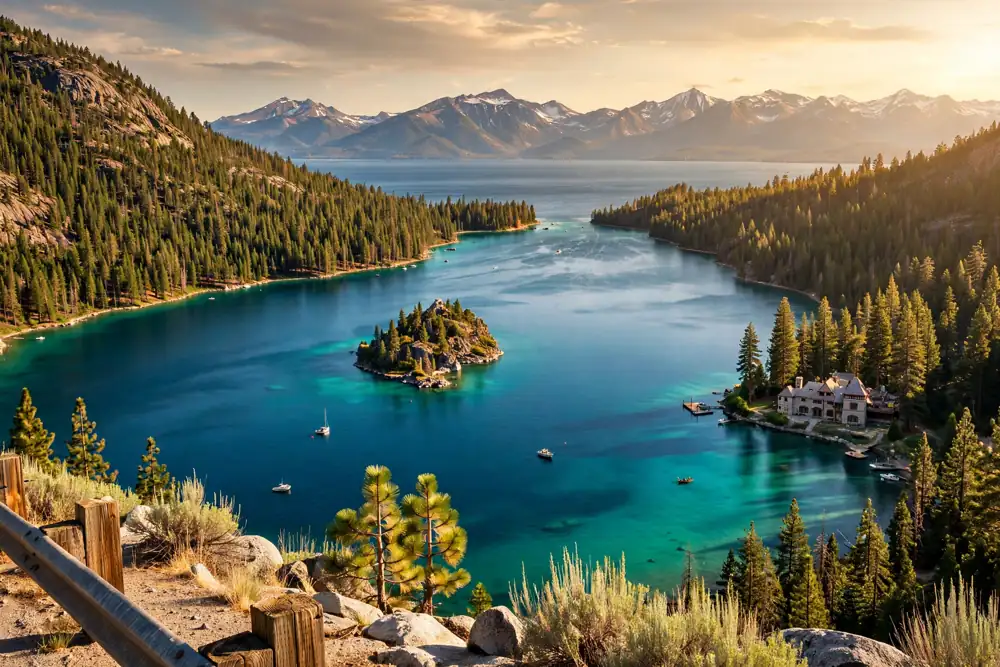
Emerald Bay State Park on Wikipedia is the most photographed place on Lake Tahoe, and the one view that justifies the whole trip. The bay is a flooded glacial valley on the West Shore, a sheltered inlet of impossibly green water with Fannette Island on Wikipedia in the middle of it — the lake’s only island — and Vikingsholm on Wikipedia at its head, a 38-room Scandinavian-style mansion built in 1929 by Lora Josephine Knight, who had the house built from local stone and timber by 200 workers and furnished it with pieces she collected on trips to Scandinavia. The viewpoint on Highway 89, Inspiration Point, is the postcard shot, and it is free — but arrive before 9 a.m. in summer, when the small lots fill and the highway backs up. The walk down to the house is the real experience: a steep one-mile trail from the Vikingsholm lot (2 miles round trip), past Eagle Falls, down to the shore, where the water is at its greenest. The house itself is only open on a guided tour run by the Sierra State Parks Foundation, and this is the timing trap: in 2026 tours ran daily from May 23 to September 30, every half hour from 10:30 a.m. to 4 p.m. (no 12:30 tour), at $18 for adults, $15 for students 7 to 17, seniors, active military and college students, and free for children 6 and under — and that season is now over, with the 2027 dates not yet posted. Parking in the Vikingsholm lot costs $10 per vehicle for the day or $3 for one hour, for vehicles up to 18 feet, and the park is open sunrise to sunset. In winter the bay is still beautiful from the overlook, but the trail down can be icy and the house is closed.
2. Sand Harbor
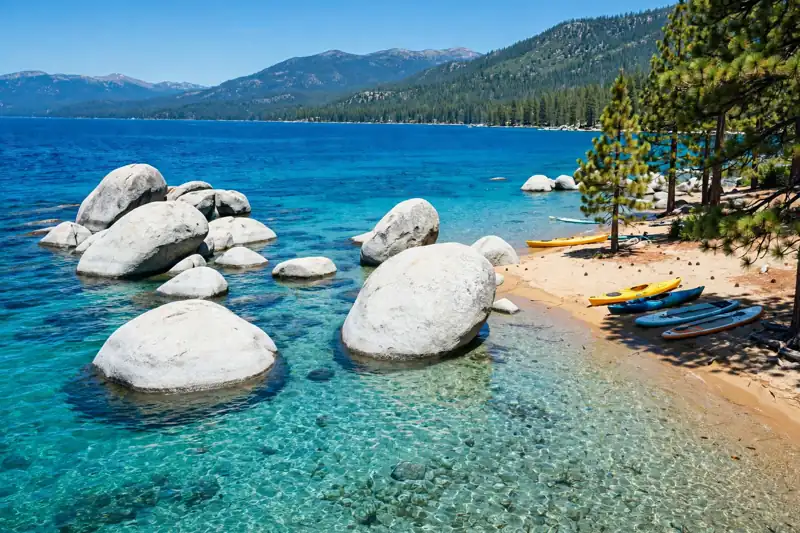
Sand Harbor on Wikipedia is the beach that made Lake Tahoe famous on Instagram, and it is worth the planning it now demands. The day-use area of Lake Tahoe Nevada State Park on the East Shore, about 4 miles south of Incline Village, has the clearest water on the lake, smooth granite boulders rising out of the shallows, a sandy beach, a boat ramp and the lakeside theatre where the Shakespeare Festival plays in summer. The water here is the attraction: swim among the boulders, rent a kayak or a paddleboard and paddle south to Bonsai Rock, or just sit on the sand and watch the light change on the water. The catch is the reservation system, and this is the detail most guides still get wrong: from May 15 through September 30, vehicles need a day-use reservation to enter between 8:00 and 10:30 a.m., booked only at reservenevada.com — not at the gate — at $10 for a Nevada-registered vehicle and $15 for an out-of-state vehicle, plus a $5 processing fee except on same-day bookings. A reservation holds your space only until 10:30 a.m.; after that, unused spaces go first come, first served. From October 1 the reservation requirement ends. The park is open 8 a.m. to one hour after sunset, and parking or dropping off on Highway 28 anywhere other than a designated lot is prohibited — you will be towed. The workaround that works: walk in on the Tahoe East Shore Trail from Incline Village, which needs no vehicle reservation at all, or take the free East Shore Express shuttle in summer. The beach fills by late morning on summer weekends, so go early or go in September, when the water is at its warmest and the crowds are gone.
3. The Heavenly Gondola
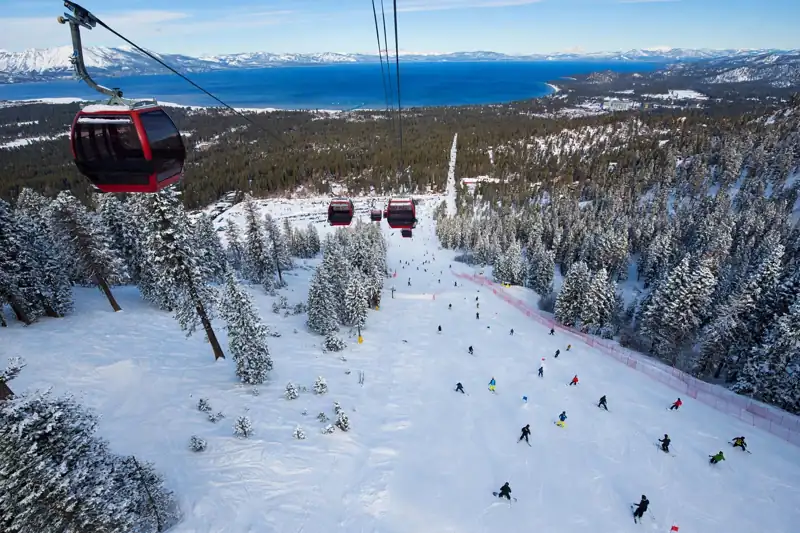
The Heavenly Gondola is the easiest great view in Lake Tahoe: a 2.4-mile ride from Heavenly Village in South Lake Tahoe up to a 9,123-foot observation deck, with the whole lake opening out below you as the cabins climb. Heavenly Mountain Resort on Wikipedia is the mountain that straddles the California–Nevada line, so you can ski in two states in one day, and the gondola is the sightseeing version of the same mountain — no skis required. At the top there are hiking trails, a climbing wall, a zip line and the Tamarack Lodge, and in summer the Epic Discovery activities run alongside the scenic ride. The price is the part to check before you go, because it changes with the season: a summer scenic ride was about $72 to $84 for an adult in 2026, about $52 for a child aged 5 to 12, and the Epic Discovery all-activities pass was $109; winter sightseeing was higher — $108 for an adult, $74 for a child and $95 for a teen or senior on a December 2026 date. Summer operations run late May through late September, daily 10 a.m. to 5 p.m. from mid-June to Labor Day and weekends into late September, with the last uphill boarding at 4 p.m. The gondola closes in high wind, which happens often enough that you should not build a whole day around it — go in the morning, when the air is calmest, and have a backup plan. The ski season was planned to open around November 20, 2026, snow permitting, and to run into early April 2027, with lift tickets from about $139 to $284 a day; Heavenly is on the Epic Pass with Northstar and Kirkwood.
4. Palisades Tahoe
Palisades Tahoe on Wikipedia is the mountain that put Lake Tahoe on the world map, and it is still the biggest ski area on the lake. It hosted the 1960 Winter Olympics on Wikipedia — the first Winter Games televised in America — and the Olympic rings still stand at the base. The resort was called Squaw Valley until 2021, when it was renamed Palisades Tahoe; older guides and older skiers still use the old name, and the mountain is the same one. It covers 6,400 acres across eight peaks, with 279 runs and 39 lifts, and it includes the Alpine Meadows side, so one ticket covers both mountains. The 2026/27 season was planned to open November 25, 2026, and recent seasons have run into May. Lift tickets are priced by date and demand: budget roughly $189 to $289 for a walk-up adult day ticket, with advance online tickets up to 35 percent cheaper, so quiet midweek days in early season or spring can cost well under $200. Palisades Tahoe is on the Ikon Pass, not the Epic Pass. In summer the mountain runs the Aerial Tram to High Camp, with a pool, a hot tub and a roller rink at 8,200 feet, plus hiking and mountain biking. The base village at Olympic Valley has the shops, the restaurants and the ice rink, and the drive up from Tahoe City takes about 15 minutes. If you only ski one day in Tahoe, ski this one — and if you do not ski at all, ride the tram in summer for the view.
5. Kayak to Bonsai Rock
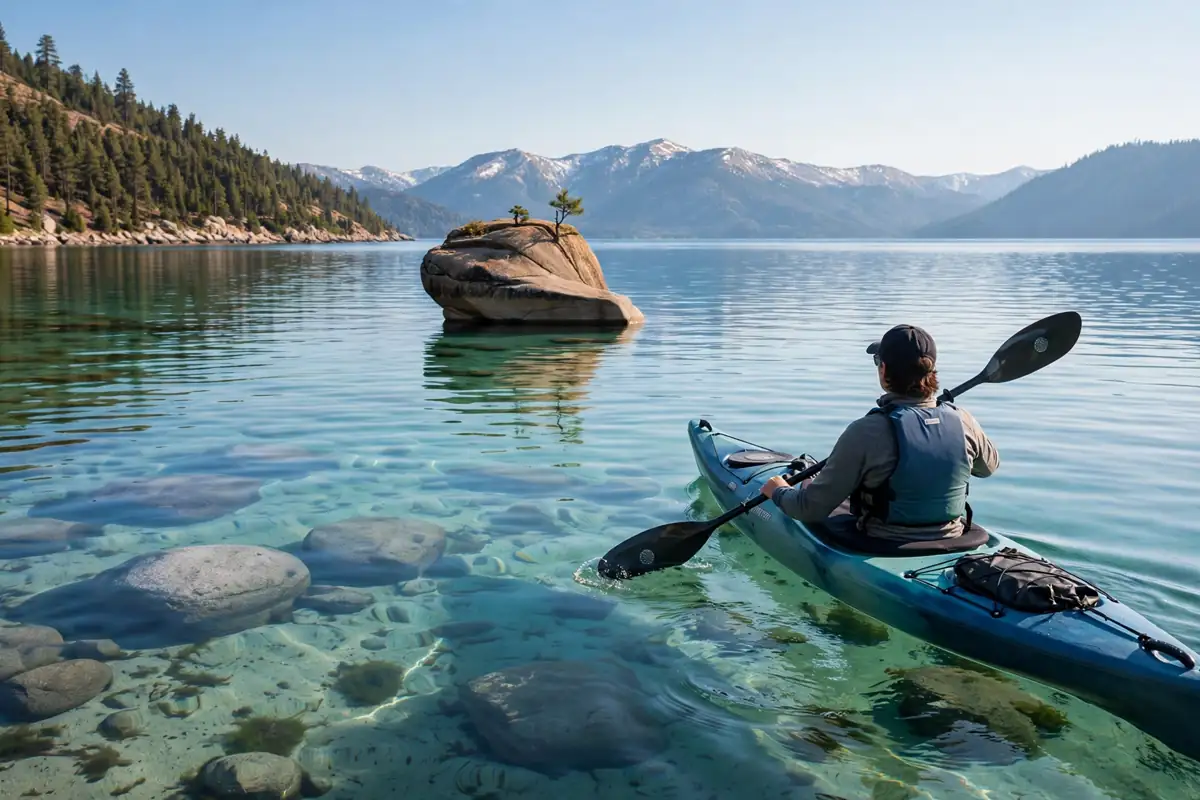
Kayaking to Bonsai Rock is the quietest great experience on Lake Tahoe, and the one that feels most like a secret even though everyone knows about it. Bonsai Rock is a granite boulder on the East Shore, about a mile south of Sand Harbor, topped with a tiny windswept pine tree that looks exactly like a bonsai — and the only sensible way to reach it is from the water. Launch at Sand Harbor, paddle south along the boulder-strewn shore, and you will see the rock from a long way off: the tree is the giveaway. The paddle takes about 20 to 30 minutes each way in calm water, and the water is so clear you can see the boulders 30 feet below your boat. Go early in the morning, when the lake is flat and the light is low, and be off the water by midday in summer, when the afternoon wind picks up and the chop makes the return paddle hard work. Rentals are available at Sand Harbor and at Kings Beach; a single kayak runs about $25 to $40 an hour, and a half-day rental is the better value. The same paddle works for Hidden Beach, about a mile and a half north of Sand Harbor, and for Skunk Harbor, about five miles south — but Bonsai Rock is the one to aim for first. Two warnings that matter: the water is cold even in August, around 65 degrees, so a capsize is a shock, and the East Shore has almost no shade, so bring water, sunscreen and a hat. If you would rather not paddle, the Tahoe East Shore Trail runs along the same shore on foot and by bike, with the same views.
6. The M.S. Dixie II paddle wheeler cruise
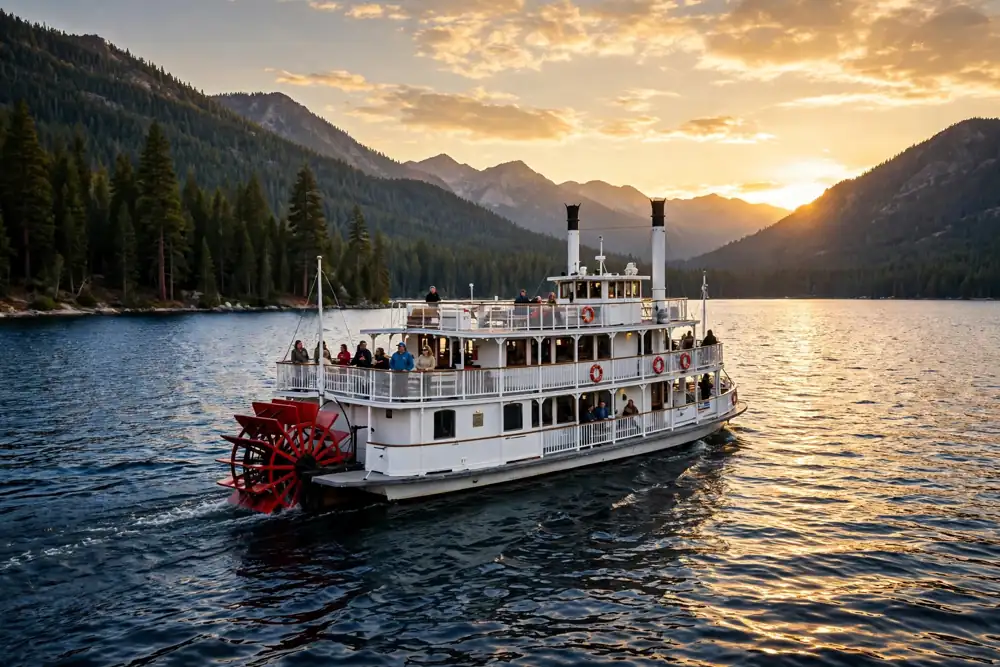
The M.S. Dixie II is the boat to take on Lake Tahoe, and it is the only big paddle wheeler left on the lake. The white Mississippi-style paddle wheeler sails from Zephyr Cove Resort and Marina on the Nevada side, at 760 US Highway 50, on daytime scenic cruises, sunset cruises and dinner cruises, with live narration about the lake’s history, the estates and the old steamers. The daytime scenic cruise runs about two and a quarter hours, usually departing at noon, at about $99 to $116 for an adult — book ahead, because weekend departures sell out in summer. The sunset dinner cruise is about $170, and the boat also runs special cruises through the year, including a Santa Cruise on December 19, 2026, at $99 for an adult and $55 for a child. The boat is the largest cruising vessel on the south shore, with three decks and room to move around, and the top deck is the place to be when the boat rounds into Emerald Bay. One thing to get right: the Tahoe Queen, the other paddle wheeler that older guides still list, is permanently closed — it caught fire in August 2016 and never sailed again, and its tickets are no longer sold. If a guide or a booking site offers you the Tahoe Queen, it is out of date. The Dixie II is the cruise that replaced it, and the Spirit of Tahoe, which runs daily year-round Emerald Bay cruises from Ski Run Marina, is the other reliable option.
7. D.L. Bliss State Park and the Rubicon Trail
D.L. Bliss State Park on Wikipedia is the comeback story of Lake Tahoe, and the park most visitors missed for three years. The 1,830-acre park on the West Shore, just north of Emerald Bay, was closed from June 2023 while crews replaced the water main and added 25 fire hydrants in a $5 million project — and it fully reopened for camping and day use on May 21, 2026, with a new visitor center. Older guides still say it is closed, or do not mention it at all. Lester Beach, at the north end of the park, is one of the best swimming beaches on the lake, with clear water and a sandy shore, and the Rubicon Trail on Wikipedia runs 7.4 miles from Lester Beach along the shore to Emerald Bay and Vikingsholm, past Rubicon Point — where the water is at its deepest and clearest, and where the highest-elevation lighthouse in the United States stands on the point. The Balancing Rock Trail and the Lighthouse Trail are the shorter walks, both worth an hour. Day use is $10 per vehicle, sunrise to sunset, and the park has 168 campsites booked through ReserveCalifornia, including coveted beach sites right on Lester Beach. One seasonal catch: the vehicle road to Lester Beach closes on October 1, 2026, and the park is walk-in only after that, so a late-season visit means a hike in from the highway. Come in late May or June, when the park is freshly open and the crowds have not found it yet.
8. Eagle Falls and Eagle Lake
Eagle Falls is the waterfall walk that every Emerald Bay visitor should do and most skip, because the viewpoint is so good they never get out of the car. The falls drop in two tiers beside Highway 89 at the head of Emerald Bay: the lower falls are a short, steep scramble from the Vikingsholm parking lot, and the upper falls are the start of the Eagle Lake Trail, a 2-mile round trip that climbs through granite and pine to Eagle Lake, a small alpine lake in a granite bowl below the peaks. The trail is the most popular short hike on the West Shore, and it earns it: the lake is the reward, and the views back down to Emerald Bay are the bonus. The trailhead shares the Vikingsholm lot, so the same $10-a-day or $3-an-hour parking applies, and the lot fills by mid-morning in summer — go early, or walk in from the Bayview Trailhead a little further along the highway. The trail is rocky and exposed, so wear real shoes and bring water; in early summer the falls run hardest off the snowmelt, and by late summer they slow to a trickle. In winter the trail is a snowshoe route, and the falls freeze into ice. Allow about two hours for the round trip with stops, and do not try to climb the rocks beside the falls — people are injured there every year.
9. Taylor Creek Visitor Center and the Kokanee salmon run
The Taylor Creek Visitor Center is the best free wildlife show in Lake Tahoe, and it only happens in October. Every fall, Kokanee salmon on Wikipedia — landlocked sockeye — swim up Taylor Creek from the lake to spawn, turning from silver to blazing red with green heads, and crowding the shallow stream shoulder to shoulder. The run peaks in mid-October, and up to 60,000 fish have returned in a good year. The visitor center, run by the U.S. Forest Service on Highway 89 about three miles northwest of South Lake Tahoe, is free, and the half-mile paved Rainbow Trail loops through aspen and marsh to the creek. The star is the Stream Profile Chamber, an underground viewing window that lets you watch the fish swim past at eye level, underwater. The timing matters, and this is the detail to get right: the visitor center is open Thursday through Sunday, 9 a.m. to 4 p.m., and it closed for the 2026 season on October 25, 2026 — the chamber closed with it. The fish keep coming into November, but after the center closes you are on your own, watching from the trail. The run itself is not guaranteed on any given day: the Forest Service says upstream movement depends on water temperature, rain and stream flow, so call the center (530-543-2674) before a special trip. And one warning: the salmon draw black bears, so keep your distance, make noise on the trail, and never approach a bear for a photograph.
10. Tallac Historic Site
The Tallac Historic Site is Lake Tahoe’s Gilded Age, preserved in three estates on the South Shore — and it is the stop that explains how the lake became a playground. The 74-acre site at 1 Heritage Way, on Highway 89 past Camp Richardson, holds the Baldwin Estate, the Pope Estate and Valhalla, the summer homes of San Francisco’s richest families in the late 1800s and early 1900s, when the lake was a private resort for the wealthy. The Baldwin House is now a museum, with exhibits on the families, the Washoe people on Wikipedia and the lake’s early resort years, and the Pope House is open on a docent-guided tour. The site is seasonal, and this is the trap: it opens in May and closes in October, and the 2026 season is over — the final Pope House tour ran on September 20, 2026, and the cabins are now closed for the winter. In season the site is open Thursday through Sunday, 10 a.m. to 4:30 p.m., the grounds are free, the Pope House tour is a $19 suggested donation for adults and $10 for children aged 5 to 12, and the Grand Estates Tour is $25 for an adult and $10 for a child. The grounds stay open year-round for walking and, in winter, for cross-country skiing and snowshoeing, even when the buildings are closed. Allow two hours, and pair it with Taylor Creek next door — the two sites share the same stretch of Highway 89 and the same free parking.
11. The Tahoe Rim Trail
The Tahoe Rim Trail on Wikipedia is the long walk around Lake Tahoe: 165 miles of trail that loops the whole lake through the Sierra Nevada, and the best way to see the parts of Tahoe that no road reaches. Most visitors do not hike the whole thing — they hike a day section, and the best first section is the stretch from Tahoe City to Brockway Summit, which climbs through pine forest to views across the north shore, or the Spooner Summit to Marlette Lake section on the East Shore, which drops to a mountain lake above the east shore. The trail is open, but the Spooner backcountry around it is not always open, and this is the 2026 detail to know: the trails in Spooner Lake Backcountry State Park — the Flume Trail, the Marlette Lake Trail, North Canyon Road and Hobart Road — were closed Monday through Friday, 5 a.m. to 6 p.m., through about October 2026, while crews repaired the Marlette Lake Dam, and Hobart Reservoir stayed closed all summer. The Tahoe Rim Trail itself and the Capital to Tahoe Trail stayed open throughout, and the backcountry trails were open on weekends. Two rules that catch people out: since January 1, 2024, bear canisters are required for all smellables — food, toothpaste, sunscreen — anywhere on the Tahoe Rim Trail, and wood fires are banned across the whole basin through fire season, a restriction that took hold on June 15, 2026. Check the current conditions page at tahoerimtrail.org before you go, and carry more water than you think you need — there is almost no water on the ridge sections.
12. South Lake Tahoe
South Lake Tahoe on Wikipedia is the biggest town on the lake and the easiest base for a first trip, and it earns its place as a single stop because it is a town, not a beach. The city sits at the south end of the lake, on the California side of the state line, with the longest sandy beaches on the lake — El Dorado Beach and Lakeview Commons, where the summer concerts play on the sand — and Heavenly Village at its centre, a walkable cluster of shops, restaurants and the gondola base. Van Sickle Bi-State Park, on the California–Nevada line at the edge of town, is the free local favourite: a short trail up to a waterfall and a viewpoint over the lake, with no crowds and no fee. The farmers market runs on Tuesdays in summer, and the beach at Lakeview Commons is the place to be on a summer evening. South Lake Tahoe is also the base that works without a car: the Lake Link shuttle is free and on-demand, the Route 50 bus is free, and the Tahoe Blue Event Center brings concerts and games to the Stateline edge of town. Stay here if you want the most restaurants, the most hotels and the easiest logistics; stay elsewhere if you want quiet. One honest note: the town is at its worst on summer holiday weekends, when Highway 50 through town can take an hour to drive — walk, take the shuttle, or stay put.
13. Incline Village
Incline Village on Wikipedia is the quiet side of Lake Tahoe, and the one place on the lake where the word “village” is accurate. The Nevada town on the North Shore, about 25 minutes from Tahoe City and 15 minutes from Sand Harbor, is home to Diamond Peak on Wikipedia, the locals’ ski mountain, with the best lake views of any ski area in Tahoe and far smaller lift lines than Palisades or Heavenly; the Hyatt Regency Lake Tahoe, the big resort on the shore; and Incline Beach, a small sandy beach with a pier that residents love and visitors can use for a day fee. The Tahoe East Shore Trail starts here, a paved 3-mile path along the shore to Sand Harbor that is the best walk on the lake — flat, easy, and right above the clearest water in Tahoe. Incline Village is also the base for the Flume Trail and for the drive up Mount Rose Highway, the highest year-round pass in the Sierra Nevada, with a trailhead at the top. Stay here if you want a quieter trip with easy access to Sand Harbor and the East Shore, and if you are happy to drive for dinner — the town has a handful of good restaurants, but nothing like the South Shore’s choice. Note that Incline Beach and the other IVGID beaches are resident beaches with limited public access; check the current day-pass rules before you go.
14. Kings Beach
Kings Beach on Wikipedia is the north shore’s biggest public beach, and the easiest beach day on the lake. The town of Kings Beach sits on the north shore where Highway 28 meets the lake, and the Kings Beach State Recreation Area has the longest sandy shore on the north side, with a pier, picnic tables, a playground and shallow water that is the warmest swimming on the lake in late summer. The beach is free to walk onto, and the lot fills by late morning on summer weekends, so arrive early or take the free TART bus. On summer Thursdays the farmers market sets up in the park, and on Friday evenings the free Concerts at Kings Beach play on the sand. The town itself is a low-key strip of motels, taco stands and rental shops, and the North Tahoe Event Center at the beach hosts the summer events. Kings Beach is the beach to choose if you have children — shallow water, sand, shade and a playground — and the beach to choose if you want a beach day without a reservation, a fee or a plan. In winter the beach is quiet and the lake is at its clearest, and the pier is the place to watch the sun set over the north shore.
15. Tahoe City and the Truckee River float
Tahoe City on Wikipedia is the north shore’s village, and the place where the lake becomes a river. The town sits at the northwest corner of the lake, where the Truckee River on Wikipedia leaves the lake and runs toward Nevada, and the Commons Beach at the water’s edge is the town’s front lawn — free, with a playground, a pier and summer concerts on Sunday afternoons. The river float is the classic Tahoe City experience: a 5-mile float from the dam in Tahoe City to River Ranch Lodge, gentle Class I water, family-friendly and pet-friendly, with the river running cold and clear through pine forest. In 2026 the season ran May 22 to September 7, at $77 for an adult and $40 for a child aged 6 to 12, and the season is now over — the outfitters are closed until spring 2027. The whitewater is on a different stretch, east of Truckee between Boca and Floriston, where guided trips run mid-May to the end of September from about $99, on Class II and III water. Tahoe City itself is worth an afternoon on foot: the shops and restaurants along North Lake Boulevard, the Tahoe City Marina, and the start of the Tahoe Rim Trail. It is also the transport hub of the north shore — the free TART buses run from here to Kings Beach, Northstar, Palisades Tahoe and Truckee.
16. Donner Lake and Donner Memorial State Park
Donner Lake is the day trip that changes how you see Lake Tahoe, because it is the place where the lake’s beauty and its hardest history sit side by side. The lake is 15 minutes west of Truckee on Interstate 80, a smaller, quieter alpine lake ringed by granite and pine, with a public beach, a boat ramp and a lakeside trail. Donner Memorial State Park on Wikipedia preserves the story of the Donner Party on Wikipedia, the wagon train that was trapped by snow here in the winter of 1846–47 — one of the most famous stories in American history — and the Emigrant Trail Museum tells it straight, with the Pioneer Monument outside. Day use is $10 per vehicle. The lake itself is the draw in summer: warmer than Lake Tahoe, with a beach, kayaks and paddleboards, and the Donner Lake Rim Trail is being built around it, with 12 miles open on the north side so far. In winter the lake freezes at the edges and the park is a snowshoe and cross-country ski stop. Come for the museum and stay for the lake, and drive the old Donner Pass Road on the way back — the original Lincoln Highway over the summit, with views down to the lake that the freeway never gives you.
17. Northstar California
Northstar California on Wikipedia is the polished ski resort of Lake Tahoe, and the best choice for families and for anyone who wants the resort experience without the crowds of Heavenly or Palisades. The mountain sits on Mount Pluto, an extinct volcano, above the Martis Valley near Truckee, with 3,170 acres, 100 trails and 20 lifts, and a village at its base that feels like a small alpine town — shops, restaurants, an ice rink in winter and a roller rink in summer. The skiing is the draw in winter: long groomed cruisers, a good terrain park and some of the best tree skiing on the lake, with a 2026/27 season planned to open November 20, 2026, and to close April 11, 2027. Walk-up adult day tickets start from about $131, with peak days around $205, and Northstar is on the Epic Pass. In summer the mountain turns to mountain biking, with lift-served trails, and the village runs concerts and events. One perk worth knowing: if you fly into Reno–Tahoe International Airport on Wikipedia, show your same-day boarding pass at the guest services office and you get a free afternoon lift ticket. The free TART bus runs from Truckee and Tahoe City to the village, so you do not need to drive — and the parking lot fills on powder weekends, so the bus is the better plan anyway.
18. The Stateline casinos
The Stateline casinos are the Nevada side of Lake Tahoe, and the one part of the lake that never sleeps. Stateline, Nevada on Wikipedia sits at the south end of the lake, right across the state line from South Lake Tahoe, and the casino towers — Harrah’s, Harveys, the Hard Rock and the Golden Nugget — are the skyline of the South Shore. The casinos are the draw after dark: slots and table games, big-name shows at the Harveys Outdoor Arena in summer, and the restaurants and bars that stay open later than anything on the California side. You must be 21 to gamble, and the casinos are serious about checking. The Nevada side also has the best sunset views on the South Shore from the casino towers, and the Edgewood Tahoe golf course next door. If you do not gamble, the casinos are still worth an evening for a show, a meal or a drink with a lake view — and the Lake Link shuttle is free, so you do not need to drive back to your hotel. One practical note: parking at the casinos is paid, and the rates vary by event, so take the shuttle. The casinos are also the reason the South Shore has the most hotel rooms on the lake, and the cheapest rooms in winter, when the ski crowd fills the mountains and the casino hotels run deals.
19. Edgewood Tahoe Golf Course
Edgewood Tahoe on Wikipedia is the golf course on the lake, and the one place in Tahoe where the sport and the scenery are equal. The public course sits on the Nevada shore at Stateline, right on the water, with the lake visible from almost every hole and the mountains behind it. It is a championship course — the home of the American Century Championship on Wikipedia, the celebrity golf tournament that brings former athletes and actors to Tahoe every July — and the 2027 tournament is set for July 7 to 11. The course is open to the public, and it books up fast in summer, so reserve well ahead; the season runs roughly May to October, weather permitting. Even if you do not play, the clubhouse restaurant, The Edge, is one of the best lake-view tables in Tahoe, and locals rate it the best restaurant view on the lake — reserve a window table for sunset. The course also hosts the summer concerts and the winter ice rink at the Edgewood lodge. It is the most expensive round of golf on the lake, and the one most worth it.
20. The 72-mile drive around the lake
The 72-mile drive around Lake Tahoe is the simplest great thing to do on the lake, and the one that ties the whole trip together. The loop runs on Highway 89, Highway 28 and US Highway 50, around the entire shoreline, and it takes about three hours of driving without stops — but plan a full day, because the stops are the point. Start in South Lake Tahoe and go clockwise: Emerald Bay and Inspiration Point on the West Shore, the Vikingsholm overlook, D.L. Bliss and Lester Beach, Tahoe City and Commons Beach, Kings Beach, the East Shore Trail and Sand Harbor, the Logan Shoals viewpoint above the East Shore, Cave Rock, Zephyr Cove and the Stateline casinos, and back to South Lake Tahoe. The best viewpoints are Inspiration Point above Emerald Bay, Logan Shoals on the East Shore, and the pullouts along Highway 28, where the water is at its bluest. In summer, go early — the West Shore road backs up by late morning — and in winter, check the chain controls before you go: the loop is plowed, but Caltrans posts R1, R2 or R3 chain controls on I-80 and US-50 in storms, and even exempt vehicles must carry chains. The drive is free, the viewpoints are free, and it is the best way to understand the lake: one loop, two states, four shores, and a different lake at every turn.
Lake Tahoe in 3 days — a ready-made itinerary
Three days is the right length for Lake Tahoe: one day for the South Shore and Emerald Bay, one day for the East Shore and the North Shore, and one day for the mountains and the lake itself. Two days works if you skip the ski day, but the 72-mile drive is the one thing you should not cut. This plan assumes summer; if you come in winter, swap the beach and kayak days for ski days at Palisades Tahoe and Heavenly, and keep the same shape.
Day 1 — South Shore, Emerald Bay and the Heavenly Gondola
Start early at Emerald Bay: drive up Highway 89 to Inspiration Point for sunrise, walk down to Vikingsholm if the tours are running, and stop at Eagle Falls on the way back up. Then come back down the West Shore to D.L. Bliss for a swim at Lester Beach and a walk on the Rubicon Trail. In the afternoon, drive back to South Lake Tahoe for the Taylor Creek Visitor Center — in October, for the salmon — and the Tallac Historic Site next door. Finish the day on the Heavenly Gondola at sunset, when the lake turns gold and the crowds thin, and have dinner in Heavenly Village.
Day 2 — East Shore, Sand Harbor and the North Shore
Start at Sand Harbor before 8 a.m., with a reservation in summer, and spend the morning swimming among the boulders and kayaking to Bonsai Rock. Then walk or bike the Tahoe East Shore Trail back toward Incline Village, and have lunch in Incline Village or Kings Beach. In the afternoon, drive the North Shore to Tahoe City: Commons Beach, the shops on North Lake Boulevard, and a walk along the Truckee River. If it is summer, float the river from Tahoe City to River Ranch; if it is winter, drive up to Northstar for an afternoon on the slopes instead. Finish with dinner in Tahoe City and the sunset from the pier at Commons Beach.
Day 3 — The mountains, Donner Lake and the 72-mile drive
Start at Palisades Tahoe: ride the Aerial Tram to High Camp in summer, or ski in winter, and stand where the 1960 Winter Olympics were held. Then drive to Truckee for lunch — the old downtown is the best-preserved mining town on the lake — and on to Donner Lake for the Emigrant Trail Museum and a swim. In the afternoon, finish the 72-mile drive around the lake, stopping at the viewpoints you missed on Day 1 and Day 2, and end at Stateline for dinner at The Edge at Edgewood Tahoe, or a show at the casinos. If you have a fourth day, spend it on the water: a morning kayak on the West Shore, an afternoon on the M.S. Dixie II, and a sunset at Kings Beach.
Best time to visit Lake Tahoe
| Season | Weather | What happens | Who it suits |
|---|---|---|---|
| Spring (April–May) | 40–65°F, snowmelt and rain | Ski season winds down into May; waterfalls run hardest; trails open as the snow melts; hotels are cheapest | Bargain hunters and waterfall watchers |
| Summer (June–September) | 70–85°F, warm and dry | Beaches, kayaking, the M.S. Dixie II, the Shakespeare Festival Jul 3–Aug 23, 2026, Fourth of July fireworks, the American Century Championship | Everyone — the best season for a first trip |
| Autumn (September–November) | 50–70°F, crisp and clear | Warmest water in September; Kokanee salmon run in October; fall colour on the aspens; crowds thin fast | Photographers and anyone who hates crowds |
| Winter (December–March) | 20–40°F, snow | Ski season at Palisades, Heavenly, Northstar and Kirkwood; February and March are the best snow months; chain controls on I-80 and US-50 | Skiers and snow lovers |
June to September is the best time for a first trip, and September is the best month of all: the water is at its warmest, the crowds have thinned, the Shakespeare Festival is still playing into late August, and the hiking is at its best. July is the busiest month — the Fourth of July fireworks on July 4 draw the biggest crowds of the year, and the lake is at its most crowded — so book early and arrive early. For skiing, February and March are the best months: March is usually the snowiest month in Tahoe, and the resorts run into April and May. October is the quiet season’s secret: the Kokanee salmon run at Taylor Creek, the fall colour on the aspens, the cheapest hotels of the year, and the lake at its clearest — but the Vikingsholm tours are over, the Tallac Historic Site is closed, and the visitor centre shuts on October 25. Winter is the other Tahoe: the ski resorts open in late November, the lake freezes at the edges, and the chain controls on I-80 and US-50 mean you should check Caltrans QuickMap before every drive. One event not to plan around: the Tahoe Queen — it stopped sailing in 2016 and is permanently closed, though several older guides still list it. The M.S. Dixie II is the boat that runs now.
Where to stay in Lake Tahoe
| Area | Best for | Price range | Notes |
|---|---|---|---|
| South Lake Tahoe | First-timers, nightlife, Heavenly, the gondola | About $150–$350 a night | The most hotels and restaurants on the lake; Lake Link shuttle is free; book early for July and ski weekends |
| Stateline, Nevada | Casinos, shows, Edgewood Tahoe | About $150–$400 a night | Harrah’s, Harveys, Hard Rock and the Golden Nugget; cheapest rooms in winter; parking is paid |
| North Shore (Tahoe City, Kings Beach) | Families, beaches, the north shore | About $150–$300 a night | Smaller hotels and motels; TART buses are free; quieter than the South Shore |
| Incline Village | Quiet trips, Sand Harbor, the East Shore | About $200–$450 a night | The Hyatt Regency is the big resort; fewer restaurants; best access to the East Shore |
| Truckee | Skiers, Donner Lake, the old town | About $150–$300 a night | 15 minutes from the north shore; the best-preserved downtown on the lake; free TART buses |
South Lake Tahoe is the right base for most visitors: the most hotels, the most restaurants, the Heavenly Gondola, the free Lake Link shuttle and the easiest logistics. The casino hotels at Stateline are the best value in winter, when the ski crowd fills the mountains and the rooms run deals, and the worst value on summer holiday weekends. The North Shore is the right base for families and for anyone who wants a quieter trip: Tahoe City and Kings Beach have smaller hotels and motels, the beaches are free, and the TART buses are free. Incline Village is the splurge base — the Hyatt Regency is the big resort on the shore, and the village is the quietest place on the lake — but you will drive for dinner. Truckee is the best base for skiers: 15 minutes from the north shore, with the best-preserved downtown on the lake and the free TART buses to Palisades Tahoe and Northstar. Whatever you choose, book early for July, for the Fourth of July weekend, for the American Century Championship in July and for ski weekends in February and March, when prices double and the good rooms go first. And if you are flying in, Reno–Tahoe International Airport is about an hour from the north shore and 90 minutes from the south shore, and the South Tahoe Airporter runs from the airport to the Stateline casino resorts.
Getting around Lake Tahoe
| Way to get around | Cost | Best for | Notes |
|---|---|---|---|
| Car | About $50–$80 a day to rent, plus parking | The 72-mile loop, the trailheads, Emerald Bay, Donner Lake | Essential outside the towns; summer parking fills by late morning at Sand Harbor, Emerald Bay and Kings Beach |
| TART bus | Free | North shore, Truckee, Palisades Tahoe, Northstar | Free through 2027; runs Tahoe City to Kings Beach, Truckee and Olympic Valley; real-time tracking in the Transit app |
| Lake Link | Free | South Lake Tahoe, Stateline, Zephyr Cove | Free on-demand microtransit, 365 days, 7 a.m.–9 p.m. (11 p.m. Fri–Sat); book in the app |
| TART Connect | Free | North shore on-demand rides | Free curb-to-curb microtransit in the north shore, Truckee and Incline Village zones |
| Rideshare and taxi | About $10–$30 in town | Evenings, the casinos, the airport | Easy in South Lake Tahoe and Stateline; slow to pick up at trailheads and beaches |
| Biking | Free on your own bike | The East Shore Trail, the Legacy Trail, Tahoe City | The 3-mile Tahoe East Shore Trail is the best ride on the lake; bring water, there is little shade |
| Airport | Reno–Tahoe International Airport (RNO) | Flying in | About 1 hour to the north shore, 90 minutes to the south shore; the South Tahoe Airporter runs to the Stateline casinos |
Lake Tahoe is two places for getting around: the towns, where you do not need a car, and everywhere else, where you do. The good news that most guides miss is that every public bus in the basin is free: TART on the north shore, Lake Link on the south shore, and the Route 50 bus along the South Shore corridor, all free to the rider. The TART buses run from Tahoe City to Kings Beach, Truckee, Palisades Tahoe and Northstar, and TART Connect is a free on-demand shuttle for the north shore and Truckee. On the South Shore, Lake Link is a free on-demand shuttle that runs 365 days a year and now reaches the Tahoe Keys, Zephyr Cove, Kingsbury Grade and the airport. But the trailheads, Emerald Bay, Donner Lake and the full 72-mile loop still need a car, and summer parking is the real constraint: Sand Harbor needs a reservation, the Vikingsholm lot fills by mid-morning, and parking on Highway 28 is prohibited. In winter, the constraint is the road: check Caltrans QuickMap before every drive, carry chains even if your car has four-wheel drive, and expect I-80 and US-50 to close in big storms. If you are adding a day trip, Truckee is 15 minutes from the north shore, Reno is an hour, and Sacramento is about two hours from the south shore.
Lake Tahoe food you have to try
Lake Tahoe’s food is mountain food with a lake view: fresh fish, big breakfasts, barbecue and burgers after a day on the slopes, and a farmers market in every town in summer. The cooking here is not fancy — it is filling, and it is best eaten with the lake in front of you. The one thing to know before you order: the lake’s own fish, the Lahontan cutthroat trout, is a protected native species, so the trout on the menu is farmed or from elsewhere — order it anyway, it is the local dish.
Fresh trout, fish tacos and the lakefront table
Trout is the fish of Lake Tahoe, and the lakefront restaurants serve it every way: grilled, blackened, in tacos and on a plate with rice and vegetables. The best tables are the ones on the water: Gar Woods Grill and Pier in Carnelian Bay, on the North Shore, with a deck over the lake; the Lone Eagle Grille at the Hyatt Regency in Incline Village, with the best sunset view on the East Shore; and the restaurants along the South Shore beaches, where the fish tacos and the lake view come together. The Edge at Edgewood Tahoe is the fine-dining pick — reserve a window table for sunset — and the lakeside cafes at Zephyr Cove and Kings Beach are the casual picks, with fish and chips and a beer on the deck. Order the trout, order the fish tacos, and order the local beer: the Tahoe breweries — Alibi Ale Works in Incline Village and Truckee, and the South Lake Brewing Company — are worth a visit on their own.
Burgers, pizza and the après-ski scene
Après-ski is the other Tahoe food tradition, and it is at its best in the resort villages. After a day at Heavenly, Northstar or Palisades Tahoe, the base villages fill with skiers in boots, and the burgers, pizza and nachos come out. The best of it is in the villages themselves: the restaurants at the base of Heavenly in South Lake Tahoe, the village at Northstar, and the base lodge at Palisades Tahoe, where the deck faces the slopes. In South Lake Tahoe, the burgers at the local pubs and the pizza at the Base Camp Pizza Co. are the post-ski picks, and the food trucks at the Heavenly Village summer concerts are the summer version. The pattern is the same everywhere: big portions, local beer, and a table with a view of the mountain you just came down. Eat lunch on the mountain, where the prices are kindest at the mid-mountain lodges, and save dinner for the villages.
Coffee, bakeries and the farmers markets
Tahoe runs on coffee and farmers markets. The mornings start at the local cafes — the coffee shops in Tahoe City, Truckee and South Lake Tahoe, where the pastries are baked on site and the baristas know the trail conditions — and the markets are the best place to eat like a local. The Tahoe City Farmers Market runs on Thursdays in summer, the Kings Beach market on Thursdays, and the South Lake Tahoe market on Tuesdays, with local produce, baked goods, flowers and food trucks. Buy the local honey, the jam and the baked bread to take home, and eat breakfast at the market: the breakfast burritos and the fresh pastries are the best value on the lake. In winter, the cafes are the warm stop between ski runs, and the bakeries in Truckee — the old downtown has the best of them — are worth the drive alone.
Free things to do in Lake Tahoe
Lake Tahoe is generous with free things, and a careful visitor can fill a day without spending a dollar. The beaches are free to walk onto — Kings Beach, Commons Beach in Tahoe City, El Dorado Beach in South Lake Tahoe — and the water is free to swim in. The Tahoe East Shore Trail is free, all 3 miles of it, with the clearest water on the lake below you. The Taylor Creek Visitor Center is free, and the Rainbow Trail is free. The grounds of the Tallac Historic Site are free, and so are the trails at Van Sickle Bi-State Park, the Legacy Trail and the Tahoe Rim Trail. The farmers markets are free to browse, with live music on summer evenings, and the summer concerts — Concerts at Commons Beach in Tahoe City, the Kings Beach concerts on Friday evenings, and the free shows at the Heavenly Village — are free. The buses are free, too: TART on the north shore, Lake Link on the south shore, and the Route 50 bus. Add it up and the free list is longer than the paid one — which is why Lake Tahoe works so well on a budget, and why the money you do spend should go on the gondola, the cruise and the kayak.
Frequently asked questions
How many days do you need in Lake Tahoe?
Three days is the right length: one day for the South Shore and Emerald Bay, one day for the East Shore and the North Shore, and one day for the mountains and the lake itself. Two days works if you skip the ski day, but do not cut the 72-mile drive — it is the one thing that ties the whole trip together. Four or five days is better if you want a ski day, a full hike and a slow beach day, and a week is not too long if you want to do the Tahoe Rim Trail properly.
What is the best time to visit Lake Tahoe?
June to September for beaches, kayaking, hiking and the full range of activities, with September the best month of all — warm water, thin crowds and the Shakespeare Festival still playing into late August. February and March for the best skiing, with March usually the snowiest month. October for the Kokanee salmon run and the fall colour, with the cheapest hotels of the year. Winter for the ski resorts, which open in late November and run into April and May. There is no bad month, but there is a wrong month for the wrong activity: do not come for the beach in February, and do not come for the skiing in July.
Can you swim in Lake Tahoe?
Yes, and the water is the clearest you will ever swim in — but it is cold. In late summer the surface water reaches about 65 to 70 degrees, and in winter it drops to about 40 degrees. The warmest swimming is in August and September, at the shallow sandy beaches: Kings Beach, El Dorado Beach and the south shore beaches. The water is so clear that you can see the bottom 70 feet down, and the cold is the reason the lake stays so clear — almost nothing grows in it. Swim near the shore, stay out of the wind, and do not swim alone: the lake can turn rough fast, and the cold can cramp a swimmer in minutes.
Do you need a car in Lake Tahoe?
Yes, for the full loop and the trailheads, and no, for the towns. The 72-mile drive, Emerald Bay, Donner Lake and the trailheads all need a car, and summer parking is the real constraint — Sand Harbor needs a reservation, and the Vikingsholm lot fills by mid-morning. But every public bus in the basin is free: TART on the north shore, Lake Link on the south shore, and the Route 50 bus, all free to the rider. The towns are walkable, the East Shore Trail is walkable and bikeable, and the ski resorts are served by the free buses. If you stay in one town and use the buses, you can do a good trip without a car — but you will miss the loop.
Is Lake Tahoe expensive?
Yes, and the two big costs are the hotel and the lift ticket. A mid-range hotel runs about $150 to $350 a night, and more on summer holiday weekends and ski weekends; a day lift ticket runs about $131 to $289 depending on the resort and the date. But the lake itself is cheap: the beaches are free, the trails are free, the visitor centres are free, the buses are free, and the state park day use is $10 to $15 a car. The way to do Tahoe on a budget is to come in October or April, stay in Truckee or on the North Shore, cook some meals, and spend your money on the gondola, the cruise and the kayak — the three paid experiences that are worth it.
What should I skip in Lake Tahoe?
Do not plan a trip around the Tahoe Queen: it caught fire in August 2016 and is permanently closed, though several older guides still list it — the M.S. Dixie II is the boat that runs now. Do not plan around the Vikingsholm tours in winter: they run only from late May to the end of September, and the 2026 season is over. Do not build a summer trip around the Flume Trail on a weekday: it is closed Monday to Friday through about October 2026 for the Marlette Lake Dam repair. Do not try to park on Highway 28 at Sand Harbor: parking outside the designated lots is prohibited and you will be towed. Do not drive the lake in a storm without chains: Caltrans posts chain controls on I-80 and US-50, and even four-wheel-drive vehicles must carry them. And do not expect to swim for long: the water is cold even in August, and the lake can turn rough in an afternoon wind.
Further reading
Lake Tahoe on Wikipedia
Emerald Bay State Park on Wikipedia
Vikingsholm on Wikipedia
Fannette Island on Wikipedia
Lake Tahoe Nevada State Park on Wikipedia
Heavenly Mountain Resort on Wikipedia
Palisades Tahoe on Wikipedia
1960 Winter Olympics on Wikipedia
Northstar California on Wikipedia
Kirkwood Mountain Resort on Wikipedia
Donner Lake on Wikipedia
Donner Party on Wikipedia
Donner Memorial State Park on Wikipedia
Truckee River on Wikipedia
Tahoe Rim Trail on Wikipedia
Rubicon Trail on Wikipedia
D.L. Bliss State Park on Wikipedia
Kokanee salmon on Wikipedia
Kings Beach, California on Wikipedia
Tahoe City, California on Wikipedia
Incline Village, Nevada on Wikipedia
South Lake Tahoe, California on Wikipedia
Zephyr Cove, Nevada on Wikipedia
Stateline, Nevada on Wikipedia
Edgewood Tahoe on Wikipedia
American Century Championship on Wikipedia
Lake Tahoe Shakespeare Festival on Wikipedia
Sierra Nevada on Wikipedia
California on Wikipedia
Nevada on Wikipedia
Washoe people on Wikipedia
Marlette Lake on Wikipedia
Truckee, California on Wikipedia
Reno, Nevada on Wikipedia
Diamond Peak (Nevada) on Wikipedia
Mount Rose (Nevada) on Wikipedia
For local tips and first-hand reports from people who live around the lake, the r/laketahoe community on Reddit is the place to ask — it is where locals swap trail conditions, parking advice and photos of the lake.
No Quora link is included, because no live, on-topic Quora thread about visiting Lake Tahoe could be verified.
Your Lake Tahoe trip, in one paragraph
Lake Tahoe is the place where the whole idea of this site — one honest, complete guide per place — feels most at home: the clearest water in America, the highest lighthouse in the country, a paddle wheeler that still runs and a ski mountain that hosted the Olympics, all around one lake that two states share. Start with the islands and the coasts: our Hawaii guide, our Maui guide, and our Honolulu guide. Then the American cities, in the order we wrote them: our Chicago guide, our Nashville guide, our Los Angeles guide, our Orlando guide, our Miami guide, our San Diego guide, our Denver guide, our Savannah guide, our Dallas guide, our Charleston guide, our San Francisco guide, our Myrtle Beach guide, our Las Vegas guide, and our San Antonio guide. Further afield: our London guide, our Portland guide, our Pigeon Forge guide, our Puerto Rico guide, our Atlanta guide, our Phoenix guide, our Paris guide, our Key West guide, our Colorado Springs guide, our Sedona guide, our Chattanooga guide, our Palm Springs guide, our St Louis guide, and our Tokyo guide. Then the middle of the map: our Japan guide, our Kansas City guide, our Tennessee guide, our Branson guide, our Florida guide, our Amsterdam guide, our Montreal guide, our Fort Lauderdale guide, our Toronto guide, our Aruba guide, our Charlotte guide, our Indianapolis guide, our New Orleans guide, our Destin guide, our Santa Barbara guide, our Mexico City guide, our Arizona guide, our Osaka guide, our Minneapolis guide, our Pittsburgh guide, our California guide, our Asheville guide, our Costa Rica guide, our Washington DC guide, our Seattle guide, our St Augustine guide, our Lisbon guide, our Dubai guide, and our Santa Fe guide. And the most recent: our Galveston guide, our Maine guide, our Sacramento guide, our Kauai guide, our Boston guide, our Cancun guide, our Madrid guide, our Salt Lake City guide, our Baltimore guide, our Barcelona guide, our Reno guide, our Milwaukee guide, our North Carolina guide, our New York guide, our Tucson guide, our Raleigh guide, our Corpus Christi guide, our Milan guide, our Salem guide, our Wilmington guide, our Memphis guide, our Flagstaff guide, our Austin guide, our Oahu guide, our Iceland guide, our Cincinnati guide, our Fort Worth guide, our Panama City Beach guide, our Monterey guide, our Nassau Bahamas guide, and our Lexington guide. Lake Tahoe belongs on that list because it is the one place in America where you can ski in the morning and swim in the afternoon — and after three days here, with Emerald Bay, Sand Harbor, a gondola ride and a glass of something cold on a beach behind you, you will understand why.

About the Author