Things to Do in Cincinnati
20 Best Attractions, a 3-Day Itinerary, Where to Stay, and the Food You Cannot Miss
Quick Info
Best for: First-timers, museum lovers, food lovers, baseball fans and families — a walkable riverfront city with a world-class zoo, free art museums, a 170-year-old market and a food scene built on chili
Best time: May to June and September to October for the weather; October for BLINK in even years and Oktoberfest Zinzinnati; November to January for the zoo’s Festival of Lights
How long: 1 day for downtown, Over-the-Rhine and the riverfront; 2 days adding the zoo and Eden Park; 3 days for the full trip, including Kings Island or the Newport Aquarium
Budget: About $150–$250 per person per day mid-range — downtown hotels run about $150–$300 a night, the big museums $10–$26 each, and the art museum, the riverfront parks and the streetcar cost nothing
Don’t miss: The Cincinnati Zoo, Findlay Market on a Saturday morning, Over-the-Rhine, the Roebling Bridge at sunset, the National Underground Railroad Freedom Center, and a 3-Way at Skyline Chili
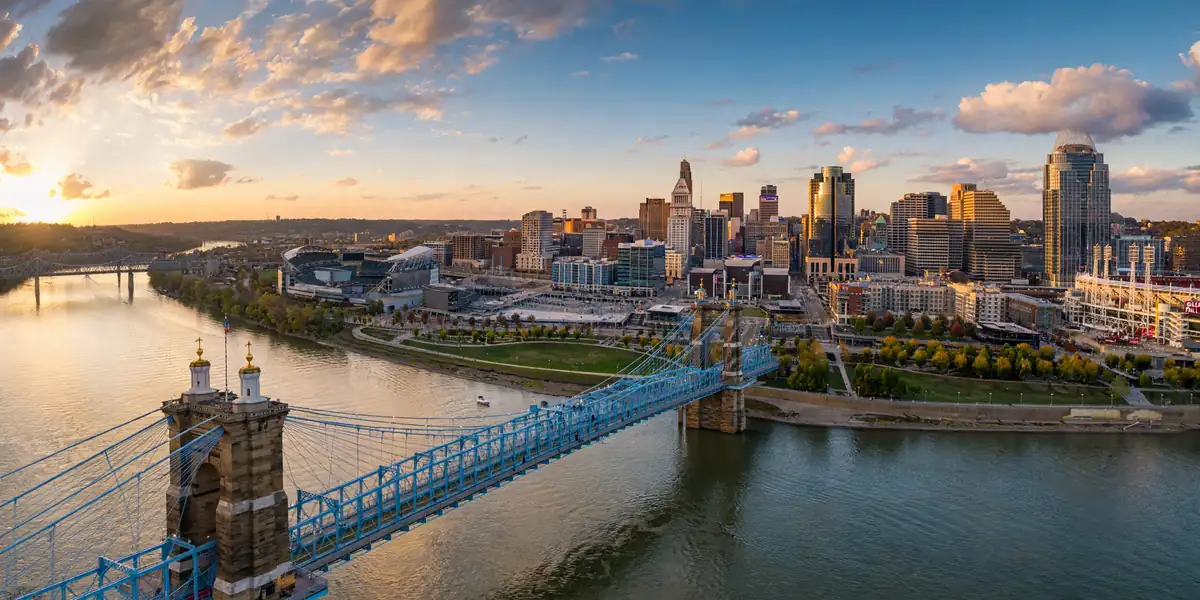
Cincinnati is the Queen City of the Ohio River — a city founded in 1788 on the north bank of the river, where Ohio meets Kentucky, that grew rich on river trade and German immigration and never quite lost either influence. It is a city of hills and bridges, of 19th-century brick neighbourhoods, of the second-oldest zoo in America, of free art museums, and of a chilli so distinctive that locals argue about it the way other cities argue about pizza. This guide covers the 20 best things to do in Cincinnati, a 3-day itinerary that groups the city by neighbourhood so you are not criss-crossing it, where to stay without paying riverfront prices for a room you only sleep in, how to get around on the free streetcar and on foot downtown, the three foods you should not skip, and the free sights that cost nothing. Everything below was checked against live sources in November 2026 — including the zoo’s dynamic pricing, the Freedom Center’s reduced hours, the American Sign Museum’s price rise, the Carew Tower observation deck that has been closed since 2020, and the BLINK festival that has just ended and does not return until 2028.
Cincinnati at a glance
| Topic | What to know |
| Full name | Cincinnati, Ohio — the Queen City, on the north bank of the Ohio River in the south-west corner of Ohio, across the river from Covington and Newport, Kentucky |
| Founded | 1788, as Losantiville; renamed Cincinnati in 1790 after the Society of the Cincinnati, the officers’ society of the Revolutionary War |
| Population | About 310,000 in the city, about 2.3 million in the metro area that spills across Ohio, Kentucky and Indiana |
| Nickname | The Queen City — the name dates to 1819, when a Cincinnati newspaper called the young city the Queen of the West |
| Best base | Downtown or Over-the-Rhine for first-timers; Mount Adams for views; Covington or Newport across the river for lower prices and a different skyline |
| Getting around | Walk downtown and Over-the-Rhine; the free Connector streetcar runs the 3.6-mile loop between the riverfront and Findlay Market; a car or rideshare for the zoo, the observatory and Kings Island |
| Famous for | Cincinnati chili, the Reds, the Bengals, the zoo’s hippo Fiona, Graeter’s ice cream, German heritage, Oktoberfest Zinzinnati and the Roebling Bridge |
Cincinnati rewards visitors who slow down and walk it. Downtown is compact — Fountain Square, the riverfront, the ballpark and the museums sit within a mile of each other — and Over-the-Rhine, just north of downtown, is one of the most complete 19th-century neighbourhoods in America, all brick facades and corner bars and coffee shops. The river is the city’s front porch: The Ohio River carried the trade that built the city, and the riverfront today is parks and stadiums and a bridge that was the prototype for the Brooklyn Bridge. The trap most guides fall into is the outdated detail: the Carew Tower observation deck has been closed since 2020 and has no reopening date, the American Sign Museum now charges $20 not $15, the Freedom Center is closed on Mondays and Tuesdays, and the zoo’s tickets are dynamic and online-only. This guide gets those right, because we checked them in November 2026.
The 20 best things to do in Cincinnati
1. Cincinnati Zoo & Botanical Garden
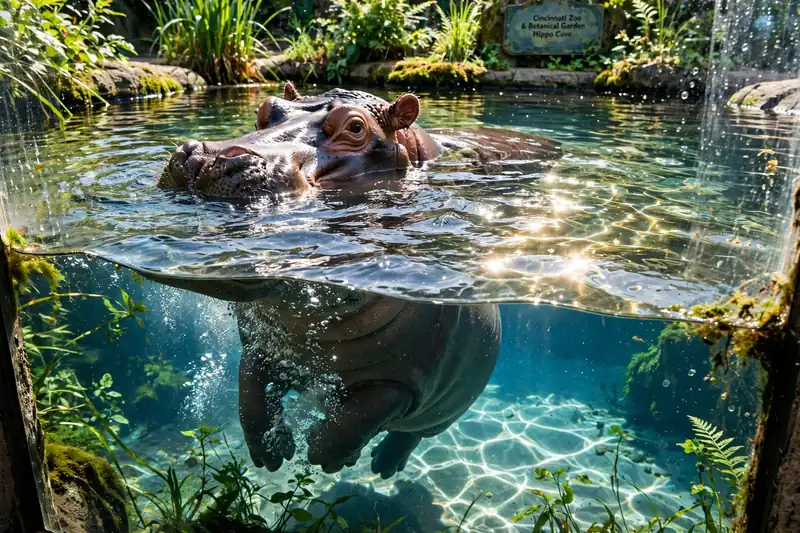
The Cincinnati Zoo & Botanical Garden is the single best reason to come to Cincinnati, and one of the best zoos in America. Founded in 1875, it is the second-oldest zoo in the United States, a 75-acre garden-zoo in the Avondale neighbourhood that holds more than 500 animal species and 3,000 plant species, and it is famous for two things: its conservation work, especially with gorillas, and Fiona the hippo. Fiona was born six weeks premature in January 2017, weighing just 29 pounds, and the world watched her fight to survive; today she is the zoo’s biggest star, and Hippo Cove, with its above- and below-water viewing, is the first place most visitors head. The newer Elephant Trek habitat, the manatee exhibit, the Night Hunters nocturnal house and the botanical gardens — the zoo is a botanical garden in its own right, and spring brings thousands of tulips — fill a full day easily. The pricing is the thing older guides get wrong: the zoo uses dynamic pricing in 2026, with adult tickets from $9 on select off-peak winter days to $26 on peak summer weekends, children and seniors from $6 to $20, children under 3 free, and all tickets must be bought online — there are no walk-up sales. Parking is $10, paid by phone. The zoo opens daily at 10 a.m. and closes at 5 p.m., and it is closed on Thanksgiving Day, Christmas Eve and Christmas Day. From 19 November 2026 to 3 January 2027 the PNC Festival of Lights takes over, with millions of LED lights, animal lanterns and a light show on Swan Lake, and the zoo stays open until 9 p.m. Sunday to Thursday and 10 p.m. Friday and Saturday. Arrive at opening, see Fiona first before the crowds, and allow four to five hours. The Cincinnati Zoo and Botanical Garden covers the zoo and its history.
2. Cincinnati Art Museum
The Cincinnati Art Museum is the best free museum in the Midwest, and it is free in the most complete sense: general admission is free for everyone, and parking is free too. It sits in Eden Park, in a grand building that has grown since the museum was founded in 1881 as one of the oldest art museums in the country and the first purpose-built art museum west of the Allegheny Mountains. The collection holds more than 67,000 works spanning 6,000 years — Egyptian antiquities, European old masters, American paintings, Asian art, contemporary works — and the Cincinnati Wing, which tells the city’s own art story, is the part most visitors remember. The museum is open Tuesday to Sunday from 11 a.m. to 5 p.m., Thursday until 8 p.m., and closed on Mondays. Special exhibitions are ticketed separately: The Art of Charley Harper: Creatures Wild and Tame, an in-depth show on the mid-century modern artist and nature advocate, runs from 16 October 2026 to 7 March 2027. Come in on a Thursday evening, when the museum stays open late and the crowds thin, walk the Art Climb — the outdoor staircase that climbs the hill from the park to the museum entrance — and allow two to three hours. The Cincinnati Art Museum covers the museum and its collection.
3. National Underground Railroad Freedom Center
The National Underground Railroad Freedom Center is the most important museum in Cincinnati, and the one that stays with you longest. It stands on the riverfront at 50 East Freedom Way, on the Ohio River bank where Kentucky was a slave state and Ohio was a free state, and where thousands of freedom seekers crossed the river to freedom. The museum opened in 2004 in a 158,000-square-foot building of travertine stone, and its centrepiece is a genuine 1830s slave pen from Mason County, Kentucky — a two-storey log structure that held enslaved people awaiting sale, dismantled, moved here and rebuilt inside the museum. The permanent exhibits run from slavery to freedom and on to modern-day slavery around the world, and the ESCAPE! Freedom Seekers exhibit lets visitors step into the choices a freedom seeker faced. The hours are the detail most guides get wrong: the Freedom Center is open Wednesday to Sunday from 10 a.m. to 5 p.m. and closed on Mondays and Tuesdays, so do not plan a Monday or Tuesday visit. Admission is about $20 for adults, about $18 for seniors and about $17 for children in 2026 — check the site before you go, because the price has risen and older guides still list the old $15. Admission is free on the third Sunday of the month and on Martin Luther King Jr. Day, and Fifth Third Community Days made it free on 8 November and make it free on 6 and 20 December 2026, with a free ticket reserved online in advance. Allow three to four hours, and go in the morning, when the building is quietest. The National Underground Railroad Freedom Center covers the museum and its mission.
4. Findlay Market
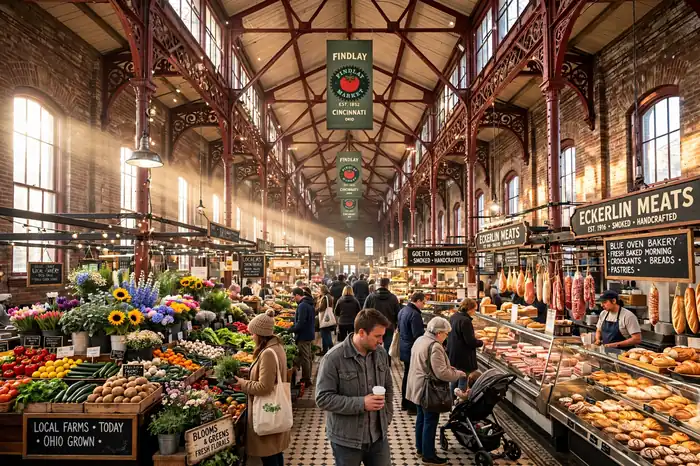
Findlay Market is Ohio’s oldest continuously operated public market, and the best place in Cincinnati to eat your way through a morning. It has been serving the city since 1855, in a brick market house at 1801 Race Street in Over-the-Rhine, and today it holds more than 50 full-time merchants — butchers, bakers, cheese sellers, flower stalls, coffee roasters, international grocers — plus a farmers market outdoors on weekends. Come on a Saturday, when the farmers market runs from 8 a.m. to 2 p.m. and the whole block is crowded with shoppers, street performers and food stalls, and eat as you go: goetta from Eckerlin Meats, a pastry from Blue Oven Bakery, an empanada from one of the Latin stalls. The market is open Tuesday to Friday from 9 a.m. to 6 p.m., Saturday from 8 a.m. to 6 p.m. and Sunday from 10 a.m. to 4 p.m., and it is closed on Mondays — the farmers market runs Saturday 8 a.m. to 2 p.m. and Sunday 10 a.m. to 2 p.m. Bring a reusable bag, bring cash for the smaller stalls, and allow two hours, more if you linger over lunch. Findlay Market covers the market and its history.
5. Over-the-Rhine
Over-the-Rhine is the neighbourhood that explains Cincinnati. Settled by German immigrants in the 19th century, it holds the largest intact collection of Italianate architecture in the United States — block after block of brick buildings with ornate cornices, built when this was the city’s German quarter, with breweries, churches and beer gardens on every corner. In the 1990s nobody recommended visiting it; today, after two decades of restoration, it is the city’s best neighbourhood to walk, eat and drink in. Start at Washington Park, the 8-acre park at the neighbourhood’s heart that was rebuilt in 2012, with its dog park, playground, garage and summer concerts, and walk Vine Street and Main Street for the shops, galleries and restaurants. Cincinnati Music Hall anchors the south end of the park — the 1878 concert hall that is home to the Cincinnati Symphony Orchestra, the Cincinnati Opera and the May Festival, and one of the most beautiful performance spaces in America. The Rhinegeist Brewery sits in a 125,000-square-foot former bottling plant at 1910 Elm Street, with a vast taproom, more than 25 beers on tap, public brewery tours and a rooftop bar with skyline views; it opens at 3 p.m. Monday to Thursday, noon on Friday, Saturday and Sunday. Over-the-Rhine covers the neighbourhood and its history.
6. Smale Riverfront Park
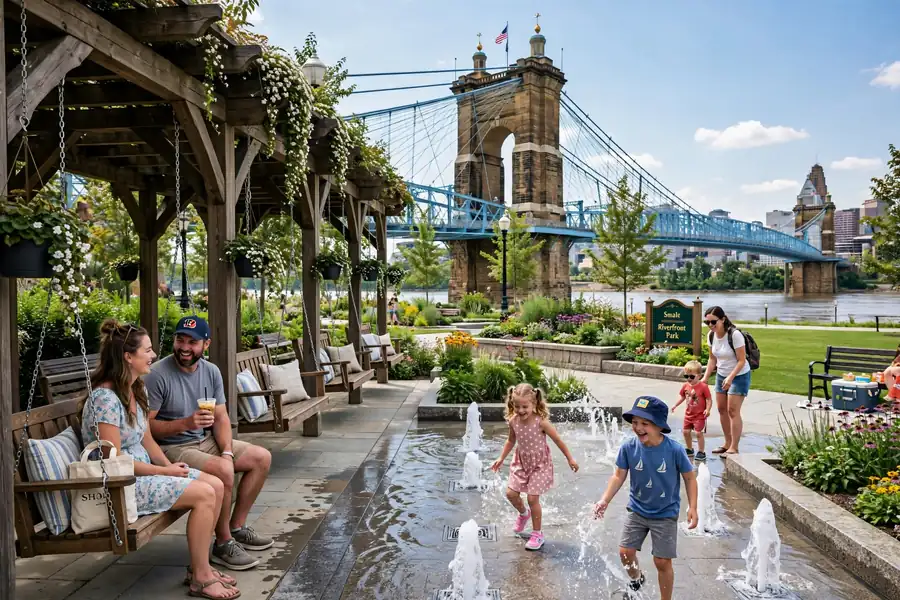
Smale Riverfront Park is Cincinnati’s front lawn on the Ohio River, and the best free place in the city to spend an afternoon. The park runs along the riverfront between the two stadiums — Great American Ball Park to the east and Paycor Stadium to the west — and the first phase opened in May 2012 as part of a $120 million riverfront rebuild, with more phases following. It is built for lingering: porch swings facing the river, a labyrinth, a foot piano, water features and spraygrounds for children, the Heekin Family/PNC Grow Up Great Adventure Playground, gardens and a river-edge promenade. Carol Ann’s Carousel, a hand-carved wooden carousel with 44 Cincinnati-themed characters, opened in May 2015 in a glass pavilion just west of the Roebling Bridge. The John A. Roebling Suspension Bridge cuts through the middle of the park, and the Black Brigade Monument honours the Black Cincinnatians who built the city’s defences in the Civil War. Come at sunset, when the bridge and the Kentucky hills turn gold, and bring a picnic. Smale Riverfront Park covers the park and its features.
7. John A. Roebling Suspension Bridge
The John A. Roebling Suspension Bridge is the most graceful thing in Cincinnati, and the bridge that taught America how to build the Brooklyn Bridge. Designed by John A. Roebling and opened on 1 December 1866, it was the longest suspension bridge in the world when it opened, with a 1,057-foot main span, and its stone towers and wire cables became the prototype for the Brooklyn Bridge, which Roebling designed afterwards and which opened in 1883. It carries cars and pedestrians across the Ohio River to Covington, Kentucky, and the walk across is free and takes about fifteen minutes each way. Go at sunset, when the light hits the Cincinnati skyline from the Kentucky side, and walk back across for the view from the middle of the river. The bridge is also the best free viewpoint in the city, and the reason Smale Riverfront Park feels like it has a monument at its centre.
8. Cincinnati Museum Center at Union Terminal
The Cincinnati Museum Center at Union Terminal is three museums in one of the most beautiful train stations in America. Union Terminal opened in 1933, a half-domed Art Deco masterpiece of mosaics, murals and a 106-foot-high rotunda, and after the trains left it became the Museum Center in 1990. One admission covers the Cincinnati History Museum, the Museum of Natural History & Science — with its dinosaur gallery, its limestone-cave replica and its model of the city in miniature — and the Duke Energy Children’s Museum, with eight play areas for children up to age 10. The Robert D. Lindner Family OMNIMAX Theater, the Holocaust & Humanity Center and the special exhibitions are ticketed separately; the current special exhibition is LEGO Jurassic World: The Exhibition, open from 22 May 2026 to 4 January 2027. The Museum Center is open daily from 10 a.m. to 5 p.m., closed on Thanksgiving Day and Christmas Day, with short hours of 10 a.m. to 2 p.m. on 6 November, 25 November and 24 December 2026. Admission is $19.50 for visitors aged 13 and over and $12.50 for ages 3 to 12 and seniors over 60 — older guides still list the old $14.50, which is stale — and parking is $6 a day. The Museums for All programme gives $3 admission for up to 10 people with a SNAP, EBT, Medicaid or WIC card. Allow three to four hours, and look up in the rotunda before you go inside: the mosaic murals of Cincinnati’s industrial history are the building’s best exhibit, and they are free. The Cincinnati Museum Center at Union Terminal covers the museum and the terminal.
9. Great American Ball Park
Great American Ball Park is the home of the Cincinnati Reds, and a ballgame here is the most Cincinnati evening there is. The ballpark opened in 2003 on the riverfront, with 42,271 seats, a view of the Ohio River from the upper deck, and the Reds Hall of Fame & Museum built into its west side. The Reds trace back to the 1869 Cincinnati Red Stockings, baseball’s first professional team, and the Hall of Fame tells that story with uniforms, bats, World Series trophies and the 1975 and 1976 Big Red Machine. The Hall of Fame and Museum costs $15 to enter, and the guided ballpark tour, which includes the Hall of Fame and takes about 85 minutes over roughly three-quarters of a mile, costs $35. Game tickets start from about $22 on the resale market for ordinary games, and much more for the big series. The 2026 season has ended and the 2027 season starts in late March 2027; if you are visiting in summer, book early for weekend games, sit on the third-base side for the river view, and eat a Skyline Chili cheese coney in the stands — Skyline is the official chili of the Reds. Paycor Stadium next door is the home of the Cincinnati Bengals, and the 2026–27 season is running now, with a $470 million renovation of the stadium debuting for the 2026 season; resale tickets start from about $60 for the quieter games and $200 or more for the Steelers and the Chiefs. Great American Ball Park covers the ballpark and the Reds.
10. American Sign Museum
The American Sign Museum is the most unexpectedly delightful museum in Cincinnati — 20,000 square feet of neon, gold leaf and hand-painted signs in a former factory in the Camp Washington neighbourhood. It holds the history of American signage from the 1870s to the 1970s, from hand-painted gold-leaf letters to milk-glass letters, bare bulbs, neon and post-war plastics, all arranged along a recreated Main Street that you walk down like a street from another century. The museum opened to the public in 2005, after founder Tod Swormstedt began collecting in 1999. The price is the trap: admission is now $20 for adults, $15 for seniors 65 and over, $10 for military, first responders, students and educators with ID, and free for children 12 and under — older guides still list the old $15, which is stale. The museum is open Wednesday to Sunday from 10 a.m. to 4 p.m. and closed on Mondays and Tuesdays. Free guided tours run at 11 a.m. and 2 p.m. Wednesday to Saturday and at 2 p.m. on Sundays, neon-bending demonstrations run on Saturdays at 11 a.m. and 1 p.m., and parking is free. If you hold a Cincinnati & Hamilton County Public Library card, check the library’s Discovery Pass programme before buying tickets — it can give admission for two adults. Allow 60 to 90 minutes. The American Sign Museum covers the museum and its collection.
11. Eden Park and Krohn Conservatory
Eden Park is Cincinnati’s great hilltop park, and the Krohn Conservatory is its glasshouse jewel. The park was established in 1869 on 186 acres above the Ohio River, with Mirror Lake, Twin Lakes, the Hinkle Magnolia Garden and views across the river to Kentucky, and it holds the Cincinnati Art Museum, the Krohn Conservatory and the Cincinnati Playhouse in the Park. The Krohn Conservatory is a 1933 Art Deco glasshouse with more than 3,500 plant species across themed rooms — the Palm House with its 20-foot waterfall, the Desert Garden, the Fern House and the Orchid House — and it is one of the cheapest good hours in the city: adults $10, youth aged 5 to 17 $7, children under 5 free, open daily from 10 a.m. to 8 p.m. The seasonal shows are the reason to time your visit: the spring butterfly show, which in 2026 was called Destination Monarch and ran from 9 May to 9 August with thousands of free-flying butterflies, needs a timed ticket booked online in advance — $12 for adults and $8 for children during the show — and tickets are not sold at the door. The winter holiday show, with 3,000 poinsettias and a miniature Cincinnati built from natural materials with model trains running through it, is the other peak. Go in the late afternoon, when the light comes through the glass and the park is quiet, and allow one to two hours for the conservatory and another hour for the park. Eden Park (Cincinnati) covers the park, and the Krohn Conservatory covers the glasshouse.
12. Cincinnati Observatory
The Cincinnati Observatory is the birthplace of American astronomy, and the oldest professional observatory in the United States. It was founded in 1843, when Ormsby McKnight Mitchel raised the money to build it, and the cornerstone of the original building was laid by former President John Quincy Adams. The observatory moved to its present home on Mount Lookout in 1873, and its two historic telescopes are still in use: the 11-inch Merz and Mahler refractor, first used in 1845 and the oldest professional telescope in the country, and the 16-inch Alvan Clark refractor from 1904. The catch is the hours — this is not a walk-in museum. Daytime history tours run on Tuesdays and Thursdays from noon to 3 p.m., with Sunday history tours on the second and fourth Sundays of the month, and the evening programmes run on Friday nights at 7 p.m., reservations required and weather permitting. Tickets for tours and programmes run about $5 to $10, evening events cost more, and parking is free. Book ahead, especially for the Friday night viewings and the popular Late Night Date Night evenings, and come on a clear night if you can — looking at Saturn through a telescope that has been in use since 1845 is the point. The Cincinnati Observatory covers the observatory and its telescopes.
13. Newport Aquarium
The Newport Aquarium is across the river in Kentucky, and it is worth the crossing. It sits at 1 Aquarium Way in Newport, Kentucky, at Newport on the Levee, a five-minute walk across the Taylor Southgate Bridge from downtown Cincinnati, and it holds 70 exhibits across 14 galleries — sharks, rays, penguins, jellyfish, a 75-foot Shark Bridge you walk across with sharks swimming under your feet, and the Penguin Palooza theatre. Admission uses dynamic pricing: one-day general admission starts at $25.99, with adults ranging from about $22.99 to $39.99 by date, and children under 2 are free. The aquarium is open Monday to Thursday from 10 a.m. to 5 p.m., Friday from 9 a.m. to 6 p.m., Saturday from 9 a.m. to 7 p.m. and Sunday from 9 a.m. to 6 p.m. The aquarium is fully cashless, and reservations are recommended on weekends and school holidays — book online for the lowest price. The Underwater Pumpkin Glow ran through 1 November 2026 and was included with general admission. Allow two to three hours, and pair it with dinner at Newport on the Levee afterwards. Newport, Kentucky covers the town across the river, and the Newport Aquarium covers the aquarium.
14. Kings Island
Kings Island is the biggest amusement park in the Midwest, and a full day out from Cincinnati. It sits in Mason, Ohio, about 24 miles north-east of downtown, and it holds more than 100 rides, including The Beast — the longest wooden roller coaster in the world, running since 1979 — plus the 33-acre Soak City water park, which is included with admission in the summer. The park opens in mid-April and runs through the season, with Halloween Haunt on Thursday to Sunday nights through 31 October and WinterFest on select nights from 27 November to 31 December 2026. Day tickets start from $39 to $49 online, plus a processing fee of up to $9.99, and there is no gate price worth paying — buy online. Parking is $35 for a regular space and $45 for preferred, and guests aged 65 and over get free admission through 31 December 2026. The park is owned by Six Flags Entertainment, after the Cedar Fair merger of 2024. Go on a weekday if you can — a peak summer Saturday without a Fast Lane pass means long waits at every coaster — and allow a full day. Kings Island covers the park, and Mason, Ohio covers the town it sits in.
15. Fountain Square
Fountain Square is the heart of downtown Cincinnati, and the square the whole city meets in. Its centrepiece is the Tyler Davidson Fountain, cast in Munich in 1871 — a bronze figure known as the Genius of Water, with four figures representing the uses of water, standing in a granite basin. The square around it is the city’s living room: food trucks and concerts in summer, craft markets and festivals through the year, and an ice rink in winter, when the square turns into the city’s outdoor skating rink from November to February. It is also the best free people-watching in Cincinnati, and the place to start any downtown walk — the Contemporary Arts Center, Carew Tower and the Aronoff Center are all within a block. Come at lunchtime, when the square is fullest, or at dusk, when the fountain is lit. Fountain Square, Cincinnati covers the square and its fountain.
16. Contemporary Arts Center
The Contemporary Arts Center is the most striking building in downtown Cincinnati, and one of the most important contemporary art museums in America. It was founded in 1939, and in 1940 it was one of the first venues in the United States to exhibit Picasso’s Guernica. Its home since 2003 is the Lois and Richard Rosenthal Center for Contemporary Art, designed by Zaha Hadid — the first museum in the United States designed by a woman, a building the New York Times called the most important American building completed since the end of the Cold War, and the design that won Hadid the Pritzker Prize. The galleries are free to enter, which makes it one of the best free hours in the city. The centre is open Wednesday from 10 a.m. to 5 p.m., Thursday and Friday from 10 a.m. to 7 p.m., and Saturday and Sunday from 10 a.m. to 4 p.m., and closed on Mondays and Tuesdays. The UnMuseum, the hands-on creativity space for families, is free too, and the rooftop is worth the climb for the view alone. Allow one to two hours. The Contemporary Arts Center covers the centre and its building.
17. Taft Museum of Art
The Taft Museum of Art is a small museum in a grand house, and the quietest good hour in downtown Cincinnati. It sits at 316 Pike Street in the Baum-Longworth-Sinton-Taft house, built in 1820 and the oldest wooden residence in downtown Cincinnati still in its original location, the home of Charles Phelps Taft, half-brother of President William Howard Taft. The collection holds more than 800 works — European old masters, Chinese porcelains, American furniture and decorative arts — displayed in the rooms of the house itself, which makes it feel like visiting a home rather than a museum. Admission is $15 for adults and $12 for seniors, and it is free on Sundays and Mondays; the museum is open Wednesday to Monday from 10 a.m. to 5 p.m. and closed on Tuesdays. The cafe is a good lunch stop, and the garden is a quiet place to sit. Go on a Sunday or Monday, when it is free, and allow one to two hours. The Taft Museum of Art covers the museum and its collection.
18. BB Riverboats
The best way to see Cincinnati is from the Ohio River, and BB Riverboats is how to do it. The company runs sightseeing, lunch and dinner cruises from 101 Riverboat Row in Newport, Kentucky, on the riverboats River Queen and Belle of Cincinnati, cruising past the downtown skyline, the Roebling Bridge, the stadiums and the riverfront parks. The sightseeing cruise is the one to take if you only have an afternoon: about two hours on the water, with narration about the river and the city, and the skyline looks best from the middle of the river at sunset. Dinner cruises run in the evenings with a buffet and live music, and the company runs special cruises for holidays and events — check the schedule before you go, because cruises do not run every day in winter. Book ahead in summer and for dinner cruises, arrive 30 minutes early, and sit on the top deck. The Ohio River covers the river the boats cruise on.
19. Spring Grove Cemetery & Arboretum
Spring Grove Cemetery & Arboretum is the most beautiful and most surprising place in Cincinnati — a cemetery that is also a 733-acre arboretum, a National Historic Landmark, and one of the largest cemeteries in the United States. It was founded in 1845, when Cincinnati’s churchyards were full, and it was designed as a rural garden cemetery, with lakes, rolling lawns, thousands of trees and monuments that range from modest stones to grand mausoleums. It is free to visit, and the grounds are open daily during daylight hours. Walk the lakes, look for the Civil War monuments and the Dexter Mausoleum, and come in spring, when the flowering trees are at their best, or in autumn, when the maples turn. It is not a morbid place — it is a park that happens to be a cemetery, and locals walk, run and photograph here every day. Allow one to two hours. Spring Grove Cemetery covers the cemetery and its history.
20. Mount Adams
Mount Adams is Cincinnati’s hilltop village, and the best view in the city that you can walk to. The neighbourhood sits on a steep hill just east of downtown, above Eden Park, and it is a cluster of narrow streets, old houses, bars and restaurants with the skyline spread out below. Climb the steps to the Holy Cross-Immaculata Church, the hilltop church where thousands of pilgrims climb the steps on Good Friday, and look down over the river and the city. The Rookwood Pottery building, the former home of the famous art pottery founded in 1880, stands on the hill too. Come for a drink at sunset — the bars on the hill have the best views in the city — and walk down through Eden Park afterwards. Mount Adams, Cincinnati covers the neighbourhood and its history.
Cincinnati in 3 days — a ready-made itinerary
Day 1: Downtown, the riverfront and Over-the-Rhine
Start at Fountain Square, then walk down to Smale Riverfront Park and across the Roebling Bridge to Covington and back for the skyline view. Spend the late morning at the National Underground Railroad Freedom Center — remember it opens at 10 a.m. and is closed on Mondays and Tuesdays — then lunch at the Banks, the riverfront dining district between the stadiums. In the afternoon, ride the free Connector streetcar up to Over-the-Rhine, walk Washington Park and Vine Street, and eat an early dinner in OTR. End the day at the Rhinegeist rooftop with a beer and the skyline, or at a Reds game at Great American Ball Park if they are in town.
Day 2: The zoo, Eden Park and the museums
Spend the morning at the Cincinnati Zoo — arrive at 10 a.m. when it opens, see Fiona first, and give it four hours. Drive or rideshare to Eden Park for the afternoon: the Cincinnati Art Museum, free, then the Krohn Conservatory, and a walk around Mirror Lake and Twin Lakes. In the evening, drive to Mount Lookout for a Friday night programme at the Cincinnati Observatory if one is running, or back downtown for a show at Music Hall or the Aronoff Center.
Day 3: Findlay Market, the Sign Museum and the Kentucky side
Start Saturday at Findlay Market — go early, eat goetta for breakfast, and shop the stalls. Then the American Sign Museum in Camp Washington, which opens at 10 a.m. and closes at 4 p.m., and the Cincinnati Museum Center at Union Terminal in the afternoon. Cross the river to Newport for the aquarium, or take a BB Riverboats cruise at sunset. If you have a fourth day, spend it at Kings Island in Mason, which needs a full day of its own.
Best time to visit Cincinnati
| Season | What it is like | What to do |
| Spring (March–May) | Mild, 50s to 70s°F, rain possible, flowers everywhere | Krohn butterfly show (May–August), the Flying Pig Marathon in early May, Taste of Cincinnati in May, the zoo in spring bloom |
| Summer (June–August) | Warm and humid, 80s°F, afternoon storms | Reds baseball, Kings Island and Soak City, riverfront concerts, Findlay Market at its liveliest, the Rhinegeist rooftop |
| Autumn (September–November) | The best weather, 50s to 70s°F, crisp and dry | Oktoberfest Zinzinnati in September, BLINK in October in even years, autumn colour in Eden Park and Spring Grove, the Festival of Lights from 19 November |
| Winter (December–February) | Cold, January highs around 38°F, occasional snow | The Festival of Lights at the zoo until 3 January, the Fountain Square ice rink, the Krohn holiday show, fewer crowds and lower hotel prices |
The best time to visit Cincinnati is May to June and September to October, when the weather is warm without the summer humidity and the event calendar is full. October is the most eventful month in even years: BLINK, the nation’s largest free public light and art festival, ran from 8 to 11 October 2026 across more than 30 city blocks in downtown Cincinnati and Covington, with 92 artists from 20 countries — and because BLINK is biennial, it does not return until 2028, so do not plan a 2027 trip around it. September brings Oktoberfest Zinzinnati, the largest Oktoberfest in the United States, at the Banks and Sawyer Point. Winter is the quiet season: the Festival of Lights at the zoo runs from 19 November 2026 to 3 January 2027, the Fountain Square ice rink runs from November to February, and hotel prices drop. Avoid the hottest weeks of July and August if you dislike humidity, and remember that several attractions close on Mondays — the Art Museum, Findlay Market and the Freedom Center are all closed or partly closed on Mondays, so plan your Monday around the zoo, the Museum Center and the riverfront.
Where to stay in Cincinnati
| Area | Best for | What to expect |
| Downtown and The Banks | First-timers, walkers, game days | The most hotels, the riverfront and Fountain Square on foot, $150–$300 a night mid-range |
| Over-the-Rhine | Food, nightlife, neighbourhood feel | Boutique hotels and short-term rentals above the restaurants and bars, $150–$250 a night |
| Mount Adams | Views, quiet evenings, couples | Small inns and rentals on the hill, $150–$250 a night, a steep walk or a short drive to downtown |
| Covington and Newport, Kentucky | Value, river views, a different skyline | Hotels across the river from $100–$200 a night, a 10-minute walk across the bridge to downtown |
| Mason and the north suburbs | Kings Island trips, families, driving trips | Chain hotels near the park from $100–$180 a night, 25 minutes from downtown |
Stay downtown or in Over-the-Rhine if this is your first visit. Downtown puts Fountain Square, the riverfront, the ballpark and the Contemporary Arts Center within walking distance, and the free Connector streetcar runs from the riverfront up to Findlay Market. Over-the-Rhine puts you above the city’s best restaurants and bars, and Washington Park is your front garden. The Hilton Netherland Plaza, inside the Carew Tower complex at Fountain Square, is the grandest stay in the city — an Art Deco hotel from 1931 — and its lobby is worth a look even if you are not staying there. Covington and Newport, across the river in Kentucky, are the value play: hotels are cheaper, the skyline view from the Kentucky side is the best in the city, and the walk across the Roebling Bridge takes fifteen minutes. Hotel prices below are approximate ranges, not live quotes — check before you book, because prices rise sharply on Reds and Bengals game days, during BLINK and during Oktoberfest.
Getting around Cincinnati
| Way to get around | Cost | Best for |
| Walking | Free | Downtown, Over-the-Rhine, the riverfront, Fountain Square — the core is compact |
| Connector streetcar | Free | The 3.6-mile loop from the riverfront through downtown to Findlay Market, 18 stops |
| Metro bus | About $2 a ride | The zoo, the observatory, the Museum Center, the suburbs |
| Rideshare or taxi | $10–$25 in town | The zoo, the observatory, the Sign Museum, late nights, the airport |
| Rental car | About $50–$80 a day | Kings Island, the Newport Aquarium by car, day trips, families with children |
| Parking downtown | $10–$25 a day | Garages at Fountain Square, Washington Park and the Banks; street parking is metered |
Cincinnati is a driving city with a walkable core, and the trick is to use both. Downtown, Over-the-Rhine and the riverfront are compact enough to walk, and the Connector streetcar is free — it has been fare-free since November 2020, so ignore any older guide that tells you to buy a $1 ticket. The 3.6-mile loop runs from the riverfront through downtown to Findlay Market, with 18 stops, Monday to Friday from 7:30 a.m. to 11:30 p.m., Saturday from 8:30 a.m. to 11:30 p.m. and Sunday from 9:30 a.m. to 9:30 p.m., 365 days a year. For the zoo, the observatory, the American Sign Museum and Kings Island, take a rideshare or a rental car — the bus runs to most of them, but slowly. The airport, Cincinnati/Northern Kentucky International Airport, is across the river in Hebron, Kentucky, about 13 miles south-west of downtown and about a 20-minute drive; there is no rail link, so take a rideshare, a taxi or an airport shuttle. Do not drive downtown on a Reds or Bengals game day without a parking plan — the garages at the Banks fill up, and the streets around the stadiums close.
Cincinnati food you have to try
Cincinnati chili
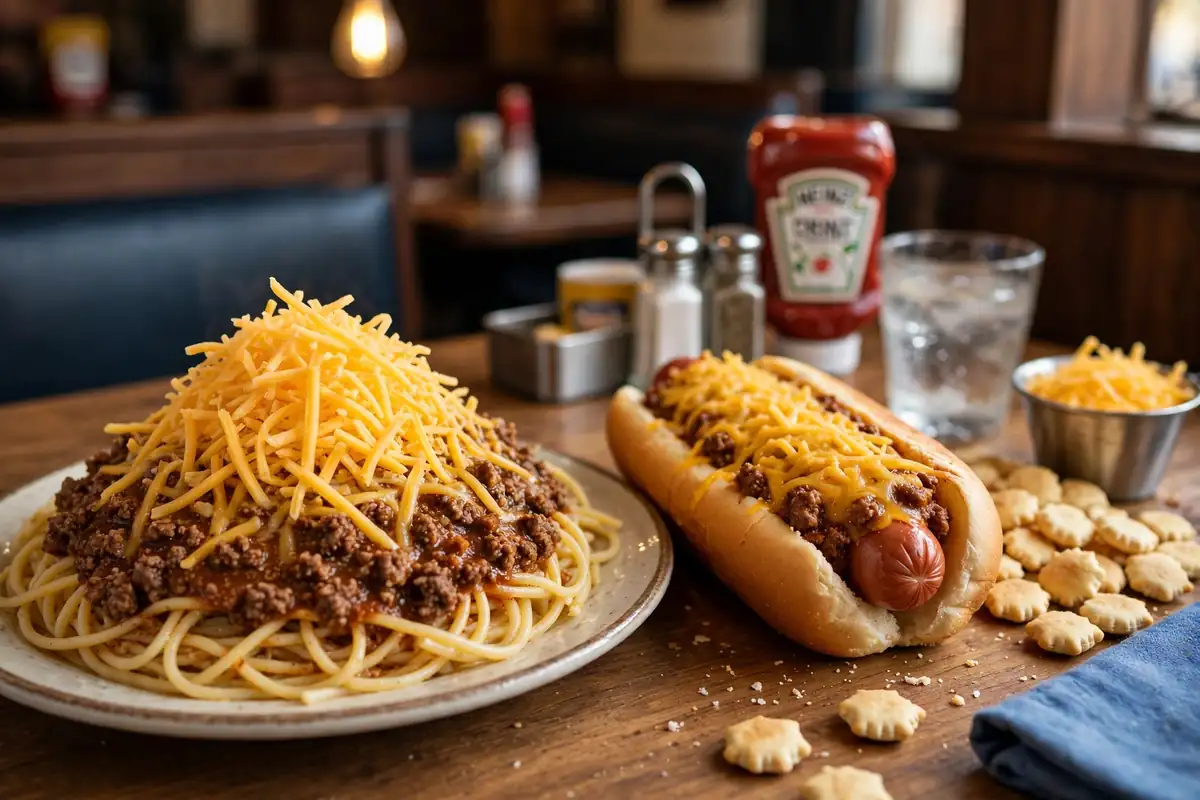
Cincinnati chili is the dish that defines the city, and it is not like any other chilli in America. It was created by Greek immigrants in the 1920s, who adapted Mediterranean meat sauces to American tastes: a thin, finely textured spiced meat sauce, seasoned with cinnamon, cloves, allspice and sometimes cocoa, served over spaghetti rather than eaten from a bowl. Skyline Chili made it famous — founded on 8 October 1949 by Greek immigrant Nicholas Lambrinides, it now has more than 150 locations, and it is the official chili of the Cincinnati Reds. Order by the ways system: a 3-Way is spaghetti, chili and a mound of shredded cheddar cheese; a 4-Way adds either onions or beans; a 5-Way adds both. A regular 3-Way costs about $9 to $10, and a cheese coney — a hot dog with mustard, chili, onions and cheddar — costs about $4. Gold Star Chili, founded in 1965, is the other great chain, and locals argue about Skyline versus Gold Star the way other cities argue about sports teams. Try both, and try a small independent parlour too — the best chili in Cincinnati is a matter of neighbourhood loyalty. Cincinnati chili covers the dish and its history.
Goetta
Goetta is Cincinnati’s other signature food, and the one most visitors have never heard of. It is a German breakfast sausage made from pork and steel-cut oats, pressed into a loaf, sliced and fried crisp — the food German immigrants brought to Over-the-Rhine in the 19th century, when meat was stretched with grain to feed a family. It is served for breakfast with eggs, on sandwiches, and on burgers all over the city, and the best place to try it is Eckerlin Meats at Findlay Market, which has been selling it for generations. Goetta is also the star of Goettafest, the summer festival in Newport, Kentucky, across the river. Order it crisp, with a fried egg and a side of potatoes, and you will understand why Cincinnatians are evangelical about it. Goetta covers the dish and its history.
Graeter’s Ice Cream
Graeter’s Ice Cream is the dessert Cincinnati is proudest of, and it has been made the same way since 1870. Louis C. Graeter founded the company in 1870, and the family still makes its ice cream in small batches in antique French Pot machines, freezing just 2.5 gallons at a time and pouring in liquid chocolate as the pot spins, so the chocolate sets into irregular chunks instead of uniform chips. The signature flavour is Black Raspberry Chip — black raspberry ice cream studded with dark chocolate chunks — which Oprah Winfrey called the best ice cream she had ever tasted. A single scoop costs about $4 to $6, and a pint costs about $6. The Over-the-Rhine shop at 1401 Vine Street is open from 11 a.m. to 10 p.m. Sunday to Thursday and until 11 p.m. on Friday and Saturday, and there are shops all over the city. Get the Black Raspberry Chip, in a sugar cone, and eat it walking through Washington Park. Graeter’s covers the company and its history.
Free things to do in Cincinnati
Cincinnati is one of the most generous free cities in America, and a whole day here can cost nothing. The Cincinnati Art Museum is free, with free parking, and the Contemporary Arts Center is free too. Smale Riverfront Park, the Roebling Bridge, Fountain Square, Washington Park and Eden Park are all free, and the Connector streetcar is free, so you can ride the whole downtown loop for nothing. Spring Grove Cemetery is free, and its grounds are open daily. The Taft Museum of Art is free on Sundays and Mondays, and the National Underground Railroad Freedom Center is free on the third Sunday of the month and on Martin Luther King Jr. Day. Ault Park, in Hyde Park, is free, with gardens and a pavilion overlooking the Little Miami River valley, and the Little Miami Scenic Trail is a 78-mile paved trail for walking and cycling. Mount Airy Forest, one of the largest municipal forests in the country, is free, with hiking trails and a treehouse. The best free day in Cincinnati: the Art Museum in the morning, the riverfront and the Roebling Bridge in the afternoon, and Fountain Square at dusk.
Frequently asked questions
How many days do you need in Cincinnati?
Three days is the right amount. One day covers downtown, Over-the-Rhine and the riverfront; two days add the zoo and Eden Park; three days add Kings Island or the Newport Aquarium and a slower pace. Two days works if you skip Kings Island. One day is enough for the highlights — the zoo, Findlay Market, Over-the-Rhine and the riverfront — but you will be moving fast.
Is Cincinnati worth visiting?
Yes. It is one of the most underrated cities in the Midwest: a walkable riverfront, a world-class zoo, free art museums, a 170-year-old market, a food scene built on chili and ice cream, and a neighbourhood — Over-the-Rhine — that is one of the best-preserved 19th-century districts in America. It is cheaper and calmer than Chicago, and it rewards a weekend more than most cities its size.
Do you need a car in Cincinnati?
Not for downtown and Over-the-Rhine — walk, and ride the free Connector streetcar. You will want a car or a rideshare for the zoo, the observatory, the American Sign Museum and Kings Island, and the airport is 13 miles away in Kentucky with no rail link. If you are staying downtown for two or three days and not going to Kings Island, skip the rental car and use rideshares.
What is the best time to visit Cincinnati?
May to June and September to October, when the weather is warm without the summer humidity. October is the biggest month in even years, with BLINK and Oktoberfest Zinzinnati; the 2026 BLINK festival has just ended, and the next one is in 2028. November to January brings the zoo’s Festival of Lights and the Fountain Square ice rink, with lower hotel prices.
Is the Carew Tower observation deck open?
No. The observation deck on the 49th floor of Carew Tower has been closed since 2020, when it shut during the COVID-19 pandemic, and it has no reopening date. The building was bought in 2022 by a developer that is converting it into a primarily residential building, with completion planned by late 2029, and the deck may reopen as part of that work — but as of November 2026 it is closed, and you should not plan a visit around it. Older guides still list the deck as open with a $5 or $6 admission, and that is stale. The lobby and the Hilton Netherland Plaza hotel inside the complex are still open, and the Art Deco architecture is worth a look from the ground.
What should I skip in Cincinnati?
Skip the Carew Tower observation deck — it has been closed since 2020. Skip paying for the Cincinnati Art Museum — it is free, and so is its parking. Skip a peak summer Saturday at Kings Island without a Fast Lane pass, because the waits at the big coasters are long. Skip the abandoned subway tunnels — there are no public tours, and entering them is trespassing. And skip driving downtown on a Reds or Bengals game day without a parking plan, because the garages fill up and the streets around the stadiums close.
Further reading
The Cincinnati Zoo and Botanical Garden
The National Underground Railroad Freedom Center
The John A. Roebling Suspension Bridge
The Cincinnati Museum Center at Union Terminal
The Cincinnati Symphony Orchestra
The Black Brigade of Cincinnati
No Reddit link is included here: no live r/Cincinnati thread turned up in search, so none is listed rather than linking to an unverified one. No Quora link is included either: no live on-topic Quora thread about visiting Cincinnati turned up in search, so none is listed rather than linking to an unverified one.
Your Cincinnati trip, in one paragraph
Cincinnati is the Queen City that surprises people — a riverfront city with a world-class zoo, free art museums, a 170-year-old market, a bridge that taught America how to build the Brooklyn Bridge, and a chilli that nobody else in America eats. Start with the islands and the coasts: our Hawaii guide covers the whole state, our Maui guide covers the Valley Isle, and our Honolulu guide covers the capital city. Then the American cities, in the order we wrote them: our Chicago guide, our Nashville guide, our Los Angeles guide, our Orlando guide, our Miami guide, our San Diego guide, our Denver guide, our Savannah guide, our Dallas guide, our Charleston guide, our San Francisco guide, our Myrtle Beach guide, our Las Vegas guide and our San Antonio guide. Further afield: our London guide, our Portland guide, our Pigeon Forge guide, our Puerto Rico guide, our Atlanta guide, our Phoenix guide, our Paris guide, our Key West guide, our Colorado Springs guide, our Sedona guide, our Chattanooga guide, our Palm Springs guide, our St Louis guide, our Tokyo guide and our Japan guide. Then the middle of the map: our Kansas City guide, our Tennessee guide, our Branson guide, our Florida guide, our Amsterdam guide, our Montreal guide, our Fort Lauderdale guide, our Toronto guide, our Aruba guide, our Charlotte guide, our Indianapolis guide, our New Orleans guide, our Destin guide, our Santa Barbara guide, our Mexico City guide, our Arizona guide, our Osaka guide, our Minneapolis guide, our Pittsburgh guide, our California guide, our Asheville guide, our Costa Rica guide, our Washington DC guide and our Seattle guide. And the most recent: our St Augustine guide, our Lisbon guide, our Dubai guide, our Santa Fe guide, our Galveston guide, our Maine guide, our Sacramento guide, our Kauai guide, our Boston guide, our Cancun guide, our Madrid guide, our Salt Lake City guide, our Baltimore guide, our Barcelona guide, our Reno guide, our Milwaukee guide, our North Carolina guide, our New York guide, our Tucson guide, our Raleigh guide, our Corpus Christi guide, our Milan guide, our Salem guide, our Wilmington guide, our Memphis guide, our Flagstaff guide, our Austin guide, our Oahu guide and our Iceland guide.

About the Author