Things to Do in Fredericksburg
20 Best Attractions, a 3-Day Itinerary, Where to Stay, and the Food You Cannot Miss
Quick Info
Best for: German heritage, Texas wine, Hill Country scenery and small-town Main Street life — a slow weekend from Austin or San Antonio
Best time: March to May for wildflowers and mild weather; October for Oktoberfest and fall colour; November to December for the Christmas lights
How long: 2–3 days for the museum, Enchanted Rock, the wineries and Main Street; add a day for Luckenbach and the LBJ sites
Budget: About $120–$200 per person per day mid-range — the museum is about $24, tastings run $20–$35 each, and Main Street is free to wander
Don’t miss: The Pacific War Museum, sunrise at Enchanted Rock, a Wine Road 290 tasting, Luckenbach at dusk, and peach ice cream in season
Fredericksburg on Wikipedia is the most German town in Texas, and the most surprising one. Founded in 1846 by German immigrants who came to the Hill Country under Prince Carl of Solms-Braunfels, it still speaks with a German accent — in the schnitzel on the menus, the Oktoberfest in the town square, the 1847 Vereins Kirche, and a dialect, Texas German, that old-timers still speak. But Fredericksburg is not a theme park. It is a working Hill Country town of about 10,875 people with 150-plus locally owned shops on Main Street and no chains, a world-class war museum, a pink granite dome that draws hikers from across the state, and more than 50 wineries along a single highway. This guide covers the 20 best things to do in Fredericksburg, a 3-day itinerary that pairs the museum with the wineries and the great outdoors, where to stay on Main Street or in a vineyard cottage, getting around by car and on foot, the food you have to try, and the free things to do that cost nothing. Everything below was checked against live sources in November 2026 — including the details most guides still get wrong: the Pacific War Museum costs more than the $20 older guides print, Enchanted Rock needs a reservation on weekends, and the Texas White House at the LBJ Ranch has been closed for rehabilitation since January 2024.
Fredericksburg at a glance
| Topic | What to know |
|---|---|
| Full name | Fredericksburg, Texas — the county seat of Gillespie County, in the Texas Hill Country, about 70 miles northwest of San Antonio and 80 miles west of Austin |
| Founded | 1846, by German immigrants under Prince Carl of Solms-Braunfels and John O. Meusebach, for the Adelsverein; named for Prince Frederick of Prussia |
| Population | About 10,875 (2020 census) |
| Location | On US Highway 290 in the Texas Hill Country, between Austin and San Antonio; the Pedernales River runs just south of town |
| Getting there | About 1.5 hours by car from Austin, about 1 hour from San Antonio; nearest airports are Austin-Bergstrom (AUS) and San Antonio International (SAT); no Amtrak — the nearest station is San Antonio |
| Best base | Main Street for first-timers — walkable shops, restaurants and tasting rooms; a vineyard cottage on US-290 for wine weekends; a B&B south of Main Street for quiet |
| Getting around | A car is essential for the wineries, Enchanted Rock and the LBJ sites; Main Street itself is best on foot |
| Famous for | German heritage, Wine Road 290, the National Museum of the Pacific War, Enchanted Rock, Luckenbach, peaches, and Oktoberfest |
Fredericksburg rewards visitors who slow down. It is not a city of tick-box sights — it is a town you walk, taste and sit in. The morning is for the museum and the dome, the afternoon is for the wineries, and the evening is for Main Street, when the shops close, the tasting rooms spill onto the sidewalk, and the live music starts. The mistake most visitors make is trying to do it in a day trip from Austin or San Antonio: the museum alone deserves three hours, Enchanted Rock deserves a morning, and the wineries deserve an unhurried afternoon with a designated driver. The trap most guides fall into is the outdated detail: the museum’s admission has risen, Enchanted Rock’s weekend reservations sell out, and the Texas White House is closed — this guide gets those right, because we checked them in November 2026. One more thing before you pack: Fredericksburg is a walking town on a hot Texas plain — bring comfortable shoes, a hat and sunscreen, a reusable bottle, and a plan for getting home from the wineries that does not involve driving yourself.
The 20 best things to do in Fredericksburg
Fredericksburg’s 20 best sights split neatly into four groups: the history, the outdoors, the wine, and Main Street life. Do the history first, because it runs on a schedule — the Pacific War Museum is closed on Tuesdays and Enchanted Rock needs a weekend reservation — then the outdoors, which is best in the morning before the Texas heat, then the wine, which is an afternoon pursuit, then Main Street, which is at its best in the evening. Luckenbach and the LBJ sites are the half-day exceptions: they sit outside town and need a car and a plan.
1. National Museum of the Pacific War
The National Museum of the Pacific War on Wikipedia is the best museum in the Texas Hill Country, and the one sight in Fredericksburg that justifies the trip on its own. It stands on the site where Admiral Chester W. Nimitz on Wikipedia — commander of the Pacific Fleet in the Second World War — was born in 1885, in his grandfather’s hotel, and it tells the whole Pacific War across 55,000 square feet and three galleries on a six-acre campus at 311 East Austin Street. Start in the George H. W. Bush Gallery, which runs from Pearl Harbor to the Japanese surrender with aircraft, tanks, a midget submarine and a full-scale walk-through of a Pacific island battle, then cross to the Admiral Nimitz Gallery in the old hotel, and finish in the Pacific Combat Zone, an outdoor reenactment area with a PT boat, a TBM Avenger and a Japanese garden of peace. The Memorial Courtyard and the Japanese Garden of Peace are free and open daily until 5 p.m., even when the museum is closed. In 2026 the museum is open Wednesday to Monday, 9 a.m. to 5 p.m., and closed on Tuesdays; the Combat Zone closes at 3 p.m., last tickets are sold at 3:30 p.m., and arriving after 3 p.m. means a shorter visit. Tickets can be booked up to four weeks ahead and buying online is strongly recommended, because timed entry can sell out on weekends. Admission is about $24 for adults — the price has risen, and older guides still print $20; other sources list $26, so check the museum’s own site before you go. Seniors, military and students pay less, and children aged 5 and under enter free. One thing to know before you go: the museum’s new immersive experience, “The Rescue”, is a separate ticket and is not included in general admission. Allow three hours, and pair it with the Pioneer Museum the same morning — they are two blocks apart, and together they are Fredericksburg’s history in one walk.
2. Enchanted Rock State Natural Area
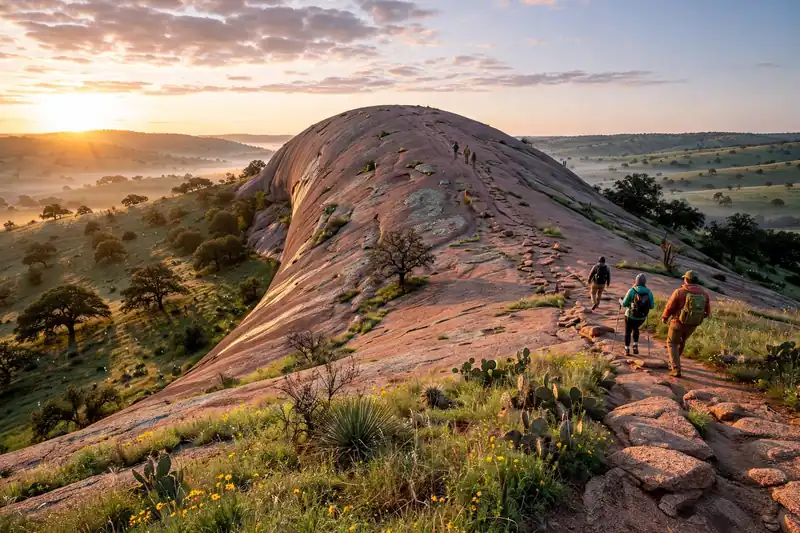
Enchanted Rock State Natural Area on Wikipedia is the most famous natural sight in the Texas Hill Country, and the one outdoor experience in Fredericksburg that needs a plan. A 425-foot pink granite dome rises out of the hills 18 miles north of town on Ranch Road 965, and the Summit Trail climbs it in about 45 minutes — a steep, open granite slope with no shade and a 360-degree view from the top that takes in the whole Hill Country. The dome is 1,643 acres of granite, oak and cactus, with 11 miles of trails, and a 2025 expansion added more than 3,000 acres to the park. In 2026 entry costs $8 per adult aged 13 and over, and children 12 and under enter free; the gate is open 6:30 a.m. to 8 p.m. and the park stays open until 10 p.m. The rule that catches visitors out is the reservation: day passes are required on Fridays, Saturdays, Sundays and holidays, and recommended every other day, and they can be booked up to 30 days ahead — weekend passes sell out one to two weeks ahead, so book the moment your dates are fixed. There are five entry time windows through the day, and the Summit Trail closes in wet or icy weather, because wet granite is dangerously slick. Go at sunrise, when the dome glows pink and the trail is empty, and bring more water than you think you need — there is no water on the dome itself. Two more things: the park is an International Dark Sky Park, so on a clear night the stars over the dome are some of the best in Texas; and on hunt dates (13–16 October, 3–6 November, 1–4 and 19–21 December, 26–29 January) parts of the park close, so check before you go.
3. Main Street and the Historic District
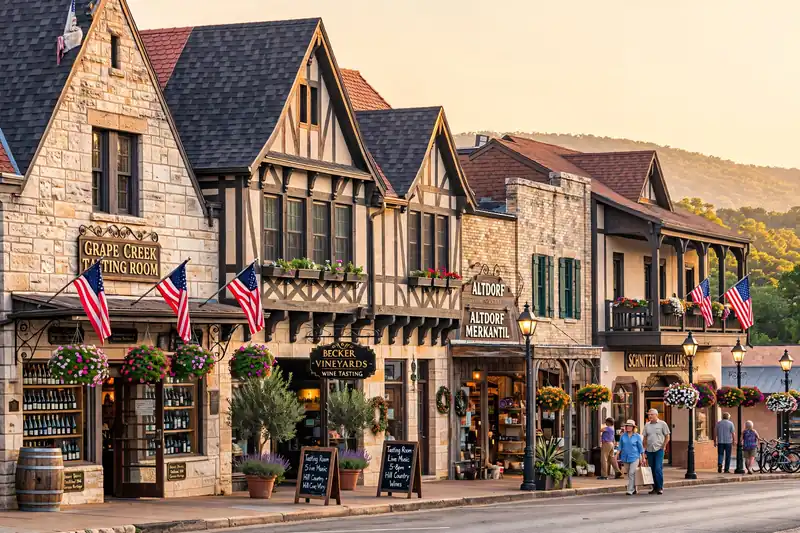
Main Street is the heart of Fredericksburg, and the best free walk in town. It runs for about a mile through the historic district, lined with limestone storefronts from the 19th century, and it holds more than 150 locally owned shops, galleries, restaurants and tasting rooms — and no chains. Start at the western end, where the Pioneer Museum and the old jail sit, and walk east past the German bakeries, the peach stands, the boot shops and the art galleries, to Marktplatz and the Vereins Kirche in the middle of town. The street is at its best in the morning, when the shops open and the bakery smells drift out onto the sidewalk, and again in the evening, when the tasting rooms spill onto the patios and the live music starts. Two honest notes: the shops are genuinely local — the boots, the quilts, the peach jam and the German Christmas ornaments are made here, not imported — and the prices are honest Hill Country prices, not tourist prices, because Fredericksburg’s shops serve Texans as much as visitors. And the parking: Main Street fills by 10 a.m. on weekends, so park at the visitor centre lot on South Adams Street and walk — the whole street is a twenty-minute stroll, and the side streets, with their Sunday Houses and old limestone cottages, are worth the detour. Allow two hours for the walk, longer if you shop, and come back at dusk, when the string lights come on and Main Street looks like a film set.
4. Wine Road 290
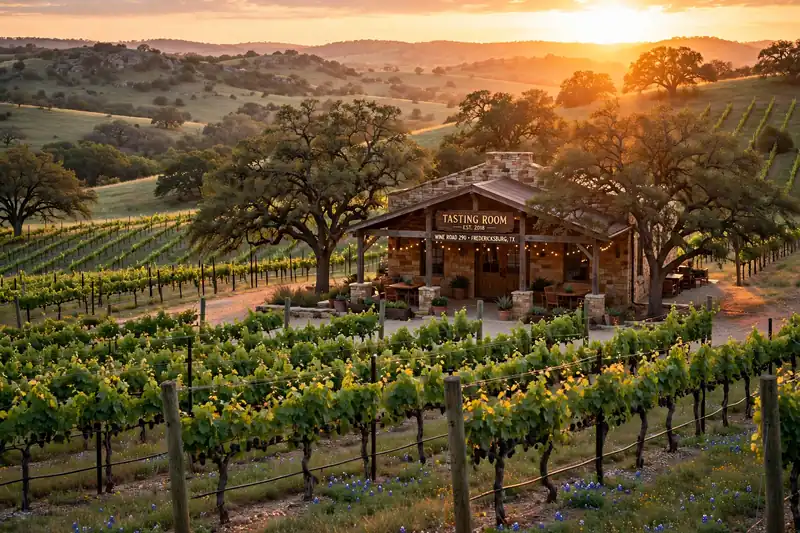
Wine Road 290 is the reason Fredericksburg is the wine capital of Texas, and the best afternoon in the Hill Country. More than 50 wineries line US Highway 290 between Fredericksburg and Johnson City, a roughly 30-mile corridor of tasting rooms, vineyards and patios — the largest concentration of wineries in the state, and the reason Texas wine is taken seriously now. Start with the big names: Becker Vineyards, with its lavender fields and its walk-in tastings; Grape Creek Vineyards, with its Italianate villa and its reserve tastings; and William Chris Vineyards, with its farm-to-table approach and its estate wines. In 2026 a standard tasting costs $20–$35 per person, and elevated tastings run $40–$75; most wineries take walk-ins on weekdays, but weekend reservations are essential two to three weeks ahead at the popular estates, and the best tables on a Saturday go first. The practical way to do it is the 290 Wine Shuttle, a hop-on hop-off bus that runs Friday and Saturday for about $40–$50 for a day pass, or a guided tour at about $80–$120 per person, which includes the tastings and the driving. Do not drive yourself between wineries — the sheriff’s deputies patrol US-290 on weekends, and the tastings add up faster than you think. Three wineries is the right number for an afternoon, four is the maximum, and the last tasting should be the one with the sunset patio. And the honest note most guides skip: Texas wine is good now, and the Hill Country’s Tempranillo, Viognier and Sangiovese are the bottles to try — the state has come a long way from the sweet wines of twenty years ago.
5. Pioneer Museum
The Pioneer Museum is the best place in Fredericksburg to understand how a German settlement became a Texas town, and the most underrated stop on Main Street. The 3.5-acre complex at 325 West Main Street holds the 1849 Kammlah House, the 1870s schoolhouse, the old jail, a blacksmith shop and a barn full of wagons and farm tools, and it tells the story of the German immigrants who arrived in 1846 with almost nothing and built a town out of limestone and stubbornness. In 2026 the museum is open Monday to Saturday, 10 a.m. to 5 p.m., and closed on Sundays; a day pass costs $12 for adults, $5 for students, $7 for seniors and military, and children under 5 enter free. The pass also covers the Vereins Kirche Museum in Marktplatz, which costs $5 on its own, and the Historic Jail, which is open on the first Saturday of each month from 10 a.m. to 3 p.m. The museum is self-guided and takes about an hour, and the docents — many of them descendants of the original settlers — are the best part of it: ask them about the Sunday Houses, the little limestone cottages the farm families built in town so they could come to church on Sundays, and about the Texas German dialect, which old-timers in Gillespie County still speak. Pair it with the Pacific War Museum the same morning — they are two blocks apart — and go to the jail on a first Saturday if you can, when the cells and the gallows are open and the stories are at their best.
6. Marktplatz and the Vereins Kirche
Marktplatz is the town square of Fredericksburg, and the place where the town’s German heart still beats loudest. The square holds the Vereins Kirche on Wikipedia, the octagonal white church built in 1847 as the town’s first school, church and meeting hall — the most photographed building in Fredericksburg, and the symbol of the town on every postcard. The square is where Fredericksburg gathers: the farmers market on Saturdays, the Oktoberfest in October, the Christmas tree and the Nights of Lights in December, and the concerts and festivals all summer. The Vereins Kirche Museum inside the church costs $5, or is included in the Pioneer Museum day pass, and it tells the story of the building and the families who worshipped in it. The square is free to visit, open all day, and at its best in the early morning, when the market sets up and the coffee carts open, and at dusk, when the lights come on and the square fills with families. Two honest notes: the square is the town’s living room, not a tourist attraction — the people sitting on the benches are locals, and the events on the calendar are for them as much as for you — and the best time to come is during one of the big events, when the square is at its liveliest. Come for half an hour, sit on a bench with a coffee from the bakery across the street, and watch Fredericksburg go about its day.
7. Luckenbach Texas
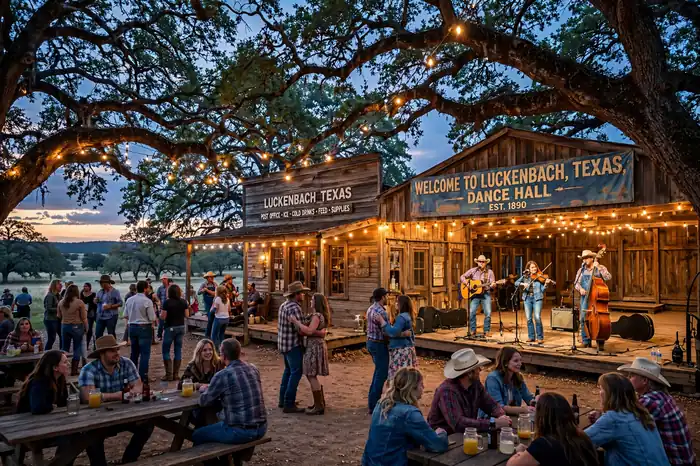
Luckenbach, Texas on Wikipedia is the most famous small town in Texas, and it has a population of three. Thirteen miles southeast of Fredericksburg on Luckenbach Town Loop, it is a general store, a bar and a dance hall that has been operating since 1887, and it became a legend in 1977 when Willie Nelson on Wikipedia and Waylon Jennings on Wikipedia recorded “Luckenbach, Texas (Back to the Basics of Love)”. The song is still the town’s anthem, and the dance hall still hosts live music every day — free to walk in during the day, with ticketed shows in the evenings, when the dance floor fills with two-steppers and the whole Hill Country seems to show up. The general store sells the T-shirts and the pickled eggs, the bar pours cold beer, and the oak trees outside hold the picnic tables where the afternoon crowd gathers. In 2026 daytime entry is free and the live music is daily; ticketed dancehall shows run about $20–$24, and the Christmas Ball on 26 December is the biggest night of the year. Go in the late afternoon, when the light is low and the music starts, and stay for the sunset — Luckenbach at dusk, with the string lights and the fiddles, is the most Texan hour in the Hill Country. And the honest note: Luckenbach is small — a store, a hall, a few picnic tables — and the people who leave disappointed are the ones who expected a town. Come for the music and the atmosphere, not the size.
8. Wildseed Farms
Wildseed Farms is the largest working wildflower farm in the United States, and the most colourful stop on US-290. Seven miles east of Fredericksburg at 100 Legacy Drive, the 200-acre farm grows the wildflower seed that colours Texas highways every spring — bluebonnets, Indian paintbrush, pink evening primrose — and its fields are open to visitors daily from 9:30 a.m. to 5 p.m. In 2026 entry is free, though a small field fee of about $5 per adult has been reported in full bloom, so check at the gate in peak season. The best time to come is March to May, when the fields are in full bloom and the farm is at its most spectacular, and the worst time is high summer, when the flowers are gone and the heat is on. The farm also has a market with seeds, plants and gifts, a butterfly garden, and a wine tasting room — the Wildseed Farms vineyard pours its own wines, and the tasting is a good way to finish a morning in the fields. Allow an hour, bring a camera and a hat, and walk the field paths rather than the road — the best photographs are in the middle of the blooms, not at the edge. And the honest note: the farm is a working farm, not a garden — the fields are planted for seed, so the blooms follow the farming calendar, and a dry spring means a thinner display. Check the farm’s bloom report before you drive out.
9. Lyndon B. Johnson State Park and Historic Site
Lyndon B. Johnson State Park and Historic Site on Wikipedia is the free, quiet counterpoint to the LBJ Ranch next door, and the best place in the Hill Country to understand the president who came from it. Fourteen miles east of Fredericksburg in Stonewall, the park holds the Sauer-Beckmann Living History Farm, a working 1918 German-Texan farm where costumed interpreters plough with mules, churn butter and bake bread in a wood stove, and the visitor centre, which tells the story of Lyndon B. Johnson on Wikipedia and Lady Bird Johnson on Wikipedia and the land they loved. In 2026 admission is free, and the buildings are open 8:30 a.m. to 4 p.m.; the Sauer-Beckmann Farm is open October to May, 10 a.m. to 4 p.m., and June to September, 9 a.m. to 3 p.m., and it is closed on the last Tuesday of every month. The park is closed on Thanksgiving, Christmas and New Year’s Day. The farm is the part to see — go in the morning, when the interpreters are working and the animals are out, and ask them about the German settlers, because the farm is a German-Texan farm, and the story it tells is Fredericksburg’s story too. Allow two hours, and pick up your free LBJ Ranch driving-tour permit at the visitor centre while you are here — it is the only place to get one, and no permits are issued after 4 p.m. The park is also an International Dark Sky Park, designated in November 2021, so on a clear night the stars over the Pedernales are some of the darkest in Texas.
10. LBJ Ranch and the Texas White House
The Lyndon B. Johnson National Historical Park on Wikipedia is the ranch where Lyndon Johnson was born, lived and is buried, and the one sight in the Fredericksburg area where the most important fact is what you cannot see. The Texas White House — the ranch house where Johnson governed the country for long stretches of his presidency — has been closed for rehabilitation since 2 January 2024, with reopening anticipated in 2027, and older guides still describe the house tour as if it were running. It is not, and the visitors who arrive expecting to walk through the president’s living room leave disappointed. What is open is the ranch driving tour, a self-guided drive through the working ranch past the airstrip, the cattle, the Johnson family cemetery and the birthplace house, and it is free, daily from 9 a.m. to 5 p.m. — pick up a free permit at the LBJ State Park visitor centre, where permits are issued from 9 a.m. and none after 4 p.m. The Boyhood Home in Johnson City, where Johnson grew up, is open for guided tours daily at 10:30, 11:30 and 1:30. Allow half a day for the ranch and the state park together, and go in the morning, when the light is low over the Pedernales and the ranch is at its quietest. And the honest note: the ranch is a working cattle ranch, not a museum — the cattle are real, the fences are real, and the best of it is the landscape, the river and the sense of a president who never really left home.
11. Old Tunnel State Park
Old Tunnel State Park on Wikipedia is the smallest state park in Texas, and one of the most extraordinary wildlife sights in the country. Eleven miles south of Fredericksburg, the 16.1-acre park is an abandoned railroad tunnel that has become the summer home of up to three million Mexican free-tailed bats — one of the largest bat colonies in the world. From 1 May to 31 October the bats emerge at dusk, a river of wings that pours out of the tunnel and spirals into the sky for up to an hour, and the park opens its viewing areas for the show. In 2026 day use is free from sunrise to 5 p.m., and the evening bat viewing needs an advance online ticket — no tickets are sold on site — with the lower viewing area at $5 per person and the upper viewing area by reservation. The bats emerge between about 7 and 9 p.m., depending on the season, and the lower deck, closest to the tunnel mouth, is the place to be. Book ahead, because the evening tickets sell out on weekends, and arrive an hour early — the rangers give a talk before the emergence, and the talk is half the experience. Bring a jacket, because the hilltop is cooler than town at dusk, and leave the flash off your camera — the bats are sensitive to light. And the honest note: the bats are wild animals, and the emergence varies with the weather and the season — a cold front or a late rain can thin the show, and the rangers will tell you honestly what to expect on the night.
12. Jenschke Orchards
Jenschke Orchards is the best place in Fredericksburg to taste the peach that made Gillespie County famous, and the most honest farm stand in the Hill Country. At 8301 US Highway 290, the family orchard has been growing peaches since the 1960s, and in season — mid-May to mid-August, peaking in June and July — it sells pick-your-own peaches, peach ice cream, peach cobbler and peach jam from a shaded stand under the trees. Gillespie County grows about 40 percent of all the peaches in Texas, on roughly 600 acres, and the 2026 crop was anticipated to be moderate after a dry spring — so the peaches are there, but the season is shorter than in a wet year, and the best fruit goes early. In 2026 the orchard is open Wednesday to Sunday, 9 a.m. to 5 p.m., and closed on Mondays and Tuesdays. Go in the morning, when the fruit is cool and the stand is quiet, and ask which variety is ripe — the orchard grows a dozen, and the staff will tell you which one is sweetest that week. The Stonewall Peach JAMboree, the county’s peach festival, runs in mid-June in Stonewall, and the Fredericksburg Peach Trail, a free mobile pass, maps the stands and the peach dishes across town. Allow an hour, bring cash for the stand, and eat the peach ice cream on the porch — it is the best ice cream in the Hill Country, and the reason people drive out here in the first place.
13. Becker Vineyards
Becker Vineyards is the winery that put Texas wine on the map, and the best first tasting on Wine Road 290. Founded in 1992 by Richard and Bunny Becker, it is the oldest winery on the corridor and the one that proved the Hill Country could grow serious grapes — its Viognier and its Tempranillo have won national awards, and its lavender fields, in bloom in May and June, are the most photographed in Texas. The tasting room is a stone barn with a wide patio under the oaks, and unlike the estates that need a reservation weeks ahead, Becker accepts walk-ins — which makes it the best winery to start with on a Saturday, when the reserved estates are booked out. Tastings run in the standard $20–$35 range, and the estate also hosts a lavender festival in the spring, when the fields are purple and the whole farm smells of lavender. Allow an hour, taste the Viognier first and the Tempranillo last, and walk the lavender rows if they are in bloom — the photographs are worth the detour, and the lavender products in the shop make the best souvenir in Fredericksburg. And the honest note: Becker is popular, and the patio fills by noon on a Saturday — come at opening, taste, and move on to the smaller rooms, where the winemakers pour and the conversation is better.
14. Lady Bird Johnson Municipal Park
Lady Bird Johnson Municipal Park is Fredericksburg’s backyard, and the best free green space in town. Named for the First Lady who loved the Hill Country, the park sits on the south side of town with a swimming pool, walking trails, sports fields, picnic areas and a fishing pond, and it is where Fredericksburg families spend their summer evenings. It is free to enter, open daily, and at its best in the late afternoon, when the pool is open and the trails are shaded, and on a Saturday morning, when the farmers market spills over from Marktplatz. The park is also the trailhead for the town’s walking paths, which run along Barons Creek and through the pecan trees to the south of Main Street. Allow an hour for a walk and a swim, or a whole afternoon if you bring a picnic, and come here if you need a break from the wineries and the shops — the park is the quietest hour in Fredericksburg, and the best place in town to watch the Hill Country slow down. And the honest note: the park is a city park, not a state park — the pool has seasonal hours, the trails are simple, and the best of it is the shade and the quiet, not the facilities.
15. Longneck Manor
Longneck Manor is the most unexpected attraction in Fredericksburg, and the one children remember longest. A giraffe and rhino conservation centre on the edge of town, it offers small-group encounters with giraffes, rhinos and other animals, in a setting that is closer to a private ranch than a zoo. The encounters are booked ahead and run in small groups, which means the animals are calm, the guides are knowledgeable, and the photographs are close — you feed a giraffe from your hand, and the rhino walks past at arm’s length. The manor is a conservation project first and a visitor attraction second, and the money from the encounters funds the animals’ care and the breeding programme. Allow two hours, book ahead — the encounters sell out on weekends, especially in spring and summer — and wear closed shoes, because the ranch is dusty and the paths are unpaved. And the honest note: Longneck Manor is not cheap, and it is not a zoo — if you want to see a hundred animals, go to a zoo; if you want to spend an hour with a giraffe and learn how conservation works, this is the place.
16. Das Peach Haus
Das Peach Haus is the most Fredericksburg shop in Fredericksburg, and the best place in town to buy a souvenir that actually tastes of the place. A peach orchard, a cafe and a gift shop in one, it sells peach preserves, peach salsa, peach ice cream and peach cobbler, alongside Hill Country gifts, German ornaments and Texas-made crafts. The cafe serves lunch under the pecan trees, and the peach ice cream — made from the orchard’s own fruit — is the best in town, which is saying something in a town that takes its peaches seriously. The Haus is at its best in peach season, from June to August, when the fruit is fresh and the cobbler is warm, but it is worth a stop in any season for the preserves and the gifts. Allow half an hour, taste before you buy — the staff pour samples of everything — and take home a jar of the peach preserves, which is the souvenir that actually gets used. And the honest note: Das Peach Haus is a shop, not a sight — come for the ice cream and the preserves, not for a tour, and pair it with Jenschke Orchards the same morning if you want the full peach story.
17. Cross Mountain
Cross Mountain is the smallest hike with the biggest view in Fredericksburg, and the best place in town to watch the sunset. A short, steep trail climbs the hill on the north side of town to a white cross at the summit, where the whole of Fredericksburg and the Hill Country spreads out below you — Main Street, the church steeples, the vineyards and the granite hills to the north. The hike takes about thirty minutes up and twenty down, and it is steep enough to count as exercise and short enough to do before dinner. The cross at the top was erected by the town’s German settlers, and the hill has been a place of prayer and pilgrimage ever since — the Easter sunrise service here is one of the oldest traditions in Fredericksburg. Go in the late afternoon, when the light is low and the town glows, and bring water — there is no shade on the trail and no water at the top. And the honest note: Cross Mountain is a hill, not a mountain, and the trail is rocky and uneven — wear proper shoes, go slowly, and do not attempt it in the midday heat of July and August, when the granite is hot enough to burn.
18. Fredericksburg Brewing Company
Fredericksburg Brewing Company is the oldest brewpub in Texas, and the best place in town for a beer that is not wine. Opened in 1994 in a 19th-century building on Main Street, it brews its own German-style beers — a lager, a hefeweizen, a dunkel and a seasonal bock — and serves them in a beer hall that feels like a German gasthaus, with long wooden tables, a fireplace and a patio. The food is pub food with a German accent — sausages, schnitzel sandwiches, pretzels and burgers — and the prices are the most reasonable on Main Street. It is at its best in the late afternoon, when the tasting rooms close and the beer drinkers take over, and on a Friday night, when the live music starts and the hall fills. Allow an hour for a pint and a pretzel, or a whole evening if you stay for the music, and try the hefeweizen first — it is the beer the brewpub is known for, and the one that tastes most of Fredericksburg’s German roots. And the honest note: the brewpub is popular, and the patio fills on weekends — come early, sit at the bar if the tables are full, and do not expect a quiet dinner. This is a beer hall, and it is at its best when it is loud.
19. Fort Martin Scott
Fort Martin Scott on Wikipedia is the oldest frontier fort in Texas, and the most honest history in Fredericksburg. Built in 1848 on the outskirts of town, it was the first federal fort in Texas, and it guarded the German settlements against Comanche raids for five years before the frontier moved west. The site holds the restored officers’ quarters, the barracks, the guardhouse and the hospital, set on open ground with interpretive signs that tell the story of the soldiers, the settlers and the Comanche who lived here before them. It is free to visit, open daily, and at its best in the morning, when the light is low and the site is quiet, and in the spring, when the wildflowers cover the parade ground. Allow an hour, walk the whole site — the hospital is the most interesting building, and the view from the officers’ quarters is the best in the fort — and read the signs, because the fort’s story is the story of the frontier, and it is told here better than anywhere else in the Hill Country. And the honest note: Fort Martin Scott is a quiet site, not a show — there are no costumed interpreters and no gift shop, and the visitors who love it are the ones who come for the history and the open ground, not for entertainment.
20. The Palace Theater
The Palace Theater is the oldest theatre in Fredericksburg, and the best night out on Main Street. Built in 1918 as a vaudeville house and a movie palace, it still shows films and hosts live theatre, concerts and community events in its restored auditorium, with its original marquee glowing over Main Street. The theatre is at its best on a Friday or Saturday night, when the lights are on and the town comes out — a film, a play or a concert, with a crowd that knows each other and a room that feels like a community hall. Check the programme before you go, because the theatre’s calendar changes weekly, and the best shows sell out — the Christmas productions and the summer musicals are the ones to book ahead for. Allow an evening, arrive early for a good seat, and walk Main Street afterwards, when the shops are closed and the street is quiet. And the honest note: the Palace is a community theatre, not a Broadway house — the productions are local, the sound is simple, and the charm is in the room and the crowd, not in the spectacle.
Fredericksburg in 3 days — a ready-made itinerary
Three days is the right length for Fredericksburg: one day for the history, one day for the outdoors and the wine, and one day for Main Street, Luckenbach and the LBJ sites. Two days works if you skip the LBJ Ranch and the bats, and one day is enough for the museum, Main Street and a single winery if you start at 9 a.m. and drive fast. The itinerary below assumes a car, a designated driver for the wine day, and a weekend reservation at Enchanted Rock.
Day 1: The museum, Main Street and the German town
Start at the National Museum of the Pacific War at 9 a.m., when it opens and the galleries are quiet, and give it three hours — the Bush Gallery, the Nimitz Gallery and the Combat Zone, in that order. Walk two blocks to the Pioneer Museum for an hour, then to Marktplatz for the Vereins Kirche and a coffee from the bakery. Spend the afternoon walking Main Street, from the western end to the eastern, stopping at the shops and the galleries, and finish at the Fredericksburg Brewing Company for a hefeweizen and a pretzel. In the evening, walk back to Main Street for dinner at Otto’s German Bistro or the Auslander, and finish with a stroll under the string lights.
Day 2: Enchanted Rock, the wineries and the sunset
Start at Enchanted Rock at sunrise — book your day pass in advance, arrive at the gate at 6:30 a.m., and climb the Summit Trail before the heat. Give the dome two hours, then drive back to town for a late breakfast at the Old German Bakery. Spend the afternoon on Wine Road 290: three wineries, starting with Becker Vineyards, then Grape Creek and William Chris, with the 290 Wine Shuttle or a guided tour so nobody has to drive. Finish at the last winery’s sunset patio, then drive back to town for dinner at Cabernet Grill or Vaudeville. If it is a Friday or Saturday, check whether the 290 Wine Shuttle is running — it is the easiest way to do the corridor without a car.
Day 3: Luckenbach, the LBJ sites and the bats
Drive east to the LBJ State Park and Historic Site in Stonewall, pick up your free LBJ Ranch driving-tour permit at the visitor centre, and spend the morning at the Sauer-Beckmann Farm and the ranch drive. Drive back through town for lunch at Eaker Barbecue, then out to Luckenbach for the afternoon — the general store, the bar, and the live music under the oaks. In peach season, stop at Jenschke Orchards on the way back for peach ice cream. In bat season, from May to October, finish the day at Old Tunnel State Park for the evening emergence — book your ticket in advance, arrive an hour early, and watch three million bats pour out of the tunnel at dusk. It is the best ending to a Fredericksburg trip there is.
Best time to visit Fredericksburg
| Season | Weather | Crowds | What is on |
|---|---|---|---|
| Spring (Mar–May) | Mild, 70–80°F, wildflowers in bloom | Busy on weekends, manageable midweek | Wildseed Farms in bloom, peach blossom, the best hiking weather |
| Summer (Jun–Aug) | Hot, 90–100°F, afternoon thunderstorms | Busy, especially June for peaches | Peach season, the Gillespie County Fair in late August, bat season at Old Tunnel |
| Autumn (Sep–Nov) | Warm days, cool nights, 70–85°F | Busy in October, quiet in November | Oktoberfest in early October, fall colour, the best wine-tasting weather |
| Winter (Dec–Feb) | Cool, 50–65°F, occasional freezes | Quiet, except Christmas week | Christmas Nights of Lights, the Light the Night Parade, the Eisbahn ice rink |
March to May is the best time to visit Fredericksburg, and it is not close: the wildflowers are in bloom, the weather is mild, the hiking is at its best, and the wineries are quiet enough to talk to the winemakers. October is the smart alternative, with Oktoberfest, fall colour and the best wine-tasting weather of the year — but it is the busiest month, and the hotels book out weeks ahead. November to December is the Christmas choice, with the Nights of Lights and the parade, and January to February is the budget choice, with the town to yourself and the lowest hotel prices, but the days are short and the wineries run winter hours. Summer is the peach choice, with the fruit at its best and the bats at Old Tunnel, but it is hot — highs in the 90s and over 100°F — and the afternoons are best spent in a tasting room or a pool. Avoid the idea of a day trip in July without a plan: the heat, the crowds and the sold-out Enchanted Rock passes will beat you.
Where to stay in Fredericksburg
| Area | Best for | Price range (approx) |
|---|---|---|
| Main Street | First-timers — walk to the shops, restaurants and tasting rooms | $150–$300 per night |
| US-290 wine corridor | Wine weekends — vineyard views, cottages and B&Bs | $200–$400 per night |
| South of Main Street | Quiet — B&Bs, guesthouses and treehouses | $130–$300 per night |
| Highway 87 and the chains | Budget — motels and chain hotels on the edge of town | $90–$160 per night |
Main Street is the best base for a first visit: the Inn on Barons Creek, the Sunday House Inn and the Hotel Kitsmiller are all within a short walk of the shops and the restaurants, and the Albert Hotel is the town’s first luxury hotel, downtown on Main Street. The B&Bs south of Main Street — Hoffman Haus, the Wine Country Cottages and the Onera treehouses and domes — are the best choice for a quiet weekend, and the vineyard cottages on US-290 are the best choice for a wine weekend, when the tasting rooms are a short drive away. The chain hotels on the edge of town — the Holiday Inn Express, the Hampton Inn and the Comfort Inn — are the budget choice, and the US-290 corridor motels are the cheapest rooms in town. Book ahead for Oktoberfest, Christmas and the spring wildflower weekends, when the town fills and the prices rise, and book a B&B rather than a hotel if you want the full Fredericksburg experience — the breakfasts are the best in the Hill Country, and the hosts know the town better than any guide.
Getting around Fredericksburg
| Option | What to know |
|---|---|
| Car | Essential — the wineries, Enchanted Rock, Luckenbach and the LBJ sites are all a drive from town; rent at Austin or San Antonio airport |
| On foot | Best for Main Street — the whole historic district is a twenty-minute walk, and the side streets are worth the detour |
| 290 Wine Shuttle | Hop-on hop-off bus on Wine Road 290, Friday and Saturday, about $40–$50 for a day pass |
| Rideshare and taxis | Limited — Uber and Lyft run in town, but waits are long on weekends; book ahead for the wineries |
| Parking | Main Street fills by 10 a.m. on weekends — use the visitor centre lot on South Adams Street |
| Airport | Austin-Bergstrom (AUS), about 1.5 hours east, and San Antonio International (SAT), about 1 hour south; no public transport from either |
Fredericksburg is a driving town, and the first thing to understand is that the sights are spread out: Enchanted Rock is 18 miles north, Luckenbach is 13 miles southeast, the LBJ sites are 14 miles east, and the wineries run 30 miles along US-290. A car is essential, and the best way to get one is to rent at Austin or San Antonio airport and drive in — there is no Amtrak, no bus from either city, and no public transport in town. Once you are in Fredericksburg, Main Street is best on foot: park once, at the visitor centre lot on South Adams Street, and walk — the whole historic district is twenty minutes end to end, and the side streets, with their Sunday Houses and limestone cottages, are the best part of the walk. For the wineries, use the 290 Wine Shuttle on Friday and Saturday, or a guided tour, or a rideshare booked ahead — do not drive yourself between tastings. And one warning for drivers: US-290 is patrolled on weekends, and the Hill Country roads are dark and winding at night, so plan your return before the last tasting, not after it.
Fredericksburg food you have to try
Fredericksburg’s food is better than its reputation, and it is built on three things: German cooking, Texas barbecue and peaches. The town eats well at every price — the bakeries, the biergartens, the smokehouses — and the best meals in Fredericksburg are the ones that could not exist anywhere else. Three rules: eat where the locals eat, never at the winery with the biggest parking lot; a menu in German and English is a good sign; and the best tables in town book out on weekends, so reserve.
Schnitzel and German classics — Otto’s, Auslander and the Old German Bakery
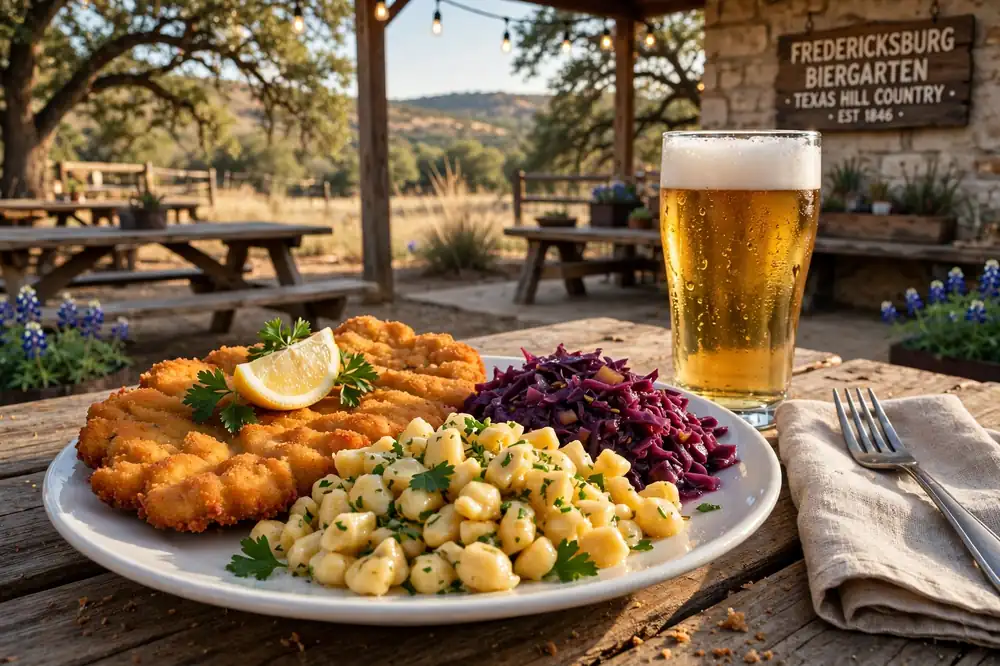
Schnitzel on Wikipedia is Fredericksburg’s signature dish, and the one food every visitor should eat. Otto’s German Bistro, at 316 East Austin Street, is the best of it: dinner only, from 4 p.m., reservations essential, and a duck schnitzel that regulars drive from Austin for. The Auslander Restaurant and Biergarten, at 323 East Main Street, has been serving Jägerschnitzel in its biergarten since 1979, and it is the most Fredericksburg meal in town — schnitzel, spaetzle, a cold German beer, under the oaks. Friedhelm’s Bavarian Inn, at 905 West Main, serves nine schnitzel variations, and Der Lindenbaum and the Old German Bakery and Restaurant round out the German table — the bakery’s breakfast, with its apple strudel and its German pancakes, is the best breakfast in town. Expect about $20–$35 for a schnitzel dinner in a good Main Street restaurant, and order it where the menu is in German first — the best places are the ones with no photographs and a queue of locals. The golden rule, from every local: never eat schnitzel at the place with the biggest sign on Main Street, where it costs twice as much and tastes half as good.
Texas barbecue — Eaker Barbecue and the smokehouse scene
Texas barbecue on Wikipedia is the other half of Fredericksburg’s table, and the town does it properly. Eaker Barbecue, on the edge of town, was named one of the Texas Monthly Top 50 BBQ joints in 2021, and it is the brisket to beat in Gillespie County — smoked over post oak, sliced to order, and served with the sides that matter: potato salad, slaw and beans. The barbecue scene in Fredericksburg is small but serious, and the rule is the same as everywhere in Texas: go early, because the good places sell out, and order the brisket first, the sausage second, and the ribs if they are still there. Expect about $15–$25 for a plate at a good smokehouse, and eat it at the picnic tables, not in the car — the best barbecue in Texas is eaten outdoors, with your hands, and Fredericksburg is no exception. And the honest note: Fredericksburg is not Lockhart or Austin, and the barbecue here is one smokehouse deep, not a scene — come for Eaker, eat well, and do not expect a barbecue crawl.
Peach everything — cobbler, ice cream and the peach stands
Peach on Wikipedia is the flavour of Fredericksburg, and the one food that is only here. Gillespie County grows about 40 percent of all the peaches in Texas, and in season — mid-May to mid-August, peaking in June and July — the town eats peaches in every form: peach cobbler, peach ice cream, peach jam, peach salsa and peach pie. The best of it is at Jenschke Orchards, where the ice cream is made from the orchard’s own fruit, and at Das Peach Haus, where the cobbler is warm and the preserves are the souvenir that actually gets used. The peach stands on US-290 sell the fruit by the basket, and the best peaches are the ones you eat in the car, warm from the sun, with the juice running down your chin. Expect about $5–$8 for a peach ice cream and $8–$12 for a slice of cobbler, and the rule is simple: if it is not peach season, do not order the peach cobbler — the frozen kind is not worth it, and the locals will know. Come in June, eat a peach, and understand why the county’s festival is called the Peach JAMboree.
Free things to do in Fredericksburg
Fredericksburg is a generous town for a free day, and the best of it costs nothing. Walk Main Street — the whole historic district, the shops, the galleries, the Sunday Houses on the side streets — and sit on a bench in Marktplatz with a coffee. Visit the Memorial Courtyard and the Japanese Garden of Peace at the Pacific War Museum, free every day until 5 p.m. Walk the grounds of Fort Martin Scott, free every day, and climb Cross Mountain for the sunset, free every day. Drive out to Luckenbach in the afternoon, free to walk in, and listen to the live music under the oaks. Visit the LBJ State Park, free every day, and walk the Sauer-Beckmann Farm in the morning. Seven free things, and not one of them feels like a compromise.
Frequently asked questions
How many days do you need in Fredericksburg?
Three days is the right answer for most visitors: one day for the museum and Main Street, one day for Enchanted Rock and the wineries, and one day for Luckenbach and the LBJ sites. Two days works if you skip the LBJ Ranch and the bats, and one day is enough for the museum, Main Street and a single winery if you start at 9 a.m. and drive fast. Four days is the sweet spot if you want a slow wine weekend, a second morning at Enchanted Rock, and a day trip to Austin or San Antonio — both are an easy drive, and both have their own guides on this site. The visitors who stayed one day consistently say they felt rushed, and the ones who stayed three say it was just right.
Is Fredericksburg worth visiting if you don’t drink wine?
Yes — and the town knows it. The Pacific War Museum is the best museum in the Hill Country and has nothing to do with wine. Enchanted Rock is one of the great hikes in Texas. Main Street, Luckenbach, the LBJ sites, the bats at Old Tunnel and the peaches are all dry, and the town’s German food, its history and its Hill Country scenery are the real reason to come. The wineries are one afternoon of a three-day trip, and the visitors who skip them entirely still leave happy — they spend the afternoon at Wildseed Farms, at the Pioneer Museum, or at the pool in Lady Bird Johnson Park instead. Come for the history and the hills, and let the wine be a bonus, not the point.
Do you need a car in Fredericksburg?
Yes — for everything except Main Street. The museum, Main Street, Marktplatz and the Pioneer Museum are all walkable, and the whole historic district is a twenty-minute stroll. But Enchanted Rock is 18 miles north, Luckenbach is 13 miles southeast, the LBJ sites are 14 miles east, and the wineries run 30 miles along US-290, and there is no bus, no train and almost no rideshare to any of them. Rent a car at Austin or San Antonio airport and drive in, park once at the visitor centre lot on South Adams Street, and walk Main Street — then drive to everything else. For the wineries, use the 290 Wine Shuttle on Friday and Saturday, or a guided tour, so nobody has to drive after tasting.
What is the best time to visit Fredericksburg?
March to May is the best time, and it is not close: the wildflowers are in bloom, the weather is mild, the hiking is at its best, and the wineries are quiet enough to talk to the winemakers. October is the smart alternative, with Oktoberfest, fall colour and the best wine-tasting weather of the year — but it is the busiest month, and the hotels book out weeks ahead. November to December is the Christmas choice, with the Nights of Lights and the parade, and January to February is the budget choice, with the town to yourself and the lowest hotel prices. Summer is the peach choice, with the fruit at its best and the bats at Old Tunnel, but it is hot — highs in the 90s and over 100°F — and the afternoons are best spent in a tasting room or a pool. Avoid a day trip in July without a plan: the heat, the crowds and the sold-out Enchanted Rock passes will beat you.
Is Fredericksburg expensive?
Mid-range, and honest about it. A mid-range day runs about $120–$200 per person: the museum is about $24, a tasting is $20–$35, a schnitzel dinner is $20–$35, and a Main Street hotel is $150–$300 a night. The free things — Main Street, Marktplatz, the museum’s courtyard and garden, Fort Martin Scott, the LBJ State Park, Luckenbach in the daytime — keep the total down, and the wineries are the part that adds up: three tastings is $60–$105 before lunch. The budget version of Fredericksburg is real, though: a chain motel on the edge of town, a free morning at the state park, a barbecue plate for lunch, and an evening on Main Street costs less than $100 a day. The expensive version is also real: a vineyard cottage, a guided wine tour and dinner at Otto’s will run $300 a day and more. Fredericksburg is a town that lets you choose.
What should I skip in Fredericksburg?
Skip the idea of doing Fredericksburg as a day trip from Austin or San Antonio without a plan — the museum alone deserves three hours, and the drive back in the dark after a wine afternoon is a bad idea. Skip the Texas White House tour — it has been closed for rehabilitation since January 2024, and the guides that still list it are out of date; do the ranch driving tour instead. Skip driving yourself between wineries — the tastings add up, the sheriff patrols US-290, and the shuttle exists for a reason. Skip Enchanted Rock on a summer Saturday without a reservation — the passes sell out one to two weeks ahead, and the gate will turn you away. Skip the schnitzel at the place with the biggest sign on Main Street, where it costs twice as much and tastes half as good. And skip the idea that Fredericksburg is only wine: the visitors who leave disappointed are the ones who came for a tasting and a photograph, and never walked Main Street, climbed the dome, or sat under the oaks at Luckenbach.
Further reading
Fredericksburg, Texas on Wikipedia
National Museum of the Pacific War on Wikipedia
Enchanted Rock State Natural Area on Wikipedia
Luckenbach, Texas on Wikipedia
Lyndon B. Johnson National Historical Park on Wikipedia
Lyndon B. Johnson State Park and Historic Site on Wikipedia
Old Tunnel State Park on Wikipedia
Chester W. Nimitz on Wikipedia
Fort Martin Scott on Wikipedia
Texas Hill Country on Wikipedia
Gillespie County, Texas on Wikipedia
John O. Meusebach on Wikipedia
Lyndon B. Johnson on Wikipedia
Lady Bird Johnson on Wikipedia
We could not find a live, on-topic Reddit thread about visiting Fredericksburg, so we have not linked one — if you know a good one, tell us and we will add it.
We could not find a live, on-topic Quora thread about visiting Fredericksburg, so we have not linked one — if you know a good one, tell us and we will add it.
Your Fredericksburg trip, in one paragraph
Fredericksburg is the place where the whole idea of this site — one honest, complete guide per place — feels most at home: a German town in the middle of Texas, where the schnitzel is served with Texas barbecue down the street, where a war museum, a pink granite dome and fifty wineries share a single small town, and where the best of the trip is the slow evening on Main Street, not the sight you came to tick off. Start with the islands and the coasts: our Hawaii guide, our Maui guide, and our Honolulu guide. Then the American cities, in the order we wrote them: our Chicago guide, our Nashville guide, our Los Angeles guide, our Orlando guide, our Miami guide, our San Diego guide, our Denver guide, our Savannah guide, our Dallas guide, our Charleston guide, our San Francisco guide, our Myrtle Beach guide, our Las Vegas guide, and our San Antonio guide. Further afield: our London guide, our Portland guide, our Pigeon Forge guide, our Puerto Rico guide, our Atlanta guide, our Phoenix guide, our Paris guide, our Key West guide, our Colorado Springs guide, our Sedona guide, our Chattanooga guide, our Palm Springs guide, our St. Louis guide, our Tokyo guide, our Japan guide, our Kansas City guide, our Tennessee guide, our Branson guide, our Florida guide, our Amsterdam guide, our Montreal guide, our Fort Lauderdale guide, our Toronto guide, our Aruba guide, our Charlotte guide, our Indianapolis guide, our New Orleans guide, our Destin guide, our Santa Barbara guide, our Mexico City guide, our Arizona guide, our Osaka guide, our Minneapolis guide, our Pittsburgh guide, our California guide, our Asheville guide, our Costa Rica guide, our Washington DC guide, our Seattle guide, our St. Augustine guide, our Lisbon guide, our Dubai guide, our Santa Fe guide, our Galveston guide, our Maine guide, our Sacramento guide, our Kauai guide, our Boston guide, our Cancun guide, our Madrid guide, our Salt Lake City guide, our Baltimore guide, our Barcelona guide, our Reno guide, our Milwaukee guide, our North Carolina guide, our New York guide, our Tucson guide, our Raleigh guide, our Corpus Christi guide, our Milan guide, our Salem guide, our Wilmington guide, our Memphis guide, our Flagstaff guide, our Austin guide, our Oahu guide, our Iceland guide, our Cincinnati guide, our Fort Worth guide, our Panama City Beach guide, our Monterey guide, our Nassau Bahamas guide, our Lexington guide, our Lake Tahoe guide, our San Jose guide, our Tulum guide, our Louisville guide, and our Rome guide.

About the Author