Things to Do in Washington DC
20 Best Attractions, a 3-Day Itinerary, Where to Stay, and the Food You Cannot Miss
Quick Info
Best for: First-timers, history lovers, museum fans and families — and anyone who likes world-class sights that are free
Best time: Late April–May and September–October; cherry blossom season is late March–early April
How long: 3–4 days for the highlights; 5 days if you add Mount Vernon and Alexandria
Budget: About $150–$250 per person per day with a mid-range hotel — many of the best sights cost nothing
Don’t miss: The Lincoln Memorial at dusk, the founding documents at the National Archives, and the pandas at the National Zoo
Washington, D.C. on Wikipedia is the capital of the United States, and it is the rare big city where the best things are mostly free. The Smithsonian museums cost nothing, the monuments on the National Mall are open around the clock, and you can walk from the Lincoln Memorial to the Capitol in about 40 minutes. This guide covers the 20 best things to do in Washington DC, a 3-day itinerary that actually works, where to stay without overpaying, how to get around on the Metro, the three foods you should not skip, and the free sights that make DC the best value city break in America. Everything below was checked against live sources in November 2026, including the timed-entry pass rules that trip up first-timers and the new attractions that opened in 2026.
Washington DC at a glance
| Topic | What to know |
|---|---|
| Full name | Washington, District of Columbia — the federal capital of the United States |
| Founded | 1790 (Residence Act); the government moved here in 1800 |
| Population | About 702,000 in the District; about 6.4 million in the metro area |
| Currency | US dollar ($) |
| Language | English |
| Time zone | Eastern Time (ET) — UTC−5 in winter, UTC−4 in summer |
| Nearest airports | Ronald Reagan Washington National (DCA), Dulles International (IAD), Baltimore/Washington (BWI) |
| Getting in | DCA is on the Metro Blue and Yellow lines, about 20 minutes downtown; IAD is on the Silver Line, about 55 minutes |
| Best for | History, free museums, monuments, walkable neighbourhoods, food |
| Famous for | The National Mall, the Smithsonian, the Capitol, cherry blossoms, pandas |
The 20 best things to do in Washington DC
1. Stand inside the Lincoln Memorial — and go below it
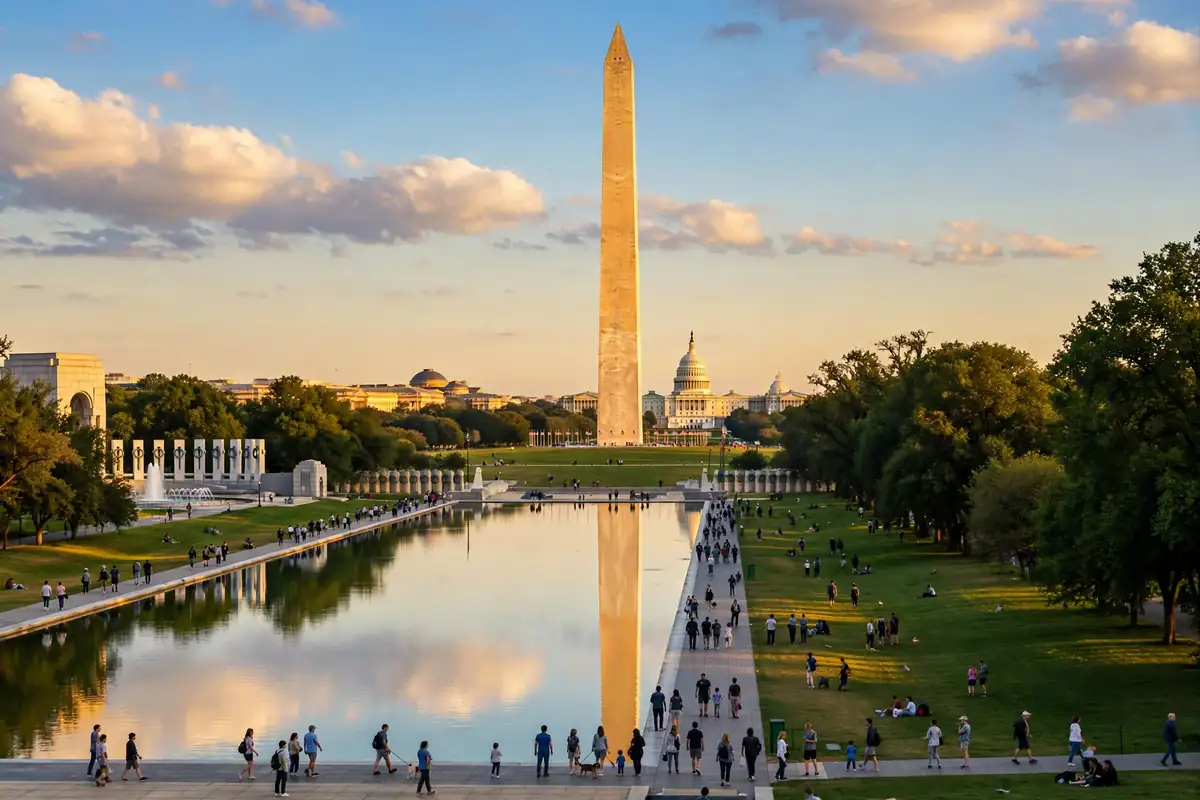
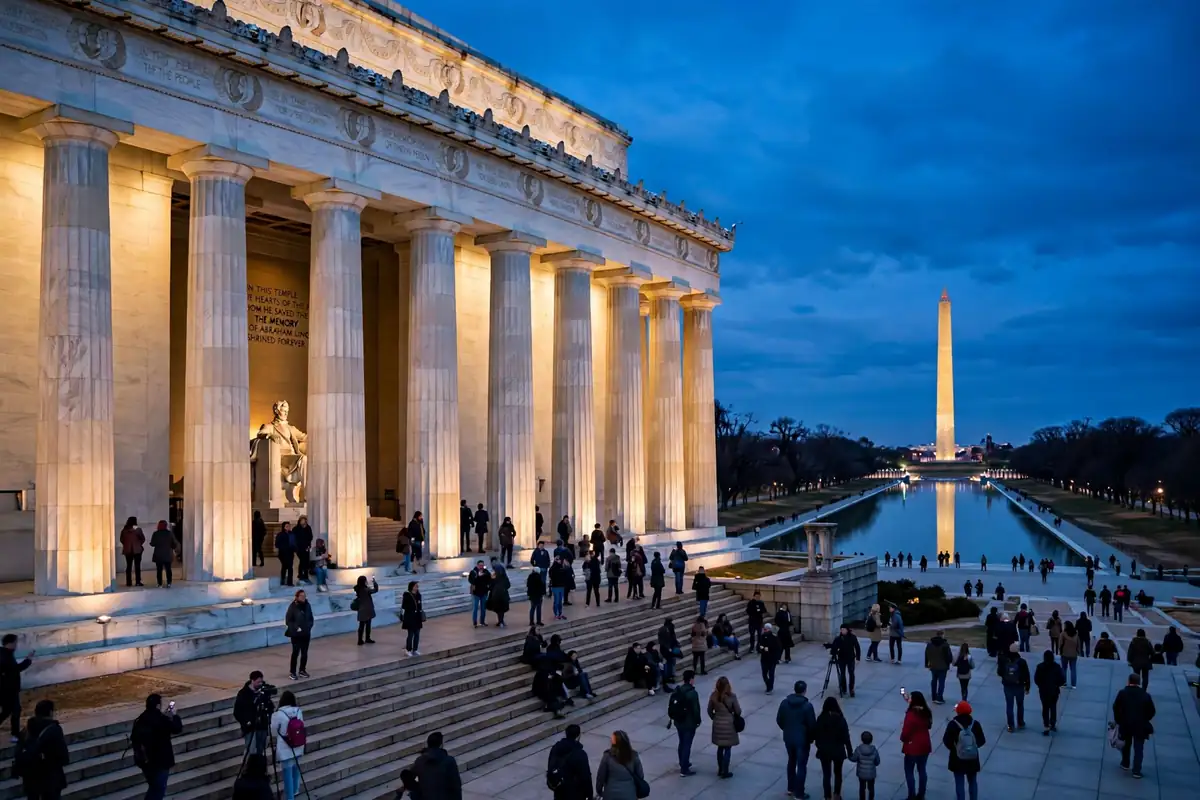
The Lincoln Memorial on Wikipedia is the most moving place in Washington, and it is free, open 24 hours a day, and busiest at sunrise and sunset. Daniel Chester French’s 19-foot seated Abraham Lincoln looks out across the Reflecting Pool toward the Washington Monument, and the steps are where Martin Luther King Jr. delivered his “I Have a Dream” speech on August 28, 1963 — the exact spot is marked on the steps. What most guides still miss is the new part underneath: the Lincoln Memorial undercroft opened to the public on June 25, 2026, a 15,000-square-foot exhibition space below the memorial with exhibits on how it was built, including the original plaster model of Lincoln. The chamber itself is still free and open around the clock, but the undercroft needs a free timed ticket, booked on Recreation.gov up to 30 days ahead at 11 a.m. ET, with next-day tickets released at 4 p.m. and same-day tickets available at the kiosk by the Korean War Veterans Memorial from 8:45 a.m. Undercroft hours are 9 a.m. to 9 p.m. from March to October and 9 a.m. to 8 p.m. from November to February, with last entry an hour before closing, and there is a $1 reservation fee per ticket. Go at dusk, when the columns glow and the crowds thin, then walk the Reflecting Pool as the lights come on.
2. Ride to the top of the Washington Monument
The Washington Monument on Wikipedia is a 555-foot obelisk, and the observation deck at 500 feet gives you the best view in the city — the whole Mall, the Capitol, the White House and the Tidal Basin in one sweep. It is open 9 a.m. to 5 p.m., with last entry at 4 p.m., and it is closed on July 4 and December 25 plus one maintenance day a month. The trap for first-timers is that you cannot just turn up: tickets are timed and released on Recreation.gov 30 days ahead at 10 a.m. ET, with an extra batch at 3 p.m. the day before, and a $1 fee per ticket. A small number of free same-day tickets are handed out at the Washington Monument Lodge on 15th Street from 8:45 a.m., but they go fast in spring and summer, so book ahead. The elevator takes about 70 seconds; allow an hour for the whole visit including security.
3. Walk the National Mall memorials at dusk
The National Mall on Wikipedia is a two-mile stretch of lawns and memorials between the Capitol and the Lincoln Memorial, and the smartest way to see it is on foot at dusk, when the marble glows and the daytime crowds are gone. Start at the World War II Memorial, with its 56 pillars for the states and territories and the fountain at the centre, then walk to the Vietnam Veterans Memorial — the black granite wall with more than 58,000 names, where volunteers help visitors find a name and make a rubbing. The Korean War Veterans Memorial, with its 19 steel soldiers in ponchos, is the most haunting after dark, and the Martin Luther King Jr. Memorial, with its 30-foot Stone of Hope, sits on the Tidal Basin nearby. The whole walk is free, flat and about two miles end to end, and the memorials themselves are open 24 hours. Do not try to do the Mall in the middle of a summer afternoon — there is almost no shade, and the distances look shorter than they are.
4. Take a free tour of the US Capitol
The United States Capitol on Wikipedia is free to tour, but you need to book. Guided tours run Monday to Saturday from the Capitol Visitor Center, 8:30 a.m. to 4:30 p.m., with the last tour at 3:20 p.m., and the building is closed on Sundays and on Thanksgiving, Christmas, New Year’s Day and Inauguration Day. Book at visitthecapitol.gov up to 90 days ahead; same-day passes are also released from 9 a.m. The tour covers the Crypt, the Rotunda under the dome, and National Statuary Hall, where each state is represented by two statues. It does not include the House or Senate chambers — those need separate gallery passes from your Member of Congress. Leave food and drink, including water bottles, at the hotel, because there is no storage and nothing edible is allowed inside. The dome, completed in 1866, is one of the great symbols of American democracy, and standing in the Rotunda under it is worth the planning.
5. See the most beautiful room in America at the Library of Congress
The Library of Congress on Wikipedia is the largest library in the world, and its Thomas Jefferson Building is the most beautiful public building in Washington — a 1897 palace of marble, mosaics and murals that most visitors walk straight past. Entry is free, but you need a free timed-entry ticket, bookable 30 days ahead, with same-day tickets released from 9 a.m. The building is open Tuesday to Saturday, 10 a.m. to 5 p.m., with Thursday hours extended to 8:30 p.m., and it is closed on Sundays and Mondays. Do not miss the Main Reading Room, viewed from the gallery above, the Gutenberg Bible on display, and the Great Hall with its marble staircase. Guided tours run daily and are free. If you are a researcher, you can apply for a reader card and work in the reading rooms yourself — one of the great free experiences in the city.
6. See the Declaration of Independence at the National Archives
The National Archives Building on Wikipedia holds the original Declaration of Independence, the Constitution and the Bill of Rights in the Rotunda, under glass in dim light, and seeing the real documents is a different experience from reading about them. Entry is free and the building is open daily from 10 a.m. to 5:30 p.m., with last admission 30 minutes before closing, closed on Thanksgiving and Christmas. Walk-ins are allowed, but the line can top an hour at peak times in spring and summer, so the $1 timed-entry ticket (slots from 10:15 a.m. to 4:30 p.m.) is money well spent. The Rotunda also holds a 1297 copy of the Magna Carta and, on rotation, the Emancipation Proclamation. Photography is not allowed in the Rotunda, and the documents are kept in low light to protect them, so give your eyes a minute to adjust. The 2026 America 250 anniversary year made this the most visited it has been in years — the Declaration reading on July 4, 2026 drew huge crowds — so book the timed ticket.
7. See the White House — and know how tours really work
The White House on Wikipedia is the one sight in Washington where outdated guides cause the most disappointment, so here is the honest 2026 picture. You can see it for free from the fence on Pennsylvania Avenue or from Lafayette Square, and the free White House Visitor Center on Pennsylvania Avenue needs no booking and is the reliable fallback. Public tours inside are free and self-guided, and US citizens request them through their Member of Congress and foreign visitors through their embassy, 21 to 90 days ahead, first come first served. Tours normally run Tuesday to Thursday from 7:30 to 11:30 a.m. and Friday to Saturday from 7:30 a.m. to 1:30 p.m., excluding federal holidays. But the East Wing was demolished in October 2025 to build a new ballroom, tours were paused in August 2025 and resumed on December 2, 2025 on a shorter route that skips the East Room, the China Room, the Vermeil Room, the Library, the East Garden Room, the Family Theater and the East Colonnade, and they have been paused again at points in 2026 for construction. Check the official White House visit page the week you travel, and never pay anyone who offers to sell you White House tour tickets — that is a scam, because the tours are always free. For the full story, the free White House Visitor Center and the nearby People’s House experience fill in what the tour cannot show.
8. Fly the Wright Flyer at the National Air and Space Museum
The National Air and Space Museum on Wikipedia on the Mall is the most visited museum in America, and after a seven-year renovation it is almost finished — 18 of its 20 galleries were open by September 2026, with the last two opening on October 30 and November 11, 2026. Entry is free, but you need a free timed-entry pass, released on the first of each month at noon ET, two months ahead. The museum is open daily from 10 a.m. to 5:30 p.m. except December 25, and there is now a single entrance on Jefferson Drive. The must-sees are the 1903 Wright Flyer, Lindbergh’s Spirit of St. Louis, the Apollo 11 command module Columbia, and a touchable Moon rock. If you have a second day, the Steven F. Udvar-Hazy Center near Dulles Airport needs no pass at all — just $15 parking — and holds the Space Shuttle Discovery and a Concorde. Book the Mall pass early in cherry blossom season, when it sells out days ahead.
9. Walk through history at the National Museum of African American History and Culture
The National Museum of African American History and Culture on Wikipedia is the newest Smithsonian on the Mall, and it is the one museum where you should allow a full half day. Entry is free, but you need a free timed-entry pass, bookable 30 days ahead, with same-day passes released from 8:15 a.m. The museum is open daily from 10 a.m. to 5:30 p.m. Start at the bottom, in the history galleries that begin with the slave trade and climb upward through segregation, the Civil Rights Movement and into the culture galleries at the top — the building is designed to be walked from the bottom up. Highlights include the segregated railway car, Emmett Till’s casket, Chuck Berry’s Cadillac, and the Sweet Home Cafe on the ground floor, which serves regional African American cooking and is worth a lunch stop on its own. This is the hardest pass in Washington to get on a spring weekend, so book the moment your 30-day window opens.
10. Meet the Hope Diamond at the National Museum of Natural History
The National Museum of Natural History on Wikipedia is the one Smithsonian on the Mall that needs no timed pass at all — just walk in. It is open daily from 10 a.m. to 5:30 p.m., it is free, and it is the best family museum in the city. The stars are the 45.52-carat Hope Diamond, the elephant in the Rotunda, the dinosaur hall with the Nation’s T. rex, the Ocean Hall with its life-size North Atlantic right whale, and the live Butterfly Pavilion, which has a small fee. It is also the museum with the best air conditioning on a hot July day, which is a genuine planning consideration in DC. Arrive at opening to see the Hope Diamond without a crowd, and allow at least two hours.
11. See the Star-Spangled Banner at the National Museum of American History
The National Museum of American History on Wikipedia is free, needs no pass, and is open daily from 10 a.m. to 5:30 p.m. Its star object is the actual Star-Spangled Banner — the huge flag that flew over Fort McHenry in 1814 and inspired the national anthem — displayed in a dim, climate-controlled chamber. Other highlights are Dorothy’s ruby slippers from The Wizard of Oz, the First Ladies’ inaugural gowns, Abraham Lincoln’s top hat, and Julia Child’s kitchen. It is the most purely American museum on the Mall, and the one that surprises visitors most. Allow two hours, and go early if you want the flag chamber to yourself.
12. See the only da Vinci in the Americas at the National Gallery of Art
The National Gallery of Art on Wikipedia is free, needs no ticket, and is open daily from 10 a.m. to 5 p.m., closed on December 25 and January 1. It has two buildings: the West Building, a neoclassical palace by John Russell Pope at 6th Street and Constitution Avenue, holds the old masters — including Leonardo da Vinci’s Ginevra de’ Benci, the only da Vinci painting in the Americas — plus Vermeer, Rembrandt and Monet. The East Building, I.M. Pei’s sharp-angled 1978 building at 4th Street and Constitution Avenue, holds modern and contemporary art, including the world’s largest collection of Alexander Calder mobiles. Between them is the Sculpture Garden at 7th Street, free and lovely in summer, with a fountain that becomes an ice rink in winter. One practical note: the West Building’s 7th Street entrance is closed until further notice, so use the Mall entrance on Madison Drive. The gallery also runs free concerts and a good, reasonably priced cafe in the underground concourse.
13. Meet the pandas at the National Zoo
The Smithsonian National Zoological Park on Wikipedia is free, but you need a free entry pass, and it is the home of Washington’s most famous residents: giant pandas Bao Li and Qing Bao, who arrived from China on October 15, 2024 and made their public debut on January 24, 2025. Bao Li is a male born on August 4, 2021 and Qing Bao is a female born on September 12, 2021, and they are on the Asia Trail under a loan that runs through April 2034. The zoo grounds are open from 8 a.m. to 4 p.m. from September 15 to March 14, with last entry at 3 p.m., and from 8 a.m. to 6 p.m. from March 15 to September 14, with last entry at 5 p.m., and the zoo is closed on December 25. Go first thing in the morning, when the pandas are most active and the crowds are thinnest — by midday they are usually asleep. One thing to skip in 2026: the Africa Trail is under renovation and is expected to stay closed until early 2027. The zoo sits in Rock Creek Park in the Woodley Park neighbourhood, about 15 minutes from downtown on the Metro Red Line, and the walk from the station is downhill going in and uphill coming back — plan accordingly.
14. Walk the Tidal Basin under the cherry blossoms
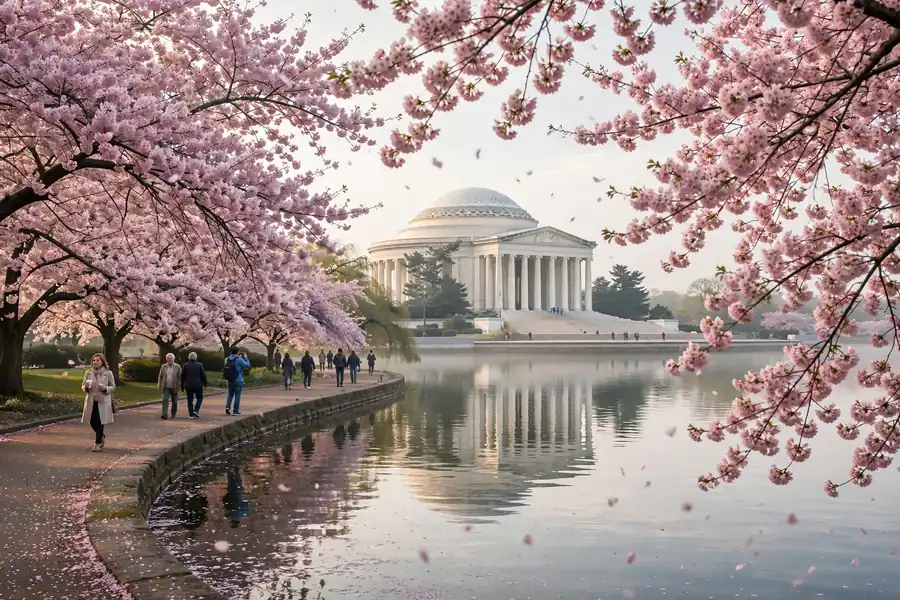
The Tidal Basin on Wikipedia is where Washington is at its most beautiful, and the cherry blossoms are the reason spring is the busiest season in the city. Japan gave Washington 3,020 cherry trees in 1912, and the Yoshino cherries around the Tidal Basin bloom for just four to ten days, usually in late March or early April — in 2026, peak bloom was confirmed on March 26. The National Park Service publishes its forecast in late February, and the National Cherry Blossom Festival runs for about three weeks around the bloom; in 2027 the festival marks the 115th anniversary of the 1912 gift. The best walk is the two-mile loop around the basin, past the Jefferson Memorial, the Franklin Delano Roosevelt Memorial and the Martin Luther King Jr. Memorial, and the Tidal Basin seawall walkways reopened in April 2026 after renovations, with 353 cherry trees replanted. Go at sunrise if you can — the crowds arrive by 9 a.m. and the parking is impossible by 10. If you miss the Yoshino bloom, the Kwanzan cherries at East Potomac Park and Hains Point bloom about two weeks later and are almost as pretty with a fraction of the crowds.
15. Watch the Changing of the Guard at Arlington National Cemetery
Arlington National Cemetery on Wikipedia is free, open daily from 8 a.m. to 5 p.m., and it is the most solemn place in Washington. More than 400,000 people are buried across 639 acres on the Virginia side of the Potomac, on land that was once Robert E. Lee’s home. The must-see is the Tomb of the Unknown Soldier, where the Changing of the Guard happens every 30 minutes from April to September and every hour from October to March, in all weather, with a precision that has to be seen to be believed. Nearby is the eternal flame at John F. Kennedy’s grave, and the views back across the river to the Lincoln Memorial are superb. Arlington Cemetery has its own Metro station, about five minutes from the entrance, and the cemetery is hilly — wear comfortable shoes and allow two to three hours. Photography is fine except during ceremonies, and silence is expected at the Tomb.
16. Wander Georgetown — M Street, the waterfront and the C&O Canal
Georgetown on Wikipedia is Washington’s oldest neighbourhood, founded in 1751, and it feels like a different city from the monumental Mall — cobblestone streets, Federal-style row houses, and the steepest hill in the city. M Street is the shopping spine, Wisconsin Avenue is the restaurant strip, and the Georgetown waterfront on the Potomac is the place to be on a summer evening, with the Key Bridge framing the sunset. Walk the towpath of the Chesapeake and Ohio Canal, which runs through the neighbourhood, and look for the Exorcist Steps — the 75 steep steps at 36th and Prospect Streets made famous by the 1973 film. Georgetown has no Metro station, so take the Circulator bus from Dupont Circle or Union Station, or walk across from Foggy Bottom. It is the best neighbourhood in the city for an aimless afternoon, and the best place to stay if you want charm over convenience.
17. Take a half-day trip to Mount Vernon
Mount Vernon on Wikipedia was George Washington’s home, and it is the best half-day trip from the city — about 16 miles south in Virginia, on the Potomac. Admission is from about $28 for adults and $14 for children aged 6 to 11, with under-6s free, and the estate is open daily from 9 a.m. to 5 p.m. from April to October, closing at 4 p.m. in winter. Book the grounds pass online and add a timed mansion tour, which takes about 45 minutes and runs through Washington’s study, dining room and the bedroom where he died in 1799. The estate also has a museum, Washington’s tomb — where free tours run at 10 a.m. and 2 p.m. from February to December — and the working distillery and gristmill, open on weekends from April to October with a shuttle included. Get there by car, rideshare, or the Fairfax Connector bus from the Huntington Metro station. Allow four to five hours including travel.
18. Feel the music on U Street — Black Broadway
U Street on Wikipedia was known as Black Broadway in the 1920s and 1930s, when Duke Ellington, Ella Fitzgerald and Billie Holiday played its clubs, and it is still the beating heart of Black Washington. The U Street corridor and the adjoining Shaw neighbourhood are now the city’s best night out — live music at the 9:30 Club, the Lincoln Theatre and the Howard Theatre, Ethiopian restaurants along the strip, and bars that stay open late. Start at the African American Civil War Memorial at 10th and U, then walk the corridor and finish at Ben’s Chili Bowl, the 1958 institution that reopened on May 1, 2026 after ten months closed for structural repairs, with its original counter intact. U Street has its own Metro station on the Green and Yellow lines, and the neighbourhood is safe and lively in the evenings, though it empties out after midnight on weeknights.
19. Remember at the United States Holocaust Memorial Museum
The United States Holocaust Memorial Museum on Wikipedia is free, and it is the hardest museum in Washington to walk through — and the most important. The Permanent Exhibition, which tells the story of the Holocaust in chronological order, needs a free timed-entry pass, with a $1 fee if you book online. The museum is open daily from 10 a.m. to 5:30 p.m. Allow at least two hours for the Permanent Exhibition, and know that it is not suitable for young children — the museum recommends it for ages 11 and up. One warning for 2026 planners: the Permanent Exhibition is scheduled to close from January 2027 for a major renovation, so if you are visiting in late 2026, check the museum’s site before you go. The Hall of Remembrance, with its eternal flame, is open to all visitors without a pass and is a quiet place to sit afterwards.
20. Step inside the new National Geographic Museum of Exploration
The National Geographic Society on Wikipedia opened its new Museum of Exploration in June 2026 at 1600 M Street NW, and it is the freshest museum in the city. Unlike the old National Geographic Museum, which was mostly a gallery, the new museum is built around immersive experiences — large-format photography, interactive exhibits on exploration and conservation, and a planetarium-style theatre. It is a few minutes’ walk from the White House and the Farragut North Metro station, and it is the best rainy-day backup in downtown Washington if the Mall museums are full. Check the museum’s site for ticket prices and hours before you go, because they have changed since the opening. It is also a reminder that Washington keeps adding new sights: the Hirshhorn Sculpture Garden, closed for a three-year transformation, is due to reopen in fall 2026 too.
Washington DC in 3 days — a ready-made itinerary
Three days is the sweet spot for a first trip to Washington DC: day one for the Mall and the monuments, day two for the museums, day three for the neighbourhoods and a day trip. A fourth day buys you Mount Vernon and Alexandria, or a deeper dive into one museum. This itinerary assumes you have booked your timed passes a month ahead — the Washington Monument, the Lincoln undercroft, the Air and Space Museum and the African American History Museum all need them, and the morning slots go first.
| Day | Morning | Afternoon | Evening |
|---|---|---|---|
| Day 1 — The Mall and the monuments | Capitol tour, then Library of Congress | National Archives, then the National Gallery of Art | Lincoln Memorial and the memorials at dusk |
| Day 2 — The museums | Air and Space Museum | African American History Museum | U Street dinner and live music |
| Day 3 — Neighbourhoods and the river | National Zoo pandas, then Georgetown | Tidal Basin and Jefferson Memorial | Dinner at The Wharf |
Day 1 — The Mall and the monuments
Start at the Capitol Visitor Center for the 8:30 a.m. tour, then cross the street to the Library of Congress Thomas Jefferson Building, which is at its quietest before noon. After lunch, walk to the National Archives to see the founding documents — book the timed ticket so you skip the line — then spend the afternoon in the National Gallery of Art, where the West Building’s old masters and the East Building’s modern art need at least two hours. In the evening, walk the Mall westward as the light fades: the World War II Memorial, the Vietnam Veterans Memorial, the Korean War Veterans Memorial, and finally the Lincoln Memorial at dusk, with the Reflecting Pool stretching out in front of you. It is a long day on foot — about five miles — so wear proper walking shoes.
Day 2 — The museums
Book the first timed slot at the National Air and Space Museum and give it the whole morning — the Wright Flyer, the Spirit of St. Louis and the Apollo 11 capsule deserve unhurried time. After lunch, cross to the National Museum of African American History and Culture and work your way up from the history galleries at the bottom to the culture galleries at the top, which takes about three hours. If you still have energy, the National Museum of Natural History is next door and needs no pass, and the Hope Diamond is a five-minute detour. In the evening, take the Metro to U Street for dinner and live music — the 9:30 Club, the Lincoln Theatre or a quiet Ethiopian restaurant on the corridor. If you booked the Washington Monument, swap it in for the Natural History Museum — the 9 a.m. slot gives you the best light for photographs.
Day 3 — Neighbourhoods and the river
Start early at the National Zoo, when the pandas are most active — Bao Li and Qing Bao are usually up and eating before 10 a.m., and asleep by midday. From Woodley Park, take the Metro to Foggy Bottom and walk into Georgetown for lunch on M Street, a stroll along the C&O Canal towpath, and the waterfront at the Potomac. In the afternoon, walk or take the Circulator to the Tidal Basin for the Jefferson Memorial and the loop around the water, then finish at The Wharf on the Southwest Waterfront for dinner — it is the best place in the city for Chesapeake seafood at sunset. If you have a fourth day, spend it at Mount Vernon in the morning and Old Town Alexandria in the afternoon, or at Arlington National Cemetery, which deserves a slow morning of its own.
Best time to visit Washington DC
| Season | Weather | Crowds | Best for |
|---|---|---|---|
| Spring (Mar–May) | 50–75°F, mild with rain | Very busy late Mar–early Apr | Cherry blossoms, festivals, walking |
| Summer (Jun–Aug) | 80–95°F, hot and humid | Busy, school groups | Long days, free outdoor concerts, the Wharf |
| Autumn (Sep–Nov) | 55–75°F, crisp and dry | Moderate | Walking, fewer crowds, fall colour |
| Winter (Dec–Feb) | 35–50°F, cold wind off the Potomac | Quiet, cheapest hotels | Museums, low prices, holiday lights |
Late April to May and September to October are the best times to visit Washington DC, with mild weather, manageable crowds and hotel prices below the spring peak. Cherry blossom season, late March to early April, is the most beautiful fortnight in the city and also the most crowded and most expensive — hotel rates can double, and the timed museum passes sell out days ahead. Summer is hot and humid, with school groups on the Mall and afternoon thunderstorms, but the days are long and the free outdoor concerts and the Wharf are at their best. Winter is the cheapest time to come, with cold wind off the Potomac but empty museums and hotel rates at their lowest, and the National Christmas Tree and the holiday lights on the Mall are genuinely lovely. One date to know: July 4, 2026 was the 250th anniversary of the Declaration of Independence, and Washington marked it with the Great American State Fair on the Mall from June 25 to July 10, the Salute to America fireworks, and the Smithsonian Folklife Festival — the biggest July 4 the city has ever hosted, and also the hottest on record at 102°F, with a thunderstorm that delayed the fireworks and cancelled the parade. If you are planning for 2027, the National Cherry Blossom Festival marks the 115th anniversary of Japan’s 1912 gift of 3,020 cherry trees.
Where to stay in Washington DC
| Neighbourhood | Best for | Budget per night |
|---|---|---|
| Downtown / Penn Quarter | First-timers, walking to the Mall | $180–$350 |
| Capitol Hill | Quiet streets, Eastern Market, families | $170–$320 |
| Dupont Circle | Restaurants, bars, boutique hotels | $180–$380 |
| Georgetown | Charm, shopping, the waterfront | $200–$400 |
| Foggy Bottom / West End | Quiet, close to the Mall and Georgetown | $190–$360 |
| The Wharf / Navy Yard | Waterfront dining, baseball, modern hotels | $180–$350 |
| U Street / Shaw | Nightlife, live music, Ethiopian food | $150–$300 |
| Arlington (Virginia) | Cheaper rates, Metro access | $130–$250 |
Stay near a Metro station and you can get anywhere in the city in 20 minutes, so the neighbourhood matters more than the exact address. First-timers should stay downtown or in Penn Quarter, within walking distance of the Mall — you will save an hour a day on transport. Capitol Hill is the best choice for families, with quiet residential streets and Eastern Market on the weekend. Dupont Circle has the best restaurants and bars and the prettiest boutique hotels. Georgetown is the most charming place to stay, but it has no Metro station, so you will rely on buses and rideshares. The Wharf and Navy Yard have the newest hotels and the best waterfront dining, and they are the best value in the city after the baseball crowds go home. If your budget is tight, stay in Arlington, Virginia — hotels are $50 or more cheaper a night, the Metro runs straight into the city in ten minutes, and you are next to Arlington National Cemetery. Hotel prices in Washington swing wildly with Congress and the seasons: expect $180 to $380 a night for a mid-range room in spring, and $130 to $250 in winter. Note that DC sales tax on hotels rose from 6% to 7% on October 1, 2026, and most hotels add a daily destination fee, so check the total before you book.
Getting around Washington DC
Washington is one of the easiest American cities to get around without a car, and you should not rent one — parking downtown costs $30 to $50 a night, and the Metro is faster. The Metro has six lines and covers the whole city plus Arlington, Alexandria and the airports. Fares are distance-based: $2.25 to $6.75 on weekdays before 9:30 p.m., and a flat $2.25 to $2.50 after 9:30 p.m. and all weekend. A one-day unlimited pass is $13.50, a three-day pass is $33.75, and a seven-day pass is $60.75. Buy a SmarTrip card for $2 at any station, or use the SmarTrip app on your phone — and since May 2025 you can also tap a contactless bank card or phone directly at the rail gates, and on buses since November 18, 2025. Remember to tap in and tap out, and remember that one card pays for one person only. Metrobus is a flat $2.25, with free transfers within three hours, and the DC Circulator is a flat $1 a ride on its six routes, including the Georgetown–Union Station loop, which is the easiest way to reach Georgetown. For the airports: Reagan National (DCA) is on the Blue and Yellow lines, about 20 minutes downtown; Dulles (IAD) is on the Silver Line, about 55 minutes and $5 to $6; Baltimore/Washington (BWI) needs a train from Union Station. The city is also very walkable — the Mall is flat and the centre is compact — and Capital Bikeshare has stations everywhere, with a day pass from $8. One honest warning: the Metro is not 24 hours, and the last trains leave downtown around midnight on weekends and 11:30 p.m. on weeknights, so plan your late nights around that. And check the funding news before you travel: federal sites including the Smithsonian museums and the National Zoo closed during the 43-day federal shutdown in autumn 2025, and federal funding runs through December 11, 2026, so a shutdown can still close the free attractions at short notice.
Washington DC food you have to try
Washington is one of the best food cities in America, and it is also one of the most international — the city has the largest Ethiopian community outside Ethiopia, a big Salvadoran community, and the Chesapeake Bay on its doorstep. You can eat very well for $15 to $25 a person, and the food halls at Union Market and Eastern Market are the best places to try several things at once.
Half-smoke at Ben’s Chili Bowl
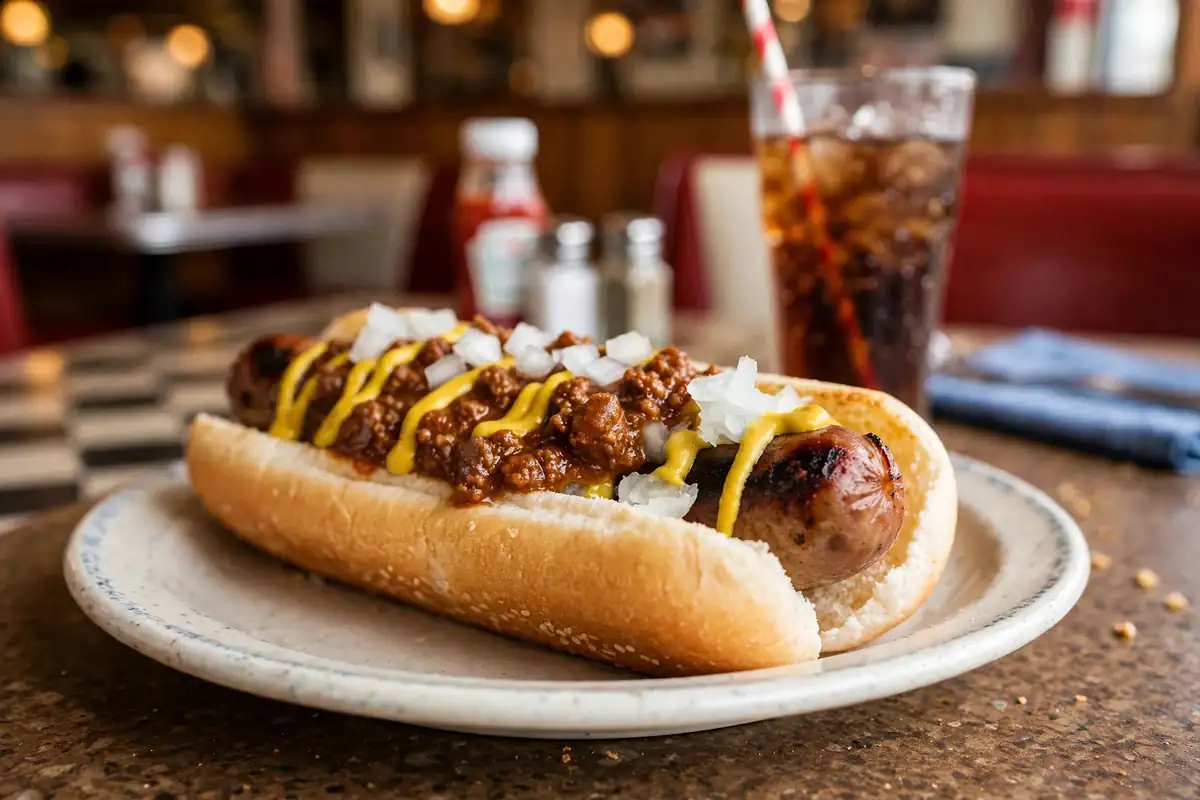
The half-smoke is Washington’s signature dish: a fat, spicy, half-pork half-beef sausage, grilled and served in a soft bun with mustard, onions and chili. The place to eat it is Ben’s Chili Bowl on U Street, a 1958 institution that has fed everyone from Duke Ellington to Barack Obama, and which reopened on May 1, 2026 after ten months closed for structural repairs, with its original counter intact. Order it “all the way” — with mustard, onions and chili — and add a side of chili cheese fries and a half-and-half, the local mix of iced tea and lemonade. A half-smoke costs about $8, and the whole meal is under $20. While you are there, try mumbo sauce, the sweet-tangy red sauce that is Washington’s other signature — it comes on chicken wings and fried chicken all over the city, and nobody agrees on the original recipe.
Ethiopian platter on U Street
Washington has the largest Ethiopian population outside Ethiopia, and the U Street and Shaw neighbourhoods are its Little Ethiopia, with a dozen restaurants serving the same meal: a big round of injera, the spongy sourdough flatbread, topped with scoops of wat — doro wat (chicken stew), misir wat (red lentils), gomen (collard greens), tibs (sautéed meat) — eaten with your hands, tearing off pieces of injera to scoop. A vegetarian combination platter for two costs about $25 to $35, and it is the best value meal in the city. Order the Ethiopian coffee ceremony if it is offered — it is slow, theatrical and the best coffee you will have in Washington. Dukem, on U Street, is the long-running favourite, and the Ethiopian restaurants along 9th Street in Shaw are just as good and less crowded.
Chesapeake crab cake at The Wharf
The Chesapeake Bay is 40 miles away, and Washington eats like a port city: blue crab, oysters and rockfish are on every serious menu. The dish to order is the crab cake — mostly lump crab meat, almost no filler, pan-fried and served with Old Bay seasoning — and the place to eat it is The Wharf on the Southwest Waterfront, where the fish market has sold the morning’s catch since 1805. A good crab cake costs $25 to $35, and the raw bar at the Wharf’s oyster houses serves Chesapeake oysters for about $3 each at happy hour. If you want the full experience, go to the Municipal Fish Market at the Wharf in the morning, when the boats come in, and eat your crab cake on the dock.
Free things to do in Washington DC
Washington is the best free city in America, and you could spend three days here without paying a dollar for attractions. All 21 Smithsonian museums and the National Zoo are free, every memorial on the National Mall is free and open 24 hours, and the Capitol, the Library of Congress and the National Archives are all free with a timed ticket. The best free things are the Lincoln Memorial at dusk, the National Gallery of Art, the National Museum of Natural History, the Hope Diamond, the National Museum of American History, the Air and Space Museum, the Tidal Basin loop, the Georgetown waterfront, and the free concerts: the National Gallery of Art runs free concerts on Sundays, the Kennedy Center’s Millennium Stage has a free performance every evening at 6 p.m., and the Smithsonian Folklife Festival in late June and early July is free. Eastern Market on Capitol Hill is free to wander on weekends, with local food, crafts and antiques, and the Sunday farmers’ market is one of the best in the city. Even the views are free: the steps of the Lincoln Memorial, the top of the Washington Monument’s grounds, and the Custis-Lee Mansion viewpoint at Arlington all cost nothing. The only thing you pay for is the occasional $1 reservation fee on a timed ticket — and the food, which is worth it.
Frequently asked questions
How many days do I need in Washington DC?
Three to four days is the sweet spot for a first trip. Three days covers the Mall, the best museums, the Capitol and one neighbourhood evening. A fourth day buys you Mount Vernon and Alexandria, or a deeper dive into one museum, or Arlington National Cemetery. Two days is possible if you skip the neighbourhoods and focus on the Mall, but you will be rushing. Five days lets you add the Udvar-Hazy Center, a second museum day, and a proper food crawl.
Do I need tickets for the Smithsonian museums?
Most Smithsonian museums are free walk-ins with no ticket at all — the National Museum of Natural History, the National Museum of American History and the National Gallery of Art among them. Four need a free timed-entry pass: the National Air and Space Museum, the National Museum of African American History and Culture, the National Zoo, and the Holocaust Museum’s Permanent Exhibition. The Washington Monument, the Lincoln Memorial undercroft and the Library of Congress also need timed tickets, as does the Capitol tour. Book all of them as soon as your window opens — 30 days ahead for most, two months ahead for Air and Space — and bring the $1 reservation fee.
When is cherry blossom season in Washington DC?
Peak bloom — when 70% of the Yoshino cherry blossoms around the Tidal Basin are open — usually falls in late March or early April, and lasts four to ten days. In 2026, peak bloom was confirmed on March 26. The National Park Service publishes its forecast in late February, and the National Cherry Blossom Festival runs for about three weeks around the bloom. Book hotels and timed museum passes as early as you can, because cherry blossom season is the busiest and most expensive fortnight in the city. If you miss the Yoshino bloom, the Kwanzan cherries at East Potomac Park bloom about two weeks later.
Is Washington DC safe for tourists?
The Mall, the museums, downtown, Georgetown, Dupont Circle, Capitol Hill and the Wharf are all safe for tourists during the day and in the evening, with heavy police and Park Police presence around the monuments. Use the same common sense you would in any big city: keep valuables out of sight, avoid empty streets late at night, and be careful around Union Station and the areas east of the Capitol after dark. The Metro is safe at all hours it runs, and rideshares are cheap and plentiful after midnight, when the Metro stops.
What is the best area to stay in Washington DC?
For first-timers, downtown or Penn Quarter, within walking distance of the National Mall. For families, Capitol Hill, with quiet streets and Eastern Market. For restaurants and nightlife, Dupont Circle or U Street. For charm, Georgetown — though it has no Metro station. For the best value, Arlington, Virginia, where hotels are $50 or more cheaper a night and the Metro reaches downtown in ten minutes. Wherever you stay, pick a hotel within five minutes of a Metro station.
Can I visit the White House?
You can see the White House for free from the fence on Pennsylvania Avenue or from Lafayette Square, and the free White House Visitor Center needs no booking. Public tours inside are free and must be requested through your Member of Congress (US citizens) or your embassy (foreign visitors), 21 to 90 days ahead. Tours normally run Tuesday to Saturday mornings, but they were paused in August 2025 for the East Wing demolition and ballroom construction, resumed on a shorter route in December 2025, and have been paused again at points in 2026 — so check the official White House visit page the week you travel, and never pay anyone who offers to sell you tickets, because the tours are always free.
Further reading — Wikipedia and Reddit
Washington, D.C. on Wikipedia has the full history of the city, from its founding in 1790 to the present day. The National Mall on Wikipedia covers the monuments and the memorials in detail. The r/washingtondc subreddit is the city’s active local community, with daily threads on what to do, where to eat and what is happening this weekend — it is the best place to ask a specific question before you travel. No Quora link is included here because no Washington DC-specific Quora thread could be verified as live.
Your Washington DC trip, in one paragraph
Washington DC is the rare capital where the best things are free — the Lincoln Memorial at dusk, the founding documents, the pandas, and 21 Smithsonian museums — and three days is enough to see them properly if you book your timed passes a month ahead and stay near a Metro station. Come in late spring or early autumn, walk the Mall at dusk, eat a half-smoke on U Street, and save a morning for Arlington. If this guide has whetted your appetite for American city breaks, our other guides cover the same ground in Chicago, Nashville, Los Angeles, Orlando, Miami, San Diego, Denver, Savannah, Dallas, Charleston, San Francisco, Myrtle Beach, Las Vegas, San Antonio, London, Portland, Pigeon Forge, Puerto Rico, Atlanta, Phoenix, Paris, Maui, Key West, Colorado Springs, Sedona, Chattanooga, Palm Springs, St Louis, Tokyo, Japan, Kansas City, Tennessee, Branson, Florida, Amsterdam, Montreal, Honolulu, Fort Lauderdale, Toronto, Aruba, Charlotte, Indianapolis, New Orleans, Destin, Santa Barbara, Mexico City, Arizona, Osaka, Minneapolis, Pittsburgh, California, Asheville, Costa Rica and Hawaii.

About the Author