Things to Do in Kauai
20 Best Attractions, a 3-Day Itinerary, Where to Stay, and the Food You Cannot Miss
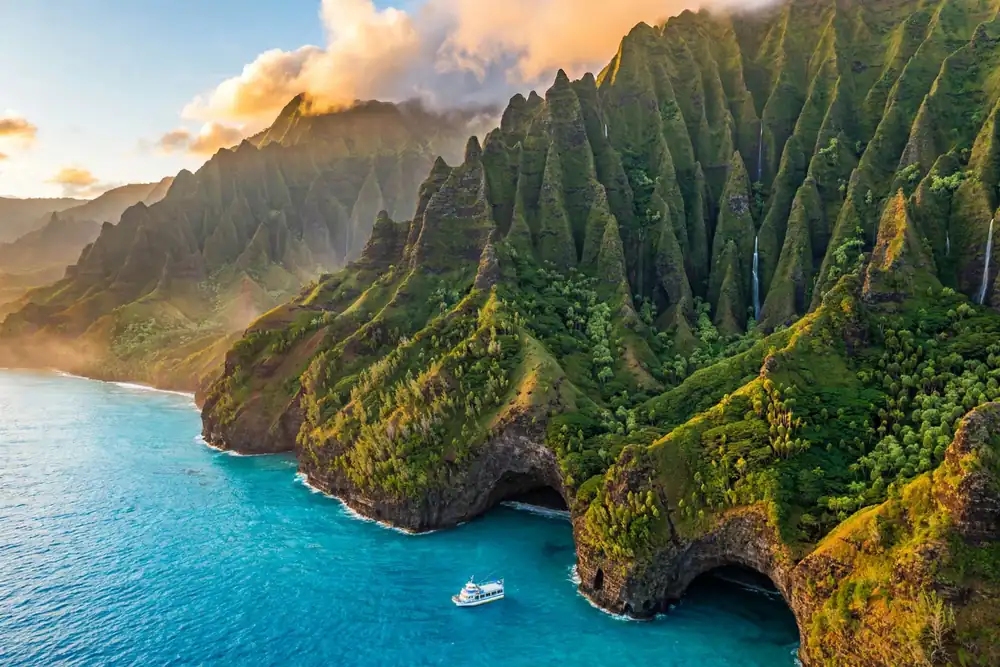
Quick Info
Best for: First-timers, hikers, beach lovers, photographers and families — Hawaii without the high-rises of Waikiki or the crowds of Maui
Best time: April–May and September–October for mild days and calmer seas; June–August is best for the north shore beaches and the Nā Pali boat tours; December–April brings whales and the biggest surf
How long: 3 days for the Nā Pali Coast, Waimea Canyon, Hanalei Bay and Poipu; 5 to 7 days adds the gardens, the kayaking and the helicopter tour
Budget: About $200–$400 per person per day with a mid-range hotel and a rental car — the beaches, the lookouts and the waterfalls are free
Don’t miss: The Kalalau Trail day hike (with a reservation), the Waimea Canyon drive at sunrise, Hanalei Bay at sunset, the Kilauea Lighthouse, a Nā Pali boat tour and a poke bowl
Kauai on Wikipedia is the oldest of the main Hawaiian islands — the Garden Isle, a round, green island of sheer sea cliffs, deep canyons and taro valleys. Only about a fifth of the island is reachable by road: the highway stops at Kēʻe Beach and Polihale, and the wild coast in between belongs to hikers, boats and helicopters. This guide covers the 20 best things to do in Kauai, a 3-day itinerary that actually works, where to stay without overpaying, how to get around on an island where a rental car is not optional, the three foods you should not skip, and the free sights that cost nothing. Everything below was checked against live sources in November 2026 — including the Hurricane Lowell closures, the Hāʻena permit system and the current boat and helicopter prices.
Kauai at a glance
| Topic | What to know |
|---|---|
| Full name | Kauai — the “Garden Isle”, the oldest of the main Hawaiian Islands, about 562 square miles |
| Age | Formed about 5 to 6 million years ago, the oldest of the eight main islands, and the fourth largest |
| Population | About 73,000 people; Lihue is the county seat and the largest town, and Hanalei has about 410 residents |
| Language | English; Hawaiian words are everywhere — aloha, mahalo, mauka and makai |
| Airport | Lihue Airport (LIH), the island’s only commercial airport; most visitors connect through Honolulu |
| Best base | Poipu for sun and first-timers; Princeville for the north shore; Kapaʻa for a cheaper central base |
| Getting around | A rental car is essential — one main road, no full loop; the Kauai Bus is slow and limited |
| Famous for | The Nā Pali Coast, Waimea Canyon, Hanalei Bay and the Kalalau Trail |
Kauai divides into four sides, and the weather changes with each one. The north shore — Hanalei, Princeville, Kilauea — is the lush, wet side: green valleys, taro fields and waterfalls. The south shore — Poipu and Koloa — is the sunny side: drier, calmer seas in winter, and most of the resorts. The east side — Lihue and Kapaʻa, the Coconut Coast — is the practical side: the airport, the shops and the cheapest rooms. The west side — Waimea and Kekaha — is the dry side: the canyon and the small towns. The surprise is how long everything takes: the road is one lane in places, and a rainstorm can close the north shore road. If you are island-hopping, our Hawaii guide covers the whole state — this guide is only about Kauai. The trap is the calendar: the Hāʻena permits sell out 30 days ahead, and the canyon road can close after a storm.
The 20 best things to do in Kauai
1. The Nā Pali Coast and the Kalalau Trail
The Nā Pali Coast State Park on Wikipedia is the sight that defines Kauai, and the Kalalau Trail on Wikipedia is the way to walk into it — 11 miles along 17 miles of sheer, fluted sea cliffs, from Hāʻena State Park to Kalalau Valley. The full trail is one of the hardest hikes in Hawaii, but most visitors walk only the first two miles, to Hanakāpīʻai Beach: steep, muddy and exposed, about two to three hours round trip. Do not swim at Hanakāpīʻai Beach — the currents are strong and people have died there. Beyond the two-mile point you need a camping permit, and the trail runs another nine miles to Kalalau Beach, reachable only on foot or by boat.
The permit system is the part most guides get wrong, so here it is in full. Hāʻena State Park on Wikipedia is entry by reservation only, booked on gohaena.com: $5 per person for non-residents (children three and under free), $10 per vehicle, and $40 per adult aged 16 and over and $25 per child aged 4 to 15 for the shuttle. Reservations open 30 days ahead at midnight Hawaii time, and the park caps entry at 900 people a day. Hawaii residents enter free with state ID. Overnight hikers may no longer park at Hāʻena under a 2026 rule — they must use the shuttle — and there is no parking on the highway outside the gate: tickets start at $200, with towing possible. Camping permits past the two-mile point are booked separately on the Explore Outdoor Hawaiʻi platform, in use since February 2026: $35 per non-resident per night plus a $5 fee, $25 per resident per night, released 90 days ahead at 12:01 a.m. Hawaii time, a maximum of five consecutive nights, and only one consecutive night at Hanakoa. Book both reservations the day they open, because both go fast.
The second thing to know is the storm. Hurricane Lowell hit Kauai on the night of September 7, 2026, and Hāʻena State Park closed on September 6 ahead of it — Lower Limahuli recorded almost 16 inches of rain, the most on the island. The park reopened on October 15, 2026 for day use, and the trail past the two-mile point and overnight camping reopened to permit holders on November 2, 2026. Kūhiō Highway reopened to all traffic on October 21, 2026. The parks are still recovering — check the DLNR notices the morning you go, and do not hike after heavy rain, when the red clay turns to grease and the streams flash-flood.
2. Waimea Canyon — the Grand Canyon of the Pacific
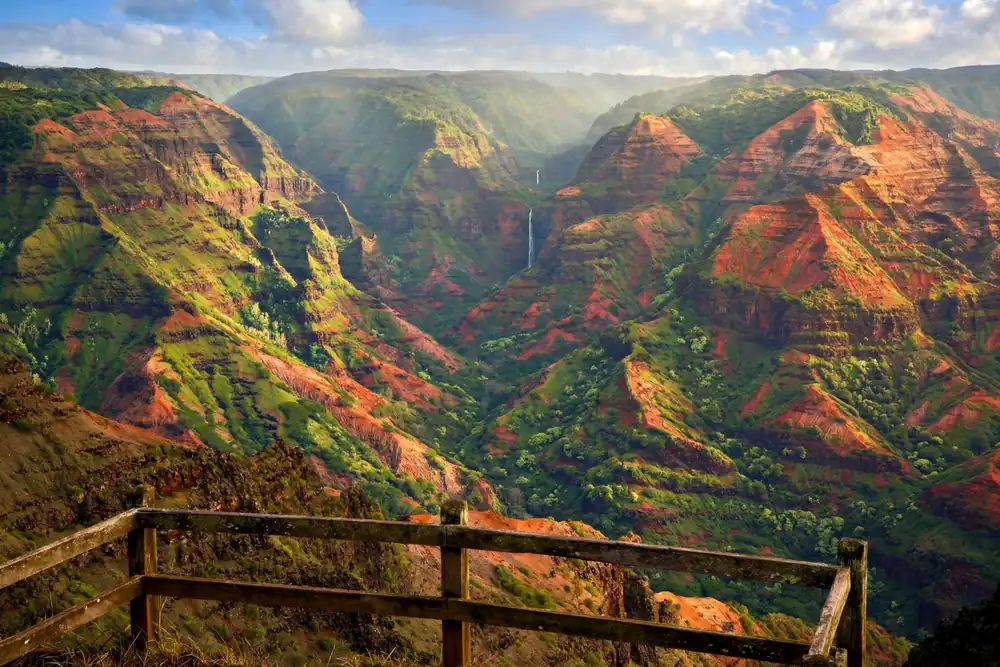
Waimea Canyon on Wikipedia is the second sight no visitor should miss, and the opposite of the Nā Pali Coast: red and orange canyon walls falling 3,600 feet into a gorge about 10 miles long and a mile wide, streaked green after rain. The drive up is the experience: Waimea Canyon Drive (Highway 550) climbs from Waimea, and Kōkeʻe Road (Highway 552) climbs from Kekaha, and the two merge partway up. The lookouts sit at the mile markers — the main Waimea Canyon Lookout at mile 10, Puʻu Hinahina at mile 13.5, the Kalalau Lookout at mile 18, about 4,000 feet up, and Puʻu o Kila at mile 19. Go early: the rim clouds build by late morning, and by noon the valley is often hidden.
Non-residents pay $5 per person for entry and $10 per vehicle for parking, children three and under are free, residents are free with ID, and one parking ticket is valid at both Waimea Canyon and Kōkeʻe State Parks. The parks are open daily in daylight hours, and there is no reservation. The Canyon Trail to Waipoʻo Falls is the best short hike: a 3.6-mile round trip to an 800-foot waterfall. The main Waimea Canyon Lookout reopened on October 24, 2026, and Waimea Canyon and Kōkeʻe State Parks reopened on November 7, 2026 at 6 a.m. with reduced services. The state parks department’s release says the lookouts and comfort stations between the Waimea Canyon Lookout and Pihea are open — but other November reports say Kōkeʻe Road beyond the main lookout may still be closed, with only the main lookout reachable. That is a genuine conflict in the current information: check the DLNR notices the morning you drive up, and if only the main lookout is open, it is still worth the drive.
3. Kōkeʻe State Park and the Alakaʻi Swamp Trail
Kōkeʻe State Park on Wikipedia is the cool, misty forest above Waimea Canyon — about 4,345 acres of native forest, red dirt trails and lookouts over the Nā Pali Coast. The Alakaʻi Swamp on Wikipedia is the highest swamp in the world, a boggy plateau that feeds the island’s rivers, and the boardwalk through it is one of the strangest walks in Hawaii. The Pihea Trail runs from the Puʻu o Kila Lookout into the swamp: 8.1 miles out and back, challenging, about three hours and 45 minutes, with 1,335 feet of climbing, and very muddy — not after rain. The road to the Pihea trailhead has been closed since March 2024, but the trail is open, and you park at the Kalalau Lookout. The Alakaʻi Swamp Trail is the shorter version: 7.2 miles out and back, moderate, about three to three and a half hours, with 1,017 feet of climbing, and a boardwalk through the marsh to the Kilohana Lookout, with views over Hanalei Bay.
Access depends on the Kōkeʻe Road status: the parks reopened on November 7, 2026 with reduced services, the state parks department lists the trails between the Waimea Canyon Lookout and Pihea as open, and other November reports say the road beyond the main lookout may still be closed. Check the DLNR notices before you drive up. The Kōkeʻe Lodge Restaurant and the Kōkeʻe Museum were expected to reopen by November 12, 2026. All Kauai state park camping remains closed, and the Kōkeʻe campground is closed for improvements through spring 2027.
4. A Nā Pali Coast boat tour from Port Allen
If the Kalalau Trail is too much, the boat is the way to see the Nā Pali Coast. The boats leave from Port Allen on the west side, year-round, and from Hanalei on the north shore from May to September only. The morning sail is the one to book: the water is calmest, the snorkelling visibility is best, and the dolphins are most likely early. The sunset sail is the romantic one: golden light on the cliffs, dinner and drinks, and no swim stop. The 2026 prices are: Holo Holo Charters’ morning snorkel sail, about $292 for five hours on a catamaran with breakfast and lunch; the Leila sunset dinner sail, about $264 for four to five hours with dinner, mai tais and a champagne toast; Captain J’s super raft, about $225 for four and a half hours, which gets into the sea caves when conditions allow; the express catamaran, about $212; and the Niʻihau and Nā Pali combination, about $361 for seven hours. Prices move with demand, so confirm at booking.
From October to April, the winter swells cancel or reroute tours often, and the boats stay away from the caves. Keep a spare day so a cancelled tour can be rebooked, and book the boat for the start of your trip rather than the end. Humpback whales are offshore from December to April. Book two to three weeks ahead in peak season, and take the seasickness tablet before you board — the open ocean off the Nā Pali Coast is not a harbour cruise.
5. A helicopter tour over Kauai
About 70 per cent of Kauai cannot be reached by road, and a helicopter is the only way to see most of it — Waimea Canyon, the Nā Pali Coast, the Hanalei Valley and, weather allowing, the crater of Mount Waialeale on Wikipedia, one of the wettest spots on Earth. A typical tour lasts 50 to 60 minutes and covers the whole island, including Manawaiopuna Falls, the waterfall from Jurassic Park. The 2026 prices are: Jack Harter, whose doors-off flight is 60 to 65 minutes in an MD500 for $399 per person — the company pioneered doors-off flying in 2005, the weight limit is 250 pounds per person, and the flight only goes with a full helicopter; Mauna Loa, whose doors-off private flight is one hour for $359; and Blue Hawaiian, whose Eco Adventure is 50 minutes for about $450 in an EC130 Eco-Star. Doors-off flights run from about $199 to about $414, and full island flights mostly cost $309 to $450.
Fly in the morning, ideally before 10 a.m., when the air is clearest — Mount Waialeale is never guaranteed. Book two to three weeks ahead in peak months. One honest warning: in March 2026, an Airborne Aviation doors-off flight crashed with three fatalities out of five on board, and the NTSB final conclusions had not yet been released by November 2026. Allow half a day with check-in, and do not schedule it on the same day as the boat tour.
6. Hanalei Bay and Hanalei Town
Hanalei Bay on Wikipedia is the most beautiful beach on Kauai, and Hanalei is the town that goes with it — a two-mile crescent of golden sand backed by waterfall-streaked mountains rising 4,000 feet behind the beach, with the historic pier reaching 340 feet into the bay. The bay holds four beach parks: Black Pot near the pier, Hanalei Pavilion, Waiʻoli and Weke Road. The pier was built of wood in 1892 for the rice farmers, extended in the early 1900s, and added to the National Register of Historic Places in 1979 — you may recognise it from the 1958 film South Pacific. The Hanalei Valley Lookout on the way in is the view to stop for: the Hanalei River running through flooded taro fields, the loʻi, below Hīhīmanu Mountain. Taro has been farmed here for more than 1,000 years, and most of Hawaiʻi’s taro still comes from Kauai — the Hoʻopulapula Haraguchi Rice Mill on ʻŌhiki Road is the only remaining rice mill in the state.
Hanalei is about 30 miles north of Līhuʻe, about an hour’s drive, and the last stretch crosses the historic one-lane steel bridges over the Hanalei River and the taro fields. The road floods and closes after heavy rain — there is no other way round — and after Hurricane Lowell the Kūhiō Highway reopened to all traffic on October 21, 2026. In summer the bay is for swimming, and in winter it is for surfing. The town of Hanalei on Wikipedia has about 410 residents.
7. Kilauea Point Lighthouse and National Wildlife Refuge
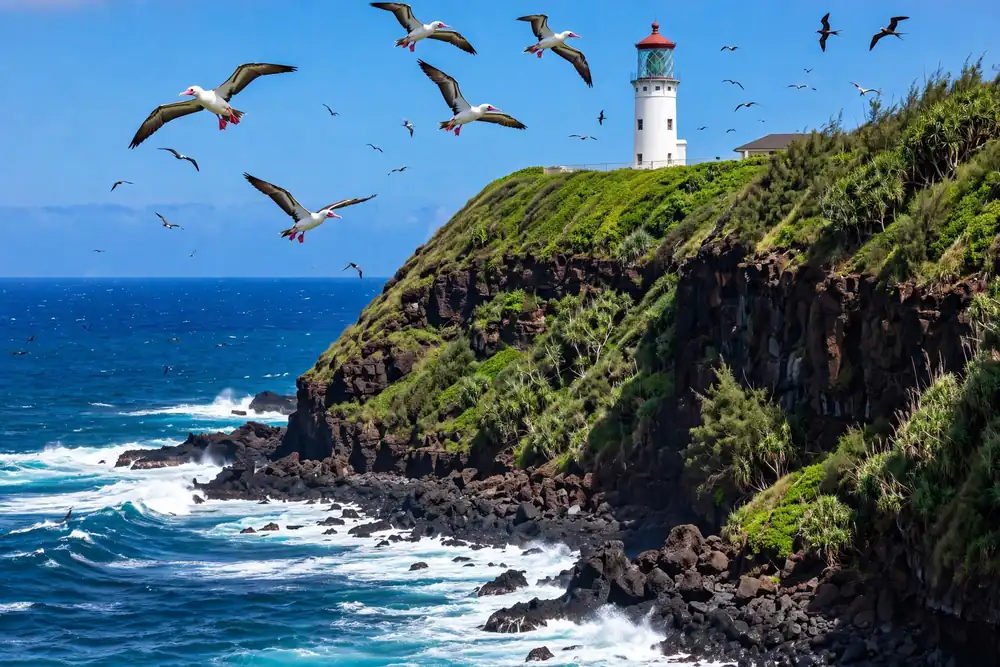
The Kilauea Point National Wildlife Refuge on Wikipedia is the northernmost point of the main Hawaiian Islands, and the Kilauea Lighthouse on Wikipedia is the white tower with a red roof on a 180 to 200-foot ocean bluff above it, watching over a cliff full of seabirds. The refuge is open Wednesday to Saturday, 10 a.m. to 4 p.m., the gate closes to new arrivals at 3:30 p.m., and it is closed on Sundays, Mondays and Tuesdays and on federal holidays. Entry is by timed ticket on Recreation.gov: $10 per adult aged 16 and over plus a $1 reservation fee, $11 in total; under-16s are free with no reservation, and America the Beautiful passes are accepted. The slots are 30-minute arrival windows from 10 a.m. to 3 p.m., each good for 45 minutes, opening 60 days ahead at 7 a.m. Hawaii time. Cancel at least 24 hours ahead for a $10 refund; the $1 fee is non-refundable.
Interior lighthouse tours are suspended after storm damage to the lantern room in 2025, so you see the lighthouse from the outside — which is the photograph everyone wants anyway. The birds are the real show: Laysan albatross from November to July, red-footed boobies year-round, and humpback whales offshore in winter. The nēnē, the Hawaiian goose, nests on the grounds, so stay on the paths during nesting season. The refuge was open on its normal schedule after Hurricane Lowell as of late October 2026, but do not plan a Sunday or Monday visit, and do not turn up without a timed ticket.
8. Poipu Beach and the south shore
Poipu on Wikipedia is the sunny side of Kauai, and Poipu Beach Park is the island’s most reliable beach: a free county park with free parking, lifeguards, a sandbar lagoon for children, and the best chance on the island of seeing a Hawaiian monk seal on the sand. The seals are among the most endangered seals in the world and are found nowhere else on Earth: stay 50 feet away, and 150 feet from a mother and pup — that is the NOAA rule. Green sea turtles feed in the shallows, and the rule there is 10 feet. The parking lot fills by late morning, so arrive early or walk from the resorts. The south shore is drier and sunnier than the north shore, and the seas stay calmer in winter, which is why Poipu is the best base for first-timers and families.
Poipu is also the base for the south shore’s other sights: the Spouting Horn is a five-minute drive, the gardens are ten minutes away in Lawai, and the Mahaʻulepu Heritage Trail starts at Shipwreck Beach. The beach is public, and the park has restrooms, showers and picnic tables. Snorkelling is good on calm days, especially in the morning before the wind picks up.
9. The Spouting Horn
The Spouting Horn on Wikipedia is the most photographed blowhole on Kauai, and it is free: a lava tube in the rocks at the end of the road in Koloa that shoots seawater up to 50 feet into the air when the surf is up. The legend says the spout is the moʻo Kaikapu, a lizard spirit trapped in the rocks. The best time to see it is at high surf, usually in the winter months and the afternoon, when the wind has built the waves — on a calm summer morning it may only puff. The lookout is a paved viewing area with a fence, and that is where you stay: the rocks around the blowhole are sharp, the currents are strong, and swimming here is extremely dangerous. Do not climb past the fence for a photograph.
10. The Wailua River and the Fern Grotto
The Wailua River on Wikipedia is the only navigable river in Hawaii, and the boat cruise up it is the gentlest half-day on Kauai: a slow ride through jungle banks to the Fern Grotto on Wikipedia, a fern-draped lava cave where Hawaiian weddings are held. Smith’s runs the cruise from Wailua Marina State Park: about $35 per adult and $17.50 per child (about $32.36 and $16.18 booked online), a 90-minute round trip, with departures at 9:30, 11:00, 2:00 and 3:30 p.m. from Monday to Friday. Check in 30 minutes early. The honest warning is the grotto itself: you walk to it, but you cannot enter it — the interior is closed for safety. Older guides still describe walking inside, and they are out of date.
The state park fee covers the whole Wailua River State Park on Wikipedia for the day: $5 per person aged four and over and $10 per vehicle, covering Wailua Marina, ʻŌpaekaʻa Falls, Poliahu Heiau, Kaumualiʻi Park and Wailua Falls on the same ticket. The river is also the kayaking river, and the Smith’s gardens and lūʻau sit on its banks.
11. Wailua Falls and ʻŌpaekaʻa Falls
Wailua Falls on Wikipedia is the waterfall every Kauai postcard uses: a double cascade dropping 173 feet into a misty pool on the South Fork of the Wailua River near Līhuʻe, surrounded by jungle. The only legal way to see it is from the designated lookout at the end of the road, with parking along the side of the road. The hike to the bottom is illegal, short, steep and dangerous, and people have been hurt on it — do not follow the social media posts that show the pool from below. ʻŌpaekaʻa Falls is the second waterfall on the same drive, in Wailua River State Park: a 151-foot cascade over basalt rock, with a viewpoint a few steps from the parking lot and no hike at all. The water splits into one, two or three channels depending on the flow. Across the road is Poliahu Heiau, an ancient temple site with a view over the Wailua River valley. Both are photo stops rather than hikes — half an hour each, and an hour for the pair with the heiau.
12. Kayaking the Wailua River to Secret Falls
The kayak trip up the Wailua River to Secret Falls is the best active half-day on the east side: paddle up Hawaii’s only navigable river, beach the kayak, and hike a muddy trail to Uluwehi Falls, the waterfall the tour companies call Secret Falls. The paddle is easy and the hike is the hard part — red mud, stream crossings and slippery roots — so wear shoes you do not mind ruining and bring a dry bag. Guided tours are the norm, including the kayak, the guide and the landing permit; book the morning departure, when the river is calm. The second option is the Hanalei River on Wikipedia, where you can paddle from the town into Hanalei Bay — a gentle trip with mountain views, and the best way to see the taro fields from the water. The third option is the Nā Pali Coast by kayak, which only runs from May to September, when the ocean is calm enough, and it is a full-day guided trip for strong paddlers, not a rental. In winter the swells make it unsafe, and no reputable operator will take you out. Allow half a day for the Wailua kayak and hike, and a full day for the Nā Pali paddle.
13. The Allerton Garden and the McBryde Garden
The National Tropical Botanical Garden on Wikipedia keeps two of its five gardens on Kauai, both on Lawai Road in Koloa, ten minutes from Poipu. The Allerton Garden on Wikipedia is the sculpted one: a garden built by Robert Allerton with fig roots, water features, statues and pools, where parts of Jurassic Park were filmed. It is guided tour only, about two and a half hours, and about $60 to $64 per adult. The McBryde Garden on Wikipedia is the wild one: 186 acres holding the largest collection of rare and endangered Hawaiian plants in the world, with a self-guided visit for about $30 to $32 per adult and $15 for children aged 6 to 12. The Best of Both Worlds ticket, covering both gardens, is about $60 to $70, and the sunset tour is about $95 to $105. Trams run hourly on the half-hour, the last tram is at 3:30 p.m., and reservations are required — book on ntbg.org.
The Allerton tour is the one to book if you only do one: the fig trees, the Diana fountain and the Jurassic Park gate are the photographs. The McBryde is the one to wander if you like plants for their own sake, and it is the better value. The tours run rain or shine — Kauai’s gardens are at their best in the rain.
14. Snorkelling at Tunnels Beach, Kēʻe Beach and Anini Beach
Kauai’s best snorkelling is on the north shore, and it is seasonal. Tunnels Beach, also called Makua Beach, is the famous one: a reef with lava tubes and more than 200 fish species, free with no reservation. Park at Haena Beach Park and walk half a mile to a mile along the sand, or use one of the two small alleyways near mile marker 8. There is no lifeguard, and from October to April the winter swell, typically 6 to 12 feet and often more, makes snorkelling unsafe. The inner reef of Makua Lagoon is a designated marine refuge and is closed to snorkelling. Summer is the season for Tunnels. Kēʻe Beach on Wikipedia is the same story: May to September is the snorkelling season, when the reef keeps the lagoon calm, and from October to April the winter swell overtops the reef and swimming is unsafe. There is a lifeguard tower, but the west-end reef channel is hazardous year-round — lagoon water drains out through it and can carry a swimmer beyond the reef. Anini Beach on Wikipedia is the safe bet: a wide, shallow reef that keeps the water calm, good for beginners and for turtles.
In January 2026, Kauai Ocean Safety closed all north shore beaches when the waves reached 20 to 35 feet. If the lifeguards say no, the answer is no — snorkel at Poipu or Anini instead. Bring reef-safe sunscreen: oxybenzone and octinoxate have been banned in Hawaii since January 2021 because they damage the reefs, and tour operators will turn you away if you are wearing the wrong kind.
15. The Mahaʻulepu Heritage Trail and Shipwreck Beach
The Mahaʻulepu Heritage Trail is the best coastal walk on the south shore, and it starts where the resorts end. Shipwreck Beach, or Keoneloa Bay, is named for a vessel that ran aground there in the 1940s, and it is a beach for looking, not swimming — the currents are strong. From the beach, the trail runs about four miles round trip along lithified sand dunes, tide pools and ancient Hawaiian sites to Mahaʻulepu Beach, also called Gillin’s Beach. The parking lot at Shipwreck Beach is small, about 15 cars, with an overflow lot — arrive early or walk from the resorts. The trail is mostly flat and exposed, so bring water and sunscreen, and go in the morning before the heat. The Koloa Heritage Trail, a 10-mile route with 14 sites, overlaps the western part of the walk near Makawehi and Paʻa Dunes and runs west to the Spouting Horn.
16. Queen’s Bath
Queen’s Bath on Wikipedia is a natural tidal pool in the lava rock at Princeville on Wikipedia, off Kapiolani Loop, and the most dangerous attraction in this guide. The pool is a still circle of water in black rock with the ocean crashing just beyond it, reached by a 15-minute hike over slippery lava rocks. But the waves that make it beautiful are the ones that kill: sudden waves sweep across the rocks and carry people into the sea, and at least 10 people had died there by May 2024. The county closes the access gate in winter, and you must not go around a closed gate. Only go in calm summer conditions, from May to October, when the waves are under four feet, and check the surf report first. If the surf is up or the gate is closed, do not go — there is no safe version of Queen’s Bath in winter surf.
17. The Koloa Rum Company and the Kauai Coffee Company
Kauai’s two tasting rooms sit twenty minutes apart on the south side, and together they make the best rainy afternoon on the island. The Koloa Rum Company is at the Kilohana Plantation in Puhi, open daily from 10 a.m. to 5 p.m. The tastings are free, hourly, and you book ahead with a $5 reservation fee for up to six people — you must be 21 or over with photo ID. The Rum Safari, a separate two-hour tour from about $78 to $80, was closed after Hurricane Lowell, with a tentative reopening on November 23, 2026 — check before you book. The Kauai Coffee Company is at 870 Halewili Road in Kalaheo, and it is the largest coffee farm in the United States. The visitor centre is open daily from 9 a.m. to 5 p.m., with a free self-guided walking tour of about 20 minutes and free tastings of the whole line. The guided Farm Tour is one hour, $50 per adult and $45 for children aged 8 to 18, from Monday to Saturday at 9:30 a.m., and the Coffee on the Brain Tour is $30, from Monday to Friday at 10 a.m. The farm is closed on Thanksgiving and Christmas.
18. The Smith’s Tropical Paradise luau
The Smith’s Family Garden Lūʻau is the lūʻau to book on Kauai: the oldest continuously running lūʻau on the island, family-operated since 1946, in 30 acres of gardens on the Wailua River. The price is $150 per adult, $45 for juniors aged 7 to 13, $35 for children aged 3 to 6, and infants aged one to two are free. The show-only ticket is $30 per adult and $15 per child aged 3 to 12. The show runs on Monday, Wednesday, Thursday and Friday from February to May, and on Monday, Wednesday and Friday from November to January. The lūʻau reopened after Hurricane Lowell, operator-confirmed, and it is running for the 2026–27 season. The state park adds $5 per person and $10 per car, paid at the park through December 31, 2026 — from January 1, 2027 the $5 is included in the ticket total. The gardens are open daily from 8:30 a.m. to 4 p.m., last entry 3 p.m., at $10 per adult and $5 for children aged 3 to 12.
Luau Kalamaku is taking bookings again, from $189 to $274. The ʻAuliʻi Lūʻau is paused as of September 27, 2026, because its host resort is closed for storm repairs. Book the lūʻau for the start of your trip, and arrive early for the garden walk and the imu ceremony. The lūʻau is the one evening on Kauai where the price is the price: the food, the show and the setting are included.
19. The Coconut Coast: Kapaʻa and Lydgate Beach Park
Kapaʻa is the town the guidebooks underrate and the locals use: the main commercial town on the east side, the Coconut Coast, with the shops, the restaurants, the food trucks and the cheapest rooms on the island. The Ke Ala Hele Makalae, the Kauai Path, is the paved coastal path that runs along the shore here — walk it or rent a bike, and you will pass the beaches, the parks and the food trucks without ever getting in a car. Lydgate Beach Park is the family beach: two rock-walled lagoons with calm water, a lifeguard, a playground and a pavilion, and the safest swimming on the east side. Kapaʻa is the best base if you want to be central: Līhuʻe is ten minutes south, the Wailua River is five minutes away, and the north shore is 45 minutes north.
20. Waimea Town, Hanapepe and the west side
Waimea on Wikipedia is where Kauai’s modern history began: Captain Cook landed at Waimea in January 1778, the first European contact with Hawaii, and the town is still the gateway to Waimea Canyon, ten minutes up the road. Hanapepe on Wikipedia is the west side’s charmer: an old plantation town with art galleries, a swinging bridge over the river, and an Art Night every Friday from 5 p.m. to 9 p.m. Polihale State Park on Wikipedia is the wild beach at the end of the west side road, with the longest beach in Hawaii — and it remains closed as of mid-November 2026 after Hurricane Lowell.
Kauai in 3 days — a ready-made itinerary
This three-day plan covers the Nā Pali Coast, Waimea Canyon, Hanalei Bay, Poipu and the food, and it uses a rental car every day. Book the Hāʻena reservation and the boat tour before you fly, and put the canyon on a weekday morning, when the road is quiet and the clouds have not yet built.
Day 1 — The north shore: Hanalei Bay, the lighthouse and Anini
Start before 9 a.m. at the Hanalei Valley Lookout, then drive into Hanalei for the bay, the pier and the town. Walk Black Pot Beach Park, have lunch from a food truck, and drive to the Kilauea Lighthouse for the 10 a.m. slot — book the timed ticket 60 days ahead. Spend the afternoon snorkelling at Anini Beach, and finish the day back in Hanalei for sunset and dinner.
Day 2 — The Nā Pali Coast and Waimea Canyon
Take the morning boat tour from Port Allen — the 5-hour snorkel sail for the full coast, the express catamaran for the shorter version. If you would rather hike, take the two-mile Kalalau Trail day hike from Hāʻena instead, with the reservation you booked 30 days ahead. In the afternoon, drive up Waimea Canyon from the town of Waimea: the main lookout, Puʻu Hinahina and the Kalalau Lookout if the road is open, and the Canyon Trail to Waipoʻo Falls if you have the energy. If it is a Friday, finish at the Hanapepe Art Night, from 5 p.m. to 9 p.m.
Day 3 — The east side and the south shore: the river, the falls, the gardens and Poipu
Start with the kayak trip up the Wailua River to Secret Falls, or the Smith’s boat cruise to the Fern Grotto if you would rather sit than paddle. Then drive to Wailua Falls and ʻŌpaekaʻa Falls on the same state park ticket, and stop at Poliahu Heiau across the road. In the afternoon, choose one: the Allerton and McBryde Gardens in Lawai, or the Kauai Coffee Company and the Koloa Rum Company tasting rooms. Finish the day at Poipu Beach for the monk seals and the turtles, watch the Spouting Horn at high surf, and end the trip with the Smith’s lūʻau.
Best time to visit Kauai
| Season | Weather | Crowds | Notes |
|---|---|---|---|
| Spring (March–May) | Highs about 78–82°F, lows about 65–68°F | Low to moderate | Best all-round season — warm, green, fewer crowds |
| Summer (June–August) | Highs about 84–88°F, lows about 70–73°F | High | Best for the north shore — calm seas, the Nā Pali boats run |
| Autumn (September–November) | Highs about 82–86°F, lows about 69–72°F | Moderate | Second-best season — warm seas, thinner crowds |
| Winter (December–February) | Highs about 77–80°F, lows about 63–66°F | High over the holidays | Rainiest, biggest surf — whale season December–April |
The best time to visit Kauai is April to May and September to October, when the days are warm, the seas are calmer and the crowds are thinner. Summer, from June to August, is the best time for the north shore beaches and the Nā Pali boat tours, and the driest time of the year. Winter, from November to April, is the rainy season, and the north shore is the wettest part of the island — Hanalei averages more than 70 inches of rain a year. The south shore is drier and sunnier all year, which is why Poipu is the winter base. Mount Waialeale, in the centre of the island, gets more than 450 inches of rain a year and is one of the wettest places on Earth. Expect rain at any time of year, and pack a poncho: a shower can cross the island in twenty minutes.
The 2026–27 winter swell season runs from November to April, and it decides what you can do. The north shore beaches close when the surf is up, the Nā Pali boats cancel, and the road to Hanalei can flood and close after heavy rain. The compensation is the whales: humpbacks are offshore from December to April, and the boat tours see them on most winter trips. The events are small and local: the Hanapepe Art Night every Friday, the Hanalei Bay sand castle contest in mid-August, and the lūʻau nights at Smith’s.
Where to stay in Kauai
| Area | Best for | Price range |
|---|---|---|
| Poipu and Koloa | Sun, beaches, first-timers | $250–$600 a night |
| Princeville and Hanalei | The north shore, scenery, luxury | $300–$700 a night |
| Kapaʻa and the Coconut Coast | Central base, food, mid-range | $150–$350 a night |
| Lihue | The airport, one-night stays | $120–$250 a night |
| Waimea and Kekaha | The west side, quiet beaches | $120–$200 a night |
Stay in Poipu if this is your first visit — the sun is the most reliable, the beaches are the calmest in winter, and the gardens and the Spouting Horn are ten minutes away. Stay in Princeville or Hanalei if the north shore is the reason you came — the scenery is the best on the island, and the rain is the price you pay. Stay in Kapaʻa if you want to be central and spend less — the food trucks, the coastal path and the cheapest rooms are all here, and everywhere is under an hour away. Stay in Waimea or Kekaha if you want the quiet west side and the canyon at your doorstep. Book early for the summer and the Christmas holidays, when the north shore fills first, and check the parking before you book in Poipu and Princeville, where the resorts charge for it. One cost to know: since January 1, 2026, the Green Fee law has raised the state lodging tax from 10.25 per cent to 11 per cent, so the total room tax is now about 18.7 per cent — a $300 room costs about $356 before the resort fee.
Getting around Kauai
| Way to travel | Cost | Best for |
|---|---|---|
| Rental car | $60–$110 a day | Everywhere — the only practical way |
| Kauai Bus | $2 a ride, $5 a day | Lihue, Kapaʻa and the south shore |
| Taxi | About $3 a mile | Airport to Poipu $35, to Princeville $60 |
| Rideshare (Uber and Lyft) | Varies, often no cars | Lihue and the airport only |
| Shuttle to Hāʻena | $40 adult, $25 child | The Kalalau Trail and Kēʻe Beach |
| Walking and cycling | Free, bike rental about $30 a day | The Kapaʻa path, Poipu, Hanalei |
Lihue Airport (LIH) is the island’s only commercial airport, and most visitors connect through Honolulu (HNL). Book the rental car early — the stock is limited, the prices rise as the dates approach, and Turo is the fallback when the agencies are sold out. A rental car costs about $60 to $110 a day, and it is not optional: the island has one main road, Kūhiō Highway 56 north to Kēʻe and Kaumualiʻi Highway 50 west to Kekaha, and there is no full loop. The Kauai Bus costs $2 a ride and $5 for a day pass, but the Lihue to Hanalei ride takes 90 minutes to two hours against less than an hour by car, and the north shore route ends at Hanalei, not Hāʻena. Taxis are county-regulated at about $3 a mile: about $35 from the airport to Poipu and about $60 to Princeville. Hanalei’s road floods and closes after heavy rain with no other way round, and a single accident can strand traffic for hours — leave early, keep the tank full, and do not plan a tight connection on the day you fly out.
Kauai food you have to try
Kauai’s food is the food of a small island with no chains to hide behind: poke from the fish market, plate lunch from a window, shave ice from a truck, and a lūʻau that has run since 1946. The resort restaurants charge $40 to $70 for an entrée, and the plate lunch costs $12 to $16.
Poke, plate lunch and shave ice
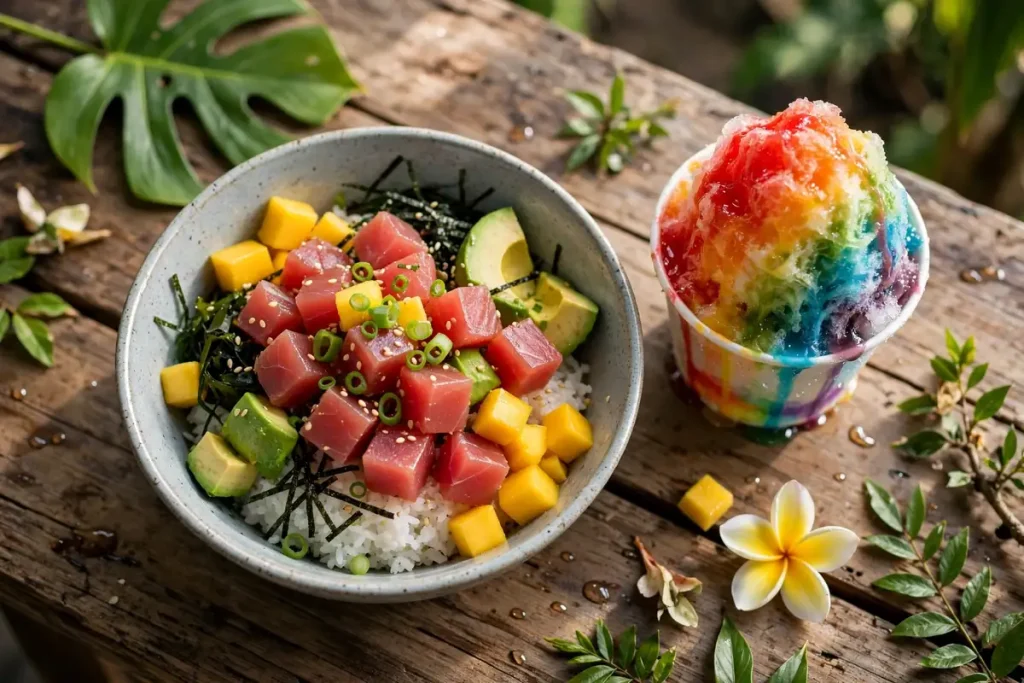
The poke bowl is the meal Kauai is known for, and the fish markets are where it is best. The Koloa Fish Market at 3390 Poipu Road is open from 10 a.m. to 3 p.m. on Monday, Tuesday, Wednesday, Friday and Saturday, and closed on Thursday and Sunday: a poke bowl for about $14, a Hawaiian plate for $8.49 to $10.49, and poke for $12 to $15 a pound, with the catch of the day selling out by about 11:30 a.m. — go early or go hungry. Hamura Saimin at 2956 Kress Street in Lihue is the institution: cash only, a small regular saimin for about $8.95, a James Beard America’s Classics award in 2006, Anthony Bourdain ate here, and the lilikoi chiffon pie and the barbecue sticks are the reason to save room. Pono Market at 4-1300 Kūhiō Highway in Kapaʻa is open from 6 a.m. to 2 p.m. from Monday to Friday and closed at the weekend: the Hapa Plate for about $13, and the kalua pork and the pork laulau sell out before 1 p.m. Mark’s Place in the Puhi industrial park does the Famous Mixed Plate for $13 to $16. Sueoka Snack Shop at 5392 Koloa Road in Old Koloa Town serves plate lunch from a window from 8:30 a.m. to 2 p.m. for under $10. Shave ice costs $5 to $7: JoJo’s in Waimea, Hee Fat General Store, Waikomo Shave Ice in Poipu, and Uncle’s.
The farmers markets and the food trucks
Kauai is a paradise for farmers markets, and they cluster on the north shore and in Lihue: the Hanalei, Kilauea and Lihue markets are the weekly ones, and the Kauai Community Market at the community college in Lihue is the biggest, with the widest range of fruit, vegetables, flowers and prepared food. The market days move with the season, so check the day before you go rather than trusting a guidebook — this one included. The food trucks are the other half of the island’s food: they park in Hanalei, in Kapaʻa, in Poipu and at the beaches, and a plate from a truck costs $10 to $14. The rule is the same as at the fish markets: the good stuff sells out, the trucks close early, and the queue is the review. Bring cash for the trucks and the smaller markets, because not all of them take cards.
Dinner, from food trucks to resort dining
Dinner on Kauai is a choice between the truck and the table. The resort dining rooms in Poipu and Princeville charge $40 to $70 for an entrée, and they are the place for a celebration dinner — book ahead in peak season. The 1 Hotel Hanalei Bay is the north shore’s sunset drink spot, with the bay below and the mountains behind. Kapaʻa is the middle ground: the restaurants and the food trucks along the highway, the cheapest good dinner on the island, and no reservation needed. The lūʻau at Smith’s is the third option, and it is the one evening where the price includes the show. Start the day with coffee from the Kauai Coffee Company visitor centre, eat poke for lunch, and save the resort dinner for the last night.
Free things to do in Kauai
Kauai is cheaper than its reputation suggests, because the best sights cost nothing. Hanalei Bay is free, with four beach parks and the pier. Poipu Beach Park is free, with the monk seals and the turtles. The Spouting Horn is free, from the lookout. Wailua Falls and ʻŌpaekaʻa Falls are free from the lookouts, apart from the state park fee for the vehicle. The Mahaʻulepu Heritage Trail is free, from Shipwreck Beach to Gillin’s Beach. The Hanalei Valley Lookout is free, over the taro fields. The Kapaʻa coastal path is free, along the Coconut Coast. The Hanapepe Art Night is free, every Friday from 5 p.m. to 9 p.m. The Koloa Heritage Trail is free, from the Spouting Horn along the coast. Do the free list on your first day, and you will have seen the bay, the beach and the blowhole before you have spent a dollar on a ticket.
Frequently asked questions
How many days do you need in Kauai?
Three days is the minimum for the highlights: one day for the north shore, one day for the Nā Pali Coast and Waimea Canyon, and one day for the east side and the south shore. Five to seven days is the right amount for a real trip, with the gardens, the kayaking and the helicopter tour. One day is possible, but you will leave having seen a third of the island.
Do you need a car in Kauai?
Yes. A rental car is essential, and it is the first thing to book after the flights. The Kauai Bus costs $2 a ride and $5 a day, but it is slow, the routes are limited, it does not reach Waimea Canyon, and the north shore route ends at Hanalei rather than Hāʻena. Taxis cost about $3 a mile, and rideshare is unreliable outside Lihue. The island has one main road and no full loop, so the car is the trip. Book it early — the stock is limited.
Can you hike the Kalalau Trail without a permit?
No. The day hike to Hanakāpīʻai Beach, the first two miles, needs a Hāʻena day-use reservation on gohaena.com: $5 per person for non-residents, $10 per vehicle for parking, or $40 per adult for the shuttle, booked 30 days ahead, with a daily cap of 900 people. Past the two-mile point, you need a camping permit on the Explore Outdoor Hawaiʻi platform, $35 per non-resident per night plus a $5 fee, booked 90 days ahead — whether or not you plan to camp. Overnight hikers may no longer park at Hāʻena. Without a reservation, you do not get in.
When is the best time to visit Kauai?
April to May and September to October, when the days are warm, the seas are calmer and the crowds are thinner. June to August is the best time for the north shore beaches and the Nā Pali boat tours, and the driest time of the year. November to April is the rainy season and the whale season: humpbacks are offshore from December to April, but the north shore beaches are often unsafe and the boats cancel. The south shore is drier and sunnier all year, which is why Poipu is the winter base.
Is Kauai expensive?
Mid-range to expensive, and more expensive than the mainland. A mid-range hotel costs $150 to $600 a night, a rental car costs $60 to $110 a day, a boat tour costs $212 to $361, a helicopter tour costs $309 to $450, and a resort dinner costs $40 to $70. A plate lunch costs $12 to $16, a poke bowl about $14, and shave ice $5 to $7. The beaches, the lookouts, the waterfalls and the trails are free, apart from the $5 per person state park fee. Since January 1, 2026, the Green Fee law has raised the state lodging tax to 11 per cent, so the total room tax is about 18.7 per cent — a $300 room costs about $356 before the resort fee.
What should I skip in Kauai?
Six things, and all six are traps older guides still get wrong. First, do not plan on the Sleeping Giant trail: the DLNR lists the Nounou Forest Reserve as closed, including every trail in it, and the Kuamoʻo Trail is closed with the bridge out. Second, do not plan a stop at Ishihara Market in Waimea for poke: it is closed, and older guides still list it as open. Third, do not hike to the bottom of Wailua Falls: the only legal view is from the designated lookout, and the trail down is illegal and dangerous. Fourth, do not go to Queen’s Bath in winter surf or around a closed gate: at least 10 people had died there by May 2024. Fifth, do not try to drive the full loop around the island: there is no road, and the highway stops at Kēʻe Beach and Polihale. And sixth, do not swim at the north shore beaches from November to March without checking the surf report: in January 2026 the ocean safety officials closed all north shore beaches when the waves reached 20 to 35 feet.
Further reading
Start with Kauai on Wikipedia, which covers the history and the geography, and the Nā Pali Coast State Park on Wikipedia for the coast and the trail. For what locals actually recommend, the r/Kauai subreddit is where Kauai residents and regular visitors answer questions about the permits, the beaches, the restaurants and the weather. Go Hawaii — Kauai is the official tourism site, with current visitor updates and the park notices that matter after a storm. No Quora link is included here: no live Quora thread on visiting Kauai could be verified, so none is listed rather than linking to an unverified one.
Your Kauai trip, in one paragraph
Kauai is the oldest island in Hawaii, and that is the trip: the Kalalau Trail at dawn with a reservation in hand, the Nā Pali Coast from a boat, Waimea Canyon at sunrise, Hanalei Bay at sunset, the Kilauea Lighthouse in the morning light, a poke bowl from a fish market, and a lūʻau on the Wailua River to finish. For more guides in the same style, start with our Hawaii guide for the whole-state trip — this guide is only about Kauai — then see how Kauai compares with Maui, Honolulu, Chicago, Nashville, Los Angeles, Orlando, Miami, San Diego, Denver, Savannah, Dallas, Charleston, San Francisco, Myrtle Beach, Las Vegas, San Antonio, London, Portland, Pigeon Forge, Puerto Rico, Atlanta, Phoenix, Paris, Key West, Colorado Springs, Sedona, Chattanooga, Palm Springs, St Louis, Tokyo, Japan, Kansas City, Tennessee, Branson, Florida, Amsterdam, Montreal, Fort Lauderdale, Toronto, Aruba, Charlotte, Indianapolis, New Orleans, Destin, Santa Barbara, Mexico City, Arizona, Osaka, Minneapolis, Pittsburgh, California, Asheville, Costa Rica, Washington DC, Seattle, St Augustine, Lisbon, Dubai, Santa Fe, Galveston, Maine and Sacramento.

About the Author