Things to Do in Tulum
20 Best Attractions, a 3-Day Itinerary, Where to Stay, and the Food You Cannot Miss
Quick Info
Best for: Ruins at sunrise, cenote swims, beach days and anyone who wants the Riviera Maya without the Cancún crowds — history, jungle water and Caribbean sand in one small town
Best time: November to April — dry, sunny and almost no sargassum; November is the value sweet spot before the December crowds
How long: 3 days for the ruins, the cenotes and the beach; add a fourth day for Chichén Itzá or a Sian Ka’an trip to Punta Allen
Budget: About $80–$150 per person per day mid-range — the ruins are 265 pesos, cenotes 150–500 pesos each, but the beaches, the town and the street food are cheap
Don’t miss: The ruins at 8 a.m., Gran Cenote before the tour buses, a float down the Muyil canal in Sian Ka’an, Playa Paraíso at opening, and tacos al pastor in the pueblo
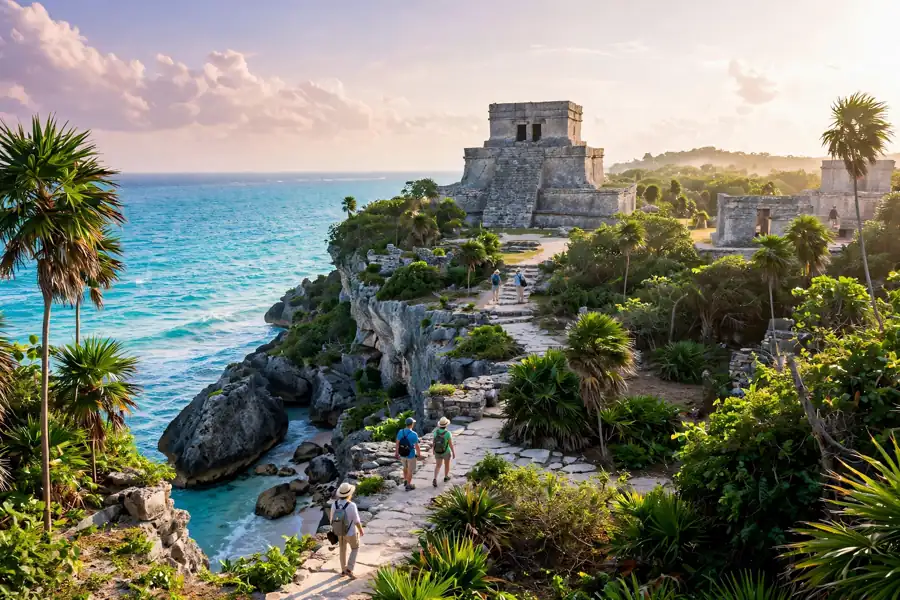
Tulum on Wikipedia is the town most visitors get wrong before they arrive. They picture a beach resort and find a Maya port city on a cliff, a jungle full of sinkholes, and a town split in two — a dusty, affordable pueblo inland and a sandy, expensive beach road on the Caribbean. Founded as Zamá, the City of the Dawn, Tulum was a walled trading port between about 1200 and 1550, and the ruins still stand where the Maya built them: on a 12-metre limestone cliff above the only beach in Mexico with a pyramid on it. This guide covers the 20 best things to do in Tulum, a 3-day itinerary that pairs the ruins with the cenotes and the biosphere reserve, where to stay without paying beach-road prices for every night, getting around by bike, colectivo and the Maya Train, the food you have to try, and the free things to do that cost nothing. Everything below was checked against live sources in November 2026 — including the details most guides still get wrong: the ruins ticket changed in July 2026, the beach clubs mostly dropped their minimum spends, the airport has direct flights from the United States, and the pyramid at Cobá can be climbed again.
Tulum at a glance
| Topic | What to know |
|---|---|
| Full name | Tulum, Quintana Roo — a town on the Caribbean coast of the Yucatán Peninsula, about 130 km south of Cancún and 60 km south of Playa del Carmen |
| Founded | As Zamá, a Maya port city, flourishing roughly 1200–1550; the modern town grew up around it in the 20th century |
| Population | About 46,000 in the town, in the municipality of Tulum |
| Location | On the Riviera Maya, at the southern end of the hotel zone’s beach road, where the jungle meets the Caribbean |
| Getting there | Tulum International Airport (TQO), about 25 km away; Cancún Airport (CUN) about 2 hours north; Tren Maya serves Tulum and Tulum Aeropuerto stations |
| Best base | Tulum Pueblo for first-timers on a budget — cheaper food and hotels, 3 km from the beach; the beach road for one or two splurge nights |
| Getting around | Bicycle ($5 a day) for town and the beach road, colectivos for the cenotes and Muyil, taxis ($4–5 between town and beach), ADO buses, car for day trips |
| Famous for | The clifftop Maya ruins, the cenotes, Playa Paraíso, Sian Ka’an Biosphere Reserve, the beach clubs and the art of SFER IK |
Tulum rewards visitors who understand it is two places, not one. The pueblo is the real town — taco stands, laundry lines, hardware stores and hotels at local prices, 3 km inland from the sea. The beach road is the fantasy — a 10 km strip of sand, boutique hotels, beach clubs and jungle art, where a smoothie can cost $18 and the road floods when it rains. The ruins and the cenotes sit between and around both, and the Sian Ka’an reserve starts where the beach road ends. The mistake most visitors make is staying only on the beach road and paying resort prices for everything, and the trap most guides fall into is the outdated detail: the ruins fee changed in July 2026, the beach clubs changed their rules in 2026, and the airport that opened in December 2023 keeps adding and dropping routes. This guide gets those right, because we checked them in November 2026. One more thing before you pack: the sun here is fierce and the jungle is buggy — bring reef-safe sunscreen for the beach, biodegradable sunscreen only for the cenotes, and mosquito repellent for dawn and dusk.
The 20 best things to do in Tulum
Tulum’s 20 best sights split neatly into four groups: the ruins, the water, the beach and the art. Do the ruins first, because they run on a schedule — the gates open at 8 a.m. and the last entry is 3:30 p.m. — then the cenotes, which are best at opening before the tour buses arrive, then the beach, which is best in the morning before the sargassum and the crowds, then the art and the town, which reward a slow evening. The biosphere reserve is the full-day exception: it needs a whole day and a plan.
1. Tulum Archaeological Zone
The Tulum Archaeological Zone on Wikipedia is the most photographed ruin in Mexico, and the only Maya city built on the sea. Zamá, the City of the Dawn, was a walled trading port — the wall runs on three sides and the Caribbean guards the fourth — and its centrepiece is El Castillo, a 7.5-metre temple on the cliff edge that doubled as a lighthouse, its windows lined up with a gap in the reef to guide trading canoes to shore. Around it stand the Temple of the Frescoes, with its faded murals, and the Temple of the Descending God, named for the upside-down figure carved above its door. The site holds more than 60 structures, and the walk between them takes about 90 minutes — but the view from the cliff path, with the turquoise water below and the white sand of the ruins beach at the foot of the rock, is the reason everyone comes. In 2026 the ticket changed, and most older guides are wrong about it: since 20 July 2026 there is one unified fee — 265 pesos for foreign visitors (100 for Parque del Jaguar and 165 for the archaeological zone and national park) and 80 pesos for Mexican nationals Monday to Saturday, free on Sundays for Mexicans and foreign residents. The site is open daily 8 a.m. to 5 p.m., last entry 3:30 p.m. — be at the gate for 8 a.m., when the light is soft, the paths are cool and the tour buses have not arrived yet. Since 27 July 2026 INAH no longer sells its own tickets; everything is paid at the Grupo Mundo Maya windows, so pay only at the official booths and ignore the touts on the approach selling overpriced “VIP” entry. An electric shuttle inside the park costs 20 pesos, and there is almost no shade inside the site — bring water, a hat and sunscreen. You cannot climb any structure, and the beach below El Castillo is swimmable down a wooden staircase: go early, before the crowds find it.
2. Playa Paraíso
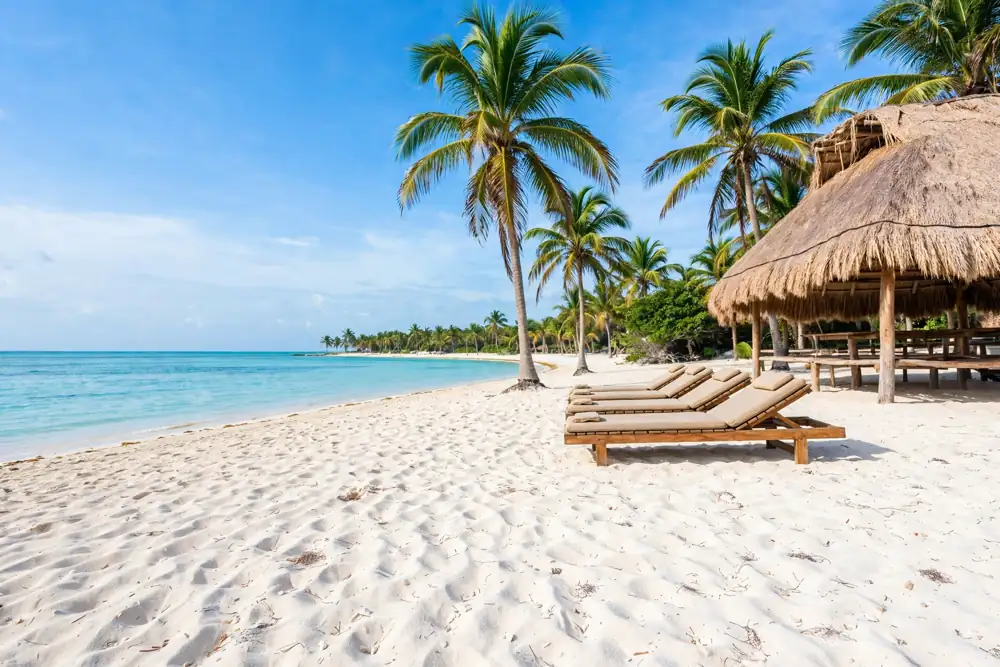
Playa Paraíso is the postcard beach of the Riviera Maya, and the best beach day in Tulum. A long curve of white sand and palm trees just north of the ruins, inside Parque del Jaguar, it has the calmest water on this coast — the reef offshore breaks the waves, so the sea here is a flat turquoise swimming pool rather than the surf that hits the hotel-zone beaches. The sand is soft, the water is clear, and the ruins sit on the cliff at the southern end of the bay, so you can swim with a pyramid on the horizon. Getting onto it got cheaper in 2026: since July, public beach access through the park is free again, and you only pay if you want the ruins ticket or a lounger at the beach club. Come at 8 a.m., when the beach is empty and the light is at its best, bring your own towel and water, and check the sargassum report before you go — from May to October the seaweed can pile up here, and Tulum takes it harder than anywhere else on the coast. The beach club at the southern end rents loungers and serves food and drinks, and the parking lot nearby is about 150 pesos for the day. Stay past the morning and the beach fills up; come early and it feels like the photographs.
3. Gran Cenote
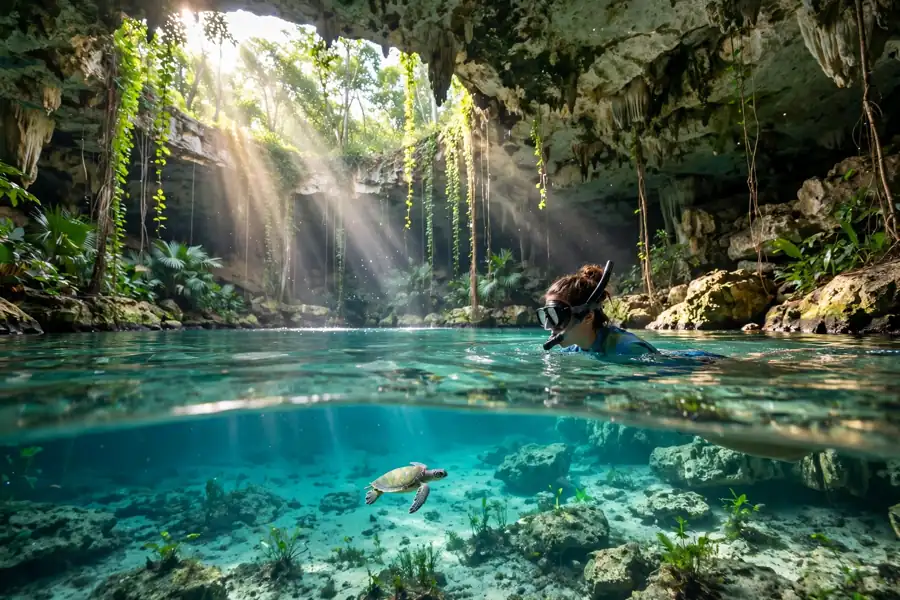
Gran Cenote on Wikipedia is the classic first cenote, and the best one for a first-time snorkeller. Four kilometres from town on the Cobá road, it is a half-open sinkhole of crystal-clear water — part open pool, part cavern — with wooden platforms, hanging vines, stalactites and a resident population of small turtles that swim past snorkellers without a care. The water is cool and so clear that the bottom looks close enough to touch, and the cavern section, where bats hang from the ceiling, is the part everyone photographs. In 2026 entry is about 500 pesos per adult, cash only at the gate, with snorkel gear rented separately — the most expensive cenote near Tulum and the most popular, so the rule is simple: be there at the 8 a.m. opening, before the tour buses from Cancún arrive, and you will have the water almost to yourself; by midday it is a queue. The site is open daily 8 a.m. to 4:45 p.m. Do not wear regular sunscreen — it damages the water, and the staff will ask you to shower first. Bring a rash guard instead, and a towel: there are changing rooms and picnic tables, but no restaurant. Pair it with Cenote Calavera, a few minutes further down the same road, for the best cenote morning in Tulum.
4. Cenote Dos Ojos
Cenote Dos Ojos on Wikipedia is the one divers talk about, and the best cavern snorkel near Tulum. Twenty-two kilometres north of town on Highway 307, it is two connected sinkholes — the Two Eyes — in a vast flooded cave system, with a bat cave, light beams that cut through the water in the morning, and visibility so good that the rock formations look close enough to touch. The snorkel route runs through the cavern between the two eyes, and the guided cavern dives here are world-class: this is one of the most dived cave systems on the planet, and the Sac Actun system it belongs to is the longest underwater cave system in the world. In 2026 entry is about 400 to 500 pesos, with snorkel gear around 100 to 200 pesos extra and guided snorkel and dive packages on top — the site is open 8 a.m. to 5 p.m. Come in the morning for the light beams, wear a life jacket (mandatory in the cavern sections), and do not swim past the daylight zone unless you are cave-certified and with a qualified guide: the cave passages beyond the marked route have killed unprepared swimmers. Dos Ojos is the cenote to choose if you only do one and you want the underground world rather than the open pool — Gran Cenote is the easy swim, Dos Ojos is the adventure.
5. Cenote Calavera
Cenote Calavera, the Temple of Doom, is the jump cenote — the one for the photograph. About three kilometres from town on the Cobá road, it is a hole in the jungle floor with three openings in the limestone ceiling, like the eye sockets and mouth of a skull, over a deep cave pool 10 metres down. You jump through the largest hole, or climb down the ladder if your nerve fails, and swim in the dark water while bats circle overhead. In 2026 entry is about 250 to 300 pesos, cash at the gate, with an extra fee if you bring a GoPro — cheaper than Gran Cenote and far quieter, and the jump is the thrill that makes it worth the stop. The site is open 9:30 a.m. to 5:30 p.m. Jump feet first, never head first, and check the water depth with the staff before you go: the pool is deep, but the rock below the surface is not forgiving. Pair it with Gran Cenote on the same morning — the two sit a few minutes apart on the same road — and you will have done the two most different cenotes near Tulum before lunch.
6. Sian Ka’an Biosphere Reserve
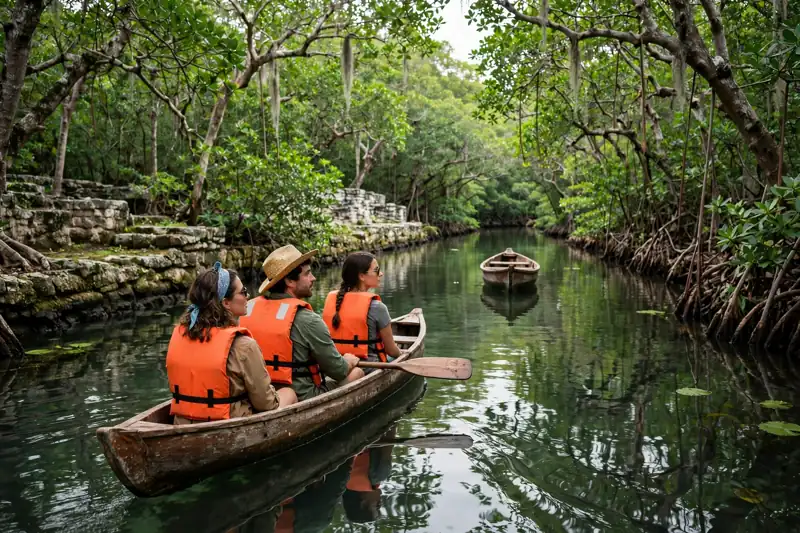
The Sian Ka’an Biosphere Reserve on Wikipedia is the wildest place in the Riviera Maya, and the best full day out of Tulum. A UNESCO World Heritage site of about 1.3 million acres — lagoons, mangroves, jungle and reef — it starts where the beach road ends and runs south to a fishing village most visitors never reach. The way to do it is the Muyil float: take a colectivo south for about 50 pesos to the Muyil archaeological site, pay the ruins entry of about 90 pesos and a reserve fee of about 50 pesos, walk the boardwalk through the jungle to the lagoon, and let the community cooperative take you by boat across two lagoons to a 400-metre canal the Maya built as a trade route — then drift down it in a life jacket, doing nothing, while the jungle passes overhead. The whole thing costs roughly $50 to $70 all-in and takes about four hours door to door, with no reservation needed. The other way is Punta Allen, the lobster-fishing village at the end of a 50 km unpaved road — two-plus hours of potholes each way in anything with clearance, and a 4WD-only mud test after rain — where the cooperatives run boat trips into Ascensión Bay for dolphins, turtles, a reef snorkel and a beach lunch. Full-day tours from Tulum run about $100 to $150, and some exclude the reserve fee of about 225 pesos, so check what is included. Go between November and April, when the roads are passable and the bays are calm, bring biodegradable sunscreen only — the boatmen will ask you to rinse off anything else — and do not attempt the Punta Allen road in a rental sedan: it has ended plenty of deposits.
7. SFER IK
SFER IK is the strangest museum in Mexico, and the one that makes Tulum feel like nowhere else. An interdisciplinary art space in the hotel zone, on the Tulum–Punta Allen road at Km 5, it is a biomorphic concrete-and-bejuco dome about 16 metres high, crowned with a Flower of Life motif, built by the self-taught architect who works as Roth — and inside, the floor is organic, the walls curve like a cocoon, and the art is the building itself as much as the rotating installations inside it. Shoes come off at the door (cubby holes are provided), the light comes through the dome in spirals, and the whole visit feels less like a museum than like walking through a living thing. In 2026 admission is about $20 USD, and the museum is open daily 10 a.m. to 7 p.m. — phone photos and videos for personal use are allowed. The bigger sister site, SFER IK Uh May, sits 23 to 25 km inland in Francisco Uh May, a ten-acre City of Arts in the jungle, with admission of 500 pesos and hours of 10 a.m. to 6 p.m. daily. Go to the hotel-zone site for the icon and the hour it takes, and to Uh May if you want the full jungle campus — either way, go early, when the dome is empty and the light is at its best.
8. Ven a la Luz
Ven a la Luz — Come to the Light — is the most photographed sculpture in Mexico, and the easiest ten minutes in Tulum. A 10-metre work by Daniel Popper, made of steel, wood, rope and greenery, it stands in the garden outside the Ahau Tulum hotel at Km 7.5 on the beach road: a woman’s figure opening her chest to the sky, plants growing out of her, the jungle behind her. It is permanently installed, and the small sculpture park around it is filling with more installations. In 2026 entry is about $3 USD, which goes to the sculpture’s maintenance and to the Art With Me community fund, and the park is open 9 a.m. to 10 p.m. daily — but go at 9 a.m. opening, when there is no queue: by midday the line for the photograph stretches down the road, and the sculpture is best in the soft morning light anyway. Ten minutes is enough, and it pairs naturally with a beach-club morning or a SFER IK visit, both a few minutes away on the same road.
9. Tulum Pueblo
Tulum Pueblo is the real town, and the part of Tulum most visitors never see. Three kilometres inland from the beach, Avenida Tulum is a working Mexican main street — taco stands, fruit sellers, laundry lines, hardware stores and hotels at local prices — where a meal costs a third of what the same food costs on the beach road. The town’s street art is the surprise: whole walls painted with Maya mythology, jaguars and cenotes, in colours bright enough to stop traffic, and the murals along the side streets make a free walking tour in themselves. The market near the centre sells fruit, hammocks and embroidered clothes, and the evenings belong to the locals: families out for ice cream, music from the bars, and the smell of al pastor from the taquerías. Stay here and you save enough on hotels and food to pay for the cenotes and the tours; eat here and you eat what the town eats. The pueblo is also the practical base — the ADO bus station, the bike rentals, the colectivos to the cenotes and Muyil, and the supermarkets are all here, and the beach is a ten-minute bike ride away.
10. The hotel-zone beach clubs
The hotel-zone beach clubs are the Tulum of the photographs, and the day to give the beach road. A 10 km strip of sand south of the ruins, lined with boutique hotels, thatched restaurants and DJ booths, it is where Tulum goes to be seen — and in 2026 the rules changed in the visitor’s favour: the old $75 to $100 minimum spend is mostly gone, and many clubs now charge no cover at all, asking only that you buy food and drink. What you pay for now is the furniture: a bed runs about 300 pesos at Niken, 500 pesos at El Paraíso, 500 to 1,000 pesos per person at Cinco, about $75 per person at Ziggy, and 1,200 pesos per person at Duna (1,000 of it credited to food and drink); Gitano charges no minimum Monday to Thursday, and Soy Tulum charges no entry or bed fee at all. The clubs to know are Tantra and Taboo for the big DJ days, Gitano for the day that turns into dinner, Ziggy for families and an easy first day, and the quieter ones at the southern end for a calmer afternoon. Remember that every beach in Mexico is public by law — the clubs sell the lounger, the shade and the service, not the sand — and the public paths between them are sometimes blocked by signs claiming otherwise: walk past them. Confirm prices by WhatsApp before you go, because they move, and check the bill before you pay: a few clubs have a reputation for adding items.
11. Casa Cenote
Casa Cenote is the mangrove swim, and the most unusual water near Tulum. On the coast road north of town, it is a cenote where fresh water meets salt water — a long, still channel through the mangroves, where the water is half clear and half green, and the fish change as you swim from one end to the other. It is shallow, calm and easy, which makes it the best cenote for a slow swim rather than a jump or a dive, and the mangrove roots and the light through the trees make it the prettiest. In 2026 entry is about 150 pesos, including a life jacket, and the site is open 9 a.m. to 3 p.m. — the cheapest of the big-name cenotes, and the quietest, because the tour buses skip it for the bigger names. Bring your own snorkel if you have one, go in the morning when the water is still, and pair it with a beach stop at Soliman Bay or a drive north to Akumal on the same day. It is the cenote to choose when you want the jungle to yourself.
12. Cenote Angelita
Cenote Angelita is the underwater river, and the strangest swim in Mexico. About 17 km south of Tulum on Highway 307, it is a deep, round sinkhole where, at about 30 metres down, a layer of hydrogen sulfide — the halocline on Wikipedia — forms a cloud that looks exactly like a river flowing underwater, with trees poking through it from the bottom like a drowned forest. Divers descend through the cloud and come back talking about it for years; snorkellers can float on the surface and watch the cloud drift below them, a white river in the dark water. This is a dive cenote first and a swim second — the water is 60 metres deep, the cloud sits far below the surface, and the site is set up for divers rather than families — so come if you dive, or come to float above the strangest thing in the Riviera Maya and say you saw it. Entry is a small gate fee, cash in pesos, and the same rules apply as everywhere: no regular sunscreen, life jacket if you are not diving, and check the current price at the gate.
13. Cenote Sac Actun
Cenote Sac Actun on Wikipedia is the underground river, and the deepest cave system you can swim in near Tulum. Part of the Sac Actun system — at about 386 km, the longest underwater cave system in the world — it is a chain of sinkholes and flooded passages under the jungle, where the water is so clear that the stalactites above the surface look like they are underwater too, and the light from the openings turns the passages blue. There is no single gate price here: entry is sold through local operators as a guided snorkel or a guided dive, so book through a dive shop in town, check what is included, and do not try to enter the cave passages on your own — the system is vast, the passages branch, and the daylight zone ends faster than you think. The snorkel route stays in the open cenotes and the lit caverns, which is where the beauty is anyway: the water, the rock and the light. If Dos Ojos is the famous cavern, Sac Actun is the bigger, quieter one — the cave system that made the record books, and the swim that feels like entering another world.
14. Snorkel the Mesoamerican Reef
Snorkelling the Mesoamerican Barrier Reef System on Wikipedia is the reason Tulum’s water is turquoise, and the best half day on the sea. The reef — the second-largest barrier reef system in the world — runs the whole length of the Riviera Maya, and off Tulum it sits close enough to shore that a short boat ride from the beach puts you over coral heads, turtles, rays and clouds of reef fish, with the white sand of the beach behind you. Half-day snorkel trips run from the beach clubs and the dive shops in town, usually with two stops — a reef section and a turtle area — and the boats leave in the morning, when the water is calmest and the light is best for seeing the coral. The reef is also the reason the water at Playa Paraíso is so flat: it breaks the waves before they reach the shore. Book through a shop rather than a tout on the beach, check that the trip includes the marine park fee, and wear biodegradable sunscreen — the reef is a living thing, and the chemicals in regular sunscreen damage it. If the sargassum is heavy, the reef trips are the workaround: the seaweed sits on the beach, not out on the reef.
15. Casa Malca
Casa Malca is the art hotel in the jungle, and the most Tulum story in Tulum. Pablo Escobar’s former beachfront mansion — the drug lord’s Caribbean hideaway, abandoned after his death — is now a boutique hotel and art space on the beach road, its whitewashed rooms filled with contemporary art, its beachfront terrace open to non-guests for a drink. The building itself is the attraction: a 1970s mansion wrapped in jungle, with the art collection spread through the rooms and the garden, and the story of how it went from cartel hideout to design hotel told in every corner. You do not need to stay here to see it — come for a drink on the terrace at sunset, look at the art, and walk the beach in front of it — but book a table if you want the terrace at golden hour, when the light turns the whole place gold. It is the one hotel in Tulum that is worth visiting as a sight, and the one that explains the town better than any guidebook: a place that keeps reinventing itself, and keeps the jungle in the middle of it.
16. Cycle the beach road
Cycling the beach road is the best way to see Tulum, and the cheapest. The road from the pueblo to the beach is flat, straight and 3 km long, and the beach road itself runs about 10 km from the ruins to the southern end — a sandy, palm-lined strip where the hotels, clubs and art sit side by side, and a bicycle is faster than a taxi and cheaper than both. Rentals in town run about $5 a day, and the ride at sunrise, when the road is empty and the light comes through the palms, is the best hour in Tulum: the clubs are closed, the beach is empty, and the only traffic is the occasional iguana crossing the sand. The road floods in heavy rain — a bicycle handles it better than flip-flops — and the sand at the edges is soft, so stay on the packed track in the middle. Lock the bike at the beach clubs and the ruins (theft is the one real risk), bring water, and ride back before dark: the road has no street lights, and the taxis drive fast. It is also the practical way to do the beach-club day — ride from club to club, leave the bike at the door, and never pay for a taxi at all.
17. Cenote Cristalino
Cenote Cristalino is the cheap swim, and the best cenote for a tight budget. On Highway 307 north of town, it is a small, open cenote of clear water with a wooden deck, a rope swing and a shallow area for wading — no cavern, no crowds, no tour buses — and in 2026 entry is about 100 pesos, the cheapest clear-water swim near Tulum. It is the cenote to choose when you have already done Gran Cenote and Dos Ojos and want one more swim without another 500-peso ticket, or when you are driving north to Playa del Carmen or Akumal and want a stop on the way. The water is clear, the jungle is close, and the whole visit takes an hour — swim, swing, dry off, drive on. Bring your own towel and water, pay cash at the gate, and do not expect facilities: this is a simple cenote, and that is the point.
18. Museo de la Costa Oriental
The Museo de la Costa Oriental is the free museum next to the ruins, and the one almost everyone walks past. Inside Parque del Jaguar, a short walk from the archaeological zone, it is a small, modern museum about the Maya coast — the trade routes, the canoes, the port cities and the people who lived here — with models, artefacts and explanations that make the ruins themselves make sense. In 2026 entry to the museum itself is free, and it is open Tuesday to Sunday, 9 a.m. to 5 p.m. — but because it sits inside the park, you pay the park fee to reach the door, which is the catch the museum’s own fans complain about: free at the desk, a fee at the gate. Go after the ruins, when the site’s stones are fresh in your mind and the museum’s models explain what you just walked through — the trade canoes, the wall, the lighthouse temple — and give it 45 minutes. It is the cheapest hour of history in Tulum, and the one that turns a walk through ruins into an understanding of a port city.
19. Las Palmas Beach
Las Palmas Beach is the public beach, and the quietest sand in Tulum. South of the hotel zone’s club strip, past the last boutique hotel, it is a long, open beach with no clubs, no loungers and no minimum spend — just white sand, palm trees and the Caribbean, and the locals who come here because the clubs are not for them. There are no facilities, no restaurant and no shade except the palms, which is exactly why it is empty: bring your own towel, water and umbrella, and you will have a stretch of the Riviera Maya’s best coast to yourself. The water here is open and can be rougher than the reef-sheltered water at Playa Paraíso, so swim close to shore and check the sargassum report — when the seaweed is heavy, the clubs clean their sand and Las Palmas does not. Come in the morning, when the light is soft and the beach is empty, and stay for the sunset, when the sky over the water turns the colour of the sand. It is the beach to choose when you want Tulum without the scene.
20. Tulum after dark
Tulum after dark is the other half of the beach road, and the reason the town stays up late. When the sun sets, the clubs turn into restaurants and the restaurants turn into parties: Gitano, with its mezcal bar and disco ball in the jungle; the Papaya Playa Project, with its full-moon parties on the sand; Bagatelle and Taboo, with their DJs and their tables; and the smaller bars in the pueblo, where the music is live and the beer is cheap. The beach road after dark is a different place — string lights, smoke, music from every doorway — and the best night is the one you do not plan: dinner at Gitano, a walk down the road, and wherever the music pulls you. The practical notes matter more at night than in the day: agree taxi prices before you get in, do not walk the beach road alone late at night, keep your phone and wallet out of sight, and drink bottled water. Tulum’s nightlife is famous for a reason, but it is also where the town’s problems concentrate — stay in the busy places, stay with your group, and the night is yours.
Tulum in 3 days — a ready-made itinerary
Three days is the right amount of time for Tulum: one day for the ruins and the beach, one day for the cenotes and the town, and one day for the wild south or a day trip. This itinerary assumes the dry season, when the beaches are clear and the roads are passable — in the green season, swap the beach day for a cenote day, because the cenotes do not care about sargassum.
Day 1 — Ruins at sunrise and the beach
Be at the ruins gate for the 8 a.m. opening, and give the site 90 minutes — El Castillo, the Temple of the Frescoes, the cliff path and the beach below, before the tour buses arrive at 10. Walk to the Museo de la Costa Oriental next door for 45 minutes, then swim at Playa Paraíso, a few minutes’ walk away, while the beach is still empty. Lunch at the Paraíso beach club, then an afternoon at a hotel-zone beach club — pick one by vibe, confirm the price by WhatsApp, and stay for the sunset. Dinner on the beach road, or tacos in the pueblo if the beach-road prices have had enough of your money for one day.
Day 2 — Cenotes and the town
Start at Gran Cenote at 8 a.m., before the buses, and give it two hours — the turtles, the cavern and the platforms. Drive a few minutes down the Cobá road to Cenote Calavera for the jump, then back to town for lunch at Taquería Honorio. In the afternoon, cycle the beach road: SFER IK for the art, Ven a la Luz for the photograph, and a slow ride past the clubs and the jungle hotels. In the evening, walk the pueblo — the street art, the market, dinner at a local spot on Avenida Tulum — and finish with a drink at Gitano if the night is still young.
Day 3 — The wild south or a day trip
Choose one of three days. The Sian Ka’an day: colectivo to Muyil at 7 a.m., the ruins and the canal float, back in Tulum by early afternoon, and the rest of the day at Las Palmas Beach. The ruins day: Cobá in the morning — 45 minutes inland, the jungle site, the bike ride to Nohoch Mul and the climb that reopened in December 2025 — then Akumal in the afternoon for the guided turtle snorkel, 27 km north. The big day: Chichén Itzá, 2.5 hours each way, the largest Maya city in the region and a New Seven Wonder, with a cenote and Valladolid on the way back — a 12-hour day, and the one to book as a tour rather than drive yourself. Kaan Luum lagoon and Bacalar, two hours south, are the fourth option if you have a fourth day.
Best time to visit Tulum
| Season | Weather | What it is like |
|---|---|---|
| Winter (December to March) | 28–30°C, dry and sunny | The best season: clear skies, the least sargassum, the clearest water — and the busiest beaches and the highest prices, peaking at Christmas and Easter |
| Spring (April to May) | 31–32°C, hot and mostly dry | Hot and bright, sargassum building from May, Easter very busy, then the crowds thin and the value improves |
| Summer (June to August) | 32–33°C, hot and humid | The worst sargassum of the year, afternoon rain, family-holiday crowds — but lower prices, and whale shark season on tours from Cancún and Holbox |
| Autumn (September to November) | 29–31°C, warm with rain | The cheapest and quietest months, with hurricane risk peaking in September; November dries out, the sargassum clears, and the value is the best of the year |
November to April is the best time to visit Tulum: dry, sunny, and the window when the sargassum is at its lightest — December and January are the safest bets of all, and November is the sweet spot, with the weather drying out, the seaweed clearing and the prices still low before the holidays. The sargassum season runs roughly May to October and peaks in June to August, and Tulum takes it harder than anywhere else on the coast because its beaches face the open ocean with no reef or island to break the incoming rafts — 2026 is on course to be the second-largest sargassum year on record, so check the live monitoring report close to your dates rather than trusting the calendar. The hurricane season ends on 30 November. The worst time to visit is a wet weekend in September, when the rain is heaviest and the seaweed is thick — but even then, the cenotes are clear, the ruins are open, and the town is at its cheapest.
Where to stay in Tulum
| Area | Best for | What to expect |
|---|---|---|
| Tulum Pueblo | First-timers, budget travellers, food lovers | Hotels and guesthouses at local prices, about $30–$80 a night; the ADO station, the bike rentals and the cheap food are all here |
| Aldea Zamá | Couples, longer stays, a quieter base | Modern condos and small hotels between town and beach, about $120–$250 a night; a 10-minute bike ride to either side |
| Hotel Zone (beach road) | The beach, the scene, a splurge | Boutique eco-hotels and beach clubs, about $250–$600 a night and more; no street lights, sandy roads, the sea at your door |
| Near the ruins / north beach | Early risers, beach purists | Small hotels near Playa Paraíso and the park entrance, about $150–$350 a night; the ruins at 8 a.m. without a taxi |
Tulum Pueblo is the best base for a first visit: the hotels are a third of the beach-road price, the food is local, and the beach is a ten-minute bike ride away — stay here for most of the trip and move to the beach road for one or two splurge nights if you want the sea at your door. Aldea Zamá, the planned neighbourhood between town and beach, is the quieter middle ground: modern condos, small hotels and a ten-minute ride to either side. The hotel zone is the splurge — boutique eco-hotels like Azulik, Casa Malca and Ahau, with the sea at your door and the prices to match — and the rooms there are worth one or two nights, not a whole week, unless money is no object. Book early for Christmas, Easter and the December-to-March peak, when the whole town fills up, and check whether your hotel includes bikes: in Tulum, a bicycle is worth more than a parking space.
Getting around Tulum
| Option | Cost | Best for |
|---|---|---|
| Bicycle | About $5 a day | Town to beach, the beach road, the nearby cenotes — the best way to see Tulum |
| Taxi | About $4–5 town to beach | Late nights and the hotel zone after dark; agree the price before you get in |
| Colectivo | About 50 MXN a ride | Muyil and Sian Ka’an, the cenotes on the Cobá road, Playa del Carmen |
| ADO bus | Varies by route | The airport, Cancún, Playa del Carmen and Chichén Itzá day trips |
| Tren Maya | From about $7 | Tulum to Playa del Carmen, Cancún, Valladolid and Bacalar — a few departures a day |
| Rental car | About $40–$70 a day | Cobá, Akumal and the day trips — essential for Chichén Itzá, a liability on the sandy beach road |
| Rideshare | Not reliable | Tulum has no Uber; use taxis and agree the price first |
Tulum is small enough to cycle and spread out enough to need a plan. The bicycle is the answer for most days: town to beach is 3 km, the beach road is 10 km, and the nearby cenotes are a short ride down the Cobá road — rent in the pueblo for about $5 a day, lock the bike everywhere, and do not ride the beach road after dark, when there are no street lights and the taxis drive fast. Colectivos — the shared white vans — run constantly down Highway 307 to Muyil, Playa del Carmen and Cancún for about 50 pesos, and the ADO buses run from the downtown station to the airport and the big day trips. The Tren Maya now has two stations here, Tulum and Tulum Aeropuerto, with trains north to Playa del Carmen and Cancún and south to Bacalar and Chetumal — but only a few departures a day, so check the timetable before building a connection around it. Rent a car for the day trips — Cobá, Akumal and Chichén Itzá — and leave it parked for the beach days: the beach road is sandy, it floods in rain, and parking is scarce. Tulum International Airport (TQO) is about 25 km away, a 35 to 45-minute drive, with an ADO bus to downtown in about 50 minutes and a Tren Maya shuttle in about 8 minutes; Cancún Airport is about two hours north, with far more flights.
Tulum food you have to try
Tulum is one of the best food towns in Mexico, and the gap between the two Tulums is nowhere wider than on the plate. In the pueblo, a taco costs a few pesos and the cook has been making it for twenty years; on the beach road, the same taco costs ten times as much and comes with a DJ. Eat in both, but eat in the pueblo first — that is where the town’s food lives.
Tacos al pastor and cochinita pibil
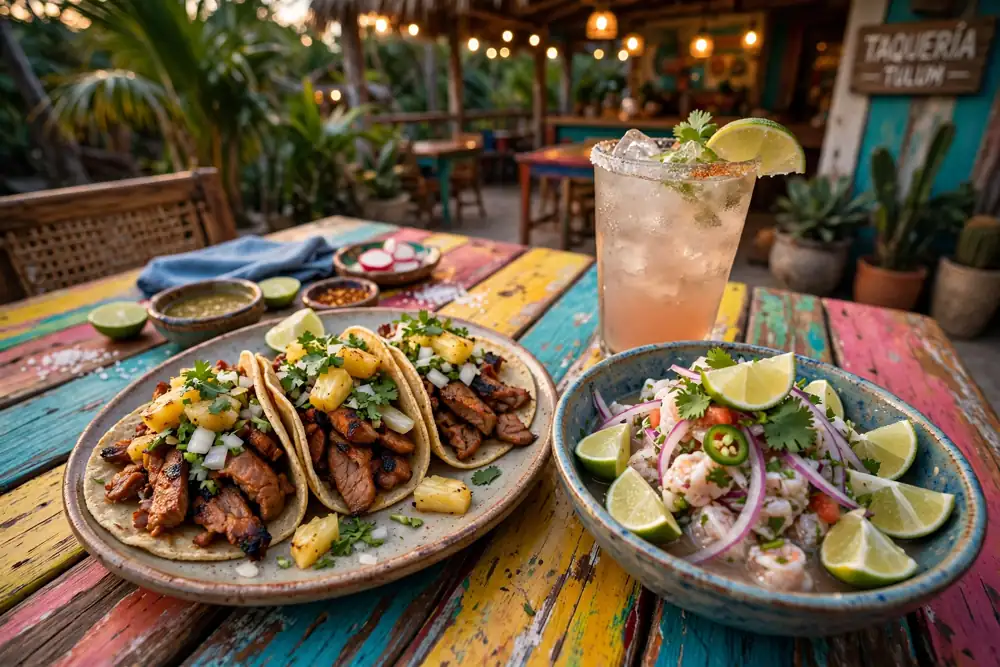
The tacos are the reason to eat in the pueblo. Tacos al pastor — pork cooked on a vertical spit, sliced onto a tortilla with pineapple, onion and cilantro — and cochinita pibil, the Yucatán’s slow-roasted pork in achiote and bitter orange, wrapped in banana leaf and buried in the ground overnight, are the two dishes that define the town, and the taquerías on Avenida Tulum serve them for a few pesos each. Taquería Honorio is the one everyone names, with tacos at $2 to $5 and a line out of the door at lunch, but the rule is simpler: eat where the line is longest, order what the person in front of you ordered, and do not skip the salsa bar. Go for lunch, when the pork is fresh off the spit, and order a plate of each — the pastor for the smoke, the cochinita for the sour orange and the achiote.
Ceviche and seafood on the beach road
The beach road is where Tulum eats fish. Ceviche on Wikipedia — raw fish cured in lime juice with onion, chilli and cilantro — is the dish the coast does best, and the beach clubs serve it with the sea in front of you: shrimp, octopus and the catch of the day, with tostadas and a cold beer. The fish here comes from the reef and the boats that work it, and the best ceviche is the simplest — lime, salt, onion, chilli, nothing to hide behind. Order it as a starter at lunch, when the fish is freshest, and eat it with your feet in the sand: the beach road’s prices are high, but a plate of ceviche and a beer at a quiet club is the cheapest luxury in Tulum. The lobster is the other local catch, and the beach restaurants serve it grilled with garlic butter when the season allows — ask what came in that morning, and order that.
Fine dining: Hartwood and the hotel-zone restaurants
The hotel zone is where Tulum’s food gets famous. Hartwood is the name everyone knows — an open-fire restaurant with no electricity in the kitchen, a menu that changes with the market, and tables that release at 8 a.m. and sell out in minutes — with dinner at about $40 to $65 per person before drinks. Book the moment the tables open, or do not go at all. Around it, the beach road holds the town’s other big rooms: Gitano, with its jungle dining room and mezcal bar; Arca, with its tasting menus and its garden; and the hotel restaurants at Azulik, Casa Malca and Ahau, where dinner comes with the art and the architecture. The food here is serious — wood fire, local fish, Yucatán ingredients cooked with a chef’s ambition — and the prices are serious too. One fine dinner on the beach road, and the rest of your meals in the pueblo, is the right balance: the town’s best food is not the most expensive food, but the most expensive food is worth trying once.
Free things to do in Tulum
Tulum is generous with free things, if you know where the money stops. The beaches are public by law — Playa Paraíso, Las Palmas and every stretch of sand between the clubs cost nothing to walk on, and the public access through Parque del Jaguar is free since July 2026. The pueblo’s street art is a free walking tour, the market is free to wander, and the sunset from the beach road costs nothing. The Museo de la Costa Oriental is free at the door. The cenotes are not free, but the cheapest, Cristalino, is about 100 pesos, and the town’s best meal — tacos al pastor from a street stand — is a few pesos. The bike ride at sunrise, the swim at Las Palmas, the walk through the pueblo in the evening: in total, you could spend a full day in Tulum and pay for nothing but food — and eat very well doing it.
Frequently asked questions
How many days do you need in Tulum?
Three days is the right amount: one day for the ruins and the beach, one day for the cenotes and the town, and one day for Sian Ka’an or a day trip to Cobá and Akumal. Two days works if you skip the biosphere reserve and focus on the ruins, one cenote and the beach. One day is enough for the ruins at 8 a.m. and Playa Paraíso in the afternoon, but you will miss the cenotes, which are the best part of Tulum. Add a fourth day if you want Chichén Itzá, which is a 12-hour day on its own, or a slow day at the beach clubs with nowhere to be.
Is Tulum safe for tourists?
Tulum is safe for tourists who behave like travellers, not like the town is a theme park. Stay in the busy areas, do not walk the beach road alone late at night, use official taxis and agree the price before you get in, keep your phone and wallet out of sight, and buy tickets only at the official booths — the touts at the ruins entrance are the most common scam in town, and the “VIP” tickets they sell are not worth the price. The town has had problems with crime, and the police presence on the beach road is visible for a reason: the risk is real but it concentrates late at night and away from the crowds. Drink bottled water, use mosquito repellent at dawn and dusk, and do not drive the Punta Allen road or swim in cave passages beyond the daylight zone. The cenotes, the ruins and the beach in daylight are as safe as anywhere in Mexico.
What is the best time to visit Tulum?
November to April, when the weather is dry, sunny and warm and the sargassum is at its lightest. November is the best value — the rain is ending, the seaweed is clearing and the prices have not yet peaked. December to March is the peak, with the clearest water and the highest prices. Avoid June to August if the beach is the point: those are the worst sargassum months, and Tulum is among the hardest-hit stretches of coast in Mexico. September and October are the cheapest and quietest, at the cost of rain and hurricane risk. Whatever month you choose, check the live sargassum report in the week before you travel — the seaweed varies year to year, and 2026 is on course to be the second-largest sargassum year on record.
Is Tulum expensive?
The beach road is; the town is not. A night on the beach road runs $250 to $600 and a smoothie can cost $18, while a night in the pueblo runs $30 to $80 and a taco costs a few pesos. The ruins are 265 pesos for foreign visitors, cenotes run 150 to 500 pesos each, and a beach-club bed runs 300 to 1,000 pesos — but the beaches themselves are free, the pueblo’s food is cheap, and a bicycle costs $5 a day. The trick is the split: stay in the pueblo, eat in the pueblo, and spend on the beach road only for the things that are worth it — one beach-club day, one fine dinner, one or two splurge nights. Done that way, Tulum costs about $80 to $150 per person per day mid-range, and the town’s best experiences — the ruins at sunrise, the cenotes, the free beaches — are the cheap ones.
Can you swim at the Tulum ruins beach?
Yes. The beach below El Castillo, at the foot of the cliff, is swimmable — a wooden staircase leads down from the site to the sand, and the water there is calm and clear, sheltered by the reef. Go early, right after the 8 a.m. opening, before the crowds find the staircase, and bring your swimsuit: the beach is the reward for the early alarm, and by midday it is busy. The sargassum can affect it from May to October, so check the report before you go, and do not expect facilities — there is no lounger rental and no restaurant on the ruins beach itself. Playa Paraíso, a few minutes’ walk north, is the better beach for a full day; the ruins beach is the better swim for an hour.
What should I skip in Tulum?
Skip the ruins at midday, when the heat, the crowds and the tour buses arrive together — 8 a.m. or not at all. Skip the “VIP” ruins tickets sold by touts on the approach: the official ticket is 265 pesos at the Grupo Mundo Maya windows, and nothing else is needed. Skip a beach club with a $100 minimum spend without checking first — most clubs dropped their minimums in 2026, and the ones that kept them are not worth it when the beach next door is free. Skip driving the Punta Allen road in a rental sedan, especially after rain: it is a 4WD road, and it has ended plenty of deposits. Skip regular sunscreen in the cenotes — it damages the water, and the staff will make you shower it off. And skip the idea that Tulum is only the beach road: the pueblo, the cenotes and the biosphere reserve are the town, and the beach road is just the shop window.
Further reading
Tulum, Quintana Roo on Wikipedia
Tulum (archaeological site) on Wikipedia
Sian Ka’an Biosphere Reserve on Wikipedia
Chichén Itzá on Wikipedia
Cobá on Wikipedia
Muyil on Wikipedia
Cenote on Wikipedia
Sac Actun on Wikipedia
Dos Ojos on Wikipedia
Akumal on Wikipedia
Mesoamerican Barrier Reef System on Wikipedia
Riviera Maya on Wikipedia
Quintana Roo on Wikipedia
Yucatán Peninsula on Wikipedia
Maya civilization on Wikipedia
Punta Allen on Wikipedia
Punta Laguna on Wikipedia
Tren Maya on Wikipedia
Tulum International Airport on Wikipedia
Bacalar on Wikipedia
Playa del Carmen on Wikipedia
Cancún on Wikipedia
Sargassum on Wikipedia
Halocline on Wikipedia
Temazcal on Wikipedia
Cochinita pibil on Wikipedia
Al pastor on Wikipedia
Ceviche on Wikipedia
For local tips and first-hand reports from people who live in and visit the town, the r/tulum community on Reddit is the place to ask — it is where travellers swap beach-club prices, cenote conditions and sargassum reports.
No Quora link is included, because no live, on-topic Quora thread about visiting Tulum could be verified.
Your Tulum trip, in one paragraph
Tulum is the place where the whole idea of this site — one honest, complete guide per place — feels most at home: a Maya city on a cliff above the Caribbean, the clearest cenotes in Mexico, a beach that lives up to every photograph, and a biosphere reserve where the road simply runs out, all in the town that turned a fishing village into the Riviera Maya’s wildest corner. Start with the islands and the coasts: our Hawaii guide, our Maui guide, and our Honolulu guide. Then the American cities, in the order we wrote them: our Chicago guide, our Nashville guide, our Los Angeles guide, our Orlando guide, our Miami guide, our San Diego guide, our Denver guide, our Savannah guide, our Dallas guide, our Charleston guide, our San Francisco guide, our Myrtle Beach guide, our Las Vegas guide, and our San Antonio guide. Further afield: our London guide, our Portland guide, our Pigeon Forge guide, our Puerto Rico guide, our Atlanta guide, our Phoenix guide, our Paris guide, our Key West guide, our Colorado Springs guide, our Sedona guide, our Chattanooga guide, our Palm Springs guide, our St Louis guide, and our Tokyo guide. Then the middle of the map: our Japan guide, our Kansas City guide, our Tennessee guide, our Branson guide, our Florida guide, our Amsterdam guide, our Montreal guide, our Fort Lauderdale guide, our Toronto guide, our Aruba guide, our Charlotte guide, our Indianapolis guide, our New Orleans guide, our Destin guide, our Santa Barbara guide, our Mexico City guide, our Arizona guide, our Osaka guide, our Minneapolis guide, our Pittsburgh guide, our California guide, our Asheville guide, our Costa Rica guide, our Washington DC guide, our Seattle guide, our St Augustine guide, our Lisbon guide, our Dubai guide, and our Santa Fe guide. And the most recent: our Galveston guide, our Maine guide, our Sacramento guide, our Kauai guide, our Boston guide, our Cancun guide, our Madrid guide, our Salt Lake City guide, our Baltimore guide, our Barcelona guide, our Reno guide, our Milwaukee guide, our North Carolina guide, our New York guide, our Tucson guide, our Raleigh guide, our Corpus Christi guide, our Milan guide, our Salem guide, our Wilmington guide, our Memphis guide, our Flagstaff guide, our Austin guide, our Oahu guide, our Iceland guide, our Cincinnati guide, our Fort Worth guide, our Panama City Beach guide, our Monterey guide, our Nassau Bahamas guide, our Lexington guide, our Lake Tahoe guide, and our San Jose guide. Tulum belongs on that list because it is the one place in Mexico where you can stand in a thousand-year-old walled city at sunrise, float down a Maya canal by midday, and eat tacos al pastor on a plastic stool in the evening — and after three days here, with the ruins, the cenotes and a swim in water so clear it looks empty behind you, you will understand why the town that built its name on a cliff is worth a trip of its own.

About the Author