Things to Do in Phoenix
20 Best Attractions, a 3-Day Itinerary, Where to Stay, and the Food You Cannot Miss
Quick Info
Best for: First-time desert travellers, hikers, museum lovers, food lovers and sports fans — saguaros, Native art, world music and mountain sunsets in one sprawling Valley
Best time: October–April for hiking and patios; March for wildflowers and spring training; avoid June–September afternoons, when it is 100°F-plus
How long: 3 full days for the highlights; 2 days covers the essentials; add a 4th day for Sedona or the Salt River
Budget: Roughly $120–$220 per person per day for a mid-range trip with one big ticketed attraction; a hiking-and-free-museums day runs much cheaper
Don’t miss: Sunrise on Piestewa Peak or Camelback, the Desert Botanical Garden at opening, the Heard Museum, a Sonoran hot dog and sunset at Hole-in-the-Rock
Phoenix is a city built around a thermometer and a map. The capital of Arizona and the fifth-largest city in the United States, it sits in the Sonoran Desert — a landscape of saguaro cacti, red sandstone buttes and mountain preserves — and it is also a city of world-class museums, a Frank Lloyd Wright winter camp, a first-Friday art walk and some of the best Mexican food in the country. This guide gives you the 20 best things to do in Phoenix in a sensible order, a ready-made 3-day itinerary, honest advice on when to go, where to stay and how to get around, and the three foods you have to try before you leave — plus the free sights that cost nothing at all. Prices and hours change, so every price in this guide is marked as approximate — always check the official website before you visit.
One thing to know before you go: when locals say “Phoenix” they mean the whole Valley of the Sun — a string of separate cities including Scottsdale, Tempe, Mesa and Glendale, home to about five million people. The big museums line Central Avenue in midtown Phoenix, the garden and the zoo sit in Papago Park on the Tempe line, Taliesin West is in north Scottsdale and the wild horses are out past Mesa. Group each day by area, because crossing the metro at rush hour can cost you an hour you would rather spend somewhere else. And plan around the heat: from October to April you can be outdoors all day, but from June through August, outdoor plans should end by about 9 a.m.
For background before you go, the Wikipedia entry on Phoenix covers the city’s history, from its Hohokam canal builders and its founding in 1867 to its growth into a desert metropolis — it is linked in Further reading at the end of this guide.
Phoenix at a glance
| Question | Short answer |
| How long do you need? | 3 full days for the highlights; 2 days covers the essentials; 4 days if you add Sedona or a full Salt River day. |
| Best area for a first trip | Papago Park and Central Avenue for the first two days — the garden, the zoo, the Heard and the Phoenix Art Museum are a short drive apart. |
| One thing to book early | Taliesin West tours, Desert Botanical Garden timed tickets in December, and spring-training seats in March. |
| One thing that is free | The mountain preserves, Hole-in-the-Rock, First Friday, the Arizona Capitol Museum and pay-what-you-wish Wednesdays at the art museum. |
| Do you need a car? | Yes, for most of the list — the trailheads, Taliesin West, the Salt River and Scottsdale are not on the light rail; no, for downtown and the midtown museums. |
Before the details, three warnings that most guides still get wrong. First, the heat rules are real and enforced: on days when the National Weather Service issues an Extreme Heat Warning, Camelback’s two summit trails, the Piestewa Peak Summit Trail and several South Mountain trails are off-limits from 8 a.m. to 5 p.m. — that happened on 45 days in 2024, and the first restrictions of 2026 came as early as March 19. Second, Mystery Castle, the folk-art house below South Mountain that plenty of lists still include, is closed to visitors while preservation work goes on — its tours are suspended until further notice. Third, the arena downtown is now called Mortgage Matchup Center, after taking its new name in October 2025 — any guide that still says Footprint Center, or promises a Coyotes hockey game (the team’s hockey operations moved to Utah in 2024), has not been updated in a while. This guide is built on what is actually open and running in late 2026, not on what used to be true.
The 20 best things to do in Phoenix
The list runs in a sensible travel order: Papago Park and the desert first, then the Central Avenue museums, then the mountains, then north Phoenix and Scottsdale, and finally the Salt River and the neighbouring cities. Every entry says what it costs, how long to allow, and what to watch out for.
1. Wander the Desert Botanical Garden
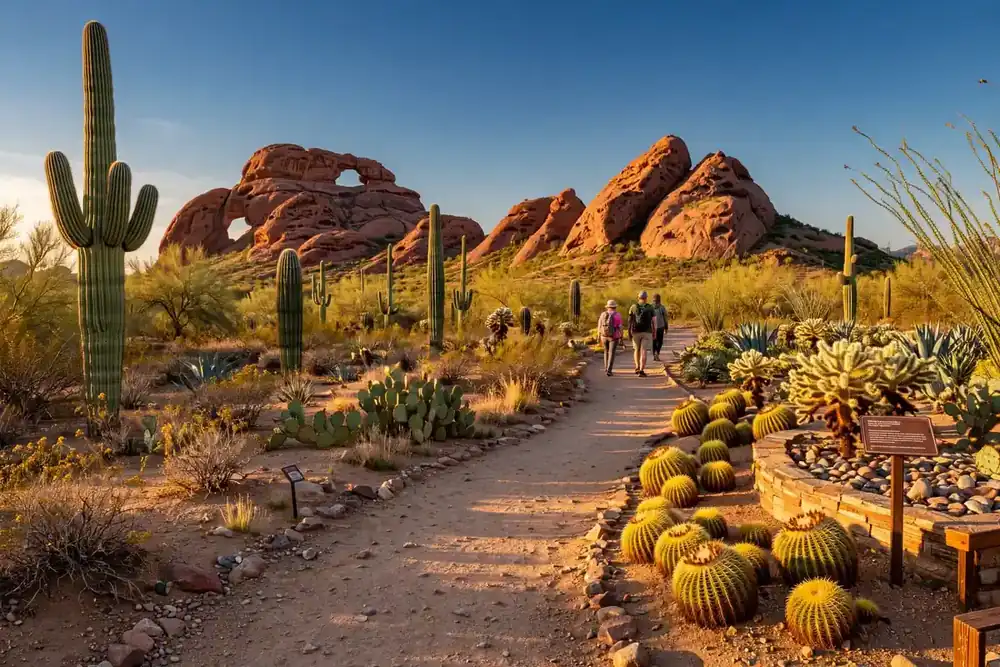
If you do one thing in Phoenix, make it this. The garden’s loop trails in Papago Park are a slow, labelled introduction to the Sonoran Desert: towering saguaros and organ pipe cactus, agaves, a wildflower loop that peaks in March and April, and exhibits on how people have lived in this desert for centuries. Spread across 140 acres, it holds more than 50,000 desert plants from around the globe on five themed trails, and it works as an orientation course — everything you drive past for the rest of the trip will make more sense afterward. The Desert Botanical Garden is the anchor of an east-Phoenix day, a few minutes from the zoo and Hole-in-the-Rock.
Practical tip: Tickets are priced by date. For October through December 2026, adult admission runs from roughly $32.95 and children’s from roughly $14.95, and online tickets are usually cheaper than paying at the gate — prices are approximate, so check before visiting. The garden opens daily at 8 a.m. in the cool season; on its 2026 summer schedule it opened at 6 a.m. and stayed open until 10 p.m., with the trails closed from 1 to 5 p.m. for the heat. Community Day, on the second Tuesday of each month, is pay what you can. Las Noches de las Luminarias, the candlelit holiday nights, run on 26 nights from November 27, 2026 to January 3, 2027, with a new Super Bloom light-art installation for 2026 — adults roughly $39.95 to $44.95, and advance timed tickets are required. Allow two to three hours, and go at opening.
2. Hike Camelback Mountain at sunrise
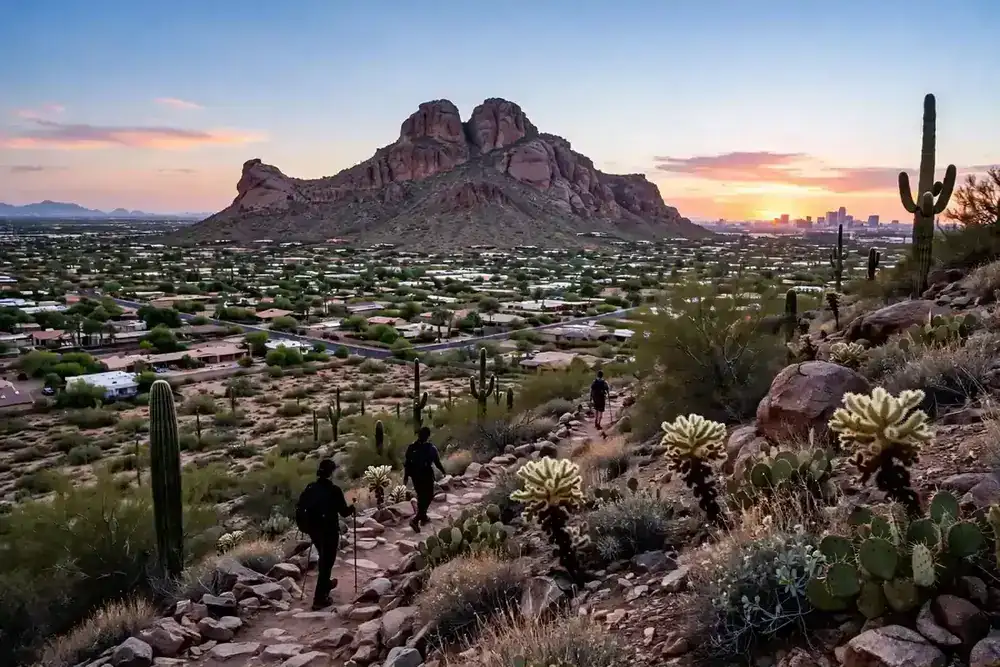
Camelback is the Valley’s signature climb and its most misjudged. Both summit routes are short and brutal: the city lists Echo Canyon at 1.14 miles each way with 1,400 feet of elevation change, and Cholla at 1.5 miles with 1,420 feet, and rates both “extremely difficult.” Expect loose rock, handrails on the steepest pitches and almost no shade on the way to the 2,704-foot summit, where the whole Valley spreads out below you. Camelback Mountain is named for its shape — the hump and head of a kneeling camel — and it is the hike every local has done and every visitor should attempt once, in the right season.
Practical tip: The trails are free and open from sunrise to sunset. Go at sunrise between November and March, carry more water than seems sensible, and turn back if you are unsure. On Extreme Heat Warning days both summit trails are off-limits from 8 a.m. to 5 p.m., and dogs are banned from Camelback’s trails all year. Parking is the other constraint: the Echo Canyon lot is typically full from late morning to early afternoon on weekdays and all day on weekends in winter and spring, and police ticket drivers who idle on McDonald Drive or Tatum Boulevard waiting for a space. If you want the view without the scramble, Piestewa Peak or Dobbins Lookout gets you most of it.
3. Learn the Southwest at the Heard Museum
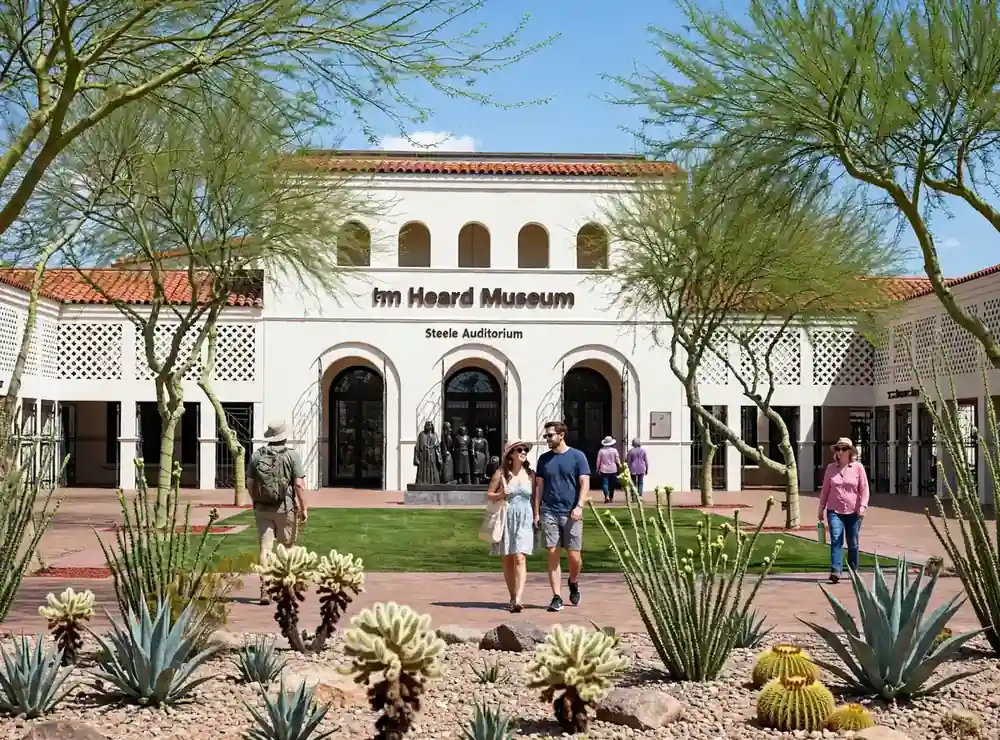
The Heard has been collecting and showing the art of the Southwest’s Native peoples since 1929, and it is the one Phoenix attraction you cannot replicate anywhere else. Its galleries hold pottery, basketry, jewellery, textiles and a large collection of katsina dolls, alongside contemporary work by Native artists, and the museum tells the story of the Indigenous peoples of the Southwest with a care few museums match. The Heard Museum sits on Central Avenue in midtown, a five-minute drive from downtown or a short light-rail ride, and it pairs naturally with the Phoenix Art Museum a short walk away.
Practical tip: Admission is roughly $25 at the door or roughly $22.50 online for adults, and the ticket system prices by date, so confirm when you book — prices are approximate, so check before visiting. Hours are 10 a.m. to 4 p.m., daily from September through May; from June through August it closes on Mondays. Entry is free on First Friday evenings, the first Friday of each month, from 4 to 8 p.m. Allow two to three hours, and leave time for the shop, which sells work by Native artists. Two annual events are worth planning around: the World Championship Hoop Dance Contest on February 6–7, 2027, and the Heard Museum Guild Indian Fair & Market, in its 69th year, on March 6–7, 2027.
4. Hear the world at the Musical Instrument Museum
MIM is the attraction people underestimate, and the one they talk about longest afterward. Its galleries are arranged by world region, with instruments from almost every country on earth — more than 8,000 of them — and the headset included with admission switches on the sound as you walk up to each display, where screens show the instruments being played. There is also a hands-on gallery where you can play instruments yourself, and a concert hall with live performances. The Musical Instrument Museum sits in far north Phoenix, off Loop 101 near Tatum Boulevard, about 30 minutes from downtown, and it is the best air-conditioned half-day in the Valley — the obvious July plan.
Practical tip: Admission is roughly $20 for adults, roughly $15 for teens aged 13 to 19, roughly $10 for children aged 4 to 12 and free for ages 3 and under, with parking free — prices are approximate, so check before visiting. Special exhibitions cost extra. It opens daily from 9 a.m. to 5 p.m. Allow at least three hours; plenty of people need two visits, and guest services sells two-day passes. It sits close enough to north Scottsdale to pair with Taliesin West on a cool morning.
5. Climb Piestewa Peak for the city view
The Summit Trail on Piestewa Peak is Camelback’s slightly friendlier sibling. The city lists it at 1.2 miles each way with 1,200 feet of elevation change, also rated extremely difficult, but it is a steady, well-worn climb rather than a scramble, and from the top you look across downtown, Camelback and most of the north Valley. The peak was renamed in 2003 for Lori Piestewa, a Hopi soldier and the first Native American woman in the US military known to have died in combat, so older maps and guides may still use the previous name. At sunrise in January, this is one of the best free hours in Phoenix.
Practical tip: The trail is free. The same heat rule applies: on Extreme Heat Warning days, the Summit Trail and its connecting trails are off-limits from 8 a.m. to 5 p.m. Dogs are never allowed on the Summit Trail, and on any city trail they are banned when it is over 100°F. The park entrance opens at 5 a.m., and from June through September the trailhead lot stays open until 9 p.m. for evening hikers. Go at sunrise between October and April, and carry water — there is no shade and no water on the trail.
6. Watch the sunset from Hole-in-the-Rock in Papago Park
Papago Park’s red sandstone buttes hold three of the Valley’s easiest wins, and this is the best of them. Hole-in-the-Rock is a 0.2-mile path, rated easy by the city, up to a natural opening in a butte that frames the view west over the park and the city — and it is at its best in the last hour before sunset, when the sandstone glows. The climb takes a few minutes, the trailhead lot by the Papago Park Visitor Center at 625 N. Galvin Parkway is open from 5 a.m. to 7 p.m., and a true sunset visit works from about mid-September to mid-April. The Desert Botanical Garden and the Phoenix Zoo sit next door, so this is the natural end to an east-Phoenix day.
Practical tip: The park and the trail are free. Come in the last hour before sunset, bring a camera, and stay for the blue hour — the city lights come on below you while the buttes turn deep red. In summer, the lot’s 7 p.m. closing means a true sunset visit is not possible, since the sun sets closer to 7:40 — plan this one for the cool season.
7. Tour Frank Lloyd Wright’s Taliesin West
Frank Lloyd Wright started building his winter home and studio in the desert foothills of north Scottsdale in 1937, largely from desert stone and sand, and it is now part of a UNESCO World Heritage listing of his work. Going inside means taking a tour: the standard option is the self-guided audio tour, which takes 60 to 75 minutes and runs through the drafting studio, the living quarters, the cabaret theatre and the gardens, with Wright’s furniture and the desert light doing most of the talking. Taliesin West is about 45 minutes from downtown Phoenix, and it is the building in Arizona not to miss if you care about architecture. Frank Lloyd Wright designed it as a camp as much as a house, and it still feels like one.
Practical tip: The self-guided audio tour costs roughly $44 for adults and roughly $22 for ages 6 to 17 from October to May, dropping to roughly $39 and roughly $19 in summer — prices are approximate, so check before visiting. The Behind-the-Scenes Tour (roughly $110, about two to two and a half hours) runs at 10 a.m. on set weekdays from November 3, 2026 to April 30, 2027. Taliesin West is open Wednesday to Monday in October 2026 and daily from November through April, and the foundation calls reservations “strongly recommended” — book through its tour page rather than turning up. Guided tours are not intended for children under 6.
8. Drive to Dobbins Lookout in South Mountain Park
South Mountain Park and Preserve covers more than 16,000 acres with more than 100 miles of trails, which makes it one of the largest city-run parks in the country — and you do not have to hike it. Summit Road climbs to Dobbins Lookout at 2,330 feet, the highest point in the park open to the public, where a stone lookout shelter looks north across the whole Valley to downtown and the mountains beyond. South Mountain Park is about 35 minutes from downtown to the lookout, and it is the best sunset drive in the city from October through March, when the sun goes down well before the park’s 7 p.m. closing.
Practical tip: The park is free, with entrance and parking hours of 5 a.m. to 7 p.m. That makes a sunset drive practical from October through March and impossible in midsummer, when the sun sets closer to 7:40. On “Silent Sundays” the city closes Summit Road to cars from 5 to 10 a.m. at the one-mile marker, and on the fourth Sunday of each month it stays closed to cars all day. Three trails here — Holbert, Mormon and Hau’pal Loop — plus the National Trail’s access from Pima Canyon, fall under the heat restrictions on Extreme Heat Warning days. One warning for the guidebooks: Mystery Castle, the folk-art house below South Mountain, is closed to visitors while preservation work goes on.
9. Spend an afternoon at the Phoenix Art Museum
The museum bills itself as the largest art museum in the Southwest, and its collections cover American and Western art, Latin American and Asian art, contemporary work and a strong fashion-design collection. Its white buildings on Central Avenue hold more than 19,000 works, with a permanent collection that runs from the Old Masters to contemporary Arizona artists, plus a rotating programme of exhibitions. The Phoenix Art Museum is a calm, airy counterpoint to the desert heat, and it pairs naturally with the Heard, a short walk away on the same avenue.
Practical tip: Adult admission is roughly $23, seniors roughly $20, students roughly $18 and ages 6 to 17 roughly $13 — prices are approximate, so check before visiting. It is closed Monday and Tuesday and stays open until 8 p.m. on Wednesdays and Fridays. Those late nights are the ones to use: Wednesdays from 3 to 8 p.m. are pay what you wish, and First Fridays from 5 to 8 p.m. are free. One caveat for fall 2026: the museum’s Ballinger Wing is temporarily closed for infrastructure work, so check what is on view if you are going for something specific. Allow two hours.
10. Walk Roosevelt Row on First Friday
Roosevelt Row is the city’s arts district: murals, small galleries, bars and some of the street life the rest of Phoenix lacks, along Roosevelt Street just north of the downtown high-rises. Its big night is First Friday, the monthly art walk that the nonprofit Artlink has run since 1994, when galleries and studios open free to the public. The same evening, the Phoenix Art Museum (5 to 8 p.m.) and the Heard (4 to 8 p.m.) are free, so one First Friday can stack three things for nothing. Most of the energy arrives after dark, which in summer is also when walking around becomes bearable.
Practical tip: The art walk is free. Come after dark on the first Friday of the month, start at Roosevelt Row and walk the galleries, then eat at one of the food trucks or the restaurants along the street. Official art-walk hours are not published and venues set their own, so arrive after 6 p.m. for the full scene. Parking is tight on First Friday — take the light rail to the Roosevelt/Central Avenue station and walk.
11. See the Salt River’s wild horses
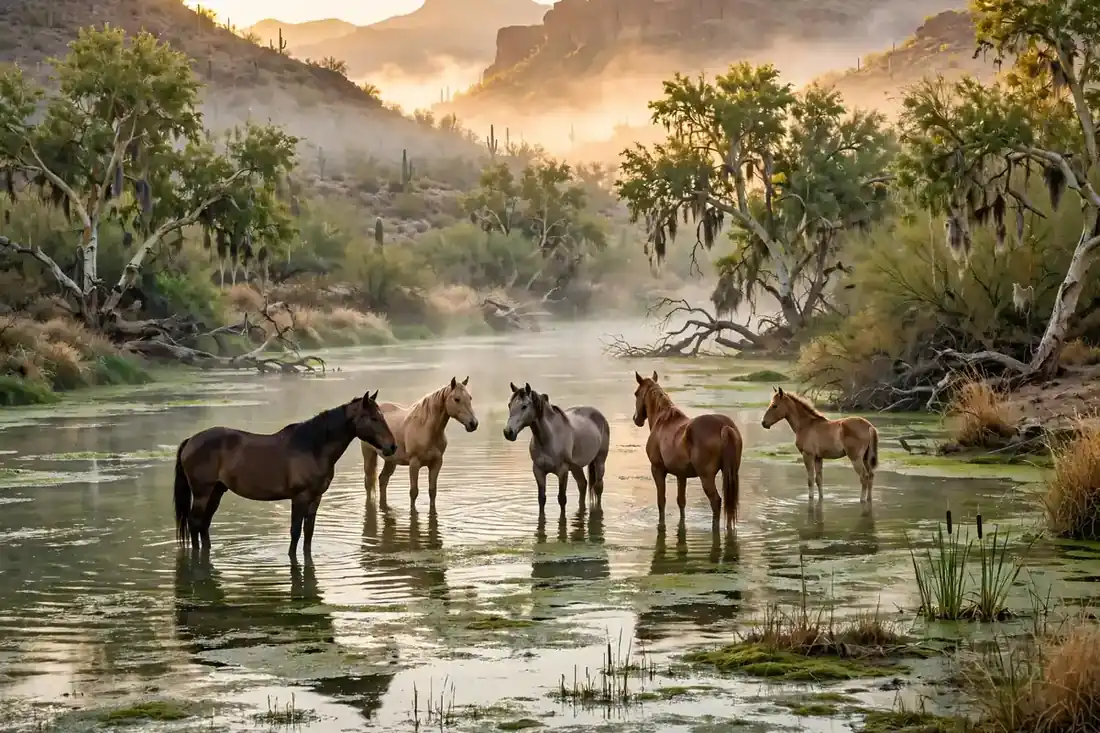
Bands of wild horses live along the Lower Salt River, and watching them wade into the water in the early light is one of the most memorable things you can do in the Valley for the price of a parking pass. The recreation sites along Bush Highway, including Phon D. Sutton, Granite Reef, Water Users and Raccoon Bluff, are the usual places to look, and your best odds are within two or three hours of sunrise or sunset. The Salt River runs through Tonto National Forest about 50 minutes northeast of downtown, past Mesa, and the horses are the free-roaming descendants of animals that have lived along the river for generations.
Practical tip: Parking at the forest recreation sites requires a Tonto Pass: roughly $8 per vehicle per day from forest offices and retailers around the Valley, or roughly $12 at the on-site machines — prices are approximate, so check before visiting. The Salt River Wild Horse Management Group asks visitors to stay at least 50 feet from the horses and never to feed them. In summer the same river is where Phoenix goes tubing: Salt River Tubing’s 2026 season ran from April 25 to the end of September, with trips only Friday to Sunday from September 8, at roughly $28 for a tube and shuttle.
12. Float over the desert in a hot air balloon
Floating over saguaros at sunrise is expensive, and for many people worth doing once. The balloon rises with the sun over the open desert north and west of the city, the cacti and mountains spread out below, and the flight ends with a champagne toast on landing. It is the single most romantic thing to do in Phoenix, and the best way to see the scale of the Sonoran Desert — a landscape that looks flat from the road and endless from the air.
Practical tip: Hot Air Expeditions charged roughly $239 per adult for a shared morning flight when checked in September 2026, plus 9% in taxes and fees, and Rainbow Ryders listed a regular rate of roughly $275 per person — prices are approximate, so check before visiting. Both fly sunrise flights year-round and add sunset or afternoon flights only in the cooler months. Summer flights mean a very early start, with check-in as early as 4:30 a.m. Meeting points differ: Hot Air Expeditions checks in at Deer Valley Airport in north Phoenix, and Rainbow Ryders meets in Glendale, in the West Valley. Book directly with the operator, check what the price includes, and expect the occasional weather cancellation, since balloons do not fly in wind.
13. Spend a family day at the Phoenix Zoo
The Phoenix Zoo sits in Papago Park next to the Desert Botanical Garden, and it is one of the largest non-profit zoos in the United States, with more than 3,000 animals across 125 acres — African savanna, a tropical rainforest trail, the Arizona Trail with native desert animals, and a children’s farm. It suits families better than adults on a short trip, but the desert setting makes it different from any other city zoo: the animals live among saguaros and red buttes, not lawns. The Phoenix Zoo is the best family day in the city, and it pairs naturally with the garden and Hole-in-the-Rock on the same east-Phoenix day.
Practical tip: Admission is roughly $44.95 for adults and roughly $32.95 for ages 3 to 13 — prices are approximate, so check before visiting. It keeps short hours in summer (7 a.m. to 1 p.m. from June through August) because of the heat, so go at opening and be done by lunch. In the cool season it opens at 9 a.m. Allow three to four hours, and do not miss ZooLights, the holiday light show, which runs from November 25, 2026 to January 15, 2027 at roughly $35 general admission.
14. Play with science at the Arizona Science Center
Arizona’s largest hands-on science center sits downtown at Heritage and Science Park, with more than 300 interactive exhibits, a planetarium and a giant-screen theatre — and it is one of the best in the country for families. The centre recently renovated its planetarium into the Dorrance DOME, which opened in October 2025 and is now one of the most technologically advanced in North America, a 60-foot LED dome with 8K resolution. The Arizona Science Center is the best indoor plan in the city when it is 110 degrees outside, and it sits next door to The Square PHX, the block of restored Victorian-era buildings with the Rosson House Museum and the original Pizzeria Bianco.
Practical tip: Admission is roughly $22.95 for adults and roughly $16.95 for ages 3 to 17 — prices are approximate, so check before visiting. It opens Tuesday to Sunday. Allow two to three hours, and add the planetarium show: the DOME is the reason to come. The Square PHX next door is worth a wander afterward — the Rosson House, an 1895 mansion seen by guided tour only, runs tours Thursday to Saturday and Sunday, with tickets sold online and on site.
15. Find quiet at the Japanese Friendship Garden
Ro Ho En, a traditional Japanese stroll garden on the northern edge of downtown, is a quiet hour among koi ponds and waterfalls, built as a collaboration with Phoenix’s sister city, Himeji. The 3.5-acre garden holds a tea house, a tea garden, stone lanterns and hundreds of koi, and it is the calmest place in the city — the antidote to a day of hiking and museums. The Japanese Friendship Garden of Phoenix is the garden to choose when you want stillness rather than spectacle.
Practical tip: Admission is roughly $14 for adults, roughly $12 for seniors and roughly $11 for ages 7 to 17, students and military — prices are approximate, so check before visiting. It opens Tuesday to Sunday: 9 a.m. to 6 p.m. from September to January and 9 a.m. to 7 p.m. from February to May. In summer it splits the day, 8 a.m. to 12:30 p.m. and 4 to 7:30 p.m., rather than closing. Allow about an hour, and go in the morning, when the koi are feeding and the garden is at its quietest.
16. Walk the ancient canals at the S’edav Va’aki Museum
Older guides call it Pueblo Grande Museum; the city now uses the O’odham name, S’edav Va’aki. It preserves part of a Hohokam village and its platform mound, with a short outdoor trail past the mound, a ballcourt and reconstructed homes — and it is the best place in town to understand why Phoenix is here at all. The Hohokam dug hundreds of miles of irrigation canals across this valley, and the city that grew up along their traces took its name from a bird reborn from ashes. The site itself is a 1,500-year-old village, and the museum sits directly on it, beside Sky Harbor airport. Pueblo Grande is the archaeological heart of the city.
Practical tip: Admission is roughly $13 for adults, roughly $10 for seniors and roughly $6 for students and ages 6 to 17 — prices are approximate, so check before visiting. From September to June it opens Monday, Thursday, Friday and Saturday from 9 a.m. to 4 p.m., with Thursdays running to 8 p.m., and Sunday from noon to 4 p.m. It is closed Tuesday and Wednesday, and in July and August it closes at 2 p.m. Allow 90 minutes, and walk the outdoor trail first, before the day warms up.
17. Catch a Diamondbacks game at Chase Field
The Diamondbacks play at Chase Field, a downtown ballpark with a retractable roof and air conditioning — so a July ballgame is comfortable even when it is 110 outside — and a swimming pool in the right-field bleachers that has become one of baseball’s famous sights. The ballpark sits a few blocks from the light rail, and a summer evening game, with the roof closed and the desert heat locked out, is the classic Phoenix night out. Chase Field is also the reason to check the schedule before you book a hotel: a homestand fills downtown.
Practical tip: Ticket prices swing widely by opponent and date, so check the team’s own site rather than trusting a figure from any guide. The Suns (NBA) and Mercury (WNBA) play a few blocks away at Mortgage Matchup Center — the arena older guides still call Footprint Center, which took its new name in October 2025. The Cardinals play at State Farm Stadium in Glendale, about 25 minutes west. There is no NHL team: the Coyotes’ players and hockey operations moved to Utah in 2024.
18. Spend a half-day in Old Town Scottsdale
It is its own city, and its compact downtown, Old Town, about 20 minutes from downtown Phoenix, is one of the most walkable districts in the Valley. It has galleries, Western-wear shops, restaurants and a bar district, with a rustic Old West heritage and a contemporary, stylish edge. The best reason to go in daylight is Western Spirit: Scottsdale’s Museum of the West, with its cowboy art, Native art and desert history. Old Town deserves more than a paragraph, so give it a half-day of its own rather than squeezing it into an evening.
Practical tip: Western Spirit charged roughly $28 for adults when checked in September 2026 — prices are approximate, so check before visiting. Come for a late afternoon and evening: the galleries close, the patios fill, and the bar district takes over. Old Town pairs naturally with Taliesin West, 20 minutes north, or with the McDowell Sonoran Preserve for a morning hike. Parking in the Old Town garages is free for the first few hours.
19. Walk Tempe Town Lake and Mill Avenue
Tempe, about 20 minutes east by car or a direct light-rail ride, is a college town built around Arizona State University. Tempe Town Lake, a two-mile lake formed by damming the usually dry Salt River, is free to walk or cycle around, with boat and paddle rentals from a private operator. Mill Avenue has the bars and restaurants, and architecture fans should look at ASU Gammage, the performing arts hall that was one of Frank Lloyd Wright’s last major designs. It is the most relaxed evening in the Valley — a lakeside walk, a patio dinner and a college-town buzz.
Practical tip: The lake path is free and open daily. Come at sunset, when the lake catches the light and the temperature drops, and walk the two-mile loop. Mill Avenue is busiest on weekend nights, when the students are out — go on a weekday evening for the quiet version. The light rail runs straight from downtown Phoenix to Mill Avenue, so this is the one east-Valley trip that does not need a car.
20. Read the rock art at Deer Valley Petroglyph Preserve
Arizona State University runs this preserve in far north Phoenix, about 30 minutes from downtown, where a quarter-mile trail passes a hillside of boulders covered in ancient rock art — more than 1,500 petroglyphs carved by the Hohokam and other peoples over a thousand years. It is a small, quiet site, and the best one in the Valley for understanding how long people have lived in this desert. Bring binoculars; many carvings sit well above the path.
Practical tip: Admission is roughly $14, roughly $13 for seniors and roughly $5 for ages 7 to 12 — prices are approximate, so check before visiting. It opens from 8 a.m. to 2 p.m., Tuesday to Saturday from January to April, and Wednesday to Saturday in May and from August to December. It closes completely in June and July. Allow about an hour, and go in the morning, when the light rakes across the carvings and they are easiest to see.
Phoenix in 3 days — a ready-made itinerary
Three full days covers the Valley’s highlights without rushing: one for Papago Park and the Central Avenue museums, one for a mountain plus north Phoenix or Scottsdale, and one for the Salt River or a second museum day. Add a day for Sedona and two for an overnight at the Grand Canyon.
| Day | Where | Highlights |
| Day 1 — Papago Park and the museums | East Phoenix and Central Avenue | Sunrise at Hole-in-the-Rock, morning at the Desert Botanical Garden, afternoon at the Heard and the Phoenix Art Museum, evening on Roosevelt Row. |
| Day 2 — A mountain and the north Valley | Camelback, north Phoenix and Scottsdale | Sunrise climb on Camelback or Piestewa Peak, morning at the Musical Instrument Museum, afternoon at Taliesin West, evening in Old Town Scottsdale. |
| Day 3 — The river and downtown | Salt River, Tempe and downtown | Early morning at the Salt River for the wild horses, afternoon at the Arizona Science Center and the Japanese Friendship Garden, evening at Tempe Town Lake or a Diamondbacks game. |
Day 1 — Papago Park and the museums: desert, art and the art walk
Start at Hole-in-the-Rock for the sunrise light, then walk straight into the Desert Botanical Garden at its 8 a.m. opening, when the trails are cool and quiet. Spend the late morning at the garden, eat lunch at the Phoenix Zoo next door or at the garden’s cafe, then drive to Central Avenue for the afternoon: the Heard Museum first, then the Phoenix Art Museum on the same avenue. If it is a First Friday, stay out: the museums are free in the evening and Roosevelt Row’s art walk runs after dark. Day one is the classic Phoenix, and it is the one to get right.
Day 2 — A mountain and the north Valley: the climb, the music and Wright
Be on the trail by sunrise — Camelback if you want the scramble, Piestewa Peak if you want the steadier climb — and be off it by 8 a.m. Spend the late morning at the Musical Instrument Museum in far north Phoenix, where three hours disappear fast, then drive 20 minutes to Taliesin West in north Scottsdale for the afternoon audio tour. Finish in Old Town Scottsdale: the galleries, a patio dinner and the walkable streets. Book the Taliesin West tour ahead — in high season the best time slots go first.
Day 3 — The river and downtown: horses, science and a ballgame
Leave before sunrise for the Lower Salt River — the horses are best within two or three hours of sunrise — and be back in the city by late morning. Spend the afternoon downtown: the Arizona Science Center and its Dorrance DOME planetarium, then the Japanese Friendship Garden for a quiet hour. Finish at Tempe Town Lake for a sunset walk, or at Chase Field for a Diamondbacks game under the closed roof. If you have a fourth day, spend it in Sedona — leave at dawn, because trailhead parking fills early — or on a slow morning at S’edav Va’aki and the Salt River.
Best time to visit Phoenix
The city is warm for most of the year, so the question is heat, crowds and price, not temperature. Spring (March to May) is the sweet spot: mild days in the 70s and 80s, desert wildflowers and spring training, but also the year’s highest prices and biggest crowds. Autumn (October to November) is the other sweet spot, with hiking weather restarting and hotel rates lower than spring. Summer (June to September) is hot — the normal July high is 106.5°F, and the city normally gets 111 days a year at 100°F or hotter — but it is also the cheapest season, with resort rates at their lowest. Winter (December to February) is mild, with highs in the 60s and 70s, and the busiest event season: the WM Phoenix Open, Barrett-Jackson and spring training all land between January and March. Monsoon season runs June 15 to September 30, with dust storms, lightning and flash floods — if a dust storm catches you driving, the state’s advice is “Pull Aside, Stay Alive.”
| Season | Months | Weather and crowds | Best for |
| Winter (peak) | December–February | Mild 66–71°F, nights in the 40s, hotel rates climb from January | Hiking, golf, sports, the holiday light shows |
| Spring (peak) | March–May | Warm 78–86°F, wildflowers, spring training, highest prices | First trips, wildflowers, Cactus League |
| Summer (low) | June–August | Hot 104–107°F, monsoon storms, lowest resort rates | Indoor museums, the Salt River, resort pools |
| Autumn (shoulder) | September–November | Cooling 77–89°F, hiking restarts, thinner crowds | Best value, hiking, balloon flights |
Where to stay in Phoenix
Downtown suits first-timers who want the light rail, the ballparks and Roosevelt Row on foot; Midtown and Central Avenue suit museum lovers; the Camelback Corridor suits resort stays and mountain access; Old Town Scottsdale suits a walkable, upscale base; Tempe suits a budget base with light-rail access. Book early for March, for the WM Phoenix Open week (February 8–14, 2027) and for the third week of February 2027, when the WM Phoenix Open, NBA All-Star weekend and the first spring-training games all land at once.
| Area | Best for | Expect to pay (approx) |
| Downtown | First-timers, light rail, ballparks, Roosevelt Row | $150–$280 a night for a mid-range hotel |
| Midtown and Central Avenue | Museums, quiet base, light rail | $130–$220 a night for a mid-range hotel |
| Camelback Corridor and Arcadia | Resorts, mountain access, upscale dining | $200–$400 a night for a resort |
| Old Town Scottsdale | Walkable base, galleries, nightlife | $180–$350 a night for a boutique hotel |
| Tempe | Budget base, ASU, Mill Avenue, light rail | $110–$200 a night for a hotel |
Getting around Phoenix
A rental car is the single most important decision on this trip. For most of this list you want a car: the trailheads, Taliesin West, the Salt River and Scottsdale are not on the light rail. The exception is a useful core. Valley Metro’s light rail costs roughly $2 a ride, and tap-to-pay fares stop charging after roughly $4 in a day. Since June 2025 it has run as two lines that meet downtown: one heads east past the airport’s free PHX Sky Train connection at 44th Street to Tempe and Mesa, and the other runs north-south along Central Avenue past the Heard and the Phoenix Art Museum. Between them they cover downtown, the midtown museums, ASU and Mill Avenue in Tempe, and downtown Mesa. Phoenix is also where Waymo first opened fully driverless rides to the public, in 2020, and a ride is still a novelty worth trying — Waymo serves downtown Phoenix, Scottsdale and parts of Tempe, Mesa and Chandler, including pickups at Sky Harbor’s terminals 3 and 4, and you book in the Waymo app. The Uber partnership in Phoenix has ended, so you can no longer summon a Waymo through Uber here. For the trailheads, the Salt River, Taliesin West and anything in the West Valley, rent a car — and allow a third longer than the off-peak drive time at rush hour.
Phoenix food you have to try
Phoenix’s food story starts at the Mexican border, about 180 miles south. Sonoran-style cooking means grilled carne asada, big flour tortillas and the Sonoran hot dog — and at the other end of the scale, the first MICHELIN Guide to the American Southwest, announced on August 26, 2026, gave no stars to Arizona but named Pizzeria Bianco and Valentine in Phoenix as Bib Gourmand picks for good value. Eat at the taco stands, the food halls and the market stalls, not just the hotel restaurants — that is where the food is best and cheapest.
The Sonoran hot dog, the dish you cannot leave without
The Sonoran hot dog is bacon-wrapped, in a soft bolillo roll, piled with beans, onions, tomatoes and salsa — and it is the one dish you should not leave Phoenix without trying. It is a Tucson invention that Phoenix adopted as its own, and the best versions come from the stands and trucks: El Güero Canelo, the Tucson-born chain with a Phoenix outpost, and the late-night trucks around downtown. Order it “con todo” — with everything — and eat it standing up, with a cold Mexican soda. It costs a few dollars, and it is the best cheap meal in the city.
Carne asada tacos and Sonoran Mexican
Sonoran Mexican is grilled carne asada, big flour tortillas, mesquite smoke and salsa made that morning. The taco stands of south Phoenix and the restaurants of Roosevelt Row serve it best: carne asada tacos, burritos the size of a forearm, and chile rellenos, all for a few dollars a plate. Bacanora, the tiny tasting-menu restaurant in downtown Phoenix, takes the same flavours upscale — it is the special-occasion version of the same cuisine — but the stands are where the food is most honest. Come hungry, pay cash at the small stands, and order the carne asada.
Pizza at Pizzeria Bianco, the MICHELIN Bib Gourmand
Pizzeria Bianco is the one people plan trips around. Chris Bianco’s wood-fired pizzas — thin crust, fresh mozzarella, local toppings — made this downtown Phoenix restaurant famous long before the MICHELIN Guide named it a Bib Gourmand in its first American Southwest guide in August 2026. The original location sits at The Square PHX, the block of restored Victorian-era buildings downtown, and the wait is part of the experience: come at an odd hour, or expect to queue. Order the Rosa, with red onion, parmesan and pistachios, and a salad to share.
Free things to do in Phoenix
The city is generous to a tight budget. The mountain preserves — Piestewa Peak, Camelback and South Mountain — charge nothing to hike. Sunset from Hole-in-the-Rock or Dobbins Lookout is free, and both are the best free views in the city from about October to March. First Friday in Roosevelt Row is free, with free evening entry to the Heard (4 to 8 p.m.) and the Phoenix Art Museum (5 to 8 p.m.). The Arizona Capitol Museum is always free — it opens weekdays from 9 a.m. to 4 p.m., plus Saturdays from 10 a.m. to 2 p.m. from mid-September through May, with walk-in tours at 2 p.m. on Mondays, Wednesdays and Fridays. The art museum is pay what you wish on Wednesday afternoons from 3 to 8 p.m., and Community Day at the Desert Botanical Garden, on the second Tuesday of each month, is pay what you can. Add the Fountain Hills fountain, about 40 minutes northeast, which goes off for 15 minutes every hour from 9 a.m. to 9 p.m. except when it is windy, and Tempe Town Lake, for a free walk or bike ride along the water — and a day of the Valley’s best experiences can cost less than a single museum ticket.
Frequently asked questions
How many days do you need in Phoenix?
Three full days covers the Valley’s highlights without rushing: one for Papago Park and the Central Avenue museums, one for a mountain plus north Phoenix or Scottsdale, and one for the Salt River or a second museum day. Add a day for Sedona and two for an overnight at the Grand Canyon. In summer, plan shorter outdoor windows and more indoor time.
Is Phoenix too hot to visit in summer?
It is hot, but it is visitable — if you plan around the heat. Resorts are at their cheapest, the museums are air-conditioned and quiet, and the Salt River and desert lakes are in season. But it is the wrong season for a hiking trip: the busiest summit trails are off-limits from 8 a.m. to 5 p.m. on Extreme Heat Warning days, and even on ordinary summer days you should be off the trail by about 8 a.m. The normal July high is 106.5°F, and Phoenix normally gets 111 days a year at 100°F or hotter. If your trip only allows afternoons outdoors, pick another season.
Can you do the Grand Canyon as a day trip from Phoenix?
Technically yes, wisely no. The South Rim is 231 miles each way — about four hours of driving in each direction — so you spend about eight hours in the car for a few hours at the rim, then drive back tired in the dark. Entry is roughly $35 per private vehicle for seven days, and non-US residents aged 16 and over now pay an extra $100 each. Stay the night near the park or in Flagstaff, or save it for another trip. Sedona, at about 115 miles and two to two and a half hours each way, is the day trip that actually works — leave at dawn, because trailhead parking fills early.
Do you need a car in Phoenix?
Yes, for most of the list. The trailheads, Taliesin West, the Salt River, Scottsdale and the West Valley are not on the light rail, and rideshare to a trailhead is expensive and unreliable for the return. The light rail covers a useful core — downtown, the midtown museums, the airport connection, Tempe and Mesa — at roughly $2 a ride with a roughly $4 daily cap, so a car-free downtown stay works if you stick to the museums, Roosevelt Row and Tempe. For everything else, rent a car.
What is the best month to visit Phoenix?
For weather alone, March is hard to beat: warm days, desert wildflowers and spring training, but also the year’s highest prices and biggest crowds. November and early December bring similar hiking weather for less money, with the holiday light shows starting at the end of November. If a resort stay matters more than hiking, July and August have the lowest rates of the year, provided you plan every outdoor activity for early morning.
What is the one thing you should not miss in Phoenix?
Sunrise on a mountain, then the Desert Botanical Garden. It is the smallest, quietest moment in the city — the desert waking up, the saguaros against a pink sky, the trail empty — and it is the experience every other stop in Phoenix builds on. After that, the Heard Museum and a Sonoran hot dog. If you only have one day, climb Piestewa Peak at sunrise, spend the late morning at the garden and the early afternoon at the Heard, and finish with sunset from Hole-in-the-Rock and dinner downtown.
Further reading — Wikipedia and Reddit
For deeper background, the Wikipedia entry on Phoenix covers the city’s history and geography, the Wikipedia entry on the Desert Botanical Garden covers the garden’s plants and history, and the Wikipedia entry on the Heard Museum covers the museum’s collections. For trip reports, recent tips and honest answers from locals and regular visitors, the Reddit community r/Phoenix is the liveliest place to ask before you go — the heat rules, the trail closures and the best Sonoran hot dog are the questions that come up there most. No Quora thread on Phoenix could be verified as a live, useful discussion, so no Quora link is included here.
Your Phoenix trip, in one paragraph
Phoenix gives you a desert that blooms, mountains you can climb before breakfast, the finest Native art museum in the country, a museum of the world’s music, a Frank Lloyd Wright winter camp, wild horses in a river and a hot dog wrapped in bacon — all in one sprawling Valley, under more than 300 days of sunshine a year. Hike at first light, do the museums through the heat of the day, and be at a viewpoint for the last hour before sunset. If this trip has given you the travel bug, the same kind of honest, up-to-date guide is waiting for your next trip: Chicago, Nashville, Los Angeles, Orlando, Miami, San Diego, Denver, Savannah, Dallas, Charleston, San Francisco, Myrtle Beach, Las Vegas, San Antonio, London, Portland, Pigeon Forge, Puerto Rico and Atlanta.

About the Author