Things to Do in Wilmington
20 Best Attractions, a 3-Day Itinerary, Where to Stay, and the Food You Cannot Miss
Quick Info
Best for: First-timers, history lovers, beach lovers, film fans and food lovers — a walkable riverfront port city with a battleship, three historic house museums, and three beaches in one trip
Best time: April to May and September to October for the weather and the prices; late November to December for Enchanted Airlie; March to April for the azaleas
How long: 1 day for downtown and the Battleship, 2 days with Airlie Gardens and the beaches, 3 days with Fort Fisher, Southport and the day trips
Budget: About $120–$220 per person per day mid-range — the beach hotels are the biggest cost in summer, and many of the best sights are free
Don’t miss: The Battleship North Carolina, the Riverwalk at sunset, Airlie Gardens in bloom, Fort Fisher, and shrimp and grits on the waterfront
Wilmington, North Carolina on Wikipedia is the American port city most visitors get wrong on the first visit — and the one they come back for. It is a city of about 117,000 people on the Cape Fear River, near the Atlantic coast, that holds three trips inside one walkable downtown: the historic port city, with the Riverwalk, the house museums and the 230-block historic district; the film city, with the studios and the television locations that made it “Hollywood East”; and the beach city, with Wrightsville Beach, Carolina Beach and Kure Beach a short drive away. This guide covers the 20 best things to do in Wilmington, a 3-day itinerary that actually works, where to stay without paying summer beach prices, how to get around without a car downtown, the three foods you should not skip, and the free sights that cost nothing. Everything below was checked against live sources in November 2026 — including the aquarium that closed in May 2026, the museum that moved to a new building in August 2026, the Battleship’s current admission, the beach parking rates for 2026, and the ferry that still runs to Southport.
Wilmington at a glance
| Topic | What to know |
|---|---|
| Full name | Wilmington, North Carolina — the Port City, on the Cape Fear River near the Atlantic |
| Founded | 1739, when the settlement on the Cape Fear River was incorporated as Wilmington, named for Spencer Compton, Earl of Wilmington |
| Population | About 117,000 people |
| Distance from Raleigh | About 130 miles southeast — about 2 hours by car; there is no Amtrak service to Wilmington |
| Best base | Historic downtown around the Riverwalk for first-timers; Wrightsville Beach for the beach days |
| Getting around | On foot downtown, the free Port City Trolley in season, Wave Transit buses, and a car for the beaches and Fort Fisher |
| Famous for | The Battleship North Carolina, the Riverwalk, Airlie Gardens, the film studios of “Hollywood East”, and the three beaches |
Wilmington divides into three ideas that most visitors only partly see. The port city is the one the postcards show: the Riverwalk along the Cape Fear River, the brick storefronts of Front Street, the house museums and the battleship across the water, all within a short walk of each other, with the historic district — more than 230 blocks on the National Register — behind them. The film city is the one the television fans come for: the working studios on North 23rd Street, the One Tree Hill and Dawson’s Creek locations scattered through downtown, and the river court that fans still play basketball on. The beach city is the one that makes the trip: Wrightsville Beach, Carolina Beach and Kure Beach, with the boardwalk, the piers and the ferry to Southport, all within half an hour of downtown. The trap is the one that catches almost every visitor: the city looks small on the map and the sights look close together, but the beaches, Fort Fisher and the gardens are spread across the county, the aquarium that every older guide lists as open has been closed since May 2026, and the summer parking at the beaches costs more than the museum tickets — so plan by day, check the hours before you go, and do not trust a guide that still lists the old aquarium or the old museum address. For the wider North Carolina trip, our North Carolina guide covers the whole state, our Raleigh guide covers the capital two hours away, and our Charlotte guide covers the state’s largest city.
The 20 best things to do in Wilmington
1. The Wilmington Riverwalk and Historic Downtown
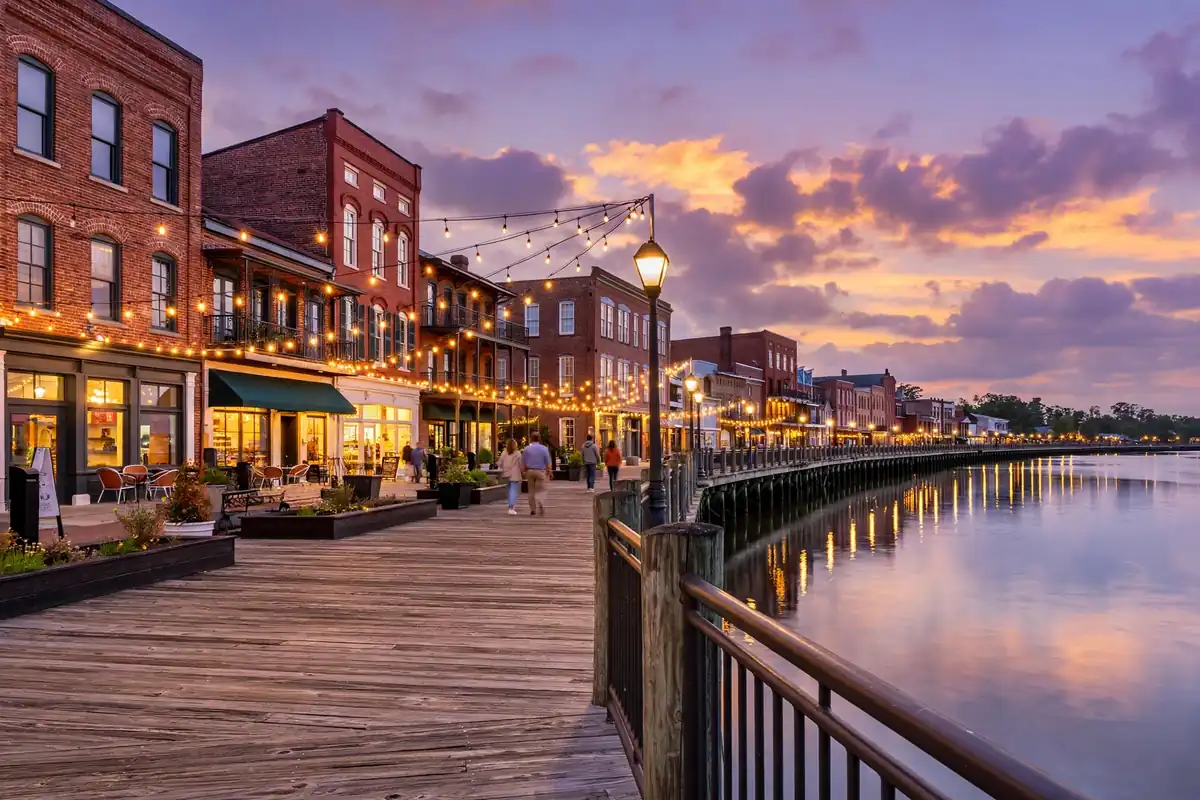
The Wilmington Riverwalk is the walk that ties the whole visit together — and the best first move in the city. The Riverwalk runs about 1.75 miles along the Cape Fear River, a wooden boardwalk past the historic brick storefronts of Front Street, the restaurants with their riverfront decks, the Naley Bench from One Tree Hill, and the views across the water to the Battleship North Carolina, and it is free and open around the clock. Behind it sits one of the largest historic districts in the country, with more than 230 blocks on the National Register of Historic Places, from the 18th-century houses of the port merchants to the cotton exchange and the 1858 Thalian Hall. The trap is the summer heat, and this is where our guide beats the older ones: the Riverwalk has almost no shade, and the brick and the boardwalk bake in a July afternoon, so walk it in the morning or at sunset, when the light is on the river and the restaurants open their decks — and the 1898 Memorial Park, which marks the November 1898 coup and massacre in Wilmington, is a short walk off the Riverwalk and worth the detour, because the Wilmington insurrection of 1898 on Wikipedia is the history most guides skip. Two practical notes: the Riverwalk is a two-hour walk, not a day — allow two hours, and go at sunset, when the string lights come on and the river turns gold — and the downtown parking meters run Monday to Saturday from 9 a.m. to 6:30 p.m., so the evening walk is the free one. Allow two hours, and walk it end to end, from the convention centre to the southern end of the boardwalk.
2. Battleship North Carolina
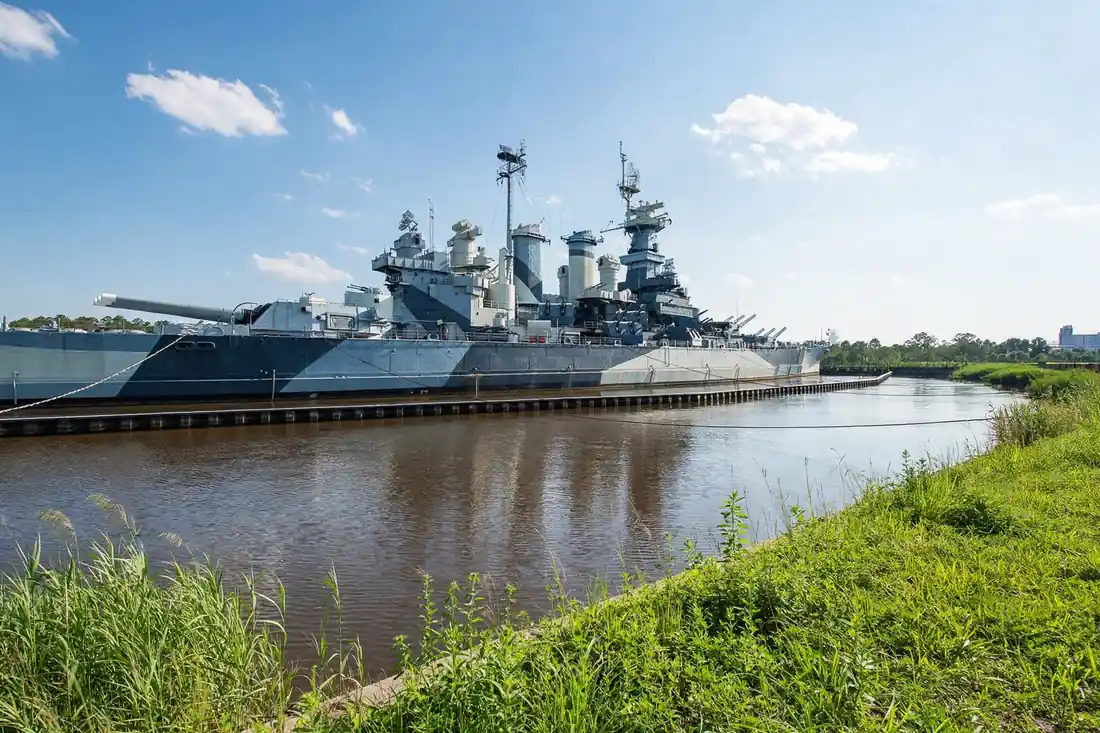
The Battleship North Carolina on Wikipedia is the sight that defines Wilmington — and the most visited attraction in the city. The battleship, known as the “Showboat”, was commissioned on 9 April 1941, fought in every major naval battle of the Pacific in the Second World War, earned 15 battle stars — more than any other American battleship — and was decommissioned in 1947 before being saved from the scrapyard and moored on Eagles Island, across the Cape Fear River from downtown, at 1 Battleship Road. The ship is 729 feet long, and the self-guided tour takes you through nine decks, from the engine rooms and the crew quarters to the bridge and the big 16-inch gun turrets, with the museum exhibits and the memorials to the 11,000 North Carolinians who served on her. The ship is open 365 days a year, from 8 a.m. to 5 p.m., and admission is $14 for adults, $10 for seniors aged 65 and over and for military, $6 for children aged 6 to 11, and free for children under 6. The trap is the heat and the stairs, and this is where our guide beats the older ones: below deck gets very hot in summer, with steep ladders between decks and no air conditioning in the tour route, so go early in the morning, wear closed shoes, and allow time for the climb — and through 31 December 2026, as part of the America 250 celebrations, residents of the 13 original colonies pay a special $13 admission, with North Carolinians using the code NC13. Two practical notes: the ship is a two- to three-hour visit, not a day — allow three hours, and start at 8 a.m., when the decks are empty and the steel is cool — and the river taxi and the walk across the bridge both work, but the parking at the ship is free, so drive if you have a car. Allow three hours, and go in the morning, before the heat builds below deck.
3. Airlie Gardens
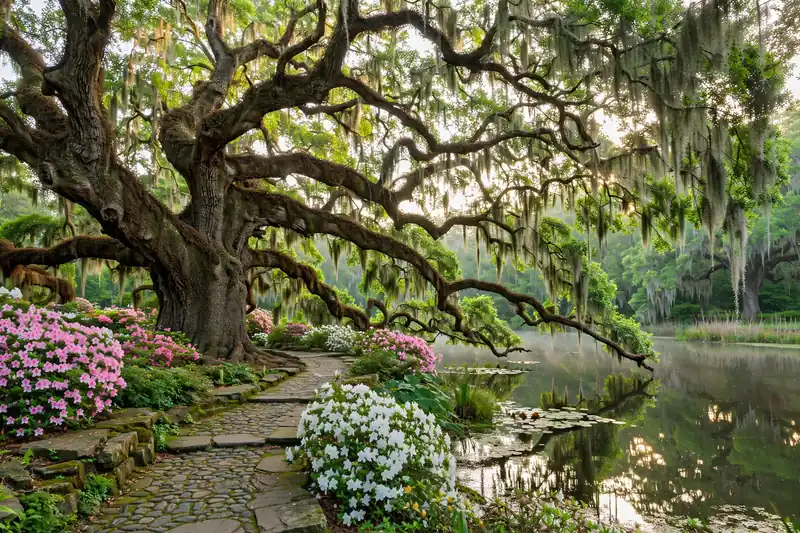
Airlie Gardens on Wikipedia is the garden that makes Wilmington a spring city — and the prettiest stop in the county. The gardens cover 67 acres at 300 Airlie Road, with the 470-year-old Airlie Oak draped in Spanish moss, the lakes and the walking trails, the butterfly house in summer, the bottle chapel, and the azalea and camellia plantings that turn the grounds into colour in the spring. The gardens are open daily from 9 a.m. to 5 p.m., with last admission at 4:30 p.m., and the tram ride around the grounds is included in the ticket, running from 10 a.m. to 4 p.m. when the weather allows — though the tram is not wheelchair accessible. Admission is $10 for general visitors, $5 for New Hanover County residents and military, $3 for children aged 4 to 12, and free for children under 4. The trap is the season and the Monday, and this is where our guide beats the older ones: the gardens are closed on Mondays in January and February, and on New Year’s Day, 10 April, Thanksgiving, and from 23 to 26 December 2026 — and the Spring Bloom, with more than 60,000 tulips and 75,000 azaleas, runs from 1 March to 15 April 2027, so a winter visit without the bloom is a different garden. Two practical notes: the gardens are a two- to three-hour visit, not a day — allow three hours, and go in the morning, when the light is on the oak and the paths are quiet — and the Enchanted Airlie light show runs from 27 November to 21 December 2026, with carload tickets at $35 and XL van tickets at $65, on sale from 28 October 2026 and selling out, with the gardens closing at 4 p.m. on show dates. Allow three hours, and go in March or April, when the azaleas are at their best.
4. Fort Fisher State Historic Site
Fort Fisher on Wikipedia is the history that most beach visitors drive past — and the place that explains why Wilmington mattered. Fort Fisher was the largest Confederate earthwork fort of the Civil War, guarding the mouth of the Cape Fear River and the last major Confederate port, and it fell on 15 January 1865, in the largest land-sea battle of the war, after which Wilmington fell and the Confederacy lost its last supply line. The historic site is free, and it is open Tuesday to Saturday from 9 a.m. to 5 p.m., closed on Sundays and Mondays and on state holidays, with the museum, the earthworks and the walking trails through the site. Beside it, the Fort Fisher State Recreation Area protects about six miles of natural shoreline, with the Basin Trail past the Second World War bunker, the beach access and the sea turtle and piping plover habitat. The trap is the Sunday, and this is where our guide beats the older ones: the historic site is closed on Sundays and Mondays, so a weekend trip that saves Fort Fisher for Sunday finds the gates shut — and the recreation area beach is unguarded, with no lifeguards, so swim with care. Two practical notes: the site is a two-hour visit, not a day — allow two hours, and go on a weekday, when the trails are quiet — and pair it with the Kure Beach pier and the aquarium’s temporary home, because the three together are the Fort Fisher afternoon. Allow two hours, and go on a weekday morning.
5. The North Carolina Aquarium at Fort Fisher — closed for renovation
The North Carolina Aquarium at Fort Fisher on Wikipedia is the attraction that every older guide still lists as open — and the one that is not. The aquarium closed on 26 May 2026 for a renovation and expansion of about 30 months, at a cost of more than $70 million, and it is expected to reopen in late 2028, with no confirmed date yet, as the largest aquarium in North Carolina, with a 400,000-gallon shark habitat, a coral habitat, a touch pool and an expanded education centre. The trap is the listing, and this is where our guide beats the older ones: most competitor guides still send you to the aquarium as if it were open, with the old admission and the old hours, and a family that drives to Fort Fisher for the aquarium finds a construction site — so do not plan a visit around it, and do not trust a guide that lists it without a closure note. The good news is the temporary replacement: Discovery Bay, a free mini-aquarium of about 8,000 square feet in the J.C. Penney wing of Independence Mall, opened on 8 July 2026, with seahorses, frogs, fish and carnivorous plants, and it is open Monday to Saturday from 10 a.m. to 8 p.m. and Sunday from noon to 6 p.m. Two practical notes: Discovery Bay is a one-hour visit, not a day — allow an hour, and go on a weekday, when the mall is quiet — and check the aquarium’s own site before any future trip, because the reopening date has not been confirmed and the 2028 estimate could move. Allow one hour for Discovery Bay, and skip the aquarium site until it reopens.
6. Bellamy Mansion Museum
Bellamy Mansion on Wikipedia is the grandest house in Wilmington — and the one that tells the hardest story honestly. The mansion at 503 Market Street was built from 1859 to 1861 for Dr. John D. Bellamy, a planter and physician, designed by the architect James F. Post in a mix of Greek Revival and Italianate styles, with about 10,000 square feet of living space, and it survived the Civil War, the 1898 coup and a century of change to become a museum. The house is open Monday to Saturday from 10 a.m. to 5 p.m. and Sunday from 1 p.m. to 5 p.m., and the self-guided tour costs $15 for adults, $14 for seniors aged 65 and over and for military, $7.50 for students aged 6 to 16, and is free for children under 5, with a premium guided tour of 90 minutes at $20 for adults and $10 for students, on the hour. The original slave quarters stand on the site, and the museum tells the story of the enslaved people who built and worked in the house, and a 30-minute video tour is available for visitors with limited mobility, with tickets sold at the Carriage House Visitor Center. The trap is the assumption, and this is where our guide beats the older ones: most guides call it a pretty house and stop there — but the Bellamy is the place to understand Wilmington’s history, including the enslaved labour and the 1898 coup, so take the guided tour if you can, because the self-guided visit misses half the story. Two practical notes: the mansion is a one- to two-hour visit, not a day — allow two hours, and go in the morning, when the light is on the columns and the house is quiet — and the house is in the historic district, so pair it with the Burgwin-Wright and Latimer houses, which are a short walk away. Allow two hours, and take the guided tour.
7. Cape Fear Museum of History and Science — the new building
Cape Fear Museum on Wikipedia is the museum that moved — and the one every older guide lists at the wrong address. The museum opened in a new building on 18 August 2026, at 230 Grace Street, shared with the Main Library as part of the Project Grace development, with 95,000 square feet of galleries, a planetarium and the collections that tell the history of the Lower Cape Fear, from the Native peoples and the colonial port to the film studios and the hurricanes. The museum is open Monday to Saturday from 9 a.m. to 5 p.m. and Sunday from 1 p.m. to 5 p.m., and admission is $16 for adults, $10 for youth aged 3 to 17, and free for children under 2, with New Hanover County residents paying half price, and the first Sunday of each month free for county residents — though advance reservations are required for the free Sundays, and they sell out. The planetarium is included in the ticket. The trap is the old address and the old price, and this is where our guide beats the older ones: most guides still list the museum at its old home on 814 Market Street at $8 a ticket, and both are out of date — the new building, the new address and the new prices are the ones above. Two practical notes: the museum is a two- to three-hour visit, not a day — allow three hours, and go in the morning, when the galleries are quiet — and the museum is the rainy-day plan in Wilmington, because the planetarium and the galleries are the best indoor hours in the city. Allow three hours, and go for the planetarium as well as the history.
8. Burgwin-Wright House and Gardens
Burgwin-Wright House on Wikipedia is the oldest house you can walk through in Wilmington — and the quietest of the three house museums. The house was built in 1770, and it is the only colonial-era structure in the city open to the public, a Georgian house with the gardens behind it, the period furnishings and the story of the Burgwin and Wright families who lived there through the Revolution and the early republic. The house is open Monday to Saturday from 10 a.m. to 4 p.m., with guided tours on the hour and the last tour at 3 p.m., and admission is $22 for adults, $11 for youth aged 6 to 17, and free for children under 5. The trap is the price, and this is where our guide beats the older ones: at $22 the Burgwin-Wright is the most expensive of the three house museums, and the tour is short, so do it if you love colonial houses — and do not mix it up with the Bellamy Mansion, because the $22 figure belongs to the Burgwin-Wright, not the Bellamy, and some guides swap the two. Two practical notes: the house is a one-hour visit, not a morning — allow an hour, and take the tour on the hour, because the house is guided only — and the gardens are the quiet part, so stay for the walk behind the house after the tour. Allow one hour, and go in the morning, before the tour groups.
9. Latimer House Museum and Gardens
Latimer House on Wikipedia is the house museum that feels like a home — and the most personal of the three. The house was built in 1852 for the merchant Zebulon Latimer, a 14-room Victorian house filled with more than 600 relics of the Latimer family and the Lower Cape Fear, and it has been the home of the Lower Cape Fear Historical Society since 1963, with the gardens behind it and the exhibits on the merchant families who built Wilmington’s port. The house is open Tuesday to Saturday, with tours on the hour from 10 a.m. to 2 p.m., and admission is about $14 for adults, about $12 for military, seniors and college students, and about $7 for children. The trap is the tour window, and this is where our guide beats the older ones: the last tour leaves at 2 p.m., and the house is closed on Sundays and Mondays, so an afternoon visit after the Bellamy finds the doors shut — plan the Latimer for a morning, before lunch, and pair it with the Burgwin-Wright, which runs tours until 3 p.m. Two practical notes: the house is a one-hour visit, not a morning — allow an hour, and arrive for the 10 a.m. tour, when the house is quiet — and the gardens are free to walk, so stay for the grounds after the tour. Allow one hour, and go in the morning.
10. Wilmington Railroad Museum
The Wilmington Railroad Museum is the museum the train fans miss — and the one that explains the city’s other industry. The museum sits at 505 Nutt Street, in an 1883 freight warehouse on the riverfront, and it tells the story of the Atlantic Coast Line Railroad, which had its headquarters in Wilmington and made the city a rail hub, with the model trains, the locomotives, the photographs and the history of the line that connected the port to the rest of the country. The museum was founded in 1979, and it is open Monday to Saturday from 10 a.m. to 4 p.m. from Labor Day to Memorial Day, and Monday to Saturday from 10 a.m. to 5 p.m. and Sunday from 1 p.m. to 5 p.m. from Memorial Day to Labor Day, closed on Sundays in winter. Admission is $12 for adults aged 13 and over, $10 for seniors and military, and $8 for children aged 2 to 12. The trap is the winter Sunday, and this is where our guide beats the older ones: the museum is closed on Sundays from Labor Day to Memorial Day, so a winter weekend that saves the railroad for Sunday finds it shut — and the older prices of $10, $9 and $6 that some guides still list are out of date, with the current prices the ones above. Two practical notes: the museum is a one- to two-hour visit, not a day — allow two hours, and go with children, because the model trains are the draw — and the museum is on the riverfront, so pair it with the Riverwalk, which runs right past the door. Allow two hours, and go in the morning.
11. Cameron Art Museum
Cameron Art Museum on Wikipedia is the art museum that stands on a battlefield — and the most thoughtful museum in the city. The museum at 3201 South 17th Street stands on the site of the Battle of Forks Road, where United States Colored Troops fought in the final days of the Civil War, and the grounds hold the memorial to those soldiers, with the museum’s galleries of North Carolina art, the changing exhibitions and the permanent collection of the state’s artists. The museum is open Tuesday to Sunday from 10 a.m. to 5 p.m., with Wednesday and Thursday evenings until 9 p.m., and it is closed on Mondays. Admission is $17 for adults, $14 for seniors, students, military and veterans, $6 for ages 6 to 17, and free for children under 5, and local university and community college students from eight counties are free. The CAM Café serves lunch Tuesday to Friday from 11 a.m. to 2 p.m., dinner on Thursday from 5 p.m. to 8 p.m., and brunch on Saturday and Sunday from 10 a.m. to 2 p.m., and gallery admission is free on Thursday evenings, with drinks and dinner in the café. The trap is the Monday, and this is where our guide beats the older ones: the museum is the classic Monday mistake, because the rest of downtown is open and the art museum is shut, so plan it for a Tuesday or later in the week — and the Thursday evening is the free visit, so time a Thursday around it if you can. Two practical notes: the museum is a two-hour visit, not a day — allow two hours, and go in the morning, when the galleries are quiet — and walk the grounds first, because the battlefield memorial is the reason the museum stands where it does. Allow two hours, and go on a Thursday evening for the free admission.
12. Thalian Hall Center for the Performing Arts
Thalian Hall on Wikipedia is the theatre that has been the centre of Wilmington since before the Civil War — and the oldest working theatre in the state. The hall was built from 1855 to 1858 and opened on 12 October 1858, as a theatre, a library and the city hall in one building, and it is the only surviving theatre designed by John Montague Trimble, one of the foremost theatre architects of the 19th century, with the original 550-seat main stage, the painted drop curtain from the opening night still on display in the lobby, and the city government still working in the same building. The Thalian Association, the theatre company that gave the hall its name, was formed in 1788, taking its name from Thalia, the Greek muse of comedy. Today the hall hosts nearly 700 events a year, with the Opera House Theatre Company, the Thalian Association Community Theatre, Big Dawg Productions and the Pied Piper Theatre, and the Main Attractions series brings national touring artists to the stage. The trap is the renovation, and this is where our guide beats the older ones: the renovation of the historic main stage and the 1990 addition is underway, so check the schedule on thalianhall.org before you book, because some performances may be in the smaller venues while the work continues — and one-hour guided tours run on selected days, so check the schedule for those too. Two practical notes: the hall is an evening, not a day — allow an evening, and book ahead, because the touring shows sell out — and the lobby is the free visit, with the original drop curtain, so stop in even if you do not have a ticket. Allow an evening, and book the show before you travel.
13. Wrightsville Beach
Wrightsville Beach, North Carolina on Wikipedia is the beach Wilmington locals go to — and the best day at the water in the county. The beach is a four-mile barrier island about 12 to 15 minutes from downtown, with the wide sand, the surf, the Johnnie Mercers Fishing Pier — about 1,200 feet long and the first concrete fishing pier in North Carolina — and the shops and restaurants of the island town. The trap is the parking, and this is where our guide beats the older ones: paid parking runs from 1 March to 31 October, with premium lots at $6 an hour or $30 a day from 9 a.m. to 8 p.m., and non-premium lots at $5 an hour or $25 a day from 9 a.m. to 7 p.m., and weekly passes at $210 to $245 — so a full day at the beach costs more than a museum ticket, and the lots fill by mid-morning on a summer Saturday. Two practical notes: the beach is a half-day to a full day, not a stop — allow a full day, and arrive before 9 a.m., when the parking is open and the sand is empty — and use the PivotGO map for real-time parking before you drive, because the island’s lots fill in order and the map shows which ones still have spaces. Allow a full day, and go early, before the parking fills. One more warning: the $105 million NCDOT bridge project is underway, with work on the smaller Lees Cut bridge expected to begin by the end of 2026, so check for delays on the causeway before you drive out.
14. Carolina Beach and the Boardwalk
Carolina Beach, North Carolina on Wikipedia is the beach with the boardwalk — and the most fun day at the water in the county. The town’s 1930s boardwalk runs along the sand with the amusement rides in summer, from Memorial Day to Labor Day, the free live music and the fireworks on summer nights, the arcade and the shops, and Britt’s Donuts, frying doughnuts on the boardwalk since 1939. The trap is the parking, and this is where our guide beats the older ones: paid parking runs from 1 March to 31 October, from 9 a.m. to 8 p.m., with on-street parking at $5 an hour, standard lots at $6 an hour or $25 a day, and premium lots at $7 an hour or $35 a day, and a weekly visitor pass at $100 — so a summer Saturday costs real money, and the lots near the boardwalk fill first. Two practical notes: the beach is a half-day to a full day, not a stop — allow a full day, and arrive before 9 a.m., when the parking is open and the boardwalk is quiet — and Freeman Park, at the north end of the island, is one of the few beaches in North Carolina where you can drive on the sand, with a permit, so book the permit ahead if that is your plan. Allow a full day, and eat the doughnuts first, before the queue forms.
15. Kure Beach, the Fishing Pier and Carolina Beach State Park
Kure Beach, North Carolina on Wikipedia is the quiet beach — and the one with the oldest pier on the Atlantic coast. The Kure Beach Fishing Pier was built in 1923 by L.C. Kure, and at 711 feet it is the oldest fishing pier on the Atlantic coast, free to walk, with fishing at $8 a day for a single rod and $16 for king mackerel, and it is open 24 hours a day from Good Friday to the Sunday after Thanksgiving, and closed in winter. Paid parking in Kure Beach runs from 15 March to 30 September, at $6 an hour or $25 a day. Beside it, Carolina Beach State Park covers 761 acres, with free entry, the marina, the trails and the Venus flytrap on Wikipedia trail, where the carnivorous plants grow wild in their native habitat — one of the few places in the world where they do. The trap is the winter, and this is where our guide beats the older ones: the pier closes in winter, and the park’s flytrap trail is best in the growing season, so a winter visit finds the pier shut and the plants dormant — and the park is the free visit, so do it on a weekday, when the trails are empty. Two practical notes: the pier and the park together are a half-day, not a day — allow half a day, and go in the morning, when the fishing is best and the trails are cool — and the park’s free entry makes it the cheapest half-day in the county, so pair it with Fort Fisher, which is minutes away. Allow half a day, and walk the pier first, before the heat.
16. “Hollywood East” — the film locations
One Tree Hill (TV series) on Wikipedia is the reason half of Wilmington’s visitors under forty are here — and the film walk that most guides get half wrong. Wilmington has been a film town since 1983, when the studios opened on North 23rd Street — today Cinespace Studios Wilmington, formerly EUE/Screen Gems, at 1223 North 23rd Street, with more than 400 productions since 1983, from Dawson’s Creek (1998–2003) and One Tree Hill (2003–2012) to Iron Man 3, The Summer I Turned Pretty, Halloween Kills and Scream, making Wilmington the largest studio outside California and the city they call “Hollywood East”. The trap is the studio, and this is where our guide beats the older ones: Cinespace is a working studio, not a tourist attraction, and it is not open for public tours, with occasional special events only — so do not drive to the gate expecting a tour, and do not trust a guide that lists studio tours as a sight. The public locations are the real visit, and they are free: the River Court at the end of Terminal Drive, near the Battleship, fully public, where fans still bring a basketball; the Naley Bench on the Riverwalk; the “One Tree Hill Way” street sign beside the studio, which is the photo stop; Karen’s Café exterior at Grace and North Front; Hell’s Kitchen at 118 Princess Street; TRIC at 1121 South Front Street, which runs ticketed tours of the nightclub set; the Alton Lennon Federal Courthouse, where Andie and Pacey had their first kiss; and Dawson’s house exterior on Creek Road, which is a private residence — view it from the road only, and respect the owners. Two practical notes: the locations are a two-hour walk, not a day — allow two hours, and do them in the morning, before the heat — and the Wilmywood Movie and TV Location Walk, about 90 minutes, is the guided version, so book it if you want the stories behind the corners. Allow two hours, and start at the River Court, because it is the one that feels like the show.
17. New Hanover County Arboretum
The New Hanover County Arboretum is the free garden — and the quietest morning in Wilmington. The arboretum at 6206 Oleander Drive covers seven acres with 33 gardens, from the Japanese garden and the rose garden to the herb garden and the children’s garden, and it has been open since 1989, with free parking and free entry, daily from 8 a.m. to 5 p.m. The trap is the assumption, and this is where our guide beats the older ones: most guides list Airlie Gardens and stop there — but the arboretum is free, it is open every day, and it is the garden the locals use, so do it on a weekday morning, when the volunteers are working and the gardens are at their best — and the monthly plant sales are the local event, so check the calendar before you go. Two practical notes: the arboretum is a one- to two-hour visit, not a day — allow two hours, and go in the morning, when the light is on the gardens and the paths are quiet — and the arboretum is free, so it is the budget visit, and the one to pair with Airlie Gardens on the same day if you love gardens. Allow two hours, and go in the morning.
18. Greenfield Lake Park and the Carnivorous Plant Garden
Greenfield Lake Park is the lake the locals go to — and the wildest nature in the city. The park covers 250 acres around Greenfield Lake, with the five-mile walking trail, the cypress trees draped in Spanish moss, the pedal boats and the canoes in season, and the wildlife — herons, alligators and turtles — that makes it feel like a swamp inside the city. Beside it, the Stanley Rehder Carnivorous Plant Garden grows the Venus flytraps, the pitcher plants and the sundews in their native habitat, with the boardwalk through the bog and the interpretive signs that explain how the plants catch their prey. The trap is the season, and this is where our guide beats the older ones: the flytraps are dormant in winter, and the pedal boats are a seasonal operation, so a winter visit finds the garden quiet and the boats shut — and the lake is the mosquito visit, so bring repellent in summer, because the cypress swamp is beautiful and the mosquitoes are real. Two practical notes: the park is a two- to three-hour visit, not a day — allow three hours, and go in the morning, when the birds are out and the trail is cool — and the garden is free, so it is the budget visit, and the one to pair with the arboretum on the same day. Allow three hours, and walk the trail in the morning.
19. Southport and the Southport–Fort Fisher Ferry
Southport, North Carolina on Wikipedia is the day trip that feels like a different century — and the ferry ride that is the trip itself. Southport is the small fishing town across the Cape Fear River, with the waterfront, the oak-lined streets, the shops and the restaurants, and the ferry from Fort Fisher is the way to get there: the NCDOT ferry takes about 35 minutes to cross the river, with no reservations, so arrive early in summer, when the queues form. The fare is $7 per vehicle under 20 feet one way, $14 round trip, $1 for pedestrians, $2 for bicycles, $3 for motorcycles, $14 for vehicles of 20 to 40 feet, and $28 for vehicles over 40 feet. From 8 September to 31 December 2026, the Southport departures run from 5:30 a.m. on weekdays and 7 a.m. on weekends, with the last departure at about 6:15 p.m., from the Southport terminal at 1650 Ferry Road. The trap is the toll, and this is where our guide beats the older ones: from 1 January 2027, new tolls arrive on two other North Carolina ferries — $10 on the Hatteras–Ocracoke ferry and $7 on the Currituck–Knotts Island ferry — but the Southport–Fort Fisher fare stays at $7, so do not believe a guide that says the Southport ferry price is rising. Two practical notes: Southport is a half-day to a full day, not a stop — allow a full day, with the ferry both ways — and take the ferry as a pedestrian if you can, because the $1 fare is the cheapest ride in North Carolina, and the walk from the terminal to the waterfront is short. Allow a full day, and take the first ferry of the morning.
20. Poplar Grove Plantation
Poplar Grove Plantation is the plantation that is still working — and the most honest look at the county’s farm history. The plantation, on US Highway 17 just north of Wilmington, is a museum complex on 16 acres on the National Register of Historic Places, with the 1850 manor house, the smoke house, the tenant house and the blacksmith shop, the farm animals, the craft demonstrations, the Wednesday Farmers’ Market and the festivals through the year — and it is known as America’s oldest peanut plantation. Guided tours through the manor house run on a limited basis, with the tours beginning on 20 May 2026, lasting about 1.5 hours, and including two sets of staircases, so they are not suitable for children under five. The plantation is open Monday to Saturday for tours from March through October, and on Saturdays only from November through February, and it is closed on Sundays. The trap is the winter, and this is where our guide beats the older ones: from November to February the plantation opens on Saturdays only, so a weekday winter visit finds it shut — and the tours are limited, so check the schedule on poplargrove.org before you drive, because the events can change the hours. Two practical notes: the plantation is a two- to three-hour visit, not a day — allow three hours, and go on a Wednesday, when the farmers’ market is on — and the plantation is the day trip that pairs with the beaches, because it sits on the road to Wrightsville Beach. Allow three hours, and go on a Wednesday morning.
Wilmington in 3 days — a ready-made itinerary
This three-day plan uses downtown Wilmington as the base for the history and the film locations, the beaches as the second day, and Fort Fisher and Southport as the third day — it needs the Battleship and Airlie Gardens early in the day, because the heat builds below deck and in the gardens, and it leaves the beaches for the second day, when you have the car. Book the Thalian Hall show before you fly, put the museums in the morning, and keep the evenings for the Riverwalk and the waterfront restaurants.
Day 1 — Downtown: the Riverwalk, the Battleship and the house museums
Start at the Riverwalk at 8 a.m., with the boardwalk and the historic district, and give it two hours, with the morning light on the river. Cross to the Battleship North Carolina at 10 a.m., with the nine decks and the gun turrets, and give it three hours, with the climb and the exhibits. Walk back downtown for lunch on Front Street, with the shrimp and grits, and take the Bellamy Mansion in the afternoon, with the guided tour and the slave quarters, and allow two hours. Walk to the Burgwin-Wright House for the late afternoon, with the tour on the hour, and allow an hour. Eat dinner on the waterfront, with the oysters, and finish the evening on the Riverwalk, with the string lights and the river at sunset.
Day 2 — The beaches: Wrightsville Beach, Carolina Beach and the boardwalk
Start at Wrightsville Beach at 8 a.m., with the sand and the Johnnie Mercers Pier, and give it the morning, with the surf and the walk — and arrive early, because the parking fills by mid-morning. Drive to Carolina Beach for the afternoon, with the boardwalk, the amusement rides and Britt’s Donuts, and allow three hours, with the doughnuts and the beach. Walk the Kure Beach Fishing Pier in the late afternoon, with the oldest pier on the Atlantic coast, and allow an hour, with the fishing and the views. Eat dinner at Carolina Beach, with the Calabash-style seafood, and finish the evening on the boardwalk, with the live music and the fireworks in summer.
Day 3 — Fort Fisher and Southport: the fort, the gardens and the ferry
Start at Airlie Gardens at 9 a.m., with the oak and the azaleas, and give it three hours, with the tram and the trails. Drive to Fort Fisher for the late morning, with the historic site and the earthworks, and allow two hours, with the museum and the Basin Trail. Take the ferry from Fort Fisher to Southport in the afternoon, with the 35-minute crossing, and give Southport the afternoon, with the waterfront and the oak-lined streets. Eat dinner in Southport, with the fresh catch, and take the ferry back in the evening, with the river at sunset — and in winter, check the ferry times, because the last departure is about 6:15 p.m.
Best time to visit Wilmington
| Season | Weather | Crowds | Notes |
|---|---|---|---|
| Winter (December–February) | Highs about 56–60°F (13–16°C), lows about 36–41°F (2–5°C) | Low | Mild and quiet, cheapest hotels, the pier closed, Enchanted Airlie in December |
| Spring (March–May) | Highs about 66–80°F (19–27°C), lows about 46–62°F (8–17°C) | Moderate | Azaleas in March and April, the Azalea Festival in April, the trolley returns |
| Summer (June–August) | Highs about 86–90°F (30–32°C), lows about 70–74°F (21–23°C) | High | Best beach weather, the ocean warmest in August, the parking dearest, hurricane season |
| Autumn (September–November) | Highs about 67–82°F (19–28°C), lows about 47–67°F (8–19°C) | Moderate–low | September is the sweet spot, October is quiet and warm, November is the cheapest |
The best time to visit Wilmington is April to May and September to October for the weather and the prices, and if you want one answer, pick September: the days are warm, with highs in the low 80s, the ocean is still warm, the summer crowds have gone, and the hotel rates have fallen — but the hurricane season runs from 1 June to 30 November, with the peak in August and September, so watch the forecast and buy the refundable room. Spring is the second-best pick, for the azaleas and the Azalea Festival — the 80th annual festival runs from 7 to 11 April 2027, with DJ Diesel and The Avett Brothers at the Live Oak Bank Pavilion, and tickets on sale from 9 November 2026 — but the gardens are the reason to come in March and April, when the tulips and the azaleas are at their best. Summer is the warmest season: July averages a high of about 88 to 90°F, with the ocean at its warmest in August, at about 82°F, and the beaches at their best — and the parking is the price of the summer, with the lots filling by mid-morning and the premium rates at $6 an hour. The city gets its coldest weather in January, with an average high of about 56 to 57°F and an average low of about 36 to 38°F, and the ocean is at its coolest in February, at about 63°F. The events are worth timing a trip around: the Azalea Festival in April, Enchanted Airlie from 27 November to 21 December 2026, and the summer fireworks at Carolina Beach — and the hotel prices more than double in summer at the beaches, so book months ahead or stay downtown and drive to the sand.
Where to stay in Wilmington
| Area | Best for | Price range |
|---|---|---|
| Downtown / Riverwalk | First-timers, walkers, the sights | $150–$350 a night |
| Wrightsville Beach | The beach, the surf, the pier | $200–$450 a night in summer |
| Carolina Beach | The boardwalk, the families, the budget | $120–$300 a night |
| Kure Beach | Quiet, the pier, the park | $100–$250 a night |
| Southport | The ferry, the quiet, the day trip | $100–$200 a night |
| Near ILM airport | Early flights, the budget | $90–$180 a night |
Stay downtown around the Riverwalk if this is your first visit — the Battleship, the house museums, the restaurants and the boardwalk are all within reach, and the hotels are the most central in the city — and the downtown hotels are the ones with the walk to the waterfront. Stay at Wrightsville Beach if you want the sand — the island hotels, with the beach outside the door, the surf and the pier, and the summer rates that are the highest in the county. Stay at Carolina Beach if you want the boardwalk — the family hotels, with the beach, the rides and Britt’s Donuts, and the prices that are lower than Wrightsville. Stay at Kure Beach if you want the quiet — the small hotels and the rentals, with the pier and the park, and the slowest pace in the county. Stay in Southport if you want the ferry — the small inns, with the waterfront and the oak streets, and the day trip that becomes the base. Two warnings: do not book a beach room in summer without checking the price first — the rates more than double, and the hotels fill months ahead — and do not book a room at the beach without checking the parking, because the beach parking is paid from March to October and the hotel lots fill first.
Getting around Wilmington
| Way to travel | Cost | Best for |
|---|---|---|
| Walking | Free | Downtown, the Riverwalk, the historic district |
| Port City Trolley (Wave 203) | Free | Downtown, April to October only |
| Wave Transit bus | About $1.25–$2 a ride | Downtown to the beaches, the stations |
| Taxi / rideshare | About $8–$20 in town | Late nights, the airport, the beaches |
| Car rental | About $50–$80 a day | The beaches, Fort Fisher, Southport, the day trips |
| Southport–Fort Fisher ferry | $7 a vehicle, $1 a pedestrian | Fort Fisher to Southport, the day trip |
| Greyhound / Amtrak Thruway | From about $30 | Raleigh, Charlotte, the long distance |
| ILM airport taxi | About $15–$25 | The airport to downtown, 3 miles |
Wilmington is a walking city downtown and a driving city outside it: the centre is walkable and the trolley is free, but the beaches, Fort Fisher and the gardens are spread across the county, and the bus does not go to all of them — so walk for the days you stay downtown, and take the car for the days you leave it. The Port City Trolley, Wave Route 203, is free and runs from April to October — and it ended for 2026 on 26 September, returning in spring 2027, so do not plan a winter trip around it. The Wave Transit buses run from Forden Station at 505 Cando Street and Padgett Station, with routes 105, 107, 109 and 712 changed in August 2026, so check the current schedule before you go. The trap is the train, and this is where our guide beats the older ones: there is no Amtrak station in Wilmington, and no train to the city — the Greyhound and Amtrak Thruway buses run from Forden Station, with six Greyhound routes a day, so do not book a train ticket to Wilmington, because there is none. Wilmington International Airport (ILM) is three miles from downtown and ten miles from Wrightsville Beach, with a taxi to downtown at about $15 to $25. Two warnings: do not drive into downtown Wilmington in summer without knowing the parking — the meters run Monday to Saturday from 9 a.m. to 6:30 p.m., at $1.50 an hour, or $3 an hour on the core blocks of Front, Second, Market and Princess, with a two-hour limit, and free after 6:30 p.m. and all day Sunday — and do not drive to the beaches on a summer Saturday without checking the parking first, because the lots fill by mid-morning and the premium rates run to $6 an hour. Take the trolley for the days you stay downtown, and the car for the days you leave it — and the only reason to rent a car is the beaches and Fort Fisher, where the car is the trip.
Wilmington food you have to try
Wilmington eats with the river behind every plate. The city is a working port, and the kitchens are the ones that fed the fishermen and the merchants, so the food is the freshest on the Carolina coast — the shrimp and grits, the oysters, the Calabash-style seafood, and the doughnuts on the boardwalk — and the trap is the opposite of most tourist cities: the restaurants on the Riverwalk are fine, but the best food is at the waterfront and the beach towns, where the locals queue, and the most Wilmington meal of all is the one eaten at a riverfront table with shrimp and grits in front of you and the Battleship across the water.
Shrimp and grits — the Lowcountry classic
Shrimp and grits on Wikipedia is the dish Wilmington is famous for — the shrimp and grits, with the plump shrimp, the creamy stone-ground grits, the bacon and the gravy, and it is the dish every visitor orders first. The place to eat it is Elijah’s Oyster and Fish Camp, at 2 Ann Street on the riverfront since 1984, with the shrimp and grits, the crab cakes and the oysters on the dog-friendly deck; The Basics, at 319 North Front Street in the Cotton Exchange since 2007, with the shrimp and grits in the Cajun veggie-and-bacon sauce, the duck and andouille gumbo, the Brunswick stew and the Hummingbird Cake; and Rx Chicken and Oysters, at 421 Castle Street in the former Hall’s Drug Store since 2012, with the North Carolina shrimp and grits as the best-seller, the Lucy Bea oysters farmed by the owners in the Topsail and Stump Sounds, and the 100 percent North Carolina seafood, with dinner Tuesday to Saturday from 5 p.m. to 9 p.m. and Sunday brunch from 10 a.m. to 2 p.m., closed on Mondays, at $20 to $70 a person. The Pilot House, at 2 Ann Street since 1978, serves the shrimp and grits, the crab dip and the Captain’s Platter. The price is about $20 to $30 for the shrimp and grits, and the shrimp is the cost, so do not expect a bargain — and the stone-ground grits are the Wilmington order, with the gravy on the side. Two practical notes: the shrimp and grits is the order, so do not skip it, because it is the reason the restaurants are famous — and the reservations are the point, because Elijah’s and The Basics are busy in summer, so book ahead or eat early. Eat the shrimp and grits once, eat it with the gravy, and eat it where the locals eat — that is the Wilmington shrimp and grits plan.

The oyster bars and the fresh catch
The oyster bars are the Wilmington institution — and the freshest food in the city. The oysters come from the Topsail and Stump Sounds, and the bars serve them raw on the half shell, with the lemon and the cocktail sauce, and the fresh catch of the day, with the flounder, the grouper and the mahi, and the Calabash-style seafood, lightly breaded and fried, from Calabash, North Carolina on Wikipedia, the fishing village down the coast that gave the style its name. The place to eat it is Seabird, at 1 South Front Street, with the daily-changing menu, the broiled hollandaise oysters and the soft shell crab; Fish Bites, at 6132-11 Carolina Beach Road, with the steamer platter and the Oyster Bombs; the Cape Fear Seafood Company, with the fresh catch and the oyster bar; Hieronymus, at 5035 Market Street, with the seafood and the raw bar; and Anne Bonny’s, the only floating barge bar in the city, with the Calabash-style seafood on the water. The price is about $15 to $25 for the oysters and the fresh catch, and the oysters are the order, so do not skip them, because they are the reason the bars are famous — and the soft shell crab is the second order, with the butter and the lemon, because the two are the classic Wilmington pair. Two practical notes: the oysters are the lunch, so do not eat dinner first, because the raw bar is the meal — and the barge is the summer order, with the seafood on the water, so plan it for a summer evening. Eat the oysters once, eat the soft shell crab once, and eat both where the locals eat — that is the Wilmington oyster plan.
Britt’s Donuts and the sweet finish
Britt’s Donuts is the Wilmington institution — and the sweet finish that makes the beach day. The doughnut stand on the Carolina Beach boardwalk has been frying doughnuts since 1939, with the glazed doughnuts, hot from the fryer, and the queue that stretches down the boardwalk on a summer morning, and the doughnuts are the ones every visitor orders first. The place to eat it is the boardwalk stand itself, with the glazed doughnuts and the coffee, and the cafes of Front Street, with the hot chocolate and the cookies, and the ice cream stands at Wrightsville Beach, with the cones by the water. The price is a few dollars for the doughnuts, and the doughnuts are the morning, so do not eat dinner first, because the sweet is the finish. Two practical notes: the doughnuts are the morning, so do not plan them for the evening, because the stand closes early and the queue is longest at noon — and the sweet is the gift, so buy it from a local stand, not a chain, because the difference is the fryer and the time. Eat the doughnuts once, eat them hot from the fryer, and eat them on the boardwalk — that is the Wilmington sweet plan.
Free things to do in Wilmington
Wilmington is cheaper than its reputation suggests, because the best sights cost nothing. The Riverwalk is free, and so is the 1.75-mile boardwalk and the sunset. The historic district is free, and so is the walk through the 230 blocks and the 1898 Memorial Park. Fort Fisher State Historic Site is free, and so is the museum, the earthworks and the Basin Trail. Carolina Beach State Park is free, and so is the entry, the trails and the Venus flytrap walk. The New Hanover County Arboretum is free, and so is the entry and the 33 gardens. The Stanley Rehder Carnivorous Plant Garden is free, and so is the boardwalk through the bog. Discovery Bay is free, and so is the mini-aquarium at Independence Mall. The film locations are free, and so are the River Court, the Naley Bench and the “One Tree Hill Way” sign. The Kure Beach Fishing Pier is free to walk, and so is the stroll to the end. Greenfield Lake Park is free, and so is the trail around the lake. The Cameron Art Museum is free on Thursday evenings, and so is the gallery admission. Do the free list on your first day, and you will have seen the Riverwalk, the fort, the park, the gardens and the film locations before you have spent a dollar on a ticket.
Frequently asked questions
How many days do you need in Wilmington?
One day is enough for the highlights: the Riverwalk, the Battleship and the house museums. Two days is the right amount for a real trip, with Airlie Gardens, the beaches and the boardwalk done properly. Three days is the full trip, with Fort Fisher, Southport and the ferry. Four days is too many for Wilmington alone — use the extra day for the Outer Banks drive or the Brunswick Islands, which are the day trips from the city.
Is the North Carolina Aquarium at Fort Fisher open?
No — and this is the most important fact in this guide. The aquarium closed on 26 May 2026 for a renovation and expansion of about 30 months, at a cost of more than $70 million, and it is expected to reopen in late 2028, with no confirmed date yet. Do not plan a visit around it, and do not trust a guide that lists it as open. The temporary replacement is Discovery Bay, a free mini-aquarium at Independence Mall, open Monday to Saturday from 10 a.m. to 8 p.m. and Sunday from noon to 6 p.m.
When is the best time to visit Wilmington?
April to May and September to October for the weather and the prices, when the days are warm, the crowds are down and the hotels are cheaper. September is the single best pick, with the warm days, the warm ocean and the summer crowds gone — but the hurricane season runs from 1 June to 30 November, with the peak in August and September, so watch the forecast. March and April are the best pick for the gardens, with the azaleas and the Azalea Festival. July is the warmest month, with an average high of about 88 to 90°F. January is the coldest and cheapest month, with an average high of about 56 to 57°F. December is the quietest month, with Enchanted Airlie and the gardens lit up.
Is Wilmington expensive?
More expensive than most of North Carolina in summer, and one of the most expensive beach trips in the state for a summer weekend. A downtown hotel costs $150 to $350 a night, and a Wrightsville Beach hotel $200 to $450 a night in summer. A museum ticket costs $10 to $22, shrimp and grits about $20 to $30, oysters about $15 to $25, and the beach parking $5 to $6 an hour. The costs most visitors underestimate are the beach hotels, which are the biggest cost of the trip, and the beach parking, which adds up — the premium lots at Wrightsville Beach run to $30 a day — and the ferry and the tours, which add up. A careful three days can be done for about $120 to $220 a person a day, and the Riverwalk, the fort, the park, the gardens and the film locations are free.
Do you need a car in Wilmington?
No, for the city. The trolley, the buses and the walking cover the centre, and the centre is walkable, with the Riverwalk, the house museums and the restaurants all within reach on foot. Yes, for the beaches and Fort Fisher: Wrightsville Beach, Carolina Beach, Kure Beach and Fort Fisher are spread across the county, and the bus does not go to all of them — and the car is a liability downtown, with the meters, the two-hour limit and the summer crowds. Take the trolley for the days you stay downtown, and the car for the days you leave it — and the only reason to rent a car is the beaches and Fort Fisher, where the car is the trip.
What should I skip in Wilmington?
Six things, and all six are traps older guides still get wrong. First, do not plan a trip around the North Carolina Aquarium at Fort Fisher: it closed on 26 May 2026 for about 30 months, and it is expected to reopen in late 2028, so go to Discovery Bay instead. Second, do not plan a visit around the Cape Fear Museum at its old address: the museum moved to 230 Grace Street on 18 August 2026, and the old 814 Market Street address and the old $8 price are out of date. Third, do not plan a museum day on a Monday: the Cameron Art Museum is closed on Mondays, and Airlie Gardens is closed on Mondays in January and February. Fourth, do not drive to the Cinespace Studios expecting a tour: it is a working studio, not open for public tours, so do the public film locations instead. Fifth, do not drive to the beaches on a summer Saturday without checking the parking: the lots fill by mid-morning, and the premium rates run to $6 an hour. And sixth, do not book a train ticket to Wilmington: there is no Amtrak service, and the Greyhound and Amtrak Thruway buses run from Forden Station instead.
Further reading
Start with Wilmington, North Carolina on Wikipedia, which covers the history and the geography, and the Cape Fear River on Wikipedia for the river and the port. For the ship, the Battleship North Carolina on Wikipedia covers the battleship and the war, and for the gardens, Airlie Gardens on Wikipedia covers the grounds and the oak. For the house museums, Bellamy Mansion on Wikipedia covers the mansion and the family, Burgwin-Wright House on Wikipedia covers the colonial house, and Latimer House on Wikipedia covers the merchant house. For the fort and the aquarium, Fort Fisher on Wikipedia covers the battle and the earthworks, and the North Carolina Aquarium at Fort Fisher on Wikipedia covers the aquarium and the closure. For the museum and the theatre, Cape Fear Museum on Wikipedia covers the collections, Cameron Art Museum on Wikipedia covers the art and the battlefield, and Thalian Hall on Wikipedia covers the theatre and the history. For the beaches, Wrightsville Beach, North Carolina on Wikipedia, Carolina Beach, North Carolina on Wikipedia and Kure Beach, North Carolina on Wikipedia cover the three beach towns, and Southport, North Carolina on Wikipedia covers the ferry town. For the film history, One Tree Hill (TV series) on Wikipedia covers the show and the locations, and for the food, Shrimp and grits on Wikipedia covers the dish and Calabash, North Carolina on Wikipedia covers the seafood style. No Reddit link is included here: no live r/WilmingtonNC thread turned up in search, so none is listed rather than linking to an unverified one. No Quora link is included either: no live on-topic Quora thread about visiting Wilmington turned up in search, so none is listed rather than linking to an unverified one.
Your Wilmington trip, in one paragraph
Wilmington is the city that rewards slowing down: the Battleship in the morning, the Riverwalk at sunset, Airlie Gardens at noon, Fort Fisher in the afternoon, shrimp and grits on the waterfront in the evening, and the boardwalk at night before you leave. For more guides in the same style, start with our Hawaii guide for the whole-state trip — this guide is only about Wilmington — then see how Wilmington compares with Maui, Honolulu, Chicago, Nashville, Los Angeles, Orlando, Miami, San Diego, Denver, Savannah, Dallas, Charleston, San Francisco, Myrtle Beach, Las Vegas, San Antonio, London, Portland, Pigeon Forge, Puerto Rico, Atlanta, Phoenix, Paris, Key West, Colorado Springs, Sedona, Chattanooga, Palm Springs, St Louis, Tokyo, Japan, Kansas City, Tennessee, Branson, Florida, Amsterdam, Montreal, Fort Lauderdale, Toronto, Aruba, Charlotte, Indianapolis, New Orleans, Destin, Santa Barbara, Mexico City, Arizona, Osaka, Minneapolis, Pittsburgh, California, Asheville, Costa Rica, Washington DC, Seattle, St Augustine, Lisbon, Dubai, Santa Fe, Galveston, Maine, Sacramento, Kauai, Boston, Cancun, Madrid, Salt Lake City, Baltimore, Barcelona, Reno, Milwaukee, North Carolina, New York, Tucson, Raleigh, Corpus Christi, Milan and Salem.

About the Author