Things to Do in St Augustine
20 Best Attractions, a 3-Day Itinerary, Where to Stay, and the Food You Cannot Miss
Quick Info
Best for: History lovers, first-timers, families and beachgoers — and anyone who wants a walkable old town with a real beach ten minutes away
Best time: March–May and October–November for warm days and thinner crowds; November 21, 2026–January 18, 2027 for Nights of Lights
How long: 2–3 days for the historic district and the beach; 4 days if you add Fort Matanzas, a boat trip and a slow food crawl
Budget: About $150–$280 per person per day with a mid-range hotel — many of the best sights are free
Don’t miss: Castillo de San Marcos at opening, the lighthouse climb, Flagler College, a ghost tour after dark and St George Street after the lights come on
St Augustine on Wikipedia is the oldest continuously inhabited European-founded city in the United States, founded by the Spanish in 1565, and it is the rare American historic town where the fort is real, the streets are still cobblestone and the beach is a ten-minute drive away. A 17th-century coquina fort guards the bay, a candy-striped lighthouse watches over Anastasia Island, and the Gilded Age hotels of Henry Flagler now hold a college and a museum full of Victorian oddities. This guide covers the 20 best things to do in St Augustine, a 3-day itinerary that actually works, where to stay without overpaying, how to get around on foot, by trolley and by car, the three foods you should not skip, and the free sights that make St Augustine one of the best-value history trips in Florida. Everything below was checked against live sources in November 2026.
St Augustine at a glance
| Topic | What to know |
|---|---|
| Full name | St Augustine, Florida — the oldest continuously inhabited European-founded city in the United States |
| Founded | September 8, 1565, by Spanish admiral Pedro Menéndez de Avilés |
| Population | About 14,000 in the city; about 300,000 in St Johns County |
| Currency | US dollar ($) |
| Language | English (Spanish history everywhere — street names, menus and the Minorcan food) |
| Airport | Jacksonville International (JAX), about 55 miles north, roughly 1 hour by car |
| Best base | The historic district for walking; Anastasia Island for the beach |
| Getting around | Walk downtown, trolley for the sights, car for the beaches and Fort Matanzas |
| Famous for | Castillo de San Marcos, Nights of Lights, the lighthouse, ghost tours and Minorcan clam chowder |
St Augustine sits on Florida’s northeast Atlantic coast, about 40 miles south of Jacksonville and 110 miles north of Orlando, and it packs an unusual amount into a small, flat, walkable footprint. The historic district is roughly a mile across: the fort at the north end of the bayfront, St George Street running south through the shops and museums, the Plaza de la Constitución in the middle, and the Bridge of Lions carrying you east across Matanzas Bay to Anastasia Island, where the lighthouse, the Alligator Farm and the beaches wait. Most visitors stay in or near the historic district and drive or take the trolley to the island, and that is the right call — parking downtown is tight and expensive, while the island has room to breathe. Come for the history, stay for the beach — and plan your evenings around the light, when the coquina walls turn pink and the bay goes flat calm.
The 20 best things to do in St Augustine
1. Castillo de San Marcos
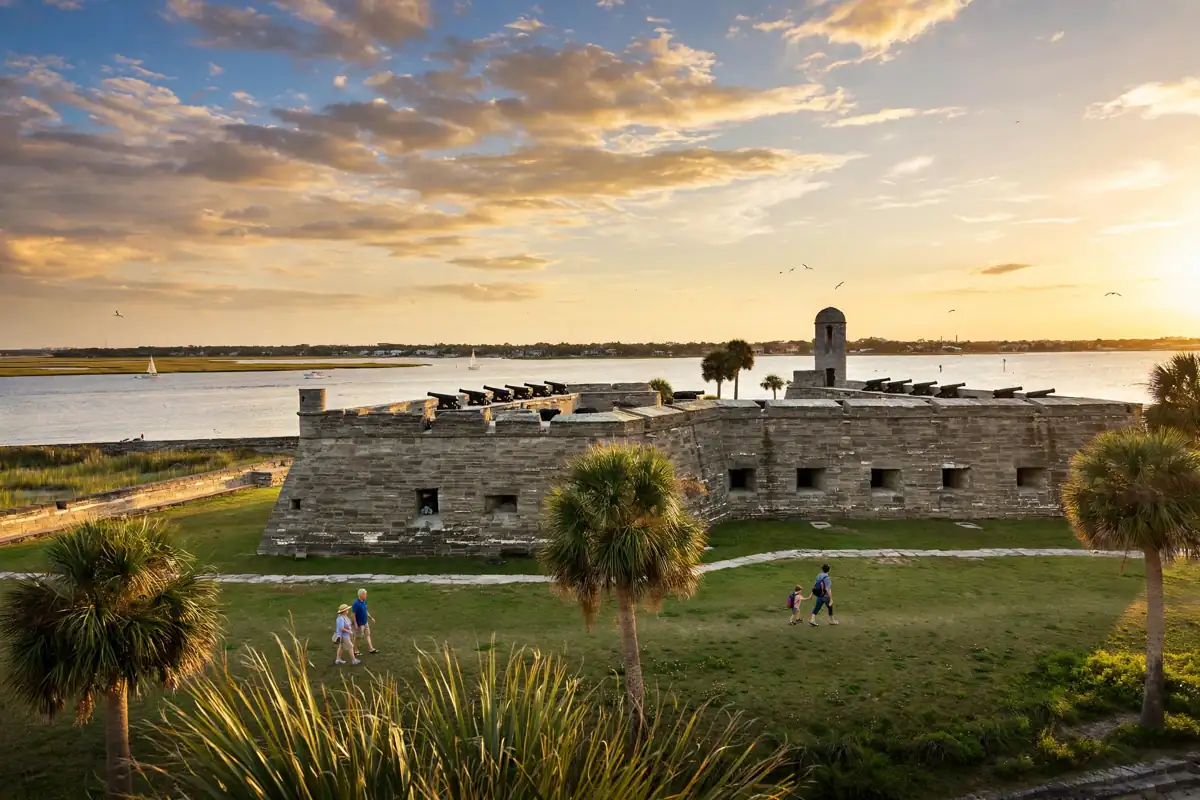
Castillo de San Marcos on Wikipedia is the oldest masonry fort in the continental United States, and it is the one sight in St Augustine you should not skip. The Spanish began building it in 1672 out of coquina — a soft limestone made of compressed shells — and finished it in 1695, and the fort has never been taken by force in more than 300 years. Inside you will find the gun deck with its cannon, the chapel, the soldiers’ quarters and the watchtowers. Admission is $15 for adults aged 16 and over, and children 15 and under are free; a ticket is valid for seven consecutive days, so you can come back. The fort is open daily from 9 a.m. to 5 p.m., closed on Thanksgiving and Christmas Day, and it is cashless — bring a card. The grounds are free and open from 5:30 a.m. to midnight. Two things most guides get wrong: first, the National Park Service began seawall construction around the fort on July 27, 2026, so some outside areas are fenced off even though the fort itself stays open — check the National Park Service site before you go. Second, cannon firings were reduced in 2026 to select dates only, so do not plan your morning around one. The fort caps visitors at 100 people inside at once, so arrive at 9 a.m. Parking in the Castillo lot costs $2.50 an hour, and the America the Beautiful pass is accepted here.
2. St George Street
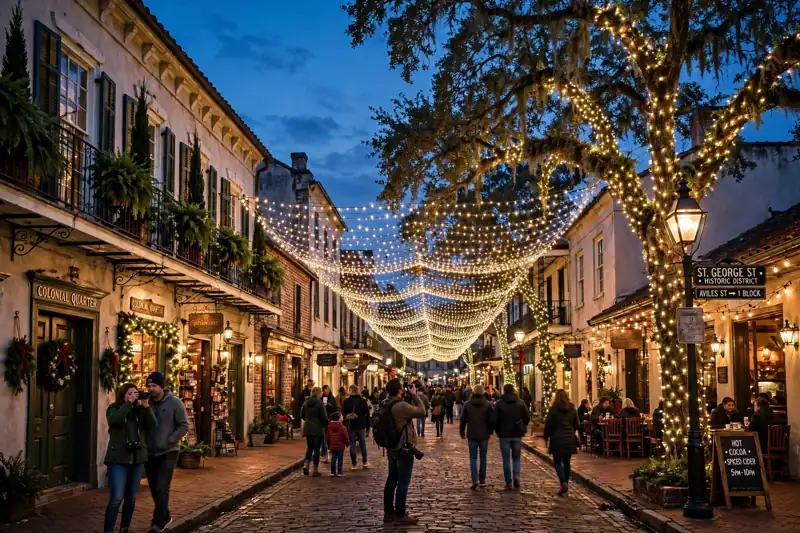
St George Street is the pedestrian spine of the historic district, an 11-block cobblestone mall that runs south from the City Gates to the Plaza de la Constitución, and it is where St Augustine feels most like a Spanish colonial town. The street is lined with shops, cafes, ice cream parlours, art galleries and museums, and the buildings are a mix of genuine colonial structures and faithful reconstructions, with wooden balconies, courtyards and overhanging second floors. Start at the City Gates at the north end — the old entrance to the walled city, rebuilt in 1808 — and walk south past the Oldest Wooden Schoolhouse, the St Photios National Shrine, the Spanish Military Hospital Museum and the Colonial Quarter, stopping for a coffee or a datil pepper sample along the way. Two practical notes: the cobblestones are uneven, so wear flat shoes, and the street gets crowded by midday — if you want photos without people in them, come before 9 a.m. The Columbia Restaurant on Hypolita Street, just off St George Street, is the local institution for Cuban food and has been serving since 1905 in its Tampa original — the St Augustine branch is one of the best lunch stops in the district.
3. St Augustine Lighthouse & Maritime Museum
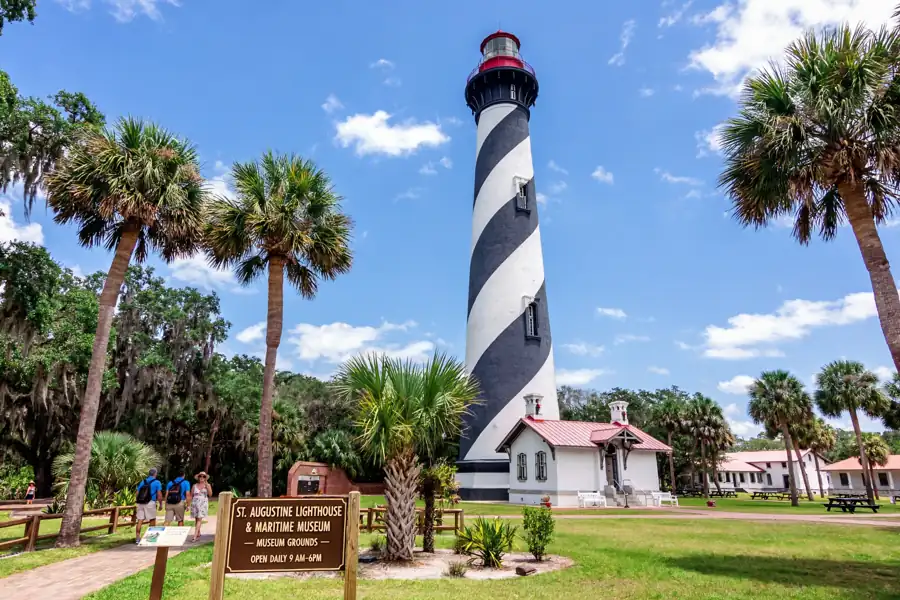
St Augustine Light on Wikipedia is the black-and-white striped tower on Anastasia Island, and climbing it is the best view in St Augustine. The lighthouse is 165 feet tall, built in 1874, and the climb is 219 steps up a spiral staircase to a deck with a 360-degree view over the city, the bay, the Atlantic and the marshes. On a clear day you can see the Castillo, the Bridge of Lions and the whole sweep of Anastasia Island. Admission is $20 for adults, $17 for seniors, students and military, and $13 for youth aged 12 to 17; children must be at least 44 inches tall to climb the tower. The museum is open daily from 9 a.m. to 6:30 p.m. from March to September and 9 a.m. to 6 p.m. from October to February, closed on Thanksgiving and Christmas Day. The keepers’ houses hold exhibits on shipwrecks and the Coast Guard, and free guided tours run hourly from 11 a.m. to 3 p.m. with admission. Book the Lighthouse Illuminations if you visit in winter: from November 20, 2026 to January 16, 2027, the grounds are lit with thousands of lights and tickets cost $26.95 for adults, $24.95 for seniors and $22.95 for children 12 and under. Allow two hours, and go on a clear morning for the best photographs. The St Augustine Lighthouse & Maritime Museum site lists current hours and special events.
4. Flagler College
Flagler College on Wikipedia is the most beautiful building in St Augustine, and most visitors walk past it without realising they can go inside. The college occupies the former Hotel Ponce de Leon, the Gilded Age palace that oil magnate Henry Flagler built in 1888 as the grandest hotel in America, with a 64-foot domed rotunda, hand-painted murals, Tiffany stained glass and a courtyard that looks like a Spanish palace. The Legacy Tour is the way to see it: a guided, one-hour tour of the ground floor, including the rotunda, the dining hall and the Flagler Room, running daily at 10 a.m. and 2 p.m. Tickets are $21 on the official booking page, though some 2026 visitors report paying $22 at the door — buy in advance and arrive 15 minutes early, because tours sell out on weekends. The college sits on King Street, directly across from the Lightner Museum in the old Alcazar Hotel, so the two Flagler buildings make a natural pair — do them back to back in one morning.
5. Lightner Museum
Lightner Museum on Wikipedia is the Victorian curiosity cabinet that every other museum wishes it could be. The museum fills the former Alcazar Hotel, Henry Flagler’s second Gilded Age hotel, built in 1888 across the street from the Ponce de Leon, and its collection is the personal hoard of Chicago publisher Otto Lightner: cut glass, porcelain, furniture, paintings, a mummy, a shrunken head, music boxes, Tiffany glass and a whole room of 19th-century mechanical curiosities. The building itself is half the show — the old hotel casino, the indoor swimming pool (now the museum cafe, with tables sitting in the empty pool), the courtyard and the Spanish Renaissance detailing. Admission is $20 for adults and $17 for seniors, students and military, with youth aged 12 to 17 at $13, and the museum is open daily from 9 a.m. to 5 p.m., closed on Easter, Thanksgiving, Christmas and New Year’s Day. The Lightner Museum site lists current exhibitions. Allow 90 minutes to two hours.
6. Fountain of Youth Archaeological Park
Fountain of Youth Archaeological Park on Wikipedia is the park that leans into the legend — and it is better than the legend deserves. The 15-acre site on Magnolia Avenue marks the spot of the first Spanish settlement in St Augustine, and archaeologists have excavated the original 1565 town here, including a Timucua village and the first Christian burial ground in the United States. The park mixes real archaeology with the Ponce de León story: you can drink from the spring itself (it tastes of sulphur, and no, it does not work), watch a cannon firing, see the planetarium show, walk the Timucua village and the Spanish mission, and look out over the marsh where Menéndez landed. Admission is $22.95 for adults, $20.95 for seniors aged 60 and over, $9.95 for children aged 6 to 12, and free for children under 5. The park is open daily from 9 a.m. to 6 p.m., with the last ticket sold at 5 p.m., and parking is free — a rare thing in St Augustine. The legend is mostly myth, and the park says so in its exhibits — the archaeology is real, and this is the best place in the city to understand what 1565 actually looked like. Allow two hours. The Fountain of Youth Archaeological Park site has current hours and show times.
7. St Augustine Alligator Farm Zoological Park
St Augustine Alligator Farm Zoological Park on Wikipedia is the only place in the world that exhibits every living species of crocodilian — all 24 of them — and it has been doing it since 1893. The farm sits on Anastasia Island, a five-minute drive from downtown, and it is part zoo, part bird rookery and part adventure course. The alligator lagoon holds hundreds of gators, the Nile crocodile exhibit is genuinely intimidating, and the wildlife shows run hourly from 10 a.m., with keepers feeding the animals and explaining the difference between an alligator, a crocodile, a caiman and a gharial. From March to June, the trees over the lagoon fill with nesting herons, egrets, roseate spoonbills and wood storks. Admission is $36.99 for adults aged 12 and over, $21.99 for children aged 3 to 11, and $33.29 for seniors aged 65 and over, with $1 off if you buy online. The farm is open daily from 9 a.m. to 5 p.m., extending to 6 p.m. from Memorial Day to Labor Day, and it is open 365 days a year. Parking is free. The Crocodile Crossing zip line course costs $70 extra and is open to ages 8 and up — it runs over the alligator lagoon and the crocodile pools, which is either thrilling or terrifying depending on your nerves. Allow two to three hours.
8. Colonial Quarter
The Colonial Quarter is the living-history museum on St George Street where St Augustine’s first two centuries come alive — blacksmiths at the forge, musket demonstrations, a 35-foot watchtower and costumed interpreters who will talk to you about 16th-century shipbuilding as if it happened last week. The two-acre site recreates the Spanish colonial town of the 1500s and 1600s, with a carpenter’s shop, a gunsmith, a leather worker and a tavern, and the Living History Tours run four times a day. Admission is $15.99 for adults aged 16 and over, $12.99 for seniors and military, and $9.99 for children aged 5 to 15. The quarter is open daily from 10 a.m. to 5 p.m., closed on Christmas Day, and sits at 33 St George Street, right in the middle of the pedestrian mall. The Colonial Quarter site lists tour times. It is at its best when the interpreters are working — time your visit for a musket demo or a blacksmith session. Children love it, and it is the best place in the city to explain to a child what life was like in 1565. Pair it with the Castillo in the morning and St George Street in the afternoon, since all three are within a ten-minute walk. The watchtower climb is short and the view over the rooftops of the historic district is a good photo.
9. Mission Nombre de Dios and the Great Cross
Mission Nombre de Dios on Wikipedia is the quietest, most moving place in St Augustine, and it costs nothing. The mission grounds on San Marco Avenue mark the site of the first parish Mass celebrated in the United States, on September 8, 1565, the day Menéndez founded the city. The site holds the National Shrine of Our Lady of La Leche — the oldest shrine in the United States — a small ivy-covered chapel, a rosary garden, the mission museum, and the Great Cross: a 208-foot stainless steel cross erected in 1965 for the city’s 400th anniversary, the tallest free-standing cross in the Western Hemisphere. Admission is free and donations are welcome. The grounds are open daily from dawn to dusk, and the museum, chapel and gift shop are open Monday to Saturday from 9 a.m. to 5 p.m. and Sunday from noon to 4 p.m. Parking is free for the first hour and during Masses, with a fee after that, paid through the Passport Parking app. Come in the late afternoon, when the light on the cross and the bay is at its best. Note: the short bridge to the cross has been closed for repairs at times in 2026. It is a short walk north from the Castillo along the bayfront, and it pairs naturally with the Fountain of Youth, which is five minutes further north.
10. Anastasia State Park
Anastasia State Park on Wikipedia is the wild beach that locals choose, and it is the best nature in St Augustine. The 1,600-acre park covers four miles of Atlantic beach, ancient sand dunes, salt marshes and maritime hammock on Anastasia Island, just across the Bridge of Lions from downtown. The beach is wide and quiet, with coquina sand and good shelling, and the park has nature trails through the dunes, a playground, picnic areas and a campground with 139 sites. Entry is $8 per vehicle for two to eight people, $4 for a single-occupant vehicle and $2 for pedestrians and cyclists, and the park is open from 8 a.m. to sundown, 365 days a year. Camping costs $28 a night plus a $7 utility fee for RVs and a $6.70 reservation fee, and in June 2026 the park added six new glamping bungalows at $145 to $165 a night — book well ahead, because they sell out fast. Beach driving passes are available from March 1 to September 30 for $10 a day. Two practical notes: the St Johns County Ocean Pier at the north end of the beach has free parking, but the pier deck itself was closed from May 13 to November 2026 for piling repairs, so check before you plan a pier walk. Allow half a day.
11. St Augustine Beach
St Augustine Beach, Florida on Wikipedia is the town’s main beach — wide, flat, family-friendly and ten minutes from downtown by car. The beach runs for about three miles along A1A on Anastasia Island, with soft sand, gentle surf, lifeguards in season, and a string of casual seafood restaurants, ice cream shops and surf stores along the boulevard. The beach itself is free, and the main access points have parking lots and restrooms, though the lots fill up by late morning on summer weekends — come before 10 a.m. or after 4 p.m. The St Johns County Ocean Pier at 350 A1A Beach Boulevard is the centre of the beach scene, with a playground, a splash park, volleyball courts and the farmers’ market on Saturday mornings. The pier deck was closed for piling repairs from May 13 to November 2026, so check the current status before you go. Walk south past the pier toward Crescent Beach for the same sand with far fewer people. If you only have one beach afternoon in St Augustine, this is it — but if you want wild dunes and empty sand, Anastasia State Park to the north is the better call.
12. Bridge of Lions
Bridge of Lions on Wikipedia is the drawbridge that joins downtown St Augustine to Anastasia Island, and it is a landmark in its own right. The bridge opened in 1927 and was rebuilt in 2010, and its two marble lions — Fiel and Firme, Faithful and Firm — guard the downtown end, with two more lions, Pax and Peli, added on the east side in 2015. The bridge is a bascule drawbridge, which means it opens on a schedule — every hour and half hour — to let boats through, and watching it rise from the bayfront is one of the small free pleasures of St Augustine. The best way to see it is on foot: walk across from the Castillo end, stop in the middle for the view back over the bayfront and the fort, and carry on to the lighthouse side. Drivers should know the bridge openings add a few minutes to the crossing, and the traffic backs up on summer weekends.
13. Old Town Trolley Tours
The Old Town Trolley is the easiest way to see St Augustine in a day, and the only tour that doubles as your transport. The green-and-orange open-air trolleys run a hop-on, hop-off loop of 22 stops past more than 100 points of interest, from the Castillo and the City Gates to the lighthouse, the Alligator Farm and the beach, and the full loop takes about 90 minutes. A one-day ticket costs $40 for adults and $18 for children aged 4 to 12; a two-day ticket is $70 for adults and $37 for children. The trolleys run from 9 a.m. to 5 p.m. from August 1 to March 31 and 9 a.m. to 6 p.m. from April 1 to July 31, departing every 15 to 20 minutes, and the ticket includes free parking at the trolley stops and free admission to the St Augustine History Museum. The Old Town Trolley site has the current schedule and stop map. The smart way to use it: ride the full loop once to get your bearings, then hop off at the stops you want. It is the best option for a one-day visit, for anyone who struggles with walking, or during Nights of Lights, when driving downtown is a slow crawl. The trolley also runs a separate Nights of Lights tour, priced at $102 per row of up to four people, which is the easiest way to see the lights without hunting for parking.
14. Pirate & Treasure Museum
St Augustine Pirate & Treasure Museum on Wikipedia is the quirkiest museum in St Augustine, and the one children remember longest. The museum holds more than 800 authentic pirate artefacts — the world’s largest collection — including an original Jolly Roger flag, the world’s only surviving pirate treasure chest, weapons, maps, ship models and props from the Pirates of the Caribbean films. The exhibits are hands-on: you can fire a cannon, steer a ship, lift a real gold bar and walk through a recreated pirate ship’s deck, and the audio tour is narrated by a pirate captain. Admission is from about $14.99 to $16 for adults, and the museum is open daily from 10 a.m. to 7 p.m., closed on Christmas Day. It sits at 12 South Castillo Drive, right across from the Castillo, so it pairs naturally with the fort — do the fort in the morning and the pirates after lunch. It is at its best for children aged 6 to 12, but the real artefacts — the treasure chest, the Jolly Roger and the 17th-century weapons — are the reason to go, not the film props.
15. Ripley’s Believe It or Not!
Ripley’s Believe It or Not! on Wikipedia is the St Augustine original — the first Ripley’s Odditorium, opened in 1950 in the Castle Warden, the 1887 mansion that Ripley himself bought as a winter home. Inside are the classic Ripley’s oddities: shrunken heads, a vampire killing kit, a 12-foot-tall model of the Eiffel Tower made of matchsticks, a portrait of the Mona Lisa made of toast, and a tunnel that makes you feel as if the room is spinning. Admission is about $23 to $25 for adults and $12 for children aged 4 to 11, with a 30% discount for military, and the museum is open daily from 10 a.m. to 5 p.m. It is not wheelchair accessible — the old mansion has stairs throughout — so plan accordingly. Children love it, and the building itself is one of the prettiest in St Augustine. It sits on San Marco Avenue, a five-minute walk from the Castillo, and it pairs well with the Oldest Wooden Schoolhouse and the Mission Nombre de Dios, which are all on the same northern stretch. Next door, Potter’s Wax Museum — America’s oldest wax museum, open since 1948 — is the same kind of fun, with more than 160 wax figures from history, film and music.
16. The Old Jail
Old St Johns County Jail on Wikipedia is the most atmospheric building in St Augustine, and the one with the darkest story. The Old Jail operated from 1891 to 1953, and it held everyone from petty thieves to the men who were hanged on its gallows — eight executions took place here, and the jail’s most famous resident was the sheriff himself, who lived in the front of the building with his family while the prisoners were locked in the back. The guided tours run every 15 minutes and walk you through the cells, the gallows, the solitary confinement block and the sheriff’s quarters, with guides who tell the stories straight and do not sugar-coat them. The jail is open daily from 9 a.m. to 4:30 p.m., closed on Christmas Day, and parking is free for patrons — book in advance on weekends, because the tours sell out. The ticket price is not published on the operator’s site, so check at the gate or when you book. The Old Jail is also the centre of St Augustine’s ghost scene: it features on the Ghosts & Gravestones trolley tour, and the Old Jail After Dark paranormal investigation runs at 11:50 p.m. for $106.49, lasts two and a half hours, is limited to 12 people and is strictly ages 13 and over.
17. St Augustine Distillery
The St Augustine Distillery is the best $5 you will spend in the city, and the best rainy-afternoon stop in the historic district. The distillery sits in a restored 1907 ice plant at 112 Riberia Street, a few blocks from downtown and next door to the San Sebastian Winery, and it makes bourbon, whiskey, rum, gin and vodka on site in small batches — it was the first bourbon distillery in Florida. The self-guided walk-through costs $5 if you sample and is free if you do not, and the $5 includes four crafted cocktail tastings along the way, with the fee credited toward any bottle you buy. A guided history and tasting class runs about $35 and goes deeper into the distilling process with larger pours. The distillery is open daily from 10 a.m. to 6 p.m., and the walk-through takes about 45 minutes to an hour. Tastings are strictly 21 and over, and the San Sebastian Winery next door offers free wine tastings of its own. If you are driving, remember the tastings add up — the four cocktails are small, but they are real cocktails, so walk or take the trolley afterwards.
18. Fort Matanzas National Monument
Fort Matanzas National Monument on Wikipedia is the free fort that most visitors miss, and it is the best half-day trip from St Augustine. The fort is a small Spanish watchtower on Rattlesnake Island, built in 1742 to guard the southern entrance to St Augustine — the back door that the British tried to use in 1740. The only way to reach it is the free ferry from the visitor centre on A1A, about 15 miles south of downtown, and the ferry ride itself is half the pleasure: a five-minute crossing over the Matanzas River with dolphins often in the water. Once on the island, a ranger-led tour walks you through the fort, the gun deck and the view over the inlet, and the beach on the ocean side is one of the quietest in the area. The fort and the ferry are both free, and the site is open daily from 9 a.m. to 5 p.m., with the ferry running on a schedule that fills up fast on weekends — arrive before 10 a.m. to be sure of a place. The Fort Matanzas National Monument site lists the ferry schedule. Bring water and sunscreen — the island has no shops.
19. Nights of Lights
Nights of Lights on Wikipedia is the event that turns St Augustine into the most beautiful small city in America for two months a year, and it is the reason to visit in winter. From November 21, 2026 to January 18, 2027 — the 33rd annual season — more than three million tiny white lights cover the historic district: the trees, the buildings, the bridges, the Plaza de la Constitución and the bayfront, all glowing white against the dark. Light-Up! Night is Saturday, November 21, 2026, with entertainment from 4 p.m. and the switch-on at about 6:30 p.m. in the Plaza, and the season includes the Christmas Parade on December 5, 2026 at 9 a.m. and the Regatta of Lights on December 12, 2026 at 6 p.m. Two things most guides miss: first, the City Commission voted on March 23, 2026 to fix the dates permanently, so Nights of Lights now runs every year from the Saturday before Thanksgiving through Martin Luther King Jr. Day — no more guessing. Second, the parking changes during the season: the downtown garage charges $40 after 1 p.m. on shuttle days and $20 before 1 p.m. or on non-shuttle days, so the free shuttles from the satellite lots are the smart move. The quietest nights are weeknights in early December and early January — avoid the Saturdays in December, when the district is packed. Book your hotel months ahead if you come in December.
20. Ghost tours after dark
St Augustine is the most haunted city in America — or so it claims, and after a night on a ghost tour you may believe it. The city has been continuously inhabited since 1565, and it has the cemeteries, the old jail, the lighthouse and the battlefields to prove it, so the ghost tours here are better researched than in most cities. The best first tour is A Ghostly Encounter: $30, 90 minutes, 4.7 stars from 2,475 reviews, and the best pick for first-timers and families. The cheapest good tour is the Original Haunted History Tour at $25, with 4.9 stars from 426 reviews and an investigator as your guide. The biggest is Ghosts & Gravestones, the open-air trolley tour at about $34 to $37 for 80 minutes, with 4.6 stars from 9,899 reviews — it takes you into the Old Jail after dark, which is the part everyone remembers, and it is rated PG-13. The most serious is the Old Jail After Dark paranormal investigation at $106.49: two and a half hours, starting at 11:50 p.m., ages 13 and over, a maximum of 12 people, and real ghost-hunting equipment in the cells where eight men were hanged. Book ahead, especially in October and during Nights of Lights, when the tours sell out days in advance. Do the tour on your first night — it will change how you see the old town for the rest of your trip.
St Augustine in 3 days — a ready-made itinerary
This three-day plan covers the historic district on foot, Anastasia Island by trolley and car, and the beach at a relaxed pace. It assumes you are staying downtown and have a car for the island days — if you do not, the trolley covers most of the same ground.
Day 1 — The historic district on foot
Start at the Castillo de San Marcos at 9 a.m., when it opens and the crowds are still at breakfast — allow 90 minutes for the gun deck and the view. Walk south along the bayfront to the City Gates, then down St George Street, stopping at the Oldest Wooden Schoolhouse and the St Photios National Shrine, and have lunch at the Columbia Restaurant on Hypolita Street. In the afternoon, tour Flagler College at 2 p.m. and the Lightner Museum across the street, then walk to the Plaza de la Constitución for a coffee. End the day with a ghost tour after dark — book A Ghostly Encounter or Ghosts & Gravestones in advance. Dinner: Minorcan clam chowder and shrimp at O’Steen’s on Anastasia Boulevard, if you can get a table, or a late supper on St George Street.
Day 2 — Anastasia Island: lighthouse, gators and the beach
Cross the Bridge of Lions on foot in the morning light, then drive or take the trolley to the St Augustine Lighthouse — climb the 219 steps first, while the air is still cool, then tour the keepers’ houses and the shipwreck exhibits. From the lighthouse it is five minutes to the Alligator Farm: allow two to three hours for the crocodilians, the bird rookery and the wildlife shows, and lunch at the farm cafe or back on A1A. Spend the afternoon at Anastasia State Park — the dunes trail, the quiet beach and a swim — or at St Augustine Beach if you want restaurants and people. In the evening, drive back over the bridge for a drink at the St Augustine Distillery and dinner on the bayfront.
Day 3 — Fort Matanzas, the mission and the slow morning
Take the morning slow: coffee on St George Street, the Mission Nombre de Dios and the Great Cross, and the Fountain of Youth Archaeological Park, which is five minutes north and best in the morning before the heat. Drive south on A1A to Fort Matanzas for the free ferry and the ranger tour of the fort — arrive before 10 a.m. to be sure of a ferry place — and stop at the beach on the ocean side of the island. On the way back, lunch in the historic district, then the Pirate & Treasure Museum and Ripley’s, which are both across from the Castillo, and the Old Jail if you have time. Finish with a last walk down St George Street for souvenirs and datil pepper sauce, and a sunset drink on the bayfront.
Best time to visit St Augustine
| Season | Weather | Crowds | Notes |
|---|---|---|---|
| Spring (March–May) | Highs 75–85°F, lows 55–65°F | Moderate | Best all-round season — warm, dry and green; book Easter week early |
| Summer (June–August) | Highs 88–91°F, lows 72–75°F, humid | High | Hot and stormy in the afternoon; beaches at their best; hurricane season starts June 1 |
| Autumn (September–November) | Highs 80–85°F, lows 65–70°F | Moderate | Warm water, fewer crowds; wettest month is September; Nights of Lights starts November 21, 2026 |
| Winter (December–February) | Highs 65–72°F, lows 45–55°F | High in December, low in January | Cheapest hotels outside the holidays; Nights of Lights runs to January 18, 2027 |
The best time to visit St Augustine is March to May and October to November: warm days, cool evenings, lower humidity and thinner crowds than summer. October and November are the sweet spot for value — the water is still warm, the summer crowds have gone, and Nights of Lights starts on November 21, 2026. Summer is hot and humid, with highs of 88 to 91°F and afternoon thunderstorms, but it is also the best beach season and the liveliest time in the historic district. Winter is the cheapest season outside the holidays, with highs of 65 to 72°F, and it is the only time you can see Nights of Lights — but book months ahead for December, because the hotels sell out. The annual average high is 79°F and the average low is 61°F, and the wet season runs from May to October, with September the wettest month at about 7.5 inches of rain. Hurricane season runs from June 1 to November 30, peaking in late August to early October — the city has been hit before, most recently by Hurricane Matthew in 2016 and Hurricane Irma in 2017, so check the forecast and buy travel insurance if you visit in the autumn.
Where to stay in St Augustine
| Area | Best for | Price range |
|---|---|---|
| Historic district | Walking everywhere, Nights of Lights, first-timers | $180–$400 a night |
| Anastasia Island | Beach days, families, quieter nights | $150–$300 a night |
| St Augustine Beach | Beachfront rooms, surfers, casual dining | $140–$280 a night |
| Vilano Beach | Quiet beaches, fishing, budget stays | $110–$220 a night |
| Uptown (San Marco Avenue) | Cheaper rooms, the mission, the Fountain of Youth | $100–$200 a night |
Stay in the historic district if this is your first visit — you will walk to the fort, St George Street, the museums and the restaurants, and you will not need the car until you cross to the island. The district’s hotels are mostly small inns and bed and breakfasts in historic buildings, and the grandest is the Casa Monica, the 1888 hotel on the Plaza, with a Moorish lobby and a rooftop bar. The Collector Luxury Inn & Gardens is the best boutique pick, with 11 historic cottages around a courtyard, and the St George Inn is the best-value hotel on the bayfront, with balconies over the water. If you are visiting for Nights of Lights, book the district months ahead — the lights are the busiest season of the year and the hotels sell out by October. For beach days, stay on Anastasia Island: the Hampton Inn and the Holiday Inn Express on A1A are the reliable mid-range picks, and the Guy Harvey Resort on St Augustine Beach is the best family choice, with a pool, a beach bar and a lazy river. Uptown, along San Marco Avenue, is the budget pick — a ten-minute walk to the Castillo and the mission, with cheaper rooms and free parking at some inns. Wherever you stay, check the parking before you book: downtown hotels charge $20 to $30 a night for parking, while island hotels usually include it free.
Getting around St Augustine
| Way to travel | Cost | Best for |
|---|---|---|
| Walking | Free | The whole historic district — it is about a mile across |
| Old Town Trolley | $40 a day, $18 a child | First day orientation and the island sights |
| Ripley’s Red Train | $25 an adult, $15 a child | A one-hour narrated loop, no hopping off |
| Car | $20–$40 a day for parking | The beaches, Fort Matanzas and day trips |
| Bike | $25–$40 a day to rent | The island, the beach and the bayfront trail |
| Uber or Lyft | $8–$15 a ride in town | Late nights and the airport run |
Getting to St Augustine is easy: Jacksonville International Airport (JAX) is about 55 miles north, roughly an hour’s drive on I-95, and downtown Jacksonville is 41 miles away, about 46 minutes. The closest airport is Northeast Florida Regional Airport (UST), just north of the city, but it has very few scheduled flights, so almost everyone flies into JAX. From JAX, rent a car — St Augustine is a driving city once you leave the historic district, and the beaches and Fort Matanzas are not reachable by public transport. Once you are in town, the historic district is best on foot: it is flat, compact and pedestrian-friendly, and St George Street is closed to cars. For the island, take the trolley or drive — the Bridge of Lions is walkable, but the lighthouse and the Alligator Farm are a mile past the bridge and the beach is further still. Parking downtown is the main headache: the Historic Downtown Parking Facility at 1 Cordova Street has 1,200 spaces and is open 24 hours, charging $20 an entry from 7 a.m. to 5 p.m. and $5 from 5 p.m. to 9 p.m., while street meters and city lots cost $2.50 an hour with a four-hour limit. During Nights of Lights, the garage charges $40 after 1 p.m. on shuttle days and $20 before 1 p.m. or on non-shuttle days, and free shuttles run from the satellite lots — use them. The trolley ticket includes free parking at its stops, which is the cheapest way to park downtown in December.
St Augustine food you have to try
St Augustine’s food is Minorcan, Spanish and Southern all at once, and it is the most distinctive food scene in Florida. The Minorcans arrived from the Mediterranean island of Menorca in the 18th century, and they brought the datil pepper with them — a small, sweet, fiercely hot chilli that now defines the city’s cooking.
Minorcan clam chowder
Minorcan clam chowder is the dish that defines St Augustine, and it is nothing like New England clam chowder. It is tomato-based, not cream-based, and it gets its heat from the datil pepper — a small orange chilli that scores 100,000 to 300,000 on the Scoville scale, in the same league as a habanero, but with a sweet, fruity flavour underneath the fire. The chowder is made with clams, tomatoes, potatoes, onions and datil, and it is served everywhere in the historic district, from the Columbia Restaurant to the little cafes on St George Street. The best bowl is a matter of local argument, and every restaurant claims theirs is the original — the honest answer is that the good ones are all good, and the bad ones are the ones that serve it from a can. The Datil Pepper Fall Festival runs in early October, and the Great Chowder Debate — a cook-off between the city’s restaurants — has run every November since 1984, which is the best weekend of the year to eat your way through the city. If you only eat one thing in St Augustine, eat this.
Datil pepper dishes
The datil pepper on Wikipedia is St Augustine’s signature ingredient, and it shows up in everything once you start looking. The pepper is small, orange and wrinkled, with a sweet, fruity flavour and a serious heat, and it was brought to Florida by the Minorcan settlers in the 18th century — it grows almost nowhere else in the United States. In the historic district you will find datil pepper sauce on every table, datil pepper jelly in the gift shops, datil shrimp on the menus, datil wings, datil Bloody Marys and even datil ice cream at The Hyppo, the gourmet popsicle shop on St George Street. The heat is real but manageable — a habanero with manners — and the sweet fruitiness is what makes it different from other hot peppers. Buy a bottle of sauce to take home: the local brands sell for about $10 a jar, and they make a good souvenir that actually gets used. If you are sensitive to heat, ask for the mild version — the restaurants are used to it, and the flavour is still there without the fire. The pepper is also the reason St Augustine’s food tastes like nowhere else in Florida: it is a Mediterranean ingredient in a Southern kitchen, and the combination works.
Fresh shrimp and seafood
Fresh shrimp is the other half of St Augustine’s food story, and the city has been a shrimping port since the 1800s. The classic order is the shrimp platter at O’Steen’s Restaurant, the cash-only institution at 205 Anastasia Boulevard that has been serving since 1965: a 12-piece butterflied shrimp platter, fried golden, with hushpuppies and slaw, for $10 to $20 a person. O’Steen’s is open Tuesday to Saturday from 11 a.m. to 8:30 p.m., closed on Sunday and Monday, and it takes cash only — there is no card machine, so bring bills. The line starts before the doors open, and the wait can be an hour on weekends, but the shrimp is worth it. For a fancier meal, the Columbia Restaurant on Hypolita Street serves Cuban food — the 1905 salad, Cuban sandwiches, ropa vieja and black beans — in a beautiful old building with a courtyard. For seafood on the water, the St Augustine Fish Camp and the Conch House, with its tables over the water, are the best waterfront picks. And for dessert, walk to The Hyppo on St George Street for a gourmet popsicle — the datil pepper flavour is the one to try, and the key lime is the safe choice.

Free things to do in St Augustine
St Augustine is one of the best-value history trips in Florida, because many of the best sights cost nothing. The Mission Nombre de Dios and the Great Cross are free, with free parking for the first hour, and the grounds are open from dawn to dusk. The Cathedral Basilica of St Augustine, on the Plaza de la Constitución, is free to enter — donations are welcome — and it holds the oldest Catholic parish in the United States, with a beautiful Spanish colonial interior and no flash photography inside. The Castillo grounds and the seawall are free, and the walk along the bayfront at sunrise is the best free morning in the city. St George Street costs nothing to walk, and the City Gates, the Plaza de la Constitución and the Bridge of Lions are all free. The beaches are free — Anastasia State Park charges $8 a vehicle, but St Augustine Beach and Vilano Beach have free access, and the St Johns County Ocean Pier area has free parking. Fort Mose, the site of the first legally sanctioned free Black settlement in what would become the United States, is free to visit, and the Lincolnville Museum tells the story of the city’s Black community. During Nights of Lights, the whole historic district is a free light show, and the free shuttles run from the satellite parking lots.
Frequently asked questions
Is St Augustine worth visiting?
Yes — St Augustine is worth visiting, and it is the best history trip in Florida. It is the oldest continuously inhabited European-founded city in the United States, founded in 1565, and it has a real fort, a real lighthouse, real Gilded Age hotels and a real beach, all within a few miles of each other. It is also one of the few Florida destinations that is not a theme park: the history is genuine, the old town is walkable, and the food is distinctive.
How many days do you need in St Augustine?
Two to three days is the right amount for most visitors. Two days covers the Castillo, St George Street, the lighthouse, Flagler College, the Lightner Museum and a beach afternoon. Three days adds Fort Matanzas, the Fountain of Youth, the Mission Nombre de Dios and a slow food crawl, and it gives you an evening for a ghost tour and an evening for Nights of Lights in winter. One day is possible — the trolley covers the highlights — but you will leave feeling rushed, and you will miss the beach.
Is St Augustine walkable?
Yes, the historic district is very walkable — it is flat, compact and about a mile across, and St George Street is pedestrian-only. You can walk from the Castillo to the Plaza to Flagler College in ten minutes, and most of the museums and restaurants are within a few blocks of each other. Anastasia Island is not walkable from downtown in practice: the Bridge of Lions is a 15-minute walk, but the lighthouse, the Alligator Farm and the beach are a mile or more past the bridge, so take the trolley or drive for the island.
When are the Nights of Lights in St Augustine?
Nights of Lights runs from November 21, 2026 to January 18, 2027 for the 33rd annual season, and the City Commission voted in March 2026 to fix the dates permanently — from the Saturday before Thanksgiving through Martin Luther King Jr. Day every year. Light-Up! Night is Saturday, November 21, 2026, with the switch-on at about 6:30 p.m. in the Plaza de la Constitución. The lights are on from about 5:30 p.m. to after 2 a.m. every night, and walking the district is free.
Are the beaches in St Augustine free?
Yes, the beaches themselves are free. St Augustine Beach and Vilano Beach have free public access, and the main access points have parking lots — though they fill up by late morning on summer weekends. Anastasia State Park charges $8 per vehicle, $4 for a single-occupant vehicle and $2 for pedestrians and cyclists, and it is worth it for the quiet dunes and the four miles of beach. The St Johns County Ocean Pier has free parking, but the pier deck was closed for piling repairs from May 13 to November 2026, so check the current status before you go.
Can you do St Augustine as a day trip from Jacksonville or Orlando?
Yes, St Augustine works as a day trip from Jacksonville — it is 41 miles away, about 46 minutes by car — and the trolley covers the highlights in a day. From Orlando it is about 110 miles, roughly two hours each way, which makes for a long day but a doable one if you leave early and focus on the Castillo, St George Street and the lighthouse. If you can, stay one night — St Augustine is at its best after dark, when the day-trippers have gone home.
Further reading
Start with St Augustine on Wikipedia, which covers the founding, the fort, the Flagler era and the modern city, and the Castillo de San Marcos on Wikipedia for the fort’s full story. The National Park Service site has current Castillo hours, ticket prices and the seawall construction notices, and the Fort Matanzas National Monument site has the ferry schedule. For what locals actually recommend, the r/StAugustine subreddit is the community where residents answer visitor questions about parking, restaurants and the best beach — it is the best place to check a plan against local knowledge before you go. Visit St Augustine is the official tourism site, with current event listings, the Nights of Lights schedule and the free shuttle information. No Quora link is included in this guide, because no St Augustine-specific Quora thread could be verified as a live, useful discussion — the Wikipedia and Reddit links above cover the history and the local advice.
Your St Augustine trip, in one paragraph
St Augustine is the oldest city in America, and it earns the title. For more city guides in the same style, start with our Florida guide for the rest of the state, then see how St Augustine compares with Chicago, Nashville, Los Angeles, Orlando, Miami, San Diego, Denver, Savannah, Dallas, Charleston, San Francisco, Myrtle Beach, Las Vegas, San Antonio, London, Portland, Pigeon Forge, Puerto Rico, Atlanta, Phoenix, Paris, Maui, Key West, Colorado Springs, Sedona, Chattanooga, Palm Springs, St Louis, Tokyo, Japan, Kansas City, Tennessee, Branson, Amsterdam, Montreal, Honolulu, Fort Lauderdale, Toronto, Aruba, Charlotte, Indianapolis, New Orleans, Destin, Santa Barbara, Mexico City, Arizona, Osaka, Minneapolis, Pittsburgh, California, Asheville, Costa Rica, Hawaii, Washington DC and Seattle.

About the Author