Things to Do in Galveston
20 Best Attractions, a 3-Day Itinerary, Where to Stay, and the Food You Cannot Miss
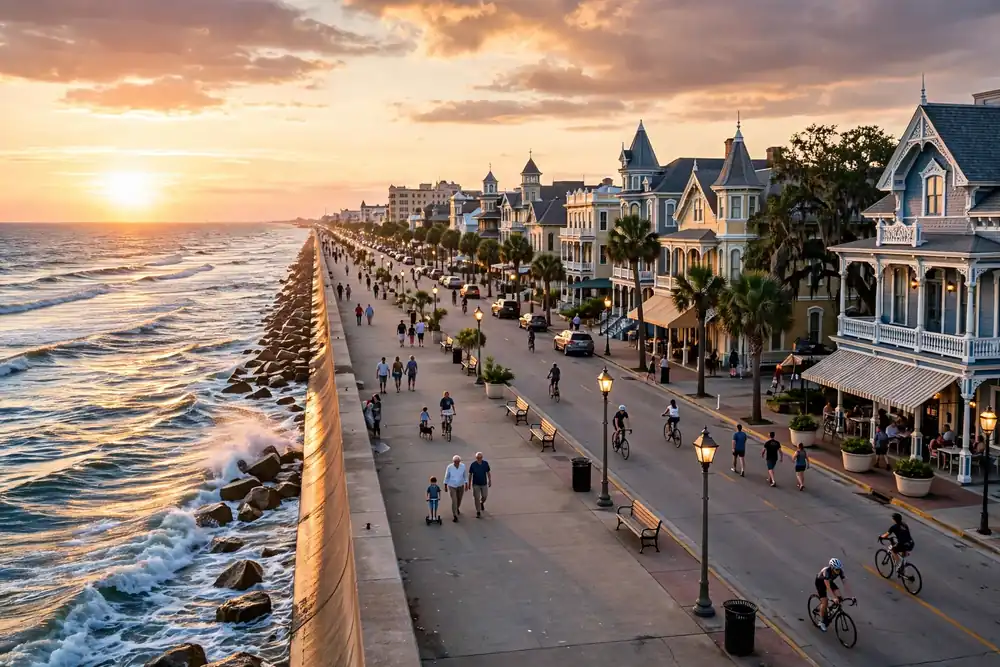
Quick Info
Best for: First-timers, beach lovers, history lovers and families — and anyone who wants Victorian streets, Gulf seafood and a free ferry ride in one walkable island
Best time: April–May and September–October for warm days, low humidity and thin crowds; June–August is peak beach season; December brings Dickens on the Strand and the holiday lights
How long: 3 days for the Strand, Moody Gardens, the beaches and the mansions; 2 days covers the highlights; add a day if you are sailing from the cruise port and want a slow beach day
Budget: About $150–$300 per person per day with a mid-range hotel — many of the best sights are free, and the seafood is the real splurge
Don’t miss: The Strand at sunset, the Moody Gardens pyramids, the free ferry to Bolivar Peninsula, Bishop’s Palace, the Pleasure Pier at dusk, and a plate of Gulf shrimp at Gaido’s
Galveston on Wikipedia is a barrier island on the Texas Gulf Coast, about 50 miles south-east of Houston, and it is the rare beach town where the history is as big as the beach. This guide covers the 20 best things to do in Galveston, a 3-day itinerary that actually works, where to stay without overpaying, how to get around by trolley, on foot and by the free ferry, the three foods you should not skip, and the free sights that let you enjoy the island without a ticket. Everything below was checked against live sources in November 2026 — including the closures, the moved museum and the seasonal hours most guides still get wrong.
Galveston at a glance
| Topic | What to know |
|---|---|
| Full name | Galveston, Texas — a barrier island city on the Gulf of Mexico, about 50 miles south-east of Houston |
| Founded | 1839, as a port city; it was the largest city in Texas in the 19th century and the busiest cotton port in the country |
| Population | About 53,000 on the island; the city covers 32 miles of beaches along a 27-mile-long island |
| Language | English; Spanish is spoken widely across the island |
| Airport | Houston’s airports — Hobby (HOU), about 50 miles, and Bush Intercontinental (IAH), about 70 miles; no commercial airport on the island |
| Best base | The Seawall for beach days, the Strand for history and walking, the West End for quiet condos |
| Getting around | Car for the island, the $1 trolley for the Seawall and downtown, walking for the Strand, the free ferry to Bolivar Peninsula |
| Famous for | The 1900 Storm, the Strand’s Victorian architecture, Moody Gardens, the Pleasure Pier, Gulf shrimp, and the cruise port |
Galveston divides into three parts, and understanding them is the key to planning. The historic east end is the Strand and the harbour — the Victorian downtown, the cruise terminals, the tall ship Elissa, the museums and the mansions on Broadway, all within a short walk of each other. The Seawall runs along the Gulf side for ten miles, from the east end past the Pleasure Pier and the beachfront hotels to the west end, and it is where the beaches, the restaurants and the hotels are. And the west end is the quiet half of the island: the state park, the wide empty beaches, the condos and the birding flats, with the ferry landing at the far north-east tip taking you across the bay to the Bolivar Peninsula. The story that ties it together is the storm of 8 September 1900, the deadliest natural disaster in American history, which killed at least 6,000 people and forced the city to raise its ground level and build the Seawall. Come for the beach, stay for the history.
The 20 best things to do in Galveston
1. The Strand Historic District
The Strand (Galveston) on Wikipedia is the street that made Galveston rich, and it is still the best place to start. In the 19th century this was the Wall Street of the South: the warehouses and counting houses of the cotton trade, built in brick and cast iron, with ornate balconies and arched windows, along a 36-block National Historic Landmark District. Today the Strand is the island’s downtown — about 100 shops, galleries, restaurants, bars and museums in those same Victorian buildings, with the harbour a block away and the cruise terminals a ten-minute walk to the east. Walk it slowly and look up: the ironwork, the painted signs and the carved stone are the attraction, and the shops are the bonus. The district is at its best in the late afternoon, when the light turns the brick gold and the bars fill, and it is the centre of the island’s two great festivals — Mardi Gras in February and Dickens on the Strand in December. Allow two hours to wander, and more if you like to shop.
2. Moody Gardens — the Aquarium and Rainforest pyramids
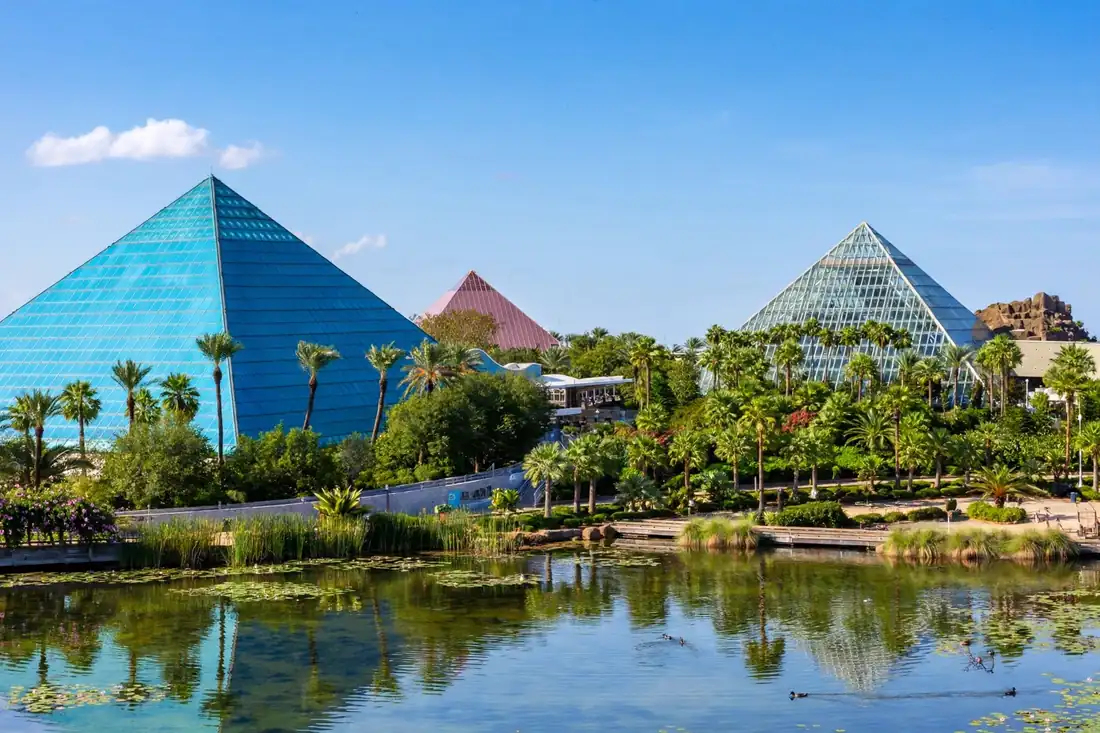
Moody Gardens on Wikipedia is the island’s biggest attraction: three enormous glass pyramids rising from a 242-acre site at 1 Hope Boulevard, just off the Seawall. The Aquarium Pyramid holds a 1.5-million-gallon tank with sharks, seals, penguins, stingrays and more than 200 species of fish, and the penguins are the stars. The Rainforest Pyramid, renovated for $25 million after Hurricane Ike, is a ten-storey tropical forest with free-flying birds, two-toed sloths, monkeys and orchids, and the walk up through the canopy is the best part. The One Day Value Pass costs about $80 at the door and about $60 online for adults, and about $70 at the door and $55 online for seniors and children; a ticket covering just the two pyramids costs about $45 online. Buy online — the door price is a real penalty. Two honest warnings: the third pyramid, the Discovery Museum, has been closed for its conversion into the Galveston Children’s Museum, due to open in November 2026, so do not plan your day around it. The Palm Beach lagoon, the Colonel Paddlewheel Boat and the ropes course run in the warmer months only. Holiday in the Gardens runs from 21 November 2026 to 2 January 2027, with the ICE LAND ice sculptures and a Holiday Evening Pass from $50 after 4 p.m., and the Galveston Island Pass bundles several paid attractions at up to 40% off. Allow half a day, and go in the morning before the school groups arrive.
3. Galveston Island Historic Pleasure Pier
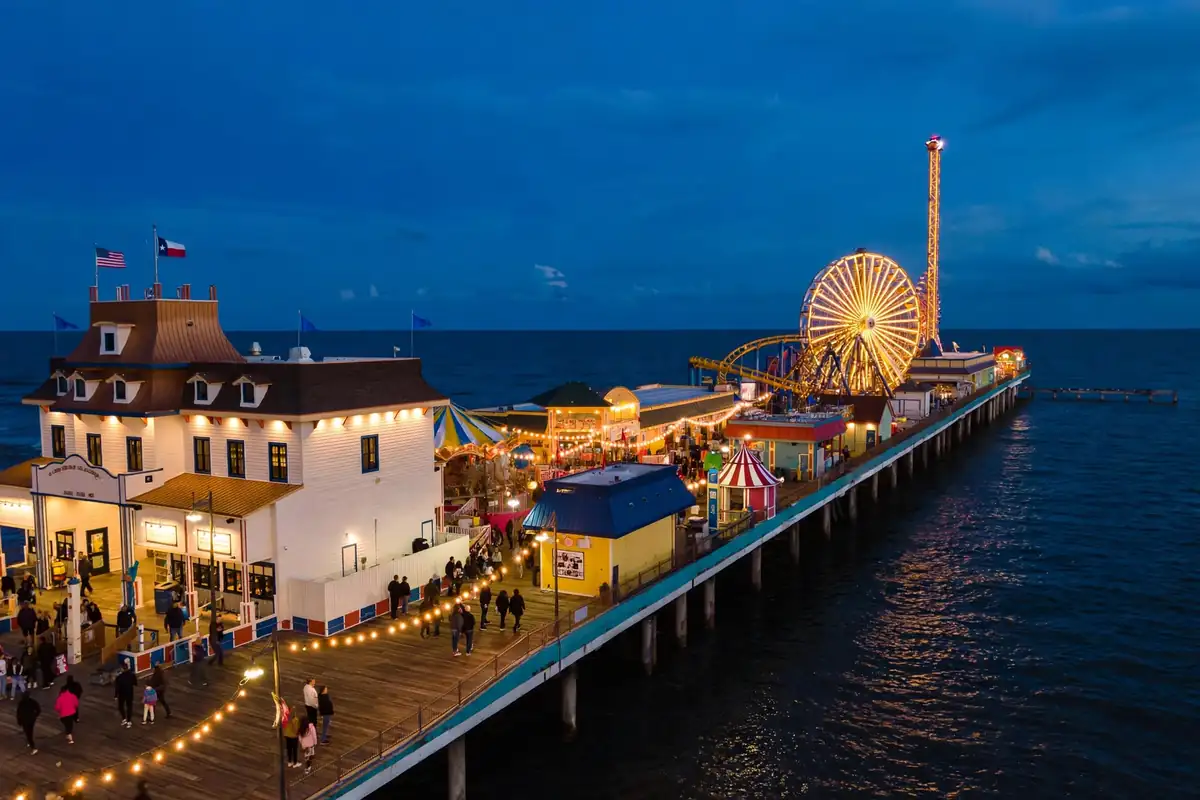
Galveston Island Historic Pleasure Pier on Wikipedia is the classic seaside boardwalk, and it is the best place on the island to be at dusk. The pier stretches 1,130 feet out over the Gulf at 2501 Seawall Boulevard, with 16 rides, midway games, food stands and shops, and the Ferris wheel’s top gondolas sit 100 feet above the water. The Iron Shark is the longest coaster built over Gulf water in Texas, with 100-foot drops. The All-Day Ride Pass costs $30.99 for riders 48 inches and over and $24.99 for shorter riders; a walk-on pass, for people who just want to stroll the pier without riding, costs $12 for adults, $11 for children and $10 for seniors. The pier is seasonal, and that is the trap most guides miss: in the off-season it runs mostly Friday to Sunday, and the hours change week to week, so check pleasurepier.com before you go — and note that there are no refunds or rain checks for weather. The first pier on this spot opened in 1943 as a USO venue for servicemen, and the current pier was rebuilt in 2012 after Hurricane Ike destroyed the old one. A second honest warning: reviews from August 2026 complain of rides closed or broken and of early closures, so if you are coming mainly for the coasters, check the ride status on the day. Allow two hours, and stay for the lights coming on over the water.
4. The 1892 Bishop’s Palace
Bishop’s Palace (Galveston, Texas) on Wikipedia is the grandest house in Texas, and it is the one mansion you should not skip. Built between 1887 and 1892 for Colonel Walter Gresham, a lawyer and politician, and designed by the Victorian architect Nicholas Clayton, it is a National Historic Landmark of carved stone, stained glass, carved wood and bronze, at 1402 Broadway — and it survived the 1900 Storm that levelled the houses around it, which is why it still stands in such remarkable condition. The self-guided tour costs $15 for adults, $12 for young people aged 6 to 18, and is free for children under 5, and the house is open daily from 10 a.m. to 5 p.m., with the last ticket at 4 p.m. It is closed on a handful of dates each year — 29 September, 6, 7 and 17 November, and 5 to 8, 24 and 25 December in 2026 — so check the calendar before you go. The Basement to Attic tour, at $40 on Saturdays from 11 a.m. to 12:30 p.m., takes you into the parts of the house the self-guided route does not reach, including the servants’ quarters and the roof. The palace is owned by the Galveston Historical Foundation and is the most-visited attraction on the island. Allow an hour.
5. The 1877 Tall Ship Elissa and the Texas Seaport Museum
Elissa (ship) on Wikipedia is the reason the harbour matters, and it is the most honest piece of history on the island. The Elissa is an 1877 iron barque, built in Aberdeen, Scotland, bought from a scrapyard in Piraeus, Greece, in 1975 for $40,000, and restored in Galveston by volunteers — and she is one of only three square-rigged ships in the world still actively sailing, and the Official Tall Ship of Texas since 2005. She is docked at Pier 22, 2200 Harborside Drive, as the centrepiece of the Texas Seaport Museum, and you can walk her decks, climb below and see how a 19th-century crew lived and worked. Admission to the museum and the ship costs $18 for adults, $12 for young people aged 6 to 18, and is free for children under 5. The museum is open Tuesday to Sunday from 10 a.m. to 5:30 p.m., with the last admission at 4:30 p.m., and it is closed on 5, 6 and 26 November, 24 and 25 December and 1 January. Two things to know: the Elissa sails. She left Galveston in June 2026 for a three-month Sail250 voyage up the East Coast and returned in late August, reopening for daily tours from Tuesday 25 August 2026 — so she is docked and open now, but on sailing days she is gone, and the day sails, a six-hour hands-on sail with lunch that ran in April 2026 for $300, sell out fast. The Tall Ships Galveston festival is on hiatus — the last full festival was in 2023. Allow 90 minutes, and pair the ship with the Strand, a block away.
6. Schlitterbahn Galveston
Schlitterbahn on Wikipedia is the island’s water park, and it is open — but it is not the Schlitterbahn your older guidebook describes. The park is now owned by Six Flags, after the Cedar Fair merger of 2024, and it is a different operation from the family-run park of the old days. The summer season in 2026 ran from 25 April to 20 September, with 33 attractions and a mile of interconnected rivers across three sections, and day passes start from about $49.99 online — some resellers list about $42 — with gate prices running up to $80. Parking costs $20 to $30, and children aged 3 to 5 get a free Pre-K Pass. The heated indoor section, which used to run on weekends in the fall and winter, is the part to check carefully: one recent source says the indoor conversion no longer happens, so do not plan a winter visit around it without checking the park’s own site. The park is at 2026 Lockheed Road, next to Moody Gardens, and it is a full-day attraction in summer — arrive at opening, because the queues move slowly and the shade is scarce. In November the park is closed for the season, and Moody Gardens and the beach are the better plan.
7. Galveston Island State Park
Galveston Island State Park on Wikipedia is the wild half of the island, and it is the best $5 you will spend in Galveston. The park covers 2,000 acres on the west end of the island, at 14901 FM 3005, with two sides 1.5 miles apart: the beachside, with Gulf swimming, fishing and the dunes, and the bayside, with the marshes, the birding trails and the kayaking. Entry costs $5 for adults aged 13 and over, and is free for children 12 and under, and the gates are open daily from 7 a.m. to 10 p.m. The park was rebuilt in a $10.6 million redevelopment, with 95 campsites at $15 to $35 a night and about four miles of trails, and a Texas State Parks Pass — $70 a year — covers entry. The trap is the day pass: the park often fills on weekends from March to October, and you should reserve it online before you drive out, because the gate turns cars away when it is full. Some boardwalks are still closed from storm damage, and the fountains at campsites 71 to 95 are out of service, so check the park’s alert page before you go. The bayside is the quieter half, and it is where the birding is — the park sits on the Central Flyway, and the spring migration in April is one of the great birding events in Texas. Allow half a day, bring water and sun protection, and do not expect concessions: this is a state park, not a resort beach.
8. Stewart Beach
Stewart Beach is the family beach, and it is the one to choose if you have children or want the full amenities. It sits at 201 Seawall Boulevard, at the east end of the Seawall, with lifeguards in season, restrooms, showers, a playground, chair and umbrella rentals, and a pavilion — the only Galveston beach with the complete set. The beach itself is free, and the charge is for parking: a single entry costs $15, paid through the ParkMobile app, and an annual beach parking pass costs $50 and covers both Stewart Beach and East Beach for a year. The pass is non-refundable, and a single entry is one-time only — leave and come back, and you pay again. The lot fills before lunch on sunny weekends, so arrive early or take the trolley, which stops at the beach. Stewart Beach is the calm end of the island’s beach life: families, sandcastles, gentle waves and a long flat stretch of sand that is easy to walk.
9. East Beach (Apffel Park)
East Beach, officially R. A. Apffel Park, is the livelier beach, and it is the one the locals choose when they want a party. It sits at the far east end of the island, past the end of the Seawall, with about a mile and a half of sand running from Stewart Beach to the ship channel, and it is the biggest beach park on the island. The rules are looser here than anywhere else on Galveston: live music, events, and a beach culture that is louder and younger than Stewart Beach, with lifeguards and security from Memorial Day weekend to Labor Day weekend. Parking works the same as Stewart Beach — $15 for a single entry through ParkMobile, $50 for the annual pass covering both beaches — and the lot holds thousands of cars, but it still fills on summer weekends. There is free parking outside the park if you are willing to walk. East Beach is the beach for the big events: the sandcastle competition, the concerts and the festivals that fill the east end in summer. If you want quiet, go to the state park; if you want the scene, come here.
10. The Galveston–Port Bolivar Ferry
The ferry is the best free thing in Texas, and it is the one attraction that costs nothing at all. The Galveston–Port Bolivar Ferry is a free, 24-hour car ferry run by the Texas Department of Transportation, crossing 2.7 miles of Galveston Bay on Highway 87 in about 18 to 20 minutes. It carries about 70 vehicles per boat, with up to five boats running in summer and on holidays, and the night schedule drops to hourly between midnight and 6 a.m. The Galveston landing is at 1000 Ferry Road, at the far east end of the island, and the Bolivar landing is at 123 Highway 87. There is no ticket, no booking and no charge — you drive on, park, and stand on deck. The crossing is a dolphin-spotting trip in itself: bottlenose dolphins follow the boats through the channel, and the view back to the island is one of the best on the Gulf Coast. The trap is the wait: in busy season the queue can run to two hours or more, so go early in the morning or late in the evening if you are driving. Walk-on passengers board fastest. There is no Wikipedia page for the ferry, so there is no link here — the facts above are from the Texas Department of Transportation and the island’s own visitor guides. Allow an hour for the round trip, and longer if you drive.
11. Moody Mansion
Moody Mansion on Wikipedia is the other great house on Broadway, and it is the one that shows how Galveston’s richest family actually lived. The mansion at 2618 Broadway was built in 1895 for the Moody family, who made their fortune in cotton and banking, and it is a 28,000-square-foot Romanesque house with 31 rooms, a ballroom, a conservatory and a carriage house, all restored to the way the family kept it. The self-guided tour costs about $15 for adults, $7 for young people aged 6 to 17, and is free for children under 5, and the house is open daily from 10 a.m. to 5 p.m., with the last ticket at 4 p.m.; it is closed on Thanksgiving, Christmas Eve and Christmas Day. The all-access tour, about two hours and around $40, takes you through the rooms the self-guided route skips, including the servants’ quarters and the basement. The mansion is also home to the Galveston Children’s Museum, and it is one of the three museums in the Riding the Rails combo — the Bryan Museum, the Railroad Museum and Moody Mansion together for $29.95 for adults and $14.95 for children aged 4 to 12. Allow an hour, and go in the morning, when the light through the stained glass is at its best.
12. The Bryan Museum
Bryan Museum on Wikipedia is the museum for people who want to understand Texas, not just Galveston. It sits at 1315 21st Street, in the old Galveston Orphans Home — a grand 1895 building that survived the 1900 Storm — and it holds one of the largest collections of Texas and American West history in the country: art, artefacts, documents and objects from the Spanish colonial period to the 20th century. Admission costs $15 for adults, $14 for seniors aged 65 and over, teachers and military, $12 for students, $7 for children aged 6 to 12, and is free for children under 6. The museum is the quietest of the island’s big attractions, and that is its charm: the building itself is worth the visit, the galleries are never crowded, and the collection is the deepest history lesson on the island. Allow 90 minutes, and pair it with the Railroad Museum, a few blocks away.
13. Galveston Railroad Museum
Galveston Railroad Museum on Wikipedia is the museum that explains why Galveston mattered, and it is the best hands-on museum on the island. The museum fills the restored Art Deco Santa Fe depot at 2602 Santa Fe Place, on the Strand, with a collection of locomotives, passenger cars and freight cars that you can walk through, and the Harborside Express train ride runs on select days from the depot. Admission costs $14 for adults, $10 for seniors aged 65 and over, $8 for children aged 3 to 12, and is free for children under 2 and for active and retired military. The museum is open daily from 10 a.m. to 5 p.m. The depot itself is the story: Galveston was the great rail port of Texas, where the cotton of the interior met the ships of the Gulf, and the museum’s collection — including the Ghosts of Travelers statues on the platform — is a reminder of how many people passed through this station. Allow 90 minutes, and check the train ride schedule before you go, because it does not run every day.
14. Ocean Star Offshore Drilling Rig Museum
The Ocean Star Offshore Drilling Rig Museum is the attraction that no other city in America has. The Ocean Star is a retired jack-up drilling rig, moored in the harbour at Pier 19, that drilled more than 200 wells between 1969 and 1984, and it has been a museum since 1997. You climb three floors of the rig — the drill floor, the living quarters and the museum decks — and see how a crew of 60 lived and worked on a steel island in the middle of the Gulf. Admission costs about $12 for adults, $10 for seniors aged 55 and over and military, and $8 for young people aged 7 to 18, with children under 6 free. The museum is open Tuesday to Sunday from 10 a.m. to 5 p.m., with the last admission an hour before close, and it is closed on Thanksgiving, Christmas Eve and Christmas Day. There is no Wikipedia page for the rig, so there is no link here. Allow an hour, and go on a clear day, because the view from the top deck, over the harbour and the bay, is one of the best on the island.
15. Galveston Naval Museum at Seawolf Park
Seawolf Park on Wikipedia is the park at the far east end of the island, past the ferry landing, where the harbour meets the Gulf — and it holds two warships you can walk through. The Galveston Naval Museum is built around the USS Cavalla, a submarine that sank the Japanese aircraft carrier Shōkaku in the Battle of the Philippine Sea in 1944, and the USS Stewart, a destroyer escort that served in the Atlantic and the Pacific. USS Cavalla on Wikipedia covers the submarine’s war record, and USS Stewart (DE-238) on Wikipedia covers the destroyer’s. Admission costs $10 to $14, and active-duty military get in free. You climb down into the Cavalla’s hatches and walk her narrow passageways, and you stand on the Stewart’s deck looking out at the shipping channel — the closest you will come to a Second World War warship anywhere on the Gulf Coast. The park itself is free to enter, with a fishing pier, picnic areas and a view of the ships coming and going through the channel. Allow 90 minutes for the ships, and bring a hat — there is almost no shade in the park.
16. The Grand 1894 Opera House
Grand 1894 Opera House on Wikipedia is the most beautiful room in Galveston, and it is the best evening on the island. The Grand, at 2020 Postoffice Street, opened in 1894 as the island’s opera house, survived the 1900 Storm with its roof torn off and its interior flooded, and was restored to its Victorian splendour — the gilt, the velvet, the painted ceiling and the chandelier, and the acoustics are among the best in Texas. The season runs through the year, with symphony concerts, musicals, dance, comedy and touring shows, and a self-guided tour of the house costs $5 if you are not seeing a show. The Grand is the reason to spend an evening on the Strand rather than at the hotel bar: the shows are the island’s cultural centre, and the building is worth the ticket on its own. Check the season before you go, because the programme changes monthly, and book ahead for the Christmas shows, which sell out. Allow an evening, and arrive early enough to have a drink on Postoffice Street first.
17. The Seawall — a 10-mile walk, ride or drive
Galveston Seawall on Wikipedia is the wall that saved the city, and it is the best walk in Galveston. The Seawall is ten miles of concrete, 17 feet high, built between 1902 and 1963 after the 1900 Storm killed at least 6,000 people — the deadliest natural disaster in American history — and forced the city to raise its ground level by as much as 17 feet and build a wall against the Gulf. The 1900 Galveston hurricane on Wikipedia tells the story of the storm itself. Today the Seawall is the island’s promenade: a wide walkway with a dedicated bike lane, benches, beach access points, restaurants and hotels along its whole length. Walking it is free, and the whole ten miles takes about three hours on foot or an hour by bike, with rentals available along the Seawall. The practical part: parking is enforced daily from 10 a.m. to 6 p.m., at $2 an hour with a two-hour minimum and a $16 daily maximum, paid through the PayByPhone app, with an annual pass at $45 — and there are free parking areas on the north side of Seawall Boulevard between 12th and 19th, 33rd and 39th, 53rd and 61st, and 85th and 91st streets. Alcohol is prohibited on the Seawall during March, the peak of Spring Break. Walk it at sunrise, when the light is on the water and the crowds are gone.
18. East End Historic District and the tree sculptures
The East End Historic District is the residential half of old Galveston, and it is the best walk on the island after the Strand. The district holds street after street of Victorian houses — the gingerbread cottages, the Queen Annes and the grand mansions of Broadway — in the largest collection of 19th-century homes in Texas, and it is best explored on foot, in daylight. The district’s most unusual attraction is the tree sculptures: after Hurricane Ike killed some 40,000 trees on the island in 2008, artists carved the dead trunks into sculptures — a mermaid, a geisha, a sea turtle, a violin — and more than 40 of them still stand in front gardens across the East End, a self-guided tour that costs nothing. The district also holds Ashton Villa, at 2328 Broadway, the 1859 house where General Order No. 3 was read on 19 June 1865, announcing the end of slavery in Texas — the day now celebrated as Juneteenth, and the reason Galveston is called its birthplace. Ashton Villa on Wikipedia covers the house, and Juneteenth on Wikipedia covers the holiday. The Nia Cultural Center, a free art gallery and museum on the Strand, tells the same story. Allow two hours to wander, and wear comfortable shoes — the district is made for walking.
19. BayWatch Dolphin Tour
The BayWatch Dolphin Tour is the best hour on the water in Galveston, and it is the one to book if you only do one boat trip. The tour leaves from Pier 21, in the harbour next to the Strand, and runs out into the ship channel and the bay, where bottlenose dolphins follow the boats, ride the bow waves and feed in the channel — the sightings are reliable enough that the tour is the island’s most popular boat trip. The tour is about 45 minutes to an hour, and it runs through the day in the warmer months, with fewer departures in winter. Book ahead in summer, because the boats fill, and sit on the upper deck for the best view of the dolphins. The tour passes the Elissa, the cruise terminals, the working port and the shrimp boats, and the guides tell the story of the harbour as they go. If the dolphins are the priority, the free ferry is the backup — the dolphins follow the ferry boats too. Allow an hour, and bring sunscreen — there is no shade on the upper deck.
20. Ghost tours — Galveston’s haunted side
Galveston’s ghost tours are the island’s most popular evening activity, and they are the reason to stay out after dark. Galveston is described as one of the most haunted cities in America, and the reason is the 1900 Storm: at least 6,000 people died on the island in a single night, and the city has been telling ghost stories about them ever since. The tours leave from 25th Street, a few blocks from the Strand, and walk the historic district after dark, stopping at the houses, the hotels and the cemeteries where the stories are set — the Bishop’s Palace, the Grand Galvez, the old orphanage, the Strand itself. The Grand Galvez, the 1911 hotel on the Seawall known as the Queen of the Gulf, is the most famous haunted hotel on the island. The tours run about 90 minutes, cost around $25 to $35 a person, and are best booked ahead in October. Whether or not you believe in ghosts, the tours are the best history lesson on the island after dark. Allow an evening, and wear walking shoes — the tours cover the whole historic district.
Galveston in 3 days — a ready-made itinerary
This three-day plan covers the Strand and the mansions, Moody Gardens and the beaches, and a day on the water. It assumes you are staying on the Seawall or near the Strand, and it uses the trolley and your own feet for two days, with a car for the third. Book Moody Gardens, the ghost tour and the dolphin tour before you fly — all three sell out on summer weekends.
Day 1 — The Strand, the mansions and the harbour
Start on the Strand before 10 a.m., when the shops are opening and the light on the Victorian brickwork is at its best. Walk the district and take the self-guided tour of the Grand 1894 Opera House. Lunch is a po’boy or a bowl of gumbo on the Strand. In the afternoon, tour Bishop’s Palace, then Moody Mansion, and finish at the Texas Seaport Museum, walking the decks of the Elissa as the light turns gold on the harbour. Dinner is Gulf shrimp on the Seawall, and the evening is a ghost tour from 25th Street.
Day 2 — Moody Gardens, the Pleasure Pier and the beach
Start at Moody Gardens when it opens, and take the Aquarium Pyramid first, then the Rainforest Pyramid — the animals are most active in the morning. Lunch is at the Seawall. In the afternoon, take the trolley to the Pleasure Pier for the rides and the Ferris wheel, then walk the Seawall to Stewart Beach for a swim. In the evening, walk the Seawall at sunset, and eat at Gaido’s or The Spot, with the Gulf on your right and the lights of the pier behind you.
Day 3 — The state park, the ferry and the west end
Rent a car for the day and start at the Galveston–Port Bolivar Ferry for the free crossing — go early, before the queues build, and watch for dolphins. Back on the island, drive west to Galveston Island State Park for the bayside trails and the birding, then the beachside for a swim. Lunch is a seafood shack on the west end. In the afternoon, drive back through the East End Historic District for the tree sculptures and Ashton Villa, then take the BayWatch Dolphin Tour from Pier 21. Finish with a last walk on the Strand and a salt water taffy from La King’s. And if you have a fourth day, take the morning for the Railroad Museum and the Bryan Museum, and the afternoon for Schlitterbahn in summer, or for the Ocean Star rig and Seawolf Park.
Best time to visit Galveston
| Season | Weather | Crowds | Notes |
|---|---|---|---|
| Spring (March–May) | Highs 70–80°F, lows 60–70°F | Moderate | Best season — warm days, low humidity, wildflowers, bird migration in April; Spring Break crowds in March |
| Summer (June–August) | Highs 88–92°F, lows 78–80°F | High | Peak beach season, warmest Gulf water, all attractions open; hot, humid, afternoon storms, hurricane season |
| Autumn (September–November) | Highs 70–85°F, lows 60–75°F | Low to moderate | Second-best season — warm Gulf, thin crowds, festivals; September is the wettest month, hurricane risk to 30 November |
| Winter (December–February) | Highs 60–65°F, lows 48–52°F | Low | Mild and quiet; Dickens on the Strand, holiday lights, Mardi Gras in February; too cold for swimming |
The best time to visit Galveston is April to May or September to October, when the daytime highs run from the low 70s to the low 80s, the humidity is down and the crowds are thin. May and October are the two driest months on the island. Summer, from June to August, is the classic beach trip: the Gulf is at its warmest, in the mid-80s, and every attraction is open — but the heat is real, with average highs around 90°F and lows near 80°F, and the humidity makes it feel hotter. The Atlantic hurricane season runs from 1 June to 30 November, with the highest risk from mid-August to mid-October and the historical peak around 10 September — a trip in that window does not mean a storm will come, but check the forecast, know the evacuation routes, and consider travel insurance. Winter is mild, with average highs around 62°F, and it is the season for the festivals: Mardi Gras Galveston runs from 29 January to 9 February 2027, with Fat Tuesday on 9 February and more than 20 parades — the largest Mardi Gras in Texas, and the city was named the official Mardi Gras Capital of Texas in 2025. Dickens on the Strand runs from 4 to 6 December 2026, the 53rd festival, with Friday evening free from 5 to 9 p.m.; adults cost $20, young people aged 7 to 12 cost $13, and children under 7 are free, with prices rising by $5 on 20 November and half price at the gate for anyone in Victorian costume. Mardi Gras on Wikipedia covers the festival’s history. September is the wettest month on the island, with rain on roughly one day in four, so pack a light rain jacket in the fall.
Where to stay in Galveston
| Area | Best for | Price range |
|---|---|---|
| The Seawall | Beach days, walking to the pier and the restaurants, first-timers | $150–$400 a night |
| The Strand and downtown | History, walking everywhere, nightlife, the cruise port | $120–$300 a night |
| The West End | Quiet condos, the state park, families who want space | $130–$350 a night |
| Near the cruise terminals | Pre-cruise nights, early departures | $100–$250 a night |
| Budget motels on the Seawall | Cheap stays, easy driving | $80–$150 a night |
Stay on the Seawall if this is your first visit — the beachfront hotels are on your doorstep, the Pleasure Pier is a walk away, and you will eat dinner every night without a car. The Grand Galvez, at 2024 Seawall Boulevard, is the grand old hotel on the beach, opened in 1911 and known as the Queen of the Gulf, with a spa, a pool and the island’s most famous ghost stories. The Strand and downtown is the pick if you want to walk everywhere: the historic hotels and the inns around the Strand put the museums, the bars and the harbour on your doorstep, and the cruise terminals are a ten-minute walk. The West End is the quiet pick, with condos and vacation rentals past 61st Street, near the state park — the trade-off is a drive to the Strand and the restaurants. If you are sailing, stay near the cruise terminals the night before: the port runs about 446 departures in 2026, and the morning traffic to the terminals is heavy. Book early for Mardi Gras in February, Dickens on the Strand in December and the summer weekends — the hotels fill months ahead, and the prices double. And check the parking before you book: many Seawall hotels charge for it, and the Seawall meters run from 10 a.m. to 6 p.m.
Getting around Galveston
| Way to travel | Cost | Best for |
|---|---|---|
| Walking | Free | The Strand, the harbour, the East End — the whole historic district |
| Galveston Island Trolley | $1 a ride, $6 day pass | The Seawall and downtown, Stewart Beach to Moody Gardens |
| Rental car | $50–$80 a day | The state park, the west end, the ferry landing, day trips |
| Galveston–Port Bolivar Ferry | Free | Bolivar Peninsula, dolphins, the bay crossing |
| Rideshare or taxi | $10–$20 in town | Late nights, the airport run, the cruise terminal |
| Parking | Seawall $2 an hour, max $16 a day; downtown $1.50 an hour | If you drive — the meters run 10 a.m. to 6 p.m. |
Getting to Galveston is easy: the island is about 50 miles from Houston, roughly an hour’s drive down I-45, and there is no train or metro — you drive, or you take a shuttle from Houston’s airports. Houston Hobby is about 50 miles away and Bush Intercontinental about 70 miles. Once you are on the island, the historic district is walkable — the Strand, the harbour, the museums and the East End are all within a 15-minute walk of each other. The Galveston Island Trolley is the best way to move between the beach and downtown: it costs $1 for adults, is free for children under 6, and $0.50 for seniors and disabled riders, with a $6 day pass, and it runs two loops — the Seawall Loop, between Stewart Beach and Moody Gardens, and the Downtown Loop, through the Strand, Postoffice Street, 25th Street and 20th Street, with a free transfer between them at 21st Street and Seawall Boulevard. Galveston Island Trolley on Wikipedia covers the routes and the history. The trolleys run about every 30 minutes, and the drivers cannot make change, so bring exact cash. The vintage rail trolley runs on a seasonal schedule — daily in summer, Thursday to Sunday in spring, Friday to Sunday in winter — and in the fall and winter season from 8 September 2026 to 28 February 2027 the Seawall Route runs from 10 a.m. to 8 p.m., the railcar from 10 a.m. to sunset and the Downtown Trolley from sunset to 8 p.m. A car is unnecessary downtown, but it is essential for the state park, the west end and the ferry landing. The cruise port is a world of its own: four terminals, with MSC’s Terminal 16, a $156 million building that opened in 2025 for the MSC Seascape’s year-round seven-night Western Caribbean sailings; Royal Caribbean’s Terminal 10 on Pier 10, a $125 million net-zero building that opened on 9 November 2022; Carnival’s four-ship programme with the Jubilee, the Breeze, the Dream and the Legend; the Disney Magic; Norwegian’s Viva from December 2025; and Princess’s Regal Princess in the 2025–26 season. The Icon of the Seas, the largest ship in the port at 250,800 gross tons and 7,600 passengers, starts sailing from Galveston in August 2027, and Margaritaville at Sea joins as the seventh cruise line in October 2027. If you are arriving by cruise, the terminals are a ten-minute walk from the Strand, and the trolley stops at the port.
Galveston food you have to try
Galveston’s food is the food of the Gulf, and the Gulf is the reason the island exists: the shrimp boats in the harbour, the oyster reefs in the bay, and the fish that come in every morning. The rule is to eat where the boats are, not where the menu is laminated in five languages.
Gulf shrimp, oysters and the Seawall seafood houses
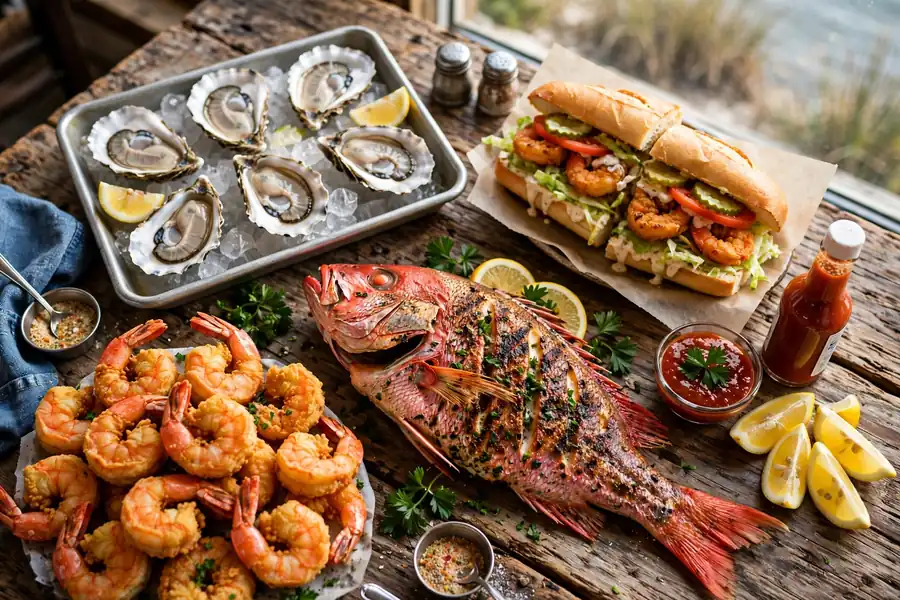
The shrimp are the point of Galveston, and the Seawall is where to eat them. Gaido’s, at 3828 Seawall Boulevard, has served Gulf seafood since 1911 — it was Galveston’s first year-round seafront restaurant — and it is the island’s landmark: the giant blue crab out front, the dining rooms full of old photographs, the menu that changes daily with the catch, and the stuffed shrimp and the Red Snapper Michael, pan-seared with a Parmesan crust and topped with a beurre blanc cream sauce, shrimp and asparagus. Gaido’s was named a 2025 James Beard America’s Classics winner, one of only six in the country, and it is open daily from 11 a.m., closing at 9 p.m. Sunday to Thursday and 10 p.m. on Friday and Saturday, with most guests spending $20 to $70. The pecan pie, not the seafood, is the most mentioned dish on the menu. Down the Seawall, The Spot, at 3204 Seawall Boulevard, is the beachfront favourite for a casual meal with a Gulf view, and Miller’s Seawall Grill and Katie’s Seafood House are the other names the islanders give. At the harbour, Fisherman’s Wharf, at 2200 Harborside Drive, sits next to the Elissa and the cruise terminal. Order the Gulf shrimp, the oysters and the snapper, and skip the frozen fish — the island’s best restaurants are proud that their seafood is never frozen.
Po’boys, gumbo and Strand comfort food
The Strand is where Galveston eats when it is not on the Seawall, and the food is the comfort food of the Gulf Coast: po’boys, gumbo, fried seafood and pub food in the old Victorian buildings. Shrimp ’N Stuff, at 2506 Ball Street and 2506 Avenue H, has been an island mainstay since 1976, and it is the place for an affordable seafood dinner — the po’boys, the gumbos and the salads are the order. Shark Shack, at 2402 The Strand, is the down-home favourite for fresh seafood and hearty pub food with a beer, and Coastal Grill, at 1827 The Strand, is the laid-back choice tucked away from the busiest blocks. The po’boy is the sandwich to learn: a French roll stuffed with fried shrimp or oysters, dressed with lettuce, tomato and mayonnaise, and eaten with your hands over the plate. The gumbo is the other essential — a dark roux, okra, sausage and Gulf seafood, served with rice, and every restaurant on the Strand has its own version. A full meal on the Strand costs about $15 to $30 a person.
Sweet endings: La King’s and Star Drug Store
Galveston’s sweet tooth is as old as the island itself. La King’s Confectionery, at 2323 Strand, has been pulling salt water taffy on the Strand since 1927, and it is the island’s sweet shop: the taffy is made in the window, the ice cream is served at the old counter, and the shop is the place to end a walk on the Strand. Star Drug Store, on the Strand, is the oldest drug store in Texas, and its old-fashioned soda fountain is the place for a breakfast of eggs and coffee at a counter that has not changed in decades. There is no Wikipedia page for La King’s, so there is no link here. The two shops are a block apart, and together they are the best 30 minutes on the Strand: a taffy from La King’s, a coffee from Star Drug, and the Victorian street outside the window.
Free things to do in Galveston
Galveston is far cheaper than its reputation suggests, because many of the best sights cost nothing. The Strand is free, the Seawall is free, the ferry is free, the East End Historic District is free, the tree sculptures are free, and the Galveston Arts Center is free. The Turtles About Town project has placed 61 colourful Kemp’s Ridley sea turtle statues around the island since 2018, and finding them is a free scavenger hunt that takes you to every corner of Galveston. The Nia Cultural Center, the free gallery and museum that tells the story of Juneteenth, is free. The beach itself is free — the charge at Stewart Beach and East Beach is for parking, not for the sand. The ferry is the best free ride in the state, and the dolphins that follow it are free too. Do the free list on your first day, and you will have seen the island before you have spent a dollar on a ticket.
Frequently asked questions
How many days do you need in Galveston?
Three days is the right amount for most visitors. Two days covers the Strand, Moody Gardens, the Pleasure Pier and a beach. Three days adds the state park, the ferry and the mansions. Four or five days adds Schlitterbahn in summer, a slow food crawl, and a day trip to the Bolivar Peninsula. One day is possible, especially before or after a cruise, but you will leave feeling rushed and miss the west end entirely.
Is Galveston worth visiting?
Yes, and for more than the beach. Galveston is the rare Gulf town where the history is as big as the shoreline: the Strand’s Victorian architecture, the 1900 Storm story, the tall ship Elissa, the mansions and the museums, all on an island an hour from Houston. The beaches are not the white sand of Florida — the Gulf water here is brown-green from the Mississippi silt, and the sand is tan, not white — but the island makes up for it with more to do than any other beach town on the Texas coast.
Can you swim in the Gulf at Galveston?
Yes, and in summer the water is warm, in the mid-80s. The Gulf at Galveston is not the clear turquoise water of the Caribbean — the Mississippi and the Atchafalaya push silt westward along the coast, so the water is usually brown-green, though it can clear up on calm days. Swim at the guarded beaches, Stewart Beach and East Beach, and stay out of the ship channel and the jetties, where the currents are strong. The best swimming is from May to October; in winter the water is too cold for a long swim without a wetsuit. Sharks, including hammerheads, live in the Gulf off Galveston, but attacks are extremely rare.
Is the Galveston ferry really free?
Yes. The Galveston–Port Bolivar Ferry is free for cars, for walk-on passengers and for bicycles, 24 hours a day, run by the Texas Department of Transportation. There is no ticket, no booking and no charge in either direction. The crossing takes about 18 to 20 minutes, and the only cost is the wait: in busy season the queue for cars can run to two hours or more, so go early in the morning or late in the evening if you are driving. Walk-on passengers board fastest.
What is the best month to visit Galveston?
May and October are the two best months. May brings warm beach weather before the peak of summer, and October brings milder temperatures, lower humidity, festivals and fewer summer crowds — and both are the island’s driest months. April and September are nearly as good. Avoid August if you can: it is the hottest month, with average highs around 90°F and lows near 80°F, and the peak of hurricane season. If you want the festivals, come in February for Mardi Gras or December for Dickens on the Strand.
What should I skip in Galveston?
Three things, and all three are traps that older guides still get wrong. First, do not go looking for the Lone Star Flight Museum in Galveston: it moved to Ellington Airport in Houston in September 2017, and the guides that still list it as a Galveston attraction are nine years out of date. Second, do not plan your day around the Discovery Museum at Moody Gardens: it has been closed for its conversion into the Galveston Children’s Museum, due to open in November 2026. Third, do not assume the Pleasure Pier’s rides are all running: check the ride status on the day, because reviews from August 2026 report rides closed or broken and early closures.
Further reading
Start with Galveston, Texas on Wikipedia, which covers the founding, the cotton trade, the 1900 Storm and the modern island, and the 1900 Galveston hurricane on Wikipedia for the storm that remade the city. For what locals actually recommend, the r/Galveston subreddit is the community where residents answer visitor questions about restaurants, beaches and the cruise port — it is the best place to check a plan against local knowledge before you go, and it gets about 16,000 visitors a week. Visit Galveston is the official tourism site, with current event listings, the festival dates and the beach conditions. For a traveller’s view of the island, the Quora thread on the Gulf Coast’s favourite coastal towns includes a long answer from a 15-year Galveston resident on the beaches, the history and the food — it is a general Gulf Coast thread, not a Galveston-only one, so read it for the local colour rather than as a guide.
Your Galveston trip, in one paragraph
Galveston is the island where Texas history and the Gulf meet, and that contrast is the trip: the Victorian warehouses of the Strand and the glass pyramids of Moody Gardens on the same streets, the 1900 Storm and the Seawall that answered it, and a plate of Gulf shrimp no other city on the Texas coast can cook. For more city guides in the same style, start with our Destin guide for the other great Gulf beach town, then see how Galveston compares with Arizona, Chicago, Nashville, Los Angeles, Orlando, Miami, San Diego, Denver, Savannah, Dallas, Charleston, San Francisco, Myrtle Beach, Las Vegas, San Antonio, London, Portland, Pigeon Forge, Puerto Rico, Atlanta, Phoenix, Paris, Maui, Key West, Colorado Springs, Sedona, Chattanooga, Palm Springs, St Louis, Tokyo, Japan, Kansas City, Tennessee, Branson, Florida, Amsterdam, Montreal, Honolulu, Fort Lauderdale, Toronto, Aruba, Charlotte, Indianapolis, New Orleans, Santa Barbara, Mexico City, Osaka, Minneapolis, Pittsburgh, California, Asheville, Costa Rica, Hawaii, Washington DC, Seattle, St Augustine, Lisbon, Dubai and Santa Fe.

About the Author