Things to Do in Hilton Head
20 Best Attractions, a 3-Day Itinerary, Where to Stay, and the Food You Cannot Miss
Quick Info
Best for: Beaches, biking, golf, dolphin cruises and Gullah history — a relaxed Lowcountry island escape for families and couples
Best time: April to May and September to October for warm weather, thin crowds and lower prices; June to August for the full beach season
How long: 3 days covers the beaches, Harbour Town, a bike ride and a dolphin cruise; add a day for Daufuskie Island or a round of golf
Budget: About $150–$250 per person per day mid-range — most beaches and parks are free, but parking, the Sea Pines gate and golf add up
Don’t miss: Coligny Beach at sunrise, the Harbour Town Lighthouse at sunset, a bike ride under the live oaks, a dolphin cruise on Calibogue Sound, and shrimp and grits
Hilton Head Island on Wikipedia is the rare beach destination that slows you down instead of wearing you out. There is no boardwalk strip, no high-rise wall along the sand, and no neon — just 12 miles of wide, hard-packed Atlantic beach, 60 miles of shaded bike paths under live oaks draped with Spanish moss, and a Lowcountry culture that runs from Gullah history to shrimp boats. The island was named for Captain William Hilton, who explored it in 1663, and it was developed as a resort from the 1950s, with the town incorporated in 1983 — yet it still feels like a place built around nature rather than on top of it. About 37,661 people live here year-round (2020 census), and the island swells to about 150,000 in peak summer, with roughly 2.5 million visitors a year. This guide covers the 20 best things to do in Hilton Head, a 3-day itinerary that pairs the beaches with the history and the water, where to stay from Sea Pines to Coligny Beach, getting around by car, bike and the free summer trolley, the food you have to try, and the free things to do that cost nothing. Everything below was checked against live sources in November 2026 — including the details most guides still get wrong: the Harbour Town Lighthouse now costs $8, not the $7.50 older guides print, the Sea Pines gate pass is $9 a car, beach parking is hourly and app-only in season, the Harbour Town Golf Links has no fixed rack rate any more, and Islanders Beach Park is closed for improvements until 31 May 2027. Most competing guides still list the lighthouse at $7.50, quote fixed golf rates that no longer exist, and never mention the Islanders closure or the record 2026 turtle season — this guide corrects all of that.
Hilton Head at a glance
| Topic | What to know |
|---|---|
| Full name | Hilton Head Island, South Carolina — a Lowcountry barrier island in Beaufort County, about 20 miles northeast of Savannah, Georgia |
| Founded | Named for Captain William Hilton, who explored the island in 1663; developed as a resort from the 1950s; the town was incorporated in 1983 |
| Population | About 37,661 (2020 census) — swells to about 150,000 in peak summer, with about 2.5 million visitors a year |
| Location | A 12-mile-long barrier island on the Atlantic coast of South Carolina, between Savannah, Georgia and Charleston, South Carolina |
| Getting there | Fly into Hilton Head Island Airport (HHH) or Savannah/Hilton Head International (SAV), about a 45-minute drive; no train service on the island |
| Best base | Coligny Beach and Forest Beach for first-timers — walkable to the beach, shops and restaurants; Sea Pines for Harbour Town and golf |
| Getting around | A car is easiest for the whole island; bikes cover most of it on 60+ miles of paths; the free Breeze trolley runs in the summer season |
| Famous for | Twelve miles of hard-packed beach, the Harbour Town Lighthouse, the RBC Heritage golf tournament, dolphin cruises, and Gullah culture |
Hilton Head Island rewards a slower pace than most beach towns. The island was planned around its trees and marshes rather than paved over them, which is why you can ride a bike from a beach to a forest preserve without ever touching a busy road, and why the most famous view on the island is a lighthouse at the end of a marina, not a skyline. The Lowcountry setting shapes everything: the food is shrimp, oysters and crab; the history is Gullah, the culture of the descendants of enslaved West Africans who built the island’s first free town; and the wildlife is dolphins in the sound, loggerhead sea turtles on the beach in summer, and alligators in the preserve lagoons. Come with a bike, a swimsuit and an appetite, and give the island at least three days — one for the beach, one for the nature and history, and one for the water. The island is about 12 miles long and 5 miles wide, with the Atlantic beaches along its eastern shore, the calm waters of Calibogue Sound and Broad Creek on the west, and the resorts strung between them along two main roads. The modern resort began in the 1950s, when developer Charles Fraser started building the Sea Pines community around the island’s trees and marshes rather than over them, and the town still enforces strict tree and building rules today. That is why there are no high-rises on the beach, and why the live oaks matter as much as the ocean here.
The 20 best things to do in Hilton Head
1. Coligny Beach Park
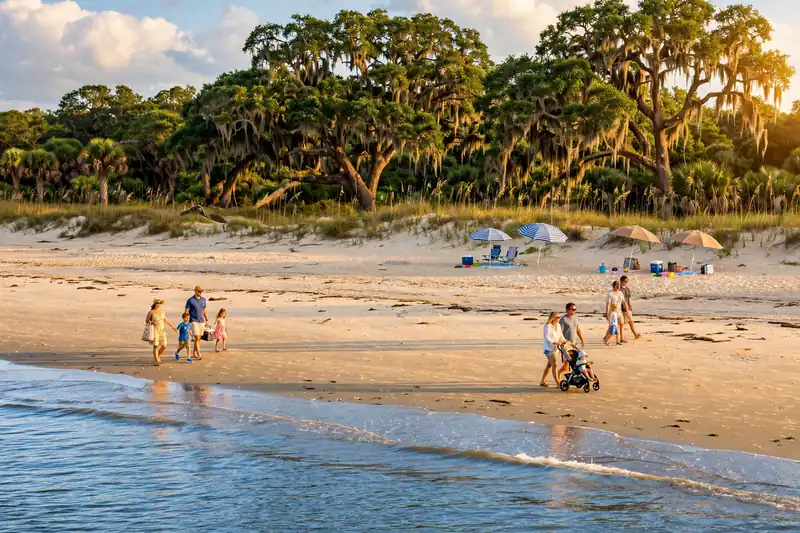
Coligny Beach Park is the island’s most popular beach, and the easiest first stop. It is the only Town beach park with free visitor parking, which matters once you learn the rest of the system: the other Town beach parks charge $3 an hour on weekdays and $5 an hour on weekends from 1 March to 7 September, 7 a.m. to 5 p.m., paid by phone app only, with no cash accepted — and free outside those dates and hours. Coligny itself is open daily from 6 a.m. to 10 p.m., with restrooms, outdoor showers, a splash pad, swings and a wide, flat stretch of hard-packed sand that is easy to walk and to bike at low tide. Coligny Plaza sits right across the street with shops, cafes and ice cream, so you can go from the sand to lunch without moving the car. The free lot fills by mid-morning on summer weekends, so arrive before 10 a.m. or ride a bike in — the paths run right to the beach. Come at sunrise for the quietest hour, when the beach belongs to walkers, runners and the occasional dolphin just past the breakers. The beach is also one of the best places on the island to watch dolphins from shore — they feed just past the breakers in the early morning — and the wide, flat sand makes it the easiest beach on the island for a long walk at low tide.
2. Harbour Town Lighthouse and Marina
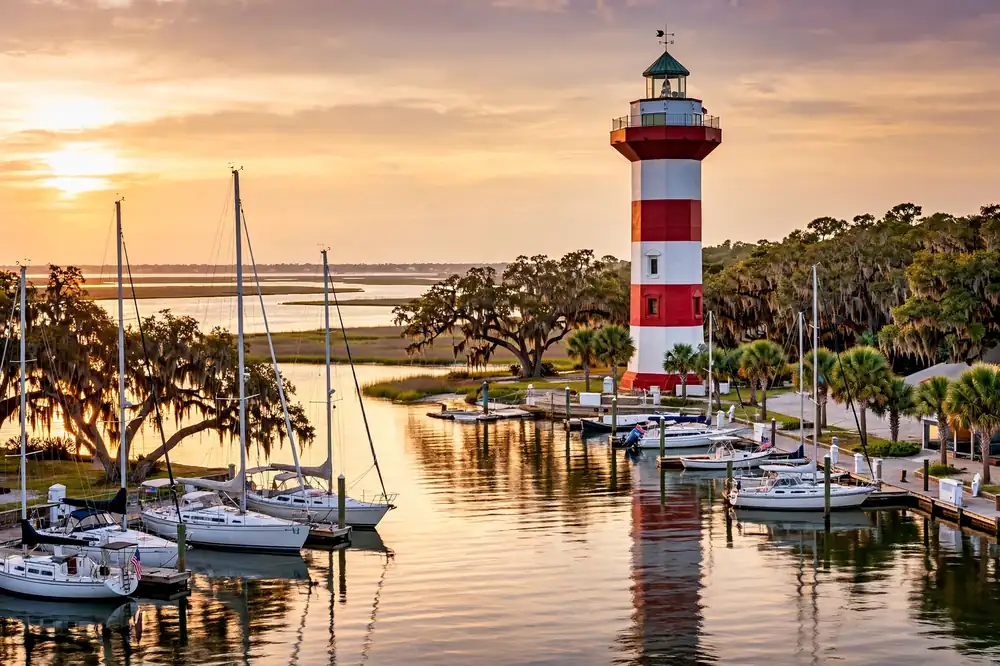
The Harbour Town Lighthouse on Wikipedia is the island’s most photographed landmark, and it is worth the climb. The 90-foot red-and-white tower was completed in 1970 and was the first privately financed lighthouse built in the United States since the early 1800s. Admission is $8.00 per person — the lighthouse’s own site, updated in September 2026, lists $8, while older guides still print $7.50 — and children 5 and under go free. The 114 steps lead past a small museum of lighthouse history to a viewing deck over the marina, Calibogue Sound and, on a clear day, Daufuskie Island across the water. The lighthouse is open daily from 10 a.m. to 7 p.m. The museum rooms on the way up tell the story of lighthouses and their keepers, and the top deck looks out over the 18th green of the Harbour Town Golf Links, where the Heritage finishes each April. The marina below it is the heart of Sea Pines: yachts, charter boats, shops and restaurants around a harbourside boardwalk, and one of the best sunset spots on the island. Remember that Harbour Town sits inside the gated Sea Pines community, so non-guests pay the $9 per car gate pass to get in.
3. Sea Pines Forest Preserve
The Sea Pines Forest Preserve is 605 acres of maritime forest, wildflower meadow and freshwater lakes tucked inside the Sea Pines resort community, and it feels a world away from the beach clubs. The preserve was dedicated in 1971 and is open from 8 a.m. to 7 p.m. A network of walking trails and boardwalks crosses the lakes — watch for alligators sunning on the banks and keep a respectful distance — and the wildflower field is at its best in late spring and summer. Entry to the preserve itself is free, but you need the $9 per car Sea Pines gate pass unless you are staying inside the community. Bicycles are not allowed on the walking trails, and swimming is not permitted anywhere in the preserve. White-tailed deer, raccoons and wading birds are common along the trails, and the boardwalk over the lake is the best place to spot an alligator without leaving the path. It is the island’s best quiet walk, and the contrast with the busy beach is the point: an hour here resets the whole trip.
4. Dolphin watching cruise on Calibogue Sound
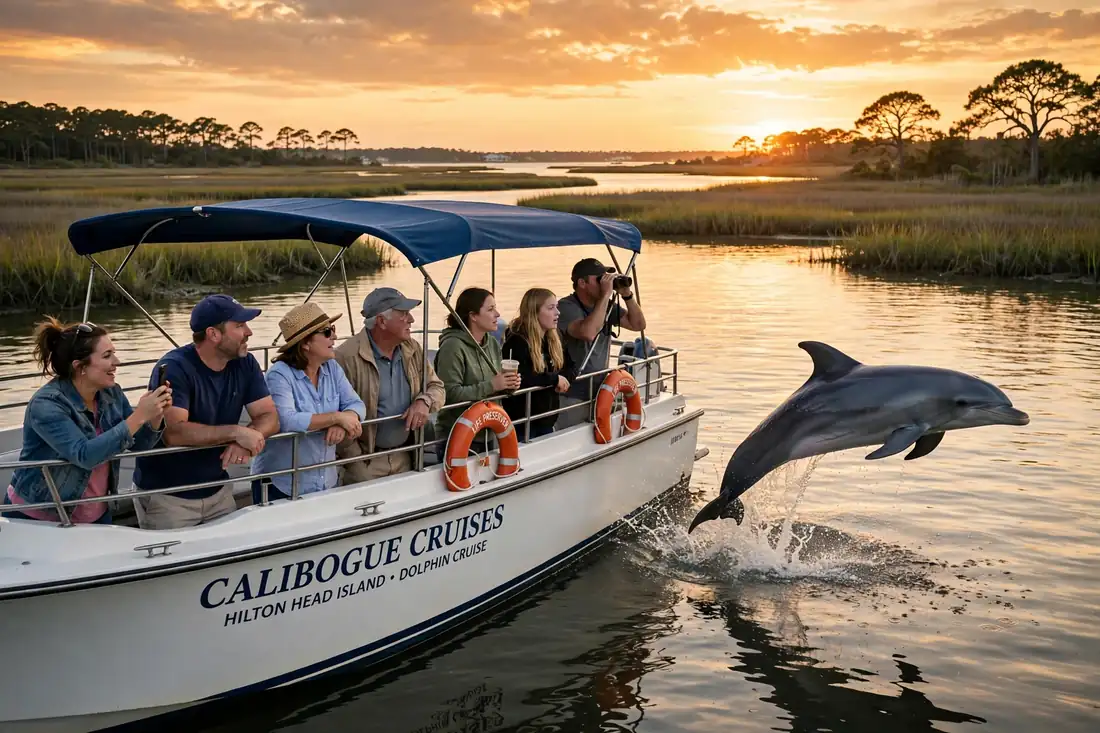
More than 200 Atlantic bottlenose dolphins on Wikipedia live in the waters around Hilton Head, and a dolphin cruise is the most reliable way to see them. The best-known operator is the Vagabond Cruise out of Harbour Town, running since 1968; its 90-minute narrated sunset dolphin cruise starts from about $50 per person, and infants 2 and under travel free (a ticket is still required). Other boats run from Harbour Town and Shelter Cove, with some tours priced from around $76 to $86 per adult, so compare the length and the route before you book. Sunset is the best sailing: the light on the sound is golden, the dolphins feed in the shallows, and the boat passes the Harbour Town Lighthouse on the way home. Boats also leave from Shelter Cove, and several operators run daytime eco-tours that combine dolphin watching with the history of the sound and the marshes. Morning sailings are calmer and better for small children; sunset sailings are the ones to book for the light. Book ahead in summer — the sunset sailings sell out — and bring a light jacket, because it gets breezy on the water after dark.
5. Bike the island’s 60+ miles of paths
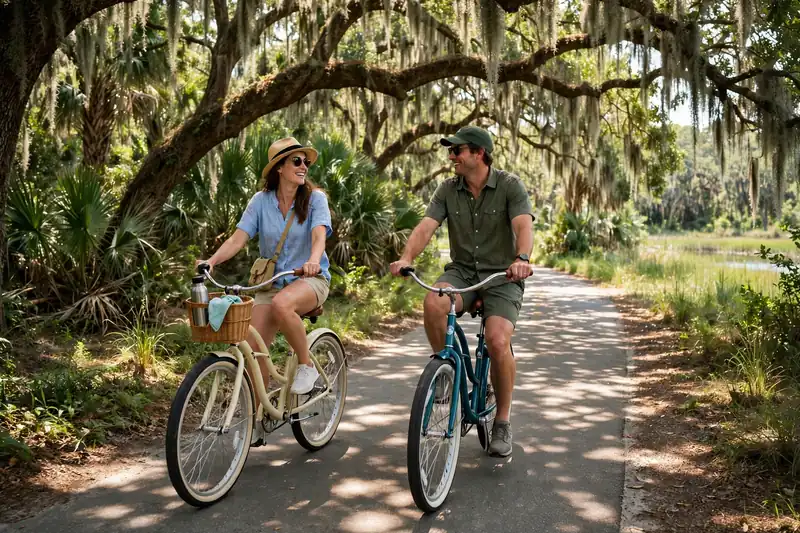
Hilton Head is a biking island first and a driving island second. More than 60 miles of paved, mostly shaded bike paths link the beaches, the resorts, the shops and the preserves, and the island is flat, so a beach cruiser is all you need. Rentals run about $20 to $33 a day for a cruiser — typically $22 to $25 — or $40 to $65 a week, and e-bikes start at about $60 a day; most shops include free island-wide delivery and pickup, so the bikes are waiting at your rental when you arrive. The prettiest ride is the canopy road through Sea Pines and along the beachfront paths at low tide, when the hard-packed sand is firm enough to ride on. Ride on the right, ring your bell before passing, and wear a helmet — the paths are shared with walkers, joggers and kids. Most rental shops deliver the bikes to your villa or hotel and pick them up at the end of the trip, and many include baskets, locks and helmets in the price. The beach itself is rideable at low tide, when the hard-packed sand is firm — check the tide tables before you set out, because soft dry sand near the dunes is a slog. If you only do one active thing on the island, make it this.
6. Pinckney Island National Wildlife Refuge
Pinckney Island National Wildlife Refuge is the first thing you pass on the way onto the island, and most visitors drive straight past it — their loss. The refuge is free, open daily from sunrise to sunset, and covers more than 4,000 acres of salt marsh, maritime forest and tidal creeks, with about 14 miles of flat trails. The easy walk is Ibis Pond, 1.2 miles from the parking area, where herons, egrets and ibis feed in the shallows; the longer hike is White Point, 7.8 miles round trip to a remote beach on Port Royal Sound. Come prepared: there are no restrooms, no drinking water and no dogs allowed, so bring water, sunscreen and binoculars. The refuge sits on the mainland side of the bridge, just before you cross onto the island, so it works as a first stop on arrival day or a last stop on the way out — the parking area is right off the highway and the trails start from the gate. Early morning is best for birds and alligators, and the refuge is rarely crowded even in peak season.
7. Historic Mitchelville Freedom Park
Historic Mitchelville Freedom Park on Wikipedia is the most important historic site on the island, and it costs nothing to visit. Mitchelville was the first self-governed town of formerly enslaved people in America, founded in 1862 during the Civil War, and it is listed on the National Register of Historic Places (as the Fish Haul Archaeological Site) since 1988. The park is free and open daily from 6 a.m. to 9 p.m. at 40 Harriet Tubman Way, with interpretive signs, a praise house, a church and a reconstructed cabin telling the story of the people who built a town — with a government, a school and a church — while the war was still being fought. Guided tours run by reservation; the self-guided walk is free. The park sits beside Mitchelville Beach, a quiet stretch of sand that is good for shelling and for a walk after the history — one of the least crowded beaches on the island. Pair it with the Gullah Museum, and allow an unhurried hour.
8. Gullah Museum of Hilton Head Island
The Gullah Museum of Hilton Head Island is small, personal and easy to miss — which is exactly why it matters. Founded in 2003 by Louise Miller Cohen, it preserves the history and traditions of the Gullah people, the descendants of enslaved West Africans whose language, food, crafts and faith shaped the Lowcountry. The museum sits at 12 Georgianna Drive in a historic home, with family photographs, artifacts and stories from the island’s Gullah community. Hours are limited and admission details were not firmly published in 2026, so check before you go and treat the visit as a short, thoughtful stop rather than a half-day museum. The Gullah language, food and crafts — sweetgrass baskets, cast-net fishing, the foodways that became Lowcountry cooking — are the island’s oldest living culture, and the museum is the most personal place to meet it. It pairs naturally with Mitchelville Freedom Park, and together the two give you the island’s real history — the part the resort brochures skip.
9. Coastal Discovery Museum at Honey Horn
The Coastal Discovery Museum is the island’s best free indoor stop, set on 70 acres of live-oak grounds at Honey Horn, 70 Honey Horn Drive. Admission is free, and the museum is open Monday to Saturday from 9 a.m. to 4:30 p.m. and Sunday from 11 a.m. to 4:30 p.m. Founded in 1985 and a Smithsonian Affiliate, it covers the island’s natural history and Gullah culture with exhibits, a butterfly habitat and walking trails through the grounds. Guided tours cost around $10, and the Tuesday farmers market, 9 a.m. to 1 p.m., is one of the island’s best places to buy local produce, baked goods and crafts. The grounds include a live-oak allée, a boardwalk through the marsh, and gardens planted with native species, and the museum’s small gift shop sells work by local artists and Gullah craftspeople. It is the ideal rainy-day or midday stop, and kids do well here — the grounds are big enough to run in and the exhibits are hands-on.
10. Shelter Cove Harbour and Marina
Shelter Cove Harbour is the island’s summer-evening headquarters. The marina is lined with shops and waterfront restaurants, and from Memorial Day weekend to Labor Day weekend it hosts HarbourFest, which celebrated its 37th year in 2026: free family shows, live music and fireworks on Tuesday evenings — 9, 16, 23 and 30 June, Saturday 4 July, and 7, 14, 21 and 28 July, and 4, 11 and 18 August — starting when the sky is dark. Admission to HarbourFest is free. Across the water, Shelter Cove Towne Centre adds more shopping and dining, and the marina is also a departure point for dolphin cruises, fishing charters and kayak rentals. The Towne Centre across the water has one of the island’s biggest concentrations of shops and restaurants, and the harbourfront walk between the two is one of the nicest evening strolls on the island. Come for dinner, stay for the fireworks, and walk the harbourfront when the boats are lit up.
11. Driessen Beach Park
Driessen Beach Park is Coligny’s quieter sibling, and the one locals tend to recommend when Coligny is packed. A long boardwalk crosses the dunes to a wide stretch of sand with restrooms, outdoor showers, picnic tables and grills. Parking is paid in season — $3 an hour on weekdays and $5 an hour on weekends from 1 March to 7 September, 7 a.m. to 5 p.m., by phone app only — and free outside those hours and dates. The beach is gentler here, with fewer crowds and more space to spread out, which makes it the better choice for families with small children and for anyone who wants a long, uninterrupted walk. The boardwalk crosses a protected dune system — one of the best-preserved on the island — and the beach beyond it is wide and gently shelving, with a gradual slope into the water that suits less confident swimmers. The dunes behind the beach are protected, so stay on the boardwalk and the marked paths.
12. Folly Field Beach Park
Folly Field Beach Park is the locals’ beach: a boardwalk over the dunes, restrooms, outdoor showers and a smaller, calmer crowd than Coligny. Parking follows the same Town rules as Driessen — $3 an hour on weekdays and $5 an hour on weekends from 1 March to 7 September, 7 a.m. to 5 p.m., app only — and is free outside the season. The sand here is good for shelling after a storm, and the beach is wide enough at low tide for a long walk north towards Burkes Beach. Folly Field sits on the north end of the island, a short drive from the Port Royal and Palmetto Dunes areas, and the walk north from here at low tide is one of the longest uninterrupted beach walks on Hilton Head. There are no shops or restaurants at the park itself, so bring water and snacks, and arrive early on summer weekends — the lot is small and fills up by mid-morning.
13. Burkes Beach and Chaplin Community Park
Burkes Beach, at the end of Burkes Beach Road, is the island’s widest and least developed public beach, backed by Chaplin Community Park with a playground, sports fields and picnic areas. Chaplin Park charged for parking from 18 May to 7 September 2026, with Saturdays free during youth soccer — check the current season’s signs when you arrive. The beach itself is free, as all Hilton Head beaches are, and it is a favourite for shelling, surf fishing and long walks away from the resort crowds. Surf fishing is popular here, and the beach is one of the better places on the island to catch whiting and redfish from the sand — a South Carolina saltwater fishing licence is required, so check the current rules before you cast. One planning note for 2026 and 2027: Islanders Beach Park, another north-end beach park, is closed for improvements from 8 September 2026 to 31 May 2027, so do not count on it — Burkes and Folly Field are the better bets on this end of the island until it reopens.
14. Kayaking and paddleboarding on Broad Creek
The island’s salt-marsh creeks are a different world from the beach, and a kayak is the way into them. Broad Creek winds through the middle of the island past oyster beds, cordgrass and osprey nests, with dolphins feeding in the deeper channels at high tide. Guided kayak tours run from around $30 to $40 per person — H2O Sports at the Sea Pines Beach Club is one option — and rentals are available at Shelter Cove and Palmetto Dunes. Beginners do fine: the water is calm, the creeks are sheltered, and a two-hour paddle covers the best of it. Ospreys nest on the channel markers, dolphins feed in the creek mouths at high tide, and the oyster beds at low tide show why the island’s seafood tastes the way it does. Go at high tide, when the creeks are full and the marsh is alive, and go early in summer before the afternoon heat and thunderstorms build.
15. Harbour Town Golf Links and the RBC Heritage
Hilton Head is often called Golf Island, with 23 courses in 54 square miles, and Harbour Town Golf Links is the one that matters most. Designed by Pete Dye with Jack Nicklaus and opened in November 1969, the course is famous for its tight, tree-lined fairways and its finishing hole beside the lighthouse. The course completed a full renovation and reopened in November 2025, alongside a new $26-million clubhouse, with a restoration led by Davis Love III. Green fees in 2026 are dynamic — there is no fixed rack rate any more — with summer samples around $378 to $414 and peak fall mornings up to about $651, plus a mandatory caddie programme that adds to the cost, so check the resort’s live rates before you go and consider a stay-and-play package. The course hosts the RBC Heritage on Wikipedia every April: the 2026 tournament ran 13 to 19 April and was won by Matt Fitzpatrick in a playoff over Scottie Scheffler, and the 59th edition is set for 12 to 18 April 2027, with tournament rounds 15 to 18 April, a $20 million purse, a limited field and no cut as a PGA Tour Signature Event. Beyond Harbour Town, the island’s 23 courses include three at Palmetto Dunes, three at Port Royal and the courses at Shipyard and Oyster Reef, so a golf trip can fill a week without repeating a fairway. If you are not playing Harbour Town, Palmetto Dunes has three well-regarded courses of its own, and the island’s other resort courses welcome visitors too.
16. Lawton Stables horseback riding
Lawton Stables, inside the Sea Pines Forest Preserve, is the island’s only horseback riding, and it is a gentle, old-fashioned experience. The stables are open Tuesday to Sunday from 8 a.m. to 5 p.m. and closed on Mondays. Pony rides for children 7 and under cost $15 for two walking loops, first come first served, with a pony lunch break from noon to 1 p.m. Guided one-hour trail rides through the preserve cost about $80, need a reservation, and have a weight limit of 240 lb. There is also a small animal farm to visit. Carriage rides have been offered in the past, but they were not confirmed as running in 2026 — ask at the stables rather than counting on them. The trail rides follow the same paths as the Forest Preserve’s walking trails, through the maritime forest and past the lakes, and the stables’ animal farm — goats, pigs and chickens — is a hit with younger children. You need the $9 Sea Pines gate pass to reach the stables unless you are staying in Sea Pines.
17. Daufuskie Island by ferry
Daufuskie Island is the day trip that feels like time travel: a car-free island of Gullah history, dirt roads, artisan shops and empty beaches, reachable only by boat. The public ferry, run by Lowcountry Ferry from C.C. Haigh Jr. Landing, costs $30 one-way, with departures at 7 a.m., 10 a.m., 1 p.m. and 4 p.m. daily and returns at 8:30 and 11:30 a.m. and 2:30 and 5:30 p.m.; children 5 and under travel free. The Vagabond runs a round-trip express ferry from Harbour Town for $44 per adult, 30 minutes each way, with four to six hours on the island. Once there, get around by golf cart or bike — there are no cars — and visit the First Union African Baptist Church, the Gullah artisan studios and the island’s quiet beaches. Daufuskie Island on Wikipedia tells the deeper story of a place that was reachable only by boat for most of its history. Rent a golf cart at the dock and spend the day wandering: the Mary Fields School, the artisans’ studios, the quiet beaches on the island’s eastern shore, and the Gullah sites that predate the resorts by more than a century. Bring water, cash and patience: the island runs on its own clock.
18. Hilton Head Distillery
The Hilton Head Distillery is the island’s first and only distillery, opened in 2016, and it marked its 10th anniversary in September 2026 with three medals at the 2026 ADI International Spirits Competition — two silver and one bronze. The Tour and Tasting costs $34.95 plus tax, lasts an hour, is for ages 21 and over, and covers six rums made on site. Tours run Monday to Saturday at noon, 1:30, 3 and 4:30 p.m.; the distillery is open Monday to Saturday from noon to 7 p.m. and closed on Sundays, at 14 Cardinal Road. If you do not want the full tour, tasting flights are available at the bar. The six rums on the tasting cover the range from silver to spiced, and the distillery also makes a small number of limited releases through the year — ask what is new when you visit. It is a good rainy-afternoon stop, and the rum makes a better souvenir than another T-shirt.
19. Sea turtle season
From 1 May to 31 October, Hilton Head’s beaches belong to the loggerhead sea turtles on Wikipedia as much as to the visitors. Loggerheads nest from May to August and hatch from mid-July to October, after about 55 to 60 days of incubation, and the island enforces a lights-out rule from 10 p.m. to 6 a.m. through the season so hatchlings are not drawn inland. The 2026 season was the third-biggest on record: 414 nests and more than 33,000 hatchlings, with the Sea Turtle Patrol moving 284 of the 414 nests to safer ground. The patrol runs dawn walks from 1 May, and visitors can join to learn how the nests are monitored. The Sea Turtle Patrol’s dawn walks run from 1 May, and they are the best way to learn how the nests are found, marked and protected — check the patrol’s schedule, because the walks fill up in the summer months. If you see a nest or a stranded turtle, do not touch it — report it to the South Carolina Department of Natural Resources at 1-800-922-5431 — and never use a flashlight or flash photography on the beach at night during the season.
20. South Beach Marina and the Salty Dog Cafe
South Beach Marina, at the southern tip of the island inside Sea Pines, is the place to end a day. The Salty Dog Cafe is the island’s best-known waterfront restaurant — a sprawling, dog-friendly spot on the marina with live music, outdoor tables and sunset views across the sound — and the marina shops around it sell the island’s most recognisable souvenirs. Come for a late lunch or an early dinner, watch the boats come in, and stay for the sunset. The Salty Dog’s outdoor tables are first come first served, and the marina’s live music runs through the summer evenings — come before sunset to get a table with a view of the boats. It is inside Sea Pines, so the $9 gate pass applies unless you are staying in the community, and it is worth combining with a bike ride or a walk through the forest preserve rather than driving in just for dinner.
Hilton Head in 3 days — a ready-made itinerary
Day 1 — Beaches and Harbour Town
Start at Coligny Beach for a morning swim and a walk on the hard-packed sand, then lunch at Coligny Plaza. In the afternoon, rent bikes and ride the shaded paths to Shelter Cove, stopping for ice cream on the way. As the light softens, drive into Sea Pines — the $9 gate pass covers the whole day — and climb the Harbour Town Lighthouse for the sunset view over the marina, then dinner at one of the harbourside restaurants. It is the classic first day, and it works because it gives you the beach, the bikes and the lighthouse in one easy loop. If the lighthouse line is long, skip the climb and watch the sunset from the marina boardwalk instead — the view over the boats is nearly as good, and it costs nothing.
Day 2 — Nature and Gullah history
Begin early at Pinckney Island National Wildlife Refuge, where the morning light is best for birds and the trails are empty. Then drive to Historic Mitchelville Freedom Park and the Gullah Museum to spend the late morning with the island’s real history. After lunch, the Coastal Discovery Museum at Honey Horn is the right pace for the afternoon heat, with its grounds and butterfly habitat, and the Tuesday farmers market if your day falls on one. Stop for lunch between the museums — the cafes around Honey Horn and Shelter Cove are easy, unhurried places to eat. End the day at Shelter Cove Harbour: dinner on the water, and fireworks on Tuesday evenings in the summer season.
Day 3 — Water, forest and the southern tip
Book a morning dolphin cruise from Harbour Town or a kayak paddle on Broad Creek at high tide — the water is calmest before noon. In the afternoon, head back into Sea Pines for the Forest Preserve walk and, if you booked ahead, a trail ride at Lawton Stables. Finish at South Beach Marina with a late lunch at the Salty Dog Cafe and a sunset walk along the southern beach. If you have a fourth day, spend it on Daufuskie Island by ferry, or on a round at one of the island’s golf courses. Golfers should book the Heritage-week courses well ahead — April tee times at Harbour Town go months in advance.
Best time to visit Hilton Head
| Season | Weather | Crowds and prices | What is on |
|---|---|---|---|
| Spring (March–May) | Highs in the 70s, warming seas, low humidity | Moderate crowds, good value | The RBC Heritage in April (12–18 April 2027); the Seafood Festival in late February; wildflowers in the Forest Preserve |
| Summer (June–August) | Highs in the upper 80s, hot and humid, afternoon thunderstorms | Peak crowds and prices; book ahead | HarbourFest and Tuesday fireworks at Shelter Cove; the Breeze trolley runs fare-free; sea turtle nesting |
| Fall (September–November) | Warm days, warm water, cooling evenings | Thin crowds, lower prices — the best value | Turtle hatching into October; quiet beaches; golf season at its best |
| Winter (December–February) | Highs in the 60s, mild and sunny, occasional cold snaps | Quietest and cheapest; some seasonal businesses reduce hours | Long beach walks, birding at Pinckney Island, and the island to yourself |
The best time to visit Hilton Head is April to May or September to October. Spring brings the Heritage golf tournament and warm, dry weather before the summer humidity arrives; fall brings warm water, empty beaches and the lowest prices of the warm months. Summer is the full beach season — hot, humid, busy and expensive — but it is also when the HarbourFest fireworks, the free Breeze trolley and the turtle nesting season are all running, so families with school-age children will find it worth the crowds. Winter is mild and quiet, with highs in the 60s, and it suits walkers, birders and golfers who do not need a swim. The shoulder months also have a practical advantage: the restaurants take walk-ins, the bike shops have stock, and the beach parks have parking — three things that cannot be assumed in July. Whenever you come, check the beach parking season: the hourly charges at the Town beach parks run from 1 March to 7 September, and parking is free outside those dates.
Where to stay in Hilton Head
| Area | Vibe | Price |
|---|---|---|
| Sea Pines and Harbour Town | Luxury villas and resorts with golf and the lighthouse on your doorstep | $$$$ |
| Palmetto Dunes | Family-friendly villas and condos, three golf courses, beach access | $$$ |
| Coligny Beach and Forest Beach | Walkable to the beach, shops and restaurants; best for first-timers | $$–$$$ |
| Shelter Cove | Marina views, restaurants and shops; a good middle ground | $$$ |
| Folly Field and North Forest Beach | Quieter condos and rentals away from the crowds | $$ |
First-timers should stay around Coligny Beach and Forest Beach, where the beach, the shops and the restaurants are all walkable and the free parking at Coligny Beach Park saves the daily parking fee. Families who want space and a kitchen do well in a Palmetto Dunes or Folly Field villa, with a bike for every member of the party. Golfers and anyone who wants the resort experience should look at Sea Pines, where the Harbour Town Lighthouse, the Forest Preserve and the golf courses are all inside the gates — remembering the $9 gate pass if you drive in and out. Most of the island’s stays are villas and condos rather than hotels, and the rental agencies handle everything from a one-bedroom condo at Coligny to a six-bedroom house in Sea Pines — book through a licensed agency and confirm the cleaning and resort fees before you pay, because they are not always in the headline price. Wherever you stay, book early for April, when the Heritage fills the island, and for June through August, when the beach rentals go first.
Getting around Hilton Head
| Way to get around | What to know |
|---|---|
| Car | Easiest for the whole island; rent at Hilton Head Island Airport (HHH) or Savannah/Hilton Head International (SAV), about a 45-minute drive away |
| Bike | 60+ miles of paved paths; cruisers about $20–$33 a day; the best way to explore the beach towns |
| Breeze trolley | Free seasonal trolley linking the beach parks, Coligny and Shelter Cove in the summer season — check the current season’s dates |
| Rideshare and taxi | Available island-wide; useful for evenings out when you do not want to drive |
| On foot | Coligny Plaza, Harbour Town and Shelter Cove are walkable; the island itself is too spread out to walk end to end |
A car is the easiest way to cover the whole island, especially if you are staying outside Coligny and want to reach Pinckney Island, the north-end beaches and the distillery. But the island is built for bikes: the paths are flat, shaded and separated from traffic, and a cruiser covers the distance between Coligny, Shelter Cove and Sea Pines in twenty minutes. In the summer season, the Breeze trolley runs fare-free between the beach parks and the shopping areas — in 2026 it ran from 11 April to 7 September — so check the current season’s schedule when you plan. If you fly into Savannah, the drive to the island is a straight run up I-95 and across the bridge — about 45 minutes without traffic — and the rental cars at SAV are usually cheaper than at the island’s own small airport. Parking is the one thing to plan around: the Town beach parks charge $3 an hour on weekdays and $5 an hour on weekends from 1 March to 7 September, 7 a.m. to 5 p.m., by phone app only, except for Coligny Beach Park, where visitor parking is free.
Hilton Head food you have to try
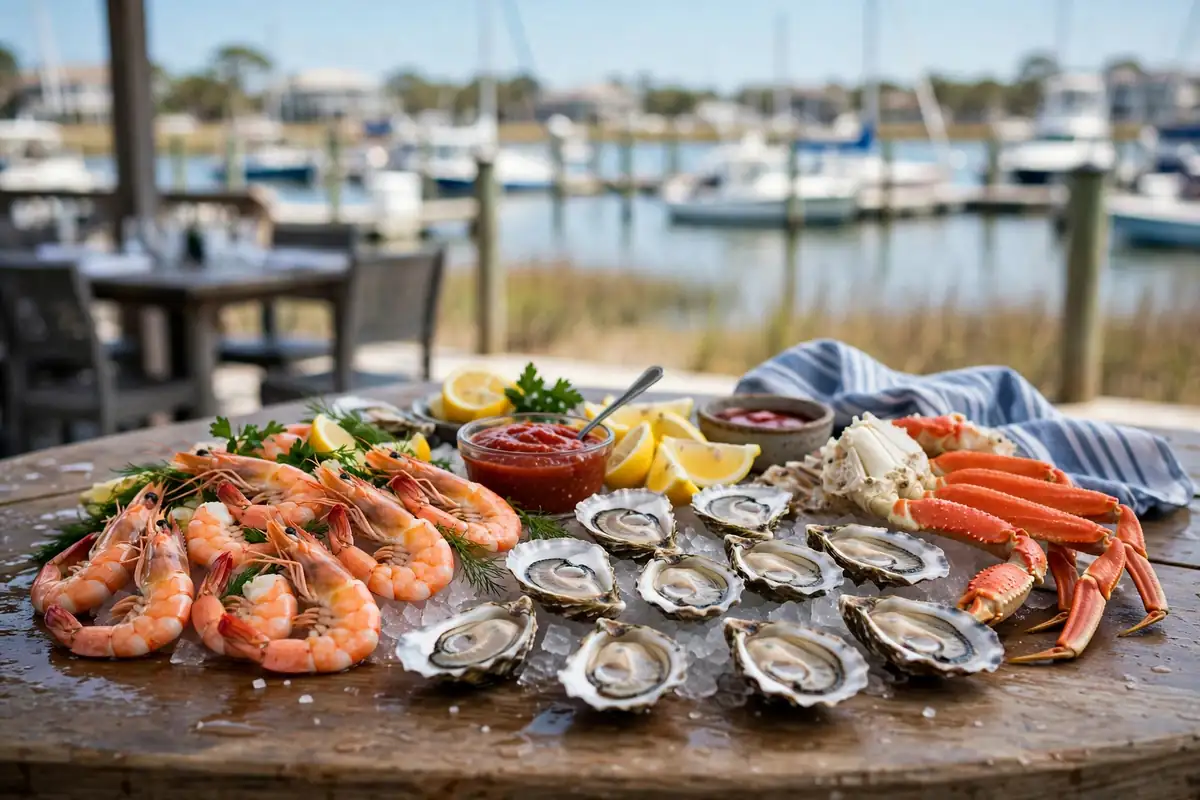
Hilton Head eats like the Lowcountry: shrimp off the local boats, oysters from the marsh creeks, crab in every form, and sweet tea with everything. The island has more than 250 restaurants, from dockside seafood shacks to white-tablecloth dining rooms, and the best meals are usually the simplest ones — a plate of shrimp, a bowl of she-crab soup, and a table with a water view. Prices run from about $15 for a shrimp basket at a dockside shack to $60 or more for a white-tablecloth dinner, and the best value on the island is usually the lunch menu at a restaurant that charges dinner prices after 5 p.m.
Lowcountry seafood: shrimp, oysters and crab
The shrimp boats work the waters off Hilton Head, and the island’s seafood restaurants buy from them — which is why the shrimp here tastes like it was caught this morning, because it often was. Hudson’s Seafood House on the Docks, on Skull Creek, is the classic choice: a working-dock restaurant where you watch the boats unload while you eat. The Salty Dog Cafe at South Beach Marina and the Skull Creek Boathouse are the other waterfront staples, and the Old Oyster Factory pours a good happy hour. Order the shrimp however it comes — boiled, fried, or in a basket — and the oysters on the half shell, which are at their best in the cooler months. Book ahead for the popular waterfront tables in summer — Hudson’s and the Salty Dog fill up, and a 6 p.m. reservation beats a 7:30 p.m. wait. Ask what is local before you order; the menus change with the catch.
Shrimp and grits, she-crab soup and Frogmore stew
Three dishes define Lowcountry cooking, and Hilton Head does all three well. Shrimp and grits on Wikipedia is the island’s signature plate — plump local shrimp over stone-ground grits, usually with bacon, scallions and a rich gravy — and almost every restaurant has its own version. She-crab soup is the Lowcountry’s other classic: a creamy, sherry-laced soup made with blue crab and crab roe, served as a starter in the island’s older dining rooms. Frogmore stew on Wikipedia — also called Lowcountry boil — is the communal feast: shrimp, sausage, corn and potatoes boiled together in one pot and poured out on a newspaper-covered table. It is the dish to order when the whole table wants to eat together, and several island restaurants serve it as a shared platter.
Sweet tea, local beer and island rum
Sweet tea is the island’s default drink, and it arrives with every meal unless you ask otherwise — strong, cold and very sweet. For something stronger, the Hilton Head Distillery pours its own rum, made on the island since 2016, and its tasting room is the best place to try it. The island’s restaurants also pour a solid range of South Carolina craft beer, and the waterfront happy hours — especially at the Salty Dog and the Old Oyster Factory — are an island institution, with early-evening drink specials and live music through the summer. Drink water too: the Lowcountry heat and humidity sneak up on you, and the sweet tea does not count as hydration.
Free things to do in Hilton Head
Hilton Head is kinder to a budget than it looks, because the best things on the island are free. Every beach is free to access — you pay for parking, not for the sand — and Coligny Beach Park’s free visitor parking makes the island’s best beach free in full. Historic Mitchelville Freedom Park is free and open daily, the Coastal Discovery Museum is free, Pinckney Island National Wildlife Refuge is free, and the HarbourFest shows and Tuesday fireworks at Shelter Cove are free all summer. The bike paths are free if you bring your own bike, the sunset from the Harbour Town marina costs nothing even if you skip the $8 lighthouse climb, and shelling at Burkes Beach, browsing the Tuesday farmers market at Honey Horn and watching the dolphins from the Coligny shore are all free. On a clear night, the beach at Coligny is also one of the darkest, quietest places on the island — good for stargazing, and, in the summer season, the right place to remember the lights-out rule that protects the nesting turtles. The island’s real luxury is not something you buy — it is a quiet beach at sunrise with nobody else on it.
Frequently asked questions
Is Hilton Head Island worth visiting?
Yes — if you want a beach holiday that is relaxed rather than frantic. Hilton Head has 12 miles of wide, uncrowded beach, 60 miles of bike paths, a lighthouse and a marina worth an evening, a golf tournament that brings the world’s best players every April, and a Gullah history that most beach towns never had. The island has been voted the number one island in the continental United States by Travel+Leisure readers multiple times — and the reason is not any single attraction, but the way the whole place works together. It is best for families and couples who like the outdoors; it is not the place for nightlife or shopping as a main event. Come for three days, rent bikes, eat shrimp, and you will understand why people return every year.
What is the best time to visit Hilton Head?
April to May and September to October are the best months: warm weather, warm water, thin crowds and lower prices. Summer, June to August, is the full beach season — hot, humid, busy and expensive — but it is when the HarbourFest fireworks, the free Breeze trolley and the sea turtle nesting season are all running. One caveat for summer and fall trips: the Atlantic hurricane season runs from June to November, peaking from mid-August to late September. Direct hits on Hilton Head are rare, but tropical storms can bring heavy rain and rough surf, so check the forecast before a late-summer trip and consider travel insurance. Winter is mild, with highs in the 60s, and suits walkers, birders and golfers. Avoid nothing in particular, but know that the hourly beach parking charges run from 1 March to 7 September.
How many days do you need in Hilton Head?
Three days covers the highlights: a beach and Harbour Town day, a nature and Gullah history day, and a water day with a dolphin cruise or a kayak paddle. Four or five days lets you add Daufuskie Island by ferry or a round of golf without rushing. A week is comfortable if you want to slow down — rent a villa, ride bikes every morning, and let the island set the pace. Less than two days is not enough: the island rewards time, and the first day is mostly learning how it works. If you only have a weekend, spend Saturday on the beach and Harbour Town and Sunday on bikes and a dolphin cruise, and skip Daufuskie — it deserves a full day of its own.
Is Hilton Head expensive?
It is mid-range, not cheap. A mid-range trip runs about $150 to $250 per person per day, including a villa or hotel, food and a few activities. The beaches, parks and museums are mostly free, but the costs add up: beach parking is $3 an hour on weekdays and $5 an hour on weekends in season, the Sea Pines gate pass is $9 a car, a dolphin cruise starts at about $50, and a round at Harbour Town Golf Links can run several hundred dollars. The biggest single saving is staying in a villa with a kitchen: cooking breakfast and a few dinners cuts the food bill in half. Coligny Beach Park’s free parking, the free museums and the free HarbourFest shows keep a careful budget honest.
Do you need a car in Hilton Head?
A car is the easiest option, but you can manage without one if you stay around Coligny Beach. The bike paths cover most of the island, the Breeze trolley runs free in the summer season, and rideshares are available. Without a car you will struggle to reach Pinckney Island, the north-end beaches and the distillery, so most visitors rent at Savannah/Hilton Head International Airport (SAV), about a 45-minute drive away, or fly into Hilton Head Island Airport (HHH) itself. The island’s small airport has direct flights from several eastern cities, which can save the Savannah drive entirely.
Are the beaches on Hilton Head free?
Yes — every beach on Hilton Head is free to access. What you pay for is parking: the Town beach parks charge $3 an hour on weekdays and $5 an hour on weekends from 1 March to 7 September, 7 a.m. to 5 p.m., by phone app only, with no cash. Coligny Beach Park is the exception — visitor parking there is free — and parking is free at all the Town beach parks outside the March-to-September season. Islanders Beach Park is closed for improvements from 8 September 2026 to 31 May 2027, so plan on Coligny, Driessen, Folly Field or Burkes Beach instead.
Further reading
Hilton Head Island on Wikipedia
Harbour Town Light on Wikipedia
Pinckney Island National Wildlife Refuge on Wikipedia
Gullah Geechee Cultural Heritage Corridor on Wikipedia
Harbour Town Golf Links on Wikipedia
Loggerhead sea turtle on Wikipedia
Common bottlenose dolphin on Wikipedia
Sea Pines Plantation on Wikipedia
Hilton Head Island Airport on Wikipedia
Beaufort County, South Carolina on Wikipedia
Savannah, Georgia on Wikipedia
Charleston, South Carolina on Wikipedia
For local tips and current advice from residents, the r/hiltonhead community on Reddit is the island’s own subreddit for news, events and visitor questions.
We could not verify a live, useful Quora thread about visiting Hilton Head Island, so we have not linked one — the Wikipedia links above and the Reddit community are the best places to check.
Your Hilton Head trip, in one paragraph
Hilton Head is the place where the whole idea of this site — one honest, complete guide per place — feels most at home: a Lowcountry island where the beach, the bike paths and the Gullah history all sit within a few miles of each other, where the lighthouse marks the end of a marina rather than the edge of a cliff, and where the best of the trip is the slow morning on the sand, not the sight you came to tick off. Start with the islands and the coasts: our Hawaii guide, our Maui guide, and our Honolulu guide. Then the American cities, in the order we wrote them: our Chicago guide, our Nashville guide, our Los Angeles guide, our Orlando guide, our Miami guide, our San Diego guide, our Denver guide, our Savannah guide, our Dallas guide, our Charleston guide, our San Francisco guide, our Myrtle Beach guide, our Las Vegas guide, and our San Antonio guide. Further afield: our London guide, our Portland guide, our Pigeon Forge guide, our Puerto Rico guide, our Atlanta guide, our Phoenix guide, our Paris guide, our Key West guide, our Colorado Springs guide, our Sedona guide, our Chattanooga guide, our Palm Springs guide, our St. Louis guide, our Tokyo guide, our Japan guide, our Kansas City guide, our Tennessee guide, our Branson guide, our Florida guide, our Amsterdam guide, our Montreal guide, our Fort Lauderdale guide, our Toronto guide, our Aruba guide, our Charlotte guide, our Indianapolis guide, our New Orleans guide, our Destin guide, our Santa Barbara guide, our Mexico City guide, our Arizona guide, our Osaka guide, our Minneapolis guide, our Pittsburgh guide, our California guide, our Asheville guide, our Costa Rica guide, our Washington DC guide, our Seattle guide, our St. Augustine guide, our Lisbon guide, our Dubai guide, our Santa Fe guide, our Galveston guide, our Maine guide, our Sacramento guide, our Kauai guide, our Boston guide, our Cancun guide, our Madrid guide, our Salt Lake City guide, our Baltimore guide, our Barcelona guide, our Reno guide, our Milwaukee guide, our North Carolina guide, our New York guide, our Tucson guide, our Raleigh guide, our Corpus Christi guide, our Milan guide, our Salem guide, our Wilmington guide, our Memphis guide, our Flagstaff guide, our Austin guide, our Oahu guide, our Iceland guide, our Cincinnati guide, our Fort Worth guide, our Panama City Beach guide, our Monterey guide, our Nassau Bahamas guide, our Lexington guide, our Lake Tahoe guide, our San Jose guide, our Tulum guide, our Louisville guide, our Rome guide, and our Fredericksburg guide, and our Helen guide.

About the Author