Things to Do in Louisville
20 Best Attractions, a 3-Day Itinerary, Where to Stay, and the Food You Cannot Miss
Quick Info
Best for: The Kentucky Derby and horse-racing history, bourbon, Muhammad Ali, underground caves and a walkable downtown — a first trip to Kentucky’s biggest city
Best time: April to May — Derby season, with the whole city dressed up; September to October is the mild, cheaper alternative, and November to December brings Lights Under Louisville
How long: 3 days for the museums, the riverfront and the neighbourhoods; add a fourth day for Mammoth Cave or a Bardstown bourbon run
Budget: About $90–$160 per person per day mid-range — the big museums run $16–$25 each, but the riverfront, the bridge and the parks are free
Don’t miss: The Derby Museum at Churchill Downs, the giant bat at the Slugger Museum, the Ali Center, a Mega Cavern tour, a walk across the Big Four Bridge at sunset, and a Hot Brown
Louisville on Wikipedia is the city most visitors get wrong before they arrive. They picture a racetrack and a bottle of bourbon and find a proper American city on the Ohio River — a downtown of museums and Whiskey Row bars, a Victorian neighbourhood bigger than any other in the country, a 296-acre garden cemetery, a cave under the city with a zipline in it, and a park system designed by the man who designed Central Park. Founded in 1778 by George Rogers Clark, Louisville grew rich on the river and on horses, and it still runs on both: the Kentucky Derby is the most famous two minutes in sport, and bourbon is a way of life here, not a souvenir. This guide covers the 20 best things to do in Louisville, a 3-day itinerary that pairs the Derby sights with the riverfront and the neighbourhoods, where to stay without paying Derby-week prices, getting around on foot, by bus and by bike, the food you have to try, and the free things to do that cost nothing. Everything below was checked against live sources in November 2026 — including the details most guides still get wrong: the 2027 Derby is on 1 May, not 2 May, the Speed Art Museum is free on Sundays, the Waterfront Park expansion is not open yet, and the Slugger Museum’s ticket price is not the number the resellers quote.
Louisville at a glance
| Topic | What to know |
|---|---|
| Full name | Louisville, Kentucky — the largest city in Kentucky, on the Ohio River at the Kentucky–Indiana border, in Jefferson County |
| Founded | 1778 by George Rogers Clark, named for King Louis XVI of France; the falls of the Ohio made it a river port before it was a horse town |
| Population | About 630,000 in the city, about 1.3 million in the metro area |
| Location | On the south bank of the Ohio River, across from Jeffersonville and Clarksville, Indiana; about 100 miles south of Cincinnati and 110 miles west of Lexington |
| Getting there | Louisville Muhammad Ali International Airport (SDF), about 15 minutes from downtown; Interstates 64, 65 and 71 meet here; Amtrak does not serve the city |
| Best base | Downtown or NuLu for first-timers — walkable museums, Whiskey Row and the riverfront; the Highlands for bars and local restaurants |
| Getting around | Downtown and the riverfront are walkable; TARC buses cover the city; a car is worth it for the zoo, the Mega Cavern, Waverly Hills and the day trips |
| Famous for | The Kentucky Derby, bourbon, the Louisville Slugger bat, Muhammad Ali, the Hot Brown sandwich and the Belle of Louisville steamboat |
The 20 best things to do in Louisville
Louisville’s 20 best sights split neatly into four groups: the horses, the museums, the river and the neighbourhoods. Do the horses first, because they run on a schedule — the Derby Museum opens at 8 a.m. and the track tours leave from it — then the downtown museums, which cluster within a few blocks of each other on Main Street and Sixth Street, then the riverfront at sunset, when the Big Four Bridge lights up, then the neighbourhoods, which reward a slow evening. The cave and the cemetery are the two outliers: one is underground and one is a garden, and both are worth the drive.
1. Kentucky Derby Museum
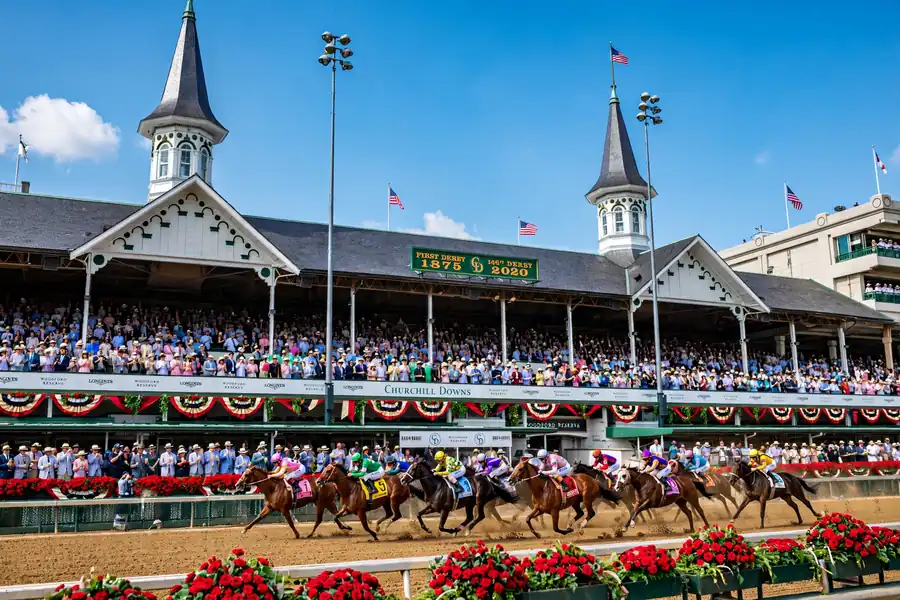
The Kentucky Derby Museum on Wikipedia is the place to start any Louisville trip, and the one museum in the city that makes a sport feel like history. It stands at the gates of Churchill Downs, and its two floors tell the story of the Derby from the first running in 1875 — the silks, the trophies, the mint julep glasses, the hats — with a 360-degree film, “The Greatest Race”, that puts you in the starting gate and on the track for the two minutes that matter. General admission includes a complimentary Guided Track Visit, a walking tour of the track itself, and that is the part not to skip: standing on the dirt where the horses run, under the Twin Spires, with a guide who tells you what the grandstand looked like in 1895, is worth more than any exhibit. In 2026 admission is $20 for adults (13 and over) and $12 for children (5 to 12). Hours run 8 a.m. to 5 p.m. Monday to Saturday and 11 a.m. to 5 p.m. Sunday from 1 April to 30 November, and 9 a.m. to 5 p.m. Monday to Saturday and noon to 5 p.m. Sunday from 1 December to 30 March. The museum is closed Thursday to Saturday of Derby weekend, Thanksgiving, Christmas Eve and Christmas Day — so do not plan a Derby-week visit and expect to walk in. Come on a non-race morning, be there at opening, and give it two hours before the crowds arrive.
2. Churchill Downs
Churchill Downs on Wikipedia is the most famous racetrack in America, and the reason Louisville exists on the world’s map. The track opened in 1875, the Twin Spires went up in 1895, and the Kentucky Derby has run here on the first Saturday in May ever since — the 153rd Derby runs on Saturday, 1 May 2027, with the Kentucky Oaks the day before, on Friday, 30 April 2027, and the track’s own Opening Day on Saturday, 24 April 2027. Several older guides still print 2 May for the 2027 race; that is wrong, and it is the kind of mistake that ruins a trip. Outside Derby week the track is a working racetrack with a spring meet (late April to early July) and an autumn meet (late September to November), and between meets the grandstand is quiet — which is exactly when to go, because the museum’s track tour still runs and you can stand on the rail without a crowd. Derby Day itself is a different world: general admission tickets sell out, the infield is a party, and a seat in the grandstand costs hundreds of dollars — book through the official site, never a reseller, and book months ahead. If you are in town for the Derby Festival, the two weeks before the race are the best time to be in Louisville: the festival’s Tour de Lou bike ride runs on Sunday, 11 April 2027, and the miniMarathon and Marathon on Saturday, 24 April 2027, with the course running through the Churchill Downs infield. Thunder Over Louisville, the air show and fireworks that open the festival, falls in mid-April — the 2027 date had not been announced when we checked in November 2026, so check the festival site before you plan around it.
3. Louisville Slugger Museum & Factory
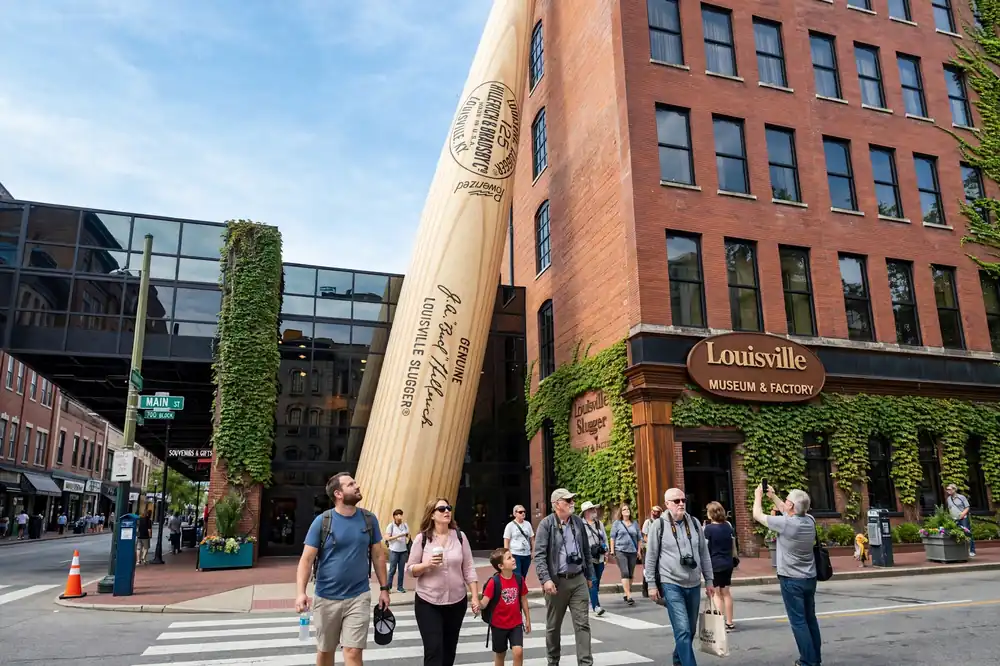
The Louisville Slugger Museum & Factory is the most Louisville thing in Louisville, and the one stop every visitor photographs. The museum sits on Main Street under a 120-foot baseball bat — the world’s largest — leaning against the building, and inside, the factory floor is still a working factory: you watch billets of wood become bats on the same lathes, and every visitor leaves with a free souvenir mini-bat. The tour runs about 30 minutes, with factory tours every 20 minutes to an hour and the last tour 30 minutes before closing, and you should allow two hours for the whole visit — the museum’s bat vault, the signature wall and the batting cages eat time happily. Hours are Monday to Saturday 9 a.m. to 5 p.m. and Sunday 10 a.m. to 4 p.m., closed Thanksgiving, Christmas Eve and Christmas Day. One warning: the ticket price is the one fact in Louisville that the internet cannot agree on. A 2026 listing puts admission at about $18 for adults, $17 for seniors (60 and over) and $11 for children (6 to 12), free under 5, but resellers quote a gate price over $25 for the same ticket — check the official site before you go and buy there, not through a third party. Even at the higher number it is worth it: this is the bat Babe Ruth swung, made in the city that still makes them.
4. Muhammad Ali Center
The Muhammad Ali Center on Wikipedia is the most moving museum in Louisville, and the one that explains the city to itself. Ali was born in Louisville in 1942, and the six-floor centre on the riverfront tells his life as more than a boxing career — the Louisville childhood, the 1960 Rome gold medal, the refusal to be drafted, the Parkinson’s years, and the humanitarian work that filled the last decades of his life — through films, a full-size boxing ring you can step into, and the torch he lit at the 1996 Atlanta Olympics. It is an official stop on the U.S. Civil Rights Trail, and it earns that: the exhibits on race, faith and conscience are the heart of the building, not a footnote. In 2026 admission is $20 for adults, $17 for seniors (60 and over), $10 for children (6 to 17), $15 for students, and free for children under 6. Hours are Wednesday to Sunday 10 a.m. to 5 p.m., closed Monday and Tuesday, last entry 4:15 p.m. — the Monday–Tuesday closure catches people out, so plan it for a midweek or weekend day. Give it two hours, and pair it with Cave Hill Cemetery, where Ali is buried, for the full story: the museum shows you the life, the grave shows you the quiet end of it.
5. Louisville Mega Cavern
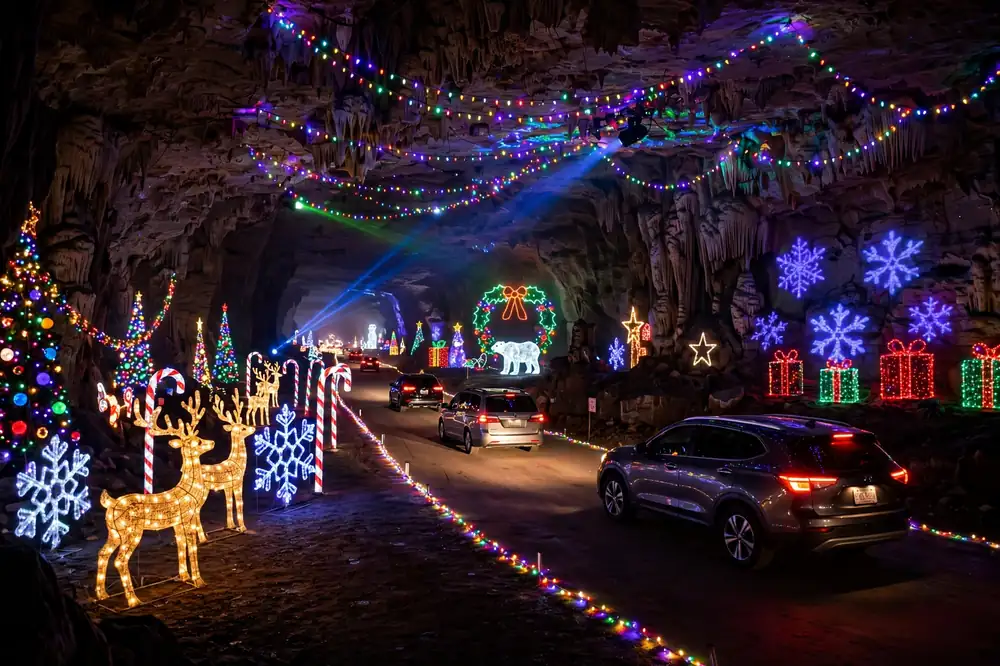
The Louisville Mega Cavern on Wikipedia is the strangest attraction in the city, and the one no other American city can copy: a 100-acre limestone cave under the Louisville Zoo, once a quarry, now an underground adventure park. In winter it becomes Lights Under Louisville, a drive-through Christmas light show in the dark — the 2026 season runs 13 November 2026 to 2 January 2027, and the rules matter: tickets are sold in advance only, not at the gate, a standard vehicle pass starts at $42.99 and a Priority Pass at $89.99 (buy by 2 p.m. on the day), and the guided open-top Christmas Express runs about 30 minutes at $22.99 per person. All year round the cavern runs the Mega Zips — the world’s only fully underground zipline, six lines and two challenge bridges in about two and a half hours, from about $59.95 — and the Mega Quest ropes course, about two hours. The cavern sits at 58 to 60 degrees Fahrenheit all year, so bring a jacket even in July, and book ahead: the lights show sells out on December weekends, and the zipline books up days in advance. It is at 1841 Taylor Avenue, about ten minutes from downtown, and it is the best bad-weather plan in Louisville — rain does not exist underground.
6. Waterfront Park and the Big Four Bridge
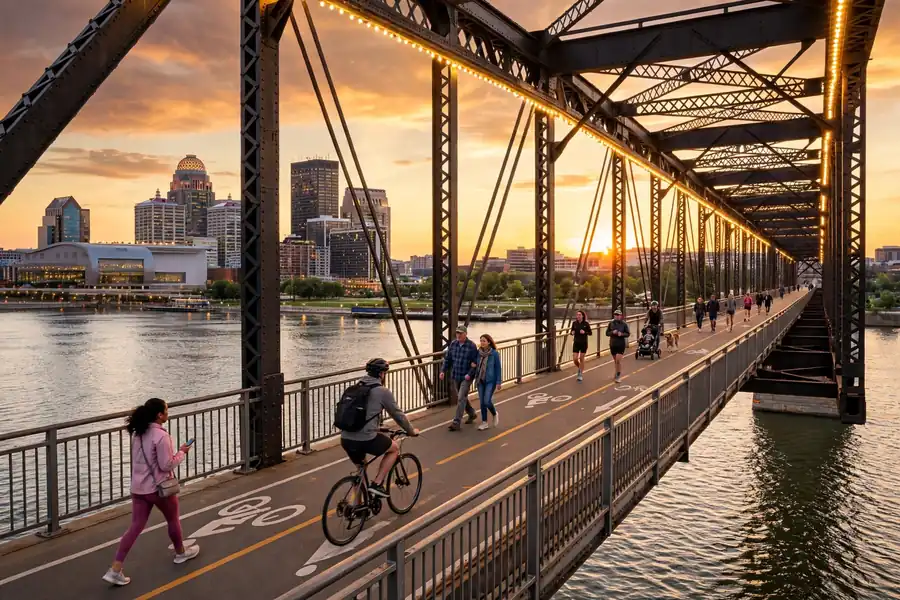
Waterfront Park and the Big Four Bridge on Wikipedia are the best free evening in Louisville, and the walk that ties the whole riverfront together. The park is 85 acres of lawns, fountains and playgrounds on the Ohio, open daily 6 a.m. to 11 p.m., and the bridge is its centrepiece: a former railroad bridge opened to walkers and cyclists in February 2013, free to cross, about two miles there and back, with the Louisville skyline on one side and Jeffersonville, Indiana, on the other. The bridge’s light show runs nightly from dusk to 1 a.m., and the walk at sunset — the river gold, the skyline lit, the lights coming on over the water — is the photograph every visitor takes. A few rules to know: no pets except service animals, no skateboards and no motorised vehicles on the bridge, and it may close in icy weather and during Thunder Over Louisville. The Indiana side has its own park, Big Four Station Park, open dawn to dusk, and the free parking lots on the Louisville side (the Red and Silver lots) fill up on summer weekends — come on foot from downtown if you can. The new PlayPort playground at 1105 Rowan Street is the draw for families. One thing not to expect: the park’s Phase IV expansion, a 22-acre westward extension, is still fundraising and not open yet — older guides that describe it as finished are wrong.
7. Louisville Zoo
The Louisville Zoo on Wikipedia is the best family day in the city, and a better zoo than its size suggests. It is open daily all year, and the hours change with the season: through 19 March 2027 it opens 10 a.m. to 4 p.m. (exit by 5 p.m.), and from 20 March to 19 September 2027 it opens 10 a.m. to 5 p.m. (exit by 6 p.m.), closed Thanksgiving, Christmas and New Year’s Day. Pricing is dynamic, so the number on the website is the number that matters — as a guide, the fall and winter season (1 November 2026 to 12 March 2027) runs $11 to $17 for adults (12 to 59), $8 to $14 for children (3 to 11) and seniors (60 and over), free under 2, with peak-season adults reaching $15.75 to $31, and parking is $7. The winter deal is the Kroger Wild Winter Days, 1 November 2026 to 28 February 2027: $11 for adults and $8 for children and seniors at the window, with a canned-food donation for Dare to Care. The zoo’s strengths are the Glacier Run polar bears, the gorillas and the Islands exhibit, and the whole visit takes three to four hours. It sits next to the Mega Cavern, so the two pair naturally into one day — zoo in the morning, cave in the afternoon.
8. Kentucky Science Center
The Kentucky Science Center on Wikipedia is the rainy-day plan that works for adults too, not just children. Three floors of hands-on STEM exhibits and a four-storey digital theatre fill a handsome building at 727 West Main Street, a block from the Slugger Museum, and the exhibits change often enough that locals go back. In 2026 admission is $24 for adults (13 and over) and $22 for children (2 to 12) for the exhibits only, or $29 and $27 for the Discovery ticket, which adds a film. Hours are daily 9:30 a.m. to 5 p.m., and it is closed on Derby Day (the first Saturday in May), Thanksgiving, Christmas Eve and Christmas Day — the Derby Day closure is the one that surprises visitors, so do not plan it for that Saturday. Allow two to three hours, and if you have children, the theatre film is worth the extra few dollars: it is the biggest screen in Kentucky, and it turns a museum visit into an event.
9. Frazier History Museum
The Frazier History Museum on Wikipedia is the museum that explains Kentucky to Kentuckians — and the official starting point of the Kentucky Bourbon Trail. At 829 West Main Street it holds the trail’s Welcome Center, the Spirit of Kentucky bourbon exhibit and the Bottle Hall, alongside the Lewis and Clark Experience (the expedition set out from Louisville) and the museum’s own Kentucky history galleries. In 2026 admission is $16 for adults (18 to 59) and $14 for seniors, and admission is free for SNAP and EBT cardholders through Museums for All. Hours are Monday to Saturday 10 a.m. to 5 p.m. and Sunday 11 a.m. to 4 p.m., with two closures to know about: it is closed Tuesday and Wednesday in January, and closed Thanksgiving, Christmas Eve and Christmas Day, and it closes at 2 p.m. on Thunder Over Louisville and Derby days. If bourbon is on your list, start here: the Welcome Center staff will map the trail for you, and the Spirit of Kentucky exhibit is the best 30-minute bourbon education in the state — better than any single distillery tour, because it explains the whole industry before you taste any of it.
10. Speed Art Museum
The Speed Art Museum on Wikipedia is Kentucky’s oldest and largest art museum, and it has the best deal in Louisville: admission is free every Sunday. The museum sits on the University of Louisville’s Belknap Campus at 2035 South Third Street, and its collection runs from ancient art to contemporary work, with a strong Kentucky and American wing and a sculpture garden outside. In 2026 admission on other days is $25 for adults (18 to 59), $21 for children (4 to 17) and $23 for seniors (60 and over). Hours are Wednesday to Saturday 10 a.m. to 5 p.m. and Sunday noon to 5 p.m., closed Monday and Tuesday. Two honest notes: the café, Est. 1927, closed on 10 May 2026, so do not plan lunch here — eat in the Highlands or on Bardstown Road instead — and the free Sunday is genuinely free, with no ticket required, which makes it the best Sunday morning in the city. Give it two hours, and pair it with Cherokee Park, which is a five-minute drive away.
11. Evan Williams Bourbon Experience
The Evan Williams Bourbon Experience on Wikipedia is the best first bourbon stop in Louisville, because it is on Whiskey Row, it is small, and it tells the story from the beginning. Evan Williams was Louisville’s first commercial distiller, in 1783, and the experience — a working distillery in miniature on Main Street — runs a 45- to 60-minute tour that ends with a tasting of three or four expressions. The tour costs about $20 (sources vary from $18 to $23, and the Speakeasy and Single Barrel experiences run about $30 and $40), and hours are Monday to Thursday 11 a.m. to 5 p.m., Friday to Saturday 10 a.m. to 5 p.m. and Sunday 1 to 5 p.m., with the last tour an hour before closing. It is at 528 West Main Street, in the middle of Whiskey Row, so the day writes itself: Evan Williams, then Old Forester, Angel’s Envy and Michter’s, all within a few blocks — but note that Old Forester is closed on Sundays and Mondays, so plan the Whiskey Row day for a Friday or Saturday if you want the full street. Book ahead on weekends; the tours sell out, and the last tour of the day is the first to go.
12. Belle of Louisville
The Belle of Louisville on Wikipedia is the oldest operating Mississippi River-style steamboat in the world, and the most relaxing two hours on the Ohio. She was launched on 18 October 1914 — 112 years old in 2026 — and she still runs sightseeing cruises from 401 West River Road, mostly two hours long (some 90 minutes), with boarding 45 minutes to an hour before departure. Tickets are cashless and bought in advance, an afternoon leisure cruise runs about $21.99 for adults (13 to 64) at the group rate, and the Steamboat Supper cruise is $59.99. Her sister boat, the Mary M. Miller, runs the holiday cruises from 25 October to New Year’s Eve. The 2026 season began on 5 April 2026, after the 2025 season was cut short by historic flooding and repairs — the river is the reason the Belle exists and the reason she sometimes cannot sail, so check the sailing schedule the morning you go, and expect a reduced frequency from November to March. The sunset cruise is the one to book: the skyline from the water, with the Big Four Bridge lit behind you, is the best view in the city, and it costs less than dinner.
13. Old Louisville
Old Louisville is the largest Victorian historic district in the United States, and the most beautiful walk in the city. South of downtown, its streets hold the biggest collection of Victorian homes in the country — brick and stone mansions with turrets, stained glass and cast-iron fences — around St. James Court and Belgravia Court, a pair of leafy squares that feel like a film set. It is free to wander, and the walk is the attraction: an hour on foot, starting at Central Park (the neighbourhood’s own Olmsted park), down St. James Court and the side streets, is enough to see the best of it. The neighbourhood’s big day is the St. James Court Art Show, on the first weekend in October, when the court fills with hundreds of artists and tens of thousands of visitors — come then if you like crowds and art, and come any other weekend if you like the streets to yourself. The Conrad-Caldwell House Museum, a Richardsonian Romanesque mansion on St. James Court, runs tours for a small fee and is worth it if you want to see inside one of these houses. Go in the late afternoon, when the light turns the brick gold and the trees throw long shadows across the sidewalks.
14. Cave Hill Cemetery
Cave Hill Cemetery on Wikipedia is the most peaceful place in Louisville, and the most surprising: a 296-acre Victorian garden cemetery and Level II arboretum that locals treat as a park. It was chartered in 1848, and its rolling grounds hold the graves of Muhammad Ali, Colonel Harland Sanders of KFC, George Rogers Clark — the founder of Louisville — and Patty and Mildred Hill, the sisters who wrote “Happy Birthday to You”. Admission is free, the gates open daily 8 a.m. to 4:45 p.m., and the visit is a walk: follow the green line painted on the road to Ali’s grave (Section U) and the yellow line to Colonel Sanders, whose monument carries a bronze bust sculpted by his daughter. A historical walking tour runs for $20, and a map at the gate helps — the grounds are a maze, and the famous graves are spread out. Allow two hours, bring water, and remember it is an active cemetery: keep your voice down, stay on the paths, and do not climb on the monuments. Pair it with the Ali Center, and the two stops together tell the whole arc of the city’s most famous son.
15. Cherokee Park
Cherokee Park is the park Louisville lives in, and the best green space in the city. Designed by Frederick Law Olmsted — the man behind Central Park — it is 389 acres in the Highlands, with a 2.4-mile scenic loop for walking, running and cycling, wooded hills, a creek and a dog hill where the city’s dogs meet every evening. It is free, open from dawn to dusk, and the loop is the thing: an hour on foot, or twenty minutes on a bike, takes you through the best of it, and the hills are gentle enough for anyone. The park is also the gateway to the Highlands — Bardstown Road runs along its edge, so the natural day is a morning loop in the park and lunch on Bardstown Road. If you want more Olmsted, Iroquois Park, his other Louisville design, is 730 acres on the south side and holds the Iroquois Amphitheater, which runs summer concerts. Come in October, when the trees turn and the park is at its best, or in spring, when the loop fills with runners training for the Derby Festival Marathon.
16. Waverly Hills Sanatorium
Waverly Hills Sanatorium on Wikipedia is the most famous haunted building in America, and the most unusual tour in Louisville. It was a tuberculosis hospital — a small wooden building opened in 1910, replaced by the huge Gothic structure visitors tour today in 1926, closed in 1961 — and it is now run by the historical society that is restoring it, with the tour money paying for the roof, the glass and the stonework. The regular season runs 1 March to the end of August: a daytime historical tour of about two to two and a half hours costs about $30, a two-hour paranormal tour costs $25, a six-hour public investigation costs $90, and a private overnight investigation costs $1,000. Outside the season the haunted house runs on Friday and Saturday nights from 25 September to 31 October 2026. Book in advance — the tours sell out, and October dates go months ahead — and know the rules: the minimum age is 13 for tours and 18 for investigations. It is at 4400 Paralee Drive, about twenty minutes from downtown, and the building is enormous once you are inside it: the corridor runs the length of a city block, and the body chute — the tunnel where the dead were carried out — is the part everyone asks about. Come for the history even if you do not believe in ghosts: the story of tuberculosis treatment in America is worth the tour on its own.
17. NuLu (East Market District)
NuLu — New Louisville, the East Market District — is the neighbourhood where Louisville eats, shops and shows off, and the best evening walk in the city. A few blocks east of downtown on East Market Street, it holds the city’s best concentration of independent restaurants, galleries, distilleries and shops: the Rabbit Hole distillery, the Frazier’s neighbours on the bourbon trail, the galleries that spill onto the sidewalk on the first Friday of the month, and the restaurants that make NuLu the first reservation on any food lover’s list. It is free to wander, and the visit is a stroll: an hour on foot, with a coffee or a bourbon in hand, takes you through the best of it, and the side streets hold the murals and the small shops. Come on a Friday or Saturday evening, when the restaurants are full and the street is alive, and book dinner ahead — the best tables in NuLu go days in advance on weekends. If you only eat one dinner in Louisville, eat it here.
18. Bardstown Road and the Highlands
Bardstown Road and the Highlands are Louisville’s local neighbourhood — the place the city goes when it is not performing for visitors. The road runs southeast from downtown through the Highlands, past Cherokee Park, and it is lined with the bars, coffee shops, bookshops and restaurants that make it the city’s indie-eating strip: breakfast spots that open early, barbecue joints, taco stands, record shops and the bars that stay open late. It is free to wander, and the visit is a crawl: pick a stretch between Eastern Parkway and Douglass Boulevard, walk it, and stop where the smell is good. The Highlands are also where Louisville’s nightlife lives — the bars on Bardstown Road are the city’s liveliest, and the crowd is local, not tourist. Come in the evening, eat somewhere without a reservation, and finish with a walk through Cherokee Park at dusk, when the loop is full of runners and the light goes gold through the trees.
19. Fourth Street Live!
Fourth Street Live! on Wikipedia is downtown Louisville’s entertainment district, and the place to end a day. A covered block of Fourth Street between Liberty and Muhammad Ali Boulevard, it holds bars, restaurants and live music under one roof — a sports bar, a bourbon bar, a dance floor and a stage, with the crowds spilling onto the street on Friday and Saturday nights. It is free to enter, and the visit is a night out: come after dinner, listen to the band, and stay for one drink or three. It is at its best during Derby week, when the whole city seems to pass through it, and during the summer concert series. It is also the most tourist-facing spot in the city, and it knows it — if you want the local version, walk ten minutes to NuLu or Bardstown Road instead. But for a first night in Louisville, with the lights on and the music going, Fourth Street Live! is exactly what it promises: the city, out on the town.
20. Louisville Bats at Louisville Slugger Field
The Louisville Bats at Louisville Slugger Field are the cheapest great night in Louisville, and the most American one. The Bats are the Triple-A affiliate of the Cincinnati Reds, and they play at a ballpark on the riverfront, a ten-minute walk from the Slugger Museum — a small, friendly stadium where the tickets are cheap, the beer is cold and the view includes the downtown skyline. The season runs April to September, with most games in the evening, and a ticket in the outfield costs less than a museum admission. It is the Louisville that locals actually do on a summer night: families on the lawn, the mascot Buddy Bat, and fireworks after Friday games. The stadium sits on the site of the old Louisville & Nashville rail yards, and the museum’s giant bat is visible from the upper deck. If you are in town between April and September, go — and if you are not, the Kentucky Kingdom amusement park, across town, is the family alternative in the summer months, though it is seasonal and its dates change every year, so check before you plan around it.
Louisville in 3 days — a ready-made itinerary
Three days is the right length for Louisville: one day for the horses and the downtown museums, one day for the river and the neighbourhoods, and one day for the cave, the cemetery and the food. This itinerary assumes you are staying downtown or in NuLu, and it keeps the walking to a minimum by grouping the sights that sit together.
Day 1 — The Derby, the bat and Whiskey Row
Start at the Kentucky Derby Museum at its 8 a.m. opening, take the Guided Track Visit at Churchill Downs, and give the museum two hours. Drive or take a rideshare back downtown — the track is about fifteen minutes from the centre — and spend the late morning at the Louisville Slugger Museum & Factory, where the factory tour runs every twenty minutes to an hour and every visitor leaves with a mini-bat. Lunch on Whiskey Row, then the afternoon is the Frazier History Museum, the official start of the Kentucky Bourbon Trail, followed by the Evan Williams Bourbon Experience and a walk down Main Street to Old Forester and Angel’s Envy. Dinner in NuLu, and if you still have energy, a drink on Fourth Street Live! to end the day.
Day 2 — Ali, the river and the Highlands
Start at the Muhammad Ali Center when it opens at 10 a.m. — remember it is closed Monday and Tuesday — and give it two hours. Walk to Waterfront Park for lunch, then cross the Big Four Bridge to Jeffersonville and back, which takes about an hour at a stroll. In the afternoon, drive to Cave Hill Cemetery for the green line to Ali’s grave and the yellow line to Colonel Sanders, and give it two hours. Late afternoon, a loop in Cherokee Park, then dinner on Bardstown Road in the Highlands, where the bars stay open late and the crowd is local.
Day 3 — The cave, the art and the food
Morning at the Louisville Mega Cavern — the zipline if you booked it, or the cavern tour — then the Louisville Zoo next door if you have children, or the Speed Art Museum if you do not (free on Sundays). Lunch in NuLu, then the afternoon is Old Louisville: an hour on foot around St. James Court and Belgravia Court, with the Conrad-Caldwell House if you want to see inside a Victorian mansion. If you have a fourth day, spend it on a day trip: Mammoth Cave National Park, about 90 minutes south, is the world’s longest cave system and its tours book ahead; Bardstown, about 45 minutes away, is the bourbon capital, with Heaven Hill and Barton 1792; and Bernheim Forest, about 30 minutes south, holds the Forest Giants troll sculptures in 16,000 acres of woodland.
Best time to visit Louisville
| Season | What it is like | What to know |
|---|---|---|
| Spring (March–May) | The best time and the busiest — Derby season, mild weather, the city dressed up | Derby week (late April to 1 May 2027) is the most expensive week of the year; book hotels months ahead; Thunder Over Louisville falls in mid-April |
| Summer (June–August) | Hot and humid, with festivals and baseball | Highs in the high 80s Fahrenheit; the Bats play all summer; the Mega Cavern is the cool escape at 58–60°F; Waverly Hills runs its regular season |
| Autumn (September–October) | The local favourite — mild, dry and cheaper | Bourbon & Beyond runs in late September (2027 dates TBA); the St. James Court Art Show is the first weekend in October; Cherokee Park turns in October |
| Winter (November–February) | The quietest and cheapest, with the lights show | Lights Under Louisville runs 13 November 2026 to 2 January 2027; the zoo’s Wild Winter Days run to 28 February 2027; expect cold days and some attractions on reduced hours |
Spring is the best time to visit Louisville, and it is not close: the Derby Festival turns the whole city into a party for two weeks, the weather is mild, and every attraction is open. The catch is the price — Derby week hotels cost several times their normal rate, and the city is full. September and October are the smart alternative: the weather is just as good, the crowds are gone, the prices are normal, and Bourbon & Beyond and the St. James Court Art Show give the month its own reason to come. Winter is the budget choice, and it has its own draw in Lights Under Louisville, but expect short days and cold walks across the bridge. Summer is the family choice — the Bats, the zoo, the Mega Cavern — but it is hot and humid, and the afternoons are best spent underground or indoors.
Where to stay in Louisville
| Area | Best for | What to expect |
|---|---|---|
| Downtown | First-timers, Derby week, walkers | The Brown Hotel (home of the Hot Brown), the 21c Museum Hotel (art hotel), the Galt House on the riverfront; the museums, Whiskey Row and the riverfront on foot |
| NuLu / East Market | Food lovers, couples, nightlife | Boutique hotels and short-term rentals; the best restaurants in the city on the doorstep; a ten-minute walk to downtown |
| The Highlands / Bardstown Road | Local flavour, longer stays, budget | Guesthouses and rentals near Cherokee Park; bars and restaurants on the doorstep; a short drive or bus ride downtown |
| Near Churchill Downs | Derby week only | Hotels around the track fill first and cost most in Derby week; fine for the race, inconvenient for everything else |
| Airport area (SDF) | Budget, early flights, drivers | Chain hotels at half the downtown price; a 15-minute drive to the centre; not walkable |
Downtown is the right base for a first trip: the museums, Whiskey Row, the riverfront and the Big Four Bridge are all within walking distance, and the bus and rideshare cover the rest. NuLu is the better base if food is the point of the trip — the restaurants are the best in the city, and downtown is a ten-minute walk. The Highlands suits a longer stay, with Cherokee Park on the doorstep and Bardstown Road’s bars and restaurants, but you will need a car or the bus for the museums. Avoid staying near Churchill Downs unless you are coming for the Derby: the hotels there are the most expensive in the city during race week and the least convenient the rest of the year. Wherever you stay, book early for Derby week — the city’s hotels sell out months ahead, and the prices on the remaining rooms are not a misprint.
Getting around Louisville
| Option | Best for | What to know |
|---|---|---|
| Walking | Downtown, the riverfront, NuLu, Old Louisville | The museum district, Whiskey Row and Waterfront Park are all walkable; the Big Four Bridge is a two-mile round trip on foot |
| TARC bus | Budget travel, the Highlands, the university | The city bus system; a day pass is the cheapest way around; routes run less often on Sundays |
| Rideshare (Uber/Lyft) | The zoo, the Mega Cavern, Waverly Hills, evenings | The practical way to reach the sights outside downtown; about $10–$25 for most trips in the city |
| LouVelo bikes | The riverfront, Cherokee Park, the Big Four Bridge | The city’s bike-share; the Waterfront Park loop and the bridge are the best rides |
| Car | Day trips, families, Derby week | Worth it for Mammoth Cave, Bardstown and Bernheim Forest; downtown parking is about $10–$20 a day in garages; the track area is gridlocked on Derby Day |
| Taxi | Airport, late nights | Available at SDF and downtown; rideshare is usually cheaper |
Downtown Louisville is walkable, and the first two days of this itinerary need no car at all: the museums cluster on Main Street and Sixth Street, the riverfront is a ten-minute walk, and NuLu is ten minutes further. The sights that need wheels are the zoo, the Mega Cavern, Waverly Hills, Cave Hill Cemetery and Cherokee Park — a rideshare covers all of them for about $10 to $25 a trip, and a rental car only makes sense if you are doing the day trips. TARC, the city bus, is the budget option, but it runs less often on Sundays, so check the timetable. If you do drive, the downtown garages charge about $10 to $20 a day, and the street parking near the riverfront fills up on summer weekends. One warning for Derby week: the roads around Churchill Downs are closed or gridlocked on race day, and the only sensible way to the track is the shuttle or a rideshare dropped a few blocks away.
Louisville food you have to try
Louisville’s food is better than its reputation, and it is built on three things: a sandwich invented in a hotel, a spirit invented in the state, and a barbecue tradition that predates both. The city eats well at every price — the taco stands on Bardstown Road, the barbecue joints in the Highlands, the white-tablecloth dining rooms downtown — and the best meals in Louisville are the ones that could not exist anywhere else.
The Hot Brown at the Brown Hotel
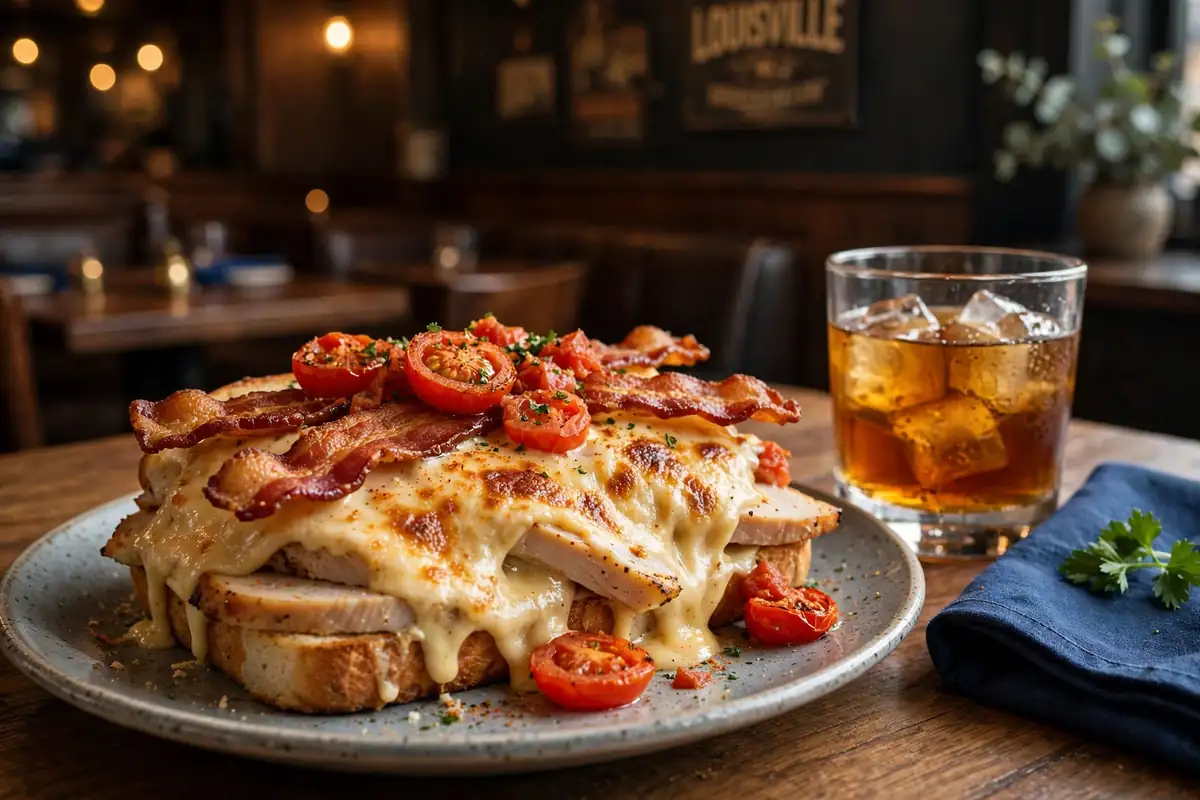
The Hot Brown on Wikipedia is Louisville’s signature dish, and the one food every visitor should eat. It was invented in 1926 at the Brown Hotel, downtown, as a late-night snack for the dance crowd: an open-faced turkey sandwich, covered in a creamy Mornay sauce, with bacon and tomato, baked until the sauce bubbles and browns. The Brown Hotel still serves the original, in the hotel’s restaurant, and it is the one to order — the sauce is the recipe, the turkey is real, and the room is the 1920s dining room it was invented in. Expect about $18 to $22 for the sandwich, and order it at lunch, when the dining room is quiet and the light comes through the windows. Every other restaurant in Louisville serves its own version, and most of them are good, but the original is the one worth the trip: it is a sandwich with a birth certificate, and it tastes like it.
Bourbon on Whiskey Row and the Urban Bourbon Trail
Bourbon on Wikipedia is not a drink in Louisville; it is an industry, a history and a pub crawl. Whiskey Row, the block of Main Street between Sixth and Tenth, holds the distilleries you can walk between — Evan Williams, Old Forester, Angel’s Envy, Michter’s — and the Urban Bourbon Trail, the city’s official list of bourbon bars, runs through downtown, NuLu and the Highlands. The way to do it is a flight, not a bottle: three or four half-ounce pours, with the bartender’s guidance, costs less than a single cocktail and teaches you more. Start at the Frazier History Museum’s Spirit of Kentucky exhibit, which explains the whole industry in thirty minutes, then walk Whiskey Row in the afternoon, and finish the evening on the Urban Bourbon Trail in NuLu, where the bartenders take it seriously. Two rules: book the distillery tours ahead on weekends, and remember that Kentucky bourbon is at least 40 percent alcohol — eat first, drink water between pours, and take a rideshare home.
Barbecue, beer cheese and the NuLu food scene
Barbecue and beer cheese are the other two pillars of Louisville food, and NuLu is where they meet the city’s best cooking. The barbecue here is Kentucky-style — smoked pork and mutton, with a vinegar-based sauce — and the joints on Bardstown Road and in the Highlands serve it by the plate with the sides that matter: baked beans, slaw and white bread. Beer cheese, the sharp cheddar spread invented across the river in Kentucky, shows up on every menu in the city, usually with pretzels, and it is the snack to order while you decide. NuLu, the East Market District, is where the city’s ambitious cooking lives: the restaurants there change with the seasons, the chefs come from the best kitchens in the country, and the best tables go days ahead on weekends. Eat barbecue for lunch in the Highlands, beer cheese with a bourbon in NuLu, and one proper dinner in the East Market District — and if you want the local breakfast, find a biscuit-and-gravy spot on Bardstown Road before 9 a.m., when the line starts.
Free things to do in Louisville
Louisville is a generous city for a free day, and the best of it costs nothing. Walk Waterfront Park and cross the Big Four Bridge at sunset, when the lights come on over the Ohio and the skyline turns gold — the whole walk is free, and it is the best evening in the city. Visit the Speed Art Museum on a Sunday, when admission is free all day. Walk Cave Hill Cemetery, free every day, and follow the green line to Muhammad Ali’s grave and the yellow line to Colonel Sanders. Spend an hour on the scenic loop in Cherokee Park, free from dawn to dusk. Wander Old Louisville’s Victorian streets around St. James Court, free to walk, and photograph the giant bat outside the Louisville Slugger Museum — the museum charges, but the bat, the most photographed object in the city, is free from the sidewalk. Window-shop and gallery-hop in NuLu on a Friday evening, and finish the night people-watching on Fourth Street Live!, where the music and the lights cost nothing to enjoy. Seven free things, and not one of them feels like a compromise.
Frequently asked questions
How many days do you need in Louisville?
Three days is the right answer for most visitors: one day for the Derby sights and the downtown museums, one day for the river and the neighbourhoods, and one day for the cave, the cemetery and the food. Two days works if you skip the zoo and the Mega Cavern, and one day is enough for the Derby Museum, the Slugger Museum and the Ali Center if you start early and walk fast. Add a fourth day for Mammoth Cave or a Bardstown bourbon run, and a fifth if you want to do the Derby Festival properly — the festival runs for two weeks, and the city is a different place in that fortnight.
Is Louisville worth visiting if you are not into horses or bourbon?
Yes — and the horses and the bourbon are the least of it. The Ali Center is one of the best civil-rights museums in America, the Mega Cavern is the only underground zipline in the world, Cave Hill is one of the most beautiful cemeteries in the country, Waverly Hills is the most famous haunted building in America, and the riverfront walk is free and beautiful. The horses and the bourbon are the reason people come; the museums, the cave, the cemetery and the neighbourhoods are the reason they come back.
Do you need a car in Louisville?
No, not for the first two days: downtown, the riverfront, NuLu and Old Louisville are all walkable, and a rideshare covers the zoo, the Mega Cavern, Waverly Hills and Cave Hill for about $10 to $25 a trip. A car is worth it only for the day trips — Mammoth Cave, Bardstown and Bernheim Forest are all a drive, and the bus does not go there. If you do rent one, take it for a single day rather than the whole trip: downtown parking runs about $10 to $20 a day, and the car sits unused while you walk the museum district.
What is the best time to visit Louisville?
April to May is the best time, and it is not close: the Derby Festival turns the city into a party, the weather is mild, and every attraction is open. The catch is the price — Derby week hotels cost several times their normal rate, so book months ahead. September and October are the smart alternative, with the same weather, no crowds and normal prices, plus Bourbon & Beyond and the St. James Court Art Show. Winter is the budget choice, with Lights Under Louisville as its draw, and summer is the family choice, with the Bats and the zoo, but it is hot and humid.
Is Louisville safe for tourists?
Yes, for the usual care. Downtown, the riverfront, NuLu and the Highlands are busy and well-lit, and the sights are in the safe parts of the city. The rules are the normal American city rules: keep your bag in front of you on a crowded street, do not leave valuables visible in a parked car, take a rideshare rather than walking alone late at night, and avoid the unlit streets west of downtown after dark. The riverfront and the Big Four Bridge are safe in the evening when they are busy, and they are busy most evenings from spring to autumn.
What should I skip in Louisville?
Skip the Derby Museum on Derby weekend itself — it is closed Thursday to Saturday of race week, and the track is a crowd, not a visit. Skip the Slugger Museum’s reseller tickets and buy from the official site. Skip the Waterfront Park Phase IV expansion, because it is not open yet, whatever the older guides say. Skip the Belle of Louisville in the depths of winter, when the sailings are few and the river is cold. And skip the idea that Louisville is only the Derby: the visitors who leave disappointed are the ones who came for a racetrack and a bottle, and never walked the bridge, the cemetery or the Highlands.
Further reading
Louisville, Kentucky on Wikipedia
Louisville Slugger on Wikipedia
Louisville Mega Cavern on Wikipedia
Cave Hill Cemetery on Wikipedia
Waverly Hills Sanatorium on Wikipedia
Kentucky Bourbon Trail on Wikipedia
Belle of Louisville on Wikipedia
Frazier History Museum on Wikipedia
Kentucky Science Center on Wikipedia
Evan Williams (bourbon) on Wikipedia
Mammoth Cave National Park on Wikipedia
Bardstown, Kentucky on Wikipedia
Bernheim Arboretum and Research Forest on Wikipedia
Fourth Street Live! on Wikipedia
Thunder Over Louisville on Wikipedia
George Rogers Clark on Wikipedia
Frederick Law Olmsted on Wikipedia
For first-hand tips from people who live in the city, the r/Louisville community on Reddit is active, with more than 75,000 members discussing events, restaurants and neighbourhoods. We could not find a live, on-topic Quora thread about visiting Louisville, so we have not linked one — if you know a good one, tell us and we will add it.
Your Louisville trip, in one paragraph
Louisville is the place where the whole idea of this site — one honest, complete guide per place — feels most at home: a racetrack that has run the same race since 1875, a bat factory that still makes the bats, a boxer who became the city’s conscience, a cave under the city with a zipline in it, and a riverfront walk that costs nothing and gives you the best sunset in Kentucky, all in the city that invented the Hot Brown and taught America to drink bourbon. Start with the islands and the coasts: our Hawaii guide, our Maui guide, and our Honolulu guide. Then the American cities, in the order we wrote them: our Chicago guide, our Nashville guide, our Los Angeles guide, our Orlando guide, our Miami guide, our San Diego guide, our Denver guide, our Savannah guide, our Dallas guide, our Charleston guide, our San Francisco guide, our Myrtle Beach guide, our Las Vegas guide, and our San Antonio guide. Further afield: our London guide, our Portland guide, our Pigeon Forge guide, our Puerto Rico guide, our Atlanta guide, our Phoenix guide, our Paris guide, our Key West guide, our Colorado Springs guide, our Sedona guide, our Chattanooga guide, our Palm Springs guide, our St. Louis guide, our Tokyo guide, our Japan guide, our Kansas City guide, our Tennessee guide, our Branson guide, our Florida guide, our Amsterdam guide, our Montreal guide, our Fort Lauderdale guide, our Toronto guide, our Aruba guide, our Charlotte guide, our Indianapolis guide, our New Orleans guide, our Destin guide, our Santa Barbara guide, our Mexico City guide, our Arizona guide, our Osaka guide, our Minneapolis guide, our Pittsburgh guide, our California guide, our Asheville guide, our Costa Rica guide, our Washington DC guide, our Seattle guide, our St. Augustine guide, our Lisbon guide, our Dubai guide, our Santa Fe guide, our Galveston guide, our Maine guide, our Sacramento guide, our Kauai guide, our Boston guide, our Cancun guide, our Madrid guide, our Salt Lake City guide, our Baltimore guide, our Barcelona guide, our Reno guide, our Milwaukee guide, our North Carolina guide, our New York guide, our Tucson guide, our Raleigh guide, our Corpus Christi guide, our Milan guide, our Salem guide, our Wilmington guide, our Memphis guide, our Flagstaff guide, our Austin guide, our Oahu guide, our Iceland guide, our Cincinnati guide, our Fort Worth guide, our Panama City Beach guide, our Monterey guide, our Nassau Bahamas guide, our Lexington guide, our Lake Tahoe guide, our San Jose guide, and our Tulum guide.

About the Author