
Things to Do in Lexington
20 Best Attractions, a 3-Day Itinerary, Where to Stay, and the Food You Cannot Miss
Quick Info
Best for: Horse lovers, bourbon drinkers, history buffs, food lovers and anyone who wants a Southern city without the crowds — white fences, stone racetracks and barbecue in one walkable downtown
Best time: April and October, when Keeneland is racing and the Bluegrass is at its greenest; come in June for Railbird and in early May for Derby week in nearby Louisville
How long: 3 days for Keeneland, the Horse Park, a farm tour, the Distillery District and the historic houses; 2 days if you skip the bourbon day trips
Budget: About $150–$250 per person per day mid-range — a downtown hotel is the biggest cost; the horse attractions run $7–$28 and the best parks are free
Don’t miss: Keeneland on a race day, the Kentucky Horse Park, a Thoroughbred farm tour, the Distillery District, Gatton Park and the Saturday Farmers Market
Lexington, Kentucky is the Horse Capital of the World, and it earns the title the moment you leave the airport: more than 450 horse farms and 22,000 horses spread across rolling Bluegrass pasture behind white plank fences, with a stone racetrack at the centre of it all. But Lexington is more than horses. It is also the bourbon capital’s quieter neighbour, with eight distilleries inside the city limits and eleven more within a 45-minute drive; a history town where the girlhood home of Mary Todd Lincoln stands a few blocks from the mansion of Henry Clay; and, since August 2025, the home of Gatton Park, a brand-new 11-acre downtown green that most older guides do not mention at all. This guide covers the 20 best things to do in Lexington, a 3-day itinerary that pairs the racetrack with the farms and the bourbon, where to stay without paying resort prices for a room you only sleep in, getting around without a car where you can and with one where you must, the food you have to try, and the free things to do that cost nothing. Everything below was checked against live sources in November 2026 — including the details most guides still get wrong: the Breeders’ Cup was at Keeneland on 30–31 October 2026 and is gone, the Festival of the Bluegrass ended in 2019, the Red Mile’s 2026 season is over, Tolly-Ho closed for good on 31 December 2025, and the Kentucky Horse Park runs on winter hours from November to March.
Lexington at a glance
| Topic | What to know |
|---|---|
| Full name | Lexington, Kentucky — the second-largest city in Kentucky, in the heart of the Bluegrass region of central Kentucky, about 80 miles east of Louisville and 80 miles south of Cincinnati |
| Founded | Named in June 1775, after the Battle of Lexington, Massachusetts, by a party of pioneers camped at McConnell Springs; incorporated as a town in 1782 |
| Population | About 322,000 in the city (2020 census) — Lexington and Fayette County are one merged government, so the city limits cover 285 square miles of farmland and suburbs |
| Size | The downtown core is compact and walkable; the horse farms, the Horse Park and the distilleries of Woodford County and Frankfort are a 15–30 minute drive away |
| Language | English; the currency is the US dollar, and cards are taken almost everywhere — though the farmers market and the smaller farm tours still like cash |
| Best base | Downtown Lexington for walkers, the Opera House, the Distillery District and Gatton Park; the north side near the Horse Park if horses are the whole trip |
| Getting around | A car is essential for the farms and the Horse Park; downtown is walkable, Lextran city buses cost about $1 a ride, and rideshares are easy downtown |
| Famous for | Thoroughbred horses, Keeneland, the Kentucky Horse Park, bourbon, Henry Clay, Mary Todd Lincoln, beer cheese, Ale-8-One and the Bluegrass itself |
Lexington rewards visitors who split the trip in two: the mornings for the horses and the afternoons for the town. The city is small enough that you can walk from the Farmers Market to the Opera House in ten minutes, and the best of it — Keeneland, the Horse Park, the farms, the distilleries — sits within a 20-minute drive of downtown. The mistake most visitors make is treating Lexington as a pit stop on the way to Louisville, when the horse country around it is the reason to come at all: the farms along Old Frankfort Pike and Paris Pike are the most beautiful driving in Kentucky, and a farm tour is the one experience you cannot get anywhere else in America. The trap most guides fall into is the outdated detail: the Breeders’ Cup has already happened, the Festival of the Bluegrass is seven years gone, the Red Mile is dark until next summer, and the Aviation Museum now charges $18, not the $15 that half the internet still lists. This guide gets those right, because we checked them in November 2026. One more thing before you pack: April and October are race season, and hotel prices double around the Keeneland meets and Derby week, so book early and check whether your dates fall on a race day before you plan anything else.
The 20 best things to do in Lexington
Lexington’s 20 best sights split neatly into four groups: the horses, the history, the bourbon and the outdoors. Do the horses first, because they run on a schedule — Keeneland only races in April and October, the Horse Park closes on Tuesdays in its main season and runs winter hours from November to March, and the farm tours book out days ahead. Then the history, which is open most of the year, then the bourbon, which tastes the same in every season, then the parks, which are free and ask nothing of you but good shoes.
1. Keeneland Race Course
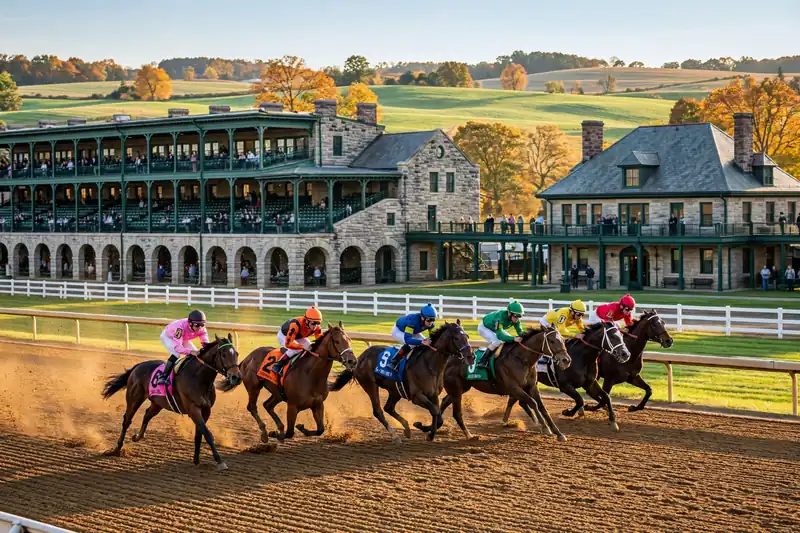
Keeneland is the most beautiful racetrack in America, and the whole city revolves around it twice a year. Built in 1936 from native limestone, with stone walls, white fences and a grandstand that has barely changed since the first race, it is a National Historic Landmark that still runs a real race meet rather than a museum version of one. The Spring Meet runs 2–23 April 2027 — fifteen days, fifteen graded stakes, including the Blue Grass Stakes — and the Fall Meet runs 1–23 October 2027, seventeen days with seventeen graded stakes and six Grade 1 races. There is no racing on Mondays and Tuesdays, and the first post is at 1 p.m. General admission in the fall of 2026 was $7 on Wednesdays and Thursdays, $10 on Fridays through Sundays and $15 on opening weekend, with reserved grandstand seats from $15 to $30; 2027 prices had not been published when we checked, so expect a small rise. Come for the racing, stay for the scene: the paddock, where the horses are saddled in front of the crowd, is the best free show in Kentucky, and the clubhouse has a dress code, so leave the denim at the hotel. The track also runs the world’s largest Thoroughbred auctions, and the September Yearling Sale is worth a look even if you will never bid. One date to get right: the Breeders’ Cup World Championships were held at Keeneland on 30–31 October 2026 — fourteen Grade 1 races worth more than $34 million, ending with the $7 million Classic — and they are over. The 2027 Breeders’ Cup goes to Belmont Park on 29–30 October 2027, so do not plan a Lexington trip around a Breeders’ Cup that is not happening here.
2. Kentucky Horse Park
The Kentucky Horse Park is the one place in the world that is a working horse farm, a museum and an international competition venue at the same time, spread across more than 1,200 acres on Lexington’s northern edge. It opened in 1978, and it is the only park of its kind anywhere: more than 30 breeds live here, from Clydesdales to Arabians, and the Hall of Champions puts retired champions — the kind of horses whose names racing fans know by heart — on show twice a day in the main season, at 10:30 a.m. and 1:15 p.m., with a nightcap at 3:30 p.m. The International Museum of the Horse, a Smithsonian Affiliate, is the best single museum in Lexington, and the American Saddlebred Museum and the Wheeler Museum are included in the same ticket. Prices and hours change with the season, and this is where most guides go stale: from 9 November 2026 to 14 March 2027 the park is on winter hours, open Friday to Sunday only, 10 a.m. to 4 p.m., at $20 for adults, $15 for seniors and military, and $10 for students aged 5 to 17. From 15 March 2027 the main season starts — daily, 9 a.m. to 5 p.m., closed on Tuesdays — at $28 for adults, $23 for seniors, $21 for military and $14 for students, and your ticket includes the next day free. Horseback trail rides run about $35 a rider and pony rides about $10. Come in late April for the Kentucky Three-Day Event, the five-star eventing competition that fills the park with the best horse-and-rider pairs on the planet, and book it months ahead.
3. A Thoroughbred farm tour
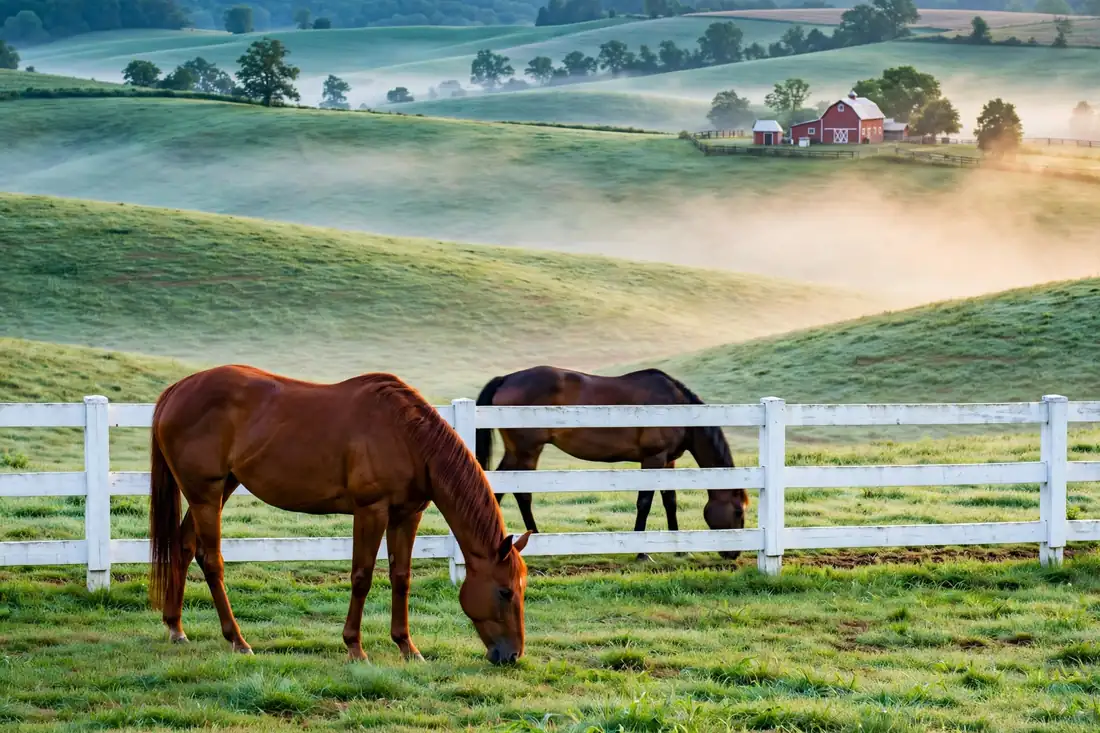
A farm tour is the experience that makes Lexington different from every other American city, and it is the one thing you cannot do by just showing up. The farms are working businesses, not attractions: the gates are closed, the horses are worth millions, and the only way in is a booked tour. Book through Visit Horse Country, the booking hub at visithorsecountry.com, which runs tours at dozens of farms, nurseries, feed mills, veterinary clinics and retirement operations. Spendthrift Farm, at 884 Iron Works Pike, is the easiest first tour: founded in 1937 on 1,200 acres, home to Authentic, Into Mischief, Beholder and Monomoy Girl, it runs public tours Thursday to Saturday, with a Shuttle Experience at $35, a stallion-complex tour at $45 and a train ride experience at $53. Claiborne Farm in Paris, Kentucky, is the historic one — founded in 1910, the birthplace of more than 80 champions, and the resting place of Secretariat — with guided tours seven days a week, a walking stallion tour and a seasonal shuttle tour from April to October. Jonabell Farm, the Darley stallion complex, runs tours for about $20, and Mill Ridge Farm, Spy Coast Farm, Taylor Made, Three Chimneys and Lane’s End all offer tours through the same hub. The half-day Thoroughbred Heritage tour, about $45 for three hours from 366 Waller Avenue, is the best value if you want two farms in one morning. A few rules that save embarrassment: book at least a few days ahead, wear closed shoes, do not touch a horse unless the guide says so, and do not expect to walk into Calumet Farm — the famous white-fenced farm at 3301 Versailles Road is drive-by only on most tours, with no regular public tour of its own.
4. The Red Mile
The Red Mile is the other racetrack in Lexington, and it is older than Keeneland by sixty years: harness racing has run here since 1875, making it the second-oldest harness track in the world. The horses are Standardbreds, the drivers sit in two-wheeled sulkies, and the whole thing is faster and stranger than Thoroughbred racing — a mile in under 1:50 is routine here, and the track record book reads like a history of the sport. The 2026 live season, the 151st, ran from 26 July to 10 October, with racing Sunday to Wednesday, and the Grand Circuit meet closed it out on 1–3 and 8–10 October, headlined by the 134th Kentucky Futurity on 3 October, the final jewel of the Trotting Triple Crown. That season is now over, and this is the timing trap: from November to June there is no live racing at the Red Mile at all, so do not build a winter trip around it. If you come in summer or early autumn, an afternoon at the Red Mile is the cheapest racing in Lexington and the most local — the crowd is regulars, the betting windows are uncrowded, and the infield is also where Railbird, the city’s big music festival, sets up every June.
5. Mary Todd Lincoln House
The Mary Todd Lincoln House is the girlhood home of the future first lady, and it is the most personal of Lexington’s historic houses: a 14-room home at 578 West Main Street where Mary Todd grew up, filled with the family’s portraits and furniture, and the first historic site in America restored to honour a first lady, opened as a museum in 1977. Mary Todd Lincoln was born in Lexington in 1818, married Abraham Lincoln in 1842, and the house tells her story rather than his — her childhood, her family, her Lexington years before Springfield. The house runs on a seasonal clock, and this catches visitors out: it is open 15 March to 30 November, Monday to Saturday, 10 a.m. to 4 p.m., closed on Sundays, and closed entirely from 1 December to 14 March. Self-guided visits are $15 for adults and $6 for young people aged 6 to 17, guided tours are $20 and $10, children under 5 are free, and admission is free for SNAP recipients. The guided tour at 3 p.m., Monday to Friday, is the one to take if you want the stories rather than the labels. Parking is free, with a two-hour validation at the Main Street Baptist Church lot, and the house pairs naturally with Ashland, a ten-minute drive away.
6. Ashland, The Henry Clay Estate
Ashland is the 18-room mansion of Henry Clay, the “Great Compromiser” — Speaker of the House, Secretary of State, senator and three-time presidential candidate — set on 17 acres of gardens and grounds at 120 Sycamore Road. The house is a National Historic Landmark, and the guided tour is the best hour of American political history in Kentucky: Clay’s rise, his compromises, his duels, his horses, and the enslaved people whose labour built the estate, told honestly on the Traces: Slavery at Ashland tour, which is limited to ages 12 and up. Tours cost $25 for adults, $15 for students aged 6 through college, and are free for children under 5; the grounds are free. Hours are the trap here, and half the internet still lists the old $9 admission: the mansion is open Tuesday to Saturday, 10 a.m. to 4 p.m., and Sunday, 1 p.m. to 4 p.m., with tours at 10:00, 11:30, 2:30 and 3:45 on weekdays and Saturdays and at 1:00, 2:30 and 3:45 on Sundays. It is closed every Monday, on major holidays, and for all of January and February, though the grounds stay open from 8 a.m. to 5 p.m. daily. Book online in advance — space on each tour is limited — and leave an hour for the gardens, which are an official arboretum.
7. Waveland State Historic Site
Waveland State Historic Site is the quieter of Lexington’s three great houses, and the one most visitors skip, which is a mistake. The 1848 Greek Revival mansion at 225 Waveland Museum Lane was the home of Joseph Bryan, a grandnephew of Daniel Boone who followed Boone through the Cumberland Gap and became one of the Bluegrass region’s early horsemen. The house sits on 10 acres of gardens and grounds, with its original slave quarters still standing, and the guided tour — led by guides in period dress — tells the story of the 1850s hemp industry that made this part of Kentucky rich. Hours are Wednesday to Saturday, 9:30 a.m. to 4 p.m., and Sunday, 1 p.m. to 4 p.m., closed Monday and Tuesday; guided tours cost a small fee, about $7 for adults, with lower rates for children and seniors — check the Kentucky State Parks page before you go, as winter tours run by reservation only. The Tea Tuesday events, at 2 p.m. with reservations required, are a Lexington institution, and the grounds are free to wander when the house is closed.
8. Aviation Museum of Kentucky
The Aviation Museum of Kentucky sits on the grounds of Blue Grass Airport at 4029 Airport Road, and it is the surprise hit of Lexington: a former corporate hangar, opened to the public in 1995, packed with warbirds and Kentucky aviation history. The stars are the Grumman F-14B Tomcat, a veteran of 50 strike missions, and the Blue Angels A-4 Skyhawk parked outside, plus a Crosley Moonbeam biplane, flight simulators the kids can climb into, and the Kentucky Aviation Hall of Fame, which honours the Kentuckians who shaped flight — from Matthew Sellers, who gave aviation retractable landing gear, to Noel Parrish of Versailles, who led the Tuskegee Airmen. Admission is $18 for adults aged 17 to 59, $16 for seniors, veterans, active-duty military, first responders and teachers, $12 for young people aged 4 to 17, free for children 3 and under, and $50 for a family of four — and that $18 is worth knowing, because several popular guides still list the old $15. Hours are Tuesday to Saturday, 10 a.m. to 5 p.m., and Sunday, 1 p.m. to 5 p.m., closed on Mondays, with shorter winter hours from January to March, Tuesday to Friday, 11 a.m. to 4 p.m. The museum is outgrowing its hangar: a new facility is planned at the corner of Man O’War Boulevard and Airport Road for March 2028. Allow about two hours, and check the events page before you go — the summer fly-ins bring restored barnstormers and warbirds onto the ramp.
9. Lexington Opera House
The Lexington Opera House has been downtown’s stage since 1886, and it is still the best room in the city to see a show. The building at 401 West Main Street survived fire, demolition threats and a century of changing tastes, and today it hosts the touring Broadway series, concerts, comedy and dance, a few steps from the bars of Short Street. The Broadway season is the draw — the touring productions that play Louisville and Cincinnati stop here too, usually for a week, and the tickets are cheaper than in the bigger cities. Check the listings before you travel, because the calendar is seasonal: the big shows cluster from autumn to spring, and summer is quieter. If nothing is playing, the building itself is worth a look from the outside, and the Opera House pairs with the Kentucky Theatre, two blocks away, for a full evening of downtown culture. Book ahead for the Broadway weeks; the best seats go first, and the mezzanine is the value pick.
10. The Kentucky Theatre
The Kentucky Theatre is one of the last surviving movie palaces in America, and it has been showing films on East Main Street since 1922. The single screen, the balcony, the Wurlitzer organ and the hand-painted ceiling make it the opposite of a multiplex: first-run films, classic revivals and the Summer Classics series, with the organ played before weekend shows. It is also the cheapest night out in downtown Lexington — a ticket costs a fraction of a Broadway seat — and the crowd is local, which is the point. The theatre has had its own close calls, including a closure scare in 2020, and it survives because Lexington keeps turning up for it. Go on a Friday night, sit in the balcony, and stay for the organ. Check the weekly schedule online, because the programming changes every week and the classics sell out.
11. The Distillery District
The Distillery District is where Lexington’s bourbon story is easiest to taste: a 25-acre former distillery complex on Manchester Street, centred on the James E. Pepper Distillery, which sat vacant for 50 years before reopening in 2017. James E. Pepper traces its brand to the American Revolution, and the tour — $25 for adults 21 and over, $10 for young adults aged 14 to 20, $10 for veterans and free for active military, ages 14 and up only — is one of the best in Bourbon Country: small groups, a working distillery, a tasting glass to keep, and a story that runs from the 1700s to the present. Hours are Monday to Thursday, 10 a.m. to 6 p.m., Friday to Saturday, 10 a.m. to 7 p.m., and Sunday, 11:30 a.m. to 5:30 p.m. Next door, Barrel House Distilling Co., in the old Pepper barrel house at 1200 Manchester Street, runs tours on the hour Wednesday to Sunday for about $11 including a tasting, with the gift shop and tasting room open Wednesday to Sunday, 11 a.m. to 5 p.m., last tour at 4 p.m. The district also holds Town Branch Distillery, the Elkhorn Tavern, Goodfellas Pizzeria, Crank & Boom ice cream and Brevede coffee, all along Town Branch Creek. Come hungry, come with a designated driver or a rideshare, and remember that Lexington has eight distilleries inside the city and eleven more within a 45-minute drive — this is the starting point, not the whole trail.
12. Gatton Park on the Town Branch
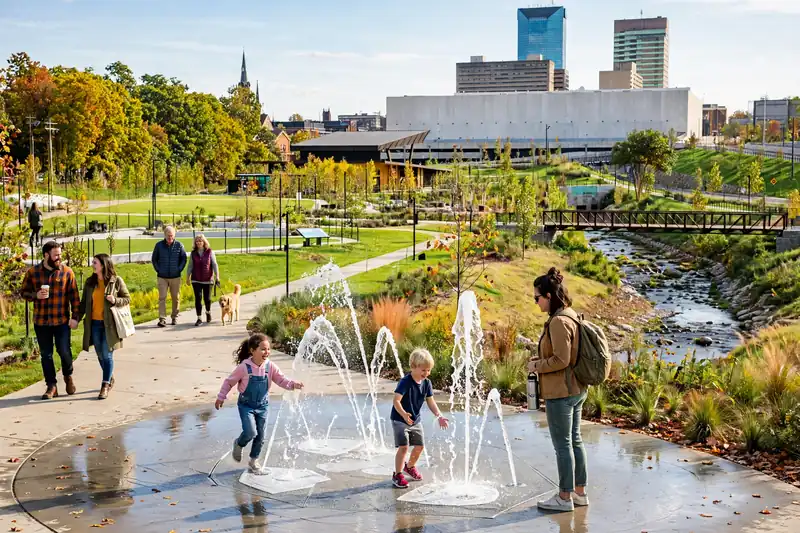
Gatton Park on the Town Branch is the newest thing in Lexington, and it is already the city’s front room. The 11-acre park behind Rupp Arena and the Central Bank Center opened on 23 August 2025, after a decade of planning and two years of construction, on the site of a former asphalt parking lot — and more than 280,000 people visited in its first year. The restored Town Branch Creek runs down the middle of it, with a 5,000-seat amphitheatre, the CommonSpirit Health Stage, an adventure playground designed for children of all abilities, a splash pad, two dog parks, public art and free Wi-Fi across the whole park. It is free to enter, it is part of the Town Branch Commons Trail, 22 miles of connected bike and pedestrian paths, and it is where Lexington now holds its outdoor concerts, its food-truck nights and its big free events. Come in the late afternoon, when the light hits the creek and the amphitheatre fills up, and bring the kids — the four-storey playground is the best in the city. Older guides do not list Gatton Park at all, which is exactly why it belongs at the top of yours.
13. The Arboretum, State Botanical Garden of Kentucky
The Arboretum, the official State Botanical Garden of Kentucky, is 100 acres of calm on the University of Kentucky campus at 500 Alumni Drive, and it is free. The grounds are open daily from dawn to dusk, the Dorotha Smith Oatts Visitor Center is open Tuesday to Saturday, 9 a.m. to 4 p.m., and the two-mile paved loop passes through the “Walk Across Kentucky”, a living map of the state’s seven regions, from the Bluegrass to the Mississippi Alluvial Plain. The Kentucky Children’s Garden, inside the Arboretum, charges $4 for children aged 2 and over and runs from 1 April to 31 October — and it is closed until 1 April 2027, so do not promise it to the kids in winter. Parking is free, from 8 a.m. to 8 p.m. daily, with one catch: the grounds and parking close on University of Kentucky football home game days, when the whole south side of campus becomes a tailgate. Come in April for the spring blooms, in October for the fall colour, and on a weekday morning for the quietest walk in the city.
14. Raven Run Nature Sanctuary
Raven Run Nature Sanctuary is Lexington’s wild side: 734 acres of meadows, woodland, streams and limestone bluffs along the Kentucky River Palisades, about 20 minutes south of downtown, run by the city’s parks department and free to enter. Ten miles of trails wind through it, and the Red Trail — a roughly five-mile loop through rocky woods — is the one to take, ending at the Kentucky River Overlook, 70 feet above the river, with the best view in Fayette County. The Freedom Trail, a paved half-mile beside Chandler Creek, is the easy option, and the Evans Mill site, where Peter Evans built a grist mill in 1833, is the history stop. Hours are seasonal, and this is the detail to check: from November to March the sanctuary is open 9 a.m. to 5 p.m. with trails closing at 4:30 p.m.; in April it runs 9 a.m. to 6 p.m.; from May to September it runs 9 a.m. to 7 p.m. with trails closing at 6:30 p.m. It is closed on Thanksgiving and from 24 to 26 December, and the rules are strict — no pets, no bikes, no drones, no fires, no picnicking except in the designated areas — because it is a sanctuary first and a park second. Bring water, wear real shoes, and give the Red Trail two hours.
15. McConnell Springs Park
McConnell Springs Park is where Lexington began, and it is the smallest, quietest stop on this list. In June 1775 a party of pioneers camped at these springs, heard the news of the Battle of Lexington, Massachusetts, and named their settlement after it — and the park at 416 Rebmann Lane preserves the springs, the sinkhole and the 26 acres around them. McConnell Springs is a free city park with about two miles of trails through woods and meadows, a small education centre, and the blue hole where the spring water rises. It is open daily, dawn to dusk, and it is the best half-hour in Lexington for anyone who likes the origin story of a place: stand at the springs, read the markers, and remember that everything in this guide — Keeneland, the Horse Park, the bourbon, the whole Bluegrass — started with a campfire here in 1775. Pair it with the Legacy Trail, which passes nearby, or with a drive out Old Frankfort Pike.
16. The Legacy Trail
The Legacy Trail is the best way to see the Bluegrass without a car window between you and it: a 12-mile paved trail that runs from downtown Lexington all the way to the Kentucky Horse Park, past horse farms, stone fences and the rolling pasture that made this region famous. It is free, it is flat enough for any rider, and it is the locals’ favourite weekend ride. Start downtown, ride north past the farms on Iron Works Pike, and finish at the Horse Park, where you can lock the bike and spend the afternoon. The trail is also the practical answer to the Horse Park’s parking on busy days, and it connects to the Town Branch Commons Trail downtown. Bring water in summer — there is almost no shade on the middle stretch — and ride it in the morning, when the mist is still on the fields and the horses are out.
17. Lexington Cemetery
The Lexington Cemetery is 170 acres of park, garden and history at 833 West Main Street, and it is one of the most beautiful walks in the city. Founded in 1849, it is the final resting place of Henry Clay, whose monument towers over the grounds, and of thousands of Civil War soldiers, and its rolling lawns, old trees and spring magnolias make it feel more like an arboretum than a burial ground. It is free, open daily during daylight hours, and the driving loop is the lazy way to see it — though the walking paths, past the lakes and the historic section, are the better choice. Come in April, when the magnolias and redbuds are out and the whole cemetery turns into a garden, and keep your voice down: it is still an active cemetery, and Lexington families still bury their dead here.
18. Triangle Park
Triangle Park is downtown Lexington’s living room, a small green triangle at Main Street and Broadway with a splash fountain in summer and an ice rink in winter. It is free to sit in, free to watch, and the best place downtown to do nothing for half an hour: the fountain draws children all summer, the rink draws skaters from November to January, and the food trucks and lunchtime concerts draw the office crowd. It sits between the Opera House, the Kentucky Theatre and the bars of Short Street, so it works as the meeting point for an evening out, and it is the easiest free stop on this list — no ticket, no hours, no plan. If you are downtown on a Saturday, walk through it on the way to the Farmers Market, and if you are here in December, skate a lap and then go and warm up with a bourbon on Short Street.
19. Lexington Farmers Market
The Lexington Farmers Market is the city’s main producers’ market, and its Saturday market downtown is the best morning in Lexington. It runs year-round, every Saturday, at the Fifth Third Pavilion in Henry A. Tandy Centennial Park — the park most locals still call by its old name, Cheapside Park — right beside the historic courthouse on Main Street. Hours are 8 a.m. to 2 p.m. from April to October, and 9 a.m. to 1 p.m. in winter, and the winter location is the detail to get right: from Saturday 7 November 2026 the winter Saturday market moves indoors to Greyline Station, 101 West Loudon Avenue, at the same 9 a.m. to 1 p.m. hours — an older page on the market’s own site still says it stays at Tandy Park, so check the homepage before you go. The market also runs Sundays on Southland Drive, 10 a.m. to 2 p.m., and Tuesdays and Thursdays on National Avenue, and SNAP benefits are doubled at every market. Come hungry: the stalls sell Kentucky produce, meats, eggs, baked goods and plants from more than 50 farmers, plus food trucks and live music on Saturdays. Metered street parking is free on Saturdays, and the market is the best place in the city to buy beer cheese, bourbon balls and Ale-8-One to take home.
20. 21c Museum Hotel
The 21c Museum Hotel is a hotel that is also a free art museum, and it is the most interesting place to sleep in downtown Lexington. The boutique hotel at 167 West Main Street, in a renovated historic building beside the old courthouse, has two floors of rotating contemporary art exhibitions that are free and open to the public, whether you are staying there or not. The green penguins are the signature — the life-size sculptures appear all over the hotel, and finding them is half the fun — and the restaurant, Lockbox, is one of the best tables downtown. Even if you stay elsewhere, walk in, look at the art, and have a drink at the bar: it is the easiest free culture in the city, and the building itself, with the old courthouse next door, is the best-preserved corner of historic downtown. Rooms run about $180–$300 a night, which is top of the downtown range, but the art is free, the location is the best in the city, and the penguins are worth the visit on their own.
Lexington in 3 days — a ready-made itinerary
Three days is the right length for Lexington: one day for the horses, one day for the history and the town, and one day for the outdoors and the bourbon. Two days works if you skip the bourbon day trips, but the farm tour is the one thing you should not cut. This plan assumes April or October, when Keeneland is racing; if you come outside race season, swap the Keeneland morning for the Horse Park and add a second farm tour.
Day 1 — Keeneland, the Distillery District and downtown
Start at Keeneland. Arrive by 10 a.m., walk the grounds, watch the horses being saddled in the paddock, and stay for the first races after the 1 p.m. post — even if you never bet, the paddock and the grandstand are the show. Have lunch at the track or back downtown, then spend the afternoon in the Distillery District: the James E. Pepper tour, a tasting at Barrel House, and a wander along Town Branch Creek, finishing with ice cream at Crank & Boom. In the evening, walk through Gatton Park as the lights come on, have dinner on Short Street — Dudley’s on Short or Carson’s Food & Drink — and catch a show at the Opera House or a film at the Kentucky Theatre if anything is playing.
Day 2 — The Horse Park, the historic houses and the Farmers Market
If it is a Saturday, start at the Farmers Market downtown, 8 a.m. to 2 p.m., for breakfast from a food truck and a bag of beer cheese to take home. Then drive north to the Kentucky Horse Park for the morning: the Hall of Champions Show at 10:30 a.m., the International Museum of the Horse, and a trail ride if you booked one. In the afternoon, come back into town for the history: the Mary Todd Lincoln House, then Ashland, the Henry Clay Estate, ten minutes away. Finish the day at 21c Museum Hotel — walk the free galleries, look for the green penguins, and have dinner at Lockbox — or, if the weather is good, take a picnic to Triangle Park and watch downtown wind down.
Day 3 — Outdoors, the Bourbon Trail and the Bluegrass drive
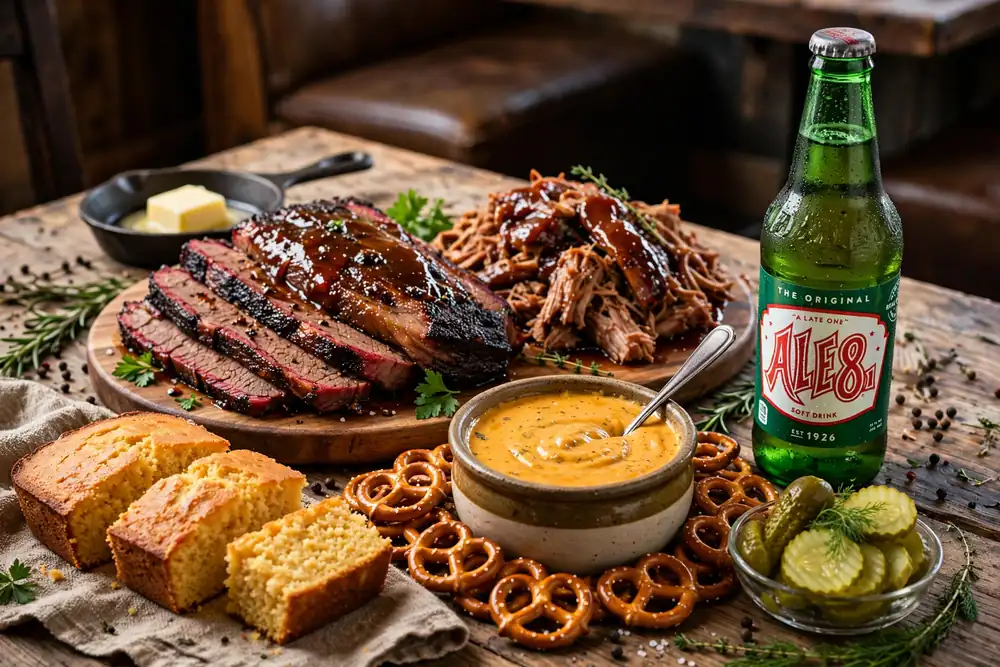
Start early at Raven Run Nature Sanctuary for the Red Trail loop and the Kentucky River Overlook, or at the Arboretum if you want an easier morning. Then take the Bluegrass drive: out Old Frankfort Pike past the horse farms to Woodford Reserve in Versailles, about 12 miles from downtown, for the Path to Flavor tour — book it online, 90 days ahead, because walk-in spots are not reliable — or on to Buffalo Trace in Frankfort, about 25 minutes further, where the Trace Tour is free but the booking slots open on Wednesdays at 10 a.m. and go fast. On the way back, stop at the Legacy Trail for a late-afternoon ride or walk, then finish with barbecue: Blue Door Smokehouse is the local favourite, and a plate of bourbon-glazed brisket with beer cheese and an Ale-8-One is the right last meal in Lexington.
Best time to visit Lexington
| Season | Weather | What happens | Who it suits |
|---|---|---|---|
| Spring (April–May) | 55–75°F, mild with rain | Keeneland Spring Meet 2–23 April 2027; Kentucky Derby 1 May 2027 in Louisville; Kentucky Three-Day Event; magnolias at the Cemetery; Farmers Market in full swing | Everyone — the best season in Lexington |
| Summer (June–August) | 80–90°F, hot and humid | Railbird Festival in June; Red Mile harness season July–October; farmers markets at their peak; long evenings at Gatton Park | Festival goers and families, if you can take the heat |
| Autumn (September–November) | 50–70°F, crisp and clear | Keeneland Fall Meet 1–23 October 2027; fall colour at the Arboretum and Raven Run; the Horse Park’s last full month before winter hours | Race fans and photographers — the second-best season |
| Winter (December–February) | 30–45°F, cold and quiet | Horse Park on winter hours, Friday to Sunday only; Mary Todd Lincoln House and Ashland closed January and February; hotel deals; Triangle Park ice rink | Bargain hunters and anyone who hates crowds |
April and October are the months to aim for, and it is not close: the Keeneland meets set the city’s calendar, the weather is at its best, and the Bluegrass is at its greenest in spring and its most colourful in autumn. April has the extra pull of Derby week — the Kentucky Derby runs on Saturday 1 May 2027 at Churchill Downs in Louisville, about 80 miles west, and Lexington fills up with Derby-week visitors, so book early and expect hotel prices to jump. June is the festival month: Railbird ran on 6–7 June 2026 at the Infield at Red Mile, headlined by Tyler Childers and The Lumineers, with two-day general admission from $265, and the 2027 dates had not been announced when we checked. Summer is hot and humid, and the Red Mile’s season runs July to October, so a summer trip works if you plan around the heat and the harness racing. Winter is the quiet season and the cheap one: hotel rates fall, the parks empty, and the Triangle Park ice rink is the main event — but the Horse Park runs Friday to Sunday only from November to March, and the Mary Todd Lincoln House and Ashland are both closed in January and February, so check the hours before you book. One event not to plan around: the Festival of the Bluegrass — the oldest bluegrass festival in the region, held at the Kentucky Horse Park every June from 1974 — ended in 2019 and never resumed after the 2020 cancellation, though several older guides still list it. Railbird is the festival that replaced it.
Where to stay in Lexington
| Area | Best for | Price range | Notes |
|---|---|---|---|
| Downtown | Walkers, food, the Opera House, Gatton Park, the Distillery District | About $150–$300 a night | 21c Museum Hotel, The Campbell House, Hilton Lexington/Downtown and Hyatt Regency Lexington; book early for race weeks and Derby week |
| North side, near the Horse Park | Horse fans, families, early starts | About $120–$220 a night | Chain hotels along Newtown Pike and Iron Works Pike, ten minutes from the Horse Park and Keeneland |
| Versailles Road and horse country | Romance, bourbon trips, the Kentucky Castle | About $200–$400 a night | The Kentucky Castle in Versailles, about 15 minutes from downtown, is the splurge — a castle hotel in the middle of the farms |
| Budget, near I-75 | Drivers, short stays, saving money | About $90–$150 a night | Chain motels along the interstate exits; a 10-minute drive to downtown, and the cheapest beds in town |
Downtown is the right base for most visitors: everything on this list except the Horse Park and the farms is walkable from it, and the restaurants, bars and theatres are all within a few blocks. The 21c Museum Hotel is the most interesting stay in the city — a boutique hotel that is also a free art museum — and The Campbell House, the Hilton Lexington/Downtown and the Hyatt Regency Lexington are the solid mid-range picks, all within walking distance of Gatton Park and Short Street. If horses are the whole trip, stay on the north side near the Horse Park, where the chain hotels along Newtown Pike put you ten minutes from the park and from Keeneland. The splurge is The Kentucky Castle in Versailles, a castle hotel in the middle of the horse farms, about 15 minutes from downtown — book it for a special occasion, and book it early, because it sells out on race weekends. Budget travellers should look at the chain motels along I-75: a ten-minute drive from downtown, and the cheapest beds in Lexington. Whatever you choose, book early for the Keeneland meets in April and October and for Derby week at the start of May, when prices double and the good rooms go first. And if you are combining Lexington with the Derby itself, Louisville is an easy day trip — about 80 miles west on I-64 — but stay in Lexington for the horses and go to Louisville for the race.
Getting around Lexington
| Way to get around | Cost | Best for | Notes |
|---|---|---|---|
| Car | About $50–$80 a day to rent, plus parking | The Horse Park, the farms, the distilleries, Woodford Reserve and Buffalo Trace | Essential outside downtown; downtown parking runs about $10–$25 a day, and metered street parking is free on Saturdays |
| Lextran city bus | About $1 a ride | Downtown and the University of Kentucky campus | Useful in town, but the buses do not reach the Horse Park or the farms |
| Rideshare and taxi | About $10–$25 in town | Evenings, the Distillery District, the airport | Easy downtown; book ahead for the Horse Park and the farms, where pickups are slow |
| Walking | Free | Downtown, Gatton Park, the Opera House, the Farmers Market, Short Street | The downtown core is compact — the market to the Opera House is a ten-minute walk |
| Biking | Free on your own bike | The Legacy Trail, the Town Branch Commons Trail | The 12-mile Legacy Trail runs from downtown to the Horse Park; bring water in summer, there is little shade |
| Airport | Blue Grass Airport (LEX), 15 minutes west of downtown | Flying in | A small, easy airport; rideshares and taxis meet every flight, and the Aviation Museum is on the airport grounds |
Lexington is two cities for getting around: downtown, where you do not need a car, and everywhere else, where you do. Downtown is compact and walkable — the Farmers Market, Gatton Park, the Opera House, the Kentucky Theatre, the Distillery District and Short Street are all within a fifteen-minute walk of each other — and Lextran buses, about $1 a ride, cover the town and the University of Kentucky campus. But the Horse Park, the farm tours, Woodford Reserve, Buffalo Trace and Raven Run are all a drive away, and the buses do not go there, so rent a car for at least the horse and bourbon days. Rideshares are easy downtown and at the airport, but slow to pick up at the Horse Park and the farms, so book your return ride before you go in. Parking downtown runs about $10–$25 a day in the garages, and metered street parking is free on Saturdays, which is another reason to do the Farmers Market on foot. If you are adding a day trip, Louisville is about 80 miles west on I-64 — an easy drive for the Derby or Churchill Downs — and Cincinnati is about 80 miles north on I-75, and our Cincinnati guide covers it. Blue Grass Airport is 15 minutes west of downtown, and the Aviation Museum sits on the airport grounds, so it is the easiest possible stop on your way in or out.
Lexington food you have to try
Lexington was named the sixth-best food city in the United States, and it earns it without trying to be fancy: the cooking here is Kentucky cooking — bourbon in everything, barbecue smoked low and slow, beer cheese on every table — served in rooms that range from white-tablecloth to counter-service. The Hot Brown, Kentucky’s most famous dish, belongs to Louisville, not Lexington, so do not go looking for it here; Lexington’s plates are bourbon, barbecue and burgoo, and they are better for it.
Bourbon and beer cheese
Bourbon whiskey is not just a drink in Lexington, it is an ingredient: bourbon-glazed brisket, bourbon balls, bourbon butter, bourbon in the barbecue sauce and in the ice cream. Start at the Distillery District, where the tastings teach you the difference between a wheated bourbon and a high-rye one, then eat your way down Short Street, where the menus all carry a bourbon list as long as the wine list. Beer cheese is the other Lexington staple: a sharp, spreadable cheddar-and-beer dip invented in Winchester, just east of Lexington, in the 1940s, and now on every bar table in the city, served with pretzels and celery. Buy a tub at the Farmers Market to take home — it travels better than a bottle of bourbon, and it is the souvenir that actually gets eaten. The city’s own distilleries make the pairing easy: eight inside the city limits, eleven more within a 45-minute drive, and the Kentucky Bourbon Trail runs right through town.
Burgoo, barbecue and the Bluegrass table
Burgoo is Kentucky’s stew — a thick, smoky mix of meats and vegetables, cooked for hours and served in a bowl with cornbread — and it is the dish that tells you that you are in the Bluegrass rather than anywhere else in the South. Order it wherever you see it, and order the barbecue with it: Blue Door Smokehouse is the local favourite for brisket and pulled pork, and the farm-to-table rooms — Dudley’s on Short, Carson’s Food & Drink, Honeywood at the Summit at Fritz Farm — are where Lexington’s chefs show off the farms that surround the city. The pattern is the same everywhere: local meat, local produce, a bourbon glaze, and a portion that assumes you walked here. Eat lunch downtown, where the prices are kindest, and save dinner for the rooms with a bourbon list.
Ale-8-One and Lexington’s sweet side
Ale-8-One is Kentucky’s own soda — a ginger-and-citrus soft drink, bottled in Winchester since 1926, that tastes like nothing else in America — and it is the drink to order with barbecue, with breakfast, and with anything fried. It comes in the green glass bottle, it comes in diet and cherry, and it comes with every meal in Lexington if you ask for it. For dessert, the local sweet is the Blue Monday: a chocolate-covered pulled-cream candy bar made in Lexington by Rebecca Ruth since 1919, sold at the Farmers Market and in the downtown shops. And for ice cream, Crank & Boom in the Distillery District makes the city’s best scoops, including a bourbon-ball flavour that tastes exactly like the name suggests. Finish the day with a Blue Monday and an Ale-8-One, and you will understand Lexington’s food in one bite and one sip.
Free things to do in Lexington
Lexington is generous with free things, and a careful visitor can fill a day without spending a dollar. The Arboretum’s 100 acres of gardens are free, dawn to dusk, every day of the year. Gatton Park is free, all 11 acres of it, with the creek, the amphitheatre and the playground. Triangle Park is free, McConnell Springs is free, the 12-mile Legacy Trail is free, Raven Run’s 734 acres of trails are free, and the grounds of Ashland are free from 8 a.m. to 5 p.m. daily, even when the mansion is closed. The University of Kentucky Art Museum is free, and so are the two floors of contemporary art at 21c Museum Hotel — walk in, look at the exhibitions, find the green penguins, and leave without spending anything. Thoroughbred Park, downtown on Main Street, is a free open-air gallery of life-size bronze horses. Keeneland’s grounds are free to walk on non-race days, and the Farmers Market is free to browse, with live music on Saturdays. The Lexington Cemetery is free, dawn to dusk, and the most beautiful free walk in the city in April. Add it up and the free list is longer than the paid one — which is why Lexington works so well on a budget, and why the money you do spend should go on the farm tour and the bourbon.
Frequently asked questions
How many days do you need in Lexington?
Three days is the right length: one day for the horses, one day for the history and the town, and one day for the outdoors and the bourbon. Two days works if you skip the bourbon day trips to Woodford Reserve and Buffalo Trace, but do not cut the farm tour — it is the one experience you cannot get anywhere else. One day is enough only for Keeneland and downtown, and you will leave feeling you missed the point.
Is Lexington worth visiting if you are not into horses?
Yes. The horses are the headline, but the bourbon, the history and the food are a full trip on their own: the Distillery District, the Mary Todd Lincoln House, Ashland, the Opera House, the Kentucky Theatre, Gatton Park, the Arboretum and the Farmers Market have nothing to do with racing, and the barbecue and beer cheese are worth the flight alone. If you actively dislike horses, come in June for Railbird, or in winter, when the city is at its quietest and cheapest.
Do you need a car in Lexington?
Yes, for the horses and the bourbon, and no, for downtown. The Horse Park, the farm tours, Woodford Reserve, Buffalo Trace and Raven Run are all a drive away, and the buses do not go there, so rent a car for at least the horse and bourbon days. Downtown is walkable — the market, Gatton Park, the Opera House, the theatres and Short Street are all within fifteen minutes of each other — and Lextran buses cost about $1 a ride. Rideshares are easy downtown but slow to pick up at the Horse Park and the farms, so book your return before you go in.
What is the best time to visit Lexington?
April and October, when Keeneland is racing and the weather is at its best. The Spring Meet runs 2–23 April 2027 and the Fall Meet runs 1–23 October 2027, and the Bluegrass is at its greenest in spring and its most colourful in autumn. Early May brings Derby week in nearby Louisville, June brings Railbird, and summer brings the Red Mile season and the farmers markets at their peak. Winter is the cheapest season, but the Horse Park runs Friday to Sunday only and the Mary Todd Lincoln House and Ashland are both closed in January and February.
Can you visit a Thoroughbred farm without booking a tour?
No. The farms are working businesses with closed gates, and the only way in is a booked tour through Visit Horse Country, the booking hub at visithorsecountry.com. Book at least a few days ahead — the popular tours sell out, especially on race weekends — wear closed shoes, and do not touch a horse unless the guide says so. Calumet Farm is drive-by only, with no regular public tour. If you want to walk in somewhere without a booking, go to the Kentucky Horse Park instead: it is open to the public, it has more than 30 breeds, and the Hall of Champions Show runs twice a day in the main season.
What should I skip in Lexington?
Do not plan a trip around the Festival of the Bluegrass: it ended in 2019 and never resumed, though several older guides still list it — Railbird in June is the festival that replaced it. Do not plan around the Breeders’ Cup either: it was at Keeneland on 30–31 October 2026 and is over, and the 2027 running goes to Belmont Park. Do not build a winter trip around the Red Mile: there is no live racing from November to June. Do not go looking for Tolly-Ho, the late-night burger counter that fed generations of University of Kentucky students — it closed for good on 31 December 2025 after 54 years — and do not expect lunch at Zim’s Café in the old courthouse, which closed the same day. Do not try to visit the Horse Park on a Tuesday in the main season, when it is closed, or the Mary Todd Lincoln House and Ashland in January and February, when they are both shut. And do not pay for a farm tour from a stranger on the street: book through Visit Horse Country, where the farms are real and the prices are published.
Further reading
Shaker Village of Pleasant Hill
For local tips and first-hand reports from people who live in Lexington, the r/lexington community on Reddit is the place to ask — it is where locals swap restaurant news, race-day advice and photos of the horse country. No Quora link is included, because no live, on-topic Quora thread about visiting Lexington could be verified.
Your Lexington trip, in one paragraph
Lexington is the Horse Capital of the World, and it is the city where the whole idea of this site — one honest, complete guide per place — feels most at home: white fences, stone racetracks, bourbon, history and the Bluegrass, all within a twenty-minute drive of a downtown that finally has a park of its own. Start with the islands and the coasts: our Hawaii guide, our Maui guide, and our Honolulu guide. Then the American cities, in the order we wrote them: our Chicago guide, our Nashville guide, our Los Angeles guide, our Orlando guide, our Miami guide, our San Diego guide, our Denver guide, our Savannah guide, our Dallas guide, our Charleston guide, our San Francisco guide, our Myrtle Beach guide, our Las Vegas guide, and our San Antonio guide. Further afield: our London guide, our Portland guide, our Pigeon Forge guide, our Puerto Rico guide, our Atlanta guide, our Phoenix guide, our Paris guide, our Key West guide, our Colorado Springs guide, our Sedona guide, our Chattanooga guide, our Palm Springs guide, our St Louis guide, and our Tokyo guide. Then the middle of the map: our Japan guide, our Kansas City guide, our Tennessee guide, our Branson guide, our Florida guide, our Amsterdam guide, our Montreal guide, our Fort Lauderdale guide, our Toronto guide, our Aruba guide, our Charlotte guide, our Indianapolis guide, our New Orleans guide, our Destin guide, our Santa Barbara guide, our Mexico City guide, our Arizona guide, our Osaka guide, our Minneapolis guide, our Pittsburgh guide, our California guide, our Asheville guide, our Costa Rica guide, our Washington DC guide, our Seattle guide, our St Augustine guide, our Lisbon guide, our Dubai guide, and our Santa Fe guide. And the most recent: our Galveston guide, our Maine guide, our Sacramento guide, our Kauai guide, our Boston guide, our Cancun guide, our Madrid guide, our Salt Lake City guide, our Baltimore guide, our Barcelona guide, our Reno guide, our Milwaukee guide, our North Carolina guide, our New York guide, our Tucson guide, our Raleigh guide, our Corpus Christi guide, our Milan guide, our Salem guide, our Wilmington guide, our Memphis guide, our Flagstaff guide, our Austin guide, our Oahu guide, our Iceland guide, our Cincinnati guide, our Fort Worth guide, our Panama City Beach guide, our Monterey guide, and our Nassau Bahamas guide. Lexington belongs on that list because it is the one place in America where the horses are not a tourist attraction but a way of life — and after three days here, with Keeneland, the Horse Park, a farm tour and a glass of bourbon behind you, you will understand why.

About the Author