
Things to Do in Monterey
20 Best Attractions, a 3-Day Itinerary, Where to Stay, and the Food You Cannot Miss
Quick Info
Best for: Whale watchers, aquarium lovers, kayakers, history buffs and families — sea otters, whales and sea lions are part of everyday scenery here, not a special event
Best time: September to October, when the fog lifts, the water is calmest and the crowds thin out; whale season peaks December to April for gray whales
How long: 2 days for the Aquarium, Cannery Row, the Wharf and Point Lobos; 3 days adding the 17-Mile Drive, Elkhorn Slough and a Big Sur day trip
Budget: About $150–$250 per person per day mid-range — Cannery Row hotels run about $250–$450 a night, the Aquarium is $65, most other attractions are free or under $20, and the trail, the beaches and the historic adobes cost nothing
Don’t miss: The Monterey Bay Aquarium, Point Lobos at sunrise, a whale watching boat, the Lone Cypress on the 17-Mile Drive, and a bowl of clam chowder on Old Fisherman’s Wharf
Monterey, California on Wikipedia is the small city on the southern edge of Monterey Bay where California began — the old Spanish capital, the sardine-canning town John Steinbeck made famous, and today the home of one of the world’s best aquariums, set on one of the richest marine sanctuaries on the planet. It is a town that works on the water’s schedule: sea otters raft in the kelp off Cannery Row, gray whales pass in winter, humpbacks feed in summer, and monarch butterflies crowd a eucalyptus grove in Pacific Grove from October to February. This guide covers the 20 best things to do in Monterey, a 3-day itinerary that pairs the Aquarium with Point Lobos and the 17-Mile Drive, where to stay without paying Cannery Row prices for a room you only sleep in, how to get around on the free summer trolley and the 18-mile coastal trail, the three foods you should not skip, and the free sights that cost nothing. Everything below was checked against live sources in November 2026 — including the details most guides still get wrong: the Aquarium now costs $65 and sells tickets online only, the 17-Mile Drive toll is $12.50, Point Lobos charges $5 even to walk in, Highway 1 through Big Sur is open again, and Point Lobos was never closed by the 2026 fires — that was Pfeiffer Big Sur.
Monterey at a glance
| Topic | What to know |
| Full name | Monterey, California — a city of about 28,000 people in Monterey County on the Central Coast, on the southern edge of Monterey Bay, about 116 miles south of San Francisco |
| Founded | Established as a Spanish presidio and mission in 1770; capital of Alta California under Spain and Mexico; the U.S. flag was raised over the Custom House in 1846 |
| Population | About 28,000 in the city, about 100,000 across the Monterey Peninsula including Pacific Grove, Carmel and Seaside |
| Nickname | The Sardine Capital of the World (in its cannery days); today “the crown jewel of the Central Coast” |
| Best base | Cannery Row for first-timers; downtown near the Wharf for walkers; Pacific Grove for quiet and Victorian inns |
| Getting around | Walkable downtown and waterfront; free MST Trolley in summer; MST bus $2.50 a ride; a car is needed only for Point Lobos, the 17-Mile Drive and Big Sur |
| Famous for | The Monterey Bay Aquarium, Cannery Row, Old Fisherman’s Wharf, whale watching, Point Lobos, the 17-Mile Drive and sea otters |
Monterey rewards visitors who plan by the tide and the fog, not by the clock. The town is small — you can walk from Old Fisherman’s Wharf to the Aquarium in about 20 minutes along the water — and almost everything worth doing is on the shore or just off it: the Aquarium at the end of Cannery Row, the historic adobes of Old Monterey, the rocky coves of Point Lobos 15 minutes south, and the 17-Mile Drive through Pebble Beach. The mistake most visitors make is treating Monterey as a half-day stop on the way to Big Sur, when two full days barely covers the Aquarium, the Wharf, Point Lobos and a whale watching boat. The trap most guides fall into is the outdated detail: the Aquarium’s price has risen to $65 with online-only tickets, the 17-Mile Drive toll has risen to $12.50, and Highway 1 through Big Sur — closed for three years, then closed again by the August 2026 fires — is open end to end again. This guide gets those right, because we checked them in November 2026. One more thing before you pack: bring layers. The bay sits at about 55°F all year, the fog rolls in most summer mornings, and a sunny afternoon can turn cold by 5 p.m.
The 20 best things to do in Monterey
1. Monterey Bay Aquarium
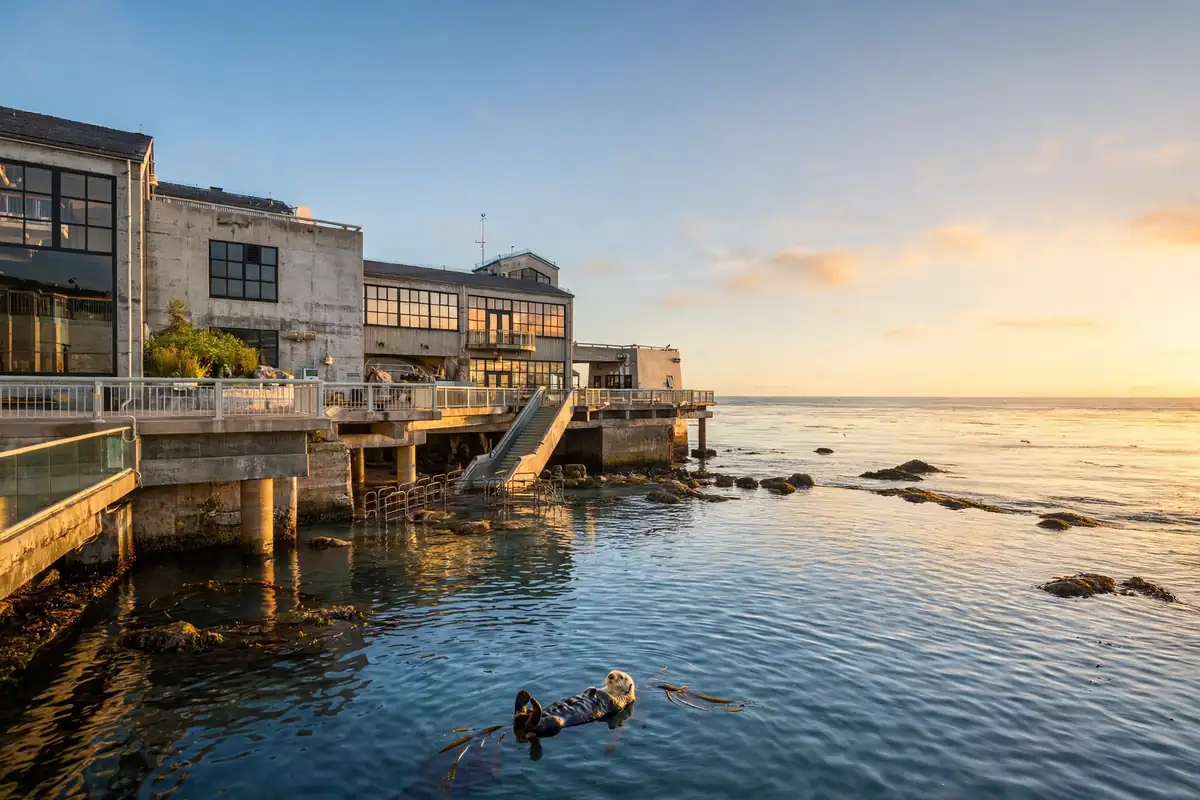
The Monterey Bay Aquarium is the reason most people come to Monterey at all, and it earns the reputation. It sits directly on the water at the end of Cannery Row, in a converted sardine cannery, and its exhibits focus on the local marine ecosystem: the three-storey kelp forest tank, the Open Sea gallery with its million-gallon tank, the mesmerising jellyfish, and the sea otter habitat, where the rescued otters are the stars of the show. As of November 2026, tickets cost $65 for adults (ages 18–69), $50 for youth (ages 5–17) and $50 for seniors (ages 70 and over), with free admission for children 4 and under — and you must buy them online in advance, because the aquarium does not sell tickets at the door. It is open daily from 9:30 a.m. to 6 p.m. Older guides still list $59.95 for adults, and one popular guide still lists $60 — both are stale. Book your ticket online in advance and arrive at opening, when the crowds are thinnest, and allow three to four hours; the afternoon feedings and the otter programme are worth timing your visit around. The aquarium garage at 685 Cannery Row validates parking: show your ticket and the fee drops from $35 to $10 for up to five hours. The Monterey Bay Aquarium on Wikipedia covers the aquarium and its history.
2. Cannery Row
Cannery Row is Monterey’s most famous street, and the one John Steinbeck made world-famous in his 1945 novel Cannery Row on Wikipedia. In the 1930s and 1940s this was the sardine-canning capital of the world, with dozens of canneries working around the clock; the fishery collapsed in the 1950s, the canneries closed, and the street was reborn as a waterfront district of shops, galleries, tasting rooms, restaurants and hotels, with the old cannery buildings kept and converted. Walk it from the Aquarium end to the Steinbeck Plaza end and you pass the whole story: the preserved cannery facades, the wine tasting rooms pouring Carmel Valley wines, the souvenir shops and the seafood restaurants with tables over the water. It is free to walk, and the best time is the morning, before the tour buses arrive, or the evening, when the lights come on and the bay goes quiet. Parking is the catch: the garages typically run $18–$30 a day and the street meters about $1.75 an hour, so walk from your hotel or take the trolley if you can. Steinbeck fans should keep going to the National Steinbeck Center on Wikipedia in Salinas, about 20 minutes inland. Cannery Row on Wikipedia covers the street and its history.
3. Old Fisherman’s Wharf
Old Fisherman’s Wharf is where Monterey’s working waterfront meets its tourist waterfront, and the place to start any first day. The wharf was built in 1846 as the town’s commercial pier, and it still works: fishing boats unload here, sea lions haul out on the pilings below, and the whale watching boats leave from its slips. The wharf itself is a row of seafood restaurants, sweet shops and souvenir stores, famous for the free clam chowder samples the restaurants hand out at their doors — take the samples, then sit down for the real bowl. It is free to walk, open all day, and the best time is the morning, when the fishing boats are coming in and the sea lions are loudest, or the late afternoon, when the whale watching boats return and the light turns gold. The Wharf parking lot charges $1.50 an hour with a $10 daily maximum, and the Monterey Bay Coastal Recreation Trail runs right past its entrance, so you can walk here from Cannery Row in about 20 minutes without touching a road. Fisherman’s Wharf (Monterey, California) on Wikipedia covers the wharf and its history.
4. Whale watching on Monterey Bay
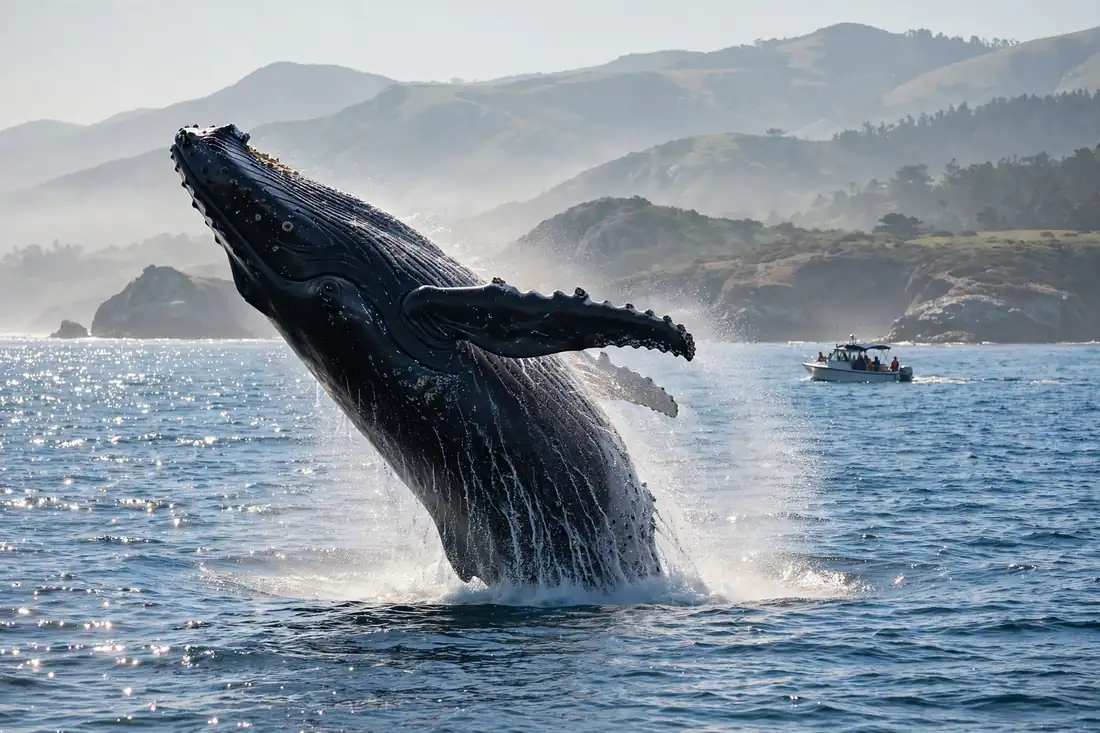
Whale watching is the boat trip that makes the trip, because Monterey Bay is one of the best whale watching spots in North America. A deep submarine canyon drops to about 10,000 feet just two miles offshore, pulling nutrient-rich water — and the whales that feed on it — within a short boat ride of the harbour. The boats run year-round from Old Fisherman’s Wharf, and the season decides what you see: gray whales from December to April, peaking in January on the southbound migration and in March when the mothers pass north with their calves; humpback whales from March to November, peaking from July to September; blue whales from May to October, peaking in July and August; and orcas in April to May and again in August to October. Standard three to four hour tours run roughly $62–$95 per person in 2026, with Discovery Whale Watch and Monterey Bay Whale Watch the two long-running local operators, and Princess Monterey running trips from about $65. Book ahead in summer and on weekends, dress far warmer than the forecast suggests — it is cold and windy on the water even on a sunny day — and take motion-sickness tablets if you need them, because the canyon water can be rough. The humpback whale on Wikipedia covers the animal you are most likely to see.
5. Point Lobos State Natural Reserve
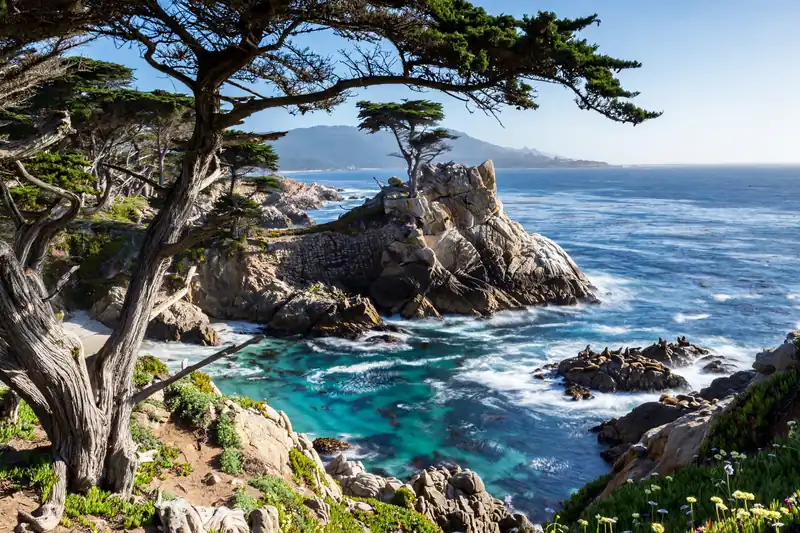
Point Lobos State Natural Reserve is the most beautiful short drive in Monterey, and the place locals call the crown jewel of the state park system. It is 15 minutes south of town on Highway 1, a headland of wind-sculpted Monterey cypress, turquoise coves, sea lion colonies and tide pools, with trails that run from 15 minutes to three hours. The Sea Lion Point trail and the Cypress Grove trail — a loop of about a mile under the twisted cypress — are the two to do first, then China Cove and Gibson Beach, where the water is the clearest on the coast. Entry is $10 per vehicle ($9 for seniors, $5 with a Disabled Discount Pass) and $5 per person to walk or cycle in, and the reserve is open from 8 a.m. to 7 p.m., with last entry at 6:30 p.m. There are only about 150 parking spaces and no reservations for general entry, so the lots fill by about 9–9:30 a.m. on weekends — arrive early or come on a weekday. Dogs are not allowed anywhere in the reserve, including in parked vehicles, and vehicles over 21 feet are not allowed. Two things most guides get wrong: the walk-in is not free, it is $5; and the reserve was NOT closed by the August 2026 Timber Fire — that was Pfeiffer Big Sur State Park, which reopened on 16 October 2026. Point Lobos was open throughout. Point Lobos State Natural Reserve on Wikipedia covers the reserve and its trails.
6. The 17-Mile Drive
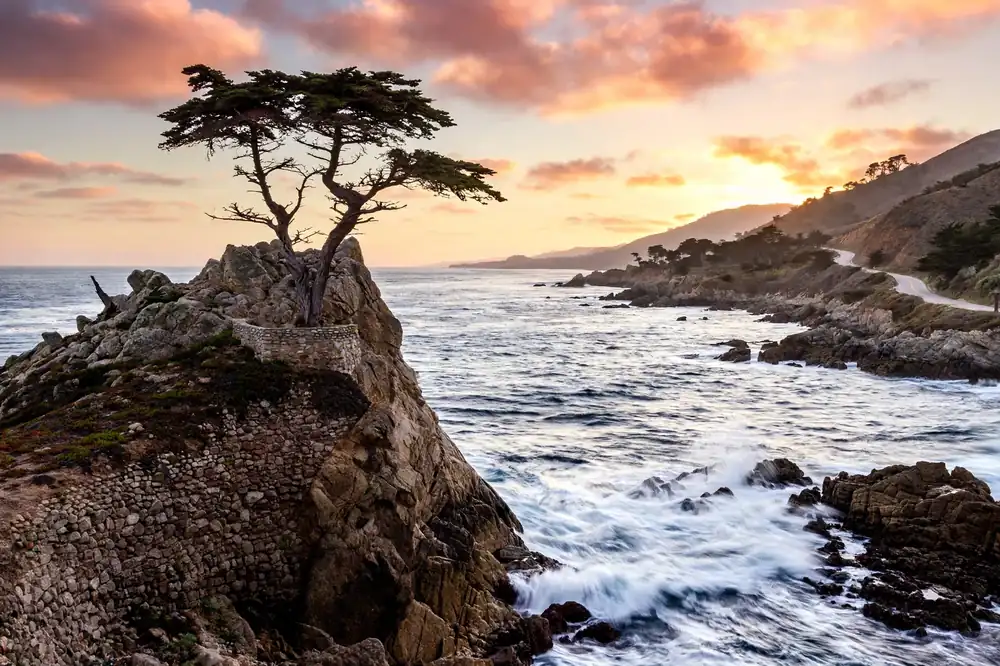
The 17-Mile Drive is the scenic loop through Pebble Beach that every visitor should drive at least once: 17 miles of gated private road through the Del Monte Forest, past golf courses, mansions and some of the most photographed coastline in California. The stops are the point, not the driving — the Lone Cypress on Wikipedia, the 250-year-old cypress standing alone on a granite outcrop; Spanish Bay, where the bagpiper plays at sunset; Bird Rock, covered in cormorants and sea lions; Fanshell Overlook, where harbour seals pup in spring; and the Pebble Beach Golf Links, one of the most famous courses in the world. As of 2026 the gate fee is $12.50 per vehicle — one popular guide still lists $10.50, which is years out of date, and another lists $12.25, the earlier 2026 rate. The fee is refundable with a $35 or more spend at a Pebble Beach Resorts restaurant (not the Pebble Beach Market), so keep the gate receipt; overnight guests of The Lodge, The Inn at Spanish Bay and Casa Palmero enter free. Motorcycles are prohibited, cyclists and pedestrians enter free, and tour buses pay $6 per passenger. Allow two to three hours with stops, and go in the late afternoon, when the light is best and the fog has burned off. The 17-Mile Drive on Wikipedia covers the route and its stops.
7. The Monterey Bay Coastal Recreation Trail
The Monterey Bay Coastal Recreation Trail is the 18-mile paved path that runs along the shore from Fisherman’s Wharf through Cannery Row to Lovers Point and Asilomar, and on to Marina — and the best free way to see the whole waterfront without a car. It follows the old Southern Pacific rail line, so it is flat, wide and separate from the road, with the bay on one side the whole way. The best stretch is the three miles from the Wharf to Lovers Point: past the Aquarium, the Coast Guard pier where the sea otters raft, the beaches of Pacific Grove and the lawn at Lovers Point, with sea lions, otters and pelicans visible from the path. Walk it, run it, or rent a bike or a surrey on Cannery Row — the bike rentals run about $10–$15 an hour — and watch for the sections where cyclists and walkers share the path, because it gets busy on summer weekends. It is free, open all day, and it is also the practical way to move between the Wharf, Cannery Row and Pacific Grove without paying for parking twice. The Monterey Bay Coastal Recreation Trail on Wikipedia covers the trail and its route.
8. Kayaking with sea otters
Kayaking is the closest you will get to the sea otters, and the best morning in Monterey that does not involve a boat ticket. The bay’s kelp forests hold one of the densest sea otter populations on the coast, and from a kayak you sit at water level with them — otters cracking shells on their chests, harbour seals surfacing beside the boat, sea lions barking from the Coast Guard pier. Monterey Bay Kayaks runs guided tours from the beach near the Wharf: the 1.5-hour harbour tour is $60 per person, the two-hour shoreline tour along Cannery Row is $65, and the 2.5-hour kelp forest tour is $70, for ages 12 and over. Unguided rentals run about $40 for two hours. No experience is needed and the harbour water is calm, but the bay water is about 55°F, so wear the splash jacket and wetsuit the outfitters provide, arrive 30 minutes early to gear up, and book ahead in summer. If you want even more otters, drive 25 minutes north to Elkhorn Slough, where the largest remaining raft of southern sea otters on the planet lives — see below. The sea otter on Wikipedia covers the animal you will be paddling with.
9. Colton Hall Museum
Colton Hall Museum is the small free museum where California was born, and the best hour in Old Monterey. The hall was built between 1847 and 1849 as the town’s first schoolhouse and town hall, and in October 1849 the delegates of the California Constitutional Convention met in its upstairs room to draft the state’s first constitution — the bilingual document that led to statehood in 1850. The museum recreates the meeting room as it was, with the original chairs and desks, and adds exhibits on early Monterey, the Mexican and Spanish periods and the first newspaper and printing press in California. It is free, open seven days a week from 10 a.m. to 4 p.m., at 570 Pacific Street, a five-minute walk from the Wharf and two minutes from the Monterey Museum of Art. The jail in the basement is part of the visit, and the attendant gives short tours on request. It is the single best stop for understanding why Monterey matters in California history, and it costs nothing. The Monterey State Historic Park on Wikipedia covers Colton Hall and the other historic adobes.
10. The Custom House and the Path of History
The Custom House and the Path of History are the walk through Old Monterey that ties the whole town together. The Custom House, built in 1827 by the Mexican government, is the oldest government building in California and California State Historical Landmark No. 1 — the building where the U.S. flag was raised in 1846 and where California’s first customs were collected. It stands on Custom House Plaza, at the entrance to Old Fisherman’s Wharf, as part of Monterey State Historic Park, a collection of more than a dozen historic adobes within half a mile of the plaza. The Custom House, the Pacific House Museum and the First Brick House are open Tuesday to Sunday from 10 a.m. to 4 p.m., and admission is free. Hour-long guided history walks leave from the Custom House Thursday to Sunday at 11 a.m., 1 p.m. and 3 p.m., and a free cell-phone audio tour covers the whole park. The Path of History itself is a self-guided two-mile walk marked by gold tiles in the sidewalk, linking the adobes, the gardens and the Memory Garden — follow the tiles from the plaza to Colton Hall and back, and you have walked the whole of old Monterey. The Monterey State Historic Park on Wikipedia covers the park and its buildings.
11. Lovers Point Park
Lovers Point Park is the locals’ beach in Pacific Grove, and the prettiest small park on the Peninsula. It is a rocky cove with a lawn, a small sandy beach, a swimming area and a rock jetty, at the end of Ocean View Boulevard, about a 30-minute walk or a 10-minute bike ride from Cannery Row along the coastal trail. It is free, open all day, and it is where Pacific Grove comes on a sunny afternoon: families on the lawn, kayakers launching from the cove, swimmers in the sheltered water, and couples watching the sunset from the rocks. The park is also a good launch point for the kayaking and the coastal trail, and the beach at the cove is one of the few in Monterey where swimming is comfortable — the water is still cold, about 55°F, but the cove is sheltered and shallow. Come at sunset, when the rocks turn gold and the whole of Monterey Bay opens out in front of you. Pacific Grove, California on Wikipedia covers the town and its parks.
12. Asilomar State Beach
Asilomar State Beach is the wild mile of sand at the Pacific Grove end of the Peninsula, and the best beach walk in Monterey. It is a mile-long stretch of white sand backed by dunes and boardwalks, with the Asilomar Conference Grounds — the Julia Morgan-designed retreat centre from 1913 — behind it. The beach is free, dogs are allowed on a leash, and the boardwalk through the dunes is wheelchair accessible. It is not a swimming beach — the surf is strong and the water is cold — but it is a walking beach, a surfing beach and a sunset beach, and on a clear winter afternoon the light on the dunes is the best on the coast. The conference grounds are worth a walk on their own: the Arts and Crafts buildings, the gardens and the paths through the pines feel like a different century. Park in the lots off Sunset Drive and walk the boardwalk to the beach. Asilomar State Beach on Wikipedia covers the beach and the conference grounds.
13. Monarch Grove Sanctuary
The Monarch Grove Sanctuary is the free nature spectacle that only exists from October to February, and the reason to visit Monterey in winter. Every autumn, monarch butterflies migrate to a eucalyptus grove at 250 Ridge Road in Pacific Grove to wait out the winter, clustering on the branches in what look like brown leaves or small pinecones. The sanctuary is free, open sunrise to sunset, and the best time to go is between 11 a.m. and 3 p.m., when the museum docents are on site from October through February — go before 11 a.m. or on a cold day below 55°F to see the clusters, and after 11 a.m. on a sunny day above 55°F to see them flying over the nectar beds at the south end of the trail. One honest warning: the numbers have fallen. The 2025 season peaked at only 226 butterflies, counted on 12 December 2025, and the 2026 season was expected to start as a slow trickle from mid-October, peaking around the end of November. Check the Pacific Grove Museum of Natural History’s weekly updates before you go, stay on the marked paths, keep your voice low, and never touch a butterfly. Pacific Grove, California on Wikipedia covers the town and the sanctuary.
14. Elkhorn Slough
Elkhorn Slough is the day trip that birders and otter lovers should not skip: a 1,700-acre tidal estuary at Moss Landing, about 25 minutes north of Monterey on Highway 1, and the place where the largest remaining raft of southern sea otters on the planet lives. The reserve’s visitor centre is open Wednesday to Sunday from 9 a.m. to 5 p.m., admission is free, and the South Marsh Loop trail runs through the marshes and oak woodland with hundreds of bird species overhead. The best way to see it is from the water: Kayak Connection rents half-day kayaks at the Moss Landing harbour — a single sit-on-top is $60, a double $95, a single closed-deck kayak $80 — and the Elkhorn Slough Safari runs 1.5-hour pontoon tours with a trained naturalist aboard. Paddle early in the morning, when the water is flat and the otters are feeding, and watch the tide: paddling against an incoming tide is hard work, and the slough’s channels change with it. Dogs are not allowed on the rental kayaks. The Elkhorn Slough on Wikipedia covers the estuary and its wildlife.
15. Dennis the Menace Playground and Lake El Estero
Dennis the Menace Playground is the famous free playground on the shore of Lake El Estero, and the best stop in Monterey with children. The park opened on 17 November 1956, designed with input from Hank Ketcham on Wikipedia, the creator of the Dennis the Menace comic strip, and it has been Monterey’s favourite playground ever since: a maze, a climbing wall, a swaying suspension bridge, the long red roller slide, and the vintage Southern Pacific steam engine that has stood here since 1956. It is free, open from 10 a.m. to dusk, at 777 Pearl Street — but note the Tuesday rule: from Memorial Day to Labor Day it is open daily, and from Labor Day to Memorial Day it is closed on non-holiday Tuesdays, a rule that has caught out more than one family who planned a Tuesday visit. The steam engine is currently fenced off, because it does not meet current safety standards. Around the playground, the 45-acre El Estero Park complex has a 1.2-mile path around the lake, paddleboat rentals, picnic areas and fishing piers. Dennis the Menace (comics) on Wikipedia covers the comic strip and its creator.
16. Monterey Museum of Art
The Monterey Museum of Art is the compact art museum in the heart of Old Monterey, and the best indoor hour after the Aquarium. It holds eight galleries of California painting, photography and contemporary work, with shows rotating every three to four months, and a sculpture garden out the back. It is at 559 Pacific Street, two minutes from Colton Hall, open Thursday to Sunday from 11 a.m. to 5 p.m. Admission is $15 for adults, free for students with ID, free for visitors 18 and under, and free for active military — and admission is free throughout December for the Illuminado exhibition, and free on the first Friday of every month. The museum closes for Thanksgiving Day, 26 November 2026, and for the winter break from 21 December 2026 to 6 January 2027, so check the calendar before a December visit. Allow one to two hours, and pair it with Colton Hall and the Path of History for a full morning of Old Monterey. The Monterey Museum of Art on Wikipedia covers the museum and its collection.
17. Del Monte Beach
Del Monte Beach is the long sandy beach closest to downtown Monterey, and the one the locals use. It is the southern end of Monterey State Beach, a flat, wide stretch of sand running from the Wharf area east towards Seaside, with dunes behind it and the bay in front of it. It is free, open all day, with parking in the lots off Del Monte Avenue, and it is the best beach in town for a morning walk, a run, kite flying, or just sitting on the sand with a coffee. The water is about 55°F all year, so this is not a swimming beach for most people — the locals treat the beach as scenery and exercise, not a pool — but the sunsets are good, the crowds are thin on weekdays, and the dunes at the east end are a quiet place to watch the pelicans. Dogs are allowed on a leash on parts of the beach. The Monterey State Beach on Wikipedia covers the beach and its dunes.
18. Pacific Grove Museum of Natural History
The Pacific Grove Museum of Natural History is the small free museum that explains everything you have been looking at all weekend. It sits at 165 Forest Avenue in Pacific Grove, a 10-minute walk from Lovers Point, and its exhibits cover the natural history of the Peninsula: the monarch butterflies and their migration, the birds of the bay, the geology of the coast, and the Native history of the Rumsen Ohlone people. Admission and parking are both free, and the museum is the place that publishes the weekly monarch counts for the sanctuary in winter — the numbers in this guide came from its updates. It is a one-hour stop, and it pairs naturally with the Monarch Grove Sanctuary and Lovers Point on the same afternoon. The Pacific Grove Museum of Natural History on Wikipedia covers the museum and its exhibits.
19. WeatherTech Raceway Laguna Seca
WeatherTech Raceway Laguna Seca is the motorsport stop, 15 minutes inland from Monterey, and one of the most famous road courses in the world. The 2.238-mile circuit has 11 turns and the Corkscrew — the plunging S-bend that drops five storeys in a few hundred feet and is one of the most photographed corners in racing. The calendar is the reason to go: the IMSA Monterey SportsCar Championship returns 30 April to 2 May 2027, the Sea Otter Classic — the world’s largest cycling festival — runs 15 to 18 April 2027, the Rolex Monterey Motorsports Reunion runs 11 to 14 August 2027 during Monterey Car Week, celebrating the track’s 70th anniversary, and the IndyCar season finale closes the year on 5 September 2027. On non-race days the track is quiet and there is little to see without an event, so plan your visit around the calendar, buy tickets in advance for the big weekends, and bring ear protection — the Corkscrew is loud. The WeatherTech Raceway Laguna Seca on Wikipedia covers the circuit and its history.
20. Lower Presidio Historic Park
Lower Presidio Historic Park is the free viewpoint and the oldest ground in Monterey, and the place to go when you want the whole bay in one look. The park sits on the hill above the harbour, on the site of the Spanish presidio founded in 1770, and its trails run through the pines and the oaks to viewpoints over the bay, the Wharf, Cannery Row and the mountains of Big Sur. It is free, open from dawn to dusk, with parking at the top and a trail down to the waterfront. The history is here too: this is the ground where the Spanish fort stood, where the Mexican period ran its course, and where the American period began — the Sloat Monument stands on the hill, and the Presidio of Monterey on Wikipedia, the Army post below, is still an active base and home to the Defense Language Institute. Come at sunset, when the whole bay turns gold and the town below lights up. The Presidio of Monterey on Wikipedia covers the post and its history.
Monterey in 3 days — a ready-made itinerary
Day 1 — Cannery Row, the Aquarium and the Wharf
Start at the Monterey Bay Aquarium when it opens at 9:30 a.m., before the crowds — book your ticket online in advance, because there are no door sales. Spend the morning in the kelp forest, the Open Sea gallery and the otter habitat, then walk Cannery Row for lunch, stopping at the wine tasting rooms and the preserved cannery facades. In the afternoon, walk the coastal trail to Old Fisherman’s Wharf, take the free chowder samples, watch the sea lions on the pilings, and end the day with dinner on the Wharf — clam chowder and cioppino — as the whale watching boats come in.
Day 2 — Point Lobos, the 17-Mile Drive and Pacific Grove
Be at Point Lobos before 9 a.m., while there is still parking, and walk the Sea Lion Point and Cypress Grove trails in the morning light. Drive the 17-Mile Drive in the late morning, stopping at the Lone Cypress, Spanish Bay and Bird Rock, and keep the gate receipt — it is refundable with a $35 spend at a Pebble Beach Resorts restaurant. In the afternoon, walk the coastal trail to Lovers Point, swim or kayak in the cove if the day is warm, and finish in Pacific Grove with the Monarch Grove Sanctuary if it is butterfly season, or Asilomar State Beach at sunset if it is not.
Day 3 — The bay by boat and Big Sur
Take the morning whale watching boat from Old Fisherman’s Wharf — the 2.5 to 4 hour tours leave in the morning, and the gray whales are in the bay from December to April, the humpbacks from March to November. In the afternoon, choose: kayaking with the sea otters from the beach near the Wharf, a half-day at Elkhorn Slough for the largest otter raft on the planet, or the drive south on Highway 1 into Big Sur — the road is open end to end again, but check the Caltrans QuickMap first, because one-way traffic control is in place at Rocky Creek Bridge through 30 November 2026. End the trip with dinner in downtown Monterey on Alvarado Street, and a walk through Old Monterey’s adobes after dark.
Best time to visit Monterey
| Season | Months | Weather | What to expect |
| Spring | March to May | 55–68°F, fog in the morning | Wildflowers on the coastal trail, harbour seal pups at Point Lobos and Fanshell Overlook, gray whales passing north with calves in March. The Monterey Bay Aquarium is busy on spring-break weekends. |
| Summer | June to August | 60–70°F, fog most mornings | The foggiest season — the marine layer rolls in most mornings and burns off by noon. Humpback whales feed in the bay, the free MST Trolley runs, and the town is at its busiest. The water stays about 55°F. |
| Autumn | September to November | 65–72°F, clearest skies | The best season: the fog lifts, the water is calmest, the crowds thin out, and the light is at its best. The Monterey Jazz Festival runs in September, and Monterey Car Week fills the town in August. |
| Winter | December to February | 50–65°F, rain at times | The quietest and cheapest season. Gray whales arrive in December, monarch butterflies crowd the eucalyptus grove in Pacific Grove, and the Aquarium is at its emptiest. Rain falls mainly from November to March. |
The honest answer is September to October. The fog that hangs over the bay all summer finally lifts, the water is at its calmest, the crowds thin out after Labor Day, and the light on the coast is the best of the year. May is the other good month, with wildflowers and seal pups, but the mornings are foggy. Summer is the busiest and the foggiest — the marine layer rolls in most mornings and the town fills up, and the water never warms past about 55°F. Winter is the bargain season and the whale season: gray whales pass from December to April, the monarchs are in Pacific Grove, and the Aquarium is quiet, but the rain comes and the days are short. If you can only pick one month, pick September: warm, clear, and the Jazz Festival is on. Whatever month you choose, bring layers — a sunny afternoon in Monterey can turn cold by 5 p.m., and the wind off the bay is always there.
Where to stay in Monterey
| Area | Best for | What to expect |
| Cannery Row | First-timers, families | Waterfront hotels with bay views, steps from the Aquarium and the trail. The most expensive area, about $250–$450 a night in season, and the parking is $35–$45 a day at the big hotels. |
| Downtown and the Wharf | Walkers, couples | Hotels and inns around Alvarado Street and the Wharf, walkable to the historic adobes, the museums and the restaurants. About $150–$300 a night, with cheaper parking than Cannery Row. |
| Pacific Grove | Quiet seekers, couples | Victorian inns and bed and breakfasts on Lighthouse Avenue and Ocean View Boulevard, a 30-minute walk from Cannery Row along the trail. About $180–$350 a night, and the quietest base on the Peninsula. |
| Del Monte Beach and Seaside | Budget travellers, families | Motels and inns along Del Monte Avenue and in Seaside, a short drive from the waterfront, with the lowest prices in town. About $100–$180 a night. |
| Carmel-by-the-Sea | Couples, luxury travellers | The storybook town 10 minutes south, with inns, cottages and white-sand beach. The prettiest base, and the most expensive — about $300–$600 a night in season. |
The first decision is Cannery Row or not. A waterfront hotel on Cannery Row costs more, but you walk out of your room and onto the coastal trail, the Aquarium is at the end of the street, and you do not pay for parking or carry beach gear across a road. A hotel downtown, around Alvarado Street or the Wharf, costs less and is a 20-minute walk from the Aquarium along the water, with the historic adobes and the museums at your door. Couples who want quiet should look at Pacific Grove, where the Victorian inns on Lighthouse Avenue are a 30-minute walk from Cannery Row and the town goes to sleep early. Budget travellers should look at the motels along Del Monte Avenue and in Seaside, a short drive east, where the prices drop by half. Book early for September and October, for Monterey Car Week in August and for the AT&T Pebble Beach Pro-Am in February — the Peninsula fills up months ahead for those weeks — and check whether your hotel charges for parking, because the big Cannery Row hotels charge $35–$45 a day.
Getting around Monterey
| Way to get there | How it works | What to know |
| Car | The main way to reach the day trips | You do not need a car in town, but you will want one for Point Lobos, the 17-Mile Drive, Elkhorn Slough, Laguna Seca and Big Sur. Rental cars are at Monterey Regional Airport. |
| Walking | Downtown, the Wharf and Cannery Row | The waterfront is flat and walkable: the Wharf to the Aquarium is about 20 minutes along the coastal trail, and the Aquarium to Lovers Point is about 30 minutes more. |
| Biking | The 18-mile coastal trail | The paved trail runs the whole waterfront from the Wharf to Asilomar and on to Marina. Bike rentals on Cannery Row run about $10–$15 an hour. |
| MST bus | Public bus across the Peninsula | Monterey-Salinas Transit runs $2.50 a ride, with a day pass capped at $6. The free MST Trolley runs daily from 10 a.m. to 6 p.m. from Memorial Day weekend to Labor Day, linking downtown, the Wharf, Cannery Row and the Aquarium. |
| Rideshare or taxi | Uber and Lyft run throughout | The easy option at night, and the best way to get to dinner on Alvarado Street without worrying about parking. Surge pricing applies on summer weekends. |
| Parking | Garages, meters and lots | Cannery Row garages typically run $18–$30 a day, street meters about $1.75 an hour, and the Fisherman’s Wharf lot $1.50 an hour with a $10 daily maximum. The Aquarium validates its garage from $35 to $10 for up to five hours. |
| Airport | Monterey Regional Airport (MRY) | About 10 minutes from downtown, with nonstop flights from San Francisco, Los Angeles, Denver, Phoenix and Las Vegas. San Jose is about 1.5 hours north, San Francisco about 2 hours. |
You do not need a car for Monterey itself, but you will want one for everything outside it. The town is small and the waterfront is flat: the Wharf to the Aquarium is a 20-minute walk along the coastal trail, and the free summer trolley links downtown, the Wharf, Cannery Row and the Aquarium from 10 a.m. to 6 p.m. daily between Memorial Day weekend and Labor Day. The MST bus runs the Peninsula for $2.50 a ride with a day pass capped at $6. The car matters for Point Lobos, the 17-Mile Drive, Elkhorn Slough, Laguna Seca and Big Sur — none of them is reachable by bus, and the 17-Mile Drive needs a car or a bike. Parking is the cost to watch: the Cannery Row garages run $18–$30 a day, the Wharf lot $1.50 an hour with a $10 maximum, and the big hotels charge $35–$45 a day. Fly into Monterey Regional Airport on Wikipedia, about 10 minutes from downtown, or drive from San Francisco in about two hours via US 101 and Highway 156 — the scenic route down Highway 1 from Santa Cruz takes longer and is worth it on a clear day.
Monterey food you have to try
Clam chowder and cioppino on the Wharf
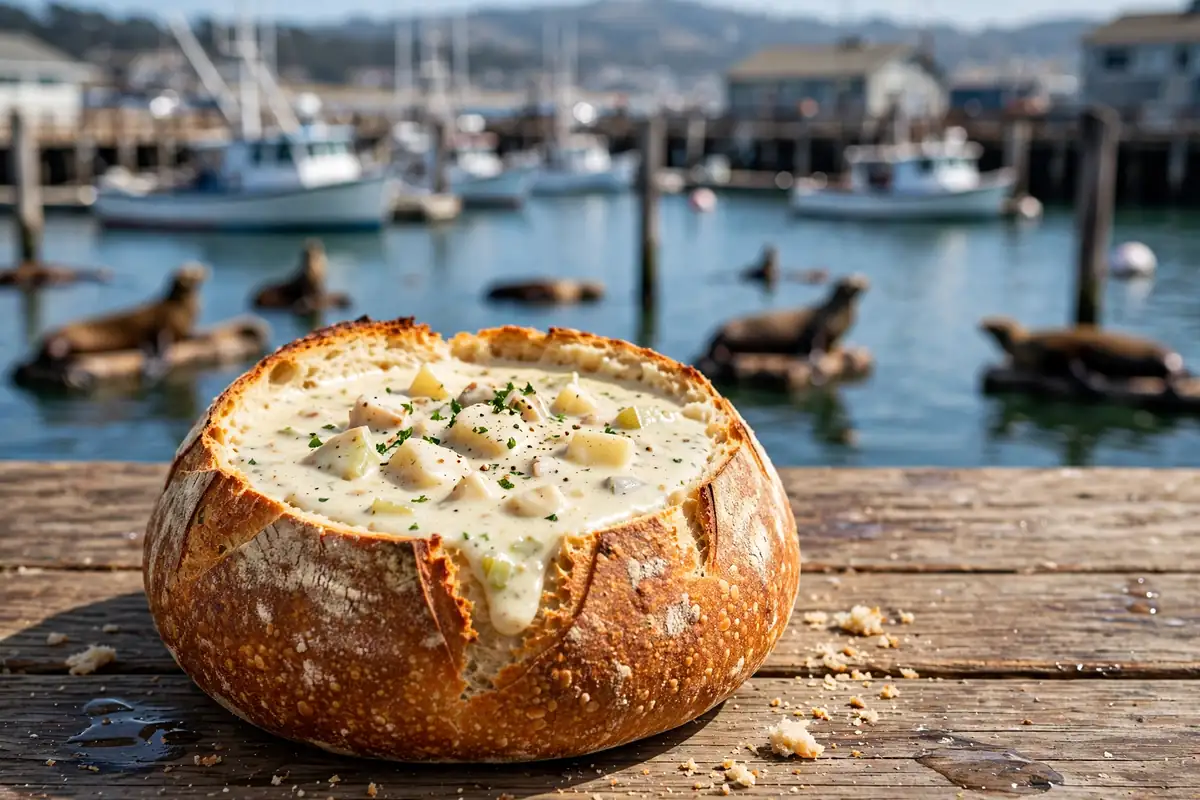
Clam chowder is the food to order first in Monterey, and the one the Wharf is famous for: a thick, creamy New England-style chowder, served in a cup, a bowl or a sourdough bread bowl, with the free samples at the Wharf restaurant doors as the way in. The classic place to eat it is Old Fisherman’s Grotto on the Wharf, the family-run restaurant that has been serving it for decades, and the other Wharf restaurants — Abalonetti’s, the Crab House, Scales — all do their own version. The second dish to order on the Wharf is cioppino, the tomato-based seafood stew the Italian fishermen brought to the California coast: crab, clams, mussels, shrimp and fish in a rich broth, served with sourdough for dipping. Order the chowder as a starter and the cioppino as the main, and eat it with the harbour in front of you — the sea lions on the pilings are part of the meal. The clam chowder on Wikipedia covers the dish and its styles.
Sand dabs and the local catch
Sand dabs are the local fish to order in Monterey, and the one most visitors have never heard of: a small, delicate flatfish caught in Monterey Bay, served whole or as fillets, lightly fried or sautéed in butter, and eaten with the bones picked out at the table. They are on the menu at the Wharf restaurants and the Cannery Row seafood houses, and they are the taste of the bay itself — mild, sweet and best eaten the day they are caught. The other local catch to ask for is the Dungeness crab in season, from November to June, and the calamari, which Monterey’s Italian fishing fleet has been landing since the 1800s. The rule is simple: if the restaurant is on the water, order the fish that came in that morning, and ask what the catch of the day is, because the boats come in every morning and the menu changes with them. The sanddab on Wikipedia covers the fish and its species.
Craft beer and Carmel Valley wine
Craft beer and Carmel Valley wine are the drinks to try in Monterey, and the two scenes sit side by side on the same streets. Alvarado Street Brewery, in downtown Monterey, is the Peninsula’s best-known brewery, pouring hoppy West Coast IPAs and lagers in a big brewpub a five-minute walk from the Wharf; Dust Bowl Brewing and Cannery Row Brewing pour on Cannery Row itself. The wine side is Carmel Valley: the valley 20 minutes inland is warm and sunny while the coast is foggy, so the grapes ripen, and the tasting rooms have moved to Cannery Row — walk the Row and you can taste Pinot Noir, Chardonnay and Syrah from a dozen Carmel Valley wineries without leaving the waterfront. The best plan is a tasting-room afternoon on Cannery Row, then dinner on the Wharf with a local beer. Monterey County, California on Wikipedia covers the county and its wine country.
Free things to do in Monterey
The coastal trail is free, and it is the best free thing in town — 18 miles of paved path along the shore, from the Wharf through Cannery Row to Lovers Point and Asilomar, with sea otters, sea lions and pelicans visible from the path. The historic adobes are free too: Colton Hall, the Custom House, the Pacific House Museum and the Path of History cost nothing, and the guided walks are free. Lovers Point Park, Asilomar State Beach and Del Monte Beach are free, and the sunset from the Lower Presidio costs nothing at all. The Monarch Grove Sanctuary is free from October to February, the Pacific Grove Museum of Natural History is free, and the Monterey Museum of Art is free on the first Friday of every month and throughout December. The Wharf is free to walk, with free clam chowder samples at the restaurant doors, and the sea lions on the pilings are free to watch. The cheapest day in Monterey is a good one: the trail in the morning, the adobes at noon, Asilomar at sunset, and dinner from a grocery store on Alvarado Street.
Frequently asked questions
How many days do you need in Monterey?
Two days covers the Aquarium, Cannery Row, the Wharf and Point Lobos. Three days is the right amount: it adds the 17-Mile Drive and Pacific Grove on the second day, and a whale watching boat and a Big Sur or Elkhorn Slough day trip on the third. Four or five days lets you slow down — a day for kayaking, a day for the museums and the adobes, and a day trip to Carmel-by-the-Sea or the Carmel Valley wineries. A week is the classic Monterey Peninsula trip, and it is the one the inns expect: most visitors split it between Monterey, Pacific Grove and Carmel, with a day in Big Sur and a day at Laguna Seca if a race is on.
Is Monterey worth visiting?
Yes, if you want wildlife and the coast rather than a city break. The Aquarium is one of the best in the world, the whale watching is among the best in North America, Point Lobos is the most beautiful short drive on the California coast, and the sea otters are part of everyday scenery — you can watch them from the coastal trail without paying for anything. It is at its best in September and October, when the fog lifts and the water is calm. It is at its worst in the deep fog of June and July, when the mornings are grey and the town is crowded, and in the rain of January. If you want nightlife, museums and a walkable downtown, go to a city instead. If you want otters, whales, cypress trees and a bowl of chowder, come here.
Do you need a car in Monterey?
Not in town, yes for the day trips. The waterfront is flat and walkable — the Wharf to the Aquarium is 20 minutes along the coastal trail — and the free MST Trolley links downtown, the Wharf, Cannery Row and the Aquarium all summer, with the MST bus at $2.50 a ride the rest of the year. But Point Lobos, the 17-Mile Drive, Elkhorn Slough, Laguna Seca and Big Sur are not reachable by bus, so rent a car for at least one day of your trip, or for the whole trip if you are staying outside downtown. The car also matters for parking: the Cannery Row garages run $18–$30 a day, so walk or take the trolley when you can.
Is the Monterey Bay Aquarium worth $65?
Yes, if you go for the whole morning and arrive at opening. The $65 adult ticket is the highest in the aquarium’s history — older guides list $59.95 or $60, both stale — and it buys three to four hours in one of the world’s best aquariums: the three-storey kelp forest, the million-gallon Open Sea tank, the jellyfish galleries and the sea otter habitat. Children 4 and under are free, youth and seniors pay $50, and the ticket must be bought online in advance, because there are no door sales. If $65 is too much, the free alternative is the coastal trail: the sea otters raft in the kelp off Cannery Row and the Coast Guard pier, and you can watch them from the path without paying anything.
What is the best time to visit Monterey?
September to October. The fog that hangs over the bay all summer finally lifts, the water is at its calmest, the crowds thin out after Labor Day, and the light on the coast is the best of the year. May is the other good month, with wildflowers and seal pups, but the mornings are foggy. Summer is the busiest and the foggiest, and the water never warms past about 55°F. Winter is the bargain season and the whale season: gray whales pass from December to April, the monarchs are in Pacific Grove, and the Aquarium is quiet, but the rain comes and the days are short. If you can only pick one month, pick September: warm, clear, and the Jazz Festival is on.
What should I skip in Monterey?
Skip the Aquarium without a ticket — there are no door sales, so showing up without an online booking wastes a morning. Skip Point Lobos after 9:30 a.m. on a weekend, when the 150 parking spaces are full and the cars are turned away. Skip the 17-Mile Drive at midday in the fog, when the views are grey and the toll is the same $12.50 — go in the late afternoon instead. Skip the beach as a swimming beach, because the water is about 55°F all year and the locals do not swim in it. Skip the Dennis the Menace Playground on a non-holiday Tuesday in winter, when it is closed. And skip Big Sur without checking the Caltrans QuickMap first, because the road has closed twice in 2026 and one-way traffic control is in place at Rocky Creek Bridge through 30 November 2026. What you should not skip is in the list above — the Aquarium, Point Lobos, the whale watching boat, the Lone Cypress and the chowder.
Further reading
Monterey, California on Wikipedia
Monterey Bay Aquarium on Wikipedia
Fisherman’s Wharf (Monterey, California) on Wikipedia
Point Lobos State Natural Reserve on Wikipedia
Monterey State Historic Park on Wikipedia
Asilomar State Beach on Wikipedia
Monterey Museum of Art on Wikipedia
Monterey State Beach on Wikipedia
Pacific Grove, California on Wikipedia
WeatherTech Raceway Laguna Seca on Wikipedia
Presidio of Monterey on Wikipedia
Pebble Beach, California on Wikipedia
Carmel-by-the-Sea on Wikipedia
Monterey Bay National Marine Sanctuary on Wikipedia
Monterey County, California on Wikipedia
California State Route 1 on Wikipedia
Monterey Jazz Festival on Wikipedia
National Steinbeck Center on Wikipedia
Monterey Peninsula on Wikipedia
Dennis the Menace (comics) on Wikipedia
Pacific Grove Museum of Natural History on Wikipedia
Cannery Row (novel) on Wikipedia
Moss Landing, California on Wikipedia
Monterey Bay Coastal Recreation Trail on Wikipedia
No Reddit link is included here: no live r/Monterey thread turned up in search, so none is listed rather than linking to an unverified one.
No Quora link is included either: no live on-topic Quora thread about visiting Monterey turned up in search, so none is listed rather than linking to an unverified one.
Your Monterey trip, in one paragraph
Monterey is the small city on the southern edge of the bay where California began — the old Spanish capital, the sardine town Steinbeck made famous, and the home of one of the world’s best aquariums, set on one of the richest marine sanctuaries on the planet. Start with the islands and the coasts: our Hawaii guide covers the whole state, our Maui guide covers the Valley Isle, and our Honolulu guide covers the capital city. Then the American cities, in the order we wrote them: our Chicago guide, our Nashville guide, our Los Angeles guide, our Orlando guide, our Miami guide, our San Diego guide, our Denver guide, our Savannah guide, our Dallas guide, our Charleston guide, our San Francisco guide, our Myrtle Beach guide, our Las Vegas guide and our San Antonio guide. Further afield: our London guide, our Portland guide, our Pigeon Forge guide, our Puerto Rico guide, our Atlanta guide, our Phoenix guide, our Paris guide, our Key West guide, our Colorado Springs guide, our Sedona guide, our Chattanooga guide, our Palm Springs guide, our St Louis guide, our Tokyo guide and our Japan guide. Then the middle of the map: our Kansas City guide, our Tennessee guide, our Branson guide, our Florida guide, our Amsterdam guide, our Montreal guide, our Fort Lauderdale guide, our Toronto guide, our Aruba guide, our Charlotte guide, our Indianapolis guide, our New Orleans guide, our Destin guide, our Santa Barbara guide, our Mexico City guide, our Arizona guide, our Osaka guide, our Minneapolis guide, our Pittsburgh guide, our California guide, our Asheville guide, our Costa Rica guide, our Washington DC guide and our Seattle guide. And the most recent: our St Augustine guide, our Lisbon guide, our Dubai guide, our Santa Fe guide, our Galveston guide, our Maine guide, our Sacramento guide, our Kauai guide, our Boston guide, our Cancun guide, our Madrid guide, our Salt Lake City guide, our Baltimore guide, our Barcelona guide, our Reno guide, our Milwaukee guide, our North Carolina guide, our New York guide, our Tucson guide, our Raleigh guide, our Corpus Christi guide, our Milan guide, our Salem guide, our Wilmington guide, our Memphis guide, our Flagstaff guide, our Austin guide, our Oahu guide, our Iceland guide, our Cincinnati guide, our Fort Worth guide, and our Panama City Beach guide.

About the Author