Things to Do in Milan
Things to Do in Milan
20 Best Attractions, a 3-Day Itinerary, Where to Stay, and the Food You Cannot Miss
Quick Info
Best for: First-timers, art lovers, fashion lovers, food lovers and football fans — Italy’s business and fashion capital, with Leonardo’s masterpiece, a walkable Gothic rooftop and canal-side aperitivo
Best time: Mid-May to mid-June and the first three weeks of September for the weather; December for the Christmas markets and Sant’Ambrogio; avoid mid-August when the city empties
How long: 3 days for the centre, the art and the canals; 4–5 days with Lake Como and Bergamo
Budget: About €120–€250 per person per day mid-range — the hotels are the biggest cost, and many of the best sights are free
Don’t miss: The Duomo rooftop at sunset, The Last Supper (booked months ahead), the Galleria at dusk, an aperitivo on the Navigli, and a saffron risotto in Brera
Milan on Wikipedia is the Italian city most visitors get wrong on the first visit — and the one they come back for. It is the city they call the capital of fashion and design, founded as Mediolanum more than 2,600 years ago, a working city of banks, studios and workshops that also happens to hold Leonardo da Vinci’s most famous painting, the largest Gothic cathedral in Italy and the oldest shopping arcade in the country. This guide covers the 20 best things to do in Milan, a 3-day itinerary that actually works, where to stay without paying fashion-week prices, how to get around on the €2.20 metro ticket, the three foods you should not skip, and the free sights that cost nothing. Everything below was checked against live sources in November 2026 — including the Duomo rooftop prices, the Last Supper booking system that sells out months ahead, the museum prices that rose in 2026, the paper tickets that no longer exist, and the Olympics ceremony that put San Siro on the world stage in February.
Milan at a glance
| Topic | What to know |
|---|---|
| Full name | Milan — Milano, the capital of Lombardy and Italy’s second-largest city |
| Founded | About 600 BC as Mediolanum, a Celtic settlement; a Roman city from 222 BC |
| Population | About 1.4 million people in the city, about 5.2 million in the metro area |
| Elevation | About 120 metres above sea level, on the Po Valley plain between the Alps and the Po River |
| Airport | Milan Malpensa (MXP), about 50 minutes northwest by train; Linate (LIN), about 15 minutes east by metro |
| Best base | The historic centre around the Duomo for first-timers; Brera for the charm; Navigli for the evenings |
| Getting around | Metro, trams and buses on one €2.20 ticket; the centre is walkable |
| Famous for | The Duomo, The Last Supper, fashion, design, La Scala, aperitivo and the 2026 Winter Olympics |
Milan divides into three ideas that most visitors only partly see. The historic centre is the one the postcards show: the Duomo, the Galleria and La Scala, all within walking distance of each other, with the Brera lanes behind them. The canals and the neighbourhoods are the one the locals live in: the Navigli at aperitivo hour, Isola’s street art, the Porta Nuova towers, with the fashion district in between. The museums and the day trips are the one that makes the trip: Leonardo’s Last Supper, the Brera masterpieces, the science museum, and the lakes and walled towns an hour away by train. The trap is the one that catches almost every visitor: the city looks compact on the map and the sights look close together, but the museums all close on Mondays, the Last Supper sells out months ahead, and the older guides still list prices from before the 2026 rises — so plan by day, book the Last Supper before you book the hotel, and check the hours before you go. For the wider European trip, our Barcelona guide covers the other great Mediterranean design city, and our Madrid guide covers the Spanish capital.
The 20 best things to do in Milan
1. The Duomo di Milano and the rooftop terraces
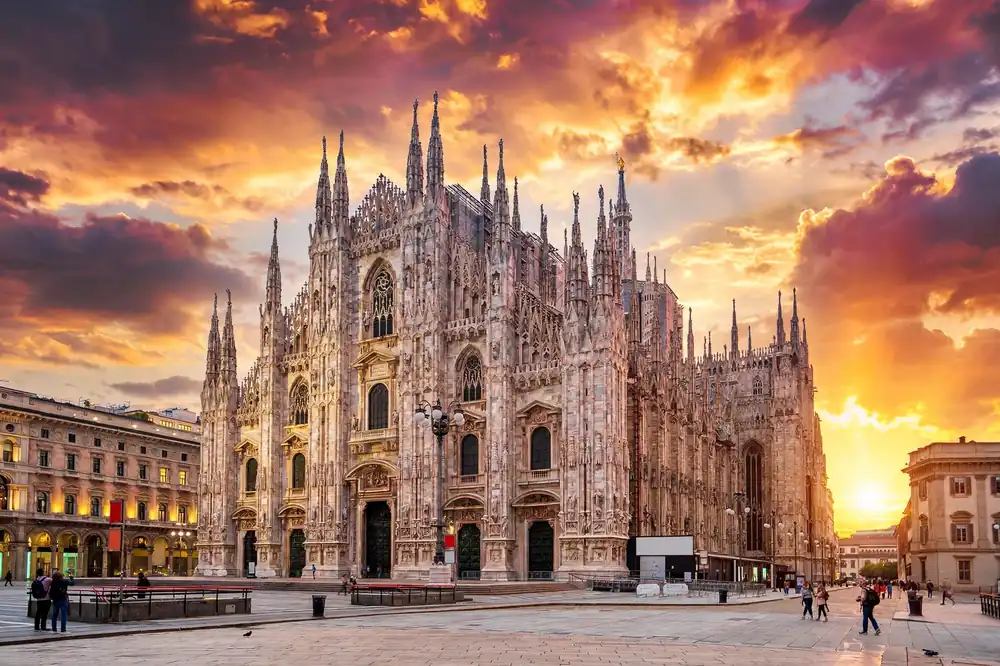
The Milan Cathedral on Wikipedia is the reason most people come to Milan — and the rooftop is the reason they stay longer than planned. The cathedral took nearly six centuries to build, begun in 1386 and finished only in 1965, and it is the largest church in Italy and the third-largest in Europe, in white and pink Candoglia marble, with 135 spires and more than 3,400 statues, and the golden Madonnina on the tallest spire, 108.5 metres up, watching over the city. The cathedral is open daily from 9 a.m. to 7 p.m., and the terraces from 9 a.m. to 7 p.m., with last entry at 6 p.m. — and on summer Fridays, Saturdays and Sundays the terraces stay open until 8 p.m. The rooftop-only ticket is €16 by the 251 steps or €18 by lift, the Duomo plus terraces is €22 by stairs or €26 by lift, the Duomo plus the museum is €10, and the fast-track ticket is €32 — and the prices have been stable since the tariff of 1 April 2025, with no booking fee online. The trap is the queue, and this is where our guide beats the older ones: the rooftop line is the longest in Milan in summer, so book the first slot of the day and take the stairs if you can — the lift queue is the slow one — and the dress code is real, with shoulders and knees covered, so bring a scarf or a light layer even in August. Two practical notes: the rooftop is a one- to two-hour visit, not a day — allow two hours, and go at sunset, when the marble turns pink and the Alps show on a clear day — and the ticket is valid for two days, so use it for the museum on the second day, which is closed on Wednesdays. Allow two hours, and go early or late, when the light is on the marble and the crowds are down.
2. Leonardo da Vinci’s The Last Supper
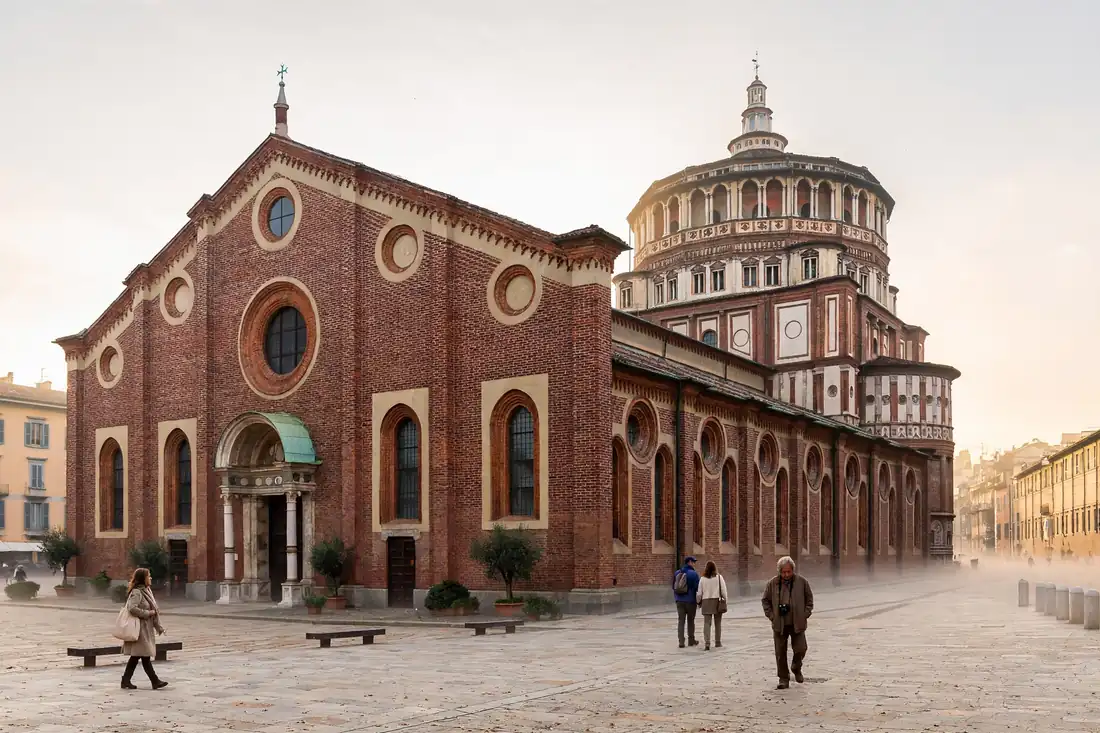
The Last Supper (Leonardo) on Wikipedia is the single hardest ticket in Italy — and the one you must book before anything else in Milan. The mural was painted between 1495 and 1498 on the wall of the refectory of Santa Maria delle Grazie, Milan on Wikipedia, the Dominican church that is a UNESCO World Heritage site, and it is the most famous painting in the world that hangs on a dining-room wall, not in a museum. The visit lasts 15 minutes, in groups of about 35 to 40 people, with about 900 to 1,300 visitors a day, and the official ticket costs €15. The museum is open Tuesday to Sunday from 8:15 a.m. to 7 p.m., with last admission at 6:45 p.m., and it is closed on Mondays. The trap is the booking, and this is where our guide beats the older ones: the tickets are released in quarterly blocks about three months ahead, at noon Italian time — the May to August 2026 tickets went on sale on 24 March 2026, and the September to December tickets on 23 June 2026 — and there is an extra batch every Wednesday at noon for the following week, which is the detail most guides omit. The official sites are cenacolovinciano.vivaticket.it and lastsupper.shop, and anything else is a reseller — and as of 1 September 2026 every entry-only ticket to the end of the year was sold out, with only the guided tours, at €60 to €95, still available. Two practical notes: book two to three months ahead in peak season, and arrive 30 minutes early, because there are no walk-ups and a late arrival loses the slot — and the church next door is free and worth an hour on its own, with Bramante’s tribune and the small cloister. Allow an hour for the church and the 15 minutes for the painting, and book the ticket the day it goes on sale.
3. Galleria Vittorio Emanuele II
The Galleria Vittorio Emanuele II on Wikipedia is the covered street every Milan visit walks through — and the one most visitors rush through too fast. The arcade was built between 1865 and 1877, designed by the architect Giuseppe Mengoni, who died falling from the scaffolding the day before it opened, and it is Italy’s oldest active shopping arcade, a glass-and-iron cross with a dome 47 metres high, joining Piazza del Duomo to Piazza della Scala. The shops are the luxury names — Prada, whose first boutique opened here in 1913, Louis Vuitton, Gucci — and the prices are the highest in the city, so the Galleria is a walk and a coffee, not a shopping trip, for most visitors. The mosaic bull on the floor is the tradition: the bull is the coat of arms of Turin, and the ritual is to spin three times on its heel with your eyes closed for good luck — and the locals roll their eyes at it, because the floor has to be repaired so often, so spin once and move on. The trap is the price, and this is where our guide beats the older ones: the café tables under the dome charge the view, with a coffee at Camparino in Galleria, the 1915 bar at the Galleria’s entrance, costing several times the price of the same coffee a street away — so take the photo, have the coffee standing at the bar, and eat on the side streets. Two practical notes: the Galleria is a thirty-minute stop, not a morning — allow an hour at dusk, when the glass roof glows and the lights come on — and the passage is free and open all day, so walk it on the way between the Duomo and La Scala, which is what it was built for. Allow one hour, and go at dusk, when the arcade is at its best.
4. Sforza Castle and its museums
Sforza Castle on Wikipedia is the fortress that guards the park — and the museum quarter most visitors skip. The castle was built in the 15th century by Francesco Sforza, Duke of Milan, on the foundations of the Visconti fortress, and it was the home of the Sforza court, where Leonardo da Vinci worked, and the seat of the city’s rulers for four centuries. The courtyards are free, open daily from 7 a.m. to 7:30 p.m., and the nine civic museums inside are open Tuesday to Sunday from 10 a.m. to 5:30 p.m., with last entry at 4:30 p.m., and closed on Mondays. Admission to the museums is €10 for adults and €5 reduced — and the price rose from €5 in May 2026, which is the detail the older guides still get wrong — and the museums are free on the first Sunday of the month and on the first and third Tuesday of the month from 2 p.m. The treasures are the reason to go: Michelangelo’s Rondanini Pietà, his last sculpture, unfinished at his death, and the Sala delle Asse, the room Leonardo decorated around 1498 with a painted pergola of mulberry trees, and the museums of ancient art, musical instruments and Egyptian art. The ramparts walk is a separate €10 ticket. The trap is the Monday, and this is where our guide beats the older ones: the castle is the classic Monday mistake, because the courtyards are open but the museums are shut, so plan it for a Tuesday or later in the week — and the free courtyards are still worth the walk on a Monday, with the fountain and the tower. Two practical notes: the castle is a two- to three-hour visit, not a day — allow three hours, and start with the Pietà, because it is the room that fills first — and the park behind the castle, Parco Sempione, is the picnic and the walk after. Allow three hours, and go in the morning, when the museums open and the light is on the courtyard.
5. Pinacoteca di Brera and the Brera district
The Pinacoteca di Brera on Wikipedia is the gallery that makes Milan an art city — and the district around it is the prettiest walk in the centre. The gallery sits in the Palazzo di Brera, at Via Brera 28, the home of the Academy of Fine Arts, and it holds about 500 paintings, including Raphael’s Marriage of the Virgin, Mantegna’s Lamentation over the Dead Christ and Caravaggio’s Supper at Emmaus. The Grande Brera ticket costs €20 — and the price rose from €15 in 2026, which is the detail the older guides still get wrong — with €4 for EU citizens aged 18 to 25 and free entry for under-18s, and the ticket also covers Palazzo Citterio, the modern wing that opened in December 2024, valid on the same day and for six days after. The gallery is open Tuesday to Sunday from 8:30 a.m. to 7:15 p.m., with last entry at 6 p.m., and closed on Mondays, 1 January, 1 May and 25 December — and it is free on the first Sunday of the month, with a reservation, booked at brerabooking.org. The district is the other half of the visit: the lanes of Brera, with the bookshops, the wine bars and the trattorias, and the Orto Botanico, the botanical garden, and the church of Santa Maria del Carmine. The trap is the ticket, and this is where our guide beats the older ones: the first-Sunday free entry needs a reservation, and without it you will be turned away — and the gallery is the classic Monday mistake, so plan it for a Tuesday or later. Two practical notes: the gallery is a two- to three-hour visit, not a day — allow three hours, and go in the morning, when the rooms are quiet — and the district is the dinner stop, so stay for the evening, when the lanes fill with the aperitivo crowd. Allow three hours, and go in the morning, then eat in Brera in the evening.
6. Teatro alla Scala and the Theatre Museum
Teatro alla Scala on Wikipedia is the opera house that defines Milan — and the museum is the way in for everyone who cannot get a ticket. The theatre opened in 1778, in the Neoclassical building by Giuseppe Piermarini, and it is the most famous opera house in the world, the home of Verdi and the stage where the season opens every year on 7 December, the feast of Sant’Ambrogio, the city’s patron saint. The 2026–27 season opens with Verdi’s Otello on 7 December 2026, running to 5 January 2027. The Theatre Museum costs €12 for adults and €8 reduced, with an open ticket at €15, and it is open daily from 9:30 a.m. to 5:30 p.m., with last entry at 5 p.m. — and it is closed on 7, 25 and 26 December, 1 January, Easter, 1 May and 15 August. The museum shows the costumes, the portraits, the instruments and Verdi’s piano, and the view into the auditorium from the boxes, when there is no rehearsal or performance. The trap is the ticket, and this is where our guide beats the older ones: the opera tickets sell out fast and the prices are high, but the last-minute seats go on sale two hours before the curtain, up to 25% cheaper, at the box office on Largo Ghiringhelli 1, open Monday to Saturday from 1 p.m. to 6 p.m. — and the museum is the way to see the house without a performance, so do not skip it because the opera is sold out. Two practical notes: the museum is a one-hour visit, not a morning — allow an hour, and go in the morning, when the auditorium is most likely to be open — and the square outside, Piazza della Scala, is the photo stop, with the statue of Leonardo and the Galleria at the other end. Allow one hour, and go in the morning, then walk the Galleria to the Duomo.
7. The Navigli canals and the aperitivo
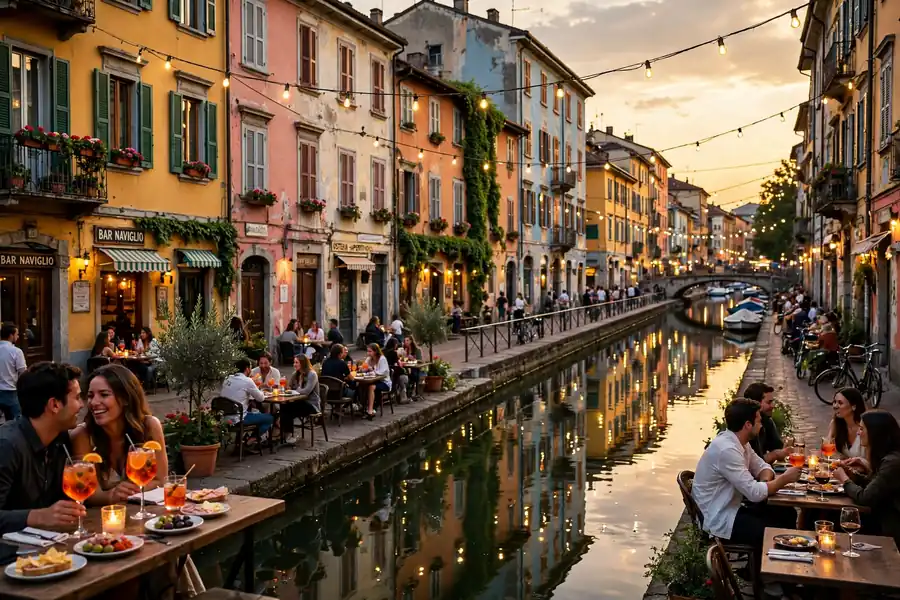
The Navigli on Wikipedia are the canals that made Milan a port — and the aperitivo hour that makes the city at night. The Naviglio Grande and the Naviglio Pavese are the two canals that survive of the system that once carried marble for the Duomo and goods for the city, with Leonardo da Vinci working on the locks in the late 15th century, and the Darsena, the old dock, is the water at the centre of it all. The canals are the evening: the aperitivo runs from 6 p.m. to 9 p.m., with a cocktail at €10 to €15 and the food included, at the bars along the Naviglio Grande — the MAG Café at Ripa di Porta Ticinese 43, Rita at Via Angelo Fumagalli 1, and Bar Basso at Via Plinio 39, the home of the Negroni Sbagliato, the drink invented here in 1972 when a bartender reached for the prosecco instead of the gin — and the Vicolo dei Lavandai, the washhouse lane, and Backdoor43, the smallest bar in the world. The trap is the weekend, and this is where our guide beats the older ones: the canals are packed on Friday and Saturday nights, so go on a weekday evening, when the tables are free and the prices are the same — and Bar Basso is closed on Tuesdays, so do not plan the Negroni Sbagliato for a Tuesday. Two practical notes: the canals are a free walk and a paid drink — allow an evening, and arrive at 6 p.m., when the aperitivo starts and the light is on the water — and the antique market fills the canal on the last Sunday of the month, with the Mercatone dell’Antiquariato, so plan a Sunday visit around it. Allow one evening, and go at 6 p.m., when the aperitivo starts.
8. Basilica di Sant’Ambrogio
The Basilica of Sant’Ambrogio on Wikipedia is the church that made Milan — and the one most visitors never see. The basilica was founded between 379 and 386 by St Ambrose, the bishop of Milan, and consecrated in 387, and it is the prototype of Lombard Romanesque architecture, rebuilt in the 11th and 12th centuries, with the two bell towers that do not match — the monks’ tower from the 9th century and the canons’ tower from the 12th — and the atrium of columns in front. Entry is free, and the basilica is open Monday to Saturday from 10 a.m. to 12 p.m. and from 2:30 p.m. to 6 p.m., and on Sundays from 3 p.m. to 5 p.m. only. The treasures are the reason to go: the golden altar from around 835, the crypt with the bodies of St Ambrose and the martyrs Gervasius and Protasius, the mosaics in the apse, and the Devil’s Column outside, the Roman column with two holes that the legend says the devil left. The Ambrosius Museum, the treasury museum, opened in December 2025. The trap is the midday, and this is where our guide beats the older ones: most Milan churches close from about 12:30 p.m. to 3 p.m., and Sant’Ambrogio is no exception, so plan it for the morning or the late afternoon — and the Sunday hours are short, so do not leave it for a Sunday morning. Two practical notes: the basilica is a one-hour visit, not a morning — allow an hour, and go in the morning, when the light is in the atrium — and the metro stop is Sant’Ambrogio on the M2, two stops from the Duomo. Allow one hour, and go in the morning.
9. Basilica di San Lorenzo Maggiore and the Columns of San Lorenzo
The Basilica of San Lorenzo, Milan on Wikipedia is the oldest church in Milan — and the columns in front of it are the city’s best free photo. The basilica was built in the 4th century, and it is the oldest church in the city, with the dome and the chapels that have stood for sixteen centuries, and the 16 Roman columns in front, from the 2nd and 3rd centuries, which are the most photographed stones in Milan. Entry is free, and the basilica is open Monday to Friday from 8 a.m. to 12:30 p.m. and from 3 p.m. to 6:30 p.m., and on Saturdays and Sundays from 9 a.m. to 1 p.m. and from 3 p.m. to 7 p.m. The Cappella di Sant’Aquilino, the chapel with the 4th-century mosaics, costs about €2. The trap is the square, and this is where our guide beats the older ones: the columns are the meeting point for the city’s nightlife, so the square is quiet in the morning and crowded at night — and the church is the classic midday mistake, because it closes from 12:30 p.m. to 3 p.m., so plan it for the morning or the late afternoon. Two practical notes: the basilica is a one-hour visit, not a morning — allow an hour, and go in the morning, when the square is empty and the light is on the columns — and the tram 3 stops at the door, on the way from the Duomo to the Navigli. Allow one hour, and go in the morning, then walk to the canals.
10. Parco Sempione and the Arco della Pace
Parco Sempione on Wikipedia is the park that joins the castle to the arch — and the free green space in the middle of the city. The park covers about 47 hectares behind Sforza Castle, with the lawns, the lake, the paths and the trees, and the Arco della Pace on Wikipedia at the far end, the triumphal arch built between 1807 and 1838, first for Napoleon and finished under the Austrians, and the Torre Branca, the 108.6-metre steel tower from 1933, by Gio Ponti, with the view over the city. The park is free, and it is open all day, with the Triennale, the design museum, and the Acquario Civico, the city aquarium, inside it. The trap is the evening, and this is where our guide beats the older ones: the park is the city’s living room by day and quieter after dark, so use it in the daytime and walk the castle grounds in the morning — and the Torre Branca is the view, so go on a clear day, when the Alps show behind the arch. Two practical notes: the park is a one- to two-hour walk, not a day — allow two hours, and go in the morning, when the runners are out and the light is on the arch — and the park is the picnic stop, so buy the food in Brera and eat it on the lawn. Allow two hours, and go in the morning.
11. Porta Nuova, the Bosco Verticale and Piazza Gae Aulenti
The Bosco Verticale on Wikipedia is the building that made Milan a design city again — and the towers that every photo of the new Milan shows. The two residential towers were completed in 2014, designed by Stefano Boeri, and they are covered in more than 900 trees, 5,000 shrubs and 11,000 plants, a vertical forest that changes colour with the seasons, and they won the International Highrise Award in 2014. The towers are private homes, so the visit is from the street and the park: the Piazza Gae Aulenti, the square raised above the station, with the Unicredit Tower, the tallest building in Italy, and the Biblioteca degli Alberi, the free park of trees and lawns, and the Isola neighbourhood behind it, with the street art and the independent shops. The trap is the expectation, and this is where our guide beats the older ones: the towers are homes, not a viewpoint, so do not look for a ticket — the visit is the walk, the square and the park, and the best photo is from the park at dusk, when the lights come on. Two practical notes: the district is a one- to two-hour walk, not a day — allow two hours, and go at dusk, when the towers are lit and the square is full — and the metro stop is Porta Garibaldi or Isola on the M2 and M5, two stops from the centre. Allow two hours, and go at dusk.
12. The Quadrilatero della Moda — the fashion district
The Quadrilatero della moda on Wikipedia is the fashion district — and the most expensive walk in Italy. The district is the rectangle bounded by Via Monte Napoleone, Via della Spiga, Via Manzoni and Corso Venezia, with the flagship stores of every luxury house — and Via Monte Napoleone is one of the most expensive shopping streets in the world, with the rents to match. The walk is free, and the window-shopping is the visit, with the palazzi, the courtyards and the cafés, and the Museo Bagatti Valsecchi, the house museum, and the Villa Necchi Campiglio, the 1930s villa, on the edge of the district. The trap is the price, and this is where our guide beats the older ones: the district is a look, not a buy, for most visitors, with the prices to match the rents — and the fashion weeks are the worst time to come, with the women’s shows in February and September and the men’s in January, when the hotel prices can more than triple, and the Salone del Mobile design week in April, when the city is booked solid. Two practical notes: the district is a one- to two-hour walk, not a day — allow two hours, and go in the morning, when the streets are quiet and the windows are dressed — and the side streets are the find, with the smaller boutiques and the cafés, so walk the rectangle and then eat in Brera, a ten-minute walk away. Allow two hours, and go in the morning.
13. San Siro Stadium — AC Milan and Inter
San Siro on Wikipedia is the stadium that turned 100 in 2026 — and the place where the Winter Olympics opened. The stadium, officially the Stadio Giuseppe Meazza, opened on 19 September 1926, and it is the home of AC Milan and Inter, with about 75,000 seats, and the stage for the Milan derby, the Derby della Madonnina, and the concerts that fill it in summer. The stadium hosted the opening ceremony of the 2026 Winter Olympics on Wikipedia on 6 February 2026, the “Armonia” ceremony, with the cauldron lit at the Arco della Pace by Alberto Tomba and Deborah Compagnoni and in Cortina by Sofia Goggia — and the Games ran from 6 to 22 February 2026, with the Paralympics from 6 to 15 March 2026. The museum and tour costs €37 for adults, €27 reduced, with a family pack at €24.50 each, and the Skywalk, the walk on the stadium roof, is an €11 add-on for ages 7 and up. The museum is open from 9:30 a.m. to 5 p.m. from November to March, and to 6 p.m. from April to October — and it is closed or shortened on match days, so check the calendar before you go. The trap is the match day, and this is where our guide beats the older ones: the museum closes early or not at all on a match day, and the area fills hours before kick-off, so plan the tour for a non-match day — and the new stadium is coming, with the replacement ready in June 2031, after the appeals were rejected on 6 October 2026, so the old ground has a few seasons left. Two practical notes: the stadium is a two- to three-hour visit, not a day — allow three hours, and take the M5 to San Siro Stadio, which stops at the door — and the derby is the night to be there, with the tickets selling out weeks ahead, so book the moment they go on sale. Allow three hours, and go on a non-match day for the tour.
14. San Maurizio al Monastero Maggiore — the Sistine Chapel of Milan
San Maurizio al Monastero Maggiore on Wikipedia is the church they call the Sistine Chapel of Milan — and the one most visitors walk past without knowing. The church was built in the early 16th century for the Benedictine nuns, and the walls are covered in frescoes by Bernardino Luini and the school of Leonardo da Vinci, with the biblical scenes, the saints and the portraits, in a single room that glows with colour. Entry is free, and the church is part of the Civic Archaeological Museum, with the Roman ruins and the cloisters beside it. The trap is the door, and this is where our guide beats the older ones: the church is easy to miss, on Corso Magenta, a ten-minute walk from the Duomo, with a plain facade that gives nothing away — and it is closed on Mondays, like most Milan museums, so plan it for a Tuesday or later in the week. Two practical notes: the church is a one-hour visit, not a morning — allow an hour, and go in the morning, when the light comes through the windows and the frescoes are at their brightest — and the archaeological museum is the second half, with the Roman walls and the mosaics, so allow two hours for both. Allow two hours, and go in the morning.
15. Museo del Novecento and Piazza del Duomo
The Museo del Novecento on Wikipedia is the modern art museum on the Duomo square — and the view from the top floor is the reason to go. The museum sits in the Palazzo dell’Arengario, at Piazza del Duomo 8, with more than 4,000 works of 20th-century Italian art, including Boccioni’s Unique Forms of Continuity in Space, the Futurist sculpture, and the rooms of the Italian avant-garde, from Futurism to Arte Povera. Admission is €10 for adults and €8 reduced, with free entry for under-18s, and the museum is open Tuesday to Sunday from 10 a.m. to 7:30 p.m., with Thursday hours to 10:30 p.m., and closed on Mondays. The top floor is the reward: the glass wall looks straight across Piazza del Duomo at the cathedral, and the terrace is the photo stop. The trap is the Monday, and this is where our guide beats the older ones: the museum is the classic Monday mistake, because the square is full and the museum is shut, so plan it for a Tuesday or later — and the Thursday late opening is the best time to go, when the museum is open to 10:30 p.m. and the square is quiet. Two practical notes: the museum is a one- to two-hour visit, not a day — allow two hours, and go on a Thursday evening, when the light is on the cathedral and the rooms are quiet — and the ticket is the cheapest in the centre, so pair it with the Duomo in the morning. Allow two hours, and go on a Thursday evening.
16. The Leonardo da Vinci National Museum of Science and Technology
The Museo Nazionale Scienza e Tecnologia Leonardo da Vinci on Wikipedia is the biggest science museum in Italy — and the Leonardo galleries are the reason to go. The museum sits in a former Olivetan monastery on Via San Vittore, with the galleries of Leonardo’s machines, built from his drawings, and the transport halls, with the trains, the planes and the ships, and the submarine Enrico Toti, the Italian navy submarine you can walk through. The museum is closed on Mondays, like most Milan museums, so plan it for a Tuesday or later in the week. The trap is the size, and this is where our guide beats the older ones: the museum is the biggest in the city, with more than 50,000 square metres, so it is a half-day, not an hour — and the Leonardo galleries are the first stop, because they fill with school groups by midday. Two practical notes: the museum is a three- to four-hour visit, not a day — allow half a day, and go in the morning, when the galleries are quiet — and the submarine is the second stop, because the tours are timed, so book the slot when you arrive. Allow half a day, and go in the morning.
17. Cimitero Monumentale — the open-air museum
The Cimitero Monumentale di Milano on Wikipedia is the cemetery that is really an open-air museum — and the quietest hour in Milan. The cemetery opened in 1866, with the Famedio, the hall of fame, at the entrance, and the tombs of the city’s great families, in Art Nouveau and Liberty style, with the sculptures, the chapels and the monuments that make it a museum of 19th- and 20th-century art. Entry is free, and the cemetery is open during the day, with the Famedio and the main avenues the walk. The trap is the size, and this is where our guide beats the older ones: the cemetery is large, with the tombs spread across the grounds, so take the map at the entrance and walk the main avenues — and the cemetery is a place of quiet, so keep the visit to an hour and the voice down. Two practical notes: the cemetery is a one- to two-hour visit, not a day — allow two hours, and go in the morning, when the light is on the marble and the grounds are quiet — and the metro stop is Monumentale on the M5, two stops from the centre. Allow two hours, and go in the morning.
18. Fondazione Prada and the Torre
The Fondazione Prada on Wikipedia is the contemporary art foundation in the south of the city — and the tower is the reason to go. The foundation sits in a former gin distillery at Largo Isarco 2, converted by Rem Koolhaas and OMA, with the gold-leaf building, the cinema, the library and the galleries of contemporary art, and the Torre, the nine-storey tower from 2018, with the Bar Luce, the café designed by Wes Anderson, and the view over the city from the top. The trap is the distance, and this is where our guide beats the older ones: the foundation is south of the centre, a twenty-minute tram ride from the Duomo, so plan it as a half-day, not a stop on the way — and the tower is the visit, so go to the top, where the bar and the view are, and then walk the galleries. Two practical notes: the foundation is a two- to three-hour visit, not a day — allow three hours, and go in the afternoon, when the light is on the gold building and the bar is open — and the tram 24 stops at the door, on the way from the centre to the south. Allow three hours, and go in the afternoon.
19. Lake Como — the day trip
Lake Como on Wikipedia is the day trip every Milan visitor should take — and the one that needs a plan, not a guess. The lake is an hour from Milan by train, with the direct trains from Milano Centrale to Varenna-Esino taking 64 to 65 minutes for €7.70 one way — and the fare rose on 1 September 2026, which is the detail the older guides still get wrong — and the trains to Como San Giovanni taking about 40 minutes for €5.40, and from Cadorna to Como Nord Lago about 60 minutes for €5.40. The ferry from Varenna to Bellagio takes 15 minutes for €5.50 one way, with a central-lake day pass at €17.50, and the day trip costs about €33 before the villa tickets, with the Villa Monastero in Varenna and the Villa Melzi gardens in Bellagio the two stops. The trap is the timetable, and this is where our guide beats the older ones: the ferries run on a winter timetable from 2 November 2026 to 14 March 2027, with fewer boats, so check the schedule before you go — and the trains run about hourly, from 6:20 a.m. to 10:20 p.m., so take the early train and the late ferry, and do not try to see the whole lake in a day. Two practical notes: the lake is a full-day trip, not a half-day — allow a day, and go to Varenna and Bellagio, the two towns that make the trip, and skip the rest — and the villas are the second stop, so buy the garden tickets in advance in summer, when the queues are long. Allow a full day, and take the early train.
20. Bergamo and Turin — the other two day trips
Bergamo and Turin are the two other day trips — and the two that show the north of Italy beyond Milan. Bergamo is the walled city, 50 minutes from Milano Centrale by direct train, for about €6 one way, with the Città Alta, the upper town, enclosed by the 16th-century Venetian walls, a UNESCO site, and reached by the funicular from the lower town, with the Piazza Vecchia, the Cappella Colleoni and the Basilica di Santa Maria Maggiore, and the walk around the walls at sunset. Turin is the royal capital, 44 to 51 minutes from Milano Centrale by Frecciarossa to Torino Porta Susa, for €13.90 booked about five weeks ahead — and up to €38 the day before, which is the detail the older guides still get wrong — with the Egyptian Museum, the Mole Antonelliana and the 18 kilometres of arcades, and the historic cafés pouring bicerin, the espresso, chocolate and cream in a small glass. The trap is the calendar, and this is where our guide beats the older ones: the Mole Antonelliana is closed on Tuesdays and the Musei Reali on Wednesdays, so plan Turin around the weekday — and the Egyptian Museum sells tickets online only, so buy them before the train. Two practical notes: each city is a full-day trip, not a half-day — allow a day for each, and do one or the other, not both in a rush — and Bergamo is the cheaper and easier day, with the train at a fixed price, while Turin is the bigger day, with the museums to book ahead. Allow a full day, and take the early train.
Milan in 3 days — a ready-made itinerary
This three-day plan uses the historic centre as the base for the art and the rooftops, the canals as the evenings, and the lake as the day trip — it needs the Last Supper booked before anything else, because the tickets sell out months ahead, and it leaves the day trips for the third day. Book the Last Supper and the Duomo rooftop before you fly, put the museums in the morning, and keep the evenings for the Navigli and Brera.
Day 1 — The centre: the Duomo rooftop, the Galleria and La Scala
Start at the Duomo at 9 a.m., with the rooftop first, by the 251 steps, and give it two hours, with the terraces and the cathedral. Walk the Galleria to La Scala for the late morning, with the museum and the view into the auditorium, and allow an hour. Walk to Brera for the afternoon, with the Pinacoteca and the lanes, and allow three hours. Eat dinner in Brera, with the risotto alla milanese, and finish the evening on the Navigli, with the aperitivo at 6 p.m.
Day 2 — Leonardo and the museums: The Last Supper, Sforza Castle and the park
Start at Santa Maria delle Grazie at 8:15 a.m., with the 15 minutes at The Last Supper, and give it an hour, with the church and the cloister. Walk to Sforza Castle for the late morning, with the Rondanini Pietà and the Sala delle Asse, and allow three hours. Walk through Parco Sempione to the Arco della Pace for the afternoon, with the park and the tower, and allow two hours. Eat dinner on the Navigli, with the cotoletta alla milanese, and finish the evening at the canals, with the aperitivo and the walk along the water.
Day 3 — The day trip: Lake Como, or Bergamo, or the modern city
Take the early train to Varenna, with the ferry to Bellagio, and give it the day, with the lake, the villas and the gardens — and in winter, check the ferry timetable, because the boats run less often. Or take the train to Bergamo, with the funicular to the Città Alta, and give it the day, with the walls, the square and the sunset. Or stay in Milan, with the science museum in the morning, the Fondazione Prada in the afternoon, and the Bosco Verticale at dusk, with the towers lit and the square full. Finish with dinner in Brera, with the ossobuco and the panettone, and a final walk through the Galleria.
Best time to visit Milan
| Season | Weather | Crowds | Notes |
|---|---|---|---|
| Winter (December–February) | Highs about 5–10°C (41–50°F), lows about −1–2°C (30–36°F) | Low–moderate | Cold and foggy, cheapest hotels, Christmas markets, Sant’Ambrogio on 7 December |
| Spring (March–May) | Highs about 15–22°C (59–72°F), lows about 5–11°C (41–52°F) | Moderate–high | Best weather; Salone del Mobile in April; spring rain |
| Summer (June–August) | Highs about 28–30°C (82–86°F), lows about 18–20°C (64–68°F) | High | Hot and humid, longest days, many restaurants closed around 15 August |
| Autumn (September–November) | Highs about 13–24°C (55–75°F), lows about 6–14°C (43–57°F) | Moderate–high | Warm September, fashion week, October and November the wettest months |
The best time to visit Milan is mid-May to mid-June and the first three weeks of September, and if you want one answer, pick September: the days are warm, the humidity is down, the crowds are thinner than in summer, and the fashion week is the only price spike. Spring is the second-best pick, for the mild days and the design week in April — but the Salone del Mobile books the city solid, so check the dates before you book. Summer is the hardest season: July averages a high of 29°C, with humidity that never lets up, and 2026 was the hottest summer in northern Italy since 1961 — and many restaurants close around 15 August, when the city empties for the holiday. The city gets about 920 to 945 millimetres of rain a year, with October and November the wettest months, at 122 and 104 millimetres — so carry an umbrella in autumn. January is the coldest month, with an average high of about 6°C, and the cheapest hotels of the year. The events are worth timing a trip around: the Salone del Mobile from 13 to 18 April 2027, the women’s fashion week from 21 to 27 September 2027, and the men’s from 15 to 19 January 2027 — and the hotel prices can more than triple during the events, so book early or avoid the dates.
Where to stay in Milan
| Area | Best for | Price range |
|---|---|---|
| Duomo / Historic centre | First-timers, walkers, the sights | €150–€350 a night |
| Brera | Charm, restaurants, the galleries | €150–€300 a night |
| Navigli | Evenings, aperitivo, canals | €120–€250 a night |
| Porta Nuova / Isola | Design, modern Milan, quieter | €130–€280 a night |
| Porta Venezia / Corso Buenos Aires | Budget, shopping, the metro | €90–€180 a night |
| Near Milano Centrale | Early trains, budget, the airport | €80–€160 a night |
Stay in the historic centre around the Duomo if this is your first visit — the cathedral, the Galleria and La Scala are all within reach, and the hotels are the most central in the city — and the centre hotels are the ones with the view across the rooftops. Stay in Brera if you want the charm — the lanes, the wine bars and the trattorias, with the Pinacoteca outside the door, and the prices to match the location. Stay on the Navigli if you want the evenings — the canals, the aperitivo and the bars, with the metro a short walk away, and the prices lower than the centre. Stay in Porta Nuova or Isola if you want the modern city — the towers, the park and the design, with the quieter streets and the newer hotels. Stay in Porta Venezia or on Corso Buenos Aires if you want the budget — the shopping street, the metro and the cheapest hotels in the centre. Stay near Milano Centrale if you want the trains — the early departures and the airport link, with the budget hotels and the metro at the door. Two warnings: do not book a room during fashion week or the Salone del Mobile without checking the price first — the rates can more than triple — and do not book a room around Milano Centrale late at night without knowing the area, because the station perimeter is the least pleasant part of the centre after about 10 p.m.
Getting around Milan
| Way to travel | Cost | Best for |
|---|---|---|
| Metro / tram / bus (ATM) | €2.20 a ride (90 minutes), €7.60 a day, €15.50 for 72 hours | The centre, the museums, the airports |
| Malpensa Express | €13–€15 one way | Malpensa airport to Cadorna (38 min) or Centrale (51 min) |
| M4 metro from Linate | €2.20 | Linate airport to San Babila in 12 minutes |
| Taxi / rideshare | About €15–€30 in town | Late nights, the airport with luggage |
| Bike / bike share | Varies | The parks, the canals, the flat centre |
| Walking | Free | The centre, Brera, the Galleria, the Duomo |
Milan is a metro city in the centre and a train city outside it: the centre is walkable and the metro is cheap, but the airports, the day trips and the lakes are spread across the region, and the metro does not go to all of them — so take the metro for the days you stay in the centre, and the train for the days you leave it. The ATM ticket costs €2.20 for 90 minutes, with one metro entry and unlimited buses and trams, and the 24-hour pass is €7.60, the 72-hour pass €15.50, and the carnet of 10 is €19.50 — and the contactless tap caps at €7.60 a day after four trips. The trap is the paper ticket, and this is where our guide beats the older ones: paper tickets were abolished on 1 January 2026, so you travel by tapping a contactless card or phone at the gates, or with a RicaricaMi card or the ATM app — and the old paper tickets could only be exchanged until 30 June 2026. The metro has five lines, M1 to M5, and the M4 runs to Linate airport. Malpensa airport is about 50 minutes northwest by train, and the Malpensa Express costs about €13 to €15 one way, to Cadorna in 38 minutes or Centrale in 51 minutes — and Linate airport is 7 kilometres east, with the M4 metro to San Babila in 12 minutes for €2.20. Two warnings: do not buy a ticket from a tout at the station, because the contactless tap is the ticket — and do not leave a bag unzipped on the M1 between Duomo and Cadorna, because the pickpockets work the crowded cars at 9 to 11 a.m. and 5 to 7 p.m. Lake Como is about an hour by train — our Lake Como day trip is in the attractions above — and Bergamo is about 50 minutes, with Turin under an hour by high-speed train.
Milan food you have to try
Milan eats with the butter behind every plate. The city is a working city, and the kitchens are the ones that fed the merchants and the workshops, so the food is the richest in Italy — the saffron risotto, the breaded veal cutlet, the ossobuco with the gremolata, and the aperitivo that the city invented — and the trap is the opposite of most Italian cities: the restaurants on the tourist streets are fine, but the best food is in the trattorias of Brera and the Navigli, where the locals queue, and the most Milanese meal of all is the one eaten at a canal-side table with a Negroni Sbagliato in one hand and a plate of risotto in the other.
Risotto alla milanese — the saffron risotto
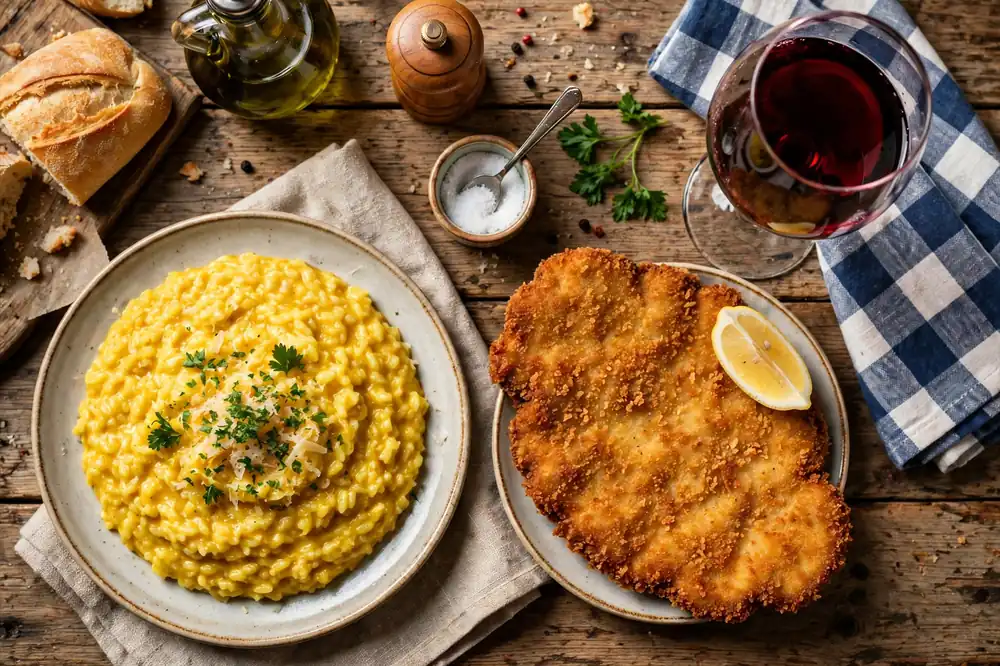
Risotto on Wikipedia is the dish Milan is famous for — the saffron risotto, golden and creamy, made with Carnaroli or Vialone Nano rice, beef stock, butter, Parmesan and saffron, and served as a first course, not a side. The legend is the one every Milanese knows: in 1574, the apprentice of the stained-glass worker Valerio di Fiandra, who was colouring the windows of the Duomo, added saffron to the wedding risotto as a joke, and the guests loved it — and the dish has been Milan’s ever since. The place to eat it is Trattoria Milanese, on Via Santa Marta, serving since the 1930s, with the risotto and the ossobuco, and Antica Trattoria della Pesa, serving since 1880, with the risotto and the cotoletta. The price is €14 to €20 for the risotto, and the coperto, the cover charge, is €2 to €4. Two practical notes: the risotto is the order, so do not skip it, because it is the reason the restaurants are famous — and the ossobuco is the second order, with the risotto, because the two are the classic Milanese pair, with the gremolata on top. Eat the risotto once, eat the ossobuco once, and eat both where the locals eat — that is the Milan risotto plan.
Cotoletta alla milanese — the veal cutlet
The cotoletta alla milanese is the veal cutlet — the bone-in veal chop, breaded and fried in butter, golden and crisp, and served with a lemon wedge and the salad, and it is the dish the city argues about most. The cutlet is documented in 1134, in the records of the monks of Sant’Ambrogio, as “lombolos cum panitio”, the loin with breadcrumbs — and the Austrians claim it as the Wiener Schnitzel, and the Milanese claim it as theirs, and the argument has run for two centuries. The place to eat it is Trattoria Milanese, with the cutlet and the risotto, and Masuelli San Marco, serving since 1921, with the cutlet and the ossobuco, at €45 to €65 a head. The price is €20 to €30 for the cutlet, and up to €35 in the grander rooms. Two practical notes: the cutlet is the order, so do not skip it, because it is the reason the restaurants are famous — and the butter is the point, because the cutlet is fried in butter, not oil, so do not ask for it any other way. Eat the cutlet once, eat it with the lemon, and eat it where the locals eat — that is the Milan cutlet plan.
Aperitivo and panettone — the rituals
Aperitivo on Wikipedia is the ritual Milan invented — and the one that makes the city at night. The aperitivo runs from 6 p.m. to 9 p.m., with a cocktail at €10 to €15 and the food included, at the bars of the Navigli and Brera — and the drink is the Negroni Sbagliato, the mistaken Negroni, invented at Bar Basso in 1972, with prosecco instead of gin, and the Campari, the bitter aperitif invented in Milan by Gaspare Campari in 1860. Panettone on Wikipedia is the other ritual: the Christmas cake of Milan, the tall dome of sweet bread with candied fruit and raisins, and the legend is the baker Toni, who saved the duke’s Christmas dinner with the sweet bread — and the cake is eaten from December to January, with the best from the historic pasticcerie. Two practical notes: the aperitivo is the evening, so do not eat dinner first, because the food at the bar is the dinner — and the panettone is the gift, so buy it from a pasticceria, not a supermarket, because the difference is the butter and the time. Drink the Sbagliato once, eat the panettone once, and do both where the locals do — that is the Milan ritual plan.
Free things to do in Milan
Milan is cheaper than its reputation suggests, because the best sights cost nothing. The Galleria is free, and so is the walk under the glass dome and the photo of the bull. The Sforza Castle courtyards are free, and so is the fountain and the tower. Parco Sempione is free, and so is the park, the lake and the Arco della Pace. The Brera lanes are free, and so are the bookshops and the windows. The Navigli are free, and so is the walk along the canals and the Vicolo dei Lavandai. Porta Nuova is free, and so are the square, the park and the view of the towers. The churches are free, and so are Sant’Ambrogio, San Lorenzo and the columns. The civic museums are free on the first Sunday of the month, including the Sforza Castle museums, the Museo del Novecento and the science museum — and the Pinacoteca di Brera is free on the first Sunday too, with a reservation. The Duomo square is free, and so is the cathedral from the outside and the view of the spires. Do the free list on your first day, and you will have seen the Galleria, the castle, the park, the canals and the churches before you have spent a euro on a ticket.
Frequently asked questions
How many days do you need in Milan?
Three days is the minimum: one day for the centre and the rooftop, one day for Leonardo and the museums, and one day for the canals and the day trip. Four to five days is the right amount for a real trip, with Lake Como, Bergamo and the modern city done properly. Two days works if you plan well — the Duomo, the Last Supper and the Navigli — but you will leave having seen a third of the city, and you will have missed the day trips and the museums, which is the reason to come back.
Is Milan safe?
Milan is safe in the way a big European city is safe, and unsafe in one specific way that every visitor needs to know. Violent crime is rare in the tourist areas — the Duomo, the Galleria, Brera and the Navigli — which are busy with visitors at all hours. The problem is the pickpockets in the crowds and late at night: keep your bag zipped and in front of you, your phone in a front pocket and never on a bar or a table, and do not leave valuables visible in a parked car, because the break-ins are the local crime. The hotspots are the M1 metro between Duomo and Cadorna, the Duomo steps and the south side, where the friendship-bracelet sellers work, and Milano Centrale and its perimeter after about 10 p.m. Milan recorded about 6,989 reported crimes per 100,000 residents in 2024, the highest in Italy, but almost all of it is property crime, and the homicide rate is about 0.5 per 100,000. Use the same sense you would in any European city, and the only thing you will lose is money at the fashion district.
When is the best time to visit Milan?
Mid-May to mid-June and the first three weeks of September, when the days are warm, the humidity is down and the parks are at their best. September is the single best pick, with the warm days, the fewer crowds and the fashion week — but the fashion week triples the hotel prices, so book early. Spring is the second-best, for the mild days and the design week in April. Summer is the hardest season, with July averaging a high of 29°C and humidity that never lets up — and many restaurants close around 15 August. January is the coldest and cheapest month, with an average high of about 6°C. The city gets about 920 to 945 millimetres of rain a year, with October and November the wettest months.
Is Milan expensive?
More expensive than Rome and far more expensive than the south of Italy, and one of the most expensive cities in the country for a weekend. A centre hotel costs €150 to €350 a night, a museum ticket €10 to €20, a risotto about €14 to €20, a cocktail about €10 to €15, and the metro €2.20. The costs most visitors underestimate are the hotel, which is the biggest cost of the trip, and the tickets, which add up — the Duomo rooftop, the Last Supper tour and the Brera together are more than €60 a person — and the fashion-week hotel prices, which can more than triple. A careful three days can be done for about €120 to €250 a person a day, and the Galleria, the castle courtyards, the park, the canals and the churches are free.
Do you need a car in Milan?
No, for the city. The metro, the trams and the buses cover the centre, and the centre is walkable, with the Duomo, the Galleria, Brera and the Navigli all within reach on foot or by metro. Yes, for the day trips: Lake Como, Bergamo and Turin are all by train, not by car, and the train is faster and cheaper than driving — and the car is a liability in the centre, with the traffic, the parking and the limited-traffic zone. Take the metro for the days you stay in the centre, and the train for the days you leave it — and the only reason to rent a car is a road trip to the lakes or the Alps, where the car is the trip.
What should I skip in Milan?
Six things, and all six are traps older guides still get wrong. First, do not plan a trip around The Last Supper without a ticket: the entry-only tickets sell out months ahead, and as of 1 September 2026 every ticket to the end of the year was gone, with only the €60 to €95 guided tours left. Second, do not plan a museum day on a Monday: Brera, Sforza Castle, the Museo del Novecento, the science museum and the Last Supper are all closed on Mondays. Third, do not plan a visit around the Duomo rooftop without booking: the queue is the longest in Milan in summer, and the lift queue is the slow one. Fourth, do not pay for a paper ticket: paper tickets were abolished on 1 January 2026, so tap a contactless card or phone at the gates. Fifth, do not plan a shopping trip around the fashion district expecting a bargain: the prices are the highest in the city, and the district is a look, not a buy. And sixth, do not plan a night around Milano Centrale after 10 p.m.: the station perimeter is the least pleasant part of the centre late at night, so take the metro or a taxi instead.
Further reading
Start with Milan on Wikipedia, which covers the history and the geography, and the Milan Cathedral on Wikipedia for the cathedral and the rooftop. For the painting, The Last Supper (Leonardo) on Wikipedia covers the mural and the refectory, and for the man, Leonardo da Vinci on Wikipedia covers the artist and the inventor. For the arcade, Galleria Vittorio Emanuele II on Wikipedia covers the glass dome and the shops, and for the castle, Sforza Castle on Wikipedia covers the fortress and the museums. For the lake, Lake Como on Wikipedia covers the water and the towns, and for the stadium, San Siro on Wikipedia covers the ground and the derby. For the Olympics, the 2026 Winter Olympics on Wikipedia covers the Games that opened in Milan in February 2026. No Reddit link is included here: no live r/Milan thread turned up in search, so none is listed rather than linking to an unverified one. No Quora link is included either: no live on-topic Quora thread about visiting Milan turned up in search, so none is listed rather than linking to an unverified one.
Your Milan trip, in one paragraph
Milan is the city that rewards slowing down: the Duomo rooftop in the morning, the 15 minutes at The Last Supper at noon, the aperitivo on the Navigli at dusk, a saffron risotto in Brera in the evening, and the Galleria at night before you leave. For more guides in the same style, start with our Hawaii guide for the whole-state trip — this guide is only about Milan — then see how Milan compares with Maui, Honolulu, Chicago, Nashville, Los Angeles, Orlando, Miami, San Diego, Denver, Savannah, Dallas, Charleston, San Francisco, Myrtle Beach, Las Vegas, San Antonio, London, Portland, Pigeon Forge, Puerto Rico, Atlanta, Phoenix, Paris, Key West, Colorado Springs, Sedona, Chattanooga, Palm Springs, St Louis, Tokyo, Japan, Kansas City, Tennessee, Branson, Florida, Amsterdam, Montreal, Fort Lauderdale, Toronto, Aruba, Charlotte, Indianapolis, New Orleans, Destin, Santa Barbara, Mexico City, Arizona, Osaka, Minneapolis, Pittsburgh, California, Asheville, Costa Rica, Washington DC, Seattle, St Augustine, Lisbon, Dubai, Santa Fe, Galveston, Maine, Sacramento, Kauai, Boston, Cancun, Madrid, Salt Lake City, Baltimore, Barcelona, Reno, Milwaukee, North Carolina, New York, Tucson, Raleigh and Corpus Christi.

About the Author