Things to Do in Tucson
Things to Do in Tucson
20 Best Attractions, a 3-Day Itinerary, Where to Stay, and the Food You Cannot Miss
Quick Info
Best for: First-timers, desert lovers, hikers, food lovers and stargazers — the soul of the Sonoran Desert, with giant saguaros, a mountain that drops 30 degrees in an hour, and the best Mexican food in the United States
Best time: October–April for hiking and the desert; late April–early May for the saguaro bloom; November–February for the mildest days
How long: 3 days for the desert, the mission and the food; 5 days for the mountains, the museums and a day trip to the San Pedro River
Budget: About $120–$220 per person per day mid-range — the car and the hotels are the biggest costs, and many of the best sights are free
Don’t miss: Saguaro National Park at sunrise, the Desert Museum in the morning, a Sonoran hot dog on South 12th Avenue, the Mount Lemmon drive, and the sunset from Gates Pass
Tucson on Wikipedia is the city most visitors get wrong — they come for the desert and leave having eaten the best Mexican food in America. It is the second city of Arizona, a Spanish fort from 1775 wrapped around a university, with a forest of giant saguaros on its doorstep, a mountain that climbs from cactus to pine in 27 miles, and a food scene that made it the first UNESCO City of Gastronomy in the United States. This guide covers the 20 best things to do in Tucson, a 3-day itinerary that actually works, where to stay without paying for a resort you do not need, how to get around on the free streetcar and the desert roads, the three foods you should not skip, and the free sights that cost nothing. Everything below was checked against live sources in November 2026 — including the Pima Air & Space price rise, the end of the Boneyard bus tours, the scaffolding on Mission San Xavier, the seasonal hours at Old Tucson, and the prices older guides underplay.
Tucson at a glance
| Topic | What to know |
| Full name | Tucson — the Old Pueblo, the Soul of the Sonoran Desert, in Pima County, Arizona |
| Founded | 1775 as a Spanish presidio; one of the oldest continuously inhabited places in the United States |
| Population | About 550,000 people in the city, about 1 million in the metro area — the second city of Arizona |
| Elevation | 2,389 feet above sea level, ringed by five mountain ranges |
| Airport | Tucson International Airport (TUS), about 20 minutes south of downtown |
| Best base | Downtown and Fourth Avenue for first-timers; the Catalina Foothills for the views and the resorts |
| Getting around | A car for the desert sights; the free Sun Link streetcar downtown; the free buses across the city |
| Famous for | Saguaro cacti, the Sonoran hot dog, the Desert Museum, Mount Lemmon and the best Mexican food in the US |
Tucson divides into four ideas that most visitors only partly see. The desert west is the one the postcards show: Saguaro National Park, the Desert Museum and the Tucson Mountains, with the cacti, the sunsets and the Gates Pass viewpoint. The mountains are the one that surprises people: Mount Lemmon climbs from saguaro desert to pine forest in 27 miles, and the Catalina Highway is the drive that makes the city make sense. Downtown is the one that feeds you: Fourth Avenue, Congress Street, the Presidio, Barrio Viejo and the Sonoran hot dog corridor on South 12th Avenue. The museums are the one that keeps you longer: the Pima Air & Space Museum, the Titan Missile Museum and Biosphere 2, all within an hour of the centre. The trap is the distance and the heat: the sights are spread across a valley ringed by mountains, the summer days pass 100 degrees, and the old guides still list prices and tours that no longer exist — the Boneyard bus tour is gone, Old Tucson no longer runs a daily daytime park, and the Pima Air & Space Museum has raised its prices. Plan by direction, drive early, and book the underground missile tour before you fly, and the city rewards you in every month of the year. For the wider state, our Arizona guide covers the Grand Canyon, Sedona and the rest of the state around Tucson.
The 20 best things to do in Tucson
1. Saguaro National Park — East and West
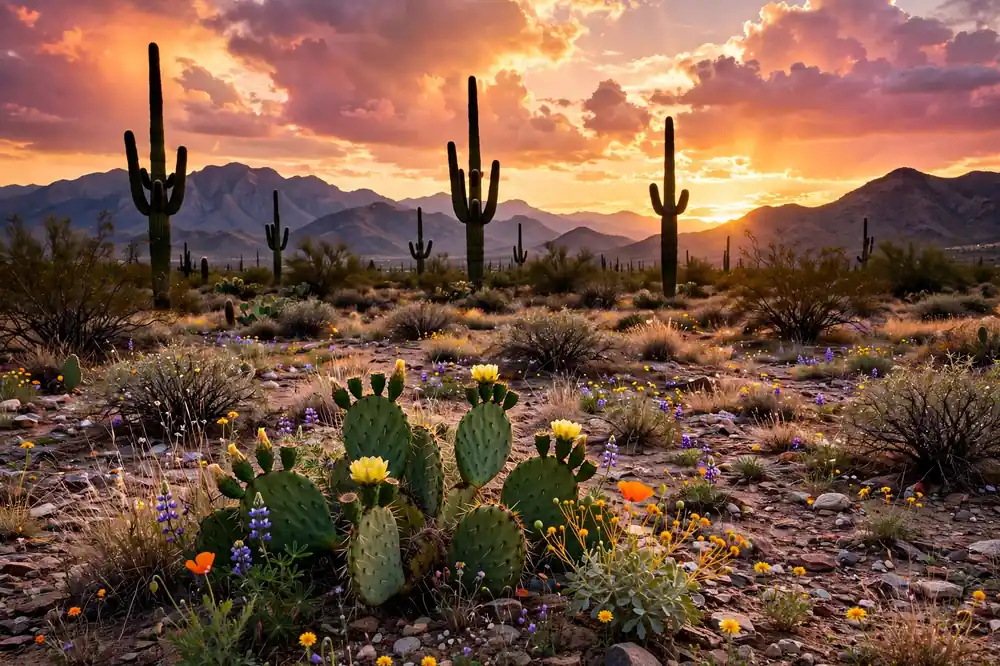
Saguaro National Park on Wikipedia is the reason to come to Tucson — two districts of the Sonoran Desert on opposite sides of the city, filled with the giant cacti that most people picture when they think of Arizona. The park was a national monument from 1933 and became a national park in 1994, and it now covers 91,716 acres with about 165 miles of trails. The saguaro on Wikipedia is the plant itself: it lives 150 to 200 years, grows its first arm at about 75 years old, and can weigh several tonnes when it is full of water after the rains. The trap is the two districts, and this is where our guide beats the older ones: the East district, the Rincon Mountain District, and the West district, the Tucson Mountain District, are about 10 miles apart on opposite sides of the city, and you cannot drive through from one to the other — pick one per visit. The East has the Cactus Forest Loop Drive, open from 5 a.m. to 8:30 p.m., and the higher Rincon Mountains; the West has the Bajada Loop Drive, open in daylight hours, and the densest saguaro forest, with the Desert Museum next door. As of November 2026, entry costs $25 per vehicle for seven days, $20 for a motorcycle and $15 per person on foot or by bike, and the America the Beautiful pass at $80 covers it. The visitor centres are open 9 a.m. to 5 p.m. from October to May and 8 a.m. to 4 p.m. from June to September, and the park takes cards only, no cash. Two warnings: the desert is dangerous in summer, so hike before 10 a.m., carry at least 3 litres of water per person, and never enter an arroyo when a flash-flood warning is out — the Javelina Wash Trail was closed after flash flooding on 1 October 2026, and the West Side Loop Drive was closed after severe storms on 1 September 2026. The bloom is the reason to time a spring trip: the white saguaro flowers open at the top of every arm in late April and early May, for only a few weeks, and the flowers are pollinated at night by bats and in the day by bees. Allow half a day per district, and go at sunrise, when the light is low, the cacti are black against the sky, and the park is at its best.
2. Arizona-Sonora Desert Museum
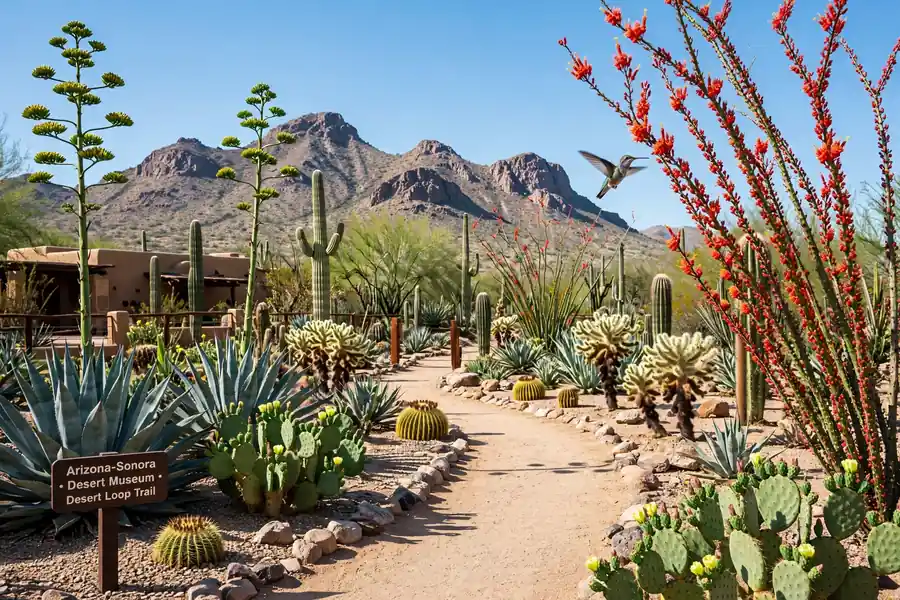
The Arizona-Sonora Desert Museum on Wikipedia is the best single stop in Tucson — a zoo, a botanical garden, a natural history museum, an aquarium and an art gallery in one place, spread over 98 acres on the west side of the city at 2021 North Kinney Road. It was founded in 1952, and it now holds about 230 animal species and 1,200 plant species, all from the Sonoran Desert: the coyotes, the javelinas, the mountain lions, the hummingbirds, the cactus garden and the underground mine tunnel. The trap is the heat and the timing, and this is where our guide beats the older ones: the museum is almost entirely outdoors, so go in the morning, when the animals are active and the paths are in shade, and do not plan a midday visit in summer. As of November 2026, admission is $29.95 for adults 13 to 64, $24.95 for children 3 to 12, and free for children under 3, with $5 off for Arizona and Sonora residents and $2 off for seniors and military. The hours are 8:30 a.m. to 5 p.m. from October to May and 7:30 a.m. to 4 p.m. from June to September, and the museum is open 365 days a year. The Raptor Free Flight season runs from 12 November 2026 to 29 March 2027, with the birds flying free over the desert at 10:30 a.m. from Thursday to Monday, and the Stingray Touch pool costs $4 extra. The Cool Summer Nights run on Saturdays in June, July and August, with the museum open to 10 p.m. Two practical notes: the museum is a full morning, not an hour — allow three to four hours, and wear a hat, because there is almost no shade on the paths — and the parking lot fills by 10 a.m. on winter weekends, so arrive at opening. Allow half a day, and pair it with Saguaro National Park West, which is five minutes down the road.
3. Sabino Canyon
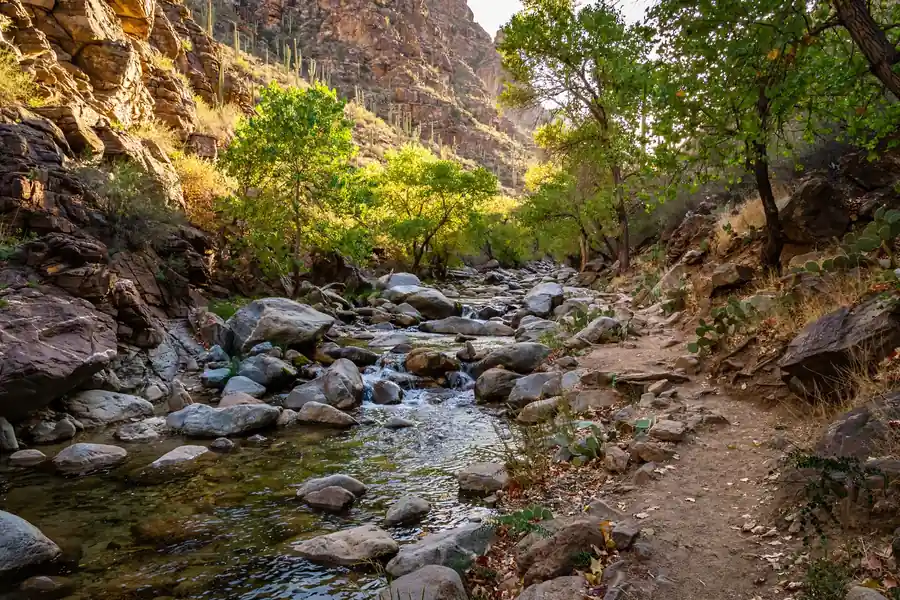
Sabino Canyon on Wikipedia is the desert oasis on the edge of the city — a canyon in the Santa Catalina Mountains with a stream, pools, waterfalls and 30 miles of trails, 15 minutes from downtown at 5700 North Sabino Canyon Road. The walk is the visit, but the Crawler is the way most people see it: the open-air electric shuttle runs the 7.4-mile round trip through the canyon in about an hour, with nine stops, and you can hop on and hop off at any of them. As of November 2026, the Crawler costs $15 for adults and $8 for children under 12, and the Bear Canyon shuttle costs $8 for adults and $6 for children — and the day-use fee for the canyon is $8 per vehicle, $10 for a week, or $40 for the annual Coronado pass. The shuttles run from 9 a.m. to 4 p.m., and the canyon itself is open from dawn to dusk. The trap is the water and the heat: the stream runs after the winter rains and the monsoon, and it can be a trickle by late spring, so the pools are best from March to May and again from August to October — and the canyon is a heat trap in summer, so hike before 10 a.m. and never cross a flooded wash. Two practical notes: the Crawler is the easy way to see the canyon, but the best part is walking back down from the top stop, which is downhill all the way — and the parking lot fills by 9 a.m. on winter weekends, so arrive early or take the bus. Allow half a day, and ride the Crawler up, walk the Phoneline Trail or the creek back down, and finish with a swim in the pools if the water is running.
4. Mount Lemmon and the Catalina Highway
Mount Lemmon on Wikipedia is the mountain that makes Tucson make sense — a sky island that climbs from saguaro desert at 2,700 feet to pine forest at 9,157 feet, in 27 miles of road. The Catalina Highway, the Sky Island Parkway, is the drive: it climbs about 6,300 feet through five life zones, from cactus to oak to pine, and the temperature drops about 30 degrees from the valley floor to the summit, so a 100-degree day in Tucson can be 70 degrees at the top. The trap is the road and the season, and this is where our guide beats the older ones: the road can close after snow, and chains or four-wheel drive may be required in winter, so check the Pima County Sheriff road hotline on 520-351-3351 before you drive up. Mount Lemmon Ski Valley is the southernmost ski area in the continental United States, with 200 acres and 21 runs, and the 2025–26 ski season ran from 14 December 2025 to 27 February 2026, for 75 days. The Sky Ride scenic chairlift runs year-round, and as of November 2026 it costs $17 for adults 18 to 64 and $14 for seniors 65 and over and military, with summer hours of Monday, Thursday and Friday 11 a.m. to 4 p.m. and Saturday and Sunday 10 a.m. to 4 p.m., closed Tuesday and Wednesday. Summerhaven, the little village at the top, is the place for lunch and the general store. Two practical notes: the drive is the attraction, so allow two hours up and back with stops at the viewpoints — Windy Point is the best of them — and the summit is 30 degrees cooler than the city, so bring a jacket even in July. Allow half a day, and drive up in the morning, ride the chairlift, eat lunch in Summerhaven, and drive back down for the sunset over the city.
5. Mission San Xavier del Bac
Mission San Xavier del Bac on Wikipedia is the White Dove of the Desert — the white baroque church on the Tohono O’odham Nation, about 10 miles south of downtown at 1950 West San Xavier Road, and the oldest European structure in Arizona. The mission was founded by the Jesuit missionary Eusebio Kino in 1692, and the church you see today was built by the Franciscans between 1783 and 1797, with the painted interior, the dome, the bell tower and the statues that make it one of the finest Spanish colonial churches in the United States. Admission is free, and the church is open daily from 9 a.m. to 4 p.m., the gift shop from 8 a.m. to 5 p.m., and the museum from 9 a.m. to 4 p.m. The free docent-led tours run for about 30 minutes from Monday to Saturday, usually at 9:15 and 10:15 a.m., and they stop when the temperature passes 95 degrees. The trap is the scaffolding, and this is where our guide beats the older ones: the façade is under restoration, with scaffolding up and the work phased to run to 2027 or 2028, so the famous white front may be partly covered when you visit — the interior is unaffected, and it is the part to see. Two practical notes: the church has no air conditioning or heating, so bring layers in winter and water in summer, because there is almost no shade outside — and the fry bread stands outside the church are the lunch, with the Tohono O’odham fry bread sold by the vendors at the gate. Allow one to two hours, and go in the morning, when the light is on the façade and the tours are running.
6. Pima Air & Space Museum
The Pima Air & Space Museum on Wikipedia is one of the largest aviation museums in the world — about 400 aircraft on 80 acres at 6000 East Valencia Road, next to Davis-Monthan Air Force Base, with six indoor hangars and a field of jets, bombers and airliners outside. The collection is the reason to go: the SR-71 Blackbird, the B-52, the 787 Dreamliner prototype, the 390th Memorial Museum in Hangar 5, and the Spirit of Freedom Hangar, with the aircraft that are too big for the Smithsonian and live here instead. The trap is the price and the Boneyard, and this is where our guide beats the older ones: the museum has raised its prices, and the official site now lists a $37 Combo Pass for adults that bundles the tram tour — the general admission other 2026 sources list is about $22.50 for adults 13 and over, $19.75 for seniors 65 and over and $16 for children 5 to 12, with children under 5 free — so check the official site before you go, because the price depends on which ticket you buy. The museum is open daily from 9 a.m., and in summer it closes at 3 p.m. with last admission at 1:30 p.m. The second trap is the one that catches almost every visitor: the AMARG Boneyard bus tours have permanently ended, and there is no public bus access to the Boneyard from the museum any more — the older guides that tell you to book the bus tour are wrong, and the Boneyard is now a view from the fence, not a visit. Bank of America cardholders get free general admission on the first full weekend of every month through the Museums on Us programme. Two practical notes: the museum is a full morning, not an hour — allow three to four hours, because the hangars alone take two — and the outdoor field is brutally hot in summer, so do the hangars at midday and the field in the morning. Allow half a day, and go in the morning, when the light is on the aircraft and the field is walkable.
7. Titan Missile Museum
The Titan Missile Museum on Wikipedia is the most unusual museum in Arizona — a real Titan II missile in a real underground silo, about 25 miles south of Tucson at 1580 West Duval Mine Road in Sahuarita, just off Interstate 19. It is the only publicly accessible Titan II launch complex in the country, a National Historic Landmark since 1994, and the last of the 54 Titan II sites that stood ready from 1963 to 1987. The tour is the visit: a 45-minute guided walk down 55 steps, 35 feet underground, into the launch control centre, past the blast doors and the crew quarters, to the silo itself, where the 103-foot missile stands and the guide runs a simulated launch. As of November 2026, admission is $19.50 for adults, $17.50 for military, $16.75 for seniors, $15.25 for Pima County residents and $15 for juniors 5 to 12, with a topside-only ticket at $7. The trap is the booking, and this is where our guide beats the older ones: the underground silo tour is by online reservation only, with no door sales, and the tickets are non-refundable and cannot be rescheduled — so book the day before you go, and do not drive out without a reservation. The hours are 9:45 a.m. to 5 p.m. from October to May, with the first tour at 10 a.m. and the last at 4 p.m., and Thursday to Monday in summer from June to September. Two practical notes: the tour is 55 steps down and 55 steps back up, with no lift, so it is not step-free — and the silo is cool underground, so bring a layer even on a hot day. Allow two to three hours with the drive, and book the first tour of the day, when the groups are smallest and the guide has time to answer questions.
8. Old Tucson
Old Tucson on Wikipedia is the film studio that became a theme park — built in 1939 for the Western film Arizona, and the filming location for more than 300 films and television shows, from Rio Bravo to Little House on the Prairie, at 201 Kinney Road on the west side of the city. The trap is the calendar, and this is where our guide beats the older ones: Old Tucson no longer runs a regular daily daytime park, and it now opens for seasonal events — so do not drive out expecting a 10 a.m. gate, and check the calendar on oldtucson.com before you go. The two big seasons are Nightfall in October, the Halloween event, and Yuletide, the Christmas event, which runs on select days from 27 November to 27 December 2026, from 5 to 10 p.m. As of November 2026, Yuletide costs $36 for all ages on non-peak days and $46 for adults 13 and over and $36 for children 5 to 12 on peak days, with children 4 and under free, and the season pass is $109. The old daytime admission of about $19.95 for adults that the older guides still list is not the current picture. If you want the Old West without the ticket, Trail Dust Town is the free alternative: a replica Old West plaza at 6541 East Tanque Verde Road, free to walk in, open Monday to Friday 5 to 9 p.m. and Saturday and Sunday noon to 9 p.m., with the Pistoleros Wild West stunt show from $8.50 on Thursday and Sunday at 7 p.m. and Friday and Saturday at 7 and 8 p.m. Allow an evening for Old Tucson during an event season, and check the calendar first — the park is worth it at Nightfall and Yuletide, and a wasted drive at any other time.
9. Downtown Tucson and Fourth Avenue
Downtown Tucson is the city at street level — Congress Street, the Presidio, Barrio Viejo and Fourth Avenue, all within walking distance of each other, and all best seen on foot or on the free streetcar. Fourth Avenue is the strip: the shops, the bars, the cafés, the murals and the vintage stores along the avenue between the university and downtown, with the street fair in December and the food trucks at night. The Presidio San Agustín del Tucson Museum is the recreated 1775 Spanish fort at the north end of downtown, with the adobe walls, the soldiers’ quarters and the Turquoise Trail, the 2.5-mile walking loop through the historic district. Barrio Viejo is the oldest neighbourhood in the city, south of the convention centre, with the adobe houses, the colourful doors and the El Tiradito wishing shrine, where visitors still leave candles and notes. The Hotel Congress, the 1919 hotel on Congress Street, is the place where John Dillinger was captured in 1934, and its lobby and the Cup Cafe are the downtown meeting point. The Rialto Theatre, the 1920s movie palace on Congress Street, is the live music room. Two practical notes: downtown is quiet in the afternoon and comes alive in the evening, so plan the museums for the day and Fourth Avenue for the night — and the parking is the trap, because the garages fill on event nights, so take the streetcar instead. Allow half a day, and walk from the Presidio through Barrio Viejo to Fourth Avenue, then eat on Congress Street in the evening.
10. The University of Arizona and the Arizona State Museum
The University of Arizona on Wikipedia is the university that built Tucson — founded in 1885 as the first university in the Arizona Territory, with about 50,000 students, the red-brick Old Main, the long green Mall, the palm trees and the stadium at the east end of the campus. The campus is free to walk, and it is worth an hour: Old Main, the oldest building, the Student Union, the cactus garden, and the Mall, which runs from the main gate at University Boulevard and Park Avenue to Old Main. The Arizona State Museum on Wikipedia is the trap, and this is where our guide beats the older ones: it is the oldest and largest anthropology museum in the Southwest, established in 1893, at 1013 East University Boulevard, with more than 3 million objects covering 13,000 years of human history in the region — but its exhibits building has been closed to the public since 1 August 2024, because the 100-year-old North Building’s electrical and plumbing systems are outmoded, and no reopening date has been announced yet. The collection — the world’s largest whole-vessel collection of Southwest Indian pottery, the finest Navajo textile collection in the country, the Mexican folk masks, and the exhibits on the Hohokam, the Mogollon and the living Native cultures of the Southwest — is not on public view while the building is closed, though the museum still runs events, classes and travel and keeps online exhibits. Do not plan a visit around the galleries until the museum announces a reopening; the campus walk is the visit for now. The Flandrau Science Center and Planetarium, also on campus, is the star-gazing stop, with the planetarium shows and the science exhibits. Two practical notes: the campus is busiest on weekdays during term, so go on a weekend or in the summer for a quiet walk — and the parking is the trap, because the campus garages charge by the hour, so take the free streetcar to the University stop instead. Allow two hours, and walk the Mall in the morning, see the Flandrau planetarium, and eat on University Boulevard at lunch.
11. Tucson Botanical Gardens
The Tucson Botanical Gardens on Wikipedia is the garden in the middle of the city — 5.5 acres of desert and tropical plants at 2150 North Alvernon Way, on the old Porter family property, with the cactus garden, the butterfly pavilion, the herb garden and the Great Garden Express miniature railway. As of November 2026, admission is $20 for adults, $18 for seniors 62 and over and active military, and $10 for children 17 and under, with children 2 and under free. The gardens are open daily from 8:30 a.m. to 4:30 p.m., with the gates closing at 4:15 p.m., and they are closed on Thanksgiving, Christmas Eve, Christmas Day, New Year’s Day and 4 July. The trap is the price, and this is where our guide beats the older ones: the older guides still list $15 or $19 for adults, and the price has risen to $20 — and the combo ticket with the Yume Japanese Gardens next door is $25 for adults, $20 for seniors and military and $12 for children, which is only $5 more than the main gardens alone. Yume, the walled Japanese garden one block south at 2130 North Alvernon Way, was bought by the Botanical Gardens in May 2025 and reopened on 11 October 2026, open Tuesday to Sunday from 9:30 a.m. to 3 p.m. The Butterfly Magic pavilion runs from October to May, and LightsUp!, the holiday light walk, runs from 27 November 2026 to 10 January 2027, Tuesday to Sunday from 6 to 9:30 p.m. Two practical notes: the parking lot fills by 11 a.m. on winter weekends, but there is free street parking on the residential blocks nearby — and the Grant Road Improvement Project may affect your route, so allow extra time. Allow two hours, and go in the morning, when the gardens are in shade and the butterflies are out.
12. Reid Park Zoo
Reid Park Zoo on Wikipedia is the small zoo that punches above its weight — 24 acres inside the 131-acre Gene C. Reid Park in midtown Tucson at 3400 East Zoo Court, with more than 250 animals, the elephants, the lions, the tigers, the giraffes, the flamingos and the grizzly bears. As of November 2026, admission is $12.75 for adults 15 to 61, $10.75 for seniors 62 and over and $9 for children 2 to 14, with children under 2 free — and the older guides that list $12, $10 and $8.50 are a dollar behind. The hours are 9 a.m. to 4 p.m. from October to May and 8 a.m. to 2 p.m. from June to September, with last entry 30 minutes before closing, and the zoo is closed on Thanksgiving and Christmas Day. The news is the Pathway to Asia exhibit, the new habitat that opened in 2026, with timed tickets required for all guests, including members, for the first few weeks it is open — so book online before you go. The giraffe encounters run at 10 a.m., and the $3 Tuesdays run in June and July, with general admission reduced to $3 per person on Tuesdays. The Summer Safari Nights run on Saturday evenings in summer, from 6 to 8 p.m. Two practical notes: the zoo is a two-hour visit, not a day — allow two hours, and go at opening, when the animals are active and the paths are empty — and the aviaries close at noon from Monday to Friday, so see the birds first. Allow two hours, and pair it with the Botanical Gardens, which is ten minutes away.
13. The Fox Tucson Theatre
The Fox Tucson Theatre on Wikipedia is the theatre that saved downtown — a 1930 Southwestern Art Deco movie palace at 17 West Congress Street, with the murals, the chandeliers and the 1,164 seats, restored after decades of decline and listed on the National Register of Historic Places. It now hosts more than 150 events a year: the concerts, the comedy, the classic films, the community events and the Broadway tours. The calendar is the reason to check before you go: as of November 2026, the theatre has Daughtry on 11 November, #IMOMSOHARD on 13 November, The Sixties Show on 19 November, Outlander in Concert on 20 November, the Steep Canyon Rangers on 22 November, Fraggle Rock Live on 24 November, the Fab Four on 28 November and The Nutcracker on 11 December. The box office is open Tuesday to Friday from noon to 4 p.m., and the doors usually open an hour before the show. Two practical notes: the theatre is small, so there is no bad seat, but the balcony is the best value — and the parking is the trap on show nights, because the garages fill, so take the free streetcar to the Congress stop. Allow one evening, and book the show before you fly if it is the reason for the trip — the popular nights sell out, and the theatre is the best room in the city for live music.
14. Biosphere 2
Biosphere 2 on Wikipedia is the strangest day trip from Tucson — a 3.14-acre glass world in the desert at Oracle, about 30 miles north of the city at 32540 South Biosphere Road, a 45-minute drive up Oracle Road. It was built between 1987 and 1991 as a sealed experiment in living off the Earth, and two crews lived inside it from 1991 to 1994, growing their own food and breathing their own recycled air. Today it is a University of Arizona research facility, and the visit is a self-guided walk through the rainforest, the ocean, the desert, the savanna and the lung — the giant white dome that breathes with the building. As of November 2026, admission is $27 for adults, $25 for seniors 62 and over and military, and $15 for children 5 to 17, with children under 5 free — and tickets bought online get a $2 discount on the adult, senior and military prices. The campus is open daily from 9 a.m. to 4 p.m., with last entry at 3:30 p.m., and closed on Thanksgiving and Christmas Day. The self-guided tour takes about 90 minutes, and the Lung Tour and the Library and History Tour cost $12 extra and need to arrive 30 minutes early. Two practical notes: the tickets are non-refundable, but they can be rescheduled within a year — and the building is warm inside, because it is a greenhouse, so bring water even in winter. Allow half a day with the drive, and book online before you go, especially on weekends, because the daily ticket limit can sell out.
15. The San Pedro River
The San Pedro River on Wikipedia is the wildest day trip from Tucson — one of the last free-flowing rivers in the Southwest, running north from Mexico through a green corridor in the desert, about 80 miles southeast of the city. The San Pedro Riparian National Conservation Area protects almost 57,000 acres of public land along 40 miles of the river, from the Mexican border to St. David, and it is one of the richest wildlife habitats in the United States: more than 350 bird species, more than 80 species of mammals, 100 breeding birds and 250 migrant and wintering birds, in a cottonwood and willow forest that should not exist in the desert. The drive is the plan: take Interstate 10 east for about 40 miles to Arizona Route 90, follow it south through Huachuca City to Sierra Vista, then east on Fry Boulevard for 6 miles to the San Pedro House, the main visitor centre. Entry is free, and the area is open year-round. The Friends of the San Pedro River lead guided nature walks every Saturday at 8 a.m. from San Pedro House, and bird walks on the second Wednesday and fourth Saturday of the month at 7 a.m. The best birding is in spring migration from April to May and in fall migration from August to September, when the grey hawk, the yellow-billed cuckoo, the green kingfisher and the tropical kingbird all pass through. Two practical notes: there is no public transport to the conservation area, so a car is essential — and the dirt roads can become impassable in the monsoon, so check conditions after rain. Allow a full day, and go at dawn, when the birds are loudest and the river is at its coolest.
16. Sentinel Peak — the “A” Mountain
Sentinel Peak on Wikipedia is the free viewpoint that every Tucsonan knows — the 2,897-foot hill west of downtown, with the giant letter “A” on its side, built by University of Arizona students in 1915 after a football victory, and repainted ever since. The drive up is the visit: the road winds to the top, where the whole city spreads out below — downtown, the university, the Catalina Mountains to the north and the Tucson Mountains to the west — and the sunset from the top is the best free view in Tucson. The hill is free, and it is open from dawn to dusk, with picnic tables and the interpretive signs at the top. The name is the history: Sentinel Peak was the lookout for the Spanish presidio, and the hill was the landmark for every traveller on the road from Mexico. Two practical notes: the road is narrow and the parking at the top is small, so go on a weekday or arrive an hour before sunset — and the wind at the top is strong, so bring a jacket even on a warm evening. Allow one hour, and go at sunset, when the city lights come on and the mountains turn pink — the locals call it the time when the hills turn pink, and it is the moment to be there.
17. Tumamoc Hill
Tumamoc Hill on Wikipedia is the sunrise hike — a 3.1-mile round trip up a paved road to the top of an 860-acre desert hill on the west side of the city, with 728 feet of climbing and the whole of Tucson below. The hill is a University of Arizona ecological research station, a desert laboratory since 1903, and the road is the workout: the locals walk it at dawn, the runners run it, and the view from the top is the reward. The hill is free, and it is open from dawn to dusk. The trap is the dogs and the heat: dogs are not allowed on the hill, and the road is fully exposed, so hike before 9 a.m. in summer and carry water — the climb takes 45 minutes to an hour, and there is no shade and no water on the way up. The desert is the point: the saguaros, the cholla, the ocotillo and the wildflowers, with the research plots and the old stone buildings at the top. Two practical notes: the parking lot at the base fills by 7 a.m. on winter weekends, so arrive early or walk from the neighbourhood — and the hill is steepest in the first half mile, so pace yourself and stop at the benches. Allow two hours, and go at sunrise, when the light is on the Catalinas and the city is still cool.
18. Tohono Chul Park
Tohono Chul on Wikipedia is the desert garden on the north side of the city — 49 acres of desert preserve at 7366 North Paseo del Norte, with the gardens, the art exhibits, the nature trails and the Garden Bistro, named for the Tohono O’odham words for desert corner. As of November 2026, admission is $20 for adults, $15 for seniors 62 and over and active military, and $10 for youth 2 to 17. The grounds are open daily from 8 a.m. to 5 p.m., and the park is closed on New Year’s Day, 4 July, Thanksgiving and Christmas. The gardens are the visit: the cactus garden, the desert palm oasis, the wildflower garden, the art in the gardens, and the trails that wind through the 49 acres. The Holiday Nights run on Fridays, Saturdays and Sundays from 6 to 9 p.m. on 4–6, 11–13 and 18–20 December 2026, with the gardens lit, the music, the food and the visit with Santa. Two practical notes: the park is quieter than the Botanical Gardens, so it is the garden for a slow morning — and the Garden Bistro is the lunch, with the patio under the trees. Allow two hours, and go in the morning, when the gardens are in shade and the birds are out.
19. Kitt Peak National Observatory
Kitt Peak National Observatory on Wikipedia is the night sky — the largest collection of optical telescopes in the world, on a 6,875-foot mountain about 56 miles southwest of Tucson, a 90-minute drive through the desert and the Tohono O’odham Nation. It was founded in 1958, and it now holds 25 telescopes, including the McMath-Pierce Solar Telescope, the largest solar telescope in the world, and the WIYN 3.5-metre telescope, with the white domes spread across the mountaintop. The day visit is the tour: the guided tours of the telescopes, the visitor centre and the views across the desert to Mexico. The night visit is the reason to go: the Nightly Observing Program, with the telescopes, the guides and the darkest sky in the country — Tucson is one of the darkest cities in America, and the sky over Kitt Peak is the reason the observatories are here. The trap is the booking and the drive: the night programmes need to be booked ahead, and they sell out on weekends, and the mountain road is steep and winding, so drive it in daylight and bring a jacket, because the summit is 20 degrees cooler than the city. Two practical notes: the observatory is on tribal land, so respect the rules and the signs — and the sunset from the summit is the show before the stars, so arrive an hour early. Allow a full evening, and book the night programme before you fly.
20. Colossal Cave Mountain Park
Colossal Cave on Wikipedia is the cool-down — a limestone cave in a 2,400-acre park about 22 miles southeast of Tucson at 16721 East Old Spanish Trail in Vail, where the temperature is 70 degrees all year round. The Classic Cave Tour is the visit: a half-mile guided loop through the stalactites, the stalagmites and the flowstone, down 363 stairs, about six storeys, in 40 to 55 minutes, with the guide telling the stories of the outlaws who are said to have hidden here. As of November 2026, the Classic Cave Tour costs $24 for adults and $14 for children 5 to 12, and the park charges $5 per car for entry. The tours run daily on the hour, and children under 5 are not allowed on the tour. The Ladder Tour costs $60 for ages 12 and over, and the Wild Cave Tour costs $85 for the intermediate and $125 for the advanced, both for ages 16 and over, with a two-person minimum — and both need advance reservations. The park is open daily, with the grounds from 8 a.m. to 4 p.m. through 15 September, and the cave tours from 9 a.m. to 3 p.m. Monday to Thursday and 9 a.m. to 4 p.m. Friday to Sunday. The trap is the price, and this is where our guide beats the older ones: the older guides still list $18 for adults and $11 for the tour, and the price has risen to $24 — and the Frommer’s listing of $18 is out of date. Two practical notes: the tour is 363 stairs down and 363 stairs back up, so it is not step-free — and the cave is 70 degrees, so bring a layer even on a 100-degree day. Allow half a day with the drive, and book five days ahead in peak season, because the groups are limited to 20 people.
Tucson in 3 days — a ready-made itinerary
This three-day plan uses the west side as the base for the desert, downtown as the base for the food, and the mountains as the escape — it needs a car, because the desert sights are spread across the valley, and it leaves the San Pedro River and Kitt Peak for a fourth and fifth day. Book the Titan Missile tour and the Fox Theatre show before you fly, put the desert sights in the morning, and keep the evenings for Fourth Avenue and the Sonoran hot dog corridor.
Day 1 — The desert west: the Desert Museum, Saguaro West and Gates Pass
Start at the Arizona-Sonora Desert Museum at 8:30 a.m., and give it three hours, with the Raptor Free Flight if it is running. Drive five minutes to Saguaro National Park West for the Bajada Loop Drive and a short hike among the saguaros, then eat lunch at the Desert Museum or back in town. Spend the afternoon at the Tucson Botanical Gardens or the Reid Park Zoo, then drive to Gates Pass for the sunset — the best free view in the city — and finish with dinner on Fourth Avenue.
Day 2 — The mission, downtown and Sabino Canyon
Start at Mission San Xavier del Bac at 9 a.m., with the free docent tour and the fry bread stands outside, then drive back to downtown for the Presidio, Barrio Viejo and the Hotel Congress. Walk Fourth Avenue for lunch and the shops, then drive to Sabino Canyon for the Crawler in the afternoon — ride it up and walk back down. Finish with a Sonoran hot dog on South 12th Avenue in the evening, and a drink on Congress Street.
Day 3 — The mountain and the museums: Mount Lemmon, Pima Air & Space and the Titan Missile
Drive the Catalina Highway to Mount Lemmon in the morning, ride the Sky Ride chairlift and eat lunch in Summerhaven, then drive back down for the afternoon at the Pima Air & Space Museum — allow three hours for the hangars and the field. If you booked ahead, drive south to the Titan Missile Museum for the late tour, or save it for a fourth day and spend the evening at the Fox Tucson Theatre instead. Finish with dinner downtown, and an Eegee’s on the way home.
Best time to visit Tucson
| Season | Weather | Crowds | Notes |
| Winter (December–February) | Highs about 65–72°F (18–22°C), lows about 38–45°F (3–7°C) | Low–moderate | Best hiking weather; the desert is green after the winter rains; the Gem Show and the Rodeo in February |
| Spring (March–May) | Highs about 75–95°F (24–35°C), lows about 45–60°F (7–16°C) | Moderate–high | Wildflowers in March; the saguaro bloom in late April–early May; the Festival of Books in March |
| Summer (June–August) | Highs about 98–104°F (37–40°C), lows about 70–77°F (21–25°C) | Low | Extreme heat in June; the monsoon storms from mid-July; the cheapest hotels of the year |
| Autumn (September–November) | Highs about 75–96°F (24–36°C), lows about 47–70°F (8–21°C) | Moderate | The monsoon ends, the desert turns green, and the light is the best of the year |
The best time to visit Tucson is October to April, and if you want one answer, pick November to February: the days are in the 60s and low 70s, the hiking is possible all day, the wildlife is active, and the hotel prices are fair. Late April to early May is the second-best pick, for the saguaro bloom — the white flowers on top of every arm, for only a few weeks — but the days are already in the 90s, so hike before 9 a.m. Tucson has five seasons, not four: winter, spring, the dry summer from mid-May to early July, the wet summer of the monsoon from mid-July to early September, and autumn. June is the driest and hottest month, with the days regularly over 100 degrees and the desert empty after 8 a.m. The monsoon arrives in mid-July, with severe thunderstorms almost every afternoon, the desert turning green overnight, and the best light of the year after the storms — but the storms bring flash floods, so stay out of arroyos and washes whenever a flood warning is out, because the water can arrive even when no rain is falling where you are. The desert safety rules are simple: hike before 10 a.m. in the warm months, carry at least 3 litres of water per person, wear a hat and sunscreen, and remember the 20 to 30 degree swing between day and night — a warm afternoon becomes a cold evening as soon as the sun goes down, so bring a layer. The events are worth timing a trip around: the Tucson Gem, Mineral and Fossil Showcase in early February, the Tucson Rodeo in February, and the Tucson Festival of Books in March on the University of Arizona campus.
Where to stay in Tucson
| Area | Best for | Price range |
| Downtown / Fourth Avenue | First-timers, walkers, the streetcar | $120–$250 a night |
| University area | Families, the Festival of Books, the stadium | $100–$200 a night |
| Catalina Foothills | Views, resorts, the quiet side | $200–$450 a night |
| East side (Tanque Verde) | Sabino Canyon, the Rincon Mountains, the quiet | $120–$220 a night |
| Oro Valley / north | Mount Lemmon, Biosphere 2, the resorts | $150–$300 a night |
| South Tucson | Budget, the Sonoran hot dog corridor | $70–$130 a night |
Stay downtown or on Fourth Avenue if this is your first visit — the Presidio, Barrio Viejo, Congress Street and the streetcar are all within reach, and the hotels are the most central in the city — and the Hotel Congress, the 1919 hotel where John Dillinger was captured in 1934, is the stay that is an attraction in itself. Stay in the Catalina Foothills if you want the views and the resorts — the desert, the mountains and the quiet, with the pools and the spas, and the prices to match. Stay on the east side, around Tanque Verde Road, if you want Sabino Canyon and the Rincon Mountains — the trails are a ten-minute drive, and the hotels are cheaper than the foothills. Stay in Oro Valley if you want Mount Lemmon and Biosphere 2 — the resorts at the foot of the Catalinas, with the golf and the views. Stay in South Tucson if you want the budget and the food — the Sonoran hot dog corridor on South 12th Avenue is outside the door, and the hotels are the cheapest in the city. Two warnings: do not book a room in early February without checking the price first — the Gem Show week books out months ahead, and the rates spike — and do not book a room in June expecting a resort deal without checking the heat, because the pools are the reason the rates drop, and the desert is the reason you will not want to leave the pool.
Getting around Tucson
| Way to travel | Cost | Best for |
| Rental car | About $40–$70 a day | The desert sights — Saguaro, Sabino Canyon, Mount Lemmon, the Titan Missile Museum |
| Sun Link streetcar | Free | Downtown, Fourth Avenue and the University of Arizona |
| Sun Tran bus | Free | Across the city |
| Taxi / rideshare | About $12–$25 in town | Late nights, the airport with luggage |
| Bike | Varies | The Loop — 131 miles of paved paths around the city |
| Walking | Free | Downtown, Fourth Avenue, the University, Barrio Viejo |
Tucson is a car city for the desert and a streetcar city downtown: the sights are spread across a valley ringed by mountains, and the bus does not go to Saguaro National Park, Sabino Canyon or Mount Lemmon — so rent a car for the days you leave the city, and use the streetcar for the days you do not. The Sun Link streetcar runs 3.9 miles from downtown through Fourth Avenue to the University of Arizona, and it is free — and so are all the Sun Tran buses, at the direction of the Mayor and Council, so the whole transit system costs nothing. The car is the way to the desert: Interstate 10 runs north to Phoenix in about two hours — our Phoenix guide covers the drive and the city at the other end — and south to the Titan Missile Museum and the border, and Interstate 19 runs south to Nogales. The Loop, the 131-mile paved path around the city, is the way to see Tucson by bike, with the Rillito River path the most popular stretch. Tucson International Airport is about 20 minutes south of downtown, and the rideshare from the airport costs about $20. Two warnings: do not drive into the desert without water and a full tank, because the gas stations thin out fast outside the city — and do not trust the phone signal in the mountains, because the Catalina Highway and the San Pedro River both have dead zones, so download the map before you go.
Tucson food you have to try
Tucson eats with 4,100 years of continuous agriculture behind every plate. UNESCO named it the first United States City of Gastronomy in December 2015, for exactly that reason: the Tohono O’odham, Yaqui, Spanish, Mexican and Anglo-American food traditions still meet here, at Mission Garden at the base of Sentinel Peak, and the city now runs a 23-mile Mexican food trail that Visit Tucson calls the 23 Miles of Mexican Food. The food is the reason many visitors come back: the Sonoran hot dog, the chimichanga, the fry bread, the carne asada and the frozen eegee, and the trap is the opposite of most cities — the restaurants on the tourist streets are fine, but the best food is on South 12th Avenue and South 4th Avenue, where the locals queue, and the most Tucson meal of all is the one eaten standing up with a hot dog in one hand and an eegee in the other.
The Sonoran hot dog — and where to eat it
The Sonoran hot dog on Wikipedia is the city’s signature street food — a bacon-wrapped link, grilled and steamed in a soft bolillo bun, then loaded with pinto beans, onions, tomato, mayonnaise, mustard and jalapeño salsa, and eaten with a grilled yellow pepper on the side. It crossed the border from Hermosillo in the late 1980s and 1990s, and Tucson made it its own: South 12th Avenue in South Tucson, the one-square-mile incorporated city inside Tucson, is the Sonoran hot dog row, and the United States capital of the dogo. The place to eat it is El Güero Canelo, at 5201 South 12th Avenue, which won the James Beard Foundation America’s Classic award in 2018 for the dog — the flagship on South 12th, with the other locations on Oracle Road, 22nd Street and Irvington Road. BK Tacos, at 5118 South 12th Avenue, is the other major dogo stop on the same stretch, with the biggest, most fully-loaded version and the grilled yellow pepper. Ruiz Hot Dogs Los Chipilones, at 1140 South 6th Avenue, is the locals’ pick, and El Sinaloense, the cart at 1526 North Alvernon Way, is the late-night stop. Two practical notes: the carts and the stands on South 12th Avenue run late, until 11 p.m. on weeknights and 2 a.m. on weekends — and the dog is cheap, a few dollars, so eat two and compare, because the taste test is the Tucson tradition. Eat the Sonoran hot dog once, eat it on South 12th Avenue, and eat it with the pepper — that is the Tucson food plan.

Mexican food: the 23-mile corridor and the chimichanga
The 23 Miles of Mexican Food is the trail that runs through Tucson — the taquerias, the bakeries, the tortilla factories and the family restaurants from South Tucson to the north side, with the carne asada, the burritos, the tamales and the tacos that made the city a UNESCO City of Gastronomy. The place to start is El Charro Café on Court Avenue downtown, the oldest continuously family-owned Mexican restaurant in the United States, run by the same family since 1922, and the restaurant that claims the chimichanga on Wikipedia as its invention — the deep-fried burrito that Tucson gave the world. Mi Nidito, on South 4th Avenue, is the other classic, with the president’s plate and the birria. The food is the reason to drive the corridor: the flour tortillas, the Sonoran carne asada, the green corn tamales, and the salsa that is made in the morning and gone by the afternoon. Two practical notes: the best Mexican food in Tucson is not on the tourist streets — it is on South 12th Avenue, South 4th Avenue and Oracle Road, where the menus are in Spanish and the prices are low — and the breakfast burrito is the morning meal, with the chorizo and egg burrito the local order. Eat the chimichanga once, eat the carne asada once, and eat both where the locals eat — that is the Tucson Mexican food plan.
Eegee’s and the sweet side
Eegee’s on Wikipedia is the Tucson institution — the frozen fruit drink, the Grinder sub and the ranch fries, from a chain that started in September 1971 with two childhood friends, Ed Irving and Bob Greenberg, $2,500 of starting capital and a used vending truck parked near the University of Arizona campus. The name comes from the founders’ initials, the E of Ed and the G of Bob, and the drink is a semi-frozen fruit slush, somewhere between an Italian ice and a slushie. The year-round flavours are lemon, strawberry and piña colada, with a Flavor of the Month that rotates — watermelon is the top all-time flavour — and the lemon eegee is the order. The chain now has 25 locations across Tucson and Phoenix, and the one at 243 East Speedway Boulevard, near downtown and the university, is the easiest for visitors. The news is the survival: Eegee’s filed for Chapter 11 bankruptcy protection on 6 December 2024, was sold in April 2025, and celebrated its 55th anniversary in September 2026 — and the lemon eegee, the Grinder and the ranch fries are still the through-line. The sweet side does not stop there: Barrio Bread, at 18 South Eastbourne Avenue, where Don Guerra won the James Beard Outstanding Baker award in 2022 for his heritage white Sonora wheat loaves, is the bakery to visit in the morning. Two practical notes: the eegee is the answer to a 105-degree afternoon, and the lemon is the flavour to order first — and the Grinder sub is the lunch, with the ranch fries on the side. Drink the lemon eegee once, eat the Grinder once, and take a loaf from Barrio Bread home — that is the Tucson sweet plan.
Free things to do in Tucson
Tucson is cheaper than its reputation suggests, because the best sights cost nothing. Mission San Xavier del Bac is free, and so are the church, the museum and the docent tours. Sentinel Peak is free, and so is the drive to the top and the sunset over the city. Gates Pass is free, and so is the sunset viewpoint on the road to the Desert Museum. Tumamoc Hill is free, and so is the sunrise hike up the paved road. Fourth Avenue is free, and so are the shops, the murals and the window-shopping. The Sun Link streetcar is free, and so is the ride from downtown to the university. Trail Dust Town is free to walk in, and so is the Old West plaza on Tanque Verde Road. The Loop is free, and so are the 131 miles of paved paths around the city. The University of Arizona campus is free, and so are the Mall, the cactus garden and the walk past Old Main. Reid Park is free, and so are the lawns, the ponds and the rose garden. The San Pedro River is free, and so are the trails and the bird walks. The Tucson Museum of Art is free on the first Thursday of the month. Do the free list on your first day, and you will have seen the mission, the mountains, the desert and the food before you have spent a dollar on a ticket.
Frequently asked questions
How many days do you need in Tucson?
Three days is the minimum: one day for the desert west, one day for the mission and downtown, and one day for Mount Lemmon and the museums. Five days is the right amount for a real trip, with the San Pedro River, Kitt Peak and a second desert morning, and a week if you want the day trips too — Tombstone, Bisbee and Tubac are all within two hours. Two days works if you plan well — the Desert Museum, Saguaro National Park and a Sonoran hot dog — but you will leave having seen a third of the city, and you will have missed the mountains and the missions, which is the reason to come back.
Is Tucson safe?
Tucson is safe in the way a desert city is safe, and unsafe in one specific way that every visitor needs to know. Violent crime is rare in the tourist areas — downtown, Fourth Avenue, the university, the foothills and the parks — which are busy with visitors at all hours. The problem is the petty crime in the crowds and late at night: keep your bag zipped and in front of you, your phone in a front pocket and never on a bar or a table, and do not leave valuables visible in a parked car at a trailhead, because the trailhead break-ins are the local crime. The real danger is the heat, not the people: the summer days pass 100 degrees, the desert kills the unprepared, and the rescue calls in Saguaro National Park are for heat, not crime. Use the same sense you would in any American city, and the only thing you will lose is money at the resort restaurants.
When is the best time to visit Tucson?
October to April, when the days are warm, the hiking is possible all day and the desert is at its best. November to February is the single best pick, with the days in the 60s and low 70s and the wildlife active. Late April to early May is the second-best, for the saguaro bloom — the white flowers on top of every arm, for only a few weeks — but the days are already in the 90s, so hike before 9 a.m. June is the hottest and driest month, with the days regularly over 100 degrees and the desert empty after 8 a.m. Mid-July to early September is the monsoon, with the afternoon thunderstorms, the desert turning green and the best light of the year — and the flash-flood risk, so stay out of the washes. October is the shoulder season, with the heat gone and the evenings still warm, and the crowds thin.
Is Tucson expensive?
Cheaper than Phoenix and far cheaper than Scottsdale, and the cheapest desert city in Arizona for a weekend. A downtown hotel costs $120 to $250 a night, a museum ticket $13 to $30, a Sonoran hot dog a few dollars, an Eegee’s a few dollars, and the streetcar and the buses are free. The costs most visitors underestimate are the car, which is $40 to $70 a day and essential for the desert sights, and the tickets, which add up — the Desert Museum, Pima Air & Space and the Titan Missile Museum together are more than $70 a person — and the February hotel prices, which spike for the Gem Show week. A careful three days can be done for about $120 to $220 a person a day, and the mission, the viewpoints, the streetcar and the parks are free.
Do you need a car in Tucson?
Yes, for the desert itself. Saguaro National Park, Sabino Canyon, Mount Lemmon, the Titan Missile Museum, Biosphere 2 and the San Pedro River all need a car or a tour, and the bus does not go to any of them. No, for downtown: the Sun Link streetcar is free and runs from downtown through Fourth Avenue to the University of Arizona, and the buses are free too, so the centre is walkable and rideable without a car. Rent the car only for the days you leave the city, and take the streetcar for the days you do not — the downtown parking costs more than the rental on a show night. The only reason to rent for the whole trip is a road trip to Tombstone, Bisbee or the Grand Canyon, where the car is the trip.
What should I skip in Tucson?
Six things, and all six are traps older guides still get wrong. First, do not hike at midday in summer: the days pass 100 degrees, the desert kills the unprepared, and the rescue calls in Saguaro National Park are for heat — hike before 10 a.m., carry 3 litres of water per person, and never enter an arroyo when a flood warning is out. Second, do not drive to Old Tucson expecting a daytime park: it now opens for seasonal events only, so check the calendar first, or you will find a closed gate. Third, do not plan a trip around the Boneyard bus tour: the AMARG bus tours have permanently ended, and there is no public access to the Boneyard from the Pima Air & Space Museum any more. Fourth, do not drive to the Titan Missile Museum without a reservation: the underground tour is online only, with no door sales, and the tickets are non-refundable. Fifth, do not budget the old Pima Air & Space prices: the museum has raised its prices, and the official site now lists a $37 Combo Pass — check the site before you go. And sixth, do not expect the full white façade at Mission San Xavier: the church is under restoration, with scaffolding up and the work phased to 2027 or 2028, so the front may be partly covered — the interior is unaffected, and it is the part to see.
Further reading
Start with Tucson on Wikipedia, which covers the history and the geography, and the Arizona-Sonora Desert Museum on Wikipedia for the desert and its wildlife. For what visitors actually think of the Desert Museum, the Quora thread on the Desert Museum has a week-long first visit, the summer heat warning, the Fourth Avenue praise and the Tombstone and Bisbee day trips. No Reddit link is included here: no live r/Tucson thread turned up in search, so none is listed rather than linking to an unverified one.
Your Tucson trip, in one paragraph
Tucson is the city that rewards getting up early: the saguaros at sunrise in Saguaro National Park, the Desert Museum at opening, Mount Lemmon before the heat, a Sonoran hot dog on South 12th Avenue in the evening, and the stars over Kitt Peak before you leave. For more guides in the same style, start with our Hawaii guide for the whole-state trip — this guide is only about Tucson — then see how Tucson compares with Maui, Honolulu, Chicago, Nashville, Los Angeles, Orlando, Miami, San Diego, Denver, Savannah, Dallas, Charleston, San Francisco, Myrtle Beach, Las Vegas, San Antonio, London, Portland, Pigeon Forge, Puerto Rico, Atlanta, Phoenix, Paris, Key West, Colorado Springs, Sedona, Chattanooga, Palm Springs, St Louis, Tokyo, Japan, Kansas City, Tennessee, Branson, Florida, Amsterdam, Montreal, Fort Lauderdale, Toronto, Aruba, Charlotte, Indianapolis, New Orleans, Destin, Santa Barbara, Mexico City, Arizona, Osaka, Minneapolis, Pittsburgh, California, Asheville, Costa Rica, Washington DC, Seattle, St Augustine, Lisbon, Dubai, Santa Fe, Galveston, Maine, Sacramento, Kauai, Boston, Cancun, Madrid, Salt Lake City, Baltimore, Barcelona, Reno, Milwaukee, North Carolina and New York.

About the Author