
Things to Do in North Carolina
20 Best Attractions, a 3-Day Itinerary, Where to Stay, and the Food You Cannot Miss
Quick Info
Best for: First-timers, road trippers, families and outdoor lovers — a state with the Blue Ridge Mountains, the Great Smoky Mountains, the Outer Banks and three very different cities in one trip
Best time: April–June and September–October for the mountains and the cities; June–August for the Outer Banks beaches; mid-to-late October for fall colour on the Blue Ridge Parkway
How long: 3 days for one region; 7 days for the mountains and the coast together — this is a 500-mile-wide state, not a weekend city
Budget: About $150–$250 per person per day mid-range — a rental car is the biggest cost, and many of the best sights are free
Don’t miss: The Blue Ridge Parkway at sunrise, the Biltmore Estate, the Wright Brothers Memorial, the Mile High Swinging Bridge, and a plate of Lexington barbecue with Cheerwine
North Carolina on Wikipedia is the state most visitors get wrong — they picture one place and miss the other three. It is a 500-mile-wide state with the Blue Ridge Mountains in the west, the Piedmont cities in the middle and the barrier islands of the Outer Banks in the east, and the best trip touches all three. This guide covers the 20 best things to do in North Carolina, a 3-day itinerary that actually works, where to stay in each region without paying leaf-season prices by accident, how to get around a state with no single transit system, the three foods you should not skip, and the free sights that cost nothing. Everything below was checked against live sources in November 2026 — including the Blue Ridge Parkway closures after Hurricane Helene, the Cape Hatteras Lighthouse closure, the Raleigh history museum closure, and the prices older guides underplay.
North Carolina at a glance
| Topic | What to know |
|---|---|
| Full name | North Carolina — the Tar Heel State, the Old North State, the 12th state of the Union |
| Founded | 1789, admitted as the 12th state; the first English colony in America was Roanoke in 1585; the capital is Raleigh |
| Population | About 11 million people, the 10th most populous state in the country |
| Geography | 53,819 square miles — the Blue Ridge Mountains in the west, the Piedmont in the middle, the Coastal Plain and the Outer Banks in the east |
| Highest point | Mount Mitchell, 6,684 feet — the highest peak east of the Mississippi River |
| Airports | Charlotte Douglas International (CLT), Raleigh-Durham International (RDU), Asheville Regional (AVL), Wilmington International (ILM) |
| Best base | Asheville for the mountains, Nags Head for the Outer Banks, Raleigh or Charlotte for the cities |
| Getting around | A car is essential — the state is about 500 miles wide; I-40, I-85 and I-95 cross it |
| Famous for | The Blue Ridge Parkway, the Great Smoky Mountains, the Wright brothers’ first flight, Biltmore, barbecue and Cheerwine |
North Carolina divides into three ideas that most visitors only partly see. The mountain west is the one the postcards show: the Blue Ridge Parkway, the Great Smoky Mountains, the waterfalls of Pisgah National Forest and the small towns of the High Country. The Piedmont middle is the one that surprises people: Charlotte with its whitewater centre and NASCAR, the Triangle of Raleigh, Durham and Chapel Hill with its free museums and gardens, and the Triad of Greensboro and Winston-Salem with the sit-in museum and Old Salem. The coast is the one that rewards the drive: the Outer Banks, 200 miles of barrier islands with wild horses, lighthouses and the place where flight began. The trap is the distance and the small print: the state is 500 miles wide, the Parkway is still not a through-drive after Hurricane Helene, the Cape Hatteras Lighthouse cannot be climbed in 2026, the history museum in Raleigh is closed until 2028, and the Outer Banks in October is a different place from the Outer Banks in July. Plan one region properly, drive the Parkway in the morning, and book the Biltmore and Grandfather Mountain ahead, and the state rewards you in every month of the year.
The 20 best things to do in North Carolina
1. Drive the Blue Ridge Parkway
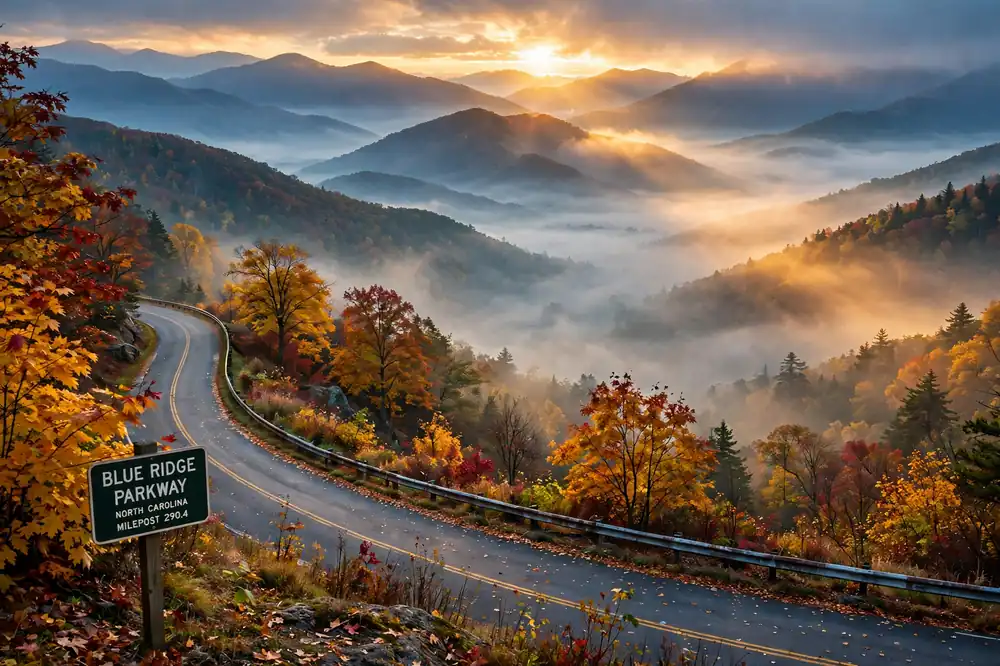
The Blue Ridge Parkway on Wikipedia is the drive that defines North Carolina — 469 miles of scenic road from Virginia to the Great Smoky Mountains, with about 252 miles of it in North Carolina, and the single best thing to do in the state. The road runs at 45 mph through overlooks, tunnels, waterfalls and the highest ground in the east: Richland Balsam Gap at 6,053 feet is the highest point on the whole Parkway, Craggy Gardens at milepost 364.6 turns pink with rhododendron in June, the Linn Cove Viaduct curls around Grandfather Mountain near milepost 304, Moses Cone Memorial Park sits at milepost 294 with its manor house and carriage trails, and Waterrock Knob at milepost 451.2 gives the highest viewpoint in the state, with its visitor centre at 5,820 feet. The Folk Art Center at milepost 382 and the Parkway Visitor Center at milepost 384, both near Asheville, are the two places to stop for maps and advice. The trap is the road itself, and this is where our guide beats the older ones: Hurricane Helene closed the whole Parkway in September 2024, and as of November 2026 it is not yet a through-drive. The National Park Service reported on 5 October 2026 that 458 of the 469 miles had been restored, with 48 of 60 slide repairs complete — but the stretch from milepost 344.2 to 355.3, from NC-80 to Mount Mitchell State Park, is still closed for Helene repairs, and recreation of any kind is prohibited inside it, with a target reopening at the end of 2026. The sections that reopened in October 2026 — mileposts 317.5 to 324.7 south of Linville Falls and 333.9 to 340.2 at Little Switzerland — mean you can now drive from Virginia all the way to Little Switzerland without a hard stop, and from Mount Mitchell south through Asheville, but you cannot drive through the gap. There are also sporadic single-lane closures between mileposts 291.8 and 305.1 and 317 and 344, and the high sections close for ice and snow in winter. The Park Service warns that its LiveMap is not displaying closures, so use the written Road Status page and check it the morning you drive. Allow a full day for the Asheville to Cherokee stretch, and drive it in the morning, when the light is best and the fog is lifting off the valleys.
2. Great Smoky Mountains National Park
Great Smoky Mountains National Park on Wikipedia is the most visited national park in America, and the North Carolina side is the quieter half — more than 800 square miles of mountains, waterfalls and old-growth forest straddling the line with Tennessee, entered from Cherokee and Bryson City on the North Carolina side. The park has no entrance fee, which is the first thing older guides get right, but the second thing they miss is the parking tag: since 2023, any vehicle parked for more than 15 minutes needs a Park It Forward tag — $5 a day, $15 a week or $40 a year — and you must buy it before you head out, because most trailheads have no machine, and the America the Beautiful pass does not cover it. The headline hike is Kuwohi, the 6,643-foot peak renamed from Clingmans Dome in September 2024, the highest point in the park and in Tennessee: the road to it runs 1 April to 29 November in 2026 and closes from 1 December to 31 March, and it can close any time for ice and snow. Newfound Gap Road, US 441, the 31-mile road from Gatlinburg to Cherokee, is open year-round except during and after winter storms. The practical rules are the ones that save a day: the main lots at Alum Cave, Laurel Falls and Kuwohi fill by 8:30 to 9 a.m. in peak season, so arrive before 8 a.m. or after 4 p.m.; the elk are best seen at dawn and dusk in the Oconaluftee Valley and Cataloochee; the three waterfalls of Deep Creek near Bryson City are the easiest waterfall walk in the park; and the Cades Cove Cable Mill runs from mid-March to late November 2026. The Great Smoky Mountains Railroad in Bryson City runs the Polar Express in November and December, and the Smokies were not one of the 11 parks that added the $100 nonresident surcharge in 2026. Allow two days, and go on a weekday if you can — the park is the most visited in the country, and the weekends in October are the busiest days of the year.
3. The Biltmore Estate
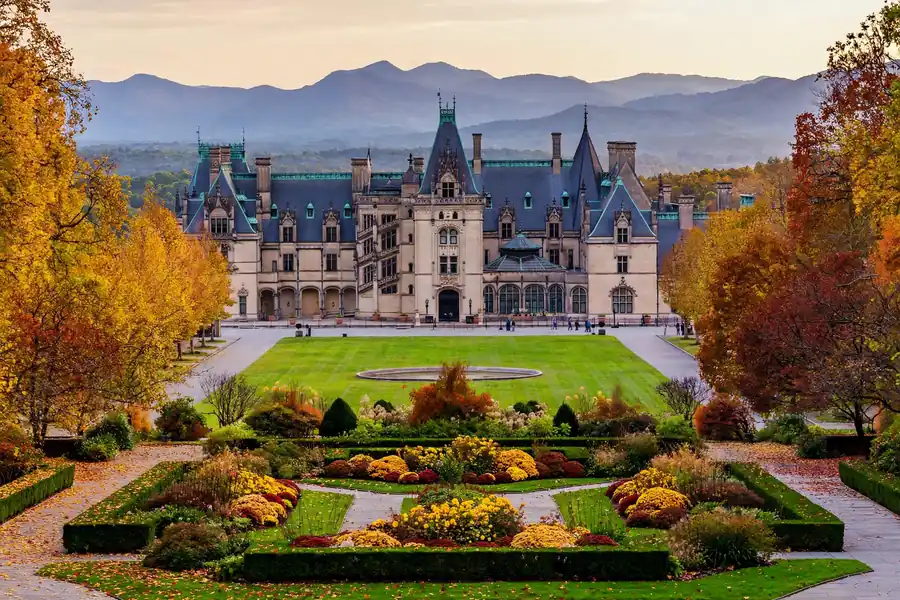
The Biltmore Estate on Wikipedia is the largest privately owned home in America — and the one attraction in Asheville that justifies a whole day. George Vanderbilt built it between 1889 and 1895, with the architect Richard Morris Hunt and the landscape designer Frederick Law Olmsted, and it opened on Christmas Eve 1895: 250 rooms, 35 bedrooms and 43 bathrooms on 8,000 acres at 1 Lodge Street, Asheville, with the gardens, the winery and Antler Hill Village around it. The house itself takes about 90 minutes to two hours, and the entry is a timed reservation, so arrive 30 to 45 minutes early and do not expect to walk in off the street at Christmas. The prices are the part older guides get wrong: as of November 2026, daytime House and Grounds tickets start from $110, Candlelight Christmas Evenings from $135, grounds-only tickets from $85, and the annual pass is $299 — children under 9 are free, with discounts for ages 16 and under, and parking is free. Christmas at Biltmore runs 3 November 2026 to 10 January 2027, with the Candlelight Evenings from 3 November 2026 to 9 January 2027 — not on 17 November, Thanksgiving Day on 26 November, or Christmas Eve — and the Antler Hill Village illumination runs 3 November 2026 to 15 February 2027, from 5 p.m. to midnight. For the full city around the estate, read our Asheville guide — this article gives Asheville one attraction, the Biltmore, because the city already has its own guide. Allow a full day, and book the house for the morning and the gardens for the afternoon — the estate is at its best in the late light, and the winery tasting is the way to end it.
4. The Outer Banks — Cape Hatteras and the lighthouses
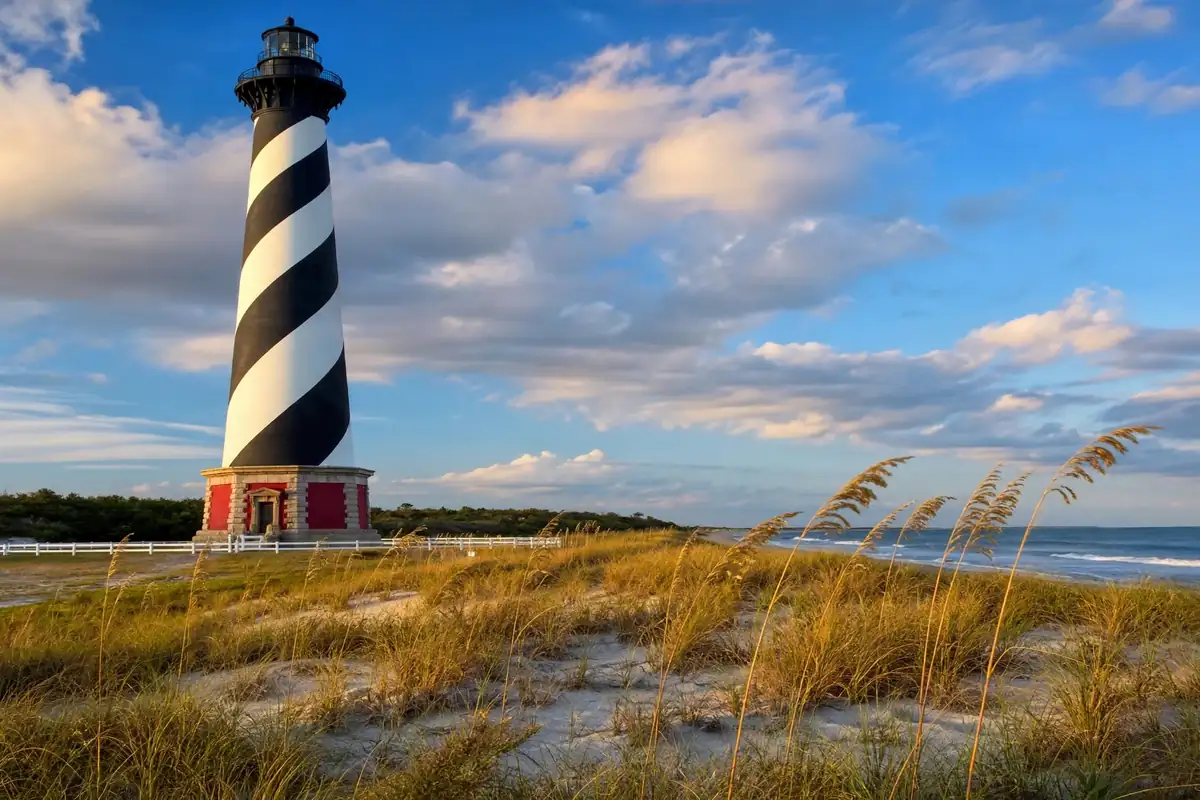
Cape Hatteras National Seashore on Wikipedia is the coast that made North Carolina famous — 200 miles of barrier islands from Corolla to Ocracoke, with the tallest brick lighthouse in the country, the wild beaches and the road, NC-12, that runs with the ocean on one side and the sound on the other. The Outer Banks on Wikipedia are a national scenic byway of about 138 driving miles plus 25 ferry miles, from Whalebone Junction in Nags Head down to Ocracoke. The trap is the lighthouse, and this is the fact older guides get wrong: the Cape Hatteras Lighthouse on Wikipedia will not open for climbing in 2026, due to restoration work on the flooring, the metal workings and the windows — the grounds and the visitor centre are open, and the outdoor areas are open 24 hours a day, but do not plan a trip around climbing it, and do not buy a tour that promises the climb. The lighthouse is the tallest brick lighthouse in the United States, moved 2,900 feet inland in 1999 to save it from the sea. The climb that is open in 2026 is the Bodie Island Lighthouse on Wikipedia, late April to early November: $10 for adults and $5 for seniors 62 and over, children 11 and under and the disabled, with tickets sold only on recreation.gov from 7 a.m. on the day of the climb. The Currituck Beach Lighthouse in Corolla, the 162-foot red-brick tower from 1875 with 220 steps, runs 21 March to 30 November 2026 at $13 for ages 4 and over, and the Ocracoke Island Lighthouse is never open for climbing. Two more warnings: Pea Island National Wildlife Refuge is the birding stop between the two, and Fort Raleigh National Historic Site on Roanoke Island is where the Lost Colony vanished in 1587. And in October 2026 a storm forced an evacuation of Hatteras Island under a Dare County state of emergency, closing the campgrounds and the off-road vehicle routes — the Outer Banks are a hurricane coast, and the season runs 1 June to 30 November, peaking in August to October, so check the conditions before you drive down NC-12. Allow two to three days, and stay in Nags Head or Kitty Hawk for the beaches and the Wright Brothers, or in Hatteras Village for the lighthouse and the ferry.
5. Wright Brothers National Memorial
The Wright Brothers National Memorial on Wikipedia is where the world changed — the 90-foot dune at Kill Devil Hills where Orville and Wilbur Wright made the first powered flight on 17 December 1903, 12 seconds and 120 feet that became the age of flight. The memorial sits on 1000 North Croatan Highway in Kill Devil Hills, with the visitor centre and museum, the reconstructed 1903 Flyer, the markers for the four flights, and the 60-foot granite monument on top of Big Kill Devil Hill, with a view over the dunes and the sea. The prices are the part older guides get wrong: as of November 2026, admission is $10 per person for ages 16 and over, good for seven days, and free for ages 15 and under, with an annual pass at $35 — the $4 and $7 prices in the old guides are years out of date, and the fee is paid at a machine in the parking lot. The memorial is open seven days a week, 9 a.m. to 5 p.m., closed only on Christmas Day, and the ranger talks run through the day. Two practical notes: the climb to the monument is steep, so wear good shoes and bring water, and the site is closed to drones. Allow two hours, and go in the morning, before the heat and the school groups, then walk the dune where the first flight happened — the markers on the ground are the most moving part of the visit, and they cost nothing extra.
6. Jockey’s Ridge State Park
Jockey’s Ridge State Park on Wikipedia is the tallest living sand dune system on the East Coast — 426 acres of sand in Nags Head, with dunes up to 100 feet high, and the most fun free afternoon on the Outer Banks. The dunes move with the wind, which is why they are called living, and the park is the place to fly a kite, try sandboarding, or take a hang-gliding lesson with Kitty Hawk Kites, which has taught on the dunes since 1974. The park is free to enter, and the visitor centre has the exhibits on the dunes and the hang gliding. Two practical notes: the sand is hot in summer, so wear shoes and bring water, and the sunset from the top of the dune is the best free view on the Outer Banks — the dune faces west over the sound, and the sun drops straight into it. Allow two to three hours, and go in the late afternoon, when the light is low, the wind is up, and the kites are in the air.
7. Chimney Rock State Park
Chimney Rock State Park on Wikipedia is the mountain that looks like a postcard — a 315-foot granite monolith above the Rocky Broad River, with Hickory Nut Falls, the 404-foot waterfall where the finale of The Last of the Mohicans was filmed, and the village of Chimney Rock and Lake Lure below it. The trap is the storm: Hurricane Helene hit on 27 September 2024, and the park was closed for nine months before it reopened on Friday 27 June 2025, with a new temporary bridge over the Rocky Broad River, and the village is still recovering unevenly. As of November 2026, advance reservations are required, admission is about $17 for adults, and the hours are seasonal — the gate opens at 8:30 a.m. and the park closes at 7 p.m. through 1 November, then 8:30 a.m. to 4:30 p.m. with a 6 p.m. close from 2 November to 31 December, closed on Christmas Day. The access is via NC 9 through Lake Lure, and US 64 from Bat Cave reopened on 28 March 2026, while Lake Lure has been refilling since February 2026. A minor landslide closed the park for one day on 26 May 2026, so check the status before you drive. The climb is the Outcroppings Trail, 499 steps to the top of the Chimney, with the falls trail below it. Allow half a day, and book the reservation before you leave Asheville — the park turns away cars without one, and the weekends in October sell out.
8. Grandfather Mountain and the Mile High Swinging Bridge
Grandfather Mountain on Wikipedia is the mountain with the bridge — the Mile High Swinging Bridge, built in 1952, 228 feet long at 5,280 feet of elevation, the highest suspension footbridge in the United States, with the 5,946-foot peak behind it. The bridge sways in the wind, which is the point, and the view from it runs over the Blue Ridge in every direction. The prices are the part older guides get wrong: as of November 2026, admission is tiered by day — base days $25 for adults, $23 for seniors 60 and over and $13 for children 3 to 12; mid-level days $30 and $28; peak days $35 — with taxes and fees extra, and advance online timed-entry reservations are required, because the tickets sell out. The hours are spring 8 a.m. to 6 p.m., summer 8 a.m. to 7 p.m., fall 8 a.m. to 6 p.m. and winter 9 a.m. to 5 p.m., closed on Thanksgiving Day and Christmas Day, with last entry an hour before closing. Two warnings: the bridge closes in high winds and typically from late November to early April in hazardous conditions, and the Profile Trail is currently closed due to Hurricane Helene damage. The wildlife habitats — the bears, the cougars and the otters — and the Wilson Center for Nature Discovery are included in the ticket, and this is a privately operated attraction, not the free state park backcountry on the other side of the mountain. Allow three to four hours, and go on a weekday morning, when the bridge is quietest and the light is best.
9. Mount Mitchell — the highest peak east of the Mississippi
Mount Mitchell on Wikipedia is the highest peak east of the Mississippi River — 6,684 feet, in the first park in the North Carolina state park system, with an observation deck on the summit and a view that runs a hundred miles on a clear day. The trap is the road: the park reopened on 15 September 2025 after almost a year closed by Hurricane Helene, and as of November 2026 it can be reached only from the Asheville side — drive north on the Blue Ridge Parkway to NC 128 at milepost 355.3, because the Parkway from milepost 344.2 to 355.3, from NC-80 to the park, is still closed, with recreation prohibited inside it. Between Asheville and the park there is a 35 mph work zone with dump-truck traffic and one-lane stretches, and there are no gas stations, so fill up first and budget for a 70-mile round trip. The park opens at 7 a.m. and closes at 8 p.m. in October and 6 p.m. from November to February, and the high sections close for snow and ice in winter, so check the road status the morning you drive. The summit is a short walk from the parking lot, and the observation deck is the reason to come — the layers of blue ridges in every direction, and the spruce-fir forest that feels like Canada. Allow half a day, and go on a clear morning, when the view is the point and the clouds take it away.
10. Linville Falls and Linville Gorge
Linville Falls on Wikipedia is the waterfall that drops in stages through Linville Gorge off the Blue Ridge Parkway, finishing in a 45-foot plunge into a deep pool — and the gorge itself is the deepest in the east, where the Linville River drops 2,000 feet in 12 miles through a steep, rugged canyon. The trap is the visitor centre: Hurricane Helene destroyed it in September 2024, and it has been removed — there is no building, no gift shop, no ranger desk and no indoor restrooms, only portable toilets near the parking area, with a plan to rebuild by the end of 2027. The good news is that the trail system has reopened, and the Linville Falls spur road at milepost 316.5 is open into the main parking area, where the trails lead to the overlooks. The campground and the picnic area remain closed because of Helene damage, and swimming in the Linville River and climbing on the rocks are prohibited. The trails are the reason to come: the upper falls, the chimney viewpoint and the plunge basin overlook, through old-growth hemlock, white pine, oak, hickory and birch. Allow two to three hours, and check the Parkway road status before you go — the falls are open, but the road south of them is not fully back to normal, and the conditions change as repairs continue.
11. The U.S. National Whitewater Center
The U.S. National Whitewater Center on Wikipedia is the biggest outdoor playground in the country — 1,300 acres on the Catawba River outside Charlotte, with the world’s largest man-made, recirculating whitewater river, 40 miles of mountain bike and hiking trails, a ropes course, zip lines, rock climbing and flatwater paddling, and an official U.S. Olympic Training Site. The pricing is the part older guides get wrong: there is no facility fee — entry to the grounds, the trails, the live music and the festivals is free — but parking is $12 a day or $40 a year, and the activities are paid separately. As of November 2026, the All Access Pass is $79 a day, $69 for ages 9 and under, and $149 a year, with single activities from $18 for the Wildwoods pass to $35 for mountain biking and $59 for a day of whitewater rafting. The centre is at 5000 Whitewater Center Parkway, about 15 minutes from uptown Charlotte, and it is open year-round, with the river running in season and the trails open at dawn. For the full city around the centre, read our Charlotte guide — this article gives Charlotte one attraction, the Whitewater Center, because the city already has its own guide. Allow a full day, and book the rafting for the morning and the zip lines for the afternoon — the pass is the value if you do three activities, and the single-activity pass is the value if you do one.
12. The North Carolina Museum of Natural Sciences, Raleigh
The North Carolina Museum of Natural Sciences on Wikipedia is the best free museum in the state — the Southeast’s largest natural history museum, in downtown Raleigh on Bicentennial Plaza, with more than 1.7 million specimens across two connected buildings, four floors of exhibits, live animals, working research labs you can watch, and the Dueling Dinosaurs exhibit. The admission is free, and the hours are Tuesday to Sunday, 10 a.m. to 5 p.m., closed on Mondays — and closed on 26 November, 24 December and 25 December 2026. One warning: the Living Conservatory butterfly room is closed until summer 2027. The trap is across the plaza: the North Carolina Museum of History on Wikipedia is closed for a major renovation, with a 40,000-square-foot expansion and 25 percent more gallery space, and is scheduled to reopen in 2028 — older guides still list it as an open attraction, and it is not. The Natural Sciences museum is the Raleigh museum to go to until then, and it is the most visited museum in North Carolina. The museum sits at 11 West Jones Street, next to the State Capitol, and the parking across the street is about $2 an hour. Allow two to three hours, and go on a weekday morning, when the school groups are thinnest and the dinosaurs are quietest.
13. Sarah P. Duke Gardens, Durham
Sarah P. Duke Gardens on Wikipedia is the garden that makes Durham worth a stop — 55 acres on the Duke University campus, free to enter, open daily from 8 a.m. to dusk, with the Terrace Gardens, the Blomquist Garden of Native Plants and the Culberson Asiatic Arboretum. The gardens are the most beautiful free sight in the Triangle, and the reason to come is the seasons: the cherry blossoms in spring, the roses in summer, the maples in autumn, and the quiet in winter. Durham on Wikipedia itself is the third city of the Triangle, with the American Tobacco Campus, the Durham Bulls ballpark and the food scene that the city is known for — and the gardens are the calm in the middle of it. Two practical notes: the gardens are free, but the parking is paid, so walk from the campus or take the bus, and the gardens are a working university garden, so the paths are quietest in the early morning. Allow two hours, and pair it with lunch at the American Tobacco Campus, a ten-minute drive away.
14. The USS North Carolina Battleship, Wilmington
The USS North Carolina (BB-55) on Wikipedia is America’s most decorated World War II battleship — permanently moored on the Cape Fear River at Wilmington, open 365 days a year from 8 a.m. to 5 p.m., with nine levels to explore, from the engine rooms to the bridge. The ship is North Carolina’s official World War II memorial, honouring the roughly 11,000 North Carolinians who lost their lives in the war, and the self-guided tour takes about two hours, with the bunks, the galley, the guns and the sick bay all open. The price to know in 2026 is the America 250 offer: through 31 December 2026, residents of the 13 original colonies pay just $13 per adult, with the code NC13 at the ticket window or online — the offer ends on 31 December 2026 and will not extend into the new year, so check battleshipnc.com for the standard rates before you go. Wilmington on Wikipedia itself is the riverfront city across the water, with the Riverwalk, the historic downtown and Wrightsville Beach a short drive east — the beach is the reason to stay the night, and the battleship is the reason to come in the morning. Allow two to three hours, and go early, when the ship is quietest and the river is calm.
15. Old Salem, Winston-Salem
Old Salem on Wikipedia is the living history village that tells the story of the Moravians who founded Salem in 1766 — a historic district in downtown Winston-Salem where the bakers, the potters, the gunsmiths and the gardeners still work in the buildings they built, and the Museum of Early Southern Decorative Arts sits in the Horton Museum Center. The historic district is free to walk around, but the buildings need a ticket, and the ticket is the part older guides get wrong: as of November 2026, the All-in-One ticket is $30 for adults and $16 for students and children, free for children 3 and under, and valid for two consecutive days — and the holiday rate from 15 November to 30 December is $36 for adults. The site is open Wednesday to Saturday, 10 a.m. to 4 p.m., and closed in January each year, so do not plan a January visit. The Winkler Bakery is the stop to make — the Moravian sugar cake and the gingerbread — and the gardens are the quietest corner of the site. Two practical notes: the ticket is bought at the Visitor Center at 900 Old Salem Road, the Horton Center or the bakery, and the site is a working museum, so the buildings open and close through the day and the docents are the reason to go slowly. Allow three hours, and go on a Wednesday morning, when the village is quietest and the bakers are at work.
16. The International Civil Rights Center & Museum, Greensboro
The International Civil Rights Center and Museum on Wikipedia is the most important museum in North Carolina — the Woolworth’s store in downtown Greensboro where, on 1 February 1960, four students from North Carolina A&T State University — David Richmond, Franklin McCain, Ezell Blair Jr. and Joseph McNeil — sat down at the whites-only lunch counter and launched the sit-in movement. The museum opened on 1 February 2010, fifty years to the day, and the lunch counter itself is still there, with the stools and the exhibits on the movement that followed. The visit is a guided walking tour of about 90 minutes, and the price is $20 per adult — and the rules are strict: no photographs, no food and no drinks on the tour, and the tour is wheelchair accessible with an elevator. The museum is at 134 South Elm Street in downtown Greensboro, and it is a Travellers’ Choice winner for 2026. Two practical notes: the tour is the only way to see the museum, so book ahead, and the visit is heavy — this is not a light afternoon, and it is not meant to be. Allow two hours, and go in the morning, when the museum is quietest and the exhibits can be taken slowly.
17. The North Carolina Zoo, Asheboro
The North Carolina Zoo on Wikipedia is the world’s largest natural-habitat zoo — 2,600 acres in Asheboro, with 500 acres developed, more than 1,700 animals and 200 species, from the elephants and the rhinos of the African plains to the polar bears and the Arctic foxes of the North American habitats. The prices are seasonal, and this is the part older guides get wrong: in peak season, 15 March to 15 November, admission is $20 for adults on site and $18 online, $18 for seniors 62 and over, college students and military, and $16 for children 3 to 12, with children under 3 free — and the $15, $13 and $11 prices in the old guides are the low-season prices, from 16 November to 14 March, when adults pay $15 on site and $14 online. Buy online at least a day ahead and save about $2. The hours are peak season 9 a.m. to 5 p.m., with last entry at 4 p.m., and low season 9 a.m. to 4 p.m., with last entry at 3 p.m., closed on Thanksgiving Day and Christmas Day, and the parking is free. One warning: the new Asia region is under construction, with funding and 54 new staff positions approved in the July 2026 state budget, but no opening date has been announced — do not plan a trip around it. The zoo celebrated its 50th anniversary in 2024, and it is a USA Today 10Best winner. The zoo is at 4401 Zoo Parkway, Asheboro, about 75 minutes from Raleigh and 90 minutes from Charlotte. Allow a full day, and go in the morning, when the animals are active and the crowds are thinnest.
18. Pisgah National Forest waterfalls
Pisgah National Forest on Wikipedia is the waterfall forest — more than 500,000 acres of the Blue Ridge around Brevard, with Transylvania County alone holding more than 250 waterfalls, and the Cradle of Forestry, where the Biltmore Forest School ran from 1898 to 1913 as the first forestry school in America. The star is Looking Glass Falls, the roadside waterfall on US 276 that you can see from the car, with the steps down to the plunge pool. Sliding Rock is the natural waterslide, where the water runs over the smooth rock into a pool, and Moore Cove Falls and Rainbow Falls are the hikes — Rainbow Falls is the long one, with the 150-foot falls at the end. Graveyard Fields at milepost 418 on the Parkway is the high meadow with the waterfalls and the blueberry bushes, and Black Balsam Knob is the bald summit above it. Two practical notes: the waterfalls are at their fullest in spring, after the rain, and the rocks are slippery, so wear good shoes and do not climb on them — the rescues here are the ones the rangers talk about. Allow a full day from Asheville or Brevard, and drive US 276, the Forest Heritage Byway, which connects the falls, the Cradle of Forestry and the Parkway.
19. Corolla’s wild horses and the northern Outer Banks
Corolla, North Carolina on Wikipedia is the Outer Banks that most visitors never see — the northern end of the barrier islands, where about 100 wild Colonial Spanish mustangs roam the beaches and the dunes, descended from the horses that came with the Spanish more than five centuries ago. The horses live in the Currituck National Wildlife Refuge, north of where the paved road ends, and the way to see them is a wild horse tour in an open-air truck, or a 4×4 drive on the beach with a permit. The Currituck Beach Lighthouse is the stop on the way — the 162-foot red-brick tower from 1875, with 220 steps to the top, open 21 March to 30 November 2026 at $13 for ages 4 and over — and Historic Corolla Park, with the Whalehead mansion and the free Currituck Maritime Museum, is the quiet corner. Two practical notes: the horses are wild, so keep your distance and do not feed them, and the beach driving needs a 4×4 and a permit, so the tour is the better choice for most visitors. Allow half a day, and go in the morning, when the horses are on the beach and the light is best.
20. Ocracoke Island and the Hatteras ferry
Ocracoke, North Carolina on Wikipedia is the island at the end of the road — a village of 900 people at the southern tip of the Outer Banks, reached only by ferry, with no chain stores, no traffic lights and the beach that Dr. Beach named America’s Best Beach in 2022. The way there is the free Hatteras to Ocracoke vehicle ferry, about an hour across Pamlico Sound, running year-round, first come first served — arrive early in summer, because the line forms by mid-morning, and the toll ferries from Cedar Island and Swan Quarter take reservations. The island itself is the Ocracoke Lighthouse, the oldest operating lighthouse in North Carolina from 1823, never open for climbing, and the village, with the shops, the restaurants and the graveyard where the pirate Blackbeard was killed off the island in November 1718. The beaches are the reason to come: the Lifeguard Beach, the sound-side sunsets and the empty sand that runs for miles. Two practical notes: the island is small, so rent a bike or a golf cart, and the restaurants close early in winter, so check the hours before you go. Allow a full day, and take the first ferry in the morning — the island is at its best before the day-trippers arrive, and the sunset from the sound side is the way to end it.
North Carolina in 3 days — a ready-made itinerary
This three-day plan covers the mountains, because three days cannot cover a 500-mile state — it uses Asheville as the base, with a car, and it leaves the Outer Banks for a second trip, or a fourth and fifth day. Book the Biltmore and Grandfather Mountain before you fly, put the Parkway on a weekday, and keep the evenings for downtown Asheville — the city eats early by big-city standards, with dinner from 6 p.m.
Day 1 — Asheville and the Biltmore: the estate, the River Arts District and downtown
Start at the Biltmore Estate at 9 a.m., and give the house two hours, then the gardens and the winery in the afternoon. Drive back into Asheville for the River Arts District, where the studios and the galleries line the French Broad River, then dinner downtown — the city has more restaurants per person than almost anywhere in the country, and the breweries are the reason the evening runs late.
Day 2 — The Blue Ridge Parkway: Craggy Gardens, Mount Mitchell and Linville Falls
Drive the Parkway north from Asheville in the morning: Craggy Gardens at milepost 364.6 for the rhododendron and the view, then Mount Mitchell at milepost 355.3 for the summit and the observation deck — remember the road from NC-80 is closed, so come from the Asheville side only. Continue north to Linville Falls at milepost 316.5 for the afternoon hike to the overlooks, then drive back to Asheville for dinner. Fill up before you leave Asheville — there is no gas on the Parkway.
Day 3 — Waterfalls and the Smokies: Pisgah Forest, Looking Glass Falls and Bryson City
Drive south on US 276 into Pisgah National Forest: Looking Glass Falls from the road, Sliding Rock for the waterslide, and the Cradle of Forestry for the history. In the afternoon, drive west to Bryson City and the Great Smoky Mountains, for the Deep Creek waterfalls or the railroad, then back to Asheville for a last dinner — and a plate of barbecue, because you have not eaten North Carolina until you have.
Best time to visit North Carolina
| Season | Weather | Crowds | Notes |
|---|---|---|---|
| Spring (March–May) | Highs about 60–75°F (15–24°C), lows about 40–55°F (4–13°C) | Moderate | Best all-round season; wildflowers, waterfalls at full flow, the Parkway reopening after winter |
| Summer (June–August) | Highs about 80–90°F (27–32°C), lows about 65–75°F (18–24°C) | High | Beach season on the Outer Banks; hot and humid inland; hurricane season starts 1 June |
| Autumn (September–November) | Highs about 55–75°F (13–24°C), lows about 40–60°F (4–16°C) | High in October | Fall colour peaks mid-to-late October on the Parkway; leaf season crowds and prices |
| Winter (December–February) | Highs about 40–55°F (4–13°C), lows about 25–35°F (−4–2°C) | Low | Ski season in the High Country; Parkway high sections close for ice and snow |
The best time to visit North Carolina is April to June, and if you want one answer, pick late April or May: the days are warm without being punishing, the waterfalls are at full flow, the Parkway is open after winter, and the hotel prices have not yet spiked for the summer. September is the second-best pick, with the heat gone and the beaches still warm. October is the leaf season, and the colour on the Blue Ridge Parkway peaks in mid-to-late October — come then for the leaves, and book the hotel a month ahead, because the rooms sell out and the prices double. The beach season is June to August, and the Outer Banks in July is the busiest place in the state. The hurricane season runs 1 June to 30 November, peaking in August to October, and an October 2026 storm forced an evacuation of Hatteras Island — check the forecast and the ferry status before you drive down NC-12. The ski season runs December to March at Beech Mountain, Sugar Mountain and Appalachian Ski Mountain, and the Parkway high sections close for ice and snow in winter, so a January trip to Mount Mitchell is a walk in the cold, not a drive. The seasonal traps are specific: the Cape Hatteras Lighthouse cannot be climbed in 2026; the history museum in Raleigh is closed until 2028; the Parkway from milepost 344.2 to 355.3 is closed; and the Outer Banks in November is a different place from the Outer Banks in July, with the restaurants closed and the wind off the Atlantic.
Where to stay in North Carolina
| Area | Best for | Price range |
|---|---|---|
| Asheville | Mountains, Biltmore, the Parkway | $150–$300 a night |
| Nags Head / Kitty Hawk | Outer Banks beaches, Wright Brothers, Jockey’s Ridge | $150–$400 a night in season |
| Charlotte (Uptown) | Whitewater Center, museums, NASCAR | $130–$250 a night |
| Raleigh (Downtown) | Museums, the Triangle, day trips | $120–$220 a night |
| Wilmington | Battleship, Riverwalk, Wrightsville Beach | $130–$260 a night |
| Bryson City / Cherokee | Great Smoky Mountains, the railroad | $100–$200 a night |
Stay in Asheville if this is your first visit — the Biltmore, the Parkway and the restaurants are all within reach, and the downtown hotels are the most reasonable in the mountains — and the Omni Grove Park Inn, the grand hotel on the hill above the city, is the stay that is an attraction in itself, with its stone fireplaces and its view. Stay in Nags Head or Kitty Hawk if you are here for the Outer Banks — the vacation rentals are the value, with a week in a house cheaper than a week in a hotel, and the beach is outside the door. Stay in Uptown Charlotte if you are here for the Whitewater Center or a game — the light rail runs through the centre, and the museums are a walk away. Stay in downtown Raleigh if you are here for the museums — the Natural Sciences museum, the Capitol and the art museum park are all walkable, and the Triangle is a day trip from there. Stay in Wilmington if you are here for the battleship and the beach — the Riverwalk hotels are the charm, and Wrightsville Beach is a fifteen-minute drive. Stay in Bryson City or Cherokee if you are here for the Smokies — the railroad, the Deep Creek waterfalls and the Oconaluftee elk are all within reach. Two warnings: do not book a room on the Parkway in October without checking the price first — the leaf-season rates double, and the rooms sell out — and do not book a beach house on the Outer Banks without checking the hurricane season, because the season runs to 30 November and the storms close the road.
Getting around North Carolina
| Way to travel | Cost | Best for |
|---|---|---|
| Rental car | About $50–$90 a day | Essential — the state is 500 miles wide and the sights are spread out |
| Driving I-40 / I-85 / I-95 | Free | The main east–west and north–south routes |
| Amtrak Carolinian / Piedmont | Varies | Charlotte–Raleigh–Greensboro; no service to the mountains or the Outer Banks |
| Hatteras–Ocracoke ferry | Free | Vehicle ferry, about an hour; arrive early in summer |
| Charlotte LYNX light rail | Varies | Uptown Charlotte and the airport bus |
| Rideshare / taxi | About $15–$35 in the cities | Late nights and airport runs |
| Biking / walking | Free | Downtown Asheville, the Riverwalk in Wilmington, the Outer Banks beach roads |
North Carolina is a driving state: the sights are spread across 500 miles, there is no statewide transit, and the car is the trip. Fly into Charlotte Douglas International, the major hub, or Raleigh-Durham International for the Triangle, Asheville Regional for the mountains, or Wilmington International for the coast — and rent the car at the airport, because the rental is the first thing to sell out in October. The interstates are the way between the regions: I-40 runs east to west from Wilmington through Raleigh and Greensboro to Asheville and the Smokies, I-85 runs through Charlotte and Greensboro to Durham, and I-95 runs north to south along the Coastal Plain. The Amtrak Carolinian runs from Charlotte through Greensboro and Raleigh to New York, and the Piedmont runs Charlotte to Raleigh several times a day — but there is no train to the mountains or the Outer Banks, and the bus does not fill the gap. The ferry is the way to Ocracoke: the Hatteras to Ocracoke vehicle ferry is free and takes about an hour, first come first served, and the toll ferries from Cedar Island and Swan Quarter take reservations. Two warnings: the mountain roads are slow — the Parkway runs at 45 mph and the passes close for ice and snow in winter, so budget twice the time the map says — and the Outer Banks road, NC-12, floods in a storm and closes, so check the conditions before you drive down it. The only reason to skip the car is a city-only trip to Charlotte or Raleigh, where the light rail and the buses cover the centre — and even then, the car is the way to the mountains.
North Carolina food you have to try
North Carolina’s food is the food of a state that argues about barbecue and agrees about everything else — the pork, the seafood, the soda and the doughnuts, and the tourist-trap problem here is the opposite of most states: the chain restaurants on the highway are fine, but the best food is in the barbecue joints, the seafood shacks and the doughnut shops, where the locals queue, and the most North Carolina meal of all is the one eaten with a plate of chopped pork, a bottle of Cheerwine and a hot Krispy Kreme for dessert.
North Carolina barbecue — Lexington vs Eastern
Barbecue in North Carolina on Wikipedia is the argument that defines the state, and the argument has two sides. Eastern style, from the Coastal Plain, is the whole hog, chopped, with a thin vinegar-and-pepper sauce and no tomato — the Skylight Inn in Ayden is the temple of it, serving whole-hog barbecue since 1947. Lexington style, from the Piedmont, is the pork shoulder, chopped or sliced, with a tomato-vinegar dip that the locals call the dip — Lexington Barbecue in Lexington is the temple of it, and the Lexington Barbecue Festival each October is the party. The order is the same on both sides: a chopped plate with two sides — the coleslaw, the hushpuppies and the baked beans — and the slaw goes on the sandwich, not beside it, which is the part visitors get wrong. The Pit in Raleigh, run by Ed Mitchell, is the Eastern-style stop in the capital, and 12 Bones Smokehouse in the Asheville area is the mountain stop. Eat the Eastern style once, eat the Lexington style once, and then pick a side — the argument is the fun, and the pork is the point.

Shrimp and grits and the coastal catch
Shrimp and grits on Wikipedia is the dish the coast is known for — the shrimp, the stone-ground grits, the bacon and the gravy, served in every seafood shack from Wilmington to the Outer Banks, and the best version is the one with the shrimp that came off the boat that morning. The coast has its own style: Calabash-style seafood, from the fishing village of Calabash near the South Carolina line, is lightly breaded and fried — the shrimp, the oysters and the flounder — and the oysters are the reason to come in the cold months, when the water is cold and the oysters are at their best. The soft-shell crabs come in spring, and the blue crabs come in summer, and the fish shacks on the Outer Banks serve the catch with the hushpuppies and the slaw. Eat the shrimp and grits once, eat the Calabash platter once, and eat the oysters in winter — that is the North Carolina seafood plan.
Cheerwine, Krispy Kreme and the sweet side
Cheerwine on Wikipedia is the cherry soda that North Carolina drinks — born in Salisbury in 1917, when L.D. Peeler mixed the cherry flavour that became the state’s drink, and still bottled in glass in the state, with the caffeine and the sugar that the locals swear by. Krispy Kreme on Wikipedia is the doughnut that North Carolina invented — founded in Winston-Salem in 1937 by Vernon Rudolph, with the hot glazed doughnut that melts in your mouth, and the Hot Now sign that tells you when the doughnuts are coming off the line. The sweet side does not stop there: the Moravian sugar cake from Old Salem, the sweet potato pie, and Pepsi, invented in New Bern in 1893 by the pharmacist Caleb Bradham as Brad’s Drink. Drink the Cheerwine with the barbecue, eat the Krispy Kreme hot, and take the Moravian sugar cake home — that is the North Carolina sweet plan.
Free things to do in North Carolina
North Carolina is cheaper than its reputation suggests, because the best sights cost nothing. The Blue Ridge Parkway is free to drive, and so are the overlooks, the trails and the views. Great Smoky Mountains National Park has no entrance fee, and so do the elk at Oconaluftee and the waterfalls at Deep Creek — the parking tag is $5 a day, but the park itself is free. Jockey’s Ridge State Park is free, and so are the dunes, the kites and the sunset. The North Carolina Museum of Natural Sciences is free, and so are the dinosaurs, the Dueling Dinosaurs exhibit and the research labs. Sarah P. Duke Gardens is free, and so are the 55 acres, the cherry blossoms and the maples. The Outer Banks beaches are free, and so are the sand, the surf and the sound-side sunsets. Linville Falls is free, and so are the trails and the overlooks. The historic district of Old Salem is free to walk, and so are the streets and the gardens. The 164-acre museum park at the North Carolina Museum of Art in Raleigh is free, and so are the sculptures and the trails. The Riverwalk in Wilmington is free, and so is the walk along the Cape Fear River. Do the free list on your first day, and you will have seen the mountains, the museums, the gardens and the beach before you have spent a dollar on a ticket.
Frequently asked questions
How many days do you need in North Carolina?
Seven days is the minimum for the whole state: two days for the mountains and Asheville, two days for the Outer Banks, and three days for the cities and the middle — and even then you will have missed the High Country and the Triad. Three days is the right amount for one region, with the itinerary in this guide covering the mountains from Asheville. Five days works for the mountains and the coast together, with a long drive in between, and a week is the right amount for a real trip, with the Biltmore, the Parkway, the Smokies, the Outer Banks and one city. Two days works if you plan well — the Biltmore and the Parkway, or the Outer Banks and the Wright Brothers — but you will leave having seen a third of the state, and you will have missed the other two thirds, which is the reason to come back.
Is North Carolina safe?
North Carolina is safe in the way a large American state is safe, and unsafe in three specific ways that every visitor needs to know. The cities are safe in the downtown, university and tourist areas, which are busy with visitors at all hours — keep your bag zipped and in front of you, your phone in a front pocket and never on a bar or a table, and do not leave valuables visible in a parked car. The mountains are safe, but the roads are not: the Parkway runs at 45 mph, the passes close for ice and snow in winter, and the waterfalls are slippery, so wear good shoes and do not climb on the rocks. The coast is safe, but the sea is not: the rip currents on the Outer Banks are the danger the lifeguards warn about, so swim near a lifeguard, and the hurricane season runs 1 June to 30 November, so check the forecast before you drive down NC-12. Use the same sense you would in any American state, and the only thing you will lose is money at the barbecue joints.
When is the best time to visit North Carolina?
April to June, when the days are warm, the waterfalls are at full flow and the Parkway is open after winter. Late April and May are the single best picks. September is the second-best, with the heat gone and the beaches still warm. October is the leaf season, with the colour on the Blue Ridge Parkway peaking in mid-to-late October — come then for the leaves, and book a month ahead. The beach season is June to August, and the Outer Banks in July is the busiest place in the state. The ski season is December to March at Beech Mountain, Sugar Mountain and Appalachian Ski Mountain. January is the coldest and quietest, with the museums at their quietest and the hotel prices at their lowest — and the Parkway high sections closed for ice and snow.
Is North Carolina expensive?
Cheaper than the big coastal cities for the same week, and cheaper than most American states for a road trip. A hotel costs $120 to $300 a night, a rental car $50 to $90 a day, a Biltmore ticket from $110, a Grandfather Mountain ticket from $25, a zoo ticket from $15 to $20, and a barbecue plate is the cheapest dinner in the state. The costs most visitors underestimate are the Biltmore ticket, which is $110 and up, and the leaf-season hotel prices, which double in October — and the rental car, which is the biggest cost of the trip. A careful three days in the mountains can be done for about $150 to $250 a person a day, and the Parkway, the Smokies, the museums, the gardens and the beaches are free.
Do you need a car in North Carolina?
Yes, for the state itself. The sights are spread across 500 miles, there is no statewide transit, and the car is the trip — the Parkway, the Smokies, the Outer Banks and the waterfalls all need one, and the rental is $50 to $90 a day. No, for a city-only trip: Charlotte has the LYNX light rail, Raleigh has the buses, and downtown Asheville, the Riverwalk in Wilmington and the Outer Banks beach roads are walkable — but even then, the car is the way to the mountains, and the train does not go there. Rent the car at the airport, and rent it for the whole trip — the downtown parking costs less than the rental on a leaf-season weekend, and the bus does not fill the gap. The only reason to skip the car is a single-city weekend in Charlotte or Raleigh, where the light rail and the buses cover the centre.
What should I skip in North Carolina?
Six things, and all six are traps older guides still get wrong. First, do not plan a trip around climbing the Cape Hatteras Lighthouse in 2026: it is closed for restoration, and the grounds are the visit — climb Bodie Island instead. Second, do not go to the North Carolina Museum of History in Raleigh: it is closed for renovation until 2028, and the Natural Sciences museum across the plaza is the museum to go to. Third, do not plan a through-drive on the Blue Ridge Parkway: the stretch from milepost 344.2 to 355.3 is closed, with recreation prohibited inside it, and the through-drive will not work until the end of 2026 at the earliest. Fourth, do not budget $4 or $7 for the Wright Brothers Memorial: admission is $10 now, and the old prices are years out of date. Fifth, do not go to Linville Falls expecting a visitor centre: it was destroyed by Hurricane Helene and removed, and there are only portable toilets and the trails. And sixth, do not budget $15 for the North Carolina Zoo in summer: the peak-season adult ticket is $20 on site, and the $15 price is the low-season price from November to March.
Further reading
Start with North Carolina on Wikipedia, which covers the history and the geography, and the Blue Ridge Parkway on Wikipedia for the road and its mileposts. For what locals and regular visitors actually recommend, the r/NorthCarolina subreddit is where travellers ask about the Parkway closures, the leaf season, the Outer Banks ferries and the barbecue argument — the Biltmore, the Smokies, the Outer Banks and the barbecue joints are the answers that come up again and again. No Quora link is included here: no live on-topic Quora thread on visiting North Carolina turned up, so none is listed rather than linking to an off-topic one.
Your North Carolina trip, in one paragraph
North Carolina is the state that rewards getting up early: the Blue Ridge Parkway at sunrise with the fog in the valleys, the Biltmore Estate in the morning before the crowds, the Wright Brothers Memorial and Jockey’s Ridge in the afternoon, the Mile High Swinging Bridge on a clear day, and a plate of Lexington barbecue with Cheerwine before you leave. For more guides in the same style, start with our Hawaii guide for the whole-state trip — this guide is only about North Carolina — then see how North Carolina compares with Maui, Honolulu, Chicago, Nashville, Los Angeles, Orlando, Miami, San Diego, Denver, Savannah, Dallas, Charleston, San Francisco, Myrtle Beach, Las Vegas, San Antonio, London, Portland, Pigeon Forge, Puerto Rico, Atlanta, Phoenix, Paris, Key West, Colorado Springs, Sedona, Chattanooga, Palm Springs, St Louis, Tokyo, Japan, Kansas City, Tennessee, Branson, Florida, Amsterdam, Montreal, Fort Lauderdale, Toronto, Aruba, Charlotte, Indianapolis, New Orleans, Destin, Santa Barbara, Mexico City, Arizona, Osaka, Minneapolis, Pittsburgh, California, Asheville, Costa Rica, Washington DC, Seattle, St Augustine, Lisbon, Dubai, Santa Fe, Galveston, Maine, Sacramento, Kauai, Boston, Cancun, Madrid, Salt Lake City, Baltimore, Barcelona, Reno and Milwaukee.

About the Author