
Things to Do in Reno
20 Best Attractions, a 3-Day Itinerary, Where to Stay, and the Food You Cannot Miss
Quick Info
Best for: First-timers, families, skiers and road-trippers — a compact high-desert city with a riverwalk, two excellent museums and Lake Tahoe 45 minutes away
Best time: May–June and September–October for mild days; July for Artown and the festival season; November–April for skiing at Mt. Rose
How long: 3 days for downtown, the museums and one day trip; 4 to 5 days adds Lake Tahoe, Virginia City and Pyramid Lake
Budget: About $120–$200 per person per day mid-range — the hotels are cheaper than Las Vegas, the museums are $15–$18, and the riverwalk is free
Don’t miss: The Reno Arch at dusk, the National Automobile Museum, a Basque family-style dinner at Louis’, sunrise balloons at the Balloon Race in September, and Sand Harbor at Lake Tahoe
Reno on Wikipedia is Nevada’s second city and the one most visitors get wrong — a high-desert city of about 274,000 people at 4,505 feet on the Truckee River, where the neon arch, the riverwalk and the casinos sit 45 minutes from Lake Tahoe and half an hour from a 19th-century silver-mining town. This guide covers the 20 best things to do in Reno, a 3-day itinerary that actually works, where to stay without paying resort fees you did not expect, how to get around on the bus and on foot, the three foods you should not skip, and the free sights that cost nothing. Everything below was checked against live sources in November 2026 — including the Air Races leaving Reno, the planetarium’s renovation closure, the Animal Ark’s November hours, the Mt. Rose opening date and the resort-fee traps older guides underplay.
Reno at a glance
| Topic | What to know |
|---|---|
| Full name | Reno — “The Biggest Little City in the World”, the county seat of Washoe County, Nevada |
| Founded | 1868, as a railroad town on the Central Pacific line; named for Union General Jesse Lee Reno |
| Population | About 274,000 people in the city, about 490,000 in the metro area |
| Elevation | 4,505 feet (1,373 metres) — high desert, dry air, strong sun |
| Airport | Reno-Tahoe International Airport (RNO), about 3 miles south-east of downtown |
| Best base | Downtown for a first visit — the arch, the riverwalk and the museums are walkable; Midtown for food and local life |
| Getting around | Walking downtown, RTC buses, and a car for Tahoe, Virginia City and Pyramid Lake |
| Famous for | The Reno Arch, the Truckee River, the National Automobile Museum, Basque food, Lake Tahoe and Burning Man |
Reno divides into two ideas that most visitors only partly see. The postcard city is the one the casinos built: the neon arch over Virginia Street, the riverwalk, the three connected downtown resorts and the slot machines that never sleep. The other Reno is the one that makes people come back: a university town at the foot of the Sierra Nevada, with a river running through the middle of downtown, a serious art museum, a Basque food culture found almost nowhere else in America, and a calendar of festivals that fills the summer. The trap is the season and the small print: the city is at its best in late spring and early autumn, packed and expensive during the big events, and quiet in November, while the ski mountain opens in early November, the wildlife sanctuary closes for winter, and the casino room rate on the booking site is not the rate you pay. Book the museums for the morning, the riverwalk for the evening, and a car for the day trips, and the city rewards you in every month of the year.
The 20 best things to do in Reno
1. The Truckee Riverwalk and Whitewater Park
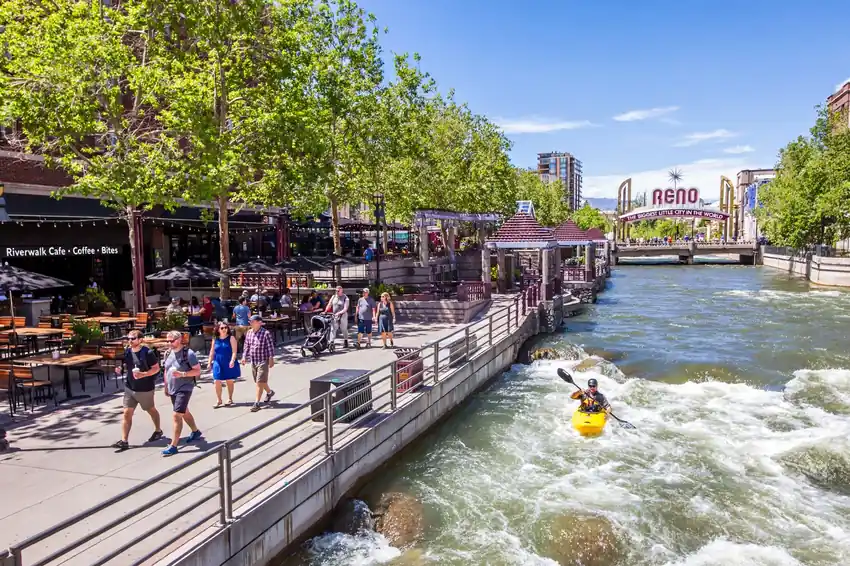
The Truckee River on Wikipedia is the reason Reno exists where it does — the river runs out of Lake Tahoe, through the Sierra Nevada and straight through the middle of downtown, and the Riverwalk District along its banks is the single best free thing in the city. The paved promenade runs from the downtown casinos west through Wingfield Park, past public art, restaurant patios and fishing spots, and in summer it is full of kayakers working the whitewater course that drops through the middle of the city, with the Reno River Festival each May turning the whole stretch into a party. The practical news for 2026 is good: Arlington Avenue and Wingfield Park reopened in June 2026 after the RTC Arlington Avenue Bridges project finished, so the walk is fully open again — older guides may still show the bridges closed. Walk it in the early morning, before the heat, or at dusk, when the lights come on along the river and the casinos glow behind it, and allow an hour or two with a coffee stop. Two honest warnings: the river is snowmelt and it is cold and fast even in July, so do not wade in without knowing the flow, and the whitewater course is for kayakers with a roll, not for first-time tubers. The Riverwalk is free, all day, all year, and it is the walk that tells you whether Reno is your kind of city.
2. The Reno Arch
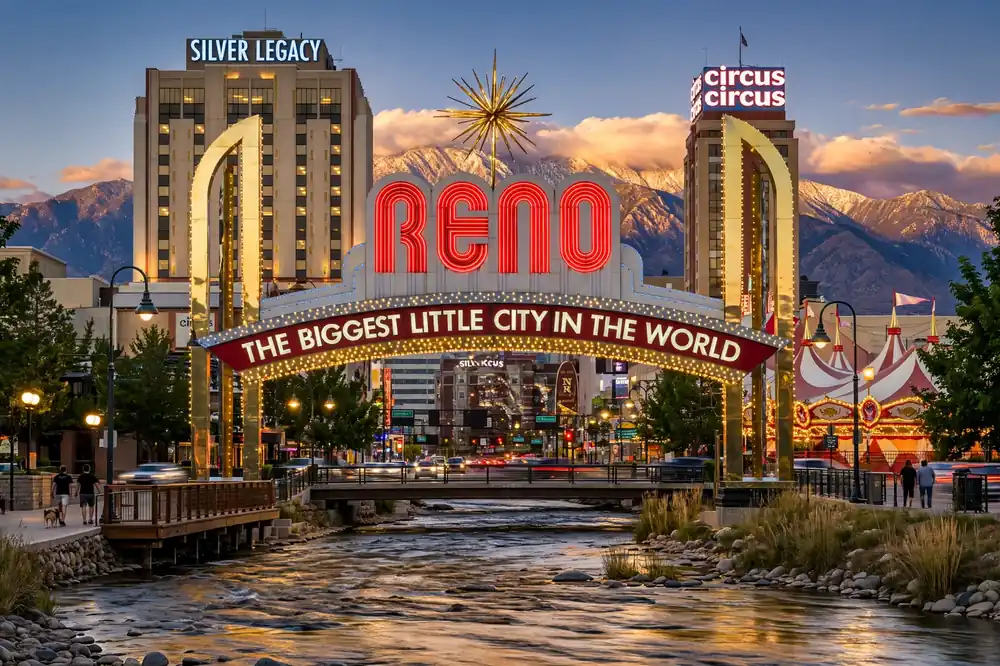
The Reno Arch on Wikipedia is the most photographed landmark in Nevada after the Las Vegas sign, and in 2026 it turned 100 years old — the original arch was built on 23 October 1926 to celebrate the completion of the Lincoln and Victory Highways, and it marked its centenary on 23 October 2026. The slogan on it came from a contest: the city offered a $100 prize, G. A. Burns of Sacramento won it in 1929 with “Reno, The Biggest Little City in the World”, and the words first appeared on the arch on 25 June 1929. There have been three arches in all: the 1926 original, which now stands on Lake Street beside the National Automobile Museum after being rebuilt there in 1995; the 1963 arch, which now stands in Willits, California; and the current arch over Virginia Street, installed on 8 August 1987 and refurbished in 2018 in silver and blue. Go at dusk, when the neon comes on and the street fills with people taking the same photograph, and then walk two blocks to Lake Street to see the 1926 original, which most visitors never find. The arch is free, it is always there, and it is the photograph that proves you were in Reno — allow fifteen minutes, and do not stand in the middle of Virginia Street to take it.
3. The National Automobile Museum
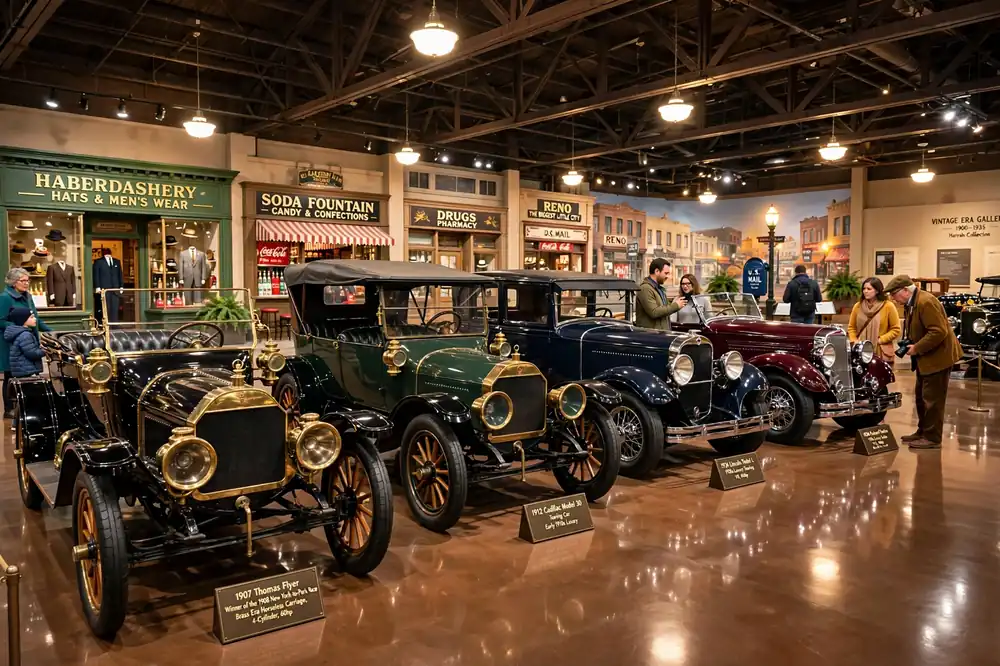
The National Automobile Museum on Wikipedia is the best museum in Reno and one of the best car museums in America — more than 225 cars from the Harrah Collection, the collection William Harrah built with his casino fortune, displayed in street scenes from the 1900s to the 1970s, with the 1907 Thomas Flyer that won the New York to Paris race as the centrepiece. The museum opened in 1989 on the Truckee River at 1 Museum Drive, a two-minute walk from the Reno Arch, and in 2026 it was ranked No. 8 on USA TODAY’s 10Best list for car-lover attractions. The prices and the hours are the part older guides get wrong: as of November 2026, admission is $16 for adults, $15 for seniors 65 and over, $14 for active military, veterans and first responders with ID, $13 for youths 6 to 17, and $3 for children 5 and under, with members free — older guides still quote $15 adult and $7 child, and both are stale. Hours are Monday to Friday 9 a.m. to 5 p.m. and Saturday to Sunday 10 a.m. to 4 p.m., and the museum is closed on Thanksgiving, Christmas Eve and Christmas Day. Daily guided tours run at 1:30 p.m., last about 90 minutes and depend on volunteer guides, so arrive a little early. Parking is free. Allow two hours, and do not rush the street scenes — the cars are the stars, but the recreated garages, the 1900s street and the movie cars are the reason the museum works for people who do not care about cars.
4. The Nevada Museum of Art
The Nevada Museum of Art on Wikipedia is the museum locals recommend most and visitors most often skip — the only art museum in Nevada accredited by the American Alliance of Museums, in a building by the architect Will Bruder that has stood at 160 W Liberty Street since 2003, its form inspired by the geology of the Black Rock Desert. The collection is built around art of the land and the environment, with rotating exhibitions that change through the year, and the rooftop is one of the best quiet views in downtown Reno. The prices are straightforward: as of November 2026, general admission is $15, students and seniors pay $13, ages 6 to 14 pay $3, under-5s are free, members are free, and Nevada high school students and University of Nevada, Reno, Truckee Meadows and Western Nevada College students are free with ID. Hours are Tuesday to Sunday 10 a.m. to 6 p.m., Thursday to 8 p.m., and the museum is closed on Mondays and national holidays — it is also closed on Thanksgiving and closes at 3 p.m. on 24 December 2026. The free window is the part to plan around: admission is free on Second Saturdays, courtesy of the Estelle J. Kelsey Foundation, with hands-on activities. Guided tours run on Fridays at 2 p.m. and on Saturdays at 11 a.m. and 2 p.m. and Sundays at 11 a.m., and the café, Perenn, serves breakfast and lunch Tuesday to Sunday from 8 a.m. to 2:30 p.m. Allow two hours, and go on a Thursday evening if you can, when the museum stays open late and the crowds are thinnest.
5. The Discovery — Terry Lee Wells Nevada Discovery Museum
The Discovery is Reno’s hands-on science museum and the best rainy-day stop in the city with children — 67,000 square feet of interactive exhibits on science, technology, engineering, art and maths at 490 S Center Street, a five-minute walk from the riverwalk, with a climbing structure, a water-play area and travelling exhibitions that change through the year. The prices are higher than the other Reno museums, so know them before you go: as of November 2026, admission is $17.95 for adults, $15.95 for youths 6 to 17 and seniors 65 and over, $13.95 for ages 1 to 5, free for under-1s, free for University of Nevada, Reno and Truckee Meadows Community College students with ID, and $5 a person for EBT, SNAP, WIC and TANF holders, up to six people. Hours are Tuesday to Sunday 10 a.m. to 5 p.m., Wednesday to 8 p.m., and the museum is closed on Mondays — except on Mondays from Memorial Day to Labor Day, on state and national holidays, and during Washoe County school breaks, when it opens. There is no Wikipedia page for the museum, so this section has no Wikipedia link by design. Allow two to three hours with children, or an hour and a half without, and go on a Wednesday evening if you want the quietest visit.
6. Midtown Reno
Midtown Reno is the neighbourhood that tells you Reno is not just a casino town — the stretch of Virginia Street south of the river, where the murals, the independent shops, the coffee roasters, the breweries and the restaurants live, and where the city’s creative life happens. Start at the corner of Virginia and California Avenue and walk south: the vintage shops and the bookshops, the coffee at Hub Coffee Roasters, the biscuits at Pine State Biscuits, the wine at the Liberty Food & Wine Exchange, and the murals that cover the sides of the buildings. Midtown is also where Reno eats best after dark, with the restaurants on Virginia Street and the side streets staying open later than the downtown casino restaurants, and where the First Friday art walk spills out of downtown on the first Friday of every month. Two practical notes: Midtown is a fifteen-minute walk from the arch, or two stops on the RTC RAPID Virginia Line, and the parking is street parking, so the bus or a walk is the better choice. Allow half a day, and come hungry — Midtown is the district that rewards a slow wander, and the shopkeepers are the people who will tell you what else to do in town.
7. The casinos of downtown Reno
The downtown casinos are the Reno that the postcards sell, and they are worth an evening even if you never gamble — the three connected resorts of the ROW, the Eldorado, the Silver Legacy and Circus Circus, standing together on Virginia Street under the arch, with the Silver Legacy’s mining-tower facade and the Circus Circus midway. The single best free show in the casino district is at Circus Circus: the world’s largest permanent circus, with free circus acts — trapeze, juggling, clowns and acrobats — performing daily on the midway above the casino floor, and it is the show that has kept families coming to downtown Reno for decades. The table games are the other reason to come: the minimums are lower than Las Vegas, the dealers are friendlier, and a $10 blackjack table is still a real thing here. Two honest warnings: the casino room rate on the booking site is not the rate you pay — the big resorts add a resort fee, typically $25 to $45 a night, plus tax, on top of the headline price, so check the total before you book — and the casinos are 24 hours, which means the lights, the noise and the smoke never stop, so ask for a room on a high floor away from the casino if you want sleep. Allow an evening, set a budget before you walk in, and treat the slots as entertainment, not as a plan.
8. The Whitney Peak climbing wall
The Whitney Peak Hotel on Wikipedia holds the strangest landmark in downtown Reno: the Guinness-certified tallest artificial climbing wall on Earth, 164 feet of climbing surface bolted to the side of the hotel at 255 N Virginia Street, towering over the Reno Arch. The wall is the outdoor arm of BaseCamp, the climbing gym inside the hotel, which also has a 7,000-square-foot indoor bouldering park and the only official 15-metre speed wall in the United States. The prices are straightforward: as of November 2026, a day pass is $17 for adults as a drop-in and $10 for hotel guests, $12 for seniors 55 and over, youths 14 and under and students, and $5 for hotel guests in those groups, with access to the Big Wall outside at $40 for non-members and $35 for members. The gym is open seven days a week, 8 a.m. to 10 p.m. Monday to Friday and 8 a.m. to 9 p.m. Saturday and Sunday, and the outdoor wall runs year-round, weather permitting. The hotel itself is the first non-casino, non-smoking hotel in the heart of downtown Reno, part of Hilton’s Tapestry Collection, and hotel guests get half off the climbing fees. Allow an hour to watch the climbers from the street — it is free to look — or half a day if you climb, and book the “Climb to the Top” package if you want the full two-pitch route to the roof.
9. Rancho San Rafael Regional Park
Rancho San Rafael Regional Park is the green lung of Reno — about 580 acres just north of downtown, the largest park in Washoe County, with walking trails, picnic areas, a dog park, an arboretum and the Wilbur D. May Center, a museum and arboretum at 1595 N Sierra Street inside the park, holding the May family’s collection of art and artefacts from their travels. The park is also the home of the Great Reno Balloon Race, which fills the dawn sky with hot-air balloons every September, and it is the park where Reno goes on a Sunday: families, runners, dog walkers and the farmers market crowd. The trails are flat and easy, the trees give shade in summer, and the views run from the park across the city to the Sierra Nevada. Two practical notes: the park is a ten-minute drive from downtown, or a bus ride on the RTC routes that run north on Sierra Street, and the May Center has its own hours, so check them before you go. Allow two hours, and come in the morning, when the light is best and the trails are quietest.
10. Animal Ark Wildlife Sanctuary
Animal Ark Wildlife Sanctuary is the wildlife stop that most Reno guides list and few explain properly — a 38-acre sanctuary at 1265 Deerlodge Road, about 28 to 30 minutes north of Reno in the Red Rock foothills, home to non-releasable wildlife: black bears, wolves, mountain lions, cheetahs, a jaguar and raptors, animals that cannot be returned to the wild and are not bred, sold or traded. The seasonal hours are the trap older guides miss: the sanctuary is open from March to November, Tuesday to Sunday 10 a.m. to 4:30 p.m. and closed on Mondays in season — but in November it is open on weekends only, 11 a.m. to 3 p.m., and it is closed entirely from December to March for the winter. Admission is about $11 for adults and about $7.50 for children 3 to 12, with under-2s free, and golf-cart rental is about $10 — check the site before you go, because the prices have moved between sources and the sanctuary’s own site is the authority. There is an end-of-year sale on the Friday, Saturday and Sunday after Thanksgiving. Allow two to three hours, bring water and sun protection — there is almost no shade — and drive carefully on Deerlodge Road, which is a winding country road.
11. Idlewild Park
Idlewild Park is the neighbourhood park that visitors stumble into and then wish they had found on day one — a green stretch along the Truckee River west of downtown, with a rose garden, a duck pond, a playground, picnic areas and the Riverside Farmers Market on Sunday mornings in summer. The park is where Reno families spend their weekends, and it is the quietest place in the city to sit by the river: the ducks, the cottonwoods and the sound of the water, with the casinos out of sight and the Sierra Nevada on the horizon. The farmers market is the reason to time your visit: local produce, baked goods and food stalls, with the vendors who supply the Midtown restaurants. Two practical notes: the park is a twenty-minute walk west along the river from the Riverwalk, or a short bus ride, and the rose garden is at its best from May to September. Allow an hour, and bring a picnic — the tables by the pond are the best free lunch spot in Reno.
12. The Grand Sierra Resort
The Grand Sierra Resort on Wikipedia is the biggest casino resort in northern Nevada and the one that behaves least like a casino — 1,990 rooms on the east side of Reno, with a bowling alley, go-kart racing, a driving range, a pool with a lazy river, and the Grand Theatre, which brings in the biggest touring acts that play Reno. The casino floor is the largest in northern Nevada, but the resort is the draw for families: the arcade, the cinema, the pool deck and the concerts, with free parking that the downtown resorts do not always offer. The resort also runs a free shuttle to the Reno Rodeo grounds during the rodeo, from 2 p.m. to 12:30 a.m., which is the easiest way to get to the rodeo without driving. Two practical notes: the resort is a ten-minute drive from downtown, not a walk, and the room rates move sharply with the concert and event calendar, so check the dates before you book. Allow half a day for the pool and the activities, or a full evening for a show, and check the Grand Theatre schedule before your trip — the best nights sell out weeks ahead.
13. The Reno Aces at Greater Nevada Field
The Reno Aces on Wikipedia are the city’s professional baseball team — the Triple-A affiliate of the Arizona Diamondbacks, playing at Greater Nevada Field on Wikipedia, the ballpark at 250 Evans Avenue in downtown Reno that opened in 2009. The season runs from April to September, with Fireworks Fridays, themed nights and a ballpark that sits close enough to the riverwalk to walk to from the casinos. The Aces are the cheapest professional sport in Reno: tickets start in the teens, the food is ballpark-priced rather than stadium-priced, and the atmosphere is the small-city kind, with families on the lawn and the players close enough to talk to. Two practical notes: the best seats are behind home plate on the lower level, and the Fireworks Friday games sell out, so buy ahead. Allow an evening, and pair it with dinner in Midtown before the first pitch.
14. Sparks and Victorian Square
Sparks is Reno’s twin city, ten minutes east on I-80, and Victorian Square is its downtown — a railroad-town square with the Nugget casino, the farmers market, the outdoor movie nights in summer and the Sparks Marina, a lake with a beach, a playground and a walking path, built on the site of an old gravel pit. The Nugget is the anchor: the casino that built Sparks, with its restaurants and its events, and the square around it is where Sparks holds its festivals, including the Hot August Nights street parties that spill over from Reno. The marina is the surprise: a proper swimming beach in the desert, with lifeguards in summer, and the best place in the Reno area to cool off on a hot August afternoon without driving to Tahoe. Two practical notes: Sparks is a fifteen-minute bus ride from downtown Reno on the RTC routes that run along Prater Way, and the marina beach is busiest on summer weekends, so come early. Allow half a day, and do not skip the marina if you are here in summer.
15. The University of Nevada, Reno campus
The University of Nevada, Reno on Wikipedia is the university that anchors the north end of downtown — founded in 1874 in Elko and moved to Reno in 1885, with about 21,000 students on a hillside campus of brick buildings, lawns and pine trees, a ten-minute walk north from the arch. The campus is worth a walk for the views alone: the lawns look south over the city to the Sierra Nevada, and the Mackay Stadium and the Lawlor Events Center bring in the crowds on game days. The trap is the planetarium: the Fleischmann Planetarium, the university’s domed planetarium and science centre, is closed for regular drop-in programmes from 4 May 2026 through early 2027 for renovation — older guides and the university’s own older pages still list it as open, and it is not. Do not build a visit around it until it reopens. Two practical notes: the campus is free to walk, and the parking is permit-only on weekdays, so walk up from downtown or take the bus. Allow an hour, and go on a game day if you want the full atmosphere — the Wolf Pack crowds are the loudest in the city.
16. Mt. Rose Ski Tahoe
Mount Rose on Wikipedia is the ski mountain that makes Reno a ski town — Mt. Rose Ski Tahoe, about 25 minutes from downtown up the Mt. Rose Highway, with the highest base elevation in the Tahoe region at 8,260 feet, 1,200 acres of terrain and a season that runs from early November to almost May. For the 2026–27 season, Mt. Rose opened on 6 November 2026, the first resort in the Tahoe region to open, with the Lakeview Express running from 9 a.m. to 4 p.m. and the Kit Carson Traverse, Kit Carson Bowl and Ponderosa trails open on day one. The lift tickets are dynamic, so check the resort’s site before you go: the published weekday adult ticket is about $119 and the child ticket about $59, with weekend and holiday prices higher, and the resort offers $60 tickets for holders of a season pass from another resort. The Wildslide Tahoe snow tubing opens on Thanksgiving Day, 26 November 2026. Two practical notes: the drive up the Mt. Rose Highway is the highest year-round pass in the Sierra Nevada, so carry chains in winter and check the road conditions before you leave — the highway closes in heavy storms — and the altitude is real at 8,260 feet, so drink water and take it easy on your first run. Allow a full day, and rent your gear in Reno if you do not own it, because the resort’s rental shop is the most expensive option.
17. Lake Tahoe day trip — Sand Harbor
Lake Tahoe on Wikipedia is the day trip that justifies the flight to Reno — the alpine lake 45 minutes west on I-80 and the Mt. Rose Highway, with water so clear you can see 70 feet down, and Sand Harbor, the beach on the Nevada shore, is the place to see it. Sand Harbor is Lake Tahoe Nevada State Park’s most popular beach: a crescent of sand, granite boulders and pine trees, with a boat launch, a nature trail and the Lake Tahoe Shakespeare Festival in July and August. The prices are straightforward: $10 a vehicle for Nevada-registered cars, $15 for non-Nevada cars, $2 a bike, and $20 to $25 for the boat launch, with the park open from 8 a.m. to an hour after sunset. The reservation rule is the part that catches visitors: day-use vehicle reservations are required for morning entry from 15 April to 15 October, for arrivals before 10:30 a.m., and the window is quoted differently in different places — some sources say 15 May to 30 September — so book through Reserve Nevada if you plan to arrive before 10:30 a.m. in season, and know that no reservations are needed from 1 October 2026, in the fall off-season. Dogs are allowed on a leash in the off-season, from 15 October to 15 April, only. The East Shore Trail runs three miles from Incline Village to Sand Harbor, and it is the best walk at the lake. Allow a full day, and leave Reno early — the parking fills by 10 a.m. in summer, and the drive back over the pass is slow on a Sunday afternoon.
18. Virginia City and the V&T Railroad
Virginia City on Wikipedia is the silver-mining town that built Nevada — a 19th-century boomtown on the Comstock Lode, about 30 minutes south-east of Reno on the Geiger Grade, State Route 341, with wooden boardwalks, saloons, mine tours and the Silver Queen Hotel, and the best-preserved mining town in the American West. The way to do it is the Virginia & Truckee Railroad: in the regular season, from Memorial Day weekend to mid-October, seven daily 35-minute narrated steam train tours run from Virginia City to Gold Hill and back, steam on weekends, and the longer trip from Carson City on Wikipedia is a 24-mile round trip of about six and a quarter hours with a three-and-a-half-hour stop in Virginia City, diesel on Fridays and steam on Saturdays and Sundays. The regular season ends in mid-October, and after that only the holiday trains run — and the holiday trains are the reason to come in November and December 2026: the Polar Express from 13 November to 23 December from $60, the Electric Holiday Train O’ Lights from 27 November to 19 December on Friday and Saturday evenings at $42 to $46, the Very Merry Candy Cane Express from 27 November to 20 December on Saturdays and Sundays at $32 to $38, and the North Pole Express from 28 November to 20 December on Saturday and Sunday evenings at $39 for adults and $32 for children. Two practical notes: the Geiger Grade is a winding mountain road, so drive slowly and watch for wild horses on the road, and Virginia City is at 6,200 feet, so it is colder than Reno — bring a jacket even in summer. Allow a full day, and do the mine tour, which is the part of Virginia City that the street alone does not show.
19. Pyramid Lake
Pyramid Lake on Wikipedia is the desert lake that most Reno visitors never see and the one that explains the landscape — a vast, saline lake about 35 minutes north-east of Reno on the Pyramid Lake Paiute Tribe’s reservation, named for the pyramid-shaped tufa rock that rises from its shore, and the home of the Lahontan cutthroat trout, one of the largest freshwater trout in the world. The lake is tribal land, and the rules matter: a day-use permit costs $25, boating needs a separate permit, and fishing needs a tribal fishing permit — buy them before you go, because there is nowhere to buy them at the lake. The scenery is the point: the tufa formations, the desert mountains and the water, with the Pyramid itself as the photograph, and the fishing is the draw for anglers, with the Lahontan cutthroat running in spring and autumn. Two practical notes: there are no services at the lake — no food, no fuel, no shade — so bring water, food and sun protection, and the wind comes up in the afternoon, so go in the morning. Allow half a day, and treat the lake with respect: it is a sacred place for the Paiute people, and the permit is not a formality.
20. Reno’s big events — Hot August Nights, Artown and the Balloon Race
Reno’s calendar is the reason to time your trip, and the big events are the city’s best and worst weeks at once. Hot August Nights on Wikipedia is the classic-car festival that fills downtown with chrome and rock and roll — in 2026 it ran from 31 July to 9 August, with the kickoff in Virginia City, and it is the week when the hotel prices double and the streets close. Artown is the July arts festival, running all month since 1996, with more than 500 events — concerts, theatre, dance and art — most of them free, and the best free culture in the city. The Great Reno Balloon Race is the September dawn event: in 2026 it ran from 10 to 13 September, its 45th year, at Rancho San Rafael Regional Park, the world’s largest free hot-air-balloon event, with the mass ascension at dawn — and the 2027 dates are already announced, 9 to 12 September 2027. The Reno Rodeo is the June event, the “Wildest, Richest Rodeo in the West” since 1919 — in 2026 it ran from 18 to 27 June, ten days, more than 140,000 attendees, with performance tickets from $25 to $41 and grounds-only admission at $10, and the tickets sell out a month ahead. Burning Man on Wikipedia is the desert gathering 120 miles north in the Black Rock Desert — in 2026 it ran from 30 August to 7 September with the theme “Axis Mundi” and the Temple of the Moon, the Man Burn on Saturday 5 September and the Temple Burn on Sunday 6 September, with about 70,000 to 80,000 attendees, main-sale tickets at about $575 plus fees and a vehicle pass at $150, and the 2027 dates are already announced, 29 August to 6 September 2027, with the theme “Spellbound”. And the trap: Reno Air Races on Wikipedia no longer happen in Reno — the last race at Reno-Stead was in 2023, and the National Championship Air Races moved to Roswell, New Mexico in 2025, running there from 16 to 20 September 2026. Older guides still list the Air Races as a Reno event, and they are wrong — do not plan a trip around them.
Reno in 3 days — a ready-made itinerary
This three-day plan covers downtown, the museums and one day trip, and it uses walking and the bus in the city, with a car only for the day trip. Book the Basque dinner before you fly, put the museums on a weekday, and keep the evenings for Midtown and the riverwalk — Reno eats late by desert standards, with dinner from 6 p.m. and the casino restaurants open all night.
Day 1 — Downtown: the Arch, the riverwalk and the museums
Start at the Reno Arch at dusk the evening you arrive, for the photograph, then walk the riverwalk to Wingfield Park. In the morning, start at the National Automobile Museum at 9 a.m. and give it two hours, then walk two blocks to the 1926 arch on Lake Street and along the riverwalk to the Nevada Museum of Art for the afternoon. Finish with dinner at Louis’ Basque Corner, booked ahead, and a drink in Midtown afterwards.
Day 2 — Midtown, the parks and the casinos
Start with breakfast at Pine State Biscuits in Midtown, then walk the Midtown murals and shops and take the bus to Rancho San Rafael Regional Park for the trails and the Wilbur D. May Center. In the afternoon, come back downtown for the Whitney Peak climbing wall — watch the climbers from the street, or climb if you booked — and then Idlewild Park for the rose garden and the river. Finish with the free circus acts at Circus Circus and an evening on the casino floor, with a budget set before you walk in.
Day 3 — Out of town: Virginia City or Lake Tahoe
In summer, drive to Virginia City on the Geiger Grade, ride the V&T Railroad to Gold Hill, take the mine tour and eat lunch on the boardwalk, and be back in Reno for dinner in Midtown. In winter, drive up the Mt. Rose Highway to Mt. Rose Ski Tahoe for a day on the snow, and finish with the Wildslide tubing if it is open. In November, when the V&T regular season has ended and the ski season is just starting, take the Sand Harbor trip instead — the fall off-season means no reservations, thin crowds and the clearest water of the year — or drive north to Pyramid Lake for the morning, with the permit bought ahead.
Best time to visit Reno
| Season | Weather | Crowds | Notes |
|---|---|---|---|
| Spring (March–May) | Highs about 57–72°F (14–22°C), lows about 33–44°F (1–7°C) | Moderate | Best all-round season; the riverwalk at its best, the Reno River Festival in May |
| Summer (June–August) | Highs about 82–90°F (28–32°C), lows about 51–56°F (11–13°C) | High | Festival season — the Rodeo, Artown, Hot August Nights and the Balloon Race; dry heat, cool nights |
| Autumn (September–November) | Highs about 54–80°F (12–27°C), lows about 30–47°F (−1–8°C) | Moderate | Second-best season; the Balloon Race in September, fall colour on the river, thin crowds by November |
| Winter (December–February) | Highs about 45–51°F (7–11°C), lows about 25–28°F (−4–−2°C) | Low | Ski season at Mt. Rose; cold mornings, sunny days, snow in the Sierra, rarely much in town |
The best time to visit Reno is May to June and September to October, and if you want one answer, pick late May or late September: the days are warm without being punishing, the evenings are cool, the riverwalk is at its best, and the hotel prices have not yet spiked for the festivals. July is the festival month, with Artown all month and Hot August Nights at the end of it, and the city is at its most crowded — come then for the events, and book the hotel a month ahead. November is the quiet month: the average high is about 54°F (12°C) and the low about 30°F (−1°C), the crowds are gone, the hotel prices are at their lowest, and the ski season is just opening at Mt. Rose, with the holiday trains starting in Virginia City. January is the coldest month, with an average high of 45°F (7°C) and a low of 25°F (−4°C), and the city almost never sees deep snow — the snow stays in the Sierra, which is where you want it. The seasonal traps are specific: the Animal Ark closes from December to March and runs weekends only in November; the V&T Railroad’s regular season ends in mid-October; the Fleischmann Planetarium is closed until early 2027; and the Sand Harbor reservation rule only applies from April to October, so a November trip to Tahoe needs no reservation at all. Reno gets more than 300 days of sunshine a year, and the dry air means the temperature swings 30 degrees between day and night — pack a jacket even in July.
Where to stay in Reno
| Area | Best for | Price range |
|---|---|---|
| Downtown casino resorts | First-timers, the arch and the riverwalk | $70–$180 a night, plus resort fees |
| Midtown | Food, murals, local life | $120–$220 a night |
| Whitney Peak / non-gaming | Climbers, non-smokers, families | $130–$220 a night |
| Grand Sierra Resort | Shows, bowling, the pool, families | $90–$200 a night |
| South Reno | Quiet, value, the mall and the airport | $80–$150 a night |
| Sparks | Value, Victorian Square, the Nugget | $60–$130 a night |
Stay downtown if this is your first visit — the arch, the riverwalk and the museums are walkable, the casino restaurants are open all night, and the room rates are the cheapest in the city — but check the total before you book, because the resort fee, typically $25 to $45 a night plus tax, is added on top of the headline rate at the big resorts. Stay in Midtown if you want local life — the murals, the coffee roasters and the restaurants, with downtown a fifteen-minute walk away. Stay at the Whitney Peak if you want a non-gaming, non-smoking hotel — the climbing wall is on the building, the arch is outside the door, and the rooms are quiet. Stay at the Grand Sierra Resort if you are here for a show or with children — the pool, the bowling alley and the go-karts are the draw, and the parking is free. Stay in South Reno if you want quiet and value — the mall, the airport and the chain hotels, with the bus into downtown. Stay in Sparks if you want the lowest prices — Victorian Square and the Nugget, with downtown a fifteen-minute bus ride away. Two warnings: do not book a room on the casino floor side of a downtown resort if you want quiet, and do not book during Hot August Nights, the Reno Rodeo or Burning Man week without checking the price first — the rates double, and the rooms sell out.
Getting around Reno
| Way to travel | Cost | Best for |
|---|---|---|
| Walking | Free | Downtown, the riverwalk, the arch, Midtown |
| RTC RIDE bus (single ride) | $2.00 | Downtown to Midtown, the airport, the malls |
| RTC RIDE 24-hour pass | $5.00 | A full day of buses, including the airport |
| RTC RIDE 7-day pass | $16.00 | A week of buses |
| RTC RAPID Virginia Line | $2.00 a ride | Virginia Street, downtown to Meadowood Mall |
| Taxi / rideshare | About $15–$30 in the city | Late nights, the airport with luggage |
| Rental car | About $50–$90 a day | Lake Tahoe, Virginia City, Pyramid Lake, Mt. Rose |
| Amtrak California Zephyr | Varies | Arriving by train from California — the station is downtown |
Downtown Reno is a walking city: the arch, the riverwalk, the museums and the casinos are all within fifteen minutes of each other, and Midtown is a fifteen-minute walk south. The bus is the way to go further: RTC RIDE runs the city, with a single ride at $2.00, a 24-hour pass at $5.00 and a 7-day pass at $16.00, and the RTC RAPID Virginia Line runs along Virginia Street from downtown to Meadowood Mall. The airport bus is the bargain: RTC Routes 12 and 19 run from Reno-Tahoe International Airport to the downtown 4th Street Station for $2.00, and the airport is only about three miles from downtown, a ten-minute drive. A car is only needed for the day trips — Lake Tahoe, Virginia City, Pyramid Lake and Mt. Rose — and the drive to Tahoe crosses Donner Pass on Wikipedia on I-80, which is the pass to check in winter, because it closes in heavy storms. Two warnings: the downtown street parking is metered, and the casino parking is free but fills up on event nights, so the bus is the better choice on a festival weekend — and the altitude is 4,505 feet, so the sun is strong and the air is dry, and you will feel the walk uphill more than you expect.
Reno food you have to try
Reno’s food is the food of a railroad town that grew up on Basque boardinghouses, casino buffets and Midtown kitchens — and the tourist-trap problem here is the opposite of most cities: the casino restaurants are fine, but the best food is in Midtown and on East Fourth Street, where the locals queue, and the most Reno meal of all is the one eaten at a long communal table with strangers.
Basque family-style dining
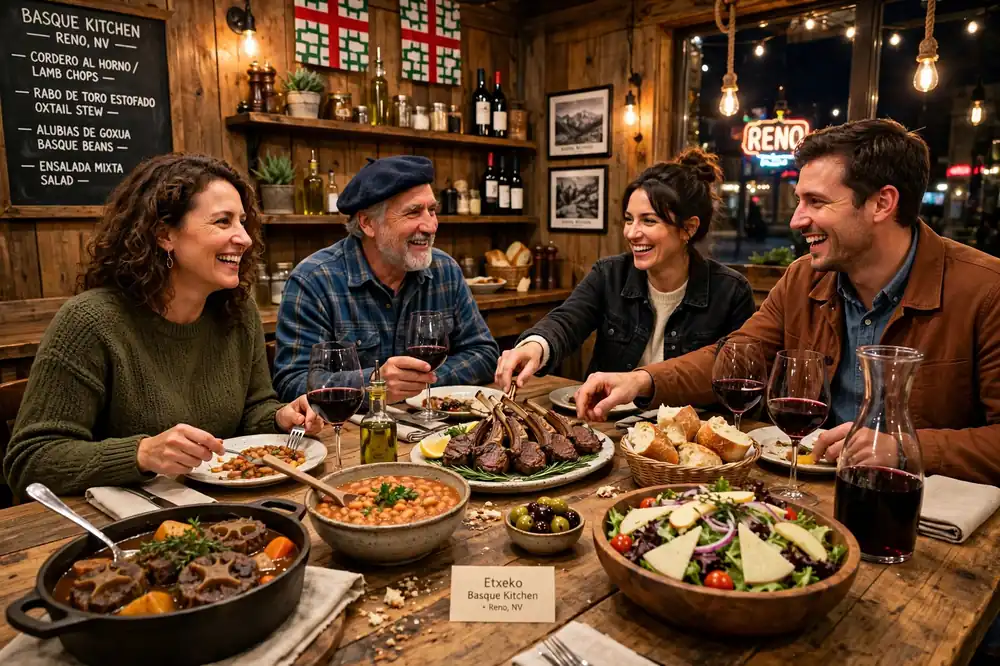
Basque cuisine on Wikipedia is the dish Reno is known for in the food world, and the reason is the Basque sheepherders who came to Nevada in the 19th century and opened boardinghouses for their own — long communal tables, family-style service, and a parade of courses for one price. Louis’ Basque Corner, at 301 E 4th Street, is the last of the great Reno Basque houses: a seven-course dinner, served family-style at long shared tables, with soup, salad, Basque beans, French bread, a first course and dessert, plus a glass of house wine, and an entree of your choice — oxtails, lamb chops, tongue Basquaise, chicken Basquaise or paella — for under $50 a person before tip. Lunch runs Tuesday to Saturday from 11:30 a.m. to 2:30 p.m., dinner starts at 5 p.m. daily, and there is free parking. The Picon Punch is the drink to order — the Basque cocktail that the house is famous for. One warning: the Santa Fe Hotel, the other famous Basque house in Reno, closed in 2025 after reopening in 2023 — older guides still list it, and it is gone, so do not plan a meal around it. Book Louis’ ahead for a weekend, arrive hungry, and sit with strangers — that is the point of the place.
Midtown and the local food scene
Midtown is where Reno eats now — the independent restaurants, cafes and bars along Virginia Street south of the river, where the food is for locals and the prices are lower than the casino restaurants. Start the day at Pine State Biscuits, the breakfast spot the locals name first, with biscuits that the regulars on the Reno forums call the best breakfast in Nevada. Get coffee at Hub Coffee Roasters, the local roaster that the same forums name as the coffee shop in Reno. For dinner, the Liberty Food & Wine Exchange is the upscale pick, Kwok’s is the Chinese restaurant the locals recommend, and R-Town Pizza is the pizza stop. The Basement, in the historic Post Office Building downtown, is the food hall — a marketplace of locally owned shops and restaurants under one roof. Eat lunch at 11:30 a.m. or 12 p.m., dinner from 6 p.m., and do not expect the Midtown kitchens to stay open as late as the casinos — the local restaurants close earlier than the casino restaurants, and the best tables fill by 7 p.m. on a Friday.
Casino buffets and late-night Reno
The casino buffet is the Reno institution that the locals both love and warn you about — and the one to try is the Peppermill, south of downtown, where the buffet is the best in the city and the indoor rain falls every fifteen minutes or so over the atrium, a show in itself. The Atlantis buffet is the other name to know, and the downtown casino restaurants are the late-night option: Reno is a 24-hour city, and the casino restaurants are open when everything else is closed, which is why the 2 a.m. meal after a show is a Reno tradition. The prices are the honest part: the buffets run about $25 to $40 a person, the late-night diner meals about $12 to $18, and the casino restaurants are cheaper than the Midtown restaurants for the same plate, because the casino wants you to stay. Two warnings: the buffet lines are longest on Friday and Saturday nights, so go on a weekday, and the free drinks on the casino floor are for players, not for spectators — sit down at a machine or a table if you want one. Eat the buffet once, eat in Midtown twice, and eat Basque once — that is the Reno food plan.
Free things to do in Reno
Reno is cheaper than its reputation suggests, because the best sights cost nothing. The Riverwalk is free, and so is the walk along the Truckee from the casinos to Wingfield Park. The Reno Arch is free, and so is the photograph under it — and the 1926 original on Lake Street is free too. Rancho San Rafael Regional Park is free, and so is Idlewild Park, the rose garden and the duck pond. The First Friday art walk is free, on the first Friday of every month, with the galleries open late and the streets full. The Nevada Museum of Art is free on Second Saturdays, and the University of Nevada, Reno campus is free to walk. The Great Reno Balloon Race is free — the world’s largest free hot-air-balloon event — and Artown in July is mostly free, with more than 500 events. The Believe sign and the Space Whale sculptures at City Plaza are free, and so is the walk through Midtown’s murals. Do the free list on your first day, and you will have seen the river, the arch, the parks and the art before you have spent a dollar on a ticket.
Frequently asked questions
How many days do you need in Reno?
Three days is the minimum for the highlights: one day for downtown, the arch, the riverwalk and the museums, one day for Midtown, the parks and the casinos, and one day for a day trip — Virginia City or Lake Tahoe. Four to five days is the right amount for a real trip, with both day trips, Pyramid Lake and a ski day at Mt. Rose, and a week if you want to use the city as a base for Tahoe, the Black Rock Desert and Carson City. Two days works if you plan well — the Automobile Museum, the arch, the riverwalk and a Basque dinner — but you will leave having seen a third of the city, and you will have missed the day trips, which are the reason to come.
Is Reno safe?
Reno is safe in the way a small American city is safe, and unsafe in one specific way that every visitor needs to know. Violent crime is rare, and the downtown, Midtown and riverwalk areas are busy with visitors at all hours. The problem is the petty crime around the casino district and East Fourth Street late at night: keep your bag zipped and in front of you, your phone in a front pocket and never on a bar or a slot machine, and do not leave valuables visible in a parked car — the break-ins are the crime the police report most. The motels on East Fourth Street that rent by the week are the ones to avoid, and the alleys behind the casinos are not a shortcut after dark. Use the same sense you would in any American city, and the only thing you will lose is money at the tables.
When is the best time to visit Reno?
May to June and September to October, when the days are warm, the evenings are cool and the city is full without being crowded. Late May and late September are the single best picks. July is the festival month, with Artown all month and Hot August Nights at the end of it, and the highest hotel prices — come then for the events, and book a month ahead. November is the quietest good month, with an average high of 54°F, thin crowds and the lowest hotel prices, and the ski season just opening at Mt. Rose. January is the coldest, with an average high of 45°F, and the best month for skiing, with the mountain at its snowiest and the city at its emptiest.
Is Reno expensive?
Cheaper than Las Vegas for the same weekend, and cheaper than most American cities for a ski trip. A downtown casino hotel costs $70 to $180 a night plus a resort fee of $25 to $45, a Midtown hotel $120 to $220, a museum ticket $15 to $18, a Basque dinner under $50, a bus ride $2, and a ski lift ticket about $119 on a weekday. The costs most visitors underestimate are the resort fee, which is added to every casino room rate, and the ski tickets, which are dynamic and rise on weekends and holidays. A careful three days can be done for about $120 to $200 a person a day, and the riverwalk, the arch, the parks and the art walk are free.
Do you need a car in Reno?
No, for the city itself. Downtown, Midtown and the riverwalk are walkable, and the RTC buses cover the airport, the malls and South Reno for $2 a ride. Yes, for everything outside the city: Lake Tahoe, Virginia City, Pyramid Lake and Mt. Rose all need a car, and the rental is $50 to $90 a day. Rent a car only for the days you leave the city, and take the bus for the days you do not — the downtown parking costs more than the rental on a festival weekend. The only reason to rent for the whole trip is a road trip through the Sierra Nevada, where the car is the trip.
What should I skip in Reno?
Six things, and all six are traps older guides still get wrong. First, do not plan a trip around the Reno Air Races: the last race in Reno was in 2023, and the races moved to Roswell, New Mexico in 2025. Second, do not go to the Fleischmann Planetarium: it is closed for renovation from 4 May 2026 through early 2027. Third, do not plan a meal at the Santa Fe Hotel: the Basque restaurant closed in 2025. Fourth, do not go to the Animal Ark between December and March: it is closed for the winter, and in November it is open on weekends only. Fifth, do not go to Sand Harbor in summer without a reservation: the morning entry needs one from April to October, and the parking fills by 10 a.m. And sixth, do not ride the V&T Railroad after mid-October expecting the regular trains: the regular season ends then, and only the holiday trains run until December.
Further reading
Start with Reno on Wikipedia, which covers the history and the geography, and Nevada on Wikipedia for the state and its mining history. For what locals and regular visitors actually recommend, the r/Reno subreddit is where travellers ask what there is to do besides gambling — the Riverwalk, Lake Tahoe, Virginia City, Midtown and the Nevada Museum of Art are the answers that come up again and again. For the same question from visitors, the Quora thread on lesser-known attractions in Reno is worth reading, with locals recommending the river, the museums and the day trips over the casino floor.
Your Reno trip, in one paragraph
Reno is the high-desert city that rewards getting up early: the Reno Arch at dusk with the neon on, the Riverwalk in the morning before the heat, the National Automobile Museum and the Nevada Museum of Art in the afternoon, a Basque family-style dinner at Louis’ with strangers at your table, and a day trip to Virginia City or Sand Harbor before you leave. For more guides in the same style, start with our Hawaii guide for the whole-state trip — this guide is only about Reno — then see how Reno compares with Maui, Honolulu, Chicago, Nashville, Los Angeles, Orlando, Miami, San Diego, Denver, Savannah, Dallas, Charleston, San Francisco, Myrtle Beach, Las Vegas, San Antonio, London, Portland, Pigeon Forge, Puerto Rico, Atlanta, Phoenix, Paris, Key West, Colorado Springs, Sedona, Chattanooga, Palm Springs, St Louis, Tokyo, Japan, Kansas City, Tennessee, Branson, Florida, Amsterdam, Montreal, Fort Lauderdale, Toronto, Aruba, Charlotte, Indianapolis, New Orleans, Destin, Santa Barbara, Mexico City, Arizona, Osaka, Minneapolis, Pittsburgh, California, Asheville, Costa Rica, Washington DC, Seattle, St Augustine, Lisbon, Dubai, Santa Fe, Galveston, Maine, Sacramento, Kauai, Boston, Cancun, Madrid, Salt Lake City, Baltimore and Barcelona.

About the Author