Things to Do in Barcelona
20 Best Attractions, a 3-Day Itinerary, Where to Stay, and the Food You Cannot Miss
Quick Info
Best for: First-timers, Gaudí lovers, food lovers and families — a walkable Mediterranean city where the beach, the old town and the modernist masterpieces sit within a few miles of each other
Best time: Mid-April–June and September–mid-October for mild days; November for thin crowds and the lowest hotel prices
How long: 3 days for the Gaudí sights, the old town and Montjuïc; 4 to 5 days adds Tibidabo, the beaches and a Montserrat day trip
Budget: About €110–€170 per person per day mid-range — the Gaudí tickets add up fast, the museums and the parks are often free
Don’t miss: The Sagrada Família at opening time, sunset from the Bunkers del Carmel, the mosaic terrace at Park Güell, paella in Barceloneta and a vermouth in Gràcia
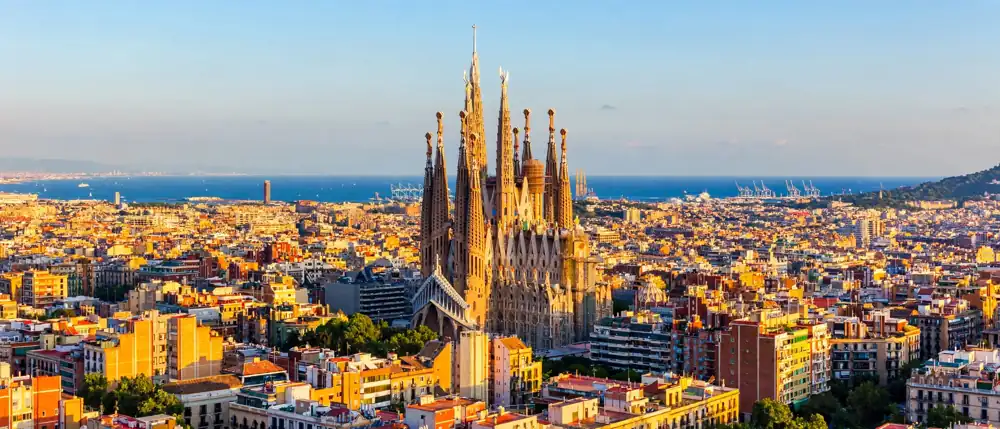
Barcelona on Wikipedia is the capital of Catalonia and the most visited city in Spain — a Mediterranean port of about 1.7 million people where Antoni Gaudí’s impossible basilica, a medieval Gothic Quarter, a working beach and one of Europe’s great food cultures sit within a few miles of each other. This guide covers the 20 best things to do in Barcelona, a 3-day itinerary that actually works, where to stay without overpaying, how to get around on the metro and on foot, the three foods you should not skip, and the free sights that cost nothing. Everything below was checked against live sources in November 2026 — including the Sagrada Família’s new prices, the Camp Nou rebuild, the doubled tourist tax, the Magic Fountain’s November closure and the pickpocket traps older guides underplay.
Barcelona at a glance
| Topic | What to know |
|---|---|
| Full name | Barcelona — the capital of Catalonia, on the Mediterranean coast of north-east Spain |
| Founded | As the Roman colony Barcino in the 1st century BC, on a settlement older still |
| Population | About 1.7 million people in the city, about 5.6 million in the metro area |
| Language | Catalan and Spanish — street signs and menus are in Catalan first, and everyone speaks Spanish too |
| Airport | Barcelona–El Prat Airport (BCN), about 13 km south-west of the city centre |
| Best base | The Eixample for a first visit — central, flat and close to everything; the Gothic Quarter for atmosphere |
| Getting around | Metro, bus and walking — the centre is flat and compact, and the metro reaches every sight |
| Famous for | Gaudí and the Sagrada Família, the Gothic Quarter, tapas and vermouth, FC Barcelona, and the beach |
Barcelona divides into two ideas that most visitors only partly see. The postcard city is the one Gaudí built: the Sagrada Família, Park Güell, Casa Batlló and La Pedrera, all of it in the Eixample grid, a ten-minute metro ride from the sea. The other Barcelona is the one that makes people come back: the Gothic Quarter’s medieval lanes, the vermouth bars of Gràcia, the markets and the beach at the end of a long lunch — where the Catalan language, the food and the late dinners live. The trap is the calendar and the ticket: the city is at its best in late spring and early autumn, packed and expensive in July and August, and quiet in November, while the big sights sell out weeks ahead and cannot be bought at the door at all. Book the basilica and the park before you fly, stay near a metro line, and the city rewards you in every month of the year.
The 20 best things to do in Barcelona
1. The Sagrada Família
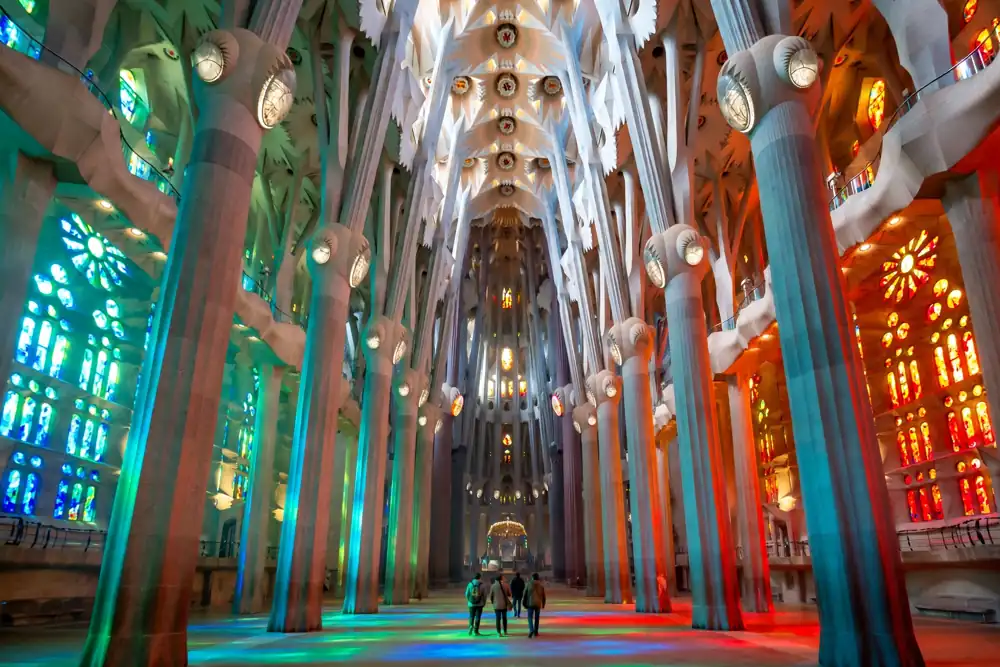
The Sagrada Família on Wikipedia is the most visited building in Spain and the single attraction most likely to wreck a Barcelona trip when left unbooked — and in 2026 it is also the most changed. Antoni Gaudí took over the basilica in 1883 and worked on it until his death in 1926; a century later, in February 2026, the Tower of Jesus Christ received its cross and rose to 172.5 metres, making the Sagrada Família the tallest church in the world, and Pope Leo XIV blessed the tower on 10 June 2026, a hundred years to the day after Gaudí’s death. The full completion of the remaining towers has now slipped to 2028–2030, so what you see is a working building site as well as a church — cranes and scaffolding are part of the visit, not a surprise. Inside, the columns branch like trees and the stained glass throws red, blue and green light across the nave, and the effect is strongest in the morning, when the sun comes through the Nativity side. The prices and the rules are the part older guides get wrong: as of November 2026, the basic ticket is €26 for the basilica and museum with the app audio guide, €30 with a 50-minute guided tour, €36 with one tower (Nativity or Passion, lift up and stairs down), and €40 with a guide and a tower. Under-30s and students pay €24, seniors €21, and children under 11 go free but still need a ticket. There is no ticket office and no walk-up sale — every ticket is sold online only, carries your name, and runs on a 15-minute arrival window, with dates opening about two months ahead. In 2026, the centenary year, morning slots and tower tickets sell out weeks in advance, so book the moment your dates are fixed, and never buy from the touts near the basilica — counterfeit QR codes are in circulation. Dress for a church: shoulders and knees covered. Allow two to three hours, and go at the first slot of the day, when the light and the crowds are at their best.
2. Park Güell
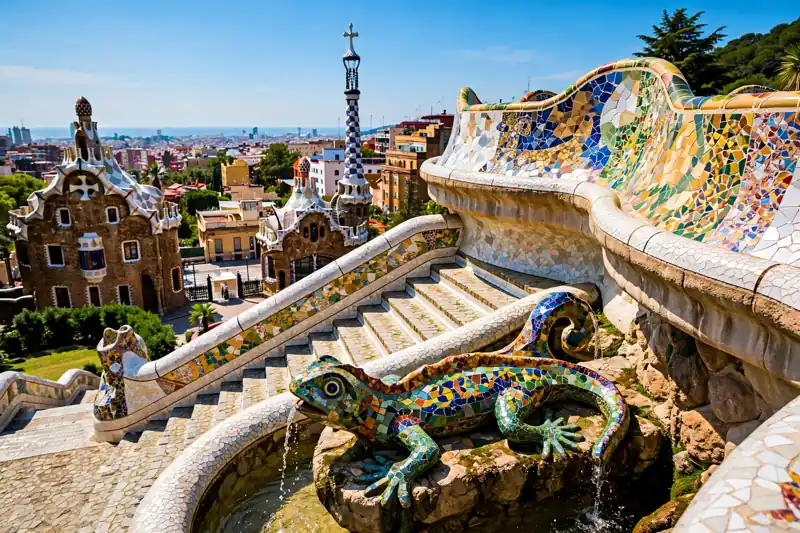
Park Güell on Wikipedia is Gaudí’s failed housing estate turned into Barcelona’s most joyful park — a hillside of mosaic lizards, gingerbread gatehouses, a hall of 86 Doric columns and the famous wavy mosaic bench terrace, with the city spread out below it. The single most important thing to understand before visiting is that the park has two zones with very different rules. The Monumental Zone, about 9 hectares at the heart of the park, holds the dragon staircase, the Hypostyle Room and the mosaic bench terrace, and it requires a timed ticket: €18 for adults in 2026, €13.50 for children 7 to 12 and over-65s, free for under-7s, with entry in 30-minute slots from 9:30 a.m. to 7:30 p.m. (9:30 a.m. to 5:30 p.m. in November), a cap of 1,400 visitors an hour, and no walk-up tickets sold. The rest of the park — roughly 17 hectares of forested hillside, stone viaducts and pine-shaded paths — is completely free and open at all times. Tickets are sold on the official site, parkguell.barcelona, up to three months ahead, and you have 30 minutes from your slot time to enter; miss it and the ticket is lost, and once you leave the Monumental Zone you cannot go back in. Two practical warnings for November 2026: the escalators on the Baixada de la Glòria from the Vallcarca metro stop are out of service, so do not arrive that way — come from Lesseps on line L3 and walk uphill, or take the Bus Güell shuttle from Alfons X on line L4, which is included with your ticket. And the climb is real: the park sits on a steep hill, so wear flat shoes and allow two to three hours, with the terrace at golden hour if you can time it.
3. La Rambla
La Rambla on Wikipedia is Barcelona’s most famous street and its most misunderstood — a 1.2 km tree-lined boulevard from Plaça de Catalunya down to the old port, crowded, noisy and entirely worth walking once, with your eyes open. The street is mid-renovation: in November 2025 the pavers were being replaced and much of the boulevard was a building site, with the flower stalls and street performers thinned out, so expect works and hoardings rather than the postcard version. Walk it in the early morning, before 10 a.m., when the market traders are setting up and the crowds have not arrived, and treat the rest of the day as a corridor, not a destination. Two honest warnings: La Rambla is the pickpocket capital of Europe, and the teams work it around the clock — a bump, a “sorry!”, a map in your face, and your phone is gone, so keep your bag zipped and in front of you, your phone in a front pocket, and nothing on a café table. And do not eat on La Rambla: the restaurants with picture menus and touts at the door are the most overpriced and lowest-quality food in the city, with tourist menus of three tapas and paella for €15.50 plus tax that no local would touch. Turn one street off the boulevard, into the Gothic Quarter or El Raval, and the prices halve and the food gets real. The nearest metro stops are Liceu and Drassanes, both on line L3, and La Boqueria market sits halfway down on the El Raval side. Allow an hour to walk it, and save your appetite for the side streets.
4. The Gothic Quarter and Barcelona Cathedral
The Gothic Quarter on Wikipedia is the oldest part of Barcelona — a maze of medieval lanes, Roman walls, hidden squares and Gothic churches around the cathedral, and the part of the city that feels least like a postcard. Start at the Barcelona Cathedral on Wikipedia, La Seu, the 14th-century Gothic cathedral with its cloister of white geese and its rooftop terrace over the old town, then wander to Plaça del Rei, where the medieval royal palace stands over the excavated Roman city, and into El Call, the old Jewish quarter, one of the oldest in Europe. The quarter rewards getting lost: the lanes are narrow enough to shade you in summer, the squares fill with café tables in the evening, and the best of it is found by turning down the street that looks like it goes nowhere. Two practical notes: the quarter is almost entirely pedestrian, so wear flat shoes on the uneven stones, and it is also a pickpocket hotspot, especially around the cathedral steps and the terrace cafés — the same rules as La Rambla apply. Come in the late afternoon, when the day-trippers have left and the light turns the stone gold, and stay for dinner in one of the lanes off Carrer de Ferran, where the restaurants are for locals. Allow half a day, and do not try to see it from a map: the lanes defeat maps, and that is the point.
5. Casa Batlló
Casa Batlló on Wikipedia is the house that convinces people who thought the Sagrada Família might have been a one-off — Gaudí’s 1904–1906 remodelling of an ordinary Eixample apartment block at Passeig de Gràcia 43 into a dragon: a scaly roof, bone-shaped columns, a blue-tiled light shaft and a façade that seems to breathe. Inside, the visit is deliberately experiential, with an audio guide in 15 languages, a 10D immersive room and the Gaudí Dôme, and the general visit takes about an hour and a quarter. The price moves with the date: the general visit starts from €29, and booking ahead online saves up to €15 a person against the door price, so never buy on the day. The tiers are worth understanding before you pay: Blue is the essential visit from €29, Silver adds the rooftop terrace, Gold adds the Gaudí Dôme and the private Batlló family rooms, and Platinum adds a tablet guide and flexible entry. The Be the First visit at 8:30 a.m. costs €45 and puts you in the building before general opening, and the night visit from €25 leaves the rooftop out. Children under 13 go free. The house is open every day of the year, 9 a.m. to 10 p.m., and it sits 490 metres from La Pedrera on the same boulevard, so the two make a natural pair — do Casa Batlló first, then walk five minutes north to La Pedrera. Allow an hour and a half, and book at least a week ahead in peak season, two to three weeks in July and August.
6. La Pedrera (Casa Milà)
Casa Milà on Wikipedia, universally known by its nickname La Pedrera — the stone quarry — is Gaudí’s last civil work, a block of flats built round two courtyards at Passeig de Gràcia 92, with an attic of 270 brick arches and a rooftop of 29 chimney “warriors” that look like sentries over the city. The rooftop is the reason to come: at sunset the chimneys turn gold against the sky, and the view runs from the Sagrada Família to the sea. The tickets split by time of day, and the split matters: the Essential day visit starts from €29 (9 a.m. to 5:30 p.m.), the Sunset visit from €25 (5:30 to 8:30 p.m.) with the rooftop included, and the Night Experience and the guided Sunrise visit both start from €39.50. Children under 12 go free, and ages 12 to 17, over-65s and students have reduced fares on the booking page. Two warnings for winter visitors: from 2 November 2026 to 25 February 2027 the house opens daily 9 a.m. to 6:30 p.m., and it is closed on 25 December 2026 and from 11 to 17 January 2027, so check the date before you plan around it. And the rooftop closes in rain, which is the one thing that can spoil the visit — if the forecast turns, go in the morning and save the sunset for another day. Allow two hours, and do the attic first, then the period apartment, then the roof, which is the order the building wants you to take.
7. La Boqueria
La Boqueria on Wikipedia is Spain’s most famous food market — the Mercat de Sant Josep de la Boqueria, a cast-iron and glass hall off La Rambla at number 91, with more than 300 stalls of seafood, jamón, fruit, cheese and tapas counters, and the best free show in Barcelona is simply walking it. The market opens Monday to Saturday, 8 a.m. to 8:30 p.m., and it is closed every Sunday and on public holidays, which catches first-time visitors every week: do not build a Sunday morning around it. The fish stalls are also closed on Mondays, when there is no fresh weekend catch. Come early, between 8 and 10 a.m., before the cruise crowds and tour groups arrive after 11, and eat standing at a counter rather than sitting at a table — the counters are where the market’s own people eat, and the prices are half the table prices. One 2026 note: a €12 million renovation began in summer 2026, with a new roof and wider aisles, and the market stays open throughout, in phases — expect some stalls moved and some scaffolding, but nothing closed. And the most famous counter of all, Pinotxo, is gone: it moved to the Mercat de Sant Antoni in 2023, so do not queue for a name that is no longer there. Allow an hour to wander and an hour to eat, and bring cash for the stalls that still prefer it, though most now take cards.
8. The Picasso Museum
The Picasso Museum on Wikipedia is the museum that explains Picasso before he was Picasso — more than 4,250 works across five interconnected 13th- to 15th-century Gothic palaces on Carrer Montcada in El Born, tracing the artist from his teenage years in Barcelona to the Blue Period and the early Cubist experiments. The collection is the largest of Picasso’s early work anywhere, and the rooms that matter most are the first ones: the teenage portraits, the 1899–1900 café paintings and the Las Meninas series, 58 reinterpretations of Velázquez that Picasso painted in 1957. The ticket is cheaper than most guides say: as of November 2026, the general ticket is €12 online or €13 at the door for the permanent collection, €14 with the temporary exhibition, reduced €7 to €7.50 for 18- to 25-year-olds, students and over-65s, and free for under-18s. The museum is closed every Monday, and in winter (29 September to 29 March) it opens Tuesday to Sunday 10 a.m. to 7 p.m., with the ticket office closing 30 minutes before. The free windows are the part most guides get wrong: entry is free on the first Sunday of every month, on Thursday afternoons from 4 to 7 p.m. in winter, and on 12 February, 17 May and 24 September — but every free slot needs an online reservation, released four days ahead, and they go fast. Book a timed ticket before you go in any case: the museum caps daily visitors and sells out on weekends. Allow two hours, and pair it with Santa Maria del Mar, two minutes away.
9. Spotify Camp Nou
Camp Nou on Wikipedia is the stadium that is open and a building site at the same time — and the single sight in Barcelona where older guides are most dangerously out of date. FC Barcelona returned to play at the Spotify Camp Nou on 22 November 2025, after two and a half seasons at the Olympic Stadium on Montjuïc, and the stadium has been reopening in stages since then: the first and second tiers are open on all four sides, the Gol Nord opened in March 2026, and the authorised capacity is now 62,652. The third tier is built but not yet open, and the roof is the last big step: installation is planned to start in summer 2027, which is why Barça will leave again and play at Montjuïc from about June 2027 to January 2028. When the work is finished the stadium will hold about 105,000, the largest in Europe, and it will host the men’s Champions League final on 2 June 2029. What this means for a visitor in November 2026: matches are on, with tickets from the club’s own site, but the classic Camp Nou Experience tour is suspended — you cannot step out to the edge of the pitch, or see the dressing rooms, the tunnel and the press room. What you can do is the museum and the Barça Immersive Tour, with tour tickets from €28, which is digital-heavy and honest about what it is. Do not pay a reseller for a “stadium tour” that promises the pitch: that tour does not exist right now. The metro is line L3 to Palau Reial or Les Corts, and on match days the area is packed an hour before kick-off. Allow two hours for the museum, or a full evening for a match, and check the club’s website before you go — the construction timetable has already been delayed several times.
10. Montjuïc
Montjuïc on Wikipedia is the hill that holds half of Barcelona’s best views and a third of its museums — a green mountain between the port and the city, topped by a castle, ringed by the 1992 Olympic sites, and the place to go when the old town gets too crowded. The way up is the first decision: the funicular from Paral·lel metro (lines L2 and L3) climbs to Parc de Montjuïc on an ordinary metro ticket, and from there the cable car continues to the castle — €19 return at the desk, €17.10 booked online, €12 one way, children 4 to 12 half price, running daily from 10 a.m. (to 6 p.m. from November). The cable car is a separate ticket and is not covered by any travel card, which is the mistake most visitors make. At the top, Montjuïc Castle on Wikipedia costs €12 (€8 reduced, under-16s free) and is free on Sunday afternoons from 3 p.m. and all day on the first Sunday of the month, with a 360-degree view over the port, the city and the sea. Down the hill are the Olympic Stadium, the Palau Sant Jordi, the Joan Miró Foundation and the National Art Museum of Catalonia, and at the foot of the hill is the Magic Fountain of Montjuïc on Wikipedia — and the fountain is the trap to check before you go. The shows returned in September 2025 after the drought closure, but the fountain is switched off from 1 to 15 November 2026 for its annual maintenance, with no shows at all, and performances resume on 19 November, running Thursday to Saturday from 8 to 9 p.m. under winter hours. Older guides still say the fountain is closed for the drought, or print the old nightly schedule — both are wrong now. Allow half a day for the hill, and go in the late afternoon, when the light over the port is at its best.
11. Barceloneta Beach
Barceloneta on Wikipedia is Barcelona’s city beach — a wide strip of sand a ten-minute walk from the old town, with the W Hotel at one end, the beach bars (chiringuitos) along the front, and the boardwalk that runs all the way to the Olympic Port. In November it is not a swimming beach: the sea is cold, the chiringuitos are mostly shut, and the sand is for walking, running and sitting with a coffee, which is honestly the best way to enjoy it — the summer crowds are gone and the light is softer. Two honest warnings: Barceloneta is the second pickpocket hotspot in the city after La Rambla, and the beach is where it happens — never leave a bag unattended while you swim, and do not leave a phone on a towel. And the beach bars in summer are the most overpriced drinks in the city: walk two streets back into the Barceloneta neighbourhood, where the fishermen’s bars serve the same vermouth for half the price. If you want to swim, the better beaches are further out: Bogatell and Nova Icària, two metro stops east, are cleaner, quieter and where the locals go. The metro is Barceloneta on line L4, and the beach is free, all year, all day. Allow an hour to walk the front, and pair it with lunch in the neighbourhood, where the paella is actually cooked to order.
12. Hospital de Sant Pau
Hospital de Sant Pau on Wikipedia is the sight most first-timers miss and the one architects rate highest — the world’s largest Art Nouveau complex, a garden city of tiled pavilions and underground tunnels designed by Lluís Domènech i Montaner between 1905 and 1930, and a working hospital until 2009, when a new hospital opened next door. The pavilions were built to heal: gardens between the wards, light and colour in every room, and a main administration pavilion that looks like a palace. The ticket is cheaper than the Gaudí sights and the visit is quieter: as of November 2026, self-guided entry is €18 before 2 p.m. and €17 after 2 p.m., reduced €11.90, children under 12 free, with hours 9:30 a.m. to 5 p.m. from November to March (6:30 p.m. April to October) and last entry 30 minutes before closing. Entry is free on 23 April (Sant Jordi), 24 September (La Mercè) and the first Sunday of every month. The site is a ten-minute walk from the Sagrada Família, down Avinguda de Gaudí, which is itself one of the prettiest streets in the city, so pair the two: the basilica in the morning, Sant Pau after lunch, when the light in the gardens is best and the ticket is €1 cheaper. Allow two hours, and do not rush the gardens — they are the point of the place.
13. Palau de la Música Catalana
The Palau de la Música Catalana on Wikipedia is the concert hall that out-Gaudís Gaudí — a UNESCO-listed Modernista palace by Domènech i Montaner, opened in 1908, with a stained-glass skylight like an inverted sun, mosaics, sculptures and a stage framed by muses, and it is still a working concert hall, not a museum. The way to see it is a concert, not a tour: the guided tour is good, but the hall at night, full of people and music, is the experience, and tickets for the Orfeó Català choir and the visiting orchestras start from not much more than the tour. If you do take the tour, it runs daily in English and Spanish and covers the auditorium, the Lluís Millet hall and the rehearsal room, with the skylight as the climax. The hall sits at the edge of the Gothic Quarter, two minutes from the cathedral, and the café on the ground floor is open to everyone — a good place for a coffee between the old town and El Born. One practical note: the hall is a working venue, so parts of it close for rehearsals and private events, and the tour route changes on concert days — check the day’s schedule before you go. Allow an hour for the tour, or a full evening for a concert, and book the concert, not the tour, if you can only do one.
14. Tibidabo
Tibidabo on Wikipedia is the mountain that watches over Barcelona — 512 metres high, topped by the church of the Sacred Heart and the city’s oldest amusement park, with the best panoramic view in the city and the fewest tourists. On a clear day you can see the whole city, the port, the sea and, behind you, the Collserola hills and the Pyrenees. The park is the oldest in Spain, opened in 1901, and it is small and old-fashioned in the best way: a Ferris wheel, a carousel, a hall of mirrors and the Avió, a red aeroplane ride from 1928 that is the park’s symbol. Tickets start from €39 for the park in 2026, and the funicular from Plaça del Doctor Andreu is included in the park admission — there is no separate funicular ticket, and the funicular only runs on days the park is open, so check the park’s calendar before you go. The old blue tram, the Tramvia Blau, is closed, so the way up is the bus from Plaça de Catalunya or the metro to Avinguda del Tibidabo and then the bus. The church itself is free to enter, and the view from its terrace is free too, so you can do Tibidabo without the park ticket if you only want the view. In November the park runs reduced hours and some weekdays it does not open at all — check before you set out, and go on a clear day, because the view is the whole point and the clouds take it away.
15. El Born and Santa Maria del Mar
El Born on Wikipedia is the old town’s prettiest quarter — a grid of medieval lanes east of the Gothic Quarter, full of independent shops, wine bars and small restaurants, and the place to eat and drink in the evening after the day’s sightseeing. At its heart is the Santa Maria del Mar on Wikipedia, the 14th-century “cathedral of the sea”, a vast, plain, luminous Gothic church built by the dockworkers of the port, with a single nave, slender octagonal columns and almost no decoration — the opposite of the cathedral, and the more moving of the two. Entry is free, and the rooftop terrace, reached by a guided visit, gives a view over the quarter’s rooftops. Around the church is the Passeig del Born, the old jousting ground turned into a bar-lined promenade, and the Born Cultural Centre, the old market hall with the excavated ruins of the 1714 city underneath a glass floor. The Picasso Museum is two minutes away, so the natural half day is the museum, the church and the quarter, and the natural evening is a crawl of the wine bars on Carrer de la Princesa and Carrer del Rec. Allow half a day, and come hungry: El Born is where Barcelona eats after dark.
16. Gràcia
Gràcia on Wikipedia is the neighbourhood that used to be a village — an independent town until 1897, and it still feels like one: low houses, small squares, no cars on the main streets, and a local life that the old town lost years ago. The squares are the point: Plaça del Sol, Plaça de la Vila de Gràcia, Plaça del Diamant, each with its own bars, its own crowd and its own rhythm, and the evenings belong to the people who live there. Gràcia is also the vermouth quarter: the old vermouth bars with their barrels and their olives, where a vermut de grifo costs a few euros and the afternoon stretches into the evening. The big event is the Festes de Gràcia in mid-August, when the streets compete to decorate themselves and the whole quarter becomes a street party — if you are here in August, do not miss it, and if you are not, the squares are still the best free evening in the city. Casa Vicens, Gaudí’s first house, sits on Carrer de les Carolines, and Park Güell is a twenty-minute walk uphill. The metro is Fontana or Lesseps on line L3, and the quarter is best explored on foot, without a plan. Allow half a day, and bring cash for the market stalls and the vermouth bars that still prefer it.
17. Ciutadella Park
Parc de la Ciutadella on Wikipedia is Barcelona’s central park — 17 hectares of lawns, lakes, palm trees and the Cascada fountain, on the site of the 18th-century citadel that the city tore down, and the greenest free space in the centre. The fountain is the landmark: a monumental cascade with a golden quadriga on top, designed by Josep Fontserè with a young Gaudí helping on the hydraulics, and the best place in the park to sit is the steps in front of it. The park holds the zoo, the Catalan Parliament in the old arsenal building, the Castle of the Three Dragons (now the zoology museum) and the boating lake, where you can rent a rowing boat for a few euros. It is the park where Barcelona goes on a Sunday: families, runners, musicians, picnics and the drum circle by the lake, and it is free, all day, all year. The Arc de Triomf stands at the park’s western end, on the Passeig de Lluís Companys, and the walk from the arch through the park to the zoo is the nicest free half hour in the city. The metro is Arc de Triomf on line L1 or Ciutadella–Vila Olímpica on line L4. Allow two hours, and go on a Sunday morning, when the park is at its liveliest.
18. The National Art Museum of Catalonia (MNAC)
The National Art Museum of Catalonia on Wikipedia is the museum in the palace on Montjuïc — the Palau Nacional, built for the 1929 International Exposition, with a dome, a grand staircase and the best view over the Magic Fountain and the city below. Inside is the finest collection of Romanesque art in the world: the painted apses of the Pyrenean churches, taken down stone by stone and rebuilt in the museum, with their 12th-century frescoes intact, and they are the reason to come. Beyond them are the Gothic altarpieces, the Renaissance and Baroque rooms, the modern Catalan art of the 19th and 20th centuries, and a rooftop viewpoint that is one of the best in the city. The museum is free on Saturday afternoons from 3 p.m. and all day on the first Sunday of the month, which is the time to go if you are counting euros — the Gaudí tickets will have taken enough of them. The museum is closed on Mondays, and it sits at the top of the Montjuïc steps, above the Magic Fountain, so pair it with the fountain in the evening: the museum in the afternoon, the fountain after dark. Allow two to three hours, and start with the Romanesque rooms on the ground floor, which are the ones no other museum in the world can match.
19. The Bunkers del Carmel
The Bunkers del Carmel is the best sunset in Barcelona and the cheapest — a ruined anti-aircraft battery from the Spanish Civil War on the Turó de la Rovira, 262 metres up, with a 360-degree view over the whole city, the Sagrada Família in the middle of it, the sea on one side and Tibidabo on the other, and not a ticket booth in sight. There is no Wikipedia page for the bunkers, so this section has no Wikipedia link by design — the site is a local secret that became a sunset ritual, and the city has kept it free and unfenced. Come an hour before sunset, bring a drink and something to sit on, and watch the city turn gold: the Sagrada Família catches the last light, the sea goes silver, and the lights come on one by one. Two honest warnings: there are no facilities up there — no toilets, no water, no shade — and the neighbours have asked visitors to keep the noise down after dark, so keep it quiet and take your rubbish with you. The way up is the metro to Alfons X on line L4 and then a steep uphill walk, or bus 24 from the centre, which drops you closer to the top. Allow an hour and a half, and go on a clear evening — the clouds take the view away, and the wind up there is real.
20. Casa Vicens
Casa Vicens on Wikipedia is where Gaudí began — his first house, built 1883 to 1885 for the tile manufacturer Manuel Vicens in what was then the village of Gràcia, and the building where the whole Gaudí language first appears: the coloured tiles, the brick, the ironwork, the Moorish and Oriental patterns, and the garden that the house was built around. It is smaller and quieter than the later houses, and that is its charm: you can see the whole building in an hour, and you can see Gaudí learning his craft in front of you. The house became a UNESCO World Heritage Site in 2005 and opened as a museum in 2017, after a restoration that brought back the original garden and the smoking room, with its papier-mâché birds and its ceiling of leaves. It is in Gràcia, on Carrer de les Carolines, two minutes from the squares, so pair it with a Gràcia afternoon: the house, then a vermouth in Plaça del Sol. Book ahead, because the house is small and the slots sell out on weekends, and go in the morning, when the light comes through the stained glass in the dining room. Allow an hour, and do not skip the garden — it is the part of the house that most visitors walk past.
Barcelona in 3 days — a ready-made itinerary
This three-day plan covers the Gaudí sights, the old town and Montjuïc, and it uses the metro and walking, with a bus only for Tibidabo. Book the Sagrada Família and Park Güell before you fly, put the museums on a weekday, and keep the evenings for Gràcia and El Born — Barcelona eats late by northern European standards, with lunch at 2 p.m. and dinner from 9 p.m., and the best tables fill by 8 p.m.
Day 1 — Gaudí: the Sagrada Família, Sant Pau and the Passeig de Gràcia houses
Start at the Sagrada Família at the first slot of the day, before the crowds, and give it two to three hours — the nave first, then the museum underneath, then a tower if you booked one. Walk down Avinguda de Gaudí to the Hospital de Sant Pau for the gardens and the tiled pavilions, and give it two hours. Take the metro to Passeig de Gràcia for Casa Batlló and La Pedrera, five minutes apart on the same boulevard, and do the rooftop of La Pedrera at sunset if you booked the Sunset ticket. Eat dinner in the Eixample, where the restaurants are for locals, and finish with a drink on Passeig de Gràcia, under the dragon roof of Casa Batlló.
Day 2 — The old town: the Gothic Quarter, La Rambla, El Born and the Picasso Museum
Start at the Barcelona Cathedral and the Gothic Quarter, wandering the lanes to Plaça del Rei and El Call, and give it the morning. Walk La Rambla early, before the crowds, and turn off it into La Boqueria for lunch at a counter — remember the market is closed on Sundays, so do this on a weekday. In the afternoon, cross into El Born for the Picasso Museum and Santa Maria del Mar, and give the museum two hours. Finish in El Born, with a vermouth on Passeig del Born and dinner in one of the lanes off Carrer de la Princesa, where the wine bars stay open late and the food is for locals.
Day 3 — The hill, the park and the beach: Montjuïc, Park Güell and Barceloneta
Start at Park Güell at the 9:30 a.m. slot, before the heat and the crowds, and give it two to three hours — the Monumental Zone first, then the free paths above it. Take the metro to Paral·lel for the funicular up Montjuïc, and spend the afternoon on the hill: the castle, the Olympic Stadium, the National Art Museum and the view over the port. If it is after 19 November, stay for the Magic Fountain show on Thursday, Friday or Saturday evening; if it is before, the fountain is off for maintenance, so go to the Bunkers del Carmel for sunset instead. Finish in Barceloneta, with a walk along the front and dinner in the neighbourhood, where the paella is cooked to order and the vermouth is half the beach price.
Best time to visit Barcelona
| Season | Weather | Crowds | Notes |
|---|---|---|---|
| Spring (March–May) | Highs about 17–24°C (63–75°F), lows about 8–14°C (46–57°F) | Moderate | Best all-round season; Sant Jordi on 23 April, long evenings, the parks in flower |
| Summer (June–August) | Highs about 27–29°C (81–84°F), lows about 20–22°C (68–72°F) | High | Hottest and most crowded; beach season, Festes de Gràcia in August, the highest hotel prices |
| Autumn (September–November) | Highs about 17–24°C (63–75°F), lows about 9–15°C (48–59°F) | Moderate | Second-best season; La Mercè in September, mild days, thin crowds by November |
| Winter (December–February) | Highs about 13–15°C (55–59°F), lows about 5–8°C (41–46°F) | Low | Coldest and quietest; Christmas markets, the lowest hotel prices, the shortest days |
The best time to visit Barcelona is mid-April to June and September to mid-October, and if you want one answer, pick late May or late September: the days are warm without being punishing, the evenings are long, the sea is warm enough to swim, and the Gaudí sights are bookable without a month’s notice. July and August are the hottest months, with average highs of 28 to 29°C (82 to 84°F), and the humidity is the real story — Barcelona’s summers are hot and sticky, with the city at its most crowded, so plan the museums for the middle of the day and the beach for the morning and evening. November is the quiet month: the average high is about 17°C (63°F) and the low about 9°C (48°F), with around 60 mm of rain over four to six days, and the November 2026 forecast runs slightly warmer and wetter than normal. January is the coldest month, with an average high of 14°C (57°F) and a low of 6°C (43°F), and the city almost never sees snow. The seasonal traps are specific: the Magic Fountain is off from 1 to 15 November for its annual maintenance; La Pedrera closes from 11 to 17 January 2027; the Tibidabo park runs reduced hours in winter and some weekdays it does not open at all; and the Sagrada Família’s centenary year means morning slots sell out weeks ahead in every season. There is no wet season — October is the wettest month at about 90 mm of rain, July the driest at about 20 mm — and the city gets more than 2,500 hours of sun a year.
Where to stay in Barcelona
| Area | Best for | Price range |
|---|---|---|
| Eixample | First-timers, walking everywhere, the Gaudí sights | €120–€250 a night |
| Gothic Quarter | Atmosphere, medieval lanes, the cathedral | €110–€220 a night |
| El Born | Nightlife, wine bars, restaurants | €110–€200 a night |
| Gràcia | Local life, squares, vermouth bars | €90–€180 a night |
| Barceloneta | The beach, the sea, the port | €120–€250 a night |
| Sants | Quiet, value, the main station | €80–€160 a night |
Stay in the Eixample if this is your first visit — everything is walkable, the metro is under your feet, the Sagrada Família and the Passeig de Gràcia houses are the meeting point, and the airport bus drops you at Plaça de Catalunya. Stay in the Gothic Quarter if you want atmosphere — the medieval lanes, the cathedral and the squares, with La Rambla at your door — but ask for a room off the main streets if you want quiet, because the bars go on until late. Stay in El Born if you want the nightlife — the wine bars, the restaurants and the Picasso Museum, with the beach a walk away. Stay in Gràcia if you want local life — the squares, the vermouth bars and the village feel, with Park Güell uphill. Stay in Barceloneta if you want the sea — the beach, the port and the fishermen’s bars — but ask for a room off the beachfront if you want quiet, because the summer nights are loud. Stay in Sants if you want value and quiet — the main station, the market and the local bars, with the metro into the centre in ten minutes. Two warnings: do not book a room right on La Rambla or Plaça de Catalunya if you want quiet, and do not forget the tourist tax, which is charged on top of the room rate — €12 a night in a five-star hotel, €8.40 in a four-star, €9.50 in a tourist apartment and €6 in a hostel, per person per night, for up to seven nights, with under-17s exempt.
Getting around Barcelona
| Way to travel | Cost | Best for |
|---|---|---|
| Metro, bus and tram (T-casual) | €13 for 10 journeys | Everything in the centre, one person at a time |
| Metro, bus and tram (single ticket) | €2.90 one journey | One-off trips, 75 minutes of transfers |
| Airport metro (L9 Sud) | €5.90 one journey | Airport to the city by metro |
| Hola Barcelona card | €18.70 for 48 hours | Heavy use, airport metro included |
| R2 Nord train (airport T2) | Covered by T-casual | Airport to the city by train |
| Taxi (airport to the centre) | About €30–€45 | Groups, luggage, late nights |
| Walking | Free | The old town, the Eixample, the beachfront |
Barcelona’s metro on Wikipedia is the way to move around the city: eight lines, running from 5 a.m. to midnight (all night on Saturdays), with the Sagrada Família, Park Güell, the Gothic Quarter and Montjuïc all on the network. The ticket to buy is the T-casual: ten journeys for €13 in zone 1, valid on the metro, buses, trams and Rodalies trains, with 75 minutes of transfers on each journey. It is for one person at a time — you cannot pass it back through the barrier for a friend — and since April 2026 all fares are loaded onto the T-mobilitat card, paper or plastic or on your phone, because paper magnetic tickets are no longer sold. The airport is the trap: the T-casual and the single ticket are NOT valid at the Aeroport T1 and T2 metro stations on line L9 Sud, where you need the separate €5.90 Airport ticket, unless you hold a Hola Barcelona card, which covers the airport metro with no surcharge. The cheaper way in is the R2 Nord train from Terminal 2, which does take the T-casual, and takes about 20 minutes to Passeig de Gràcia. The airport itself is about 13 km south-west of the centre: the metro takes 30 to 35 minutes with one change, the train about 20 minutes, and a taxi about €30 to €45 with the €4.60 airport supplement. Two warnings: the metro is a pickpocket hotspot, especially lines L1 and L3 and the Catalunya, Liceu, Passeig de Gràcia and Sagrada Família stations — keep your bag in front of you and your phone in a front pocket — and the Montjuïc cable car is NOT covered by any travel card, so budget €19 return for it separately.
Barcelona food you have to try
Barcelona’s food is the food of a port city that grew up on the Mediterranean: the tapas, the seafood, the vermouth, the markets and the late dinners, and the tourist-trap problem here is the opposite of most cities: the restaurants on La Rambla and the beachfront are fine, but the best food is one street back, in the markets and the neighbourhoods — eat where the locals queue, and eat late, because the best tables fill by 9 p.m.
Tapas, paella and the Catalan table
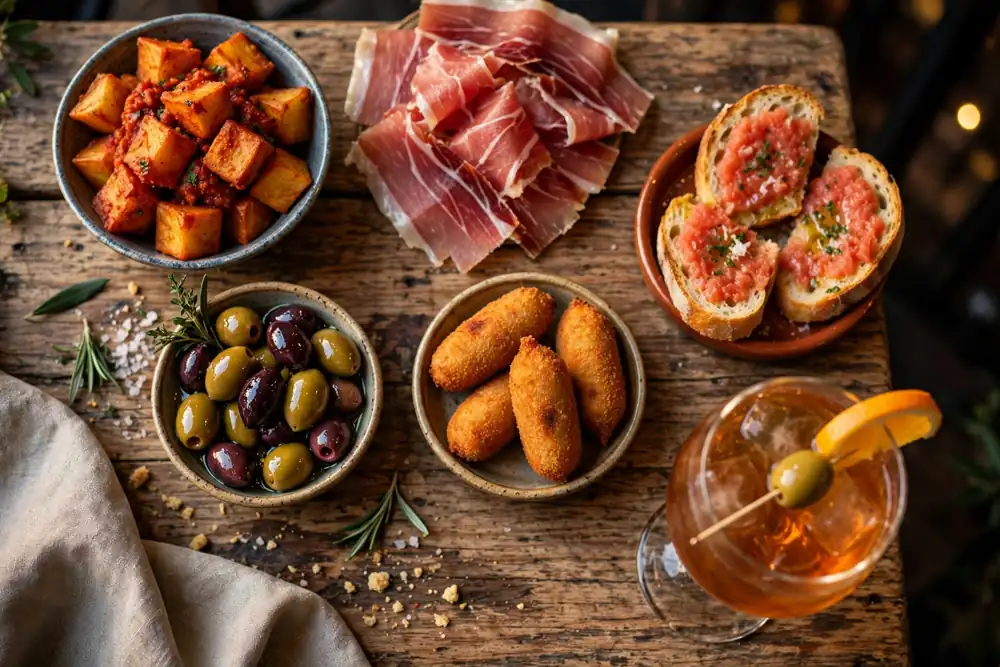
Tapas on Wikipedia is the dish Barcelona argues about most, and the first thing to know is that Barcelona is not a tapas city in the way Seville is: the Catalan table is built on small plates, but the real local move is the vermouth hour, the market lunch and the shared plates of a proper restaurant, not a crawl of tiny bars. The plates to order are the classics: patatas bravas with allioli, jamón ibérico, pan con tomate — bread rubbed with tomato, garlic and olive oil, the base of every Catalan meal — croquettes, padron peppers and gambas al ajillo, garlic prawns in sizzling oil. Paella on Wikipedia is the second thing to know: it is a Valencian dish, not a Catalan one, and the paella on La Rambla and the beachfront is the most overpriced and lowest-quality in the city, cooked from frozen and served to people who will never come back. The good paella is in Barceloneta’s back streets and in the restaurants of the Eixample, where it is cooked to order, takes 30 minutes, and costs €20 to €25 a person — if it arrives in five minutes, it was not cooked for you. Catalan cuisine on Wikipedia is the wider table: the seafood stews, the botifarra sausage with white beans, the calçots in spring, and the crema catalana for dessert. Eat lunch at 2 p.m., dinner from 9 p.m., and do not expect a table before then — the kitchens are closed in between.
Vermouth, cava and the Barcelona drink
Vermouth on Wikipedia is the drink Barcelona runs on — vermut, the aromatised wine that the city drinks at midday on Sundays and every afternoon in Gràcia, served on ice with an olive and a slice of orange, with a plate of olives and crisps on the side. The vermouth hour is the Catalan aperitif: a vermut de grifo from the barrel, in an old bar with tiled walls and a marble counter, costs a few euros and stretches into the evening, and it is the most local thing you can do in the city. Cava is the second drink: the sparkling wine of Penedès, an hour south of the city, served cold and dry, and the bottle to order in a restaurant when the vermouth hour ends. The third is the wine: the Priorat and the Penedès reds, and the house wine in a porró, the glass pitcher with the thin spout that Catalans pour from above their heads — ask for it in a traditional restaurant and the waiter will show you how. Do not order sangria: it is the drink tourists are sold and locals do not drink, and the same goes for the frozen cocktails on the beachfront. Drink vermouth at noon, cava with dinner, and water with everything — the tap water in Barcelona is safe, though it tastes of chlorine, so most locals drink bottled.
Markets, bakeries and the sweet side
The markets are where Barcelona eats, and the sweet side is where it finishes. La Boqueria is the famous one, but the local markets are the better ones: Santa Caterina in El Born, with its wavy coloured roof, and Sant Antoni, with its Sunday book and coin fair outside and its food hall inside, where the prices are half the Boqueria’s and the crowd is Barcelona. The bakeries are the other stop: the ensaïmada, the spiral pastry from Mallorca that Barcelona adopted, and the xuixo from Girona, a fried pastry filled with crema catalana, sold in the old bakeries of the Gothic Quarter. The seasonal sweet is the November one: La Castanyada, on 1 November, when the city eats roasted chestnuts and sweet potatoes from the street stalls and panellets, the small marzipan cakes topped with pine nuts, from the bakeries — if you are here in November, the chestnut stalls are the smell of the city. For dessert after dinner, the local move is a crema catalana, the Catalan crème brûlée with its burnt sugar top, or a xuixo with a cup of coffee, and the Natty Boh of Barcelona is the Estrella Damm, the local lager, which is the beer to order with any of it. Save room after dinner: Barcelona’s sweet tooth is not a side note, it is the city’s personality.
Free things to do in Barcelona
Barcelona is cheaper than its reputation suggests, because the best sights cost nothing. The Gothic Quarter is free, and so is the walk through its lanes, the cathedral square and the Roman walls. The beach is free, and so is the walk along the front from Barceloneta to the Olympic Port. The Bunkers del Carmel is free, and so is the best sunset in the city. Ciutadella Park is free, and so is the Cascada fountain, the boating lake and the Sunday drum circle. The Magic Fountain is free, when it is running — and it is off from 1 to 15 November, so check the date. The Picasso Museum is free on Thursday afternoons in winter and the first Sunday of the month, the National Art Museum is free on Saturday afternoons and the first Sunday, and the Hospital de Sant Pau is free on the first Sunday too. The Sagrada Família is free to look at from the outside, and the view of it from the Bunkers is free as well. And the paid sights have free windows: the Montjuïc Castle is free on Sunday afternoons, the Park Güell outside the Monumental Zone is free, and the Tibidabo church terrace is free. Do the free list on your first day, and you will have seen the old town, the park, the beach and the sunset before you have spent a euro on a ticket.
Frequently asked questions
How many days do you need in Barcelona?
Three days is the minimum for the highlights: one day for the Gaudí sights, one day for the old town and El Born, and one day for Montjuïc, Park Güell and the beach. Four to five days is the right amount for a real trip, with Tibidabo, Gràcia and a Montserrat day trip, and a week if you want to use the city as a base for Girona, Tarragona and the Costa Brava. Two days works if you plan well — the Sagrada Família, Park Güell, one museum and the Gothic Quarter — but you will leave having seen a third of the city, and you will have queued for most of it.
Is Barcelona safe?
Barcelona is safe in the way a big European city is safe, and unsafe in one specific way that every visitor needs to know. Violent crime is rare, and the tourist areas are well policed and busy with visitors at all hours. Pickpocketing is the problem, and it is a serious one: Barcelona is one of the top three pickpocketing cities in Europe, and the hotspots are La Rambla, the metro (lines L1 and L3, especially Catalunya, Liceu, Passeig de Gràcia and Sagrada Família stations), the Sagrada Família, Barceloneta beach, the Gothic Quarter terraces and Plaça de Catalunya. The teams work in groups of three to six, with one person bumping you or spilling something while the others open your bag. The rules are non-negotiable: keep your bag zipped and in front of you, your phone in a front pocket and never on a café table, wear a backpack on your front in crowds, and leave spare cards and cash in the hotel room. If you are robbed, block your cards first, then file a police report — a denuncia — with the Mossos d’Esquadra before you leave Spain: your insurance will want it, and the main tourist station is at Carrer Nou de la Rambla 76–80. Use the same sense you would in any big city, and the only thing you will lose is sleep.
When is the best time to visit Barcelona?
Mid-April to June and September to mid-October, when the days are warm, the evenings are long and the city is full without being crowded. Late May and late September are the single best picks. July and August are the hottest and most crowded months, with average highs of 28 to 29°C and the highest hotel prices — come then for the beach, and plan the museums for the middle of the day. November is the quietest good month, with an average high of 17°C, thin crowds and the lowest hotel prices, and January is the coldest, with an average high of 14°C. May is the festival month, with Sant Jordi on 23 April and the Primavera Sound festival, and September is La Mercè, the city’s main festival, on 24 September — though the city is packed for both, so book early. December brings the Christmas markets and the shortest days, with the Magic Fountain running on its winter schedule.
Is Barcelona expensive?
Mid-range for Western Europe, and more expensive than Madrid for the same weekend. A mid-range hotel costs €120 to €250 a night in the Eixample, plus the tourist tax of €6 to €12 a person a night, a Sagrada Família ticket €26, Park Güell €18, Casa Batlló and La Pedrera from €29 each, a vermouth €3 to €5, a paella €20 to €25, and a T-casual €13 for ten metro rides. The Gaudí tickets are the cost most visitors underestimate: the four big ones add up to more than €100 a person, so pick two and do the rest free. A careful three days can be done for about €110 to €170 a person a day, and the old town, the parks, the beach and the sunset are free.
Do you need a car in Barcelona?
No. The metro, the buses and your feet cover everything in the city, and a car is a liability: the centre is mostly pedestrian, parking is €20 to €40 a night, and the low-emission zone fines cars that do not have the right sticker. For everything outside the city, use the train: Montserrat on the R5 from Plaça d’Espanya, then the rack railway or the cable car at €15 return, and Girona in 38 minutes on the high-speed train. Rent a car only for the days you leave the city for the Costa Brava or the Pyrenees, and take the metro for the days you do not — the rental is €40 to €80 a day, and downtown parking costs more than the rental. The only reason to rent for the whole trip is a road trip through Catalonia, where the car is the trip.
What should I skip in Barcelona?
Six things, and all six are traps older guides still get wrong. First, do not eat on La Rambla or the beachfront: the tourist menus and the frozen paella are the worst food in the city, and one street back the prices halve and the food gets real. Second, do not buy Sagrada Família tickets from a reseller or a tout: the official site is the cheapest place, the tickets are named and timed, and counterfeit QR codes are in circulation. Third, do not go to Park Güell without a ticket: there is no walk-up sale, and the Monumental Zone turns away everyone without a timed slot. Fourth, do not plan on the Magic Fountain between 1 and 15 November: it is off for its annual maintenance, with no shows at all, and it resumes on 19 November. Fifth, do not pay for a Camp Nou “stadium tour” that promises the pitch: the classic tour is suspended while the rebuild goes on, and the museum is the only visit available. And sixth, do not go to La Boqueria on a Sunday: the market is closed, the gates are shut, and the walk down La Rambla to find them closed is the most common first-timer mistake in the city.
Further reading
Start with Barcelona on Wikipedia, which covers the history and the geography, and Catalonia on Wikipedia for the region and its language. For what locals and regular visitors actually recommend, the r/Barcelona subreddit is where travellers ask about the neighbourhoods, the pickpocket warnings, the best vermouth bars and the Sagrada Família booking windows. No Quora link is included here: the only Quora thread that turned up is a 2024 post about places a family should avoid, not a guide to visiting Barcelona, so none is listed rather than linking to an off-topic one.
Your Barcelona trip, in one paragraph
Barcelona is the Mediterranean city that rewards getting up early: the Sagrada Família at the first slot with the stained glass to yourself, Park Güell before the crowds, an afternoon in the Gothic Quarter with the cathedral and the Roman walls, sunset from the Bunkers del Carmel, and a vermouth and tapas in Gràcia for dinner. For more guides in the same style, start with our Hawaii guide for the whole-state trip — this guide is only about Barcelona — then see how Barcelona compares with Maui, Honolulu, Chicago, Nashville, Los Angeles, Orlando, Miami, San Diego, Denver, Savannah, Dallas, Charleston, San Francisco, Myrtle Beach, Las Vegas, San Antonio, London, Portland, Pigeon Forge, Puerto Rico, Atlanta, Phoenix, Paris, Key West, Colorado Springs, Sedona, Chattanooga, Palm Springs, St Louis, Tokyo, Japan, Kansas City, Tennessee, Branson, Florida, Amsterdam, Montreal, Fort Lauderdale, Toronto, Aruba, Charlotte, Indianapolis, New Orleans, Destin, Santa Barbara, Mexico City, Arizona, Osaka, Minneapolis, Pittsburgh, California, Asheville, Costa Rica, Washington DC, Seattle, St Augustine, Lisbon, Dubai, Santa Fe, Galveston, Maine, Sacramento, Kauai, Boston, Cancun, Madrid, Salt Lake City and Baltimore.

About the Author