Things to Do in Baltimore
20 Best Attractions, a 3-Day Itinerary, Where to Stay, and the Food You Cannot Miss
Quick Info
Best for: First-timers, history lovers, food lovers and families — a walkable harbor city with three free world-class art museums
Best time: Mid-April–June and September–mid-October for mild days; July–August for peak blue crab season and the hottest, most humid weather
How long: 3 days for the harbor, the museums and Fells Point; 4 days adds the zoo, the neighborhoods and a slower pace
Budget: About $120–$180 per person per day mid-range — the big museums are free, the aquarium and Fort McHenry are not
Don’t miss: The National Aquarium at opening time, Fort McHenry at the 10 a.m. flag change, sunset from Federal Hill, a crab cake at Lexington Market and the free Harbor Connector across the water
Baltimore on Wikipedia is the largest city in Maryland and the most underrated weekend trip on the East Coast — a working port city of about 570,000 people on the Patapsco River, where the Inner Harbor, the star-shaped fort that inspired the national anthem and three free art museums sit within a few miles of each other. This guide covers the 20 best things to do in Baltimore, a 3-day itinerary that actually works, where to stay without overpaying, how to get around on the free Circulator and the free Harbor Connector, the three foods you should not skip, and the free sights that cost nothing. Everything below was checked against live sources in November 2026 — including the delayed Harborplace demolition, the aquarium’s new prices, the renamed railroad museum, the zoo’s 150th anniversary and the Key Bridge rebuild.
Baltimore at a glance
| Topic | What to know |
|---|---|
| Full name | Baltimore — the largest city in Maryland, nicknamed “Charm City” |
| Founded | 1729, as a port town on the Patapsco River near Chesapeake Bay |
| Population | About 570,000 people in the city, about 2.8 million in the metro area |
| Language | English; the Baltimore accent turns “water” into “wooder” and everyone is “hon” |
| Airport | Baltimore/Washington International Thurgood Marshall Airport (BWI), about 10 miles south of downtown |
| Best base | The Inner Harbor for a first visit — walkable, with the free Circulator at your door |
| Getting around | Free Charm City Circulator buses downtown, the free Harbor Connector on the water, and a car or rideshare for the zoo and the outer neighborhoods |
| Famous for | The Inner Harbor, Fort McHenry and the Star-Spangled Banner, blue crabs and Old Bay, and the Orioles at Camden Yards |
Baltimore divides into two ideas that most visitors only partly see. The postcard city is the one on the harbor: the National Aquarium, the historic ships, the promenade and the skyline from Federal Hill, all of it rebuilt from a working port into the model waterfront that other American cities copied. The other Baltimore is the one that makes people come back: the neighborhoods — Fells Point’s cobblestones, Mount Vernon’s monuments, Hampden’s weird shops, the markets and the rowhouse streets — where the food, the music and the accent live. The trap is the calendar and the map: the city is at its best in late spring and early autumn, hot and humid in July and August, and quiet in January, while the harbor and the neighborhoods are a short walk or a free bus ride apart but the zoo and the outer sights are not. Plan around the season, stay near the water, and the city rewards you in every month of the year.
The 20 best things to do in Baltimore
1. The Inner Harbor
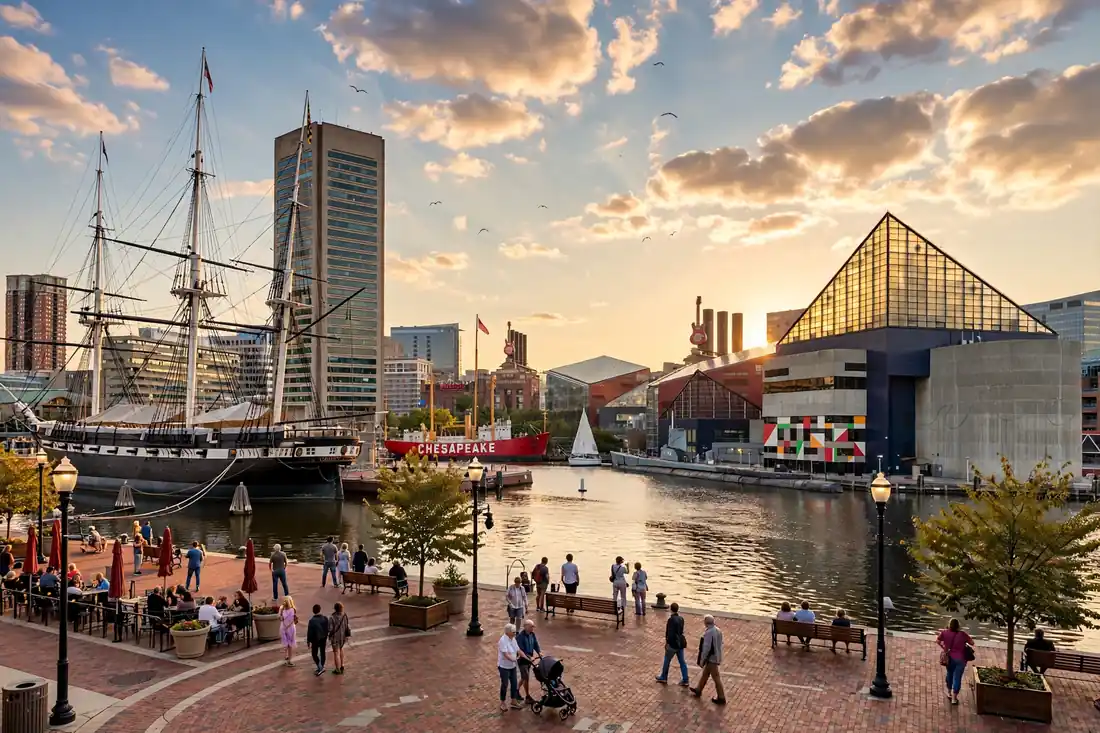
The Inner Harbor on Wikipedia is the heart of Baltimore and one of the most successful waterfront rebuilds in America — a working seaport since the 18th century that was reborn in the 1980s as a promenade of museums, ships, restaurants and public space, with the National Aquarium at one end and the Maryland Science Center at the other. Walk the brick promenade first, before you pay for anything: the harbor is free, the views are free, and the best of it is the water itself, with the historic ships at Pier 1, the Harbor Wetland between Piers 3 and 4, and the skyline across the basin. The one thing to know before you visit in 2026 is Harborplace, the two glass pavilions on the promenade: the $900 million to $1 billion redevelopment was approved by voters in November 2024, but the demolition of the pavilions was delayed on September 17, 2026, and the pavilions stay open until further notice, with tenants told they can stay at least until January. Construction is now expected to begin before the end of 2026, starting with roadway and intersection work, and the promenade itself will be raised for flood resilience. Older guides still describe the pavilions as already demolished or already rebuilt — neither is true yet, and the Cheesecake Factory, a harbor fixture for about 30 years, closed on January 24, 2026. The Christmas Village at West Shore Park was approved to operate for four more years, and new local businesses, including Soul Kuisine Cafe and Made in Baltimore, have opened inside the pavilions through the Downtown Partnership’s BOOST program. Allow an hour to walk the promenade, and come back at night, when the harbor lights come on and the skyline reflects in the water.
2. The National Aquarium
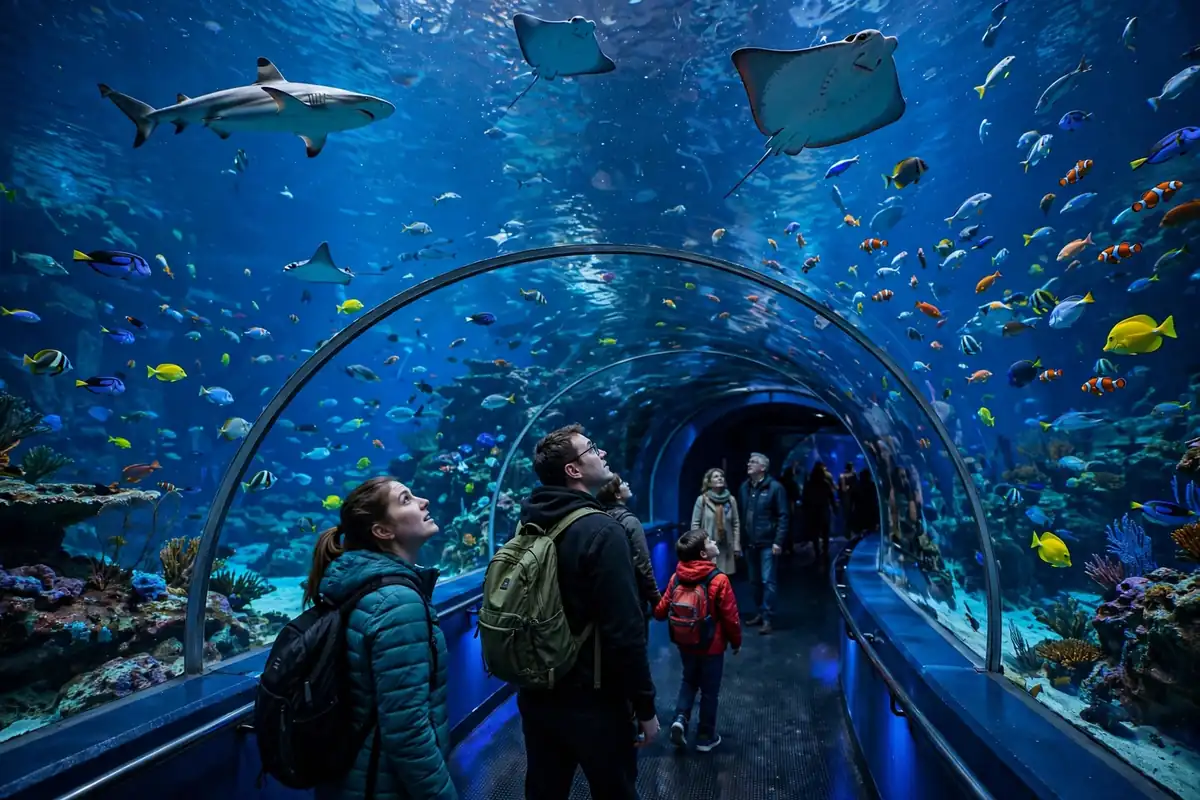
The National Aquarium in Baltimore on Wikipedia is the city’s most popular attraction, and for good reason: more than 17,000 animals across some 750 species in 2.2 million gallons of water, in the glass building that anchors the Inner Harbor. The route runs from the rainforest canopy at the top, through the sharks and rays of the Blacktip Reef, to the dolphins and the jellyfish — and the dolphin colony, the sharks circling the reef, and the Australian Outback exhibit are the three stops to slow down for. The prices changed, and older guides still quote the old ones: as of November 2026, admission is $49.95 for adults 21 to 69, $39.95 for youth 5 to 20 and seniors 70 and over, and free for children under 4. Tickets are timed entry and must be booked online, with last entry 60 minutes before closing. November hours are Monday to Thursday 10 a.m. to 5 p.m., Friday 10 a.m. to 9 p.m., and Saturday and Sunday 10 a.m. to 6 p.m., and the aquarium is closed on November 26, 2026, with extended hours of 9 a.m. to 9 p.m. on November 27 and 28 and 9 a.m. to 6 p.m. on November 29. Two money-saving facts most guides miss: Friday evenings after 5 p.m. are half-price admission all year, and from September to February, Maryland residents get $10 off adult tickets and $5 off children’s tickets for visits before noon, Sunday to Friday. Book the first slot of the day, arrive at opening, and give it three hours — and do not skip the free Harbor Wetland outside, a floating marsh between Piers 3 and 4 that is open to everyone.
3. Fort McHenry National Monument and Historic Shrine
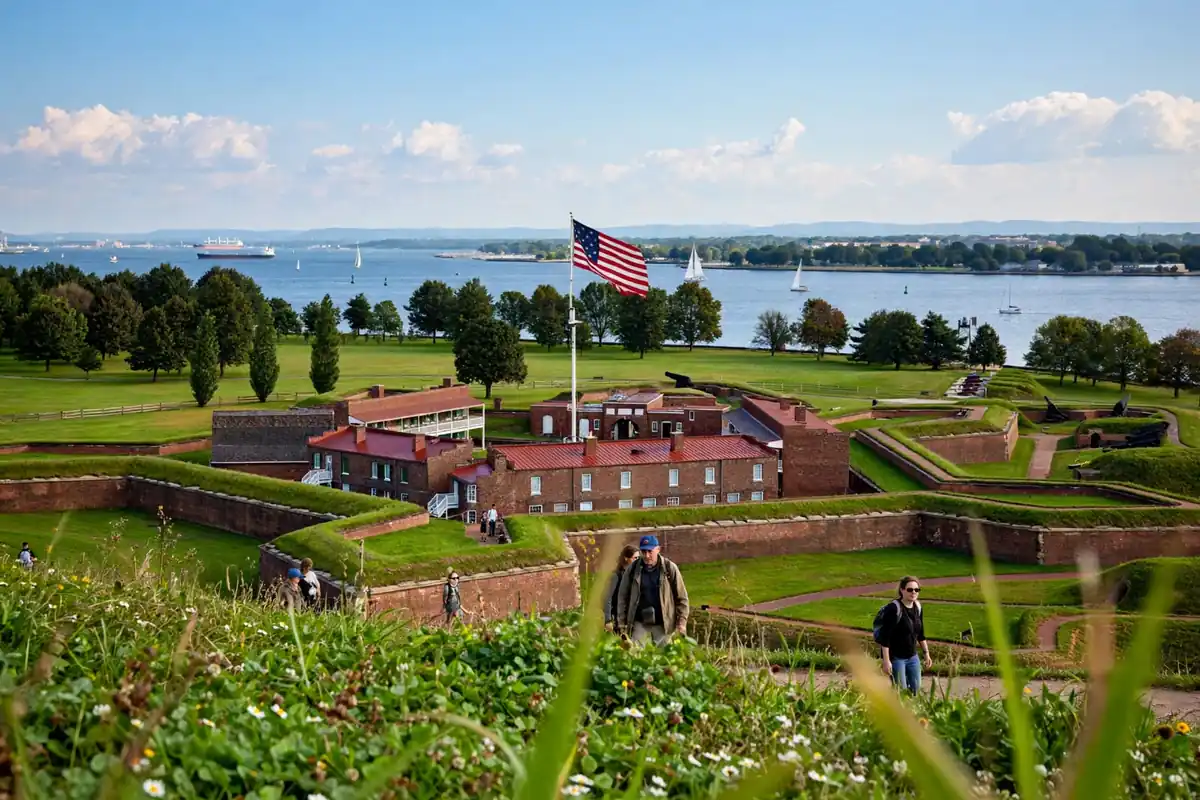
Fort McHenry on Wikipedia is the star-shaped fort where the American national anthem was born, and the single most important historic site in Baltimore. On the night of September 13 to 14, 1814, during the Battle of Baltimore in the War of 1812, the British bombarded the fort for 25 hours, and Francis Scott Key, watching from a ship in the harbor, saw the huge American flag still flying at dawn and wrote “The Star-Spangled Banner.” The fort’s star shape is the point: walk the ramparts, stand on the seawall trail that runs 0.9 miles around the point, and watch the flag change ceremonies at 10 a.m. and 4 p.m. Admission is $15 for ages 16 and over, free for under-16s, and the ticket is good for seven days; the grounds, the seawall trail, the Visitor Center and the film are free. The fort is open daily from 9 a.m. to 5 p.m., to 6 p.m. in summer, with last entry at 4:45 p.m., and it is closed on Thanksgiving, Christmas Day and New Year’s Day. One warning: under the National Park Service entrance-fee and pass changes that took effect on January 1, 2026, the $15 fee applies to all visitors 16 and over, and the America the Beautiful pass rules changed too — check the current pass terms before you rely on one. The easiest way to get there is the free Charm City Circulator Banner Route from the Inner Harbor, and the water taxi stops nearby. Allow two hours, and go in the morning, when the flag ceremony and the light over the harbor are at their best.
4. The American Visionary Art Museum
The American Visionary Art Museum on Wikipedia is the strangest museum in Baltimore and one of the best — a museum of outsider art, work made by self-taught creators outside the art world, in a wild mirrored building on the south side of the Inner Harbor, next to Federal Hill. Inside are whirligigs, bottle-cap mosaics, embroidered maps, a giant pink flamingo and a rotating cast of obsessive, joyful, deeply personal art, and outside is the sculpture garden, which is free and open around the clock. The museum is open Wednesday to Sunday from 10 a.m. to 5 p.m., closed on Mondays and Tuesdays, Thanksgiving and Christmas. Admission is $20 for adults, $17 for seniors 65 and over, $11 for active military and veterans, $11 for children 7 and over and students, and free for children under 6. One 2026 warning: the main building’s second floor was closed from September 9 to October 9, 2026, with reduced admission of $15 for adults during the closure — check whether the full building is open before you go, because the second floor holds some of the best work. The gift shop, called Sideshow, is free to enter and is half the fun. Allow two hours, and do not rush the labels: the stories of the artists are the exhibit.
5. The Walters Art Museum
The Walters Art Museum on Wikipedia is a free, world-class museum in Mount Vernon, about a mile north of the Inner Harbor — and it is the best free museum in the city. The collection covers some 36,000 works across 7,000 years of art, from Egyptian mummies and ancient Greek sculpture to Renaissance paintings, Art Nouveau jewelry and a famous collection of medieval manuscripts, all of it free to enter. The museum is open Wednesday from 10 a.m. to 5 p.m., Thursday from 1 p.m. to 8 p.m., and Friday to Sunday from 10 a.m. to 5 p.m., and it is closed on Mondays and Tuesdays, New Year’s Day, Juneteenth, Independence Day, Thanksgiving, Christmas Eve and Christmas Day. The building itself is part of the visit: the 1909 palazzo on Charles Street, the Hackerman House across the courtyard, and the Sculpture Court, one of the most beautiful rooms in Baltimore. Guided tours are free, with a suggested donation of $12 per person for group tours, and special exhibitions are free too. Allow two hours, and go on a Thursday evening if you can, when the museum stays open until 8 p.m. and the crowds thin out.
6. The Baltimore Museum of Art
The Baltimore Museum of Art on Wikipedia is Maryland’s largest art museum, on the Johns Hopkins University campus in Charles Village, and it holds the largest and most significant collection of Henri Matisse works in the world — the Cone Collection, assembled by Baltimore sisters Claribel and Etta Cone, with more than 500 Matisse works alone, plus Picasso, Cézanne, Gauguin and Van Gogh. General admission is always free, though you should reserve a free ticket before entering the galleries, and special exhibitions require a separate ticket. The museum is open Wednesday to Sunday from 10 a.m. to 5 p.m., and Thursday until 9 p.m., and it is closed on Mondays and Tuesdays. The sculpture gardens outside are open from 10 a.m. to dusk, weather permitting, with two terraced gardens, fountains and 34 sculptures, and the museum’s restaurant, Gertrude’s Chesapeake Kitchen, is the place to eat after the galleries. The museum also runs a branch inside Lexington Market, the BMA Lexington Market, which is worth a look on a market day. Allow two to three hours, and do not miss the Cone wing: it is the reason the museum is famous, and it is free.
7. Fells Point
Fells Point on Wikipedia is Baltimore’s oldest waterfront neighborhood and its best evening walk — a grid of 18th- and 19th-century rowhouses, Belgian block streets, pubs, coffee shops and independent stores along the harbor, about a mile east of the Inner Harbor. Founded in the 1730s as a shipbuilding port, it was the working waterfront where Frederick Douglass lived as an enslaved young man and later returned as a free man, and the streets still feel like a port town: the cobblestones, the low brick buildings, the smell of the water. The Broadway Market, the neighborhood’s market hall, anchors the main square, and the pubs along Thames Street are the oldest continuously operating drinking establishments in the city. Come in the late afternoon, walk the waterfront from the Inner Harbor or take the free Harbor Connector, eat dinner on Thames Street, and stay for the bars — Fells Point is the liveliest nightlife in Baltimore, and the safest way to enjoy it is to take a rideshare between neighborhoods after dark rather than walking the long stretches alone. Allow an evening, and wear flat shoes: the Belgian blocks are beautiful and uneven.
8. Oriole Park at Camden Yards
Oriole Park at Camden Yards on Wikipedia is the ballpark that changed baseball — the first of the retro ballparks, opened in 1992, built into the old Baltimore and Ohio Railroad warehouse on the edge of downtown, with the brick warehouse as the right-field wall and the skyline behind it. The Orioles play here from late March to early October, and a summer evening game, with the warehouse lit up and the smell of pit beef from Boog’s Barbecue behind the stands, is the most Baltimore night there is. Even if there is no game, the 90-minute ballpark tour is worth it: it visits the dugouts, the press box and the scoreboard control room, and tickets are $9 for adults and $7 for seniors and children, with tours running on non-game days. Babe Ruth was born two blocks away, at 216 Emory Street, and the Babe Ruth Birthplace and Museum is a short walk from the ballpark. One 2026 note: the Preakness Stakes, Baltimore’s other great sporting event, moved to Laurel Park, about 20 miles south, for 2026 while Pimlico Race Course is rebuilt, with the race planned to return to a rebuilt Pimlico from 2027 — do not plan a Pimlico trip for 2026. Book game tickets early for weekend series, and arrive an hour before first pitch for the warehouse, the statues and Eutaw Street, the promenade between the ballpark and the warehouse that is part of the stadium itself.
9. The B&O Railroad Museum
The B&O Railroad Museum on Wikipedia is the birthplace of American railroading — and it has a new name in 2026, which is the first thing older guides get wrong. In 2026 the museum was renamed the National Museum of Railroad History & Innovation, though the B&O name still appears on signs and tickets, and the museum sits at 901 West Pratt Street, on the site where the Baltimore and Ohio Railroad, the first common-carrier railroad in the United States, began in 1827. Inside the roundhouse are more than 250 pieces of railroad equipment, including the oldest surviving locomotives in America, and the museum is a Smithsonian affiliate. Admission is $20 for adults, $17 for seniors 60 and over, $12 for children, and free for members; the museum is open daily from 10 a.m. to 4 p.m., and closed on Thanksgiving, Christmas Eve, Christmas Day and New Year’s Day. The train ride is $5 for adults and $4 for children extra, and the second Wednesday of the month is a $10 Admission Day, while the Museums for All program offers $1 admission with an EBT or SNAP card. The new Innovation Hall is scheduled to open in January 2027, so check what is open before you go. Allow two to three hours, and ride the train if it is running: it runs on the first mile of commercial railroad track ever laid in America.
10. The Maryland Zoo in Baltimore
The Maryland Zoo on Wikipedia is celebrating its 150th anniversary in 2026 — founded on April 7, 1876, it is the third-oldest zoo in the United States — and it is the best family day in the city, inside Druid Hill Park, about 15 minutes northwest of downtown. The big 2026 news is the new red panda habitat, which opened in early summer 2026, the first new habitat for a new species at the zoo in more than 20 years, with a gibbon habitat and the new Harvey M. Meyerhoff Plaza, with a cafe, event space and splash pad, coming within a few years. Admission is about $28 for adults and about $20 for children 2 to 10, with children under 2 free, and winter tickets are $25 for ages 2 and over from November 9 to February 28. The zoo is open daily from 10 a.m. to 4 p.m. from March to December, and Friday to Monday from 10 a.m. to 4 p.m. in January and February, and it is closed on Thanksgiving and Christmas. Two warnings for November 2026: the zoo was closed on Saturday, November 7, 2026, for a private event, and the African Watering Hole, home to the rhinos, ostriches and zebras, is off exhibit from November 9 for scheduled maintenance, with no end date posted — check the zoo’s site before you go if the rhinos are the reason you are coming. The rides close for winter and reopen on March 1, 2027. Allow three to four hours, and go in the morning, when the animals are most active and the crowds are thinnest.
11. USS Constellation and the Historic Ships
The USS Constellation on Wikipedia is the last sail-only warship built by the United States Navy, launched in 1854, and it floats at Pier 1 in the Inner Harbor as the centerpiece of Historic Ships in Baltimore. Climb aboard and walk four decks — the gun deck, the officers’ quarters, the berth deck — and watch for the low doorways and steep steps, especially if you are tall. One ticket, the Boarding Pass, covers all the open museum ships: the Constellation, the submarine USS Torsk, the Lightship Chesapeake and the Coast Guard cutter USCGC Taney. As of November 2026, the Boarding Pass is $21.95 for adults 21 to 59, $19.95 for seniors 60 and over, military and students, $9.95 for youth 6 to 14, and free for children under 6, and the ticket is valid until used, so you can visit different ships on different days. Two practical warnings: the ships and gift shops do not accept cash — all tickets must be purchased by card — and the hours change by season, with winter hours typically 10 a.m. to 4:30 p.m. and summer hours to 5:30 p.m., so check the day’s hours before you go. The Constellation alone takes about an hour; the full four-ship ticket takes half a day, and the Parrott-rifle firing demonstration, when it runs, is the moment to catch.
12. The Maryland Science Center
The Maryland Science Center on Wikipedia is the Inner Harbor’s hands-on science museum, at 601 Light Street on the south side of the harbor, and it is the best rainy-day stop in the city. Three floors of exhibits cover dinosaurs, space, the human body and the physics of the everyday, with live science demonstrations, a planetarium and an IMAX theater, plus a rooftop observatory with a telescope. Admission is $26.95 for adults, $20.95 for children 3 to 12, and $25.95 for seniors, and the museum is open Wednesday to Sunday, closed on Monday and Tuesday, with hours of Wednesday to Friday 10 a.m. to 4 p.m. and Saturday and Sunday 10 a.m. to 5 p.m. It is the most child-friendly of the harbor museums, and the dinosaur hall and the space exhibits hold adults too. Allow two to three hours, and book the planetarium and IMAX shows separately, because they sell out on weekends. Pair it with the USS Constellation across the harbor, which is a ten-minute walk, and eat lunch on the south shore, where the restaurants are quieter than the north side.
13. Lexington Market
Lexington Market on Wikipedia is America’s oldest public market, founded in 1782, and the best place to eat like a Baltimorean. The market hall was rebuilt and reopened in 2022, and inside are more than 50 stalls: crab cakes, oysters, pit beef, soul food, Korean, Middle Eastern, baked goods and produce, with the BMA Lexington Market branch of the Baltimore Museum of Art inside the hall. The stall to know is Faidley’s Seafood, the market institution famous for its jumbo lump crab cake, made with almost no filler and broiled, not fried — it is the crab cake other crab cakes are measured against. Come hungry, come at lunchtime, and come with cash for the stalls that still prefer it, though most now take cards. The market sits at the edge of downtown, a short walk from Camden Yards and the Hippodrome Theatre, and it is the most local of the harbor-area sights: the crowd is Baltimoreans doing their shopping, not tourists. Allow an hour for lunch, and do not leave without trying a coddie, the cod-and-potato cake sandwich that is Baltimore’s other great street food.
14. Federal Hill Park
Federal Hill Park on Wikipedia is the free viewpoint of Baltimore — a small park on a hill on the south side of the Inner Harbor, with the best skyline view in the city, the harbor spread out below and the downtown towers behind it. The hill has history: in 1788, Baltimoreans celebrated Maryland’s ratification of the Constitution here, and during the Civil War, Union troops fortified the hill and pointed cannons at the city — the cannons are still there. Walk up from the harbor in ten minutes, or take the free Harbor Connector to the Rusty Scupper landing and climb the steps from the south side. The park is free and open all day, and it is at its best at sunset, when the harbor lights come on and the skyline turns gold, and again on the Fourth of July, when the fireworks go off over the water. The neighborhood around it, Federal Hill, is one of the best places to stay in the city: brick rowhouses, Cross Street Market, bars and restaurants, all within walking distance of the harbor. Allow 30 minutes for the view, and bring a camera: this is the photograph of Baltimore.
15. The Edgar Allan Poe House and Museum
The Edgar Allan Poe House and Museum on Wikipedia is the small brick rowhouse at 203 North Amity Street where Edgar Allan Poe lived from 1833 to 1835, when he was a young, unknown writer trying to make a living with his pen — and it is the most atmospheric literary stop in America. The house is small, dark and spare, with a few rooms, a tiny garret and exhibits on Poe’s life in Baltimore, where he lived, married his cousin Virginia, and died in 1849 under circumstances that are still argued about. The house is open for tours Thursday to Sunday from 11 a.m. to 4 p.m., and you must make a reservation through the museum’s booking page. Poe is buried a short walk away at Westminster Hall and Burying Ground, where the original grave and the monument are both marked, and the grave is the place to leave a rose — the tradition of the mysterious Poe Toaster, who left roses and cognac on the grave every January 19th for decades, ended in 2009, but visitors still leave roses. Allow an hour for the house and the grave, and read “The Raven” before you go: it lands differently in the city where Poe lived and died.
16. The George Peabody Library
The George Peabody Library on Wikipedia is the most beautiful room in Baltimore — a “cathedral of books” in Mount Vernon, with five tiers of cast-iron balconies rising to a skylight, holding some 300,000 volumes, mostly from the 19th century. The library opened in 1878 as part of the Peabody Institute, and it is now part of Johns Hopkins University, but it is open to the public and free to enter: walk in, look up, and take the photograph everyone takes. The library is at 17 East Mount Vernon Place, a two-minute walk from the Walters Art Museum and the Washington Monument, so the three make a natural Mount Vernon half day. It is a working research library, not a museum, so keep your voice down, do not touch the books without asking, and check the hours before you go, because the library closes for university events. Allow 30 minutes, and go on a weekday morning, when the light through the skylight is at its best and the room is quiet.
17. Hampden and The Avenue
Hampden on Wikipedia is Baltimore’s quirkiest neighborhood — a former mill town north of downtown, built around the cotton mills on the Jones Falls, now a strip of vintage shops, record stores, coffee roasters and restaurants along 36th Street, known as The Avenue. The neighborhood’s big event is HonFest, the celebration of Baltimore’s “hon” culture, which moved to the summer and runs along The Avenue, and the other is the Miracle on 34th Street, when one block of 34th Street covers every house in Christmas lights from late November to New Year’s Eve, drawing crowds from across the city. Come on a Saturday morning for the 32nd Street Farmers Market, one of the best in the city, then walk The Avenue, eat at Café Hon, the restaurant that named the “hon” look, and browse the shops. Hampden is a 15-minute drive or bus ride from downtown, and it is the Baltimore most visitors never see — which is exactly why it is worth the trip. Allow half a day, and bring cash for the market stalls.
18. Patterson Park
Patterson Park on Wikipedia is the 137-acre park locals call Baltimore’s best backyard — a green expanse in Southeast Baltimore, between Fells Point and Canton, with lawns, lakes, sports fields, a swimming pool and the white Pagoda, an 1891 observatory tower that is the park’s landmark. The park is free and open all day, and it is at its best in spring, when the cherry blossoms around the boat lake bloom, and in summer, when the farmers’ market and the festivals fill the lawns. The Pagoda is open on Sundays in the warmer months, with a view over the park and the harbor, and the park’s history runs deep: it was a fortification in the War of 1812, a hospital in the Civil War, and a public park since 1827. Come for a morning run, a picnic, or a slow walk, and pair it with Canton, the waterfront neighborhood to the east, where the bars and restaurants along the water are the evening half of the day. Allow one to two hours, and go on a Sunday, when the park fills with families, dogs and runners.
19. Mount Vernon and the Washington Monument
Mount Vernon on Wikipedia is Baltimore’s grandest neighborhood — a square of 19th-century mansions, churches and cultural institutions around Mount Vernon Place, a mile north of the Inner Harbor, and the home of the first major monument to George Washington in the United States. The Washington Monument, a 178-foot marble column topped by a statue of Washington, was begun in 1815 and completed in 1829, and you can climb its 227 steps to the top for the view over the city — check whether the climb is open on the day you visit, because it closes in bad weather. Around the square are the Walters Art Museum, the George Peabody Library, the Peabody Institute and the Mount Vernon Place United Methodist Church, and the neighborhood’s restaurants and bars make it one of the best places to stay in the city. The Flower Mart, Baltimore’s oldest festival, fills the square every May with flowers, food and music. Allow half a day for the square, the monument, the Walters and the Peabody Library, and come in the evening, when the monument is lit and the square is quiet.
20. The Baltimore Museum of Industry
The Baltimore Museum of Industry on Wikipedia sits in a former oyster cannery at 1415 Key Highway, on the south side of the harbor, and it tells the story of the Baltimore most visitors never see: the working city. Inside are the machines and the workshops of the industries that built the port — oyster canning, garment making, steel, printing, food processing — with a recreated 1900s cannery, a garment loft, a print shop and a pharmacy, and the museum’s volunteers, many of them retired workers, are the best guides in the city. The museum is small, the exhibits are hands-on, and the view from the waterfront deck, across the harbor to the downtown skyline, is one of the best in Baltimore. The museum runs boat tours of the harbor in the warmer months, and the deck is the place to watch the sunset after the galleries close. Allow two hours, and pair it with Federal Hill Park, which is a ten-minute walk away — the museum explains the working harbor, and the park shows you the skyline it built.
Baltimore in 3 days — a ready-made itinerary
This three-day plan covers the harbor, the museums and the neighborhoods, and it uses the free Circulator and the free Harbor Connector downtown, with a car or a rideshare only for the zoo and Hampden. Book the aquarium’s first slot and the Poe House reservation before you fly, put the museums on a weekday, and keep the evenings for Fells Point and the food — Baltimore eats early by big-city standards, and the best tables fill by 7 p.m.
Day 1 — The Inner Harbor: the aquarium, the ships and sunset from Federal Hill
Start at the National Aquarium at the 10 a.m. opening, before the crowds, and give it three hours — rainforest first, then the sharks, the dolphins and the jellyfish. Walk the promenade to Pier 1 for the USS Constellation, and climb aboard for an hour on the gun deck and the berth deck. Eat lunch at the Maryland Science Center end of the harbor, or cross to the south shore, where the restaurants are quieter. In the afternoon, walk the promenade past Harborplace — remember the pavilions are still standing in 2026, with the demolition delayed — and take the free Harbor Connector across the water to Federal Hill. Climb to Federal Hill Park for sunset, with the skyline turning gold over the harbor, and eat dinner in Federal Hill or Fells Point, where the bars and the crab cakes are.
Day 2 — The museums: Mount Vernon, the Walters, the BMA and the AVAM
Start at Mount Vernon Place, with the Washington Monument and the George Peabody Library — the library is free, and the light through the skylight is best in the morning. Walk two minutes to the Walters Art Museum for the Egyptian mummies, the Renaissance paintings and the medieval manuscripts, all free, and give it two hours. Take the Circulator or a rideshare to the Baltimore Museum of Art for the Cone Collection and the largest Matisse collection in the world, and walk the sculpture gardens. In the afternoon, cross to the south side of the harbor for the American Visionary Art Museum — the whirligigs, the mosaics and the free sculpture garden — and finish at the Baltimore Museum of Industry, where the old cannery explains the working harbor. Dinner is on Thames Street in Fells Point, with a walk along the cobblestones after dark.
Day 3 — The fort, the market and the neighborhoods: Fort McHenry, Lexington Market and Hampden
Start at Lexington Market for breakfast — a crab cake at Faidley’s, or a coddie from a market stall — and browse the hall, including the BMA branch inside. Take the free Banner Route Circulator to Fort McHenry for the 10 a.m. flag change, the ramparts and the seawall trail, and give it two hours. In the afternoon, ride the B&O Railroad Museum’s train and walk the roundhouse — remember the museum’s new name, the National Museum of Railroad History & Innovation — or drive to the Maryland Zoo for the red pandas and the 150th-anniversary exhibits, checking first whether the African Watering Hole is back on exhibit. Finish in Hampden, with the 32nd Street Farmers Market if it is a Saturday, a walk down The Avenue, and dinner at Café Hon. Spend the last evening in Fells Point, with a drink on Thames Street and a last look at the harbor.
Best time to visit Baltimore
| Season | Weather | Crowds | Notes |
|---|---|---|---|
| Spring (March–May) | Highs about 55–75°F (13–24°C), lows about 36–55°F (2–13°C) | Moderate | Best all-round season; cherry blossoms, Flower Mart in May, Preakness in May |
| Summer (June–August) | Highs about 84–89°F (29–32°C), lows about 65–73°F (18–23°C) | High | Hottest and most humid; peak blue crab season, HonFest, Artscape, harbor festivals |
| Autumn (September–November) | Highs about 57–79°F (14–26°C), lows about 40–58°F (4–14°C) | Moderate | Second-best season; mild days, thin crowds, best hotel prices |
| Winter (December–February) | Highs about 43–47°F (6–8°C), lows about 28–31°F (-2–-1°C) | Low | Coldest and quietest; museums, Christmas Village at the harbor, Miracle on 34th Street |
The best time to visit Baltimore is mid-April to June and September to mid-October, and if you want one answer, pick late May or late September: the days are warm without being punishing, the evenings are long, the harbor is full without being crowded, and the blue crabs are in season. July is the hottest month, with an average high of 88°F (31°C) and a low of 73°F (23°C), and the humidity is the real story — Baltimore’s summers are hot and sticky, with afternoon thunderstorms, so plan the museums for the middle of the day and the harbor for the morning and evening. January is the coldest month, with an average high of 43°F (6°C) and a low of 31°F (-1°C), and the city averages about 20 inches of snow a year, against about 500 inches in the mountains to the west. The seasonal traps are specific: the Preakness moved to Laurel Park for 2026, so do not plan a Pimlico trip; Artscape moved to Memorial Day weekend in 2026; the zoo’s rides close for winter and reopen on March 1, 2027; and the Harbor Connector’s weekend service runs from October 17 to December 6, 2026, on Saturdays and Sundays from 10:30 a.m. to 7:30 p.m. There is no wet season — July is the wettest month at about 4 inches of rain, November the driest at about 3 inches — and the city gets more than 2,500 hours of sun a year.
Where to stay in Baltimore
| Area | Best for | Price range |
|---|---|---|
| Inner Harbor | First-timers, walking everywhere, the Circulator | $120–$250 a night |
| Fells Point | Nightlife, cobblestones, restaurants and bars | $100–$200 a night |
| Mount Vernon | Culture, quiet streets, the Walters and the Peabody | $90–$180 a night |
| Federal Hill | Skyline views, Cross Street Market, bars | $100–$200 a night |
| Canton | Young, waterfront, bars and restaurants | $110–$200 a night |
| Harbor East | Upscale, quiet, restaurants and the water taxi | $180–$350 a night |
Stay at the Inner Harbor if this is your first visit — everything is walkable, the free Circulator is under your feet, the aquarium and the ships are the meeting point, and the BWI light rail drops you downtown. Stay in Fells Point if you want the nightlife — the cobblestones, the pubs and the restaurants, with the harbor a walk or a water taxi away — but ask for a room off Thames Street if you want quiet, because the bars go on until 2 a.m. Stay in Mount Vernon if you want culture and quiet: the grand 19th-century streets around the square, with the Walters, the Peabody Library and the Washington Monument on your doorstep. Stay in Federal Hill if you want the view — the skyline from the park, Cross Street Market, and the bars — and the walk across the harbor to downtown. Stay in Canton if you want the young waterfront — the bars and restaurants along the water, with the park at Patterson Park nearby. Stay in Harbor East if you want upscale and quiet — the restaurants, the water taxi and the newest hotels, with the harbor at your door. Two warnings: do not book a room right on Thames Street or The Block if you want quiet, and do not assume a downtown hotel includes parking, because most charge $20 to $40 a night for it.
Getting around Baltimore
| Way to travel | Cost | Best for |
|---|---|---|
| Charm City Circulator | Free | Downtown, the harbor, Fort McHenry, the museums |
| Harbor Connector (free water taxi) | Free | Inner Harbor, Fells Point, Canton, Federal Hill, Locust Point |
| Baltimore Water Taxi (ticketed) | About $14 all-day pass | Harbor neighborhoods, sightseeing on the water |
| MTA bus, Light RailLink, Metro Subway | $2.00 one-way | BWI airport, the zoo, Hampden, the outer neighborhoods |
| Rental car | $40–$80 a day plus fuel | Day trips, the zoo, the suburbs |
| Taxi or rideshare (BWI to downtown) | $25–$40 | Groups, luggage, late nights |
Baltimore’s Charm City Circulator on Wikipedia is the way to move downtown: free buses on four routes — Purple, Orange, Green and Banner — running every 10 to 15 minutes through the harbor, downtown, Mount Vernon and Fells Point, with the Banner Route running to Fort McHenry. The Harbor Connector is the free water taxi, also part of the Circulator: it runs the Inner Harbor Loop, from Pier 1 at Harborplace to Harbor East, Federal Hill, Fells Point and Locust Point, and the Outer Harbor Loop, from Fells Point to Locust Point and Canton Waterfront Park, with weekend service added from October 17 to December 6, 2026, on Saturdays and Sundays from 10:30 a.m. to 7:30 p.m., and the routes adjusted on March 2, 2026. Do not confuse the free Harbor Connector with the ticketed Baltimore Water Taxi, a private service with 13 landings and an all-day pass of about $14 — the two look alike and dock in the same places, and the Water Taxi’s on-demand pilot runs through the 2026 season. Beyond downtown you need the MTA: the Light RailLink runs from BWI Airport to downtown in about 35 minutes, and the local bus, Light Rail and Metro Subway are $2.00 a ride. The airport is 10 miles south of downtown, and the MARC Penn Line train runs from BWI to Washington, D.C., in about 35 minutes, which makes Baltimore an easy day trip from the capital. Two warnings: the Circulator does not run all night, so late returns from Fells Point need a rideshare, and the harbor bridges and the tunnels are the chokepoints — the Francis Scott Key Bridge, which collapsed on March 26, 2024, when the container ship Dali struck a pier, is still being rebuilt, with the first permanent piles driven in December 2025, the south tower 55 percent complete and the north tower 26 percent complete as of October 13, 2026, and the replacement cable-stayed bridge not expected to open until late 2030, so use the I-95 and I-895 tunnels or the western I-695 beltway instead.
Baltimore food you have to try
Baltimore’s food is the food of a port city that grew up on the Chesapeake: the blue crabs, the crab cakes, the Old Bay on everything, the pit beef smoked over charcoal, and the snowballs that cool the summer. The tourist-trap problem here is the opposite of most cities: the restaurants on the harbor promenade are fine, but the best food is a ten-minute walk away, in the markets and the neighborhoods — eat where the locals queue, and eat early, because the best tables fill by 7 p.m.
Crab cakes, Old Bay and the blue crab
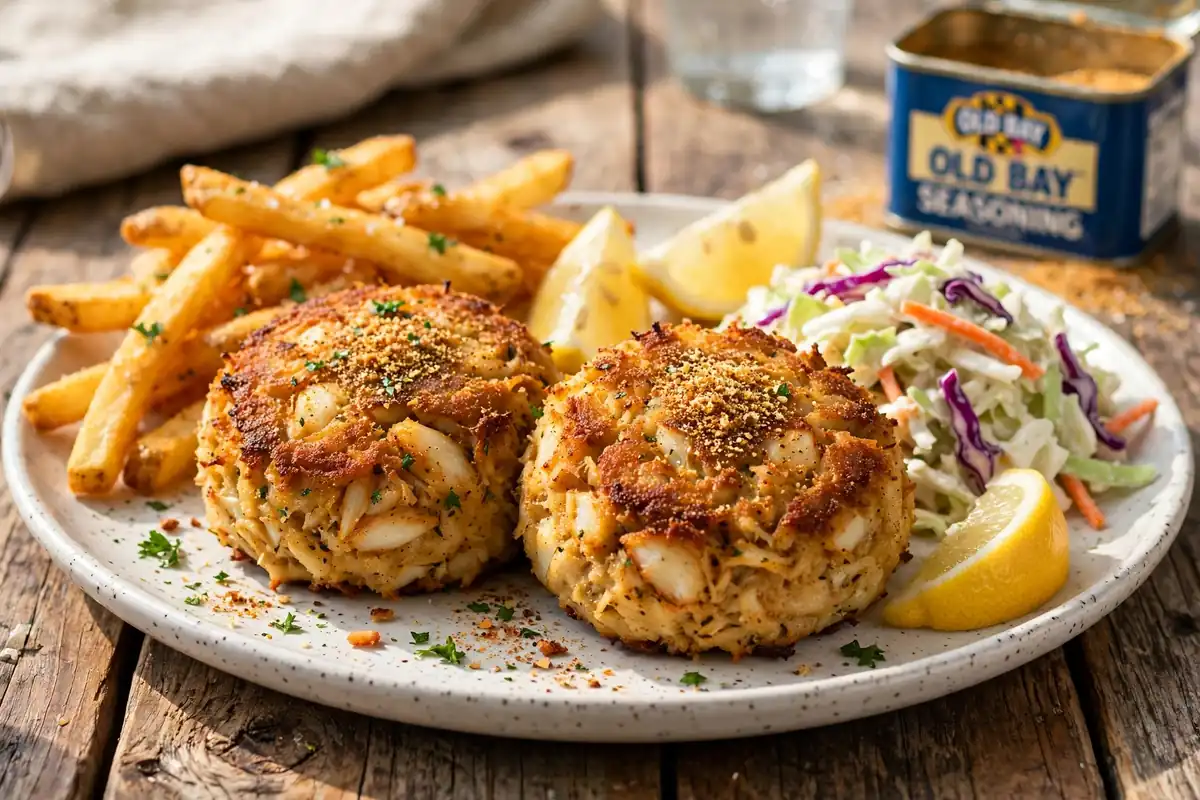
The Maryland blue crab on Wikipedia is the dish Baltimore argues about most, and the crab cake is the test: a jumbo lump crab cake, broiled, with almost no filler, seasoned with Old Bay, the spice blend created in Baltimore in 1939 by Gustav Brunn, a German immigrant spice merchant. The place to eat it is Faidley’s Seafood at Lexington Market, where the crab cake is the size of a baseball and the line is the review — order it broiled, with a lemon wedge, and eat it standing at the counter like everyone else. The other way to eat crab in Baltimore is the steamed blue crab, served by the dozen on brown paper, with mallets and Old Bay, at a crab house like LP Steamers in Locust Point: crack the shell, pick the meat, and do not wear white. Old Bay on Wikipedia goes on everything in the city — fries, corn, popcorn, even the rim of a Bloody Mary — and the blue crab season peaks from July to early October, when the crabs are fattest and the prices are best. In winter, the crabs are smaller and the prices are higher, so order the crab cake, which is made from picked meat and is good all year.
Pit beef, coddies and the Baltimore sandwich
Pit beef is Baltimore’s other great sandwich: a top round roast cooked over a charcoal pit, sliced thin, piled on a Kaiser roll with horseradish and raw onion, and eaten standing up. The place to eat it is Chaps Pit Beef, the Baltimore institution that started as a roadside stand and now has a restaurant on Pulaski Highway — order it rare, with extra horseradish, and add a side of fries with Old Bay. The coddie is the city’s older street food: a cod-and-potato cake, fried and served on a saltine cracker with yellow mustard, sold at markets and delis across the city, and best eaten at Lexington Market. The third Baltimore sandwich is the lake trout — not trout at all, but fried whiting, served on white bread with hot sauce, a staple of the city’s Black food culture and the corner carryouts. Order the pit beef rare, the coddie with mustard, and the lake trout with hot sauce, and you will have eaten the Baltimore that the harbor restaurants never show you.
Snowballs, Berger cookies and the sweet side
The Baltimore snowball is not a snow cone: it is finely shaved ice, softer and fluffier than a snow cone, topped with flavored syrup and, if you want it the Baltimore way, a scoop of marshmallow fluff on top — the “marshmallow topping” that makes it a Baltimore snowball and not a Hawaiian shave ice. The stands open in spring and close in autumn, and the best are the neighborhood stands in Hampden and Canton, where the flavors run from egg custard, the local favorite, to wild cherry and spearmint. The other Baltimore sweet is the Berger cookie: a vanilla cookie buried under a thick layer of chocolate fudge, made by the Berger bakery since the 19th century and sold in grocery stores and bakeries across the city. For dessert after dinner, the local move is a Berger cookie with a cup of coffee, or a snowball on a hot afternoon — and the Natty Boh, the National Bohemian beer that is Baltimore’s hometown lager, is the drink to order with any of it. Save room after dinner: Baltimore’s sweet tooth is not a side note, it is the city’s personality.
Free things to do in Baltimore
Baltimore is cheaper than its reputation suggests, because the best sights cost nothing. The Inner Harbor promenade is free, and so is the walk along the water, the Harbor Wetland and the skyline from Federal Hill Park. The Walters Art Museum is free, and so is the Baltimore Museum of Art, with the largest Matisse collection in the world. The American Visionary Art Museum’s outdoor sculpture garden is free, and so is the George Peabody Library, the most beautiful room in the city. The grounds of Fort McHenry are free, and so is the seawall trail, the Visitor Center and the film. Patterson Park is free, and so is the walk around its boat lake and the Pagoda on Sundays. Mount Vernon Place is free, and so is the Flower Mart in May. And the paid museums have free windows: the Charm City Circulator and the Harbor Connector are free, the aquarium is half-price on Friday evenings after 5 p.m., and the B&O Railroad Museum runs $10 Admission Days on the second Wednesday of the month. Do the free list on your first day, and you will have seen the harbor, the art, the library and the skyline before you have spent a dollar on a ticket.
Frequently asked questions
How many days do you need in Baltimore?
Three days is the minimum for the highlights: one day for the Inner Harbor and Federal Hill, one day for the museums in Mount Vernon and Charles Village, and one day for Fort McHenry, Lexington Market and the neighborhoods. Four days is the right amount for a real trip, with the zoo, Hampden and a slower pace, and a week if you want to use the city as a base for Washington, D.C., which is 35 minutes away by MARC train, and Annapolis, which is 30 minutes by car. Two days works if you plan well — the aquarium, Fort McHenry, one museum and Fells Point — but you will leave having seen a third of the city.
Is Baltimore safe?
Baltimore’s reputation is the question every visitor asks, and the honest answer is specific, not vague. The tourist areas — the Inner Harbor, Fells Point, Federal Hill, Mount Vernon and Canton — are generally safe, especially in the daytime, and they are well policed and busy with visitors. The basic urban rules are non-negotiable: keep your phone in your pocket at night, do not walk alone through unfamiliar streets after dark, and use a rideshare between neighborhoods late at night rather than walking the long stretches. The areas of concern in the news are typically far from the tourist centers, and the crime that makes the headlines is not the crime that affects visitors. Homicides and shootings in the city have dropped significantly in 2023 and 2024, by roughly a third, though the numbers are still high by national standards. Use the same sense you would in any American city, stay in the busy neighborhoods after dark, and the only thing you will lose is sleep.
When is the best time to visit Baltimore?
Mid-April to June and September to mid-October, when the days are warm, the evenings are long and the city is full without being crowded. Late May and late September are the single best picks. July and August are the hottest and most humid months, with average highs of 88°F and 86°F, and the peak of blue crab season — come then for the crabs, and plan the museums for the middle of the day. December to February is the quietest season, with the lowest hotel prices, the Christmas Village at the harbor and the Miracle on 34th Street in Hampden, and January is the coldest month, with an average high of 43°F. May is the festival month, with the Flower Mart and the Preakness — though the Preakness was at Laurel Park in 2026, not Pimlico — and June is HonFest in Hampden.
Is Baltimore expensive?
Mid-range, and cheaper than Washington, D.C., or New York for the same weekend. A mid-range hotel costs $120 to $250 a night at the Inner Harbor, a crab cake about $20 to $25, a pit beef sandwich about $12 to $15, and a snowball about $5. The Circulator and the Harbor Connector are free, the Walters and the Baltimore Museum of Art are free, Fort McHenry is $15, and the aquarium is $49.95 for an adult — and half-price on Friday evenings after 5 p.m. A careful three days can be done for about $120 to $180 a person a day, and the harbor, the parks, the library and the skyline are free.
Do you need a car in Baltimore?
For downtown and the harbor, no. The free Charm City Circulator runs through the harbor, downtown, Mount Vernon and Fells Point, the free Harbor Connector crosses the water, and the city centre is flat and walkable. For everything else, it helps: the zoo, Hampden and the outer neighborhoods are beyond the Circulator, and the Light RailLink from BWI to downtown takes about 35 minutes. Rent a car for the days you leave downtown, and take the Circulator for the days you do not — the rental is $40 to $80 a day, and downtown parking is $20 to $40 a night, so the maths favours renting only when you need it. The only reason to rent for the whole trip is a day trip to Annapolis or the Eastern Shore, where the car is the trip.
What should I skip in Baltimore?
Six things, and all six are traps older guides still get wrong. First, do not plan on driving across the Francis Scott Key Bridge: it collapsed on March 26, 2024, and the replacement is not expected to open until late 2030 — use the I-95 or I-895 tunnels or the western I-695 beltway. Second, do not plan a Preakness trip to Pimlico in 2026: the race moved to Laurel Park while Pimlico is rebuilt, with the return planned from 2027. Third, do not expect Harborplace to be already demolished or already rebuilt: the demolition was delayed in September 2026, the pavilions are still open, and the rebuild has not started. Fourth, do not pay full price at the aquarium without checking the Friday evening half-price admission after 5 p.m., or the Maryland resident discount from September to February. Fifth, do not confuse the free Harbor Connector with the ticketed Baltimore Water Taxi: they dock in the same places, but one is free and the other is about $14 a day. And sixth, do not go to the zoo expecting the African Watering Hole in November 2026: the rhinos, ostriches and zebras are off exhibit for maintenance from November 9, with no end date posted.
Further reading
Start with Baltimore on Wikipedia, which covers the history and the geography, and Maryland on Wikipedia for the state and its regions. For what locals and regular visitors actually recommend, the r/baltimore subreddit is where travellers ask about the neighborhoods, the safety questions, the best crab cakes and the Harbor Connector versus the Water Taxi. No Quora link is included here: no live Quora thread on visiting Baltimore could be verified, so none is listed rather than linking to an unverified one.
Your Baltimore trip, in one paragraph
Baltimore is the harbor city that rewards getting up early: the National Aquarium at the 10 a.m. opening with the sharks to yourself, Fort McHenry at the 10 a.m. flag change, an afternoon at the Walters and the Baltimore Museum of Art with the Matisses and the mummies, sunset from Federal Hill Park, and a crab cake with Old Bay for dinner. For more guides in the same style, start with our Hawaii guide for the whole-state trip — this guide is only about Baltimore — then see how Baltimore compares with Maui, Honolulu, Chicago, Nashville, Los Angeles, Orlando, Miami, San Diego, Denver, Savannah, Dallas, Charleston, San Francisco, Myrtle Beach, Las Vegas, San Antonio, London, Portland, Pigeon Forge, Puerto Rico, Atlanta, Phoenix, Paris, Key West, Colorado Springs, Sedona, Chattanooga, Palm Springs, St Louis, Tokyo, Japan, Kansas City, Tennessee, Branson, Florida, Amsterdam, Montreal, Fort Lauderdale, Toronto, Aruba, Charlotte, Indianapolis, New Orleans, Destin, Santa Barbara, Mexico City, Arizona, Osaka, Minneapolis, Pittsburgh, California, Asheville, Costa Rica, Washington DC, Seattle, St Augustine, Lisbon, Dubai, Santa Fe, Galveston, Maine, Sacramento, Kauai, Boston, Cancun, Madrid and Salt Lake City.

About the Author