Things to Do in Maine
20 Best Attractions, a 3-Day Itinerary, Where to Stay, and the Food You Cannot Miss
Quick Info
Best for: First-timers, road trippers, hikers, lighthouse lovers and seafood eaters — and anyone who wants a whole state of coast, mountains and small towns in one trip
Best time: Late June–September for warm days and open everything; October 5–20 for fall foliage; December–March for skiing at Sugarloaf and Sunday River
How long: 3 days for Portland, Acadia and the MidCoast; 5–7 days adds Baxter, the moose country and the islands
Budget: About $150–$300 per person per day with a mid-range hotel — many of the best sights are free, and the lobster roll is the real splurge
Don’t miss: Sunrise on Cadillac Mountain, the Marginal Way, Portland Head Light, a windjammer sail from Camden, a lobster roll at a shack, and a moose at dawn near Moosehead Lake
Maine on Wikipedia is the state where America runs out of road — more than 3,400 miles of tidal coastline, more than 60 lighthouses, a 5,269-foot mountain at Katahdin, and a lobster roll waiting at the end of almost every one of them. This guide covers the 20 best things to do in Maine, a 3-day itinerary that actually works, where to stay without overpaying, how to get around by car, train, bus and ferry, the three foods you should not skip, and the free sights that let you enjoy the Pine Tree State without a ticket. Everything below was checked against live sources in November 2026 — including the national-park surcharge, the Cadillac Mountain reservation rules and the Bar Harbor cruise-ship court ruling.
Maine at a glance
| Topic | What to know |
|---|---|
| Full name | Maine — the Pine Tree State, the north-easternmost state in the United States, bordering New Hampshire, Canada and the Atlantic Ocean |
| Founded | 1820, as the 23rd state; Portland was the capital until 1832, when the capital moved to Augusta |
| Population | About 1.4 million people — the least densely populated state east of the Mississippi, and the whitest and oldest state by median age |
| Language | English; French is spoken in the northern counties near the Canadian border |
| Airport | Portland International Jetport (PWM) is the main airport; Bangor International (BGR) serves the north and Acadia |
| Best base | Portland for the south coast, Bar Harbor for Acadia, Camden for the MidCoast, Millinocket for Baxter and the moose country |
| Getting around | Car for almost everything; the Amtrak Downeaster runs Boston–Portland–Brunswick; Concord Coach buses cover the coast; ferries serve the islands |
| Famous for | Lobster, lighthouses, Acadia National Park, Mount Katahdin, wild blueberries, whoopie pies, L.L.Bean and fall foliage |
Maine divides into three parts, and understanding them is the key to planning. The southern coast runs from Kittery to Portland — the beaches, the outlet towns, the lighthouses and the food scene, all within two hours of Boston. The MidCoast runs from Freeport through Camden to Penobscot Bay — the windjammers, the lobster shacks and the islands. And the north and east is the wild half: Acadia and Bar Harbor, the Schoodic Peninsula, the Down East coast, and the deep woods around Baxter State Park, Moosehead Lake and the Allagash. The distances are the trap most first-timers miss: Portland to Bar Harbor is a three-hour drive, Bar Harbor to Baxter another three. Plan by region, not by wish list.
The 20 best things to do in Maine
1. Acadia National Park and Cadillac Mountain
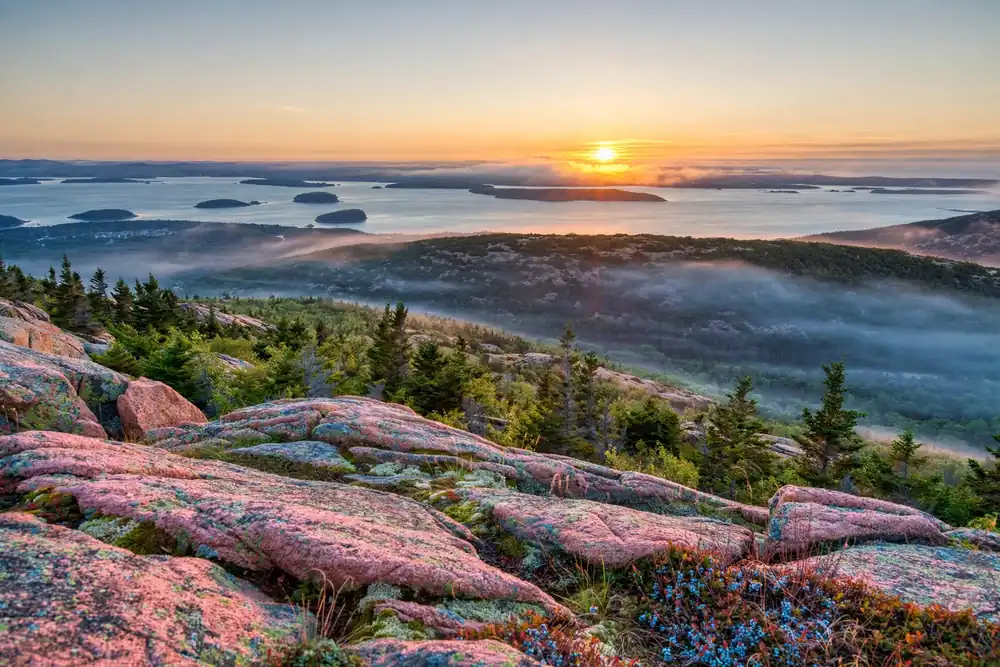
Acadia National Park on Wikipedia is the reason most people come to Maine, and it earns the trip. The park covers about 49,075 acres on Mount Desert Island and the Schoodic Peninsula, with 27 miles of historic carriage roads, 158 miles of hiking trails, two sand beaches, and the highest mountain on the Atlantic coast of the United States. Cadillac Mountain on Wikipedia is the centrepiece: at 1,530 feet it is the tallest mountain on the East Coast north of Brazil, and from 7 October to 6 March it is the first place in the United States to see the sunrise. The entrance pass costs $35 per vehicle for seven days, and it is separate from the Cadillac reservation — and that reservation is the thing most guides get wrong. A vehicle reservation for the Cadillac Summit Road is required from 20 May to 25 October 2026, costs $6 per vehicle, and can only be booked on Recreation.gov — never at the park. Thirty per cent of the slots are released 90 days ahead and 70 per cent two days ahead, both at 10 a.m. Eastern, and the sunrise slots are 90-minute windows while daytime slots are 30 minutes. Vehicles over 21 feet long, including RVs and trailers, are not allowed up the summit road at all. The road itself is open to cars from 15 April to 1 December 2026, and closed to cars from 1 December to 14 April. One more 2026 change: a $100-per-person surcharge for non-US residents aged 16 and over now applies at all national parks including Acadia, in effect since January 2026 — and Acadia went cashless from 15 April 2026. The free Island Explorer buses run the Schoodic, Loop Road and Gateway routes from 20 May 2026, with the other major routes from 23 June to 12 October 2026. Two traps to avoid: the timed entry applies only to the Cadillac Summit Road, not to the whole Park Loop Road, whatever one popular competitor guide claims — the Loop Road itself needs no reservation. moose are very rare in Acadia, so do not build your wildlife hopes on it. The park had 4.08 million visits in 2025, so book the Cadillac slot before you book the hotel. Allow a full day, and take the Jordan Pond House popovers — the restaurant at Jordan Pond on Wikipedia has served them since the 1890s — on the lawn above the pond.
2. Bar Harbor
Bar Harbor, Maine on Wikipedia is the town that serves Acadia, and it is the best base for the park — a walkable harbour town of restaurants, shops, whale-watch boats and inns, a ten-minute drive from the park’s Hulls Cove entrance. The town’s big story in 2026 is the cruise ships. Bar Harbor’s voters approved a 1,000-passenger daily cap, and on 15 May 2026 a US District Judge ruled the cap unconstitutional outside July and August — so the cap now survives only in those two months, and the town is not accepting new advance cruise reservations while it develops a new approach. The 2026 season tells the story: 67 ship visits and just under 50,000 passengers, against about 182,000 passengers in 2024 and about 67,000 in 2025. The whale boats leave from here, the Island Explorer hub sits here, and the free Shore Path runs along the water past the grand old summer cottages. Eat lobster in town, walk the Shore Path at sunset, and book early for July, August and October — the hotels fill first.
3. Portland’s Old Port
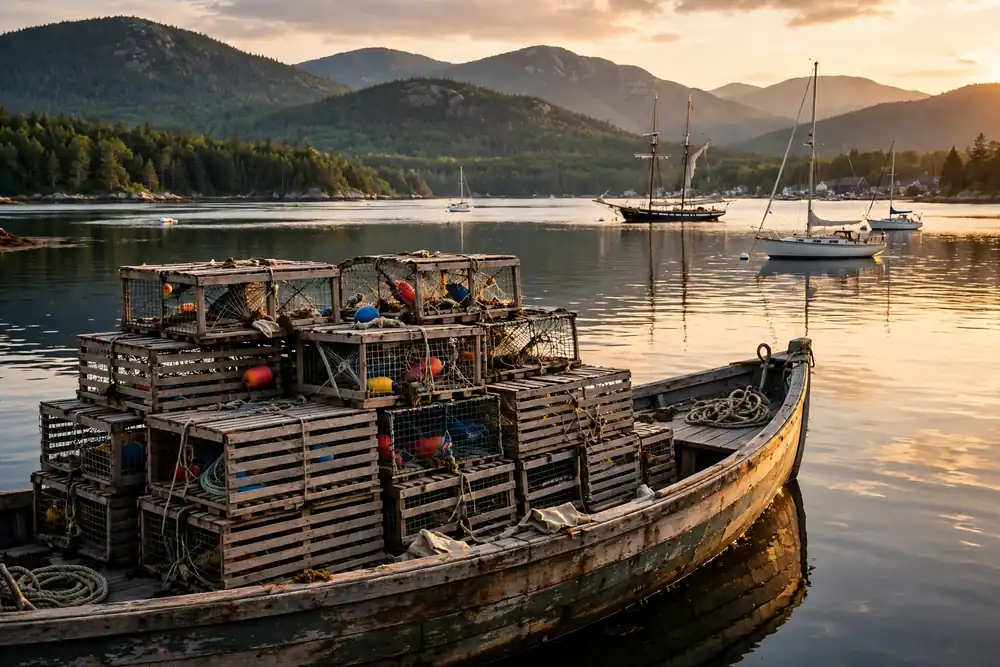
Portland, Maine on Wikipedia is not Portland, Oregon — it is a small, salty, working waterfront city of about 69,000 people, and its Old Port is the best food neighbourhood in New England. The Old Port is the historic district of brick warehouses and cobbled streets around Commercial Street, where the fishing boats still unload beside the restaurants that cook what they catch. Start at the working waterfront: the lobster boats, the fish pier, the Casco Bay Lines ferry terminal, where boats leave year-round for Peaks Island and the other Casco Bay islands, about 20 minutes across the water, with round-trip fares running about $8 off-peak to $17 in peak season. Then eat. Eventide Oyster Co. is the oyster bar that put Portland on the national food map, Duckfat is the beloved fry shack, and Standard Baking Co. is the bakery the locals queue for in the morning. The Old Port also hosts the First Friday Art Walk, when the galleries stay open late, and the Eastern Promenade above the harbour has the best sunset view in the city. Portland has no cruise-ship passenger limits, so the big ships still call here, and the Old Port is at its best on the quiet mornings before the crowds arrive. Allow a full day, and stay for dinner.
4. Portland Head Light and Fort Williams Park
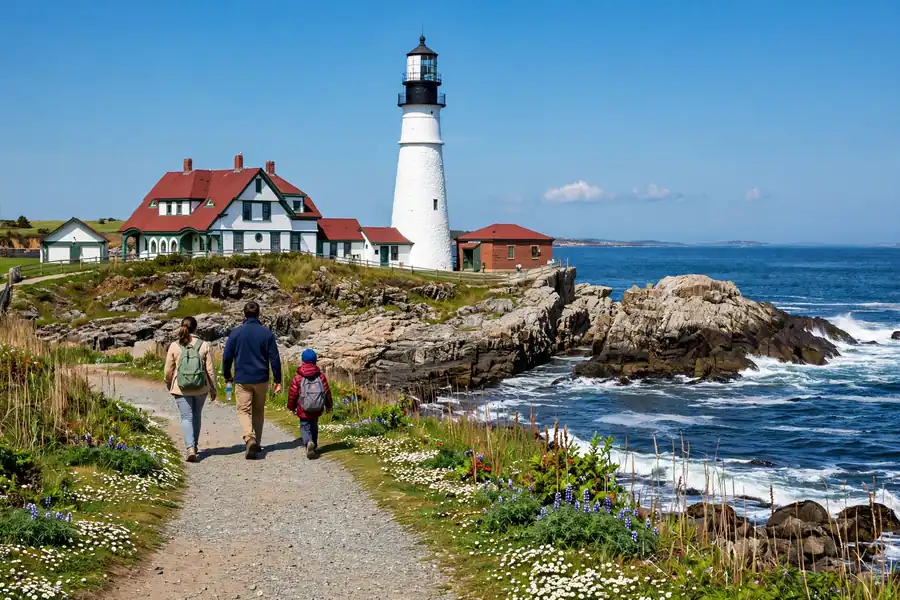
Portland Head Light on Wikipedia is the most photographed lighthouse in New England, and it is the one Maine lighthouse you should not miss. The light stands at the end of Fort Williams Park at 1000 Shore Road in Cape Elizabeth, commissioned by George Washington in 1791, making it Maine’s oldest lighthouse, and it still guides ships into Portland Harbour. The park itself is free and open from sunrise to sunset all year, and that is the honest way to see it: walk the cliff path, watch the waves on the rocks, and take the photograph from the lawn. The details that catch people out are the parking and the tower. Parking runs from 1 April to 15 November at $6 for a two-hour minimum and then $2 an hour, card only, with a free overflow lot a short walk away. The Museum at Portland Head Light costs $2 for adults and $1 for children aged 6 to 18, free under 6, and is open from Memorial Day to Indigenous Peoples Day, 10 a.m. to 4 p.m. daily, and weekends only in May and November. The free 40-minute Cliff Walk tour runs at 3 p.m. daily from mid-May to mid-October. And the tower itself opens to the public only on Maine Open Lighthouse Day — 12 September in 2026 — so do not build a trip around climbing it. Come at sunrise, when the park is empty, or at sunset, when the whole of Casco Bay turns gold. Allow two hours, and pair it with the Lobster Shack at Two Lights, the shack at the next point along the cape.
5. The L.L.Bean Flagship Store in Freeport
L.L.Bean on Wikipedia is Maine’s most famous shop, and its flagship in Freeport is worth a stop even if you never buy a boot. The store at 95 Main Street has been open around the clock for most of its life — the doors famously had no locks — and after a $50 million renovation the new flagship debuted in September 2026, back to 24 hours a day, 365 days a year for the main store and the attached Hunting and Fishing store, with the other campus stores keeping daytime hours. The renovation added a new indoor trout pond and an expanded café, and the dog rules changed in September 2026. The trap is the old information: guides written before the renovation still list reduced hours from the construction period, when one May 2026 source reported 7 a.m. to 10 p.m. — that was the renovation, and the 24-hour store is back. Freeport is the outlet town, a natural stop about 20 minutes north of Portland on I-295. Allow an hour, longer if you shop — and go at night at least once.
6. Camden and the windjammers of Penobscot Bay
Camden, Maine on Wikipedia is the prettiest harbour town in Maine, and it is the home of the windjammers — the great wooden schooners that sail Penobscot Bay on Wikipedia all summer. Camden sits where the mountains meet the sea: the harbour is ringed by hills, the schooners are moored in the middle of town, and the view from Mount Battie in Camden Hills State Park, a short drive up the mountain road, is the postcard of the whole MidCoast. The day sails are the thing to book: the Appledore II runs two-hour day sails from Bayview Landing from mid-May to mid-October for about $65, the Schooner Surprise runs day sails from about $54 to $55, and the sunset sails run about $56 to $58. The Maine Windjammer Association also runs multi-day cruises on the big schooners, sleeping aboard for three to six days. Book ahead in July and August, and bring a layer: it is ten degrees colder on the water than on the dock. Camden is also the base for the Penobscot Bay islands and the drive up Route 1 to Belfast and Searsport. Allow half a day for the town and the sail.
7. Kennebunkport and Walker’s Point
Kennebunkport, Maine on Wikipedia is the resort town of the southern coast, and its most famous sight is the one you cannot visit. Walker’s Point on Wikipedia is the Bush family compound on the point at the mouth of the Kennebunk River, and it is a private residence, off-limits to visitors — the main house is now used by George W. Bush and Laura Bush, and the Texas flag flies beneath the American flag when they are in residence. The honest way to see it is from Blowing Cave Park on Ocean Avenue, a small roadside pull-off with about five parking spaces and a 15-minute limit, and from the Anchor to Windward monument nearby. Do not drive into the compound road, and do not expect a tour: there is none. The rest of Kennebunkport is the reward. Dock Square is the walkable centre of shops, galleries and restaurants, the Colony Hotel is the grand white hotel on the point, and the beaches — Goose Rocks, Colony Beach and Mother’s Beach — are the sandy southern Maine beaches that the MidCoast does not have. Kennebunkport is 11 miles from Ogunquit, so the two towns pair naturally in a single day. Allow half a day.
8. Ogunquit and the Marginal Way
Ogunquit, Maine on Wikipedia is the beach town of the southern coast, and its Marginal Way on Wikipedia is one of the best short walks in New England. The Marginal Way is a 1.25-mile paved cliffside path from Ogunquit Center to Perkins Cove, running along the granite ledges above the Atlantic, with benches, viewpoints and the ocean on your right the whole way. It is free, it is flat, and it takes about 45 minutes at a stroll — and it is the reason Ogunquit is worth a stop even if you never touch the sand. Perkins Cove at the far end is the working harbour, with the lobster boats, the drawbridge, and the restaurants where the fishermen eat. Ogunquit Beach itself is a long, sandy, family beach, and the town is the most walkable of the southern coast towns, with the shops and restaurants clustered around the centre. Portland International Jetport is about 40 minutes away, and the town fills on summer weekends, so arrive before 10 a.m. for parking. Allow half a day for the Marginal Way and Perkins Cove.
9. Baxter State Park and Mount Katahdin
Baxter State Park on Wikipedia is the wild heart of Maine, and Mount Katahdin on Wikipedia is its summit — 5,269 feet, the highest mountain in Maine and the northern terminus of the Appalachian Trail on Wikipedia. The park is not a national park and it does not behave like one: no services inside, no cell service, cash only at the gates, and vehicle limits of 9 feet high, 7 feet wide and 22 feet long, with no RVs or trailers over 20 feet. The reservation system is the thing to get right. The non-resident entrance fee is $20 per vehicle — older sources still say $12 to $15, and they are stale. The Katahdin Trailhead Pass costs $10 per vehicle — older sources say $5, also stale — and it reserves a parking spot at Roaring Brook, Abol or Katahdin Stream, the three trailheads for the summit. Maine residents can book from 1 April, non-residents only within two weeks of the hike date, with a maximum of three passes per person per month, and the spot is held only until 7:05 a.m. Campers staying at those campgrounds do not need a pass, and no pass is required in May. The campgrounds run from 15 May to 15 October, some to 22 October, and all Katahdin and Traveler Ridge trails close for the season from 13 October 2026. The gates run 6 a.m. to 6 p.m. from 23 October 2026. The classic climb is the Hunt Trail from Katahdin Stream, the last stretch of the Appalachian Trail — a hard 10-mile round trip. Overnight Appalachian Trail hikers need a free Long Distance Hiker permit, picked up in person at the Katahdin Stream ranger station. Start early, carry layers and water, and do not attempt it in bad weather. Allow a full day for the climb, and a night in Millinocket before and after.
10. The Maine moose — where to see them
Moose on Wikipedia is the animal Maine is named for in the imagination, and seeing one is a matter of going to the right place at the right time. The state estimate is 40,000 to 60,000 moose, from the Maine Department of Inland Fisheries and Wildlife in July 2025, and they live in the north woods, not on the coast. The best spots are Greenville and Moosehead Lake, Baxter State Park — Sandy Stream Pond, a half-mile walk from Roaring Brook, where a “Moose Pass” three-hour parking permit is available at the Togue Pond Gatehouse — the Katahdin Woods and Waters National Monument, about 87,000 acres, Rangeley, Jackman and The Forks, Aroostook County, Route 11 between Brownville and Millinocket, and the Golden Road, the dirt logging road where the logging trucks have right of way. The best times are dawn and dusk, in mid-May to July and in the fall rut from late September to early October. The honest warnings: moose are very rare in Acadia; a moose is a 1,000-pound animal that will not move for your car; and moose eyes often do not shine in headlights, so drive slowly at dawn, dusk and night. A guided moose tour from Greenville or Millinocket is the best bet for a first-timer — the guides know the ponds. Treat a moose sighting as a bonus, not a guarantee.
11. Whale watching from Bar Harbor and Boothbay Harbor
Whale watching on Wikipedia is the best day on the water in Maine, and the boats leave from Bar Harbor and Boothbay Harbor all summer. In Bar Harbor, the Bar Harbor Whale Watch Co. sails from 1 West Street: $84 for adults aged 15 and over, $72 for juniors aged 6 to 14, $35 for children 5 and under, and $67.50 for Maine residents with ID. The trips run three to five and a half hours, 30 to 50 miles offshore, usually at 11 a.m., and the season runs from late May to early October — the last 2026 sailing was Saturday 24 October, and the company’s site now reads “Thank you for an incredible season! We will see you in May 2027!” The no-whale policy is the honest part: if no whale is seen, the ticket becomes a voucher good for three years, with no refunds. The company is the only Maine operator in Whale SENSE, the responsible-whale-watching programme, since 2012. In Boothbay Harbor, Cap’n Fish’s runs about three and a half hours for $91 for adults 13 and over, $81 for youth 2 to 12, and $21 for children under 2, with a whale-and-puffin combination from $109. The puffins are the seasonal catch: they nest on the offshore islands from May to mid-August only, and then they are out on the open ocean. Book ahead in July and August, bring a warm layer, and sit on the upper deck. Allow half a day.
12. Monhegan Island
Monhegan on Wikipedia is the island Maine keeps for itself — 12 miles off the MidCoast, no cars, no chain stores, a lighthouse, 17 miles of hiking trails, and an artists’ colony that has drawn painters for more than a century. The ferry is the plan. The Monhegan Boat Line runs from Port Clyde: $52 per adult round trip, $35 for children aged 2 to 12, $35 one-way for adults, $10 per pet, in 70 minutes on the Laura B or 55 minutes on the Elizabeth Ann, and advance reservations are required. The Hardy Boat runs from New Harbor for about $70 per adult round trip, and Balmy Days runs from Boothbay Harbor for about $55 per adult, 9:30 a.m. out and 4:15 p.m. back, from mid-June to September with weekends either side, an hour and a half each way, with a $5 extra for a 30-minute circumnavigation. Parking at the Port Clyde dock costs $10 a day. On the island, walk the cliff trails to the lighthouse and browse the galleries — there are no cars, so everything is on foot. An overnight stay is the better trip if you can manage it: the island after the last ferry leaves is a different place entirely. Allow a full day for the day trip, and book the ferry before you book anything else, because the boats sell out on summer weekends.
13. Pemaquid Point Lighthouse
Pemaquid Point Light on Wikipedia is the lighthouse on the Maine state quarter, and it is the one to visit if you want to climb a tower. The light stands on the granite ledges at the tip of Pemaquid Neck in Bristol, commissioned by John Quincy Adams in 1827, where Muscongus Bay meets Johns Bay, and the rocks below it are the most dramatic on the MidCoast — the waves come in over the ledges, and the photographs take themselves. Admission is $4 per person, with a suggested donation of $1 to climb the tower, staffed by volunteers in season. The park grounds are open year-round from 9 a.m. to 5 p.m., and the tower is open from Memorial Day weekend to Indigenous Peoples Day. The ticket includes the Fishermen’s Museum in the keeper’s house, the art gallery and the learning centre, and it is good all day, so you can leave and come back for sunset. It is about an hour south of Camden — pair it with Damariscotta, the oyster town up the river. Allow two hours, and wear shoes with grip: the ledges are slippery, and the tide comes in faster than it looks.
14. The Schoodic Peninsula — Acadia’s quiet half
Schoodic Peninsula on Wikipedia is the half of Acadia National Park that most visitors never see, and it is the best part of the park if you hate crowds. Schoodic is the mainland section of the park, across the bay from Mount Desert Island, around the fishing village of Winter Harbor — and it needs no reservation, no timed entry, and no advance planning at all. The Schoodic Loop Road is a six-mile drive around the point, past the spruce forest, the rocky shore and the Schoodic Institute, to Schoodic Point, where the waves break over the granite in the same way they do at Thunder Hole, with a fraction of the people. The Island Explorer’s Schoodic route runs from 20 May 2026, so you can get here without a car from Bar Harbor in season. Schoodic is also the place for the park’s quieter trails and the sunset — the point faces west across the bay. Pair it with Winter Harbor, the working fishing village at the base of the peninsula. Allow half a day.
15. Sugarloaf and Sunday River — skiing in Maine
Sugarloaf (ski resort) on Wikipedia and Sunday River (ski resort) on Wikipedia are the two ski mountains that make Maine a winter destination, and they are the reason to come back after the leaves fall. Sugarloaf opens on Friday 20 November 2026 for its 76th season and closes around 25 April 2027, and it is the only lift-serviced above-treeline skiing on the East Coast, with 2,820 feet of vertical, more than 1,200 acres, 176 trails and glades, and 15 lifts. Sunday River opens as early as it can, typically in late October or early November, and closes in late April. The pricing is the trap: neither mountain publishes a single adult day rate. Both use dynamic advance-purchase pricing, date-specific and online only, so the price you pay depends on the day and how early you book. Sunday River full-day tickets start from $69, and Sugarloaf’s two-day Ticket Pack starts from $199, valid across Sugarloaf, Sunday River, Loon and Pleasant Mountain. The Maine and Canada Day deal is $69 on Wednesdays from January, excluding the February vacation week. Sugarloaf adds snow tubing from 18 December 2026. Book the tickets online before you go, and the lodging even earlier — the mountain hotels fill for the holiday weeks. Allow two days for a ski trip.
16. Bangor and Stephen King country
Bangor, Maine on Wikipedia is the city that Stephen King on Wikipedia made famous, and it is the best base for the north woods. King has lived in Bangor for decades, and his house at 47 West Broadway — a red Victorian with bats and spiders on the iron fence — is a private residence, so look from the street and do not knock. The town of Derry in his novels is Bangor with the serial numbers filed off, and the walking tours run by SK Tours of Maine take you to the places that became the books: the standpipe, the library, the Barrens, the sewer grate. Bangor is more than King: it is the gateway to Baxter State Park and the moose country, and the home of a 31-foot Paul Bunyan statue that has stood since 1959. It is also the practical base: Bangor International Airport is the closest airport to Acadia’s north side and to Baxter, and the Concord Coach bus runs here from Boston and Portland. Allow half a day, and a night here before a Baxter climb or a moose dawn patrol.
17. The Maine Maritime Museum in Bath
Maine Maritime Museum on Wikipedia is the museum that explains why Maine exists — and it sits in Bath, Maine on Wikipedia, the City of Ships, on the Kennebec River. The museum covers 20 acres of the old Percy and Small Shipyard, the last surviving wooden shipbuilding yard in America, with the shipyard buildings, the historic boats, the lobstering exhibit and the lighthouse collection. Bath Iron Works, the shipyard next door, still builds destroyers for the US Navy, and the museum tells the story of the whole industry, from the wooden schooners to the steel warships. Bath itself is worth an hour after the museum: a handsome Victorian downtown and the gateway to the Boothbay peninsula. The museum is a natural stop on the drive between Portland and Camden, about 40 minutes north of Portland. Allow two hours for the museum, and an hour for Bath itself.
18. Coastal Maine Botanical Gardens in Boothbay
Coastal Maine Botanical Gardens on Wikipedia is the garden that made Boothbay a destination, and it is the best family stop on the MidCoast. The gardens cover about 300 acres on the Boothbay peninsula, with the woodland trails, the water features, the children’s garden, and the five giant wooden trolls — the Guardians of the Seeds, built by the Danish artist Thomas Dambo in 2021, hidden along the trails for children to find. The trolls are the reason many families come, and the treasure-hunt walk to find all five is the best half-day on the peninsula. The gardens are seasonal, open from spring to autumn, and busiest in July and August. Boothbay Harbor next door pairs naturally: the gardens in the morning, the harbour in the afternoon. Allow half a day for the gardens, and wear walking shoes — the trails are the attraction, and they cover a lot of ground.
19. Red’s Eats and the lobster shacks of Wiscasset
Red’s Eats on Wikipedia is the most famous lobster shack in Maine, and it is the one with the longest queue. The shack at 41 Water Street in Wiscasset has been voted the best lobster roll in Maine 16 years running: whole-claw meat, butter and mayonnaise on the side, in a toasted bun, for about $34 to $38 in 2026 — one review from 30 August 2026 reported $38. The practical part is the queue: lines can run two hours or more, with one June 2026 report of arriving at 2:20 p.m. and eating at 4:40 p.m. The shack is cash only, open Wednesday to Sunday from 11:30 a.m. to 5 p.m., and closed on Monday and Tuesday — do not drive to Wiscasset on a Monday. The typical Maine lobster roll in season costs $20 to $35, so Red’s is at the top of the range. If the line is too long, the other shacks are the backup: the Lobster Shack at Two Lights in Cape Elizabeth, Five Islands Lobster Co. in Georgetown, and McLoons in South Thomaston all serve the same idea — a roll, a picnic table, and the water — with shorter waits. Bring cash, patience and sunscreen.
20. The island ferries — a day trip to Vinalhaven
Maine State Ferry Service on Wikipedia is the way to see the Maine that tourists never reach — the year-round island communities of Penobscot Bay. The classic day trip is Rockland to Vinalhaven: an hour and fifteen minutes across the bay, several sailings a day, year-round. The adult round-trip fare is $15.75 in the off-peak season from 1 October to 31 May and $23 in the peak season from 1 June to 30 September; minors aged 6 to 17 pay $8 off-peak and $15 peak, and children under 6 travel free. A vehicle costs $41.50 off-peak and $55 in peak season, plus a $17 reservation — and for a day trip, leave the car in Rockland and walk on: Vinalhaven is a walking island, with the harbour, the quarries, the galleries and the trails all within reach of the ferry landing. The Lincolnville to Islesboro crossing is the shorter version, at $10.25 off-peak and $17 peak for an adult round trip. The ferries are working boats, not tourist boats: you travel with the islanders, the mail and the lobstermen. Schedules change between the winter and summer seasons, so check before you go. Take the first boat out and the last boat back.
Maine in 3 days — a ready-made itinerary
This three-day plan covers the southern coast, Acadia and the MidCoast, and it uses a car for all three days. Book the Cadillac Mountain vehicle reservation and the whale-watch tickets before you fly, and the hotels before that: Portland, Bar Harbor and Camden all fill in July, August and October.
Day 1 — Portland, Freeport and the southern coast
Start in Portland before 9 a.m. with breakfast in the Old Port and a walk along the working waterfront. Take the Casco Bay Lines ferry to Peaks Island, then drive south to Cape Elizabeth for Portland Head Light and lunch at the Lobster Shack at Two Lights. In the afternoon, drive north to Freeport for the L.L.Bean flagship store — go at night if you can, when the 24-hour store is at its strangest — and finish the day in Ogunquit, walking the Marginal Way to Perkins Cove at sunset. Dinner is a lobster roll in Ogunquit or Kennebunkport, and the night is in Portland or Ogunquit.
Day 2 — Acadia and Bar Harbor
Drive to Bar Harbor in the morning — about three hours from Portland — and start at Cadillac Mountain, using the vehicle reservation you booked 90 days ahead. Spend the morning on the Park Loop Road and the carriage roads, then lunch on the Jordan Pond House lawn. In the afternoon, hike the Ocean Path from Sand Beach to Otter Point, then drive the Schoodic Loop Road. Back in Bar Harbor, walk the Shore Path at sunset and eat lobster in town. If the whale boats are running, swap the afternoon for the 11 a.m. whale watch from 1 West Street — it is the best half-day on the coast.
Day 3 — Camden, the MidCoast and the lighthouses
Drive south from Bar Harbor to Camden, about an hour and a half, and take the morning windjammer sail from the harbour. Lunch is in Camden, then drive down Route 1 to the Pemaquid Point Lighthouse, stopping in Damariscotta for the oysters on the way. In the afternoon, walk the ledges at Pemaquid, then drive back through Boothbay Harbor, and finish with dinner in Camden or Portland. And if you have a fourth day, take the morning ferry to Monhegan Island, or drive north to Bangor and Baxter State Park for the moose country.
Best time to visit Maine
| Season | Weather | Crowds | Notes |
|---|---|---|---|
| Spring (March–May) | Highs 45–65°F, lows 30–45°F | Low | Quiet and cheap; mud season in the woods; black flies arrive in May and June |
| Summer (June–August) | Highs 70–80°F, lows 55–65°F | High | Best season — everything open, warmest water, longest days; book months ahead |
| Autumn (September–November) | Highs 50–70°F, lows 35–50°F | Moderate to high in October | Fall foliage peaks October 5–20; Acadia peaks around October 13–15; crowds thin after Columbus Day |
| Winter (December–February) | Highs 25–35°F, lows 5–15°F | Low | Ski season at Sugarloaf and Sunday River; cold, dark and quiet on the coast; many shacks and inns closed |
The best time to visit Maine is late June to September, when the daytime highs run from the low 70s to the low 80s and everything is open — but it is also the busiest season, and the hotels fill months ahead. October is the second-best month, and the one for the foliage: the sweet spot is 5 to 20 October, with the north turning late September to early October, western Maine around Rangeley in early October, the centre and east in mid-October, and the coast and Acadia in mid to late October — Acadia peaks around 13 to 15 October and holds colour through 22 to 25 October. The Maine Forest Service’s final 2026 foliage report, on 14 October, had the north and west past peak and the coast and Down East at peak, which is exactly the pattern to plan around. Spring is the quiet season, and the cheapest, but it is mud season in the woods and the black flies arrive in May and June — the tiny biting flies that make the north woods miserable for a few weeks. Winter is the ski season: Sugarloaf opens 20 November 2026 and runs to about 25 April 2027, and Sunday River runs from late October or early November to late April. The coast in winter is cold, dark and quiet, and many of the lobster shacks and inns are closed — come for the skiing, not for the beach. The ocean is never warm: even in August the water off Acadia is in the low 60s, so swim at the southern beaches.
Where to stay in Maine
| Area | Best for | Price range |
|---|---|---|
| Portland and the Old Port | Food, the southern coast, first-timers, no-car days | $180–$400 a night |
| Bar Harbor | Acadia, whale watching, the Schoodic Peninsula | $150–$400 a night |
| Camden and the MidCoast | Windjammers, the islands, the prettiest driving | $130–$350 a night |
| Kennebunkport and Ogunquit | Beaches, the Marginal Way, resort towns | $150–$400 a night |
| Bangor and Millinocket | Baxter State Park, the moose country, the north woods | $90–$200 a night |
Stay in Portland if this is your first visit — the Old Port puts the food, the waterfront and the ferry terminal on your doorstep. Bar Harbor is the pick for Acadia: ten minutes from the park entrance, with the whale boats and the Island Explorer hub — but also the most expensive base in the state in July, August and October, so book early. Camden is the pick for the MidCoast, with the harbour, the schooners and the mountain views in one town, and it is the quietest of the three big bases. Kennebunkport and Ogunquit are the resort picks, with the beaches and the Marginal Way, and the highest prices on the southern coast. Bangor and Millinocket are the practical picks for the north: cheaper rooms, and the only sensible bases for a Baxter climb or a moose dawn patrol — do not try to do Katahdin as a day trip from Bar Harbor. Book early for July, August and the foliage weeks in October, and check the parking before you book in Portland and Bar Harbor, where the hotels charge for it.
Getting around Maine
| Way to travel | Cost | Best for |
|---|---|---|
| Rental car | $50–$80 a day | Almost everything — the coast, the MidCoast, Acadia, Baxter, the moose country |
| Amtrak Downeaster | $24 one way Boston–Portland | Boston to Portland, Freeport and Brunswick without driving |
| Concord Coach Lines | About $26–$31 Boston–Portland | Boston to Portland, Augusta and Bangor, with free Wi-Fi |
| Maine State Ferry Service | $15.75–$23 adult round trip Rockland–Vinalhaven | The islands — Vinalhaven, North Haven, Islesboro, Swans Island |
| Casco Bay Lines | About $8–$17 round trip | Peaks Island and the Casco Bay islands from Portland |
| Island Explorer | Free | Acadia and Bar Harbor in season, no car needed in the park |
| Walking | Free | Portland’s Old Port, Bar Harbor, Camden, Ogunquit — the towns are made for it |
The state is about two hours from Boston by car or train, and Portland International Jetport is the main airport, with Bangor International serving the north. Once you are here, a car is essential for almost everything — there is no metro, no subway, and the bus network is thin outside the coast. The Amtrak Downeaster on Wikipedia runs five round trips a day from Boston North Station to Brunswick, 145 miles, in about two and a half hours to Portland and about three hours and fifteen to twenty minutes end to end; Boston to Portland costs $24 each way, and the BOGO promo code v114 applies when you buy three or more days ahead. The stops include Wells, Saco, Portland, Freeport and Brunswick; note the Downeaster arrives at Boston North Station, and you need a transfer to South Station or Back Bay to continue south. Concord Coach Lines runs about 31 daily trips between Boston and Portland in about two hours, for about $26 to $31, with free Wi-Fi, and continues to Augusta and Bangor. The driving times are the plan: Boston to Portland is about two hours, Portland to Bar Harbor about three, and Bar Harbor to Millinocket about three more. The Island Explorer buses are free in season and cover Acadia and Bar Harbor, so you can leave the car at the hotel for a park day. The ferries are the other network: the Maine State Ferry Service runs year-round to the bay islands, and Casco Bay Lines runs from Portland to the bay islands. Book the car before you fly in summer and October, and fill the tank when you see a station in the north woods — the gaps between them are long.
Maine food you have to try
Maine’s food is the food of the cold Atlantic and the short summer: the lobster boats, the wild blueberries, and the bakeries that have not changed their recipes in decades.
The lobster roll — Maine’s signature sandwich
Lobster roll on Wikipedia is the sandwich that defines Maine, and the Maine version is specific: cold lobster meat, lightly dressed with mayonnaise, served in a toasted, buttered, split-top hot dog bun — not the warm, buttered Connecticut version, and not a salad. The meat should be whole-claw, not shredded, and the bun griddled in butter until golden. The typical Maine lobster roll in season costs $20 to $35, and the best ones come from the shacks, not the white-tablecloth restaurants: a picnic table, a paper tray, and the water in front of you. Red’s Eats in Wiscasset is the most famous, and the queue is the price of fame — two hours on a summer day. The Lobster Shack at Two Lights in Cape Elizabeth is the classic alternative, with the lighthouse behind you and the ocean in front of you, and the shacks of the MidCoast — Five Islands Lobster Co., McLoons, the Boothbay shacks — serve the same idea with shorter waits. Order it Maine-style, and eat it with your hands over the tray. A lobster roll is a lunch, not a dinner: the shacks close by five, and the best ones sell out.

Whoopie pies and wild blueberries
Whoopie pie on Wikipedia is Maine’s official state treat, and it is the dessert you will find in every bakery, farm stand and gas station in the state: two soft chocolate cake rounds with a sweet cream filling, sold individually wrapped and eaten out of hand. The best ones are the bakery versions, not the packaged ones, and the flavours go beyond chocolate — pumpkin in the autumn, maple, and the blueberry versions that use the state’s other crop. Wild blueberries are the second half of the story: Maine is the largest producer of wild, low-bush blueberries in the United States, small and intense where the cultivated high-bush berry is large and mild, and they grow on the barrens of Washington County, around Machias and Columbia Falls, where Wild Blueberry Land — the giant blueberry-shaped building on Route 1 — is the roadside stop. The blueberry season is short, from late July to early September, and the pie, the pancakes and the jam made from them are the taste of a Maine summer. Buy the pie from a farm stand, not a supermarket.
Clam chowder, fried clams and the rest of the Maine table
The clam chowder is the New England kind — cream-based, with potatoes and salt pork, not the tomato Manhattan version — and the best bowls come from the shacks, where the clams were dug that morning. The fried clams are the other essential: whole-belly clams in a light batter, served with tartar sauce and lemon, and the ones with the bellies are the real thing — the strips are for the cautious. The oysters are the quiet stars: Damariscotta River oysters are among the best in America, and the raw bars in Portland and Damariscotta serve them by the dozen. And the fish is the haddock, fried or baked, the fish of the Friday-night supper in every town in the state. A full seafood dinner in Portland costs about $30 to $60 a person, and a shack lunch about $20 to $35.
Free things to do in Maine
Maine is far cheaper than its reputation suggests, because many of the best sights cost nothing. The Marginal Way in Ogunquit is free, the Shore Path in Bar Harbor is free, the grounds of Fort Williams Park and the view of Portland Head Light are free, the Eastern Promenade in Portland is free, the L.L.Bean flagship store is free to walk into at any hour of the day or night, and the working waterfronts of Portland, Camden and Bar Harbor are free to wander. Cape Neddick Light on Wikipedia — the Nubble Light, the most photographed lighthouse in the state — is free to see from Sohier Park in York, and the view from the park is the postcard. The First Friday Art Walk in Portland is free, and the beaches are free to walk at low tide — the charge at the southern beaches is for parking, not for the sand. The Island Explorer buses in Acadia are free in season. Do the free list on your first day, and you will have seen the coast before you have spent a dollar on a ticket.
Frequently asked questions
How many days do you need in Maine?
Three days is the right amount for a first trip: one day for Portland and the southern coast, one day for Acadia and Bar Harbor, and one day for Camden and the MidCoast. Five to seven days adds Baxter State Park, the moose country, the islands and the Down East coast, and a week is the honest minimum for the whole state. One day is possible from Boston — Portland and the southern coast — but you will leave having seen a tenth of the state.
Do you need a car in Maine?
Yes, for almost everything. The Amtrak Downeaster and the Concord Coach buses cover Boston to Portland, Freeport and Brunswick, and the Island Explorer buses cover Acadia and Bar Harbor in season, but the MidCoast, the islands, Baxter State Park and the moose country are car-only. There is no metro and no subway anywhere in the state. Rent the car in Portland or Boston, and book it before you fly in summer and October.
Is Acadia’s Cadillac Mountain reservation really required?
Yes. A vehicle reservation for the Cadillac Summit Road is required from 20 May to 25 October 2026, costs $6 per vehicle, and can only be booked on Recreation.gov — never at the park. It is separate from the $35-per-vehicle park entrance pass. Thirty per cent of the slots are released 90 days ahead and 70 per cent two days ahead, both at 10 a.m. Eastern, and vehicles over 21 feet are not allowed up the summit road at all. The reservation applies only to the Cadillac Summit Road, not to the whole Park Loop Road, whatever some guides claim. Without a reservation, walk or cycle up, or take the Island Explorer and hike from the base.
When is the best time to see fall foliage in Maine?
The sweet spot for most travellers is 5 to 20 October. The north turns late September to early October, western Maine around Rangeley in early October, the centre and east in mid-October, and the coast and Acadia in mid to late October — Acadia peaks around 13 to 15 October and holds colour through 22 to 25 October. The Maine Forest Service’s final 2026 report, on 14 October, had the north and west past peak and the coast and Down East at peak. Book the hotels early: the foliage weeks are the busiest of the year outside July and August.
Is Maine expensive?
Mid-range, and cheaper than Boston or New York. A mid-range hotel costs $130 to $400 a night depending on the town and the season, a lobster roll $20 to $35, a seafood dinner $30 to $60, and the park entrance $35 per vehicle for seven days. Many of the best sights — the Marginal Way, the Shore Path, the lighthouse parks, the working waterfronts — are free. The expensive mistakes are avoidable: booking late in July, August or October, and paying the door price at the ski mountains instead of booking online.
What should I skip in Maine?
Three things, and all three are traps that older guides still get wrong. First, do not drive up Cadillac Mountain without a vehicle reservation: it is required from 20 May to 25 October 2026, it costs $6, it is only on Recreation.gov, and the park will turn you away without one. Second, do not plan your trip around climbing Portland Head Light: the tower opens to the public only on Maine Open Lighthouse Day, 12 September in 2026, and the park, the museum and the cliff walk are the visit. Third, do not expect to see a moose in Acadia — they are very rare there — and do not drive to Red’s Eats on a Monday or Tuesday, when the shack is closed. And do not trust the old guides on L.L.Bean’s hours or the Bar Harbor cruise cap — the flagship is back to 24 hours a day since September 2026, and the cap now survives only in July and August.
Further reading
Start with Maine on Wikipedia, which covers the history, the geography and the economy, and Acadia National Park on Wikipedia for the park’s trails, carriage roads and history. For what locals actually recommend, the r/Maine subreddit is the community where Mainers answer visitor questions about the coast, the woods, the moose and the lobster rolls — it is the best place to check a plan against local knowledge before you go. Visit Maine is the official tourism site, with current event listings, the foliage reports and the ferry schedules. For a traveller’s view of the southern coast, the Quora thread on a four-day trip to Portland, Maine has a long answer from a 42-trip Maine veteran on the places worth visiting and the ones to skip.
Your Maine trip, in one paragraph
Maine is the state where America runs out of road, and that is the trip: the sunrise on Cadillac Mountain, the windjammers of Camden, the moose ponds of the north woods, and a lobster roll in Wiscasset. For more guides in the same style, start with our California guide for the other great whole-state road trip, then see how Maine compares with Destin, Arizona, Chicago, Nashville, Los Angeles, Orlando, Miami, San Diego, Denver, Savannah, Dallas, Charleston, San Francisco, Myrtle Beach, Las Vegas, San Antonio, London, Portland, Pigeon Forge, Puerto Rico, Atlanta, Phoenix, Paris, Maui, Key West, Colorado Springs, Sedona, Chattanooga, Palm Springs, St Louis, Tokyo, Japan, Kansas City, Tennessee, Branson, Florida, Amsterdam, Montreal, Honolulu, Fort Lauderdale, Toronto, Aruba, Charlotte, Indianapolis, New Orleans, Santa Barbara, Mexico City, Osaka, Minneapolis, Pittsburgh, Asheville, Costa Rica, Hawaii, Washington DC, Seattle, St Augustine, Lisbon, Dubai, Santa Fe and Galveston.

About the Author