Things to Do in Santa Fe
20 Best Attractions, a 3-Day Itinerary, Where to Stay, and the Food You Cannot Miss
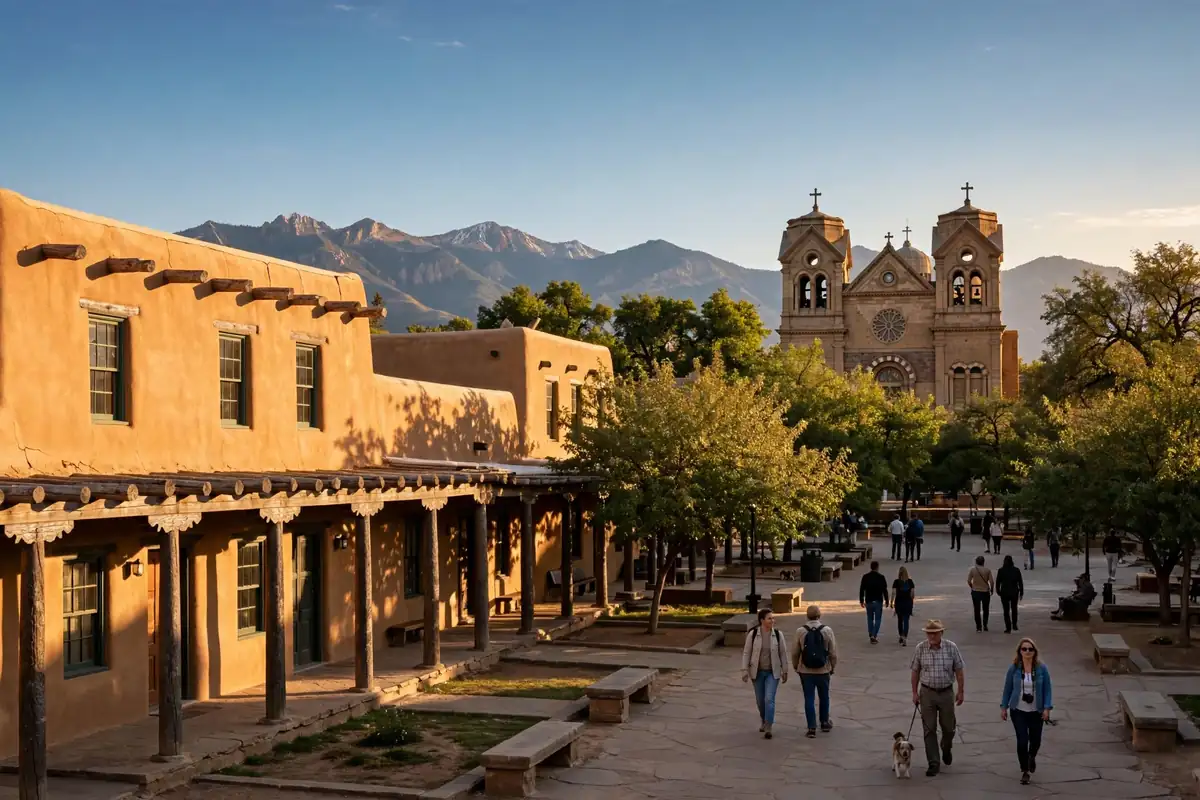
Quick Info
Best for: First-timers, art lovers, food lovers and history lovers — and anyone who wants adobe streets, mountain light and the best chile in America in one walkable city
Best time: September–October for warm days, cool nights, fall colour and the chile harvest; May–June is the other sweet spot; December–February is for skiing and the Farolito Walk
How long: 3 days for the Plaza, the museums, Canyon Road and a day trip to Bandelier; 4–5 days if you add Tent Rocks, Ghost Ranch and a slow food crawl
Budget: About $150–$300 per person per day with a mid-range hotel — many of the best sights are free, and the food is the real splurge
Don’t miss: The Plaza at sunset, the Georgia O’Keeffe Museum, the Loretto Chapel staircase, a walk down Canyon Road, the red-versus-green chile question, and a day trip to Bandelier
Santa Fe on Wikipedia is the oldest capital city in the United States, founded in 1610 at 7,199 feet above sea level — the highest capital in the country — and the past here is not a museum district but the whole downtown. This guide covers the 20 best things to do in Santa Fe, a 3-day itinerary that actually works, where to stay without overpaying, how to get around on foot, by bus and by the Rail Runner, the three foods you should not skip, and the free sights that let you enjoy the city without a ticket. Everything below was checked against live sources in November 2026 — including the closures and reopenings most guides still get wrong.
Santa Fe at a glance
| Topic | What to know |
|---|---|
| Full name | Santa Fe, New Mexico — the state capital, in the foothills of the Sangre de Cristo mountains |
| Founded | 1610, by Don Pedro de Peralta; the oldest capital city in the United States |
| Elevation | 7,199 feet (2,194 m) — the highest state capital in the US; drink water and take the first day slowly |
| Population | About 88,000 in the city; around 155,000 in the metro area |
| Language | English; Spanish is spoken widely, and the city’s history is Spanish, Mexican and Pueblo |
| Airport | Albuquerque International Sunport (ABQ), about 60 miles south, roughly 1 hour 10 minutes by car or train |
| Best base | Downtown, around the Plaza, for first-timers; the Railyard for a livelier, cheaper stay |
| Getting around | Walkable historic core; Santa Fe Trails bus ($1 a ride); the Rail Runner train from Albuquerque |
| Famous for | Adobe architecture, the art market, Georgia O’Keeffe, New Mexican chile, and the oldest church and oldest public building in the US |
Santa Fe divides into three parts, and understanding them is the key to planning. The historic core is the Plaza and the streets around it — the Palace of the Governors, the cathedral, the Loretto Chapel, San Miguel Mission and the oldest house in the country, all within a ten-minute walk of each other, along with the Georgia O’Keeffe Museum and the New Mexico Museum of Art. Canyon Road, about half a mile long and a short walk east of the Plaza, is the gallery district, with more than a hundred galleries in old adobe houses. And Museum Hill, about two miles south-east of the Plaza, holds four museums in one cluster — the Museum of Indian Arts and Culture, the Museum of International Folk Art, the Wheelwright Museum and the Museum of Spanish Colonial Art — with the Santa Fe Botanical Garden next door. Beyond the city are the day trips: Bandelier National Monument, Kasha-Katuwe Tent Rocks, Ghost Ranch and the O’Keeffe country around Abiquiú, and the ski mountain 16 miles up the road. Come for the art and the light, stay for the chile.
The 20 best things to do in Santa Fe
1. Santa Fe Plaza and the Palace of the Governors
Santa Fe Plaza on Wikipedia is the heart of the city, and it has been the centre of town since 1610 — a National Historic Landmark where the Spanish founded the capital, where the Santa Fe Trail ended, and where the city still gathers for festivals, markets and concerts. The Plaza itself is a shady square of lawns, benches and cottonwood trees, surrounded by adobe shops, restaurants and the long portico of the Palace of the Governors. On the Palace’s south side, under the portal, Native American artists from the region’s pueblos sell handmade jewellery, pottery and textiles every day, roughly 8:30 a.m. to 5 p.m. — it is the oldest and most respected Native art market in the United States, and the artists themselves are the sellers. The Palace of the Governors on Wikipedia stands on the Plaza’s north side and is the oldest public building in the United States, built in 1610 as the seat of Spanish colonial government. Entry is $12 for non-residents and $7 for New Mexico residents, with children 16 and under free; the ticket also covers the New Mexico History Museum behind it. The Palace is open 10 a.m. to 5 p.m., and it is closed on Mondays from November to April. Allow an hour for the Plaza and the Palace.
2. Georgia O’Keeffe Museum
Georgia O’Keeffe on Wikipedia is the artist who made the New Mexico desert famous, and her museum on Johnson Street, two blocks from the Plaza, is the single most visited museum in Santa Fe. O’Keeffe painted the skulls, the flowers and the red rock of northern New Mexico for half a century, and the museum holds the largest collection of her work in the world — the big flowers, the desert landscapes, the bones and the Abiquiú studio views — along with her photographs and the belongings she carried from New York to the desert. Admission is $24 for adults, and tickets are timed, released every 15 minutes and sold up to 60 days ahead — book online, because the popular slots sell out on weekends. The museum is open Thursday to Tuesday, 10 a.m. to 5 p.m., and closed on Wednesdays. On the first Friday of the month it is free from 5 p.m. to 7 p.m. Note that from 1 to 21 November 2026 admission was reduced while Galleries 6 to 9 were closed for a changeover, with two new exhibitions — “Spaces of Becoming” and “Georgia O’Keeffe & Sam Scott” — opening on 21 November 2026; allow about an hour. A much bigger change is coming: a new museum campus is under construction downtown, built from some 40,000 adobe bricks, which will triple the gallery space to 54,000 square feet when it opens in 2028. O’Keeffe’s home and studio in Abiquiú, 52 miles north-west, is a separate visit — see number 20.
3. Meow Wolf — House of Eternal Return
Meow Wolf on Wikipedia is the immersive art experience that put Santa Fe on the map for a new generation, and the House of Eternal Return, in a former bowling alley at 1352 Rufina Circle, is the original — more than 70 rooms built by a collective of local artists, all connected by a mystery story about a family that vanished from a Victorian house. You walk through a refrigerator into another dimension, crawl through a dryer, climb a treehouse and slide down a glowing tunnel, and the story only makes sense if you read the letters, watch the videos and open the drawers. Timed-entry tickets start from about $32 to $33 for adults and from $26 for children aged 4 to 12, with children under 3 free; an anytime ticket, which lets you arrive whenever you like on your chosen date, costs from about $42 to $54. Prices vary by date and time, and older guides listing $29 or $45 are out of date. Book ahead — tickets are non-refundable, though they can be rescheduled up to an hour before your slot. New Mexico residents get a discount. George R.R. Martin, the author of Game of Thrones, bought the bowling alley and funded the build. Allow two to three hours, wear comfortable shoes, and go with children if you have them — this is the best thing in Santa Fe for ages 6 to 60.
4. Canyon Road
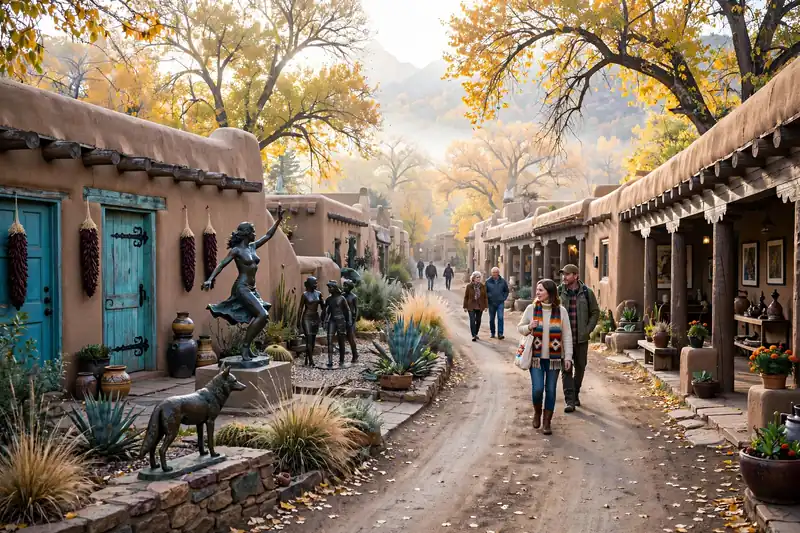
Canyon Road on Wikipedia is the half-mile street that holds the heart of Santa Fe’s art market: more than a hundred galleries in old adobe houses, with sculpture gardens, courtyards and turquoise doors, running east from Paseo de Peralta. It was a residential street for Spanish settlers in the 1700s, then the address of artists in the early 1900s, and it is now the densest gallery street in the country. Walking it is free, and that is the point: the galleries are open to browsers, most of them from about 10 a.m. to 5 p.m., and the sculpture gardens are the best free art in town. On Friday evenings from April to November the galleries stay open late for openings, with wine and crowds. The Christmas Eve Farolito Walk, on 24 December, is the street’s great tradition: thousands of paper-bag lanterns line the walls and the roofs, the galleries open their doors, choirs sing in the courtyards, and the whole street glows — arrive before dark, because the crowds are enormous. A free shuttle loops between downtown and Canyon Road roughly every 30 minutes. Allow two hours to walk it slowly, and more if you like to stop.
5. Loretto Chapel and the Miraculous Staircase
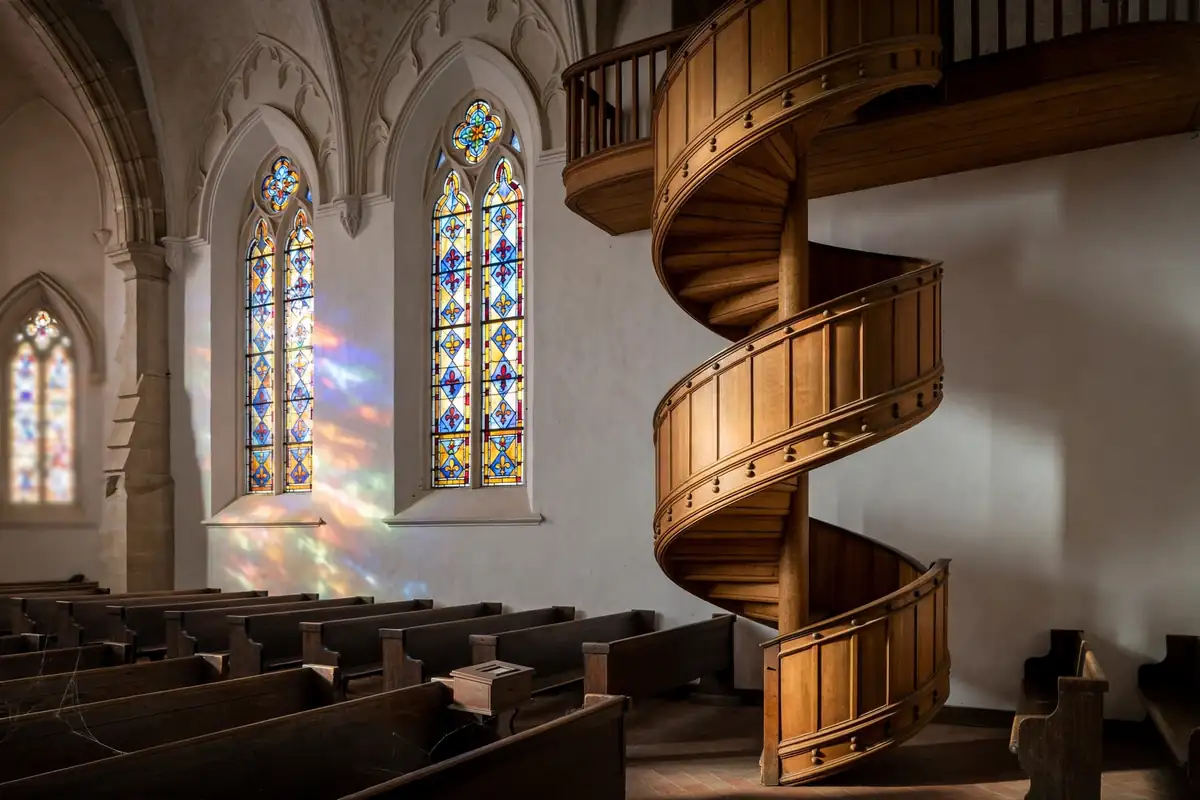
Loretto Chapel on Wikipedia is a small Gothic chapel on Old Santa Fe Trail, built in 1878, and it holds the most famous staircase in America. The chapel was built for the Sisters of Loretto, and when it was finished the choir loft had no way up — no staircase, no ladder, only a 22-foot gap. According to the story the sisters prayed for nine days, and on the ninth day a stranger arrived with a toolbox, built a spiral staircase in six months, and vanished without payment or thanks. The staircase has 33 steps, two full 360-degree turns, and no visible central support — it stands on its own, held together by wooden pegs rather than nails. The handrails were added later, and the staircase is still roped off. Entry is $5 for adults, $4 for seniors aged 65 and over, and $3 for young people aged 7 to 17, with children under 7 free. The chapel is open daily, roughly 9 a.m. to 5 p.m., and 10:30 a.m. to 5 p.m. on Sundays, at 207 Old Santa Fe Trail. It is a working museum now, not a parish church, so it is quiet and quick — allow 30 minutes, and go early, before the tour groups arrive.
6. Cathedral Basilica of St. Francis of Assisi
Cathedral Basilica of St. Francis of Assisi on Wikipedia is the great Romanesque church on the east side of the Plaza, built between 1869 and 1886 from stone quarried in the nearby hills, and it is the mother church of the Archdiocese of Santa Fe. Its twin towers frame the Plaza, and inside are the oldest Madonna in the United States — La Conquistadora, a statue of the Virgin brought from Spain in 1626, dressed in robes donated by generations of New Mexicans — and a baptismal font carved from a single block of stone. The cathedral is free to enter, with donations welcome, and it is open daily; Mass runs through the week, and visitors are welcome to sit quietly outside service times. Come in the late afternoon, when the sun slants through the west windows and the stone glows, and allow 30 minutes.
7. San Miguel Mission and Barrio de Analco
San Miguel Mission on Wikipedia is the oldest church in the United States, built around 1610 on the south side of the Santa Fe River, in the Barrio de Analco — the old neighbourhood across the river from the Plaza, where the Tlaxcalan Indians who came north with the Spanish lived. The mission is a small adobe church with a bell tower, whitewashed inside, and its walls are nearly five feet thick in places. It was burned during the Pueblo Revolt of 1680 and rebuilt in 1710, but the site and the claim are the same: no church in the country is older. Entry is a small donation of about $3 to $4. Hours are Monday 11 a.m. to 3 p.m., Tuesday to Friday 9 a.m. to 3 p.m., Saturday 10 a.m. to 3 p.m. and Sunday noon to 3 p.m., at 401 Old Santa Fe Trail. Next door, on De Vargas Street, is the Oldest House in the United States, the De Vargas Street House, built around 1646 and still standing as a small museum of colonial life. The two together are the best half-hour of history in Santa Fe, and they are the reason to cross the river — most visitors never do, and they miss the oldest part of the city.
8. New Mexico Museum of Art — Plaza Building and Vladem Contemporary
New Mexico Museum of Art on Wikipedia is the state’s oldest art museum, and it is really two museums on one ticket. The Plaza Building, at 107 West Palace Avenue, opened in 1917 as the Museum of Fine Arts in a Pueblo Revival building modelled on the old mission churches, with a courtyard and vigas; it holds the historic collection of New Mexico art, from the early Santa Fe and Taos painters to the modernists. The Vladem Contemporary, at 404 Montezuma Street in the Railyard, opened on 23 September 2023 in a converted warehouse, and it holds the contemporary collection — large-scale installations, video and new work by living New Mexican artists. One ticket covers both: $12 for non-residents and $7 for New Mexico residents, with children 16 and under free. From November to April the museums are open Tuesday to Sunday, 10 a.m. to 5 p.m., and closed on Mondays; from May to October they are open daily, 10 a.m. to 5 p.m., with Friday hours to 7 p.m. The Plaza Building is free on the first Friday of the month from 5 p.m. to 7 p.m., and Vladem is free on the final Friday.
9. Museum of Indian Arts and Culture
Museum of Indian Arts and Culture on Wikipedia is the museum on Museum Hill that tells the story of the Native peoples of the Southwest, and it is the one to visit first if you want to understand the art you will see all over Santa Fe. The permanent exhibition, “Here, Now and Always”, traces the history of the Pueblo, Navajo and Apache peoples from the ancient sites to the present day, with pottery, textiles, jewellery and photographs, and the museum’s collection holds more than 75,000 objects. Docent-led tours run at 10:30 a.m., 1 p.m. and 3 p.m. The museum is at 710 Camino Lejo, on Museum Hill. From May to October it is open daily, 10 a.m. to 5 p.m.; from November to April it is open Tuesday to Sunday, 10 a.m. to 5 p.m., and closed on Mondays. Admission is $12 for non-residents and $7 for New Mexico residents, with children 16 and under free — and the New Mexico Culture Pass, $30, covers this museum and 14 other state museums and historic sites. Allow 90 minutes, and pair it with the folk art museum next door.
10. Museum of International Folk Art
Museum of International Folk Art on Wikipedia is the largest folk art museum in the world, and it is the most joyful museum in Santa Fe. It holds more than 130,000 objects from more than 100 countries — masks, puppets, toys, textiles, ceramics and carvings — and the centrepiece is Girard’s Multiple Visions, a single enormous gallery filled with more than 10,000 objects collected by Alexander Girard, the designer, arranged in a village of scenes that feels like walking through a festival. Current exhibitions include Cartoneria Mexicana, the paper-mâché figures of Mexico, and Yōkai: Ghosts and Demons of Japan, while La Nueva México, a new exhibition on New Mexico’s own folk traditions, opened in October 2026 and runs through 30 January 2028. The museum is at 706 Camino Lejo, next door to the Museum of Indian Arts and Culture. It is open Tuesday to Sunday, 10 a.m. to 5 p.m., and closed on Mondays from September to May; it is open daily from Memorial Day to Labor Day. Admission is $12 for non-residents and $7 for New Mexico residents, with children 16 and under free, and the first Sunday of the month is free for New Mexico residents. Allow two hours — the Girard wing alone deserves an hour.
11. Santa Fe Opera
Santa Fe Opera on Wikipedia is the open-air opera house in the desert hills seven miles north of town, and it is one of the great summer institutions in America: a roofless theatre, the Crosby Theatre, where the audience watches opera under the stars while the sun sets over the Jemez Mountains. The 2027 season is the company’s 70th, running from 2 July to 28 August 2027 with 38 performances: Puccini’s Turandot from 2 July, Rossini’s The Barber of Seville from 3 July, Mozart’s Così fan tutte from 17 July, Janáček’s Kátya Kabanová from 24 July, and the American premiere of Of One Blood, a new opera, from 31 July, with apprentice scenes on 15 and 22 August. Performances start at 8:30 p.m. in July and 8 p.m. in August, and tickets start from $39. The opera runs in summer only — there is no winter season, so a November visit finds the theatre closed and the season to plan for is the next summer. The tailgate is half the ritual: the audience arrives early, spreads a picnic on the lawns behind the theatre, and watches the sunset before the lights go down. Dress for a mountain evening — it cools fast after dark, even in July — and book early for the opening nights. The opera is at 301 Opera Drive, and the drive from downtown takes about 15 minutes.
12. Bandelier National Monument
Bandelier National Monument on Wikipedia is the great day trip from Santa Fe, and it is the place where the desert history of the Southwest becomes something you can walk through. The Ancestral Pueblo people lived in Frijoles Canyon from about 1150 to 1550, carving rooms into the soft volcanic tuff of the cliffs and building a circular pueblo of some 400 rooms on the canyon floor. The Main Loop Trail, 1.4 miles, takes you past the cliff dwellings, the petroglyphs and the reconstructed pueblo, and the ladder climb to the Alcove House, 140 feet up a sheer cliff face on four wooden ladders, is the reward for the climb — a ceremonial cave with a reconstructed kiva, looking out over the whole canyon. Entry is $25 per vehicle for seven days, $15 per person on foot or by bike, and $20 per motorcycle, and the park is cashless. No timed-entry reservation is needed. A free shuttle runs from the Frey Trail parking lot to the canyon from 19 March to 14 October 2026, every 30 minutes from 10:30 a.m., and it is only required when the canyon lot is full. The visitor centre is open 9 a.m. to 5 p.m. Bandelier is at 15 Entrance Road, Los Alamos, about 50 minutes from Santa Fe. Allow half a day, bring water and a hat — there is almost no shade in the canyon — and do not miss the Tsankawi unit, a separate trailhead on the road in, where a 1.5-mile loop follows an ancient trail worn waist-deep into the rock.
13. Kasha-Katuwe Tent Rocks
Kasha-Katuwe Tent Rocks National Monument on Wikipedia is the other great day trip, and it is the one most guides still get wrong: Tent Rocks is open again. The monument was closed from the spring of 2020, and it reopened on 1 February 2026 after nearly six years. The landscape is a slot canyon of cone-shaped tent rocks, formed from volcanic ash and pumice, with a trail that climbs through a narrow canyon to a viewpoint over the whole Rio Grande valley. Entry is by reservation only, through Recreation.gov, at $6 per person including the $1 fee, plus a separate Cochiti Pueblo Tribal Access Pass, because the monument sits on Cochiti Pueblo land. Entry is from Thursday to Monday, 8 a.m. to 1 p.m., with everyone out by 4 p.m., and the monument is closed from 15 December to 31 January every year. The Veterans Memorial Overlook is temporarily closed after monsoon damage. The Cave Loop is 1.2 miles and the Canyon Trail climbs from 5,570 feet to 6,760 feet. No dogs are allowed. Tent Rocks is about 40 minutes south of Santa Fe, off Highway 22. Book the reservation before you leave home — walk-ups are not admitted — and go in the morning, when the light in the slot canyon is at its best and the heat is still low.
14. Santa Fe Farmers Market and the Railyard
The Santa Fe Farmers Market is the best Saturday morning in town, and it is the place where the food of northern New Mexico is still grown, baked and sold by the people who made it. The market fills the Railyard pavilion at 1607 Paseo de Peralta with more than 150 vendors, all of them from northern New Mexico, selling chile ristras, heirloom corn, green chile in season, bread, cheese, honey, flowers and breakfast burritos eaten standing up. It runs on Saturdays year-round, 8 a.m. to 1 p.m., and on Tuesdays from May to December, 8 a.m. to 1 p.m. On Sundays the Railyard Artisan Market takes over, 10 a.m. to 3 p.m., with jewellery, pottery and textiles from local makers. The Railyard itself, the old rail yards rebuilt as the city’s second centre, holds the market pavilion, the Violet Crown cinema, the Vladem Contemporary, and the restaurants that make it the livelier evening alternative to the Plaza. Come hungry, bring cash for the small stalls, and allow two hours on a Saturday — the market is the best place in Santa Fe to buy the chile, the honey and the piñon that you will want to take home. The market has no Wikipedia page of its own, so there is no link here.
15. Santa Fe Botanical Garden
The Santa Fe Botanical Garden is the quietest attraction on Museum Hill, and it is the one to visit when the museums have filled your head and you want the desert itself. The garden covers 19 to 20 acres on the hill at 715 Camino Lejo, with the Orchard Gardens, a piñon-juniper woodland, an ethnobotanical garden of the plants the Pueblo and Spanish settlers used for food and medicine, and a trail of Native sculpture. It is a garden of the high desert, not a flower show. Admission is $16 for adults and $8 for young people aged 4 to 17, with children under 3 free. From March to October it is open daily, 9 a.m. to 5 p.m.; from November to February it is open 10 a.m. to 4 p.m. The garden has no Wikipedia page of its own, so there is no link here. Come in the late afternoon, when the light on the sculpture trail is at its best, and pair it with the two museums on the hill — the garden, the folk art museum and the Indian arts museum make a complete Museum Hill afternoon.
16. Ski Santa Fe
Ski Santa Fe on Wikipedia is the ski mountain 16 miles up the road from downtown, and it is the reason Santa Fe works as a winter trip. The base sits at 10,350 feet and the summit at 12,075 feet, with seven lifts and 86 trails spread across the Sangre de Cristo mountains, and the snow is the dry, light powder of the high desert. The 2026–27 season is scheduled to open on 26 November 2026 and close on 4 April 2027. Adult lift tickets are dynamically priced and run from about $89 to $132 depending on the day, with weekends the most expensive — the weekday ticket was about $110 and the weekend ticket about $132 in the most recent pricing. The mountain is not on the Epic or Ikon passes, which is part of its charm: the lift lines are short, the parking is free, and the lodge is a local’s mountain rather than a resort. The drive from downtown takes about 30 minutes up Hyde Park Road. If you do not ski, the mountain is still worth the drive for the view from the lodge and the snow-covered aspens. Book the ticket online, because the dynamic price rises as the day approaches.
17. Cross of the Martyrs
Cross of the Martyrs on Wikipedia is the hilltop viewpoint above the Plaza, and it is the best free sunset in Santa Fe. The cross stands on a hill at the east end of Paseo de Peralta, reached by a short, steep walk up a paved path from the street, and from the top the whole city spreads out below — the adobe roofs, the cathedral towers, the Plaza — with the Sangre de Cristo mountains behind and the Jemez mountains to the west. The cross honours the 21 Franciscan friars killed in the Pueblo Revolt of 1680, and the site is quiet during the day and crowded at sunset. It is free, it is always open, and it takes about 20 minutes to walk up from the Plaza. Go at sunset with a jacket — the wind on the hill is cold even in summer — and stay for the moment the lights come on in the city below.
18. Ten Thousand Waves
Ten Thousand Waves is the Japanese-style mountain spa in the foothills above town, and it is the best way to end a day in Santa Fe. The spa sits among the pines at 21 Ten Thousand Waves Way, about ten minutes’ drive from the Plaza, with eight private hot tub suites — each with its own tub, sauna and cold plunge — and a communal bath, all fed by water from a mineralised 900-foot well, kept at 104 to 106 degrees. The water is not a natural hot spring, and the spa is honest about that; it is a Japanese onsen in the mountains, founded in 1981. Private hot tub suites cost $89 per person for 90 minutes, and Reserved Community Soaking costs $64 per person for 90 minutes, for ages 16 and over, Sunday to Thursday, with swimsuits required. Older guides list $85 and $62 — those prices are stale, and the booking portal now shows $89 and $64. Everything is by reservation only, with no walk-ins, and the private suites open for booking 45 days ahead, so book before you fly — weekends sell out weeks ahead. Book a private suite for the evening, and arrive early enough to watch the light go down over the city from the hills.
19. El Rancho de las Golondrinas
El Rancho de las Golondrinas on Wikipedia is a living history museum on 200 acres in the farming valley of La Ciénega, just south of Santa Fe, on what was once the Camino Real — the royal road that ran from Mexico City to Santa Fe. The rancho is a village of 18th- and 19th-century buildings: a church, a schoolhouse, a blacksmith’s shop, a mill and a winery, with costumed villagers demonstrating the work of the frontier — weaving, milling, baking and blacksmithing. It is the best place in the Santa Fe area to see how New Mexico actually lived before the railroads. The 2026 regular season ran from 3 June to 8 November, open Wednesday to Sunday, 9 a.m. to 3 p.m., with a daily guided tour at 9:30 a.m. included in admission. Admission is $10 for adults, $8 for seniors aged 62 and over, teenagers aged 13 to 17, veterans and students, and free for children 12 and under; New Mexico residents are free on Fridays from June to October. The museum is at 334 Los Pinos Road. The catch, and the reason to check before you go: the museum is closed for the winter, from November to March, so a November visit finds the gates shut — the 2027 season should open in early June. In summer, plan a festival weekend — the Wine Festival, the Renaissance Fair and the Harvest Festival are the liveliest days of the year. Allow two to three hours, and wear walking shoes — the village is spread out over the valley.
20. Ghost Ranch and O’Keeffe’s Abiquiú Home and Studio
Ghost Ranch on Wikipedia is the red-rock landscape that Georgia O’Keeffe painted for the last half of her life, and it is the farthest day trip in this guide — about 65 miles north-west of Santa Fe, near Abiquiú — and the one that explains her work. The ranch is a retreat and education centre in a valley of red cliffs, with the flat-topped Cerro Pedernal on the horizon, the mountain O’Keeffe said was her mountain and the one she asked to have her ashes scattered from. In the same valley, 52 miles from Santa Fe, is O’Keeffe’s own home and studio in Abiquiú. Georgia O’Keeffe Home and Studio on Wikipedia is the house she bought in 1945 and rebuilt over a decade, with its plain adobe walls, its garden and its view of the Chama River valley — and it is open only by guided tour, from March to November, with reservations required. The Welcome Center in Abiquiú is free, open Tuesday to Sunday, 8 a.m. to 4 p.m., and private tours of the house cost $1,250 for up to ten people, ages 8 and over. The drive from Santa Fe takes about an hour, through the high desert that O’Keeffe painted. Go for the light: the red cliffs at sunset are the reason she stayed.
Santa Fe in 3 days — a ready-made itinerary
This three-day plan covers the Plaza and the museums, Canyon Road and the Railyard, and a day in the desert canyons. It assumes you are staying near the Plaza and walking for two days, with a car for the third. Book the Georgia O’Keeffe Museum, Meow Wolf and Ten Thousand Waves before you fly: all three sell out on weekends.
Day 1 — The Plaza, the museums and Canyon Road
Start at the Plaza before 10 a.m., when the portal vendors are setting out under the Palace of the Governors and the light on the adobe is at its best. Walk through the Palace, then cross to the cathedral and the Loretto Chapel — the staircase is quietest before the tour groups arrive. Lunch is a green chile cheeseburger or a bowl of posole on the Plaza. In the afternoon, take the timed slot you booked at the Georgia O’Keeffe Museum, then walk to the New Mexico Museum of Art’s Plaza Building. Finish the day on Canyon Road, walking the galleries as the light turns gold, and eat dinner on the street or back on the Plaza.
Day 2 — Museum Hill, the Railyard and Meow Wolf
Take the bus or a taxi to Museum Hill in the morning, and start at the Museum of Indian Arts and Culture, then the Museum of International Folk Art next door — the Girard wing alone deserves an hour — and finish with the Botanical Garden if the weather is kind. Lunch at the Railyard, then spend the afternoon at Meow Wolf, which needs two to three hours and a timed ticket. In the evening, walk the Railyard’s galleries and restaurants, or take a private tub at Ten Thousand Waves for 90 minutes in the pines. If it is a Saturday, start the day at the Farmers Market instead, and push Museum Hill to the afternoon.
Day 3 — Bandelier, Tent Rocks or Abiquiú
Rent a car for the day and drive to Bandelier National Monument, 50 minutes away: the Main Loop Trail, the cliff dwellings and the ladder climb to the Alcove House, with a picnic lunch in the canyon. If you booked a Tent Rocks reservation, go there instead — the slot canyon is the more dramatic walk, but it needs the reservation and the early start. Be back in Santa Fe by late afternoon for a last walk on the Plaza and a sopapilla with honey. And if you have a fourth day, take the morning for Ghost Ranch and O’Keeffe’s Abiquiú, and the afternoon for El Rancho de las Golondrinas in season, or for Ski Santa Fe in winter.
Best time to visit Santa Fe
| Season | Weather | Crowds | Notes |
|---|---|---|---|
| Spring (March–May) | Highs 60–75°F, lows 30–45°F | Moderate | Wildflowers and windy days; the gardens wake up; hotel rates are reasonable |
| Summer (June–August) | Highs 85°F, lows 58°F | High | Warm days, cool nights; afternoon monsoon thunderstorms in July–August; opera season |
| Autumn (September–October) | Highs 76°F in Sep, 64°F in Oct; lows 50°F, 39°F | High | Best season — fall colour, chile harvest, Indian Market and Zozobra |
| Winter (November–February) | Highs 42–50°F, lows 20–30°F | Low | Cold nights, snow in town, skiing; the Farolito Walk on Christmas Eve |
The best time to visit Santa Fe is September to October, when the daytime highs run from 64°F to 76°F, the nights are cool enough for a jacket, the aspens turn gold in the mountains, and the chile harvest fills the markets with the smell of roasting green chile. September is the festival month: the Santa Fe Indian Market, the largest Native art market in the world, fills the Plaza on 21 and 22 August 2027 with around 1,000 artists from more than 200 tribal nations, and the burning of Zozobra — a 50-foot puppet of Old Man Gloom, torched to banish the year’s troubles — takes place on Friday 3 September 2027, the 103rd burning, at Fort Marcy Park, with the gates opening at 4 p.m. and the Fiesta de Santa Fe running from 3 to 12 September 2027, the 315th. May to June is the other sweet spot, with warm days and the gardens in bloom. Winter, from December to February, is a different trip: cold nights, snow in town — about 32 inches a year — and the ski mountain open from late November, with the Christmas Eve Farolito Walk on Canyon Road as the season’s great night. July and August bring the monsoon, with afternoon thunderstorms that clear as fast as they arrive — plan your outdoor walks for the morning. Santa Fe gets more than 300 sunny days a year and about 14 inches of rain, and the dry air means the temperature swings 30 degrees between day and night — pack a jacket in every season.
Where to stay in Santa Fe
| Area | Best for | Price range |
|---|---|---|
| Downtown and the Plaza | First-timers, walking everywhere, the historic hotels | $200–$450 a night |
| Eastside and Canyon Road | Quiet adobe inns, gallery walks, romantic stays | $180–$400 a night |
| Railyard | Livelier evenings, the market, newer hotels | $150–$300 a night |
| Cerrillos Road | Budget stays, motels, easy driving | $90–$180 a night |
| Tesuque and the foothills | Luxury lodges, spa stays, mountain views | $250–$500 a night |
Stay near the Plaza if this is your first visit — the historic hotels are on your doorstep, the museums are a walk away, and you will eat dinner every night without a car. La Fonda on the Plaza, at 100 East San Francisco Street, is the grand old hotel on the corner of the square, with hand-painted furniture and a rooftop bar. The Eastside, around Canyon Road, is the romantic pick, with small adobe inns in old houses. The Railyard is the livelier pick, with newer hotels and the market on your doorstep, and the Drury Plaza Hotel Santa Fe, at 828 Paseo de Peralta, is the best value there. Cerrillos Road, the long strip south of downtown, is the budget pick, with motels and chain hotels for $90 to $180 a night — the trade-off is a ten-minute drive to the Plaza. Tesuque, in the foothills north of town, is the luxury pick: Bishop’s Lodge, at 1297 Bishop’s Lodge Road, is a resort in the pines with a spa and a pool, and Ten Thousand Waves has lodging in the hills above town. Wherever you stay, book early for Indian Market week in August and for Zozobra in September — the hotels fill months ahead, and the prices double. And check the parking before you book: the downtown hotels charge for it, and the city garages on Sandoval Street and Water Street are the cheapest place to leave a car.
Getting around Santa Fe
| Way to travel | Cost | Best for |
|---|---|---|
| Walking | Free | The Plaza, Canyon Road, the museums — the whole historic core |
| Santa Fe Trails bus | $1 a ride | Museum Hill, the Railyard, Cerrillos Road |
| Santa Fe Pick-Up shuttle | Free | Downtown to Canyon Road, roughly every 30 minutes |
| Rail Runner train | $6–$9 one way, $9 all-day | Albuquerque and the airport, about 1 hour 35 minutes |
| Taxi or rideshare | $10–$20 in town | Late nights, the opera, Ten Thousand Waves |
| Rental car | $50–$80 a day | Bandelier, Tent Rocks, Ghost Ranch, Ski Santa Fe |
| Parking | Meters $1–$2 an hour; garages $5–$15 a day | Downtown, if you drive |
Getting to Santa Fe is easy: the nearest airport is Albuquerque International Sunport, about 60 miles south, and the Rail Runner train runs from the airport’s station to Santa Fe in about an hour and 35 minutes, for $6 to $9 one way or $9 for an all-day pass, with free Wi-Fi on board. The train stops at Santa Fe Depot, South Capitol and Zia Road, and the fall and winter timetable runs from 1 November 2026. Once you are in town, the historic core is walkable — the Plaza, the cathedral, the O’Keeffe Museum and Canyon Road are all within a 15-minute walk of each other — and that is how most visitors spend two days. The Santa Fe Trails bus costs $1 a ride and covers Museum Hill, the Railyard and Cerrillos Road, and the free Santa Fe Pick-Up shuttle loops between downtown and Canyon Road roughly every 30 minutes. New Mexico Rail Runner Express on Wikipedia covers the line, the stations and the fares. A car is unnecessary downtown and a nuisance to park, but it is essential for the day trips: Bandelier, Tent Rocks, Ghost Ranch and Ski Santa Fe all need one. Uber and Lyft run in Santa Fe, but there are fewer drivers than in a big city, so allow extra time at night. The altitude means the walk up to the Cross of the Martyrs feels steeper than it looks.
Santa Fe food you have to try
Santa Fe’s food is the food of New Mexico, and New Mexico is the only state in America with its own official cuisine — a blend of Pueblo, Spanish and Mexican cooking, built on chile, corn, beans and squash, that tastes like nowhere else in the country. The rule is to eat where the locals queue, not where the menu is laminated in five languages, and the first question every server will ask you is the one this section answers.
Red or green chile? The question that defines Santa Fe
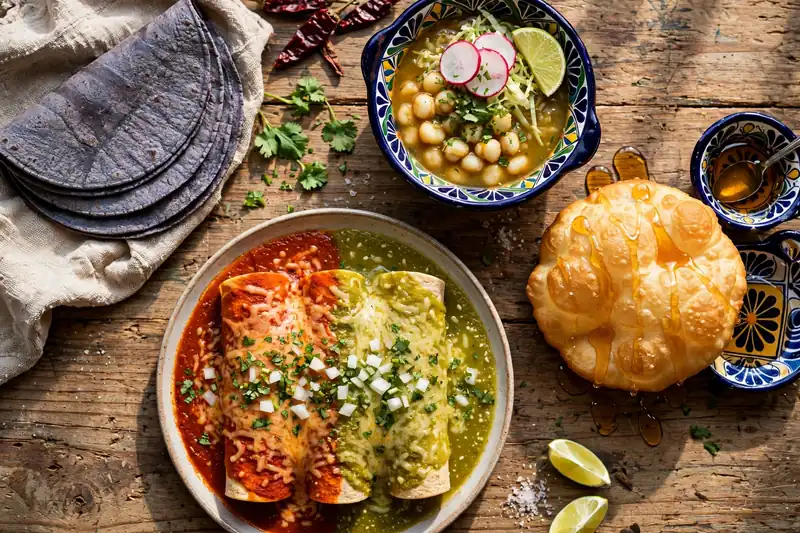
New Mexican cuisine on Wikipedia is the cuisine of the state, and its centre is the chile. Green chile is made from roasted green chiles — usually Anaheim or Hatch chiles, picked unripe and roasted until the skin blisters — and it is bright, vegetal and gently hot. Red chile is made from the same chiles left to ripen and dry, then ground and cooked into a smooth, earthy sauce. New Mexico chile on Wikipedia covers the peppers, the harvest and the heat. The question every server asks is “red or green?”, and the correct answer, if you cannot choose, is “Christmas” — half red and half green on the same plate, a combination so beloved that the state legislature made it the official state question in 1999. The dishes to order are the enchiladas, smothered in chile and topped with a fried egg; the posole, a hominy stew with pork and chile; the tamales, steamed in corn husks; and the sopapilla, a puffed fried bread served with honey to cool the heat. The chile harvest in September is the best time to eat: the roasters set up outside the markets, and the whole city smells of green chile. And the heat is real — ask for mild if you are unsure, and order the sopapilla anyway.
The Shed, Tomasita’s and Cafe Pasqual’s — where to eat it
The Shed is the restaurant to book first. It sits at 113 1/2 East Palace Avenue, a few steps from the Plaza, in a house from 1692, and it has served New Mexican food since 1953 — the oldest restaurant in Santa Fe, and the place where the red chile enchiladas are the benchmark every other restaurant is measured against. It is small, it is busy, and it does not take reservations for lunch, so arrive before noon or expect a wait. Tomasita’s, at 500 South Guadalupe Street in the old train station, has served the same food since 1974, with a bigger room, a margarita list and the same red chile — it is the local’s choice, and the sopapillas are the best in town. Cafe Pasqual’s, at 121 Don Gaspar Avenue, has been the breakfast institution since 1979, with organic ingredients, a communal table and a line out the door on weekends — the huevos rancheros with green chile are the order. For the classic frito pie — corn chips, chile and cheese in a bag — walk to the Five & Dime general store on the Plaza, where the dish was invented in the 1960s. A full New Mexican meal costs about $15 to $30 a person, and it is the best value in town.
Margaritas, breweries and fine dining
Santa Fe drinks as well as it eats. Maria’s New Mexican Kitchen, at 555 West Cordova Road, holds one of the largest margarita lists in the country — more than a hundred varieties, from the classic lime to the prickly pear — and it is the place to go after the museums close. Santa Fe Brewing Company, founded in 1988, is the oldest craft brewery in New Mexico, with a taproom and a beer garden on the south side of town; the Happy Camper IPA and the Adobe Igloo winter ale are the local favourites. For fine dining, try Geronimo, in a 1756 adobe house on Canyon Road, or Sazon, for modern Mexican food with a tasting menu. The rule that saves money everywhere in Santa Fe: the best meals are the cheap ones — the $15 enchilada plate at The Shed beats the $60 tasting menu for most visitors, and the margarita at Maria’s is the drink to remember. Eat the chile, drink the margarita, and the food budget stays sane.
Free things to do in Santa Fe
Santa Fe is far cheaper than its reputation suggests, because many of the best sights cost nothing. The Plaza is free, Canyon Road is free, the Cross of the Martyrs is free, and the Railyard is free to wander. The cathedral is free to enter, and the San Miguel Mission’s exterior and the Oldest House’s courtyard are free to see. SITE Santa Fe on Wikipedia is the contemporary art space in the Railyard, and its admission is free — it is the best free gallery in town, with large-scale exhibitions and a rooftop view. The Georgia O’Keeffe Museum is free on the first Friday of the month from 5 p.m. to 7 p.m., the New Mexico Museum of Art’s Plaza Building is free at the same hour, and the state museums are free for New Mexico residents on the first Sunday of the month. The Farolito Walk on Christmas Eve is free. Do the free list on your first day, and you will have seen the city before you have spent a dollar on a ticket.
Frequently asked questions
How many days do you need in Santa Fe?
Three days is the right amount for most visitors. Two days covers the Plaza, the museums, Canyon Road and the Railyard. Three days adds a day trip to Bandelier or Tent Rocks. Four or five days adds Ghost Ranch and Abiquiú, a day at the spa, and a slow food crawl. One day is possible, but you will leave feeling rushed and miss the desert entirely.
Is Santa Fe walkable?
The historic core is very walkable — the Plaza, the cathedral, the Loretto Chapel, the O’Keeffe Museum and Canyon Road are all within a 15-minute walk of each other, on flat streets with wide pavements. Museum Hill is two miles from the Plaza, and the Railyard is a 15-minute walk south, so the bus or a taxi covers those. The altitude makes the walking feel harder than it looks, especially the climb to the Cross of the Martyrs, so take the first day slowly.
Will the altitude affect me?
Possibly. Santa Fe sits at 7,199 feet, and visitors from sea level often feel it on the first day: a headache, shortness of breath on stairs, tired legs, and a stronger effect from alcohol. Drink more water than usual, go easy on the alcohol on the first night, eat regular meals, and do not plan a hard hike on day one. Most people adjust within 24 hours. If you have heart or lung trouble, talk to your doctor before you travel — and remember the sun: at this altitude the ultraviolet light is strong, so wear sunscreen even on a cloudy day.
Is Santa Fe expensive?
Santa Fe is a mid-range American city, not a cheap one and not a luxury one. A mid-range day costs about $150 to $300 per person, including a hotel, a meal or two and a museum ticket. The hotels are the biggest cost, at $150 to $450 a night near the Plaza, and the food is the best value — a full New Mexican meal costs $15 to $30. The free list in this guide covers the Plaza, Canyon Road, the Cross of the Martyrs, the Railyard and the cathedral without a ticket.
What is the best time to visit Santa Fe?
September to October, when the daytime highs run from 64°F to 76°F, the aspens turn gold, the chile is roasting and the festivals are on. May to June is the other sweet spot. Winter is for skiing and the Farolito Walk, and summer is for the opera — but July and August bring afternoon thunderstorms. Avoid Indian Market week and Zozobra weekend unless you have booked months ahead, because the hotels fill and the prices double.
Do I need a car in Santa Fe?
Not for downtown. The historic core is walkable, the bus costs $1 a ride, and the free shuttle covers Canyon Road. You do need a car for the day trips — Bandelier, Tent Rocks, Ghost Ranch and Ski Santa Fe all require one — so rent for a single day rather than the whole trip. The Rail Runner train covers the journey from Albuquerque airport, so you can arrive without a car and rent one only when you need it.
Further reading
Start with Santa Fe on Wikipedia, which covers the founding in 1610, the Pueblo Revolt, the Santa Fe Trail and the modern art market, and Georgia O’Keeffe on Wikipedia for the artist’s full story. For what locals actually recommend, the r/SantaFe subreddit is the community where residents answer visitor questions about restaurants, hikes and the best viewpoint — it is the best place to check a plan against local knowledge before you go. Visit Santa Fe is the official tourism site, with current event listings, the festival dates and the museum hours. No Quora link is included in this guide, because no Santa Fe-specific Quora thread could be verified as a live, useful discussion — the Wikipedia and Reddit links above cover the history and the local advice.
Your Santa Fe trip, in one paragraph
Santa Fe is the city that has been the capital of New Mexico since 1610, at 7,199 feet above sea level, and that contrast is the trip: the oldest church and the oldest public building in the country on the same streets as the newest immersive art in America, and a plate of red and green chile that no other city can cook. For more city guides in the same style, start with our Arizona guide for the desert Southwest, then see how Santa Fe compares with Chicago, Nashville, Los Angeles, Orlando, Miami, San Diego, Denver, Savannah, Dallas, Charleston, San Francisco, Myrtle Beach, Las Vegas, San Antonio, London, Portland, Pigeon Forge, Puerto Rico, Atlanta, Phoenix, Paris, Maui, Key West, Colorado Springs, Sedona, Chattanooga, Palm Springs, St Louis, Tokyo, Japan, Kansas City, Tennessee, Branson, Florida, Amsterdam, Montreal, Honolulu, Fort Lauderdale, Toronto, Aruba, Charlotte, Indianapolis, New Orleans, Destin, Santa Barbara, Mexico City, Osaka, Minneapolis, Pittsburgh, California, Asheville, Costa Rica, Hawaii, Washington DC, Seattle, St Augustine, Lisbon and Dubai.

About the Author