Things to Do in Mexico City
20 Best Attractions, a 3-Day Itinerary, Where to Stay, and the Food You Cannot Miss
Quick Info
Best for: Aztec ruins, world-class museums, street food, markets and neighbourhood wandering
Best time: November to April for dry, sunny days; late October for Day of the Dead
How long: 3 days covers the essentials; add a fourth day for Teotihuacán
Budget: Roughly MX$2,000–MX$3,500 per person per day mid-range, before hotel (about US$110–190)
Don’t miss: The Zócalo at sunset, the Anthropology Museum, Frida Kahlo’s Casa Azul, a trajinera on the Xochimilco canals and tacos al pastor
Mexico City is the biggest, oldest and most delicious capital in the Americas — an Aztec island-city buried under a Spanish colonial grid, ringed by volcanoes at 2,240 metres above sea level, and home to more museums than almost any city on earth. This guide covers the 20 best things to do in Mexico City, a 3-day itinerary that strings them together, where to stay for every budget, how to get around on five pesos, three foods you have to try, and the best free sights in town. Every price below was checked against live sources in November 2026, and where older guides get it wrong — above all on museum prices — we say so.
Mexico City at a glance
| Attraction | What it is | Price in 2026 | Where |
|---|---|---|---|
| The Zócalo | Mexico’s vast main square | Free | Centro Histórico |
| Templo Mayor | Aztec great temple ruins and museum | MX$210 foreign visitors | Zócalo, Centro Histórico |
| Palacio de Bellas Artes | Art Deco palace and murals | MX$95; free on Sundays | Alameda Central |
| Museo Nacional de Antropología | Mesoamerican archaeology | MX$210 foreign visitors | Chapultepec Park |
| Chapultepec Castle | Hilltop castle and history museum | MX$210 foreign visitors | Chapultepec Park |
| Museo Frida Kahlo | Casa Azul, Frida’s blue house | MX$320 foreign visitors | Coyoacán |
| Xochimilco canals | Trajinera boat ride | MX$750 per hour, per boat | South of the city |
| Teotihuacán | Pyramids of the Sun and Moon | MX$210 foreign visitors | About 50 km northeast |
| Basílica de Guadalupe | Pilgrimage basilica | Free | North of the city |
| Lucha libre | CMLL wrestling at Arena México | From about MX$90 | Colonia Doctores |
The 20 best things to do in Mexico City
1. The Zócalo
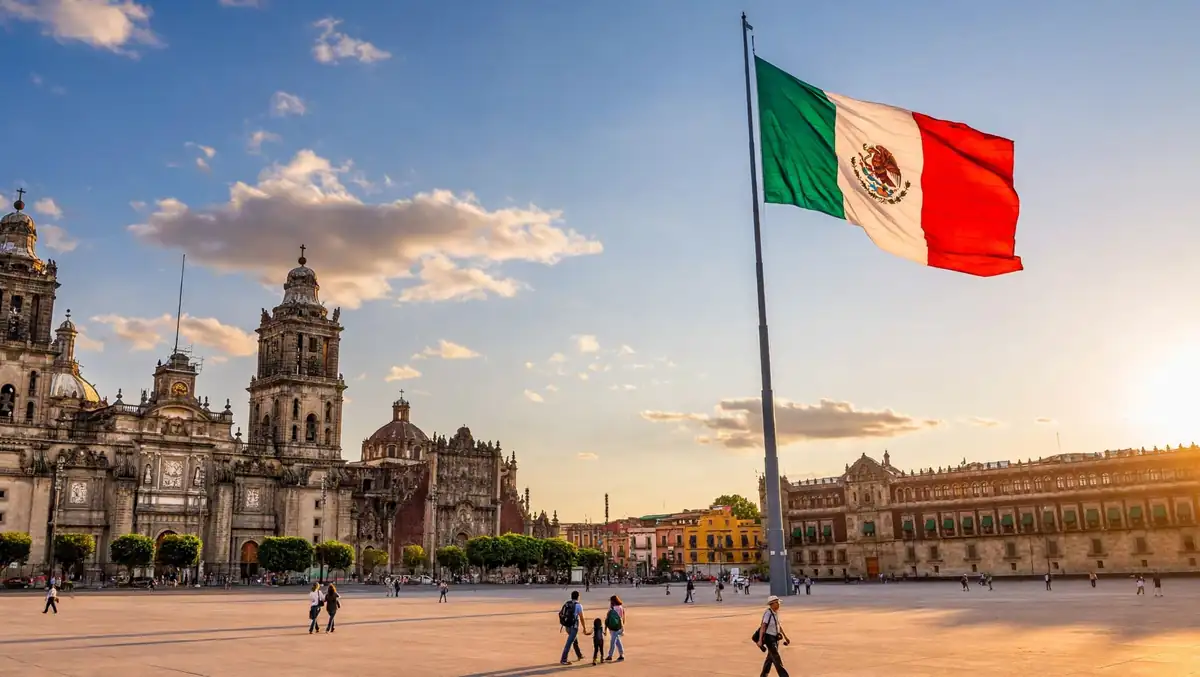
Start in the middle of everything. The Zócalo, officially the Plaza de la Constitución, is one of the largest public squares in the world — a vast stone expanse of about 57,600 square metres that has been the heart of this city since the Aztecs built Tenochtitlan on this exact spot in 1325. The Spanish levelled the Aztec capital and built their own city on top of it, and the square still works the way it always has: as the place where the whole city gathers. Come at sunset, when the light turns the cathedral gold and the giant Mexican flag — one of the largest in the country — snaps in the wind above the National Palace. At 6 p.m. most evenings, soldiers lower the flag in a short ceremony that is worth timing your visit around. The square is free and open around the clock, and it is also where the city stages its biggest free events, from the monumental Day of the Dead ofrenda to Independence Day on September 16. Read about the Zócalo on Wikipedia.
The practical facts for 2026: the Zócalo costs nothing and never closes, but it does fill up. On Sundays the square and the streets around it are at their liveliest, and during major events whole sections are fenced off for stages and crowds. The flag ceremony is free to watch from anywhere on the square, and the cathedral and the National Palace line the square’s edges, both covered below.
2. Templo Mayor
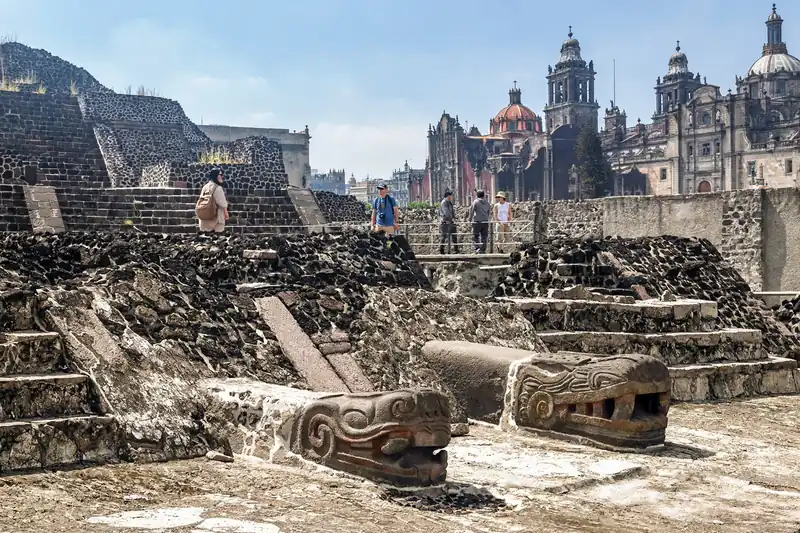
One block from the Zócalo, the ground opens up to reveal the reason this city exists. The Templo Mayor was the great temple of Tenochtitlan, the Aztec capital, and its ruins were only rediscovered in 1978 when workers digging for a power line hit a massive carved stone of the goddess Coyolxauhqui. Today you walk on raised platforms over the excavated pyramid terraces, past carved serpent heads and the remains of the twin shrines to the war god Huitzilopochtli and the rain god Tlaloc, while the cathedral towers over you from the next block — the old religion and the new one, side by side. The on-site museum is excellent, with the Coyolxauhqui stone itself, the great Aztec calendar stone’s companions, and offerings pulled from the temple’s foundations. Allow two hours: one for the ruins, one for the museum. Read about the Templo Mayor on Wikipedia.
The practical facts for 2026: this is where the new museum-price rule bites. Since January 1, 2026, foreign visitors pay MX$210 (about US$12) at every INAH Category I site, while Mexican nationals and residents pay MX$105 — and the famous free Sunday now applies only to nationals and residents, so as a foreign visitor you pay full price on Sunday too. Older guides still quote MX$85 or MX$100 and promise a free Sunday: both are out of date. The site is open Tuesday to Sunday, 9 a.m. to 5 p.m., and closed on Mondays, like almost every major museum in the city. Under-13s, students, teachers, over-60s and visitors with disabilities enter free with ID.
3. Metropolitan Cathedral
The Metropolitan Cathedral dominates the north side of the Zócalo, and it took nearly 250 years to build — from 1573 to 1813 — which is why it mixes Gothic, Baroque, Churrigueresque and Neoclassical styles in a single facade. It is the largest and oldest cathedral in the Americas, built partly from stones taken from the Templo Mayor it faces, and it is slowly sinking into the soft lakebed soil beneath the city, which is why the towers lean very slightly and the floor inside is visibly uneven. Step inside for free: the gilded Altar of the Kings, the choir stalls carved from dark wood, and the Sagrario chapel next door, a masterpiece of Mexican Baroque. The cathedral is still a working church, so visit quietly and check for services before you go. Read about the Metropolitan Cathedral on Wikipedia.
The practical facts for 2026: entry to the cathedral is free, and it is open daily, generally from around 8 a.m. to 7 p.m. Guided tours of the bell towers and the crypt run on some days for a small fee — ask at the entrance. The sinking is real and ongoing: engineers have been stabilising the building for decades, and the tilt is part of the experience, not a reason to worry. Pair it with the Templo Mayor next door and the National Palace across the square for a single morning that covers 700 years of the city’s history.
4. Palacio Nacional
The National Palace runs along the entire east side of the Zócalo, and inside it hangs the single most famous artwork in Mexico: Diego Rivera’s History of Mexico murals, painted between 1929 and 1935 across the main staircase and the second-floor corridors. The murals tell the whole story of the country in one sweeping narrative — pre-Hispanic life, the Spanish conquest, independence, revolution — and they are free to see. The palace is still the seat of the federal government and the president’s residence, so security is airport-style: bring your passport or photo ID, leave large bags behind, and expect a queue at the door. The murals alone are worth an hour; the palace gardens and the small museum of the building’s history are a bonus. Read about the National Palace on Wikipedia.
The practical facts for 2026: entry is free with photo ID, and the palace is open Tuesday to Sunday, roughly 9 a.m. to 5 p.m., closed on Mondays and on public holidays — and it can close at short notice for official events, so check on the morning you plan to go. The murals are on the second floor; photography is allowed without flash. This is one of the best free things in the city, and it is also one of the most crowded: arrive at opening time to see the murals without a tour group in front of them.
5. Palacio de Bellas Artes
The white marble Palacio de Bellas Artes, at the edge of the Alameda Central park, is the most photographed building in Mexico City — an Art Nouveau exterior that took thirty years to finish, topped by a yellow and orange tiled dome, with an Art Deco interior of red marble, bronze and a stained-glass curtain by Tiffany showing the volcanoes Popocatépetl and Iztaccíhuatl. Inside, the second floor holds the great murals of the Mexican muralist movement: Rivera, Orozco, Siqueiros and Tamayo, all in one building. The palace is also the home of the Ballet Folklórico de México, which performs on Sunday and Wednesday evenings, and the National Symphony Orchestra. Even if you skip the museum, the lobby and the ground floor are worth a look. Read about the Palacio de Bellas Artes on Wikipedia.
The practical facts for 2026: the museum costs about MX$95 (around US$5) and is open Tuesday to Sunday, 10 a.m. to 6 p.m., closed on Mondays. Here is the exception worth planning around: Bellas Artes is run by INBAL, not INAH, so it is still free to EVERYONE on Sundays — the only universal free museum day left in the city. Older guides that call it free every day are wrong; the lobby is free, the exhibitions are not. Ballet Folklórico tickets sell out — book ahead.
6. Torre Latinoamericana
For the best view in the city, go up the Torre Latinoamericana, the 44-storey skyscraper on the corner of Madero and Eje Central that was the tallest building in Latin America when it opened in 1956. The observation deck on the 44th floor gives a 360-degree panorama over the Centro Histórico — the Zócalo, the cathedral, Bellas Artes and the sprawl of the valley to the volcanoes on a clear day — and the building itself is a piece of engineering history: it survived the devastating earthquakes of 1957, 1985 and 2017 without structural damage, which is why it is a symbol of the city as much as a viewpoint. There is a small museum on the 38th floor about the tower and the city, and a bar on the 41st. Go at sunset, when the light is best and the city below starts to glow. Read about the Torre Latinoamericana on Wikipedia.
The practical facts for 2026: the observation deck costs MX$220 for adults and MX$170 for children (about US$12 and US$9), and it is open every day from 9 a.m. to 10 p.m. — one of the few major attractions that does NOT close on Mondays, which makes it the answer to a Monday in the city. The deck is at the top of a working office building, so expect a security check and a lift queue at weekends. On hazy days the volcanoes disappear; mornings after rain are the clearest.
7. Museo Nacional de Antropología
The National Museum of Anthropology, in Chapultepec Park, is one of the great museums on the planet — and the single museum you should not miss in Mexico City. Its 23 halls cover 3,000 years of Mesoamerican civilisation: the Aztec Sun Stone, the jade death mask of the Maya king Pakal from Palenque, colossal Olmec heads, the treasures of the Templo Mayor, and the reconstructed tomb of Pakal. The building itself is a masterpiece, arranged around a vast courtyard shaded by a single-column concrete umbrella fountain. The ground floor alone takes three hours; the upstairs ethnography halls, showing the living cultures of Mexico’s indigenous peoples, take another two. Do not try to see it all in one visit — pick the Aztec and Maya halls first, then the cultures of the north and west if you have the energy. Read about the National Museum of Anthropology on Wikipedia.
The practical facts for 2026: admission for foreign visitors is MX$210 (about US$12) since January 1, 2026 — older guides still quote MX$85 or MX$95, and that price is long gone. The museum is open Tuesday to Sunday, 9 a.m. to 6 p.m., and closed on Mondays. The famous free Sunday applies only to Mexican nationals and residents now; as a foreign visitor you pay full price on Sunday, and Sunday is also the most crowded day, so go on a weekday if you can. A video permit costs MX$65 if you want to film. There is a good restaurant, the Sala Gastronómica, inside the museum for lunch.
8. Chapultepec Castle
Chapultepec Castle sits on the hill at the centre of Chapultepec Park, and it is the only royal castle in the Americas — home first to viceroys, then to Emperor Maximilian and Empress Carlota in the 1860s, then to Mexican presidents until 1940. Today it is the National Museum of History, with period rooms, murals by Orozco and Siqueiros, the carriage collection, and the rooms where the Niños Héroes, the boy cadets of 1847, are remembered. The real reward is the terrace: the best free view over Paseo de la Reforma and the city skyline, with the Anthropology Museum below and the volcanoes on the horizon on a clear day. The climb up the hill takes about fifteen minutes and is the steepest part of the visit — wear comfortable shoes. Read about Chapultepec Castle on Wikipedia.
The practical facts for 2026: admission for foreign visitors is MX$210 (about US$12), the same INAH Category I rate as the Anthropology Museum and the Templo Mayor. The castle is open Tuesday to Sunday, 9 a.m. to 5 p.m., and closed every Monday of the year. The free-Sunday rule is the same as everywhere else run by INAH: free for Mexican nationals and residents, full price for foreign visitors. Pair it with the Anthropology Museum in a single Chapultepec day, and go to the castle first in the morning, when the light on the terrace is best and the hill is quietest.
9. Chapultepec Park
Bosque de Chapultepec is one of the largest urban parks in Latin America — about 678 hectares across three sections, more than twice the size of Central Park — and it has been a place of escape since Aztec times, when it was the emperors’ retreat. The first section alone holds the Anthropology Museum, the castle, the zoo, the lake with its rowing boats, the botanical garden and the Casa del Lago. The second section is quieter, with picnic lawns and the Museo de Arte Moderno and the Museo Tamayo. The third section, linked since September 2024 by Cablebús Line 3, is wilder, with hiking trails and the new Parque Aztlán amusement park. The park is free, it is open daily, and it is where the city comes to breathe on Sundays — expect families, runners, food stalls and mariachi bands. Read about Chapultepec Park on Wikipedia.
The practical facts for 2026: the park itself is free, and so is the Chapultepec Zoo inside it — open Tuesday to Sunday, 9 a.m. to 4:30 p.m., closed on Mondays — including the Anfibium, the axolotl museum, which is one of the most popular new attractions in the park. Rowing boats on the lake cost a few dozen pesos an hour. Cablebús Line 3, which opened in September 2024, links the park’s sections for MX$7 on the same transport card as the Metro. Plan one section per visit, not all three in a day.
10. Museo Soumaya
The Museo Soumaya, in Polanco, is the silver-tiled, windowless hull of a building that looks like nothing else in the city — and it is free, every day of the year. Inside are more than 66,000 works from the collection of Carlos Slim: the largest Rodin collection outside France on the top floor, European old masters, Mexican colonial painting, Dalí sculptures and pre-Hispanic art, spread over six floors connected by a single winding ramp. Start at the top with the Rodin bronzes and work your way down, which is how the building is designed to be seen. The museum is open daily, typically 10:30 a.m. to 6:30 p.m., with no Monday closure — which makes it, with the Torre Latinoamericana and the Basílica, one of the few big sights that works on a Monday. Read about the Museo Soumaya on Wikipedia.
The practical facts for 2026: admission is free, always, and there is no ticket to book — just walk in. The museum sits in Plaza Carso, next to the Museo Jumex and the aquarium, so Polanco makes a good half-day on its own. The Rodin floor is the highlight, but do not skip the Mexican art on the lower floors, which is stronger than most visitors expect. Allow about ninety minutes.
11. Museo Frida Kahlo — the Casa Azul
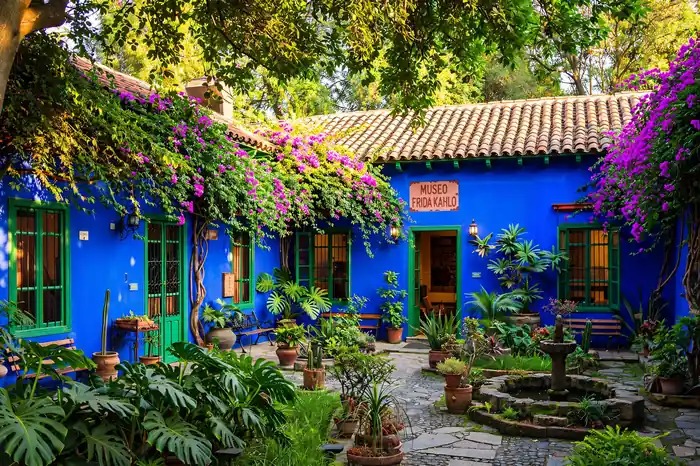
The Museo Frida Kahlo, the Casa Azul, is the most visited museum in the city and the hardest to get into — which is exactly why it needs planning. The cobalt-blue house in Coyoacán is where Frida Kahlo was born, lived most of her life and died in 1954, and it holds her paintings, her personal objects, her studio, her wheelchair, her dresses and the garden where she and Diego Rivera entertained the artists and revolutionaries of the twentieth century. It is a house, not a gallery, and it is small: allow ninety minutes, and expect a crowd even with a timed ticket. The garden, the kitchen with its yellow tiles and the studio with her easel are the rooms that stay with you. Read about the Frida Kahlo Museum on Wikipedia.
The practical facts for 2026: this is the single most important booking rule in this guide. Tickets are sold ONLINE ONLY through the museum’s own booking system — there is no ticket office at the door, and people turn up every day to find that out. General admission for foreign visitors is MX$320 (about US$17), plus a MX$16 service charge on the official site; Mexican nationals pay MX$160 with ID. The museum is closed on Mondays; it opens Tuesday and Friday to Sunday from 10 a.m. to 6 p.m., Wednesday from 11 a.m., and Thursday until 9 p.m. Timed tickets regularly sell out days or weeks ahead, especially at weekends — book before you book your flights. Your ticket also admits you to the Museo Diego Rivera-Anahuacalli as a courtesy, valid for a month.
12. Coyoacán
Coyoacán, in the south of the city, is the neighbourhood that feels least like a megacity and most like a colonial town — and it was one, until Mexico City swallowed it. Cobblestone streets, low colonial houses painted in ochre and blue, the Jardín Centenario with its coyote fountain, the Jardín Hidalgo, the sixteenth-century church of San Juan Bautista, and the Mercado de Coyoacán, where the tostada stalls are a destination in themselves. This is also where Frida Kahlo and Diego Rivera lived, where Leon Trotsky was assassinated in 1940 (his house is now a museum, the Museo Casa de León Trotsky), and where the city’s artists and writers still gather in the cafés around the squares. Coyoacán is free to wander, and it is best on a Saturday or Sunday morning, when the squares fill with families, street performers and market stalls. Read about Coyoacán on Wikipedia.
The practical facts for 2026: Coyoacán is about 45 minutes by Metro and light rail from the Centro, or 25 minutes by Uber outside rush hour. The Frida Kahlo Museum is here, so book it first and build the neighbourhood around your timed slot. The Mercado de Coyoacán is the place to eat: tostadas, tlacoyos and fresh juices from the market stalls. The Museo Casa de León Trotsky is a short walk from the squares and is open Tuesday to Sunday. Coyoacán is one of the safest and most walkable parts of the city, and it is the best base if you want quiet streets rather than a hotel district.
13. Xochimilco canals
Xochimilco, in the far south of the city, is the last surviving piece of the lake system the Aztecs built their city on — a UNESCO World Heritage site of canals, floating gardens called chinampas, and brightly painted flat-bottomed boats called trajineras. You hire a boat, a boatman poles it along the canals, and mariachi bands, food boats and flower sellers come alongside. It is loud, colourful and completely unlike the rest of the city, and it is the best half-day out of the centre. Go in the morning, when the canals are quieter and the light is best, or at sunset for the party atmosphere. The chinampas are still farmed, and some of the best food in the city is grown on them. Read about Xochimilco on Wikipedia.
The practical facts for 2026: trajineras are priced PER BOAT, PER HOUR, not per person — the official rate is MX$750 an hour for the boat, which takes up to about eighteen people, so a group of twelve pays about MX$62 each. Agree the price and the length of the trip before you set off, and use the official embarcaderos such as Nativitas or Cuemanco, where the rates are posted. Older guides quote MX$400 or MX$500 an hour: those rates are out of date. Get there on the Tren Ligero light rail from Tasqueña, which the World Cup rebuild modernised in 2026, and allow half a day including the journey. The Museo Dolores Olmedo, which reopened at its original site in La Noria, Xochimilco, on May 30, 2026 after more than five years closed, is a short ride from the canals and pairs well with a morning here.
14. Teotihuacán
Teotihuacán, about 50 kilometres northeast of the city, is the greatest ancient city in the Americas — a UNESCO site of pyramids, temples and avenues built around 100 BC, centuries before the Aztecs, and abandoned long before they arrived. The Avenue of the Dead runs for two kilometres between the Pyramid of the Sun, one of the largest pyramids in the world, and the Pyramid of the Moon, past the Ciudadela and the Temple of the Feathered Serpent. It is a full half-day out of the city, and it is the one day trip no first visit should skip. Go early: the site opens at 9 a.m., the sun is fierce by midday, and there is almost no shade on the avenue. Read about Teotihuacán on Wikipedia.
The practical facts for 2026: admission for foreign visitors is MX$210 (about US$12), the same INAH rate as the city museums, and the site is open every day of the year — which makes it the answer to a Monday, when the museums close. The cheapest way there is the bus from Sala 8 of the Terminal del Norte, about MX$60 each way. Here is the trap most guides still get wrong: you CANNOT climb the Pyramid of the Sun — climbing has been closed since 2020 — and access to the Pyramid of the Moon has changed during 2026, so check the current INAH notice on the day rather than trusting a guide that promises a climb. Buy tickets only at the site box offices or through INAH’s own channel; the tour touts at the bus station are not the official price. One ticket covers the whole zone including the on-site museums.
15. Basílica de Guadalupe
The Basílica de Guadalupe, north of the centre, is one of the most visited Catholic pilgrimage sites on earth — about 20 million visitors a year come to see the tilma, the cloak of Juan Diego bearing the image of the Virgin of Guadalupe, which hangs above the altar of the modern basilica built in the 1970s. The old basilica, sinking into the lakebed like the cathedral, stands beside it, and the hill of Tepeyac, where the Virgin is said to have appeared in 1531, rises behind the complex with a chapel at the top. Whether or not you are Catholic, the scale of the devotion is extraordinary, and December 12, the feast of Our Lady of Guadalupe, brings millions of pilgrims on foot from across the country. Entry is free, the basilica is open daily, and it is one of the few major sights that does not close on Mondays. Read about the Basilica of Guadalupe on Wikipedia.
The practical facts for 2026: the basilica is free and open every day, generally from early morning to evening. It is about 30 minutes by Metro from the Centro — take Line 6 to Martín Carrera or the Metrobús to the Basílica stop. Dress respectfully, keep voices down inside, and use the moving walkway that passes beneath the tilma rather than blocking the altar. If you visit on December 12, expect crowds in the millions and plan your transport carefully; on any other day it is calm and easy.
16. Roma Norte and Condesa
Roma Norte and Condesa, west of the Centro, are the neighbourhoods where most visitors end up spending their evenings — and where many wish they had stayed. Roma Norte is Art Deco and Art Nouveau mansions, bookshops, mezcal bars and some of the best restaurants in the city, centred on Plaza Luis Cabrera and the streets around Colima and Orizaba. Condesa, across Avenida de los Insurgentes, is greener and quieter: the oval Parque México and the smaller Parque España, the tree-lined Avenida Ámsterdam — a former race track, which is why it is an oval — and the cafes and ice-cream shops that fill it. Both are flat, leafy and walkable, and both are at their best in the late afternoon, when the light is golden and the terraces fill. Read about Roma Norte on Wikipedia.
The practical facts for 2026: Roma and Condesa are free to wander and safe by day and evening, and they are the best places in the city to eat without a plan — just walk and follow the crowds. The Metro stations are Insurgentes, Sevilla and Chapultepec on Line 1, which fully reopened on November 16, 2025 after a three-year rebuild of all twenty stations. Ecobici, the city’s bike-share, has stations all over both neighbourhoods; a day pass costs MX$134. These are also the two neighbourhoods where a street taco at midnight is a normal part of the evening, not an adventure.
17. Lucha libre at Arena México
Lucha libre — Mexican masked wrestling — is the loudest, funniest and most Mexican night out in the city, and Arena México, the “Cathedral of Lucha Libre”, has been staging it since 1956. The Consejo Mundial de Lucha Libre, the world’s oldest active wrestling organisation, runs the shows: masked técnicos (the good guys) against rudos (the bad guys), high-flying dives, dramatic betrayals and a crowd that treats it all with complete seriousness and complete joy. The arena seats about 16,500 people, the beer is cheap, the masks on sale outside are the souvenir, and you do not need to know anything about wrestling to love it. Read about lucha libre on Wikipedia.
The practical facts for 2026: Arena México runs three nights a week — Tuesdays at 7:30 p.m., Fridays at 8:30 p.m. and Sundays at 5 p.m. — and Friday is the big night, with the best wrestlers and the biggest crowd. Tickets start from about MX$90 in the upper bleachers and run to roughly MX$670 for ringside, bought at the box office on the day or through Ticketmaster México; the special anniversary show in September sells out in advance. The arena is in Colonia Doctores, about a ten-minute walk from the Metro, and the neighbourhood is quiet at night — take an Uber or DiDi back to your hotel rather than walking. A guided lucha libre night with tacos and beer beforehand is the easiest way to do it as a first-timer.
18. Mercado de Coyoacán and Mercado Roma
Mexico City’s markets are where the city actually eats, and two of them are worth a visit on their own. The Mercado de Coyoacán, in the heart of the old town, is a traditional market of tostada stalls, flower sellers, fruit juice stands and craft stalls — the tostadas here, piled high with tuna, ceviche or pata, are famous across the city, and the market is at its best on a Saturday morning. Mercado Roma, in Roma Norte, is the opposite: a gourmet food hall in a converted market building, with stalls for tacos, ramen, oysters, mezcal, craft beer and pastries under one roof, plus a rooftop beer garden. Between them they cover both halves of the city’s food culture — the market stall and the food hall — and both are free to browse. The Mercado de la Merced, the city’s biggest wholesale market, is a different experience: vast, chaotic and not aimed at tourists, so save it for a second visit.
The practical facts for 2026: both markets are open daily, generally from morning to early evening, and both take cash and cards — though the small stalls in Coyoacán prefer cash, so bring pesos. Eat at the stalls where the locals queue, not the ones with the biggest signs. A tostada at the Coyoacán market costs a few dozen pesos; a full lunch at Mercado Roma runs a few hundred. Neither market needs a booking, and neither is a place to rush: allow an hour for each, and go hungry.
19. Museo Dolores Olmedo
The Museo Dolores Olmedo is the comeback story of 2026. The museum, holding one of the great collections of Diego Rivera and Frida Kahlo — including Rivera’s portraits of Dolores Olmedo herself — closed its old home in Xochimilco years ago and reopened at its original site in La Noria, Xochimilco, on May 30, 2026, after more than five years closed. The house and gardens, with their peacocks and xoloitzcuintli dogs wandering the lawns, are as much the attraction as the paintings, and the collection includes pre-Hispanic art, folk art and the largest collection of Rivera’s work anywhere. It is the museum most 2026 guides still list as closed — because it was, until May — and it is now one of the best reasons to go south of the city. Read about the Museo Dolores Olmedo on Wikipedia.
The practical facts for 2026: the museum is in La Noria, Xochimilco, a short ride from the canal embarcaderos, so pair it with a Xochimilco morning. It is open Tuesday to Sunday; check the current hours and admission on the museum’s own site before you go, because the reopening programme is still settling in and prices are not yet fixed in the guidebooks. Allow two hours, and go for the gardens as much as the paintings — the peacocks are not a gimmick, they really do wander the lawns.
20. Paseo de la Reforma and the Ángel de la Independencia
Paseo de la Reforma is the city’s grand boulevard, running from Chapultepec Park to the Centro, and the Ángel de la Independencia — the golden winged Victory on its tall column — is the symbol of the city. The boulevard is lined with skyscrapers, embassies, the Diana Cazadora fountain and the giant alebrijes that stand along it in autumn, and it is the route of the city’s great parades: Independence Day, the Day of the Dead Gran Desfile and the Pride march. The best time to see it is on a Sunday morning, when the Muévete en Bici programme closes Reforma and other main roads to cars and the whole city comes out on bicycles, skates and foot — it is the most joyful hour of the week in Mexico City, and it is free. Read about the Ángel de la Independencia on Wikipedia.
The practical facts for 2026: Reforma is free to walk at any time, and the Sunday closure typically runs from about 8 a.m. to 2 p.m. — check the route on the day, because parade and event closures change it. Ecobici bikes are available all along the route, and the Ángel is a short walk from the Insurgentes or Sevilla Metro stations. The Day of the Dead Gran Desfile ran along Reforma on Saturday, October 31, 2026 — the parade’s tenth year — drawing 1.6 million spectators to the boulevard and the Zócalo, with the monumental ofrenda in the Zócalo standing from October 29 to November 2. If you are planning for 2027, the parade falls in the same late-October window and the city announces the date in the summer.
Mexico City in 3 days — a ready-made itinerary
| Day | Morning | Afternoon | Evening |
|---|---|---|---|
| Day 1 — Centro Histórico | Zócalo, Templo Mayor, Cathedral and Palacio Nacional | Bellas Artes, Torre Latinoamericana, Alameda Central | Roma Norte dinner, or lucha libre at Arena México on a Friday |
| Day 2 — Chapultepec and Polanco | Museo Nacional de Antropología | Chapultepec Castle, Chapultepec Park and Cablebús Line 3 | Museo Soumaya and dinner in Polanco |
| Day 3 — Coyoacán and Xochimilco | Museo Frida Kahlo, booked weeks ahead | Coyoacán squares, market and Trotsky house | Xochimilco trajinera at sunset |
Day 1 — Centro Histórico
Start at the Zócalo before the crowds — the flag ceremony is in the evening, but the square is quietest in the morning, and the light on the cathedral is best then. Walk the Templo Mayor ruins and the cathedral, then the Rivera murals in the Palacio Nacional with your passport in hand. After lunch, cross to Bellas Artes and the Torre Latinoamericana for the view, and finish the day in Roma Norte, where the restaurants and mezcal bars are a ten-minute Uber away. If it is a Friday, swap dinner for lucha libre at Arena México at 8:30 p.m. — and remember that Monday is the wrong day for this plan, because the Templo Mayor, the Palacio Nacional and Bellas Artes are all closed.
Day 2 — Chapultepec and Polanco
Spend the morning at the Anthropology Museum — arrive at the 9 a.m. opening and go straight to the Aztec hall before the school groups arrive. After lunch in the museum restaurant, climb to Chapultepec Castle for the terrace view, then ride Cablebús Line 3 across the park’s sections for seven pesos. Finish the day in Polanco at the free Museo Soumaya, and have dinner on Avenida Presidente Masaryk, the city’s smartest shopping street. This is the easiest day in the guide, because everything is inside one park and one neighbourhood.
Day 3 — Coyoacán and Xochimilco
Your Frida Kahlo ticket is timed, so build the day around it — book the first slot of the morning and arrive in Coyoacán early. After the Casa Azul, wander the squares, eat tostadas at the Mercado de Coyoacán and visit the Trotsky house, then take the Tren Ligero south to Xochimilco for a late-afternoon trajinera, when the canals are golden and the mariachi bands are out. Add a fourth day for Teotihuacán if you have it: the bus from Terminal del Norte leaves from early morning, and the site is open every day, including Mondays.
Best time to visit Mexico City
Mexico City’s seasons are defined by rain, not temperature: at 2,240 metres, average highs stay between 22°C and 28°C all year and nights are cool, so the question is whether it rains in the afternoon. The dry season runs from November to May, and the best months are November to April, with sunny days, clear skies and the clearest views of the volcanoes. The rainy season runs from May to October, with short, heavy afternoon downpours that clear the air and empty the streets — and cheaper hotels. December and January are the coolest months, with cold nights, and February to May is the smoggiest, when the dry air traps pollution over the valley.
| Season | Weather | Crowds | Notes |
|---|---|---|---|
| Dry season (November–April) | Sunny, highs 22–25°C, cool nights | High in December | Best weather; clearest volcano views; Day of the Dead Oct 31–Nov 2 |
| Rainy season (May–October) | Afternoon storms, highs 24–28°C | Lower | Lush parks; cheaper hotels; carry a rain jacket |
| Winter (December–February) | Coolest, highs 20–23°C, cold nights | High at Christmas | Day of the Dead season ends; Posadas in December |
| Spring (March–May) | Warm, dry, smoggiest | Moderate | Jacarandas bloom purple in March; Holy Week crowds |
Two dates to plan around. The Day of the Dead season runs from late October to November 2: the Gran Desfile on October 31, the Mega Procesión de Catrinas on October 25, the monumental ofrenda in the Zócalo and the candlelit vigil at Mixquic on the night of November 2. In 2026 the parade drew 1.6 million spectators, so book hotels months ahead if you are coming for it. Independence Day, September 16, fills the Zócalo with the Grito ceremony the night before, and it is the biggest party of the year. One more note on 2026: the FIFA World Cup opened at the Estadio Azteca on June 11, 2026 and brought more than four million visitors to the city, with hotel prices to match — the tournament is over now, the light rail to Xochimilco was rebuilt for it, and prices have settled back to normal.
Where to stay in Mexico City
Mexico City is enormous, so the choice of neighbourhood matters more than the choice of hotel. Most visitors stay in Roma Norte, Condesa or the Centro Histórico, with Polanco for luxury and Coyoacán for quiet. The Centro is best for a first visit with a short stay; Roma and Condesa are best for a longer one, because that is where the restaurants and the evening life are.
| Area | Best for | Price per night in 2026 | Getting around |
|---|---|---|---|
| Centro Histórico | First-timers, history | MX$1,500–MX$3,500 | Walk to the Zócalo; Metro everywhere |
| Roma Norte | Foodies, walkers | MX$1,800–MX$4,000 | Metro Line 1; walkable streets |
| Condesa | Parks, calm, families | MX$1,800–MX$4,000 | Parque México on the doorstep |
| Polanco | Luxury, museums | MX$3,000–MX$7,000+ | Museo Soumaya; Metro Line 7 |
| Coyoacán | Quiet, colonial, longer stays | MX$1,200–MX$3,000 | Metro and light rail; 45 minutes to the Centro |
Book early for the big weekends — Day of the Dead in late October, Independence Day in mid-September and the film and food festivals in spring fill the city, and prices rise sharply. If you are visiting in summer, a hotel with air conditioning is worth real money, because the rainy-season afternoons are humid. For a first visit, stay between Roma Norte and the Centro: everything on this list is reachable from there, and you will only need a car — or rather an Uber — for Teotihuacán and the airport.
Getting around Mexico City
Mexico City’s public transport is the cheapest in any major capital, and it is the fastest way to beat the traffic. The Metro costs MX$5 flat — any distance, any number of transfers — and the Metrobús costs MX$6, except Line 4 to the airport, which costs MX$30 and takes no cash. The Cablebús, the aerial cable car that floats over the city, costs MX$7, and Line 3 links the sections of Chapultepec Park. Everything runs on a single rechargeable card, the Tarjeta de Movilidad Integrada, which costs about MX$15 from a station machine and works on the Metro, Metrobús, Cablebús, Tren Ligero light rail, trolleybus and RTP buses. Paper tickets stopped being sold in March 2024, so the card is not optional. Load MX$150 to MX$300 on arrival. Read about the Mexico City Metro on Wikipedia.
The Metro runs from 5 a.m. to midnight on weekdays, 6 a.m. on Saturdays and 7 a.m. on Sundays and holidays, and it is extremely crowded at rush hour — the front carriages are reserved for women and children. Metro Line 1, the pink line from Pantitlán to Observatorio, fully reopened on November 16, 2025 after a three-year rebuild of all twenty stations. For anything the Metro does not reach, Uber and DiDi are cheap and are the safest way to travel at night; a ride across Roma to Condesa runs about MX$60 to MX$120, and an authorised airport taxi to Roma or Condesa costs around MX$300 to MX$380 — buy the ticket at the official booths inside the terminal, never from a tout. From Benito Juárez International Airport, Metrobús Line 4 runs to the Centro for MX$30, card only. You do not need a car in Mexico City, and you do not want one: the traffic is among the worst in the world, and parking in the Centro is scarce.
Mexico City food you have to try
Mexico City may be the best food city in the Americas. Street stalls, markets, fondas and some of the best restaurants on the planet all coexist in the same few square kilometres, and the Michelin Guide’s arrival in 2024 confirmed what locals already knew: a taco stand can be as good as a tasting menu. The food below is the starting point, not the whole story — the real rule is to eat where the locals queue.
Tacos al pastor
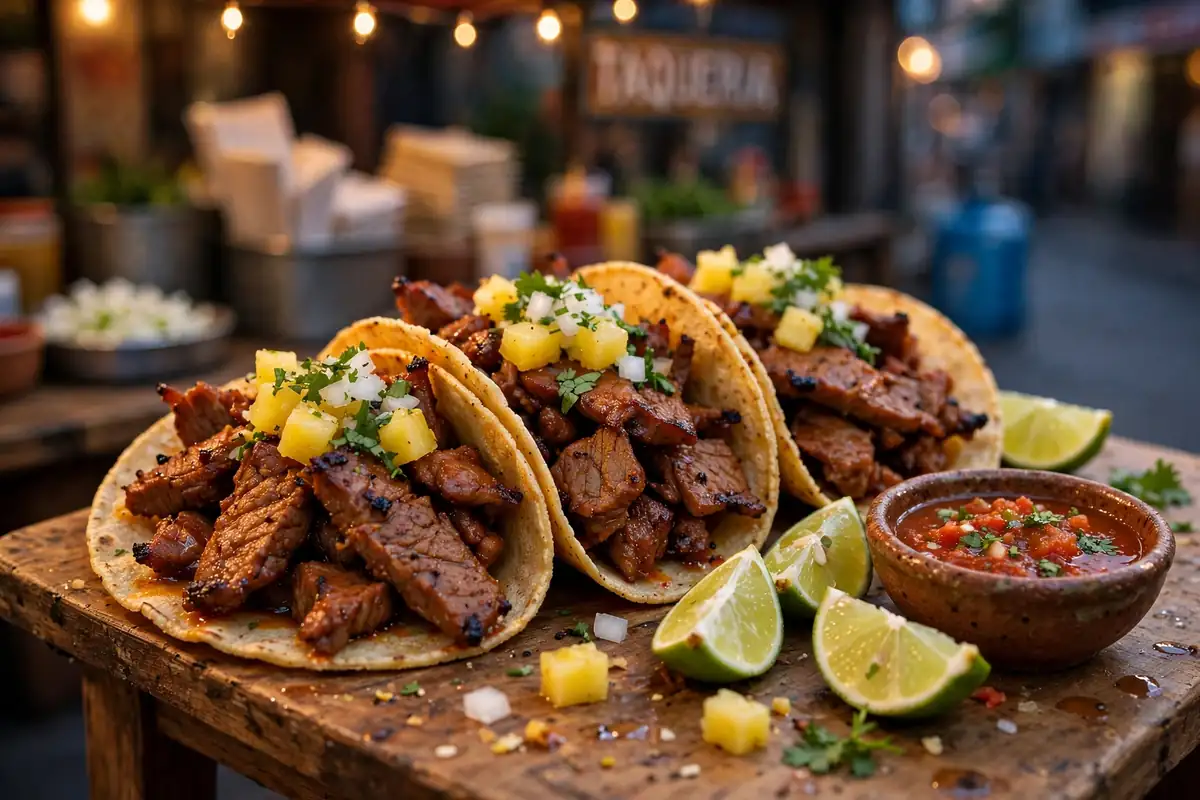
Tacos al pastor are the dish of Mexico City: thin slices of pork marinated in achiote and chillies, shaved off a vertical trompo spit, served on small corn tortillas with diced pineapple, chopped onion and cilantro, and eaten standing up at a counter at midnight. The dish arrived with Lebanese immigrants in the 1930s and became entirely Mexican, and the best ones are at the taquerías that never close — El Huequito, in the Centro since 1959, and El Califa de León in San Rafael, which in 2024 became the first taco counter in the world to earn a Michelin star. In the 2026 Michelin guide the star passed to the taquería Once Mil, which tells you how seriously this city takes its tacos. A taco costs about MX$30 to MX$60, and three or four make a meal. Read about tacos al pastor on Wikipedia.
Mole
Mole is Mexico’s great sauce — a dark, complex blend of chillies, chocolate, nuts, seeds and spices that takes a day to make and a lifetime to perfect — and Mexico City is the best place to taste it, because the city’s fondas serve the moles of every region. Order mole poblano, the dark chocolate-chilli sauce from Puebla, over chicken or turkey at a traditional fonda, or mole negro from Oaxaca if you find it on a menu. The best mole is not in the fine-dining restaurants, though they serve it well: it is in the neighbourhood fondas, the family-run lunch counters where the menu changes daily and the mole has been made the same way for decades. A plate of mole at a fonda is one of the best-value meals in the city, and it is the dish to order when you want to understand why Mexican food is on UNESCO’s list of the world’s intangible heritage. Read about mole on Wikipedia.
Churros and hot chocolate at El Moro
For the city’s most famous sweet, go to Churrería El Moro, the churro shop that has been frying them since 1935 on the corner of Eje Central and the Alameda. The churros are made to order — crisp outside, soft inside, rolled in sugar and cinnamon — and they are served with thick Mexican hot chocolate, made with real chocolate and milk, for dipping. There are now several El Moro branches around the city, but the original on Eje Central is the one to visit, especially late at night, when the queue is part of the experience. A churro and a chocolate cost a few dozen pesos, and it is the cheapest famous meal in Mexico City. Read about churros on Wikipedia.
Free things to do in Mexico City
Mexico City is generous with free things to do, and you can fill a whole day without spending a peso. The Zócalo, Chapultepec Park, the Roma and Condesa streets, the Paseo de la Reforma on a Sunday morning and the Basílica de Guadalupe are all free. The Diego Rivera murals in the Palacio Nacional are free with photo ID, the Museo Soumaya is free every day, the Chapultepec Zoo is free, and the Palacio de Bellas Artes is free to everyone on Sundays — as are the Museo Tamayo and the Museo de Arte Moderno. The flag ceremony in the Zócalo at 6 p.m., the Sunday bike ride on Reforma, the markets and the parks cost nothing, and the best view in the city from the top of Chapultepec Castle’s hill is free once you are in the park — only the castle museum itself charges. The Biblioteca Vasconcelos, the vast public library with a whale skeleton hanging inside, is free and is one of the most photographed interiors in the city.
Frequently asked questions
Is Mexico City safe to visit?
Yes, with the same caution you would use in any big city. The US State Department rates Mexico City at Level 2, “exercise increased caution”, and the main visitor areas — the Centro Histórico, Roma, Condesa, Polanco, Coyoacán and Chapultepec — are generally safe with sensible precautions. Stick to those neighbourhoods, use Uber or DiDi instead of hailing taxis off the street at night, keep your phone out of sight in busy areas, and do not flash valuables. Petty crime, especially phone theft on the Metro and in crowded markets, is the main risk. Security operations in February 2026 prompted temporary shelter-in-place orders in several Mexican cities, but the US Embassy lifted its final security alert on February 25, 2026, and the city has been operating normally since.
How many days do you need in Mexico City?
Three days covers the essentials: one day for the Centro Histórico, one for Chapultepec and Polanco, and one for Coyoacán and Xochimilco. Add a fourth day for Teotihuacán, and a fifth if you want a slower day in Roma and Condesa, a food tour and a night of lucha libre. A single day is possible but you will only scratch the surface — the museums alone could fill a week. Four days is the right length for a first visit.
Can you visit Mexico City without a car?
Yes, and you should. The Metro costs MX$5 a ride, the Metrobús MX$6 and the Cablebús MX$7, all on one rechargeable card, and Uber and DiDi are cheap for the gaps. The only places that need a car or a tour are Teotihuacán, which is an hour away by bus, and the southern canals, which are reached by light rail anyway. If you fly into Benito Juárez airport, the Metrobús Line 4 runs to the Centro for MX$30.
What is the best time to visit Mexico City?
November to April is the best time: dry, sunny days, cool nights and the clearest views of the volcanoes. Late October to November 2 is the Day of the Dead season, the biggest event of the year, and September 16 is Independence Day. The rainy season, May to October, brings afternoon storms but fewer crowds and cheaper hotels. Avoid planning your museum days for a Monday — almost every major museum in the city is closed on Mondays.
Is Mexico City expensive?
Mexico City is good value but no longer cheap where most visitors stay. A mid-range traveller spends roughly MX$2,000 to MX$3,500 per person per day (about US$110–190) before hotel, on food, transport and admissions — the museums alone add up to about MX$1,300 for the classic three days. Street food is the bargain: tacos at MX$30–60 each, market lunches for a few hundred pesos. Hotels in Roma and Polanco are the biggest cost, and they rise sharply on festival weekends. Budget travellers manage on MX$1,000–1,400 a day; comfortable travel runs MX$4,500–7,000.
Do you need cash in Mexico City?
Yes, some. Cards are widely accepted in restaurants, hotels and shops, but the markets, street stalls, small fondas and the Metro top-up machines work best with pesos — bring cash for tacos, tostadas and tips. ATMs are everywhere, including inside the airport, and they give the best rate if you decline the conversion they offer. The visitor fee, the derecho de no residente, is MX$983 in 2026 and is normally built into your air fare — it rises to MX$1,158 on January 1, 2027. Tipping is 10–15% in restaurants, a few pesos for baggers and bathroom attendants, and nothing is added automatically.
Further reading — Wikipedia, Reddit and Quora
For more background on the city, read about Mexico City on Wikipedia, Tenochtitlan on Wikipedia and Frida Kahlo on Wikipedia. For local tips and current conditions, the Mexico City subreddit is the city’s active community forum. For a first-timer’s view, read the Quora thread on travelling to Mexico City alone as an American, with advice on Chapultepec Castle, Coyoacán and Xochimilco.
Your Mexico City trip, in one paragraph
Mexico City is the rare capital that does everything at once: an Aztec city buried under a colonial one, the greatest anthropology museum on the planet, a blue house in Coyoacán that the whole world queues for, canals where mariachi bands float past your boat, and tacos that earned a Michelin star — all of it crossed by a five-peso Metro, in three days, without ever feeling rushed. If this trip has whetted your appetite for more cities, our guides to Chicago, Nashville, Los Angeles, Orlando, Miami, San Diego, Denver, Savannah, Dallas, Charleston, San Francisco, Myrtle Beach, Las Vegas, San Antonio, London, Portland, Pigeon Forge, Puerto Rico, Atlanta, Phoenix, Paris, Maui, Key West, Colorado Springs, Sedona, Chattanooga, Palm Springs, St Louis, Tokyo, Japan, Kansas City, Tennessee, Branson, Florida, Amsterdam, Montreal, Honolulu, Fort Lauderdale, Toronto, Aruba, Charlotte, Indianapolis, New Orleans, Destin and Santa Barbara cover the rest of the Americas and beyond — pick your next city and start planning.

About the Author