Things to Do in Toronto
20 Best Attractions, a 3-Day Itinerary, Where to Stay, and the Food You Cannot Miss
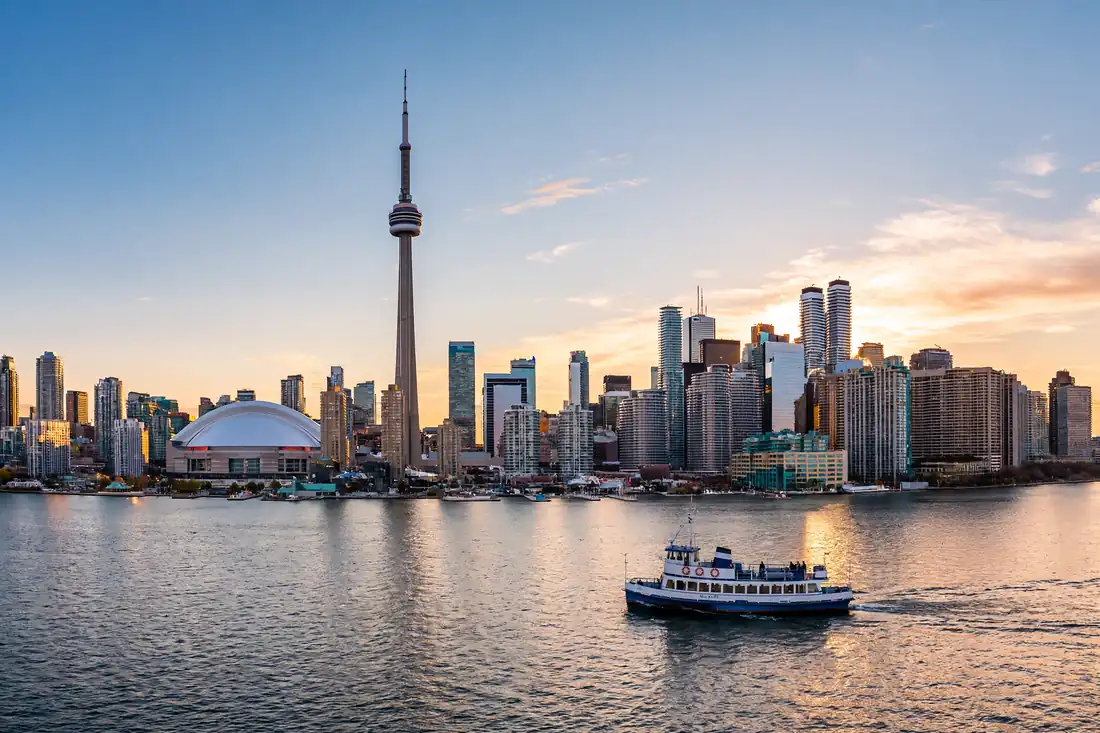
Quick Info
Best for: First-time visitors, families, food lovers and skyline chasers
Best time: Late May to June, and September to early October
How long: 3 full days (4 with a Niagara Falls day trip)
Budget: About C$150–C$220 per person per day, mid-range, before your hotel
Don’t miss: The CN Tower at sunset, a ferry to the Toronto Islands, a peameal bacon sandwich at St. Lawrence Market, the Distillery District after dark, High Park in cherry blossom season
Toronto is Canada’s largest city and its most surprising one: a 553-metre tower, a castle on a hill, two world-class museums, a car-free island chain ten minutes by ferry and more than 200 languages spoken across its neighbourhoods. This guide covers the 20 best things to do in Toronto, with honest 2026 prices and the traps outdated guides still fall into. Use the 3-day itinerary to plan your days, the where to stay section to pick a neighbourhood, and the how to get around notes to ride the TTC like a local — then finish with the three foods every visitor should taste and the free sights that cost nothing at all.
Toronto sits on the north shore of Lake Ontario, about 130 kilometres from Niagara Falls and a 90-minute flight from New York. Most visitors stay downtown, where the CN Tower, the aquarium, the Hockey Hall of Fame and the ferry terminal sit within a ten-minute walk of Union Station, and the big museums are one subway ride north. Come in late spring or early autumn for the best weather, book the tower and the islands ferry a day or two ahead in summer, and carry a card that taps — cash is the slow way to pay for almost everything in this city.
Toronto at a glance
| Attraction | What it is | Adult price in 2026 | Nearest TTC stop |
|---|---|---|---|
| CN Tower | 553-metre tower with observation decks | C$47 timed entry | Union (Line 1) |
| Ripley’s Aquarium of Canada | Aquarium at the foot of the CN Tower | From about C$44 | Union (Line 1) |
| Royal Ontario Museum | Canada’s largest museum | From about C$26 | Museum (Line 1) |
| Art Gallery of Ontario | 120,000 works in a Gehry building | C$30 | St. Patrick (Line 1) |
| Casa Loma | Gothic Revival castle | C$45 | Dupont (Line 1) |
| Hockey Hall of Fame | Hockey’s shrine and the Stanley Cup | C$29.95 | King or Union (Line 1) |
| Toronto Zoo | 3,000 animals on 287 hectares | From about C$35 | Scarborough, by bus |
| Toronto Islands ferry | Car-free islands with the best skyline view | C$9.57 return | Union, then a short walk |
| St. Lawrence Market | Historic food hall | Free to enter | King (Line 1) |
| Distillery District | Car-free Victorian brick quarter | Free to enter | King (Line 1) |
The 20 best things to do in Toronto
1. CN Tower
The CN Tower is the one sight no Toronto trip skips, and in 2026 it is worth more than it has been in years: the tower turned 50 this year, and its Lower Observation Level reopened in January 2026 after a C$21 million renovation. The tower stands 553 metres tall and held the title of the world’s tallest freestanding structure for over three decades. The timed general admission ticket costs C$47 for adults (14–64), C$34 for seniors and youth 6–13, and C$18 for children 3–5, plus tax, and it covers the LookOut level at 346 metres, the famous Glass Floor and the Outdoor SkyTerrace at 342 metres. The Top, the old SkyPod at 447 metres, costs C$12 extra on the day or C$59 bundled with admission. Read about the CN Tower on Wikipedia before you go, then book a timed slot online a day or two ahead — tickets go on sale 30 days out and summer weekends sell out. The tower is open 9:30 a.m. to 11 p.m. daily, with last entry at 9 p.m. Go at sunset if you can: the light over Lake Ontario is the city’s best free upgrade, and the revolving 360 Restaurant one floor down is the splurge version of the same view. The EdgeWalk, a hands-free walk on a 1.5-metre-wide ledge at 356 metres, runs from about C$199 plus tax in the warmer months and needs its own booking. The trap to avoid: older guides quote C$43 for admission. The 2026 price is C$47, and the walk-up price can be higher than the online price, so book ahead.
2. Toronto Islands
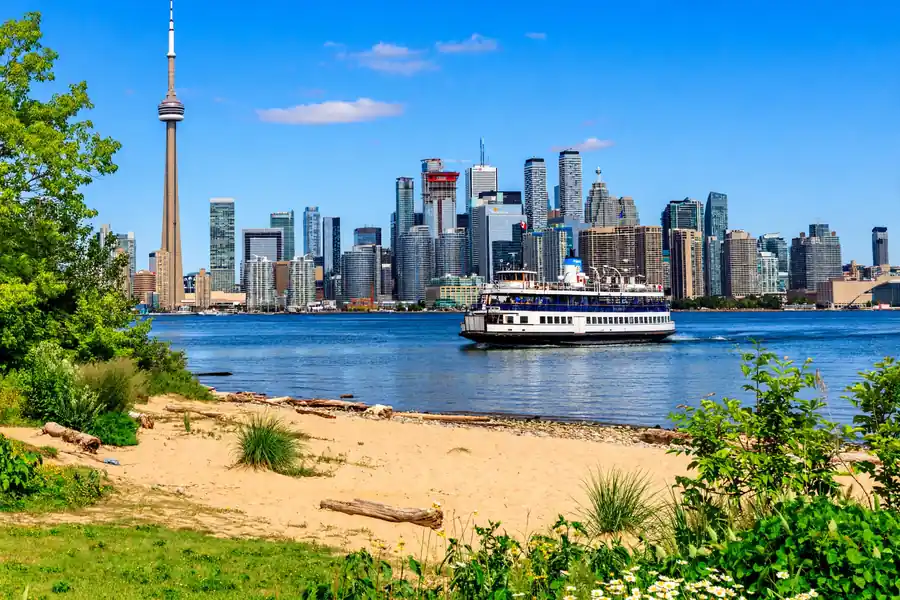
The Toronto Islands are the best half-day in the city: fifteen car-free islands linked by bridges and boardwalks, ten minutes by ferry from downtown, with the single best view of the skyline in return. Ferries leave from the Jack Layton Ferry Terminal at 9 Queens Quay West, at the foot of Bay Street, for Centre Island, Hanlan’s Point and Ward’s Island. The adult round-trip fare is C$9.57, seniors and youth 15–19 pay C$6.15, children 2–14 pay C$4.51 and under-2s ride free — and the ticket includes the return, from any island dock. Centre Island is the family end, with Centreville Amusement Park, a small beach and the pier; Hanlan’s Point has the quieter western beaches, including a clothing-optional stretch; Ward’s Island is the sleepy residential end with the best picnic lawns. Learn more about the Toronto Islands on Wikipedia. Two traps catch visitors here. First, Centre Island and Hanlan’s Point run only from mid-April to mid-October; from October 14, 2026 to mid-April 2027 the city runs the Ward’s Island boat only, so a winter visit means a 35-minute walk from Ward’s to Centre Island. Second, the ticket does not reserve a departure — boarding is first come, first served, and on summer weekends the queue at the terminal can pass an hour. Buy online in advance for the express line, arrive before 10 a.m. or after 3 p.m., and take the Ward’s boat when the Centre Island line looks long.
3. Ripley’s Aquarium of Canada
Right at the foot of the CN Tower, Ripley’s Aquarium of Canada is the easiest pairing in the city: tower in the morning, sharks in the afternoon, with no transit in between. The aquarium holds more than 20,000 animals in 5.7 million litres of water, and the centrepiece is Dangerous Lagoon, a moving walkway through a tunnel where sharks, rays and sea turtles glide overhead. Timed tickets for adults (14–64) run from about C$44 to C$46 in 2026, flex tickets that let you arrive any time cost about C$50 to C$52, and the Sharks After Dark ticket after 5 p.m. saves about C$5. Children under 2 go free. The aquarium opens at 9 a.m. daily and is at its calmest before 11 a.m. or after 3 p.m. The trap: many guides still quote C$33 or C$40 from older pricing. The 2026 timed ticket starts around C$44, and the CN Tower plus aquarium combo, the Sea the Sky ticket, is C$79 online only. If you plan to visit five big attractions, price the Toronto CityPASS first: at C$134.96 plus tax for adults it bundles the CN Tower and Ripley’s with three of the ROM, Casa Loma, the Toronto Zoo, the AGO and a seasonal harbour cruise, valid for nine days.
4. Royal Ontario Museum (ROM)
The Royal Ontario Museum, the ROM, is Canada’s largest museum of world cultures and natural history, with more than 18 million objects across 40 galleries — dinosaurs, Egyptian mummies, Chinese temple art, First Peoples galleries and a mineral hall that glows under black light. It sits at 100 Queen’s Park in the unmistakable Michael Lee-Chin Crystal, a jagged glass addition that locals either love or love to argue about. Admission uses Plan Ahead Pricing: the further ahead you book, the less you pay, with adult tickets starting at about C$23 to C$26 and last-minute tickets reaching about C$35. Children 3 and under enter free. The museum is closed on Mondays and open Tuesday to Sunday, 10 a.m. to 5:30 p.m. Read about the Royal Ontario Museum on Wikipedia. Two money-saving facts most guides bury: admission is free on the third Tuesday evening of every month, 4 p.m. to 8:30 p.m., with an advance ticket, and the main floor galleries were free from September 25 to November 29, 2026. Special exhibitions such as Wildlife Photographer of the Year carry a surcharge. Give it three hours, start with the dinosaurs on Level 2, and do not confuse it with the AGO — the ROM is natural history and world cultures, the AGO is art, and they need separate tickets.
5. St. Lawrence Market
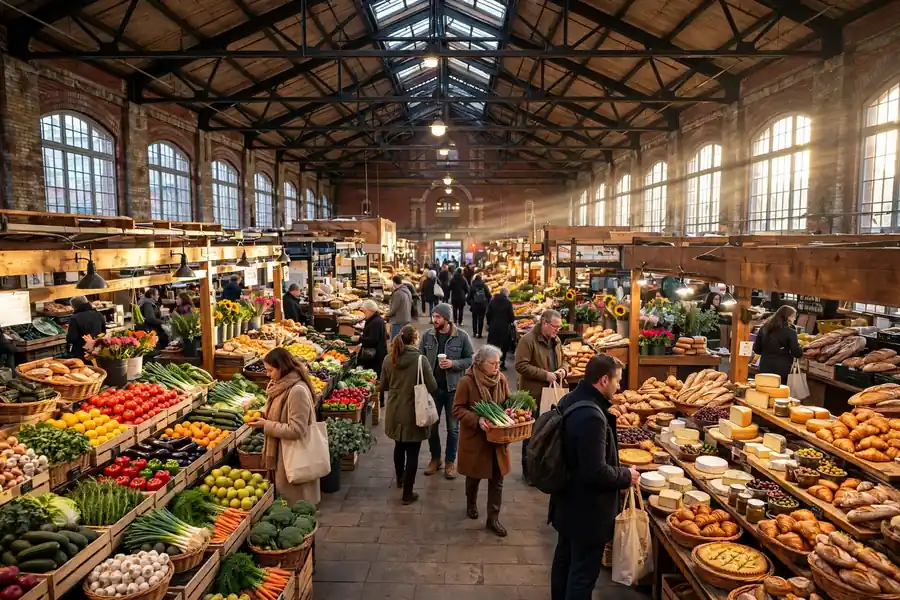
St. Lawrence Market is the city’s great food hall and, by National Geographic’s old reckoning, once the best food market in the world. A farmers’ market has stood on this site since 1803, and the South Market building, put up in 1902 around the council chamber of the 1845 City Hall, now holds more than 60 specialty vendors across two floors. The South Market is open Tuesday to Friday 9 a.m. to 7 p.m., Saturday 7 a.m. to 5 p.m. and Sunday 10 a.m. to 5 p.m., and it is closed on Mondays — the single most common planning mistake in Toronto. The Saturday Farmers’ Market runs 5 a.m. to 3 p.m. in the North Market, and the Sunday Antique Market runs 9:30 a.m. to 5 p.m. except on the last Sunday of the month. Come hungry: the peameal bacon sandwich at Carousel Bakery on the upper level, declared Toronto’s official signature dish in 2016, is the city’s most famous bite, and the lower level holds cheese mongers, butchers, bakers and the fish counters that have fed the city for generations. Read about St. Lawrence Market on Wikipedia. The trap: the North Market is a brand-new building, rebuilt and reopened in 2025, so guides that describe the old temporary market hall are out of date, and the market is not a late-night stop — most vendors close by 7 p.m. on weekdays. Saturday morning is the liveliest time, so arrive before 10 a.m. to beat the crowds.
6. Distillery District
The Distillery District is Toronto’s most photogenic quarter: a pedestrian-only maze of red-brick Victorian industrial buildings at 55 Mill Street, once the Gooderham and Worts distillery, among the largest in the world in the 19th century. Today the cobbled lanes hold galleries, boutiques, breweries, restaurants and public art, and it is free to walk in on any open day. The site is open Monday to Wednesday 10 a.m. to 8 p.m., Thursday to Saturday 10 a.m. to 9 p.m. and Sunday 11 a.m. to 8 p.m., 364 days a year. Read about the Distillery District on Wikipedia. The exception is the Winter Village, the Christmas market that runs November 12, 2026 to January 3, 2027: on ticketed evenings — opening night, from 4 p.m. every Friday, Saturday and Sunday, from 4 p.m. every Thursday in December, and daily December 14 to 31 — entry costs about C$19.89 all-in, with children 9 and under free. The tree lighting is Thursday, November 12 at 6 p.m. The trap: from November 1, 2026, replacement buses run on part of the 504 King streetcar route while King Street work is under way, so the Distillery Loop streetcar stop may not be running when you visit — check ttc.ca before you set out, and walk the ten minutes from St. Lawrence Market instead.
7. Casa Loma
Casa Loma is the only full-scale castle in the middle of a North American city, and it is exactly as improbable as it sounds: 98 rooms of Gothic Revival stone, secret passages, a tunnel to the stables and gardens with a view over the skyline, built between 1911 and 1914 for financier Sir Henry Pellatt, who went bankrupt keeping it up. Adult admission is C$45 including HST, and regular hours are 9:30 a.m. to 5 p.m. daily, with last admission at 4:30 p.m. The ticket includes a mobile audio guide and the Pellatt documentary, and the gardens are at their best from late spring to early autumn. Read about Casa Loma on Wikipedia. The trap: older guides quote C$35 or C$40. The 2026 adult price is C$45, and separately ticketed evening events — escape rooms, concerts, the Halloween haunt — are not covered by general admission. Get there from Dupont station on Line 1, then walk ten minutes uphill, or take the short streetcar ride north from the ROM. Two hours is enough for the house, the tunnel and the gardens, and the castle is a favourite with families because the secret passages and the tower climb feel like a treasure hunt.
8. Art Gallery of Ontario (AGO)
The Art Gallery of Ontario, the AGO, holds more than 120,000 works from the first century to the present day, in a building at 317 Dundas Street West that Toronto-born architect Frank Gehry remade in 2008 with a sweeping wooden gallery along the street. The Canadian collection — the Group of Seven, Emily Carr, Inuit art — is the heart of it, with strong European and contemporary wings and the Henry Moore sculpture centre. Adult single-day admission is C$30, youth 10–17 pay C$15, children 9 and under are free, and the C$40 annual pass pays for itself on a second visit. Ontario residents under 25 get in free with a free annual pass, and admission is free for everyone on the first Wednesday evening of each month, 6 p.m. to 9 p.m., with a free ticket booked online in advance. The gallery is closed on Mondays and open Tuesday to Sunday, 10:30 a.m. to 5 p.m., with Wednesday evenings until 9 p.m. Read about the Art Gallery of Ontario on Wikipedia. The trap: the AGO joined the Toronto CityPASS on March 31, 2026, replacing the Ontario Science Centre in the pass, so guides that list the Science Centre as a CityPASS choice are out of date. The new Dani Reiss Modern and Contemporary Gallery, adding 40,000 square feet and at least 13 galleries, is expected in fall 2027. Give it two hours, start with the Canadian wing on the second floor, and step out into Grange Park behind the gallery for a breather.
9. Kensington Market and Chinatown
Kensington Market is Toronto at its most gloriously unpolished: a tangle of narrow streets lined with painted Victorian houses turned into vintage shops, cheese and spice stores, bakeries, cafés and cheap food counters, spilling straight into Chinatown on Spadina Avenue. The market is a National Historic Site, and its Pedestrian Sundays — when the streets close to cars on the last Sunday of the month from May to October — are the best time to come. Eat your way along Augusta Avenue: tacos, empanadas, Jamaican patties, fresh juices and the city’s best cheap eats, then cross into Chinatown for dim sum, bubble tea and groceries you will not find anywhere else in Canada. Read about Kensington Market on Wikipedia. There is no admission and no single sight to tick off — the point is the wandering. Come on a weekday morning for the quiet version, or a Sunday afternoon for the full crush. The trap: Kensington is not a mall and it does not keep mall hours. Many shops open late and close early, cash still helps at the smallest stalls, and the market’s energy drops sharply on Mondays. Pair it with the AGO, ten minutes east on Dundas, or with Graffiti Alley, ten minutes south.
10. High Park
High Park is Toronto’s largest public park, 161 hectares of trails, gardens, Grenadier Pond, playgrounds and picnic lawns at 1873 Bloor Street West, and it is free. In late April and early May the hillside near Hillside Gardens erupts with about 2,000 cherry blossom trees, a gift from the citizens of Tokyo in 1959, and peak bloom lasts only four to ten days — check the City of Toronto blossom updates before you go, arrive early on a weekday and come by subway, because cars are not allowed into the park during peak bloom. In October the same hillside is one of the best places in the city for fall colour. The park’s trails, the pond, the gardens and the playgrounds are free, and parking inside the park is free on the days cars are allowed in. Read about High Park on Wikipedia. The trap: the little High Park Animal Display, the free zoo with bison, llamas, peacocks and highland cattle, closed on October 13, 2026 for construction and does not reopen until spring 2027. Guides that list it as open are out of date. Cars are also barred from the park on Saturdays, Sundays and holidays, so take Line 2 to High Park or Keele station and walk in.
11. Hockey Hall of Fame
Ice hockey is close to a national faith in Canada, and its shrine sits in an ornate 1885 former Bank of Montreal branch at Front and Yonge streets, attached to the Brookfield Place complex. The Hockey Hall of Fame holds the Stanley Cup itself — you can stand beside it, and on some days a keeper will pose for a photo with it — plus the original Cup, the Esso Great Hall, interactive shooting and goaltending games, and the Hall of Famers’ plaques. Adult admission is C$29.95 plus tax, youth 4–13 pay C$19.95 and seniors 65 and over pay C$24.95. It is open daily, and the nearest TTC stops are King or Union. Read about the Hockey Hall of Fame on Wikipedia. The trap: the building is easy to walk past. The entrance is inside Brookfield Place, through the Allen Lambert Galleria, so follow the signs from Front Street rather than circling the block. Give it two hours, try the shooting game early before the line builds, and pair it with a Blue Jays game at Rogers Centre or a Raptors or Leafs game at Scotiabank Arena, both a short walk away. Even if you have never watched a hockey game, the Stanley Cup room is worth the ticket on its own.
12. Harbourfront Centre and the waterfront
Harbourfront Centre, at 235 Queens Quay West, is the cultural heart of the waterfront: a 10-acre site of theatres, galleries, studios and free performance stages, with festivals running all summer and an outdoor rink in winter. The Martin Goodman Trail runs about 56 kilometres along Lake Ontario through the city, and the stretch from Harbourfront west to the music garden and east to Sugar Beach is the city’s best flat walk. Sugar Beach, with its pink umbrellas and white sand, is a favourite photo stop, and the 60-minute City Cruises harbour tour — one of the Toronto CityPASS choices from April to October — is the lazy way to see the skyline from the water. Read about Harbourfront Centre on Wikipedia. The trap: the Ontario Science Centre’s original Don Mills building closed in June 2024 over roof safety, and guides still send visitors there. The Science Centre’s interim home opened on June 29, 2026 right here at Harbourfront Centre, a short walk from Union Station, with hands-on exhibits while its permanent building rises at Ontario Place. Check the day’s hours before you go, because the waterfront hosts festivals that close sections of the promenade, and the lake wind is real even on a warm day — bring a layer.
13. Nathan Phillips Square and the TORONTO sign
Nathan Phillips Square is Toronto’s main public square, in front of the curved twin towers of City Hall, and the giant illuminated TORONTO sign is the photo every visitor takes. The sign was built for the 2015 Pan American Games and stayed because the city fell in love with it; the maple leaf in the middle lights up in different colours for different occasions. In winter the square’s reflecting pool becomes a free outdoor skating rink — bring your own skates or rent a pair on site — and in summer it hosts concerts, food festivals and the farmers’ market. The square is free, open all hours, and a five-minute walk from the Eaton Centre and Yonge-Dundas Square. Read about Nathan Phillips Square on Wikipedia. There is no trap here, only a timing tip: come at dusk, when the sign lights up and the City Hall towers glow, and you will get the shot without the midday crowds. In December the square also hosts the Cavalcade of Lights, the city’s official tree-lighting festival, with fireworks on opening night.
14. Toronto Zoo
The Toronto Zoo is Canada’s largest zoo, with more than 3,000 animals from over 300 species spread across 287 hectares and 10 kilometres of walking trails at 2000 Meadowvale Road in Scarborough, beside Rouge National Urban Park, the largest urban national park in North America. The zoo is organised into seven geographic zones — Indo-Malaya, Africa, the Americas, Tundra Trek, Australasia, Eurasia and the Canadian Domain — and the polar bears, the giant pandas’ old neighbours the red pandas, the gorillas and the white lions are the stars. Tickets use dynamic pricing: adult admission typically runs from about C$35, with weekday tickets usually 15 to 25 percent cheaper than weekends, and children 3 and under enter free. The zoo is open daily year-round, 9:30 a.m. to 4:30 p.m. in winter and 9 a.m. to 7 p.m. in summer, closed only on Christmas Day, and parking is C$20. Read about the Toronto Zoo on Wikipedia. The trap: the zoo is not downtown. It is a 45-minute bus ride from the subway, so budget a full day, wear walking shoes and take the TTC 86 Scarborough bus or the seasonal Route 200 shuttle from Meadowvale Loop. In winter 2026 the zoo added Glow in the Wild, a lantern walk on select evenings through January 3, 2027, with adult tickets at C$38 — a separate ticket from the daytime zoo.
15. Scarborough Bluffs
The Scarborough Bluffs are Toronto’s most dramatic natural sight and its best-kept secret: a 90-metre eroded clay escarpment running 15 kilometres along Lake Ontario in the city’s east end, with white cliffs, a small beach, a marina and views that feel nothing like a big city. Bluffer’s Park, at the foot of Brimley Road, is the easiest access point, with a sandy beach, picnic areas and a boardwalk under the cliffs. The top of the bluffs at Scarborough Heights Park gives the postcard view down the cliff face. Read about the Scarborough Bluffs on Wikipedia. The trap is a safety one, and the city repeats it every summer: the cliffs are crumbling clay, and people are injured every year standing too close to the edge or climbing the face. Stay on the marked paths, stay behind the fences at the top, and never climb the bluffs. The beach is unsupervised, so swim with care. Getting there takes a bus from Kennedy or Warden station on Line 2, or a taxi from downtown in about 30 minutes. Pair it with the Toronto Zoo, twenty minutes north, for a full Scarborough day.
16. Graffiti Alley and Queen Street West
Graffiti Alley — officially Rush Lane, the laneway south of Queen Street West between Spadina Avenue and Portland Street — is Toronto’s open-air street art gallery: a full block of legal murals, repainted every few weeks, where a cult film was shot and where every visitor takes the same photo against the colour. It is free, open all hours and at its best in the morning light before the crowds arrive. From the alley, walk west along Queen Street West, once named one of the coolest streets in the world: independent shops, record stores, vintage boutiques, galleries and cafés run for blocks through the fashion district. Read about Queen Street West on Wikipedia. The trap: the murals change constantly, so the specific wall you saw on Instagram may already be painted over — that is the point, and the reason to go with fresh eyes rather than a checklist. The alley is also a working laneway with delivery trucks, so watch your step. The 501 Queen streetcar runs the length of the street, and the walk east from the alley takes you to the AGO in ten minutes and to Nathan Phillips Square in fifteen.
17. Fort York National Historic Site
Fort York is where Toronto began: the 1812 fort at the foot of Bathurst Street, on the site where the city was founded as York in 1793, with eight original War of 1812 buildings, a visitor centre and costumed interpreters who fire the cannon on summer weekends. The fort’s soldiers held off the American invasion in the Battle of York in April 1813, and the site tells the story of the Indigenous nations who lived and gathered here long before 1793. General admission is free, with some separately charged events, and normal hours are Wednesday to Sunday, 11 a.m. to 4 p.m. Read about Fort York on Wikipedia. The trap: Fort York now sits inland, about a kilometre from the water, because the shoreline has been filled in over two centuries — first-time visitors who follow the lake looking for it walk straight past. Take the 511 Bathurst streetcar from Bathurst station and get off at Fleet Street. The fort is a quiet contrast to the tower and the markets, and it is the best place in the city to understand that Toronto is older than its skyline suggests.
18. Ontario Science Centre (interim Harbourfront site)
The Ontario Science Centre is one of Canada’s great family museums, and in 2026 it lives in a temporary home. The original Don Mills building closed suddenly in June 2024 when engineers found the roof unsafe, and after two years of uncertainty the Science Centre reopened on June 29, 2026 in an interim site at Harbourfront Centre, a short walk from Union Station, with hands-on exhibits, live science demonstrations and the planetarium shows that made it famous. A permanent building is planned at Ontario Place, on the waterfront west of downtown. Read about the Ontario Science Centre on Wikipedia. The trap is the one this whole section exists to fix: almost every older guide, and many maps, still send you to Don Mills Road, where the building is closed and fenced off. Go to Harbourfront instead, check the day’s hours on the Science Centre’s site before you set out, and note that the interim site is smaller than the old one — two to three hours is enough. The Science Centre is also no longer a Toronto CityPASS choice since the AGO joined the pass in March 2026, so do not buy the pass expecting it.
19. Aga Khan Museum
The Aga Khan Museum, at 77 Wynford Drive in North York, is the first museum in North America devoted to Islamic art and culture, and its building alone is worth the trip: a white granite and glass pavilion by Fumihiko Maki, set in a formal garden by landscape architect Vladimir Djurovic, with a reflecting pool that mirrors the dome. Inside are more than 1,000 years of art from across the Muslim world — manuscripts, ceramics, metalwork, textiles and contemporary installations — plus a performing arts programme and a restaurant serving dishes from the Silk Road. Adult admission is about C$20, and the museum is open Tuesday to Sunday. Read about the Aga Khan Museum on Wikipedia. The trap: it is not downtown. Take Line 5 Eglinton — the line that finally opened on February 8, 2026 after fifteen years of construction — to Science Centre station, then walk ten minutes, or take a bus from Eglinton station. The museum shares its park with the Ismaili Centre, and the two buildings together are one of the calmest corners of the city. Pair it with the nearby Ontario Science Centre’s old neighbourhood, or with a walk through the Don Valley trails.
20. Day trip: Niagara Falls
Niagara Falls is not in Toronto, but almost every Toronto visitor goes, and it is the easiest day trip in Canada: about 130 kilometres, or 90 minutes by road, from downtown. The falls are taller and louder than any photo suggests, and the classic circuit is the Table Rock viewpoint, the Journey Behind the Falls tunnels, the Hornblower boat that sails into the mist, and the Clifton Hill strip. GO Transit runs trains and buses from Union Station to Niagara Falls, and several operators run day tours from downtown hotels, but the train is the cheapest way there. The trap: Niagara is a full day, not a half-day add-on. Guides that promise “Toronto in the morning, the falls in the afternoon” are selling a fantasy — the round trip alone is three hours, and the falls deserve five. Read about Niagara Falls on Wikipedia. If you go, stay for the evening illumination, when the falls are lit in colour, and skip the wax museums on Clifton Hill unless you love them. In winter the falls partly freeze into ice formations that are quieter and, some say, more beautiful than the summer crowds.
Toronto in 3 days — a ready-made itinerary
| Day | Morning | Afternoon | Evening |
|---|---|---|---|
| Day 1 — Downtown icons | CN Tower, then Ripley’s Aquarium | St. Lawrence Market lunch, Hockey Hall of Fame | Distillery District and dinner on King Street |
| Day 2 — Museums and neighbourhoods | Royal Ontario Museum | Casa Loma, then Kensington Market and Chinatown | Queen Street West and Graffiti Alley |
| Day 3 — Islands and parks | Ferry to the Toronto Islands | Harbourfront and the AGO | Nathan Phillips Square at dusk, dinner in Little Italy |
Day 1 — Downtown icons
Start at the CN Tower with the first timed slot of the day, 9:30 a.m., when the light is clean and the crowds are thin. Give it ninety minutes, including the Glass Floor, then walk next door to Ripley’s Aquarium for the late morning. Lunch at St. Lawrence Market — a peameal bacon sandwich at Carousel Bakery, eaten standing up like a local — then the Hockey Hall of Fame at Front and Yonge, two hours with the Stanley Cup. In the evening, walk east to the Distillery District for dinner among the brick lanes, and if it is a Friday or Saturday, stay for the lights. Total walking is about 5 kilometres, all flat, and everything is within a ten-minute walk of Union Station.
Day 2 — Museums and neighbourhoods
Take Line 1 to Museum station for the ROM at 10 a.m., and give it three hours — dinosaurs first, then the world cultures galleries. Walk or take the streetcar north to Casa Loma for the early afternoon, two hours for the house, the tunnel and the gardens. Then ride the subway south to St. Patrick and walk into Kensington Market and Chinatown for the late afternoon: vintage shops, spice stores, dim sum and bubble tea. In the evening, walk south to Graffiti Alley for photos in the golden light, then dinner on Queen Street West. If it is the first Wednesday of the month, swap the evening for the AGO’s free Wednesday night, 6 p.m. to 9 p.m., with a ticket booked in advance.
Day 3 — Islands and parks
Catch the first ferry from the Jack Layton Ferry Terminal to Centre Island, rent a bike at the dock, and ride the boardwalk to Ward’s Island and back — the skyline view from the beach is the best in the city, and the islands are at their quietest before 10 a.m. Back on the mainland, walk the waterfront east to Sugar Beach and Harbourfront Centre, where the interim Ontario Science Centre sits, then take Line 1 north to the AGO for the afternoon. Finish at Nathan Phillips Square at dusk for the TORONTO sign, then dinner on College Street in Little Italy. If you have a fourth day, spend it at Niagara Falls, or at the Toronto Zoo and the Scarborough Bluffs.
Best time to visit Toronto
| Season | Weather | Crowds | What is on |
|---|---|---|---|
| Late spring (May–June) | 15–25°C, long days | Moderate | Cherry blossoms in late April, patios open, gardens in bloom |
| Summer (July–August) | 25–30°C, humid | Busiest | Caribbean Carnival, CNE in August, island beaches, festivals every weekend |
| Autumn (September–October) | 10–20°C, crisp air | Lighter | TIFF in September, fall colour in High Park, Nuit Blanche in October |
| Winter (November–March) | -5 to 0°C, snow | Quietest | Distillery Winter Village, skating at Nathan Phillips Square, holiday lights |
Late May to June and September to early October are the sweet spots: warm enough for the islands and the patios, cool enough to walk all day, and cheaper than July and August. Summer is the liveliest season — the Caribbean Carnival, the Canadian National Exhibition in August, the island beaches and a festival every weekend — but hotel prices peak, the CN Tower and the ferry queues are longest, and the humidity can be heavy. Autumn brings the Toronto International Film Festival in September, fall colour in High Park in mid-to-late October and Nuit Blanche, the all-night art festival, in October. Winter is the quietest and cheapest season, and it has its own rewards: the Distillery Winter Village from November 12, 2026 to January 3, 2027, free skating at Nathan Phillips Square, and the city dressed in lights. Just pack a proper coat — Toronto winter is a real winter, with snow and wind off the lake.
Where to stay in Toronto
| Neighbourhood | Best for | Price per night | Notes |
|---|---|---|---|
| Downtown / Financial District | First-timers, business travellers | C$220–C$400 | Walk to the CN Tower, Union Station and the ferry |
| Old Town / St. Lawrence Market | Food lovers, couples | C$200–C$350 | Quieter streets, market on your doorstep |
| Entertainment District | Nightlife, theatre, sports | C$200–C$380 | King Street bars, Scotiabank Arena, TIFF venues |
| Yorkville | Luxury, museums, shopping | C$350–C$600 | Steps from the ROM, quiet and polished |
| Queen West / West Queen West | Indie shops, cafés, younger travellers | C$150–C$280 | Streetcar to downtown in 15 minutes |
| The Annex / Bloor Street | Budget stays, students, longer trips | C$120–C$220 | Subway on Line 2, lively student streets |
| Harbourfront | Waterfront views, families | C$250–C$450 | Ferry and Harbourfront Centre at your feet |
Stay downtown if it is your first visit. The Financial District and the streets around Union Station put the CN Tower, the aquarium, the Hockey Hall of Fame and the ferry terminal within a ten-minute walk, and the subway is at your door. Old Town, around St. Lawrence Market, is the quieter downtown choice, with the market for breakfast and the Distillery District a ten-minute walk east. The Entertainment District, around King and John, is the nightlife choice, and Yorkville, north of Bloor, is the luxury choice, steps from the ROM. Queen West suits travellers who want indie shops and cafés and do not mind a fifteen-minute streetcar ride downtown, and the Annex, around Bloor and Bathurst, is the budget choice, with hostels and smaller hotels on the subway. The trap: Toronto hotel prices carry a 13 percent HST plus the Municipal Accommodation Tax, which returned to 6 percent on August 1, 2026 after a temporary 8.5 percent rate — so a C$250 room costs about C$297 before you add anything else, and older guides quoting 8.5 percent overstate the tax. Book early for TIFF in September, the Caribbean Carnival and the CNE in August, when downtown rooms sell out and prices spike.
Getting around Toronto
The TTC — the Toronto Transit Commission — runs the subway, the streetcars and the buses on one flat fare: C$3.30 with a PRESTO card or a tapped debit or credit card, C$3.35 in cash, with two hours of transfers included. Children 12 and under ride free. The subway has four lines that matter to visitors: Line 1 Yonge-University, the north-south spine through Union, King, St. Patrick, Museum and Dupont; Line 2 Bloor-Danforth, the east-west line through the Annex and High Park; Line 5 Eglinton, the new light rail across midtown; and the streetcars, above all the 501 Queen and the 504 King, which run the length of downtown. The biggest change of 2026 is fare capping: since September 1, 2026, rides after 47 paid trips in a calendar month are free, and the old monthly pass ended on August 31, 2026 — so do not buy a monthly pass from an outdated guide. Fares have been frozen for a third straight year, so the C$3.30 fare is the same as in 2023, and the day pass is C$13.50. The second big change is Line 5 Eglinton itself: after fifteen years of construction and opening dates promised for 2020, 2021, 2022, 2023, 2024 and 2025, the 19-kilometre line with 25 stations finally opened on February 8, 2026, running from Mount Dennis in the west to Kennedy in the east in about 50 to 55 minutes end to end. It is the fastest way across midtown and the way to reach the Aga Khan Museum. From the airport, the UP Express train runs from Pearson Terminal 1 to Union Station in 28 minutes, every 15 minutes, at C$12.35 one way or C$9.25 with PRESTO, and children 12 and under ride free. The cheapest airport route is the 900 Airport Express bus to Kipling station, then the subway, for a single C$3.30 fare. A taxi downtown costs about C$55 to C$75 plus tip. Downtown Toronto is walkable and mostly flat, and the streetcars are part of the experience — but check ttc.ca before you travel, because the 504 King route has replacement buses on part of its run from November 1, 2026 while King Street work is under way.
Toronto food you have to try
Peameal bacon sandwich

The peameal bacon sandwich is Toronto’s signature dish, declared the city’s official sandwich in 2016: thick-cut peameal bacon — cured pork loin rolled in cornmeal, a Toronto invention — griddled and served on a fresh kaiser roll with mustard. The place to eat it is Carousel Bakery on the upper level of St. Lawrence Market, which calls itself the home of the world-famous peameal bacon sandwich and has sold it in the market for more than 50 years. Expect to pay about C$10 to C$12, expect a queue on Saturday mornings, and expect to eat it standing up. Read about peameal bacon on Wikipedia. Paddington’s Pump, the market’s only full-service sit-down restaurant, also serves one if you want a table. Do not confuse peameal bacon with Canadian bacon: peameal is unsmoked, rolled in cornmeal and griddled, and it tastes nothing like the ham you know.
Butter tarts
The butter tart is Canada’s most argued-over dessert: a small pastry shell filled with a runny mixture of butter, sugar, syrup and egg, with or without raisins, and with or without pecans — the with-or-without raisins question has split Canadian families for generations. Toronto’s bakeries take it seriously, and the best ones are found at St. Lawrence Market, in Kensington Market and at the city’s French bakeries on Queen West. A good butter tart costs about C$4 to C$6, and the test is the filling: it should be gooey, not set, with a crisp shell that holds. Read about the butter tart on Wikipedia. The Ontario town of Midland claims the first printed recipe, from 1900, but Toronto’s version is the one most visitors actually eat. Buy two: one to eat now, one for the walk back to the hotel.
Jamaican beef patties
Toronto has one of the largest Jamaican communities outside Jamaica, and the beef patty is its gift to the city’s lunch counters: a turmeric-yellow pastry shell, flaky and crisp, filled with spiced ground beef, with chicken, vegetable and ackee versions alongside. The classic is the C$2 to C$4 patty from a bakery on Eglinton West — Little Jamaica — or from the counters in Kensington Market, eaten hot from a paper bag with a bottle of Ting, the grapefruit soda. Read about the Jamaican patty on Wikipedia. The patty even made legal history: in 1985, Toronto patty makers fought the federal government over a rule that called their product a “beef patty” and tried to regulate it, and the city rallied behind them. It is the cheapest great lunch in Toronto, and the spiciest.
Free things to do in Toronto
Toronto is generous with free sights. The TORONTO sign and the skating rink at Nathan Phillips Square cost nothing, and the square is open all hours. Graffiti Alley is free, as are the Distillery District outside the Winter Village ticketed evenings, Kensington Market, Chinatown, the waterfront walk from Harbourfront to Sugar Beach, and High Park with its trails, gardens and cherry blossoms. The AGO is free on the first Wednesday evening of every month, 6 p.m. to 9 p.m., with a ticket booked online, and Ontario residents under 25 get in free any time. The ROM is free on the third Tuesday evening of every month, 4 p.m. to 8:30 p.m., and its main floor was free from September 25 to November 29, 2026. Fort York’s general admission is free. The Toronto Islands cost only the ferry, and the skyline view from the beach is free once you are there. The Art Gallery of Ontario’s neighbour, Grange Park, is free, and so is the walk along the Martin Goodman Trail. On summer weekends, Harbourfront Centre’s free stages host concerts and festivals, and the city’s libraries — including the Toronto Reference Library at Yonge and Bloor — are free, air-conditioned and open to everyone. The best free day in the city: the islands ferry at sunrise, the waterfront walk, Graffiti Alley, Kensington Market and the TORONTO sign at dusk, for the price of one C$9.57 ferry ticket.
Frequently asked questions
How many days do you need in Toronto?
Three full days cover the best of Toronto: downtown icons on day one, museums and neighbourhoods on day two, and the islands and the waterfront on day three. Add a fourth day for a Niagara Falls day trip, or for the Toronto Zoo and the Scarborough Bluffs. Two days is enough for the highlights — the CN Tower, the islands, St. Lawrence Market and one museum — but you will miss the neighbourhoods, which are half the city. A week lets you slow down, add the Aga Khan Museum, a Blue Jays game and a day trip to Prince Edward County wine country.
Is the CN Tower worth the price?
Yes, if you go at the right time. The C$47 timed ticket buys the LookOut at 346 metres, the Glass Floor and the Outdoor SkyTerrace, and the view on a clear day reaches 160 kilometres across Lake Ontario. Go at sunset for the best light, book online a day or two ahead to avoid the walk-up price, and skip it on a cloudy day — the tower is the one attraction where the weather decides the value. If heights are not your thing, the view from the Toronto Islands ferry costs C$9.57 and is free once you are on the beach. The Top, at 447 metres, adds C$12 and is worth it only on a clear day.
Do I need a car in Toronto?
No. Downtown Toronto is walkable, the subway and streetcars cover every attraction in this guide except the zoo and the Bluffs, and parking downtown costs C$20 to C$40 a day. A car only helps for the Toronto Zoo, the Scarborough Bluffs and day trips to Niagara Falls or Prince Edward County, and even Niagara is reachable by GO Transit train from Union Station. If you do drive, remember that Toronto traffic is among the worst in North America, street parking is scarce, and the King Street transit priority corridor restricts cars on parts of King Street West.
Is Toronto expensive?
Toronto is a big-city price, but not a New York or London price. A mid-range day runs about C$150 to C$220 per person before your hotel: C$47 for the CN Tower, C$30 for the AGO, C$10 to C$12 for a peameal bacon sandwich, C$3.30 per TTC ride and C$15 to C$25 for a casual dinner main. The free sights in this guide — the islands beach, Graffiti Alley, the markets, the waterfront, the AGO and ROM free evenings — cut the bill sharply. Hotels are the biggest cost: budget C$200 to C$350 a night downtown, plus 13 percent HST and the 6 percent Municipal Accommodation Tax.
What is the best way to get from Pearson Airport to downtown?
The UP Express train is the best choice for most visitors: 28 minutes from Pearson Terminal 1 to Union Station, every 15 minutes, C$12.35 one way or C$9.25 with PRESTO, and children 12 and under ride free. From Terminal 3, take the free LINK train to Terminal 1 first. The cheapest way is the 900 Airport Express bus to Kipling station and then the subway, for a single C$3.30 TTC fare. A taxi or rideshare to downtown costs about C$55 to C$75 plus tip. Check the UP Express planned-works page before you travel: no trains ran on October 31 and November 1, 2026, with GO buses replacing them, and more construction weekends are planned.
When is the best time to visit Toronto?
Late May to June and September to early October, for warm weather, thinner crowds and lower hotel prices than July and August. Summer is the liveliest season, with the Caribbean Carnival, the CNE and the island beaches, but it is also the busiest and most expensive. Winter is the quietest and cheapest, with the Distillery Winter Village and free skating at Nathan Phillips Square, but pack a proper coat. The cherry blossoms in High Park peak for only four to ten days in late April or early May, and the fall colour peaks in mid-to-late October. One date to note: Toronto hosted FIFA World Cup matches in June 2026, and that tournament is over — guides that tell you to plan around it are out of date.
Further reading — Wikipedia and Reddit
Read about Toronto on Wikipedia for the city’s history, from its founding as York in 1793 to the present day, and read about the CN Tower on Wikipedia and the Toronto Islands on Wikipedia for the background on the two sights this guide starts with. For what locals are actually saying right now, join the Toronto community on Reddit. No Quora link is included here — we could not verify a live Toronto-specific thread on Quora, so we have not invented one.
Your Toronto trip, in one paragraph
Toronto rewards the traveller who looks past the tower: a castle on a hill, a market that has fed the city since 1803, a car-free island chain ten minutes by ferry and a food scene that spans the world. If this guide has you planning more city trips, our other guides cover Chicago, Nashville, Los Angeles, Orlando, Miami, San Diego, Denver, Savannah, Dallas, Charleston, San Francisco, Myrtle Beach, Las Vegas, San Antonio, London, Portland, Pigeon Forge, Puerto Rico, Atlanta, Phoenix, Paris, Maui, Key West, Colorado Springs, Sedona, Chattanooga, Palm Springs, St Louis, Tokyo, Japan, Kansas City, Tennessee, Branson, Florida, Amsterdam, Montreal, Honolulu and Fort Lauderdale. Book the tower and the ferry ahead, ride the brand-new Line 5, eat a peameal bacon sandwich standing up at the market, and let the skyline do the rest.

About the Author