Things to Do in Kansas City
20 Best Attractions, a 3-Day Itinerary, Where to Stay, and the Food You Cannot Miss
Quick Info
Best for: Barbecue and jazz lovers, history buffs, families, sports fans and anyone who wants big-city culture at small-city prices
Best time: Mid-April to mid-May and mid-September to mid-October for the best weather; late November for the Plaza Lights
How long: 3 days covers the essentials; 2 days works if you skip the Kansas side and the day trips
Budget: Roughly $120 to $180 per person per day for a mid-range trip, including a hotel, one paid museum and meals; a day of free museums, fountains and the streetcar costs almost nothing
Don’t miss: The National WWI Museum at sunset, a burnt-ends plate at Joe’s Kansas City, the free Nelson-Atkins, the Plaza fountains and one ride on the free streetcar end to end
Kansas City is the American city that most travellers get wrong before they arrive, and then cannot stop talking about after they leave. It is two cities in one — Kansas City, Missouri, the big one on the river, and Kansas City, Kansas, its smaller twin across the state line — and it is the home of burnt ends, bebop jazz, more than 200 fountains and the only museum in America devoted entirely to the First World War. This guide gives you the 20 best things to do in Kansas City in a sensible order, a ready-made 3-day itinerary, honest advice on when to go, where to stay and how to get around, and the three foods you have to try before you leave — plus the free sights that cost nothing at all. Prices and hours change, so every price in this guide is the 2026 price as published by the attraction itself — always check the official website before you visit.
One thing to know before you go: Kansas City in 2026 is not the city of the old guidebooks, and the old guides are wrong in expensive ways. The Arabia Steamboat Museum closes permanently on November 13, 2026, so if you want to see the largest collection of pre-Civil War artefacts in the world, this is your last chance. RideKC buses are no longer free — fares came back on June 1, 2026, and cash is not accepted on board — while the streetcar is still free forever and now runs all the way from the River Market to the University of Missouri-Kansas City. And Kansas City has just hosted the World Cup: six matches at Arrowhead Stadium in the summer of 2026, including aquarter-final, with Argentina playing three times in the city. This guide tells you which traps to watch for, so you can plan with facts instead of outdated blog posts. Read about Kansas City on Wikipedia.
Kansas City at a glance
| Question | Short answer |
|---|---|
| Where is Kansas City? | A metro of about 2.2 million people straddling the Missouri–Kansas state line; the main city is Kansas City, Missouri, on the Missouri River |
| What is it best for? | Barbecue, jazz, fountains, free museums and big-league sports — and it is a 2026 World Cup city that hosted six matches |
| How long should I stay? | 3 days for the essentials; 2 days if you skip the Kansas side |
| How much does it cost? | Roughly $120 to $180 per person per day mid-range; a day of free museums, fountains and the streetcar costs almost nothing |
| What is the one thing not to miss? | The National WWI Museum and Memorial at sunset, then burnt ends at Joe’s Kansas City |
| When is the best time to go? | Mid-April to mid-May and mid-September to mid-October; late November for the Plaza Lights |
| Is it good for families? | Yes — the zoo, Science City, LEGOLAND, Worlds of Fun and free museums, and the streetcar is free for everyone |
| Do I need a car? | Not downtown — the free streetcar and the $2 buses cover the core; a car helps for the zoo, Worlds of Fun and the Kansas side |
The 20 best things to do in Kansas City
These are the 20 best things to do in Kansas City, ranked the way a first-time visitor should actually do them: the war museum and the free art museum first, then the Plaza and Union Station, then the jazz district and the barbecue, then the family attractions and the Kansas side. Every price below is the 2026 price as published by the attraction itself, and every trap — the museum that closes for good in November, the buses that are no longer free, the aquarium that needs a timed reservation — is called out where it matters.
1. National WWI Museum and Memorial
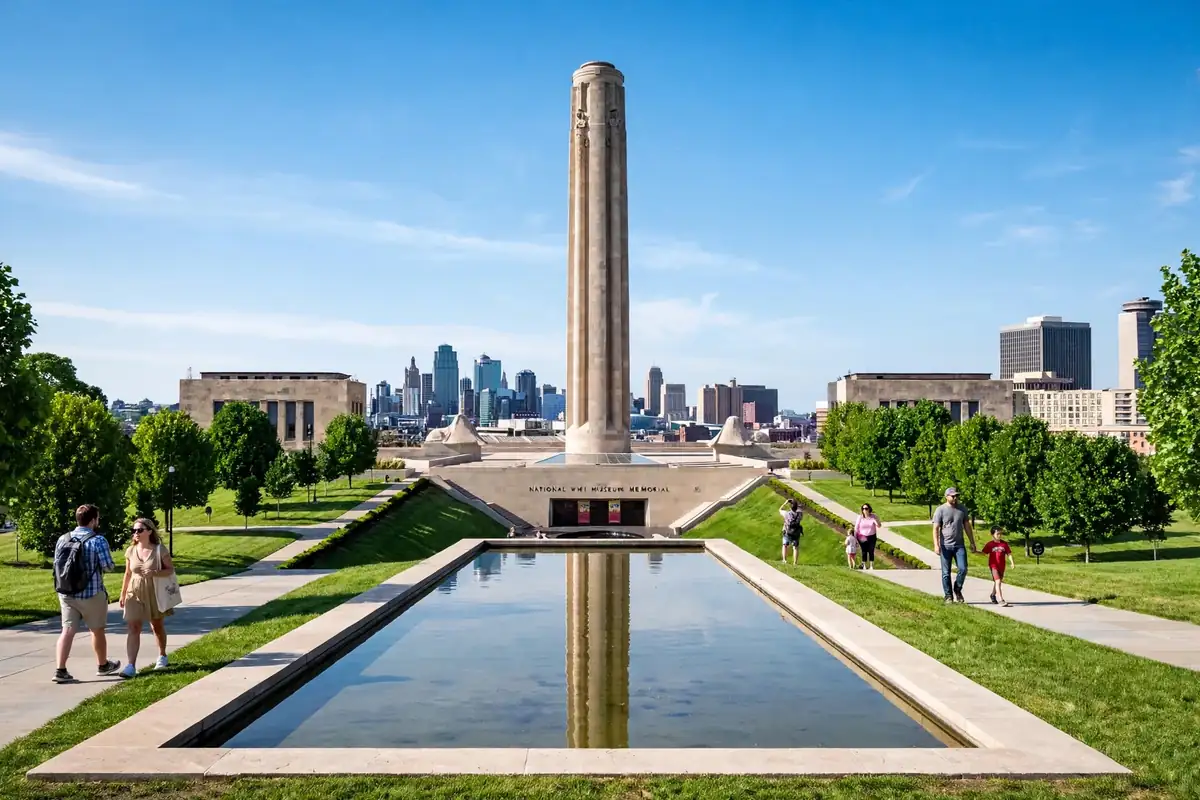
The National WWI Museum and Memorial is the single best reason to visit Kansas City, and it is the only museum in the United States devoted entirely to the First World War. It sits on a hill above Union Station, and the 217-foot Liberty Memorial tower in front of it is the city’s skyline — climb to the top of the tower at sunset and the whole downtown opens up below you in golden light. Inside, the main gallery opens with a field of 9,000 red poppies, one for every 1,000 combatant deaths of the war, and then walks you through the trenches, the propaganda, the machines and the human cost with a honesty that most war museums avoid. The museum was built as the Liberty Memorial in 1926 and was designated the nation’s official WWI museum by Congress in 2004, and 2026 is its centennial year. Read about the National WWI Museum and Memorial on Wikipedia.
The practical facts for 2026: admission is $19.50 for adults, $15.50 for seniors 65 and over and military, and $11.50 for youth aged 6 to 15, with under-6s free. The Liberty Memorial Tower is $6 extra, and the museum-plus-tower combo is $26.50. The museum is open Wednesday to Monday from 10 a.m. to 5 p.m. and is closed on Tuesdays, except daily from Memorial Day to Labor Day. If you live in the metro, there is a $10 local combo from August 1 to December 30, 2026, for residents of seven metro counties. The grounds around the memorial are free to walk at any time, so even if the museum is closed on a Tuesday you can still stand under the tower, look at the two stone sphinxes guarding it and take the photograph. Allow two to three hours inside, and go late in the day if you can — the light on the tower at sunset is the best free view in the city.
2. Nelson-Atkins Museum of Art
The Nelson-Atkins Museum of Art is one of the finest art museums in America, and it is free — every day, for everyone, with no ticket and no catch. That alone would make it worth a visit, but the collection is the real reason to go: more than 35,000 works spanning 5,000 years, with one of the strongest Asian art collections in the country, a superb European painting gallery and a sculpture park that is free from sunrise to sundown. Outside, the four giant Shuttlecocks on the lawn are the most photographed objects in Kansas City, and the glass Bloch Building, added in 2007, glows at night like a lantern. Read about the Nelson-Atkins Museum of Art on Wikipedia.
The practical facts for 2026: the museum is open Monday from 10 a.m. to 5 p.m., Thursday and Friday from 10 a.m. to 9 p.m., and Saturday and Sunday from 10 a.m. to 5 p.m., and it is closed on Tuesdays and Wednesdays — the trap most visitors fall into, so do not plan your art day for a Tuesday. Admission is free, though some special exhibitions charge, and you need to check in on arrival, in person or online in advance. Two things to know for 2026: galleries in the Bloch Building are closing and reopening on a rolling basis through the year for maintenance, so one wing may be shut on your visit, and the museum announced a major expansion in May 2026. The museum is at 4525 Oak Street, three blocks from the Country Club Plaza, so pair it with the Plaza fountains on the same afternoon. Allow two hours, or half a day if you love Asian art.
3. Country Club Plaza
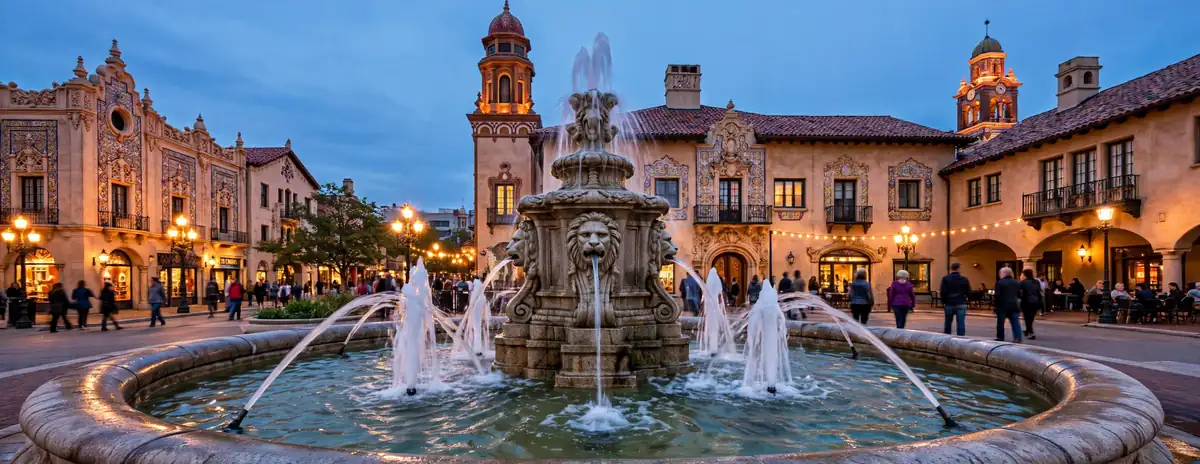
The Country Club Plaza is the prettiest place to walk in Kansas City, and it is the oldest shopping centre in America designed for the automobile, opened in 1922 by developer J.C. Nichols. Fifteen blocks of Spanish and Moorish architecture — red tile roofs, ornate towers, courtyards and painted tiles — stretch along Brush Creek, and the fountains are the point: the J.C. Nichols Memorial Fountain is the grandest, but there are fountains on almost every corner, which is why Kansas City calls itself the City of Fountains. Come in the daytime for the shops and the patios, and come back after dark if you are here in winter, because the Plaza Lights are the city’s great tradition. Read about the Country Club Plaza on Wikipedia.
The practical facts for 2026: the 97th Plaza Lighting Ceremony falls on Thanksgiving night, November 26, 2026, with a 5 p.m. start moved up to fit around the Chiefs game that evening, and the lights then shine every evening through mid-January. The tradition began with a single strand of lights in 1925 and the first ceremony in 1930, and it has only ever been switched off once, in 1973. The lights are free, the garages are free, and the best views are from the second floor of Barnes and Noble or the rooftop of a parking garage. One honest warning: the Plaza is in the middle of a major redevelopment, with a $1.49 billion bond plan advancing in November 2026, so expect some construction hoardings and a few empty storefronts while the work goes on. The Plaza Art Fair in September is the other big date, one of the longest-running art fairs in the country.
4. Union Station and Science City
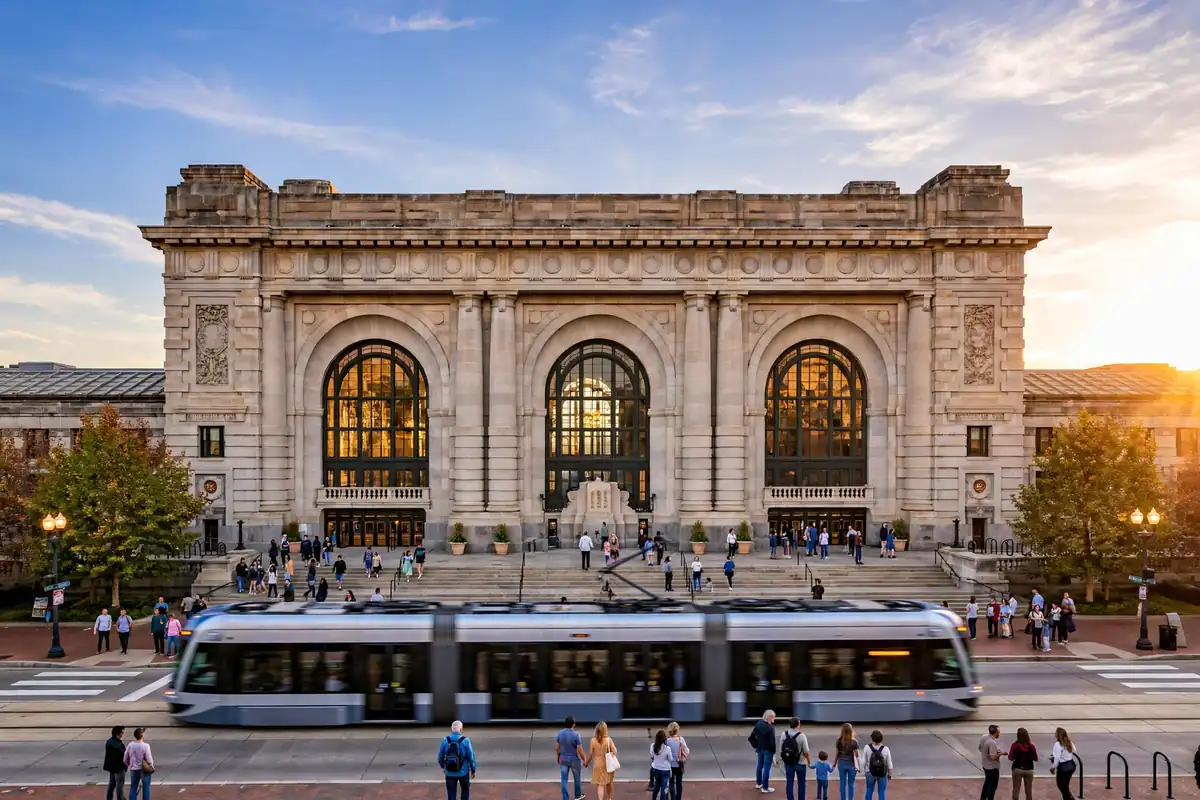
Union Station is Kansas City’s great room, a Beaux-Arts palace opened in 1914 that was once one of the busiest train stations in America and is now the city’s living room — free to walk into, full of restaurants, exhibitions and families, with a model train gallery that children stare at for an hour. The grand hall, with its 95-foot ceilings and three giant chandeliers, is worth the visit on its own, and the station is still a working Amtrak station, with the Southwest Chief to Chicago and Los Angeles and the Missouri River Runner to St Louis. Downstairs is Science City, the hands-on science centre that is the best rainy-day stop in the city for families, with a planetarium next door. Read about Union Station on Wikipedia.
The practical facts for 2026: entering Union Station itself is free. Science City costs $17.25 for adults, youth and seniors, with children under 12 months free, plus a 10 percent preservation fee on top, and the museum-plus-planetarium combo is $23.25. Hours are summer Monday to Saturday 10 a.m. to 5 p.m. and Sunday noon to 5 p.m., and in winter Tuesday to Saturday 10 a.m. to 5 p.m. and Sunday noon to 5 p.m., closed on Mondays. Parking is $15 in the South Plaza and Triangle lots and $6 in the garage for up to four hours. The station is at 30 West Pershing Road, right on the free streetcar line, and it is the southern terminus of the streetcar’s Main Street extension. Allow an hour for the station itself and two to three hours if you add Science City.
5. Arabia Steamboat Museum — go before it closes for good
The Arabia Steamboat Museum is the most urgent stop on this list, because it closes permanently on November 13, 2026. The museum holds the cargo of the steamboat Arabia, which sank in the Missouri River in 1856 and was dug out of a cornfield in 1988 — 200 tons of it, the largest single collection of pre-Civil War artefacts in the world, from fine china and shoes to guns, tools and unopened bottles of perfume, all preserved in river mud for 132 years. It is a time capsule of ordinary American life on the eve of the Civil War, and there is nothing else like it anywhere. Read about the Arabia steamboat on Wikipedia.
The practical facts for 2026: the museum is at 400 Grand Boulevard in the River Market, open Monday to Saturday 10 a.m. to 5 p.m. and Sunday noon to 5 p.m., and admission is about $16. The lease on its City Market building ends on November 13, 2026 — exactly 35 years to the day after it opened on November 13, 1991 — and the site is to be redeveloped with a hotel and apartments. The museum hopes to relocate, with Leavenworth, Kansas, mentioned as a possibility, but no new location had been announced when this guide was written. If you are in Kansas City before that date, go. If you are coming after it, check the museum’s website first, because the collection may be in storage and the building may be gone. This is the trap most 2026 guides still get wrong: they list the Arabia as a permanent attraction, and it is not.
6. Negro Leagues Baseball Museum
The Negro Leagues Baseball Museum is the most moving museum in Kansas City, and one of the most important baseball museums in America. It tells the story of the Negro Leagues — the Black professional baseball leagues that played in the shadow of segregation from 1920 to the 1950s — through the players who made them great: Satchel Paige, Josh Gibson, Cool Papa Bell and Buck O’Neil, the Kansas City Monarchs star who became the museum’s heart and soul. The Field of Legends, a dozen life-size bronze statues of the greats on a miniature diamond, stops most visitors in their tracks. The museum was founded in 1990 and sits at 1616 East 18th Street, in the historic 18th and Vine district, two blocks from the Paseo YMCA where Andrew “Rube” Foster founded the Negro National League in 1920. Read about the Negro Leagues Baseball Museum on Wikipedia.
The practical facts for 2026: admission is $15 for adults, $12 for children aged 5 to 12, and free for under-5s, and admission is free for everyone in February for Black History Month. Hours are Tuesday to Saturday 10 a.m. to 5 p.m. and Sunday noon to 5 p.m., closed on Mondays. It shares a building with the American Jazz Museum, but the tickets are separate and there is no combo ticket, so budget for both if you want the full 18th and Vine experience. Allow an hour to ninety minutes, and read the story of Buck O’Neil before you go — the museum is his legacy, and it shows.
7. American Jazz Museum
The American Jazz Museum is the other half of 18th and Vine, and it belongs on the same morning as the baseball museum. Kansas City is one of the birthplaces of jazz — Charlie Parker was born here, and the 18th and Vine district was the city’s Black cultural centre in the 1920s and 1930s, when Count Basie held court and the clubs never closed. The museum covers Parker, Duke Ellington, Louis Armstrong and Ella Fitzgerald with listening stations, instruments and film, and the Blue Room jazz club inside the building still hosts live sets. The Gem Theater, a restored 1912 vaudeville house across the street, is part of the same story. Read about the American Jazz Museum on Wikipedia.
The practical facts for 2026: admission is $15 for adults, $12 for seniors 65 and over, $10 for youth aged 6 to 18, free for under-5s, and $12 for students and educators aged 19 and over with ID. Two warnings for 2026: the museum is closed on Mondays from September 14, 2026, to May 31, 2027, and the Blue Room is closed for all of January 2027, and there is construction around 18th and Vine that affects parking and street access, so allow extra time and check the museum’s website before you go. The jazz district is best in the evening, when the clubs are playing — the 18th and Vine Jazz Festival in the summer is the big date — but the museum itself is a daytime stop. Allow an hour, then walk the district and eat at one of the barbecue places nearby.
8. Kansas City Zoo and Aquarium
The Kansas City Zoo and Aquarium is the best family day out in the city, and it is much bigger than most visitors expect: 202 acres in Swope Park, with more than 1,700 animals, and a full aquarium inside the zoo. The headline for 2026 is the Sobela Ocean Aquarium, which opened in 2023 — sharks, rays and sea turtles in the middle of Missouri — and it is free with zoo admission, but you need a timed reservation for it, which is the detail most guides forget to mention. The zoo is laid out by continent, with African elephants and rhinos, Australian kangaroos and penguins, and a sky ride over the African savanna that is worth the extra ticket. Read about the Kansas City Zoo on Wikipedia.
The practical facts for 2026: tickets are $22 to $24 online and $25 to $28 at the gate, with under-2s free, and residents of Jackson and Clay counties in Missouri pay $11 to $12. Hours are November to February 9:30 a.m. to 4 p.m., and March to October Monday to Friday 9:30 a.m. to 4 p.m. and Saturday and Sunday 9:30 a.m. to 5 p.m. The zoo is closed on Thanksgiving, Martin Luther King Jr. Day, Christmas and New Year’s Day. Parking is free. Book online and book the Sobela timed slot at the same time, because the aquarium slots fill up on weekends, and arrive early — the zoo is a 20-minute drive southeast of downtown at 6800 Zoo Drive, and the animals are most active in the morning. Allow four to five hours for the full zoo.
9. Worlds of Fun and Oceans of Fun
Worlds of Fun is Kansas City’s big theme park, and it is the stop that surprises visitors most, because it is far better than a regional park has any right to be. Opened on May 26, 1973, by Chiefs owner Lamar Hunt and inspired by Jules Verne’s Around the World in Eighty Days, it is laid out in themed lands — Americana, Africa, Europa, the Orient and Scandinavia — with more than 40 rides including the Mamba hypercoaster and the Patriot inverted coaster. Next door is Oceans of Fun, the water park that opened on May 22, 1982, and one ticket covers both parks on operating days. Read about Worlds of Fun on Wikipedia.
The practical facts for 2026: a daily ticket starts at $39.99 online and $59 at the gate, for ages 3 and over, with under-2s free, and a 2027 season pass starts at $75.99. Two things changed in 2026 that most guides still get wrong. First, the parks are now operated by Enchanted Parks, not Six Flags or Cedar Fair — the official site is now worldsoffun.enchantedparks.com — although Six Flags passes bought before April 6, 2026, are honoured through the 2026 season. Second, Oceans of Fun was closed for the 2026 season, opening only for Memorial Day weekend, May 23 to 25, 2026, so do not plan a water-park day in 2026. The park is at 4545 Worlds of Fun Avenue, about 15 minutes northeast of downtown, and it is a full-day stop — arrive at opening, ride the big coasters first, and save the shows for the hot afternoon.
10. Kauffman Center for the Performing Arts
The Kauffman Center for the Performing Arts is the most beautiful building in Kansas City, and it is worth a visit even if you never see a show inside it. Two great shells of white concrete and glass rise over downtown, designed by architect Moshe Safdie and opened in 2011, and the lobby looks out over the city through a wall of glass. Inside are two halls: the Muriel Kauffman Theatre, with 1,800 seats, home to the Lyric Opera of Kansas City and the Kansas City Ballet, and Helzberg Hall, with 1,600 seats, home to the Kansas City Symphony. The building is at 1601 Broadway Boulevard, on the south edge of downtown, and the view from the lobby at dusk, with the city lights coming on below, is one of the best free sights in the city. Read about the Kauffman Center on Wikipedia.
The practical facts for 2026: the building is open for performances and for guided tours, and the box office sells tickets for the Symphony, the ballet and the opera, with prices that vary widely by show — balcony seats for the Symphony are often the best value in the house. If you are not seeing a show, come for a tour or simply walk into the lobby during opening hours and look at the view. The Kauffman Center is on the free streetcar line, a short ride from Union Station or the Power and Light District, and it pairs naturally with dinner in the Crossroads afterwards. Check the calendar before your trip, because the Symphony’s season runs from autumn to spring and the ballet’s Nutcracker in December is the hardest ticket in town.
11. City Market and the River Market
The City Market is the oldest part of Kansas City and the best place to spend a Saturday morning. The market has been in continuous operation since 1857, in the River Market district on the Missouri River, and on Saturdays it becomes the largest farmers market in the region, with produce stalls, food trucks, crafts and live music spilling across the square. The rest of the week it is quieter but still worth a wander: the permanent shops sell spices, Middle Eastern groceries, fresh pasta and flowers, and the Arabia Steamboat Museum is right here, two minutes from the market square. The River Market is also the northern end of the free streetcar line, so it is the natural starting point for a streetcar ride south through downtown. Read about Kansas City on Wikipedia.
The practical facts for 2026: the market is at 20 East 5th Street, and the big day is Saturday, when the farmers market runs in the morning and the crowds arrive early — come before 10 a.m. if you want to eat your way through the food stalls without queuing. The shops are open through the week, and the district’s restaurants and coffee shops make it a good breakfast stop before a day downtown. Combine it with the Arabia Museum while you still can, because the museum closes permanently on November 13, 2026, and with a streetcar ride south to Union Station. Allow an hour on a weekday and two to three hours on a Saturday morning.
12. Power and Light District and T-Mobile Center
The Power and Light District is downtown Kansas City after dark: eight blocks of bars, restaurants and live music around the KC Live! block, a covered outdoor plaza with a giant screen that shows the game and hosts free concerts in summer. It is loud, crowded and fun on a Friday night, and it is the obvious place to eat and drink before or after an event next door at the T-Mobile Center, the 19,000-seat arena that opened in 2007 and hosts the biggest concerts in the city, the Big 12 basketball tournament and the occasional big fight. Read about the Kansas City Power and Light District on Wikipedia.
The practical facts for 2026: the district is free to walk through, and the KC Live! block’s concerts are often free, which makes it one of the cheapest nights out in the city. The T-Mobile Center’s calendar is the thing to check before your trip — a big concert or a tournament weekend fills every hotel downtown and doubles the prices, while a quiet week leaves the district half empty. The district sits on the free streetcar line, so you can ride in from Union Station or the River Market and ride home again without paying for parking. If you want a quieter evening, the Crossroads is a ten-minute walk south and a world away in atmosphere.
13. Boulevard Brewing Company
Boulevard Brewing Company is Kansas City’s brewery, and the tour is one of the best free things in the city. Founded in 1989 in an old brick warehouse on Southwest Boulevard, the company is now the largest specialty brewer in the Midwest and Missouri’s largest independent brewery, and its Tank 7 farmhouse ale and Unfiltered Wheat are the beers you will see on every menu in town. The free public tour lasts 45 minutes, walks you through the brewhouse and the bottling line — there are more than 160 stair steps, though ramps and lifts cover all the stops — and ends with samples in the Beer Hall across the street. Read about Boulevard Brewing Company on Wikipedia.
The practical facts for 2026: the free tours run Wednesday to Sunday, year-round, and tickets are released on a weekly basis and go fast — the official advice is to show up when the Tours and Rec Center opens at 10 a.m. and claim a ticket for a later tour that day, because the day’s tickets can be gone within minutes on a busy Saturday. You must be 21 to taste. The brewery also runs paid specialty tours, including the Smokestack tour with food pairings, and the Beer Hall at 2534 Madison Avenue is open for drinks and food without a tour ticket. The brewery is at 2501 Southwest Boulevard, on the western edge of downtown near the Crossroads, and it is a 15-minute walk from the streetcar’s Main Street line. Allow two hours, and do not drive — the samples add up.
14. Crown Center, LEGOLAND and SEA LIFE
Crown Center is Kansas City’s family entertainment complex, built by Hallmark on an 85-acre site south of downtown and opened in 1973, and it is the rainy-day answer for families with small children. The complex itself is free to walk through, with shops, restaurants and a big public square, and in winter the Crown Center Ice Terrace opens for outdoor skating. Inside are the two paid attractions that bring families here: LEGOLAND Discovery Center, an indoor LEGO playground with rides, a 4D cinema and a miniature Kansas City built from bricks, and SEA LIFE Kansas City Aquarium, with sharks, rays and an ocean tunnel. Read about Crown Center on Wikipedia.
The practical facts for 2026: LEGOLAND tickets start at $21.99 online in advance, against $24.99 at the door, and the combo ticket with SEA LIFE starts at $29.99; SEA LIFE on its own starts at about $21. One rule catches adults out: all adults must be accompanied by a child aged 17 or under to visit LEGOLAND, except on adult nights, so do not plan a child-free visit. The complex is at 2450 Grand Boulevard, on the free streetcar line between Union Station and the Plaza, which makes it an easy half-day stop between the two. Allow two to three hours for the two attractions together, and book online in advance — the walk-up price is higher and the slots sell out on school holidays.
15. Kansas City, Kansas: Speedway, Legends and Sporting KC
Kansas City, Kansas, is the other Kansas City, and it is worth half a day for sports and shopping. The draw is Village West, the entertainment district off Interstate 70, about 20 minutes west of downtown: the Kansas Speedway, a 1.5-mile NASCAR oval that hosts two big race weekends a year; the Legends Outlets, an open-air shopping centre with more than 100 stores; and Children’s Mercy Park, the home of Sporting Kansas City, one of the best soccer-specific stadiums in America, where the atmosphere on a match night is the loudest in the city after Arrowhead. Read about the Kansas Speedway on Wikipedia.
The practical facts for 2026: the Speedway’s NASCAR weekends are the biggest dates on this side of the river, and the hotels and restaurants around Village West fill up for them, so book early if you are coming for a race. Sporting Kansas City’s season runs from spring to autumn, and tickets are generally cheaper and easier to get than Chiefs tickets, which makes a soccer night the best-value big-league ticket in the city. The Legends Outlets are open daily and are the place to go for outlet shopping, with a Hollywood Casino next door for adults. You need a car or a rideshare to get here — the streetcar does not cross the state line, and the buses are infrequent — so plan it as a half-day trip from downtown, not a walk-up stop.
16. Harry S. Truman Presidential Library and Museum
The Harry S. Truman Presidential Library and Museum is the best day trip from Kansas City, and it is twenty minutes east in Independence, the town where Truman lived most of his life. The museum reopened in 2021 after a $29 million transformation, and it is one of the best presidential libraries in the country: Truman’s White House office, the exhibits on the decision to use the atomic bomb, the desegregation of the armed forces in 1948 and the Marshall Plan, and the story of a haberdasher from Missouri who became president by accident and then remade the world. Truman’s grave is on the grounds, and his house in Independence, a National Park Service site a short drive away, offers free guided tours. Read about the Harry S. Truman Presidential Library on Wikipedia.
The practical facts for 2026: the library is at 500 West US Highway 24 in Independence, open Monday to Saturday 9 a.m. to 5 p.m. and Sunday noon to 5 p.m. from April to December, and closed on Sundays from January to March. Admission is $12 for adults, $10 for seniors 62 and over and veterans, $8 for college students with ID, $5 for youth aged 13 to 18, and free for children 12 and under, with free parking in the lots around the building. You will go through a security screening on entry, and there are no lockers or coat check. Allow two to three hours for the museum, and add an hour for Truman’s house — book the house tour in advance, because the free tours fill up.
17. Kauffman Stadium and GEHA Field at Arrowhead Stadium
Kansas City’s sports complex is the Truman Sports Complex, east of downtown, and it holds two of the most famous stadiums in America. Kauffman Stadium, home of the Kansas City Royals since 1973, is the prettiest ballpark in the league, with its famous outfield fountains — the largest water display in Major League Baseball — and tickets that start at about $15. Next door is GEHA Field at Arrowhead Stadium, home of the Kansas City Chiefs since 1972, the loudest stadium in the world — the crowd set a Guinness World Record of 142.2 decibels in 2014 — and the hardest ticket in town, with prices from about $80 to more than $400. Read about Arrowhead Stadium on Wikipedia.
The practical facts for 2026: the big story is the World Cup. Arrowhead hosted six matches in the summer of 2026, called Kansas City Stadium for the tournament: Argentina beat Algeria 3-0 on June 16, with Messi scoring the opener; Ecuador drew 0-0 with Curaçao on June 20; the Netherlands beat Tunisia 3-1 on June 25; Algeria drew 3-3 with Austria on June 27; Colombia beat Ghana 1-0 on July 3 in the round of 32; and Argentina beat Switzerland 3-1 after extra time on July 11 in the quarter-final, the only quarter-final in the central United States. Argentina played three times in Kansas City, more than any other team, and the FIFA Fan Festival ran for 18 days on the south lawn of the WWI Museum, while England’s national team was based in the city. The stadiums are not on the streetcar line, so take a rideshare or a bus on game day, and arrive early — the tailgating at Arrowhead is a Kansas City institution in itself.
18. Crossroads Arts District and First Fridays
The Crossroads Arts District is Kansas City’s creative quarter, a grid of old warehouses between downtown and Union Station that now holds galleries, studios, coffee roasters, breweries and the city’s best food hall. On the first Friday of every month, the district holds First Fridays, when the galleries open late, the streets fill with food trucks and music, and the whole neighbourhood becomes a free open-air art walk — the best free evening in the city, and the one most visitors miss because it only happens once a month. The rest of the time, the Crossroads is worth a slow afternoon: the Parlor food hall at 1707 Locust Street has seven kitchens under one roof, and the streetcar runs straight down Main Street through the district. Read about the Kemper Museum of Contemporary Art on Wikipedia.
The practical facts for 2026: First Fridays run on the first Friday of the month, all year, and they are free — check the Crossroads calendar for the month you are visiting, because the summer editions are the biggest and the winter ones are quieter. The Kemper Museum of Contemporary Art, at 4420 Warwick Boulevard just south of the district, is free and is the best small contemporary art museum in the region, with a strong permanent collection and a good café. The Crossroads is walkable from the Power and Light District in ten minutes, and the streetcar’s Main Street stops put you in the middle of it. Allow an afternoon, or a whole evening on a First Friday.
19. The Money Museum at the Federal Reserve Bank
The Money Museum is the most underrated free stop in Kansas City, and it sits two blocks from the WWI Museum, so there is no excuse to miss it. Inside the Federal Reserve Bank of Kansas City, at 1 Memorial Drive, you can watch millions of dollars being counted and shredded, lift a real gold bar worth nearly $400,000, see the Harry S. Truman coin collection, and walk out with a free souvenir bag of shredded United States currency — a bag of real money, cut into confetti. It is a small museum, less than an hour, and it is the only place in the city where you can hold a fortune in your hands and laugh about it. Read about the Federal Reserve Bank of Kansas City on Wikipedia.
The practical facts for 2026: the Money Museum is free and walk-in, with no tickets required, and it is open Monday to Friday from 9:30 a.m. to 4 p.m., with last entry at 3:30 p.m. It is closed on weekends and bank holidays, so plan it for a weekday. Everyone over 18 needs a valid photo ID, and you will go through airport-style security screening on entry, so arrive ten minutes early and leave the pocket knife at the hotel. Parking is free in the visitor lot off Wyandotte Street. The museum also runs free guided pop-up tours on Friday mornings. Pair it with the WWI Museum on the same morning — the two buildings are neighbours, and together they are the best free-and-cheap half day in the city.
20. Westport, the city’s oldest neighbourhood
Westport is where Kansas City began, and it is the best place to end a day. Founded in 1833, Westport predates Kansas City itself — it was a frontier outfitting town on the Santa Fe, California and Oregon trails, and its old buildings still line Westport Road. Today it is the city’s liveliest neighbourhood after dark: bars, restaurants, coffee shops and live music in a walkable grid, with Kelly’s Westport Inn, in one of the oldest buildings in the city, pouring drinks where the trail hands once drank. The Westport Flea Market is the place for a burger, and the shops on Westport Road are the best place in the city for a souvenir that is not from a gift shop. Read about Westport on Wikipedia.
The practical facts for 2026: Westport is a ten-minute drive or a short bus ride south of downtown, and it is best in the evening, when the patios fill up and the live music starts. It is also one of the best places to stay on a budget, with smaller hotels and guesthouses that cost far less than downtown or the Plaza. Come for dinner and stay for the music, and if you are here on a weekend, arrive before 7 p.m. if you want a table at the popular spots. Westport is also the gateway to the Plaza and the Nelson-Atkins, which are a short walk or a streetcar ride away, so it works as a base for a whole day of the city’s best stops.
Kansas City in 3 days — a ready-made itinerary
Three days is the right amount of time for Kansas City: one day downtown and in the River Market, one day on the Plaza and in the museums, and one day for jazz, the zoo and the Kansas side. The itinerary below assumes you are staying downtown or in the Power and Light District, and it uses the free streetcar for almost everything in the city centre. If you only have two days, do Day 1 and Day 2 and save the Kansas side for next time.
| Day | Theme | Highlights | Where you sleep |
|---|---|---|---|
| Day 1 | Downtown and the River Market | Union Station, Science City, WWI Museum, Money Museum, City Market, Arabia Museum, Power and Light District in the evening | Downtown or Power and Light |
| Day 2 | The Plaza, the museums and barbecue | Nelson-Atkins, Country Club Plaza, Boulevard Brewing tour, Crossroads and First Fridays if it is a Friday, barbecue dinner | Downtown, Plaza or Westport |
| Day 3 | Jazz, the zoo and the Kansas side | Negro Leagues and American Jazz museums, Kansas City Zoo or Worlds of Fun, Speedway and Legends or Truman Library in Independence | Downtown or Power and Light |
Day 1 — Downtown and the River Market
Start at the River Market. Get to the City Market early, before 10 a.m. on a Saturday, and eat your way through the food stalls, then walk two minutes to the Arabia Steamboat Museum — remember, it closes permanently on November 13, 2026, so if you are reading this after that date, skip it and spend the morning at the market instead. Ride the free streetcar south from the River Market stop through downtown to Union Station, and spend an hour in the grand hall and the model train gallery, then two hours at Science City if you have children. Walk up the hill to the National WWI Museum and Memorial for the afternoon, and pair it with the free Money Museum next door — the two together are the best half day in the city. Come back down to the station at sunset, when the light on the Liberty Memorial tower is at its best, and end the evening in the Power and Light District, where the KC Live! block has free concerts in summer and the bars are full on a Friday night.
Day 2 — The Plaza, the museums and barbecue
Take the streetcar south to the Plaza and start at the Nelson-Atkins Museum of Art, which opens at 10 a.m. and is free — but not on a Tuesday or a Wednesday, when it is closed, so check the day before you plan this. Spend two hours with the Asian art and the Shuttlecocks on the lawn, then walk three blocks to the Country Club Plaza for lunch on a patio and an afternoon among the fountains and the Spanish architecture. In the late afternoon, take the streetcar back north to the Crossroads for the Boulevard Brewing tour — book the free ticket in the morning, because the day’s tickets go fast — and end the day with the barbecue dinner Kansas City is famous for: Joe’s Kansas City for the Z-Man, Arthur Bryant’s for the classic plate, or Q39 for competition-style barbecue. If it is the first Friday of the month, the Crossroads First Fridays art walk is the evening instead, and it is free.
Day 3 — Jazz, the zoo and the Kansas side
Spend the morning at 18th and Vine: the Negro Leagues Baseball Museum and the American Jazz Museum share a building, and together they tell the two great Kansas City stories — baseball and jazz — in about two hours. Then choose your afternoon. Families should go to the Kansas City Zoo and Aquarium, with a timed reservation for the Sobela Ocean Aquarium booked in advance, or to Worlds of Fun for the coasters. Sports fans should drive twenty minutes west to the Kansas side for the Speedway, the Legends Outlets and a Sporting Kansas City match at Children’s Mercy Park. History lovers should drive twenty minutes east to Independence for the Harry S. Truman Presidential Library and Museum, with a free tour of Truman’s house if you booked ahead. End the day in Westport, the city’s oldest neighbourhood, for dinner and live music — it is the best place in Kansas City to finish a trip.
Best time to visit Kansas City
The best time to visit Kansas City is mid-April to mid-May and mid-September to mid-October, when the days are warm, the humidity is low and the city is at its best for walking. July is the hottest month, with an average high of about 90 degrees Fahrenheit, and January is the coldest, with an average low of about 24 degrees, so the city swings hard between the seasons. May is the wettest month, with about 5.3 inches of rain, and spring brings thunderstorms and the occasional tornado warning — check the forecast and take the warnings seriously. Autumn is probably the best season of all: drier than spring, cooler than summer, and the trees along Brush Creek turn in October. Winter is the budget season, with the lowest hotel prices, and it has its own reward: the Plaza Lights, which shine from Thanksgiving night through mid-January, are worth a winter trip on their own.
| Season | Months | Weather | What’s on |
|---|---|---|---|
| Spring | March to May | Highs 58 to 76 degrees, May is the wettest month with about 5.3 inches of rain | Farmers markets open, thunderstorms possible, baseball season starts |
| Summer | June to August | Highs 85 to 90 degrees, hot and humid | Royals baseball, Worlds of Fun, zoo, free concerts at KC Live! |
| Autumn | September to November | Highs 55 to 80 degrees, the driest season | Plaza Art Fair in September, fall colours in October, Plaza Lights from Thanksgiving night |
| Winter | December to February | Highs 41 to 46 degrees, lows in the 20s | Plaza Lights through mid-January, Crown Center ice skating, indoor museums, lowest hotel prices |
Where to stay in Kansas City
Downtown and the Power and Light District are the best base for a first visit: you are on the free streetcar line, within walking distance of Union Station, the River Market and the Crossroads, and the nightlife is outside your door. The Country Club Plaza is the prettiest base, and the best for couples and shoppers, with the fountains and the restaurants a short walk away and the Nelson-Atkins three blocks off. Westport is the budget base, with smaller hotels and guesthouses, bars and live music, and a short ride to the Plaza. The Crossroads Arts District is the boutique base, with design hotels and the food hall scene, and the River Market is the quiet base, with apartments and coffee shops and the Saturday market on your doorstep. The Kansas side, around the Legends, only makes sense if you are coming for a race or a soccer match.
| Area | Best for | Price range |
|---|---|---|
| Downtown and Power and Light | First-timers, nightlife, streetcar | $140 to $220 a night |
| Country Club Plaza | Couples, shopping, fountains | $150 to $250 a night |
| Westport | Budget travellers, bars, live music | $90 to $150 a night |
| Crossroads Arts District | Boutique hotels, galleries, food halls | $130 to $200 a night |
| River Market | Apartments, markets, quiet mornings | $100 to $160 a night |
| Kansas side, Legends | Speedway, Sporting KC, outlets | $100 to $150 a night |
Getting around Kansas City
Kansas City International Airport, MCI, is 15 miles northwest of downtown, and it has a single $1.5 billion terminal that opened on February 28, 2023, with 40 gates — if you have not flown through Kansas City in a few years, the new building will surprise you, because the old three horseshoe terminals are gone. A rideshare or a taxi takes about 20 to 25 minutes into downtown, and RideKC buses run to the airport as well. Read about Kansas City International Airport on Wikipedia.
Once you are downtown, the KC Streetcar is the way to get around, and it costs nothing — free forever, with no ticket and no fare. The Main Street Extension opened on October 24, 2025, adding 3.5 miles and 16 new stops from Union Station south to the University of Missouri-Kansas City at 51st Street and Brookside Boulevard, so the whole line is now 5.7 miles from the River Market to UMKC, and a Riverfront extension opened in May 2026. In November 2025 the streetcar carried 341,922 trips, a record and two and a half times the previous November. The buses are a different story, and this is the trap: RideKC buses were free from March 2020, but fares came back on June 1, 2026 — $2 for a single ride, $4 for a day pass, $20 for a week and $62.50 for a month, with fare capping, and cash is not accepted on board. Most guides still say the buses are free, and they are wrong. For the zoo, Worlds of Fun and the Kansas side you will want a car or a rideshare, because the streetcar does not go there and the buses are infrequent. Downtown itself is walkable, and the streetcar covers the core, so a car is a cost, not a necessity, for a three-day trip.
Kansas City food you have to try
Kansas City is a food city, and barbecue is only the beginning. The city invented its own style of barbecue, named a cut of steak after itself and brews some of the best beer in the Midwest, and the food halls and markets are as good as the restaurants. Eat barbecue at least twice, once at a classic counter and once at a modern competition-style place, and save room for the steak and the ice cream.
Kansas City barbecue — the burnt ends and the Z-Man
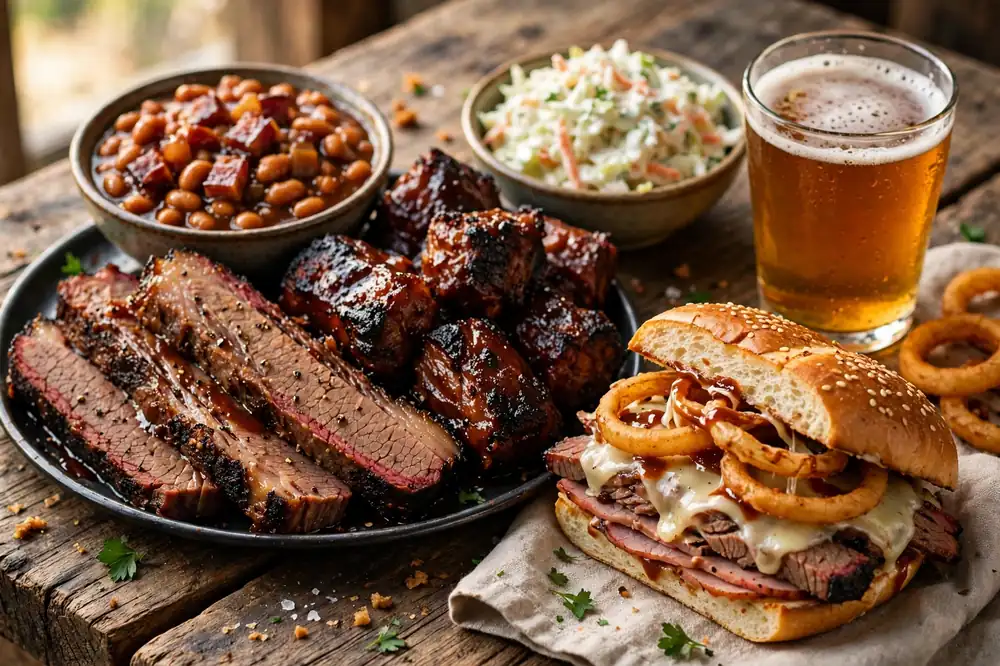
Kansas City barbecue is slow-smoked meat with a thick, sweet, tomato-based sauce, and the dish that defines it is the burnt end: the twice-smoked, caramelised points of a beef brisket, crisp on the outside and melting inside, that started as a free end-piece given away at the counter and became the most famous bite in the city. The pilgrimage starts at Joe’s Kansas City, in the original gas station at 47th and Mission, where the Z-Man sandwich — sliced brisket, smoked provolone, onion rings and barbecue sauce on a kaiser roll — is the order, and where the James Beard Foundation has recognised the counter. Arthur Bryant’s, at 1727 Brooklyn Avenue near 18th and Vine, is the classic: a Formica counter, a line out of the door and a plate of brisket and ribs that has not changed in decades. Q39 in Midtown is the modern competition-style answer, with brisket, the Mr. Burns sandwich and a line that moves fast, and Gates Bar-B-Q, with its famous greeting and its mixed plate, is the old-school rival. Jack Stack Barbecue, in the old Freight House by Union Station, is the sit-down version, with a cheesy corn bake and crown prime rib. Read about Kansas City-style barbecue on Wikipedia. Two honest tips: the burnt ends sell out, so go early, and order at the counter, not the table — the counter is where the city eats.
Beyond barbecue — steak, Italian and ice cream
Kansas City named a cut of steak after itself, and the Kansas City strip — the bone-in strip steak that New York calls a New York strip — is still the order at the city’s old steak houses. Jess and Jim’s Steakhouse in Martin City, south of downtown, is the classic: a big, no-nonsense dining room, huge portions and a playroom for the children, while the Golden Ox, in the old Stockyards district, is the historic one, where the cattle men ate. For Italian, go to Columbus Park, the city’s old Italian neighbourhood just east of the River Market, where Garozzo’s Ristorante has served chicken spiedini — skewered chicken in a lemon-butter sauce — since 1989, and where the portions are famously generous. For dessert, Betty Rae’s Ice Cream has shops in the River Market, Westport and Waldo, with flavours that change with the season, and Glacé Artisan Ice Cream on Main Street is the small-batch rival. None of these places is expensive, and all of them are where Kansas Citians eat when they are not eating barbecue.
Markets and food halls — City Market, Parlor and Westport
If you want to eat your way through Kansas City in one afternoon, start at the City Market on a Saturday morning, when the farmers market fills the square and the food stalls sell everything from tacos to dumplings to fresh-baked bread. The Parlor, the Crossroads food hall at 1707 Locust Street, is the modern version: seven kitchens under one roof, from burgers and pizza to ramen and vegan bowls, with a bar in the middle and the streetcar outside. Westport is the evening version, with a dense grid of restaurants and bars along Westport Road — the Westport Flea Market for a burger, and a dozen smaller places for everything else. The three together cover the city’s food scene better than any single restaurant list, and they are all on or near the free streetcar line.
Free things to do in Kansas City
Kansas City is one of the cheapest big cities in America to visit, because so much of the best of it is free. The Nelson-Atkins Museum of Art is free every day, with one of the best collections in the country. The KC Streetcar is free forever, end to end, from the River Market to UMKC. The Money Museum at the Federal Reserve Bank is free on weekdays, with a gold bar to lift and a bag of shredded money to take home. The grounds of the National WWI Museum and Memorial are free to walk, and the sunset from the tower hill is the best free view in the city. The fountains are free — more than 200 of them, second only to Rome — and the Plaza Lights are free from Thanksgiving night through mid-January. Loose Park’s rose garden is free, the Kemper Museum of Contemporary Art is free, the First Fridays art walk in the Crossroads is free, browsing the City Market is free, the Boulevard Brewing tour is free, and walking Crown Center costs nothing. A full day of free sights in Kansas City is not a budget compromise; it is the best day in the city.
Frequently asked questions
Is Kansas City in Missouri or Kansas?
Both. The metro area straddles the state line, but the main city — downtown, the Plaza, the museums, the barbecue and the sports stadiums — is Kansas City, Missouri, on the Missouri River. Kansas City, Kansas, is a separate, smaller city across the river, and it holds the Kansas Speedway, the Legends Outlets and Sporting Kansas City’s stadium. When people say “Kansas City” without specifying, they almost always mean the Missouri side, and that is where you should stay.
How many days do you need in Kansas City?
Three days is right for a first visit: one day downtown and in the River Market, one day on the Plaza and in the museums, and one day for jazz, the zoo and the Kansas side. Two days works if you skip the Kansas side and the day trips, and four or five days lets you add the Truman Library in Independence, a day in Lawrence, Kansas, and a slower pace at the museums. Do not try to do it in one day — the WWI Museum alone deserves half a day.
What is Kansas City known for?
Barbecue, jazz, fountains and sports. Kansas City invented its own style of barbecue and the burnt end, it is one of the birthplaces of jazz — Charlie Parker was born here and Count Basie played here — it has more than 200 fountains, second only to Rome, and it is home to the Chiefs and the Royals and the only museum in America devoted entirely to the First World War. It is also a 2026 World Cup city, which hosted six matches including a quarter-final.
Is Kansas City worth visiting?
Yes, and it is one of the best-value city breaks in America. The Nelson-Atkins is free, the streetcar is free, the Money Museum is free, the barbecue is cheap and the hotels cost far less than in Chicago or New York. It has a world-class war museum, a world-class art museum, a great food scene and big-league sports, and it does all of it without the crowds or the prices of the coastal cities. Come for three days and you will leave planning the next trip.
Is the KC Streetcar really free?
Yes. The KC Streetcar is free forever, with no ticket and no fare, and it runs 5.7 miles from the River Market through downtown and the Crossroads to the University of Missouri-Kansas City, after the Main Street Extension opened on October 24, 2025. Do not confuse it with the buses: RideKC buses were free from March 2020, but fares came back on June 1, 2026 — $2 for a single ride, $4 for a day pass — and cash is not accepted on board. Most guides still say the buses are free, and they are wrong.
What food is Kansas City famous for?
Burnt ends, first and always: the twice-smoked brisket points that Kansas City made famous, eaten at Joe’s, Arthur Bryant’s, Q39 or Gates. Then the Z-Man sandwich at Joe’s Kansas City, the Kansas City strip steak that the city named after itself, and Boulevard beer, brewed in the city since 1989. Beyond that, the Italian food of Columbus Park, the ice cream at Betty Rae’s and the food halls of the Crossroads are all worth a meal.
Further reading — Wikipedia, Reddit and Quora
For more background on the city, read about Kansas City on Wikipedia, which covers the history, the two-state metro and the fountains in detail. For up-to-date local advice, restaurant debates and trip reports from people who live there, the KansasCity community on Reddit is active and helpful — search it for the barbecue argument of the week, because Kansas Citians take that argument seriously. For the barbecue question specifically, the Quora thread on Kansas City barbecue has real answers from people who have eaten at all of them, on the differences between the top places and how to choose between Joe’s, Arthur Bryant’s, Q39 and Gates.
Your Kansas City trip, in one paragraph
Kansas City is the city that gives you a field of 9,000 poppies and a plate of burnt ends in the same day, a free world-class art museum and the loudest stadium on Earth, a streetcar that costs nothing and a barbecue argument that never ends — and it is the city that rewards a slow three days more than a rushed one. Come for the WWI Museum at sunset and the Plaza fountains at dusk, stay for the jazz on 18th and Vine, the free museums and the food, and leave with a plan to come back in a different season, because Kansas City in the Plaza Lights and Kansas City in baseball season are two different cities. And if you want more city guides in the same style, we have them: Chicago, Nashville, Los Angeles, Orlando, Miami, San Diego, Denver, Savannah, Dallas, Charleston, San Francisco, Myrtle Beach, Las Vegas, San Antonio, London, Portland, Pigeon Forge, Puerto Rico, Atlanta, Phoenix, Paris, Maui, Key West, Colorado Springs, Sedona, Chattanooga, Palm Springs, St Louis, Tokyo and Japan.

About the Author