Things to Do in Japan
20 Best Attractions, a 3-Day Itinerary, Where to Stay, and the Food You Cannot Miss
Quick Info
Best for: First-time Japan visitors, food lovers, temple and castle hunters, families, train fans and anyone who wants ancient and futuristic in the same trip — the country that does both better than anywhere else on Earth
Best time: Late March to early April for cherry blossom; mid-to-late May and November for the best weather; February for Hokkaido snow; July for lavender in Furano
How long: 7 to 10 days for the classic Tokyo–Kyoto–Osaka route; 3 days is only a first taste; two weeks if you add Hokkaido or Okinawa
Budget: Roughly ¥18,000 to ¥30,000 ($120 to $200) per person per day for a mid-range trip, plus the bullet train fares between cities; a day of free shrines, parks and viewpoints runs much cheaper
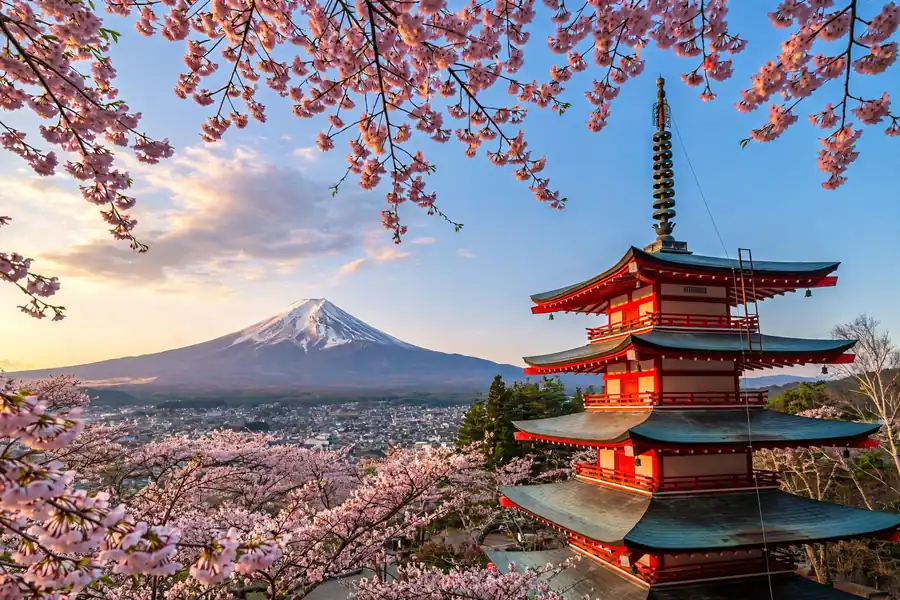
Don’t miss: Fushimi Inari at dawn before the crowds, Mount Fuji from the Chureito Pagoda, the floating torii at Miyajima at high tide, the bowing deer of Nara and one night in a ryokan with an onsen
Japan is the country that gives you a 1,400-year-old shrine and a robot cafe in the same day, a bowl of ramen that costs less than a coffee back home and a bullet train that crosses the country at 320 kilometres an hour — and it does all of it on time, in perfect order, with the friendliest service on Earth. This guide gives you the 20 best things to do in Japan in a sensible order, a ready-made 3-day itinerary, honest advice on when to go, where to stay and how to get around, and the three foods you have to try before you leave — plus the free sights that cost nothing at all. Prices and hours change, so every price in this guide is the 2026 price as published by the attraction itself — always check the official website before you visit.
One thing to know before you go: Japan in 2026 is not the country of the old guidebooks, and the old guides are wrong in expensive ways. The Japan Rail Pass now costs ¥50,000 for seven days and no longer pays for itself on the classic Tokyo–Kyoto–Osaka route — any guide still telling you to buy it automatically will cost you money. Himeji Castle doubled its admission for non-residents on March 1, 2026, to ¥2,500. Mount Fuji now charges a ¥4,000 climbing fee on every trail, Ginkaku-ji in Kyoto doubled to ¥1,000, and the departure tax tripled to ¥3,000 on July 1, 2026. This guide tells you which traps to watch for, so you can plan with facts instead of outdated blog posts. Read about Japan on Wikipedia.
Japan at a glance
| Question | Short answer |
| Where is Japan? | An island country in East Asia — more than 14,100 islands, with four main ones: Honshu, Hokkaido, Kyushu and Shikoku |
| What is it best for? | Temples and neon cities in the same trip, the best food on Earth, bullet trains, hot springs and four distinct seasons |
| How long should I stay? | 7 to 10 days for the classic Tokyo–Kyoto–Osaka route; 3 days is only a first taste; two weeks if you add Hokkaido or Okinawa |
| How much does it cost? | Roughly ¥18,000 to ¥30,000 ($120 to $200) per person per day mid-range, plus the bullet train fares between cities |
| Do I need the Japan Rail Pass? | Only if your long-distance legs add up to more than ¥50,000 in 7 days — the classic route alone does not; do the maths first |
| What is the one thing not to miss? | Fushimi Inari at dawn in Kyoto, then Mount Fuji from the Chureito Pagoda |
| When is the best time to go? | Late March to early April for cherry blossom; mid-to-late May and November for the best weather; February for Hokkaido snow |
| Is it good for families? | Yes — deer, snow monkeys, theme parks, bullet trains and the friendliest service on Earth; the trains are safe and easy |
The 20 best things to do in Japan
These are the 20 best things to do in Japan, ranked the way a first-time visitor should actually do them: Kyoto first, then Mount Fuji and Nara, then Hiroshima and Osaka, then the mountains, the snow and the islands. Every price below is the 2026 price as published by the attraction itself, and every trap — the pass that no longer pays, the castle that doubled its price, the mountain that now charges to climb — is called out where it matters.
1. Fushimi Inari-taisha, Kyoto
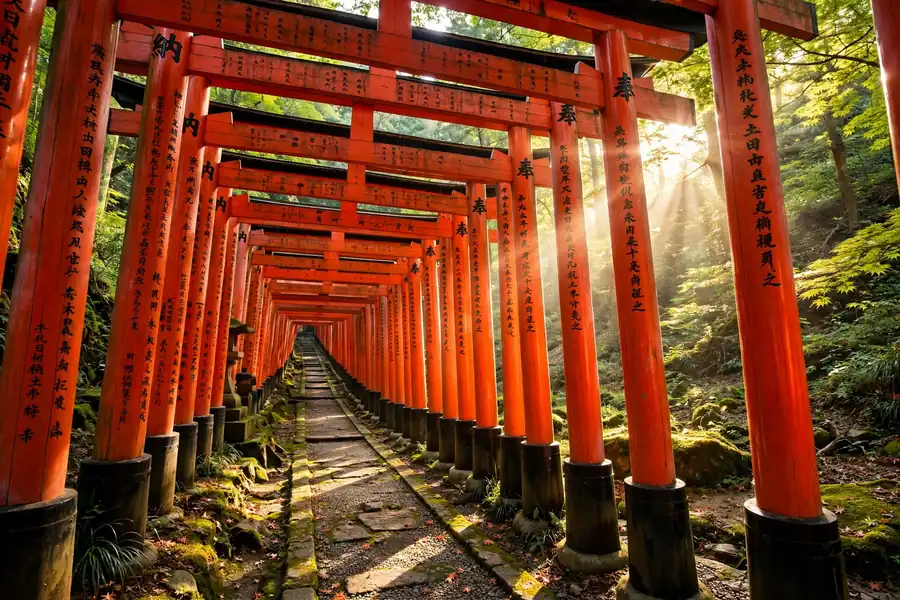
Fushimi Inari-taisha is the most photographed place in Japan, and it is free. The head shrine of about 30,000 Inari shrines across the country, it is a mountain covered in vermilion torii gates — roughly 10,000 of them — forming tunnels of red that climb Mount Inari behind the main hall. The famous Senbon Torii, the thousand-gate tunnel at the bottom, is where everyone takes the photo, but the real walk is the full loop up the mountain and back, two to three hours through smaller shrines, stone foxes and forest, where the crowds thin out fifteen minutes past the first big gates. The shrine is open at all hours, all year, and it costs nothing to enter. Read about the Fushimi Inari-taisha on Wikipedia.
The practical facts for 2026: go early or go late. Before 8 a.m. the lower gates are almost empty, and after dark the lanterns come on and the mountain is quiet in a way the daytime never is. The shrine is a five-minute walk from Inari Station on the JR Nara Line, two stops from Kyoto Station, or from Fushimi-Inari Station on the Keihan Line. Two honest warnings: the full loop is a real climb, with stone steps and no shade in summer, so bring water and wear proper shoes; and do not stop in the middle of the narrow gate tunnels for a long photo session — the crowd behind you is not patient.
2. Kinkaku-ji, the Golden Pavilion, Kyoto
Kinkaku-ji is the temple on every postcard of Japan: a three-storey pavilion covered in gold leaf, standing over a mirror pond in a pine garden, and it is more beautiful in person than in any photograph. Built as a shogun’s villa in the 14th century and rebuilt after a fire in 1950, it is a Zen temple and a UNESCO World Heritage site, and the visit is a one-way circuit around the pond that takes about 25 minutes — there are no interiors to enter, so the whole experience is the view, the garden and the light on the gold. Admission is ¥500 for adults, and the pavilion is open 9 a.m. to 5 p.m. every day. Read about the Kinkaku-ji on Wikipedia.
The practical facts for 2026: go at 9 a.m. when the gates open, or after 4 p.m., when the tour groups have left and the afternoon light turns the gold warm. The pavilion is reached by city bus 101 or 205 from Kyoto Station, about 40 minutes, and the crowds are the worst part of the visit — on a spring weekend the circuit is shoulder to shoulder. One trap to know: the Silver Pavilion, Ginkaku-ji, doubled its admission to ¥1,000 on April 1, 2026, its first rise in 32 years, so the golden pavilion now costs half of what the silver one does — and several guides still quote the old ¥500 for both. Pair Kinkaku-ji with Ryoan-ji, the Zen rock garden temple nearby (¥600), for a full morning of northwest Kyoto.
3. Arashiyama Bamboo Grove, Kyoto
The Arashiyama Bamboo Grove is the most peaceful walk in Kyoto and the most crowded one, which is why the hour matters more than the place. The path runs through a towering bamboo forest on the western edge of the city, and at 7 a.m. it is empty, green and silent except for the creak of the bamboo — by 10 a.m. it is a queue of selfie sticks. The grove itself is free and always open, and it sits in a neighbourhood worth a whole morning: the Tenryu-ji temple garden (¥500), the Togetsukyo Bridge and the monkey park on the hill above. Read about Arashiyama on Wikipedia.
The practical facts for 2026: take the JR Sagano Line from Kyoto Station to Saga-Arashiyama, about 15 minutes, and walk the grove first, before the temples, because the light is best and the crowds are thinnest. The Tenryu-ji garden, a UNESCO site with a pond garden designed in the 14th century, costs ¥500 for the garden and ¥800 with the halls. Two honest warnings: the bamboo path is short — about 500 metres — so do not plan your morning around the grove alone; and the rickshaw drivers at the entrance will offer a ride for about ¥5,000, which skips the walk but not the crowds.
4. Kiyomizu-dera, Kyoto
Kiyomizu-dera is the temple every first-time visitor to Kyoto should see at dawn. It stands on the eastern hillside above the city, its great wooden stage jutting 13 metres out over the trees on a lattice of pillars joined without a single nail, and from the stage you look out over Kyoto, over the pagoda below and over the maple trees that turn red in autumn and pink in spring. The temple opens at 6 a.m. — earlier than any comparable sight in Japan — and before 7 a.m. the stage and the slopes below are far quieter than at midday. Admission is ¥500 for adults. Read about the Kiyomizu-dera on Wikipedia.
The practical facts for 2026: the temple is reached by bus 100 or 206 to Gojo-zaka, then a ten-minute walk up the slope, and the slopes themselves — Ninenzaka and Sannenzaka, stone lanes of tea shops and souvenir stalls — are half the visit. The Otowa Waterfall at the base of the main hall, where visitors drink from three streams for health, longevity and success, is included in the ticket. Two honest warnings: the stage is the bottleneck, and at midday in cherry blossom season you will queue to stand on it; and the temple is on a steep hill, so go early and reward yourself with a yudofu lunch in the lanes below.
5. Mount Fuji and the Fuji Five Lakes
Mount Fuji is the symbol of Japan and the view that makes the whole trip worth it. At 3,776 metres it is the tallest mountain in the country, a near-perfect cone that has been painted, photographed and worshipped for a thousand years, and a UNESCO World Heritage site since 2013. The best view of it is from the Chureito Pagoda in Fujiyoshida: a five-storey red pagoda on a hill above the town, with Fuji framed behind it and cherry blossom in front in spring — the photograph on every Japan poster, and free to visit, 400 steps up from the station. The Fuji Five Lakes around the northern base — Kawaguchiko is the main one — hold the hotels, the boat rides and the onsen with Fuji views. Read about Mount Fuji on Wikipedia.
The practical facts for 2026: the trap is the climb. The official climbing season in 2026 ran July 1 to September 10 on the Yoshida and Subashiri trails and July 10 to September 10 on the Fujinomiya and Gotemba trails, and every trail now charges a mandatory ¥4,000 fee per climber, with a daily cap of 4,000 on the Yoshida Trail, an online reservation, and gates closed from 2 p.m. to 3 a.m. to anyone without a mountain hut booking — the days of turning up and walking up are over. Mountain huts cost ¥10,000 to ¥15,000 a night with dinner and breakfast, and outside the season climbing above the 5th Station is prohibited and dangerous. If you only want the view, take the bus from Shinjuku to Kawaguchiko, about two hours, and check the weather first: Fuji hides behind cloud more often than the postcards admit.
6. Nara Park and Todai-ji, Nara
Nara is Japan’s first permanent capital, founded in 710, and it holds the friendliest wild animals in the country: about 1,687 sika deer, counted in the 2026 official survey, roaming free in Nara Park and bowing for crackers. The deer are a national natural monument, protected by law, and they are not a petting zoo — they will crowd you the moment a cracker appears. At the north end of the park stands Todai-ji, the Great Buddha Hall: the world’s largest wooden building, holding a 15-metre bronze Buddha cast in 751, one of the most awe-inspiring crafted objects on the planet. Admission to the hall is ¥800 for adults, and the hall opens at 7:30 a.m. from April to October. Read about Nara Park on Wikipedia.
The practical facts for 2026: the deer crackers, shika senbei, cost ¥200 for a bundle of ten from licensed stands, and they are the only food you may offer the deer — feeding anything else is banned, and the prefecture has banned acts that could injure deer, such as kicking, since April 2025. Todai-ji is cash only at the ticket window, so bring yen, and a joint ticket for the hall and the museum costs ¥1,200. Nara is 45 minutes from Kyoto on the JR Miyakoji Rapid (¥720) or from Osaka-Namba on the Kintetsu Line (¥680), and Kintetsu Nara Station drops you fifteen minutes closer to the park than JR Nara. Go at 7:30 a.m. when the hall opens and the deer are calm, before the coach groups arrive.
7. Hiroshima Peace Memorial Park and Museum
Hiroshima is the most moving place in Japan, and the one every visitor should see. On August 6, 1945, the first atomic bomb used in war destroyed the city; the Peace Memorial Park now stands on that ground, with the skeletal A-Bomb Dome — the one building left standing near the hypocentre, a UNESCO World Heritage site — the Children’s Peace Monument, the Cenotaph and the Peace Memorial Museum, which documents the bombing through victim belongings, photographs and testimony and draws more than a million visitors a year. The park is free and open all day; the museum costs ¥200 for adults, ¥100 for high school students and nothing for younger children. Read about the Hiroshima Peace Memorial on Wikipedia.
The practical facts for 2026: the museum opens at 7:30 a.m. — earlier than almost any museum in Japan — and is open to 7 p.m. from March to July and September to November, to 8 p.m. in August and to 6 p.m. from December to February; it is closed December 30 and 31, and the extended-hour slots at the start and end of the day need an online reservation. Allow two hours for the museum and the park, and be ready: the exhibits are restrained, factual and devastating. Hiroshima is 90 minutes from Osaka by Shinkansen and 1 hour 40 minutes from Kyoto on the Nozomi (¥11,540 reserved). Pair the park with Miyajima the next morning.
8. Miyajima and the floating torii
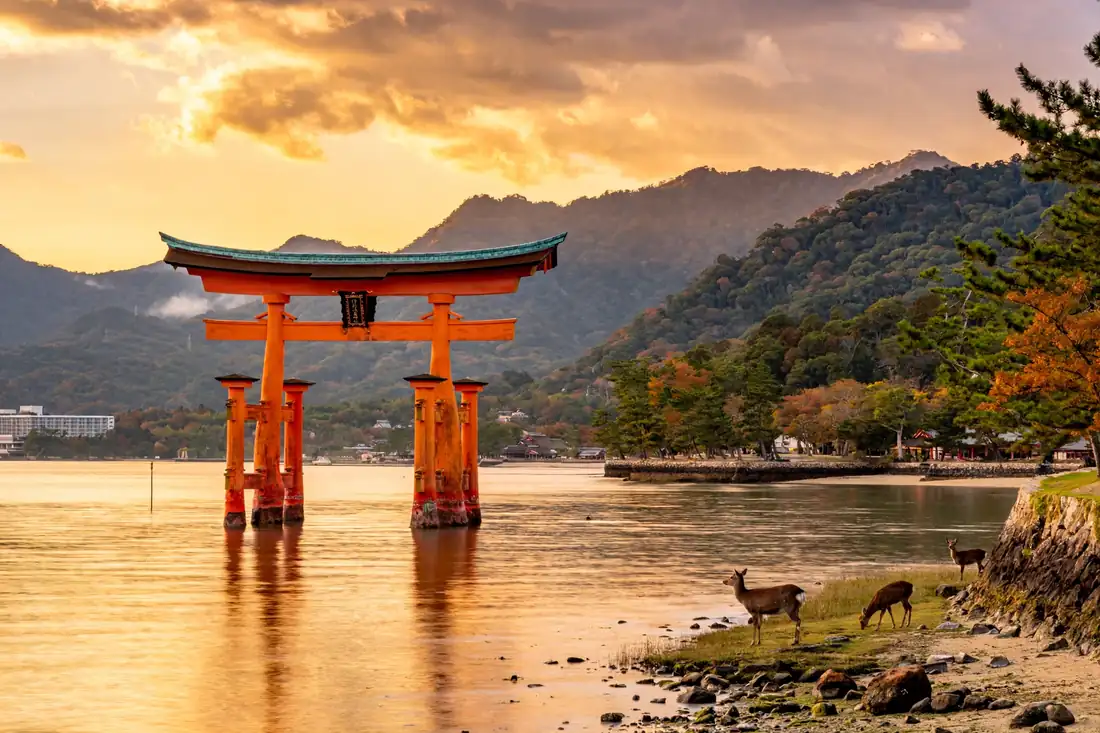
Miyajima is the island where a shrine floats on the sea. Itsukushima Shrine, a UNESCO World Heritage site, is built over the water, and its great vermilion torii gate — 16 metres tall, first erected in the 12th century — stands in the Seto Inland Sea, so at high tide it appears to float, and at low tide you can walk out to it across the sand. The shrine costs ¥300 for adults, or ¥500 with the Treasure Hall, and it is open from 6:30 a.m., closing between 5 p.m. and 6 p.m. depending on the month. The island is also home to tame wild deer, a ropeway up Mount Misen with a view over the whole Inland Sea, and streets of maple-leaf cakes and oyster stalls. Read about Itsukushima Shrine on Wikipedia.
The practical facts for 2026: take the JR Sanyo Line from Hiroshima Station to Miyajimaguchi, about 30 minutes, then the JR ferry, about 10 minutes and ¥200 one way — the Japan Rail Pass covers both — plus the ¥100 Miyajima Visitor Tax collected with the fare. Check the tide times before you go: the floating effect only happens at high tide, so build the island day around the morning tide. The Mount Misen ropeway costs ¥2,000 return, with the last ride down at 4:30 p.m. Allow a full half day, five to six hours including the ferry both ways, and stay for the oysters — Miyajima’s are the best in Japan.
9. Dotonbori, Osaka
Dotonbori is the loudest street in Japan and the best place in the country to eat standing up. The canal in the middle of Osaka is lined with neon signs — the Glico running man above the bridge is the most photographed sign in the city — and with restaurants and stalls selling takoyaki octopus balls, okonomiyaki savoury pancakes, kushikatsu fried skewers and crab the size of a car on the front of the Kani Doraku restaurant. The street is free to walk, the shops open in the late morning, and the best time is from 5:30 p.m. to 10:30 p.m., when the signs come on and the canal glows. Read about Dotonbori on Wikipedia.
The practical facts for 2026: Dotonbori is a five-minute walk from Namba Station, and the neighbouring Shinsaibashi-suji arcade is the daytime half of the same visit. Budget about ¥2,000 to ¥3,000 for a proper grazing dinner: a tray of takoyaki, an okonomiyaki and a skewer or two, eaten standing up. Two honest warnings: the most famous stalls have queues of 30 minutes on a weekend, and the canal cruise (about ¥1,500 to ¥2,000) sells out at sunset, so book it in the afternoon. Osaka’s motto is kuidaore — eat until you drop — and Dotonbori is where you do it.
10. Osaka Castle
Osaka Castle is the most beautiful castle in Japan from the outside and the most honest about what it is on the inside. The keep rises over a moat and stone ramparts in the middle of a huge park, and it is a 1931 reconstruction — the original burned down in the 19th century — so the ticket buys an eight-floor museum of the castle’s history, armour and city views, not a historic interior, and the castle says so plainly. The keep costs ¥1,200 for adults, high school and university students pay ¥600 with a student card, and children in junior high or younger enter free; it is open 9 a.m. to 6 p.m. and closes only from December 28 to January 1. The park around it is free. Read about Osaka Castle on Wikipedia.
The practical facts for 2026: the trap is the old price. Many guides still say the castle costs ¥600 — it has been ¥1,200 for years, and the Nishinomaru Garden beside it went from ¥200 to ¥300 on April 1, 2026. The castle is a ten-minute walk from Osakajokoen Station on the JR Osaka Loop Line, or from Tanimachi 4-chome on the subway. Two honest warnings: the keep takes no reservations of any kind, so go at 9 a.m. when it opens; and the garden holds about 300 cherry trees, so in blossom season it is one of the best hanami spots in the city, and one of the most crowded.
11. Universal Studios Japan, Osaka
Universal Studios Japan is the biggest theme park in Asia outside Tokyo Disney, and the one that sells out first. It holds Super Nintendo World — the only one in Japan, with the Mario Kart ride and the Donkey Kong coaster — plus the Wizarding World of Harry Potter, the Minions, Jurassic Park and the Flying Dinosaur, the world’s longest flying coaster. The ticket is a 1-Day Studio Pass, and the price moves with the date: from ¥8,400 for adults, ¥5,500 for children aged 4 to 11 and ¥7,600 for seniors 65 and over, rising to about ¥11,900 on Saturdays and holidays. Children under four go free. Read about Universal Studios Japan on Wikipedia.
The practical facts for 2026: the trap is the app. Since January 5, 2026, the official USJ app is required to obtain Area Timed Entry Tickets and Standby Entry Tickets — without it, you cannot enter Super Nintendo World at all on a busy day, and the park does not hand out paper timed tickets. Buy your Studio Pass online in advance, and since September 1, 2026, a date’s price can rise after it goes on sale, so buying early is cheaper. An Express Pass, which skips the queues on four rides, starts at ¥14,800 and does not include admission — buy it on top of the Studio Pass, not instead of it. The park is a five-minute walk from Universal City Station on the JR Yumesaki Line.
12. Himeji Castle
Himeji Castle is the finest surviving feudal castle in Japan, and the one whose price doubled in 2026. Known as the White Heron for its white plastered walls, it is a UNESCO World Heritage site and the largest original castle in the country — eight of its buildings are National Treasures — and it survived the wars, the earthquake and the fires that destroyed almost every other castle, so the keep you climb is the real 17th-century building, with steep wooden stairs and the same stone foundations the samurai walked. Admission is ¥2,500 for non-residents, ¥1,000 for Himeji residents with ID, and free for under-18s. Read about Himeji Castle on Wikipedia.
The practical facts for 2026: the trap is the old price and the wrong explanation. General admission has been ¥2,500 since March 1, 2026 — ¥1,500 more than the old ¥1,000 fare — and the line the city draws is residency, not nationality: a foreign resident of Himeji pays ¥1,000, and a Japanese citizen from Tokyo pays ¥2,500. In the first month under the new price, entries fell 16.8%, which is why the castle is now a better visit, with shorter queues. A second warning: conservation scaffolding stands around the main keep from July 2026 until July 2027, so the famous white silhouette is partly covered — check the current state before you go. Himeji is about an hour from Osaka by Shinkansen, and the castle is a fifteen-minute walk from the station.
13. Tokyo in a day — Senso-ji and Shibuya
Tokyo deserves its own trip, and it has its own guide on this site — but if Japan gives you only one day in the capital, spend it on the two places that show you both Tokyos. Start at Senso-ji in Asakusa, the oldest temple in the city, founded in 645 AD: walk under the giant red lantern of the Kaminarimon, through the Nakamise shopping street of about 90 stalls, past the five-storey pagoda and into the main hall, where the air smells of incense. The temple is free, the main hall is open from 6 a.m. to 5 p.m., and at 7 a.m. you will have it almost to yourself. Then take the train to Shibuya for the other Tokyo: the busiest pedestrian crossing in the world, where as many as 3,000 people cross at once in perfect order, and the Hachiko statue, the meeting point for all of Tokyo. Read about the Senso-ji Temple on Wikipedia.
The practical facts for 2026: Senso-ji is five minutes from Asakusa Station on the Ginza and Asakusa subway lines, and Shibuya is one stop from Harajuku on the JR Yamanote Line. Do not eat while walking in Asakusa — it is considered rude — and do not stop in the middle of the Shibuya Crossing for photos, because the crowd moves fast and you will be in the way. For teamLab Planets, the Skytree, Tsukiji Market, the Ghibli Museum and the day trips to Nikko and Kamakura, read our full Tokyo guide, which covers the 2026 ticket prices and the traps the old guides still get wrong.
14. Hakone — onsen, Lake Ashi and the Fuji view
Hakone is the classic onsen town, an hour and a half from Tokyo, and the best place in Japan to see Mount Fuji without climbing it. The loop is the experience: the mountain railway up from the town, the cable car over the Owakudani volcanic valley — where eggs boiled in the sulphur springs turn black and are said to add seven years to your life — the ropeway down to Lake Ashi, and the pirate ship across the lake to the red torii gate standing in the water at Hakone Shrine, with Fuji behind it on a clear day. The town also holds the Hakone Open-Air Museum, a sculpture park in the hills, and dozens of ryokan with open-air baths looking at the mountains. Read about Hakone on Wikipedia.
The practical facts for 2026: the Hakone Freepass costs ¥7,100 for two days and covers the trains, buses, cable car, ropeway and pirate ship — but not the Romancecar limited express from Shinjuku, which costs ¥1,150 to ¥1,200 on top. Two warnings: the ropeway is closed for maintenance from December 7 to 24, 2026, and again from January 12 to February 26, 2027, so check the dates before you book; and Hakone is a full day, not a half day — stay overnight in a ryokan if you can, because the baths at dusk are the point of the whole trip.
15. The snow monkeys of Jigokudani, Nagano
Jigokudani is the only place on Earth where wild monkeys bathe in a hot spring. In the mountains of Nagano, Japanese macaques — snow monkeys — come down from the forest in winter and sit in the steaming onsen pool, up to their chins in the water, while snow falls on their red faces and white fur. It is the most photographed animal scene in Japan, and it is real: the monkeys are wild, the pool is a natural hot spring, and the park has no fences between you and them, only a rope and a ranger. The park is open all year, but the monkeys bathe most in the cold months, from December to March, when the snow is deep and the pool is the warmest place in the valley. Read about the Jigokudani Monkey Park on Wikipedia.
The practical facts for 2026: the park is a 30-minute walk from the Kanbayashi Onsen bus stop, up a forest path that is icy in winter — wear boots with grip, not trainers. Entry is a modest fee of about ¥800 for adults. The nearest town is Yudanaka, reached by train from Nagano Station in about 45 minutes, and the whole visit takes about two hours from the bus stop. Two honest warnings: the monkeys do not bathe on a schedule, and on a warm day they may stay in the trees, so go on a cold morning; and do not feed them, touch them or make eye contact — they are wild animals.
16. Sapporo and the Snow Festival, Hokkaido
Sapporo is Japan’s winter capital, and the Snow Festival is the reason to go. Every February the city builds a festival out of snow and ice: giant sculptures of castles, temples and cartoon characters in Odori Park, ice sculptures glowing along the Susukino street, and snow slides and ice bars at the Tsudome site — and all three sites are free to enter. The 77th Sapporo Snow Festival runs from February 4 to 11, 2027, eight days in all, and it draws about two million people to a city built for snow, with underground shopping streets, miso ramen on every corner and the Sapporo Beer Museum. Read about the Sapporo Snow Festival on Wikipedia.
The practical facts for 2026: the festival dates were announced on July 13, 2026, and the closing day, February 11, is a national holiday — book hotels months ahead, because festival week prices are far above normal. Sapporo is 90 minutes by plane from Tokyo Haneda, or about four hours by Shinkansen to Hakodate and then a local train, and February averages minus 3°C, so bring real winter clothing, not a jacket. Two honest warnings: the festival is free, but the city is not cheap in festival week, and the best sculptures are lit after dark, so plan your days for the food and the museums and your evenings for the park.
17. Okinawa — beaches and the other Japan
Okinawa is the Japan most visitors never see: a subtropical island chain at the southern end of the country, with white sand beaches, coral reefs and a culture that is Ryukyuan before it is Japanese. The main island holds the Churaumi Aquarium — one of the largest in the world, with whale sharks in a tank the size of a building — the limestone caves of Okinawa World, the pineapple fields of the north and the beaches of the Kerama Islands, a 40-minute ferry from Naha, where the water is the clearest in Japan and the snorkelling is world-class. Winter is mild, summer is hot and typhoon-prone, and the food is different too: Okinawa soba, goya champuru and the purple sweet potato in everything. Read about Okinawa Island on Wikipedia.
The practical facts for 2026: fly from Tokyo Haneda to Naha in about two and a half hours — the flight is often cheaper than the Shinkansen to Kyoto, and it is the only sensible way to get there. The island needs a car: the buses are slow and the best beaches are not on a train line, so rent one at the airport and drive on the left. Two honest warnings: Shuri Castle’s main hall burned down in 2019 and is still being rebuilt — check the current state before you go; and the typhoon season runs from June to October, so check the forecast in summer.
18. Kanazawa — the garden, the gold and the old streets
Kanazawa is the Kyoto that the crowds forgot. On the Sea of Japan coast, it holds Kenrokuen, one of Japan’s three great gardens — a strolling garden of ponds, pines and stone lanterns that is beautiful in every season and at its best in the snow, when the pine branches are held up by ropes against the weight of it. Around the garden are the samurai district of Nagamachi, with its mud walls and narrow lanes, the Higashi Chaya geisha district, where the wooden teahouses still serve tea in the evening, and the Omicho Market, where the fish comes in from the Sea of Japan and the sushi is the cheapest good sushi in the country. Kanazawa is also the home of gold leaf: 99 percent of Japan’s gold leaf is made here, and you can eat it on soft-serve ice cream. Read about Kenroku-en on Wikipedia.
The practical facts for 2026: Kenrokuen costs about ¥320 for adults and is open from early morning, and the garden is free on certain days in spring and autumn — check the calendar. Kanazawa is two and a half hours from Tokyo by Shinkansen on the Hokuriku line, and it is a full day, best paired with the neighbouring town of Takayama. Two honest warnings: the bus loop is the easy way between the garden, the castle park and the districts; and the gold leaf ice cream costs about ¥900, which is a lot for an ice cream and exactly what you should pay once, for the photograph.
19. Takayama and Shirakawa-go
Takayama is the old Japan that Kyoto used to be: a mountain town in the Japanese Alps with a preserved old town of wooden merchant houses, morning markets that have run for 600 years, and Hida beef — the wagyu of the region — sold as sushi, skewers and steak on the street. An hour away by bus is Shirakawa-go, a village of gassho-zukuri farmhouses with steep thatched roofs built to shed the snow, a UNESCO World Heritage site, and the most photographed village in Japan in winter, when the roofs are white and the lights come on in the evening. The two together are the best two days in the mountains. Read about Takayama on Wikipedia.
The practical facts for 2026: Takayama is about two hours from Nagoya by limited express train, and the bus to Shirakawa-go takes about 50 minutes and needs a reservation in winter, when the village runs a limited number of evening light-up events and the buses sell out. The morning markets run from 7 a.m. to noon, and the Hida beef sushi — two pieces for about ¥600 — is the best-value wagyu in Japan. Two honest warnings: Shirakawa-go is a living village, not a theme park, so keep your voice down and do not photograph people’s houses; and in winter check the bus status the night before, and bring boots.
20. Beppu onsen, Kyushu
Beppu is the onsen capital of Japan: a seaside city in Kyushu with more hot springs than anywhere else in the country, about 2,300 of them, and the steam rising from the streets is the first thing you see. The famous sight is the eight “hells” — jigoku — pools of boiling water in different colours, from blood-red to cobalt blue, that are for looking at, not bathing in. The bathing is everywhere else: sand baths where you are buried in warm black sand, steam baths, mud baths and the ryokan baths looking out over the bay. A night in a ryokan here, with a kaiseki dinner and a private open-air bath, is the most Japanese night you can spend. Read about Beppu on Wikipedia.
The practical facts for 2026: the onsen rules matter more than the price. Wash thoroughly before you enter — every bath has washing stations, and you enter the water clean and naked; swimsuits are not allowed, and towels do not go in the water. Tattoos are the trap: many traditional onsen still ban them, so if you have tattoos, look for a tattoo-friendly bath or book a private family bath, kashikiri, which you can reserve by the hour and use alone. Beppu is about two hours from Fukuoka by limited express train. Allow a full day and one night, and bring cash — many small baths do not take cards.
Japan in 3 days — a ready-made itinerary
Three days is not enough for Japan — be honest about that before you start. This is the fastest possible first taste, and it works only because the bullet train is so fast: one day in Tokyo, one day in Kyoto, one day in Osaka and Nara, with the train doing the long distances while you sleep. If you have seven to ten days, stretch each day here into two or three and add Hiroshima, Mount Fuji and an onsen night.
| Day | Focus | Highlights |
| Day 1 | Tokyo — old and new | Senso-ji at dawn, Imperial Palace East Gardens, Shibuya Crossing and SHIBUYA SKY, Shinjuku at night |
| Day 2 | Kyoto — temples and gates | Fushimi Inari at dawn, Kiyomizu-dera, Kinkaku-ji, Arashiyama bamboo, Gion in the evening |
| Day 3 | Osaka and Nara — food and deer | Todai-ji and the deer in the morning, Osaka Castle, Dotonbori at night |
Day 1 — Tokyo, old and new
Start at Senso-ji at 7 a.m., before the shops open and before the crowds arrive, and walk Nakamise as the stalls set up. Take the subway to the Imperial Palace East Gardens in the late morning, when the light is on the stone walls, and have lunch in the food hall of a department store near Tokyo Station. In the afternoon, take the Yamanote Line to Shibuya: the Hachiko statue, the crossing at street level, and SHIBUYA SKY at sunset, which you booked two weeks ago at midnight. End the day in Shinjuku: dinner in Omoide Yokocho, the narrow alley of yakitori stalls by the station, a drink in Golden Gai, and the free observatory at the Tokyo Metropolitan Government Building, open until 10 p.m., for the night view. Sleep near Tokyo Station — the first Shinkansen to Kyoto leaves early.
Day 2 — Kyoto, temples and gates
Take the first Hikari Shinkansen from Tokyo to Kyoto, about two hours and forty minutes, and start at Fushimi Inari, where the gates are empty before 8 a.m. Take the bus to Kiyomizu-dera for the morning view from the stage, then walk down through Ninenzaka and Sannenzaka for lunch. In the afternoon, take the bus to Kinkaku-ji for the gold in the afternoon light, then to Arashiyama for the bamboo grove as the day cools. End the day in Gion, walking Hanamikoji Street at dusk, when the lanterns come on — and remember that the side streets of Gion are private, so stay on the main street.
Day 3 — Osaka and Nara, food and deer
Take the train from Kyoto to Nara in the morning — 45 minutes on the JR Miyakoji Rapid — and be at Todai-ji when it opens at 7:30 a.m., before the deer get crowded and the coaches arrive. Feed the deer, walk the park and take the train to Osaka for lunch. In the afternoon, walk the park and the keep of Osaka Castle, then spend the evening in Dotonbori: takoyaki, okonomiyaki and the neon on the canal. If you have a fourth day, spend it in Hiroshima and Miyajima, and if you have a fifth, add Mount Fuji and the Chureito Pagoda, and a sixth for Hakone and an onsen night.
Best time to visit Japan
The best time to visit Japan is late March to early April for the cherry blossom, and mid-to-late May and November for the best weather. In May the skies are clear, the gardens are green and the blossom crowds have gone. In November the skies are clear again, the autumn leaves turn in the last two weeks of the month, and the hotel prices drop. February is the month for Hokkaido, July for the lavender of Furano and the Fuji climbing season.
| Season | Weather | What it is like |
| Spring (March to May) | 10 to 23°C (50 to 73°F) | Cherry blossom — Tokyo first bloom March 19 and full bloom March 28 in 2026, Kyoto March 23 and March 30; Golden Week late April to early May is the busiest week of the year; the best season overall, and the busiest |
| Summer (June to August) | 25 to 31°C (77 to 88°F), humid | Rainy season early June to mid-July; festivals, fireworks and beer gardens; Fuji climbing July 1 to September 10; Hokkaido is the escape — lavender in Furano in July |
| Autumn (September to November) | 13 to 23°C (55 to 73°F) | Clear skies, autumn leaves mid-November to early December in Kyoto; typhoon season September to October; November is one of the best months to visit |
| Winter (December to February) | 2 to 10°C (36 to 50°F), minus 3°C in Sapporo | Snow Festival February 4 to 11, 2027; snow monkeys in Nagano; the best views of Mount Fuji; the cheapest hotels; illuminations in every city |
A few dates to plan around. The cherry blossom in 2026 opened early: Tokyo’s sample tree opened on March 19 and reached full bloom on March 28, and Kyoto opened on March 23 with full bloom on March 30 — both about five days ahead of the 30-year average, which puts Tokyo at March 24 and March 31 and Kyoto at March 26 and April 4. The blossom lasts about a week at full bloom, and the peak moves by a few days every year, so check the forecast in the week before you fly. Golden Week, late April to early May, is the busiest week of the year — book Shinkansen seats early. The rainy season, tsuyu, runs from about early June to mid-July, with grey skies and sudden downpours, though it rarely rains all day. Read about cherry blossom on Wikipedia.
Where to stay in Japan
Japan has no single centre, so where you stay matters more than in most countries. The rule is simple: stay near a Shinkansen station or a Yamanote Line station in Tokyo, because the bullet train is how you move between cities and the city trains are how you move inside them. Tokyo is the best base for first-timers, Kyoto is the best base for temples and tradition, Osaka is the best base for food and day trips — it is 29 minutes from Kyoto and 45 minutes from Nara — and an onsen town is the best base for one night of doing nothing at all.
| Area | Best for | Budget |
| Tokyo | First-timers: transport, nightlife, the most hotels, the most restaurants | Mid-range ¥15,000 to ¥30,000 a night |
| Kyoto | Temples, traditional streets, ryokan, Gion in the evening | Mid-range ¥15,000 to ¥30,000 a night |
| Osaka | Food, nightlife, the best day-trip base — Kyoto, Nara and Himeji | Mid-range ¥12,000 to ¥25,000 a night |
| Hiroshima | Peace Park, Miyajima, the Inland Sea | Budget to mid-range ¥10,000 to ¥20,000 a night |
| Hakone or Beppu | Ryokan and onsen night, doing nothing beautifully | Ryokan ¥20,000 to ¥40,000 per person with dinner |
| Sapporo | Snow Festival, skiing, Hokkaido | Mid-range ¥12,000 to ¥25,000 a night |
A few practical notes. A ryokan — a traditional inn with tatami floors, futon beds, a kaiseki dinner and an onsen bath — costs about ¥20,000 to ¥40,000 per person per night with dinner and breakfast; book it for one night, not every night, because the price adds up. A business hotel — a small, clean, efficient room — costs about ¥8,000 to ¥15,000 and is the best value in the cities. A capsule hotel costs about ¥3,000 to ¥5,000 a night and is a real option for solo travellers. Book early for cherry blossom season, Golden Week and the Snow Festival, when prices double, and check the room size before you book — Japanese hotel rooms are small by American standards, and a room listed for two people can be tight with two suitcases. And one 2026 change to budget for: Kyoto’s accommodation tax rose on March 1, 2026, to five tiers from ¥200 to ¥1,000 a person a night depending on the room rate — and up to ¥10,000 at the very top.
Getting around Japan
Japan has the best trains in the world, and you will not need a car except in Okinawa and the deep countryside. The system has three parts: the Shinkansen bullet trains that connect the cities at up to 320 kilometres an hour; the JR and private lines inside the cities; and the subways. The trick is to buy the right ticket for the right trip, and the 2026 prices are the ones that matter, because the pass that used to be automatic no longer pays for itself.
The Japan Rail Pass is the trap that costs visitors the most money. The seven-day Ordinary pass costs ¥50,000 if you buy it on the official website, and ¥53,000 if you buy it through an agency, after the price rise on October 1, 2026; the 14-day pass is ¥80,000, or ¥84,000 through an agency, and the 21-day pass is ¥100,000, or ¥105,000. It only pays for itself if your long-distance legs add up to more than the pass: a Tokyo to Kyoto return on the Hikari costs about ¥27,700, and the whole Golden Route by individual tickets comes to about ¥34,240 — well under ¥50,000, so for the classic route the pass loses by about ¥16,000. The break-even is roughly a Tokyo to Hiroshima round trip, about ¥40,000 to ¥44,000, plus more travel on top — do the maths first. And the fastest trains, the Nozomi and Mizuho, are not covered: pass holders pay a supplement of ¥4,960 for Tokyo to Kyoto. Read about the Japan Rail Pass on Wikipedia.
Start with an IC card for everything local. A Suica or Pasmo card is a rechargeable card you tap at every gate, on trains, subways and buses, and in convenience stores — and regular unregistered cards are back on sale after the chip shortage that stopped sales in 2023. Sales resumed on March 1, 2025. A regular Suica costs a ¥500 deposit, refundable when you return the card, minus a ¥220 handling fee. The tourist versions — the Welcome Suica and the Tourist Pasmo, launched in May 2026 — need no deposit, are valid for 28 days, and the balance is not refundable. If you have an iPhone, you can add a Suica to Apple Wallet and skip the physical card entirely. Read about Suica on Wikipedia.
The regional passes are where the real value is in 2026. The Kansai-Hiroshima Area Pass costs about ¥17,000 for five days and covers Kyoto, Osaka, Nara, Kobe, Himeji and Hiroshima, including the Shinkansen between them — which is exactly the second half of the classic route, for a third of the nationwide price. Buy Shinkansen tickets through the SmartEX app, which sells reserved seats in English. Send your big bag ahead with a luggage forwarding service — takkyubin — for about ¥2,000 to ¥2,500 a bag, and travel with a day pack: the Shinkansen has almost no luggage space. For Hokkaido and Okinawa, fly: the domestic flights are often cheaper than the train, and the Shinkansen to Hakodate alone takes about four hours from Tokyo.
One last 2026 change: the departure tax rose from ¥1,000 to ¥3,000 on July 1, 2026 (it is included in your air ticket), and tax-free shopping changed on November 1, 2026, to an airport refund scheme.
Japan food you have to try
Japan has more Michelin-starred restaurants than any other country, and it also has the best cheap food on Earth. The range runs from a ¥110 plate of tuna on a conveyor belt to a ¥30,000 omakase counter, and the food at a ¥900 ramen counter can be just as good as the food at a ¥50,000 tasting menu. Plan on ¥3,000 to ¥6,000 a day for good eating without holding back, and less if you mix in convenience stores and ramen counters. The exchange rate is about ¥150 to the dollar, so ¥1,000 is roughly $6.50.
Sushi — from the conveyor belt to the omakase counter
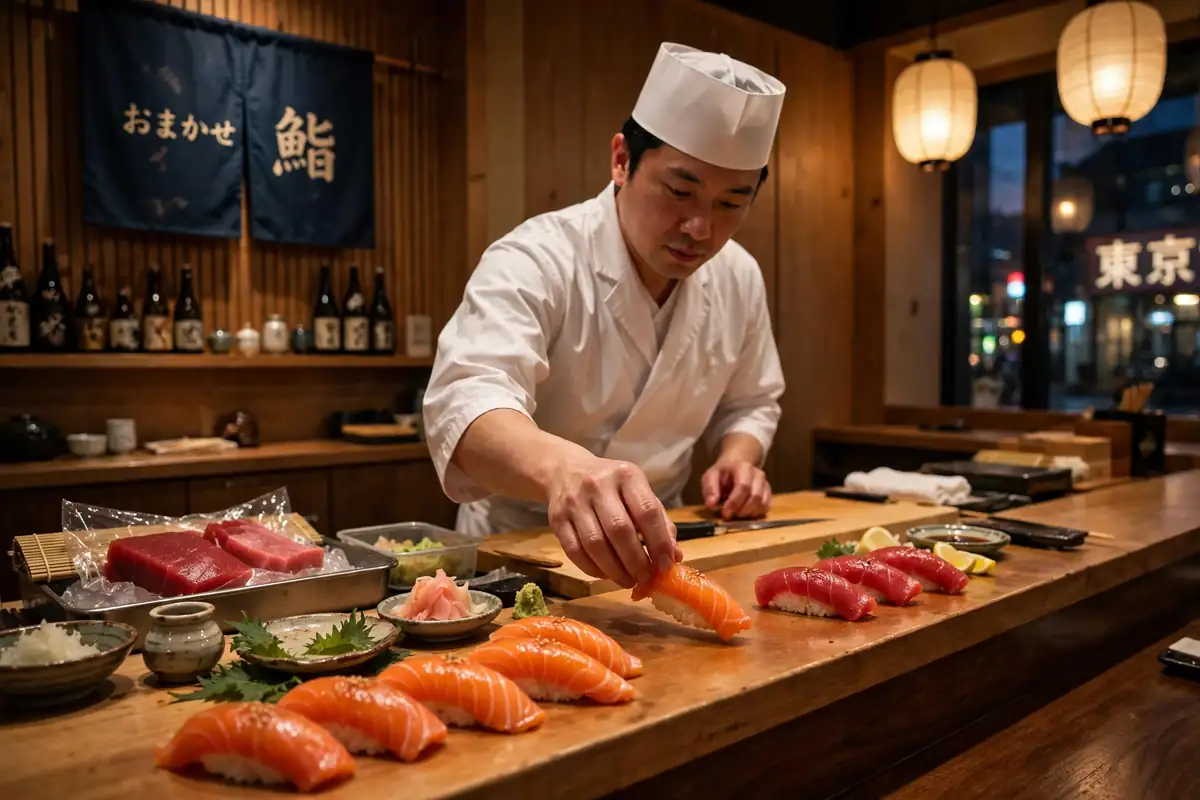
Sushi in Japan runs the full range, and you should try at least two levels of it. The cheap end is kaiten-zushi, conveyor-belt sushi: chains like Sushiro, Kura Sushi and Hama Sushi charge ¥110 to ¥150 a plate, and most people leave full for ¥1,000 to ¥3,000. It is fast, fun, and the fish is good — this is the best first sushi meal in the country. The middle is a mid-range counter, where a set of 8 to 12 pieces of nigiri costs ¥3,000 to ¥8,000, and the best value of all is a lunch omakase, where a counter that charges ¥20,000 for dinner offers an eight-piece set for ¥3,500 to ¥5,000 at lunch. The top end is the evening omakase: from about ¥10,000, climbing past ¥20,000 at the renowned Ginza and Roppongi counters, and ¥30,000 to ¥60,000 at the most famous rooms. Book the top counters weeks ahead — the best ones do not take walk-ins — and remember that omakase means “I leave it to you”, so you eat what the chef serves, in the order he serves it, and you do not ask for a menu.
Ramen, wagyu and the regional bowls
The second food to try is the one Japan argues about most: the regional bowl. Ramen is the single best-value serious meal in the country. A standard bowl costs ¥900 to ¥1,300, and the national average bowl hit an all-time high of ¥736 in 2026, so Tokyo’s prices are higher than the rest of Japan, but still cheap for what you get. Every region has its own style: Tokyo’s clear shoyu broth, Fukuoka’s rich tonkotsu, Sapporo’s miso with corn and butter, and tsukemen, where the noodles and the broth arrive separately and you dip. Then there is the wagyu: Kobe beef in Kobe, Hida beef in Takayama — try it as sushi, two pieces for about ¥600 on the street — and Matsusaka beef, the most expensive of all. And the regional bowls: Hiroshima’s okonomiyaki, layered with noodles, is a different dish from Osaka’s, and both cities will tell you theirs is the real one; try both and decide for yourself.
Kaiseki, izakaya and konbini
The third food to try is not one dish but three ways of eating. Kaiseki is the formal meal: a sequence of small, seasonal courses — sashimi, soup, grilled fish, a hot pot, rice, pickles and dessert — served in a ryokan or a Kyoto restaurant for ¥10,000 to ¥30,000 or more, and it is the most beautiful meal in Japan. The izakaya is the Japanese pub: a small, noisy room with a counter and low tables, where you order small plates — yakitori skewers, fried chicken, sashimi, pickles — and beer or sake, and a full evening with drinks costs about ¥3,000 to ¥5,000 a person. The konbini is the convenience store — 7-Eleven, FamilyMart and Lawson — and it is the best cheap meal in Japan: onigiri rice balls, sandwiches, fried chicken, bento boxes and hot coffee, a full meal for ¥500 to ¥800, open 24 hours. Eat at a konbini at least once, because the food is genuinely good, and because at 2 a.m., after the last train, it is the only place open.
Free things to do in Japan
Japan is not a cheap country, but its best things are often free. The shrines are free: Fushimi Inari, the Meiji Shrine and the Yasaka Shrine cost nothing to enter, and the Arashiyama bamboo grove, the Philosopher’s Path and the streets of Gion cost nothing to walk. The parks are free: Ueno Park, Yoyogi Park, Nara Park and the Imperial Palace East Gardens are all free, and the deer of Nara and Miyajima cost nothing to watch. The viewpoints are free: the Tokyo Metropolitan Government Building has two free observatories on the 45th floor, 202 metres up, and the Chureito Pagoda viewpoint costs nothing but the 400 steps. The festivals are free: the Sapporo Snow Festival, the Gion Matsuri in July and the cherry blossom parties in every park in spring cost nothing to join. A full day in Japan — Fushimi Inari at dawn, the bamboo grove, the free observatory at sunset and the crossing at night — costs nothing but lunch and the train fare. One warning: the Bunkyo Civic Center viewpoint, which half the internet still recommends, has been closed for renovation since March 2025 and is not expected to reopen until early December 2026, so do not plan your day around it.
Frequently asked questions
How many days do you need in Japan?
Seven to ten days is the right amount of time for a first visit: three days in Tokyo, three days in Kyoto, two days in Osaka and Nara, and a day for Hiroshima and Miyajima. Three days covers the essentials — Fushimi Inari, the Golden Pavilion, the Shibuya Crossing and Dotonbori — but you will be moving fast. Two weeks lets you add Mount Fuji, Hakone and an onsen night, and three weeks lets you add Hokkaido or Okinawa.
Is the Japan Rail Pass worth it?
Not for the classic route alone. The seven-day pass costs ¥50,000, and the Tokyo to Kyoto return on the Hikari costs about ¥27,700, so the whole Golden Route by individual tickets comes to about ¥34,240 — well under the pass. The pass only pays if your long-distance legs add up to more than ¥50,000 in seven days, which means several Shinkansen trips: Tokyo to Hiroshima and back, about ¥40,000 to ¥44,000, plus a day trip, roughly breaks even, and Tokyo to Fukuoka and back, about ¥45,100, plus an excursion, does it. For most first-time trips, a regional pass is better value: the Kansai-Hiroshima Area Pass costs about ¥17,000 for five days and covers Kyoto, Osaka, Nara, Kobe, Himeji and Hiroshima. Do the maths for your own route before you buy anything.
Do I need cash in Japan?
Yes, some, but less than you think. The big stores, the chain restaurants, the trains and the convenience stores all take cards, and Suica works in the konbini. But the small ramen counters, the temple gates, the market stalls, the tiny bars of Golden Gai and the family shops of Yanaka are often cash only, so carry ¥10,000 to ¥20,000 in cash a day and top up at a 7-Eleven ATM, which takes foreign cards. Tipping does not exist in Japan — do not tip — and the price on the menu is the price you pay, with tax included in most places.
When is cherry blossom season in Japan?
The cherry blossom in 2026 opened early: Tokyo’s sample tree opened on March 19 and reached full bloom on March 28, and Kyoto opened on March 23 with full bloom on March 30. In most years the season runs from late March to early April in Tokyo, Kyoto and Osaka, with the 30-year average putting Tokyo at March 24 and March 31 and Kyoto at March 26 and April 4, and Hokkaido follows in late April to early May. The best places to see it are Shinjuku Gyoen and Ueno Park in Tokyo, the Philosopher’s Path and Maruyama Park in Kyoto, and the castle parks in Osaka and Himeji. Book hotels months ahead for blossom season, because the prices double, and check the forecast in the week before you fly — the blossom moves by a few days every year, and a warm March brings it early.
Is Japan expensive?
Japan is expensive for hotels and cheap for food, and the total depends on how you travel. A mid-range trip costs roughly ¥18,000 to ¥30,000 ($120 to $200) a person a day, with a hotel and one big ticketed sight, plus the bullet train fares between cities. A budget trip — a capsule hotel or business hotel, ramen and konbini meals, free shrines and parks — can run ¥8,000 to ¥12,000 a day. The most expensive mistakes are the Japan Rail Pass you do not need and the hotel you book in cherry blossom season without checking the price. The cheapest wins are the free shrines and parks, the ¥500 temple and the ¥900 ramen bowl.
Can I visit an onsen with tattoos?
It depends on the bath, and the answer is getting better every year. Many traditional onsen still ban tattoos, because of the old association with organised crime, and the rule is usually posted at the entrance in English. But a growing number of baths welcome tattoos, and the easiest answer is a private family bath, kashikiri, which you can book by the hour at most ryokan and many public baths and use alone — no one sees your tattoos, and no one minds. Small tattoos can sometimes be covered with a skin-coloured sticker, sold at convenience stores. Whatever the bath, the rules are the same: wash thoroughly before you enter the water naked, keep your towel out of the water, and do not put your hair in the pool.
Further reading — Wikipedia, Reddit and Quora
For more background on the country, read about Japan on Wikipedia, which covers the history, the regions and the economy in detail. For up-to-date local advice, itinerary checks and trip reports from people who have just been there, the JapanTravel community on Reddit is active and helpful — search it for the route you are planning, and for the latest on the JR Pass prices, the Fuji climbing rules and the cherry blossom. For the lesser-known side of the country, the Quora thread on trip ideas in Japan has real answers from people who lived there, on Hiroshima, Miyajima, the snow monkeys, Hokkaido and Okinawa.
Your Japan trip, in one paragraph
Japan is the country that gives you a 10,000-gate shrine and a floating torii in the same week, a bowl of ramen for less than a coffee back home and a bullet train that crosses the country while you watch Mount Fuji go past the window — and it is the country that rewards a slow ten days more than a rushed three. Come for Fushimi Inari at dawn and the Shibuya Crossing at night, stay for the temples, the deer, the onsen and the food, and leave with a plan to come back in a different season, because Japan in cherry blossom and Japan in snow are two different countries. And if you want more city guides in the same style, we have them: Chicago, Nashville, Los Angeles, Orlando, Miami, San Diego, Denver, Savannah, Dallas, Charleston, San Francisco, Myrtle Beach, Las Vegas, San Antonio, London, Portland, Pigeon Forge, Puerto Rico, Atlanta, Phoenix, Paris, Maui, Key West, Colorado Springs, Sedona, Chattanooga, Palm Springs, St Louis and Tokyo.

About the Author