Things to Do in Palm Springs
20 Best Attractions, a 3-Day Itinerary, Where to Stay, and the Food You Cannot Miss
Quick Info
Best for: First-time desert visitors, architecture lovers, hikers, festival-goers and pool loungers — a walkable downtown with a mountain, a desert and a national park on its doorstep
Best time: October–May for hiking and sightseeing; March, October and November are the sweet spot; summer is pool season with the lowest hotel prices
How long: 3 full days for the highlights; 2 days covers the tramway, the canyons and downtown; add a 4th day for Joshua Tree and the desert towns
Budget: Roughly $200–$350 per person per day for a mid-range trip with a hotel and one big ticketed activity; a day of free sights and VillageFest runs much cheaper
Don’t miss: The Aerial Tramway at sunset, Palm Canyon’s palm oasis, a date shake at Shields, Thursday night VillageFest and a walk past the mid-century modern houses
Palm Springs sits in the Coachella Valley in the California desert, about 110 miles east of Los Angeles and two hours from San Diego, at the foot of the San Jacinto Mountains — and it is the rare American city where the scenery changes completely in ten minutes: from a palm-lined downtown street to a 60-foot waterfall in a canyon, and from a 109°F valley floor to a pine forest at 8,516 feet. This guide gives you the 20 best things to do in Palm Springs in a sensible order, a ready-made 3-day itinerary, honest advice on when to go, where to stay and how to get around, and the three foods you have to try before you leave — plus the free sights that cost nothing at all. Prices and hours change, so every price in this guide is marked as approximate — always check the official website before you visit.
One thing to know before you go: Palm Springs in 2026 is not the city of the old guidebooks. The Aerial Tramway — the city’s most famous attraction — was closed for its annual maintenance from September 8 to October 4, 2026, and only reopened on October 5, so any guide that still calls it closed is out of date. The Art Museum’s admission has risen to $25, the Living Desert’s to $44.95, and both the Indian Canyons and Tahquitz Canyon now run reduced Friday-to-Sunday-only hours through the summer. And the summer heat is not a joke: daytime highs pass 100°F from June to September, and the canyons and the desert trails are for early mornings only. This guide tells you which of those traps to watch for, and which prices changed in 2026, so you can plan with facts instead of outdated blog posts.
Palm Springs at a glance
| Question | Short answer |
| Where is Palm Springs? | In the Coachella Valley in the California desert, about 110 miles east of Los Angeles and 125 miles northeast of San Diego, at the foot of the San Jacinto Mountains |
| What is it best for? | A mountain tramway, palm-filled canyons, mid-century modern architecture, a national park day trip and pool culture |
| How long should I stay? | 3 full days for the highlights; 2 days for the essentials; add a day for Joshua Tree and the desert towns |
| How much does it cost? | Roughly $200–$350 per person per day mid-range; many of the best sights — VillageFest, the gardens at Sunnylands, the downtown walk — are free |
| Do I need a car? | Not downtown — it is flat and walkable, with $1 SunLine buses — but a car is the easiest way to reach Joshua Tree, the Living Desert and Cabazon |
| What is the one thing not to miss? | The Aerial Tramway at sunset, then Thursday night VillageFest on Palm Canyon Drive |
| When is the best time to go? | October–May for hiking and sightseeing; March, October and November are the sweet spot; summer for pool season and the lowest prices |
| Is it good for families? | Yes — the tramway, the dinosaurs, the zoo, the canyons and the date shake are all built for kids |
The 20 best things to do in Palm Springs
These are the 20 best things to do in Palm Springs, ranked the way a first-time visitor should actually do them: the mountain first, then the canyons, then the architecture and the museums, then the day trips into the wider desert. Every price below is the 2026 price as published by the attraction itself, and every trap — the tramway that was closed, the canyon hours that shrink in summer, the ticket prices that jumped, the heat that ends hikes by mid-morning — is called out where it matters.
1. Palm Springs Aerial Tramway
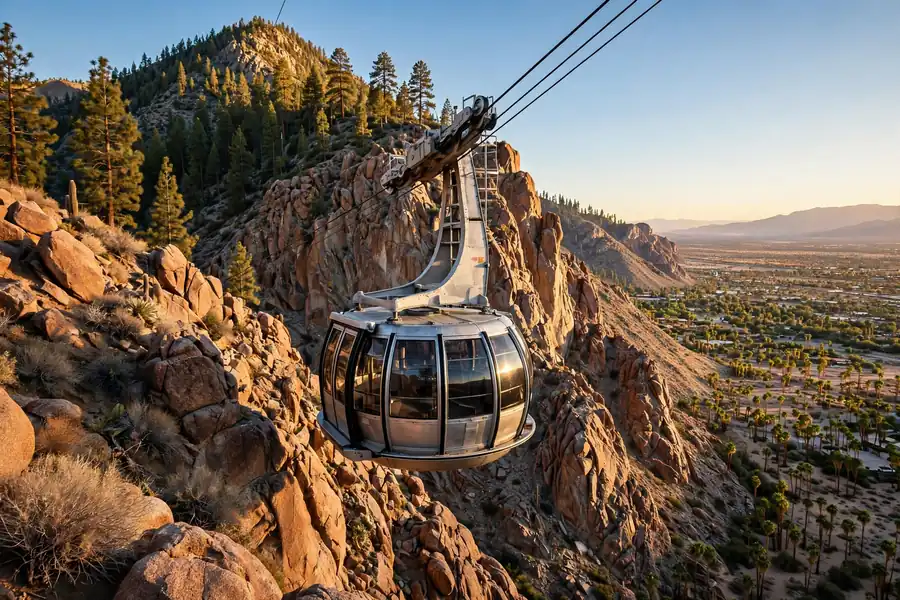
The Palm Springs Aerial Tramway is the single best reason to come to Palm Springs, and one of the most unusual rides in America. Since it opened in 1963, its cars — the world’s largest rotating tram cars — have climbed 2.5 miles up the sheer cliffs of Chino Canyon in about ten minutes, turning a full circle on the way so nobody fights for a window seat. You leave a desert valley floor and arrive at the Mountain Station at 8,516 feet, in a pine forest where the temperature is often 30 degrees cooler than downtown. Up there are more than 50 miles of hiking trails in Mount San Jacinto State Park, two restaurants, an observation deck and, in winter, snow. Read about the Palm Springs Aerial Tramway on Wikipedia.
The practical facts for 2026: a round trip costs $36.95 for adults, $33.95 for seniors 65 and over and $20.95 for children 3 to 10, with a small online processing fee included in the online price. Winter hours run from October 5, 2026 through May 27, 2027: the first car up is at 10 a.m. on weekdays and 8 a.m. on weekends and holidays, the last car up is at 8 p.m. and the last car down is at 9:30 p.m. Here is the freshness that most guides still get wrong: the tramway closes every autumn for maintenance, and in 2026 it was shut from September 8 to October 4, reopening on October 5. Any guide that still says it is closed is out of date — and any guide quoting the old $33 adult fare is out of date too. Book online in advance, because cars sell out on weekends and holidays, and go for the late afternoon, when the light on the canyon is at its best and the valley below turns gold.
2. Indian Canyons
Indian Canyons is the desert at its most beautiful, and the hike every Palm Springs visitor should do first. On the land of the Agua Caliente Band of Cahuilla Indians, ten minutes south of downtown, three canyons — Palm, Andreas and Murray — hold more than 60 miles of trails through groves of native California fan palms, the only palm native to California. Palm Canyon holds the world’s largest natural stand of them, a green ribbon of thousands of palms running 15 miles down the canyon floor. Andreas Canyon is the easiest, a one-mile loop along a year-round stream under rock walls, and Murray Canyon hides the Seven Sisters Falls. Learn about the Agua Caliente Band of Cahuilla Indians on Wikipedia.
The practical facts for 2026: admission is $12 for adults, $7 for seniors 62 and over and students with ID, $6 for children 6 to 12, and free for under-5s and US military with ID. From October 2 to July 5 the canyons are open daily from 8 a.m. to 5 p.m., with the last vehicle admitted at 4 p.m.; from July 6 to October 1 they open Friday to Sunday only, on the same hours. Ranger-led hikes are free with admission from October through June, on Friday to Sunday at 10 a.m. and 1 p.m., and they are the best way to understand the place — the canyons are the ancestral home of the Cahuilla people, and the rangers explain the plants, the water and the history. Two warnings: no dogs are allowed, you must be 18 or older to enter alone, and the tribe occasionally closes the canyons entirely for a week for cultural observances — in 2026 one closure was announced for November 15 to 22 — so check the official notices before you drive out. Buy tickets at the tollgate at 38520 South Palm Canyon Drive.
3. Tahquitz Canyon
Tahquitz Canyon is the short hike with the big payoff: a 1.8-mile loop from the visitor centre to a 60-foot seasonal waterfall, right at the edge of town. The trail climbs about 350 feet through a rocky canyon of granite walls and native fan palms, past Cahuilla rock art and the site of an old village, to Tahquitz Falls, which runs best from late December through May on snowmelt and winter rain from the San Jacinto Mountains above. In a dry summer it can be a trickle, so spring is the time to go. The canyon is also on Agua Caliente tribal land, and the rangers tell the story of Tahquitz, the spirit of the mountain in Cahuilla legend, on their guided walks. Read about Palm Springs on Wikipedia.
The practical facts for 2026: admission is $15 for adults and $7 for children 6 to 12, with under-5s and active-duty US military free. The canyon is open daily from 7:30 a.m. to 5 p.m. from October 2 to July 5, and Friday to Sunday only from July 6 to October 1, with the last hiker admitted onto the trail at 3:30 p.m. Ranger-led interpretive hikes are included with paid admission and last about two and a half hours. Allow 90 minutes to two hours for the self-guided loop, wear shoes with grip — the stone steps are tall and uneven — and carry at least a quart of water per person per hour. The visitor centre at 500 West Mesquite Avenue has a short film, a gift shop and restrooms, and parking is free.
4. Joshua Tree National Park
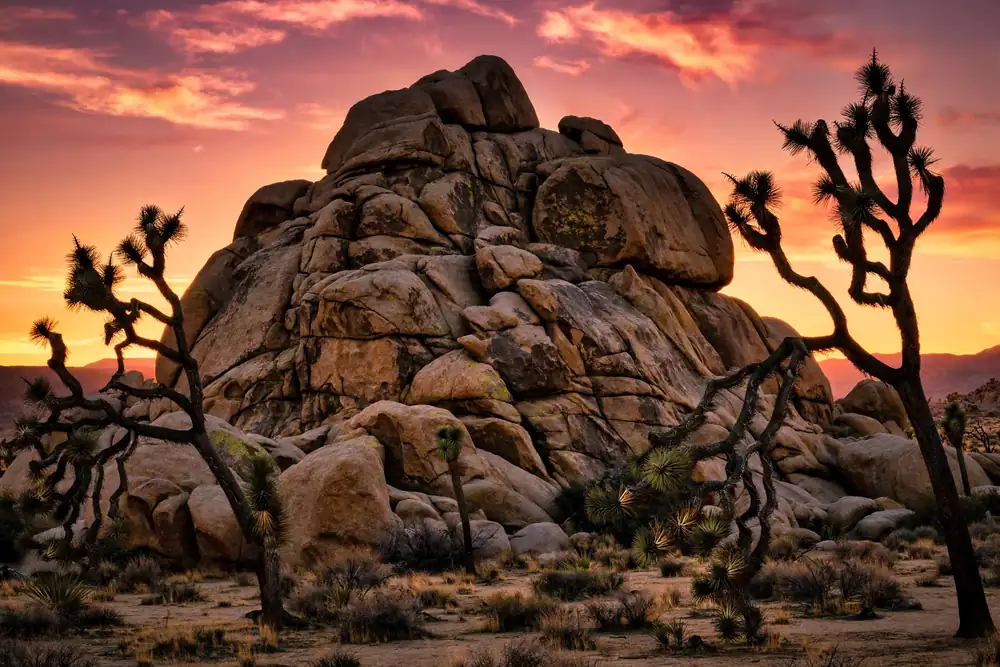
Joshua Tree National Park is the day trip that makes a Palm Springs holiday complete, and it is only about an hour away. Where two deserts meet — the Mojave and the Colorado — the park holds the twisted Joshua trees, the giant granite boulder piles of Hidden Valley and Barker Dam, the strange face of Skull Rock, the Cholla Cactus Garden and the view from Keys View, 5,185 feet up, over the whole Coachella Valley. It is also one of the best places in Southern California to see the stars: the night sky here is dark enough for the Milky Way, and the park stays open 24 hours a day. Read about Joshua Tree National Park on Wikipedia.
The practical facts for 2026: the entrance fee is $30 per private vehicle, $25 per motorcycle and $15 per person on foot or by bicycle, valid for seven days, and children 15 and under are free. There is no reservation or timed entry to enter the park — you simply show up, pay and drive in — but the campgrounds do need reservations on Recreation.gov, and they book out weeks ahead in spring. From Palm Springs, the south entrance at Cottonwood is about an hour by Interstate 10, and the west entrance through the town of Joshua Tree is a little further. Go early: the park has almost no shade, no water and almost no cell service, so buy a digital pass before you arrive and save it to your phone, fill the tank, and plan the hikes for the morning. The trap to avoid is the summer afternoon — the park is at its most dangerous then, and the rangers rescue overheated hikers every year.
5. Mid-century modern architecture
Palm Springs is the world capital of mid-century modern architecture, and the houses are the attraction. In the 1950s and 1960s, architects like Richard Neutra, Albert Frey and William Krisel built hundreds of low, glassy, flat-roofed houses for Hollywood stars and desert dreamers, and the best of them survive in neighbourhoods like Twin Palms, Vista Las Palmas and the Movie Colony. The stars of any self-guided drive are the Kaufmann Desert House of 1946, Neutra’s glass-and-stone masterpiece (private — admire it from the street), the Elvis Honeymoon Hideaway at 1350 Ladera Circle, where Elvis and Priscilla Presley spent their honeymoon in 1967, and Frey House II, the architect’s own tiny glass house on the hillside, which you can tour through the Palm Springs Art Museum. Learn about mid-century modern design on Wikipedia.
The honest rules: most of these houses are private homes, so look from the street, never walk onto a driveway, and never fly a drone over a neighbourhood. The best time to come is Modernism Week, the 11-day festival that runs February 11 to 21, 2027, with more than 400 house tours, walks, talks, films and parties across the valley, and tickets on sale from November 1, 2026. A smaller October edition ran October 15 to 18, 2026. If you are not here for the festival, the organiser’s own 22-seat mini-coach architecture tours run from October 15, 2026 to May 29, 2027, and the Palm Springs Visitor Center — itself a landmark, the 1965 Tramway Gas Station by Richard Neutra with its swooping winged roof — hands out a free self-guided driving map. Start at the visitor centre, then drive the Twin Palms and Movie Colony streets in the late afternoon, when the light is low and the glass walls glow.
6. Palm Springs Art Museum
The Palm Springs Art Museum is the largest cultural institution in the Coachella Valley, and the best indoor escape from the desert heat. Its 1976 building by E. Stewart Williams — one of the architects who shaped the city — holds modern and contemporary art, photography, glass, Native American baskets and a strong collection of California art, plus the Architecture and Design Center, a second building down on Palm Canyon Drive that covers the city’s design history. The museum was established in 1938, and it is the only major art museum between Los Angeles and Phoenix. Read about the Palm Springs Art Museum on Wikipedia.
The practical facts for 2026 — and the trap: admission is now $25 for adults, $23 for seniors 62 and over and $17 for students and teachers, and children under 18 are always free. Older guides still quote $16 or $20, and they are out of date. The museum is open Thursday from noon to 8 p.m. and Friday to Sunday from 10 a.m. to 5 p.m., closed Monday to Wednesday, with Mondays opening again from November 23, 2026. The best deal is Thursday night: general admission is free from 5 to 8 p.m., funded by the City of Palm Springs, and it pairs perfectly with VillageFest outside. The museum has been cashless since October 15, 2026, so bring a card. Outside, on the museum’s plaza, stands Forever Marilyn, the 26-foot statue of Marilyn Monroe in her white dress from The Seven Year Itch — the most photographed thing in downtown Palm Springs — and the Agua Caliente Cultural Museum, which opened downtown in 2023 and tells the story of the Cahuilla people, is a short walk away.
7. VillageFest
VillageFest is the best free night out in Palm Springs, and the one evening every visitor should plan around. Every Thursday night, Palm Canyon Drive closes to cars between Amado Road and Baristo Road and turns into a street fair: more than a hundred stalls selling art, jewellery, crafts and fresh produce, food vendors, live music on every block and the whole town out strolling. It is part farmers’ market, part street party, and it is the fastest way to feel like a local. Read about Palm Springs on Wikipedia.
The practical facts: VillageFest runs every Thursday from 6 to 10 p.m. from October through May, and from 7 to 10 p.m. from June through September, when the later start dodges the worst of the heat. It is free to attend, and it is skipped on holidays like Thanksgiving, Christmas and New Year’s. Two local tips: move your car off Palm Canyon Drive before 4 p.m., because the city starts clearing the street then and cars can be towed, and arrive hungry — the food stalls are the cheapest dinner in downtown. If your Thursday lines up, do the free Thursday evening at the Art Museum from 5 to 8 p.m. first, then walk straight out into the fair.
8. Moorten Botanical Garden
Moorten Botanical Garden is the smallest, strangest and most charming museum in Palm Springs: a walled cactus garden and glasshouse on South Palm Canyon Drive, founded in 1938 by Chester “Cactus Slim” Moorten and his wife Patricia. Inside are more than 3,000 plants — towering cacti, agaves, aloes and succulents from deserts all over the world — packed into a long glasshouse called the Cactarium, with the family’s own collection of desert rocks and minerals. It takes about an hour, it is almost entirely outdoors, and it is the best place in the city to learn what actually grows in a desert. Read about Palm Springs on Wikipedia.
The practical facts for 2026: admission is $7 for adults and seniors, $5 for veterans and $3 for children 5 to 12, with under-5s free. From October to May the garden is open from 10 a.m. to 4 p.m. every day except Wednesday; check the summer hours before you go, because they shrink in the heat. Go in the morning, when the glasshouse is cool and the light is good for photographs, and pair it with a walk down Palm Canyon Drive — it is a ten-minute stroll from the downtown hotels.
9. The Living Desert Zoo and Gardens
The Living Desert Zoo and Gardens, in Palm Desert about 16 miles southeast of downtown Palm Springs, is the best family day out in the valley — a zoo and a botanical garden in one, spread over more than 1,000 acres at the foot of the Santa Rosa Mountains. The animals are the desert’s own: bighorn sheep, giraffes, cheetahs, zebras, mountain lions and a walk-through Australian adventure with wallabies, plus 1,400 species of desert plants in 10 themed gardens. The giraffe feeding, about $10 for a bunch of lettuce, is the moment children remember. Read about the Living Desert Zoo and Gardens on Wikipedia.
The practical facts for 2026 — and the trap: admission is $44.95 for adults 18 and over and $34.95 for ages 3 to 17, with under-3s free, and tickets must be bought in advance online or at the self-service kiosks by the entrance. Older guides still quote $27.95 or $29.95, and they are years out of date. Hours are seasonal for a reason: from October 1 to May 31 the zoo is open 8 a.m. to 5 p.m., with last admission at 4 p.m., but from June 1 to September 30 it opens at 7 a.m. and closes at 1:30 p.m., with last admission at 12:30 p.m., to protect the animals and the visitors from the afternoon heat. It is closed only on Christmas Day. In summer, go at 7 a.m. or do not go at all. In winter, look out for WildLights, the evening light show that runs November 24 to December 30, 2026.
10. Palm Springs Air Museum
The Palm Springs Air Museum is the best museum in the valley for anyone who likes aeroplanes — and the best air-conditioned stop on a hot day. In 91,000 square feet of open hangars and on the tarmac at 745 North Gene Autry Trail, it holds more than 75 vintage airframes from the Second World War, the Korean War, the Vietnam War and the War on Terror, many of them still flyable, with docents who are often veterans of the aircraft they stand beside. The stars are Walt Disney’s own Gulfstream I, restored and opened to the public for the first time in 2026, and the F/A-18 Blue Angels Super Hornet flown in the film Top Gun: Maverick, which retired to the museum on November 7, 2026. Read about Palm Springs on Wikipedia.
The practical facts for 2026: admission is $26 for adults and $24 for seniors, teens 13 to 17 and retired military, and children 12 and under are free with a paid adult; active-duty military and their immediate family are free with ID. The museum is open daily from 10 a.m. to 5 p.m., and closed on Thanksgiving, Christmas and the first Saturday in February. Allow two to three hours — the hangars are bigger than they look — and check the events calendar before you go: the museum runs flight demonstrations, evening talks with pilots and, from November 2026 to April 2027, special 90-minute Top Gun experiences with the F/A-18’s aviators.
11. Downtown Palm Canyon Drive
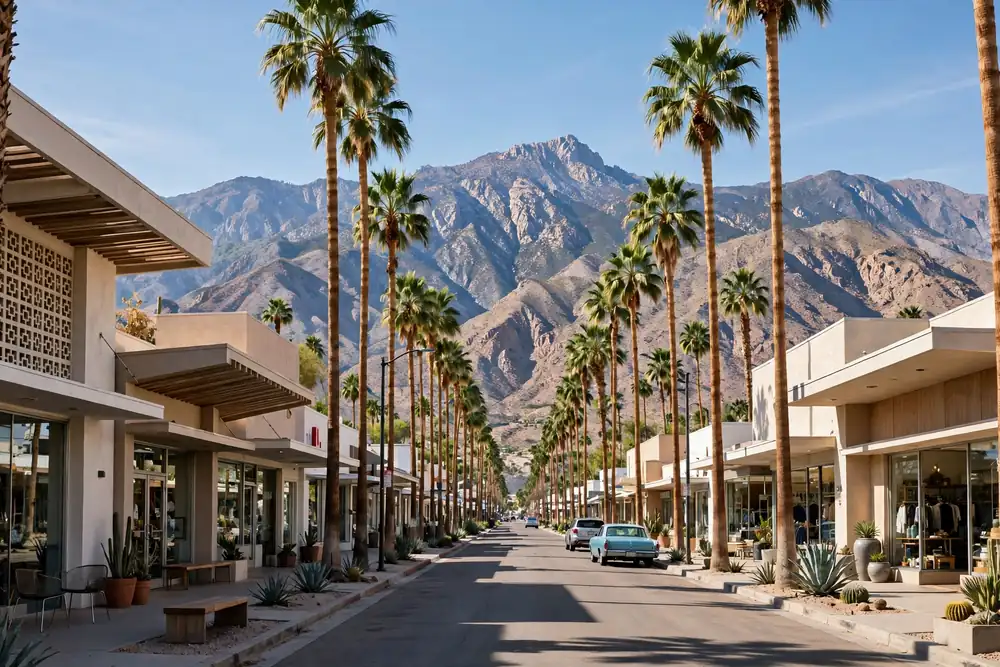
Downtown Palm Springs is the walk itself: Palm Canyon Drive, the main street, lined with tall palms, mid-century storefronts, vintage shops, galleries and restaurants, with the San Jacinto Mountains filling the view at the end of every cross street. Start at the Palm Springs Walk of Stars, the sidewalk of more than 400 brass stars honouring celebrities and local figures, then stand under Forever Marilyn, the 26-foot statue outside the Art Museum. From there, browse the Uptown Design District for mid-century furniture and vintage finds, and finish at the Palm Springs Visitor Center in the 1965 Tramway Gas Station, Richard Neutra’s winged-roof landmark at the north end of town. Read about Palm Springs on Wikipedia.
The honest note: downtown is compact and flat, and two hours of slow strolling covers it — but do it in the morning or the evening, not at noon in July. The shops open late and close late, the patios fill at sunset, and Thursday night is the night to be here, when VillageFest closes the street. The best free photograph in the city is the gas station at golden hour, with its roof like a wing against the mountains, and the second-best is the view down Palm Canyon Drive itself, palms on both sides and the mountain straight ahead.
12. Sunnylands Center & Gardens
Sunnylands is the most peaceful place in the Coachella Valley, and it is free. In Rancho Mirage, the 1960s estate of philanthropists Walter and Leonore Annenberg — once called the Camp David of the West, where presidents and royalty were entertained — now opens its 9-acre gardens to the public, with more than 53,000 arid-landscape plants arranged in geometric patterns inspired by Impressionist paintings. The Sunnylands Center shows art from the collection, films about the estate and rotating exhibitions, and the gardens have a self-guided audio walk, free bird walks and yoga sessions. Read about Sunnylands on Wikipedia.
The practical facts: admission and parking are free, and the centre and gardens are open Wednesday to Sunday from 8:30 a.m. to 4 p.m. Guided tours of the historic house and grounds are available, but only with a reservation made in advance, and they sell out — book as soon as you know your dates. Allow an hour for the gardens and the centre, two if you take a tour, and go in the morning, when the light on the lawns is soft and the birds are out. No pets, and the site is smoke-free throughout.
13. Cabazon Dinosaurs
The Cabazon Dinosaurs are the roadside attraction that every drive from Los Angeles passes and every child remembers: two enormous steel-and-concrete dinosaurs beside Interstate 10 at Cabazon, about 20 minutes west of Palm Springs. Dinny, the 150-foot Apatosaurus, was built from 1964 by sculptor Claude Bell to lure hungry drivers to his Wheel Inn café, and Mr. Rex, the 65-foot Tyrannosaurus, followed. Today the site is a small dinosaur park with more than 100 dinosaurs, a fossil dig, gemstone panning and a gift shop inside Dinny’s belly — and you can climb inside Mr. Rex, up through his jaws to a lookout, just as Pee-wee Herman did in the film Pee-wee’s Big Adventure. Read about the Cabazon Dinosaurs on Wikipedia.
The practical facts for 2026: admission is $15 for adults 13 to 55, $13 for children 3 to 12 and $11 for seniors and military, sold at the door only — there is no online booking. The park opens every day at 9 a.m. and closes at about 6 p.m., a little later at weekends and in summer. The honest note: you do not have to pay to enjoy the dinosaurs. Dinny and Mr. Rex are visible from the freeway and from the car park, and photographing them from outside is free. Pay the $15 if you have children, or if you want to climb inside the T. rex; otherwise, stop for the photograph and keep driving. The park is at 50770 Seminole Drive, Cabazon, at the Main Street exit off Interstate 10.
14. Mount San Jacinto State Park
Mount San Jacinto State Park is the other half of the tramway ride, and the reason to bring walking shoes. From the Mountain Station at 8,516 feet, more than 50 miles of trails run through pine forest, granite and alpine meadows, in air that can be 30 degrees cooler than the valley floor. The easy choice is the Desert View Trail, a short loop with five viewpoints over the desert below. The serious choice is the summit of San Jacinto Peak itself, at 10,834 feet, an 11-mile round trip from the tramway that takes most of a day. In winter there is snow up here, and the trails need proper boots and a check of conditions. Read about Mount San Jacinto on Wikipedia.
Two warnings, and both matter. First, the famous Cactus to Clouds trail — from the desert floor in Palm Springs to the summit in a single day — is one of the hardest day hikes in the United States, with more than 10,000 feet of climbing, and it kills people: never attempt it in summer, never attempt it without training, water and a dawn start, and never attempt it alone. Second, hikes beyond the visitor area need a free wilderness permit, available at the station. The honest advice for most visitors is simpler: ride the tramway up, walk the Desert View Trail, eat lunch at Peaks Restaurant with the valley spread out below you, and ride back down. That is the mountain, without the risk.
15. The Spa at Séc-he
The Spa at Séc-he is the reason Palm Springs exists at all: hot mineral water, bubbling out of the ground where the city now stands, sacred to the Agua Caliente Band of Cahuilla Indians for centuries. The modern spa, opened in 2023 on the site of the city’s original hot springs in the heart of downtown, is run by the tribe and built around the water itself — more than 20 mineral pools of different temperatures, private soaking tubs, a grotto and a salt cave, with the mineral-rich water drawn from the same springs the Cahuilla people used. It is the most relaxing half-day in Palm Springs, and the best antidote to a morning of hiking. Learn about the Agua Caliente Band of Cahuilla Indians on Wikipedia.
The practical facts: day passes are sold online and they sell out on weekends and in the winter season, so book ahead — walk-ins are often turned away. Check the current day-pass price on the official site before you go, because it changes with the season, and arrive early in the morning for the quietest pools. Bring a swimsuit and leave the phone in the locker; the spa is deliberately quiet, and the pools are for soaking, not for scrolling. If the spa is full, the mineral pools of Desert Hot Springs, twenty minutes north, are the backup plan.
16. San Gorgonio Pass wind farm
The San Gorgonio Pass, the gap in the mountains west of Palm Springs, is one of the windiest places on Earth — and it is filled with thousands of wind turbines, white blades turning against the desert sky for as far as you can see. It is the first thing you notice driving in from Los Angeles on Interstate 10, and it is worth a proper look rather than a glance from the car. Guided windmill tours run from Palm Springs, taking you out among the turbines to explain how the pass became one of the first large wind farms in America, in the 1980s, and how the turbines work. Learn about the San Andreas Fault on Wikipedia.
The practical facts: the tours run by reservation and take about two to three hours, including the drive out and back. If you would rather not pay, the view from Interstate 10 is free — and the best photograph is at sunset, when the turbines stand black against an orange sky and the light catches the blades. The pass is also where the San Andreas Fault runs, which is why the mountains rise so steeply on either side: the wind, the fault and the desert are all the same story, and the turbines are just the newest chapter. Combine the tour with the Cabazon Dinosaurs, which sit at the eastern end of the pass, for a half-day out.
17. Pioneertown
Pioneertown is the Wild West, built for real: in 1946, Hollywood actors including Roy Rogers and Gene Autry built a working town in the high desert, 18 miles north of Palm Springs, as a live-in movie set — the buildings were real businesses on the outside and film sets on the inside, so the actors could live in town between scenes. Mane Street still looks the part: false-fronted shops, a jail, a church and the Pioneertown Palace, now Pappy & Harriet’s, the barbecue joint and live-music venue that is the best night out in the high desert. Read about Pioneertown, California on Wikipedia.
The practical facts: Pioneertown is free to wander, and the shops and Pappy & Harriet’s are the reason to come. Book a table at Pappy & Harriet’s in advance if you want dinner — the weekend shows sell out, and the drive back to Palm Springs is dark desert road. The town sits at about 4,000 feet, so it is cooler than the valley, and the light on the boulders at sunset is the best in the area. Combine it with the west entrance of Joshua Tree National Park, which is a short drive further on, for a full high-desert day.
18. Coachella Valley Preserve
The Coachella Valley Preserve is the desert’s secret garden: a 20,000-acre reserve at Thousand Palms, about 25 minutes from downtown, where a spring-fed oasis of California fan palms rises out of the sand. The main oasis, around McCallum Pond, is a thicket of palms and cottonwoods with water you can hear before you see it, and the preserve has about 25 miles of trails through dunes, washes and palm groves, including the easy boardwalk to the pond and longer walks into the Indio Hills. In spring the wildflowers come out, and the birding is the best in the valley. Read about Palm Springs on Wikipedia.
The practical facts: the preserve is free, and the visitor centre is staffed by volunteers who will point you to the right trail for the heat and the hour. Go in the morning — there is almost no shade once you leave the oasis — and carry water, because there is none on the trails. The honest note: the oasis is fragile, and the palms survive because the water stays underground. Stay on the trails, do not climb the palms, and do not swim in the pond. It is the quietest of the valley’s palm oases, and the one the locals keep for themselves.
19. Desert Hot Springs mineral pools
Desert Hot Springs, twenty minutes north of Palm Springs, is the valley’s other spa town — and the cheaper one. Its hot mineral water, drawn from deep aquifers, feeds the pools of a dozen small resorts and hotels, where you can buy a day pass and soak for an afternoon without the downtown prices. The best-known are the Miracle Springs Resort & Spa and the Desert Hot Springs Spa Hotel, both with large outdoor mineral pools, and the historic Two Bunch Palms, the old desert resort with its own grove of palms. The town is also home to Cabot’s Pueblo Museum, a four-storey adobe house built by hand by homesteader Cabot Yerxa from desert materials, which you can tour for a small fee. Read about Palm Springs on Wikipedia.
The practical facts: day passes are usually sold at the door, and they are cheapest on weekdays. The pools are hottest in the morning and coolest in the evening, and the water is genuinely mineral — it smells faintly of sulphur, and it leaves your skin soft. The honest note: Desert Hot Springs is not Palm Springs. It is quieter, rougher around the edges and less polished, and that is exactly why people who love it, love it. Come for the water, not for the nightlife, and do not expect the downtown buzz.
20. Festival season — Coachella, Stagecoach and the film festival
Palm Springs does not have a festival season so much as it is a festival season, and the three big ones are worth planning a trip around — or planning a trip to avoid. The Palm Springs International Film Festival opens the year each January, with more than 180 films from 60 countries and the stars on the red carpet. Coachella takes over the Empire Polo Club in Indio, about 30 minutes away, for two April weekends — April 9 to 11 and April 16 to 18, 2027 — and Stagecoach, the country’s biggest country-music festival, follows in late April. In August, Splash House turns the downtown hotels into a pool-party festival, and Desert X, the biennial desert art exhibition, opens its next edition on October 30, 2027. Read about the Coachella festival on Wikipedia.
The practical facts, and the trap: festival weekends are the most expensive and most crowded weekends of the year. Hotel prices in Palm Springs double or triple for Coachella, rooms book out months ahead, and the roads between Palm Springs and Indio jam for hours. If you are coming for a festival, book the hotel before the ticket. If you are not, check the festival calendar before you book anything — a quiet March weekend and a Coachella weekend are two different cities, at two different prices. And remember that Coachella is not in Palm Springs at all: it is in Indio, and the drive is 30 minutes each way, longer on festival days.
Palm Springs in 3 days — a ready-made itinerary
| Day | Theme | What you do |
| Day 1 | Canyons and downtown | Indian Canyons in the morning, downtown Palm Canyon Drive and the Art Museum in the afternoon, VillageFest on Thursday night |
| Day 2 | The mountain and the modern | Aerial Tramway and Mount San Jacinto in the morning, mid-century modern drive and the Spa at Séc-he in the afternoon |
| Day 3 | The wider desert | Joshua Tree National Park all day, or the Living Desert, Cabazon Dinosaurs and a date shake at Shields |
Day 1 — Canyons and downtown
Start early at Indian Canyons — be at the tollgate when it opens at 8 a.m., before the heat — and walk the Palm Canyon Trail down into the palms, then the easy Andreas Canyon loop. Drive back to town for lunch downtown, then spend the afternoon on Palm Canyon Drive: the Walk of Stars, Forever Marilyn, the shops of the Uptown Design District and the Palm Springs Art Museum. If it is a Thursday, the museum is free from 5 to 8 p.m., and VillageFest takes over the street from 6 p.m. — the perfect first evening. Dinner downtown: a table on a patio on Palm Canyon Drive, and an early night, because day two starts early too.
Day 2 — The mountain and the modern
Take the first tramway car up in the morning — 10 a.m. on weekdays, 8 a.m. at weekends — and spend the morning at the top: the Desert View Trail, the observation decks and lunch at Peaks Restaurant, with the valley spread out 8,516 feet below. Come back down in the early afternoon and drive the mid-century modern route: the Twin Palms and Movie Colony streets, the Elvis Honeymoon Hideaway, the Kaufmann Desert House from the street and the Tramway Gas Station visitor centre. Finish the day at the Spa at Séc-he, soaking in the mineral pools as the desert cools, and dinner at Workshop Kitchen + Bar downtown.
Day 3 — The wider desert
Day three is the desert itself. The best version is a full day at Joshua Tree National Park: leave by 8 a.m., enter at the Cottonwood south entrance, and spend the day at Hidden Valley, Barker Dam, Skull Rock and Keys View, with a picnic lunch and an hour of stargazing if you stay for sunset. The easier version, for families or for a hot day, is the Living Desert in Palm Desert in the morning — it opens at 8 a.m. — then the Cabazon Dinosaurs on the way back, and a date shake at Shields Date Garden in Indio to finish. Either way, end the trip with a last walk down Palm Canyon Drive at sunset, when the palms are black against the mountains and the air finally cools.
Best time to visit Palm Springs
| Season | Weather | What it is like |
| Spring (March–May) | 80–95°F, dry and sunny | Wildflowers, festival season, the best hiking weather; March is the busiest month |
| Summer (June–August) | 104–109°F, extreme heat | Pool season, the lowest hotel prices, Splash House; hike only at dawn, if at all |
| Autumn (September–November) | 100°F cooling to 70–80°F | Fall colour in the mountains, Modernism Week in October, the best overall value |
| Winter (December–February) | 70–75°F, mild and sunny | Film festival in January, Modernism Week in February, snow on San Jacinto, peak hotel prices |
The best time to visit Palm Springs is October through May, when the days are warm enough for the pool and cool enough for a hike. March, October and November are the sweet spot: warm days, cool nights and little rain, with the trails at their best and the crowds thinner than in the winter peak. February is the month for Modernism Week, January for the film festival and April for Coachella and Stagecoach — but book months ahead for all three, because hotel prices spike. Summer is a different trip: daytime highs average 104°F in June, 109°F in July and 108°F in August, and 110°F days are common. If you come in summer, come for the pool and the spa, hike only before 10 a.m., and take the tramway up the mountain, where it is 30 degrees cooler. The cheapest time to visit is June through early September, when the heat empties the hotels and the rates fall — just do not plan a hiking holiday then.
Where to stay in Palm Springs
| Area | Best for | Price per night |
| Downtown and Uptown | First-timers, walkable, VillageFest and the museums on foot | $200–$400 per night |
| Movie Colony and the Tennis Club | Quiet, historic, mid-century homes and small boutique hotels | $250–$450 per night |
| South Palm Canyon and Indian Canyons | Resorts, pools and spa stays near the canyons | $250–$500 per night |
| Desert Hot Springs | Budget, mineral pools, quieter nights | $100–$200 per night |
| Palm Desert and Rancho Mirage | Golf resorts, the Living Desert and Sunnylands nearby | $200–$400 per night |
First-time visitors should stay downtown or in Uptown, within walking distance of Palm Canyon Drive, the museums and VillageFest — the boutique hotels here are the heart of the Palm Springs experience, many of them restored mid-century motels with pools at the centre and mountain views from every room. The Movie Colony and the Tennis Club are the quieter, more expensive choice: historic streets, small hotels and the best architecture in the city. South Palm Canyon suits travellers who are here for the resorts and the spas, with the big pool hotels and the canyons a short drive away. Desert Hot Springs is the budget choice, with mineral-pool hotels at half the downtown price, and Palm Desert and Rancho Mirage suit golfers and families who want the Living Desert and Sunnylands on their doorstep. Book early for Modernism Week in February, the film festival in January and the Coachella weekends in April, when the whole valley fills up and prices double.
Getting around Palm Springs
A car is not needed downtown, and that is one of Palm Springs’ best features. Downtown is flat and walkable, Palm Canyon Drive is the whole city in a mile, and the SunLine buses that run through the valley cost $1 for adults and $0.85 for ages 5 to 17, with under-5s free. Palm Springs International Airport (PSP) is only about 2 miles east of downtown, a ten-minute drive, and the SunLine Route 24 bus runs from the terminal to downtown — a taxi is about $10 to $15. Ride-hailing cars are easy to find downtown and at the airport.
For everything else, a car is the easiest way. Joshua Tree, the Living Desert, Cabazon, Pioneertown and the Coachella Valley Preserve are all drives, and the buses do not go to the trailheads. Amtrak’s Sunset Limited calls at Palm Springs station a few times a week, but the schedule is thin, and most visitors fly or drive — Los Angeles is about two hours away on Interstate 10. Two warnings: do not walk far in the summer midday heat, even downtown — the sun is stronger than it looks, and the shade is thin — and on VillageFest Thursday nights, Palm Canyon Drive closes to cars from the late afternoon, so park on a side street and walk in.
Palm Springs food you have to try
Palm Springs is a serious food town, and it is the one thing most guides underplay. The city grows the dates, brews the beer and cooks the Mexican food that the whole Coachella Valley is known for, and its restaurants — from a 1960s date farm to a mid-century dining room — are as much a part of the trip as the tramway. Three things define eating here — the date shake, the classic Palm Springs table and the tacos — and downtown and the desert towns are where the best of it is. Eat breakfast early, eat lunch after the morning’s sightseeing, and save the best table for the evening.
The date shake — the drink Palm Springs invented
The date shake is the taste of the Coachella Valley: low-fat vanilla ice cream blended with date crystals — dehydrated dates — into a thick, sweet milkshake, and the place to drink it is Shields Date Garden in Indio, on Highway 111. Shields has been a working 17-acre date farm since Christmas Day 1924, and it celebrated its 100th anniversary in December 2024. Entry is free, the store is open daily from 9 a.m. to 5 p.m., and the shake counter at the back of the store — the same turquoise soda fountain that has been there for a century — sells the classic shake for about $9, with vanilla and coffee versions for a little more. While you are there, taste the free samples of more than a dozen date varieties, including the Blonde and Brunette that Shields grows itself, and watch the free 15-minute film, The Romance and Sex Life of the Date, which explains how dates are hand-pollinated. Read about Palm Springs on Wikipedia.
The café at Shields serves breakfast and lunch with date-themed dishes — the Date Me Omelet, the Shields Signature Date Burger — but its hours vary, so check before you plan a meal there. The other date-shake stop is Hadley Fruit Orchards in Cabazon, on the way to the dinosaurs, which has been selling dates and shakes since 1931. One shake is enough for two people: they are thick, sweet and very filling, and they are the best $9 in the valley.

Breakfast and the classic Palm Springs table
Palm Springs does breakfast better than almost anywhere in California, and the place to start is Cheeky’s, the downtown favourite for bacon flights, cinnamon-roll pancakes and fresh-pressed juices — go early, because the queue is out of the door by 9 a.m. For dinner, the classic Palm Springs table is Workshop Kitchen + Bar, in a converted 1920s movie theatre on North Palm Canyon Drive, with a wood-fired menu and the best wine list downtown, and Spencer’s, the old-school restaurant at the base of the mountains, where the patio dinner under the palms is the most Palm Springs evening there is. Read about Palm Springs on Wikipedia.
For the rest of the table, try the farm-to-table lunch at the Parker’s Norma’s, the poolside lunch at the Ace Hotel’s King’s Highway, and the date pancakes at Shields. The honest rule: the best restaurants in Palm Springs book out on weekends in the winter season, so reserve ahead, and eat early in summer, when the patios empty in the heat and the dining rooms fill up.
Tacos and Mexican food — the valley’s other cuisine
The Coachella Valley is Mexican food country, and Palm Springs has some of the best tacos in Southern California. Start at Tac/Quila, the downtown taqueria with the big patio and the margaritas, then Las Casuelas Terraza, the old family restaurant on Palm Canyon Drive with the terrace over the street, and El Mirasol, the colourful local favourite for chile rellenos and margaritas. The food is honest, the portions are big and the prices are the lowest in downtown. Learn about the San Andreas Fault on Wikipedia.
The honest rule for a night out: the taco places are walkable from the downtown hotels, so leave the car behind and walk. The margaritas are strong, the salsa is hot, and the best plan is tacos early, a walk down Palm Canyon Drive as the lights come on, and a date shake the next morning to recover.
Free things to do in Palm Springs
Palm Springs is one of the best-value cities in California, because its best sights are free. VillageFest is free. The gardens at Sunnylands are free. The Coachella Valley Preserve is free. Forever Marilyn and the Walk of Stars are free. The Tramway Gas Station is free to photograph, the wind farm is free to look at from Interstate 10, and the downtown walk itself is free. The Art Museum is free on Thursday evenings from 5 to 8 p.m., and free at any time for children under 18. Watching the sunset from the top of the tramway — once you have paid for the ride — costs nothing extra, and stargazing from the desert roads outside Joshua Tree costs nothing at all.
A full day of the gardens, the preserve, the downtown walk and VillageFest can cost nothing — which is why the budget in this guide starts low. The paid attractions that are worth it are the tramway, the canyons and the Living Desert; everything else on a first visit can be free. The other free secret: the first Thursday of the month is not the only free night — every Thursday is, at the museum and on the street, and the samples at Shields Date Garden are free every day of the week.
Frequently asked questions
How many days do you need in Palm Springs?
Three full days is the right amount for the highlights: one day for the canyons and downtown, one day for the tramway and the mountain, and one day for the wider desert. Two days covers the essentials if you skip Joshua Tree — the tramway and the canyons on day one, downtown and the museums on day two. Add a fourth day for Joshua Tree and the desert towns, both of which deserve a full day of their own.
Is Palm Springs too hot in summer?
For hiking, yes. Daytime highs average 104°F in June, 109°F in July and 108°F in August, and 110°F days are common. The canyons run reduced hours, the trails are for dawn only, and the desert parks are at their most dangerous in the afternoon. But summer is also pool season: the hotels are at their cheapest, the pools are at their best, and the tramway, the museums and the spa are all air-conditioned or 30 degrees cooler. If you come in summer, come for the pool and the spa, not for the trails.
Do you need a car in Palm Springs?
Not downtown. The downtown core is flat and walkable, the SunLine buses cost $1, and the airport is only two miles away. But a car is the easiest way to reach Joshua Tree, the Living Desert, Cabazon, Pioneertown and the Coachella Valley Preserve, and ride-hailing is thin outside the city. If you are staying downtown and only doing the riverfront — the tramway, the canyons and the museums — skip the car; if you are doing the desert and the day trips, rent one.
Is the Aerial Tramway open?
Yes — and this is the question that catches the most visitors out. The tramway closes every autumn for about four weeks of maintenance, and in 2026 it was shut from September 8 to October 4, reopening on October 5. Any guide, map or blog post that still says the tramway is closed was written during that window and is out of date. Check the official site before you go, because the closure dates move a little every year, and book online in advance, because the cars sell out on weekends and holidays.
Is Palm Springs good for families?
Yes — it is one of the best family cities in California. The tramway, the Cabazon Dinosaurs, the Living Desert, the canyons and the date shake are all built for children, and the downtown is flat, safe and full of parks and patios. The heat is the one thing to watch: small children dehydrate fast in 100°F weather, so plan the outdoor time for the morning, keep the afternoons for the pool and the museums, and carry more water than you think you need.
When is the best time to visit Palm Springs?
October through May, when the days are warm enough for the pool and cool enough for a hike. March, October and November are the single best months: warm days, cool nights and little rain. February is the month for Modernism Week, January for the film festival and April for Coachella and Stagecoach — but book months ahead for all three. Summer is the cheapest time to visit, with the lowest hotel prices of the year, but it is the season for the pool and the spa, not for the trails. Avoid the hottest weeks of July and August if you plan to hike, and bring sunscreen and a hat in any season — the desert sun is strong all year.
Further reading — Wikipedia and Reddit
Wikipedia: Palm Springs on Wikipedia — the city’s history, geography and neighbourhoods.
Reddit: for local tips, trip reports and current conditions, see the Palm Springs community on Reddit — the live community where locals answer visitor questions. We link to the community home rather than a single thread, because threads move and close.
No Quora link is included here, because no live Quora thread about Palm Springs could be verified — we would rather link to nothing than to a thread that does not exist.
Your Palm Springs trip, in one paragraph
Palm Springs is the desert city that gives you the most for the least: a rotating tram car up a canyon wall in the morning, a palm oasis at noon, a 26-foot Marilyn and a street fair at night, a national park an hour away and a date shake at the end of the day — all in three days, much of it free. Start with the tramway, walk the canyons before the heat, look up at the mid-century houses, eat the tacos and drink the date shake, and finish with a day in Joshua Tree under the darkest sky in Southern California. And when you are ready for the next city, the same 20-attraction format covers Chicago, Nashville, Los Angeles, Orlando, Miami, San Diego, Denver, Savannah, Dallas, Charleston, San Francisco, Myrtle Beach, Las Vegas, San Antonio, London, Portland, Pigeon Forge, Puerto Rico, Atlanta, Phoenix, Paris, Maui, Key West, Colorado Springs, Sedona and Chattanooga — twenty-six guides, one for every kind of trip.

About the Author