Things to Do in Sedona
20 Best Attractions, a 3-Day Itinerary, Where to Stay, and the Food You Cannot Miss
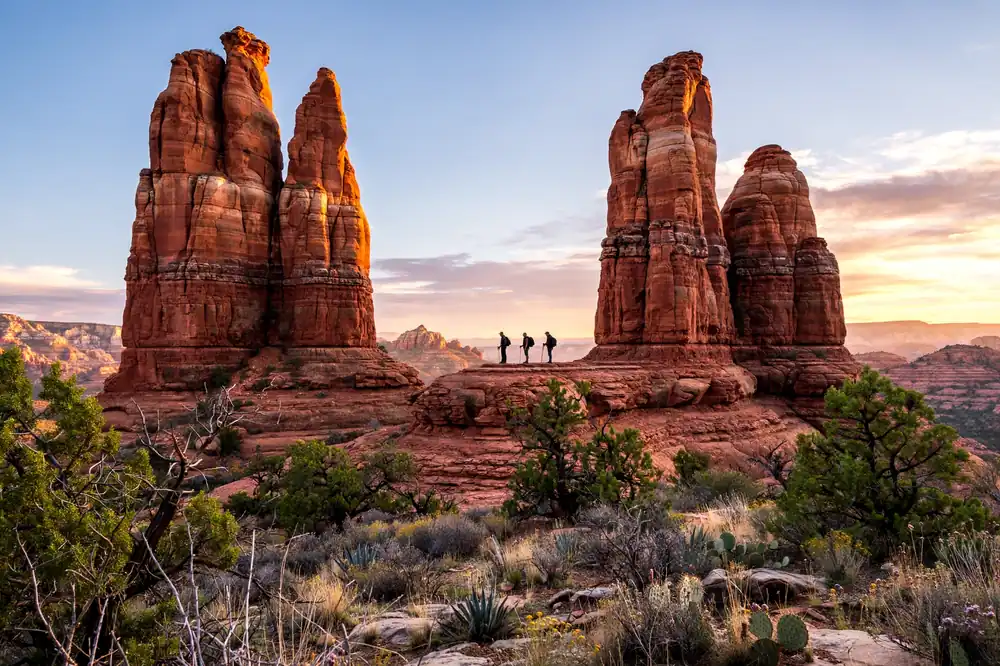
Quick Info
Best for: First-time Arizona visitors, hikers, photographers, stargazers and spiritual seekers — a small red-rock town where the trails start at the edge of town
Best time: March–May and September–November for hiking and perfect light; winter for quiet trails and low prices; avoid mid-summer afternoons for the heat
How long: 3 full days for the highlights; 2 days covers Cathedral Rock, Devil’s Bridge and the chapel; add a 4th day for Jerome and Montezuma Castle
Budget: Roughly $180–$350 per person per day for a mid-range trip with a hotel and one big ticketed activity; a day of hikes and free sights runs much cheaper
Don’t miss: Cathedral Rock at sunrise, Devil’s Bridge at dawn, the Chapel of the Holy Cross, Slide Rock in summer and sunset from Airport Mesa
Sedona sits in northern Arizona, about 115 miles north of Phoenix and 30 miles south of Flagstaff, at 4,350 feet above sea level — and it is the rare American town where the scenery is the whole point. Red sandstone buttes rise straight out of the neighbourhoods, a natural stone arch hangs over a canyon, and a chapel is built into a cliff face. This guide gives you the 20 best things to do in Sedona in a sensible order, a ready-made 3-day itinerary, honest advice on when to go, where to stay and how to get around, and the three foods you have to try before you leave — plus the free sights that cost nothing at all. Prices and hours change, so every price in this guide is marked as approximate — always check the official website before you visit.
One thing to know before you go: Sedona in 2026 is not the town of the old guidebooks. The West Fork Trail — the most popular hike in the whole Coconino National Forest — is closed after the 2026 Pocket Fire, the Cathedral Rock and Soldier Pass parking lots are gated shut on the days the free shuttle runs, and Slide Rock now charges $30 a vehicle in summer. This guide tells you which of those traps to watch for, and which prices changed in 2026, so you can plan with facts instead of outdated blog posts.
Sedona at a glance
| Question | Short answer |
|---|---|
| Where is Sedona? | In northern Arizona, about 115 miles north of Phoenix and 30 miles south of Flagstaff, at 4,350 feet above sea level |
| What is it best for? | Red-rock hikes, a natural stone arch, vortex sites, dark skies and a famous swimming hole |
| How long should I stay? | 3 full days for the highlights; 2 days for the essentials; add a day for Jerome and Montezuma Castle |
| How much does it cost? | Roughly $180–$350 per person per day mid-range; many of the best hikes and viewpoints are free |
| Do I need a car? | Yes — a car is the easiest way to get around; the free shuttle only runs Thursday–Sunday |
| What is the one thing not to miss? | Cathedral Rock at sunrise, with the red rocks glowing |
| When is the best time to go? | March–May and September–November for hiking; winter for quiet trails and low prices |
| Is it good for families? | Yes — Slide Rock, the chapel, Tlaquepaque and the easy trails are all built for kids |
The 20 best things to do in Sedona
These are the 20 best things to do in Sedona, ranked the way a first-time visitor should actually do them: the two famous hikes first, then the chapel and the viewpoints, then the water, the canyons and the day trips. Every price below is the 2026 price as published by the attraction itself, and every trap — the closed trail, the gated parking lots, the pass that does not cover everything — is called out where it matters.
1. Cathedral Rock
Cathedral Rock is the reason most people come to Sedona, and it is the most photographed site in the whole red-rock country. The hike is short but serious: about 1.2 miles round trip with roughly 700 feet of climbing, ending in a hands-on scramble up slickrock to a saddle between the spires, where the view opens across the whole valley. It takes most people 1.5 to 2.5 hours, and the rocks glow orange at sunrise and sunset — go at one of those times if you can, and bring grippy shoes, because the final pitch is steep, smooth rock. Learn more about Sedona on Wikipedia.
Here is the honest 2026 rule, and the trap. The trailhead lot on Back O’ Beyond Road is small, and on the days the free Sedona Shuttle runs — Thursday to Sunday, year-round, plus daily during spring break and holiday weeks — the lot is gated shut to private vehicles. On those days, park at the North SR 179 park-and-ride (1294 SR 179, free, no pass needed) and take Route 15, which runs about every 15 minutes from 7 a.m., with the last Cathedral Rock pickup at 5:12 p.m. On Monday to Wednesday the lot is open to cars, but it fills early. Cathedral Rock is also one of Sedona’s four best-known vortex sites, and the quieter way in is the Templeton Trail from Crescent Moon Ranch (Red Rock Crossing), where the classic reflection photo of Cathedral Rock in Oak Creek is taken.
2. Devil’s Bridge
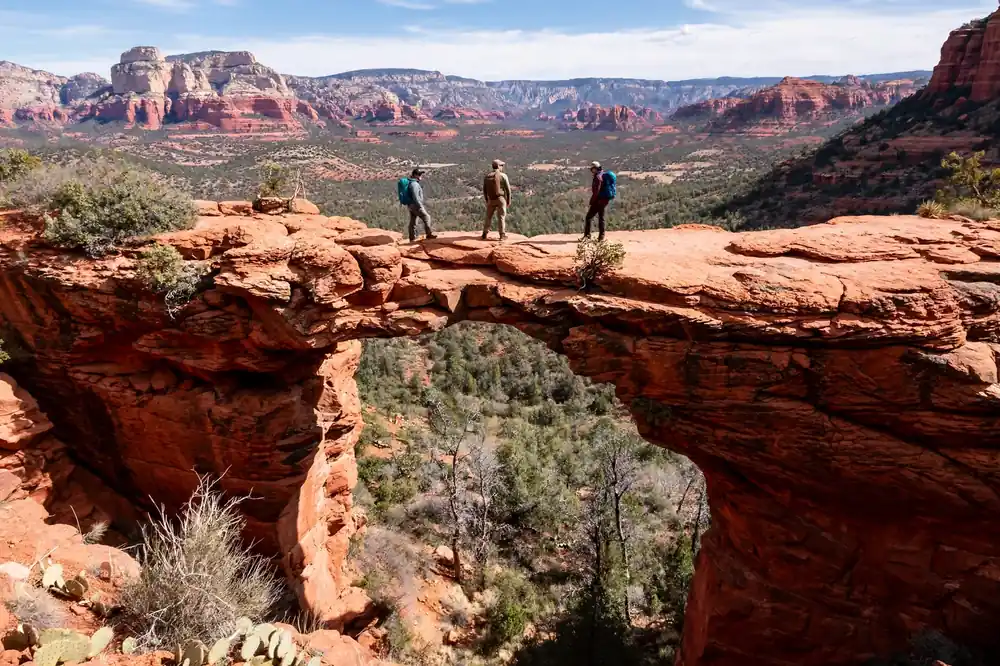
Devil’s Bridge is the largest natural sandstone arch in the Sedona area — a 54-foot-high span of red rock over a canyon — and walking across it is the most famous photo in town. The catch is getting there: the arch itself is only a short walk from the end of a dirt road that the Forest Service says needs a high-clearance vehicle, so most visitors hike in from further out. The best route for most people is the Mescal Trailhead off Long Canyon Road, a scenic 4.2-mile round trip on trail the whole way, with 64 parking spaces across two lots. Read about Sedona on Wikipedia.
The other options are the Dry Creek Vista Trailhead (3.8 to 4.1 miles round trip by the FR 152 dirt-road walk, or 5.7 to 6 miles by the prettier Chuckwagon Trail) and, if you do have a high-clearance vehicle, the small Devil’s Bridge Trailhead lot at the end of FR 152 for a 1.6- to 1.8-mile round trip — it holds only a handful of vehicles. Both paved trailheads need a Red Rock Pass displayed in the car, and the free Sedona Shuttle’s Route 11 stops at both on Thursday to Sunday from the West SR-89A park-and-ride. Two warnings: the queue to step onto the arch for a photo can run up to two hours on busy days, so go at sunrise; and do not park on the shoulder of Dry Creek Road — since spring 2024 the county, the city and the Forest Service have put up barriers and no-parking signs along it.
3. Chapel of the Holy Cross
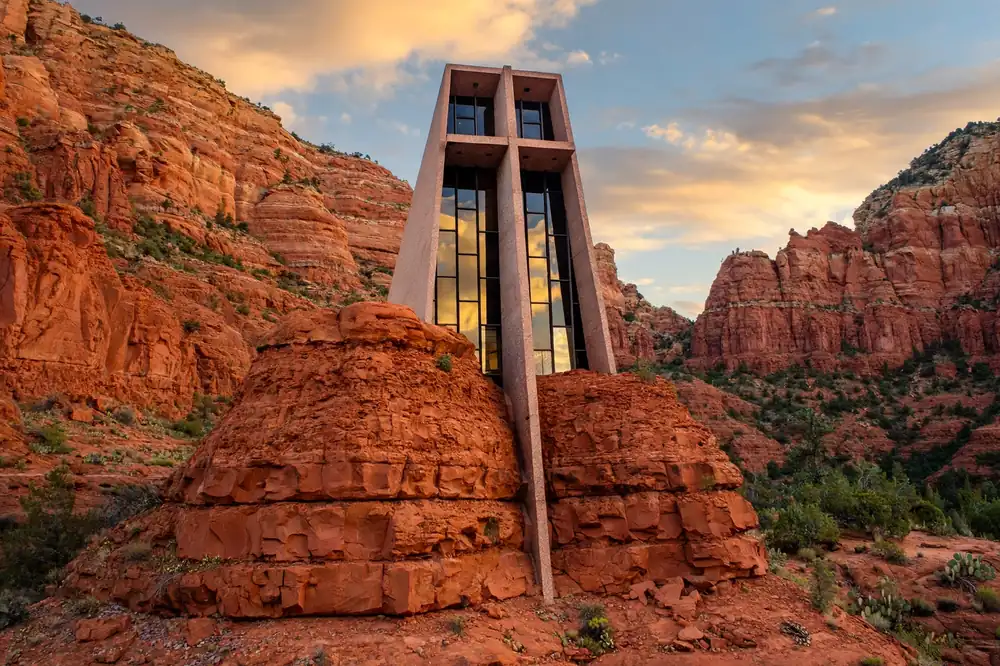
The Chapel of the Holy Cross is a small Roman Catholic chapel built directly into the red rock buttes south of town, and it is the most-reviewed attraction in Sedona — one of the rare places that looks better than the photos. It was inspired and commissioned by local rancher and sculptor Marguerite Brunswig Staude, a student of Frank Lloyd Wright, and designed by architects August K. Strotz and Richard Hein; it was built between 1954 and 1956, cost $300,000, and won the American Institute of Architects’ Award of Honor in 1957. The defining feature is a 90-foot cross rising from the building’s southwestern face, and in 2007 Arizonans voted the chapel one of the Seven Man-Made Wonders of Arizona. Read about the Chapel of the Holy Cross on Wikipedia.
The chapel is free and open daily, roughly 9 a.m. to 5 p.m., at 780 Chapel Road off Highway 179. The upper parking lot is small, so at busy times you will walk up from the lower lots — the short climb is part of the experience, and the view from the terrace is the payoff. It is an active chapel, so keep your voice down inside, and give it 30 minutes: the interior is small, the light through the glass is the point, and the silence is what people remember. It was added to the National Register of Historic Places in 2011.
4. Bell Rock and Courthouse Butte
Bell Rock is the easy first hike in Sedona, and the one to do on your first morning. The Bell Rock Pathway is a wide, gentle trail past the base of the huge bell-shaped butte, and the Bell Rock Loop runs about 3.6 miles around it, with the Courthouse Butte Loop adding about 4 miles more for a longer day. The views are enormous for almost no effort, which is why families, first-timers and photographers all start here. Bell Rock is also one of Sedona’s four best-known vortex sites, and the rock’s flat top is a popular meditation spot — though the final climb to the top is steep and exposed, so most people are happy with the base trails. Learn more about Bell Rock on Wikipedia.
Park at the Bell Rock Vista or Courthouse Vista lots on Highway 179 — both need a Red Rock Pass displayed — and go at sunrise, when the light is pink and the lots are empty. The trail is shared with mountain bikers, so keep an ear out behind you. If you want a shorter outing, the half-mile walk from the Courthouse Vista lot to the base of Bell Rock gives you the postcard view in twenty minutes.
5. Airport Mesa at sunset
Airport Mesa is the sunset spot in Sedona, and the easiest great view in town. The mesa sits about 500 feet above the centre of town, and from the overlook you can see the whole valley — Cathedral Rock, Bell Rock, Courthouse Butte and the town below — turn gold, then pink, then purple as the sun goes down. It is also one of the four best-known vortex sites, which is why you will see people sitting quietly on the rocks at the edge. The overlook parking lot charges a small fee of about $3, and the Mesa Grill restaurant at the airport is a good place for a drink after the show. Read about Sedona on Wikipedia.
Sedona Airport (SEZ) sits on top of the mesa, but do not try to fly here: there are no scheduled commercial flights, only private, charter and tour aircraft. The airport is still worth a stop in the daytime for the views from the terminal area and for helicopter tours, which take off from here. Arrive at the overlook at least 45 minutes before sunset in spring and autumn — the small lot fills fast, and the walk up from the lower lots is steep.
6. Slide Rock State Park
Slide Rock State Park is Arizona’s most famous swimming hole: an 80-foot natural rock chute in Oak Creek, where the water has polished the red sandstone into a slide you can ride in your swimsuit. It sits on the old Pendley Homestead, a 43-acre apple farm in Oak Creek Canyon, seven miles north of Sedona, and it was one of the most visited attractions in Arizona in 2024, with more than 278,000 visitors. The water is cold even in July, the rocks are slippery, and water shoes are a good idea. Read about Slide Rock State Park on Wikipedia.
Here is the 2026 price trap. Slide Rock charges by the vehicle, not by the person: $30 per vehicle (up to four adults, $5 for each extra person) through August 21, 2026, then $20 after that. Entry is by vehicle only — no walk-ins, no drop-offs — and the gates close when the lot fills, which on July Saturdays happens early. Pets are banned in summer. The Red Rock Pass does not work here: Slide Rock is an Arizona State Park, with its own fee. Go on a weekday, arrive before 10 a.m., and bring a towel and a change of clothes — you will get soaked.
7. Red Rock State Park
Red Rock State Park is the quiet alternative to Slide Rock, and the park the locals recommend when you ask where to escape the crowds. It is a 286-acre nature preserve five miles southwest of Sedona on Red Rock Loop Road, protecting a stretch of Oak Creek and its riparian habitat, with about five miles of trails, a visitor centre, and a daily guided nature walk at 10 a.m. that is included in the entry fee. The trails are gentle, the birdwatching is excellent — the lower creek is a designated Important Bird Area — and the views of Cathedral Rock from the park are some of the best in town. Learn about Red Rock State Park on Wikipedia.
Admission is $10 per adult aged 14 and over, $5 for ages 7 to 13, free for children under 7, and $5 for walk-in or bike-in entry. The park is open daily from 8 a.m. to 5 p.m., with last entry at 4:30 p.m. The Red Rock Pass does not work here either — another state park, another fee — but the price is worth it for the calm: this is the Sedona of cottonwoods and creek water, not of parking queues. Allow two to three hours, and bring binoculars if you have them.
8. West Fork Trail — closed after the 2026 Pocket Fire
West Fork Trail is the single most misunderstood attraction in Sedona right now, because almost every guide still lists it as open. It is not. West Fork was the most popular trail in the whole Coconino National Forest — a 6.5-mile round trip up the West Fork of Oak Creek, with 13 creek crossings on stepping stones, through a narrow canyon that turns gold in autumn — and it is closed. The Pocket Fire started on June 19, 2026, about seven miles north of Sedona, burned 27,393 acres, and was contained in late July. A Forest Service order now closes West Fork Trail No. 108 through February 28, 2027, because of rockfall and flood-debris hazards in the burned drainage, unless the order is lifted earlier. Read about Oak Creek Canyon on Wikipedia.
Do not drive out to the West Fork trailhead expecting to hike it, and do not trust any guide that still describes it as a current option without mentioning the closure — that is the outdated-guide trap this article exists to catch. State Route 89A through Oak Creek Canyon is open, and the canyon itself is still beautiful to drive, but the trail is closed. When it reopens, expect its own day-use fee of about $15 per vehicle — the Red Rock Pass does not cover it. Until then, the creekside alternatives are Slide Rock, Red Rock State Park and Grasshopper Point, another Oak Creek swimming spot about 2.5 miles north of town, which charges about $15 per vehicle and also does not take the Red Rock Pass.
9. Boynton Canyon
Boynton Canyon is the longest and quietest of the four vortex hikes, and the one that feels most like a real wilderness walk. The trail runs about 6.1 to 6.4 miles round trip into a sheer-walled box canyon, with about 700 feet of climbing spread across the whole route, and the walls rise to 1,000 feet on either side. The first mile passes the back boundary of Enchantment Resort, then the canyon narrows, the pines close in, and the crowds thin out. About a third of the way in, look for the Kachina Woman, a tall, narrow spire that local tradition associates with the Boynton Canyon vortex. Learn about Boynton Canyon on Wikipedia.
The trailhead is at the end of Boynton Pass Road in West Sedona, and a Red Rock Pass is required in the lot. The short Boynton Vista Trail — a half-mile loop from the same trailhead — is the way to the vortex viewpoint if you do not want the full hike. The adventurous detour is the Subway Cave, an unofficial side trail about halfway in that climbs to a cave shaped like a subway tunnel; it adds about a mile and a steep scramble, and the route is not marked, so only attempt it if you are comfortable route-finding. Boynton Canyon is also a culturally sacred area for the Yavapai-Apache people — stay on the trail, and treat it with respect.
10. Soldier Pass Trail
Soldier Pass Trail packs three Sedona icons into one moderate hike of about 4.5 miles round trip, with roughly 830 feet of climbing. The first stop is Devil’s Kitchen, a collapsed cavern sinkhole; then the Seven Sacred Pools, a chain of natural rock pools about 0.6 miles in that are beautiful after rain (the pools alone make a 1.2-mile round trip for families); then the Soldier Pass Cave, a 0.3-mile spur climb to a cave with a natural rock bridge that is all over social media. Read about Sedona on Wikipedia.
The trailhead lot is small and awkward: it is gated every day from 6 p.m. to 8 a.m., and on shuttle days — Thursday to Sunday — it is closed to private vehicles entirely, with the free Sedona Shuttle’s Route 14 taking over. On Monday to Wednesday the lot is open but fills early. The trail is shared with mountain bikers, and the cave spur is steep, so wear proper shoes. If the lot is full, do not invent a parking spot on the residential streets nearby — the neighbours and the city will both notice.
11. Pink Jeep Broken Arrow tour
The Pink Jeep Broken Arrow tour is the one paid experience in Sedona that earns its price, and it has been running since the company was founded nearly 60 years ago. The two-hour tour climbs the Broken Arrow trail in a custom pink Jeep Wrangler — the only off-road outfitter permitted to use this trail — over slickrock, past Submarine Rock and Chicken Point, with a guide who knows the geology, the history and where to stop for photos. It is the best way to see the backcountry if you cannot hike, do not want to drive a dirt road, or just want someone else to do the driving. Learn more about Sedona on Wikipedia.
In 2026 the standard two-hour Broken Arrow tour costs from about $165 per adult — check the current rate when you book, because prices change by season — and children under two are not permitted, nor are guests who are expecting. Tours leave from Pink Jeep Plaza at 204 North State Route 89A in Uptown Sedona, roughly on the hour from 7 a.m. to 4 p.m. Book ahead: the morning and sunset departures sell out in spring and autumn. The three-hour Broken Arrow and Scenic Rim combo is the better choice if you want the full tour, and the company also runs gentler scenic tours for families with small children.
12. Tlaquepaque Arts & Shopping Village
Tlaquepaque is Sedona’s most beautiful place to do nothing. Built in the early 1970s by Nevada businessman Abe Miller in a grove of sycamores along Oak Creek, and modelled on the artisan village of San Pedro Tlaquepaque near Guadalajara, Mexico, it is a warren of courtyards, fountains, bell towers and vine-covered stucco walls filled with art galleries, craft shops and restaurants. It is free to wander, and it is at its best in the evening, when the shops are lit and the crowds thin out. Read about Sedona on Wikipedia.
This is the place to buy the one good souvenir instead of the five cheap ones: Native American jewellery, hand-blown glass, bronze sculpture and local photography are all here, and the galleries are happy to talk about the artists. The restaurants in the courtyards are some of the most pleasant places to eat in town, and the village hosts art festivals through the year. Give it an unhurried hour, ideally at the end of a hiking day when your legs want a rest.
13. Uptown Sedona and the Red Rock Scenic Byway
Uptown Sedona is the town’s main street — a stretch of Highway 89A lined with shops, galleries, restaurants and tour offices, with Coffee Pot Rock and the red buttes rising behind it. It is touristy, cheerful and worth one slow afternoon: browse the galleries, buy the prickly pear candy, and eat lunch on a patio. Parking in Uptown is free, but the lots and the street spaces fill fast on weekends, so come early or use the free shuttle lots. Learn more about Sedona on Wikipedia.
The drive in is half the experience. State Route 179, the Red Rock Scenic Byway, runs about 15 miles from Interstate 17 at Exit 298 into Sedona, past Bell Rock, Courthouse Butte and the Chapel of the Holy Cross, with signed viewpoints at Bell Rock Vista, Courthouse Vista and Yavapai Vista. The byway is an All-American Road, one of the highest designations a scenic road can earn in the United States. Drive it slowly, pull over at the viewpoints, and save the drive for the golden hour if you can — the rocks change colour by the minute.
14. Oak Creek Canyon drive
Oak Creek Canyon is the 12-mile gorge that State Route 89A climbs from Sedona to the Flagstaff plateau, and it is one of the most beautiful drives in Arizona. The road switchbacks up the canyon wall past 800- to 2,000-foot cliffs of Coconino Sandstone and red Schnebly Hill Formation, with Oak Creek running along the bottom, and the Oak Creek Vista viewpoint near the top looks back down the whole canyon. The canyon is about 13 miles of winding road, and it is worth driving slowly, with stops at Midgley Bridge and the picnic areas along the creek. Read about Oak Creek Canyon on Wikipedia.
Two warnings. First, the canyon road can close in winter snow between Flagstaff and Sedona, so check conditions before you drive it from November to March. Second, the canyon is a flash-flood zone in the July-to-September monsoon — never enter a flooded wash, and never camp in a dry creek bed. The West Fork Trail in the canyon is closed after the 2026 Pocket Fire (see above), but Slide Rock and the canyon viewpoints are open, and the drive itself is the attraction.
15. Palatki Heritage Site
Palatki Heritage Site protects one of the largest cliff dwellings in the Red Rock country, built by the Sinagua people between 1150 and 1350 CE, along with a grotto of rock art — pictographs and petroglyphs made over thousands of years. It is the most rewarding ancient site near Sedona, and also the hardest to visit, because you cannot just show up. Visits are by timed guided tour only, about 75 minutes, limited to 14 people, covering both the cliff dwelling and the grotto. The trail to the dwellings includes 60 uneven, strenuous steps. Learn about Palatki Heritage Site on Wikipedia.
Book the timed tour in advance through Recreation.gov — tickets are released on a rolling basis up to 120 days ahead, the tour itself is free with a $1 reservation fee, and you will also need a Red Rock Pass displayed on your vehicle. The site is open roughly 9:30 a.m. to 3 p.m., with the last tour at 2 p.m., and it closes when temperatures exceed 100°F or after heavy rain, when the rough Forest Service access roads become impassable. Arrive at least 15 minutes before your tour, and call ahead if the weather has been bad. This is a protected archaeological site: do not touch the rock art, and do not take anything.
16. Honanki Heritage Site
Honanki is Palatki’s sister site, and the easier one to visit. It is the other large Sinagua cliff dwelling of the Red Rock country, from the same period, 1150 to 1350 CE — and unlike Palatki, it does not require a reservation: you can visit self-guided during open hours, with a Red Rock Pass on your vehicle. The road out is rough dirt, so take it slowly, and the site is also visited by Pink Jeep Tours, the only commercial outfitter permitted to bring tours here. Learn about Honanki Heritage Site on Wikipedia.
If you only have time for one ancient site and you can get a Palatki reservation, go to Palatki for the grotto. If you cannot get a reservation, or you would rather let a Jeep driver handle the road, Honanki is the better choice. The two sites pair well as a half-day: Palatki in the morning, Honanki in the afternoon, with a picnic in between. Both sites are on Coconino National Forest land, and both are protected — the same rules apply: look, photograph, and leave everything exactly as you found it.
17. Amitabha Stupa and Peace Park
The Amitabha Stupa and Peace Park is the quietest place in Sedona, and the one most visitors never hear about. A 36-foot white Buddhist stupa stands in a small park of prayer flags, juniper trees and red-rock views north of town, built as a place for meditation and peace. It is free, donations are welcome, and the whole visit takes about 30 minutes: walk the short path, spin the prayer wheels, sit for a while, and leave quietly. Read about Sedona on Wikipedia.
This is not a photo opportunity to rush through — it is a working spiritual site, and the people you meet there are meditating. Keep your voice low, stay on the paths, and do not climb on the stupa. It pairs well with a morning at Boynton Canyon, which is nearby, or as a calm stop after a busy day of hiking.
18. Stargazing under dark skies
Sedona is one of the best places in America to see the stars, because the town decided to keep it that way. In 2014 Sedona became an International Dark Sky Community — the eighth in the world — which means the city regulates outdoor lighting to protect the night sky. On a clear night you can see the Milky Way from the edge of town, and the stars are bright enough to navigate by. Learn more about Sedona on Wikipedia.
The best free spots are Airport Mesa, Yavapai Point on Highway 179, and the open ground out on Dry Creek Road — anywhere away from the Uptown lights. The Milky Way is best from April to September, and the new moon is the time to go. Bring layers (desert nights are cold even in summer), a red flashlight so you do not ruin your night vision, and a blanket to lie on. Guided stargazing tours run most nights and are worth it if you want someone to point out the constellations and set up a telescope — book ahead in spring and autumn, when they sell out.
19. Montezuma Castle and Tuzigoot (day trip)
Montezuma Castle is the best-preserved cliff dwelling in North America, and it is about 30 minutes south of Sedona — an easy half-day trip that most visitors skip and should not. The five-story dwelling sits about 90 feet up a sheer limestone cliff above Beaver Creek, built by the Sinagua people between 1125 and 1173 AD, with about 20 rooms that housed no more than 30 people. The name is wrong in two ways — it has nothing to do with Montezuma, and it is not a castle; it was more like a prehistoric high-rise apartment — but the building itself is extraordinary, and you can see it clearly from the paved third-of-a-mile trail below. Read about Montezuma Castle on Wikipedia.
Admission is $10 per adult aged 16 and over, free for children under 16, valid for seven days, and the same ticket covers Tuzigoot National Monument near Clarkdale — a 110-room pueblo built between 1125 and 1400 CE on a ridge 120 feet above the Verde River floodplain. Montezuma Castle is open daily from 8 a.m. to 5 p.m., closed on Christmas Day, and entry is cashless. You cannot go inside the dwelling — access has been closed since 1951 to protect it — and that is the point: the building survives because people stopped climbing through it. Add Montezuma Well, a free detached unit about five miles north of the castle, and a stop at one of the Verde Valley wineries on Page Springs Road on the way home.
20. Jerome (day trip)
Jerome is the ghost town that refused to die, about 30 minutes southwest of Sedona on Highway 89A. In the 1920s it was a copper-mining boom town of more than 10,000 people on the side of Cleopatra Hill; the mines closed for good in 1953, the population fell below 100, and the town was saved by artists, shopkeepers and tourists. Today it has 464 residents, a National Historic Landmark designation from 1967, and a main street of galleries, restaurants, a mining museum and famously haunted hotels — the New York Sun called it “the wickedest town in the West” in 1903. Learn about Jerome on Wikipedia.
Start at Jerome State Historic Park, in the Douglas Mansion above the town, for the mining history and the view across the Verde Valley, then walk the steep main street for the galleries and the shops. The town is built on a hillside above 88 miles of mine shafts, and some buildings have slid slowly downhill over the years — the town’s leaning buildings are part of the charm. Parking is tight and the streets are steep, so arrive early and wear good shoes. On the way back, stop in Clarkdale for the Verde Canyon Railroad, a 20-mile train ride through the Verde Valley canyon — book ahead, because it sells out.
Sedona in 3 days — a ready-made itinerary
| Day | Focus | Highlights |
|---|---|---|
| Day 1 | The icons | Cathedral Rock at sunrise, Chapel of the Holy Cross, Bell Rock Pathway, Uptown and Tlaquepaque, Airport Mesa sunset |
| Day 2 | The big hikes | Devil’s Bridge at dawn, Boynton Canyon or Soldier Pass, Slide Rock in summer, stargazing |
| Day 3 | Culture and day trips | Palatki or Honanki, Amitabha Stupa, Montezuma Castle and Tuzigoot, Jerome |
Day 1 — Cathedral Rock, the chapel and sunset
Start at Cathedral Rock at sunrise, when the rocks glow orange and the shuttle lots are empty — take the Route 15 shuttle from the North SR 179 park-and-ride if it is a Thursday to Sunday. Walk the slickrock scramble to the saddle, then drive the Red Rock Scenic Byway south to the Chapel of the Holy Cross for a quiet half-hour. Spend the late morning on the Bell Rock Pathway, have lunch in the Village of Oak Creek, and spend the afternoon wandering Uptown Sedona and Tlaquepaque. Finish at Airport Mesa for sunset — arrive 45 minutes early for a parking spot.
Day 2 — Devil’s Bridge, the canyons and the water
Start at dawn at Devil’s Bridge from the Mescal Trailhead, before the photo queue builds — this is the longest morning of the trip, about three hours. After lunch, hike Boynton Canyon for the vortex and the box-canyon walls, or Soldier Pass for the sinkhole, the pools and the cave. In summer, spend the afternoon at Slide Rock State Park (arrive early — the lot closes when full) or, in cooler months, at Red Rock State Park for the guided nature walk. Finish the day with stargazing from Airport Mesa or Yavapai Point.
Day 3 — Ancient sites and the Verde Valley
Spend the morning at Palatki Heritage Site if you have a reservation, or Honanki if you do not, then stop at the Amitabha Stupa for a quiet half-hour. Drive south to Montezuma Castle for the cliff dwelling, then to Tuzigoot for the pueblo — the same $10 ticket covers both. On the way home, stop at Jerome for the mining-town main street and the view across the Verde Valley, with a winery stop on Page Springs Road if you have time. If you have a fourth day, spend it on the Verde Canyon Railroad, or hike the trails you missed on day two.
Best time to visit Sedona
Sedona is beautiful year-round, but the best months are March to May and September to November, when the days are mild, the light is golden and the trails are at their best. Summers are hot — highs in the 90s°F — with afternoon thunderstorms in the July-to-September monsoon, and winters are mild by Arizona standards, with highs in the 50s and 60s°F and snow that is rare but possible on the higher rims.
| Season | Weather | Crowds and prices | Best for |
|---|---|---|---|
| Spring (Mar–May) | 60s–70s°F, clear and mild, wildflowers | Busiest, highest prices, book hotels and tours early | Hiking, photography, perfect light |
| Summer (Jun–Aug) | 90s°F, afternoon monsoon storms Jul–Sep | Busy, hot afternoons, Slide Rock season | Swimming, early-morning hikes, stargazing |
| Autumn (Sep–Nov) | 60s–70s°F, crisp and clear, fall colour in Oak Creek Canyon | Thinner crowds after Labor Day, good prices | Hiking, fall colour, comfortable days |
| Winter (Dec–Feb) | 50s–60s°F, sunny, snow possible on the rims | Quietest, lowest hotel prices, some trails muddy | Quiet trails, the chapel, museums, budget trips |
March to May and September to November are the sweet spot for most visitors: the hiking is comfortable, the light is at its best, and the summer crowds have gone. Summer is the season for Slide Rock and for early-morning hikes — start before 7 a.m., carry more water than you think you need, and be off the exposed trails by the afternoon, when the monsoon storms build. Winter is underrated: the trails are quiet, the hotels are cheapest, and the red rocks under a dusting of snow are beautiful. Two dates to plan around are the Sedona International Film Festival in February, which fills hotels, and the spring-break weeks in March and April, when the shuttle runs daily and the trailheads are at their busiest.
Where to stay in Sedona
| Area | Best for | Price range (approx) |
|---|---|---|
| Uptown Sedona | First-timers, walkers, shops and restaurants | $200–$350 per night |
| West Sedona | Budget-friendly, trailheads, local feel | $130–$250 per night |
| Village of Oak Creek | Quiet, Bell Rock and the Chapel nearby, views | $150–$300 per night |
| Airport Mesa | Sunset views, Sky Ranch Lodge | $180–$320 per night |
| Luxury resorts (Enchantment, L’Auberge, Ambiente) | Splurge, spa, red-rock setting | $500+ per night |
First-time visitors should stay in Uptown Sedona or the Village of Oak Creek. Uptown puts you within walking distance of the shops, restaurants and tour offices, and it is the easiest base without a car. The Village of Oak Creek is the quieter choice: cheaper, calmer, and minutes from Bell Rock and the Chapel of the Holy Cross, with the Red Rock Scenic Byway outside your door. West Sedona suits travellers who are here for the trails — the Boynton Canyon and Soldier Pass trailheads are on this side — and it has the best-value hotels and the local restaurants. Airport Mesa is the view choice: Sky Ranch Lodge sits on the mesa above town, and the sunset from your room is the one you would otherwise drive to see. The luxury resorts — Enchantment in Boynton Canyon, L’Auberge on Oak Creek and Ambiente on the mesa — are the splurge: stay there for the spa, the setting and the service, or just visit for lunch and a walk. Book early for spring weekends, the film festival and the autumn colour season.
Getting around Sedona
A car is the easiest way to get around Sedona. The attractions are spread out — Cathedral Rock, Devil’s Bridge, Boynton Canyon and the state parks are all in different directions — and the public transport is limited. Rent a car at Phoenix Sky Harbor, about 115 miles and two hours south on Interstate 17, or at Flagstaff Pulliam, about 25 to 30 miles and 40 to 45 minutes north through Oak Creek Canyon. Sedona has its own airport on Airport Mesa, but it serves private and charter aircraft only — there are no scheduled commercial flights. Groome Transportation runs a scheduled shuttle between Phoenix Sky Harbor and Sedona in about two hours and 45 minutes, with reservations recommended.
Once you are here, the free Sedona Shuttle is the smart way to reach the busiest trailheads. It runs Thursday to Sunday, year-round, from about 7 a.m. to 5:30 p.m., plus daily during spring break and holiday weeks: Route 15 serves Cathedral Rock and Little Horse from the North SR 179 park-and-ride, Route 11 serves Dry Creek Vista and Mescal for Devil’s Bridge from the West SR-89A park-and-ride, and Route 14 serves Soldier Pass. On shuttle days the Cathedral Rock and Soldier Pass lots are gated shut to cars, so the shuttle is not just convenient — it is the only way in. Parking at the park-and-ride lots is free and needs no Red Rock Pass. Uptown Sedona itself is walkable, and the Village of Oak Creek and West Sedona are both best explored on foot once you arrive. Ride-hailing apps exist in Sedona, but cars are scarce — do not count on them. If you are driving, two rules matter. First, the passes: a Red Rock Pass ($5 a day, $15 a week, $20 a year) is needed to park at most Coconino National Forest trailheads, an America the Beautiful pass works instead, and neither covers the state parks or the concessionaire sites like West Fork and Grasshopper Point. Second, the heat: summer afternoons in the 90s°F with monsoon storms, so start hikes early, carry more water than you think you need, and never enter a flooded wash.
Sedona food you have to try
Sedona is not a famous food town, and that is part of its charm: the food here is Southwestern, unpretentious and best eaten with a red-rock view. Three things define eating in Sedona — prickly pear, modern Mexican at Elote Cafe, and a fine-dining dinner with the rocks in front of you — and a fourth, the coffee-shop breakfast before an early hike, is the ritual that starts every good Sedona day. Eat breakfast early, eat lunch after the morning hike, and save the best table for sunset.
Prickly pear — the desert flavour
Prickly pear is Sedona’s signature flavour, and it is everywhere: in margaritas, lemonade, ice cream, candy and salad dressing, all of it the same startling magenta pink. The prickly pear cactus grows all over the desert around town, and its fruit — the tuna — is sweet, mild and a little like watermelon, with a colour that no photograph can quite capture. Read about prickly pear on Wikipedia.
The classic order is a prickly pear margarita on a patio at sunset, salted rim, lime wedge, red rocks in the background. The ice cream is the second thing to try — prickly pear ice cream is sold in the sweet shops on Uptown’s main street — and the candy is the souvenir to take home. It is the one flavour that tastes of this desert and nowhere else, and it is the easiest way to remember Sedona after you leave.

Elote Cafe — the restaurant everyone queues for
Elote Cafe is Sedona’s most famous restaurant, and the one with the longest queue. It serves modern Mexican food — the namesake elote, Mexican street corn, is the dish to order, along with the smoked brisket enchiladas and the seasonal specials — in a small, lively dining room on Highway 179. There are no reservations, the line forms before the doors open, and the wait can run over an hour on spring and autumn evenings. Read about Sedona on Wikipedia.
The system is simple: arrive before opening, put your name down, and go for a walk while you wait. The food is worth it — this is the restaurant that put Sedona on the food map, and the one the locals recommend first. If the wait is too long, the backup plan is the cluster of Mexican restaurants in West Sedona, which are cheaper, quieter and nearly as good.
Mariposa — dinner with the red rocks
Mariposa is the dinner to book for the one special night of your trip. It is a Latin-inspired grill on the edge of town, with a patio that looks straight out at the red rocks — Cathedral Rock in the distance, the valley below — and a menu of grilled meats, seafood and Latin flavours that is the most ambitious cooking in Sedona. Book ahead: the patio tables at sunset are the most wanted seats in town, and they go first. Read about Sedona on Wikipedia.
For the opposite end of the scale, eat breakfast at the Coffee Pot Restaurant, a Sedona institution with 101 omelettes on the menu, or lunch at one of the cafes in Tlaquepaque, where the courtyards are the prettiest place to sit in town. Sedona’s food is not about fine dining — it is about eating well with the rocks in front of you — and Mariposa is where that idea reaches its peak.
Free things to do in Sedona
Sedona is one of the best-value towns in Arizona, because its best attractions are free. Hiking is free — Cathedral Rock, Bell Rock, Boynton Canyon and Soldier Pass cost nothing to walk, and you only pay for parking. The Chapel of the Holy Cross is free. The Amitabha Stupa is free. Wandering Tlaquepaque is free. Watching the sunset from Airport Mesa costs about $3 for the overlook parking, or nothing if you walk up. Stargazing is free, and under Sedona’s dark skies it is one of the best free things in America. Driving the Red Rock Scenic Byway and Oak Creek Canyon is free, and the views from the road are the same views people pay for on tours. A full day of hikes, viewpoints, the chapel and the stars can cost nothing at all — which is why the budget in this guide starts low. The paid attractions that are worth it are the Pink Jeep tour, Slide Rock in summer and the day trips to Montezuma Castle and Jerome; everything else on a first visit can be free.
Frequently asked questions
Is Sedona worth visiting?
Yes — and it is one of the most beautiful towns in America. Cathedral Rock alone justifies the trip, and it is free to hike; Devil’s Bridge, the chapel, the vortex sites and the dark skies give you three full days without repeating yourself. It is smaller and more focused than the Grand Canyon, and the scenery is more varied. Come for the red rocks and the hikes, and stay for the sunsets, the stargazing and the small-town feel.
How many days do you need in Sedona?
Three full days is the right amount for the highlights: one day for Cathedral Rock, the chapel and Bell Rock; one day for Devil’s Bridge, Boynton Canyon and Slide Rock; and one day for the ancient sites and the Verde Valley day trips. Two days covers the essentials if you skip the day trips. Add a fourth day for the Verde Canyon Railroad, or for a slow day hiking the trails you missed.
Do you need a Red Rock Pass?
Yes, to park at most Coconino National Forest trailheads around Sedona. The pass costs $5 for a day, $15 for a week or $20 for a year, and you can buy it from the fee machines at the trailheads, at the Sedona visitor centre or on Recreation.gov. An America the Beautiful pass works instead. The pass does not cover Slide Rock or Red Rock State Park, which charge their own entry fees, or the concessionaire sites like West Fork and Grasshopper Point, which charge their own day-use fees. A quick photo stop of about fifteen minutes does not need a pass, and shuttle riders do not need one either.
Is West Fork Trail open?
No — not right now. West Fork Trail, the most popular hike in the Coconino National Forest, is closed under a Forest Service order through February 28, 2027, because of rockfall and flood-debris hazards after the Pocket Fire, which burned 27,393 acres north of Sedona in June and July 2026. The order may be lifted earlier, so check the Forest Service page before you drive out. State Route 89A through Oak Creek Canyon is open, and Slide Rock, Red Rock State Park and Grasshopper Point are the creekside alternatives while West Fork is closed.
What is a vortex, and where are the vortex sites?
A vortex is a place where, according to local New Age belief, the earth’s energy swirls and concentrates — a matter of belief, not a scientific designation. Visit Sedona names four sites as the best known: Airport Mesa, Bell Rock, Cathedral Rock and Boynton Canyon. Each is said to have its own character — Airport Mesa is described as masculine, or uplifting; Cathedral Rock as feminine, or calming; Bell Rock as balanced; and Boynton Canyon as the place for reflection. Whether or not you believe in the energy, all four are beautiful places to sit quietly, and the views from each one are worth the walk on their own.
Can you visit Sedona without a car?
It is hard, but possible with planning. Fly into Phoenix Sky Harbor and take the Groome Transportation shuttle to Sedona, or fly into Flagstaff and take a shuttle south. Once here, the free Sedona Shuttle runs Thursday to Sunday to the busiest trailheads, and Uptown Sedona is walkable. But the trailheads, the state parks and the day trips are spread out, the shuttle does not run on Monday to Wednesday, and ride-hailing cars are scarce. A car is strongly recommended — rent one at the airport, and the whole red-rock country opens up.
Further reading — Wikipedia, Reddit and Quora
Wikipedia: Sedona on Wikipedia — the town’s history, geography and neighbourhoods.
Reddit: for local tips, trip reports and current trail conditions, see the Sedona community on Reddit — the live community where locals answer visitor questions. We link to the community home rather than a single thread, because threads move and close.
Quora: read this Quora thread about fun things to do in Sedona — it covers the hikes, the Jeep tours, the vortex sites and the stargazing, with answers from visitors and locals.
Your Sedona trip, in one paragraph
Sedona is the small red-rock town that gives you the most for the least: a sunrise scramble on Cathedral Rock, a walk across Devil’s Bridge, a silent chapel built into a cliff, a natural water slide in a canyon, and a sky full of stars — all in three days, much of it free. Start with the two famous hikes, ride the free shuttle to the trailheads, taste the prickly pear, watch the sunset from Airport Mesa, and finish with a day trip to Montezuma Castle and Jerome. And when you are ready for the next city, the same 20-attraction format covers Chicago, Nashville, Los Angeles, Orlando, Miami, San Diego, Denver, Savannah, Dallas, Charleston, San Francisco, Myrtle Beach, Las Vegas, San Antonio, London, Portland, Pigeon Forge, Puerto Rico, Atlanta, Phoenix, Paris, Maui, Key West and Colorado Springs — twenty-four guides, one for every kind of trip.

About the Author