Things to Do in Key West
20 Best Attractions, a 3-Day Itinerary, Where to Stay, and the Food You Cannot Miss
Quick Info
Best for: First-time Florida Keys visitors, history lovers, snorkellers, sunset chasers and bar crawlers — a walkable island of museums, reefs and Duval Street nights
Best time: February–April for the best weather; November for the best value; avoid September for hurricane risk
How long: 3 full days for the highlights; 2 days covers the essentials; add a 4th day for Dry Tortugas
Budget: Roughly $200–$350 per person per day for a mid-range trip with a hotel and one big ticketed activity; a walking-and-free-sights day runs much cheaper
Don’t miss: The sunset at Mallory Square, a day trip to Dry Tortugas, the Hemingway Home cats, the Southernmost Point photo and a slice of Key lime pie
Key West is the end of the road — literally. The southernmost city in the continental United States sits at the end of U.S. Route 1, about 90 miles from Cuba and 130 miles from Miami, and it feels like a different country: pastel conch houses, free-roaming roosters, Cuban coffee, a sunset party every night and a bar scene that never really closes. This guide gives you the 20 best things to do in Key West in a sensible order, a ready-made 3-day itinerary, honest advice on when to go, where to stay and how to get around, and the three foods you have to try before you leave — plus the free sights that cost nothing at all. Prices and hours change, so every price in this guide is marked as approximate — always check the official website before you visit.
One thing to know before you go: Key West in 2026 is not the Key West of the old guidebooks. The free Duval Loop bus was suspended on January 2, 2026 and replaced by a $2 on-demand shuttle, the original Southernmost Point buoy is boxed up while the plaza around it is rebuilt, and the Dry Tortugas ferry sells out months ahead. This guide is built on the 2026 facts, so you will not be caught out by any of them.
For background before you go, the Key West on Wikipedia entry covers the island’s history, from its Spanish name Cayo Hueso — “Bone Key” — to the Conch Republic’s mock secession in 1982.
Key West at a glance
| Question | Short answer |
|---|---|
| How long do you need? | 3 full days for the highlights; 2 days covers the essentials; 4 days if you add Dry Tortugas and a slow Old Town day. |
| Best area for a first trip | Old Town — Duval Street, Mallory Square, the Hemingway Home and the Southernmost Point are all within walking distance. |
| One thing to book early | Dry Tortugas ferry (3–6 months ahead), sunset sails in peak season and hotels for Fantasy Fest week. |
| One thing that is free | The Mallory Square sunset, the Southernmost Point photo, the Key West Cemetery, the Eco-Discovery Center and the roosters. |
| Do you need a car? | No — Old Town is walkable and the $2 Key West Rides shuttle covers the rest; a car is a liability in Old Town. Rent one only for the drive down the Overseas Highway. |
The 20 best things to do in Key West
Watch the sunset at Mallory Square
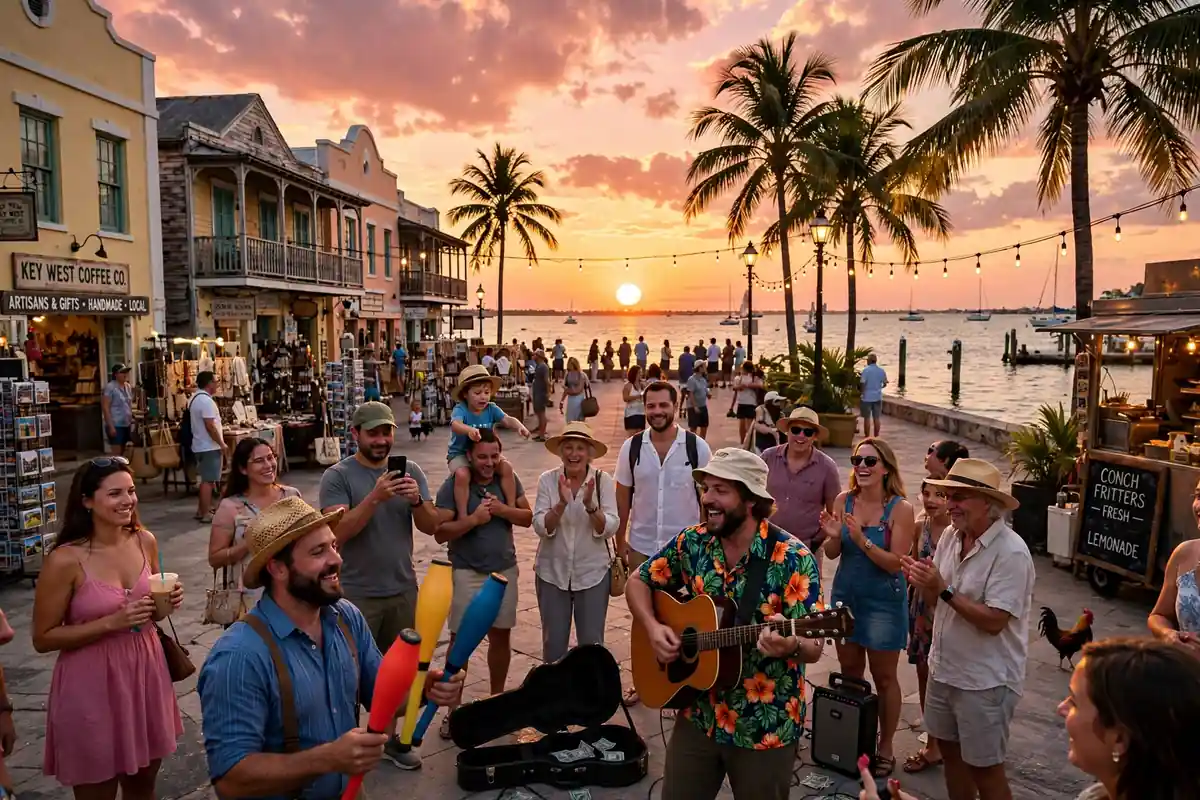
Every night in Key West ends the same way: at Mallory Square, on the northwest waterfront, where a crowd gathers to watch the sun sink into the Gulf of Mexico. The Sunset Celebration has run nearly every night since the early 1970s — street performers, jugglers, fire eaters, musicians, tarot readers and artists setting up about two hours before sunset, all working for tips. It is free, it is the most famous free evening in Florida, and it is the one thing no first-timer should skip. The sunset itself moves with the season — as early as about 5:35 p.m. in winter, as late as about 8:20 p.m. in summer — so check the time for your date and arrive about an hour before the crowd peaks.
Practical tip: The celebration is free and needs no ticket; performers are paid in tips, so carry a few small bills. The lot at the square costs about $7 an hour, so walk or bike there instead. Come an hour after the start, when the crowd has grown and the acts are in full swing, and stay for the green flash — the brief green blink of the sun as it drops below the horizon, which Key West’s clear Gulf horizon shows better than almost anywhere in the United States. The Key West on Wikipedia entry covers the square and the island’s history.
Take a day trip to Dry Tortugas National Park
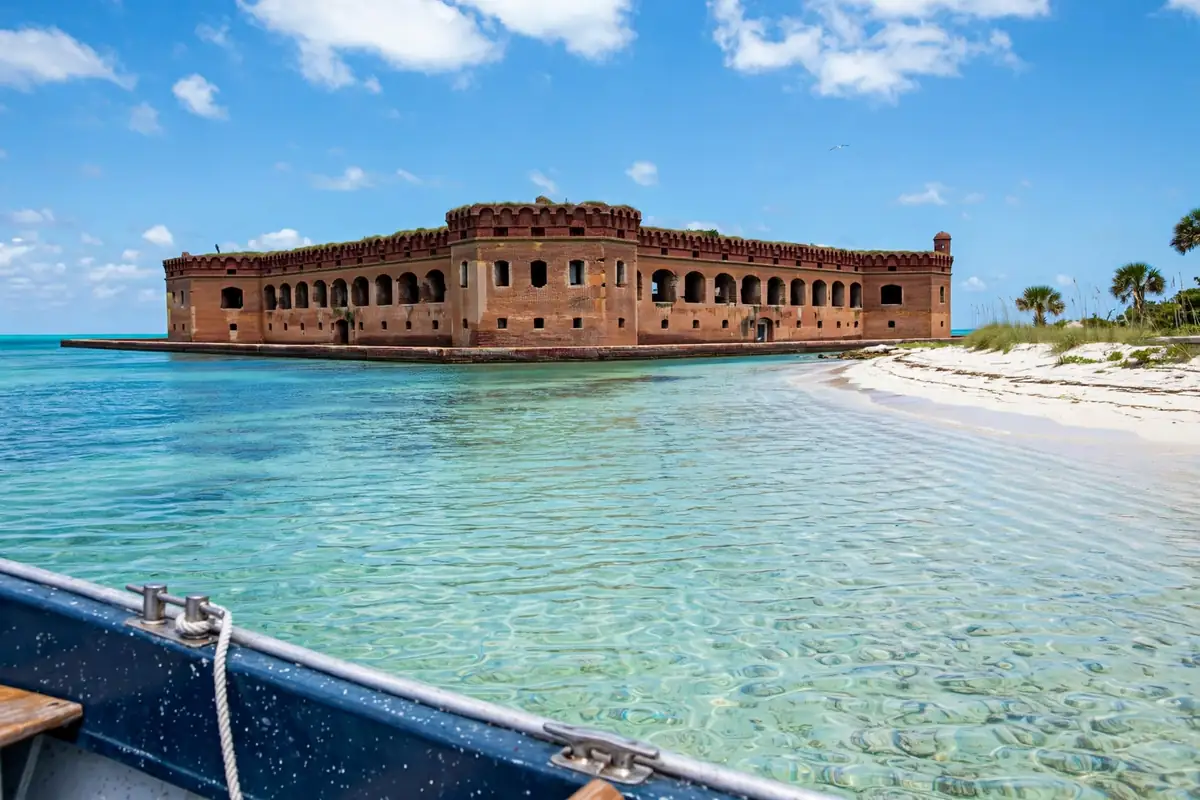
Seventy miles west of Key West, in open Gulf water, stands Fort Jefferson — a massive hexagonal fortress of more than 16 million bricks, built in the 1800s and never finished, later a Civil War prison where Dr. Samuel Mudd, the doctor who treated John Wilkes Booth, was held. Around it is Dry Tortugas National Park: seven small islands, gin-clear water, coral heads and some of the best snorkelling in the continental United States, with no roads, no shops and no crowds. It is the single most memorable day trip in the Florida Keys, and the one that sells out first. The Dry Tortugas National Park on Wikipedia entry covers the park, and the Fort Jefferson on Wikipedia entry covers the fort’s history.
Practical tip: The Yankee Freedom ferry is the standard way in — it leaves the Key West Ferry Terminal at 100 Grinnell Street at 8:00 a.m. daily, with check-in at 7:00 a.m. (campers at 6:00 a.m.) and boarding at 7:30 a.m., arrives at Garden Key at about 10:15 a.m., leaves at 3:00 p.m. and is back in Key West at about 5:15–5:30 p.m. Day trips cost from about $260 per adult (about $220 for children, about $250 for seniors, students and military), including the $15 park entrance fee, breakfast, lunch, snorkel gear and a 45-minute guided fort tour. Book 3 to 6 months ahead — the single daily sailing sells out, and the booking calendar opens six months out on the first weekday of each month. The faster alternative is Key West Seaplane Adventures: about 40 minutes each way, half-day trips from about $527 per adult and full-day trips from about $910, plus the $15 park fee, with about 2.5 hours on the island for the half-day and 6.5 hours for the full day. Two 2026 warnings: Bush Key is closed to visitors through fall 2026 for nesting seabirds, and sections of the fort’s moat wall are closed for repair through the winter of 2026 after hurricane damage. Campers can stay overnight at one of 8 primitive sites for about $15 a night — you bring everything, including water — with camping ferry transport from about $265.
Tour the Ernest Hemingway Home and Museum
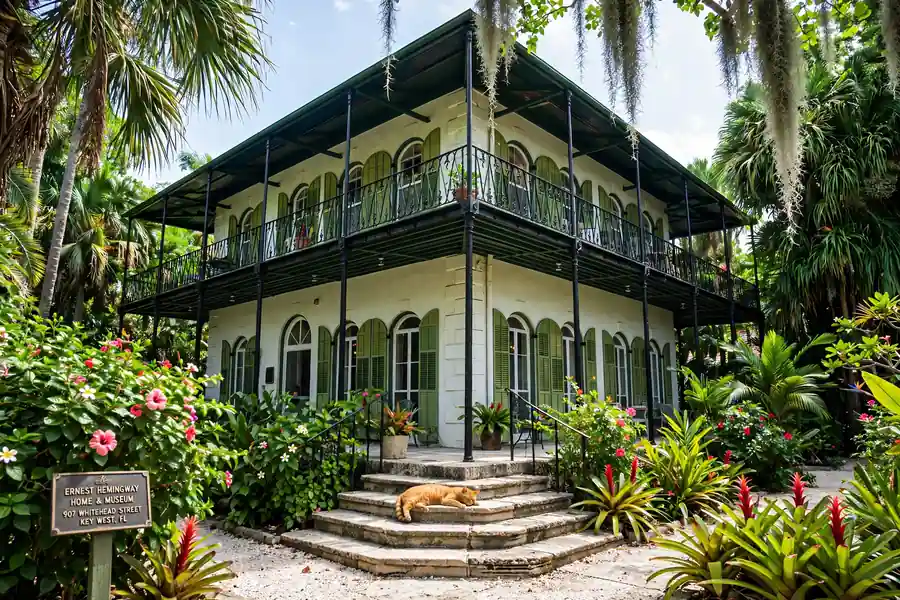
The Spanish Colonial house at 907 Whitehead Street is where Ernest Hemingway lived from 1931 to 1940, and it is one of the finest literary historic sites in the United States. He wrote To Have and Have Not here and worked on For Whom the Bell Tolls here, in the second-floor writing studio above the carriage house. The house itself dates to 1851, and the visit takes in the studio, the swimming pool — the first in-ground pool in Key West, with the famous penny embedded beside it — and the gardens, where some 60 polydactyl cats, the six-toed descendants of Hemingway’s own cats, still roam. The Ernest Hemingway House on Wikipedia entry covers the house and its writer.
Practical tip: Admission is about $19 for adults and about $7 for children aged 6 to 12, with children 5 and under free; the museum is open every day from 9 a.m. to 5 p.m., 365 days a year, and guided tours of 20 to 30 minutes leave every 15 minutes from 9:15 a.m. Tickets are sold only at the main gate — no reservations — and a 3% fee applies to card and mobile payments, so bring cash if you would rather avoid it. Allow 90 minutes, and go first thing in the morning, before the tour groups arrive.
Photograph the Southernmost Point buoy
The striped red, black and yellow concrete buoy at the corner of Whitehead and South Streets marks the southernmost point in the continental United States — 90 miles to Cuba, as the buoy says — and the photo in front of it is the most taken picture in Key West. Go early: by mid-morning the queue for the photo runs long, and by midday the sun is straight overhead and the light is flat. The Southernmost Point Buoy on Wikipedia entry covers the buoy’s history.
Practical tip: Here is the 2026 trap. The original buoy is boxed up for protection while the City rebuilds the seawall, plaza and roadway around it — the roadway project began in September 2026 and runs about 180 days — so the buoy you photograph today may be the full-size replica standing about a block away at 1400 Duval Street. Check the City of Key West’s roadway-project notice before you go. Both spots are on public sidewalks and free to visit, and the replica photographs just as well.
Climb the Key West Lighthouse
Across the street from the Hemingway Home, the Key West Lighthouse has stood since 1848, guiding ships through the reefs that made Key West rich on wrecking — salvaging cargo from ships that ran aground. The climb is 88 steps to the top, and the view from the gallery is the best orientation in town: the whole of Old Town, the harbour, the airport and the sea in every direction. The Keeper’s Quarters museum downstairs tells the story of the lighthouse keepers and their families, including the women who kept the light. The Key West Lighthouse on Wikipedia entry covers the lighthouse’s history.
Practical tip: Admission is about $17 for adults (about $15.50 online) and about $9 for ages 7 to 18, with under-7s free. It is included in the Key West Art and Historical Society’s Museum Culture Pass — about $45, covering the Custom House, the Lighthouse, Fort East Martello and the Tennessee Williams Museum (closed during its move) — which pays for itself if you visit three of the four. Go in the morning, before the heat builds in the stairwell, and pair it with the Hemingway Home across the street.
Wander the Key West Butterfly and Nature Conservatory
The most peaceful place in Key West sits at the southern end of Duval Street: a glass-enclosed tropical garden at 1316 Duval Street where hundreds of butterflies — about 60 species — fly free among orchids, waterfalls and tropical birds, with two resident flamingos, Rhett and Scarlett, in the garden. It opened in 2003 and it is the calmest hour on the island: a 15-minute introductory video, the Learning Gallery, then a slow walk through the garden while butterflies land on your shoulder. The Key West on Wikipedia entry covers the island’s attractions.
Practical tip: Admission is about $17.50 for general admission and about $12.50 for children aged 4 to 12, with ages 3 and under free; seniors and military pay about $14.50, and buying online saves about $2. It is open daily from 9:00 a.m. to 5:00 p.m., with last admission at 4:30 p.m., and it closes at 2 p.m. on Thanksgiving, Christmas Eve and Christmas Day. Look for the $2-off coupons on brochures and maps all over town. Allow about an hour, and go in the morning, when the butterflies are most active.
Snorkel the Florida Reef
Key West sits beside the Florida Reef — the only living coral barrier reef in the continental United States — and snorkelling it is the island’s great water activity. The reef trips leave from the Historic Seaport and run about three hours out to the reef, where the water is clear, the coral is alive and the fish are everywhere: yellowtail snapper, parrotfish, angelfish and the occasional turtle or ray. The best snorkelling in the Keys is at Dry Tortugas, but the reef trips are the version you can do in half a day, with gear and drinks included. The Florida Reef on Wikipedia entry covers the reef system.
Practical tip: Fury’s three-hour reef snorkel trips run about $39 to $59 for ages 11 and up, with gear and drinks included — book the morning departure, when the water is calmest and clearest. Bring reef-safe sunscreen (chemical sunscreens damage coral), and do not touch or stand on the reef: it is a living animal, and it is already under stress from warming water. If you are prone to seasickness, take medication before you board — the ride out is open water.
Spend a beach day at Fort Zachary Taylor
Fort Zachary Taylor State Park, at the southwestern tip of the island, holds the best beach in Key West — real sand, clear water, shade trees and snorkelling right off the beach, where the old fort’s rocks shelter fish. The fort itself, begun in 1845 and built through the Civil War, is a massive brick fortress, and its corridors and cannon are open to explore. It is also the quietest sunset spot on the island: the same sun as Mallory Square, without the crowd. The Fort Zachary Taylor on Wikipedia entry covers the fort’s history.
Practical tip: Entry is about $6 per vehicle for up to eight people plus a 50-cent county surcharge per person, about $4.50 for a driver alone, or about $2.50 if you walk or bike in. The beach is rocky in places, so bring water shoes, and the snorkelling is best in the morning before the wind picks up. There is a snack stand and chair and gear rentals. Come by bike — the park is a 10-minute ride from Duval Street, and parking fills on weekends.
Walk Duval Street — and drink at Sloppy Joe’s
Duval Street is Key West’s main street, running 1.25 miles from the Gulf at Mallory Square to the Atlantic at the Southernmost Point, and it is the island’s living room: bars, restaurants, shops, galleries and street life from morning to late night. Walk it end to end once — it takes about 30 minutes — then pick your spots. Sloppy Joe’s, at 201 Duval Street, is the famous one: Hemingway drank at the original Sloppy Joe’s in the 1930s, and the bar moved down the block in 1937 without ever closing — the story goes that customers simply picked up their drinks and walked. The Green Parrot, at the corner of Southard and Whitehead, is the oldest bar in town and the local favourite, and the Schooner Wharf Bar, on the Historic Seaport, is the open-air waterfront bar where the fishing boats come in. The Duval Street on Wikipedia entry covers the street’s history.
Practical tip: Duval is at its best in the early evening, when the day-trippers thin out and the live music starts. Do not drive on Duval — the street is crowded, parking is scarce and expensive, and the police enforce the open-container rules. Bars close at 4 a.m. in Key West, one of the latest closing times in Florida, so pace yourself. The street is also the route of the Fantasy Fest parade in late October, when it is impassable — check the dates before you book.
Visit the Harry S. Truman Little White House
At 111 Front Street, inside the Truman Annex, sits the house where President Harry S. Truman spent 175 days of his presidency — his winter White House, where he worked, fished and played poker, and where the “Truman Doctrine” was drafted. It is Florida’s only presidential museum, and the guided tour takes you through the rooms as Truman left them: his office, the poker table, the piano, the gardens. Truman is the president who made Key West his second home, returning again and again through his presidency. The Truman Little White House on Wikipedia entry covers the house’s history.
Practical tip: Admission is about $22.75 for visitors over 12 and about $10.45 for children aged 4 to 12, with under-4s free; the museum is open daily from 9:30 a.m. to 5 p.m. Tours are guided and run regularly through the day. The house sits steps from Mallory Square, so pair it with the sunset — and note that the gardens and gift shop are free to visit without a ticket.
See the Atocha treasure at the Mel Fisher Maritime Museum
In 1985, after a 17-year search, treasure hunter Mel Fisher found the wreck of the Spanish galleon Nuestra Señora de Atocha, which sank in a hurricane in 1622 off the Florida Keys — a cargo of gold, silver and emeralds worth about $450 million, the richest shipwreck treasure ever recovered. The Mel Fisher Maritime Museum, at 200 Greene Street, shows it: gold bars, silver coins, emeralds, the ship’s gold chain and the artefacts of the 1622 fleet, plus the story of the search itself. It is the best museum in Key West, and the one that explains why this island exists at all — wrecking, salvaging ships on the reef, made Key West the richest city in Florida in the 1800s. The Mel Fisher on Wikipedia entry covers the hunter and his find.
Practical tip: Admission is about $17.50 for adults and about $8.50 for children; the museum is open daily from 10 a.m., with the last visitor admitted at 4 p.m., and it is closed on Thanksgiving Day. The behind-the-scenes conservation lab tour, about $49.50 including admission, runs twice daily on weekdays and is worth it if you like the science behind the treasure. Allow 90 minutes.
Meet the sharks at the Key West Aquarium
The Key West Aquarium, at 1 Whitehead Street on Mallory Square, is one of the oldest aquariums in Florida — it opened in 1934 — and it is small, hands-on and charming: touch tanks with starfish and conchs, a shark tank, stingrays, sea turtles and the daily shark feeding, where the staff explain the animals while the sharks eat. It is the best rainy-hour plan in Old Town, and the one museum children remember longest. The Key West on Wikipedia entry covers the island’s attractions.
Practical tip: Admission is about $17.50 for adults and about $8.50 for children; it is open daily from 10 a.m. to 5 p.m., with last admission at 4:30 p.m. Go for the shark feeding — check the time at the door — and allow about an hour. It sits on Mallory Square, so it pairs naturally with the Sunset Celebration in the evening.
Climb the tower at the Key West Shipwreck Treasure Museum
The Shipwreck Treasure Museum, at 1 Whitehead Street on Mallory Square, tells the story that built Key West: wrecking. In the 1800s, Key West was the wrecking capital of America — lookouts in the tower watched for ships on the reef, and wreckers raced out to salvage the cargo. The museum recreates a wrecker’s warehouse, with artefacts from the Isaac Allerton, which sank in 1856, and actors playing the wreckers themselves. The climb to the top of the 65-foot lookout tower is the payoff: the best harbour view in Old Town. The Key West on Wikipedia entry covers the island’s wrecking history.
Practical tip: Admission is about $18 for adults (about $18 online) and about $10 for children aged 4 to 12. Allow about an hour, and climb the tower first — the view orients you for the rest of Old Town. The museum sits on Mallory Square, so it is an easy stop before the sunset.
Rest in the gardens at Audubon House
The Audubon House, at 205 Whitehead Street, is the 1840s home where the naturalist John James Audubon stayed in 1832 while studying Florida’s birds — and the gardens behind it are the most beautiful in Old Town: a full acre of tropical plants, orchids, bromeliads and palms, with the house itself furnished as it was in the 1800s. It is the quietest stop on this list, and the one to do when Duval Street gets too loud. The Key West on Wikipedia entry covers the island’s historic houses.
Practical tip: Tickets are sold at the door and admission is charged — check the current price when you visit. Allow about an hour for the house and the gardens, and go in the morning, when the light in the garden is at its best. The house sits a block from the Hemingway Home, so the two pair naturally.
Meet Robert the Doll at Fort East Martello
Fort East Martello, built in 1862 on the Atlantic side of the island, is a Civil War fort that never fired a shot — and it is now a museum of Key West history, with one resident who gets all the attention: Robert the Doll, a century-old straw-stuffed doll said to be haunted, who has inspired films, books and a steady stream of letters from people apologising to him. Ask permission before you photograph him — the tradition says he curses those who do not — and read the letters on the wall from people who forgot. The Robert the Doll on Wikipedia entry covers the doll’s story.
Practical tip: The fort is included in the Key West Art and Historical Society’s Museum Culture Pass (about $45, covering the Custom House, the Lighthouse, Fort East Martello and the Tennessee Williams Museum, which is closed during its move). Allow about an hour. The fort sits on the Atlantic side, a 20-minute walk from Duval Street, and it is the best stop on the quieter east side of Old Town.
Read the headstones at the Key West Cemetery
The Key West Cemetery, on Angela Street in the middle of Old Town, is one of the most entertaining cemeteries in America: above-ground tombs (the water table is too high to bury below ground), elaborate monuments, and headstone epitaphs that range from touching to hilarious — the most famous reads “I told you I was sick.” It is free, it is open during the day, and a self-guided walk takes about 45 minutes. The cemetery holds the island’s history in miniature: sailors, wreckers, cigar makers, Bahamian immigrants and the victims of the 1846 hurricane. The Key West on Wikipedia entry covers the island’s history.
Practical tip: The cemetery is free and open during daylight hours. Do not go at night — it is closed, and the locals take a dim view of it. Pick up a map at the entrance or use the free walking-tour app from the Key West Art and Historical Society. Go in the morning, when the light is good for photographs and the heat has not yet built.
Take a sunset sail
Key West has two famous sunsets: the one from Mallory Square, and the one from the water. A sunset sail — two hours on a catamaran or a schooner, with drinks included, sailing past Sunset Key and the harbour as the sky turns orange — is the best money you will spend on the island. The boats leave from the Historic Seaport in the late afternoon, and the best ones are the smaller sailing catamarans, which are quieter and closer to the water than the big party boats. The Florida Keys on Wikipedia entry covers the island chain.
Practical tip: Sunset sails run about $65 to $85 per person for two hours, with drinks included — book a day or two ahead in peak season, when the popular boats sell out. The schooner America 2.0, a replica of a 19th-century racing yacht, runs day sails from about $53 and champagne sunset sails from about $102. Bring a light jacket: it is cooler on the water after dark. If you are prone to seasickness, take medication before you board.
Kayak the backcountry mangroves
The other side of Key West is the backcountry: the shallow, mangrove-fringed waters on the Gulf side of the island, where the water is a foot deep, the fish are visible below the kayak and the birds are everywhere. Lazy Dog Adventures, based at the Hurricane Hole Marina on Stock Island, runs guided kayak and paddleboard tours through the mangrove channels that feel a world away from Duval Street — no motors, no crowds, just the sound of the paddle. It is the most peaceful water activity on the island, and the best way to see the Key West National Wildlife Refuge. The Florida Keys on Wikipedia entry covers the island chain and its wildlife refuge.
Practical tip: Book a morning tour — the water is calmest and the wildlife is most active before the afternoon wind picks up. Tours run a few hours and include gear; book ahead in peak season, when the small groups fill. Bring sun protection and water: there is no shade on the water, and no shops out there. Paddleboards are available too, but a kayak is the easier choice for first-timers.
Swim at Smathers Beach and Higgs Beach
Key West is not a beach town — much of its shoreline is rocky coral, and the sand was mostly trucked in — but it has two public beaches worth a morning. Smathers Beach, on the south side, is the largest public beach on the island, with a long stretch of imported sand, palm trees, volleyball courts and food trucks. Higgs Beach, a short walk west, is calmer and more local: a smaller beach, a pier, a children’s playground, the White Street Pier for sunset, and the Key West AIDS Memorial, a quiet garden of remembrance. The Key West on Wikipedia entry covers the island’s beaches.
Practical tip: Both beaches are free to enter, with parking along the road. Smathers has the better swimming and the livelier scene; Higgs has the better sunset and the quieter mood. Neither beach has the white sand of the mainland — set your expectations, bring water shoes for the rocky patches, and save your big beach day for Bahia Honda State Park, about 45 minutes back up the Overseas Highway, which has the best beach in the Keys.
Ride the Conch Tour Train
The Conch Tour Train has been looping Old Town since 1958, and it is the fastest way to get your bearings: a 75-minute narrated loop past the Hemingway Home, the Lighthouse, the Southernmost Point, the Historic Seaport, Bahama Village and the cemetery, with a conductor who tells the island’s stories as you go. It is the tour to take on your first morning, before you decide where to spend your time — and the train’s three stops let you hop off and explore. The Conch Republic on Wikipedia entry covers the island’s 1982 mock secession, which the train’s narration tells in full.
Practical tip: Online tickets start at about $45 per day for adults and about $20 a day for children 12 and under, with under-4s free; the first tour leaves at 10:15 a.m. and the last at 4:15 p.m., and the train runs 364 days a year. The Old Town Trolley, the train’s sister tour, is the hop-on hop-off alternative: 13 stops, about $62 a day for adults and about $20 for children 12 and under, first tour at 10 a.m. and last departure from Mallory Square at 4:30 p.m. Both are closed on the last Saturday in October for Fantasy Fest.
Key West in 3 days — a ready-made itinerary
Three full days covers the island’s highlights without rushing: one for Old Town and the museums, one for the water, and one for Dry Tortugas. Two days covers the essentials if you skip the Tortugas trip — but the Tortugas day is the one people remember longest, so add a fourth day for it if you can.
| Day | Where | Highlights |
|---|---|---|
| Day 1 — Old Town and the museums | Duval Street, Whitehead Street, Mallory Square | Hemingway Home, Lighthouse, Southernmost Point, Mallory Square sunset. |
| Day 2 — The water | Historic Seaport, Fort Zachary Taylor, Smathers Beach | Morning reef snorkel, afternoon at Fort Zach beach, sunset sail. |
| Day 3 — Dry Tortugas | Garden Key, Fort Jefferson | Ferry at 8 a.m., fort tour, snorkelling, back by 5:30 p.m. |
Day 1 — Old Town and the museums: Hemingway, the lighthouse and the sunset
Start at the Conch Tour Train for a 75-minute orientation loop, then walk to the Hemingway Home for the 9:15 a.m. tour, before the crowds arrive. Cross the street to the Lighthouse for the view, then walk down Whitehead Street to the Southernmost Point for the photo — go before 9 a.m. if you can, to beat the queue — and on to the Butterfly Conservatory at the southern end of Duval. Spend the afternoon in the museums: Mel Fisher first, then the Truman Little White House, then the Shipwreck Museum on Mallory Square. End the day where every Key West day ends: at the Sunset Celebration on Mallory Square, with dinner on Duval afterwards.
Day 2 — The water: the reef, the beach and the sunset sail
Be at the Historic Seaport by 9 a.m. for the morning reef snorkel — the earliest boats get the calmest water. Back on land by midday, have lunch at a food truck or a Cuban café, then spend the afternoon at Fort Zachary Taylor: the fort, the beach and the snorkelling off the rocks. If you want a second beach, Smathers is the alternative. In the late afternoon, board a sunset sail from the Seaport for two hours on the water, and finish with dinner and live music on Duval Street — Sloppy Joe’s for the history, the Green Parrot for the locals.
Day 3 — Dry Tortugas: the fort, the reef and the long day
Set the alarm for 6 a.m. — the Yankee Freedom leaves at 8 a.m. sharp, and check-in is at 7 a.m. Take the 45-minute guided fort tour at 11 a.m., then snorkel the moat wall and the coaling docks, where the water is clearest and the fish are thickest. The ferry leaves Garden Key at 3 p.m. and is back in Key West at about 5:30 p.m., in time for a late dinner on Duval. If you have a fourth day, spend it slowly: the Key West Cemetery in the morning, a kayak tour of the mangroves, the Audubon House gardens, and a final sunset from the White Street Pier.
Best time to visit Key West
Key West is warm all year, so the question is rain, crowds, prices and hurricanes, not temperature. The dry season, November to April, brings the best weather and the highest prices; the wet season, May to October, brings afternoon thunderstorms, lower prices and hurricane risk. The finest weather window is February and March — daily highs of about 76–80°F, almost no rain, low humidity and ideal water for snorkelling and diving. November is the best value month: the summer heat has broken, the rain has dropped and the peak-season crowds have not yet arrived. September is the hardest month — the peak of hurricane season, the wettest month and the hottest, most humid weather of the year. The Atlantic hurricane season runs June 1 to November 30, peaking in August to October, so buy travel insurance and keep your plans flexible in those months. Fantasy Fest, the island’s 10-day costume festival, ran October 16–25, 2026, with the parade on Saturday, October 24 — it brings the highest hotel prices of the year and sells out the island, so book six months ahead or avoid the week entirely.
| Season | Months | Weather and crowds | Best for |
|---|---|---|---|
| Winter (peak) | December–March | Warm 75–80°F, dry, busiest, highest prices | Best weather, snorkelling, festivals |
| Spring (peak) | April–May | Warm 80–85°F, thinner crowds after spring break | Best balance, lower prices than winter |
| Summer (low) | June–August | Hot 88–90°F, humid, afternoon storms, lowest prices | Cheapest hotels, warm water, fewer crowds |
| Autumn (shoulder) | September–November | Warm 80–88°F, hurricane risk, Fantasy Fest in October | Best value, Fantasy Fest, warm water |
The sweet spot is late February to April, and November: mild weather, daylight until late, and queues you can live with. July and August bring the lowest hotel rates — 40–60% below peak — but also the hottest, most humid weather and daily afternoon thunderstorms. December is festive and busy, with the holiday lights and the New Year’s Eve celebrations, and hotel prices climb from Christmas through March. January and February are the driest months of all, and the water stays warm enough to swim year-round.
Where to stay in Key West
Old Town suits first-timers who want to walk everywhere; the Truman Annex suits a quiet waterfront stay near Mallory Square; New Town suits a budget stay with easy parking; Stock Island suits a marina stay with food trucks and good value; Sunset Key suits a luxury stay on a private island reached by boat. Book early for February and March, for Fantasy Fest week (October 16–25, 2026) and for the Christmas and New Year weeks, when the island is at its fullest.
| Area | Best for | Expect to pay (approx) |
|---|---|---|
| Old Town (Duval–Whitehead) | First-timers who want to walk everywhere | $250–$450 a night for a mid-range hotel or guesthouse |
| Truman Annex / Mallory Square | Quiet, waterfront, close to the sunset | $300–$500 a night for a resort or inn |
| New Town (Roosevelt Blvd) | Budget stays, chain hotels, easy parking | $150–$250 a night for a chain hotel |
| Stock Island | Marina feel, food trucks, good value | $150–$280 a night for a marina hotel |
| Sunset Key | Luxury, secluded, boat access | $500+ a night for a resort |
First-timers should stay in Old Town: it is central, safe at night, full of restaurants, and within walking distance of most of the list. The guesthouses and small inns are the most Key West way to stay — they tend to cost about $200–$350 a night in spring, less in the fall shoulder season — and they feel distinctly Key West rather than generic beachy. New Town is the best value near the centre, with chain hotels and free parking, but you will need the shuttle or a bike to reach Old Town. Avoid staying near the airport late at night, and be wary of very cheap rooms far out: the island is small, but a bad location still costs you an hour a day in transit. Remember that Key West adds a 12.5% tax to hotel rates, so the price you see is not the price you pay.
Getting around Key West
Key West is a walking town first and a biking town second. The island is only about 4 miles long and 2 miles wide, and you can walk across Old Town in 20 minutes. A car is a liability here: parking in Old Town runs about $6 an hour at the Old Town Garage and the Key West Bight lot, about $7 an hour at the Mallory Square lot, with a $48 daily maximum, and the streets are narrow, crowded and one-way. The free Duval Loop bus is gone — it was suspended on January 2, 2026, and its stops are now served by Key West Rides, an app-based on-demand shuttle costing $2 per person. That is the trap most 2026 guides still get wrong: they still call the Duval Loop free. Bikes are the local way to get around — the island is flat, the bike lanes are good, and you can reach every corner in under 20 minutes — and scooters and golf carts are available to rent, though they are expensive and the police enforce the rules. Taxis and rideshares are available but pricey for short trips. Fly into Key West International Airport (EYW), which has direct flights from Miami, Fort Lauderdale, Atlanta, Dallas, Charlotte and Newark, or drive the Overseas Highway from Miami — about 3.5 hours across 42 bridges, one of the best road trips in America. The Overseas Highway on Wikipedia entry covers the highway’s history.
Key West food you have to try
Key West’s food story starts in the sea and in Cuba: fresh-caught fish, pink shrimp, stone crab, conch, Cuban sandwiches and Key lime pie, in a town where the best meals come from food trucks, Cuban cafés and waterfront shacks, not from the hotel restaurants. Eat at the trucks, the markets and the small stands — that is where the food is best and cheapest. And book the famous tables early: the island’s most celebrated restaurants need reservations days ahead in peak season.
Key lime pie, the island’s signature
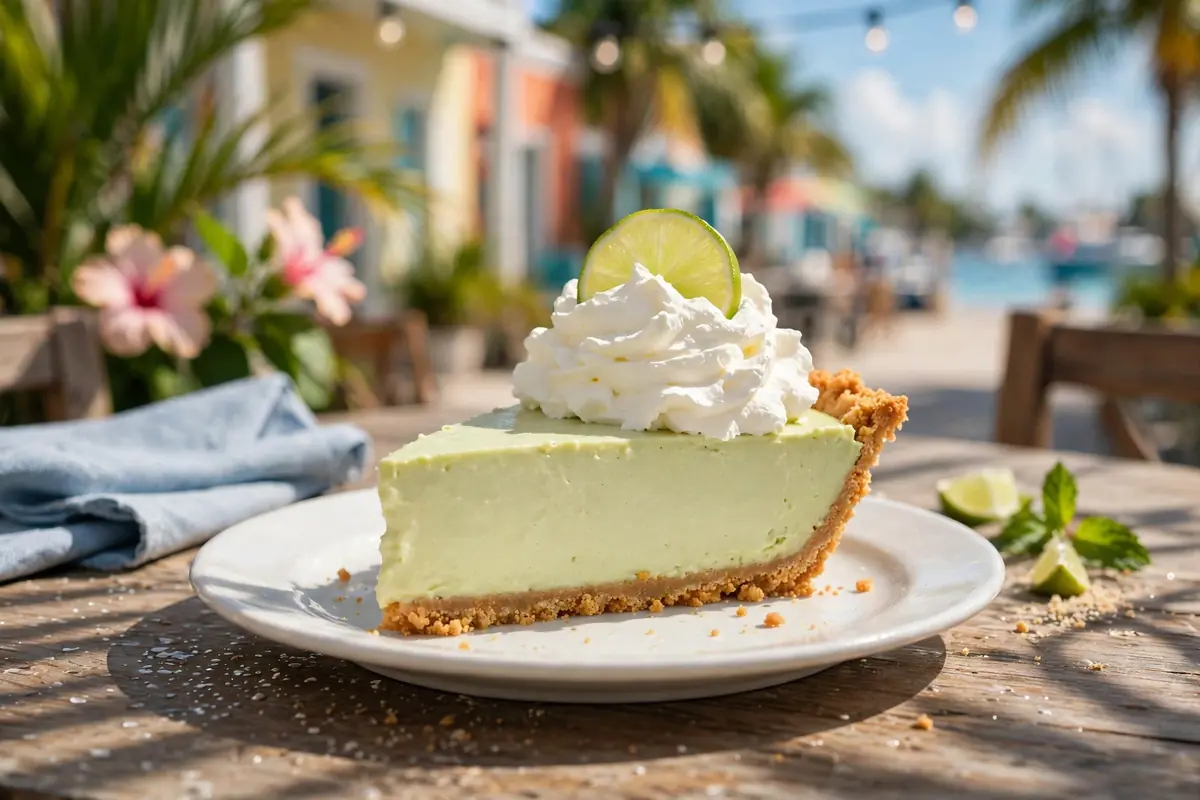
Key lime pie is the dish Key West is known for, and the rule is simple: a real Key lime pie is pale yellow — the colour of egg yolks — never green, and it is made with Key limes, the small, tart limes that grow in the Keys, not the Persian limes in the supermarket. The classic version has a graham cracker crust and a meringue or whipped-cream topping, and the argument over which topping is correct has run for decades. Kermit’s Key West Key Lime Shoppe, on Duval Street, is the famous name — its frozen chocolate-dipped pie on a stick is the thing to try — and the Key West Key Lime Pie Co. is the other classic. A slice costs a few dollars, and it is the best cheap dessert in Florida. The Key lime pie on Wikipedia entry covers the pie’s history.
Cuban food — sandwiches, coffee and guava pastries
Key West’s Cuban food comes from the cigar workers who arrived from Cuba in the 1860s–1890s, and it is the island’s everyday cuisine. The Cuban sandwich — roast pork, ham, Swiss cheese, pickles and mustard, pressed flat on Cuban bread — is the lunch to eat, and the Cuban coffee, a tiny cup of sweet, strong espresso, is the fuel that runs the island. The guava pastry, a flaky pastry filled with guava paste and cream cheese, is the breakfast to eat with it. El Meson de Pepe, on Mallory Square, is the famous Cuban restaurant; 5 Brothers, on Southard Street, is the local favourite for coffee and guava pastries; and the Cuban Coffee Queen, a coffee window on Margaret Street, is the place to stand in line for a colada. Order the coffee “con leche” if you want it with milk, and eat the sandwich pressed, never cold.
Conch fritters, pink shrimp and stone crab
Conch fritters — deep-fried balls of chopped conch meat, peppers and spices, served with a dipping sauce — are the snack of the Florida Keys, and the best versions come from the walk-up stands: DJ’s Clam Shack on Duval Street and the Conch Shack near the Seaport are the names to know. The pink shrimp, caught off the Dry Tortugas and served grilled or fried, is the island’s signature seafood, and stone crab — in season from October 15 to May 1, with the claws served cold with mustard sauce — is the luxury version. The Half Shell Raw Bar, on the Historic Seaport, is the classic waterfront spot for all three: sit outside, order the fritters and a dozen raw oysters, and watch the fishing boats come in.
Free things to do in Key West
The island is generous to a tight budget. The Mallory Square Sunset Celebration is free every night, and so is the photo at the Southernmost Point, the walk through the Key West Cemetery, the Florida Keys Eco-Discovery Center at the Truman Annex, the White Street Pier at sunset, and the beaches — Smathers and Higgs both have free entry. The free walking-tour app from the Key West Art and Historical Society turns a walk through Old Town into a guided tour, and the Conch Tour Train’s route is free to walk on your own, with a printed map from the visitor center. And the best free thing of all costs nothing and needs no ticket: the roosters. Key West’s feral chickens, protected by law, roam the streets of Old Town — descendants of the fighting cocks of the Cuban cigar workers — and watching a rooster strut down Duval Street at dawn is the most Key West sight there is. A day of the island’s best experiences — a sunset, a cemetery walk, a beach morning and a pier sunset — can cost less than a single museum ticket.
Frequently asked questions
How many days do you need in Key West?
Three full days covers the highlights on this list: Old Town and the museums, a water day and Dry Tortugas. Two days covers the essentials if you skip the Tortugas trip and move fast. Four days lets you add a slow day — the cemetery, the mangrove kayak, the Audubon House gardens and a second sunset — and a fifth day lets you drive up the Keys to Bahia Honda. Do not try to do Key West in one day — you will see the sights and miss the island.
Is the Dry Tortugas day trip worth it?
Yes, if you book ahead and you like the water. The fort, the snorkelling and the sheer remoteness are unmatched anywhere in the United States — there is nothing else like a 16-million-brick fortress rising out of a turquoise sea. But it is a full day and from about $260 per person by ferry, and the 2.5-hour crossing is open Gulf water, so if you get seasick easily or you only have two days, skip it and spend the day on the reef and at Fort Zachary Taylor instead. The seaplane, from about $527 for a half-day, is the option if you are short on time and the ferry is sold out.
Do you need a car in Key West?
No, for almost everything on this list. Old Town is walkable, the island is flat and small, and the $2 Key West Rides on-demand shuttle covers the stops the old free Duval Loop used to serve. Parking costs about $6–$7 an hour in Old Town, and a car is a liability on Duval Street. Rent a bike instead — you can reach every corner of the island in under 20 minutes — and rent a car only for the drive down the Overseas Highway from Miami, or for a day trip up to Bahia Honda.
When is the best time to visit Key West?
For weather alone, February and March are hard to beat: daily highs of about 76–80°F, almost no rain, low humidity and ideal water for snorkelling. November is the best value month, with similar weather for much less money. If a cheap hotel matters more than perfect weather, June to August has the lowest rates of the year, provided you plan around the afternoon thunderstorms. Avoid September: it is the peak of hurricane season, the wettest month and the hottest, most humid weather of the year.
Is Key West expensive?
Key West is expensive but manageable. A mid-range trip runs about $200–$350 per person per day, including a hotel, one big ticketed activity and restaurant meals. Mid-range hotel rooms average about $180–$300 a night in spring, and guesthouses run about $200–$350 — plus the 12.5% hotel tax, which many booking sites add at checkout. Save money by staying in New Town or Stock Island, eating Cuban sandwiches, food-truck plate lunches and market picnics, and filling your days with the free sights — a sunset, a beach morning and a cemetery walk can cost under $40 a person.
Is the Southernmost Point buoy the real one?
Right now, probably not — and that is the 2026 trap. The original buoy is boxed up for protection while the City rebuilds the seawall, plaza and roadway around it; the roadway project began in September 2026 and runs about 180 days. A full-size replica stands about a block away at 1400 Duval Street, and it photographs just as well. Check the City of Key West’s roadway-project notice before you go, and do not be surprised if the buoy you find is the replica — the photo is free either way.
Further reading — Wikipedia and Quora
Dry Tortugas National Park on Wikipedia
Read this Quora thread on whether Dry Tortugas is worth the trip, with Key West tips on Mallory Square, the Butterfly Conservatory, the cemetery, the lighthouse and snorkelling
No Reddit link is included here: no r/KeyWest community could be verified to exist from search evidence, so no Reddit link has been invented.
Your Key West trip, in one paragraph
Key West gives you a sunset party every night, a 16-million-brick fortress in the middle of the sea, a house full of six-toed cats, a lighthouse climb, a reef full of fish, a street of bars that never really closes and a slice of pie that tastes like the island itself — all on an island four miles long, 90 miles from Cuba and at the very end of the road. Walk everywhere, swim in the morning, do the museums through the heat of the day, and be at Mallory Square for the last hour before sunset. If Key West has given you the travel bug, the same kind of guide is waiting for the other cities on this site: Chicago, Nashville, Los Angeles, Orlando, Miami, San Diego, Denver, Savannah, Dallas, Charleston, San Francisco, Myrtle Beach, Las Vegas, San Antonio, London, Portland, Pigeon Forge, Puerto Rico, Atlanta, Phoenix, Paris and Maui — twenty-two guides, one for every kind of trip.

About the Author