Things to Do in Atlanta
20 Best Attractions, a 3-Day Itinerary, Where to Stay, and the Food You Cannot Miss
Quick Info
Best for: First-time visitors to the South, history lovers, families, food lovers and sports fans — civil rights landmarks, the world’s largest aquarium, a 22-mile trail and Southern cooking in one city
Best time: March–May and September–November for mild days and the best light; April for dogwoods, October for fall colour
How long: 3 full days for the highlights; 2 days covers the essentials; add a 4th day for Stone Mountain and the suburbs
Budget: Roughly $150–$250 per person per day for a mid-range trip with one big ticketed attraction; a museum-free day on the BeltLine and in the parks runs much cheaper
Don’t miss: The MLK National Historical Park at opening, the whale sharks at the Georgia Aquarium, a sunset walk on the BeltLine Eastside Trail and fried chicken at the Busy Bee
Atlanta is the city the South built twice — once as a railroad town that burned in the Civil War, and again as the cradle of the civil rights movement and the capital of the New South. It is the birthplace of Martin Luther King Jr. and of Coca-Cola, home to the largest aquarium in the Western Hemisphere, the busiest airport on Earth and a 22-mile trail that has turned old rail lines into the city’s front porch. This guide gives you the 20 best things to do in Atlanta in a sensible order, a ready-made 3-day itinerary, honest advice on when to go, where to stay and how to get around, and the three foods you have to try before you leave — plus the free sights that cost nothing at all. Prices and hours change, so every price in this guide is marked as approximate — always check the official website before you visit.
One thing to know before you go: Atlanta is a city of neighbourhoods, not one downtown. The big attractions cluster in three places — Downtown (the aquarium, Coca-Cola, Centennial Olympic Park and the civil rights museum), Sweet Auburn and the Old Fourth Ward (the MLK sites and the BeltLine), and Midtown (the High Museum, the Botanical Garden and Piedmont Park) — with Buckhead, Grant Park and Stone Mountain a short drive out. Plan by neighbourhood, not by a list, and the city opens up.
For background before you go, the Wikipedia entry on Atlanta covers the city’s history, from its founding as Terminus in 1837 through the Civil War, the civil rights movement and the 1996 Olympics — it is linked in Further reading at the end of this guide.
Atlanta at a glance
| Question | Short answer |
| How long do you need? | 3 full days for the highlights; 2 days covers the essentials; 4 days if you add Stone Mountain and a full Buckhead day. |
| Best area for a first trip | Downtown for the big attractions, then Midtown and the Old Fourth Ward — the three clusters are a short MARTA ride apart. |
| One thing to book early | Georgia Aquarium timed tickets, Fox Theatre shows, and a Stone Mountain visit on a summer weekend. |
| One thing that is free | The MLK National Historical Park, the BeltLine, Centennial Olympic Park and Piedmont Park — Atlanta’s best experiences cost nothing. |
| Do you need a car? | No, for the city core — MARTA rail connects the airport, Downtown, Midtown and Buckhead; yes, for Stone Mountain and the suburbs. |
Before the details, three warnings that most guides still get wrong. First, the CNN Studio Tour no longer exists: CNN moved to a new campus in early 2024, and the old CNN Center is now a mixed-use development called The Center — do not plan a morning around a tour that has closed. Second, Stone Mountain’s daily parking is now $25 a car, not the $20 that older guides still quote, and its famous Lasershow has been replaced by a drone and light show. Third, Zoo Atlanta’s pandas are back: after a two-year gap, a new pair arrived in September 2026 and made their public debut on November 6, 2026 — so guides that say the zoo has no pandas, and guides that still promise the old twin pandas, are both out of date. This guide is built on what is actually open and running in late 2026, not on what used to be true.
The 20 best things to do in Atlanta
The list runs in a sensible travel order: Downtown first, then the civil rights corridor, then the BeltLine and Midtown, then Buckhead, Grant Park and the day trip east. Every entry says what it costs, how long to allow, and what to watch out for.
1. Meet the whale sharks at the Georgia Aquarium
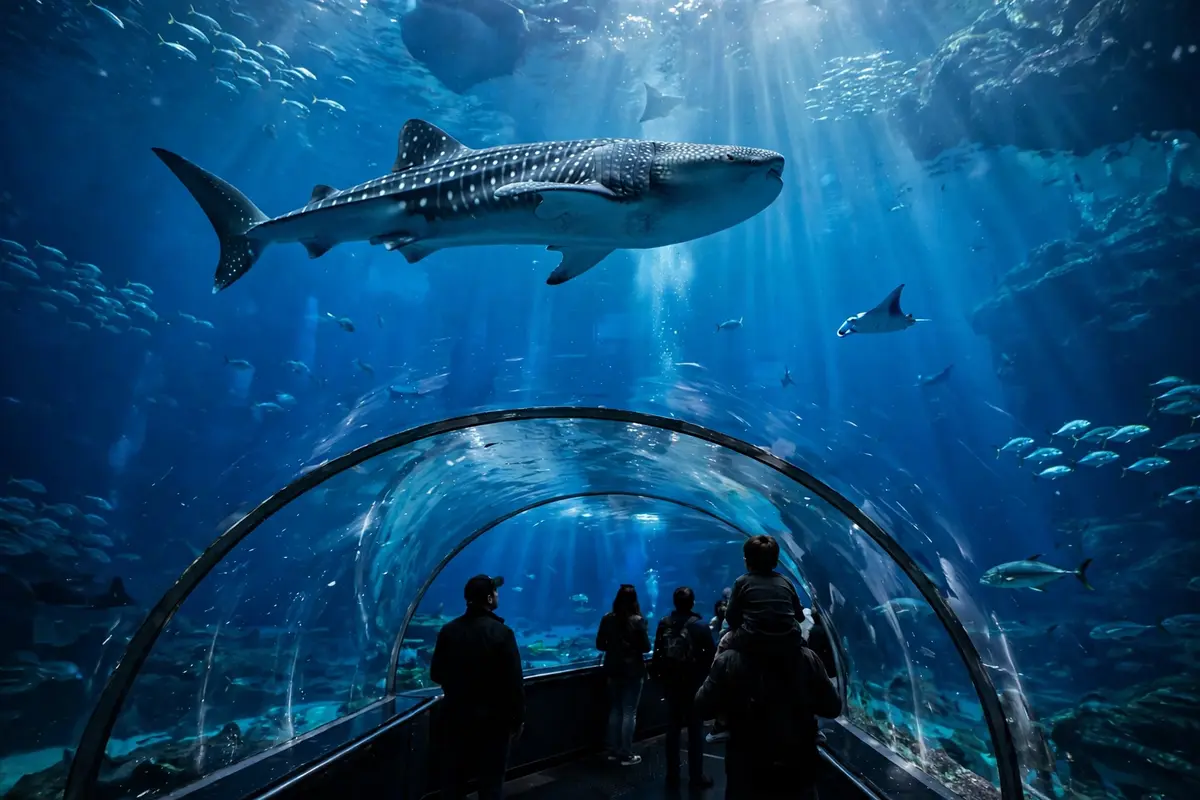
The Georgia Aquarium is the largest aquarium in the Western Hemisphere and the single most visited attraction in Atlanta — and its headline act is the only one of its kind in the country: whale sharks, the largest fish in the sea, gliding through the 6.3-million-gallon Ocean Voyager tank. Walk the glass tunnel underneath them, then work through the seven galleries: beluga whales and California sea lions, the tropical reef, the cold-water puffins and the river otters, with dolphin and sea lion presentations through the day. The aquarium is a 10-minute walk from Centennial Olympic Park, so it pairs naturally with the rest of Downtown. The Georgia Aquarium is the anchor of Pemberton Place, and it is the attraction to book first.
Practical tip: Tickets are timed-entry and must be booked online in advance. A fixed-date ticket starts from roughly $54.99, an Anytime ticket costs roughly $69.99, and the Aqua Pass — unlimited visits — costs the same roughly $69.99. Children under 3 enter free. Allow 3 to 4 hours, arrive at your timed entry, and go on a weekday morning if you can: weekends and school holidays are the busiest times in the building. The aquarium is open 365 days a year, usually from 9 a.m., with closing times varying by season — prices are approximate, so check before visiting.
2. Taste 100 flavours at the World of Coca-Cola
Right next door to the aquarium, the World of Coca-Cola tells the story of the drink Atlanta invented in 1886, when pharmacist John Pemberton mixed the first batch a few blocks from here. The museum walks you through the vault holding the secret formula, the history of the brand’s advertising, a 4D theatre and a photo with the Coca-Cola Polar Bear — and then the part everyone remembers: the Taste It! lounge, where you can sample more than 100 Coca-Cola flavours from around the world, from Italian Beverly (famously bitter) to fruity Inca Kola. New in the museum is Coca-Cola Stories, a flagship experience that opened in April 2025 and refreshed the whole visit. The World of Coca-Cola is a two-hour stop that works for every age, and it is the easiest pairing in the city with the aquarium next door.
Practical tip: General admission costs roughly $25 for adults, roughly $21 for children aged 3 to 12, and roughly $23 for seniors, with children 2 and under free — prices are approximate, so check before visiting. The museum is open daily from 10 a.m. to 7 p.m. and is closed on Thanksgiving Day and Christmas Day. Book online to skip the ticket line, and buy the combined aquarium-and-Coca-Cola ticket (roughly $79.99) if you are doing both the same day.
3. Walk the streets where Dr. King was born
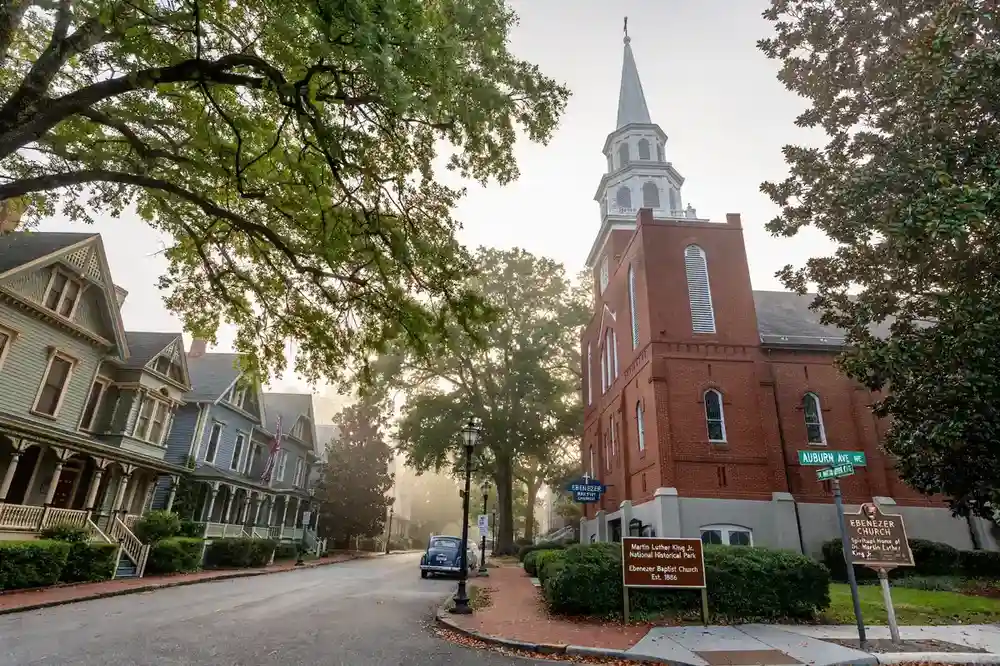
The Martin Luther King Jr. National Historical Park is the most important place in Atlanta, and one of the most significant in the United States. On two blocks of Auburn Avenue in the Sweet Auburn neighbourhood, the National Park Service preserves the house where Dr. King was born in 1929, the Ebenezer Baptist Church where he preached alongside his father, the King Center with the Eternal Flame and the tombs of Dr. and Mrs. King, and the International Civil Rights Walk of Fame. It is free, it is moving, and it is the stop that explains everything else in this guide. The Wikipedia entry on Martin Luther King Jr. is the best primer on the man before you walk his streets.
Practical tip: Admission to the park is free. The Birth Home tours are also free but limited to about 15 people at a time — tickets are handed out in person on the day, first-come first-served, from 9 a.m. at the Visitor Center, so arrive early. Allow 2 to 3 hours for the whole site, and pair it with a walk down Auburn Avenue, once the richest Black street in America, and the Sweet Auburn Curb Market for lunch.
4. Sit at the lunch counter at the National Center for Civil and Human Rights
Across Downtown at Pemberton Place, the National Center for Civil and Human Rights is the museum that makes the movement something you feel, not just read. Its centrepiece is the Lunch Counter sit-in simulation, where you sit at a counter, put on headphones and hear the abuse the student protesters endured — it is the most powerful single exhibit in the city. Around it are galleries on the American civil rights movement and on the global fight for human rights, plus a large exhibition on Dr. King. The museum completed a major two-storey expansion in 2025, adding six new galleries and more hands-on experiences, so even visitors who came a few years ago will find it changed. The National Center for Civil and Human Rights is the natural third stop in the Downtown cluster, after the aquarium and Coca-Cola.
Practical tip: Admission costs roughly $20 to $28 for adults in 2026, with discounts for children, seniors and students — prices are approximate, so check before visiting. Allow about 2 hours, and go early in the day: the Lunch Counter simulation has a queue by midday. Active-duty military enter free with ID.
5. Walk or cycle the Atlanta BeltLine Eastside Trail
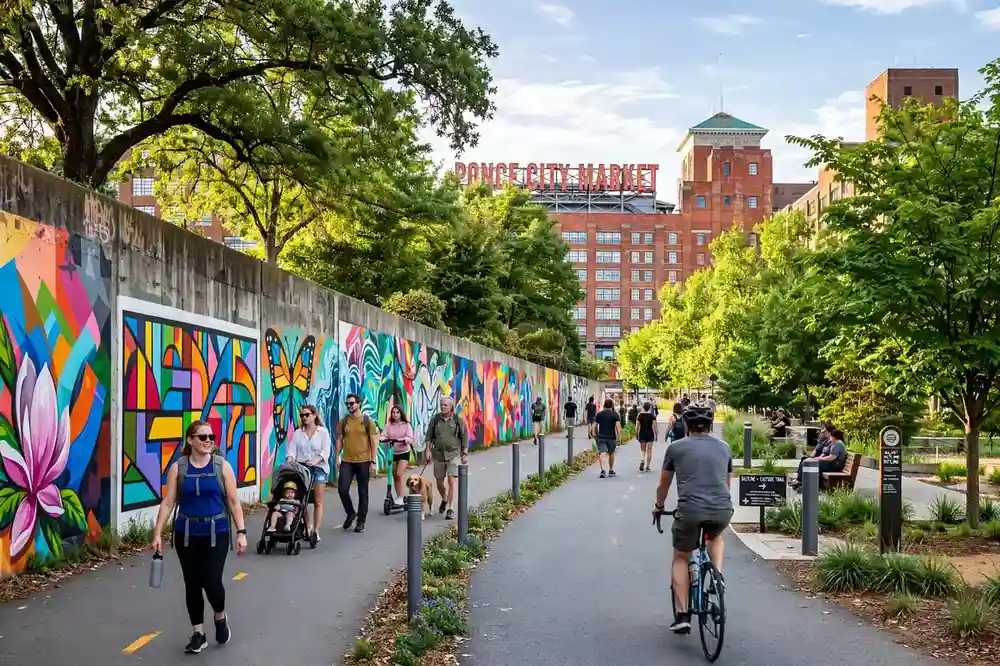
The Atlanta BeltLine is the best thing to happen to Atlanta in a generation: a 22-mile loop of former railway corridor turned into a paved trail, parks and public art, connecting 45 neighbourhoods. The Eastside Trail is the classic stretch — from Piedmont Park through the Old Fourth Ward, past Ponce City Market and Krog Street Market to Inman Park — lined with murals, food stalls, street performers and the Krog Street Tunnel, the city’s most photographed graffiti wall. And 2026 is the year the loop finally closed: the Southside Trail Segments 2 and 3 opened on June 12, 2026, joining the east and west halves into 16.7 continuous miles of trail, and the Southeast Trail opened in April 2026 — the project’s 20th anniversary year. The Atlanta BeltLine is free, it is the city’s front porch, and it is the best way to understand Atlanta beyond the attractions.
Practical tip: The trail is free and open from dawn to dusk. Rent a bike or an e-scooter at Ponce City Market or Piedmont Park, walk the Eastside Trail in the late afternoon when the light is best, and stop for dinner at Krog Street Market or Ponce City Market. Weekends are crowded — go on a weekday morning for the quiet version.
6. Cool off at Centennial Olympic Park
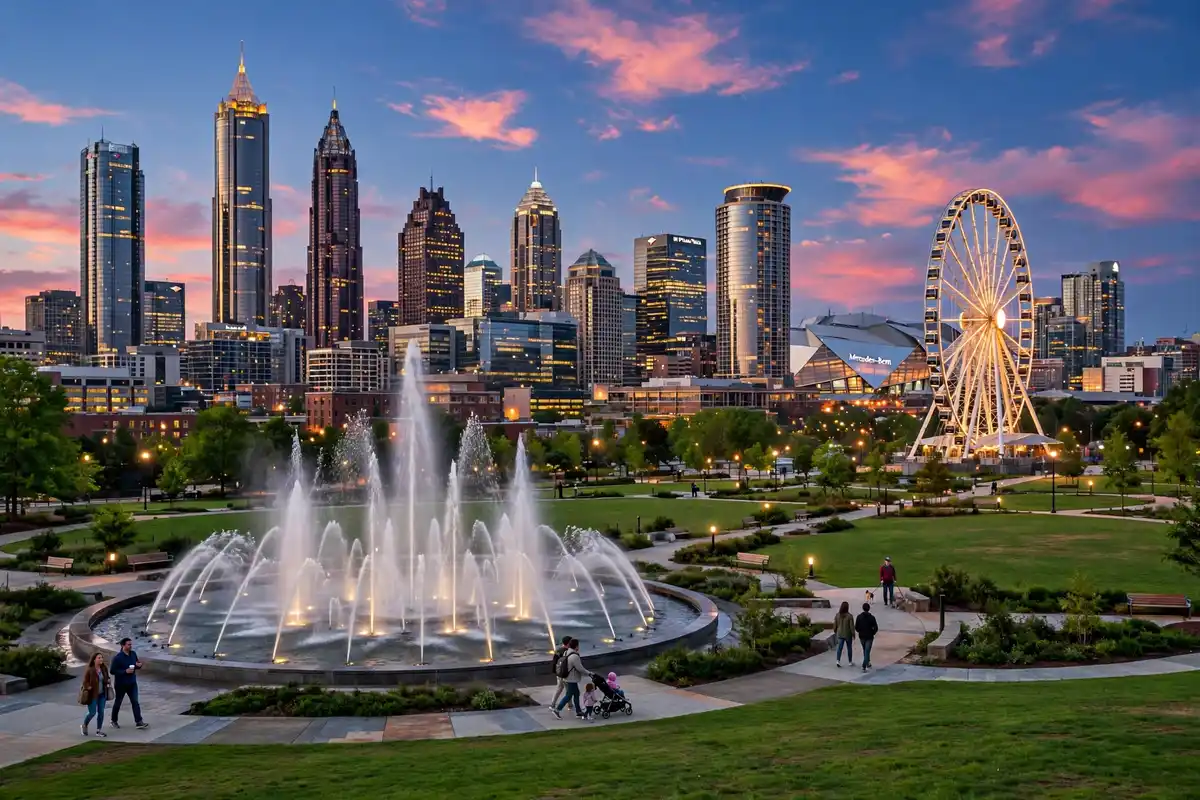
Centennial Olympic Park is Downtown’s backyard: 21 acres of lawns, fountains and walkways built for the 1996 Olympic Games, and still the city’s great gathering place. Its centrepiece is the Fountain of Rings, 193 jets of water choreographed to music, where children play in the spray on summer afternoons. The park hosts free concerts and festivals all year, and it is the hub that ties the Downtown attractions together — the aquarium, Coca-Cola, the civil rights museum and the College Football Hall of Fame are all a short walk away, and the SkyView Atlanta Ferris wheel rises at its edge. The Centennial Olympic Park is free, and it is the best place in Downtown to sit down, eat an ice cream and watch the city go by.
Practical tip: The park is free and open daily. Come in the late afternoon, when the Fountain of Rings show runs and the light on the skyline is at its best, and ride the SkyView Ferris wheel at dusk for the 20-storey view over Downtown — a ride costs roughly $15 to $20, prices are approximate, so check before visiting.
7. Spend an afternoon at the High Museum of Art
The High Museum of Art is the finest art museum in the South, and the anchor of Midtown’s cultural district. Its white Richard Meier building and Renzo Piano wings hold more than 18,000 works — American art, European paintings, African art, photography and decorative arts — with a permanent collection that runs from the Old Masters to contemporary Atlanta artists, plus a rotating programme of blockbuster exhibitions. It is a calm, airy counterpoint to the noise of Downtown, and it pairs naturally with the Botanical Garden and Piedmont Park, both a short walk away. The High Museum of Art is the museum to choose if you only visit one.
Practical tip: Admission costs roughly $22 for adults in 2026, with discounts for children, students and seniors — prices are approximate, so check before visiting. Admission is free on the first Sunday of each month. Allow 2 to 3 hours, and check the exhibition calendar before you go: the big travelling shows are the reason to time a visit.
8. Walk the canopy at the Atlanta Botanical Garden
Next door to Piedmont Park, the Atlanta Botanical Garden is 30 acres of themed gardens, tropical conservatories and seasonal spectacles in the middle of Midtown. The highlights are the Fuqua Conservatory with its orchids and tropical plants, the Japanese Garden, and the Kendeda Canopy Walk — a 600-foot skywalk through the treetops of Storza Woods. Every summer the garden stages a large temporary exhibition: in 2026 it was the playful large-scale sculptures of French artist Niki de Saint Phalle (May 9 to September 6). In winter, Garden Lights, Holiday Nights turns the whole garden into a light show. The Atlanta Botanical Garden is the prettiest hour in the city, and the best place to slow down after the museums.
Practical tip: Admission costs roughly $29.95 on weekdays and roughly $34.95 on weekends in 2026, with children cheaper — prices are approximate, so check before visiting. The garden is closed on Mondays. Book a timed ticket online, arrive at opening for the quiet version, and allow 1.5 to 2 hours. Garden Lights tickets are priced separately in winter, from roughly $29.95 on value nights.
9. Picnic in Piedmont Park
Piedmont Park is Atlanta’s Central Park — more than 200 acres of lawns, lakes, dog parks and trails in the heart of Midtown, and the city’s great free outdoor room. It is where Atlanta runs, picnics, plays and gathers: the Saturday Green Market, the free Atlanta Jazz Festival every May, the Dogwood Festival in April, and the Fourth of July crowds. The park’s Lake Clara Meer and the Oak Hill lawn, with its view of the Midtown skyline, are the classic picnic spots, and the Atlanta Botanical Garden sits on its northern edge. Piedmont Park is free, and it is the place to go when you want Atlanta without a ticket.
Practical tip: The park is free and open from 6 a.m. to 11 p.m. Come on a Saturday morning for the Green Market, bring a picnic, and walk the BeltLine Eastside Trail from the park’s southern edge — it starts here. Parking in the park’s lots is limited, so take MARTA to Midtown station and walk.
10. Eat and shop at Ponce City Market
Ponce City Market is the building that tells Atlanta’s whole story in one place: a 1926 Sears, Roebuck warehouse — once the largest brick building in the Southeast — turned into a food hall, shops, offices and apartments on the BeltLine. The Central Food Hall is the city’s best single place to eat, with dozens of stalls from ramen to tacos to Southern biscuits, and the roof holds Skyline Park, with mini golf, carnival games, a slide and the best skyline view in the city. The Ponce City Market is the stop that turns a BeltLine walk into a meal, and it is the best rainy-day food plan in Atlanta.
Practical tip: The market is free to enter; you pay for food and for Skyline Park, where a ticket costs roughly $10 to $15. Come for lunch on a weekday to beat the weekend crowds, eat at the food hall, and take the freight elevator to the roof for the view. The market sits directly on the BeltLine Eastside Trail, between the Old Fourth Ward and Midtown.
11. See a show at the Fox Theatre
The Fox Theatre is the most beautiful room in Atlanta: a 1929 movie palace built in a fantasy of Moorish and Egyptian design, with a ceiling painted like a night sky, a 4,665-seat auditorium and an organ that still rises from the floor. It hosts Broadway tours, concerts and the Atlanta Ballet, and it is the show to book if your trip overlaps with one. Even if you do not see a performance, the Fox is worth a look: the theatre runs guided tours of the building, and its marquee on Peachtree Street is one of the city’s great landmarks. The Fox Theatre opened on Christmas Day 1929, and it has been the heart of Midtown’s nightlife ever since.
Practical tip: Show tickets vary by performance and sell out for the big tours, so book ahead. Guided tours of the theatre run on selected days and cost roughly $20 — prices are approximate, so check before visiting. Dress up a little for a show, arrive early for the lobby, and pair it with dinner in Midtown.
12. Say hello to the new pandas at Zoo Atlanta
Zoo Atlanta, in historic Grant Park, is one of the oldest zoos in the United States — and in late 2026 it has the freshest story in the city. After a two-year gap, when the last of the old pandas returned to China in October 2024, a new pair — Ping Ping and Fu Shuang — arrived from Chengdu at the end of September 2026 and made their public debut on November 6, 2026 in the new Arthur M. Blank Panda Grove, on a 10-year loan. They are the headline, but the zoo is much more: more than 1,000 animals across 40 acres, including one of the largest gorilla populations in North America, African elephants, Sumatran tigers and a petting zoo, all in the shade of Grant Park’s old trees. Zoo Atlanta is the best family day in the city, and the panda debut is the reason to go now rather than later.
Practical tip: Admission costs roughly $26.99 for adults in 2026, with children cheaper, and prices vary by day — prices are approximate, so check before visiting. Go at opening, when the animals are most active, and see the pandas early in the day before the queues build. The zoo is in Grant Park, a 10-minute drive from Downtown, with free parking in the Grant Park lots.
13. Climb Stone Mountain Park
Stone Mountain Park is Georgia’s most visited attraction, and the best day trip from Atlanta: 3,200 acres around a vast granite dome 16 miles east of Downtown. The mountain itself is the sight — a single bare rock face rising 825 feet, with a one-mile Walk-Up Trail to the summit and a cable car, the Summit Skyride, for the easy way up. At the base are the Scenic Railroad, the Dinosaur Explore trail, the Great Barn and the lakeside paths, and on summer nights the Memorial Lawn fills for the evening show. Two things most guides get wrong: daily parking is now $25 a car (not the $20 older guides quote), and the classic Lasershow has been replaced by the Music Across America Drone & Light Show, with 250 colour-changing drones, lasers and flame cannons — though the classic Lasershow returned free on select Saturdays in August and September 2026. Stone Mountain is a full day, and the view from the top, out over Atlanta’s skyline, is the reward.
Practical tip: Daily parking costs $25 per vehicle; an annual pass costs $40. The Attractions Pass, which covers the Skyride, the railroad and the other rides, costs roughly $39.99 — prices are approximate, so check before visiting. Hike the Walk-Up Trail in the morning before the heat, ride the Skyride down, and stay for the evening drone and light show in summer.
14. Tour the Swan House at the Atlanta History Center
The Atlanta History Center is a 33-acre campus in Buckhead that tells the city’s story in the round: the Atlanta History Museum, the Goizueta Gardens, the Smith Farm with its live animals, and the restored Battle of Atlanta Cyclorama — a vast 360-degree painting of the 1864 battle, with a new museum experience around it. The star is the Swan House, a 1928 mansion by architect Philip Trammell Shutze, built for Edward and Emily Inman, with its marble floors, grand staircase and terraced gardens — the house film fans know from The Hunger Games. The Atlanta History Center is the museum for the visitor who wants the whole story, from the Civil War to the Olympics, and it is marking its 100th anniversary in 2026, having been founded in 1926.
Practical tip: General admission costs roughly $31 on weekdays and roughly $35 on weekends in 2026, with children cheaper, and booking online saves about $2 — prices are approximate, so check before visiting. The campus is open Tuesday to Sunday, 9 a.m. to 4 p.m. (historic houses from 11 a.m.), and is closed on Mondays. Allow 3 hours, and do not skip the Swan House — it is included in the ticket.
15. Kick a field goal at the College Football Hall of Fame
The Chick-fil-A College Football Hall of Fame is a 95,000-square-foot interactive museum in the Centennial Park District, and the most fun museum in Downtown. You pick a team at the door and the whole building personalises itself around it: a wall of 770 helmets, a 45-yard indoor football field where you can kick, throw and run drills, a virtual-reality quarterback experience, and an AI Game ON! experience that drops your face into game footage. New in January 2026 is Ascension: Rise of the Black Quarterback, a permanent exhibition on the Black quarterbacks who changed the game. The College Football Hall of Fame is the stop for sports fans, and the best rainy-day pick in the Downtown cluster.
Practical tip: Admission costs roughly $28 for adults and roughly $20 for children aged 3 to 12 in 2026, with children under 3 free — prices are approximate, so check before visiting. The Hall is open six days a week, 10 a.m. to 5 p.m., and is closed on Tuesdays. Allow 2 to 3 hours, wear comfortable shoes for the field, and book online to skip the ticket counter queue.
16. Tour Mercedes-Benz Stadium, home of a World Cup semi-final
Mercedes-Benz Stadium is one of the most advanced sports venues in the world — a retractable roof that opens like a camera aperture, a 58-foot halo video board, and a home to the Atlanta Falcons and Atlanta United. In the summer of 2026 it hosted eight FIFA World Cup matches, the joint-most of any venue, including five group games, a Round of 32 tie, a Round of 16 tie and a semi-final on July 15, 2026, when Argentina beat England 2–1 on the way to the final. During the tournament the stadium was called Atlanta Stadium, under FIFA’s clean-venue rules. The stadium runs guided tours on non-event days, and it is worth seeing even without a match: the architecture, the art collection and the view from the upper bowl are the tour. Mercedes-Benz Stadium is the building that put Atlanta on the world football map in 2026.
Practical tip: Tours run on selected days and cost roughly $25 to $35 — prices are approximate, so check before visiting. If a Falcons or Atlanta United match is on during your trip, go: Atlanta United’s crowds are among the loudest in American soccer, and the stadium’s cheap concession prices (the famous $2 hot dogs) are part of the experience.
17. Eat your way through Krog Street Market and Inman Park
Krog Street Market is the smaller, cooler cousin of Ponce City Market: a 1920s warehouse in Inman Park, Atlanta’s first planned suburb, turned into a food hall of local stalls — Southern, Mexican, Vietnamese, pizza, ice cream — with a patio on the BeltLine Eastside Trail. Around it, Inman Park is the neighbourhood to wander: Victorian houses, the Krog Street Tunnel with its ever-changing murals, and the little shops and bars along Elizabeth Street. It is the best lunch stop on a BeltLine day, and the most local-feeling food hall in the city.
Practical tip: The market is free to enter; you pay for food. Come for lunch, eat at the stalls, and walk the BeltLine from here to Ponce City Market — it is about 20 minutes on foot, with the Krog Street Tunnel on the way. Inman Park is also the stop for Little Five Points, a 10-minute walk east, with its record shops, vintage stores and street art.
18. Meet the dinosaurs at Fernbank Museum of Natural History
Fernbank Museum of Natural History is the museum for the curious: a 65-acre forest and a great hall of dinosaurs, including the world’s largest dinosaurs on display, plus exhibitions on Georgia’s natural history, the cultures of the world and a giant-screen theatre. Outside, the 10-acre WildWoods and the Fernbank Forest trails take you into one of the largest old-growth urban forests in the country, with a canopy walk and a children’s nature play area. The Fernbank Museum of Natural History is the best museum in the city for families with children, and the forest walk is the quietest hour in Atlanta.
Practical tip: Admission costs roughly $26 to $28 for adults in 2026, with children cheaper — prices are approximate, so check before visiting. Allow 2 to 3 hours, and add the giant-screen film if you have time: the IMAX ticket is sold separately. Fernbank is in Druid Hills, a 15-minute drive from Midtown, with free parking.
19. Catch a Braves game at The Battery Atlanta
The Battery Atlanta is the entertainment district built around Truist Park, home of the Atlanta Braves — and it is the best evening in the city for sports fans. The ballpark itself is a modern classic, with a 41,000-seat bowl and a view of the skyline, and around it the Battery holds restaurants, bars, shops, a live music venue and a plaza with a big screen. Even if you do not go to a game, the Battery is worth an evening: eat at one of the restaurants, watch the game on the plaza screen, and soak up the atmosphere. Truist Park is about 10 miles north-west of Downtown, in Cobb County, and the Battery is the reason to make the trip.
Practical tip: Braves tickets start from roughly $15 to $20 for the cheapest seats in 2026, rising steeply for weekend games — prices are approximate, so check before visiting. Take MARTA to the Arts Center or Midtown station and then a rideshare, or drive: parking in the Battery decks costs roughly $20 to $30 on game days. Arrive early for the plaza, and stay for the post-game fireworks on Friday nights.
20. Wander Oakland Cemetery
Oakland Cemetery is Atlanta’s oldest burial ground and its most beautiful green space: 48 acres of Victorian monuments, magnolia trees and winding paths, founded in 1850, where the city’s founders, Civil War dead, and figures like golfer Bobby Jones and author Margaret Mitchell are buried. It is also a public park and a botanical garden, with guided tours, a farmers’ market and a famous Halloween event. Oakland Cemetery is free to enter, and it is the most peaceful hour in the city — and the best place to understand Atlanta’s history in one walk.
Practical tip: The cemetery is free and open daily from dawn to dusk. Take a guided tour on a weekend morning if you can — the volunteer guides are excellent — and pair it with a walk through the Grant Park neighbourhood and Zoo Atlanta, a 10-minute drive away.
Atlanta in 3 days — a ready-made itinerary
Three days is the right length for a first trip: one day Downtown, one day on the civil rights trail and the BeltLine, one day in Midtown and Buckhead, with Stone Mountain as the fourth-day option.
| Day | Where | Highlights |
| Day 1 — Downtown | Pemberton Place and Centennial Olympic Park | Morning at the Georgia Aquarium, then the World of Coca-Cola. Afternoon at the National Center for Civil and Human Rights. Evening: Centennial Olympic Park and the SkyView Ferris wheel at dusk. |
| Day 2 — Civil rights and the BeltLine | Sweet Auburn, Old Fourth Ward and Midtown | Morning at the MLK National Historical Park and Auburn Avenue. Afternoon on the BeltLine Eastside Trail: Krog Street Market, Ponce City Market and Piedmont Park. Evening: a show at the Fox Theatre. |
| Day 3 — Buckhead and the east | Buckhead, Grant Park and Stone Mountain | Morning at the Atlanta History Center and the Swan House. Afternoon at Zoo Atlanta and the new pandas in Grant Park. Evening: dinner in Buckhead, or a full day at Stone Mountain Park instead. |
Day 1 — Downtown: the aquarium, Coca-Cola and civil rights
Base yourself Downtown and start at the Georgia Aquarium at opening, when the whale shark tank is quietest. Walk next door to the World of Coca-Cola for the tasting room, then cross to the National Center for Civil and Human Rights for the afternoon. Finish in Centennial Olympic Park: the Fountain of Rings, a walk around the park, and the SkyView Ferris wheel at dusk. Day one is the classic Atlanta, and it is the one to get right.
Day 2 — Civil rights and the BeltLine: MLK, the trail and the Fox
Take MARTA to the King Memorial station and spend the morning at the MLK National Historical Park — arrive by 9 a.m. for a Birth Home tour ticket — then walk Auburn Avenue and eat lunch at the Sweet Auburn Curb Market. Spend the afternoon on the BeltLine Eastside Trail: start at Krog Street Market, walk through the Krog Street Tunnel, and finish at Ponce City Market and Piedmont Park. End the day at the Fox Theatre, if a show is on, or with dinner in Midtown.
Day 3 — Buckhead and the east: history, pandas and Stone Mountain
Drive or take a rideshare to Buckhead for the Atlanta History Center and the Swan House in the morning, then head south to Grant Park for Zoo Atlanta and the new pandas in the afternoon. If you have a fourth day, spend it at Stone Mountain Park: the Walk-Up Trail in the morning, the Summit Skyride and the Scenic Railroad in the afternoon, and the drone and light show in the evening.
Best time to visit Atlanta
Atlanta is warm for most of the year, so the question is humidity, crowds and price, not temperature. Spring (March to May) is the sweet spot: mild days in the 60s and 70s, dogwoods and azaleas in bloom, and the city’s festival season — the Atlanta Dogwood Festival in April and the Atlanta Jazz Festival in May, both free in Piedmont Park. Autumn (September to November) is the other sweet spot, with warm days, low humidity and fall colour in the parks. Summer (June to August) is hot and humid, with highs in the high 80s and low 90s and afternoon thunderstorms, but it is also festival season, with Dragon Con over Labor Day weekend and Music Midtown in September. Winter (December to February) is mild, with highs in the 50s and the cheapest hotels, plus the Garden Lights at the Botanical Garden and the holiday lights at Stone Mountain.
| Season | Months | Weather and crowds | Best for |
| Spring | March–May | Mild 60s–70s, dogwoods in bloom, festival season | First trips, the parks, the BeltLine |
| Summer | June–August | Hot and humid, highs in the high 80s–low 90s, afternoon storms | Festivals, Dragon Con, the aquarium |
| Autumn | September–November | Warm, low humidity, fall colour, thinner crowds | Best value, walking, the parks |
| Winter | December–February | Mild 50s, cheapest hotels, fewest crowds | Budget trips, the museums, Garden Lights |
Where to stay in Atlanta
Downtown suits first-timers who want the big attractions on foot; Midtown suits arts, nightlife and the parks; Buckhead suits luxury and shopping; the Old Fourth Ward and Inman Park suit food lovers and BeltLine walkers; Decatur suits a quieter, foodie base with a MARTA station. Book early for April and October weekends, for Dragon Con over Labor Day weekend, and for any big concert or sports weekend.
| Area | Best for | Expect to pay (approx) |
| Downtown | First-timers, the big attractions on foot | $150–$300 a night for a mid-range hotel |
| Midtown | Arts, nightlife, Piedmont Park and the BeltLine | $150–$280 a night for a mid-range hotel |
| Buckhead | Luxury, shopping, fine dining | $200–$400 a night for an upscale hotel |
| Old Fourth Ward and Inman Park | Food, the BeltLine, local feel | $150–$280 a night for a boutique hotel or rental |
| Decatur | Quiet base, food scene, MARTA access | $130–$220 a night for a hotel or rental |
Getting around Atlanta
MARTA is the smart way to move around the city core. The rail system has 38 stations on four lines: the Red and Gold lines run north-south through the airport, Downtown, Midtown and Buckhead, and the Blue and Green lines run east-west to the MLK sites and Decatur. A single ride costs $2.50, with up to four free transfers within three hours, and a 1-day pass costs $9, a 7-day pass $23.75 and a 30-day pass $95. Since March 2026, MARTA’s Better Breeze system lets you tap a contactless bank card or a phone wallet straight at the faregate — no Breeze Card needed — and new Stadler CQ400 trains entered service in 2026. The ride from Hartsfield-Jackson Atlanta International Airport, the world’s busiest airport, to Downtown takes about 20 minutes on the Red or Gold line, with no airport surcharge. The Atlanta Streetcar runs a downtown loop past Centennial Olympic Park, the MLK park and the Municipal Market, for $1 a ride or $3 for a day pass. For Stone Mountain, the suburbs and the Battery, you need a car or a rideshare: Atlanta’s traffic is notorious, downtown parking costs roughly $25 to $40 a day, and the I-285 Perimeter ring is the line locals use to describe where things are — inside the Perimeter (ITP) or outside it (OTP).
Atlanta food you have to try
Atlanta’s food is the city’s most underrated attraction: Southern soul food, a wing culture the city invented, and a fine-dining scene that has won James Beard Awards. Eat at the soul food institutions, the food halls and the market stalls, not just the hotel restaurants — that is where the food is best and cheapest.
Fried chicken and soul food at the Busy Bee and Mary Mac’s
Fried chicken is Atlanta’s signature dish, and the Busy Bee Cafe is where to eat it. Open since 1947 on Martin Luther King Jr. Drive, the Busy Bee is a James Beard America’s Classic and a MICHELIN Bib Gourmand, famous for its 12-hour-brined fried chicken, collard greens, mac and cheese, candied yams and cornbread — and for the fact that Dr. King himself ate here. It is takeout only and cash-only, so order at the counter and eat on the go. For the sit-down version, go to Mary Mac’s Tea Room on Ponce de Leon Avenue, serving Southern plates since 1945: fried chicken, fried green tomatoes, peach cobbler and sweet tea, in a dining room that feels like a family kitchen.
Lemon pepper wings, the dish Atlanta invented
Lemon pepper wings are Atlanta’s great contribution to American food: chicken wings tossed in lemon-pepper seasoning, invented in the city’s wing joints and now a national obsession. The classic is J.R. Crickets, where the wings come wet or dry with a cold beer, but the dish is everywhere — from the sports bars of the Battery to the late-night spots of Buckhead. Order them dry, with a side of fries and a sweet tea, and eat them the Atlanta way: with your hands, standing up, at the counter.
Peach cobbler and a chili dog at The Varsity
Peach cobbler is Georgia’s dessert — the state grows more peaches than anywhere else in the country — and the best place to eat it is after a chili dog at The Varsity. Open since 1928 on North Avenue, The Varsity is the world’s largest drive-in restaurant, famous for its chili dogs, onion rings and Frosted Orange, and for the counter staff who shout “What’ll ya have?” the moment you walk in. Order a chili dog, onion rings and a Frosted Orange, then save room for peach cobbler at Mary Mac’s or the Busy Bee — the two tastes that sum up Atlanta’s food in one meal.
Free things to do in Atlanta
Atlanta is generous to a tight budget. The MLK National Historical Park is free, the BeltLine is free, Centennial Olympic Park is free, Piedmont Park is free, Oakland Cemetery is free, and the Krog Street Tunnel murals are free to photograph. The High Museum is free on the first Sunday of the month, the Atlanta Jazz Festival in May is free, the Dogwood Festival in April is free, and the Saturday Green Market in Piedmont Park is free to browse. Add the window-shopping at Ponce City Market and Krog Street Market, the Tiny Doors ATL scavenger hunt (dozens of tiny doors hidden around the city), and a sunset walk on the BeltLine, and a day of Atlanta’s best experiences can cost less than a single aquarium ticket.
Frequently asked questions
How many days do you need in Atlanta?
Three full days covers the highlights: Downtown, the civil rights sites and the BeltLine, and Midtown and Buckhead, with a dinner show or a Braves game. Two days covers the essentials if you skip Stone Mountain and pick one museum day or one park day. Add a fourth day for Stone Mountain Park, or for a slow day on the BeltLine and in the neighbourhoods — Atlanta rewards a slow day more than a rushed one.
Is Atlanta expensive?
Yes, but less than it looks. The MLK park, the BeltLine, Centennial Olympic Park, Piedmont Park and Oakland Cemetery are all free, and MARTA costs $2.50 a ride or $9 a day. The expensive parts are the Georgia Aquarium at roughly $54.99 to $69.99 and the big museums at roughly $20 to $35 — so pick one big ticket a day and let the free parks and trails do the rest. A mid-range trip runs roughly $150–$250 per person per day with one paid attraction, and a no-ticket day is possible on half that if you eat at the food halls and soul food spots. The Atlanta CityPASS, at roughly $106 for adults and $86 for children, covers five of the six big attractions and saves up to 47% if you visit them all within nine days.
What is the best time to visit Atlanta?
March to May and September to November are the sweet spot: mild days, comfortable walking, smaller crowds and lower hotel prices. April is the best month for dogwoods and the Dogwood Festival; October is the best month for fall colour. June to August is the classic season, hot and humid, with the festivals and Dragon Con. December to February is mild and cheap, with the Garden Lights and the holiday shows.
Do you need a car in Atlanta?
No, for the city core. MARTA rail connects the airport, Downtown, Midtown, Buckhead and Decatur, and the BeltLine and the Streetcar cover the neighbourhoods in between. A car is the easy way to Stone Mountain, the Battery and the suburbs, and the simplest way to get lost in traffic — downtown parking costs roughly $25 to $40 a day. The smart move is MARTA for the city and a rideshare for the out-of-town stops.
Is downtown Atlanta safe for tourists?
The tourist areas — Downtown, Midtown, the Old Fourth Ward, Buckhead, Grant Park and Decatur — are safe and well travelled, with the normal precautions of any city: watch your bag in crowds, do not leave valuables visible in a rental car, and avoid poorly lit streets late at night. The main risks are practical, not criminal: summer heat, afternoon thunderstorms, and the traffic. Stay in the busy areas after dark, take MARTA or a rideshare at night, and keep water with you in summer.
Is the Atlanta CityPASS worth it?
Yes, if you plan to visit three or more of the included attractions. The pass costs roughly $106 for adults and $86 for children aged 3 to 12, covers five of six attractions — the Georgia Aquarium, the World of Coca-Cola, Zoo Atlanta, and two of Fernbank Museum, the College Football Hall of Fame and the National Center for Civil and Human Rights — and is valid for nine consecutive days. Bought separately, those five tickets cost up to about $190, so the pass saves up to 47%. If you only want one or two attractions, skip the pass and buy those tickets direct.
Further reading — Wikipedia and Reddit
For deeper background, the Wikipedia entry on Atlanta covers the city’s history and geography, the Wikipedia entry on Martin Luther King Jr. covers the man and the movement, and the Wikipedia entry on the Georgia Aquarium covers the aquarium’s animals and exhibits. For trip reports, recent tips and honest answers from locals and regular visitors, the Reddit community r/Atlanta is the liveliest place to ask before you go — the BeltLine, the pandas, the World Cup and the best fried chicken are the questions that come up there most. No Quora thread on Atlanta could be verified as a live, useful discussion, so no Quora link is included here.
Your Atlanta trip, in one paragraph
Atlanta gives you the streets where Dr. King was born, the largest aquarium in the Western Hemisphere, a 22-mile trail through 45 neighbourhoods, a food hall in a 1926 warehouse, a 1929 movie palace, new pandas at the zoo and a stadium that hosted a World Cup semi-final — all in one city, in the heart of the South. Walk Auburn Avenue at opening, meet the whale sharks before the crowds, ride the BeltLine at sunset, and eat fried chicken at the Busy Bee. If this trip has given you the travel bug, the same kind of honest, up-to-date guide is waiting for your next trip: Chicago, Nashville, Los Angeles, Orlando, Miami, San Diego, Denver, Savannah, Dallas, Charleston, San Francisco, Myrtle Beach, Las Vegas, San Antonio, London, Portland, Pigeon Forge and Puerto Rico.

About the Author