Things to Do in Myrtle Beach
20 Best Attractions, a 3-Day Itinerary, Where to Stay, and the Food You Cannot Miss
Quick Info
Best for: Families, beach lovers, golfers and first-time visitors — 60 miles of sand, the Boardwalk, the SkyWheel, gardens and the best seafood buffets in America
Best time: April–May and September–October for warm days and smaller crowds; June for the Carolina Country Music Festival
How long: 3 full days for the highlights; 2 days covers the essentials; add a 4th day for golf or Pawleys Island
Budget: Roughly $130–$260 per person per day for a mid-range trip; the beach, the Boardwalk, Broadway at the Beach and the MarshWalk are free
Don’t miss: The SkyWheel at sunset, Ripley’s Aquarium, Brookgreen Gardens, a Calabash seafood platter and dinner on the Murrells Inlet MarshWalk
Myrtle Beach is the beach town America keeps coming back to. The Grand Strand — 60 miles of sand along the South Carolina coast, 14 communities from Little River to Georgetown — was named the 5th Best Small City in America in 2026, and it still feels like a proper American beach holiday: a boardwalk with an arcade, a 187-foot wheel over the ocean, the biggest collection of mini-golf courses on earth, and a seafood platter the size of a hubcap. This is not a one-beach town. It is a boardwalk, a theme park strip, a sculpture garden, a birding hotspot and a fishing village, all in one trip. The 3-day itinerary below ties it together, and the where to stay guide, the how to get around notes and the three foods you have to try cover everything else. Myrtle Beach, named for the wax myrtle trees that grow along the shore, was first a quiet stop on the railroad and only became a city in 1938 — but the Grand Strand today is the most-visited stretch of coast in South Carolina, and this guide covers the 20 best things to do in Myrtle Beach, with the 2026 openings, prices and closures the older guides have not caught up with.
Myrtle Beach at a glance
| Question | Short answer |
|---|---|
| How long do you need? | 3 full days for the highlights; 2 days covers the essentials; 4 days if you add golf or Pawleys Island. |
| Best area for a first trip | The oceanfront Boardwalk district — the SkyWheel, the beach, the arcades and the restaurants are all a walk from there. |
| One thing to book early | Pirates Voyage and Carolina Opry tickets, popular restaurants on summer weekends, and golf tee times in spring. |
| One thing that is free | The beach, the Boardwalk, Broadway at the Beach, the MarshWalk and the Market Common — the best of Myrtle Beach costs nothing. |
| Do you need a car? | Not downtown — the Boardwalk, the beach and Broadway at the Beach are walkable or a short rideshare away. A car helps for Brookgreen Gardens, Huntington Beach State Park and the golf courses. |
The 20 best things to do in Myrtle Beach
1. Walk the Myrtle Beach Boardwalk & Promenade
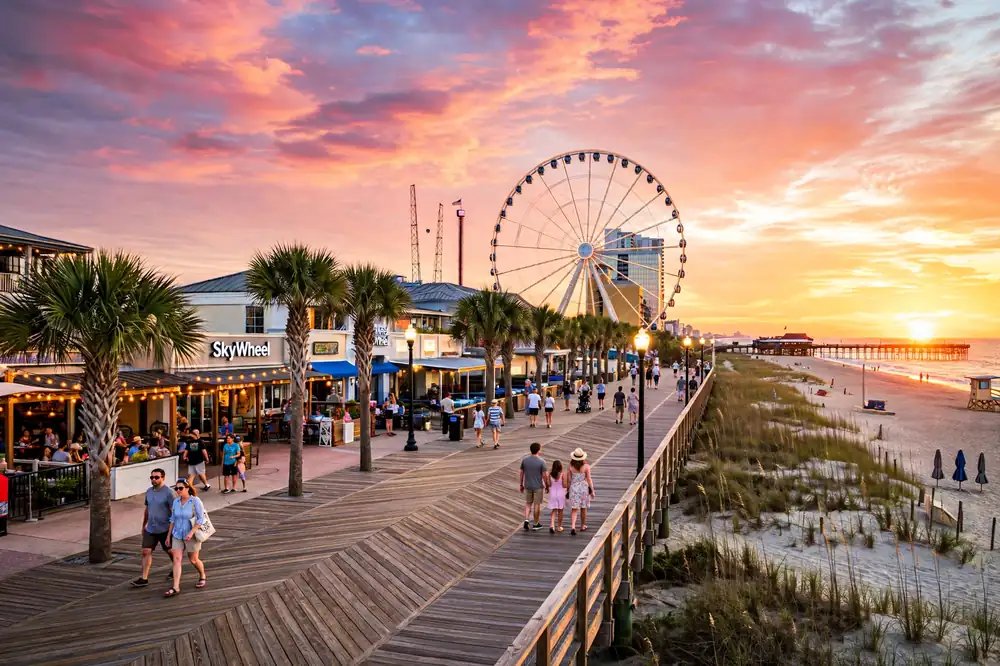
Start with the walk that defines the city. The Boardwalk & Promenade runs 1.2 miles along Ocean Boulevard from 1st Avenue North to 14th Avenue North, and it is free to stroll at any hour. National Geographic ranked it the third-best boardwalk in America and Travel + Leisure ranked it second, and both were right: palm trees, arcades, the Gay Dolphin Gift Cove — one of the largest gift shops in the country — and the beach on one side, the restaurants and the Ripley’s attractions on the other. Come at golden hour, when the light turns the ocean gold and the arcades start to glow. In summer the boardwalk hosts free fireworks on selected evenings, and the whole mile fills up with families, buskers and the smell of funnel cake. The Grand Strand is 60 miles long, but this 1.2-mile stretch is the part you will remember.
2. Ride the SkyWheel Myrtle Beach
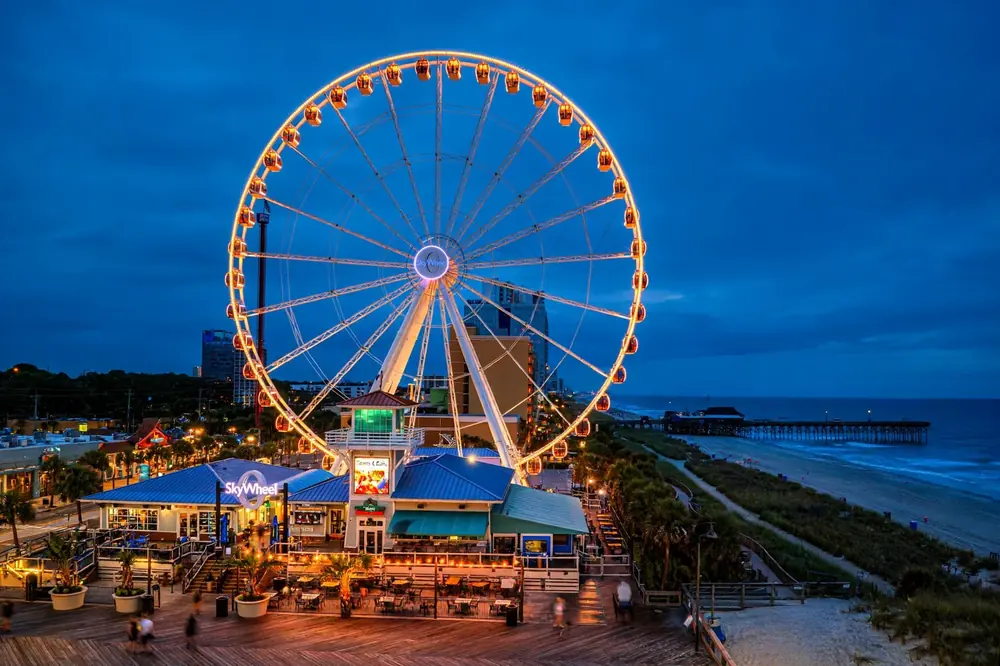
The wheel is the landmark. The SkyWheel Myrtle Beach is 187 feet tall with 42 climate-controlled gondolas, opened in 2011, and takes you on four slow rotations — roughly 10 to 15 minutes — with the whole Grand Strand laid out below you and the Atlantic stretching to the horizon. Go at sunset: the gondolas glow, the boardwalk lights come on, and the view down the beach is the best photograph in town. Tickets cost roughly $21–22 per person in 2026, and children under two ride free. Book the sunset slot online if you are visiting on a summer weekend — the queue at the ticket window can be an hour long.
3. Ripley’s Aquarium of Myrtle Beach
Step off the boardwalk and straight into the ocean’s other side. Ripley’s Aquarium sits at the south end of the boardwalk and is open 365 days a year. The centrepiece is the 330-foot glidepath through Dangerous Reef, a moving walkway that carries you through a shark tunnel while sharks, rays and sea turtles glide overhead. There are also penguins, sloths, a stingray touch pool and a coral reef gallery — enough for a full hour, two if you have children. Admission in 2026 is roughly $43 for adults 12 and over, about $27 for children aged 6–11 and about $15 for ages 3–5, and it is worth buying tickets online in advance: walk-up prices are higher and the aquarium is busiest between 11 am and 3 pm.
4. Broadway at the Beach
If the boardwalk is the postcard, Broadway at the Beach is the playground. Built on 350 acres around Lake Broadway, it is the most-visited attraction in South Carolina, drawing more than 14 million visitors a year. Shops, restaurants, bars, a zip line, the Pavilion Park rides, Legends in Concert and a Dave & Buster’s all sit around the lake, and it costs nothing to walk in and browse. Come in the evening for the lakefront lights and live music, and note the 2026 additions: Guy Fieri’s Downtown Flavortown opened here in June 2026, and the Ole Smoky Distillery and Yee-Haw Brewing Co. opened their first Grand Strand location at Broadway at the Beach in May 2026.
5. Family Kingdom Amusement Park
The oceanfront amusement park has been part of Myrtle Beach since 1966, and 2026 is its biggest year yet. Family Kingdom has more than 35 rides right on the beach — the Swamp Fox, a classic wooden coaster that is celebrating its 60th anniversary in 2026, the Log Flume, the giant wheel and a full kiddie section. A brand-new single-rail roller coaster opened in summer 2026, running more than 100 feet high at 50 miles per hour. Entry is free — you pay for rides or a wristband, roughly $45 for unlimited rides, with an early-bird price of about $30 for the first hour. In summer the park runs Monday to Friday from 4 pm to 11 pm, which makes it a perfect after-beach stop.
6. Brookgreen Gardens
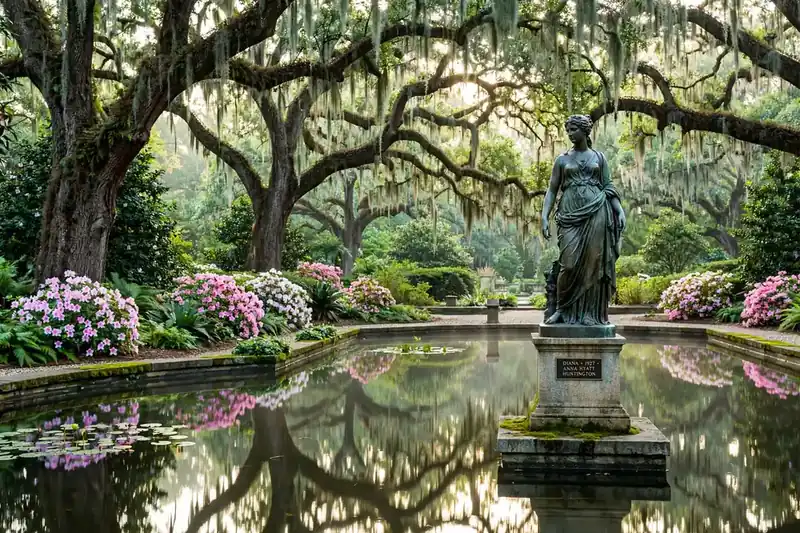
Half an hour south of the beach, and a world away from it. Brookgreen Gardens covers 9,100 acres of former rice plantations and is the first public sculpture garden in America, founded in 1931. More than 2,000 works by American sculptors sit among live oaks, reflecting pools and azaleas, and there is a Lowcountry Zoo with native animals — otters, foxes, alligators — and a butterfly garden. Admission in 2026 is $25 for adults, $23 for seniors 65 and over and $14 for children aged 4–12, and your ticket is valid for seven consecutive days. Two things changed in 2026: the new Purdy Center welcome center and a $17 million conservatory opened in January 2026, and the Nights of a Thousand Candles returns for 21 select nights from November 27, 2026 to January 3, 2027, with the gardens lit by more than 2,700 hand-lit candles.
7. Huntington Beach State Park & Atalaya Castle
Just across the road from Brookgreen, and a completely different park. Huntington Beach State Park protects 2,500 acres of maritime forest and three miles of undeveloped beach — the quietest, wildest beach on the Grand Strand, and one of the best birding spots on the East Coast, with more than 300 species recorded. Inside the park stands Atalaya Castle, the Moorish-style winter home built in the 1930s by the sculptor Anna Hyatt Huntington and her husband Archer, founder of Brookgreen. Admission is $8 per person. Come early for the birds, walk the beach at low tide, and look for alligators in the freshwater lagoon — it is the only place on the Strand where the beach feels untouched.
8. Myrtle Beach State Park
The other state park is the one the locals use. Myrtle Beach State Park sits on the south end of the beach with a maritime forest, nature trails, a campground and a fishing pier, and it is the easiest escape from the crowds: walk five minutes south of the pier and the beach is suddenly empty. Admission is roughly $8 per adult. The park’s nature centre runs free programmes in summer, and the trails through the live-oak forest are one of the few places on the Strand where you can walk in real shade. If you want a sunrise with no one in it, this is where to be.
9. Stroll the Murrells Inlet MarshWalk
Twenty minutes south of the boardwalk, Murrells Inlet calls itself the Seafood Capital of South Carolina, and the MarshWalk is where that claim is made. A half-mile wooden boardwalk runs along the salt marsh, lined with restaurants and bars whose decks sit over the water — oysters, shrimp and flounder, all caught a few miles away. Dolphins cruise the inlet at sunset, and the walk is free at any hour. Come for dinner, not lunch: the light on the marsh at sunset is the prettiest thing on the Grand Strand, and the restaurants fill up fast on summer weekends, so book a table if you can. Murrells Inlet is also the gateway to the sea: fishing charters, kayak tours and the boat that runs out to the jetties all leave from here.
10. WonderWorks
You cannot miss the building — it is upside down. WonderWorks is a hands-on science museum and indoor amusement park with more than 100 interactive exhibits, a ropes course, laser tag and a 6D XD motion theatre, all under a roof that makes it the best bad-weather plan on the Strand. It is squarely aimed at families with children aged 5 to 14, but the space and weather exhibits hold an adult’s attention for an hour too. Tickets cost roughly $30–$40 in 2026, and the all-access pass is the one to buy if you want the ropes course and laser tag included. Plan for two to three hours.
11. Play mini golf — the Miniature Golf Capital of the World
No American beach town takes mini golf as seriously as Myrtle Beach. The Grand Strand calls itself the Miniature Golf Capital of the World, with more than 50 courses, and the best of them are proper attractions: Mt. Atlanticus Minotaur Golf is a 36-hole course wrapped around a giant Minotaur statue and a volcano, Captain Hook’s Adventure Golf sends you through a pirate ship, and PopStroke — Tiger Woods’ putting-and-eats concept — opened a Grand Strand location in recent years. A round costs roughly $12–$15 per person. Play after dark in summer, when the courses are lit up and the heat finally drops, and treat it as the evening’s main event, not a filler.
12. Pirates Voyage Dinner & Show
Dolly Parton’s pirate dinner show is the big night out on the Strand, and 2026 is its 15th anniversary year. Two pirate crews — Crimson and Sapphire — battle it out over a hidden lagoon while you eat a four-course feast, and the 2026 season brings a new South Pacific Celebration with fresh acts. Expect acrobatics, mermaids, a giant sea lion and a lot of audience shouting. Tickets cost roughly $60–$82 for adults and about $30–$36 for children aged 3–9 in 2026, and the show sells out on summer weekends — book at least a week ahead. Dinner starts early, so it pairs well with an afternoon at the beach.
13. The Carolina Opry
The other great show on the Strand is older and more local. The Carolina Opry was founded in 1986 by Calvin Gilmore and is celebrating its 40th anniversary season in 2026, with the hit show Time Warp — a musical journey through the decades — and the Christmas Special, billed as the Christmas Show of the South, running through the holidays. It is a variety show in the classic sense: singers, dancers, a live band and a comedian, performed by a cast that has been doing this for decades. Tickets typically run $45–$70, and the theatre is air-conditioned and comfortable, which makes it a good summer-evening pick.
14. Myrtle Waves Water Park
South Carolina’s largest water park sits just off the highway at the south end of town. Myrtle Waves has the slides, the wave pool, the lazy river and a FlowRider surf simulator, plus a toddler area that keeps the under-fives happy — which is more than most water parks manage. It opens for the season in late May and runs through early September, and it is busiest on summer weekends, when a weekday visit is the smarter move. Day tickets cost roughly $40–$50 in 2026, with children’s prices lower, and the park is a full day out rather than a half-day stop. Bring sunscreen and water shoes; the concrete gets hot.
15. Golf the Grand Strand
Myrtle Beach is the Golf Capital of the World for the same reason it is the Miniature Golf Capital: there are more than 90 courses on the Grand Strand, and they are some of the best-designed and best-value courses on the East Coast. The Dunes Golf & Beach Club, Tidewater Golf Club and Caledonia Golf & Fish Club are the names golfers ask for, and spring and autumn are the prime seasons, with the ONEFlight Myrtle Beach Classic returning to the Strand in May 2026. Even if you never play a full round, the par-3 courses and driving ranges are an easy afternoon, and many courses welcome beginners. Book tee times early in spring — the golf weeks sell out.
16. Barefoot Landing
Barefoot Landing is the North Myrtle Beach answer to Broadway at the Beach: more than 100 shops and restaurants set around a lake on the Intracoastal Waterway, with the House of Blues, the Alabama Theatre and Alligator Adventure — a reptile park with hundreds of alligators and crocodiles — as its anchors. It is free to stroll, the lakefront is lovely at sunset, and the summer fireworks are a local tradition. Come for a late afternoon, eat at LuLu’s on the water, and stay for the music. It is the calmest of the three big entertainment complexes, and the one most locals actually choose.
17. The Market Common
Built on the site of the former Myrtle Beach Air Force Base, the Market Common is the Strand’s most walkable neighbourhood: boutiques, restaurants, a cinema, a park and a weekly farmers market, all arranged around streets you can actually stroll. Valor Park, with its memorial wall and reflecting pool, is one of the most thoughtful public spaces in town, and the district hosts free outdoor concerts and a Saturday market through the season. It is free to walk, it is the best place on the Strand for an evening without a theme-park queue, and it is where the city’s newer restaurants — including the 2026 openings — tend to land first.
18. Watch a Myrtle Beach Pelicans game
The Pelicans are the Single-A affiliate of the Chicago Cubs, and their ballpark is one of the best minor-league experiences in America. The season runs from April to September, and the ballpark unveiled a $20 million renovation in April 2026, including a new 15,000-square-foot venue called The Diamond. Games are cheap, the food is good, the mascot Splash works the crowd, and the fireworks nights are a local institution. Tickets start from roughly $12, and a Thursday night game with fireworks is the best-value evening on the Strand. Check the schedule before you travel — the team is on the road about half the season.
19. Cherry Grove Pier & North Myrtle Beach
If downtown Myrtle Beach feels too loud, drive twenty minutes north. North Myrtle Beach is the quieter sibling — wide beaches, low-rise condos and the Cherry Grove Pier, one of the longest fishing piers on the East Coast, where you can walk out over the Atlantic at sunrise for a few dollars and watch the fishermen pull in Spanish mackerel. The Main Street area has the shag-dancing clubs that gave the Strand its state dance, and the beaches here are the ones locals pick. The T.I.G.E.R.S. Preservation Station in North Myrtle Beach is free to visit and a good stop with children.
20. Day trip: Pawleys Island & the Hammock Shops
Half an hour south of the boardwalk, Pawleys Island is the Grand Strand’s antidote to itself. The island calls itself “arrogantly shabby” — no high-rises, no neon, just a quiet beach, live oaks and the Hammock Shops Village, where the original Pawleys Island rope hammock has been made by hand since 1938. Spend the morning on the beach, browse the shops in the afternoon, and stop for lunch at one of the island’s seafood restaurants before heading back. It is the easiest day trip from Myrtle Beach, and the one that shows you the Lowcountry the way it was before the hotels arrived.
Myrtle Beach in 3 days — a ready-made itinerary
| Day | Morning | Afternoon | Evening |
|---|---|---|---|
| Day 1 — The Boardwalk and the beach | Boardwalk walk and the beach | SkyWheel and Ripley’s Aquarium | Dinner on Ocean Boulevard, fireworks on the Boardwalk |
| Day 2 — Broadway and the shows | Broadway at the Beach and WonderWorks | Family Kingdom and mini golf | Pirates Voyage or the Carolina Opry |
| Day 3 — Gardens and the south Strand | Brookgreen Gardens | Huntington Beach State Park and Atalaya | Sunset dinner on the Murrells Inlet MarshWalk |
Day 1 — The Boardwalk and the beach
Start at the Boardwalk. Walk the 1.2 miles from 1st Avenue North to 14th Avenue North in the morning light, then claim a spot on the beach for the middle of the day — the sand is wide, the water is warm from June to October, and the lifeguards are on duty in summer. In the afternoon, ride the SkyWheel and walk through Ripley’s Aquarium, then have dinner on Ocean Boulevard and stay for the summer fireworks on the boardwalk. Day one is the classic Myrtle Beach, and it is the one to get right.
Day 2 — Broadway and the shows
Spend the morning at Broadway at the Beach — the shops, the lake, the zip line — and take the children through WonderWorks. In the afternoon, cross to Family Kingdom for the rides and the new single-rail coaster, then play a round of mini golf at Mt. Atlanticus or Captain Hook’s. In the evening, take your pick: Pirates Voyage for the big dinner show, or the Carolina Opry for the music. Book the show a week ahead in summer.
Day 3 — Gardens and the south Strand
Drive south. Spend the morning at Brookgreen Gardens — the sculpture, the oaks, the zoo — and the early afternoon at Huntington Beach State Park, walking the beach and visiting Atalaya Castle. Finish the day, and the trip, with a sunset dinner on the Murrells Inlet MarshWalk. If you have a fourth day, add a round of golf on the Grand Strand, or the day trip to Pawleys Island and the Hammock Shops.
Best time to visit Myrtle Beach
| Season | What it is like | Best for |
|---|---|---|
| Winter (December–February) | Mild and quiet, highs around 55–65°F, the cheapest hotels — with some attractions on reduced hours | First trips, walking, budget trips |
| Spring (March–May) | Warm days in the 70s, azaleas in bloom, golf season in full swing | First trips, golf, gardens |
| Summer (June–August) | Hot and humid, highs in the high 80s, afternoon thunderstorms — the busiest months of the year | Beaches, water parks, festivals |
| Autumn (September–November) | Warm and golden, smaller crowds, the ocean still warm enough to swim | First trips, the beach, the best weather of the year |
The best time to visit Myrtle Beach is April to May or September to October, when the days are warm, the water is warm and the crowds are gone. Summer is the classic season — hot, busy and full of festivals — while winter is mild and the cheapest time to visit. Hurricane season runs from June to November, with the highest risk in September, so check the forecast for the week of your trip rather than relying on the calendar.
Where to stay in Myrtle Beach
| Area | Who it suits | Why stay there |
|---|---|---|
| Oceanfront Boardwalk — Downtown | First-timers, walkers | The SkyWheel, the beach and the arcades on your doorstep |
| North Myrtle Beach | Families, a quieter beach | Barefoot Landing, Cherry Grove Pier and wide beaches on your doorstep |
| Murrells Inlet and Garden City | Seafood lovers, a local feel | The MarshWalk, the restaurants and the fishing piers on your doorstep |
| The Market Common | Shoppers, walkers | Shops, restaurants, the cinema and Valor Park on your doorstep |
| Cherry Grove | A quiet beach, fishing | The pier, the beach and the Intracoastal Waterway on your doorstep |
First-timers should stay oceanfront in the Boardwalk district, where the SkyWheel, the beach and the restaurants are all a walk away. Families who want a quieter beach should look at North Myrtle Beach, and seafood lovers should look at Murrells Inlet and Garden City. The Market Common suits shoppers and walkers, and Cherry Grove suits a quiet beach and fishing. Two hotel notes for 2026: the voco The Shelby opened in June 2025 as South Carolina’s first voco hotel, the Ocean Reef Resort completed a $15 million renovation, and the Ocean Escape Boardwalk Oceanfront opened in February 2026 — while the boutique hotel The Caretta is expected to open in early 2027.
Getting around Myrtle Beach
Walking is the default downtown: the Boardwalk, the beach, the SkyWheel, Ripley’s Aquarium and the Ocean Boulevard restaurants are all within a mile of each other, and the beach itself is the flattest walk in town. For anything further, rideshare works well and is cheap by big-city standards. The Coast RTA bus runs along the Strand and through the city, with a single ride costing roughly $1.50 — a good option for the run to Broadway at the Beach or the Market Common. A car is worth having if you plan to visit Brookgreen Gardens, Huntington Beach State Park, the golf courses or Pawleys Island, and the airport is only about ten minutes from downtown. Beach parking is mostly paid and metered in the summer months, so use the paid lots near the boardwalk rather than circling the residential streets, and note that the boardwalk itself is closed to bicycles in the busiest summer hours — ride on the beach road instead.
Myrtle Beach food you have to try
Calabash-style fried seafood
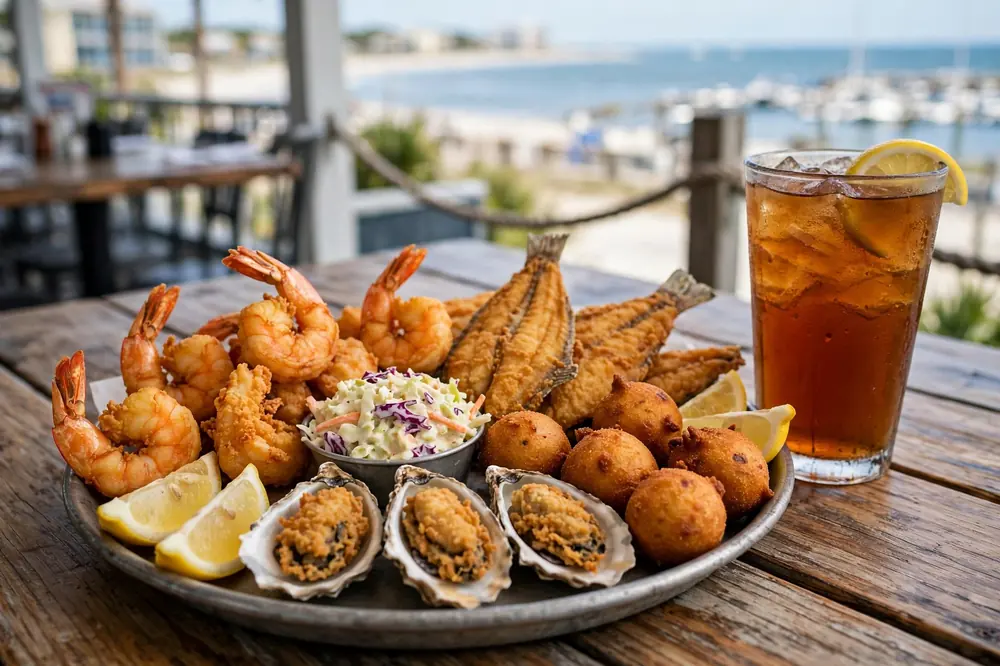
The Grand Strand’s signature plate comes from Calabash, North Carolina, just over the state line — lightly battered, lightly fried shrimp, flounder, oysters and scallops, served with hushpuppies and coleslaw. The best versions are in the small seafood houses along the Strand and in Murrells Inlet, and the portion sizes are generous: one platter feeds two light eaters. Order it at least once, and order the shrimp. This is the dish in the photograph in this article — the plate every first trip should include.
Shrimp and grits
The Lowcountry plate, done the Myrtle Beach way: fresh shrimp in a rich, buttery sauce over stone-ground grits, often with sausage, bacon and a little heat. It is on almost every menu from the boardwalk to Murrells Inlet, and it is the dish to order when you want one plate that explains the whole coast. The best versions use local shrimp — ask where the shrimp comes from, and the good places will tell you.
The seafood buffet
The Grand Strand invented the all-you-can-eat seafood buffet, and it is still the most Myrtle Beach meal there is. Captain George’s and the other big buffets serve crab legs, fried shrimp, oysters, prime rib and a dessert bar for roughly $40–$55 per person in 2026, and they are at their best on a weeknight, when the lines are short and the crab legs are fresh. It is not fine dining and it does not pretend to be — it is a feast, and it is the meal most families remember.
Beyond the three dishes above, save room for the boardwalk classics: funnel cake, saltwater taffy and a corn dog eaten while you walk, and a dinner in Murrells Inlet at sunset — the town that calls itself the Seafood Capital of South Carolina earns the title at the table, not on the sign.
Free things to do in Myrtle Beach
The beach itself — 60 miles of sand, free to walk, swim and sit on at any hour. The boardwalk too, with its arcades, its buskers and the summer fireworks. Broadway at the Beach, the Market Common and Barefoot Landing are all free to enter and stroll, and the Murrells Inlet MarshWalk costs nothing to walk at sunset. Vereen Memorial Gardens in Little River, on the Intracoastal Waterway, is a free nature park with boardwalks through the marsh. Dolphins are free to watch from any pier or from the beach at dawn. The T.I.G.E.R.S. Preservation Station in North Myrtle Beach is free to visit. And the best free thing of all is the sunrise over the Atlantic from the Cherry Grove Pier — set your alarm, bring coffee, and watch the Strand wake up.
Frequently asked questions
How many days do you need in Myrtle Beach?
Three full days covers the highlights: the boardwalk and the beach, Broadway at the Beach and the shows, and the gardens and the south Strand. Two days covers the essentials if you skip the day trip. Add a fourth day for golf, for Pawleys Island, or simply for a slow beach day — the Strand rewards a slow day.
What is the best time to visit Myrtle Beach?
April to May and September to October are the sweet spot: warm days, warm water, smaller crowds and lower hotel prices. June to August is the classic beach season, hot and busy, with the festivals and the fireworks. December to February is mild and cheap, with some attractions on reduced hours. Avoid the peak of hurricane season in September if you are booking far ahead — and check the forecast, not the calendar, for the week of your trip.
Do you need a car in Myrtle Beach?
Not downtown. The boardwalk, the beach, the SkyWheel and the Ocean Boulevard restaurants are all walkable, and rideshare covers Broadway at the Beach and the Market Common cheaply. A car is worth it if you want Brookgreen Gardens, Huntington Beach State Park, the golf courses or the Pawleys Island day trip — and the airport is only ten minutes from downtown, so a rental is easy.
Is Myrtle Beach expensive?
By American beach standards, no. A mid-range trip runs roughly $130–$260 per person per day, including a hotel, meals and one paid attraction, and the beach, the boardwalk, the MarshWalk and Broadway at the Beach are free. The expensive parts are the shows and the seafood buffets — book both in advance, and eat lunch where the locals eat, not on Ocean Boulevard.
Is Myrtle Beach safe for tourists?
The tourist areas are safe with normal city sense: stay on the boardwalk and the main streets at night, keep valuables out of sight in parked cars, and watch the ocean — rip currents are the real danger on the Strand, so swim near a lifeguard and check the flag system on the beach. The city’s busiest blocks are well lit and well patrolled in summer.
What is the one thing you should not miss in Myrtle Beach?
The SkyWheel at sunset. It is the view that makes the whole Grand Strand make sense — the beach, the boardwalk, the ocean and the lights coming on, all in one slow turn. After that, a Calabash seafood platter and a sunset dinner on the MarshWalk.
Further reading — Wikipedia and Reddit
Wikipedia — Myrtle Beach, South Carolina: the city’s history, geography and the Grand Strand. Myrtle Beach on Wikipedia
Wikipedia — Brookgreen Gardens: the sculpture garden, the Lowcountry Zoo and the history of the four plantations. Brookgreen Gardens on Wikipedia
Wikipedia — Grand Strand: the 60-mile coast, its communities and its history. Grand Strand on Wikipedia
Reddit — r/MyrtleBeach: the local community, with trip reports, restaurant recommendations and what is new in 2026. r/MyrtleBeach on Reddit
Your Myrtle Beach trip, in one paragraph
Myrtle Beach is the beach town that does everything: the boardwalk and the wheel, the aquarium and the amusement park, the sculpture garden and the seafood, the golf and the quiet island half an hour south. Three days is enough to see it properly, and the 2026 openings — the new coaster at Family Kingdom, the conservatory at Brookgreen, Flavortown at Broadway — mean the guides from last year are already out of date. Book the shows, ride the wheel at sunset, and leave a morning free for the beach. If you want more city guides from this series, start with Chicago, Nashville, Los Angeles, Orlando, Miami, San Diego, Denver, Savannah, Dallas, Charleston and San Francisco — and if the beach calls you back, the Grand Strand will still be here, 60 miles of it, waiting.

About the Author