Things to Do in Las Vegas
20 Best Attractions, a 3-Day Itinerary, Where to Stay, and the Food You Cannot Miss
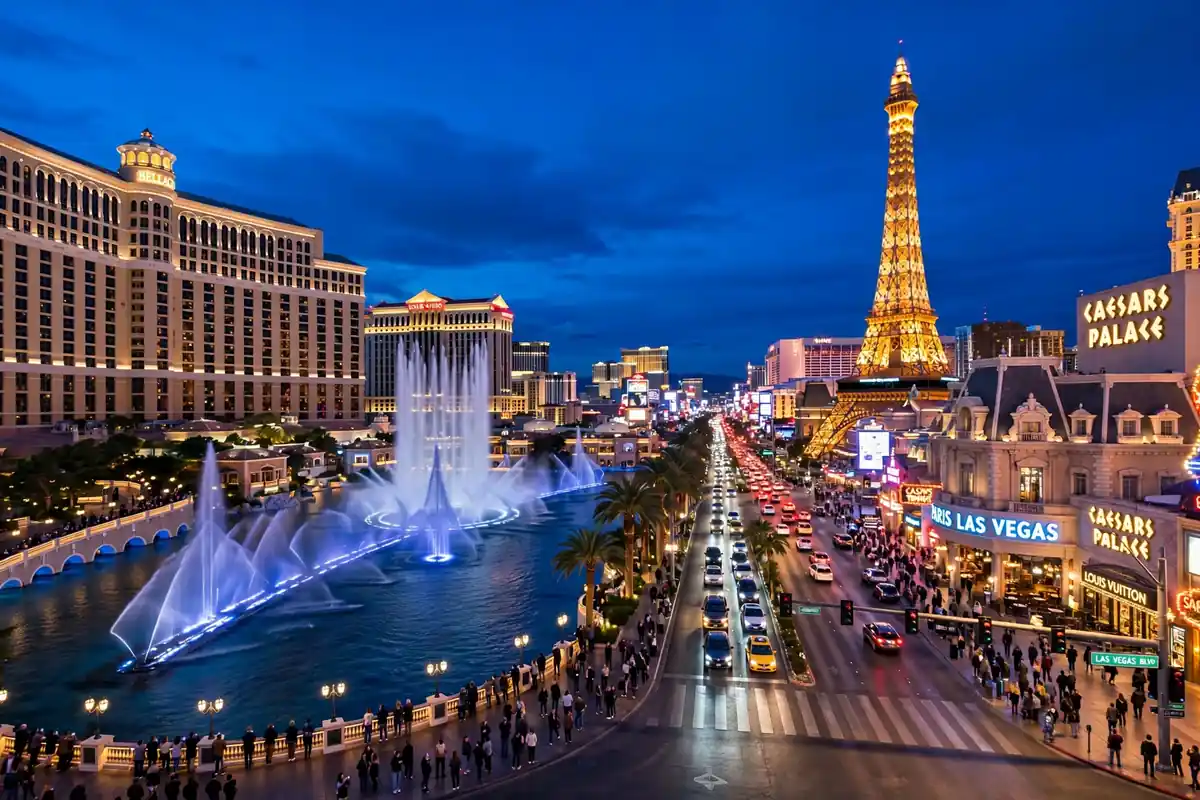
Quick Info
Best for: First-timers, show lovers, foodies and night owls — the Strip, the Sphere, world-class shows, desert day trips and free spectacles in one neon city
Best time: March–May and September–November for warm, dry days; December for holiday lights and the National Finals Rodeo
How long: 3 full days for the highlights; 2 days covers the essentials; add a 4th day for the Grand Canyon or Valley of Fire
Budget: Roughly $150–$300 per person per day for a mid-range trip, plus resort fees of roughly $40–$55 a night; the fountains, the conservatory and Fremont Street are free
Don’t miss: The Bellagio fountains at night, a show at Sphere, the Fremont Street light show, a gondola ride at the Venetian and sunrise at Red Rock Canyon
Las Vegas is the city America goes to when it wants to be someone else for a weekend. The Strip — 4.2 miles of Las Vegas Boulevard lined with the biggest resort hotels on earth — is a place where you can ride a gondola in Venice, watch the Eiffel Tower sparkle, stand under a 550-foot wheel and see a show inside a glowing ball, all before dinner. And in 2026 the city is changing faster than ever: a brand-new hotel has replaced The Cromwell, the Rio has had a $340 million makeover, the world’s largest In-N-Out has opened on the Strip, and the Sphere has become the hottest ticket in America. This guide gives you the 20 best things to do in Las Vegas in a sensible order, a ready-made 3-day itinerary, honest advice on when to go, where to stay and how to get around, and the three foods you have to try before you leave — plus the free sights that cost nothing at all. Prices and hours change, so every price in this guide is marked as approximate — always check the official website before you visit.
For background before you go, the Wikipedia entry on Las Vegas covers the city’s history, from its founding in 1905 to the mega-resort era — it is linked in Further reading at the end of this guide.
Las Vegas at a glance
| Question | Short answer |
|---|---|
| How long do you need? | 3 full days for the highlights; 2 days covers the essentials; 4 days if you add the Grand Canyon or Valley of Fire. |
| Best area for a first trip | Mid-Strip — Bellagio, Caesars Palace, Paris, Planet Hollywood and the Cosmopolitan put the fountains, the shows and the best people-watching on your doorstep. |
| One thing to book early | Sphere shows and big residencies (they sell out weeks ahead), and Hoover Dam and Red Rock Canyon timed-entry slots in busy months. |
| One thing that is free | The Bellagio fountains, the Bellagio Conservatory, the Fremont Street light show and the Welcome sign photo — the best of Las Vegas costs nothing. |
| Do you need a car? | Not on the Strip — the monorail, the Deuce bus and the free trams cover it. A car helps for Red Rock Canyon, Hoover Dam and Valley of Fire. |
The 20 best things to do in Las Vegas
The list starts with the experiences that define Las Vegas and that first-time visitors should protect time for, then moves into downtown, the museums and the desert beyond the city. If you only have two days, do numbers 1 to 10.
1. Walk the Strip at night
Start with the walk that defines the city. The Las Vegas Strip is 4.2 miles of Las Vegas Boulevard in Paradise and Winchester, just south of the city limits, lined with the biggest resort hotels in the world — and it only really wakes up after dark, when the neon comes on, the fountains dance and the whole boulevard turns into a street party. Walk it in sections rather than end to end: the blocks are far longer than they look, and a mile between mega-resorts can take half an hour with the crowds, the bridges and the detours. Come after sunset, when the light is best and the casinos spill their music onto the sidewalk, and walk the middle stretch first — from the Bellagio to the Venetian — which is where the greatest hits are.
Practical tip: The Strip walk is free and best after dark. Wear comfortable shoes, carry water in summer, and expect to be stopped for photos, flyers and street performers. The pedestrian bridges at the big intersections keep you off the road but add stairs and detours — allow twice the time you think you need.
2. Watch the Fountains of Bellagio
The fountains are the most famous free show in America — and they still stop the crowds every time. The Fountains of Bellagio shoot water 460 feet into the air across an 8.5-acre lake, choreographed to music that ranges from Sinatra to opera, with the show running every 30 minutes in the afternoon and every 15 minutes from 8 pm to midnight. Stand on the lakefront promenade for the full view, or watch from the Eiffel Tower across the street — the fountains look even better from above. The show is free, it runs in all weather, and the evening performances, with the Strip lit up behind the water, are the ones to plan your night around.
Practical tip: The fountains are free and run daily from the afternoon to midnight — prices are approximate, so check before visiting. Arrive five minutes before a show for a front-row spot on the promenade, and stay for two songs: the choreography changes with the music, and no two shows are the same.
3. See a show at Sphere
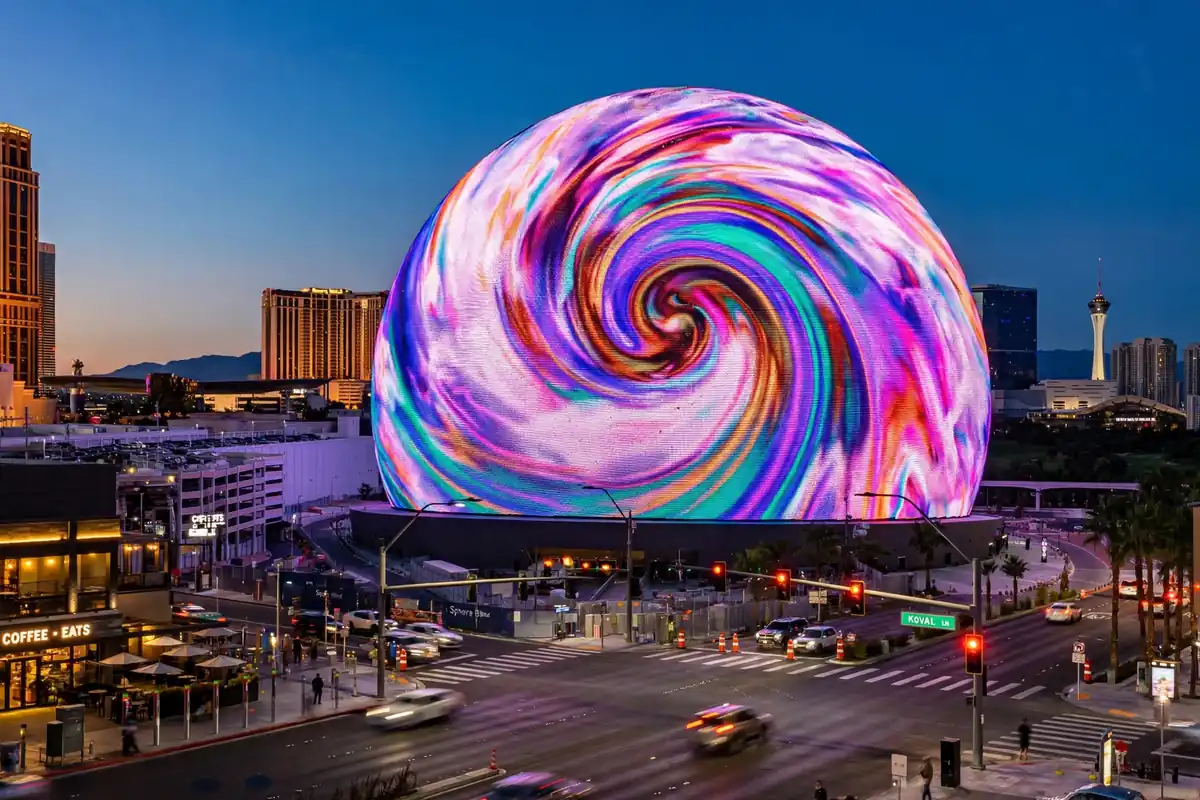
Sphere is the venue that changed Las Vegas — a 366-foot-tall ball wrapped in 580,000 square feet of LED screens, with a 16K wraparound display inside that makes you feel like you are standing inside the film. The 2026 line-up is the strongest yet: the Eagles and the Backstreet Boys are in residency, with No Doubt, Phish, ILLENIUM, Kenny Chesney and Carín León also playing the room, and The Wizard of Oz at Sphere — the 1939 film rebuilt for the giant screen with the tornado, the poppies and the Emerald City all around you — has been extended through August 2026. Even if you do not go inside, the Exosphere — the outside of the ball — is a free show in itself, with a giant eyeball, a smiley face and a pumpkin at Halloween lighting up the skyline. And on November 21, 2026, Sphere hosts the official F1 Afterparty with the Backstreet Boys after the Las Vegas Grand Prix.
Practical tip: Sphere shows cost roughly $100–$250 in 2026 — prices are approximate, so check before visiting. Book weeks ahead for residencies, sit in the 200s or 300s for the best view of the wraparound screen, and arrive early: the atrium and the AI robots are part of the experience.
4. Ride the High Roller
The High Roller is the tallest observation wheel in North America — 550 feet above the LINQ Promenade — and the best view in the city that does not require a helicopter. The High Roller takes 30 minutes for one slow rotation, with 28 glass cabins that hold 40 people each, and the whole Strip lays itself out below you: the fountains, the Eiffel Tower, the Sphere and the desert mountains beyond. Ride at sunset, when the neon is coming on and the light turns gold, or at night, when the wheel itself glows. The happy-hour cabins, with a bartender and an open bar inside the cabin, are the most Las Vegas way to do it.
Practical tip: A daytime ride costs roughly $30–$40 and a night ride roughly $40–$55 in 2026 — prices are approximate, so check before visiting. Book the sunset slot online if you are visiting on a weekend, and pair the ride with dinner on the LINQ Promenade, which has the city’s best cluster of casual restaurants and bars.
5. Fremont Street Experience
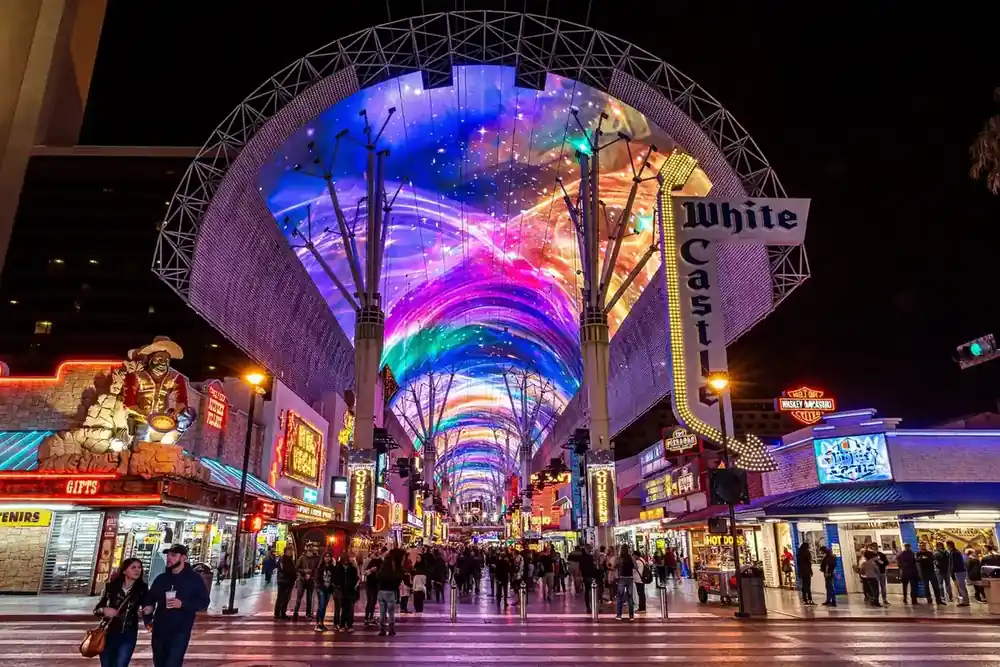
Downtown is where Las Vegas began, and Fremont Street is where it still feels most like itself. The Fremont Street Experience is a five-block pedestrian mall under a 1,500-foot LED canopy called Viva Vision — the largest video screen in the world — which puts on a free light show every hour after dark, with music, street performers and the old neon signs glowing above the casinos. It is louder, cheaper and more chaotic than the Strip, and that is the point: the $5 blackjack tables, the free concerts on three stages, the SlotZilla zipline flying under the canopy, and the Golden Nugget’s shark tank slide are all here. Come after dark, when the canopy is at its brightest and the street fills up.
Practical tip: Fremont Street is free to enter and the light shows are free — prices are approximate, so check before visiting. The SlotZilla zipline costs roughly $30–$50, and the upper Zoomline, which flies you 1,700 feet under the canopy, is the one to book. Take the Deuce bus or a rideshare downtown; the walk from the Strip is long and the route is not scenic.
6. The Neon Museum
The Neon Museum is the graveyard where old Las Vegas goes to be remembered — more than 200 retired signs from the city’s casinos and motels, laid out in the Neon Boneyard, including the Stardust, the Riviera and the original Aladdin. The Neon Museum is at its best after dark, when the restored signs are lit up on the night tour and the boneyard glows like a junkyard cathedral. The daytime tour is cheaper and easier to book, but the night tour is the one people remember: the signs, the stories of the mob-era casinos, and the La Concha lobby — a 1961 Googie shell that is itself a piece of Vegas history. Book ahead in any season; the small-group tours sell out.
Practical tip: Admission costs roughly $20–$28 in 2026 — prices are approximate, so check before visiting. The museum is a short walk from Fremont Street, so pair it with a downtown evening, and take the guided tour rather than wandering alone: the stories are half the point.
7. The Mob Museum
The Mob Museum is the best museum in Las Vegas, and the one that explains the city better than any casino tour. Housed in the 1933 federal courthouse downtown, the Mob Museum tells the story of organised crime and law enforcement in America — the Prohibition stills, the St. Valentine’s Day Massacre wall, the wiretap room, and the courtroom where the Kefauver hearings were held in 1950. The basement speakeasy, The Underground, serves Prohibition-era cocktails behind a hidden door, and the museum’s crime lab lets you try forensic science for yourself. Give it two hours, and go in the morning, before the downtown crowds arrive.
Practical tip: Admission costs roughly $30 for adults in 2026 — prices are approximate, so check before visiting. Nevada residents get a discount, and the museum is a five-minute walk from Fremont Street, so it pairs naturally with the Neon Museum and a downtown lunch.
8. Ride a gondola at the Venetian
The Venetian is the most romantic resort on the Strip, and the gondola ride is its signature. The Grand Canal Shoppes hold a quarter-mile of canals, indoor and outdoor, with singing gondoliers in striped shirts steering black gondolas under bridges and past the cafés — and the outdoor ride, which floats past the Strip with the fake sky above you, is the one to book. The resort itself is worth an hour even without the ride: the Doge’s Palace facade, the Rialto Bridge, the hand-painted ceilings and the street performers in the St. Mark’s Square are the closest thing to Venice without a passport. Go in the late afternoon, when the light on the water is best.
Practical tip: An outdoor gondola ride costs roughly $39 per person and the indoor ride roughly $34 in 2026 — prices are approximate, so check before visiting. Book the sunset slot online in summer, and expect a queue on weekend evenings; the ride lasts about 15 minutes.
9. The Bellagio Conservatory & Botanical Gardens
The Bellagio Conservatory is the quietest, prettiest room in Las Vegas — and it is free. The 14,000-square-foot glasshouse next to the hotel lobby changes its display five times a year, with tens of thousands of flowers, plants and trees built into a themed garden: spring tulips, summer topiary, the autumn harvest, the holiday display and the Lunar New Year garden. The holiday display, with its giant trees and falling snow, is the most popular, and the Lunar New Year garden, with its dragons and lanterns, is the most photographed. It takes twenty minutes, it costs nothing, and it is the best break from the casino floor in the city.
Practical tip: The Conservatory is free and open 24 hours — prices are approximate, so check before visiting. Go early in the morning for the quietest visit and the best photographs, and pair it with the fountains outside, which are a two-minute walk from the garden doors.
10. Eiffel Tower at Paris Las Vegas
The Eiffel Tower at Paris Las Vegas is a half-scale replica of the Paris original — 541 feet tall, with a viewing deck at 46 stories — and it has the best straight-on view of the Bellagio fountains in the city. Ride the elevator to the top at sunset, when the fountains are dancing below you and the Strip lights are coming on, and you will see why this is the most popular proposal spot in Las Vegas. The tower is also the best place to watch the fountains without fighting the promenade crowds, and the restaurant at its base, the Eiffel Tower Restaurant, is one of the most romantic tables on the Strip. The tower lights up at night, and the whole resort — the facade, the cobbled streets, the balloon sign — is worth a wander.
Practical tip: The viewing deck costs roughly $30 in 2026 — prices are approximate, so check before visiting. Buy the ticket online to skip the queue, and go at sunset: the fountains, the tower and the Strip all light up at once.
11. The STRAT Tower and thrill rides
The STRAT is the Strip’s wild card — a 1,149-foot tower at the north end with an observation deck, a revolving restaurant, and three thrill rides on the roof that exist nowhere else. The SkyJump lets you step off the 108th floor and free-fall 829 feet to the ground, the Big Shot fires you 160 feet straight up the mast, and X-Scream dangles you over the edge of the tower, 866 feet above the street. Even if you skip the rides, the observation deck has the best full-length view of the Strip in the city, with the whole 4.2 miles laid out below you and the mountains ringing the valley. Come at sunset, when the tower is quiet and the city lights up.
Practical tip: The observation deck costs roughly $30 in 2026, the rides roughly $25 each, and the SkyJump roughly $140 — prices are approximate, so check before visiting. The tower is at the north end of the Strip, so take the monorail or a rideshare rather than walking, and note that the rides close in high winds.
12. Red Rock Canyon
Red Rock Canyon is the reason to leave the Strip for half a day — 195,000 acres of red sandstone cliffs, desert trails and Joshua trees, twenty minutes west of the city. The 13-mile scenic drive loops through the canyon with overlooks at every turn, and the Calico Hills, with their bands of red, orange and cream rock, are the most photographed stop. Hike the Calico Tanks trail for the view over the whole valley, or the shorter boardwalk trails if you have children, and come at sunrise, when the rocks glow red and the desert is empty. It is the closest thing to the Grand Canyon without the drive, and the best morning in Las Vegas that does not involve a casino.
Practical tip: The scenic drive costs $15 per vehicle and a timed-entry reservation is required — book it on recreation.gov before you go; prices are approximate, so check before visiting. Bring more water than you think you need, wear a hat, and do not hike in the midday summer heat: the desert kills every year.
13. Day trip: Hoover Dam
Hoover Dam is the engineering marvel that made Las Vegas possible — a 726-foot concrete arch-gravity dam on the Colorado River, 30 miles south-east of the city, holding back Lake Mead. Walk across the top for the view down the dam face and the new Mike O’Callaghan–Pat Tillman Memorial Bridge, which frames the dam perfectly, then take the powerplant tour down into the generators, 530 feet below the river. The dam tour, which goes into the inspection tunnels, is the deeper experience and sells out first. Pair it with a stop at Lake Mead, or with the drive back through Boulder City, the town built for the dam workers in the 1930s.
Practical tip: Parking costs roughly $10, the powerplant tour roughly $15 and the dam tour roughly $30 in 2026 — prices are approximate, so check before visiting. Book the dam tour online, arrive early to beat the tour buses, and allow half a day for the round trip.
14. The Welcome to Fabulous Las Vegas sign
The Welcome to Fabulous Las Vegas sign is the most photographed sign in America — and the cheapest attraction in the city, because it is free. Built in 1959 and designed by Betty Willis, the 25-foot diamond-shaped sign stands in the median at the south end of the Strip, just south of Russell Road, and the small parking lot beside it means you can walk right up to it. Go early in the morning, when the light is soft and the queue is short, or at night, when the sign glows and the Strip stretches out behind you. The wedding chapels nearby will marry you on the spot if the mood takes you — and in Las Vegas, it often does.
Practical tip: The sign is free and open all day — prices are approximate, so check before visiting. Take the Deuce bus or a rideshare to the sign; walking there from the nearest resort means crossing the highway, and the lot fills up by mid-morning.
15. See a Cirque du Soleil show
Cirque du Soleil built modern Las Vegas entertainment, and its shows are still the benchmark. “O” at the Bellagio is the masterpiece — an aquatic show in a 1.5-million-gallon pool, with synchronised swimmers, aerialists and divers dropping from 60 feet into the water — and it has been running since 1998 without losing a step. Mystère at Treasure Island, the original, is the family pick, with its clown, its aerial ballet and its taiko drums, while Michael Jackson ONE at Mandalay Bay is the loudest, with the King of Pop’s catalogue driving the acrobatics. Book one, not three: they are all excellent, and one great show beats three rushed ones.
Practical tip: Cirque tickets start from roughly $80 and run past $200 for the best seats in 2026 — prices are approximate, so check before visiting. Book at least a week ahead for weekend performances, and note that Mad Apple closed in September 2026 and Awakening at Wynn closes on October 10, 2026, so check the current line-up before you book any show.
16. AREA15 and Meow Wolf’s Omega Mart
AREA15 is the weirdest place in Las Vegas — a 200,000-square-foot warehouse district off the Strip that is part art gallery, part nightclub, part funhouse. The centrepiece is Meow Wolf’s Omega Mart, a supermarket that turns out to be a portal to another dimension: walk through the freezer door and you are in a psychedelic maze of alien landscapes, secret slides and hidden rooms, with a story to piece together as you go. Outside the mart, AREA15 holds virtual-reality rides, a zip line, live music, food trucks and the Museum of Ice Cream, which is opening its largest location yet here in 2026. Go in the evening, when the lights come on and the place fills up, and give Omega Mart two hours.
Practical tip: AREA15 entry is free and Omega Mart tickets cost roughly $50 in 2026 — prices are approximate, so check before visiting. Book Omega Mart online, take a rideshare (it is a mile west of the Strip), and do not rush: the best rooms are the ones you have to find.
17. Shark Reef Aquarium at Mandalay Bay
Shark Reef Aquarium is the best family attraction on the Strip that is not a show — a 1.6-million-gallon aquarium at Mandalay Bay with more than 2,000 animals, including 15 species of shark, rays, sea turtles and a Komodo dragon. The centrepiece is the shark tunnel, where sandtiger sharks, sawfish and green sea turtles glide overhead, and the touch pool lets you handle rays and horseshoe crabs. It is a 45-minute visit that works in any weather, and it is the one attraction that keeps children happy while the adults recover from the night before. Pair it with the Mandalay Bay beach, the 11-acre pool complex with its wave pool and lazy river.
Practical tip: Admission costs roughly $30 for adults in 2026 — prices are approximate, so check before visiting. Go in the morning, when the aquarium is quietest, and book the shark-dive experience in advance if you are certified: it sells out.
18. The LINQ Promenade and Fly LINQ zipline
The LINQ Promenade is the Strip’s most walkable half-mile — a car-free street of restaurants, bars, shops and street performers between the LINQ hotel and the High Roller, with the city’s best cluster of casual dining. Above it runs Fly LINQ, the only zipline on the Strip, which launches you from a 12-storey tower and flies you 1,100 feet over the promenade, seated or superhero-style, face down. It is the cheapest thrill ride in the city and the best photograph of the High Roller, and the promenade itself is the right place for a low-key evening: the Yard House, the Brooklyn Bowl, the ice bar, and the street performers who are better than some of the shows.
Practical tip: The Fly LINQ zipline costs roughly $25–$35 in 2026 — prices are approximate, so check before visiting. Ride at sunset for the best light, and note that the promenade is where the world’s largest In-N-Out opened on June 9, 2026, at BLVD Las Vegas, with seating for 220 guests.
19. Day trip: Valley of Fire
Valley of Fire is the most beautiful place within an hour of Las Vegas — 40,000 acres of red Aztec sandstone in the Mojave Desert, 50 miles north-east of the city, with petrified logs, ancient petroglyphs and rock formations that look like they were carved by hand. Hike the Fire Wave trail, a 1.5-mile loop to a striped slickrock wave that glows orange at sunset, then drive the Valley of Fire Highway to the Elephant Rock and the Beehives, and stop at Atlatl Rock to see the petroglyphs carved a thousand years ago. It is the day trip photographers choose over the Grand Canyon, because it is closer, quieter and stranger.
Practical tip: Entry costs $15 per vehicle for out-of-state visitors in 2026 — prices are approximate, so check before visiting. Go at sunrise or sunset, when the rocks burn red, carry at least a litre of water per person, and do not hike in the midday summer heat. The park is an hour’s drive from the Strip, so leave by 7 am.
20. Catch a residency or a big show
Las Vegas in 2026 is the residency capital of the world, and the last night of your trip should be a show. The Colosseum at Caesars Palace has Dolly Parton, Kelly Clarkson, Jennifer Lopez and Cyndi Lauper in 2026; the Dolby Live at Park MGM has Zayn, Chris Stapleton and New Kids on the Block; and Allegiant Stadium, the Raiders’ home, has Bruno Mars, Morgan Wallen, Ed Sheeran, AC/DC, Guns N’ Roses and the Foo Fighters. The residencies are the smart pick: the production is built for the room, the sound is perfect, and the tickets are cheaper than a one-night stadium show. And if you are here on November 19–21, 2026, the Formula 1 Las Vegas Grand Prix takes over the Strip itself, with the race on Saturday night at 8 pm and the Backstreet Boys headlining the official afterparty at Sphere.
Practical tip: Residency tickets start from roughly $80 in 2026 — prices are approximate, so check before visiting. Book the moment tickets go on sale, check the venue’s bag policy before you go, and remember that the Mirage closed in July 2024 and is being rebuilt as the Hard Rock Las Vegas, opening in 2027 — the volcano show is gone, so do not plan your night around it.
Las Vegas in 3 days — a ready-made itinerary
| Day | Morning | Afternoon | Evening |
|---|---|---|---|
| Day 1 — The Strip | Welcome sign photo and the Bellagio Conservatory | Walk the mid-Strip, High Roller and the Venetian gondolas | Bellagio fountains, dinner, and a Cirque show |
| Day 2 — Downtown and the museums | Neon Museum and the Mob Museum | Pool time and AREA15 with Omega Mart | Fremont Street light show and dinner downtown |
| Day 3 — The desert and the big night | Red Rock Canyon at sunrise | Hoover Dam or Valley of Fire | A residency or a Sphere show, and the Strip at night |
Day 1 — The Strip
Start at the Welcome sign for the photograph, then walk the mid-Strip: the Bellagio Conservatory in the morning light, the fountains at noon, the Venetian canals and a gondola ride in the afternoon, and the High Roller at sunset. Have dinner on the LINQ Promenade, watch the fountains again after dark — they are better at night — and finish with a Cirque show at the Bellagio or Treasure Island. Day one is the classic Las Vegas, and it is the one to get right.
Day 2 — Downtown and the museums
Take the Deuce bus downtown in the morning. Start at the Mob Museum, then the Neon Museum, and have lunch on Fremont Street, where the food is cheaper and better than on the Strip. Spend the afternoon by the pool — every resort has one, and the daybed is the best money you will spend — then take a rideshare to AREA15 for Omega Mart. Finish the day back on Fremont Street after dark, when the Viva Vision canopy lights up and the street fills with music.
Day 3 — The desert and the big night
Leave early for Red Rock Canyon at sunrise, when the rocks glow and the desert is empty, and be back on the Strip by lunch. Spend the afternoon at Hoover Dam or Valley of Fire if you have the energy, or take it slow: a spa, a long lunch, and the Flamingo Wildlife Habitat. Save the last night for the big show — a residency at the Colosseum or a night at Sphere — and end it the way Las Vegas ends every night: on the Strip, under the neon, with the fountains dancing one last time.
Best time to visit Las Vegas
| Season | What it is like | Best for |
|---|---|---|
| Winter (December–February) | Mild days in the 50s and 60s, cold nights, the cheapest hotels — with the National Finals Rodeo in December and holiday lights everywhere | First trips, budget trips, the rodeo |
| Spring (March–May) | Warm days in the 70s and 80s, pool season opening, the desert in bloom | First trips, pools, desert day trips |
| Summer (June–August) | Brutally hot, highs over 100°F, the busiest pools and the cheapest rooms | Pools, night shows, budget trips |
| Autumn (September–November) | Warm and golden, smaller crowds, the Formula 1 Grand Prix in November | First trips, the best weather of the year, F1 |
The best time to visit Las Vegas is March to May or September to November, when the days are warm, the desert is comfortable and the crowds are manageable. Summer is the classic season — hot, busy and full of pool parties — but the heat is real: highs pass 100°F most days from June to August, so plan your walking for the morning and the evening. Winter is mild and the cheapest time to visit, with the National Finals Rodeo running December 3–12, 2026 at the Thomas & Mack Center. Avoid the Formula 1 weekend of November 19–21, 2026 unless you are coming for the race: the Strip closes to traffic, the hotels triple their prices, and the whole city is a race track.
Where to stay in Las Vegas
| Area | Who it suits | Why stay there |
|---|---|---|
| Mid-Strip | First-timers, show lovers | Bellagio, Caesars Palace, Paris, Planet Hollywood and the Cosmopolitan — the fountains, the shows and the best walking on your doorstep |
| South Strip | Families, pool lovers | Mandalay Bay, Luxor, Excalibur and MGM Grand — the biggest pools, the aquarium and the arena on your doorstep |
| North Strip | Luxury travellers, quiet nights | Wynn, Encore, the Venetian, Palazzo, Resorts World and Fontainebleau — the newest rooms and the quietest Strip on your doorstep |
| Downtown | Budget travellers, old Vegas | Golden Nugget, Circa and the Plaza — Fremont Street, the museums and the cheapest tables on your doorstep |
| Off-Strip | Locals’ Vegas, a quiet base | Red Rock Casino, Green Valley Ranch and the M Resort — the locals’ casinos, the golf and the desert on your doorstep |
First-timers should stay mid-Strip, where the Bellagio, Caesars Palace and the Cosmopolitan put the fountains, the shows and the best people-watching on your doorstep. Families who want the biggest pools should look at the south Strip, and luxury travellers who want a quieter night should look at the north Strip, where the Wynn, the Venetian and Fontainebleau are. Downtown suits budget travellers and anyone who wants old Vegas, and the off-Strip resorts suit a quiet base with a car. Two hotel notes for 2026: the Vanderpump Hotel opened on May 26, 2026, replacing The Cromwell at Flamingo Road, and the Rio has reopened as a Destination by Hyatt property after a $340 million renovation, with 1,500 remodelled suites and a new food hall. Whatever you book, check the resort fee before you pay: most Strip hotels add roughly $40–$55 a night plus tax, and it is never included in the headline room rate.
Getting around Las Vegas
Walking is the default on the Strip, but the distances lie: the blocks are long, the resorts are set back from the road, and a walk that looks like ten minutes is often thirty. The monorail runs the east side of the Strip from the Sahara to MGM Grand, with a day pass costing roughly $15 — prices are approximate, so check before visiting — and it is the fastest way to move north to south without a car. The Deuce double-decker bus runs the whole Strip and downtown, with a 24-hour pass costing roughly $8, and it is the cheapest way to get to Fremont Street. Three free trams help too: the Mandalay Bay–Luxor–Excalibur tram, the ARIA Express between Park MGM, Crystals and the Bellagio, and the Mirage–Treasure Island tram, which is closed while the Mirage is rebuilt. For everything else, rideshare is cheap and fast, and a car is only worth having if you plan the desert day trips — Red Rock Canyon, Hoover Dam and Valley of Fire — and the airport is only about fifteen minutes from the Strip.
Las Vegas food you have to try
The Las Vegas buffet
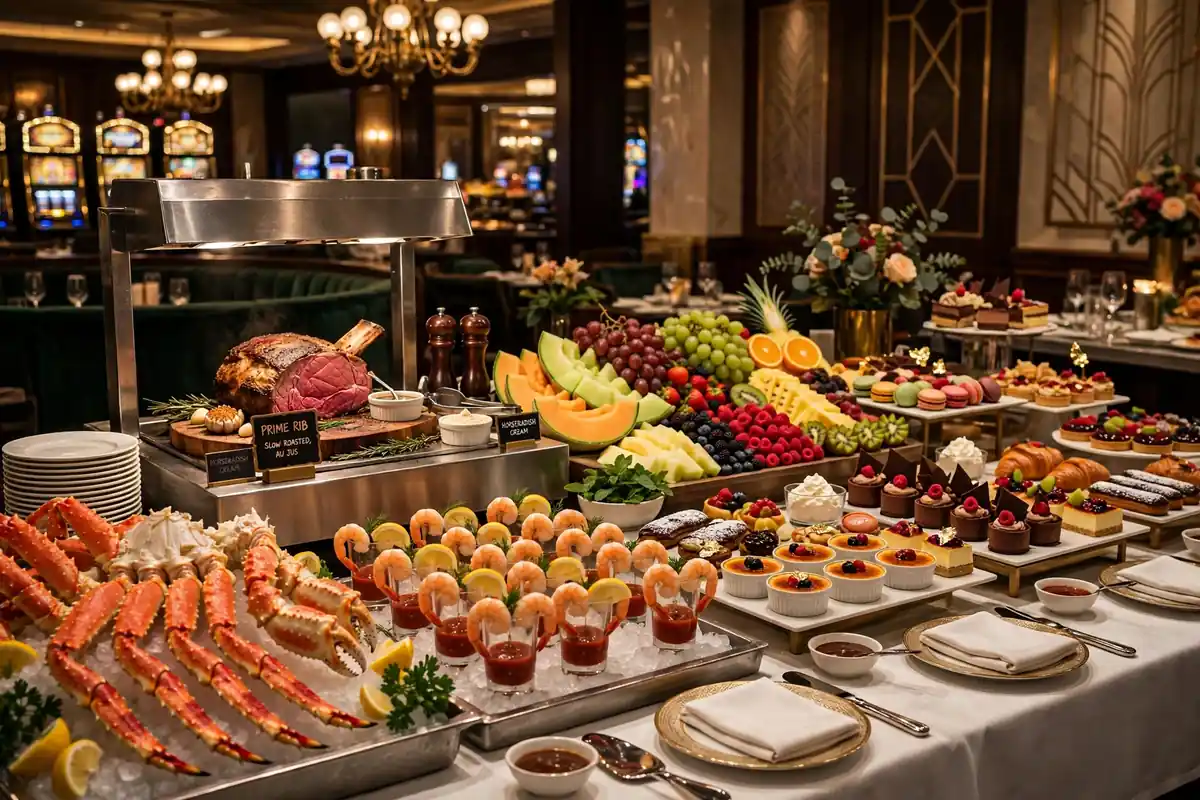
The buffet is the most Las Vegas meal there is, and the city still does it better than anywhere else. The Bacchanal Buffet at Caesars Palace is the benchmark — nine kitchens, hundreds of dishes, crab legs, prime rib, dim sum and a dessert room the size of a casino floor — and the Wynn Buffet and the Bellagio Buffet are close behind. Dinner is the splurge, lunch is the value, and the weekday lunch is the smartest booking in the city: the same food, half the queue, and a price that makes the Strip make sense. Book ahead in any season; the good buffets sell out on weekends.
Chinatown on Spring Mountain Road
The best food in Las Vegas is not on the Strip — it is on Spring Mountain Road, where the city’s Chinatown holds the best Asian restaurants in the American West. Lotus of Siam is the legend, a Thai restaurant in a strip mall that has been on every best-of list for twenty years, with northern Thai dishes you will not find anywhere else in America. Around it are ramen shops, dim sum houses, Korean barbecue, Vietnamese pho and Chinese bakeries, all cheaper and better than the Strip versions. Take a rideshare west from the Strip — it is ten minutes — and go hungry: the portions are generous and the prices are half what you pay on Las Vegas Boulevard.
In-N-Out Burger
In-N-Out is a California institution, and Las Vegas now has the biggest one in the world. The world’s largest In-N-Out opened on June 9, 2026 at BLVD Las Vegas, with indoor seating for 170 guests and an outdoor patio for 50 more, and it is the cheapest good meal on the Strip: a Double-Double, fries and a drink for roughly $12. Order it Animal Style — mustard-grilled patty, extra spread, grilled onions and pickles — and eat it the way the locals do, standing on the sidewalk with the neon behind you. The queue is long at lunch, so go at 3 pm, when the crowds are at the pool.
Beyond the three dishes above, save room for the Strip classics: the Secret Pizza slice at the Cosmopolitan, hidden on the third floor with no sign, the late-night tacos on Fremont Street, and a proper steakhouse dinner — the city has more great steakhouses per square mile than anywhere in America. And one warning: the famous cheap shrimp cocktail is long gone, and so are the $1.99 breakfasts — Las Vegas is not the bargain it was in the 1990s, so budget for the food, not just the room.
Free things to do in Las Vegas
The Bellagio fountains are the headline, but the free list runs long. The Bellagio Conservatory changes its garden five times a year and costs nothing. The Flamingo Wildlife Habitat, with its Chilean flamingos, koi and turtles, is free and open all day. The Fremont Street light show runs every hour after dark and costs nothing. The Fall of Atlantis show at the Forum Shops at Caesars Palace — a free animatronic show with fire and falling water — runs every hour. Seven Magic Mountains, the seven neon boulders in the desert ten miles south of the city, is free and open all day. And the best free thing of all is the Strip itself after dark: the neon, the fountains, the street performers and the crowds, all free, all night.
Frequently asked questions
How many days do you need in Las Vegas?
Three full days covers the highlights: the Strip and the shows, downtown and the museums, and one desert day trip. Two days covers the essentials if you skip the day trip and pick one show. Add a fourth day for the Grand Canyon, for Valley of Fire, or simply for a slow pool day — Las Vegas rewards a slow day more than a rushed one.
Is Las Vegas worth visiting if you don’t gamble?
Yes — and most first-timers barely gamble at all. The shows, the food, the pools, the museums, the desert day trips and the free spectacles are the real Las Vegas now, and the casinos are the backdrop rather than the point. The Bellagio fountains, the Sphere, Fremont Street, Red Rock Canyon and the buffets are all better than any slot machine, and none of them requires a bet.
What is the best time to visit Las Vegas?
March to May and September to November are the sweet spot: warm days, comfortable desert, smaller crowds and lower hotel prices. June to August is the classic pool season, hot and busy, with the cheapest rooms. December to February is mild and cheap, with the rodeo and the holiday lights. Avoid the Formula 1 weekend of November 19–21, 2026 unless you are coming for the race.
Is Las Vegas expensive?
It can be, but it does not have to be. A mid-range trip runs roughly $150–$300 per person per day, including a hotel, meals and one paid attraction — and the fountains, the conservatory, Fremont Street and the Welcome sign are free. The expensive parts are the shows, the resort fees of roughly $40–$55 a night, and the Strip restaurants. Book the shows in advance, eat lunch off the Strip, and check the resort fee before you pay.
Can you walk the Las Vegas Strip?
Yes, but plan for it: the Strip is 4.2 miles end to end, the blocks are long, and a walk that looks like ten minutes is often thirty. Walk it in sections, use the monorail or the Deuce bus for the long stretches, and take the free trams between the resorts. In summer, walk in the morning and the evening, and carry water — the desert heat is the real danger, not the distance.
Is Las Vegas safe at night?
The tourist areas are safe with normal city sense: stay on the Strip and Fremont Street, where the crowds and the security are, keep valuables out of sight, and do not walk alone in the unlit areas between the resorts. The Strip and Fremont Street are well lit and well patrolled all night. The real risks are the heat, the dehydration and the pickpockets in the crowds — drink water, keep your bag closed, and take a rideshare rather than walking the dark stretches.
Further reading — Wikipedia, Reddit and Quora
Wikipedia — Las Vegas: the city’s history, geography and the Strip. Las Vegas on Wikipedia
Wikipedia — Las Vegas Strip: the 4.2-mile boulevard, its resorts and its history. Las Vegas Strip on Wikipedia
Wikipedia — Sphere: the venue, its LED display and its residencies. Sphere on Wikipedia
Wikipedia — Red Rock Canyon: the conservation area, the scenic drive and the trails. Red Rock Canyon on Wikipedia
Reddit — r/LasVegas: the local community, with trip reports, show news and what is new in 2026. r/LasVegas on Reddit
Quora — What do you suggest is a “must see”, if visiting Las Vegas, for the first time? Real answers from first-time visitors. Must-see Las Vegas on Quora
Your Las Vegas trip, in one paragraph
Las Vegas is the city that does everything at full volume: the Strip and the fountains, the Sphere and the shows, the desert and the food, the neon and the quiet morning in the canyon. Three days is enough to see it properly, and the 2026 changes — the Vanderpump Hotel, the new Rio, the world’s largest In-N-Out, the Sphere residencies and the Formula 1 weekend — mean the guides from last year are already out of date. Book the shows, watch the fountains at night, and leave a morning free for the desert. If you want more city guides from this series, start with Chicago, Nashville, Los Angeles, Orlando, Miami, San Diego, Denver, Savannah, Dallas, Charleston, San Francisco and Myrtle Beach — and if the neon calls you back, the Strip will still be here, 4.2 miles of it, waiting.

About the Author