Things to Do in Savannah
20 Best Attractions, a 3-Day Itinerary, Where to Stay, and the Food You Cannot Miss
Quick Info
Best for: History lovers, ghost hunters, foodies and first-time visitors — oak-shaded squares, antebellum houses, Lowcountry food and the beach in one walkable city
Best time: March–May and October–early December for mild days and golden light; March for St. Patrick’s Day, one of America’s biggest parades
How long: 2 full days for the highlights; 3 days if you add Tybee Island and Wormsloe
Budget: Roughly $130–$250 per person per day for a mid-range trip; the squares, Forsyth Park, River Street and the cemeteries are free
Don’t miss: Sunrise in Forsyth Park, a tour of the Owens-Thomas House, Bonaventure at dusk, shrimp and grits, and a ghost tour after dark
Savannah is the oldest city in Georgia — and the prettiest city in the American South. Founded in 1733 by General James Oglethorpe as America’s first planned city, it was laid out on a grid of 24 public squares, 22 of which survive today as shaded, oak-draped living rooms ringed by antebellum houses. The Historic District — 2.5 square miles, one of the largest urban National Historic Landmark Districts in the United States — is the city at its best: walkable, slow, beautiful, and haunted in the best sense of the word. Add the river, the cemeteries, the Lowcountry food and a beach twenty minutes away, and you have the easiest weekend trip in the South.
This guide gives you the 20 best things to do in Savannah in a sensible order, a ready-made 3-day itinerary, honest advice on when to go, where to stay and how to get around, and the three foods you have to try before you leave. Prices and hours change, so every price in this guide is marked as approximate — always check the official website before you visit.
Savannah at a glance
| Question | Short answer |
|---|---|
| How long do you need? | 2 full days for the highlights; 3 days is the balanced first trip; 4 days if you add Tybee Island and a second day trip. |
| Best area for a first trip | The Historic District, around Bull Street and the squares — everything in this guide is a walk from there. |
| One thing to book early | Owens-Thomas House tours, ghost tours on weekends, and Tybee Island hotels in summer — all sell out. |
| One thing that is free | The squares, Forsyth Park, River Street, the cemeteries and the Savannah Belles Ferry — the best of Savannah costs nothing. |
| Do you need a car? | Not in the Historic District — it is flat and walkable, with a free shuttle and ferry. A car helps for Bonaventure, Wormsloe and Tybee Island. |
For background before you go, the Wikipedia entry on Savannah covers the city’s history, from Oglethorpe’s 1733 plan to the Civil War and the preservation movement — all three are linked in Further reading at the end of this guide.
The 20 best things to do in Savannah
The list starts with the experiences that define Savannah and that first-time visitors should protect time for, then moves into houses, history and the coast beyond the city. If you only have two days, do numbers 1 to 10.
1. Walk the 22 squares
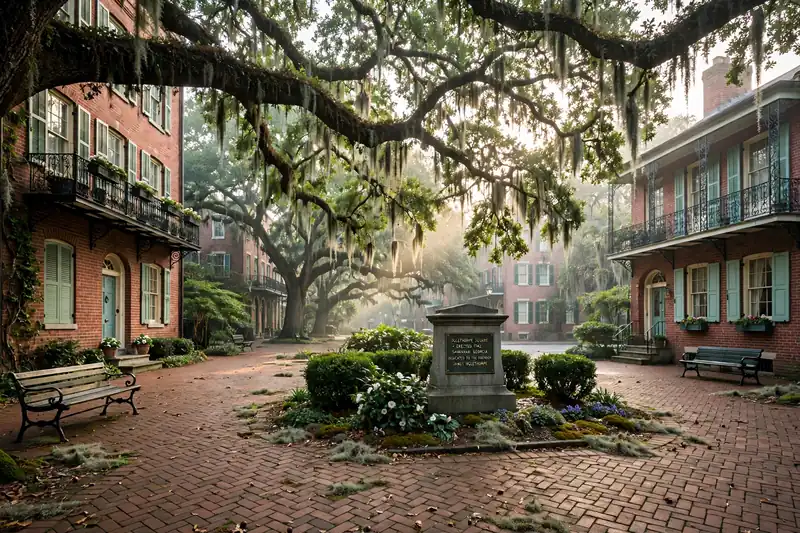
Savannah’s squares are the city’s defining feature — and the best free thing in the city. James Oglethorpe laid out the city in 1733 on a grid of wards, each with a public square at its centre; 24 squares were planned and 22 survive, each one a small park of live oaks, Spanish moss, benches and a monument. Walk Bull Street from the river to Forsyth Park and you pass five of the best in a row: Johnson Square, the oldest and largest, laid out in 1733; Wright Square, with the boulder honouring Yamacraw chief Tomochichi; Chippewa Square, where the Forrest Gump bench scene was filmed; Madison Square, with its 1888 Sergeant Jasper monument; and Monterey Square, the prettiest of them all, anchored by the Mercer-Williams House.
Practical tip: Go early: by 7am the light is filtering through the oak canopy and you will have the squares almost to yourself. Download a free walking map of the squares from Visit Savannah’s website before you go.
2. Forsyth Park and the fountain
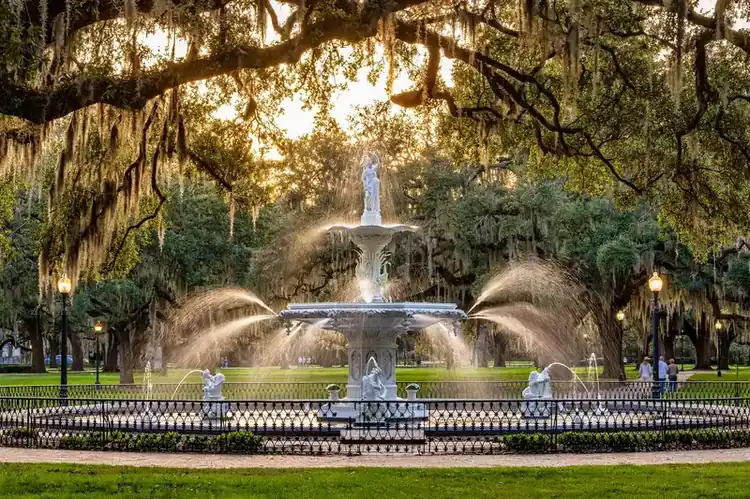
Forsyth Park is Savannah’s front garden: 30 acres at the southern end of the Historic District, with walking paths, a Fragrant Garden for the blind, tennis courts and the most photographed fountain in America. The white cast-iron fountain was ordered from the New York ironworks Janes, Beebe & Co. as “Model #5”, installed in July 1858 and modelled on the fountains of the Place de la Concorde in Paris — and it has just had its first major restoration since 1988. The city removed it in June 2025, spent about $650,000 restoring it piece by piece in Alabama, and turned the water back on on December 19, 2025, with a community celebration and the Georgia Trust’s Chairman’s Award to follow. On St. Patrick’s Day the fountain is ceremoniously turned green, and on Saturday mornings the farmers’ market fills the north end with Georgia pecans, watermelon juice and local honey.
Practical tip: The park is free and open all year. Go at sunrise for the quietest photographs, and don’t be surprised if the fountain is switched off now and then for maintenance — it still shuts down periodically.
3. Tour the Owens-Thomas House & Slave Quarters
The Owens-Thomas House is the one interior you should pay to see in Savannah. The 1819 Regency house by English architect William Jay is one of the finest houses in America, with a curved bridge over its courtyard, a cast-iron balcony and a garden that still feels like 1819 — and the guided tour tells the full story, including the slave quarters where the people enslaved by the Owens family lived and worked. It is one of three Telfair Museums sites, and the $30 Telfair ticket covers all three — the Owens-Thomas House, the Telfair Academy and the modern Jepson Center — for seven days. The big news for 2026: Mary’s, a new café in the Jepson Center atrium, opens on November 17, 2026.
Practical tip: Admission is by the $30 Telfair ticket, which covers three museums for seven days — prices are approximate, so check before visiting. All three Telfair sites are closed on Mondays, and tour times are assigned at check-in, so arrive early. Allow 45 to 60 minutes.
4. Stroll River Street
River Street is Savannah’s working waterfront turned into its liveliest evening walk: a row of 19th-century cotton warehouses along the Savannah River, now shops, bars and restaurants, with cobblestones underfoot and container ships sliding past a few hundred yards away. Start at the Waving Girl statue — Florence Martus, who waved at every ship for 44 years — and walk east past the candy shops, where River Street Sweets has been pulling pralines on marble slabs since 1973, to the riverfront benches at the far end. Savannah’s Candy Kitchen opened its third Savannah store on River Street in October 2026. Come at dusk, when the river turns gold and the bars fill, and remember the to-go cup: Savannah lets you carry one drink in a plastic cup of 16 ounces or less through the Historic District.
Practical tip: The street is free to walk and liveliest after 6pm. Watch your step on the cobblestones — they are uneven and slippery when wet — and keep to the river side for the views.
5. Bonaventure Cemetery
Bonaventure Cemetery is the most atmospheric hour in Savannah. The 160-acre cemetery sits on a bluff above the Wilmington River, southeast of downtown, its Victorian monuments and family tombs shaded by live oaks draped in Spanish moss. John Muir camped here for six nights in 1867 on his thousand-mile walk to the Gulf and called it breathtakingly beautiful; Johnny Mercer, the songwriter behind “Moon River”, is buried here; and the Bird Girl — the statue on the cover of Midnight in the Garden of Good and Evil — stood here unnoticed for 50 years before it was moved to the Telfair’s Jepson Center in 2014. The cemetery is free and open daily from 8am to 5pm.
Practical tip: The cemetery is free and open daily from 8am to 5pm. You will need a car or a rideshare to get there — it is about 20 minutes from downtown — and the late afternoon, when the light comes through the oaks, is the best time to go. Be respectful: this is a working cemetery, not a park.
6. Wormsloe Historic Site
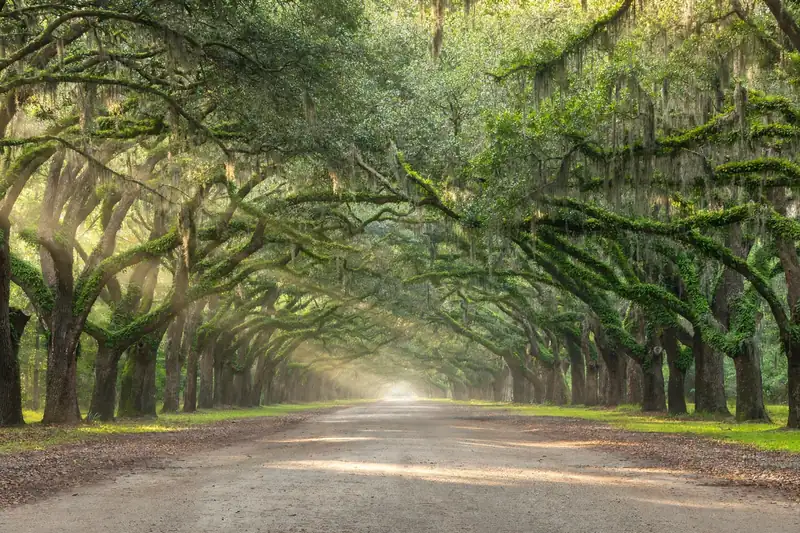
Wormsloe is the most photographed road in Georgia. The colonial estate of Noble Jones, one of Georgia’s first settlers, holds a 1.5-mile avenue of more than 400 live oaks, planted in the 1890s, their branches draped in Spanish moss forming a near-continuous canopy over the dirt road. The estate covers 822 acres on the Isle of Hope, with the tabby ruins of Jones’s fortified house from 1739–1745, a museum and marsh-side nature trails. The important change most older guides miss: since a new visitor center opened in January 2024, cars no longer drive the avenue — you see it on foot, by bike, or on the free narrated trolley that leaves every 30 minutes and takes about 20 minutes.
Practical tip: Admission costs roughly $12 for adults — prices are approximate, so check before visiting. The site is open daily from 9am to 4:45pm and closed on Thanksgiving and Christmas Day. Arrive at 9am opening for the avenue to yourself.
7. Cathedral of St. John the Baptist
The Cathedral of St. John the Baptist is the most beautiful interior in Savannah. The Gothic Revival cathedral, built in 1876 and rebuilt after a fire gutted it in 1898, holds twin spires over Bull Street, stained glass, painted ceilings and murals that make it feel like a small European cathedral dropped into the Lowcountry. It is the mother church of the Roman Catholic Diocese of Savannah, and it is open to visitors most days — the quietest hour in the Historic District.
Practical tip: The cathedral is open to visitors Monday to Saturday from 9 to 11:30am and 1 to 4:30pm, and on Sundays from 1 to 4:30pm. There is no ticket; a $3 donation is suggested. Dress respectfully and keep your voice down — it is a working church.
8. Take a ghost tour after dark
Savannah is called the most haunted city in America — and unlike most cities that make that claim, Savannah has the receipts. The city was built on its dead: the Historic District sits over old burial grounds, the houses have 250 years of history, and the stories are documented, not invented. The best walking ghost tours focus on history first and ghost stories second, weaving documented history with reported paranormal activity through the squares and past the Sorrel-Weed House, the Mercer-Williams House and Colonial Park Cemetery. Blue Orb Tours and Ghost City Tours both run well-researched evening walks.
Practical tip: Ghost tours cost roughly $30 per person — prices are approximate, so check before visiting. Book ahead for Friday and Saturday nights, when the best tours sell out, and wear walking shoes: the tours run two hours over cobblestones and brick sidewalks.
9. Spend a day on Tybee Island
Tybee Island is Savannah’s beach — twenty minutes from downtown and a different world. Three and a half miles of Atlantic sand, a county pier, a strip of fish shacks and the Tybee Island Light Station, with 178 steps to the top and a keeper’s cottage museum at the bottom. The lighthouse is one of the oldest in America, first lit in 1736 and rebuilt in 1773, and the view from the top runs from the Savannah River to the marshes. Come for the beach, stay for the sunset at the pier, and watch for dolphins off the north beach in the morning.
Practical tip: Tybee Island parking costs roughly $4 per hour or $25 a day — prices are approximate, so check before visiting. The lighthouse and the marine science center are closed on Tuesdays, so plan your beach day for another day of the week. Bring water and sunscreen: there is almost no shade on the beach.
10. Fort Pulaski National Monument
Fort Pulaski is the fort that changed warfare. The brick fort on Cockspur Island, between Savannah and Tybee Island, took 18 years to build and 25 million bricks, with walls 11 feet thick that the Army thought were impenetrable — until April 1862, when Union rifled cannon on Tybee Island breached a corner wall in just 30 hours and made brick forts obsolete overnight. The shell scars are still in the walls. A young Robert E. Lee supervised the early construction. Six days after the surrender, the Union commander freed the enslaved people at the fort, making Cockspur Island a stop on the Underground Railroad.
Practical tip: Admission costs roughly $10 for visitors aged 16 and up — prices are approximate, so check before visiting. The fort is cashless and closes at 4:30pm, so arrive by mid-afternoon. Pair it with Tybee Island: the fort sits on the road to the beach.
11. First African Baptist Church
The First African Baptist Church is the oldest Black church in North America — and one of the most important buildings in Savannah. The congregation was founded in 1773 and organised in 1777 by George Leile, an enslaved preacher who later founded a Baptist church in Jamaica; the present brick church on Franklin Square was built by enslaved and free Black craftsmen and completed in 1859. The pews still carry the marks of the Underground Railroad: the holes drilled into the floorboards to breathe through, and the symbols worked into the wood. The church still holds services, and its guided tours tell a story most Savannah guides skip.
Practical tip: Guided tours run several days a week — check the church’s schedule before you go, and book ahead: the tours are small and fill up. Services are held on Sundays, so visit on a weekday for the tour.
12. Mercer-Williams House
The Mercer-Williams House is the house from Midnight in the Garden of Good and Evil — and it is worth visiting even if you have never read the book. The Italianate mansion on Monterey Square, built in the 1860s for General Hugh Mercer and restored by antiques dealer Jim Williams, holds Williams’s collection of portraits, furniture and porcelain, and the carriage house where the book’s most famous night took place. The 35-minute guided tour is the quickest way into Savannah’s most famous murder story.
Practical tip: Tickets cost roughly $14.95 and the 35-minute guided tours run every half hour or so — prices are approximate, so check before visiting. The house is open Monday to Saturday from 10am to 5pm and on Sundays from 11:30am to 5pm. No photography inside.
13. Davenport House Museum
The Davenport House is the house that saved Savannah. The Federal-style house, built in 1820 for master builder Isaiah Davenport, was almost demolished in 1955 — and the seven women who bought it to save it founded the Historic Savannah Foundation and started the preservation movement that saved the whole Historic District. The tour covers the Davenport family and the 13 enslaved people who lived and worked in the house, and it is one of the most honest house tours in the city.
Practical tip: Admission costs roughly $15 and the 60- to 70-minute tours are timed — prices are approximate, so check before visiting. Book your tour time ahead: the house is small and the tours sell out on busy days.
14. Telfair Museums — Academy and Jepson Center
The Telfair Museums are three museums on one ticket. The Telfair Academy, an 1819 mansion on Telfair Square, holds the Bird Girl and a collection of American art; the Jepson Center, a white modern building by Moshe Safdie, holds contemporary art and the children’s ArtZeum; and the Owens-Thomas House completes the set. The $30 ticket covers all three for seven days, and the Jepson Center’s new café, Mary’s, opens on November 17, 2026.
Practical tip: The $30 Telfair ticket covers all three sites for seven days — prices are approximate, so check before visiting. All three sites are closed on Mondays, so plan your museum day for Tuesday or later in the week.
15. SCAD Museum of Art
The SCAD Museum of Art is the museum of the Savannah College of Art and Design — and the best contemporary art in the city. The museum, in a restored 1853 railway depot, holds rotating exhibitions of contemporary art, fashion and photography, and the students’ work fills the galleries and the streets around it. SCAD is the reason Savannah feels younger than its history: the college restored dozens of historic buildings across the city and filled them with art students.
Practical tip: The museum is closed on Tuesdays — plan around it. Check the museum’s site for free days and the current exhibitions before you go: the shows change several times a year.
16. Ride the free Savannah Belles Ferry
The Savannah Belles Ferry is the best free ride in the city. The ferry — named for the Belles, the women who kept Savannah’s riverfront working — runs between City Hall Landing on River Street and Waving Girl Landing on Hutchinson Island, across the Savannah River, in about 20 minutes each way. The crossing gives you the view the cotton ships saw: the whole riverfront, the Talmadge Bridge and the container port, with the skyline behind you on the way back.
Practical tip: The ferry is free and runs daily. Go at sunset, when the river turns gold and the city lights come on, and sit on the top deck for the best view. The ferry stops running in bad weather, so check before you go.
17. City Market and Broughton Street
City Market is Savannah’s outdoor living room: four blocks of shops, galleries, restaurants and courtyards in the heart of the Historic District, on the site of the city’s 1870s market, with live music most evenings and the best people-watching in the city after River Street. From there, Broughton Street runs east with the city’s best shopping — boutiques, bookshops, candy stores and galleries in restored 19th-century storefronts. Savannah’s Candy Kitchen, the praline shop, has three stores in the city now, the newest on River Street since October 2026.
Practical tip: Both are free to browse and liveliest in the late afternoon and evening, when the musicians play in the courtyards and the restaurants fill. Go hungry: City Market is the best place in the city for a casual dinner.
18. Explore the Starland District
The Starland District is the Savannah the locals keep for themselves: the creative quarter south of Forsyth Park, built around the old Starland Dairy, with murals, galleries, coffee roasters and the city’s best food trucks. Starland Yard, the outdoor food court, holds three permanent restaurants and a handful of rotating food trucks under string lights, and Bull Street runs through it with the neighbourhood’s shops and studios. Leopold’s Ice Cream, the 107-year-old Savannah institution, opened a new shop on Bull Street in October 2026, and Maizal, the city’s first dedicated gluten-free café, opened in Starland in November 2026.
Practical tip: The district is free to walk and best in the late afternoon, when the food trucks open and the light is good for the murals. Locals on r/savannah regularly point first-timers to Starland for the best coffee, the best murals and the best food trucks in the city.
19. Georgia State Railroad Museum
The Georgia State Railroad Museum is the best family morning in Savannah — and the most hands-on history in the city. The museum sits in the old Central of Georgia Railway shops, a full roundhouse complex with steam locomotives, rail cars and a working turntable, where you can climb into the cabs, ring the bells and ride the train around the yard. It is part of the Coastal Heritage Society, and one ticket covers the museum and the Savannah History Museum next door.
Practical tip: Go on a weekday morning, when the roundhouse is quiet and the train rides run on schedule, and pair it with the Savannah History Museum next door — one pass covers both. Check the museum’s site for current prices and the train-ride times before you go.
20. Pin Point Heritage Museum
The Pin Point Heritage Museum is the Savannah most visitors never hear about — and the one that tells the story the house museums leave out. The museum sits in a former oyster and crab factory on the Moon River, in the Gullah Geechee community of Pin Point, founded by freedmen after the Civil War. The exhibits follow the families who worked the factory and fished the marshes, and the Gullah Geechee language, food and craft that still shape the Lowcountry. It is small, quiet and ten minutes from Wormsloe.
Practical tip: The museum is open Thursday to Saturday — check the hours before you go, and pair it with Wormsloe, ten minutes away. Allow an hour, and bring cash for the small gift shop.
Savannah in 3 days — a ready-made itinerary
This plan groups sights that sit near each other, so you are sightseeing instead of crossing the city. Savannah is a flat, walkable city, so each day stays in one area. Timings are a guide, not a schedule to stress about — swap Day 2 and Day 3 if the weather demands it, and always do the squares in the morning, when the light is best and the heat has not yet built.
| Day | Morning | Afternoon | Evening |
|---|---|---|---|
| Day 1 — The squares and the river | Squares walk from Johnson Square to Forsyth Park | Owens-Thomas House, then the Cathedral | River Street at dusk, dinner on Bay Street |
| Day 2 — Houses, Bonaventure and ghosts | Telfair Academy and the Jepson Center | Davenport House and Mercer-Williams House | Bonaventure Cemetery, then a ghost tour |
| Day 3 — Wormsloe and the coast | Wormsloe’s oak avenue in the morning | Fort Pulaski, then Tybee Island beach | Tybee pier sunset and seafood dinner |
Day 1: The squares, Forsyth Park and River Street
Start at Johnson Square in the morning, when the city is quiet — walk Bull Street south through Wright, Chippewa, Madison and Monterey squares to Forsyth Park, for the fountain and the farmers’ market if it is Saturday. In the afternoon, tour the Owens-Thomas House, then step into the Cathedral for the quietest hour of the day. Finish the day on River Street at dusk, with dinner on Bay Street and a to-go cup for the walk back.
Day 2: House museums, Bonaventure and ghosts
Check the calendar first: Day 2 is the museum day, and the Telfair sites are closed on Mondays. Start at the Telfair Academy in the morning, then walk to the Jepson Center for the modern art and the Bird Girl. In the afternoon, tour the Davenport House and the Mercer-Williams House — the two houses that bookend Savannah’s preservation story. End the day at Bonaventure Cemetery as the light fades, then a ghost tour after dark.
Day 3: Wormsloe, Fort Pulaski and Tybee Island
Leave at 9am for Wormsloe: walk the oak avenue before the crowds arrive, then take the free trolley back to the visitor center. In the afternoon, drive to Fort Pulaski — the shell scars, the moat and the museum — then on to Tybee Island for the beach and the lighthouse. End the trip at the Tybee pier for sunset, with a seafood dinner on the strip.
Only have 2 days? Do Day 1 and Day 2, and add Bonaventure on the morning of Day 2 if your flight is late. Only have 1 day? Do the squares, Forsyth Park, the Owens-Thomas House and a ghost tour — that is Savannah in miniature. With 4 days, add a second coast day: Pin Point in the morning and a slow afternoon on Tybee.
Best time to visit Savannah
Savannah has a humid subtropical climate, so there is no bad month — but the city feels very different by season. The honest summary is this: March to May and October to early December give you the best balance of mild weather, golden light and smaller crowds, while summer is hot, humid and stormy, and winter is the cheapest and quietest time downtown.
| Season | What it is like | Best for |
|---|---|---|
| Winter (December–February) | Cool and sunny, highs around 61°F, the quietest season — and the cheapest hotels | First trips, walking, budget trips |
| Spring (March–May) | Warm days in the 70s, azaleas in bloom, the St. Patrick’s Day parade in March and the Music Festival | First trips, the squares, festivals |
| Summer (June–August) | Hot and humid, highs around 92°F, afternoon thunderstorms, the busiest beaches | Beach days, Tybee — if you can take the heat |
| Autumn (September–November) | Warm and golden, smaller crowds, the SCAD Film Festival in October | First trips, the best weather of the year |
Remember that St. Patrick’s Day (March 17) brings one of the largest parades in the United States to Savannah — book hotels months ahead if you come for it — and that the Savannah Music Festival runs in late March and early April and the SCAD Film Festival in October. Summer brings near-daily afternoon thunderstorms, so plan the squares for the morning and the museums for the afternoon. Whatever month you choose, pack for humidity in summer and layers in winter: Savannah weather changes fast, and the rain arrives without warning.
Where to stay in Savannah
For a first trip, stay in the Historic District, around Bull Street and the squares. You will be close to the sights in this guide, you will be able to walk in the evenings, and you will not lose time commuting. These are the areas to look at first:
| Area | Who it suits | Why stay there |
|---|---|---|
| Historic District — Bull Street | First-timers, walkers | The squares, Forsyth Park and River Street on your doorstep |
| River Street / Bay Street | River views, nightlife | The waterfront, the ferry and the restaurants on your doorstep |
| Victorian District | Budget stays, a local feel | Quiet streets, a short walk from Forsyth Park |
| Starland District | Art lovers, a younger crowd | Starland Yard, galleries and cafes on your doorstep |
| Tybee Island | Beach days, families | The beach, the lighthouse and the pier on your doorstep |
Wherever you choose, check how far the nearest square or shuttle stop is before you book — Savannah is walkable, but a hotel that looks central can still be a 20-minute walk from the squares you visit most. Hotel prices swing sharply with St. Patrick’s Day, the Music Festival and big weekends, so comparing dates can save real money.
Getting around Savannah
Savannah is a flat, walkable city, and the honest advice is to walk the Historic District and use the free shuttle and ferry for everything else. The neighbourhoods are a 20-minute walk apart, and the coast is further — but the core is well served.
- Walking: The Historic District is flat and compact — you can cross it on foot in about 25 minutes — and every sight in this guide is a walk from the squares. The cobblestones on River Street are uneven, so wear flat shoes.
- Free DOT shuttle: The free Downtown Express shuttle loops around 24 stops through the Historic District, saving your feet between the river and Forsyth Park. It runs daily and is free to ride.
- Savannah Belles Ferry: The free ferry crosses the Savannah River between City Hall Landing on River Street and Waving Girl Landing on Hutchinson Island, in about 20 minutes each way.
- Old Town Trolley: The hop-on hop-off trolley runs a 75-minute loop of the Historic District with 15 stops and live commentary — useful if you want a narrated overview on your first day. Day passes cost roughly $37–$46 — prices are approximate, so check before visiting.
- Rideshare: Rideshare cars are easy to find downtown and are the simplest way to reach Bonaventure and Wormsloe without a car of your own.
- Driving: A car is the most flexible way to reach Bonaventure, Wormsloe, Fort Pulaski and Tybee Island, and the sights in this guide are spread across them. Traffic is light by city standards, but the squares were not built for cars, so park in a garage and walk once you are downtown.
- From the airport: Savannah/Hilton Head International Airport (SAV) is about 20 minutes west of downtown by car. The airport shuttle and rideshare cover the trip; there is no train to downtown.
- Cycling: The city is flat and easy to cycle, and bike rentals are available on River Street and Broughton Street. Keep the bike to the Historic District and the parks — the squares are for walking.
Savannah food you have to try

You can eat very well in Savannah at every budget, from food trucks in Starland Yard to white-tablecloth dining on Bay Street. But three foods are Savannah’s signatures, and a first trip is not complete until you have tried all three.
Shrimp and grits
Shrimp and grits is the Lowcountry’s signature dish, and Savannah does it better than anywhere else. Georgia shrimp, sautéed with bacon and peppers, served over stone-ground grits with a spoonful of gravy — the dish that started as a fisherman’s breakfast and became the city’s most famous plate. Every restaurant in the city has its own version, from the diners on Bay Street to the white-tablecloth dining rooms, and the best ones are still the simplest.
Practical tip: A plate of shrimp and grits costs roughly $18–$28 — prices are approximate, so check before visiting. Order it for brunch, when the grits are freshest, and try the version with Tasso ham if the menu offers it.
Lowcountry boil
The Lowcountry boil — Frogmore stew to the locals — is Savannah’s great communal meal: shrimp, sausage, corn on the cob and new potatoes, boiled together in one pot with Old Bay and poured out onto a newspaper-covered table. It is messy, communal and unmistakably Lowcountry, and the crab shacks on Tybee Island and the riverfront serve it by the pound. Eat it with your hands, with a cold beer, and don’t ask for a fork.
Practical tip: A Lowcountry boil costs roughly $20–$30 per person — prices are approximate, so check before visiting. Go to a crab shack on Tybee Island for the original experience, and order it to share: the portions are generous.
Pralines and Leopold’s ice cream
Savannah’s sweet tooth has two institutions. The praline — a flat disc of sugar, butter, pecans and cream — has been made on River Street since 1973, when River Street Sweets started pulling candy on marble slabs, and the free samples are the best free snack in the city. And Leopold’s Ice Cream, slinging scoops since 1919, is the city’s oldest ice cream parlour, with a new shop on Bull Street in the Starland District since October 2026 to go with the original on Broughton Street.
Practical tip: A praline costs a few dollars and a scoop at Leopold’s costs roughly $5–$8 — prices are approximate, so check before visiting. The line at Leopold’s is longest on weekend evenings, so go in the afternoon.
Beyond the big three, leave room for a plate of fried green tomatoes, a bowl of she-crab soup, a family-style lunch at Mrs. Wilkes’ Dining Room — about $35 a head, and worth every cent — and at least one neighbourhood meal in Starland or on Whitaker Street.
Free things to do in Savannah
Savannah is unusually generous to budget travellers. Several of its very best experiences cost nothing at all:
- The 22 squares: Oglethorpe’s grid of green, shaded parks is the city’s best free experience — a full morning of walking and sitting that costs nothing.
- Forsyth Park: The fountain, the farmers’ market on Saturdays, the tennis courts and the Fragrant Garden — all free, all day.
- River Street and the waterfront: The cobblestones, the ships and the river views are free; you only pay if you sit down to eat or drink.
- Bonaventure and Colonial Park cemeteries: Two of the most atmospheric sights in the city, both free, both open daily.
- The Savannah Belles Ferry: A free 20-minute crossing of the Savannah River, with the best view of the riverfront in the city.
- The Cathedral of St. John the Baptist: The most beautiful interior in Savannah, free to enter, with a $3 suggested donation.
- The free DOT shuttle: The Downtown Express loops around the Historic District for free, saving your feet for the sights.
- Jones Street: One of the prettiest streets in the United States — cobblestones, gas lamps and antebellum houses, and free to walk.
Build each day around one paid highlight and fill the rest with free sights. That is how a Savannah weekend stays affordable without feeling cheap — the free things here are genuinely the best things in the city.
Frequently asked questions
How many days do you need in Savannah?
Two full days is the minimum for a first trip: one day for the squares, Forsyth Park and River Street, and one day for the house museums and Bonaventure. Three days is the balanced first trip, with time for Wormsloe and Tybee Island; four days works best for families adding a second coast day.
What is the best time to visit Savannah?
March to May and October to early December are the sweet spot: mild days, golden light and smaller crowds than summer. Spring brings the azaleas, the St. Patrick’s Day parade and the Music Festival. Summer is hot and humid, with highs around 92°F and near-daily afternoon thunderstorms. Winter is cool and sunny, with highs around 61°F, and the cheapest hotels of the year.
Do you need a car in Savannah?
Not for the main sights — the Historic District is flat and walkable, the free DOT shuttle loops around it and the free ferry crosses the river. A car helps for Bonaventure, Wormsloe, Fort Pulaski and Tybee Island. If you do rent one, remember that the squares were not built for cars: park in a garage and walk once you are downtown.
Is Savannah expensive?
Savannah is one of the most affordable historic cities in the United States: a mid-range trip runs roughly $130–$250 per person per day. The way to keep costs down is to eat in Starland and the neighbourhood cafes, use the free shuttle and ferry, and fill your days with the free squares, parks and cemeteries.
Is Savannah safe for tourists?
The tourist areas are safe with normal city sense: stay aware late at night on River Street, do not leave valuables visible in parked cars, and keep to the busy, well-lit streets after dark. The squares are quiet and dark after midnight, so walk them in the daytime and the early evening.
Can you walk around with a drink in Savannah?
Yes — in the Historic District only. Savannah lets you carry one open container in a plastic cup of 16 ounces or less, bought from a licensed bar or restaurant. Glass is not allowed, and the rule does not apply outside the Historic District, so finish your drink before you leave it.
Further reading — Wikipedia, Reddit and Quora
Want to dig deeper or hear directly from locals and other travellers? These pages are the best next stops:
- Wikipedia — Savannah, Georgia — the city’s history, from Oglethorpe’s 1733 plan to the Civil War and the preservation movement, and how it became the Hostess City of the South.
- Wikipedia — Forsyth Park — the story of the 30-acre park and its 1858 fountain, from the Janes, Beebe & Co. catalog to the 2025 restoration.
- Wikipedia — Bonaventure Cemetery — the history of the 160-acre cemetery on the Wilmington River, from John Muir’s six nights in 1867 to the Bird Girl.
- Reddit — r/savannah — the Savannah community on Reddit, where locals answer first-time visitors’ questions and share current tips on the squares, food and ghost tours.
- Quora — must-see neighborhoods in Savannah — travellers’ and locals’ answers to the must-see neighbourhoods in Savannah, from the Historic District to Wormsloe and Tybee Island.
Your Savannah trip, in one paragraph
Start in the squares in the morning, walk to Forsyth Park at dusk, spend a day on the house museums and Bonaventure, and finish with Wormsloe’s oak avenue and a sunset on Tybee Island. Do that, and you will leave Savannah understanding exactly why people who visit once tend to come back. And if you liked this guide, read our guide to things to do in Chicago, our guide to things to do in Nashville, our guide to things to do in Los Angeles, our guide to things to do in Orlando, our guide to things to do in Miami, our guide to things to do in San Diego and our guide to things to do in Denver — the same format, the same honest prices, and seven more great American cities.
Prices, hours and seasonal schedules in this guide are approximate and were given as a guide only. Please check the official website of each attraction before you visit.

About the Author